Vendor Rating: Hewlett Packard Enterprise
ARCHIVED
13 February 2024 - ID G00788030 - 18 min readBy Jeff Vogel, David Ackerman, and 6 more
HPE made significant changes to its platform-as-a-service business with continued momentum in HPE GreenLake initiatives and updates to core products and services. Vendor management leaders should use this research to assess HPE’s expanded platform and services offering for strategic fit.
Overall Rating
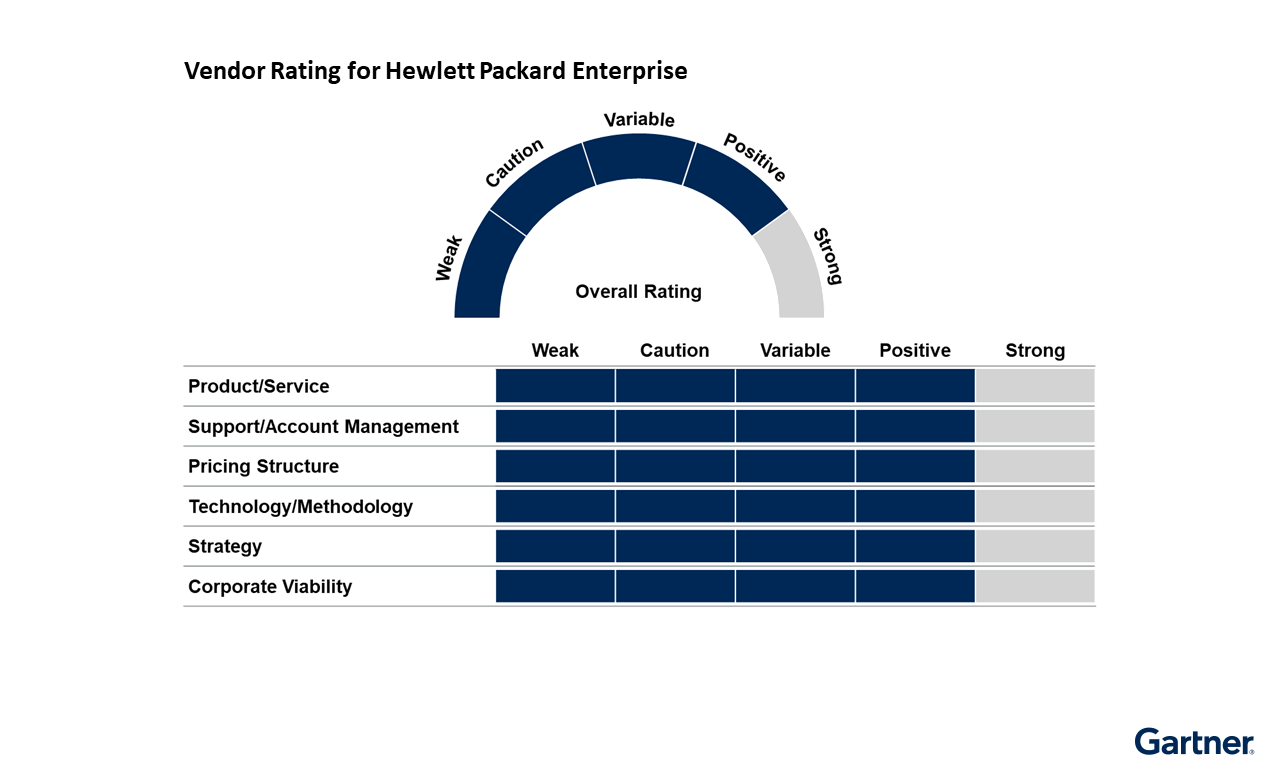
Overall Rating: Positive
Hewlett Packard Enterprise’s (HPE’s) overall rating is unchanged from the published 2023 HPE Vendor Rating.
HPE is a $29.1 billion multinational technology and service provider with a stated vision to be the edge-to-cloud company and a goal of selling its product portfolio as “everything as a service” (XaaS). HPE customers range from small and midsize businesses (SMBs) to large global enterprises and governmental entities.
We continue to assess HPE with a Positive overall rating. This is due to strong client adoption of the HPE GreenLake platform, HPE’s continued investments in its core infrastructure product technologies, and key acquisitions such as OpsRamp, 5G vendor Athonet, and SSE provider Axis Security. Further, HPE had strong growth in its Intelligent Edge business due to its momentum within the HPE Aruba Networking portfolio. Recently, HPE announced its intention to acquire Juniper Networks, providing clients with an enhanced portfolio of AI-driven networking products and capabilities to round out its cloud-to-edge offerings.
Financially, HPE’s strength in cash flow performance underscored its financial discipline, balancing investments in growth in key segments of its business. Operationally, HPE was able to accelerate its ability to integrate its discrete portfolio of products into the HPE GreenLake platform, enabling a stronger ability to execute on its strategic market demands.
HPE’s transformation to a hybrid cloud, as-a-service platform provider, produced strong annual recurring revenue (ARR) momentum and growth over ten sequential quarters to $1.3 billion in its fiscal year (FY) 4Q23 period along with as-a-service orders up 39% YoY to $12.9 billion. However, ARR is still a work in progress from a sales perspective, representing less than 10% of total HPE traditional revenue, which includes servers, storage, networking and high-performance computing. HPE recently split its traditional sales organization into two with a new focus on global sales and hybrid cloud ARR revenue growth.
HPE’s overall rating also reflects the improvements made to operate a client’s entire business through its HPE GreenLake offerings. HPE restructured its HPE GreenLake initiatives into a hybrid cloud as-a-service business unit. This enables HPE to streamline its focus on customer platform infrastructure demands and, by organizationally integrating the HPE storage business unit within the new hybrid cloud business, to focus on storage as a service (STaaS).
Detailed Rating
Product/Service: Positive

We continue from last year to rate HPE as Positive for product/service. HPE provides a complete infrastructure stack of compute, storage and networking products that can be alternatively offered with GreenLake platform-ready as a service across the following HPE business segments’ products:
- HPE Intelligent Edge (HPE Aruba Networking)
- HPE Hybrid Cloud — includes HPE GreenLake private and hybrid cloud offerings, storage, SaaS (OpsRamp, Ezmeral Data Fabric and Unified Analytics), and Zerto.
- High Performance Computing & Artificial Intelligence
- HPE Compute
- HPE Financial Services
- HPE Services
Overall, HPE’s products and services generally align with Gartner’s view of the markets in which HPE competes.
HPE Intelligent Edge offers a portfolio of wired and wireless networking devices that are managed through Aruba Central for both on-premises and cloud delivery. HPE Aruba is a leader in Gartner’s Magic Quadrant for Enterprise Wired and Wireless LAN Infrastructure. More work is needed to achieve full product feature parity between HPE’s cloud and on-premises offerings.
HPE Hybrid Cloud is a new business unit organized into four segments including private cloud solutions, storage, data and analytics SaaS software, and consumption-based, as-a-service offerings for on-premises delivery and as a managed service. Storage includes in-house structured data solutions and an unstructured file system in partnership with VAST. Zerto, an HPE company, is referenced in our Market Guide for Disaster Recovery as a Service. HPE Storage is a leader in the Gartner Magic Quadrant for Primary Storage. OpsRamp is referenced in the Market Guide for AIOps Platforms, Market Guide for Infrastructure Monitoring Tools and the Market Guide for Digital Platform Conductor Tools.
High Performance Computing & Artificial Intelligence (HPC & AI)
HPE HPC & AI portfolio for data-intensive compute and AI workloads expanded their portfolio to include new large language model as a service (LLMaaS), AI at scale, machine learning (ML), modeling and simulations, generative AI (GenAI) and data analytics. HPE offers standard and custom hardware and software solutions including HPE Cray EX/XD supercomputers, a new supercomputing solution for GenAI in partnership with NVIDIA and a comprehensive software stack to train AI and tune models.
HPE Compute: HPE is a leading vendor in the Gartner Market Share Analysis: Servers, Worldwide, 2022 report. The traditional server business is very commoditized but provides HPE with scale and free cash flow that it uses to invest in growth. Its new HPE ProLiant server series offers a broad range of enterprise workloads. Unstructured data applications include updated versions of a third-party file system from Qumulo and an object store from Scality.
HPE Financial Services (HPEFS) operates as a wholly owned subsidiary of HPE, providing clients and channel partners asset management and capital financing programs as part of HPE’s broader hybrid cloud and GreenLake as a service.
HPE (formerly Pointnext) Services include enhanced advisory, professional, financial, education, asset life cycle, management and operational services. HPE Services offers a continuum of services with experts helping clients with their AI, edge, hybrid cloud, supercomputing, storage and digital initiatives in over 200 countries, including non-HPE and HPE technologies. HPE collaborates with client’s cross-functional teams to implement solutions to transition IT operations to as-a-service. HPE Services also provides IT management solutions.
Support/Account Management: Positive

HPE’s support/account management rating is unchanged from last year and remains Positive. HPE’s traditional channel-only model was appended recently with the new HPE Partner Ready Vantage program to provide IT clients with HPE trained and certified service providers to deploy, manage and support consumption-based as-a-service solutions.
As of 1 November 2023, HPE has restructured the sales model to establish a separate global HPE Hybrid Cloud sales team, alongside its traditional sales team, to focus exclusively on serving clients’ hybrid cloud platform requirements. To support its channel partners in transitioning to an as-a-service deployment model, HPE overhauled its sales and channel model to align investments with IT operating model demands. However, there remains a level of inconsistency across sales regions in terms of helping clients understand and appreciate HPE GreenLake value.
The acquisition of OpsRamp is already in the process of integrating HPE AIOps tools and product element managers (such as HPE InfoSight and HPE Aruba Networking Central) into an IT operations management framework. OpsRamp centralizes observability and proactive alerting to IT clients with cross-platform-native capabilities to extract critical IT operating model SLA value and to proactively resolve customer problems.
We anticipate the integration will have a favorable client impact on overall HPE support and customer experience. OpsRamp provides HPE with a unique platform-native capability that will challenge other hybrid cloud vendors in their ability to service IT platform demands. HPE proactively resolves potential application infrastructure issues, aided by AIOps, by monitoring telemetry and addressing root cause. Also, customer support costs and improved efficiencies are continuously improved as actions are automated to be triggered by threshold events.
HPE Services (formerly Pointnext Services) engages to help IT clients transition to an as-a-service cloud operating model, modernize infrastructure and address security issues. Further, clients can leverage HPE’s investments in ESG and governance standards to meet internal IT and business requirements. In some cases, HPE Aruba support documentation is outdated, can be difficult to use and needs to be updated. However, end users cite Aruba as reliable, and easy to deploy and manage.
HPE’s original equipment manufacturer (OEM) partnership with VAST provides clients with an HPE branded and supported as-a-service HPE GreenLake file management solution that is integrated with HPE data services cloud console (DSCC) and HPE InfoSight. The OEM partnership will help IT clients migrate and consolidate their file workloads to HPE’s new scale-out HPE Alletra MP disaggregated storage-compute architecture.
HPE expanded its partnership with Equinix to provide IT clients with HPE private cloud services at seven Equinix International Business Exchange (IBX) data centers. In effect, this gives customers faster access to preprovisioned data center system assets and a broad range of HPE GreenLake services.
Pricing Structure: Positive

HPE’s pricing structure rating remains Positive. HPE products and HPE GreenLake services pricing are generally competitive in winning new customers and meeting customer expectations.
HPE GreenLake pricing has improved from last year, but is still somewhat complex compared to peers, lacks transparency in terms of key metrics, and it is somewhat difficult to rationalize the value delivered versus traditional capex pricing and terms. HPE contractual terms and conditions follow industry standard guidelines and HPE discounts typically align with client requirements, account circumstances and competitive alternatives. HPE services pricing with regard to long-term commitment and monthly fees is complex and requires simplification. HPE Aruba Networking clients would like to see licensing costs simplified, and Boost licensing can become expensive.
The HPE GreenLake self-service marketplace provides clients with a menu of HPE and partner-based catalog solutions, product features and free on-demand training courses to choose from. Each is organized into intuitive categories, such as storage, and is easy to navigate and deploy. Clients can request a pricing estimate through the GreenLake marketplace portal, reducing the overhead in the engagement process and, in turn, accelerating the platform deployment and onboarding process. However, clients are still required to use several different HPE product-centric consoles to activate and manage individual HPE products.
HPEFS provides IT clients and channel partners with flexible financing terms to assist with transitioning to an as-a-service hybrid cloud operating model. HPEFS operationalized its financing and asset management capabilities in support of HPE channel partners making the transition in their business models to a hybrid platform-as-a-service provider.
HPE’s SaaS software includes HPE Ezmeral Unified Analytics and HPE Ezmeral Data Fabric Software that is licensed to support on-premises large enterprise deals across major verticals. These include manufacturing (quality analysis), healthcare (patient healthcare), medical research and finance (fraud and risk detection).
HPE Ezmeral leverages several popular open-source foundational analytics and ML components to provide an ML development, training and deployment platform. The platform integrates and centralizes the compute from various cloud and on-premises platforms with data and training engines for scale and flexibility. The end result is a competitively priced SaaS solution alternative to moving data to the public cloud for analysis.
HPE’s commercial sales model is an overlay to the traditional HPE go-to-market (GTM), with dedicated product sales and technical specialists who call on data scientists and developers with packaged open-source analytics tools. HPE offers data protection services that include HPE GreenLake for Backup and Recovery, and HPE GreenLake for Disaster Recovery (built on Zerto technology). Other offerings cover the full spectrum of data protection, including cyber recovery with the Zerto Cyber Resilience Vault; backup appliances with HPE StoreOnce Systems; and archive with HPE StoreEver tape libraries.
Technology/Methodology: Positive

HPE’s technology/methodology rating remains Positive. HPE increased its research and development by $304 million to 8.1% of fiscal year (FY) 2023 revenue from 7.2% in FY22. HPE products include HPE GreenLake offerings that integrate third-party partner technologies and services into a consumption-based, as-a-service hybrid cloud platform deployment architecture.
HPE GreenLake for Block Storage MP built on Alletra Storage MP is a next-generation, disaggregated storage-compute architecture. It leverages an NVMe fabric and a common hardware to deliver a cost-efficient scale-out storage solution with the ability to scale compute and storage independently to meet various workload requirements.
Additionally, the HPE Alletra MP platform will enable clients to consolidate their various block, file and object workloads to this common hardware platform, thereby simplifying overall data storage management. Gartner’s view is that this type of architecture will modernize, and ultimately replace, legacy multi-node external controller-based (ECB) storage architecture solutions that are powering mission-critical data center and hybrid cloud infrastructures today. The new GreenLake for Block scale-out switched architecture is limited in the number of nodes supported, dependent on internal testing at any given point in time.
HPE is the second-largest server vendor by revenue. Most of HPE’s server sales are from the HPE ProLiant line of x86 tower, rack, blade and modular servers. HPE offers a broad server portfolio, including industry-standard x86, fault-tolerant, mission-critical scale-up, HPC, AI-optimized and edge servers. HPE technology focuses on distinguishing its x86 servers through its management portfolio, automation and security features. HPE exercised its right to sell its 49% joint venture stake in H3C to Chinese vendor Unisplendour but intends to continue the commercial partnership to resell HPE servers, storage and services into the Chinese market.
We expect HPE to invest in integrating its recent Axis Security acquisition for single-vendor SASE, implementing a unified fabric across all its SD-WAN products and expanding its cellular WAN offerings. HPE Aruba Networking delivers capabilities such as cloud integrations, SSE integrations and new consumption models to the SD-WAN market.
HPE participates in the shrinking integrated infrastructure systems subsegment of the integrated systems market (for more, see Market Guide for Integrated Systems) with its Alletra dHCI storage product. HPE SimpliVity addresses the hyperconverged integrated systems segment of the market, but SimpliVity has yet to deliver support for the latest Gen 11 hardware and VMware ESXi V8.0.
HPE’s HPC uses Cray supercomputing capabilities to power GenAI large language models (LLMs) that run on an AI-native architecture for AI training and simulation workloads. HPE has the potential to transform supercomputing with an as-a-service consumption-based cloud operating model, wherein users gain access to expensive HPC capabilities at a fraction of the cost of an on-premises supercomputer.
Strategy: Positive

We continue to rate HPE’s strategy as Positive. Its continued investment and differentiation in its products, use of and integration of mergers and acquisitions and HPE Hybrid Cloud platform strategies are evidence of its efforts to compete for on-premises cloud demands.
HPE’s strategy to restructure its HPE Hybrid Cloud business unit into four major business segments underpins its continued emphasis and focus on the direction of the hybrid cloud market and as-a-service consumption offerings. Incorporating storage into the HPE Hybrid Cloud business unit is a major market strategy development and evidence of how HPE intends to compete for on-premises STaaS and hybrid cloud business.
HPE has fundamentally addressed major gaps in its as-a-service platform sales model by restructuring its global sales organization. This is now two separate and distinct units, with a new global HPE Hybrid Cloud sales unit aligned with the new HPE Hybrid Cloud platform initiatives. However, more work is needed in sales and marketing to proactively transition HPE clients from capex to consumption. HPE made progress on inherent prioritization issues between the product business units and hybrid cloud. However, there remain issues between the hybrid cloud and product initiatives, including market positioning between the stand-alone product business units and the HPE Hybrid Cloud GreenLake platform.
Several updates and enhancements to HPE’s Intelligent Edge, led by the HPE Aruba Networking portfolio, include wired and wireless LAN, campus and data center switching, software-defined wide-area networking (SD-WAN), network security, and associated services to enable connectivity.
HPE’s SD-WAN offerings include Aruba EdgeConnect Enterprise and Aruba EdgeConnect SD-Branch, which provide physical and virtual appliances, and the requisite management and orchestration. HPE (Aruba) was named a leader in Gartner’s 2023 Magic Quadrant for SD-WAN. HPE (Aruba) was also named a leader in Gartner’s 2022 Magic Quadrant for Enterprise Wired and Wireless LAN Infrastructure.
In 2023, HPE moved its Athonet private 5G acquisition to the HPE Aruba Networking division to provide synergy between the high capacity of Wi-Fi and the cellular mobility within the Central platform. HPE products are often shortlisted, both within its customer base and by non-HPE customers.
HPE GreenLake for Networking is HPE’s flagship network as a service (NaaS). It has a definition broader than Gartner’s, appears more like a managed services offering, and focuses more on flexible financing options and technology refresh than on consumption-based capabilities. Aruba NaaS can be deployed either by HPE or through HPE partners.
HPE GreenLake for Large Language Models for GenAI claims they can provide a cost-effective, simplified and more reliable alternative to GenAI public cloud offerings. HPE’s strategy to leverage its HPC and supercomputing technologies for AI and GenAI applications is timely to market developments. However, HPE has to prove it can deliver supercomputing benefits cost-effectively and at scale.
Corporate Viability: Positive

HPE’s corporate viability remains Positive. Overall, HPE has sustained steady growth and a solid financial profile while also investing in faster growth initiatives. HPE has been able to generate steady, low-single-digit overall revenue growth over the last three years and is targeting a similar growth rate in fiscal year 2024. The company’s revenue growth rates and market share have been maintained throughout this period while improving gross margins and sustaining operating margins in the high single digits, demonstrating steady operational performance. HPE has no customer that represents greater than 10% of revenue and therefore has no customer concentration concerns.
The company balances the needs of customers and investors and has maintained its R&D and capital expenditures at reasonable percentages of revenue, in the mid-to-high single digits. At the same time, HPE has invested in GreenLake, growing GreenLake ARR by 37% in fiscal 2023 and as-a-service orders by 23% year over year. The company’s growth business segments, Intelligent Edge and HPC & AI, recorded solid revenue growth (40% and 38% in the company’s most recent fiscal quarter) and also generated higher operating margins.
Finally, the company’s balance sheet ratios and debt levels are positive, with HPE’s net debt to EBITDA and net debt to cash flow from operations ratios both below 2.0x, along with a cash balance of $4.3 billion. Cash from operations as a percentage of revenue was 15.2% in the last 12-month period, which was consistent with the prior year period. Cash from operations as a percentage of revenue has averaged 14.0% over the last five years. Despite a current ratio that is below 1.0, it is the reliability and predictability of cash flows that supports our viability rating for HPE.
Financial: Variable
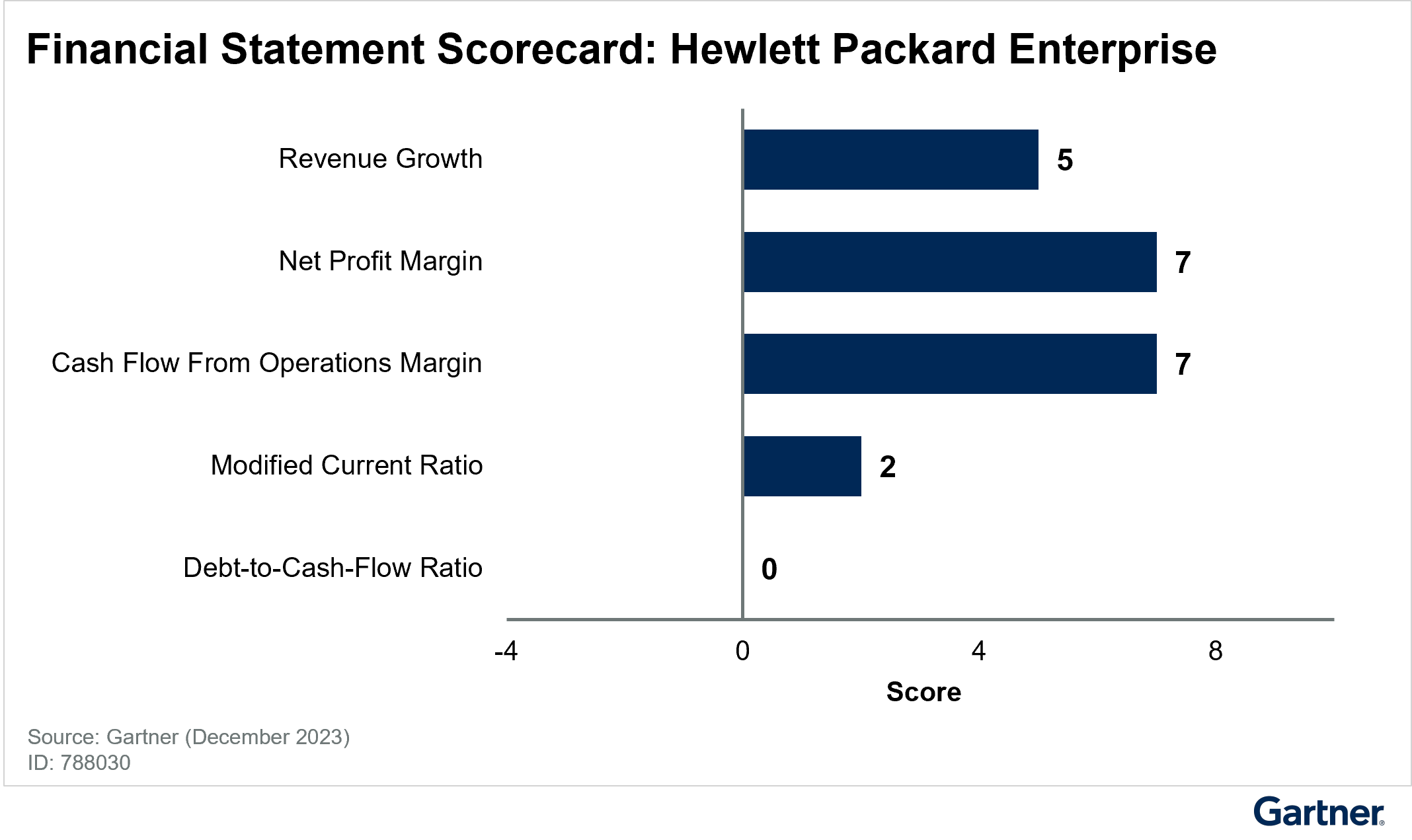
The financial rating for HPE remains Variable. This rating reflects HPE’s financial performance for the four quarters ending 31 October 2023. The rating was determined by a composite score measuring growth, profitability, financial strength and cash flow (see Figure 2 and Note 1).
Using Gartner’s methodology, HPE’s score increased from 20 in FY22 to 21 in FY23 (see Figure 2). For the 12 months in question, HPE posted revenue growth of 2.2% (compared to growth of 2.6% in the prior 12 months), a net profit margin of 7.0% (compared to 3.0% in the prior year), an adjusted current ratio of 0.92 (versus 0.93 in the prior 12-month period) and cash flow from operations margin of 15.2% (compared to 16.1% last year).1
The company’s FY 2024 outlook is as follows:2
- 2% to 4% revenue growth (in constant currency)
- Non-GAAP operating profit growth of 3% to 5%
- GAAP diluted net EPS of $1.81 to $2.01 (up 24% at the midpoint)
- Free cash flow of $1.9 to $2.1 billion (versus $2.2 billion in FY23)
1 S&P Capital IQ.
Note 1: Gartner’s Financial Statement Scorecard for Public Companies
Gartner’s Vendor Financial Statement Scorecard methodology measures a combination of growth, profitability and liquidity based on a company’s financial results from public financial statements according to GAAP. Gartner uses a standard methodology to derive its vendor financial statement scorecard, which provides a like-for-like view among a pool of more than 750 vendors using publicly available financial information.
The four basic criteria are: (1) revenue growth (trailing 12-month YoY revenue growth); (2) profitability (trailing 12-month GAAP net profit margin) with net income as a percentage of revenue; (3) balance sheet liquidity (current ratio) as current assets divided by modified current liabilities (which adjusts for the presence of deferred revenue); and (4) cash flow based on the trailing 12 months of cash flow from operations as a percentage of the trailing 12 months of revenue. For companies with large amounts of net debt, a fifth criterion, net debt divided by trailing 12-month cash flow from operations, is incorporated.
Gartner’s policy is to use financials based on GAAP in calculating the ratios needed for the Vendor Financial Statement Scorecard (see Understanding the Methodology Behind Gartner’s Financial Statement Scorecard for Public Companies).
Company Overview
Hewlett Packard Enterprise
Headquarters: Houston, Texas
HPE provides IT enterprise hardware, software and service worldwide, focused on helping customers transform to a hybrid cloud, protect their digital enterprise, empower the data-driven organization and enable workplace productivity.
Overall Rating Definitions
Strong | Is viewed as a provider of strategic products, services or solutions:
|
Positive | Demonstrates strength in specific areas, but execution in one or more areas may still be developing or inconsistent with other areas of performance:
|
Variable | Shows potential in specific areas though still variable in more than one of the required categories:
|
Caution | Faces challenges in multiple required categories and execution is inconsistent:
|
Weak | Has difficulty responding to problems in multiple areas:
|