Emerging Tech Impact Radar: Agentic AI
27 January 2026 - ID G00831218 - 93 min read
By Anushree Verma, Alfredo Ramirez IV, and 10 more
Agentic AI demands disciplined strategies and targeted investments to prevent agent washing and bridge critical technology gaps. Product leaders must prioritize emerging agentic AI technologies in their roadmaps aligning with their unique competitive advantages, or risk becoming obsolete in the evolving marketplace.
Overview
Key Findings
- Proofs of concept (POCs) limited to single tasks, as well as technological immaturity and misaligned customer expectations, have made it hard to achieve tangible revenue growth from agentic AI solutions. C-level executives must immediately prioritize investment in agentic orchestration capabilities, transitioning from narrow, task-specific projects toward managing a unified agent development life cycle (ADLC).
- Core agentic AI technologies, data and protocols, and security and trust are the foundational trends and key drivers of agentic AI, enabling ongoing innovation that is essential for long-term relevance, customer trust and competitive differentiation in the future.
- Agentic applications are expanding how organizations utilize advanced AI capabilities to plan and automate complex processes — driving innovation, operational efficiency and new business opportunities across diverse sectors.
Recommendations
- Invest in high-value automation use cases over narrow, task-specific agents, and develop an agentic orchestration framework with full-stack observability for these cases. This will help with workflow complexity, oversight requirements, and personalization needs, and further deliver consistent business value as you manage the ADLC for them.
- Prioritize emerging technologies across core agentic AI technologies, data and protocols, and security and trust to achieve greater efficiency, enhanced performance, and increased business agility, while ensuring reliability, security and compliance in production environments.
- Pursue new revenue opportunities from emerging agentic applications and drive their adoption by collaborating with strategic technology partners to deliver packaged, vertical-specific agentic applications.
Analysis
Agentic AI will drive over $450 billion in revenue by 2035 and become a table-stakes capability included in at least 50% of all software offerings by 2030 (see Emerging Tech: AI Vendor Race: Maximize Opportunities While Managing Risks of Agentic AI on Enterprise Software). The 2026 Gartner CIO and Technology Executive Survey revealed that 17% of the respondents indicated their enterprise had already deployed AI agents and 42% would deploy them in the next 12 months.1 However, the agentic AI landscape is becoming increasingly crowded, with significant investments from more than 1,000 providers. Therefore, those who have deployed it may have been “agent washed” by their vendors, as the case-based research shows that the market is still immature and is either deploying AI assistants or low “AI agency” use cases (see Emerging Tech: AI Vendor Race: Roundup For Agentic AI).
To help tech providers ensure that their agentic AI solutions provide transformative value, we have identified 20 of the highest-impact emerging technologies and trends that are critical for product leaders to evaluate as part of their competitive strategy (see Figure 1). These technology profiles enable product leaders to evaluate and prioritize the development initiatives that will shape their long-term strategy. The 20 technologies selected in this Impact Radar are segmented into four key trend categories:
Core Agentic AI Technologies Help to Build Advanced Agentic AI
These are the foundational elements of agentic AI; they help to build advanced AI agents and move AI systems from static, single-purpose tools into dynamic, multicapable systems. However, currently these technologies and the trends driving them are being used to build isolated, task-specific agents, which is creating technical debt for organizations by creating duplicate infrastructure and application requirements for developing each agent. This has created the need for an agentic orchestration, which is the control layer that lets agentic platforms scale from isolated pilots to governed and autonomous execution. It enables organizations to build generative workflows, establish trust through agent observability, manage the agent life cycle and tackle change management challenges.
Data and Protocols Drive the Next Wave of AI Agent Innovation
These technologies transform how AI agents are trained and communicate with each other and how they are deployed at scale. Once they start maturing, it will lead to a network of AI agent ecosystems that can work across multiple applications, which in today’s scenario is isolated and proprietary. See Emerging Tech: The Future of Agentic AI in Enterprise Applications.
Agentic Applications Transform Organizational Use of AI
Agentic applications are expanding and revolutionizing how organizations use AI agent capabilities to plan and automate complex processes. These are driving the applications from isolated automation capabilities to expert AI agents in vertical-specific agentic applications, creating new business opportunities across diverse sectors. These enable enterprises to scale and monetize agentic AI solutions, and foster innovation and collaboration through curated, vertical specific offerings for organizations’ internal and external applications.
Security and Trust Are Critical for Reliably and Effectively Deploying AI Agents at Scale
Security and trust are needed while deploying and managing AI agents in enterprise settings to ensure that AI agents are reliable, effective, secure, and conform with organizational policies through rigorous evaluation, continuous monitoring, and strong governance controls. They emphasize the importance of measuring agent performance, ensuring reliability, and undertaking robust observability practices for real-time monitoring, as well as providing transparency and implementing optimization to govern and secure agent interactions within organizational systems.
The Impact Radar
Figure 1 shows the highest-impact emerging technologies and trends based on time to adoption.
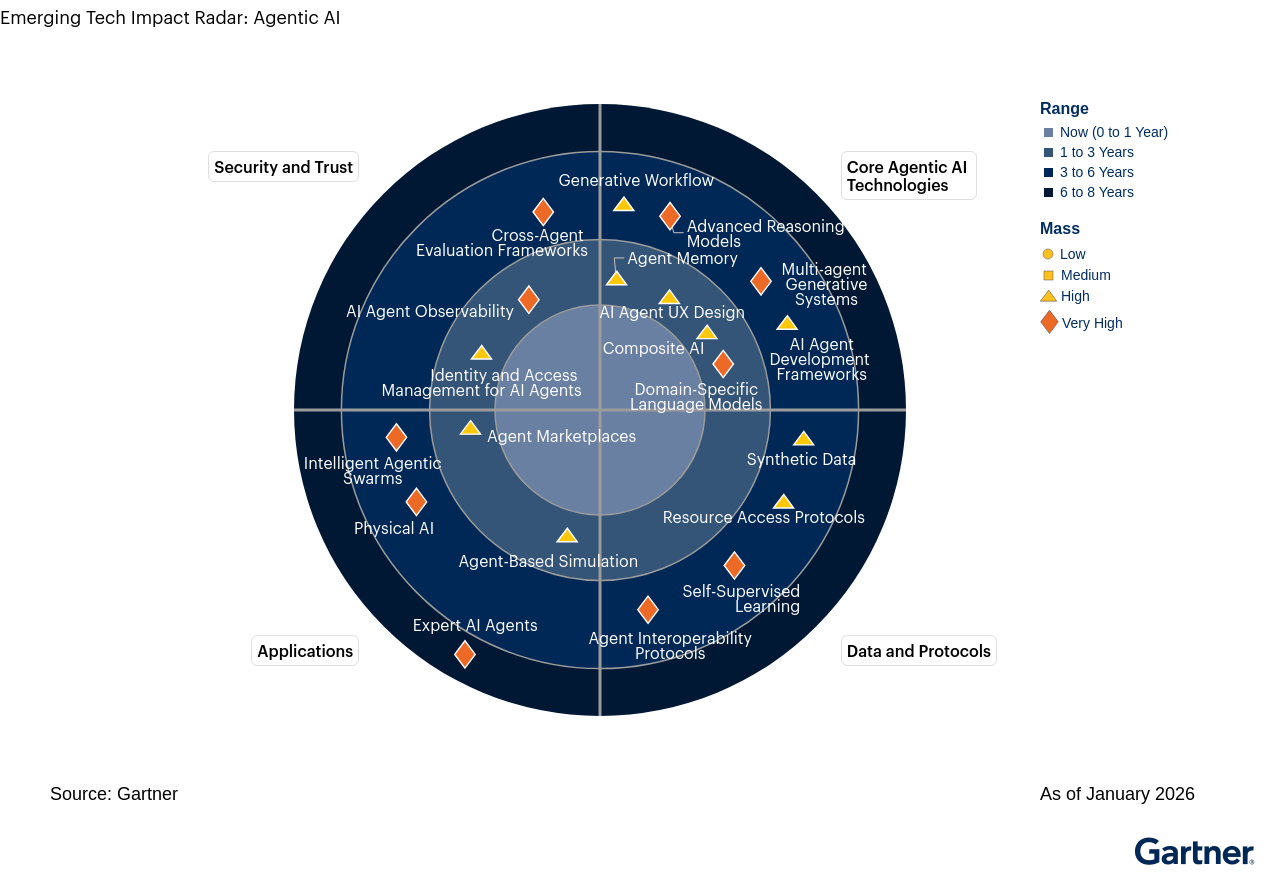
Product leaders should use the Radar Profile range to plan investment timing in the related emerging technology or trend. “Range” represents Gartner’s estimate of time to reach early majority (more than 15% target market adoption), not when product leaders should act on investment. Considering time to plan, develop and launch, a starter guide to product leader investment timing, based on product strategy, is as follows:
- First movers should be acting now on items in the six-to-eight-years ring (or beyond).
- Fast followers should be acting now on ETTs in the three-to-six-years ring.
- Majority followers should be acting on ETTs in the Now and one-to-three-years rings.
- Laggard followers can wait until the ETT has passed through to early, or even late, majority.
The objective of this research is to guide product leaders on how emerging technologies and trends are evolving and impacting areas of interest. Providers can leverage this knowledge to determine which technologies or trends are most important to the success of their business and when it makes sense to advance their products and services by investing in them. Refer to the About the Impact Radar section for more information.
Emerging Technology and Trend Profiles
The Priority Matrix lists emerging technologies and trends identified in the Impact Radar in agentic AI according to their range (see the About the Impact Radar section for our methodology). Click on a technology name in the table to jump to a profile of the emerging technology or trend.
Priority Matrix for AI Agents
| Mass | Range | |||
|---|---|---|---|---|
| Now (0 to 1 Year) | 1 to 3 Years | 3 to 6 Years | 6 to 8 Years | |
Very High | ||||
High | ||||
Medium | ||||
Low | ||||
Source: Gartner
1 to 3 Years
Agent Marketplaces
Analysis By: Aakanksha Bansal
Definition:
Agent marketplaces are digital platforms where product leaders (enterprises, startups, and developers) and adopters can efficiently discover, evaluate, buy, and sell AI agents and agentic solutions, accelerating their creation and deployment. These marketplaces provide catalogs of prebuilt templates, ready-to-use agents, and partner-built solutions. Offerings include development tools and services, libraries, APIs, integration connectors, and protocol support (such as MCP servers). AI agent marketplaces will enable enterprises to scale and monetize agentic AI solutions and foster innovation and collaboration through curated offerings for organizations’ internal and external applications.
Sample Vendors
Amazon Web Services (AWS); Fetch.ai; Google; Kore.ai; Linux Foundation; Microsoft; Palantir; Salesforce; ServiceNow; SwarmZero; Synergetics
Range
The range is one to three years out because AI agent marketplaces are already being deployed in 2025 and will see significant acceleration, marking the inflection point for enterprise adoption.
Agent marketplaces fulfill a critical role by simplifying the discovery, procurement, and deployment of agents. The agent marketplace ecosystem is rapidly emerging with the evolving AI agent ecosystem. Early developments in the agentic ecosystem focused on foundational infrastructure — standards, security, platforms, and discovery — to support large-scale deployments. As providers and platforms of agentic AI proliferate, there is a pressing need for secure and scalable environments to provide all the essential agent components in a single place. Key benefits include democratized access, personalized discovery, streamlined procurement, flexible and scalable deployment, enhanced innovation through shared tools, and secure, certified listings. Transparent reviews further build trust and loyalty among users.
The surge in demand for ready-to-use AI agents has fueled rapid growth in agent marketplaces since 2023, with significant venture funding for startups and niche platforms. Most hyperscalers and enterprise app providers now offer AI agents in their marketplaces, simplifying discovery and deployment. However, challenges persist: fragmented standards and interoperability, operational complexities, security and accountability risks, compliance and legal liabilities, and ethical biases. Overcoming these hurdles is essential for long-term success. As agents become more autonomous and specialized, marketplaces will expand to include complementary offerings like AI models and datasets, enhancing their value and utility for enterprises. Agents will be hosted primarily by providers, and the marketplace will make it easier to discover them across varied hosting and deployment environments by advertising their APIs.
Mass
The mass is high because various business functions and industry verticals that are looking to operationalize ready-to-use agents and prebuilt templates will benefit from agent marketplaces.
The use of agent marketplaces will significantly impact a number of different industries, including healthcare, manufacturing, banking, insurance, energy, media services, and retail. Some emerging applications include:
- Tailored solutions for use in regulated industries such as BFSI, healthcare and life sciences to ensure client/patient data privacy, security, and compliance with operational standards (e.g., HIPAA in healthcare).
- Prebuilt templates in retail and hospitality to quickly personalize and deploy at scale.
Specialized marketplaces are also emerging for specific business functions, offering task-specific and use-case-specific agents, which help:
- Enhance customer experience by driving cost-efficiency, which is the top use case for agentic AI.
- Automate marketing such as content generation and campaign analysis optimization.
- Sales enablement by automating lead generation, personalized outreach, and predictive analytics.
- Fraud detection, compliance assessment, and automated analyses for finance and legal domains.
Agent marketplaces will transform the way different users — enterprises, developers, SMEs, employees — access and use agent marketplaces. They democratize access to sophisticated AI agents and tools as ready-to-use or customizable solutions, enabling users to more easily buy rather than build everything from scratch, thereby accelerating the adoption of AI agents. By simplifying agent-to-agent integration and interoperability complexities, these marketplaces lower barriers to entry, making cutting-edge AI accessible to small and midsized businesses (SMBs) and nontechnical users, with SMBs accounting for a major share of the market. With the growing significance of domain specialization, agent marketplaces will evolve to include (and eventually capture) adjacent and complementary assets such as data for AI (data marketplaces) and models (model marketplaces). Further, they offer new monetization avenues for service providers with significant industry/domain knowledge and/or business process expertise or intellectual property (IP).
Recommended Actions
- Define product roadmaps that anticipate integration with agent marketplaces — for example, by identifying and packaging your core functionality and high-value workflows as reusable agents or modular capabilities, or by offering value-added connectors and templates to capture incremental revenue.
- Consider building an agent marketplace by leveraging your core capabilities or expertise (e.g., domain knowledge, business process expertise, or an extensive user base) to provide specialized solutions for vertical industry or modular agentic offerings for ecosystem growth (such as CRM or ERP providers).
- Monetize existing cloud and security infrastructure by building and operating a marketplace at competitive costs to create stickier offerings and new revenue streams.
Gartner Recommended Reading
Agent Memory
Analysis By: Akhil Singh
Definition:
Agent memory refers to the ability of an agent to retain and utilize information based on previous sessions, and adjust agent behavior, enabling improved performance, personalized responses, and context awareness. Agent memory can be isolated to a specific user or agent instance or enable sharing data between other users, or agents in the ecosystem to improve collaboration and performance.
Sample Vendors
Cognee; CrewAI; Langchain; Letta; Llamaindex; Mem0; MongoDB; Redis; Zep
Range
The range of agent memory is 1 to 3 years to early majority adoption, because they enable agent developers/builders to implement memory-based features/patterns that improve performance, reliability, and personalization, increasing adoption.
Short-term memory is already a key part of agentic AI, where these agents are able to retain information for a single session. However, as the task complexity increases, actions such as reflection will require the agents to have both short- and long-term memory. Long-term memory comes into play when implementing learning patterns that give agents access to prior information/context and response. Early use case examples include the use of agents in cybersecurity, where agents update themselves based on previous attack patterns. Other use cases include customer support, where agents are enabling personalized responses and improved customer experiences based on previous interactions. With the current hype around agentic AI, the expectation around the technology will drive the adoption of agent memory. However, results will be mixed due to implementation challenges. These challenges are related to:
- Data security and privacy challenges with LTM
- Data consistency and quality
- Interoperability of agents in a multiagent system with different providers
- Memory contextualization of agent interactions
According to Emerging Tech: Top-Funded Startups for Domain-Specialized Agentic AI and Emerging Tech: Top-Funded Startups in Agentic AI, around $3.9 billion has been invested in the last two years in startups for agentic AI, and these numbers are set to increase as organizations realize their automation goals with agentic AI. Enterprises are already looking at the use of these agents for simple repetitive tasks and improving their efficiency. The demand for agents to perform complex tasks will increase as the technology matures, increasing the need for long-term agent memory. Agentic AI is commonly used for a range of tasks with a human in the loop. Integrating long-term memory brings key benefits and some common quick wins include:
- Improved personalization in customer service.
- Enhanced context awareness for agents in software development.
- Advanced pattern analysis in cybersecurity for resolving vulnerabilities.
Mass
The mass for agent memory is high because it will transform how the agent will operate and automate enterprise workflows, improving collaboration between humans and agents.
Agent memory, as defined by patterns of memory longevity and memory scope, will significantly impact all industries by enabling AI agents to deliver more context-aware, personalized, and efficient solutions. In sectors such as customer service, healthcare, finance, and cybersecurity, the ability to maintain short-term memory allows agents to manage complex workflows and intermediate states, ensuring smooth handoffs and protecting sensitive information by not persisting data beyond runtime. Meanwhile, long-term memory empowers agents to retain valuable information across sessions, supporting advanced personalization, improved decision making, and better alignment with user preferences. For example, in healthcare, episodic memory can help track patient interactions over time for more tailored care, while semantic memory can ground agents in up-to-date medical knowledge. In finance, procedural memory can automate routine tasks and ensure compliance, while in cybersecurity, long-term pattern recognition enhances threat detection.
Agent memory advancements will fundamentally change what AI agent products can achieve. With the integration of both short-term and long-term memory, agents are no longer limited to stateless, isolated tasks. They can now reason across sessions, remember user preferences, and adapt dynamically to complex, real-world scenarios. The ability to scope memory from individual users to global systems further transforms how knowledge and experience are shared and leveraged within organizations. This unlocks entirely new use cases, such as autonomous multiagent collaboration, persistent digital assistants, and highly personalized customer journeys, which were previously unattainable with stateless AI models.
Recommended Actions
- Capture current market opportunity by targeting agent capabilities with short-term memory, focusing on improving reliability and accuracy.
- Create a roadmap anticipating future demand, integrating agents with LTM, augmenting agents’ capabilities, and improving agents’ functionality.
- Create differentiation early by focusing on improving the data governance layer for data access, privacy, provenance, and data usage for agents. This will help build trust for the adopting organizations and improve data compliance.
Gartner Recommended Reading
Agent-Based Simulation
Analysis By: Kiumarse Zamanian, Evan Brown
Definition:
Agent-based simulation is a specialized type of intelligent simulation that uses collaborative AI agents to simulate the behavior of complex real-world systems. Unlike traditional simulations that treat entities as uniform, passive groups, this approach uses intelligent, autonomous AI agents — each representing a unique entity like a person, company, or device — to make decisions and interact within a virtual environment. By modeling these unique, evolving relationships and behaviors, agent-based simulation provides a powerful way to understand, manage, and predict how dynamic business and social systems will behave under different circumstances.
Sample Vendors
Aaru; Anadyr Horizon; AnyLogic; Artificial Societies; Simudyne; Stanford University; Subconscious AI
Range
Agent-based simulation is one to three years from early majority adoption. Growth is primarily driven by increasing use of agentic systems in domains like commerce, healthcare, finance, marketing, and manufacturing, where simulation has been essential for planning and optimization.
The accelerated progression of agent-based simulation is evidenced by its recent transformation from research to reliable solutions with advanced agentic platforms and synthetic data, particularly in capital markets, healthcare, commerce, and market research. For example, regulatory bodies and financial institutions are increasingly integrating agent-based simulation into their systemic risk oversight and policy analysis. As a result, agent-based simulation has emerged as an essential technique for capital markets and is poised to become a standard component of financial modeling toolkits. Furthermore, AI agents have reduced the development time for simulating healthcare scenarios by 70% to 80%, and they can replicate human survey responses with 85% accuracy in market research. Agent-based simulation is also used to model and predict major geopolitical crises worldwide, thus helping governments and industries prepare more effectively.
The growth of agent-based simulation is fast, propelled by the pervasive integration of advanced AI techniques with a variety of real and synthetic data, as well as a growing number of well-funded startups and academic initiatives offering agent-based simulations in specific domains. Venture capital investment in agent-based simulation is a growing trend, with nearly $20 million in funding rounds demonstrating investor interest in startups that use agentic systems to model and predict complex real-world behaviors. These investments are supercharging the agent-based simulation market to offer more robust commercial enterprise solutions. This, in turn, is creating a layered competitive landscape, as startups will continue to compete at the application level, offering specialized solutions with clear business value for specific verticals, while hyperscalers and established AI vendors will provide the agentic platforms, models, and infrastructure to help large companies utilize agent-based simulation at scale.
Mass
Agent-based simulation has a high mass due to its foundational role in enabling new applications and enhancing decision making across a wide array of industries and business functions by capturing complex, dynamic interactions and emergent phenomena that traditional models cannot.
Agent-based simulation has been highly impactful across numerous sectors and geographies, playing a major role in optimizing business processes and asset management across industries:
- Agent-based simulation is transforming healthcare education by making advanced AI tools easy for clinicians to use. This boosts innovation, speeds up adoption, and improves efficiency and consistency in training and policy evaluation.
- In capital markets, it is critical for systemic risk analysis, market microstructure modeling, and evaluating regulatory policies and AI trading systems.
- In manufacturing and logistics, agent-based simulation addresses challenges from job shop scheduling to autonomous mobile robot (AMR) fleet operations by optimizing supply chains, warehouse operations, production planning, and fleet management.
- For marketing and social processes, it enables AI-powered audience simulations for content testing, brand strategy, and understanding complex human and crowd behaviors.
- In defense and security, it can be used to assess the risk of global escalations and stress-test mission-critical decisions.
- The autonomous vehicle sector also relies on agent-based simulation for virtual test drives and navigating complex scenarios.
This widespread applicability, from financial institutions to e-commerce and healthcare, confirms its extensive cross-industry and cross-geography impact. Furthermore, increasing computational power enables the creation of larger-scale and more complex simulations. The wide application and increasing use of agent-based simulation validate its near-term readiness for broader real-world applications. This signals that historical barriers like computational costs and data availability have largely diminished, favoring widespread operational deployment of agent-based simulation in many domains. This makes agent-based simulation a foundational technology for businesses seeking to leverage AI effectively, driving rapid market penetration and impact across various industries.
Using agents based on generative AI models for simulation is an incremental addition to existing simulation techniques that use traditional predictive techniques — statistical or AI. However, agent-based simulation fundamentally transforms how complex systems are understood, managed, and innovated. It offers an innovative way to evaluate dynamic scenarios and manage business and social complexity by focusing on individual interactions and emergent behaviors that traditional models fail to capture. Its ability to test “what-if” scenarios outside historical records is critical for anticipating unprecedented events and making proactive decisions.
Multimodal, domain-specific generative AI agents now enable simulations that allow for enhanced understanding, optimized operations, and robust scenario planning for black swan* events, thereby offering capabilities previously unachievable — driving a major transformation in strategic decision intelligence. New platforms make these agents scalable and easy to integrate with business systems, transforming strategic decision making. Advanced models, reinforcement learning, and hybrid architectures let agents learn and reason like humans, powering applications — like audience simulations — that are 30% more accurate than standard AI.
* The black swan theory is based on an ancient saying that confidently asserted that black swans did not exist — until they were discovered in Australia. It was popularized in the book, “The Black Swan: The Impact of the Highly Improbable,” by Nassim Nicholas Taleb.
Recommended Actions
- Enhance the predictability and adaptability of agentic systems by using generative AI to simulate complex, dynamic environments with emergent behaviors instead of relying solely on historical data.
- Ensure reliable and ethical deployment of agent-based simulations by developing and implementing robust validation frameworks that address accuracy, data realism, bias mitigation, and privacy concerns.
- Achieve comprehensive and flexible modeling results by investing in platforms and expertise that enable the integration of agent-based simulation with other approaches, such as discrete-event and system dynamics, to fully leverage diverse data sources.
Gartner Recommended Reading
AI Agent Observability
Analysis By: Jim Hare, Tom Coshow, Radu Miclaus, Eric Goodness
Definition:
AI agent observability is the ability to monitor, interpret and gain actionable insights into the behavior and performance of stochastic and deterministic agents. This includes understanding how agents interact with each other and their environment, respond to inputs, make decisions, and utilize tools and models. This observability ensures agent performance, reliability, operational efficiency, cost management and alignment with intended goals and outcomes.
Sample Vendors
Amazon Web Services; Arize AI; Datadog; Dynatrace; Fiddler AI; Google; Langfuse; Microsoft; New Relic
Range
Agent observability is one to three years from early mainstream adoption because the ecosystem still lacks standardized tools, metrics and interpretability frameworks.
While the need for transparency, debugging, and control in evaluating and deploying AI agents is growing, the ecosystem is still immature. In addition, providers face the challenge of selling AI agent observability solutions because of the growing and crowded marketplace with options coming from various markets, including AI-native startups, traditional monitoring vendors and cloud providers. Currently, most AI agents are essentially black boxes with limited tooling for tracing decisions, understanding failure modes, or aligning behavior with intent. Logs produced by most agentic systems can be used for some level of observability if the user is technical enough to analyze them. Core capabilities and frameworks for AI agent observability, such as standardized metrics, real-time tracing, and behavior explainability, don’t yet exist, but experienced developers can build home-grown observability solutions. Comprehensive stand-alone agent observability tooling to support multivendor, multiplatform agents doesn’t currently exist; however, many agentic AI platforms, LLM observability tools, and observability platforms have added some form of agent observability and logging capabilities. Also, OpenTelemetry (OTEL) support is both being integrated today and evolving through new and numerous AI tracing extensions to make it easier to trace, monitor, and debug agent workflows. At the same time, enterprise deployment of LLM-based AI agents is still in the experimental phase, which means that demand for robust observability tools hasn’t hit critical mass yet. As adoption increases and real-world deployments reveal reliability gaps, the pressure to build and adopt mature observability solutions will ramp up.
The adoption is poised to grow rapidly because organizations are under increasing pressure to ensure transparency, trust and performance in the move toward multiagent and autonomous systems. As AI agents take on more complex, real-world tasks such as making decisions in finance, healthcare, or logistics, the need to monitor, debug, and explain their behavior will become critical. AI agents require a different approach to observability because their behavior emerges from context synthesized from multiple systems to inform complex, probabilistic models with dynamic learning processes, making traditional log-based or metric-based monitoring insufficient to understand, predict, and debug their actions. As frameworks and platforms mature, integrating observability will become not just valuable but non-optional, especially in regulated or high-stakes domains. Yet, enterprises face significant challenges purchasing AI agent observability solutions because the market is immature, confusing and fragmented, making it difficult to compare disparate products and navigate the growing number of vendors with overlapping capabilities.
Mass
The number of organizations adopting agent observability will be very high because AI agents will become more autonomous and embedded in business-critical workflows.
AI agent observability is poised to become a foundational capability across a broad spectrum of industries and geographies. From e-commerce, finance, and healthcare to manufacturing and logistics, enterprises are increasingly deploying autonomous agents to handle tasks ranging from trading decisions and clinical recommendations to supply chain optimizations. As these agents increasingly operate in more complex and dynamic environments, observability will become essential for tracking their performance, decision-making, alignment with business goals, and risk and threat mitigation.
Agent observability is a two-part market: emitters and collectors. Emitters are built into agent frameworks and platforms/integrations, while collectors are extensions of existing observability tools for basic transaction visibility and analysis. Newer stand-alone agent observability products are emerging for more comprehensive, deeper analysis. The rapid expansion of tech providers focused on AI agent observability is now matched by an equally intense surge in venture capital investment (e.g., $70 million Series C round at Arize AI). As autonomous agents move beyond simple chatbots into fully automated workflow orchestration, the observability tooling layer has become mission-critical, ensuring reliability, transparency, and performance in real-world deployments.
Gartner research findings showcase that executives rank security, trust, and compliance as their top concerns for deploying AI agents at scale. The lack of observability to understand and audit an AI agent’s internal workings is a major impediment to enterprise adoption. Enterprises recognize that without robust observability and governance frameworks, agents cannot scale to enterprise-grade levels.
Recommended Actions
- Go beyond traditional observability. Move beyond simple logging to provide insights into an agent’s reasoning process, such as its chain-of-thought and decision-making. Provide clear, end-to-end tracing and filtering capabilities that allow developers to quickly pinpoint the root cause of issues in a complex agent’s workflow.
- Emphasize actionable intelligence over raw data. Offer pre-built dashboards, reports and AI-driven features that turn data into insights. Implement AI-powered features for anomaly detection, predictive analytics, and root-cause analysis to proactively identify issues and prevent failures.
- Provide cost and resource management capabilities. Enterprise AI agent usage can incur significant costs from API calls and compute usage. Observing key metrics like token usage and tool costs in real-time allows businesses to monitor and manage expenses effectively.
Gartner Recommended Reading
AI Agent UX Design
Analysis By: Roberta Cozza
Definition:
AI agent user experience (UX) design encompasses emerging UI and UX design practices tailored for AI agents solutions. These focus on the development of interface patterns and dynamics that are optimized to enhance user experience. The designs aim to build trust in agents’ decision outputs through explainable interfaces and to positively influence user behavior and expectations when interacting with agentic AI products.
Sample Vendors
Ema, Openstream.ai, Sema4.ai, SymphonyAI, WRITER
Range
AI agent UX design is 1 to 3 years from early mainstream adoption because the high demand for AI agent solutions will accelerate providers’ needs to address agent trust and reliability by improving current design approaches.
The introduction of agentic AI fosters a new dynamic of collaboration between users and AI systems. This collaboration is built on trust. As AI agents become more integrated into user interactions, building trust is crucial. Trust is a top inhibitor of the adoption of agentic AI. Users need to understand how AI agents make decisions. Implementing transparency, such as explainable AI outputs, can help users feel more confident in the technology. Today, many agentic AI products lack optimal interaction designs for AI agents and explainability features. However, we are seeing some early examples of explainability built into UIs. For example, some offer readily available explanations of why and how an LLM-based AI agent took an action or decision and disclose details such as a summary of rules, data context, explanations of less obvious model behaviors, and rules influencing an outcome, or adding natural language side panels to summarize rationale and logic.
So far AI agent providers have been focusing on the capabilities of their products and how these drive new automation and productivity-based outcomes. Beyond capabilities, over the next three years we expect vendors to have increased focus on agentic AI’s impact on behavioral outcomes, user experience and design that foster user acceptance of AI agents. This will be driven by greater requirements from customers looking for trustworthy solutions to drive user engagement with AI agents, as well as regulations pushing for greater explainability features for transparency of agentic AI decision making.
Mass
Mass is high because effective design of human-agent interactions will improve user trust, and accelerate adoption and engagement with AI agent solutions across all industries and businesses.
AI agents are poised to revolutionize a plethora of workflows across virtually all industries and across all business roles. Investment across business and vertical applications will be high as enterprises see AI agents as a crucial capability to drive new levels of business efficiencies and autonomy.
In the future, AI agents are set to become the primary intermediaries among users, application interfaces and back-end systems, reducing the importance of individual native software UIs. Gartner predicts that by 2029, at least 50% of day-to-day work decisions will be made autonomously through agentic AI, up from 20% in 2025.
As AI agents manage interactions with enterprise applications, customer relationships will evolve from isolated transactions to continuous engagements. Users will not need to navigate multiple applications, decreasing direct interaction with software and potentially reducing brand engagement. This means product leaders will need to redefine AI product design strategies to accommodate new collaboration paradigms emerging from the AI agent — human relationship.
This will also mean integrating cognitive, ethical and behavioral science insights into product development to advise on how to create effective AI agents UI and UX that generate healthy behavioral outcomes for users as employees or customers.
Recommended Actions
- Prepare for the transformational shift to new agentic interaction paradigms by diversifying your product teams. Scale up expertise in areas related to applied cognitive and social sciences, and use this expertise to redefine “human-centric” approaches for the design of agentic AI products
- Unlock agentic AI differentiation opportunities by working directly with your customers to understand the optimal level of agency they initially feel comfortable granting to agents, compared to levels of user manipulation or human-in-the-loop rules.
Gartner Recommended Reading
Composite AI
Analysis By: Alizeh Khare, Aakanksha Bansal, Vibha Chitkara
Definition:
Composite AI, also known as hybrid AI, refers to the combined application (or fusion) of different AI techniques to improve the efficiency of learning and broaden the level of knowledge representations. It broadens AI abstraction mechanisms and, ultimately, provides a platform to solve a wider range of business problems effectively. Composite AI recognizes that no single AI technique is a panacea and that a variety of techniques can be combined effectively to solve different problems while recognizing any constraints.
Sample Vendors
ACTICO; AWS; FICO; Fujitsu; IBM; Indico Data; Induced AI; Lyzr AI; SAS; XMPro
Range
The range is one to three years from early majority adoption because composite AI significantly broadens the scope and quality of AI applications by enabling solutions to address a wider variety of complex reasoning challenges.
Adoption in composite AI is expanding, fueled by the growing reliance on AI for complex decision making and converging trends such as decision intelligence platforms and agent-based systems. Organizations are blending rule-based reasoning, optimization models, prescriptive analytics, and deep learning to generate synthetic data, enrich scarce datasets, and achieve more accurate insights. Techniques such as knowledge graphs and GANs help overcome data limitations, while integrating computer vision and natural language processing improves data extraction and relationship mapping. The rise of multiagent systems and neurosymbolic approaches is making composite AI increasingly standard, with generative AI accelerating innovation and adoption in this space.
VC investment is accelerating composite AI adoption, as highlighted by funding rounds such as Filuta AI’s $4.2 million seed led by Rockaway Ventures (see Czech startup Filuta AI secures $4.2M led by Rockaway Ventures, Vestbee), reflecting strong confidence in hybrid, multimodel solutions. Leading investors and technology firms are shifting focus from pure generative AI to scalable composite approaches, integrating these capabilities into their platforms and policy initiatives. Startups like Airvolute, ARX Robotics, Beewant, Calab.ai, Empatik AI, Ensemble, Qvantia AI, STELGIC, Synapsia-AI, and WolkenVision are driving innovation in areas such as multimodal data integration, financial trading, and automated solutions. As investment and support from tech giants and governments grow, composite AI adoption across industries is set to accelerate even further.
Mass
The mass is high because combining different AI techniques yields better results; thus, composite AI will be adopted across multiple industries and deliver significant improvements in AI decision outcomes.
Composite AI is rapidly being adopted across industries by integrating multiple AI techniques to boost decision making, automate processes, and improve customer experiences. This results in deeper insights, higher efficiency, and more adaptive solutions.
- Healthcare: Enables personalized treatments, early disease detection, faster drug discovery, and better medical imaging.
- Finance: Supports real-time fraud detection, tailored credit risk assessment, smart investments, and customized financial planning.
- Manufacturing: Powers predictive maintenance, quality control, autonomous robotics, and smart factory automation.
- Retail: Delivers hyperpersonalized shopping, accurate demand forecasting, and optimized store experiences.
- Transportation and logistics: Enables dynamic traffic management, autonomous fleets, predictive maintenance, and smart supply chains.
- Education: Supports adaptive learning, personalized tutoring, early intervention, and teacher training.
- Insurance: Drives dynamic risk assessment, automated claims, personalized policies, and proactive risk management.
- Legal: Automates document generation, empowers legal assistants, and provides predictive analytics.
- Real estate: Enhances investment analysis, property recommendations, dynamic pricing, and smart home management.
Composite AI will drive major advancements in AI model outcomes, expanding AI’s benefits to organizations with strong domain expertise but limited historical or labeled data. By integrating multiple AI methodologies, Composite AI can tackle a broader range of reasoning and decision-making challenges, resulting in more versatile and higher-quality applications. Key advantages include improved interpretability, greater resilience, and stronger support for augmented intelligence. Composite AI marks an evolutionary leap by orchestrating existing AI techniques into unified, multimodal systems, overcoming the limitations of single-model approaches, such as limited explainability, narrow context, and rigidity. Over the next two to three years, composite AI will rapidly evolve, merging diverse models and multiagent systems to deliver more context-aware, explainable, and robust solutions. This will benefit both enterprise and consumer applications across sectors like finance, healthcare, and manufacturing, enabling AI to learn from data and reason through complex, real-world scenarios.
Recommended Actions
- Capture domain knowledge and human expertise by combining decision intelligence, business rules, and knowledge graphs with machine learning and causal models to contextualize data-driven insights.
- Speed up the creation of decision intelligence solutions by promoting trials with autonomous agents and generative AI, which will drive the demand for composite AI systems.
- Build composite AI expertise by training your machine learning team in graph analytics, optimization, and decision-intelligence techniques.
- Strengthen rule-based and heuristic systems by running knowledge-engineering workshops and prompt-engineering boot camps for your AI staff.
Gartner Recommended Reading
Domain-Specific Language Models
Analysis By: Annette Zimmermann
Definition:
Domain-specific language models (DSLMs) are designed to provide insight and action within a particular domain, such as industry, business function, process or discipline. They are trained on fit-for-purpose datasets (domain data) that are specific to a particular domain. Unlike general-purpose models such as GPT4 or Google Gemini 2.5, DSLMs can be built from scratch or fine-tuned from existing general-purpose models. DSLMs can power AI (domain) agents, enabling them to achieve specific goals and act (semi)autonomously in a certain domain such as manufacturing, financial services, marketing and sales.
Sample Vendors
Amazon; Apexon; Cohere; Capgemini; Fujitsu; IBM; Jasper; Onyx Networks; Siemens; SymphonyAI
Range
The range is one to three years out, primarily due to strong growth fueled by an increasing number of customers adopting the technology and the entry of new vendors into the market.
Over the past 12 months, multiple new vendors have entered the space, including AI service providers and large industry players that leverage their industry-specific data for model training. Currently, fine-tuning a generic model with domain-specific data is a common practice and can act as a temporary solution. However, achieving true domain specialization involves more than just using a generic model or basic fine-tuning. It requires integrating specialized inputs at various stages of the model’s life cycle, specifically during pretraining or by using advanced post-training techniques.
High demand for business function-specific solutions spurs enterprise adoption across the board, as DSLMs promise higher performance compared to generic large language models (LLMs) in many cases.
The accelerated growth of DSLMs has paved the way to the next generation of domain-specific AI systems, domain-specific AI agents. Current adoption growth rates are estimated to be over 150% year over year, although they are based on a small base in 2024. These agents or multiagent systems are powered by DSLMs to complete tasks semiautonomously. Gartner projects that DSLMs will enable agentic AI to autonomously complete 50% of enterprise interactions by 2029. Venture capital in DSLM-related technology is also growing rapidly. Between 2023-2025, startups enabling and using DSLMs collectively raised over $11.9 billion in VC funding.
The primary barrier to the rapid adoption of DSLMs is inadequate data. Organizations that own high-quality domain data will have the opportunity to lead in the AI race as they will be able to create unique and high-performing AI models. Providing incentives to collaboratively work on data gathering and preparation for model training will be key to overcoming these hurdles. Another important element will be the integration of synthetic data to enrich existing domain data.
Mass
The mass for DSLMs is very high because their impact not only goes across virtually any business function and industry, but also has the potential to transform the industry, inducing a shift from centralized AI power to a more collaborative system.
DSLMs leverage vast amounts of data within a specific domain to generate results that are impactful, relevant and accurate. Gartner’s research revealed this development across virtually all verticals and business functions:
- Accelerated customer engagement: Deploying specialized (DSLM-powered) AI agents to improve sales outcomes and dramatically reduce inquiry response times.
- Enhanced operational performance: Implementing specialized (DSLM-powered) AI models for internal data processing to dramatically boost process efficiency and realize hundreds of thousands in annual operational savings.
- Intelligent engineering support: Leveraging AI agents powered by proprietary industrial foundation models to assist manufacturing engineers across critical engineering stages, including quality control, planning, and design.
- Accelerated content creation: Deploying a marketing-focused DSLM, trained on compliance guidelines and content formats, to dramatically increase the throughput of compliant marketing content.
The fleet of DSLMs currently being created by a vibrant ecosystem of different players builds its value proposition on collaboration that shifts the center of gravity (and power) toward a more evenly distributed system.
DSLM will enable new capabilities by powering, for example, multiagent systems. As DSLMs and AI agents mature, they will be able to solve more complex tasks and deliver greater value, for example, through multiagent systems that act fully autonomously within three to five years. Vendors are driving advancements in optimizing DSLMs and enhancing the efficiency of model training and customization. By utilizing innovative model architectures, adjusting model sizes, and applying new training techniques to both proprietary and increasingly compact open-source models, they are enabling more efficient AI specialization. In particular, small language models (SLMs) provide a cost-effective option for developing and deploying domain-specific GenAI solutions across a variety of organizations and applications.
Recommended Actions
- Fine-tune LLMs for specific regulated domains by utilizing data annotation, synthetic data augmentation, and data minimization strategies (like context engines) to process only essential data.
- Evaluate the applicability of DSLMs against LLMs by conducting a cost versus savings analysis — factoring in customization, data acquisition and ROI — to enhance organizational capabilities strategically.
- Gain access to domain data by investing in dedicated partnerships with clients and other technology providers.
Gartner Recommended Reading
Identity and Access Management for AI Agents
Analysis By: Alfredo Ramirez IV, Kiumarse Zamanian
Definition:
The strategic deployment of AI agents is crucial for organizations seeking efficiency and innovation, and robust identity management for AI agents is essential as they become part of the workforce. Identity and access management (IAM) for AI agents covers how organizations discover, register, and control what agents access and do. The hybrid nature of agents means IAM for AI agents overlaps with workforce and machine IAM, while AI TRiSM focuses on AI stack and model security.
Sample Vendors
Astrix, Clutch Security, CyberArk, Entro Security, Microsoft, Oasis, Okta, Strata, Token Security, Twine Security
Range
The range overall is one to three years because agentic implementations need to begin to scale, at which point agent IAM will become increasingly important to support those efforts safely.
Early adopters of agentic AI will quickly run into limitations covered by the IAM problem space, e.g., how to safely delegate actions to downstream systems for agents on behalf of humans, how to manage access revocation in an automated and auditable fashion, etc. Therefore, IAM for AI agents will be forced to mature at least as fast as the deployment of agents within operational use cases.
Recent investment in startups in the machine IAM space means that solutions for discovering agents and managing agent IAM have increased substantially, alongside similar significant improvements rolled out by the existing IAM incumbents. Acceleration in the adoption of agentic solutions creates more opportunities for both IAM startups and incumbents to benefit from that growth. Implementing unified platforms that provide comprehensive visibility and control over humans and AI agents within an enterprise is essential for secure scaling and meeting future regulatory demands.
Mass
The mass overall is high as IAM for AI agents affects all industries and business functions that will come to adopt agentic solutions.
As AI agents are moving beyond simple task automation to function as autonomous digital teammates with access to sensitive systems and data, innovative approaches are needed to reliably identify and manage them within multiagent systems deployed in enterprise environments. Given current signals, we assume that agent IAM will be a requirement of most markets, industries and business functions. If AI agent adoption increases to the ubiquity of things like databases and SaaS, then agent IAM will become similarly universal.
Traditional IAM systems may fall short in handling the delegated and dynamic nature of AI agents. Zero-trust principles, dynamic identity management, ephemeral authentication, and fine-grained access controls are modern approaches for effectively managing AI agent identities. The hybrid nature of AI agents, as concerns current IAM thinking, means that current product capabilities must transform to meet hybrid requirements. For now, this is likely to manifest as an extension of current capabilities. Yet to be seen is what level of dynamic human-agent delegation is needed in real-world use cases, which may force the creation of new capabilities to deal with the scale and complexity of human-agent ecosystems in the mid to long term. In the long run, preparing a modern IAM infrastructure for the AI-enabled workforce is imperative for maintaining operational security and compliance in today’s rapidly evolving digital landscape.
Recommended Actions
- Agentic AI solution product leaders can ensure ease of adoption by building capabilities into their product to integrate bidirectionally with popular identity providers and to respect policies and credential management defined within them.
- IAM and machine IAM product leaders can benefit from the growth of agentic AI adoption by going to market with collateral that explains how they can help organizations to safely deploy agents and discover and secure agents that may already be in use but are unaccounted for.
- Move beyond static credentials and implement identity lifecycle management that can automatically provision, update, and revoke identities as AI agents are instantiated, modified, or decommissioned.
- Integrate dynamic identity management and ephemeral authentication mechanisms into your IAM solutions to address the autonomous and rapidly changing nature of AI agents.
- Implement continuous verification and contextual access policies that evaluate each AI agent’s behavior, environment, and task before granting access to sensitive systems or data.
- Invest in unified IAM platforms that provide comprehensive visibility, monitoring, and governance over both human and AI agent identities. Ensure your platform can generate audit trails, support regulatory compliance, and offer real-time insights into identity-related activities across the enterprise.
Gartner Recommended Reading
3 to 6 Years
Advanced Reasoning Models
Analysis By: Vibha Chitkara
Definition:
Advanced reasoning models are language models that use logical inference, multistep and chain-of-thought reasoning, further refined through reinforcement learning, adaptive planning, and autonomous problem-solving capabilities. They can process large amounts of information, interact with external tools and systems, explain their decisions, and independently seek out and integrate additional data when needed. Reasoning capabilities are not limited to large models.
Sample Vendors
Alibaba, ByteDance, DeepSeek, IBM, Kimi, Microsoft, Mistral, OpenAI, Writer, Zhipu AI
Range
The range is three to six years because, despite strong demand and clear drivers, as these models address the shortcomings of today’s LLMs, innovation remains immature.
While demand for autonomy and advanced automation is accelerating, the integration of sophisticated reasoning, such as recursive planning, multiagent collaboration, persistent context tracking, domain and multimodal understanding requires breakthroughs in model architecture, reasoning data, compute infrastructure, and deployment tooling.
Advanced reasoning incurs higher compute costs; therefore, it’s important to “rightsize” the model and level of reasoning capability to the problem space and value you are creating or risk facing prohibitive scaling costs. A variety of open and closed-source models now offer flexibility to optimize reasoning for specific use cases. Improvements in reasoning are not confined to large-scale models. A recent initiative by AI researchers demonstrated that core reasoning abilities can be replicated with minimal compute resources, showcasing emergent reasoning behavior in smaller models. When models are oversized for the problem, they may skip steps and produce less consistent reasoning. Right-sized models follow their chain of thought more faithfully, which is crucial for coordinating agentic systems and aggregating tasks reliably. Such advancements are expected to further accelerate the adoption of reasoning models across various applications.
Through 2025 there have been increased investments in developing advanced reasoning models by both large providers and small providers to decompose and solve complex problems. Recent developments are geared toward making them domain specific and “rightsized” to avoid incurring high costs. The future will be shaped by a proliferation of small reasoning models purpose-built for specific domains or tasks. Many of these models will be available as open source, enabling rapid experimentation and customization by startups and enterprises alike. As the ecosystem matures, tech providers ranging from agile startups to hyperscalers will train or fine-tune these models on proprietary datasets and integrate them into workflows to unlock new efficiencies and capabilities.
Key challenges remain around computational overhead, integration complexity and the need for robust safety, transparency, and explainability. Progress in model efficiency, rightsizing and user-friendly deployment platforms will be critical to scaling these capabilities.
Mass
The mass is very high as advanced reasoning models will accelerate and help scale agentic deployment through better value outcomes, higher accuracy across multiple use cases, and complex applications, not well-supported by today’s LLMs.
Reasoning models will be relevant for a multitude of industries as they can help enhance complex problem solving with high accuracy through a chain-of-thought approach, whereby they analyze and articulate the necessary steps to reach a solution. Examples of advanced reasoning models include:
- Finance: They can autonomously analyze real-time transactions, simulate market scenarios and optimize investment strategies using external data and regulatory feeds. They orchestrate end-to-end financial workflows, reducing manual intervention and error rates.
- Healthcare: They can synthesize multimodal patient data and external medical resources to recommend personalized treatments. They coordinate diagnostic teams, adapt plans in real time and autonomously design drug candidates using scientific tools.
- Legal: They can draft, review and optimize legal documents by decomposing complex requirements, and retrieving relevant case law. They monitor regulatory changes and coordinate multiagent legal research for proactive compliance.
- Industrial/Manufacturing: They can decompose production goals, allocate resources and coordinate in real-time fleets of agents, in agentic AI solutions that integrate with simulation twins and ERP systems to autonomously plan, adapt and optimize manufacturing processes.
- Disinformation Security: They can detect and counter disinformation by decomposing threat signals, retrieving external intelligence and simulating response strategies. They orchestrate multiagent moderation and adapt counter-narratives in real time.
Advanced reasoning models will deliver new capabilities beyond LLMs and follow the evolution of prior GenAI capabilities, transitioning from generic outcomes to domain- and task-specific results. This requires not just generic cognitive strategies enhanced by contextual knowledge and data, but also domain-aligned cognitive approaches tailored to specific problems. As agentic AI systems become more autonomous and adaptive, organizations across industries can leverage their domain experts to guide and refine reasoning paths for these agentic systems, enabling agents to address industry-specific challenges more effectively and create meaningful business advantage.
Recommended Actions
- Differentiate and future-proof agentic AI solutions by integrating advanced reasoning models in your product roadmap from 2026 to unlock new use case opportunities and maximize value outcomes.
- Optimize the effectiveness and scalability of agentic AI systems by rightsizing advanced reasoning models to the specific problem space and value outcome. Leverage open and closed-source models to balance performance and compute costs.
- Build user trust by incorporating transparency and explainability in AI reasoning models, similar to DeepSeek R1’s chain-of-thought reasoning, to improve user experience and facilitate error resolution.
Gartner Recommended Reading
Agent Interoperability Protocols
Analysis By: Gunjita Mundeja, Anushree Verma
Definition:
Agent interoperability protocols are a set of rules or communication frameworks that enable AI agents to securely discover, interact, and exchange information directly with one another, regardless of their underlying framework or implementation. These protocols are foundational to the advancement of decentralized architectures, supporting interoperability, automation, and trust across distributed digital ecosystems. Protocols offer standardized interfaces and methods for agent interactions, which minimizes the need for developers to build custom integrations for every tool or agent, thereby simplifying development and lowering maintenance expenses.
Sample Vendors
Cisco; Google; IBM
Range 3- 6 years
The range is three to six years because agent-to-agent protocols are still in nascent stages; however, the pace of innovation is accelerating with an increase in open-source specifications and early pilot projects.
The adoption of agent interoperability protocols is only emerging because the broader adoption of agentic AI is still immature and limited to either AI assistants or task-specific agents. While agentic AI platforms have enabled large language model (LLM)-based applications to access APIs and data, these integrations are often proprietary, leading to fragmentation and increased complexity for users. Communication protocols can support the confidentiality, integrity, and availability of communications, while enabling agents to find and interact with each other efficiently. This positions them well for adoption in mission-critical, privacy-sensitive, and large-scale applications where trust and reliability are paramount. As of now, there’s no single standard that fulfills all major needs. Though there are currently very few large-scale deployments, as more companies agree on a common specification and release ready-made tools, pilots will turn into real, everyday systems. Standards and protocols will accelerate agentic AI adoption in the next two to three years and enable AI agents to collaborate between multiple agentic systems.
The pace of innovation is accelerating, driven by a surge in open-source specifications and early pilot projects. The increasing momentum behind open-source initiatives has the potential to further propel agent interoperability protocols, enabling faster development, broader collaboration, and widespread deployment in the rapidly evolving landscape of AI agent communication. Early initiatives like Google’s A2A and IBM’s Agent Connect are key steps, with more standards expected as agentic AI and multiagentic implementations grow. Currently, 11 additional standards are in development, covering both general and domain-specific scenarios.
Mass
Agent interoperability protocols will have very high mass, as they enable scalable, secure agentic AI across industries, reducing the need for constant human oversight. Unlike traditional multiagent systems limited to one platform, these protocols operate across silos, allowing agents in different environments to share tasks and data in real time.
Agent interoperability communication protocols enable autonomous software agents — such as AI systems, bots, or digital assistants — to communicate, collaborate, and coordinate tasks directly with each other in a secure and standardized way, leading to very high-volume adoption. Each new agent boosts network capacity through peer-to-peer exchanges and cascading workflows. This unlocks powerful new possibilities, such as automated workflows that cross different platforms, seamless integration between diverse services, and the creation of intelligent networks that can solve complex problems without constant human intervention. As agents orchestrate tasks across platforms and edge devices without middleware bottlenecks, real-time decision loops and continuous data streams become the norm. This relentless back-and-forth of commands, responses and acknowledgments cements agent-to-agent communication as the high-throughput backbone of modern AI ecosystems, powering complex, cross-platform automation at scale.
Agent interoperability protocols are driving a transformative shift in AI ecosystems, enabling scalable agentic AI implementation. By standardizing production-grade deployments, these protocols eliminate barriers to agent discovery and service integration, enabling seamless interoperability across platforms. As industries shift to open, cross-platform agentic AI, agent-to-agent communication becomes the backbone of scalable, production-ready deployments.
These standardized production-grade deployments make it easier for other agents to discover and leverage their services. This supports the development of modular, easily integrated AI components. The concentrated vendor support and surge in open-source initiatives demonstrate that agent interoperability is gaining momentum. Interagent-oriented protocols aid communication and collaboration between agents, though they do not solve all the problems. While most multiagent systems have historically operated within closed, orchestrated environments, agent interoperability protocols are breaking down these silos, establishing themselves as the foundation for the next generation of open, interconnected AI solutions.
Recommended Actions
- Streamline and scale agentic AI development by implementing a prototype of interoperability protocols to use with your internal tools and data sources.
- Budget to resolve technical debt and address agent sprawl by ensuring that your teams have enough time and resources to track interoperability standards and iterate their implementation as they evolve.
- Build a rounded product approach to integrate these standards and protocols into your offerings, augmented with security, scalability, and connectivity to enterprise resources and platform services.
Gartner Recommended Reading
AI Agent Development Frameworks
Analysis By: Arun Chandrasekaran
Definition:
AI agent development frameworks accelerate the creation of AI agents and AI-powered applications that can autonomously perform complex tasks. These frameworks offer high-level abstractions for large language model (LLM)-based orchestration, along with low-level control over agent logic, memory, planning and API access. They evolved from LLM orchestration libraries into more sophisticated frameworks supporting multiagent modularity, long-term memory and common reasoning patterns.
Sample Vendors
CrewAI; Google; LangChain; Microsoft
Range
Range is 3 to 6 years out, because AI agent development frameworks are advancing capabilities with large language models, large reasoning models, reasoning and planning abilities of AI agents to support increasingly complex business use cases. Moreover, open-source communities are significantly contributing to the development of AI agent frameworks, resulting in more feature-rich solutions.
While this early pace and pockets of adoption are encouraging, AI agent development frameworks are still far away from early majority adoption. Broad enterprise adoption will require:
- Robust governance and observability: Siloed pilots must give way to cohesive strategy, integrated control planes, unified data fabrics and enterprise-grade security and compliance.
- Mature platforms and talent: As frameworks consolidate, organizations will need skilled AI engineers, standardized best practices and vibrant communities of practice to scale beyond proofs of concept toward full-blown production deployments.
- Business value: Clear ROI case studies that prove major cost reductions and productivity gains are critical to tip the balance, moving agent frameworks from “nice to have” to core infrastructure.
AI agent development frameworks will see early enterprise adoption from late 2025 to 2026, driven by innovators in finance, tech and retail experimenting with RAG agents and workflow automation tools. From 2026 to 2029, adoption will accelerate rapidly as enterprise-grade platforms mature, AgentOps practices emerge and successful use cases demonstrate ROI. By 2029, around half of large enterprises are expected to integrate agent frameworks into core functions like sales, IT and finance.
Mass
Mass is 4 because AI agent development frameworks will have a high business impact by enabling autonomous, context-aware task execution across functions, shifting enterprises from manual workflows to intelligent systems. Building agents to automate complex, multistep processes isn’t easy from scratch, which is why AI agent development frameworks are key for enabling agility and reducing costs.
AI agent development frameworks will drive cross-industry transformation by enabling intelligent automation across business functions. In customer service, agents will handle inquiries, resolve issues and personalize interactions at scale. In finance, they can automate reporting, forecasting and audit tasks. HR teams will use agents for onboarding, policy queries and learning recommendations. In IT, agents will monitor systems, manage incidents and trigger remediation workflows autonomously. Across industries — whether manufacturing, retail, healthcare or logistics — agents will orchestrate supply chains, optimize operations and improve compliance. Sales and marketing will benefit from agents that analyze buyer behavior, generate outreach and qualify leads. By integrating into existing tools and workflows, AI agents will break functional silos, enhance collaboration and reduce manual workload enterprisewide. While the early adopters will be technology forward industries, AI agent development frameworks are vertical industry agnostic.
AI agent development frameworks simplify the creation of AI agents and AI-powered applications by abstracting complexities like LLM integration, memory management, orchestration and tool access. This allows developers to concentrate on core functionality and system architecture. Agents built with these frameworks can dynamically respond to changing business inputs without code changes, adapting instead through updates to business context or process logic. As a result, organizations gain the ability to rapidly iterate, improve agility and automate low- to mid-complexity tasks with significantly reduced engineering effort.
Recommended Actions
- Experiment with AI agent development frameworks, by starting off with clearly defined, low-risk use cases to build foundational experience.
- Reduce the risks by choosing frameworks aligned to your needs. Evaluate key factors such as ecosystem integration, tool support, memory handling, ease of use, multiagent capabilities and code execution.
- Build internal expertise by developing AI-specific engineering practices and upskilling teams to design, operate and maintain agent-based systems effectively.
- Prioritize trust, risk and security management (TRiSM) by implementing robust evaluation, governance and monitoring mechanisms that address both the underlying language models and the unintended behavior of deployed AI agents.
Gartner Recommended Reading
Cross-Agent Evaluation Frameworks
Analysis By: Kiumarse Zamanian, Anushree Verma
Definition:
Cross-agent evaluation frameworks are structured methodologies used in platforms and tools for monitoring the behavior of multiagent generative systems (MAGS) within or across agentic environments. They focus on how individual AI agents interact, coordinate, and collectively achieve system goals, often in accordance with governance policies. Unlike frameworks that evaluate a single agent in isolation, these frameworks prioritize system-level analysis to ensure agents work effectively together, recognizing that even if individual agents perform well, they can still fail as a group due to poor interagent coordination and communication.
Sample Vendors
Arize; Galileo; Google; Maxim AI; Microsoft; ORG AI; RagaAI
Range
Cross-agent evaluation frameworks for MAGS are three to six years from early majority adoption due to field fragmentation and ongoing challenges; currently, they exist mostly within observability platforms, not as stand-alone, saleable offerings, delaying widespread, standardized solutions.
The complexity of multiagent interactions, the need for advanced observability tools, and the difficulty in predicting and analyzing emergent behaviors make cross-agent evaluation frameworks highly desirable yet challenging to create. Current evaluation capabilities of the vendors reviewed focus on general parameters, such as intent resolution and tool call accuracy, and often lack the scalability and real-time adaptability required for multiagent, cross-platform systems, which presents a major gap. Gartner estimates the market penetration of multiagent systems in 2025 is between 1% and 5%, indicating that despite high interest, adoption of multiagent systems is still in the early stages. Meanwhile, the increasing sophistication of AI agents across diverse industries (for example, customer support, finance, and robotics), along with rapid advancement in specialized agentic platforms, benchmarks, and MAGS, motivate the development and adoption of robust frameworks for evaluating collaborative AI agents within and across platforms.
The adoption and growth of investment in tools and platforms using cross-agent evaluation frameworks is increasing. This is evidenced by the emergence of a few platforms that offer comprehensive tools for evaluating collaborative AI agents, real-time monitoring, and custom metrics. Because agent evaluation frameworks and tools are evolving with agent development platforms, no funding data is currently available specifically for cross-agent evaluation frameworks. The competitive landscape in this area will evolve rapidly in the next two to three years as existing vendors and new players increase their investments in developing robust frameworks and tools for comprehensive monitoring of collaborative AI agents in MAGS.
Mass
The mass for cross-agent evaluation frameworks is very high because they are fundamental for building reliable, scalable, and ethically sound MAGS across numerous industries and business functions.
These frameworks will have a broad impact across various sectors, including customer support, robotics, finance, healthcare, and software engineering, where MAGS are quickly emerging and expected to transform enterprise operations. They provide critical insights into system efficiency, output quality, and ethical considerations (for example, bias detection and transparency), which are relevant across all applications of multiagent AI. By ensuring consistent quality and transparency, they enable businesses to scale agentic solutions efficiently and maintain long-term viability in high-stakes industries.
Cross-agent evaluation frameworks offer significant advancement in capabilities as they shift AI assessment from static benchmarks to dynamic, multiturn evaluations, addressing the complex, nondeterministic nature of agents. This enables a structured approach to evaluating efficiency, accuracy, and goal achievement that was previously unattainable with traditional methods and can, in turn, significantly enhance the impact and trustworthiness of agentic AI. For software leaders, these frameworks are transformational, offering the ability to debug AI agents faster, optimize performance, streamline iterations, and continuously refine AI agents through integrated prerelease simulation and postrelease real-time monitoring. They are crucial for achieving greater accuracy and better decision-making processes in complex agentic AI applications. Key metrics used in these frameworks include task completion rate, latency, efficiency, scalability, robustness, and communication effectiveness. These frameworks use clear objectives and diverse strategies to track every stage of agent operation, from input to output and downstream effects.
Recommended Actions
- Use available frameworks and tools to evaluate your AI agents and their interactions by applying simulation-based testing during prototyping and implementing real-time monitoring after deployment to drive continuous improvement and catch issues early.
- Assess agent performance and system dynamics by using comprehensive evaluation metrics for collaboration, efficiency, scalability, and emergent behaviors, and by integrating human-in-the-loop feedback to capture user experience and ethical concerns.
- Ensure trustworthy AI deployments by selecting and integrating platforms that provide advanced agent evaluation capabilities, such as detailed observability, customizable metrics, and real-time guardrails for monitoring cross-agent behavior.
Gartner Recommended Reading
Generative Workflow
Analysis By: Anushree Verma
Definition:
Generative workflow is an emerging design pattern used to create and orchestrate dynamic workflows by using advanced AI techniques in order to customize each workflow to achieve the final goal. By combining generative AI, machine learning, multimodal architectures, simulation and automation technologies, it enables intelligent systems to dynamically create, adapt and execute plans in real time in a nondeterministic way. Therefore, unlike traditional workflows, it can leverage language models to generate and orchestrate workflows with runtime context awareness and higher-order intelligence.
Sample Vendors
Amazon Web Services (AWS); Ema AI; H Company; IBM; Supervity; Tines; Twine Security
Range
The range is three to six years as most implementations of AI agents are in the early stages and yet based on deterministic workflows. However, several vendors have made progress in using generative workflows and have started seeing the emergence of some early experimental projects.
Agentic AI is rapidly growing in popularity; however, most adoption still centers around deterministic workflows in areas such as customer service, knowledge management, software engineering, operations, and cybersecurity. Adoption of generative workflows in products and services has not yet been seen, with current adoption estimated at only about 1% of the addressable market. Generative workflows have been mostly limited to a few experimental projects in operations, cybersecurity, customer experience, marketing, and sales. For example, if you want to create an AI security operations center (SOC) agent from scratch within your organization but are unaware of how to do so, a generative workflow will help by understanding the agent’s role and creating the appropriate adaptive workflow. It will also continuously learn from the changes you make to the workflow, enabling further refinements. Many vendors are using small language models to create workflows based on user-defined goals. However, none of these methods are standardized for agentic AI to scale, and each vendor’s approach for developing the “Brain/;” to do so is highly proprietary. From an execution standpoint, the key challenge is to replace the existing workflows and implement new ones in a cost-effective manner, which is currently hindering adoption in the short term.
Cloud vendors, independent software vendors and service providers are rapidly investing in reinventing process workflows through generative workflow orchestration and accelerating agentic AI adoption. Whether it is a CRM vendor or a data and analytics vendor, they are enhancing their products with generative workflow orchestrator engines built on small language models with context-aware routing that can dynamically adapt to changing process requirements. The key challenge for generative workflows is ensuring stability and predictability within application environments.
Mass
The mass is high because it enables AI to be used not just as a task executor but also as a workflow architect, thereby orchestrating workflows for complex business functions and resulting in higher-order decision making.
Generative workflows have broad applicability across industries and functions, from customer service to cybersecurity, R&D, and internal productivity applications. There have been use cases in pharmaceutical R&D where LLMs generate newer candidates and integrate it with agents to create the required workflows, including planning agents, reasoning and necessary simulation. While current AI systems are static, reactive, supervised and execute simple tasks, generative workflows enable these systems to become adaptive, proactive, autonomous and execute complex goals. As a result, existing agentic AI deployments with low agency can progress toward being high agency.
Agentic AI can help orchestrate process workflows to enhance efficiency, autonomy, decision making and user experience. The workflow orchestrator should be able to handle conditional logic and decision points intelligently. With more multiagentic systems being deployed, they will need to be interconnected with generative workflows, since deterministic, static workflows will restrict the impact of these implementations. This approach enables higher-level decision making by adapting and continuously improving to tackle complex challenges and learn from experience.
Recommended Actions
- Use productivity-based generative workflows internally by creating a “customer zero” environment before integrating them into products and services.
- Transform existing processes in domains that require automation such as customer experience and cybersecurity by utilizing generative workflow techniques to show tangible efficiency gains.
Gartner Recommended Reading
Intelligent Agentic Swarms
Analysis By: Mark Driver
Definition:
Intelligent Agentic Swarms (IAS) represent large-scale, self-organizing networks of semiautonomous AI agents that demonstrate emergent intelligence through dynamic formation, collaboration, and disbanding to solve complex problems. Unlike current multiagent systems, which operate with a handful of agents through asynchronous exchanges, IAS requires a critical mass of dozens to hundreds of agents, near-real-time responsiveness, and standardized communication protocols.
Sample Vendors
Agntcy.org, Anthropic, CrewAI, DeepMind, IBM, LangChain, OpenAI, Swarm Cloud, Swarm Engineering, Swarms.ai
Range
Intelligent Agentic Swarms are at least three to six years from mainstream early adoption because current protocols address only specific coordination aspects rather than the complete swarm requirements.
Current implementations lack critical capabilities for commercially viable swarm intelligence. While foundational protocols like MCP and A2A provide communication building blocks, achieving the necessary critical mass of coordinating agents requires fundamental advances beyond current multiagent systems. Critical mass thresholds, optimal agent density calculations, and network topology requirements remain unsolved research questions. The technology must evolve from today’s small-scale, manually configured systems to autonomous swarm formation with standardized coordination mechanisms before reaching early mainstream adopters.
Investment in agent coordination technologies is accelerating, with major providers launching standardization efforts and protocol implementations. Commercial experiments in swarm formation mechanisms are emerging from leading AI companies, while academic research continues to advance the theory of multiagent coordination. However, progress is constrained by the complexity of unsolved challenges in collective intelligence coordination, trust systems, and temporal synchronization. Systematic frameworks for agent population dynamics require sustained, multiyear development cycles before supply-side vendor growth and demand-side enterprise adoption can accelerate toward mainstream market penetration.
Mass
Intelligent Agentic Swarm technology will have a very high impact because it enables revolutionary collective intelligence capabilities that fundamentally transform how organizations approach complex problem-solving.
Intelligent Agentic Swarms impact technology companies across all industries, including financial services, healthcare, manufacturing, and enterprise software. The technology operates globally, enabling agent networks that span multiple time zones and regulatory boundaries. IAS affects numerous business units simultaneously; engineering teams coordinate development workflows, customer operations manage support escalations, and executive teams make strategic decisions. Leading adopters will be software development and customer service organizations where coordination overhead is highest, followed by research operations and strategic planning functions as the technology matures toward mainstream adoption.
Intelligent Agentic Swarms represent a revolutionary disruption for products that renders traditional workflow orchestration, task management systems, and coordination platforms obsolete through their emergent intelligence capabilities. The technology enables autonomous problem decomposition and distributed execution that current architectures cannot achieve, creating new categories of collective AI capabilities. For technology providers, building IAS capabilities requires significant architectural changes and new coordination expertise, making adoption challenging but competitively essential. IAS creates paradigm shifts for adopting organizations where human-agent and agent-agent collaboration replaces single-point automation, making mass customization and real-time adaptability impossible with current mechanisms.
Recommended Actions
- Begin experimenting with foundational technologies immediately by testing emerging agent communication standards, such as MCP, A2A, and ACP protocols, through pilot projects to build organizational capability and influence eventual industry standards before competitors establish a market position.
- Establish research initiatives to explore agent network topologies and population dynamics by developing frameworks for optimal swarm configurations and building long-term strategic positioning for specialized agent marketplace opportunities as the technology matures.
- Incorporate architectural flexibility in current product designs to support future expansion into IAS capabilities, while beginning preliminary security modeling specific to large-scale multiagent systems to identify potential challenges before mainstream adoption.
Gartner Recommended Reading
Multi-agent Generative Systems
Analysis By: Roberta Cozza, Anushree Verma, Kiumarse Zamanian
Definition:
Multiagent generative systems (MAGS) — as networks of AI agents — use a “divide and conquer” approach, assigning tasks to specialized agents within and across platforms for more effective management of intricate workflows. By distributing tasks, sharing knowledge and aligning efforts under unified governance, MAGS can greatly outperform monolithic single-agent systems. MAGS offer the adaptable architecture for collaborative intelligence, utilizing real-time information for distributed, autonomous planning and execution with non-deterministic process flows. This fosters emergent, adaptive behaviors, making MAGS more robust and flexible than rule-based systems. Large-scale MAGS excel at collaboration of interoperating AI agents from different platforms and vendors for safely managing complex, enterprise-wide processes and automating diverse workflows.
Sample Vendors
Amazon; Anthropic; Crew AI; Ema; Google; IBM; LangGraph; Microsoft; Salesforce; XMPro
Range
The range of three to six years is medium due to enterprise risk thresholds toward agentic AI for more complex tasks and multiagent market immaturity and maturation of agent interoperability standards.
The desire of enterprises to use GenAI to address complex workflows paired with the fast and broad availability of AI agent solutions has been driving interest in multiagent generative systems (MAGS) in 2025.
Nevertheless, a number of factors contribute to adopter uncertainty. Enterprise buyers lack trust in emerging multiagent solutions from a fragmented array of vendors aiming to tackle complex tasks. Additionally, the AI agent communication protocol space — critical for multiagent orchestration and eventual collaboration — is embryonic. We have seen some initial efforts emerge with Model Context Protocol (MCP) and Agent2Agent (A2A), but the protocol landscape is far from standardized. New protocols continue to appear, creating uncertainty as to which protocols will eventually emerge as the dominant standards for agent and third-party agent-to-agent communication. While the agentic AI market today focuses on outlining multiagent capabilities, less attention is given to tools that can ensure strong multiagent observability and governance. Currently, Gartner estimates the market penetration of multiagent systems to be between 1% and 5% of the target audience. This indicates that while interest is high, MAGS adoption is still in the early stages.
The growth rate of MAGS is high due to large tech companies as well as small innovator startups investing in multiagent systems as part of their ongoing expansion of their agentic frameworks and products.
Interest in multiagent systems has surged, with the number of client inquiries to Gartner on the topic increasing 15x between 1Q24 and 2Q25. In addition, the availability of multiagent development frameworks and platforms is starting to accelerate the creation of production-grade agentic systems, helping developers build coordination among multiple agents, define AI agent roles and support agent-to-agent communications. The advancement of LLM capabilities and the trend toward wider use of domain-specific language models are also helping experiment with specialized AI agents and enhanced domain reasoning.
Mass
Mass is very high because the future of agentic AI lies in collaborative multiagent systems, meaning MAGS will impact virtually all use cases and industries where agentic AI is being adopted to automate complex tasks beyond the limited capabilities of single AI agents.
Emerging MAGS use cases, most of which are in POC with some in production include:
- Manufacturing and logistics use MAGS for warehouse optimization and search and rescue operations.
- Sectors like customer service, marketing, and sales are integrating MAGS to streamline workflows and improve service delivery.
- In supply chain management, companies are utilizing MAGS to optimize scheduling, planning, routing.
- MAGS are used in transportation for traffic flow optimization and coordinating autonomous vehicle operations.
- In energy and utilities, MAGS are applied to smart grid optimization and load balancing, helping to manage energy supply and demand.
- The telecom industry employs MAGS for network optimization and fault detection, resolving radio access network issues.
- MAGS are being explored in healthcare to improve healthcare delivery and management, facilitate patient care coordination, resource allocation, and data sharing among healthcare providers
- In financial trading, MAGS analyze market data, execute trades, and detect fraudulent activities collaboratively.
The future of agentic AI is expected to evolve from collaborative AI agents within a single platform that perform routine tasks, to specialized agents from different platforms that interoperate via standard protocols to automate complex tasks and workflows. MAGS unlock new product capabilities such as automated planning and execution of cross-functional initiatives, accessing various types of data and tools from different systems within and outside of an enterprise. Financial services, commerce, transportation, healthcare, and many other domains will greatly benefit from the emergence of reliable, safe, and well-governed MAGS.
This evolution will lead to the emergence of “agent ecosystems” or an “internet of agents” with full autonomy, embedded security, and seamless collaboration among diverse sets of AI agents within and across different environments. This will lead to significant evolution in the goals and capabilities of MAGS within the next five to 10 years.
Recommended Actions
- Engage with customers by starting with focused but scalable MAGS for automating high-value, complex tasks and workflows, where they can deliver clear, quantifiable value over single agents.
- Evaluate and utilize leading agent interoperability protocols, such as A2A from the Linux Foundation or MCP from Anthropic, to create MAGS that enable collaborative agents from different platforms.
- Increase trust in MAGS by offering observability, governance, and security tools and embedding upfront multiagent behavior evaluation tools and explainability features for MAS.
Gartner Recommended Reading
Physical AI
Analysis By: Himanshu Kumar Ojha, Anushree Verma
Definition:
Physical AI is the practice of designing AI systems that directly interact with the physical world. Those AI systems sense physical phenomena, understand the world, and interact with objects and the environment. Physical AI systems gain significant advantages from adopting agentic AI architectures, which empower them to achieve a much higher degree of autonomy compared to traditional reactive or command-driven approaches. The combination of goal-directed behavior, sophisticated planning, and adaptive learning makes agentic AI architectures especially well-suited for physical AI applications, where flexibility, resilience, and independent decision-making are critical.
Sample Vendors
Archetype AI; Boston Dynamics; Diligent Robotics; Figure AI; Google Deepmind; NVIDIA; Physical Intelligence; Unitree; World Labs
Range
The range is three to six years from early majority adoption driven by immediate use cases and practical applications — particularly in robotics.
On the demand side, the urgent need to strengthen manufacturing and industrial capabilities has highlighted the potential of physical AI to advance automation beyond strictly structured tasks and rigid operating environments. By enabling greater flexibility, physical AI paves the way for an agile physical economy that can efficiently manage high-mix, low-volume manufacturing and other unstructured tasks in industrial and consumer domains. Additionally, demographic shifts — such as aging and declining populations, coupled with low birth rates — are contributing to current and future worker shortages, further underscoring the strategic importance of adopting physical AI solutions.
On the supply side, ongoing advancements in large language models with multimodal capabilities are transforming the digital economy and knowledge workforce. Technology providers are now striving to extend these innovations into the physical economy through physical AI, aiming to capture a market that is not only larger but also more impactful than their existing digital domains.
As the AI race intensifies in the digital realm, a parallel competition is rapidly emerging in the physical world. Large technology companies and well-funded startups, supported by significant venture capital investment, are aggressively developing new architectures, models, reference applications, simulation platforms, and development tools tailored for physical AI. Advancements in GenAI-powered digital twins, world models and physics-based simulation platforms significantly expedite the development life cycle by minimizing reliance on physical hardware and real-world testing.
For instance, the surge in polyfunctional robots — flagship applications of physical AI — has attracted substantial funding and commitment from startups eager to lead the field. Meanwhile, industries with deep expertise in automotive and IoT domains, including semiconductor companies and automakers, are recognizing physical AI as their next major growth opportunity, positioning themselves to capitalize on this transformative wave.
Mass
The mass for physical AI is very high because it represents a significant growth opportunity for agentic AI architectures and technology solutions originally developed for the digital world.
Physical AI has a high adoption potential across all industries and businesses worldwide, revolutionizing traditional processes and driving innovation on a global scale. By integrating intelligent automation and adaptive decision-making into physical systems, physical AI enables organizations to optimize operations, improve efficiency, and unlock new business opportunities. Its widespread adoption is reshaping sectors ranging from manufacturing and logistics to healthcare and agriculture, highlighting its far-reaching influence and potential to redefine the future of industry. Physical AI systems will eventually become pervasive across many aspects of work and life.
Physical AI is highly revolutionary, as agentic AI architectures seamlessly bridge digital intelligence with real-world action, enabling autonomous systems to perceive, reason, plan, and adapt dynamically within complex environments. This integration drives substantial improvements in efficiency, safety, and productivity, while fostering innovative business models and accelerating the deployment of intelligent solutions.
An agentic architecture empowers physical AI systems to tackle novel tasks and seamlessly operate in unfamiliar environments by leveraging the development of modular agents. Modularity not only promotes scalability but also facilitates the horizontal deployment of generalized physical AI systems across a wide range of applications. For technology providers, this opens new markets for advanced platforms, modular agents, and integration services. Ultimately, agentic physical AI (convergence of agentic AI and physical AI) is reshaping the global landscape, fundamentally redefining how technology interacts with and enhances the physical world.
Recommended Actions
- Efficiently seize opportunities and address challenges across diverse physical environments and industries by designing agentic AI architectures and solutions that prioritize scalability and adaptability.
- Accelerate go-to-market strategies and ensure seamless interoperability between digital and physical systems by collaborating with hardware manufacturers, end user industries and other technology providers to combine expertise.
- Prioritize high-impact solutions such as advanced simulation, integration, and orchestration platforms to significantly accelerate development speed, elevate operational efficiency, and improve safety and overall productivity across industries.
Gartner Recommended Reading
Resource Access Protocols
Analysis By: Daniel Sun
Definition:
Agentic AI protocols define how AI agents interact, much like traditional APIs connect software components. A key example is resource access protocols, such as the Model Context Protocol, which enable seamless integration between LLM-based applications and external data sources or tools. Resource access protocols provide a standardized approach for applications to discover and access contextual information, tools, and capabilities using LLM function-calling features. They define the communication standards between clients and servers, offering two transport options based on the JSON-RPC 2.0 protocol, with support for custom transports as well.
Sample Vendors
Anthropic; Axiom; Cloudflare; Composio; Google; IBM; Microsoft; OpenTools; Stripe; Zapier
Range
Resource access protocols are one to three years away from early majority adoption due to the potential industry adoption for agentic AI development and the time needed to address implementation challenges and security concerns.
Resource access protocols are rapidly emerging as a key solution for modern systems, offering dynamic, flexible, and intuitive integration that keeps pace with evolving business needs. Their ability to enable real-time, context-aware access decisions, support seamless updates to permissions, and facilitate natural language interactions makes them increasingly attractive to organizations seeking to streamline operations and enhance user experience. By abstracting technical complexity, these protocols empower developers to integrate diverse tools and data sources efficiently, while also future-proofing enterprise systems for scalable, secure interoperability with a growing ecosystem of AI agents and services. Driven by the surge in AI adoption and the demand for adaptive, agent-driven workflows, the market for resource access protocols is expected to experience rapid acceleration, unlocking new efficiencies and opportunities for innovation across various industries.
However, as adoption grows, several challenges must be addressed to realize the full potential of resource access protocols. Inconsistent implementation across vendors can lead to disparities in available features, while new security risks demand robust protection measures to safeguard sensitive data and interactions. Governance is also a critical concern, as organizations must ensure accountability, transparency, and compliance with evolving regulations and human values. Successfully navigating these issues will be essential for enterprises and vendors aiming to capitalize on the substantial market growth and transformative impact that resource access protocols promise in an AI-driven future.
Resource access protocols are increasingly recognized as essential for enabling scalable, interoperable multiagent architectures in AI development. Technology vendors face mounting pressure to support a rapidly expanding ecosystem of AI agents, tools, and data sources, each with unique interfaces and security requirements. Without standardized protocols, integrating these diverse components becomes complex, costly, and difficult to maintain, slowing innovation and limiting the potential for seamless collaboration between systems. Resource access protocols address these challenges by providing a unified framework for agents to securely discover, request, and interact with heterogeneous resources, simplifying integration, strengthening security, and ensuring consistent context management across platforms. As organizations seek to deploy more autonomous, collaborative, and adaptive AI systems, the foundational capabilities provided by resource access protocols are expected to drive widespread adoption and accelerate the development of new agent-driven applications and workflows.
A key example of this trend is the Model Context Protocol (MCP), which has seen early adoption from major technology companies, including Microsoft, OpenAI, and Zapier, as well as integration by development partners, including Cursor, Replit, Sourcegraph, and Windsurf. The rapid growth of community-developed servers in open-source repositories and MCP’s inclusion as an official standard in the OpenAI Agents SDK further illustrate the increasing momentum and experimentation around resource access protocols. As the AI ecosystem continues to evolve, resource access protocols will play a central role in unlocking new opportunities for innovation and collaboration across industries.
Mass
Resource access protocols will have a high impact due to their broad applicability across numerous industries and their potential to fundamentally transform existing AI product capabilities.
Resource access protocols are industry-agnostic, with applications spanning sectors such as healthcare, financial services, retail and e-commerce, customer service, manufacturing, legal, marketing, creative industries, research, enterprise IT, DevOps, and the public sector. Resource access protocols support advanced use cases such as clinical decision support, real-time fraud detection, personalized shopping experiences, intelligent chatbots, predictive maintenance, legal research, dynamic marketing campaigns, automated design feedback, and collaborative research projects.
Resource access protocols are set to become a foundational element of modern technology architectures wherever agentic AI is implemented. By offering standardized interfaces, these protocols enable AI agents to securely discover, request, and interact with diverse data sources and services, effectively abstracting underlying system complexities and supporting modular, loosely coupled integration. In current agentic deployments, resource access protocols enable context-aware orchestration, dynamic permission management, and consistent context handling, empowering agents to operate efficiently across distributed environments. As multiagent architectures and autonomous workflows advance, resource access protocols will be essential for ensuring robust interoperability, scalable coordination, and secure data exchange between heterogeneous agents and back-end systems, paving the way for the next generation of intelligent, adaptive enterprise solutions.
The goal of resource access protocols is to enable seamless integration between LLM applications and discrete data sources and tools. They have the potential to transform existing product capabilities by enabling AI applications to dynamically access and utilize relevant data from a wide range of sources, resulting in more autonomous and intelligent systems. Resource access protocols streamline interface design for AI agent developers, allowing them to integrate multiple tools and services as resource access protocol servers that LLM-based applications can automatically discover and use, eliminating the need for custom integrations and ensuring consistent context across platforms. Furthermore, the adoption of resource access protocols is driving the development of a new ecosystem and marketplace, with platforms and repositories standardizing and simplifying access to high-quality services, thereby expanding the capabilities and reach of AI agents far beyond previous limitations.
Recommended Actions
- Begin by evaluating MCP’s fit within your organization’s integration and AI strategies. Launch internal pilot projects to validate MCP’s benefits, identify integration points, and assess interoperability with existing systems.
- Prioritize security by establishing strong data protection measures and risk mitigation protocols when connecting AI applications to external data sources via MCP. Continuously monitor and refine security practices as MCP evolves.
- Integrate MCP adoption into your organization’s overall approach to system interoperability and multiagent standards. Engage with industry communities and standards bodies to ensure your solutions remain compatible and future-ready as MCP matures.
Gartner Recommended Reading
Self-Supervised Learning
Analysis By: Pieter den Hamer, Alizeh Khare
Definition:
Self-supervised learning (SSL) is an approach to machine learning (ML) in which labeled data is created from the data itself, without having to rely on historical outcome data or external (human) supervisors that provide labels or feedback. This is achieved, among others, by techniques like contrastive learning and masking. In essence, the model acquires an understanding of the significance and associations between various pieces of information (for example, the typical sequence of events, the significance of visual elements appearing together or the common co-occurrence of words). AI agents can use SSL to learn themselves from context interaction data, with the main goal to improve their adaptability and autonomy.
Sample Vendors
Amazon; Anthropic; Baidu; Google; Instadeep; Meta; Microsoft; Mistral; OpenAI; V7 Labs.
Range
It will take SLL three to six years until it reaches early majority adoption. Currently, it is used mostly by a small, albeit growing, number of innovative AI companies, in the training of large language models (LLMs), or other foundation models.
Adoption of SSL faces multiple inhibitors:
- SSL currently depends on the availability of highly experienced ML experts to design an SSL task. This is based on masking available data — or other techniques — enabling a model to develop meaningful knowledge and representations pertinent to the specific AI task.
- Tool support is still limited, making implementation a knowledge-intensive and low-level coding exercise.
- For general purpose LLMs or LRMs, SSL depends on the availability of typically large volumes of unlabeled data, with challenges related to reliability, ownership and the growing presence of AI-generated or synthetic data, all negatively impacting model quality.
- For agentic AI, SSL is also applied to learn from unlabeled agent-context data, either in training simulations or real-world operations, none of which is trivial and raises questions about generalizability (versus agent-specificity) and efficiency (in time and energy usage, especially in edge or physical AI), among others.
Given their huge potential value, many organizations are interested in AI agents, yet their adoption is not as fast as vendors seem to expect. One of the reasons for this slower than expected adoption is the fact that today most AI agents are neither very adaptive nor autonomous. Most current LLM-based agents may be context sensitive, but in fact do not learn (in the sense of retraining the model(s) they use), suffer from reliability issues and still require significant human guidance.
SSL, if applied effectively in AI agent training, both during design time and potentially also during runtime (also known as adaptive AI), may remedy some of the current limitations. Given the massive market potential and intense AI vendor competition, it stands to reason that SSL for agentic AI will be quickly adopted as a key approach to agentic AI.
Mass
The mass is very high, because SSL can be applied in any industry and business area, wherever there is a need for agentic AI, as well as related AI flavors, like predictive, generative, embodied or physical AI.
At the moment, SSL is mostly used as the main training technique behind LLMs and other foundation models, such as domain-specific language models, leveraging the availability of massive amounts of unlabeled (internet) data. Typically, a baseline version of a model is trained with SSL, followed by supervised learning and reinforcement learning with human feedback for fine-tuning.
For agentic AI, SSL is likely to become a key approach to allow AI agents to be trained or contextualized by leveraging their unlabeled interaction data. SSL applied to multimodal sensor data may help to recognize and locate objects even when data is incomplete. SSL may also be used to train world models, or abstracted representations of the agent environment (for example, to make better predictions about future states, derive causal relations and make better actioning decisions). In turn, this may help to shorten training time and improve the robustness and accuracy of agents and their models.
Consequently, SSL is expected to be pervasively applied, along with the massive adoption of AI and AI agents.
In addition to the use of SSL for foundation model training it is starting to be used — as an emerging trend — to create world models, including those used for agentic AI. Today, there is also limited adoption in banking, insurance, manufacturing and other industries that are starting to use SSL in more specific domains like fraud detection or product-quality monitoring.
SSL enables agents and models to represent concepts and their spatial, temporal or other relations in a particular domain. Applied at scale, this already has opened the door to LLMs and their massive impact.
SSL is expected to be more broadly applied, in particular for agentic AI to move the current generation of relatively limited agent capabilities to higher levels. SSL has the potential to enable agents to more autonomously reach goals, by predicting how (in)effective subgoals, decisions or actions will be on the basis of causal models or counterfactual simulations in agent world models, learned through SSL. In addition, agents may learn how to adapt to new tasks or contexts, based on comparing SSL-based predictions versus actual observations to identify errors, outcome results or novelty rewards to reinforce existing (exploitation) or new behavior (exploration).
Recommended Actions
- Foster the reuse of foundation models or other models that were created through SSL in product development or service provisioning across multiple use cases. To make them more effective for agentic AI use, apply fine-tuning, reinforcement learning, transfer learning or other grounding approaches to contextualize models to a specific AI agent use case.
- Provide products and services that help organizations apply SSL to implementations/opportunities where there is a lack of labeled training and explore the potential to use SSL or alternative approaches, such as (external) data labeling and annotation services. For instance, to enable the creation of DSLMs, for more reliability. In addition, enable organizations to use SSL in training their AI agents by leveraging their unlabeled environmental interaction data.
- In product development or service provisioning, identify use cases where AI and in particular agentic AI could benefit — through SSL — from the availability of real or simulated unlabeled data (for example, multimodal sensor data, documents, images or videos with no or limited metadata).
Gartner Recommended Reading
Synthetic Data
Analysis By: Danielle Casey, Vibha Chitkara
Definition:
Synthetic data is artificially generated and used in AI training as a substitute for or to augment real data collected from actual events, although it is often derived and extrapolated from real-world data. Many types of synthetic data are relevant for foundation models, such as textual, tabular, image, and audio. Synthetic data can be generated using rule-based methods, simulations, computer graphics, and generative AI techniques, including generative adversarial networks (GANs), diffusion models, variational autoencoders (VAEs), and large language models (LLMs).
Sample Vendors
Aindo; Anonos; Bitext; DataCebo; Malted AI; MOSTLY AI; NVIDIA; SAS (acquired Hazy); Tonic.ai; Toloka
Range
Synthetic data is three to six years until it reaches early majority adoption, as synthetic data will enable domain-specialized language models and customized agent applications.
Synthetic data will be adopted to help fine-tune and train models for improved accuracy and performance. Demand for synthetic data will grow as customized foundation models are developed for specific use cases or industries. Textual and tabular data are most relevant for LLM-focused applications, whereas image, audio, and video data is key for multimodal interactions and domain-specialized agentic automation. Synthetic data can augment existing datasets or create entirely new ones. The primary methods are:
- Rule-based processes — Data is created based on a set of predefined rules and conditions
- GANs — Generate data that mirrors the properties of real data
- LLMs — Add contextual layers to existing data records
- VAEs — Create synthetic data by learning a dataset’s underlying probability distribution
- Diffusion models — Add noise to data, then reverse the noise diffusion to generate synthetic data
These techniques can be combined to improve accuracy, statistical properties, or contextuality of synthetically generated datasets. Synthetic data may be acquired in several ways: generated in-house by an agent provider, through a partnership with a synthetic data provider, or through an AI marketplace (like Databricks).
As AI agents become more specialized, they will use smaller, domain-specific models, which may require synthetic data to fine-tune or train language models. There are a few reasons why this data will be synthetic. First, organizations may be unwilling to sell vendors their datasets due to privacy and security concerns. Second, synthetic data can provide more complete and unbiased datasets, which will improve model accuracy. Third, synthetic data can accelerate product go-to-market. These factors drive demand for synthetic data use in agent offerings.
There are several inhibitors that will impede the speed of adoption. Technical challenges include domain information complexity, poor language support in certain geographies, and limitations in generating multimodal data formats. The technology is immature and challenged to generate a sufficiently diverse and representative dataset, with few vendors able to generate multimodal data. Agent providers may also lack expertise on synthetic data techniques and their use. Lack of agreed-on standards or regulatory frameworks for generating and validating synthetic data also inhibit adoption. This is important for managing bias, as synthetic data models are trained on real-world data, which contain biases that may become amplified in synthetic data, inhibiting performance.
Mass
The mass for synthetic data is high, because it will enable domain specialization and expertise in agentic offerings, which will unlock new automation and improve use case opportunities.
The application of synthetic data is not limited by use case or industry. Its use in agents will be primarily driven by data scarcity and language model customization requirements for various domains (such as IT, HR, or sales/marketing), industries (such as retail, manufacturing or healthcare) or use cases (such as lead generation or document processing). Model customization will be important for AI agents, particularly for domain-specialization and industry expertise.
Examples of how synthetic data can be used include in healthcare to generate diagnostic reports, in financial services to generate credit card spending data, in retail to conduct customer support conversations, and in manufacturing to generate asset diagnostics. Although utilization of this technology is currently limited, it will be more broadly applied as the technology matures.
Synthetic data will deliver advancements in domain-specialized agents and value delivery by enabling:
- Faster go-to-market
- More accurate, performant models
- Improved support for niche use cases or complex, domain-specific tasks
- Reduced data scarcity challenges and associated data privacy and security concerns
Recommended Actions
- Build domain-specialized agents by using synthetic data to fine-tune or retrain language models for agent accuracy and expert understanding for certain use cases (such as marketing and legal) or industries (such as healthcare or financial services).
- Accelerate the go-to-market of expert AI agents by generating synthetic data in-house or buying through a synthetic data provider or data marketplace.
- Evaluate your synthetic data needs by comparing your use case strategy against data requirements to ensure a good dataset for use cases optimization.
Gartner Recommended Reading
6 to 8 Years
Expert AI Agents
Analysis By: Danielle Casey
Definition:
Expert AI agents represent a future evolution of AI agents that are highly autonomous, deeply specialized, and work within multi-agent systems. These expert agents are characterized by domain-specific planning and judgment, nuanced understanding of complex environments (large action spaces), and specialized integrations expertly used, culminating in a level of “expertise” for unsupervised task execution in specialized and regulated environments. They operate in complex, dynamic, and multimodal environments spanning the digital and physical realm. Expert agents are deeply role-, industry-, or use-case-specialized and operate in swarms to complete goals. They require seamless orchestration across specialized environments and embedded security.
Sample Vendors
Infosys; Relevance AI; Siemens; SymphonyAI; XMPro
Range
The range for expert agents is six to eight years due to market immaturity and the technology requirements for effective productization.
Expert agents do not fully exist today, but the underlying capabilities will quickly emerge due to AI agent investment and market traction. From January 2023 to January 2025, $2.3 billion in VC investment went into domain-specialized agent startups. These are agent providers focused on building specialized agents around industry workflows, software development, security solutions, and more. Though expert agents and their capabilities are expected to come to market in three years, broader development and adoption of expert agents is not expected until closer to six years due to solution and market immaturity. Once these challenges are overcome, there will be a proliferation of diverse, specialized agents across industries and use cases. Consequently, expert agents optimized for complex, domain workflows will reach early majority adoption within six years, redefining task automation potential.
The growth rate of expert agents is moderate due to the significant technological advancements required to offer expert agents, as well as the market maturation required for adoption. These are some requirements for expert agents to emerge:
- Foundation model innovation, particularly domain-specialized models and advanced reasoning models for robust reasoning and planning capabilities
- Embedded security and regulatory compliance for specialized, unsupervised task execution
- Effective ops and governance tooling for scalable deployment in the organization
- Advanced and standardized communication protocols for effective multiagent collaboration
- Multistep, multimodal tool use and domain-specialized integrations expertly used for deeper automation
The growth rate of expert agents is rooted in the technology and performance requirements of this future agent class.
Mass
Expert agents have a very high mass because they will impact virtually all agentic systems and provide material capability improvements and value outcomes over today’s AI agents.
Multiagent systems with a diverse set of collaborating expert agents will replace general-purpose agent systems. Expert agents will represent a new class of software due to their highly autonomous and specialized nature. They will impact both existing AI agent solutions as well as enterprise application software more generally, as expert agents can be incorporated into any system. Expert agents will particularly impact healthcare, legal, CRM, finance, and other specialized software systems that are industry or use-case-focused.
Expert agents — systems optimized for complex, domain-specialized workflow support — will also mark a massive shift in the types of tasks being automated. Expert agents will embody a depth of expertise that unlocks use cases previously unachievable. Examples include:
- Healthcare agents that provide differential diagnosis and treatment plans
- Legal agents that provide contract negotiation and legal advisory services
- Sales agents that negotiate and execute C2B and B2B purchasing decisions
- Utility agents that provide energy grid management
- Supply chain agents that automate portfolio rebalancing and risk assessments
- Finance agents that automate portfolio rebalancing and risk assessments
- Engineering agents that assist with experimentation design, building design, and simulation
Expert agents are the future of trusted agentic AI in business, redefining what’s possible for task automation in both digital and physical environments.
Recommended Actions
- Develop a product roadmap that plans for a proliferation of diverse, specialized agents in around three to six years by investing in domain-specialized AI models, multimodal capabilities, and industry-specific tool use. These emerging technologies will enable the offering of performant expert agents.
- Ensure competitive differentiation by developing a roadmap that identifies how your current use cases can extend from general AI agents to expert agents that are role-, industry-, or use-case-optimized and what capabilities they can offer.
Gartner Recommended Reading
About the Impact Radar
This Emerging Technologies and Trends Impact Radar content analyzes and illustrates two significant aspects of impact — when we expect it to have a significant impact on the market (namely, the range); and how big of an impact it has on relevant markets (specifically, mass). Each emerging technology or trend profile analysis is composed of these two aspects. See Note 1 for a complete description of our approach to this research.
In this document, profiles are organized by range and mass. Impact Radar range starts with the center and moves to the outer rings of the radar. The center of the impact radar represents when the emerging technology will cross the chasm from early adopter to early majority. The rings represent one to three years, three to six years and six to eight years from crossing the chasm.
Mass is rated from very high to very low, represented by the size of the bubble on the Impact Radar graphic. The higher the mass score, the more broadly the emerging technology or trend is predicted to be adopted, and the more revolutionary the innovation is expected to be.
The objective of this research is to guide product leaders on how emerging technologies and trends are evolving and impacting areas of interest. Providers can leverage this knowledge to determine which technologies or trends are most important to the success of their business and when it makes sense to advance their products and services by investing in them. Technology vendors should use this Emerging Tech Impact Radar to:
- Identify emerging technologies and trends that are important to the success of their business
- Determine when to act upon those trends and technologies based on business strategy
- Begin formulating a response to the technology or trend’s evolution
1 2026 Gartner CIO and Technology Executive Survey. This survey was conducted online from 1 May to 30 June 2025 to help CIOs and technology executives benchmark their priorities and investment plans against those of peers worldwide. Qualified respondents led a digital/technology function and were accountable for running or improving/growing a specific area of their enterprise. In total, 2,501 CIOs and technology executives participated, with representation from all geographies, revenue bands and industry sectors (public and private).
Note 1: Research and Methodology for the Emerging Tech Impact Radar
The Emerging Tech Impact Radar content analyzes and illustrates two significant aspects of impact:
- When we expect it to have a significant impact on the market (specifically, range)
- How big an impact it will have on relevant markets (namely, mass)
Analysts evaluate range and mass independently and score them each on a 1 to 5 Likert-type scale:
- For range, this scoring determines in which radar ring the emerging technologies and trends will appear.
- For mass, the score determines the size of the radar point.
In the Emerging Tech Impact Radar, the range estimates the distance (in years) that the technology, technique or trend is from crossing over from early adopter status to early majority adoption. This indicates that the technology is prepared for and progressing toward mass adoption. So at its core, range is an estimation of the rate at which successful customer implementations will accelerate. That acceleration is scored on a 5-point scale, with 1 being very distant (beyond eight years) and 5 being very near (within a year). Each of the five scoring points corresponds to a ring of the Emerging Tech Impact Radar graphic (see Figure 1). Those emerging technologies and trends with a score of 1 (beyond eight years) do not qualify for inclusion on the radar. When formulating scores for range, Gartner analysts consider many factors, including:
- The volume of current successful implementations
- The rate of new successful implementations
- The number of implementations required to move from early adopter to early majority
- The growth of the vendor community
- The growth in venture investment
Mass in the Emerging Tech Impact Radar estimates how substantial an impact the technology or trend will have on existing products and markets. Mass is also scored on a five-point scale — with 1 being very low impact and 5 being very high impact. Emerging technologies and trends with a score of 1 are not included in the radar. When evaluating mass, Gartner analysts examine the breadth of impact across existing products (specifically, sectors affected) and the extent of the disruption to existing product capabilities. It should be noted that an emerging technology or trend may be expressed in different positions on different Emerging Tech Impact Radars. This occurs when the maturity of emerging technologies and trends varies based on the scope of radar coverage.