Drive Supply Chain Digital Innovation Through Talent Upskilling and Resource Alignment
ARCHIVED
18 September 2024 - ID G00819022 - 12 min readBy Teh Leng Tan, Jeremy Suter
CSCOs struggle to digitally innovate their supply chain due to the lack of talent, knowledge, resources and implementation costs. Use this research to drive supply chain digital innovation through talent upskilling, dedicated resources and aligning the supply chain operating model.
Overview
Key Findings
- The lack of talent skills, knowledge and constrained resource bandwidth are some of the top challenges encountered by chief supply chain officers (CSCOs) when driving supply chain digital innovation.
- Thirty-five percent of organizations do not have dedicated resources for supply chain digital innovation in at least one of the four functions (i.e., supply chain planning, procurement, logistics and manufacturing).
- The cost of implementation is identified in the top three challenges encountered by supply chain functions as they strive to achieve supply chain digital innovation goals.
Recommendations
- Develop employee’s critical skill sets to drive supply chain digital innovation by establishing a systematic approach of upskilling at the individual, organizational and ecosystem partnership level.
- Invest in dedicated digital innovation resources to deliver the desired business outcomes by acquiring passionate talents cross-functionally, isolating digital innovation resources from operations and prioritizing initiatives in alignment with organizational strategy and goals.
- Build a financial case for innovating the supply chain digitally and start small to deliver quick wins by segmenting and standardizing operating models while balancing the development of internal talent and leveraging external expertise.
Survey Objective
The 2024 Gartner Supply Chain Innovation Survey was designed to uncover the investments companies are making to their supply chain in response to today’s dynamic business environment.1 The survey investigated the investments companies made to digitally innovate their supply chain to improve efficiency, effectiveness and overall performance. The scope of the survey refers to digital innovation in the functional areas of supply chain planning, procurement, manufacturing and logistics management. It excludes product innovation and product development. The survey was created in collaboration with the Singapore Economic Development Board (EDB). Responses were provided by business partners of EDB who participated in the survey (see Note 1).
Data Insights
Responding to the increasing disruptions, the tougher economic environment, and evolving customer needs, organizations are prioritizing investments to digitally innovate their supply chain. Ninety-four percent of the organizations surveyed plan to increase investments in the next three years in at least one of the four supply chain functions we investigated. Out of these, 57% of organizations plan to increase their budgets in at least one of the four supply chain functions by more than 10% over the next three years.
Key Investments by Functions
Functions | Examples of Key Investments |
Supply chain planning | Demand planning or forecasting. Leveraging AI and machine learning (ML) to analyze demand patterns, forecast accuracy can be improved. This enables planners to make faster decisions to improve stock availability and service levels (see Video: Danone’s Journey Into AI-Based Forecasting). |
Procurement | Optimize sourcing, procurement or vendor management flow and processes. This includes more dynamic sourcing to increase speed of the sourcing process, as well as improving the time to onboard new suppliers for new projects. By doing so, procurement can improve agility and support revenue growth (see Case Study: Dynamic Sourcing for Efficiency and Innovation). |
Manufacturing | Agile manufacturing/flexible production. By leveraging modular product design, real-time information visibility, ecosystem partnerships, manufacturers can provide rapid response to meet customers’ needs with more personalized products (see Which Technologies Are Being Adopted for Smart Manufacturing?). |
Logistics Management | Warehouse efficiency improvement through automation. Using advanced technologies such as bar code scanning, RFID technology and robotics reduce manual activities, streamlines workflows and provides real-time information about inventory and movements. This will reduce operational costs and improve service levels (see Top Innovative Technology Trends for Warehousing and Fulfillment Leaders). |
Source: Gartner (September 2024)
Across the four supply chain functions, half of the organizations will prioritize investments in supply chain planning, followed by manufacturing, procurement and logistics. The key business outcomes delivered from these investments in the last three years are enhanced supply chain resiliency, reduced costs and improved service levels (see Figure 1).
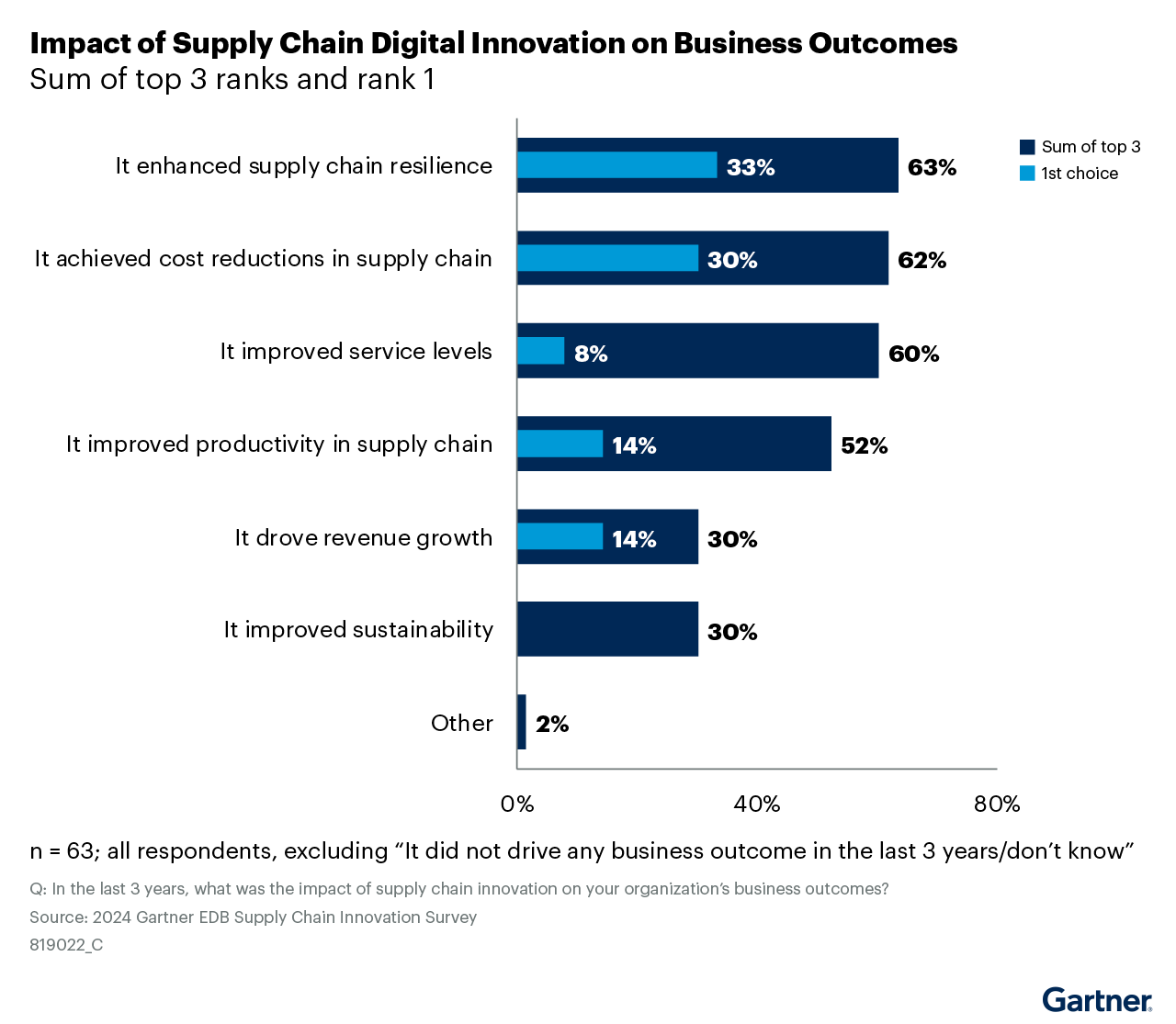
Despite the increasing investments in innovating their supply chains, organizations often struggle to find talent with the desired skills and knowledge, face constrained resource bandwidth, high implementation costs and get buy-in from internal stakeholders (see Figure 2).
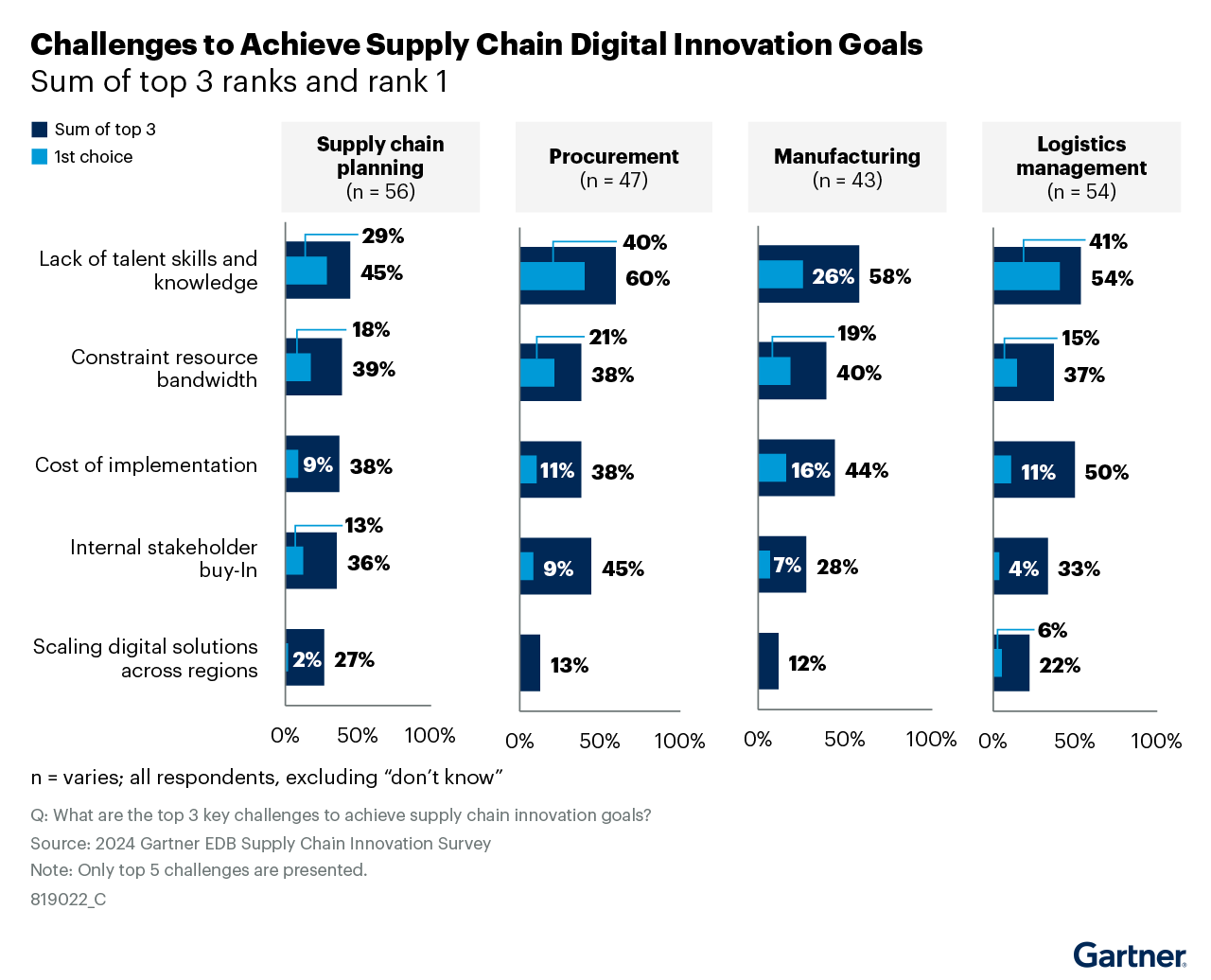
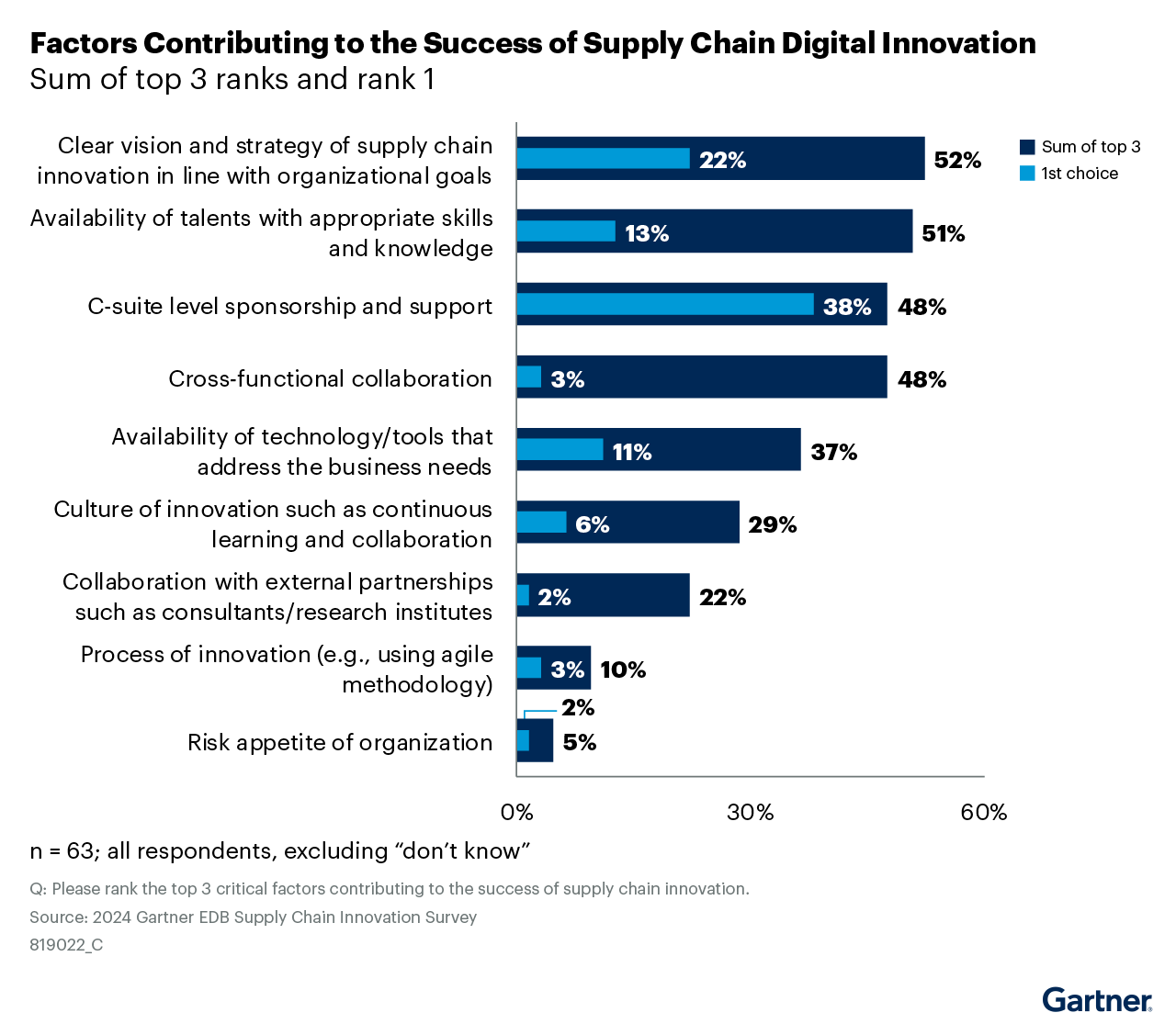
While some innovations could be associated with technologies, Figure 2 highlights the importance of people’s skill sets and knowledge when innovating supply chain strategy, technology and process. In fact, for most cases, innovation’s success depends on having the right talent on the job with technology playing the enabling role (see Figure 3).
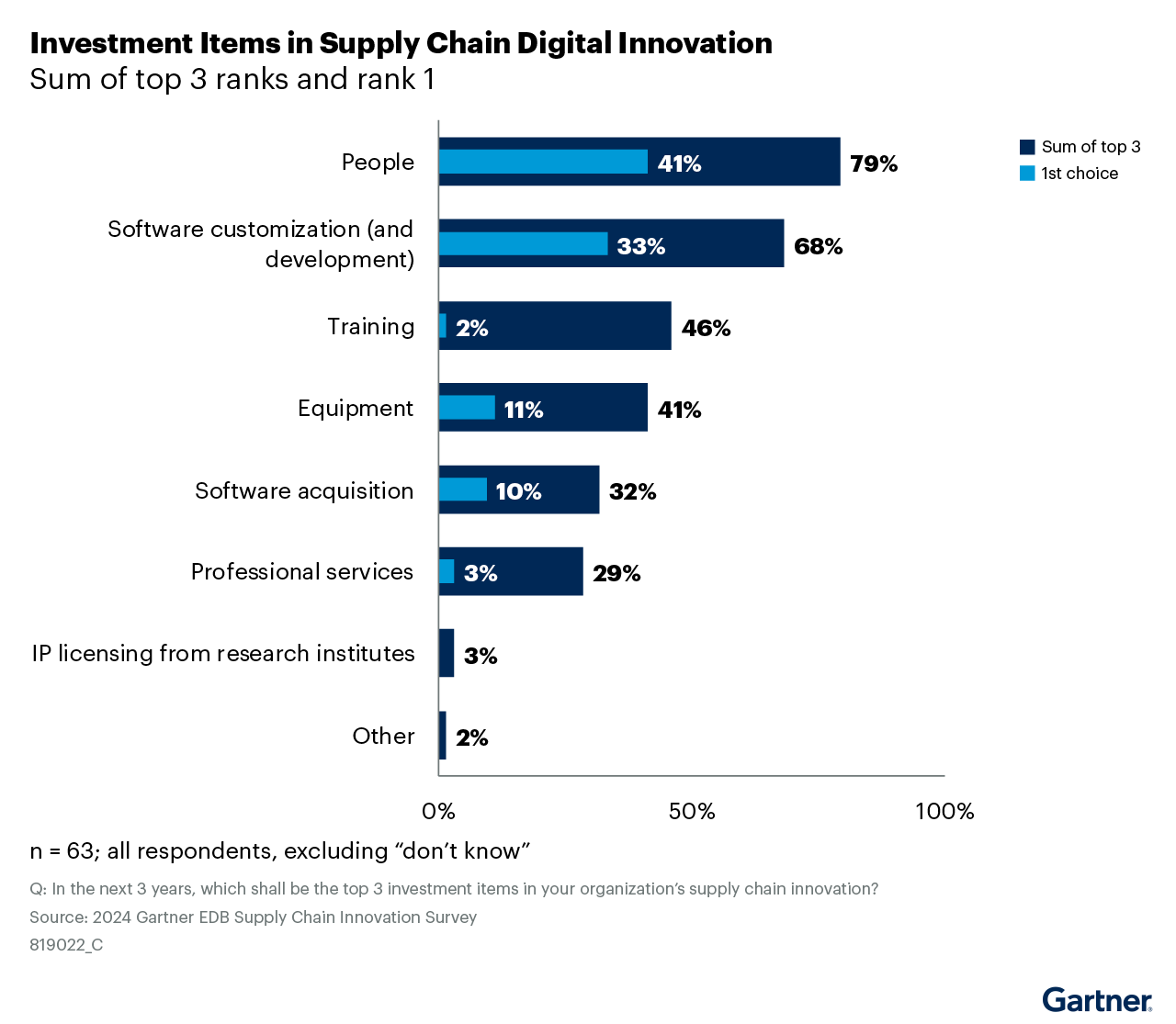
This resonates with the finding that almost eight in ten respondents highlight people as the top investment area in supply chain digital innovation (see Figure 4); in addition, the theme of inspiring people was a key trend identified in the Power of the Profession Supply Chain Awards 2024: Inspire to Innovate.
Focus on Developing Critical Skill Sets
The key skills for supply chain digital innovation include relationship building and cross functional collaboration, supply chain process, technology, tools, apps and change management. However, the core skill sets required vary across supply chain planning, procurement, manufacturing and logistics (see Figure 5).
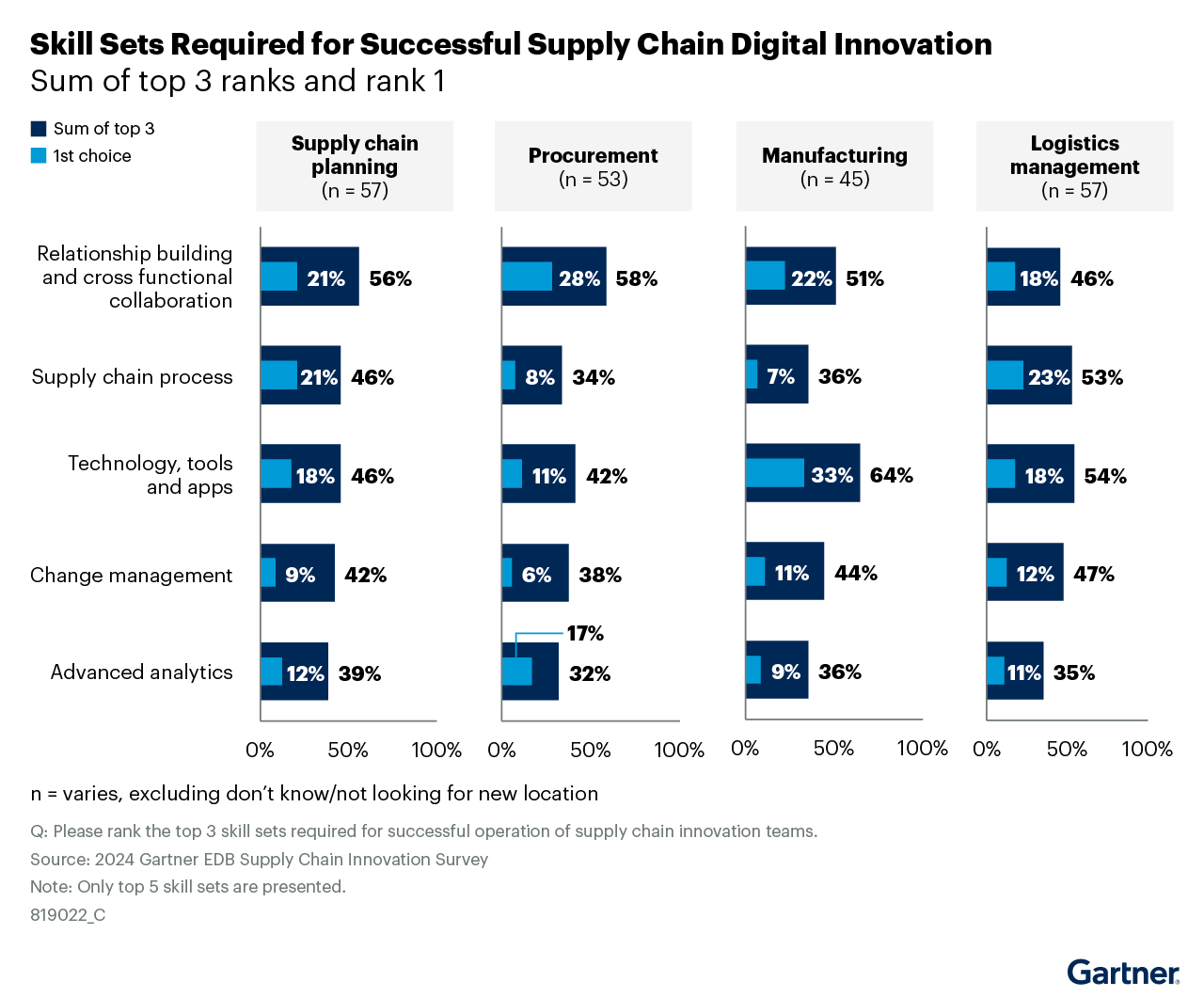
Specifically, supply chain planning and procurement functions prioritize cross-functional collaboration, while manufacturing and logistics functions focus on technology, tools and apps skills. This is likely to be driven by the nature of the planning and procurement operations where the ability to collaborate and work with cross-functional stakeholders are key for their success, while manufacturing and logistics digital innovations tend to be more operational in nature.
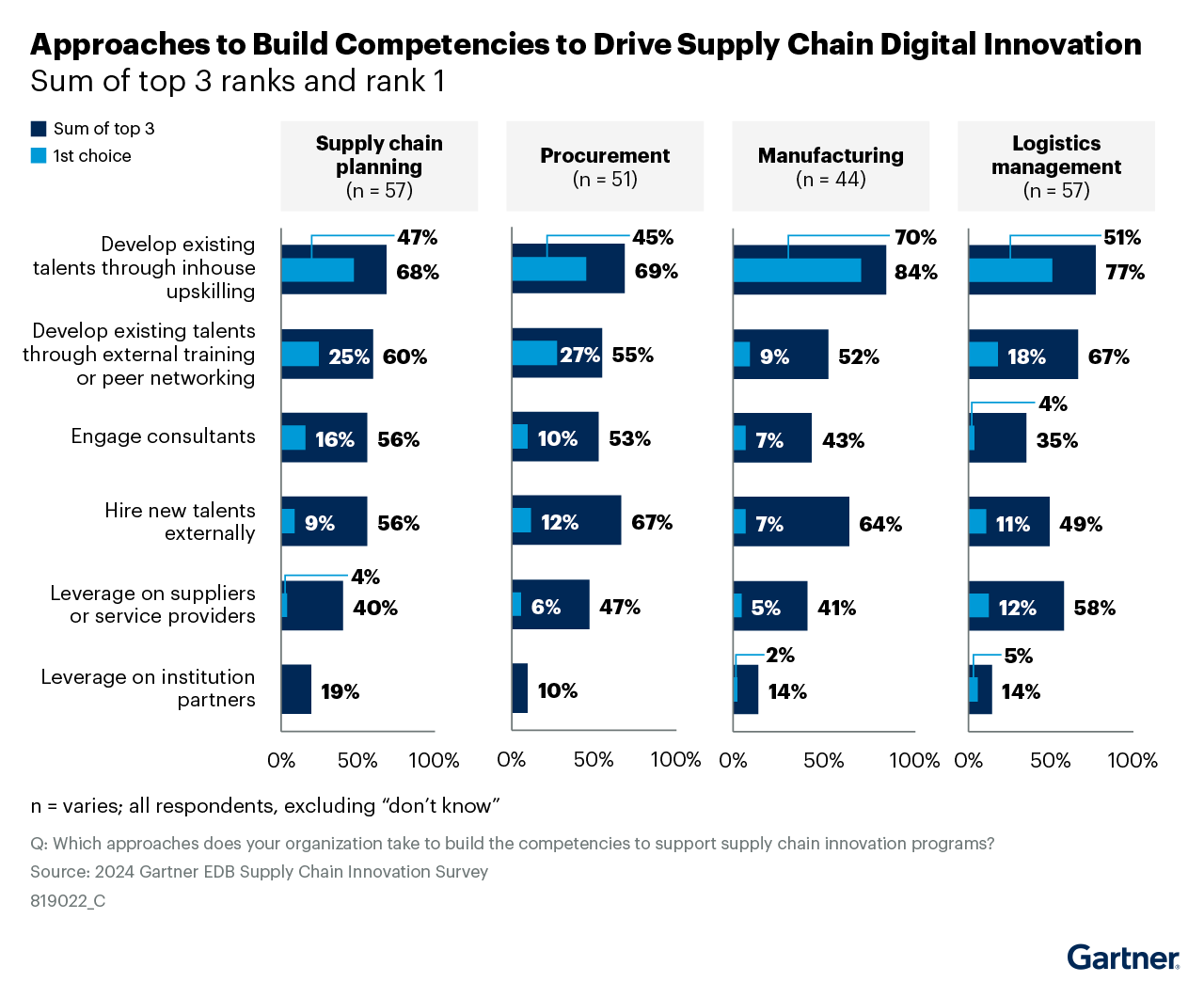
When building competencies, the key approaches are developing existing talents through in-house upskilling, external training or peer connections and hiring new talents externally (see Figure 6). Only 30% organizations would tap on the expertise from institution partners for any of the four functions.
Recommendations
To drive supply chain digital innovation with the best talent skill sets and knowledge, CSCOs must:
- Assess key areas where there are gaps in employees critical skill sets and develop them by using competencies-based assessment and establishing a systematic and structured approach of upskilling at the individual, organizational and ecosystem partnership level (see Ignition Guide to Building a Talent Strategy for Supply Chain).
- Recruit the best talent to perform supply chain digital innovation by identifying individuals with strong fundamentals of supply chain process knowledge, demonstrated good collaboration with stakeholders and have a passion for experimenting with new ways of working.
- Establish talent development programs and create the culture for digital innovation through mentorship and coaching to develop soft skills, innovation labs or organize hackathons to encourage employees’ experimentation with new ideas and technologies (see Ignition Guide to Building Compelling Individual Development Plans for Supply Chain Employees).
Invest in Dedicated Resources to Drive Innovative Strategies
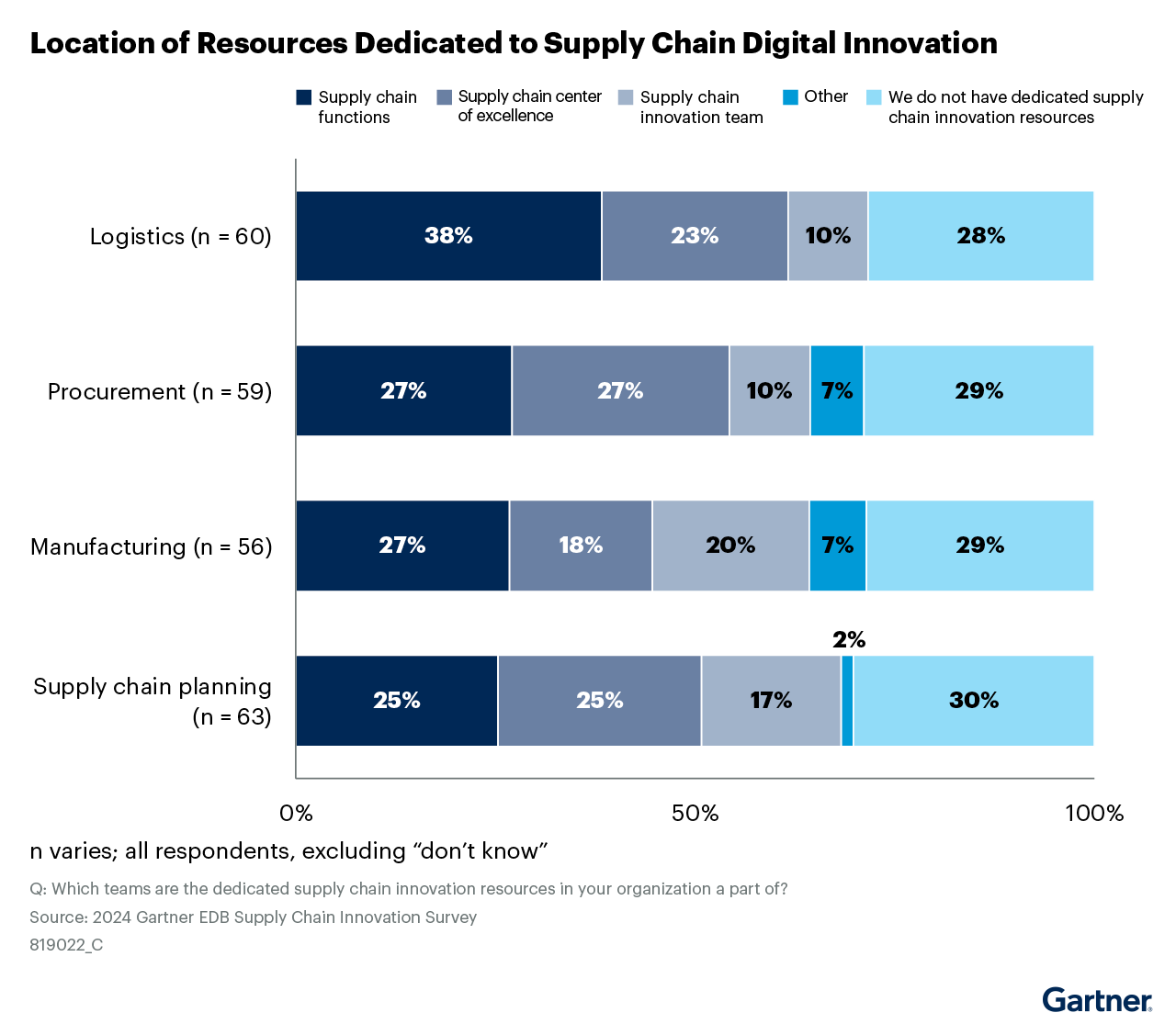
People costs are a significant part of supply chain digital innovation, with eight in ten organizations stating this to be one of the top expenditures in the last three years. In addition, at least 70% of organizations have dedicated supply chain resources (see Figure 7). Yet, 52% organizations highlighted that resource bandwidth as a key challenge to achieve their digital innovation goals for any of the four supply chain functions.
The following are a couple of factors that could be contributing to challenges in achieving their goals:
- Prioritization of supply chain digital innovation initiatives. Trying to accomplish too many innovative initiatives with a mindset of “everything is important and urgent” will overload the bandwidth of your resources aligned to innovation.
- Resources being used to support noninnovative activities. Digital innovation talents residing in supply chain functions may be asked at times to support urgent operational crises or bug-fixing activities in technologies that have been transferred to operations.
It is also important to note that 35% of organizations still do not have dedicated resources for supply chain digital innovation in at least one of the four functions. It is hard to have the same group of resources performing both digital innovation and operational activities. In most cases, resources operating in both types of activities would end up focusing on the urgent operational requests and deprioritizing their digital innovation roles.
For these organizations, it is important to review the organization’s strategic priorities. If supply chain digital innovation is important for the long-term success of the organization, investing in dedicated resources to perform the roles and activities would be essential. According to Gartner’s 2023 Organizing to Succeed in Digitalizing the Supply Chain Survey, digital leaders are establishing significantly more digital centers of excellence (COEs) than the rest, and they also have dedicated COEs in most functions.
Recommending dedicated resources when headcount cost is a key challenge can feel like a contradiction. But it doesn’t have to be. Dedicated central resources can be leveraged across functions and business units, which allows a headcount saving or at least headcount-neutral.
Organizations could explore various creative ways as they embark on supply chain digital innovation to balance resources and costs with their business goals:
- Start small and achieve quick wins, such as having a couple of resources in your supply chain COE team to explore designing innovative strategies and processes.
- Partner with universities to build knowledge, tap on their expertise and experiment with innovative technologies and processes.
- Involve two to three strategic suppliers or technology vendors who can share how other noncompeting customers are harnessing supply chain digital innovation strategies and processes to meet similar outcomes.
Dedicated resources better enable the organization to collaborate with suppliers, academics, technology vendors and more to manage the pipeline of digital innovation effectively, and learn the process of management without incurring huge investments.
Recommendations
To achieve the desired business outcome through concerted efforts in supply chain digital innovation, CSCOs must:
- Prioritize supply chain digital innovation initiatives in alignment with the organization’s strategic goals by evaluating the potential impact on customers, sales and operations as well as ensuring feasibility with the available resources.
- Segregate resources driving supply chain innovative initiatives from operational teams and activities by placing the employees in nonoperational functions, such as a COE or digital transformation team, and use different measures to assess their performance. For example, these performance measures could include the number of technologies implemented, and the supply chain productivity improvement delivered from each technology.
- Leverage ecosystem partners to scale and explore with the advancement of new strategy, technology and process by collaborating with universities and research institutions to access cutting-edge research, tap on faculty expertise and build a pipeline for future talents.
Standardize Ways of Working and Leverage Resources to Optimize Implementation Cost
Eighty percent organizations have stated people costs, and 69% organizations have stated software customization and development cost as the key expenditures in their supply chain digital innovation. These are also the key investment areas in the next three years.
When solutioning for their digital innovation initiatives, adopting off-the-shelf solutions is the first choice for most organizations (see Figure 8). However, this is not always possible due to unique business models and requirements. As a result, customizing off-the-shelf solutions in-house and co-development with external parties, such as commercial solution providers, become the more common approach.
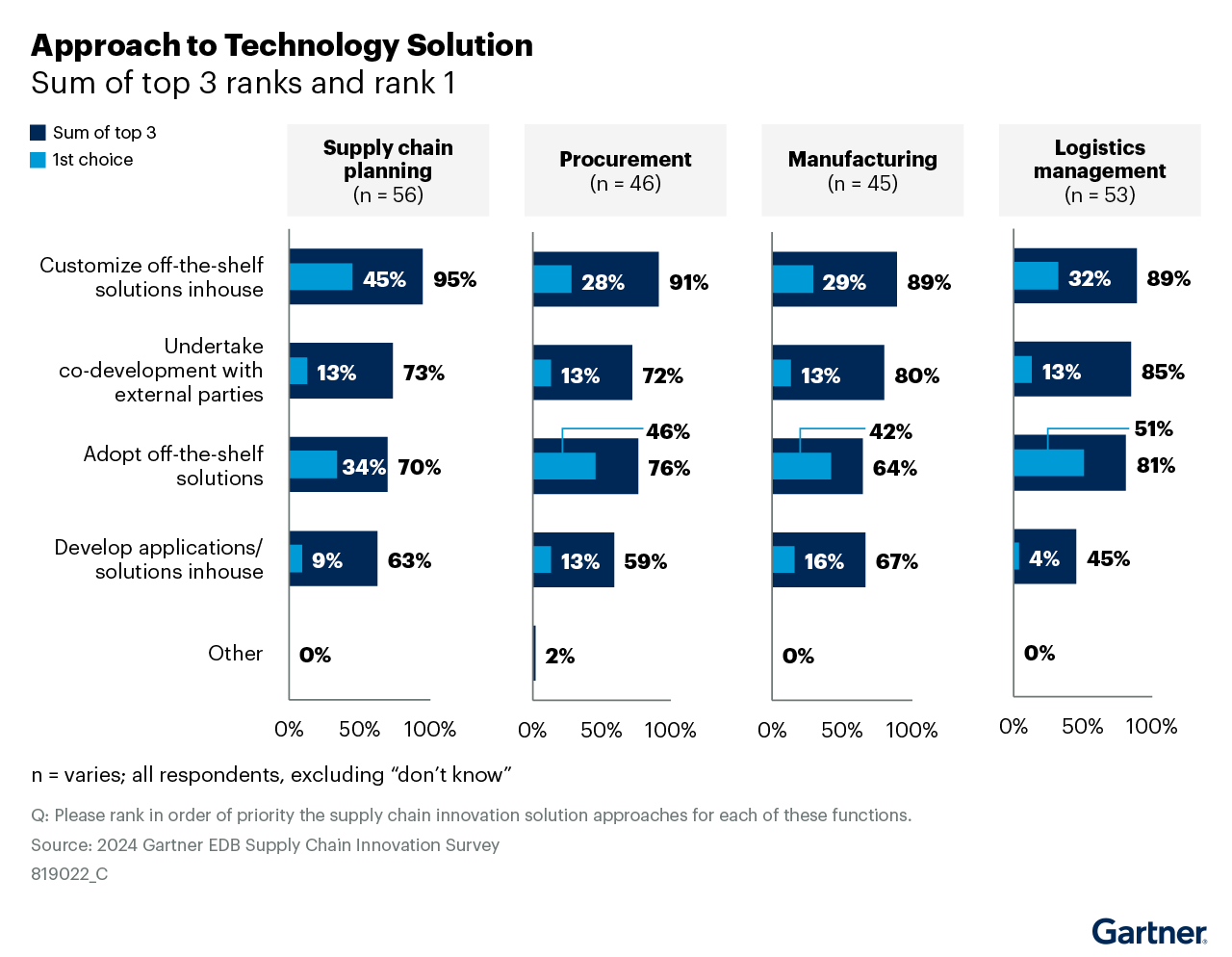
Key decision criteria used in deciding the approach to technology solution implementation are strategic alignment to organization’s goals, cost-effectiveness, including initial investment and ongoing maintenance. Other factors include resource availability and solution scalability.
When measuring the success of supply chain digital innovation, organizations should move away from just using cost as a key metric because this does not provide the complete picture. Instead, the focus should also include other factors like resiliency enhancement, service levels improvement and revenue growth.
Adopting an off-the-shelf solution can eliminate or reduce the need for software customization and hence the cost of implementation. However, customizations are often necessary due to different supply chain operating models across different business units or regions. To minimize customizations and reduce the cost of implementation, organizations could standardize operating models by employing a designed simplicity approach that focuses on the user experience (see Successful Procurement Transformation Through Designed Simplicity).
To reduce people costs, organizations could start small by investing in a few key internal roles to perform the supply chain innovative initiatives, while leveraging on external expertise on less strategic activities. CSCOs should differentiate the activities that are strategic from those that are less strategic based on the organizational goals.
Strategic activities could include applying innovative ideas to improve a process, supplier relationship management and change management. Nonstrategic activities could include data crunching, reports generation and technical proficiency of tools.
Recommendations
To achieve the optimal ROI with lower cost in technology implementation, CSCOs must:
- Develop successful business cases by prioritizing on high impact initiatives, delivering on quick wins to demonstrate immediate value and build momentum for long-term initiatives.
- Minimize the cost of customizing off-the-shelf solutions by standardizing the supply chain operating model through a design for simplicity approach that focuses on the user experience in terms of business process management to enhance the success of digital innovations.
- Streamline the cost structure by differentiating the strategic and nonstrategic activities and conducting strategic and critical digital innovation activities in-house, while outsourcing tactical tasks to external partners.
2024 Gartner Supply Chain Innovation Survey: This study was conducted to uncover the changes companies are making to their supply chain innovation teams and partnership models, in response to today’s dynamic business environment. The research was conducted online from May 2024 through July 2024 among 76 respondents from Australia, China, France, India, Japan, Netherlands, New Zealand, Singapore and the United States. These responses were spread across communications and media, healthcare providers, manufacturing, natural resources, other, retail, transportation and logistics and wholesale trade industries. A total of 62 respondents belonged to organizations with annual enterprise revenue of at least $1 billion.
Disclaimer: Results of this study do not represent global findings or the market as a whole but reflect sentiment of the respondents and companies surveyed.