Innovation Insight: Digital Health Platforms Accelerate Transformation
ARCHIVED
2 April 2024 - ID G00802422 - 17 min readBy Andrew Meyer, Gregg Pessin, and 1 more
New clinical drivers and business demands regularly challenge healthcare providers. To meet these challenges, CIOs must adopt a digital health platform approach to optimize legacy data, scale new capabilities, deliver better user experiences and improve operational performance.
Overview
Key Findings
- Healthcare providers are not responding fast enough to changing business and clinical drivers, including public health crises, unconventional competition, and medical and technology innovation.
- Healthcare provider senior leadership increasingly question the value delivered by their existing IT investments, particularly in the monolithic electronic health record (EHR)-centric application suites, which can be a barrier to digital innovation and productivity and have a high total cost of ownership (TCO).
- Unlocking the value of healthcare data is a top priority for healthcare provider CIOs as the industry enters an era of consumer engagement, precision medicine and personalized health. But many CIOs struggle to release the full potential of their organizations data.
Recommendations
Healthcare provider CIOs advancing healthcare and life science digital transformation and innovation should:
- Introduce the digital health platform (DHP) approach to your organization by connecting business-led demands, response to market disruption and the need for improved organizational agility and efficiency with technology innovation.
- Evaluate your existing application portfolio’s ability to support changing business and consumer needs by determining how easily you can repurpose data and application components to improve decision making and processes for clinical staff, patients and partners.
- Develop a plan to create value from your data and IT by shifting to a DHP architectural approach. This will require a move toward healthcare cloud adoption, an API-centric interoperability model and composition tools to create better digital user experiences.
Strategic Planning Assumption
By 2027, healthcare provider CIOs will deploy over 50% of new healthcare-specific capabilities via digital health platforms to directly address critical outcomes.
Introduction
CIOs Are Paving the Way for Digital Transformation
Healthcare provider CIOs are making heroic efforts to adopt technologies and enable business capabilities for virtual care delivery, real-time patient monitoring and data exploitation. Previously implemented at the margins, digital adoption has now moved into the mainstream.
Safely and securely navigating an organization through this digital transformation has required CIOs to confront new operational realities (see Figure 1). For many CIOs, addressing these realities has created more resilient, dynamic and agile healthcare organizations now ripe for further transformation.
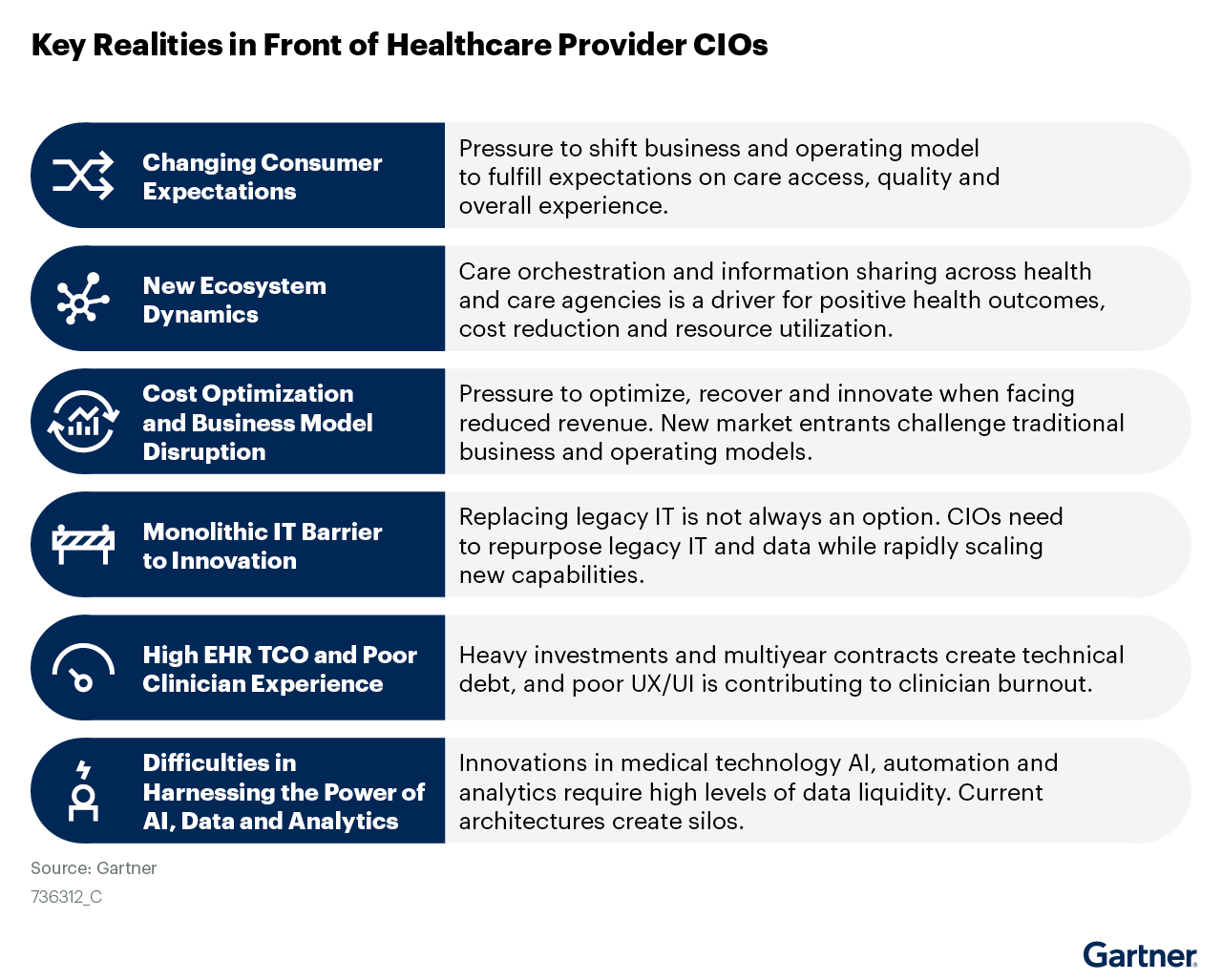
In our view, these current priorities can be addressed by making one fundamental change — how businesses acquire and deploy new digital capabilities to improve users’ digital experience and enhance their ability to make better decisions. Gartner calls this vision the “digital health platform.”
Description
The digital health platform (DHP) leverages modern cloud platforms and application capabilities built on service-oriented principles and architectures. The DHP approach allows healthcare providers to quickly adapt their business and operating model in response to external disruption and change in business strategy. It also puts them on the road to faster value realization. At a technical level, the DHP approach enables a CIO to adjust the application portfolio as the needs of the business change.
As with industry cloud platforms, the DHP addresses industry-relevant business outcomes by combining underlying SaaS, PaaS and IaaS services into a single product offering composable capabilities (see What Should I Know About Industry Cloud Platforms?).
The digital health platform (DHP) is an architectural approach that enables healthcare providers to rapidly respond to strategic imperatives and external uncertainties using modern cloud platforms and services. This approach combines three elements:
- A healthcare data fabric that provides data connectors and models to liberate siloed application data from operational systems,
- A library of prebuilt software components that can be used to quickly scale new business capabilities (packaged business capabilities [PBCs])
- Composition tools that can create tailored digital experiences for a broad range of stakeholders
Healthcare Providers Are Moving Into the DHP Era
Conway’s law states, “Any organization that designs a system will produce a design whose structure is a copy of the organization’s communication structure.”1 A popular example is “If you have four groups working on a software compiler, you’ll get a four-pass compiler.” Dating back to 1968, Conway’s law was validated in 2011 by Harvard Business School’s Alan MacCormack, who stated, “We find strong evidence to support the hypothesis that a product’s architecture tends to mirror the structure of the organization in which it is developed.” 2
The inverse of Conway’s law suggests that the structure and design choices made during system development can reshape an organization. The EHR monolithic era demonstrates how a critical system can mould an organization, changing the whole business — not always in a good way. The healthcare industry has evolved and continues to evolve, so sticking to the monolithic approach may not always serve the business. The pace of evolution and change moves at the pace of the monolithic vendor rather than the pace it could achieve.
The DHP represents a way for healthcare providers to adapt quickly, acquire and scale digital business capabilities in response to changing needs, cost pressures and provider market uncertainty. It’s founded on composable modularity, a growing architecture and investment approach, and serves the increasing demand for greater healthcare provider growth, diversification, value and agility.
Healthcare providers embracing the DHP approach can successfully offset the challenges the current monolithic era presents. This helps set their organizations on the road to the agile, composable and proactive future state of healthcare — the digital health platform era — as they scale out digital care delivery (see Table 1).
Current Versus Future State of Healthcare
Current state of healthcare | Future state: digital health platform era | |
 Enterprise |
|
|
 Management |
|
|
 Care Delivered |
|
|
 Workforce |
|
|
 Information and IT |
|
|
Source: Gartner
Gartner predicts that within the next five years, the DHP era will emerge as the dominant approach for agile, industry-leading healthcare providers. It will be the most cost-effective and technically efficient way to scale new digital capabilities.
Investment will shift from the legacy applications in the portfolio toward more modular, interoperable cloud-only-packed business capabilities. We observe signs of this in findings from the 2024 Gartner CIO and Technology Executive Survey, where healthcare provider respondents indicated plans to increase investment in areas such as AI and business intelligence (BI) while decreasing investment in legacy infrastructure (see Healthcare Provider 2024 CIO Agenda Insights and Data).3
The Gartner DHP Reference Architecture
The digital health platform reference architecture builds from an existing set of applications and associated data common to most healthcare providers today. This includes software suites such as the EHR and those running in the cloud.
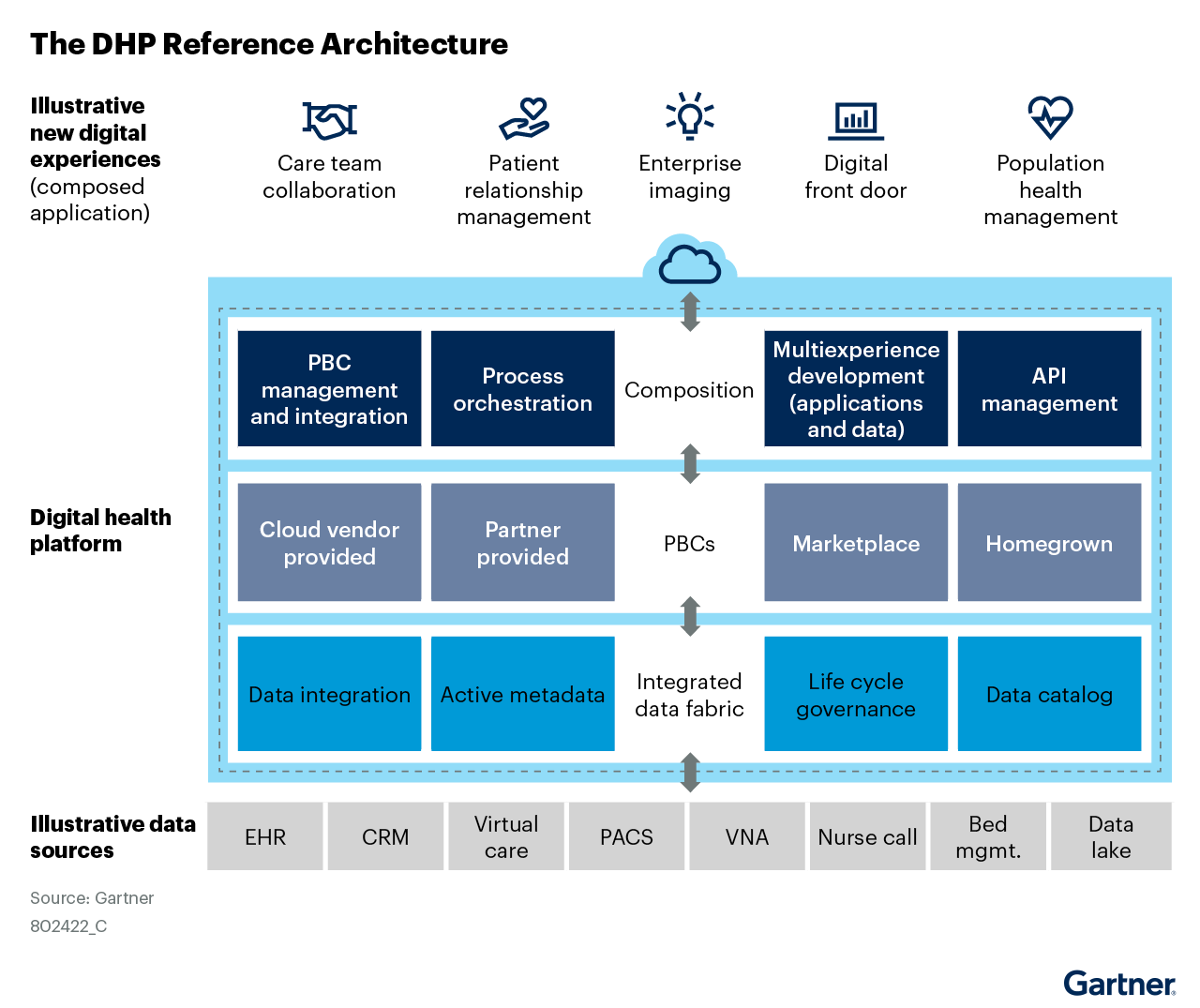
The DHP is composed of three layers described in Figure 2:
- Integrated data fabric — An integrated data fabric layer, which connects and interfaces with existing applications and provides data and metadata management for the other layers.
- Packaged business capabilities (PBCs) — Where applications and data are repurposed using published APIs or standards-based interfaces. These PBCs become a library of business functions waiting to be orchestrated or composed into new applications. PBCs are provided directly by vendors or through application marketplaces and can also be obtained from partners or custom-developed in-house using tools within the composition layer.
- Composition — A layer where PBCs and data are connected and composed into new digital experiences with much-improved user interfaces (UIs) and user experiences (UX). These are designed to meet the clinical or operational workflow needs and reduce screen time wherever possible. The composition layer includes tools that support low-code development and rapid deployment of new applications.
The Data Fabric for Scalable Data and Integration
The integrated data fabric layer is a distributed and composable architecture that is responsible for the integration and governance of data from disparate sources and preparing them for business exploration. Key features of the DHP integrated data fabric layer are:
- Automated health data integration using industry standards such as HL7 and FHIR and support for some proprietary or more basic forms of integration to extract and exchange data (e.g., supporting batch transfer or EHR overnight data extracts used to update proprietary EHR BI tools)
- Data curation of services that standardize incoming data, including patient de-identification and other data transformation tools
- Strong governance capabilities that are embedded into the data life cycle
- An active metadata repository that captures knowledge from across the organizational data systems and applications
- Metadata management services that manage the flow of data and metadata in preparing data for reuse
- Healthcare-specific common data model for standard and custom objects that facilitate interoperability (e.g., EHR clinical data)
- The ability to retain consent and privacy flags that patients have provided, which exist in operational systems that must be honored if PHI legislative compliance is required (e.g., GDPR).
PBCs Are Building Blocks for New Digital Experiences and Applications
PBCs are software components representing a well-defined business capability that is functionally recognizable by a business user. Technically, a PBC is a bounded collection of a data schema and a set of services, APIs and event channels. PBCs are used as building blocks for application product suites and custom-assembled software experiences as they reuse bits of core application code via their respective APIs.
Many vendors offering healthcare provider specific solutions supply prebuilt healthcare-specific PBCs and present them as SaaS tools. For example:
- Amazon Web Services (AWS) offers Amazon Comprehend Medical, which uses machine learning (ML) to extract knowledge from clinical notes and free text.
- Microsoft Cloud for Healthcare provides the AI-powered Azure Health Bot as a conversational interface for patients.
- Salesforce Health Cloud offers Patient360 as a tool for displaying longitudinal patient information.
Citizen developers — defined as end users who wish to interact with healthcare data and build their reports or applications — can, where appropriate, define PBCs using tools to configure and manage them with limited assistance from IT. In Figure 2, these are called “homegrown” in the PBC layer. The tools used to do this are described below in the composition layer. Examples of these user-created PBCs are an AI image interpretation task, or a remote patient monitoring event that a clinician sets up or where a patient builds a set of rules that help them manage their health and wellness device alerts and activities in line with their personal health goals and symptoms. These PBCs are sometimes used when composing a new clinical or business workflow.
Composition Layer Improves Collaboration
The composition layer allows the business and end users to create better software experiences by combining data from various sources and PBCs. The composition focuses on assembling unique digital user experiences that can deliver on the user’s preference of channel and device. Multiexperience development tools for applications and analytics are found in this composition layer (see Innovation Insight for Digital Experience Composition). A cloud service provider (CSP) typically supplies these composition layer tools as part of the DHP solution suite.
The DHP and RTHS Connection
The goals for the DHP reference architecture are perfectly aligned with the real-time health system (RTHS) framework. An RTHS uses a DHP as a set of core resources to support the practical application of these progressive capabilities to the workplace. An RTHS is built using a DHP in combination with on-premises applications and independent vendor provided technology services (often cloud hosted). DHPs accelerate a healthcare provider’s ability to become an RTHS by providing prebuilt, pre-tested combinations of complex application composition services that would be difficult and costly to construct independently. The vendors in the DHP space have deep investments in core IT capabilities such as AI and long-term investments in the healthcare technology space. The services offered by a DHP can be used in each of the defined RTHS platforms: service orchestration, health data management (see Quick Answer: Emergence of Health Data Management Platforms Signal a New Generation of Capabilities) and health event management (see Accelerate Healthcare Transformation With the RTHS Reference Architecture).
Benefits and Uses
Adopting a DHP approach to make a fundamental change to the way digital capabilities are acquired and deployed in the healthcare ecosystem today brings a range of benefits to healthcare providers:
- Increased resilience, adaptability and flexibility — The DHP approach enables healthcare providers to respond and adapt to changing patient/consumer demand, external disruption and changes in business strategy.
- Faster value realization from current investments in the IT infrastructure — The DHP approach lets healthcare providers use their existing capability portfolio by reassembling the capabilities into PBCs that can support new digital experiences. There is also the ability to fill the capability gaps in existing portfolios by using the available pool of prebuilt PBCs the CSPs provide.
- Improved power to innovate faster — Over time, reducing reliance on the limited capabilities offered by the EHR-centric architecture allows healthcare providers to take control when it comes to innovation, creating new care delivery user experiences. This typically would not have been possible in the existing monolithic, EHR-centric application environment.
- A consistent approach to extracting and making data fluid and accessible — The DHP approach enables healthcare providers to utilize the data generated by several siloed administration systems. As more data becomes fluid and available, healthcare providers can run AI and analytics on top of data to optimize various care delivery processes, use predictive modeling to better prepare for upcoming patient demands, and manage health system load. The DHP approach using modern cloud platforms offers data connector services, which use industry standards such as HL7 and FHIR to exchange data, along with data gateways for governance and curation of the data streams.
Risks
- Executive sponsorship — Some CIOs and executive sponsors may initially resist moving away from an EHR-first model to acquire new capabilities.
- Existing monolithic applications load — The technical debt associated with existing investments in monolithic applications can often prevent healthcare providers from adapting the DHP approach quickly. The shift away from the dominant IT solutions has yet to fully occur in healthcare today.
- Regulatory requirements — Regional legislation (e.g., Schrems II case in the European Union [EU]) that requires cloud vendors to adapt their solution offerings for compliance will slow things down. The absence of regional API legislation that requires healthcare IT vendors to ensure data liquidity across solution providers gets in the way.
- Architectural skills and mindset — The lack of architectural skills and capabilities of healthcare IT teams to interpret the composable approach and put it into practice within their organization keeps the DHP from progressing.
Adoption Rate
DHP Adoption Will Span Five to 10 Years From Today
The DHP is an architectural approach touching the Peak of Inflated Expectations in the Gartner Healthcare Provider Hype Cycle. The time to maturity and adoption across the enterprisewide application portfolio is currently between five and 10 years, and market penetration is at 5% or less across many regions. However, several positive signals within the industry indicate that the DHP will become a predominant approach to accelerating digital transformation and harnessing the value of existing investments. These include healthcare provider behaviors such as:
- Increasing adoption of cloud-native application architecture, using API mediation to build their digital business platforms
- Applying this architectural approach for data management via the increasing use of data lakes enables predictive and prescriptive analytics
Internet of Things (IoT) platforms for connected medical devices are also gaining popularity, as is the use of MXDP and LCAP technologies to provide clinicians and patients with new applications delivered over preferred channels and devices.
Recommendations
Champion the Value of the DHP Approach in Clinical and Business Terms
The first step starts with recognition of the realities of the current moment in healthcare and the demands on your organization that lie ahead. CIOs should take charge and socialize the DHP approach with a range of key clinical and business stakeholders. When presenting the DHP vision, focus on the following value drivers:
- CFOs — How DHP can be used to increase ROI for existing investments and will require a more revenue focused (SaaS, PaaS) funding model over time
- Chief marketing officers (CMOs) — How DHP can be used to transform the care delivery model to become more patient-centric
- Chief medical informatics officers (CMIOs)/chief nursing informatics officers (CNIOs) — How DHP will help transform clinical workflows and improve decision making to drive quality, safety and a better clinician digital experience
- COOs — How DHP will support a shift to more real-time operations, including higher levels of automation and the use of AI for efficiency and safety gains
- CEOs — How DHP supports digital business transformation and optimization in line with corporate objectives and the business strategy
- IT teams — How DHP will require a shift in mindset and new skills and capabilities with more of a focus on agility, scalability, and reduced reliance on local hosting and support and increased focus on capability and end-user experience
- Patients — Enablement of faster services, improved digital experiences, care on-demand and improved engagement
Examine the Fitness of Your Existing Application Portfolio
Examine how well your IT architecture is aligned with delivering your future business needs. Assess your existing application portfolio on its ability to:
- Support a positive consumer experience.
- Manage costs across the enterprise.
- Support clinical and business users in delivering high-quality outcomes.
- Provide information to improve operational and management decisions on care.
- Embed information into interactions with other agencies and the consumer.
- Improve or transform internal clinical and business processes for staff and patients.
- Support externally published APIs.
- Utilize low-code development and integration tools.
- Deliver agile and ubiquitous data.
Establish a Solid Foundation for Your DHP Journey
The building blocks of adaptability and agility in your organization are laid from the ground level up. CIOs should have a strategic plan to leverage the healthcare cloud solutions and change the way technology is delivered in partnership with the business, often with the business leading the ideation and setting the bar for UX/UI expectations:
- Refer to the Gartner Composability Business Index as a guiding model to design applications — founded on principles of modularity, discovery, autonomy and orchestration (see How to Design Enterprise Applications That Are Composable by Default).
- Learn about fusion teams and how SMEs from various priority business and clinical units play a role in them. Ensure common objectives are agreed upon and reflected in team goals.
Representative Providers
The vendors listed in this section do not imply an exhaustive list. This section is intended to provide an understanding of the market and its offerings. There may be additional vendors that are relevant and suitable for you that have not been listed in this research. It is not, nor is it intended to be, a competitive analysis of the vendors discussed.
1 Conway’s Law and How Do Committees Invent?, Datamation Services.
2 Exploring the Duality Between Product and Organizational Architectures: A Test of the “Mirroring” Hypothesis, Harvard Business School.
3 2024 Gartner CIO and Technology Executive Survey: This survey was conducted online from 2 May to 27 June 2023 to help CIOs determine how to distribute digital leadership across the enterprise and to identify technology adoption and functional performance trends. Ninety-seven percent of respondents led an information technology function. In total, 2,457 CIOs and technology executives participated, with representation from all geographies, revenue bands, and industry sectors (public and private), including 96 healthcare providers. Disclaimer: The results of this survey do not represent global findings or the market as a whole, but reflect the sentiments of the respondents and companies surveyed.