Market Guide for Product Information Management Solutions
22 January 2025 - ID G00803819 - 53 min read
By Helen Grimster, Jason Daigler
The intricacies of digital commerce are prompting organizations to enhance how they create, maintain and publish product information to downstream channels. This research helps data and analytics leaders assess the advantages and options available in the product information management market.
Overview
Key Findings
“This research may not reflect current market conditions after 22nd July 2026.”
- Distinguishing between product information management (PIM), master data management (MDM), product data management (PDM), and digital asset management (DAM) is challenging, as each addresses different data and content management needs.
- The PIM solutions available today are evolving to provide product experience management (PXM) capabilities, such as digital shelf analytics (DSA) and content optimization and generation.
- PXM strategically enhances product experiences across channels by delivering consistent and personalized information, using tools like PIM to tailor messages and listings.
- In digital commerce, data and analytics leaders face the challenge of providing varied product data to enhance customer experiences, driving the integration of PIM, MDM, PDM and related solutions.
Recommendations
Data and analytics leaders responsible for PIM should:
- Explore how a PIM solution can optimize their product information processes by identifying its specific use cases and distinguishing it from broader solutions like MDM or PDM. Select a PIM that is effective now and adaptable for future needs.
- Decide if PIM capabilities are enough, or if extending to a PXM approach is necessary for more diverse use cases. While PIM focuses on efficient product data management and distribution, PXM uses that data to create engaging, personalized customer experiences.
- Enhance business acceptance by communicating PIM benefits in business terms to key stakeholders, and evaluate PIM solutions based on their financial impact on current and future business needs.
- Ensure the PIM solution fits into their current and future ecosystem to support business needs for long-term success and adaptability in a rapidly changing market.
Strategic Planning Assumptions
By 2026, adoption of AI-based tools to help ensure products meet sustainability and environmental requirements to avoid greenwashing will grow to over 50%.
By 2027, the number of vendors that offer applications within the PXM framework will double, relative to 2024.
By 2027, 80% of vendors that fit within the PXM framework will offer at least two PXM capabilities.
Market Definition
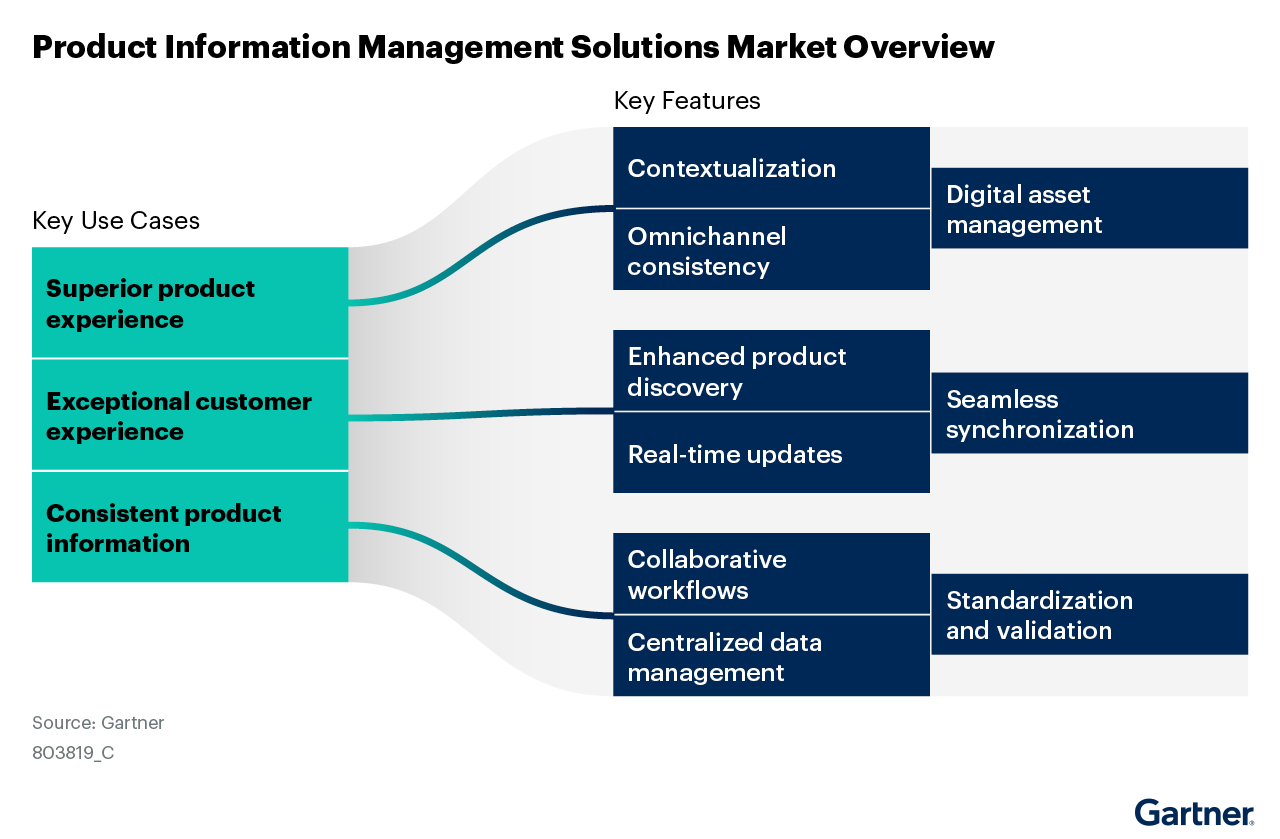
Gartner defines the product information management (PIM) market as the packaged solutions that enable product, commerce and marketing teams to create and maintain an approved shareable version of rich product content. PIM makes a single, trusted source of product information available for multichannel commerce and data exchange. PIM solutions now support complex use cases, including product data syndication (PDS), product experience management (PXM), product information effectiveness analytics, digital shelf analytics and product data contextualization. They lay the foundation for delivering personalization, product discovery and digital experience platforms (DXPs). PIM is available as hosted cloud-native, SaaS, private cloud and on-premises solutions.
PIM solutions have evolved and expanded to support various business demands and use cases. Both B2C and B2B organizations across multiple vertical markets and product categories can benefit from the introduction of a PIM solution. Business benefits include faster time to market, improved data quality, reduced costs, increased conversion rates and enhanced customer experiences.
Traditionally, PIM solutions provided an on-premises application that managed product information, with limited digital asset management, syndication or analytics capabilities. The market has evolved to provide cloud-native, composable applications that offer options to manage the entire product data journey and beyond.
The PIM solutions available today have matured to the point where they now offer standard capabilities, such as digital shelf analytics (DSA) and content optimization and generation, previously considered the remit of PXM solutions. What differentiates PIM vendors today is the additional capabilities they provide. This differentiation has extended further with the inclusion of OpenAI prompts to automate content creation and classification, among other repetitive tasks.
PIM solutions aim to support a wide range of users — including merchandising, marketing, creative, and more operational and administrative roles — both inside and outside an organization. This range of users allows a PIM solution to serve every part of the organization, including the commerce team, marketing, sales, manufacturing, legal, finance, call and service centers, third-party suppliers, agencies, distributors, and more.
Mandatory Features
The mandatory features for this market include:
- Workflow, data modeling and hierarchy management
- Digital asset management (DAM)/media asset management (MAM)
- Rich product content authoring
- Multichannel publishing and product information contextualization
- Product variant management
Common Features
The common features for this market include:
- Supplier data onboarding
- Product data syndication (PDS)
- Brand portals
- AI-assisted rich content optimization, and OpenAI prompts
- Digital shelf analytics
Market Description
PIM solutions have evolved and expanded to support various business demands and use cases. Traditionally, PIM solutions were on-premises applications that managed product information with limited digital asset management, syndication or analytics capabilities. The market has evolved to provide cloud-native, composable applications that can provide options to manage the entire product data journey and beyond. This has extended further with the inclusion of generative AI (GenAI) prompts to automate content creation and classification, among other repetitive tasks (see Table 1).
Comparison of Product Information Management and Product Experience Management
Product Information Management | Product Experience Management | |
Focus | Centralizes and manages product data | Enhances the customer experience with personalized and contextualized product content |
Functionality | Collects, stores and distributes product information, such as names, descriptions, prices, images and specifications | Uses enriched product data to create engaging and relevant product experiences tailored to specific customer segments |
Purpose | Ensures consistency and accuracy of product data across various channels (e.g., e-commerce sites, catalogs, marketplaces) | Optimizes the customer journey by providing emotionally engaging and contextually relevant product information |
Benefits | Improves operational efficiency, speeds up time to market and maintains data quality | Increases customer satisfaction, loyalty, and sales by delivering a seamless and personalized shopping experience; provides insights on product data in downstream channels that strengthen product information |
Source: Gartner (January 2025)
PXM has not replaced PIM. Instead, PXM builds upon the foundation that PIM provides, whereas PIM is a critical component within the PXM framework. (See Figure 2.)
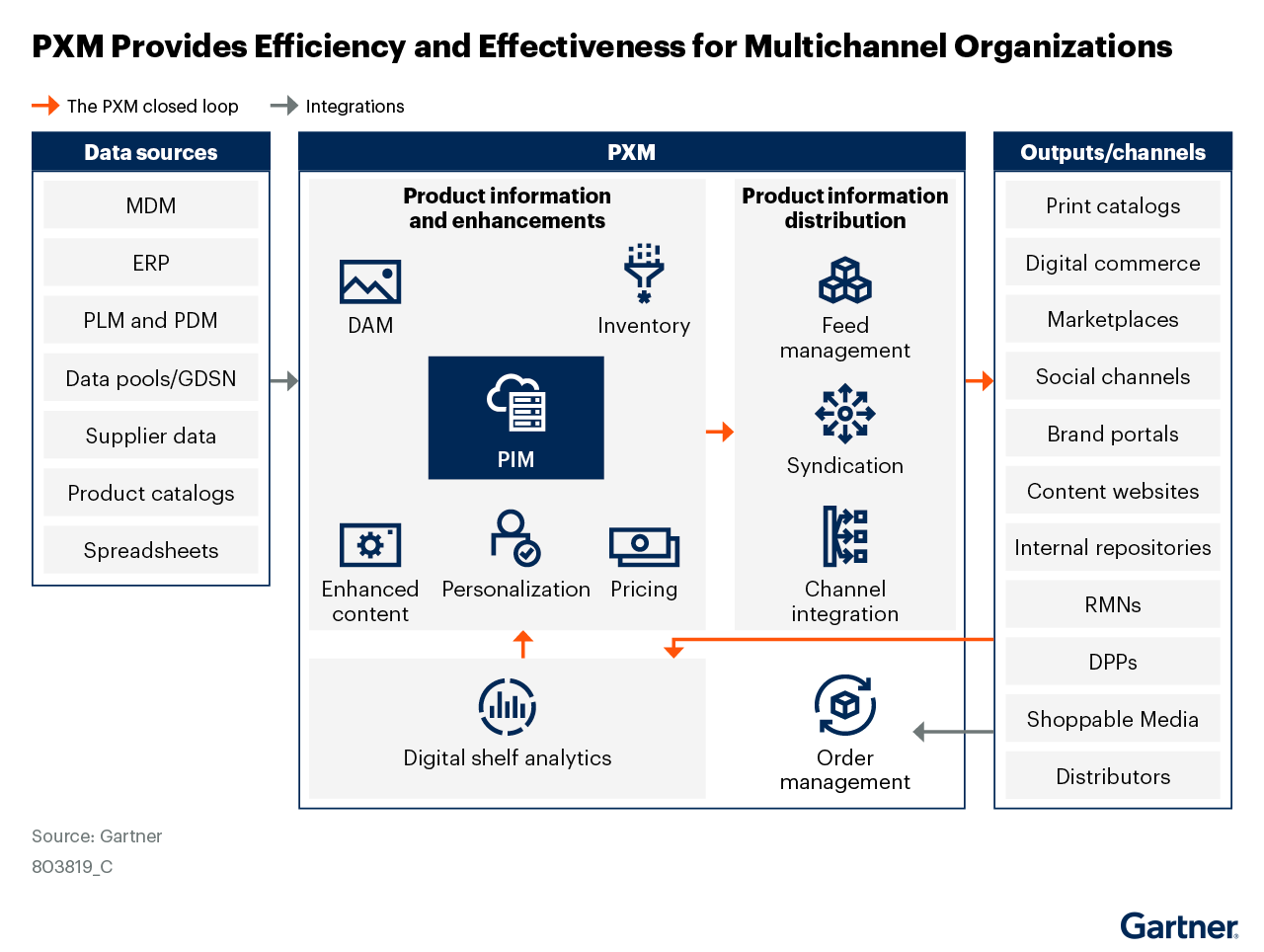
PIM is evolving and expanding to include PXM because modern consumers expect more tailored shopping experiences. Segmentation plays a crucial role in PXM by dividing users into groups based on common characteristics such as demographics, behaviors and usage patterns. This allows for more targeted experiences, which can significantly improve user engagement and retention by leveraging great product information from your PIM.
PXM complements and extends the capabilities of PIM rather than replacing it. They work together to provide a comprehensive framework for managing and enhancing product information and experiences.
PIM solutions are intended to support a wide range of users — including merchandising, marketing, creative and more operational and administrative roles — both inside and outside an organization. This range of users allows a PIM solution to serve every part of the organization, including the commerce team, marketing, sales, manufacturing, legal, finance, call and service centers, third-party suppliers, agencies and distributors.
PIM complements product data management (PDM), a common capability often integrated into the product life cycle management (PLM) market. PLM solutions assist organizations in developing and launching highly engineered products. PDM serves as the core of the PLM system, acting as the main repository for product data used in engineering and development tasks. Once a product is ready for commercialization, the approved product and its necessary data are typically transferred to other systems for management and distribution through commercial channels. Therefore, although PIM works well with PDM (if present), they are designed to perform different functions. (See Figure 3.)
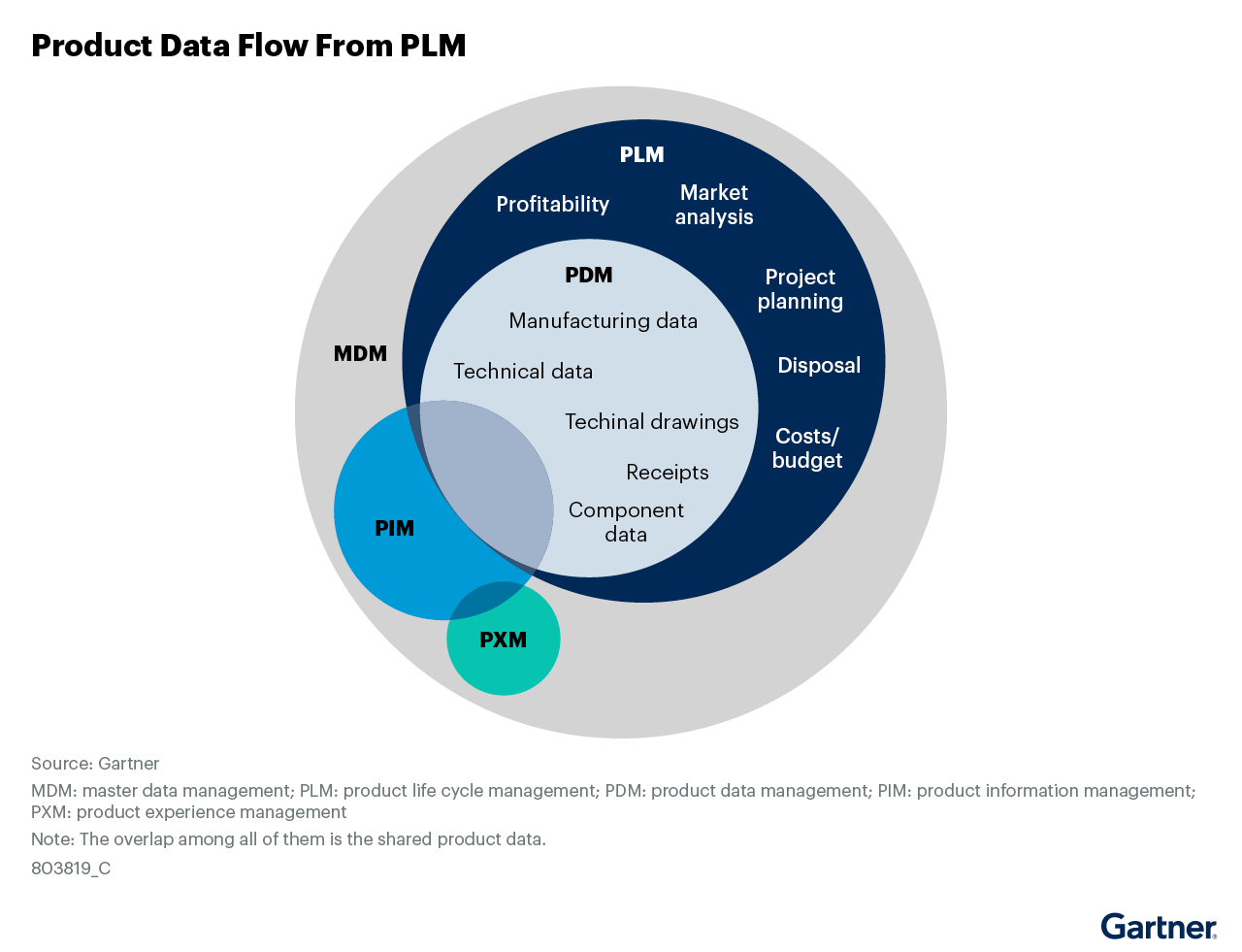
Data and analytics leaders should recognize the overlap in capabilities between packaged MDM and PIM solutions. This overlap arises because vendors that originated from PIM have expanded to support a broader range of master data domains and related use cases. See Note 2 below, which compares MDM with PIM to help decide what solution your organization needs.
Market Direction
The need for efficient data management, especially in e-commerce, is driving the adoption of PIM solutions. Manufacturing and healthcare are also increasingly adopting PIM to manage complex product information and comply with stringent regulatory requirements. The PIM market has pivoted to include new technologies, such as AI by default, alongside becoming more modular. These technologies can be tailored to deliver value and scale as requirements grow. There is an increased focus on supporting sustainability and compliance initiatives.
Near-Term Vision
PIM will diversify into two types of vendors: those who cover PIM use cases and those who will organically add capabilities to provide a full-blown PXM framework in the future. Enhanced data governance and sustainability are also becoming critical, ensuring accurate, compliant product information and supporting transparent supply chains. The inclusion of product MDM capabilities will blur the need for separate MDM tools further. The ability to provide targeted and segmented product data information for personalization will expand the integrations and capabilities of PDM further.
Growth in B2B PIM Use Cases
There will also be a greater need for PIM in B2B scenarios, as product data and quality is often inconsistent, driven by more data sources, such as data coming from suppliers. By leveraging PIM, B2B organizations can enhance their competitiveness, improve customer satisfaction and achieve operational excellence. This shift underscores growing recognition of the value in consistent and enriched product information across all sectors.
Both B2B and B2C sectors benefit significantly from PIM. But these can vary based on specific needs and complexities, with some vendors offering different strengths, depending on the B2B use cases.
Preparation for Sunrise 2027
Sunrise 2027 is an industry initiative led by GS1, aiming to transition from traditional one-dimensional (1D) bar codes to two-dimensional (2D) bar codes by the end of 2027. This shift is driven by the need for more comprehensive product information and improved supply chain efficiency.
PIM plays a crucial role in supporting the transition to meet the requirements of the Sunrise 2027 initiative, with 2D bar codes providing more detailed product information. PIM can manage this increased data volume, including nutritional information, allergens and sustainability data. The initiative is being tested in multiple countries, representing a significant portion of the global economy.
The need for standardized and validated product information is critical for the successful implementation of 2D bar codes, which require precise and comprehensive data. Other drivers include improved consumer experience. Consumers can access detailed product information on their smartphones, with a single scan, enhancing transparency and trust. It will also facilitate better inventory management, recall readiness and product authentication, improving the supply chain.
GenAI as a Key Enabler in PIM
GenAI is increasingly becoming a standard feature in PIM systems, although its adoption varies across different industries and companies. Integrating GenAI with PIM transforms the way businesses handle product information, streamlining processes and creating more tailored customer experiences, and automating content creation such as product descriptions at scale for multiple channels and regions.
AI can standardize incoming data from various sources, ensuring it fits the required format and is free from errors. This includes aligning product naming conventions, SKU formats, and categorization hierarchies. By leveraging GenAI, businesses can make the supplier product onboarding process within PIM more efficient, accurate and responsive, ultimately leading to better supplier relationships and improved product management.
Regulations Driving the Need for PIM
Consumers are increasingly vigilant and critical of environmental claims made by companies, and PIM is instrumental in supporting many global regulations and combating greenwashing by ensuring transparency, accuracy and consistency in product information. Regulations include the U.S. Food Safety Modernization Act (FSMA), the third Plastic Packaging Tax (PPT), EU Deforestation Regulation (EUDR), the EU Green Claims Directive (GCD) and the EU Ecodesign for Sustainable Products Regulation (ESPR), which includes the upcoming Digital Product Passport. PIM provides capabilities to support organizations in these initiatives.
The demand for sustainable information reflects a broader shift toward more conscious consumption patterns from consumers, and this is driving the need to store this information within a PIM. Trust is frequently eroded when there is a disconnect between what an organization claims and what it actually does.
Digital Shelf Analytics: Critical for Success in Third-Party Channel Sales
Digital shelf analytics applications provide brands and manufacturers with data from third-party digital channels where their products are sold, such as online marketplaces and third-party retailers’ digital commerce sites (see Market Guide for Digital Shelf Analytics). This means the insights generated from DSA applications are valuable, but are often not utilized in the most optimum way, especially if no action is taken based on the data to improve product data, processes or customer experiences.
Although the insights generated can be very valuable, in many cases, users will need to leverage DSA applications for insight, then take action to manipulate product content or prices on retailers’ sites. This might mean taking subsequent actions directly in the PIM solution, then resyndicating product content and information to retailers’ sites. Some vendors mitigate this additional effort by offering an integrated system that includes, at a minimum, a PIM, a channel integration application and DSA. This loopback process is becoming even more critical in remaining competitive and delivering the best product experiences.
Market Analysis
The PIM software market has evolved in scope from core competencies and from specialization in different industries to include and overlap with other new markets and segments. The market has also grown rapidly over the past five years, as new cloud-native vendors have emerged alongside more established vendors.
PIM Capabilities
PIM capabilities can be broken down into core capabilities, extended capabilities for specific use cases, additional capabilities and product experience (PXM).
Core
PIM solutions’ core capabilities are also valid for an MDM solution or any other solution designed to govern product data. Core capabilities include the following:
- Workflow/business process management. Business process modeling, data flow modeling and documentation, and analytics for KPIs and other benchmarking efforts in support of PIM.
- Loading/sync/business services. Facilities for loading data in a fast, efficient and accurate manner.
- Data modeling. Effective and flexible support of an end-user organization’s product data model requirements.
- Data quality/semantics. Strong facilities, in batch and real-time modes, for profiling, cleansing, matching, linking, identifying and semantically reconciling data in different data sources.
- Hierarchy management. Support for balanced, unbalanced and recursive hierarchies, a visualization capability to facilitate maintenance and presentation of hierarchical data, and a versioning capability to provide an audit trail and recovery capability during hierarchy creation and maintenance.
- Performance, scalability, availability. Proof points — from live reference customers — of different aspects of performance scalability and availability that match current and future requirements.
- Data and analytics (D&A) stewardship. Monitoring and enforcement capabilities supporting a business role, including analytics and performance measures relating to a range of business processes and activities taking place in support of PIM.
Extended: Specific Use Cases
Some PIM solutions’ capabilities are additional and for specific use cases. These include:
- DAM/media asset management (MAM). The ability to import digital assets (images, video, documents, etc.) and associated metadata, link assets to products, preview assets, and publish assets to channels. Basic file format conversion is also required to optimize assets for each channel.
- Rich product content authoring. The ability to enable business users to contribute to the creation and maintenance of rich product content as easily as possible.
- Multichannel publishing. The ability to publish product information to multiple channels, including e-commerce, print, PDS, in-store systems and product configurators. Ideally, the vendor should offer a library of prebuilt connectors to leading channel solutions.
- Product information contextualization. The ability to create and maintain multiple versions of product information and digital assets optimized for channel, market, brand, customer segment and seasonality. This should be achieved without the duplication of the products within the PIM.
- Product variant management. Management of product variants such as size/color within a PIM can result in a “SKU explosion.” This is where each SKU — of which there could be many — represents an individual saleable size/color variant of a product. Some PIM solutions include advanced UIs to minimize the complexity of managing variants.
- Print publishing. The ability to automate the creation of print-quality documents via desktop publishing tools such as Adobe InDesign or to generate PDFs for specification sheets.
- Catalog creation. The ability to share product information in tailored catalogs that can be used for multiple use cases, such as sharing information with retailers or suppliers, or delivering content to social media platforms with the ability to embed ordering from within the catalog.
Additional
Beyond the core PIM capabilities, optional additional capabilities support specific use cases, such as collecting data from suppliers or sharing product information to resellers. These capabilities include the following:
- Supplier data onboarding. Provides the ability for suppliers to directly upload their product information to retailers or distributors, reducing time to market, providing a consistent format to capture critical information and the ability to collaborate directly with suppliers.
- Brand portals. Provides self-service portals to allow B2B partners or other third parties to easily search and download curated data and assets.
- AI-enriched prompts. Provides enhanced quality and improved reliability of content as product information optimized by AI is being created by business users. This is achieved by the real-time analysis of product information against a set of business rules and best practices as it is being created within the PIM.
- Translation automation/AI-generated translation. Provides translation automation of product information into multiple language versions through automated translation or GenAI translation. The process can be more efficient and result in faster product introduction to all markets.
- A+ content templates. Supports the creation of A+ or enhanced content required by marketplaces.
- Data pools. Provides connectivity to industry-standard data pools where trading partners (retailers, distributors or suppliers) can obtain, maintain, and exchange information about products in a standard format or provide their own data pool.
- Regulations. Supports the different global regulatory requirements around sustainability, traceability and claims with fully scalable data models and ability to work with other solutions to create outputs such as QR codes.
Table 2 below shows the capabilities described above for the representative vendors.
Representative Vendor Functionality for Extended PIM Capabilities
Vendor | Supplier product onboarding | Brand portals/content stores | AI-assisted rich content optimization | Translation automation | A+ content templates | Data pools | Regulations |
Akeneo | ✔ | ✔ | ✔ | ✔ | ✔ | ✔ | ✔ |
apollon | ✔ | ✔ | ✔ | ✔ | ✔ | ✔ | ✔ |
Bluemeteor | ✔ | X | ✔ | ✔ | ✔ | ✔ | ✔ |
Bluestone PIM | ✔ | ✔ | ✔ | ✔ | X | ✔ | ✔ |
Contentserv | ✔ | ✔ | ✔ | ✔ | ✔ | X | ✔ |
Informatica | ✔ | ✔ | ✔ | ✔ | ✔ | ✔ | ✔ |
inriver | ✔ | ✔ | ✔ | ✔ | ✔ | ✔ | ✔ |
insightsoftware | ✔ | X | ✔ | X | ✔ | ✔ | ✔ |
Pimberly | ✔ | ✔ | ✔ | ✔ | ✔ | ✔ | ✔ |
Pimcore | X | ✔ | ✔ | ✔ | ✔ | ✔ | X |
PIMworks | ✔ | ✔ | X | X | ✔ | X | X |
Plytix | ✔ | ✔ | ✔ | ✔ | ✔ | X | X |
Precisely | ✔ | ✔ | X | X | X | X | X |
Propel | ✔ | X | X | X | X | X | X |
Sales Layer | ✔ | ✔ | ✔ | ✔ | X | X | X |
Salsify | ✔ | ✔ | ✔ | ✔ | ✔ | ✔ | ✔ |
Stibo Systems | ✔ | ✔ | ✔ | ✔ | ✔ | ✔ | ✔ |
SyncForce | X | ✔ | ✔ | ✔ | X | ✔ | ✔ |
Syndigo | ✔ | ✔ | ✔ | ✔ | ✔ | ✔ | ✔ |
Viamedici | ✔ | ✔ | ✔ | ✔ | ✔ | ✔ | ✔ |
Source: Gartner (October 2024)
PXM Capabilities
Many vendors are moving toward PXM, but not all vendors are taking this approach. See Table 3 for PXM capabilities. PXM capabilities begin with the seamless integration of product information management, digital asset management, but the framework can be extended to include:
- Feed management — The creation of dynamically segmented or tailored product feeds for internal use or use in external channels. This includes the ability to export feeds as files — typically XML, CSV, JSON or Excel files.
- Syndication — The ability to distribute product feeds across various channels by collecting, standardizing and distributing accurate product data to ensure it meets the specific requirements of each output channel.
- Channel integration — Beyond syndicating files, the ability to leverage API integrations with output channels for full integration of product information into the systems mandated by the output channels. This includes quality checks and error handling for integration issues and could include integrations to marketplaces, retailer commerce sites, etc.
- Digital shelf analytics — The ability to provide data and insights from the third-party digital channels where products are sold, such as online marketplaces and retailers’ digital commerce sites (see Market Guide for Digital Shelf Analytics).
- Inventory management — The ability to manage data about the current stock of products, based on inputs from warehouses, stores, distribution channels and anywhere else products are stored.
- Pricing — The ability to hold core prices, markup percentages, discounts and taxes, and adjust them on any product and channel.
- Closed-loop feedback — The ability to ingest data and insights from a DSA application and make either instant changes to product information or add actions to a workflow engine or process that will result in product information changes.
Representative Vendor PXM Capabilities
Vendor | Feed management | Syndication | Channel integration | Digital shelf analytics | Inventory management | Pricing | Closed-loop feedback |
Akeneo | ✔ | ✔ | ✔ | ✔ | ✔ | X | ✔ |
apollon | ✔ | ✔ | ✔ | X | X | ✔ | X |
Bluemeteor | ✔ | ✔ | ✔ | X | X | ✔ | X |
Bluestone PIM | ✔ | ✔ | ✔ | X | ✔ | ✔ | X |
Contentserv | ✔ | ✔ | ✔ | ✔ | ✔ | ✔ | ✔ |
Informatica | ✔ | ✔ | ✔ | ✔ | ✔ | ✔ | ✔ |
inriver | ✔ | ✔ | ✔ | ✔ | X | X | ✔ |
insightsoftware | ✔ | ✔ | ✔ | X | X | ✔ | X |
Pimberly | ✔ | ✔ | ✔ | X | X | ✔ | X |
Pimcore | X | X | ✔ | X | ✔ | ✔ | X |
PIMworks | X | ✔ | ✔ | ✔ | X | ✔ | ✔ |
Plytix | ✔ | ✔ | ✔ | X | X | ✔ | X |
Precisely | X | X | ✔ | X | X | ✔ | X |
Propel | X | X | ✔ | X | X | ✔ | X |
Sales Layer | ✔ | ✔ | ✔ | X | X | ✔ | X |
Salsify | ✔ | ✔ | ✔ | ✔ | ✔ | ✔ | ✔ |
Stibo Systems | ✔ | ✔ | ✔ | X | ✔ | X | X |
SyncForce | ✔ | ✔ | ✔ | X | X | ✔ | X |
Syndigo | ✔ | ✔ | ✔ | ✔ | ✔ | ✔ | ✔ |
Viamedici | ✔ | ✔ | ✔ | X | X | ✔ | X |
Xte: Capabilities are provided as part of the vendor’s offering and not via third-party integrations. | |||||||
Source: Gartner (October 2024)
Representative Vendors
The vendors listed in this Market Guide do not imply an exhaustive list. This section is intended to provide more understanding of the market and its offerings.
Vendor Selection
Gartner sizes the market at over 200 vendors that meet the majority of the core capabilities outlined in this guide. The 20 vendors named in this guide were selected to be representative of PIM capabilities discussed in the Market Direction section (see Table 4). For each solution category, we list vendors in which Gartner has received the most client interest (via searches on gartner.com and inquiries).
Representative Vendors in Product Information Management Solutions
Vendor | Solution | Headquarters | Year established | Geographical coverage | Stand-alone PIM only solution offered |
Akeneo Product Cloud | Nantes, France | 2013 | Global | Yes | |
OMN PIM | Pforzheim, Germany | 2015 | Europe | Yes | |
Product Content Cloud | Naperville, U.S. | 2021 | Global | Yes | |
Bluestone PIM | Tønsberg, Norway | 2016 | Global | Yes | |
Product Experience Cloud | Rohrbach, Germany | 2000 | Global | Yes | |
Product 360 | Redwood City, U.S. | 1993 | Global | Yes | |
inriver PIM | Malmö, Sweden | 2007 | Global | Yes | |
Agility PIM | Raleigh, U.S. | 2001 | Global | Yes | |
Product Information Management | Manchester, U.K. | 2015 | Europe, North America | Yes | |
Pimcore PIM | Salzburg, Austria | 2013 | Global | Yes | |
PIMworks | New York, U.S. | 2017 | Global | Yes | |
Plytix PIM | Dover, Delaware, U.S. | 2015 | Global | Yes | |
EnterWorks | Burlington, Massachusetts, U.S. | 1968 | North America, Europe, APAC, Latin America | No | |
Propel PIM | Redwood City, U.S. | 2015 | North America | Yes | |
Sales Layer PIM | Valencia, Spain | 2013 | North America, Europe | Yes | |
Salsify PXM | Boston, U.S. | 2012 | Global | No | |
Product Experience Data Cloud | Aarhus, Denmark | 1976 | Global | No | |
Circular PIM | Eindhoven, The Netherlands | 1999 | Global | Yes | |
Syndigo Product Information Management (PIM) | Chicago, U.S. | 1973 | Global | Yes | |
Viamedici PIM 360° | Karlsruhe, Germany | 1999 | Global | No | |
Source: Gartner (October 2024)
To expand on the coverage of the vendors geographically, Table 5 below shows the split of clients by region for their PIM solution offerings.
Representative Vendors by Region of Clients’ Presence (Percentage of Total Revenue)
Vendor | North America | EMEA | Asia/Pacific | Latin America |
Akeneo | 25% | 70% | 4% | 1% |
apollon | 0% | 100% | 0% | 0% |
Bluemeteor | 88% | 5% | 7% | 0% |
Bluestone PIM | 20% | 71% | 10% | 0% |
Contentserv | 15% | 70% | 15% | 0% |
Informatica | 65% | 25% | 8% | 2% |
inriver | 38% | 61% | 1% | 0% |
insightsoftware | 53% | 46% | 1% | 1% |
Pimberly | 20% | 78% | 2% | 0% |
Pimcore | 22% | 70% | 4% | 4% |
PIMworks | 60% | 20% | 20% | 0% |
Plytix | 45% | 42% | 9% | 4% |
Precisely | 89% | 5% | 5% | 1% |
Propel | 95 | 5% | 0% | 0% |
Sales Layer | 31% | 57% | 4% | 8% |
Salsify | 89% | 8% | 4% | 0% |
Stibo Systems | 36% | 51% | 7% | 6% |
SyncForce | 12% | 86% | 1% | 1% |
Syndigo | 69% | 29% | 1% | 1% |
Viamedici | 18% | 72% | 10% | 3% |
Source: Gartner (October 2024)
Vendor Profiles
Akeneo
Akeneo offers Akeneo Product Cloud, a platform that features composable product data studios, a scalable data platform and an integrated app store, tailored for enterprises.
The solution supports the entire product life cycle, from onboarding product data from suppliers to distributing enriched content across various channels. Akeneo’s PIM includes DAM capabilities and product activation features, facilitating product content distribution. It offers more than 160 integrations with applications, such as digital commerce platforms and content translation tools, accessible via its app store. Native collaboration workflows enhance team productivity through task assignment and tracking. Akeneo’s customer base is balanced between managing buy-side and sell-side product data, with a primary presence in EMEA, secondary operations in North America, and limited presence in Asia/Pacific (APAC) and Latin America.
Akeneo leverages advanced AI and GenAI capabilities to enhance PIM and PXM strategies. Using technologies like LLMs, Akeneo enables rapid content prepopulation and optimization, extracting and populating product descriptions from assets. AI-driven enhancements support SEO by recommending optimized keywords and titles, while also offering data cleansing and enrichment. Akeneo’s AI capabilities extend to workflow optimization, suggesting efficient workflows based on team interactions, thus accelerating time-to-market and enhancing productivity. The platform allows users to integrate their own AI systems, providing a customizable approach to AI integration.
- Deployment options: SaaS
- Licensing: Three different packages with different features based on complexity, customer use case and support needs. Add-ons for activation channels, SKUs, integrations and supplier data manager capabilities.
- Marketplace availability: Google Cloud Platform, SAP Store, Salesforce AppExchange
- MDM support/offering: No
- Average implementation time (per vendor): 3 to 6 months
- Top 3 industries: Apparel and sporting goods, manufacturing and industrial suppliers, home goods
- Reference customers: Forever 21, John Deere, Sealed Air, Staples
apollon
apollon has a focused client base, offering a composable PXM suite called Online Media NET (OMN), which includes PIM, DAM, channel management, and workflow modules. The platform is currently hosted on AWS, with plans to expand to Azure and GCP. All of apollon’s clients are based in EMEA.
apollon has integrated a third-party workflow engine, Camunda, to enhance process management and automation. Additionally, apollon has partnered with a DSA vendor to provide digital shelf analytics. apollon provides an out-of-the-box preconfigured solution, OMN Accelerator, featuring industry-specific data models. OMN PIM features integrations to ERPs, online stores, marketplaces, BIM, publishing solutions, and CRM systems. apollon supports its clients with a professional services team and a partner network located in the Germany, Austria and Switzerland (DACH) region.
The OMN platform leverages AI and GenAI technologies to enhance and optimize content. The platform supports AI-based translation with providers like Google, DeepL, Chapsvision (Systran), and Microsoft, incorporating glossaries and terminologies. It also features AI-driven text generation through generative AIs such as ChatGPT and GPT-4, as well as a template-based approach with Retresco textengine.io. AI computer vision capabilities include image recognition and manipulation, such as automated masking and ghost mannequin effects, with options for custom model creation. Additional AI services include conversion features like Text2Speech and Speech2Text to extend apollon’s functionality.
- Deployment options: SaaS, private cloud, on-premises
- Licensing: Perpetual on-premises licenses based on user and module, with a 20% annual maintenance fee and additional licenses for third-party software connectors. SaaS options involve a monthly or yearly subscription fee determined by user count, modules and consumption variables, with the option for apollon to operate the system in its own data center.
- Marketplace availability: None
- MDM support/offering: No
- Average implementation time (per vendor): 3 to 12 months
- Top 3 industries: Retail, automotive, manufacturing
- Reference customers: IKEA, Koelnmesse, Leitermann, Porsche
Bluemeteor
Bluemeteor is a new entry to the PIM market with its Product Content Cloud solution, which is an AI-powered cloud data platform that supports the management of product data throughout its life cycle. The unified platform combines PIM, DAM and data syndication, alongside strong product data onboarding and content governance capabilities. Bluemeteor utilizes AI to enhance data quality and streamline workflows. The solution has been designed to handle large volumes of data, which makes it suitable for enterprises of all sizes.
Bluemeteor’s offerings also include DataBridge, which is a PIM-, MDM- and ERP-agnostic middleware tool that helps address more complex product data use cases to facilitate efficient data management across global markets. The solution provides robust tools for managing multiple product taxonomies and enables easy mapping and conversion between different classification systems, such as ACES/PIES, ETIM and UNSPSC.
Bluemeteor comes with purpose-built portals to speed up time to multiple markets. These include product content management and optimization and Member PIM. It also offers a solution for buying groups and associations to help enhance collaboration, and allows every member to compete more effectively in any digital marketplace by having greater consistency and quality in their industry catalog data.
- Deployment options: Toward
- Licensing: Subscription licensing includes unlimited users. Scalers include number of items and number of channels (inbound or outbound).
- Marketplace availability: None
- MDM support/offering: No
- Average implementation time (per vendor): 3 months
- Top 3 industries: Manufacturing, distributors, retailers
- Reference customers: Industry Data Exchange Association (IDEA) Office Depot, Sandvik, Zep
Bluestone PIM
Bluestone PIM was founded in 2016, providing a composable SaaS PIM solution that supports B2B, B2C and service products. Bluestone PIM has international coverage via offices and is supported by a growing partner network that provides global reach and covers most of the implementation in more than 70 countries.
Bluestone PIM was a pioneer in integrating GenAI capabilities into its offerings and continues to be at the forefront of innovation. It offers AI Linguist for translations, AI Enrich for attribute extraction and AI Analyst for providing actionable insights and recommendations, which are available within the product. Bluestone PIM provides predefined data models and configurations that help accelerate implementation and address common use cases. These offerings are designed to streamline the setup process, cater to specific industry needs, and deliver faster time-to-value for customers. Bluestone PIM provides capabilities that support an AI assistant experience within its user interface, which helps guide users through various tasks and provides access to documentation.
Bluestone PIM supports a low-code/no-code and self-service approach, making it easier for users to configure, customize and manage the platform without extensive technical knowledge. It has more than 700 API endpoints. Bluestone PIM has a marketplace that provides more than 50 apps both from third parties and in-house, to allow data syndication to various CMS, commerce, industry databases and online marketplaces. DAM is provided as part of the solution, alongside the ability to deliver product data information through multiple channels.
- Deployment options: Multitenant SaaS in AWS
- Licensing: Subscription
- Marketplace availability: AWS
- MDM support/offering: No
- Average implementation time (per vendor): 1 to 2 months
- Top 3 industries: Fashion, telecom, retail
- Reference customers: COS, H&M, Persimmon, Sainsbury’s
Contentserv
Contentserv offers a cloud-based Product Experience Cloud, which encompasses a suite of solutions, including PIM and PXM applications. Contentserv serves clients primarily in EMEA, with North America and Asia/Pacific as secondary markets, and has a heavier concentration of customers that offer finished goods.
The Product Experience Cloud from Contentserv supports the entire product data life cycle, including onboarding, content enrichment, a natively integrated DAM and content delivery. The Product eXperience Hub facilitates content distribution across various channels through dynamic content APIs and connectors to third-party product data syndication providers. Contentserv provides syndication and feed management capabilities via its acquisition of Shoppingfeed in 2023. Additional features include a native workflow engine, an onboarding portal for suppliers, and a marketing experience portal for accessing product content and assets by internal and external users. The platform also includes native DSA, with limited out-of-the-box connectors, while other channels can be added through customization.
Contentserv’s capabilities are further enhanced by a wide array of integrations and connectors available through its marketplace, supporting applications such as analytics, commerce solutions, translation and print. AI and GenAI capabilities assist in tasks such as value range mapping, field mapping, PDF to PIM import, data model creation, text generation and extraction, keyword extraction, syndication mapping, product classification, image generation, vision, and comparison. These AI-driven solutions streamline processes and enhance the overall efficiency of product data management.
- Deployment options: SaaS, on-premises
- Licensing: Based on functional scope and volume and offered in three different packages. Volume is typically determined by the number of users, SKUs and storage needed for media assets.
- Marketplace availability: None
- MDM support/offering: Yes
- Average implementation time (per vendor): 1 to 3 months
- Top 3 industries: Brands, manufacturers, distributors
- Reference customers: Electrolux, Lacoste, Mizuno, Spectrum Brands
Informatica
Informatica’s Product 360 solution is a comprehensive, cloud-based, AI-driven PXM platform that integrates PIM functionality with DAM. Product 360 leverages the extensive capabilities of Informatica’s Intelligent Data Management Cloud (IDMC) and is powered by CLAIRE GPT, Informatica’s advanced AI engine. Informatica has a direct presence in 26 countries globally, with an extensive partner network covering 100 countries
Product 360 is designed to cater to both B2B and B2C scenarios. Product 360 supports the entire product data life cycle, from supplier onboarding to product data syndication. Features include enhanced data quality through automated cleansing and enrichment, support for multiple industry standards and the distribution of product data through native capabilities and integrations with platforms like Productsup and 1WorldSync.
Informatica Operational Insights can be integrated to provide detailed product analytics and recommendations, enabling closed-loop analysis and continuous improvement Informatica partners with XPLN to deliver DSA.
IDMC’s microservices architecture allows for the extension of capabilities, with additional applications such as commerce or price intelligence available through Informatica’s marketplace.
- Deployment options: SaaS deployment private/customer cloud, AWS, Google Cloud Platform (GCP), and Microsoft Azure, on-premises available
- Licensing: Consumption-based pricing based on the number of consolidated or unconsolidated records.
- Marketplace availability: AWS, Microsoft Azure and GCP
- MDM support/offering: Yes
- Average implementation time (per vendor): 1 to 4 months
- Top 3 industries: Fashion retail groups; food, beverages and consumer packaged goods (CPG); industrial manufacturing and distribution
- Reference customers: Discount Tire, PUMA, Stuller, Super Retail Group
inriver
inriver offers a multitenant SaaS solution hosted on Microsoft Azure, featuring a closed-loop PIM with integrated DAM, PDS and DSA capabilities. The platform supports the entire product data life cycle, leveraging AI for onboarding, product enrichment and omnichannel content distribution. inriver is at the forefront of sustainability initiatives and the upcoming DPP regulation, capturing essential information for ESG reporting. Its clients are primarily in EMEA, with North America as a secondary market.
The solution includes a DSA tool called Evaluate, providing data-driven insights and guidance directly within the PIM. Evaluate empowers users to assess product information effectiveness and make improvements to enhance engagement and conversion rates.
inriver’s AI and GenAI capabilities enhance PIM/PXM through various functionalities. For data onboarding, AI speeds up field mapping, data normalization and transformation, enabling automatic corrections and efficient integration. During enrichment, AI supports content generation with multimodal capabilities, improving quality and consistency. In syndication, AI aids in hyperlocalized content creation and accurate field mapping, enhancing distribution efficiency. In digital shelf analytics, AI ensures precise product matching and competitive analysis, optimizing product visibility.
The inriver marketplace extends platform capabilities through integrations with various technology platforms and software. Industry-specific accelerators for retail, manufacturing, construction, and food and beverage sectors deliver faster time to value.
- Deployment options: SaaS
- Licensing: subscription-based, with 3 tiers, based on metrics like market segmentation and integration, plus an initial setup fee.
- Marketplace availability: Azure, SAP
- MDM support/offering: No
- Average implementation time (per vendor): 2 to 9 months
- Top 3 industries: Apparel, furniture and home, manufacturing/industrial manufacturing
- Reference customers: Carhartt, John Deere, Michelin, New Balance
insightsoftware
Agility PIM became a privately owned subsidiary of insightsoftware in 2021, with a strong presence in both EMEA and North America. Agility is a PIM solution designed to streamline and enhance the management of product data across various channels. It is also aimed at manufacturing, distribution and retail, where maintaining consistent and compelling product content is crucial for customer engagement and sales growth.
Agility PIM leverages AI tools to automate and enrich product data, ensuring high-quality, accurate information such as crafting SEO-optimized content, and supporting multiple taxonomies to tailor content for each channel. By automating data clean-up, correction and enrichment processes, Agility PIM helps businesses launch products quickly and seamlessly.
Agility PIM supports the onboarding of supplier data, ensuring that product information is up to date and consistent across all platforms. The solution has the ability to syndicate approved product catalogs and manage digital assets, alongside a strong print capability to produce print catalogs or collateral.
Agility PIM’s adaptive change orchestration capabilities allow businesses to respond quickly to market changes and regulatory requirements. This feature includes integrated label and artwork management with enhanced auditing, proofing and approval features. Agility has a strong integration strategy with partnerships for DSA and also with QlikTag for DPP.
- Deployment options: On-premises, PaaS, SaaS
- Licensing: Subscription pricing based on instance and user counts
- Marketplace availability: None
- MDM support/offering: No
- Average implementation time (per vendor): 6 months
- Top 3 industries: Manufacturers, distributors, retail
- Reference customers: ASSA ABLOY, Avon, ESPO, RYOBI
Pimberly
Pimberly offers a cloud-based, SaaS Product Information Management solution tailored for distributors, manufacturers and retailers. It has offices in the U.K. and the U.S., and is supported by 20 partners. Pimberly is MACH-certified (see Note 1), emphasizing its headless and API-first architecture.
The platform encompasses all core PIM functionalities, including an integrated DAM system and channel feeds. It is particularly beneficial for the building materials and construction sector, as it integrates with Building Information Modeling (BIM) tools. This integration allows for the direct provision of product information within BIM tools, creating a central repository for complex, technical products and ensuring the accuracy of BIM models through precise PIM data.
Pimberly also offers various add-ons to extend its capabilities. These include vendor and customer portals, product data sheets, catalog creation, Pimberly AI for image recognition, premium image transformation, AI-generated product descriptions and automatic enrichment from marketplaces.
Additionally, Pimberly boasts extensive integrations with e-commerce platforms via its commerce connector, ERP systems, and data aggregators like Icecat. This wide range of integrations ensures seamless data flow and enhances the overall efficiency of product information management.
- Deployment options: AWS cloud
- Licensing:
- Regular — up to 50,000 SKUs, 20 users
- Pro — up to 100,000 SKUs, 50 users
- Corporate — up to 250,000 SKUs, 100 users
- Enterprise — more than 250,000 SKUs
- Marketplace availability: None
- MDM support/offering: No
- Average implementation time (per vendor): 1 to 4 months
- Top 3 industries: Distribution, manufacturing, retail
- Reference customers: Cotton Traders, Furniturebox, Simon, Westcoast
Pimcore
Pimcore offers a unified platform for data and experience management, encompassing digital commerce, a customer data platform, master data management and digital experience management. The company has a network of more than 170 implementation partners but serves fewer total customers than most other vendors in this research. Pimcore primarily operates in EMEA, with North America as a secondary market, and has only a few customers in APAC and Latin America.
The platform supports essential PIM functionalities for acquiring, managing and sharing product information, featuring a fully integrated DAM and omnichannel publishing, with PDS via native integration with Productsup. Additional capabilities are available through enterprise extensions. Pimcore enhances product experience management with experience portals, enabling the delivery of personalized content, such as assets or enriched product catalogs, through both internal and external consumer-facing portals. However, Pimcore does not offer digital shelf analytics, syndication or feed management.
Pimcore’s GenAI and AI capabilities are powered by Pimcore Copilot, which can integrate with any AI/ML model for training and inference. Out-of-the-box integrations include OpenAI, Google Vertex AI, Anthropic Claude, and over 500,000 models from Hugging Face. AI/ML is utilized for translation management, media autotagging, descriptive text generation, content analysis, transforming free-form content into structured data, personalization based on user intent, and customer journey analytics.
- Deployment options: PaaS, private cloud, on-premises
- Licensing: Fixed price, not based on the number of records or other volume metrics
- Marketplace availability: None
- MDM support/offering: Yes
- Average implementation time (per vendor): 4 to 8 months
- Top 3 industries: Manufacturing, retail, wholesale distribution
- Reference customers: Audi, Stanley Black & Decker, T-Mobile, Vespa
PIMworks
PIMworks maintains a smaller customer base and partner ecosystem compared to other vendors featured in this research. PIMworks primarily caters to customers located in North America, with EMEA and APAC serving as secondary markets for its services.
The platform boasts native capabilities in several key areas, including workflow management, data modeling, data loading, digital shelf analytics, and supplier onboarding. It also features a native DAM and offers some native integrations with commerce platforms. However, hierarchy management requires customization, and feed management is facilitated through third-party integration. PIMworks employs its own professional services team to manage and execute implementations on behalf of its clients.
While PIMworks currently lacks native AI or GenAI capabilities within the platform, an AI-powered content creator is planned for release in 2025. This upcoming enhancement is designed to bolster the platform’s ability to generate and manage content more efficiently, positioning PIMworks to better meet the evolving demands of its client base.
- Deployment options: SaaS, private cloud
- Licensing: Flat fee based on use case and scale, where scale is determined by number of SKUs, users, and channel or stores
- Marketplace availability: Adobe Marketplace
- MDM support/offering: No
- Average implementation time (per vendor): 1 to 4 months
- Top 3 industries: Furniture, construction and building materials, apparel
- Reference customers: ThinkSafe, Infra Market, Kawan Lama Group, Asmodee
Plytix
Plytix launched its cloud-native PIM in 2018 to address the needs of small to midsize businesses selling products. With offices in the U.S., Australia, Denmark and Spain, and a global partner network, Plytix offers a collaborative platform with four different license options, including a free version. These options are based on the number of outputs required to deliver product information to channels, brand portals or product sheet templates. Plytix licenses its solutions based on the number of outputs needed, allowing unlimited users to facilitate collaboration across all teams.
Plytix supports core PIM capabilities, including DAM, channels and integration with feed management solutions such as Channable, ChannelEngine and Productsup. While it does not directly integrate into marketplaces, it optimizes product information to ensure accurate delivery.
Plytix leverages GenAI through its product description generator, which enables bulk customized content creation for multiple channels and automated translations. Many clients use this enrichment solution in production, and it is included in the paid subscription plans.
Implementation and onboarding are handled by Plytix’s own implementation specialists.
- Deployment options: SaaS (AWS)
- Licensing: Free, starter, custom and unlimited monthly subscriptions
- Marketplace availability: None
- MDM support/offering: No
- Average implementation time: Up to 2 weeks
- Top 3 industries: Brands in all industries
- Reference customers: Alle Designs, Leigh Country, Toner Buzz, Universal Components
Precisely
Precisely EnterWorks is a versatile solution that combines both SaaS and on-premises capabilities for MDM and PIM. It is specifically designed to cater to the needs of industries such as manufacturing, oil and gas, industrial products, food and beverage, and consumer goods.
Precisely offers a comprehensive suite of data solutions, including data integration, data quality, data governance, location intelligence and data enrichment. With offices in eight countries across five continents and a network of 21 implementation partners, Precisely provides robust support and services to its global clientele.
The solution delivers core PIM functionalities with flexible data modeling capabilities. It also offers data syndication options, including a managed syndication service. Additional offerings include supplier/vendor onboarding capabilities, DAM, a member PIM solution tailored for member groups and associations, and a price management solution.
Sales and service portals provide secure, role-based access to PIM data and digital assets for internal team members and sales partners, enhancing collaboration and efficiency. The solution also includes MDM to ensure that all critical business data is accurate, consistent and accessible across the organization.
EnterWorks comes with numerous out-of-the-box connectors and industry-specific accelerators, significantly reducing implementation time and effort.
- Deployment options:
- On-premises
- SaaS (single-tenant and multitenant): Precisely (AWS or Microsoft Azure)
- Partner-hosted, private cloud/customer cloud (AWS, Azure)
- Licensing: Subscription for on-premises and SaaS deployments
- Average implementation time: 3 to 4 months
- Marketplace availability: None
- MDM support/offering: Yes
- Top 3 industries: Food and beverage, consumer goods, furniture and home furnishings
- Reference customers: Graco, IDI, Johnstone Supply, Strategic Market Alliance (SMA)
Propel
Propel offers a PIM as part of a broader Product Value Management (PVM) platform, which integrates product life cycle management (PLM), quality management (QMS), and PIM capabilities to ensure data continuity and collaboration throughout the product life cycle. It is a multitenant SaaS cloud solution built natively on the Salesforce platform. Propel’s customer base is mainly based in North America.
Propel PIM can be deployed as a stand-alone solution or integrated with an existing PLM system. Its unique ability to combine PIM and PLM enables parallel product and commercial processes, allowing organizations to take products from concept to customer by transforming technical data into customer-facing content on a single platform.
Propel PIM supports core PIM capabilities with a strong emphasis on collaboration throughout the entire product life cycle, all within the Salesforce platform. This solution facilitates the sharing of product information across channels and ensures accessibility for the entire organization. Templated workflows are available for specific use cases, such as medical devices and high-tech manufacturing, to expedite implementation.
Propel boasts a large partner ecosystem and a dedicated professional services team to support its clients.
- Deployment options: Salesforce SaaS
- Licensing: Subscription-based tiered pricing
- Marketplace availability: Salesforce AppExchange
- MDM support/offering: No
- Average implementation time (per vendor): Up to 2 months
- Top 3 industries: Medical devices, high-tech, consumer goods
- Reference customers: Rawlings, Samsara, SimpliSafe, Vizio
Sales Layer
Sales Layer is a PIM tailored to meet the specific needs of product marketing teams in midmarket brands, particularly for their B2B requirements. As a cloud-native, multitenant SaaS solution hosted on AWS, Sales Layer provides a flexible, low-code/no-code platform that empowers businesses to efficiently manage their product data without extensive technical expertise. The platform is available in three distinct pricing packages to accommodate varying business needs, along with custom solutions for more specific requirements. With offices strategically located in Spain, the U.K., and the U.S., Sales Layer also boasts an extensive partner network to deliver robust global support.
Sales Layer PIM offers comprehensive capabilities that enable organizations to centralize their product catalogs, enrich data and enhance product experiences. It facilitates the creation of personalized instant catalogs, which can significantly improve customer engagement. The platform includes built-in analytics, connectors and DAM functionalities, as well as a supplier solution for seamless product information onboarding. Its Instant Catalogs feature allows businesses to create online orders tailored to specific buyers, making it an ideal solution for both B2B and direct-to-consumer (DTC) scenarios for manufacturers, suppliers and brands. One of the standout features of Sales Layer is its user-friendly interface, which allows users to import product data from multiple sources, including spreadsheets and ERP systems.
To help organizations explore its full potential, Sales Layer offers a 30-day free trial, allowing businesses to experience the platform’s capabilities and benefits.
- Deployment options: Cloud-native multitenant SaaS on AWS
- Licensing: Scalable pricing model with three levels: Premium, Enterprise, and Enterprise Plus.
- Marketplace availability: None
- MDM support/offering: No
- Average implementation time (per vendor): 2 to 3 months
- Top 3 industries: Manufacturing, brands and B2B retailers
- Reference customers: Bellota, BdB Group, Just Spices, Teka
Salsify
Salsify offers a cloud-native, multitenant SaaS platform designed to create a tailored PIM solution. This modular approach allows businesses to select the exact capabilities needed for both buy- and sell-side product data management. With offices in Boston, London, Lisbon and Sydney, Salsify is supported by an extensive partner network, ensuring global reach and support.
The platform is available in three editions, catering to varying levels of organizational complexity and scalability needs. All editions include access to Salsify’s PIM, which features advanced data modeling to add structure, relationships, hierarchy and validations to product content. Key functionalities include product data syndication, Enhanced Content, GDSN (as a GS1-certified data pool), Catalog Sites and an automated workflow engine, all aimed at enhancing product experience management.
For retailers, Salsify offers SupplierXM, a solution that automates supplier onboarding and collaboration, enabling efficient collection, listing and enrichment of product data at scale. Salsify Automated Insights provides a suite of DSA reports, collecting data from retail endpoints to measure and optimize product page performance. These insights help brands refine their strategies, measure performance and drive business outcomes across the digital shelf with a loopback into the PIM.
Additionally, the Salsify OpenAI Accelerator enhances the creation of product content, leveraging AI to scale and improve content directly within the PIM. Salsify offers a Grocery Accelerator, designed specifically for the grocery category’s unique data and compliance needs.
- Deployment options: Multitenant SaaS platform, hosted on AWS
- Licensing: Subscription
- Marketplace availability: None
- MDM support/offering: No
- Average implementation time (per vendor): 3 to 5 months
- Top 3 industries: Brand manufacturers, retailers, distributors
- Reference customers: ASICS, Ghirardelli Chocolate Company, The Kraft Heinz, Wahl Clipper
Stibo Systems
Stibo Systems offers robust PIM capabilities within its product master data management (PMDM) solution. Its integrated approach includes a built-in DAM system and seamless connectivity to the PDX Syndication solution for product data syndication. The PIM solution supports the entire product data life cycle, from supplier onboarding and data enrichment to publishing content across multiple channels. Recently, this capability has been enhanced through a partnership with CommerceIQ to provide DSA integration. With offices worldwide and a broad partner network, Stibo Systems ensures global coverage and extensive support for consulting and sales.
Stibo Systems’ Product MDM also includes advanced governance features that underpin master data strategies when needed. The cloud-based PDX application addresses product data syndication for both B2B and B2C use cases, allowing manufacturers and brand owners to upload and share content with retail or trading partners efficiently.
Additionally, Stibo Systems integrates with Microsoft OpenAI to generate product descriptions using product attributes and bulk translation capabilities. For retailers, Stibo Systems offers specific modules designed to accelerate time to market and enhance the customer experience. These modules include predefined data models, business rules and processes tailored to the retail industry.
Stibo Systems also provides a connectivity gallery to integrate with legacy systems, data pools and third-party data sources, ensuring seamless data flow and interoperability.
- Deployment options: Cloud-based SaaS service, self-hosted (on-premises) model; self-hosted in a private cloud
- Licensing: Subscription based on number of environments, number of users, named domains and number of objects in each domain
- Marketplace availability: Azure
- MDM support/offering: Yes
- Average implementation time (per vendor): 8 weeks to 6 months
- Top 3 industries: Retail, CPG, manufacturing
- Reference customers: Marks and Spencer, Kingfisher (Screwfix), Siemens, Kellanova
SyncForce
SyncForce Circular PIM is a solution designed to streamline the go-to-market process for packaged goods manufacturers. It focuses on ensuring on-time, in-full digital product availability by automating and standardizing product information management. The solution supports product, trade and digital life cycles.
SyncForce’s Circular PIM is designed to support industries such as food, pet food and nonfood packaged goods. It captures data at the source during the go-to-market process, integrating workflows across various functions like R&D, procurement, legal and compliance, marketing, and trade. This integration eliminates the need for complex manual updates across systems and platforms, enhancing operational efficiency.
The solution also includes dedicated modules for managing regulated label information, complex trade hierarchies such as ETIM, and packaging materials. The food label information module is a preconfigured module for managing portioning, ingredients declaration, nutrients and allergens, ensuring compliance with regulations like EU 1169/2011. SyncForce’s adaptive change orchestration capabilities ensure that businesses can respond quickly to market changes and regulatory requirements.
SyncForce is actively involved in the development and implementation of the Digital Product Passport (DPP) as part of the CIRPASS consortium.
- Deployment options: SaaS
- Licensing: 3 Plans (Essential, Professional, Ultimate), license is based on company size (revenue), license is based on unlimited users, products, markets & channels.
- Marketplace availability: None
- MDM support/offering: No
- Average implementation time (per vendor): 6 to 9 months
- Top 3 industries: Food and pet food, nonfood packaged goods
- Reference customers: Lorenz, McCain, Tyson Foods, Zwanenberg Food Group
Syndigo
Syndigo’s PIM solution is a key component of its highly scalable, cloud-native platform designed to streamline the flow of data and content across the commerce ecosystem — from brands and manufacturers to distributors and retailers. This PIM solution is part of an extensive suite that includes MDM, syndication, analytics (including DSA), enhanced content, content creation and DAM. With 14 offices worldwide and an extensive partner network, Syndigo ensures comprehensive global coverage.
The PIM supports the entire product data life cycle, from vendor and supplier onboarding to publishing and syndication. It offers core capabilities such as sentiment analysis, graph relationship visualization and integration with industry standards like GDSN/GS1.
Syndigo’s AI GoPilots are built to deliver instant actionable insights through AI-powered analysis. These insights help brands improve product content, optimize listings and make strategic adjustments to price, promotion and stock. Additionally, Syndigo can generate QR codes to support the DPP initiative and move toward 2D bar codes with its SmartLabel solution. Syndigo also offers a closed feedback loop from its DSA to provide instant actionable insights into product information.
To address industry-specific needs in retail, manufacturing and food services, Syndigo provides predefined offerings that minimize implementation risks and reduce time to value. The platform also features a large app marketplace, allowing businesses to extend the PIM’s capabilities to meet a wide variety of use cases.
- Deployment options: Cloud-native SaaS data platform on Microsoft Azure in private and multitenant public cloud options
- Licensing: Consumption-based subscription
- Marketplace availability: Azure
- MDM support/offering: Yes
- Average implementation time (per vendor): 1 month (predefined models) to 12 months
- Top 3 industries: Consumer goods brands and retailers, foodservice, industrial manufacturing
- Reference customers: BODi, Unilever, Dr. Schnell, Freedom Furniture
Viamedici
Viamedici offers comprehensive solutions tailored to support manufacturers and distributors, primarily addressing sell-side use cases through their PIM 360° solution, which is part of their EPIM product suite. Their offerings include both on-premises and SaaS options, along with multidomain MDM capabilities. With seven global offices and 30 international partners, Viamedici ensures robust support for all aspects of its EPIM solution.
The platform provides extensive capabilities for suppliers, including product onboarding, enrichment and DAM. It also facilitates the preparation of product content for distribution across various channels. Viamedici’s product configurator includes a Configure, Price and Quote (CPQ) solution for generating customer-specific quotations instantly.
Viamedici’s workflow solution supports both basic and advanced workflows, based on Business Process Model and Notation (BPMN). These workflows can be utilized outside the PIM solution for processes involving other internal and external systems. Viamedici includes AI within its solution to support content creation. Viamedici has a partnership with Sustain360 to support DPP.
The EPIM solution offers extensive options for classifying product data and converting it into various output formats. It enables the quick and easy creation of electronic product catalogs for exchange between customers and business partners. Additionally, Viamedici provides industry templates for key verticals, including ready-to-use industry standards and channels, to accelerate time to value.
- Deployment options: On-premises, SaaS (Viamedici cloud, AWS and Microsoft Azure, including colocation options), private cloud/customer cloud
- Licensing: Perpetual and subscription
- Marketplace availability: None
- MDM support/offering: Yes
- Average implementation time (per vendor): 1 to 2 months
- Top 3 industries: Manufacturing, distribution, pharma and medical equipment
- Reference customers: The Schaeffler Group, TRUMPF, Kärcher, Knauf
Market Recommendations
Data and analytics leader responsible for data management solutions, you should:
- Determine the values and business capabilities that can improve both customer and product experiences. Assess whether MDM, PIM or PXM can deliver these enhancements, using the core principles of product information management.
- Decide if a PXM strategy aligns with the organization’s needs, by considering whether a comprehensive suite of solutions from a single provider or a more modular, composable approach to implement within a PXM framework is more appropriate.
- Explore whether a solution that incorporates GenAI to automate repetitive tasks is necessary. Leveraging GenAI can significantly speed up time to market by handling tasks such as data entry, content creation and product categorization. Additionally, assess the potential for AI to improve data accuracy and consistency, ultimately leading to better customer experiences and streamlined operations.
- Evaluate how a PIM solution will fit into your technology ecosystem. Identify all source systems for product data and digital assets, as well as all consumers of product data. The number and complexity of these integrations will significantly influence implementation time and cost.
The analysis in this research is based on information from sources including:
- Interactive briefings in which vendors provided Gartner with updates on their strategy, market positioning, recent key developments and product roadmaps.
- Analysis of more than 1,000 end-user interactions about PIM from 1Q22 through the end of 2Q23, which is an increase of 35% in inquiry volume compared to the previous year.
- Investment in PIM solutions is in the public domain and includes the following:
- Akeneo — $135 million March 2022
- inriver — $400 million May 2022
- Pimcore — $12 million September 2022
- Sales Layer — $25 million May 2022
Note 1: About MACH Alliance
MACH Alliance is one standard for providing a framework for microservices-based, API-first, cloud-native SaaS and headless tools as the foundation for modern, agile and scalable enterprise technology.
The goal of the MACH Alliance is to promote the adoption of these tools as the foundation for modern, agile, and scalable enterprise technology. Membership is by meeting certification standards that help identify those that embrace MACH philosophies and offer MACH-certified services. In order to become a member, an organization must be in full compliance and pay to be included.
Note 2: MDM Compared With PIM
Table 6 compares MDM with PIM to help decide what solution your organization needs.
Factors for Choosing MDM or PIM
Factor | MDM | PIM |
Scope of data management needs | Ideal for organizations needing to manage multiple data domains (e.g., customer, supplier, product, location) across the enterprise. It provides a comprehensive framework for governing all critical business data. | Best suited for companies focused on managing detailed product information and digital assets, particularly those with complex product catalogs and multiple sales channels. |
Business objectives | Supports reuse of the most common information assets across multiple domains. | Aims to enhance product-related processes, such as speeding up time to market, improving product content accuracy and delivering consistent product information across all customer touchpoints. |
Data governance | Provides robust data governance frameworks to ensure data accuracy, consistency and compliance across the enterprise. Master data is tightly scoped core data. | Ensures high-quality, enriched product data that is consistent across all sales and marketing channels. PIM provides rich data that can be reused across product-centric business processes and systems. |
Integration needs | Requires integration with various business systems (ERP, CRM, etc.) to maintain a unified view of master data. | Needs to integrate with e-commerce platforms, marketing systems, and other sales channels to distribute enriched product information. |
Complexity and scale | Suitable for large organizations with complex data relationships and multiple data domains. | Often easier to implement for companies with extensive product catalogs, especially in retail and e-commerce. |
User and departmental needs | Benefits IT, operations and data governance teams by providing a single source of truth for all master data. | Primarily benefits marketing, sales, and e-commerce teams by providing enriched product information to drive customer engagement and sales. |
Customer experience | Enhances overall data quality and consistency, indirectly improving customer experience by ensuring accurate data across all touchpoints. | Directly improves customer experience by providing detailed, accurate and engaging product information. |
Cost and ROI | Typically involves a higher initial investment due to its broader scope and complexity but offers significant long-term benefits in data governance and quality. | May have a lower initial cost and quicker implementation, with immediate benefits in product data management and marketing efficiency. |
Source: Gartner (January 2025)
Use Cases for MDM and PIM:
- MDM: For comprehensive data governance and management across multiple domains for the most critical data assets.
- PIM: For a primary focus on managing and enriching product data for marketing and sales for reuse of that data for product-specific business processes.
- Both: For both comprehensive data governance (MDM) and detailed, high-quality product information (PIM).
- By carefully evaluating these considerations, organizations can make an informed decision that aligns with their specific business needs and objectives.