Market Guide for Field Service Management
ARCHIVED
31 March 2025 - ID G00805715 - 40 min readBy Jim Robinson, Alexandre Oddos
The field service management market is integrating adjacent technologies, with use-case-specific functionalities becoming widespread. CIOs can use this research to identify how they may be disrupted by competitors using FSM, immediate actions to take and key future investments by FSM vendors.
Overview
Key Findings
- Generative AI (GenAI), machine learning and knowledge-centered service (KCS) are being integrated to improve repair and maintenance guidance for technicians.
- Asset-centric field service providers (FSPs) — the buyers of field service management (FSM) software — are using Internet of Things (IoT) event signal processing for demand generation to support business initiatives like “connected field service” and outcome-based contracts.
- Owner operators — customers of FSPs — increasingly seek self-service options for work management activities, such as rescheduling and payments.
- FSPs must manage a blended workforce of employees and third-party resources to achieve margin growth and address labor shortages, which requires the development of service provider networks, marketplaces and payment adjunction.
- Schedule optimization is now applicable beyond large appointment-driven use cases due to AI’s growing role in triage and scheduling.
Recommendations
CIOs aiming to optimize service operations that require technical resources to travel on-site, such as in energy and utilities, manufacturing, telecom, home healthcare and specialty services sectors, should:
- Identify quick value GenAI+KCS projects by collaborating with peers and reference customers, focusing on guided maintenance and work order summaries, such as prebrief and debrief notes.
- Enhance interactions with nonhuman “machine customers” by establishing rules and deployment plans for connected field service and outcome-based models.
- Evaluate customer readiness for self-service portals and conversational intelligence using journey mapping and total experience strategies, drawing requirements from this research.
- Ensure FSM vendors support all subcontractor life cycle stages by documenting contractor journeys, including onboarding, scheduling, change management and payment.
- Develop automation requirements for technician scheduling by documenting constraints and objectives used by human schedulers, accounting for variances by team and job type (e.g., installations, inspections, maintenance and break-fix jobs).
Market Definition
Gartner defines field service management (FSM) as modular software that manages work and commercial interactions for organizations whose workforces travel to remote locations. These workforces install, inspect, maintain and repair consumer, commercial or industrial equipment, assets and systems. FSM may also help manage, maintain and monitor these under a predefined service or maintenance contract. FSM software is delivered primarily as cloud-based services and mobile apps; however, some FSM vendors also provide the option to deploy some or all components on-premises.
Field service provider (FSP) organizations are those whose technicians typically travel to customer locations to provide installation, repair, inspection and maintenance services for equipment and systems (consumer, commercial or industrial).
Field service providers typically operate a for-profit business that requires coordination of labor, parts and tools supplied by owned and subcontracted field workforces. FSMs help FSPs improve their ability to manage these workforces to meet the requirements and preferences of owner-operators of (typically capitalized, mechanical) equipment or systems. These requirements typically entail break-fix repairs, ongoing preventive or predictive maintenance and inspections. Efforts expended must be justifiable so that customers will pay invoices and renew contracts in a timely manner. There are significant business functions that support these goals.
Use Cases
Appointment-Centric: Volatility in Schedules
In this use case, technicians perform over five work orders per day and schedules fluctuate intra-day due to emergencies, estimate overruns, cancellations and travel issues.
Equipment-Centric: Complex Service and Support
In this use case, heavy diagnosis/planning is needed to scope work orders, and on-site resolution by staff or subcontractors requires significant time and/or support.
Outcome-Centric: Equipment as a Service
In this use case, field service organizations (FSOs) monitor equipment via Internet of Things (IoT). They predict and address many issues remotely and contractually commit to business outcomes instead of a defined task list.
Note: Outcome-centric use cases often require many of the capabilities that equipment-centric use cases do but not always. For example, they may not require detailed tracking of specific equipment but instead require site-level or factory-level oversight and response capabilities. They also utilize condition-based maintenance (CbM) and predictive maintenance (PdM) approaches, which may be part of the FSM or require reliance on connected asset performance management (APM) products.
Mandatory Features
Demand management: FSMs collect work prerequisite information such as priority (business impact), severity (the issue’s impact on equipment outcomes), funding source, skill requirements and required replacement parts. They handle the receipt of work requests (demand) from internal and external sources across multiple modalities:
- External: customers (through multiple self- and assisted-service channels), IoT connections (sometimes via APM systems) and service-brokering networks.
- Internal-ticketing; maintenance, repair and operations (MRO); product life cycle management; long-cycle project management; and enterprise asset management systems.
Field work planning: FSMs offer skills-based workload balancing, forecasting of shift requirements, schedule optimization and routing for short- and long-cycle work requests. They also offer SLAs and cost prioritization, parts demand planning and purchasing, contracted or contingent third-party service provider management, customer approval coordination and spatial location-informed planning.
Mobile technician enablement: FSMs provide two-way communications among dispatchers, customers and technicians while also enabling digital guidance for employee or subcontractor technicians via apps on mobile and wearable devices. These enable clear dissemination of:
- GPS location and telematics
- Work scope and warranty coverage
- Equipment work history
- Parts availability and sourcing
Organizations provide remote expert guidance and collaboration with experts for technicians and customers in the field through multiexperience service support channels, such as remote video and AR-based communications systems, IoT visualizations and chatbots
Work order debrief: FSMs enable online or offline mobile collection of time and parts used, tasks completed, updates to equipment records, site evidence, customer recommendations, signoffs and satisfaction surveys. New work requirements can be captured via form-driven workflows such as:
- Inspections
- Safety forms
- Customer quotes
- Approvals for additional work
Analytics and Integration (with other systems of record): Prominent FSMs provide a comprehensive library of standard reports, dashboards and connectors. FSM suites integrate with software in various markets. These include the CRM, ERP, enterprise asset management (EAM), APM, IoT, workforce management, vendor management, product life cycle management and supply chain software markets. Specific supply chain examples are the transportation management, last-mile delivery and fleet management software markets.
- APIs and connectors for ERP, EAM, CRM and GIS application integration
- Field service performance management reports and dashboards
- Predictive analytics
- Intelligent business process management (workflows)
- Alerts and notifications
Common Features
Multiexperience support: FSMs enable digital guidance, support and collaboration with remote experts (remote expert guidance) across modalities, such as generative AI, access to knowledge management and guided maintenance that uses augmented-reality-based animated content. Some have separate functions that enable
- Knowledge centered service management
- Work instruction management
- Chatbots
- Guided maintenance
Connected Equipment Triage: Some FSMs go deeper into the analysis of telemetry retrieved from customer-operated equipment.
Operations: Organizations that handle complex service use cases for mission-critical equipment, provide both on-site and in-depot service or have FSM-driven pricing or end-to-end FSM applications also need functionality to handle installed equipment management, maintenance agreement management, maintenance plans. Additional common functionalities include warranty and claims management, reverse logistics, depot repair, equipment supersession, engineering change requests, customer pricing management and pro forma invoice preparation.
FSM suites have to operate across multiple communication channels. FSM products include web portals, supply chain solutions, third-party service-brokering solutions and analytics.
Market Description
The market addressed by FSM products is global, broad and varied. Organizations in almost every market segment have a component of their business that requires a field workforce. Operating examples can be found in Figure 1 and are described below.
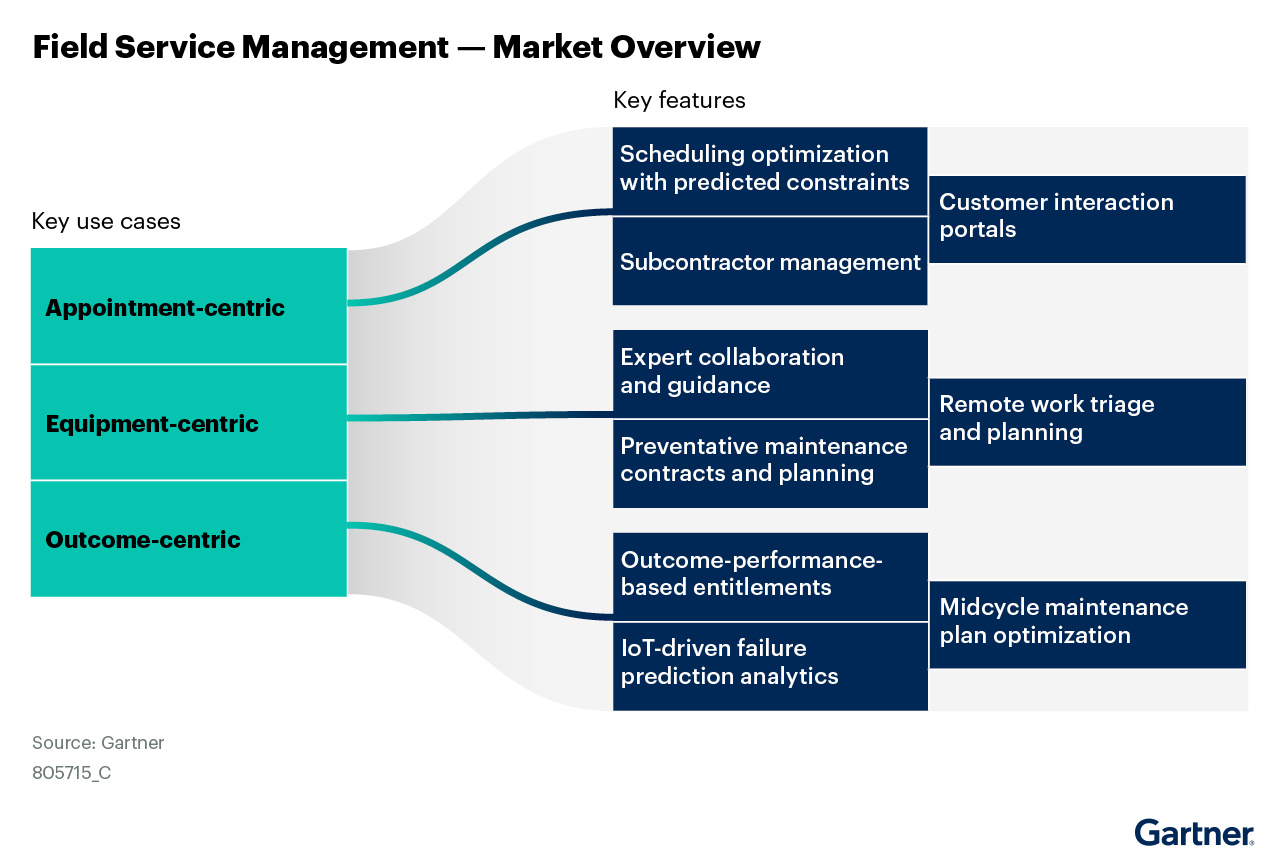
Profit and Nonprofit Industries
Most FSP organizations operate in a for-profit context, servicing customers’ mechanical capital equipment. Therefore, capabilities that enhance profitability, billing, contractual agreements and customer experience — such as customer effort and value enhancement — are crucial.
Industries Commonly Served by FSM Vendors
- Specialty and mechanical services: Financial services, home and business services, HVAC, security, life science and medical supplies.
- Manufacturing: High tech, industrial and medical devices.
- Telecom services: Installation and repair services.
Asset Management Organizations Using FSM
- Energy and utilities: Power and water providers, oil and gas companies.
- Telecom maintenance: Maintenance for owned infrastructure.
- Public sector: Government agencies like building inspection, infrastructure maintenance and repair (highway and bridge), and military services.
CIOs should recognize that vendors vary in industry expertise and should navigate each vendor’s internal structure to ensure the value proposition is industry-specific.
Commercial (B2B) and Residential (B2C) Service
FSM products support residential service providers with reactive, transactional work paid upon delivery. In contrast, commercial providers require a deeper understanding of customers’ equipment, offering planned, proactive, relationship-driven services, with profitability linked to long-term customer outcomes.
CIOs should ensure business and functional requirements reflect capabilities driven by the operation’s B2B or B2C nature.
Auditing and Inspections
Industries such as government agencies, home inspectors, and instrument providers and calibrators require technicians to visit locations and use FSM to optimize scheduling, manage the risk of underinspection and satisfy regulatory requirements. These “technicians,” often called “inspectors,” do not perform repairs or maintenance.
CIOs in inspection-focused organizations should prioritize vendor mobile app capabilities, including extensibility, configurability, data flow with neighboring apps and offline usability.
Other Service Types
Some industries that require highly specialized technicians, engineers or specialists use FSMs to schedule travel to locations. Examples include IT services or specific types of deliveries where service extends beyond collecting a proof-of-delivery (POD) signature. These extended services could be hazardous materials drop-off, tank collection, furniture delivery, appliance installation or “milk runs” (collection and storage from dairy locations).
Be prepared to source some key capabilities from independent software vendors.
CIOs and their teams should be prepared to use independent software vendors to supply some required capabilities that may not be included in the core solution. Examples include tracking truck capacity, customer signoff (e.g., PoD), and driver behavior telematics, which only a few FSMs handle.
Market Direction
Market Size, Growth and Forecast
The FSM market is valued at $5.0 billion and experienced strong growth of 18.8% year over year in 2023 and 12.8% in 2024.1 This growth is driven by both on-site and remotely connected service interactions across large organizations with high numbers of technicians and small entities. The annual growth rate is forecast to remain strong, with a projected average of 13.4% compound annual growth rate (CAGR) through 20281 (see also Market Share Analysis: Customer Service and Support, Worldwide, 2023).
Factors influencing FSM growth include:
- Advanced technologies: Machine learning, GenAI, and computer vision are transforming maintenance activities for field service technicians, enhancing margins by reducing high-effort, low-value tasks such as work summarization and spare parts sourcing.
- Enhanced self-service: Sophisticated portals and chatbots are increasing the number of requests handled without additional headcount.
- Workforce management: Solutions are improving management of blended workforces that include both employees and third-party resources, added due to labor shortages.
Market Influences and Trends
Factors influencing FSM vendors and their customers (FSPs) include:
- Mergers and acquisitions: FSPs’ demand for FSM solutions with broader capabilities is driving vendor partnerships and acquisitions in areas like knowledge management, augmented reality, IoT and warranty services.
- Composable solutions: Pressure from all-in-one vendors offering integrated capabilities is raising customer expectations for starting with a core solution and adding best-of-breed products.
- Industry-specific packaging: Leading FSM vendors are offering industry-specific solutions, often with premium add-ons like industry clouds that include sample data, workflows, analytics and integrations.
Vendors are adopting a “stack” approach, starting with a platform, followed by foundational capabilities, partner-specific functionalities and industry-specific components. This approach often includes adjacent product capabilities like augmented-reality collaboration, IoT signal processing and analytics. CIOs need to plan for integrating multiple SKUs and vendors to achieve comprehensive coverage..
Broadening Applicability of FSMs
As FSMs become more embedded, organizations aim to “do more with less” by covering more use cases using already-owned FSM functionality. Vendors are offering “lightweight” versions of features like scheduling and mobile apps to expand their market reach. Areas of notable expansion include:
- Utility teams needing different mobile app functionalities
- Insurance companies offering home warranty and property and casualty services
- Oil and gas companies focusing on parts prediction and mobile communications
- Governmental agencies conducting audits
- Crew-based contractors
Prospective buyers should review Gartner research relevant to the role of enterprise apps (see The Future of Enterprise Applications) and identify opportunities to develop composable solutions with an eye on the potential for vendors to combine.
Three Types of Vendor
FSM vendors are coalescing into three categories:
- CRM and ERP vendors: These vendors integrate FSM with customer engagement platforms, expanding through acquisitions and leveraging platform integration tools.
- Independent FSM vendors: Focused solely on field service, these vendors offer deep functionality and comprehensive solutions, often positioning themselves as trusted advisors.
- Vendors with adjacent focus: These vendors blend FSM with other capabilities, such as product life cycle management, supply chain, knowledge management and mobile app development.
Buyers should evaluate the impact of a vendor’s other activities, which can either complement or distract from FSM functionality. Aligning initiatives across functional areas may present additional opportunities. Reviewing Gartner composable enterprise research can help identify opportunities for developing composable solutions.
Market Analysis
FSM vendors target a diverse range of industries, and the evolution of features appeals differently across sectors.
GenAI, Knowledge-Centered Service and Machine Learning
FSPs are increasingly leveraging GenAI solutions to enhance service efficiency, consistency and speed (see How to Exploit AI in Field Service Management Scheduling). These solutions also support the application of KCS concepts, enabling the upskilling of junior technicians through “atomized” knowledge — content broken down into manageable components after each field service interaction.
Vendors have introduced features such as equipment summaries, action summaries for servicing equipment with similar issues, customer communication summaries and rewritten technician debriefs (see Innovation Insight: Agent Assist Technology Makes Faster, Smarter Human Agents).
To ensure rapid time to value, vendors have incorporated configuration capabilities that help organizations ground their data sources. This aids in synthesizing knowledge artifacts or summarizing activities from both internal and external data, mitigating the risk of GenAI producing inaccurate solutions based on irrelevant web information.
Connected Field Service
In the past year, there has been a notable increase in Gartner inquiries about connecting to customer-operated equipment, prompting several vendors to enhance their IoT functionality and integrations. This trend is particularly relevant for FSPs with equipment-centric use cases involving complex assets (see Why Machine Customers May Be Your Service Departments’ Best Advocates).
Connected field service represents a significant step in the maturity journey of FSPs. While condition-based maintenance (CBM) may not directly generate revenue, it requires FSPs to retrieve telemetry data from customer-operated equipment, either continuously or periodically. This data is crucial for effective previsit triage.
Some owner operators prefer service providers to offer both the service and the necessary edge hardware as a package. This requires that CIOs help to determine how to balance the cost of service and the cost of hardware (see “Edge as a Service” in Hype Cycle for Edge Computing). CIOs should explore how technology can facilitate this balance, ultimately supporting the transition to outcome-based contracts.
Overlooked Business-Driven Requirements
FSP organizations often face challenges in developing comprehensive functional requirements due to siloed services. Key requirements are often overlooked because buyers become distracted by flashy new functionality that vendors highlight. To address this, begin by creating a business capability model before considering functional requirements (see Develop Field Service Business Requirements Before Functional Requirements). This approach helps identify critical functions and avoids focusing on nonessential features. Gartner’s “most critical functions” and RFP toolkits can also help with this.
Requirements Vary by Use-Case Domain
Vendor capabilities often emphasize one domain over others. CIOs can use the vendor’s heritage and customer base to gauge their strengths. The vendor selection section provides examples of how vendors address these use cases. FSPs typically fall into one of three use-case domains:
- Appointment-centric: Characterized by schedule volatility, with technicians handling multiple work orders daily.
- Equipment-centric: Involves complex service requiring extensive diagnosis and planning.
- Outcome-centric: Focuses on equipment as a service, with IoT monitoring and predictive maintenance.
Please note that outcome-centric use cases often share some requirements with equipment-centric use cases but differ in aspects like site-level oversight and contract coverage. CIOs may choose to consider best-of-breed alternative vendors for capabilities like condition-based and predictive maintenance.
Customer Firmographics Addressed by Vendors
When planning and budgeting for FSM solutions, consider the following:
Industry
Many FSM vendors have traditionally focused on serving verticals within energy and utilities, manufacturing, and specialty service providers, particularly those in mechanical fields. However, their products are now widely applied across a range of other industries.
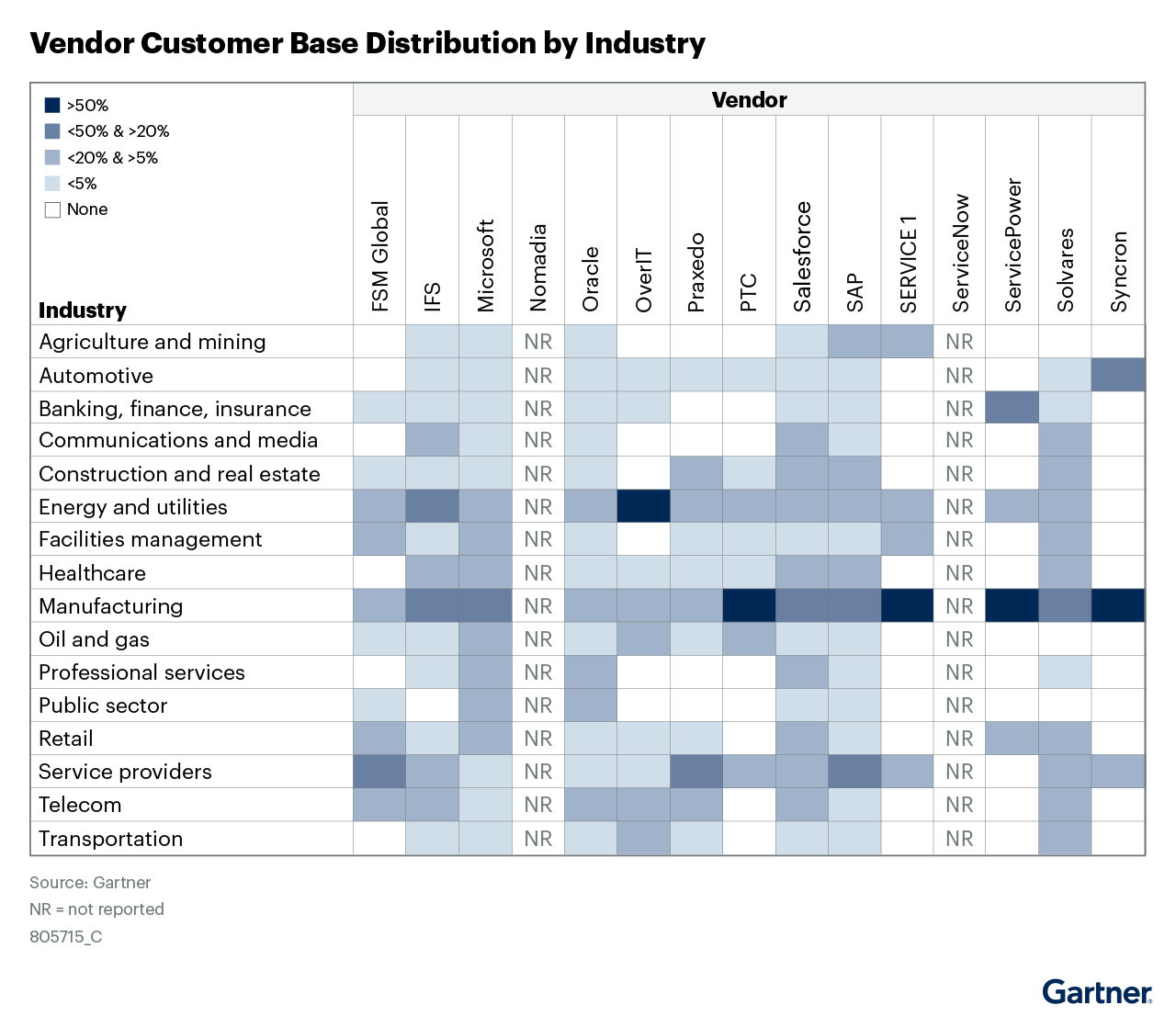
To provide insight into the FSM market’s focus on specific industries, we surveyed 15 vendors regarding their FSM software’s customer base distribution across 24 verticals (see Note 1 for a complete list). For clarity, we have consolidated this data into a simplified category list in Figure 2.
It’s important to note that a vendor’s current customer distribution across industries may not always align with its ideal target customer profile. Therefore, this information should not be the sole criterion for selecting target vendors. Each vendor’s profile below describes their typical target customers. We recommend using Figure 2 alongside vendor profiles and consulting with Gartner analysts to gain a comprehensive understanding of industry-specific coverage.
Geography
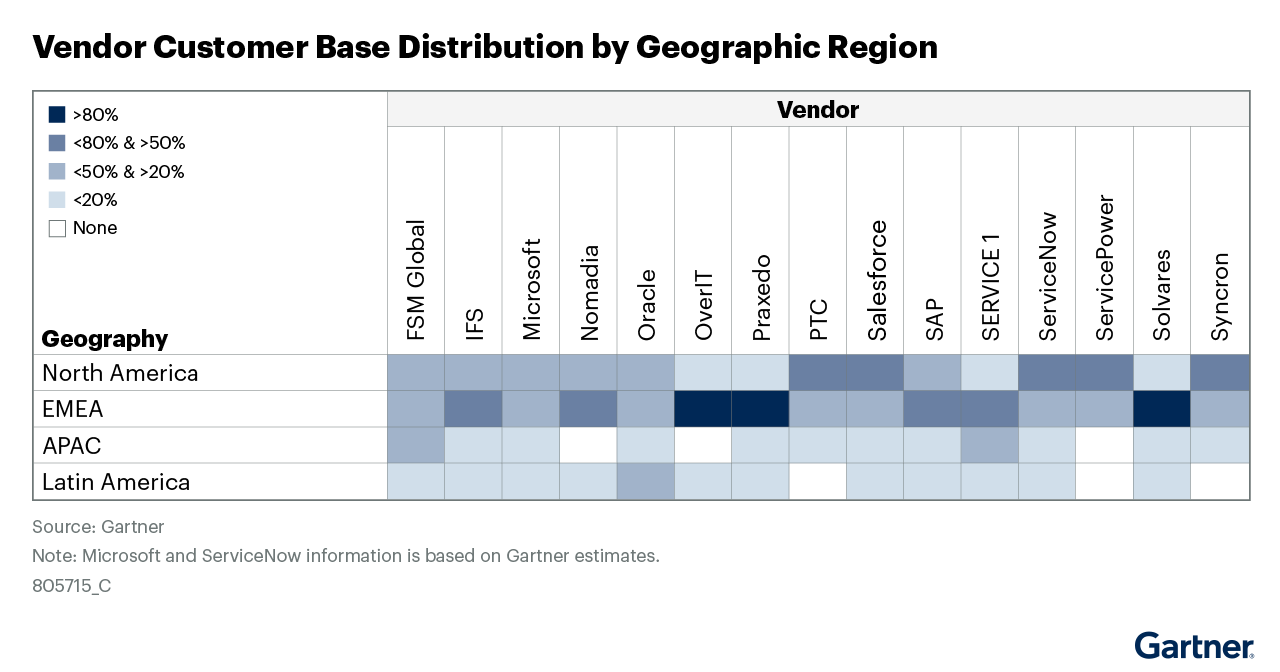
Understanding the geographical distribution of FSM offerings is crucial (see Figure 3). FSP should evaluate whether there are multiple vendors available in the regions where they plan to deploy the product. While a vendor’s absence in a specific country shouldn’t automatically disqualify their FSM product, it may suggest a scarcity of peer users and partners for collaboration in that area. This lack of local presence and collaboration opportunities could potentially increase the investment needed to achieve a stable and ROI-generating deployment.
Enterprise Size
When selecting an FSM vendor, it’s important to consider whether they can support the size of your enterprise. While size can often indicate organizational complexity in areas such as governance, regulatory exposure and scale, it is not the sole determinant. Requirements typically also depend on the nature of the use case — whether it is appointment-centric, equipment-centric or outcome-centric.
FSM vendors differ in the typical size of their customer deployments. Although most vendors claim they can tailor their products for smaller deployments, CIOs should:
- Assess if a vendor that serves large user bases can also effectively cater to smaller deployments.
- Use insights from the vendor’s reference customers, in addition to vendor-provided estimates, when planning and budgeting.
Representative Vendors
The vendors listed in this Market Guide do not imply an exhaustive list. This section is intended to provide more understanding of the market and its offerings.
Vendor Selection
The vendors featured in this Market Guide represent a selection of well-established companies from various regions, each addressing unique use cases, vertical requirements, and deployment modes (such as hosted or on-premises). This list is not exhaustive but includes a range of vendors from pure-play FSM providers to large ERP or CRM platform vendors, as well as those integrating complementary functionalities from other markets. Some vendors cater to B2B, while others focus on B2C use cases.
These vendors operate across multiple regions and industries, serving enterprises with technician teams ranging from 200 to 80,000 members. They consistently generate revenue from tens to hundreds of millions of dollars. Selection criteria included vendors demonstrating thought leadership and adoption by customers in live operations.
Each vendor possesses at least five of the following eight key capabilities, along with an extensible platform, packaged ERP and CRM integrations, and analytics and industry templates:
- Demand management and customer experience
- Connected equipment triage
- Work planning and scheduling
- Technician enablement
- Multiexperience service support
- Work order debrief
- Invoicing and reporting
- Agreements, operations, contractors
For each vendor covered, we provide insights to help readers understand market direction and highlight nuances in current functionality and emerging trends. This information aids in differentiating individual requirements. Specifically, for each vendor, we provide:
- Firmographics: Details such as headquarters location, funding status and the product representing the FSM market.
- Geographical and industry distribution: Information on the vendor’s customer base across regions and industries.
- Key functionality: Support for industries and use cases, such as appointment-centric or equipment-centric scenarios.
- Product strategy: Representation of the vendor’s strategy in recent or upcoming enhancements.
- Pricing considerations: While all vendors offer a per-user-per-month (PUPM) pricing structure, some provide alternative pricing models, such as consumption-based or hybrid options, which may be particularly relevant for organizations heavily utilizing subcontractors.
- Notable new customers: Recent additions to the vendor’s client list.
- Prepackaged integrations: Vendor-supported integrations in key areas commonly required by Gartner clients.
In the Market Direction section above, we described how vendors are coalescing into three categories. The table below displays the headquarters location, regional concentration of customers and category of representative FSM vendors.
Representative Vendors in Field Service Management
| Vendor | Headquarters | Regions* with customers in descending order of concentration | Category |
|---|---|---|---|
Dubai, UAE | NA, EMEA, APAC, LATAM | Independent FSM vendor | |
Linköping, Sweden | EMEA, NA, APAC, LATAM | CRM and ERP vendor | |
Redmond, Washington, U.S. | NA, EMEA, APAC, LATAM (Gartner estimates) | CRM and ERP vendor | |
Paris, France | EMEA, NA, APAC, LATAM | Focused on synergy with an adjacency | |
Austin, Texas, U.S. | NA, EMEA, LATAM, APAC | CRM and ERP vendor | |
Fiume Veneto, Italy | EMEA, LATAM, NA, APAC | Independent FSM vendor | |
Paris, France | EMEA, NA, APAC, LATAM | Independent FSM vendor | |
Boston, Massachusetts, U.S. | NA, EMEA, APAC, LATAM | Focused on synergy with an adjacency | |
San Francisco, California, U.S. | NA, EMEA, APAC, LATAM | CRM and ERP vendor | |
Walldorf, Germany | EMEA, NA, APAC, LATAM | CRM and ERP vendor | |
SERVICE 1 | Paderborn, Germany | EMEA, NA, APAC, LATAM | Independent FSM vendor |
Santa Clara, California, U.S. | NA, LATAM, EMEA, APAC (Gartner estimates) | CRM and ERP vendor | |
McLean, Virginia, U.S. | NA, EMEA | Independent FSM vendor | |
Heikendorf, Germany | EMEA, NA | Independent FSM vendor | |
Stockholm, Sweden | NA, EMEA, APAC | Focused on synergy with an adjacency | |
* APAC = Asia/Pacific; EMEA = Europe, the Middle East and Africa; LATAM = Latin America; NA = North America | |||
Source: Gartner
Vendor Profiles
FSM Global Technologies
FSM Global is headquartered in the UAE. It has customers primarily in North America and EMEA and also has a presence in APAC and a small presence in Latin America. It focuses on verticals like telecom, computer and office equipment, and energy but is horizontally distributed as well.
Its product strategy emphasizes proactive maintenance using IoT-driven insights and customer engagement through its dedicated customer portal. It also offers choice in licensing which includes a daily active users (DAU) model. It is working with customers on its GenAI-driven assistant, which uses insights about common equipment faults and FSM Global’s knowledge management to help field teams identify actions to improve customer equipment reliability.
Additionally, the FSM Grid product contains real-estate-owned (REO) functionality such as property management, bids management and claims management, which complements its FSM REO product.
Alternate pricing: Daily active users (DAU)
Notable new customers: Benco Dental, Enviro-Master, Meralco, Tata Steel, Zutek
Packaged connectors:
- ERP: Acumatica, Oracle, QuickBooks, SAP
- Customer engagement center: OpenText Service Manager, Salesforce, ServiceNow, Workday
- GIS: Bing, Google, OpenStreetMap
- IoT: myDevices, Thingsup
- Augmented reality: Blitzz
- Knowledge management: In-house
- Other: EZ Inspections, Field Nation (vendor network), Geotab (Fleet)
IFS
IFS is a private FSM software company based in Sweden and backed by EQT, TA and Hg. The product, IFS Cloud Service Management, has a large presence in EMEA and North America, with some customers in APAC and Latin America as well.
The top target industries for IFS include energy and utilities, manufacturing, specialty service, telecom, and oil and gas. Core features include IoT-enabled connected field service, predictive analytics and parts management for equipment-centric industries, and scheduling optimization, customer engagement and project life cycle management for appointment-centric industries.
The product strategy for IFS Cloud Service Management emphasizes field workforce management and knowledge-centered service using AI assistants across the service life cycle. Deployment options can include multitenant, single tenant or on-premises in any hybrid combination. It continues to enhance its AI capabilities, packaged integrations and industry workflows.
Recent acquisitions:
- EmpowerMX (2024): Maintenance, repair and operations (MRO)
- Copperleaf (2024): Asset investment planning (AIP)
- Poka (2023): Connected worker platform
Alternate pricing: Perpetual, consumption, pooled and flex licenses
Notable new customers: Exelon, ISTA, Rolls-Royce Power Systems, Stannah, TÜV NORD GROUP
Packaged connectors:
- ERP: IFS Cloud, SAP, Oracle, Microsoft Dynamics 365, Infor CloudSuite
- Customer engagement center: IFS CRM, Salesforce, Microsoft Dynamics 365
- CCaaS: IFS Customer Engagement Platform
- GIS: Bing, Esri ArcGIS, HERE, OpenStreetMap
- IoT: Microsoft Azure IoT, Crosser
- Augmented reality: Help Lightning
- Knowledge management: Help Lightning, IFS Cloud
- Document signatures: Docusign
- Other: Microsoft Teams, human capital management (HCM), CRM, EAM, IFS Advanced Forms, and Projects in IFS Cloud
Microsoft
Microsoft, a U.S.-based public software company, offers Dynamics 365 Frontline Applications for FSM. While much of its customer base is in the North America and EMEA regions, a significant percentage is elsewhere.
The product targets industries like manufacturing, energy, facilities management and home healthcare. Key features include Azure IoT-connected field service, a Power Apps-based mobile app for equipment-centric organizations, and scheduling optimization and recurring work support in appointment-centric industries.
Microsoft’s product strategy emphasizes integration with Microsoft 365 Copilot, Microsoft 365 and Dynamics 365. It includes connected field service, Dynamics 365 Remote Assist (augmented reality) and Guides. Guides provides task execution instructions (guided maintenance) via either self-service or assisted-service modes.
Alternate pricing: Per-device
Notable new customers: City FM, Dyno-Rod, Foley (CAT dealer), G&J Pepsi, Hobart Service, Lexmark, LifeLabs, Melbourne Airport, Wilo
Packaged connectors:
- ERP: Dynamics 365 Finance, Project Operations, and Business Central, and SAP
- Customer engagement center: Dynamics 365 Customer Service
- CCaaS: Dynamics 365 Contact Center
- GIS: Esri, EasyTerritory, LatLonGo, Maptaskr
- IoT: Acuity Brands, Azure IoT, Honeywell, ICONICS, VisiConnect360, Willow
- Augmented reality: Dynamics 365 Remote Assist and Guides, Remote Assist in Microsoft Teams
- Knowledge management: eGain, Microsoft SharePoint, Neuron7.ai, ORBIS Smart Knowledge Cloud
- Other: Hitachi Solutions (warranty), ITRAX 365 (safety), iProperty (facilities management)
Nomadia
Nomadia is a privately held organization based in France and funded by HG Capital and a private owners’ group. Its FSM offering, Nomadia Field Service, has a customer base that is primarily in EMEA, with a large presence in North America and many customers in Latin America.
Top industries include utilities, telecom, healthcare, and audit and monitoring. Functionality for predicting job duration and scheduling optimization are key functions for its appointment-centric customers. Its remote diagnostics and monitoring functionality can also be relevant in equipment-centric use cases.
Nomadia’s product strategy emphasizes combining complex scheduling (with over 150 business constraints) and telemetry-driven insights collected from customers’ equipment. Specific solutions to enhance safety and constant communications for technicians help support lone-worker scenarios. Nomadia is enhancing integrations and packaged workflows.
Alternate pricing: None
Notable new customers: Castalie, CETIH, Cover Care, Exquado, Mérieux Nutrisciences, Nexecur, Onis Contrôles, Vivisol
Recent acquisitions:
- Nomadvantage (2024): CRM for life sciences
- 7Opteam (July 2024): Scheduling and routing
- Coredinate (Nov 2024): Security and facility management
- Gazoleen (2025): FSM for HVAC
Packaged connectors:
- ERP: Microsoft, Salesforce, Oracle, IFS, SAP
- Customer engagement center: Microsoft, Salesforce, SAP, Comarch Healthcare
- GIS: HERE maps (not packaged)
- IoT: Koovea, Objenious, PTC
- Augmented reality: Inveniam, PTC
- Knowledge management: WalkMe (digital onboarding)
- Other: Docaposte (electronic signatures), sami (carbon footprint management)
Oracle
Oracle, a U.S.-based public company, offers Oracle Field Service (OFS) as part of the Oracle Fusion Cloud platform. OFS’s globally distributed customer base has a high concentration of customers in North America, medium numbers in EMEA and Latin America, and a small presence in APAC.
OFS focuses on the high tech and industrial manufacturing, telecommunications, construction and energy (including oil and gas) industries. It supports appointment-centric organizations with high-scale scheduling and forecasting which also manages complex crew dynamics. It supports equipment-centric FSPs by monitoring capital equipment and integrating its KCS and conversational intelligence.
Oracle’s OFS product strategy highlights accurate appointment time compliance using multiple AI-supported scheduling strategies at once, mobile resource enablement, support for third-party service administration and zero downtime upgrades. It is continuing to extend the role of AI and improve implementation speed.
Alternate pricing: Pooled named user (minimum purchase required)
Notable new customers: APi Group, CPS Energy, Diebold Nixdorf, Electricity Supply Board, National Oilwell Varco, NCR Voyix, Pike Corporation, Republic Services, Telecom Italia, Terracon, TMEIC, Zoll Medical
Packaged connectors:
- ERP: Oracle Asset-Based Service (Cloud ERP/SCM)
- Customer engagement center: Oracle Asset-Based Service (Fusion Service)
- CCaaS: Oracle Asset-Based Service (Fusion Service)
- GIS: Esri
- IoT: Oracle Asset-Based Service (Oracle SCM Smart Operations, IoT)
- Augmented reality: TechSee, CareAR, edX
- Knowledge management: Oracle Asset-Based Service (Fusion Knowledge)
- Other: DX4C (Comms), CX4U (Utilities), Infrastructure-Based Service, Projects
OverIT
OverIT is a private FSM software company headquartered in Italy. It has financial backing from Bain Capital and NB Renaissance. Its FSM product, OverIT NextGen Platform has customers primarily in the EMEA region, with a few in North America and Latin America. OverIT provides a suite of industry-tailored tools, such as a native GIS, augmented-reality-based work instructions and knowledge management.
The top industries for NextGen Platform include utilities and energy (including oil and gas), manufacturing and transportation (such as rail and highway). Customers benefit from NextGen Platform’s offline-enabled GIS packaging (customers can choose OEM or third-party products), linear asset and plant maintenance, and voice-controlled mobile apps.
OverIT’s product strategy highlights a field-centric UX and flexible deployment options (cloud or on-premises), scalable to tens of thousands of technicians. It also focuses on recurring maintenance scheduling and AI-driven guidance for technicians in the field via the mobile app.
Alternate pricing: None
Notable new customers: Bludigit by Italgas, Chelan PUD, EWE Netz, EVN, FS Group, Premier Energy, Sky Italia, Trenord
Packaged connectors:
- ERP: SAP, IBM Maximo Application Suite, Microsoft, Oracle, Infor
- Customer engagement center: Salesforce, ServiceNow, Oracle, Microsoft
- GIS: Esri, GE Smallworld, OpenLayer
- IoT: Azure IoT Hub, AVEVA PI Server
- Augmented reality: OverIT NextGen Field Collaboration (formerly SPACE1), Unreal Engine, Unity
- Knowledge management: OverIT Knowledge Management, Amazon Transcribe and Amazon Translate
- Other: Siemens (Spectrum Power ADMS), Picarro (gas leak detection), Oracle CC&B — NETA (billing), MDM (meter management), Qlik (analytics), Sphera (permit to work), Telematics (vehicle info), ARCOS (crew management)
Praxedo
Praxedo is a private FSM software company headquartered in France that is primarily self-funded but has financial partnerships with MBO+, BPI and Eurazeo. Its FSM product is also called Praxedo, and it has a customer base primarily in EMEA, with many customers in North America and a few in APAC and Latin America.
Praxedo’s focus industries include telecom, wastewater management, water distribution and renewable energies. Appointment-centric use cases benefit from its schedule optimization, recurring visit scheduling and its configurable customer self-service portal. For outsourced workforces, such as EV charging station and solar panel installs, its contractor management and project management help FSPs maintain communications between entities.
Praxedo’s product strategy emphasizes quick ROI and built-in connectors. It has enhanced AR content and delivery for technicians, remote expert guidance and curation for knowledge repository submissions.
Alternate pricing: None
Notable new customers: All West Communications, Daulto, Orange, POS Service, Qcells, Malezieux, SFR, WTC Fiber, ZAP
Packaged connectors:
- ERP: Sage Batigest Connect, EBP, Microsoft Dynamics 365 Business Central, Quickbooks Online, Salesforce, SAP, Sage X3, Sage 100
- Customer engagement center: Salesforce, Zendesk, ServiceNow
- GIS: HERE, Google Maps
- IoT: Grafana
- Augmented reality: ViiBE by Praxedo
- Knowledge management: ViiBE by Praxedo
- Other: Deepomatic (visual quality control), Ocean Technologies Group, Tomtom and Webfleet (fleet management) and Vertex (AI platform)
PTC
PTC is a U.S.-based public software company offering multiple FSM products with ServiceMax Core as the cross-industry solution. Its customer base is concentrated in North America, with a smaller but significant presence in EMEA and some presence in APAC. ServiceMax Core is part of PTC’s broader digital thread portfolio, which connects product data from design to service execution and service feedback, and back to design.
ServiceMax Core serves industrial equipment, high tech and medical device manufacturers, along with equipment dealers. Key capabilities include its project scheduling, predictive maintenance, remote expert guidance (provided by its Zinc application) and depot repair functionality.
PTC’s product strategy emphasizes complex workflow management support in mobile and connected field service, using an IoT product-agnostic approach that simplifies connection with other providers and helps improve equipment outcomes. PTC is enhancing its overall digital thread portfolio through tighter integrations and workflow optimizations.
Alternate pricing: None
Notable new customers: Artisan Design Group, Manitowoc (cranes), Mitsubishi Electric Power Products, Rapiscan Systems
Packaged connectors:
- ERP: SAP, Oracle ERP, NetSuite
- Customer engagement center/CCaaS: Salesforce Service Cloud
- GIS: Esri ArcGIS, Mapbox, GE Smallworld GIS
- IoT: ThingWorx, Bolt Data Connect, GE Predix
- Augmented reality: Vuforia Engine, Scope AR
- Knowledge management: Arbortext, Salesforce Knowledge, Aquant
- Other: Jitterbit, MuleSoft, OpenAI, Servigistics, Salesforce CPQ, Windchill PLM Software
Salesforce
Salesforce is a public CRM software vendor based in the United States. Its FSM product, Salesforce Field Service (SFS), has global distribution with heavy concentration in the United States, significant presence in EMEA and a smaller presence in APAC and Latin America. It also integrates with Salesforce’s broader ecosystem, including Service Cloud, Marketing Cloud and Commerce Cloud.
SFS is designed to cover all industries — with manufacturing, energy and utilities (including oil and gas), home services and healthcare being of particular focus. For appointment-centric use cases, SFS’s “truth-based” scheduling optimization assigns work directly to technicians rather than a slot and supports long-cycle project work as well as short-cycle inspection and break-fix work. For equipment-centric use cases, SFS offers parts prediction and an AI-agent-first set of templated, large language model (LLM)-agnostic capabilities through multiple modalities.
Salesforce’s product strategy for SFS includes additional configuration options and samples using GenAI to improve its support for proactive service, its extensibility, and the depth of its mobile app.
Alternate pricing: Salesforce Field Service offers usage-based options for contractors editions
Notable new customers: Axis Water Technologies, Fluvius, Guidion, PepsiCo, Powercor, Sonny’s, TOMRA Collection Australia
Packaged connectors:
- ERP: MuleSoft connectors for SAP S/4HANA, NetSuite, Microsoft Dynamics 365, Oracle JD Edwards
- Customer engagement center: Salesforce Service Cloud
- CCaaS: Service Cloud Voice
- GIS: HERE, Locana, Esri, Pitney Bowes, Google
- IoT: Waylay and Bolt via Salesforce Data Cloud
- Augmented reality: TechSee, SightCall, Apple ARKit
- Knowledge management: Salesforce Knowledge
SAP
SAP is a publicly held company with an FSM customer base that is globally distributed with concentration in EMEA and North America. Its SAP Field Service Management is part of a set of service-related products that include SAP Mobile Execution and Dynamic Forms and SAP Maintenance Assistant — which are also used in EAM use cases.
Top industries include utilities and industrial manufacturing. It also has a presence in professional services, oil and gas, and telecom, among several others. Key functionality includes its GenAI-based analysis of service history, IoT-enabled predictive services and 3D visual work instructions.
SAP’s product strategy emphasizes SAP business AI-driven workflows, integration with SAP ERP, crowd services for managing outsourced field service, and connected field service. SAP is enhancing its scheduling engine and AI-driven troubleshooting assistance functionality through a combination of internal development and partner extensions.
Alternate pricing: Transaction-based pricing for SAP Crowd Service
Notable new customers: BC Hydro, EDF Renewables, Hope Gas, Oklahoma City Water Utilities Trust, Siemens Energy, VINCI Energies
Packaged connectors:
- ERP: SAP S/4HANA, SAP ECC, SAP Business One, SAP Business ByDesign
- Customer engagement center: SAP CRM
- GIS: Amap, Esri (ArcGIS Online, On-premises), HERE
- IoT: SAP
- Augmented reality: SightCall, TeamViewer
- Knowledge management: SAP
SERVICE 1
SERVICE 1 (formerly GMS Development) is a private FSM Software company headquartered in Germany. The primary FSM product is also called SERVICE 1. Over half of SERVICE 1’s FSM customers are in EMEA and the rest are split primarily between North America and APAC regions.
The top verticals include medical device and industrial manufacturing, household appliances and HVAC service providers. These use noteworthy capabilities such as its contract entitlements management, short- and long-cycle work scheduling and enterprise knowledge management (which is integrated, but sold separately).
The product strategy for SERVICE 1 emphasizes schedule optimization, AI-driven process efficiencies and its modular, microservice-based platform that eases integration with leading CRM and ERP platforms. The product automates workflows based on equipment events and manages them with end-to-end contract life cycle functionality. SERVICE 1 is strengthening its augmented reality, conversational-intelligence-based repair guidance and AI-driven schedule optimization.
Alternate pricing: None
Notable new customers: AGRAVIS Raiffeisen AG, Mitsubishi Logisnext
Packaged connectors:
- ERP: Epicor, Odoo, SAP R/3, SAP S/4HANA
- Customer engagement center: Microsoft Dynamics 365, SAP Service Cloud, Salesforce, ServiceNow
- Augmented reality: oculavis, SightCall
- Knowledge management: Empolis Group
ServiceNow
ServiceNow is a publicly held software organization headquartered in the U.S. Its ServiceNow Field Service Management is built on ServiceNow’s Now platform and has a customer base that is heavily concentrated in North America, with significant representation in EMEA and some in APAC and Latin America.
Top verticals include telecommunications, healthcare, utilities, retail and public sector. Its mobile app and contractor management functions provide knowledge article recommendation, self-served conversational guidance via Now Assist and visual collaboration. Its scheduling and integration with other ServiceNow products such as IT asset management, project management, incident management and change management solutions are also key capabilities.
ServiceNow’s product strategy emphasizes extensibility, particularly in mobile, and consistency in platform with other ServiceNow products. It is also focused on GenAI tools, contractor marketplace, and out-of-the-box data and workflows.
Recent relevant acquisitions:
- Raytion (2024): AI search
- Advance Solutions’ Intella (2024): Talent acquisition
- 4Industry and EY Smart Daily Management Application (2024): Operational technology management
Alternate pricing: Transaction-based and organizationwide pricing options
Notable new customers: Gartner is aware of notable new customers in industries such as telecommunications, logistics and transportation, and retail; however, the names are not publicly shareable.
Packaged connectors:
- ERP: No comprehensive connectors, but ServiceNow integration platform has some objects
- Customer engagement center: ServiceNow Customer Service Management
- CCaaS: Amazon, Five9, Genesys
- GIS: ArcGIS
- IoT: Smart Operations, Volteo, Waylay
- Augmented reality: CareAR, ScreenMeet, SightCall
- Knowledge management: ServiceNow Knowledge Management
ServicePower
ServicePower is a private FSM vendor based in the U.S. and backed by Diversis Capital. It sells its product suite, ServicePower Field Service Management as a platform with three configurations: Employed Workforce, Contracted Workforce and Blended Workforce. ServicePower’s customer base is primarily in North America, but it also has a significant presence in EMEA.
ServicePower’s FSM platform optimizes service departments, third-party contractors and warranty administrators of major appliance, consumer electronics and building technology manufacturers. It also maintains a presence in home warranty, property and casualty insurers, and retail store service providers. Its AI-powered scheduling, customer self-service portal and prequalified service provider lists are key capabilities for appointment-centric organizations, especially those that outsource a portion of work. In addition, its claims management and support for complex inspections can benefit insurance providers.
ServicePower’s product strategy emphasizes scalability and configurability for scheduling optimization, supporting numerous constraints and an updated travel matrix functionality, which helps manage work across diverse population concentrations. ServicePower also enhances warranty management by improving adjudication and fraud detection, especially for jobs that require multientity collaboration or third-party administrators (TPAs).
Alternate pricing: Usage-based for contracted workforces
Notable new customers: Gartner is aware of notable new customers in verticals such as building technologies, insurance/warranty, retail and manufacturing; however, the names are not public.
Packaged connectors:
- GIS: HERE
- Augmented reality: Streem, Help Lightning
- Knowledge management: PROCIT
Solvares Group
Solvares is a private firm based in Germany with funding from Deutsche Beteiligungs AG (DBAG) and Five Arrows (Rothschild & Co.). Its FSM product FLS VISITOUR has distribution primarily in EMEA, with a small presence in North America. FLS refers to its trade name, Fast Lean Smart. FLS VISITOUR enhances CX and advanced scheduling, often replacing those functions in broader products.
Top industries of focus for the FLS VISITOUR product include property and facilities management, utilities (primarily meter installation and repair), inspections and surveys, and healthcare. For complex service use cases, Solvares typically integrates the product with an EAM or CRM and brings support for scheduling optimization. Appointment-centric use cases depend on its high-scale scheduling, forecasting and simulation capabilities, along with its self-service scheduling.
Solvares’ product strategy emphasizes driving cost-based efficiency in traffic-aware routing, scheduling and scenario planning, along with providing functionality that helps FSPs drive their customers’ success and level of effort. It is also investing in functionality to help it expand to additional countries and regions.
Alternate pricing: Flexibility for alternative models based on customer needs
Notable new customers: Affinity Water, Allianz NL, Anticimex, B&O Service, E.ON, Hobart, Samsung Europe, Sciensus, Innserve, TÜV Thüringen
Packaged connectors:
- ERP (including FSM): SAP ECC, SAP S/4HANA, Microsoft Dynamics 365, IBM Maximo Application Suite, Zinier, MRI Software
- Customer engagement center: Microsoft Dynamics 365 Customer Service
- CCaaS: Microsoft Dynamics 365
- GIS (including telematics): Webfleet, Seego
- IoT: Waylay
- Augmented reality: Help Lightning
- Knowledge management: Empolis Group
Syncron
Syncron is a privately held software firm headquartered in Sweden with backing from Summit Partners. Its FSM product, Syncron Service Fulfillment, has a customer base mostly in North America and EMEA, but there is also a small presence in APAC.
Top industries for Syncron Service Fulfillment include capital equipment manufacturers, dealers and service providers, particularly those that service complex equipment that has long life cycles. It integrates parts and product catalogs with work order management and knowledge management for a comprehensive equipment view, supporting guided maintenance and diagnostics. This functionality helps medical device manufacturers comply with U.S. federal regulations and also applies to automotive and warranty-driven use cases.
Syncron’s product strategy emphasizes warranty claims management, depot repair and inspection-driven use cases. It addresses tracking challenges that arise when the warranty, repair or refurbishment life cycle crosses entities. Syncron is known for its aftermarket parts logistics and planning capabilities.
Alternate pricing: Value-based pricing based on transaction count
Notable new customers: Gartner is aware of notable new customers in verticals such as automotive, and warranty but these are not public.
Packaged connectors:
- ERP: SAP connector via Neptune
- Customer engagement center: Integration with platforms like Zendesk and ServiceNow
- CCaaS: Custom integration with Five9
- GIS: Google Maps integration for locator functions
- IoT: Integration via ERP
- Knowledge management: Syncron Service Knowledge
- Other: UPS and FedEx
Market Recommendations
Build quick value GenAI and KCS projects to deliver smart insights:
- Catalog vendor capabilities such as embedded GenAI and consolidation from disparate sources.
- Identify quick wins such as accurate, context-aware instructions and expert collaboration.
- Reduce assistance friction across modes such as self-service, digital, human and hybrid.
- Support modalities for back-office teams, field teams via AR and customers via conversational AI.
Design connected field service, which will drive premium pricing and interaction with machine customers:
- Discuss overcoming obstacles like access to customer networks and machines and margin risk.
- Work with field service leaders to develop a strategy using the recommendations in Gartner’s Machine Customers research, including Adapt Machine Customer Sales Engagements or Risk Revenue Loss, to help mitigate risks.
Enable self-service to reduce customer effort:
- Use outside-in journey mapping in collaboration with field service leaders to identify opportunities to improve customer control and communication effectiveness.
- Evolve self-service using Reduce Customer Effort by Consolidating Field Service and Customer Service Communications Technology research to identify areas where both field service dispatch and customer service agent teams can utilize the same technology.
Ensure FSM vendors support all subcontractor life cycle stages:
- Document contractor journeys including onboarding, scheduling, change order (variance) management and payment.
- Develop business requirements that highlight differences in each stage of the work order life cycle when using outside contractors as compared to the same stages when using employees.
Help adopt scheduling optimization to improve productivity:
- Capture rules and objective weightings across teams and work types: installation, inspection, maintenance (proactive) and break-fix (reactive).
- Create a framework to assess vendors by using Launch Field Service Scheduling Optimization That Actually Works to identify areas to mitigate risks, How to Exploit AI in Field Service Management Scheduling to assess digital maturity and Toolkit: RFP for Field Service Management to seed requirements.
Note 1: List of Vertical Markets
- Agriculture and mining
- Automotive
- Banking, finance, insurance
- Communications and media
- Construction and real estate
- Energy and utilities
- Facilities management
- Healthcare:
- Healthcare — Home health
- Healthcare — Life sciences
- Healthcare — Other/unspecified
- Manufacturing:
- Manufacturing — High tech
- Manufacturing — Industrial
- Manufacturing — Medical devices
- Manufacturing — Other/unspecified
- Oil and gas
- Professional services
- Public sector
- Retail
- Service providers:
- Service providers — Financial services
- Service providers — Home and business services
- Service providers — HVAC
- Service providers — Security
- Service providers — Life sciences
- Service providers — Medical supplies
- Service providers — Medical supplies other/unspecified
- Telecom
- Transportation