Unlock Global Expansion: How Global Employer of Record Solutions Empower Tech CEOs
3 February 2025 - ID G00802308 - 9 min read
By Chris Pang, Kaustav Dey
Hiring the first few staff members in a new geography can be an extreme stretch in HR expertise and resources for many tech CEO organizations. Instead, tech CEOs can limit employment risk exposure and gain valuable experience by using a global employer of record solution.
Overview
Key Findings
- Many organizations operate a lean HR function that will be stretched if they need to hire and pay employees in a new and unfamiliar geography. Getting it wrong is not an option due to the compliance risk and penalties associated with employment rules, benefits and HR reporting needs.
- In addition to the salary and benefits cost, a global employer of record (EoR) provider may charge over $6,000 per individual employee annually.
- Some global EoR providers can also help customers source the talent needed for geographic expansion.
- Having staff under a global EoR provider may preclude tech CEOs from selling to sensitive or regulated customer segments.
Recommendations
- Simplify employment processes such as contracts, pay, benefits, reporting and compliance by using a global EoR solution.
- Optimize costs by monitoring the level and number of individuals covered by the EoR provider. Consider moving to in-house HR and direct employment when the number of individuals covered by an EoR provider in single geography exceeds 15.
- Facilitate local talent finding by using staffing services offered by EoR providers, but ensure you invest time and effort in selecting the right candidates for your operation.
- Mitigate contractual risk with customers by checking that existing customers do not have contracts forbidding the use of indirect employees. For new customers, ensure that your contracts cover the use of indirect employees and contractors.
Analysis
Many organizations tend to operate a lean HR function. Indeed, in a recent survey, 53% of HR operations and shared service leaders reported that their HR operation capacity was at capacity, while 23% reported it was over or far over capacity (see HR Shared Services Benchmarking Report).
For tech CEOs’ organizations, the HR capacity and capability shortfall is likely to be even more acute, which makes hiring and paying staff in a new geography daunting. Having staff in a new geography is also fraught with compliance risk if the HR function has little prior experience and/or bandwidth to understand the requirements. A global EoR solution can accelerate the process and provide peace of mind in complying with local employment regulations, needs and practices.
Global EoR solutions can be used to deploy staff in a new geography and to take advantage of talent not available at a home location because of cost or availability reasons. Global EoR solutions are not new and are different from professional employer organizations (PEOs),1 but based on Gartner inquiry observations, global EoR solutions are relatively unknown to many tech CEOs.
Global EoR solutions hire and manage workers on behalf of their client in a new geography, without the client needing to set up a legal entity. The global EoR provider is the full legal employer, thus assuming all employer-related responsibilities (HR, legal, benefits and payroll) and tasks on behalf of the client.
The predominant pricing model for EoR solutions is per employee per month, but some providers have a standard cost per entity. Gartner observes an average list price ranging from $500 to $600 per employee per month, meaning an annual cost of $6,000 to $7,200 per employee (which is in addition to the salary and benefits cost of the individual).2
Global EoR solutions feature in the Innovation Trigger zone in Gartner’s Hype Cycle for HR Technology, which further emphasizes the limited awareness of the service (see Hype Cycle for HR Technology, 2023). This can be an advantage for tech CEOs if they lack experience and in-house HR capabilities in a new geography.
Figure 1 provides a decision tree to help tech CEOs evaluate if they should use a global EoR solution.
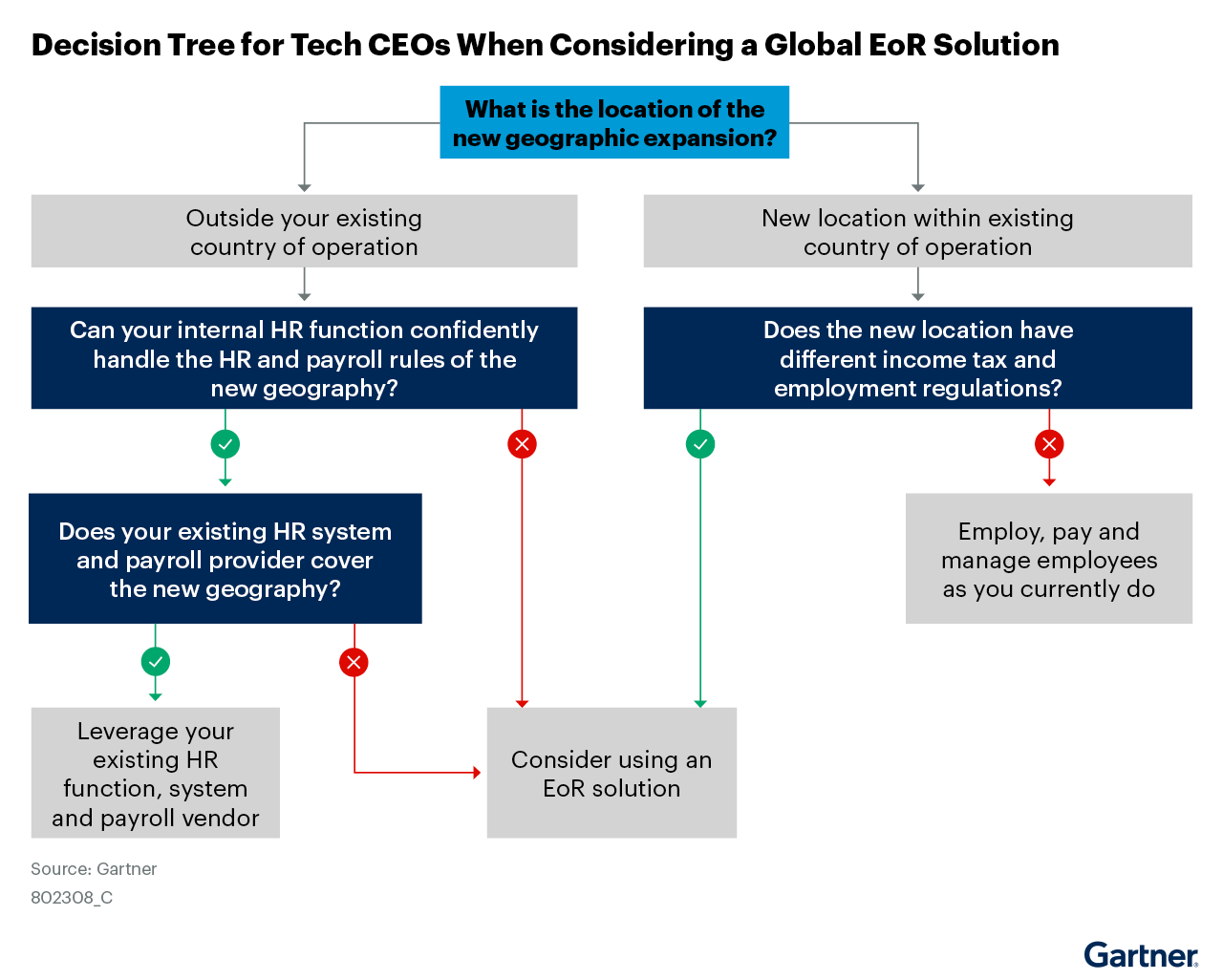
This research provides Tech CEOs the answers to five questions they should ask when considering the use of a global EoR solution.
- What are the business outcomes of using a global EoR provider?
- Faster and cheaper than setting up a new legal business entity. If the individuals in the new geography are for operational support rather than generating invoices and receiving payments, a global EoR provider can help stand up your resources faster. (Examples of operational support include software development, implementation/customer delivery, customer support and back-office processing.)
- Cost avoidance from having to set up an in-country HR team/function.
- Have “staff” in a new geography to recruit, supplement or supervise existing channel partners.
- Hire local individuals with knowledge of the local language, competitors, culture, business practices and what it takes to succeed in the new geography.
- What HR compliance risks can tech CEOs avoid?
- Employment compliance liability is owned by the global EoR vendor, which helps tech CEOs navigate local requirements for life events, resignations and terminations.
- Avoidance of co-employment issues.
- What additional advantages can the tech CEO’s organization gain?
- Employee development opportunity by allowing individuals to move to another country to assist in your company expansion plan.
- Staff retention by allowing key individuals who wish to move to another country (for their own reasons) to stay with your organization.
- Gain a level of separation when operating in geographies that have a reputational risk on the “home” organization due to local practices and culture.
- Provide employee benefits such as healthcare and retirement funds that are expensive and complex to initiate on a small scale.
- What else should I consider when using a global EoR provider?
- Talent. Some EoR providers help their clients to source and screen talent in the new geography, but for key roles the tech CEO organization should be in charge of recruiting to ensure they get the quality skills and quality needed.
- The EoR is the legal employer, which can create issues with business opportunities in sensitive and regulated industries. For example, government, financial services and healthcare customers are normally averse to dealing with providers who do have “their own” employees in-country or when part of delivering their solution involves using “not their own employees.”
- Data protection. If operating and engaging with European customers, General Data Protection Regulation (GDPR) rules apply. Therefore, delivering your service outside of Europe via global EoR staff can create issues. Similar rules may be in place for customers in other regions/countries.
- Learning opportunities. EoR solutions provide shielding from employment risks and compliance challenges, but do not absolve tech CEOs’ organizations from having to understand the risks and needs of employees in the geography. (Indeed, tech CEOs should learn those needs while using the service to ease direct hiring when the time arises.)
- HR system integration and compatibility. EoR solutions do not need full integration to your HR solution, but some integration is needed for key master HR data between yourself and the third party. This may entail additional effort and cost if you are not using a modern HR platform with APIs to more easily connect to other systems.
- Is using a global EoR a permanent solution?
- The answer depends on the number of individuals under contract by the global EoR provider and the tech CEO’s business plans for the geography.
Volume Considerations: Gartner observes most vendors charge on a per employee per month basis. With a list price in the range of $500 to $600 per employee, this means an annual cost of $6,000 to $7,200 per employee (in addition to the salary and benefits cost of the individual).3 To be more cost efficient, the staffing should be weighted toward senior and midrange roles so the cost of using the global EoR solution is proportionally less relative to the monthly salary.
Therefore, global EoR solutions are ideal for small or emerging employee populations (one to 15 individuals), but if the number of individuals needed scales, so will the cost of the global EoR service. Gartner typically recommends that when the global EoR managed individuals count exceeds 15 employees to evaluate your options, which are: (A) renegotiating pricing with the incumbent provider, (B) evaluating alternative EoR providers or (C) set up your own HR function to directly employ and manage those employees.
This is because the EoR solution cost for 15 to 20 employees in a single geography could pay for an HR resource in the home office or new office to begin to take control and directly employ and manage those employees.4 Further cost efficiencies are gained as headcount increases in the geography. The creation of a new legal entity can be challenging, but some global EoR providers support the process, offering to help set up a new legal entity and transitioning the staff over more seamlessly.
Business Considerations: Global EoR solutions are typically used in the starting phase of business expansion to have individuals working for the organization outside of established offices. But as the number of people needed grows, tech CEOs need to organically build their organization’s presence and create a legal entity. The latter is especially important if you are to operate and invoice customers locally. In such situations, establishing your own HR expertise and resources and directly employing individuals is a logical next step.
Another consideration is when selling to regulated and sensitive industries in the same or a different location where the client may insist they are dealing only with the vendor’s employees with no “outside” workers involved.
Background and Context
When expanding into a new geography, tech CEOs typically begin by employing a small number of employees in the country or region to initiate the endeavor. Conventionally, employment contracts, benefits and payroll are managed by the home HR manager/function. However, for many organizations, the knowledge and resources to confidently initiate and run the HR process in the new geography are generally very limited. Global EoR services are relatively unknown for tech CEOs, and leveraging such services can significantly reduce the friction and learning curve needed by the existing HR manager and function.
2023 Gartner Future of HR Shared Services HR Leader Survey. This survey was conducted to understand the current state of HR shared services, including topics such as structure, goals, user experience, process distribution and technology. The research was conducted online from 16 March through 2 May 2023 and contains responses from 68 HR shared services/HR operations leaders with representation from various geographies and industries.
1 Professional employer organizations differ from global EoRs by requiring tech CEOs’ organizations to have a legal entity in the new geography. PEOs also entail a co-employment relationship between the tech CEO’s organization, the employee and the PEO. PEO organizations can be more efficient when a legal entity is already established, whereas global EoR solutions are beneficial when setting up a legal entity is premature or not yet desired.
2 Based on Gartner analysis of “list” prices published on a number of global EoR provider websites.
3 Based on Gartner analysis of “list” prices published on a number of global EoR provider websites.
4 Assumed cost of a global EoR provider per employee per month at $500 = $6,000 per employee annually. Multiplied by 15 employees equals $90,000 in annual global EoR provider cost. At 20 employees in a single geography, the cost of a global EoR provider could exceed $120,000 annually.
The 2023 Gartner Future of HR Shared Services HR Leader Survey was conducted to understand the current state of HR shared services including topics such as structure, goals, user experience, process distribution and technology. The research was conducted online from 16 March to 2 May 2023 and contains responses from 68 HR shared services/HR operations leaders with representation from various geographies and industries. The survey was designed and developed by Gartner’s HR Practice research team.