5G Network Slicing: Unlock New Revenue With Near-Term Use Cases
22 April 2025 - ID G00764882 - 15 min read
By Susan Welsh
Network slicing is promising for 5G monetization, yet its application and integration into product portfolios present a challenge. CSP product leaders should focus on incorporating three near-term slicing use cases into product portfolios to drive revenue in B2B and B2B2X market segments.
Overview
Impacts
- 5G network slicing commercial deployment is at an early stage, and slicing capabilities will expand over time as standards and equipment evolve. To start, slicing will be deployed with an initial set of capabilities and most likely will not be ubiquitously available across an operator’s entire public network, impacting product go-to-market and monetization strategy and roadmap decisions.
- Slicing is the tool, not the product. Product leaders will be tasked with developing services that incorporate new network functionalities to drive increased value to customers, resulting in better market traction and monetization of 5G. Over time, a wide range of products will use network slicing as a way to enhance the value proposition to customers; slicing can also be a tool for CSPs to manage network resources internally.
- For most CSPs, initial opportunities to incorporate slicing into their product portfolio center around three approaches. These are enhanced reliability for fixed wireless access (FWA), support for 5G private mobile networks (PMNs) and multitenant VIP slices for premium connectivity to support enhanced service bundles or critical communications.
Recommendations
- Develop a portfolio incorporating network slicing by collaborating with your CIO or CTO and network leaders to align slicing capabilities, geographic coverage and network capacity to support use cases that address customer needs. Identify geographical areas with end-user profiles similar to successful proofs of concept (POCs), ensuring targeted and effective deployment, by using analytics.
- Focus on customer needs by leveraging network slicing to deliver value propositions that align with business outcomes for both enterprise and public sector clients, rather than starting with a view of slicing as a product. Initiate with POCs in strategically identified locations where potential buyers are most likely to align with the service value. Once validated, scale deployments to similar markets to maximize impact and ROI.
- Develop three categories of near-term use cases with (mostly) static slicing to improve the value propositions:
- Enhanced reliability for broadband with agile deployment for FWA slice
- Expanded deployment options and performance for PMN
- Enhanced service offerings that use multitenant VIP slice access for improved performance of applications (such as productivity and collaboration tools, video services, premium gaming and point-of-sales terminals)
Strategic Planning Assumption
By 2028, 30% of CSPs with 5G networks will incorporate network slicing in their B2B service portfolios, up from a handful in 2024.
Introduction
With the launch of 5G stand-alone networks, CSPs are assessing how to incorporate network slicing into product portfolios in order to drive further 5G revenue growth. Commercial deployments and network capabilities for 5G network slicing are at an early stage, and slicing capabilities and incorporation into service offerings will evolve over time.
CSPs in many markets are involved in trials, and some have launched initial commercial offerings to help evaluate and drive:
- Technology capabilities
- Slicing use cases
- Value propositions that will drive demand
- Business models to support go-to-market planning
- Broader ecosystem maturity (including a wide range of device types)
As early trials and offerings identify use cases and capabilities that deliver customer value and help to drive return on investment, CSPs will begin to scale deployments and invest in further slicing capabilities development.
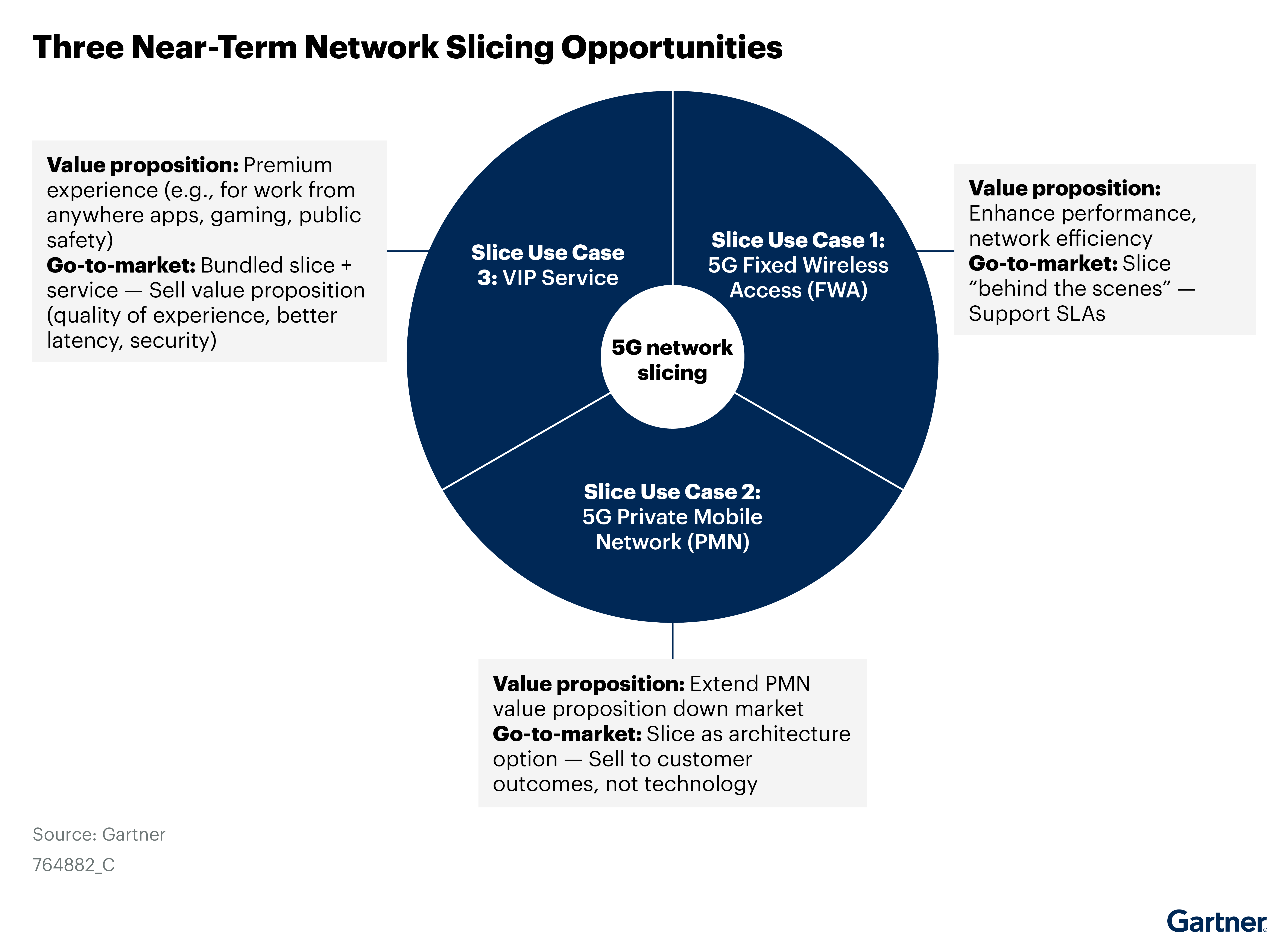
Emerging early stage opportunities for incorporating slicing into product portfolios center on three main areas (see Figure 1):
- 5G FWA: Integration with enhanced FWA for improved and more consistent performance
- 5G PMN: Cost-effective additional PMN service models and enhanced value propositions
- VIP service: Enablement of premium connectivity for uses that require lower latency, higher or more reliable data speeds or critical connections (e.g., public safety, video broadcasting, gaming, edge-computing-related use cases across multiple industries)
Impacts and Recommendations
Limited but Evolving Early-Stage Slicing Capabilities Will Shape Product Decisions
5G network slicing is best considered in a phased approach — leveraging its early capabilities and then gradually incorporating more advanced capabilities in products over the medium to long term.
Early-Stage Capabilities
Early-stage slicing capabilities most likely will not be ubiquitously available across the public network. CSPs will seek to prove out use cases and ROI before further geographic expansion, and the ability for roaming into other markets will not be widely available.
Most initial slicing will connect a device into a static slice for all its data use. Evolving device capabilities at the operating system (OS) level enable user equipment (UE) (e.g., smartphone or router) capability to select a slice for specific applications using user equipment route selection policy (URSP). This could be in conjunction with mobile device management (MDM) or more comprehensive unified endpoint management (UEM) solutions.
Network APIs, such as the CAMARA APIs for quality on demand (QoD) and network slice reservation, will support building apps that can request network slice access or network performance characteristics. These can be delivered using a slice either dynamically, as needed, or by connecting into a static always-on slice.
Medium- to Long-Term Incorporation of 5G Network Slicing in Products
As product leaders gain experience and market insights into initial slicing offers that incorporate slicing into products, they will refine and expand offerings that use 5G network slicing to deliver more tailored value propositions. Over the longer term, network, device and application capabilities will evolve to support more dynamic, on-demand slice creation and connection, with slice capabilities embedded in more applications and devices.
For example, we are likely to see network slicing bundled or automatically triggered with service offerings in digital marketplaces or enterprise self-service portals/management tools. The purchaser might not even be aware that the connectivity is provided with a network slice, but the slice will be used to support enhanced SLAs. Additionally, CSPs will offer tailored connectivity-as-a service (or slice-as-a-service) models provisioned using dynamic slicing capabilities. With the expanded use of network APIs (such as network slice reservation API), slicing capabilities will be exposed to developers through developer platforms for integration into B2B and B2C applications. These technical developments will support further product evolution for both horizontal (for example, video surveillance or AR) and vertical market offerings (e.g., video broadcast, smart agriculture, logistics, retail, healthcare, public safety) that incorporate slicing.
Product leaders will need to continue to iterate and evolve product portfolios and go-to-market (GTM) approaches in collaboration with the ecosystem as network slicing capabilities expand, the market matures and demand changes.
Recommendations:
- Collaborate with CIO or CTO and network leaders to align slicing capabilities, geographic coverage and network capacity to support use cases that address customer needs.
- Monitor emerging examples of slicing trials by other CSPs and engage with ecosystem partners to help evaluate and drive technology capabilities.
Market Traction With Slicing Requires Focus on Customer Value
Slicing is the tool, not the product. Keep in mind that you most likely won’t be selling slices — you will be using slicing to deliver the value proposition that supports business outcomes for your customers.
Each of the types of slicing-enabled services in the product portfolio (across B2B, B2B2X and modernized wholesale) need to focus on how to deliver value to customers and enable them to meet their business transformation goals. CSPs must also decide how the services can be priced to match that value.
CSPs and the broader ecosystem of partners, vendors and leading enterprise customers will co-innovate and explore options and solutions to evaluate value delivery and what business models and pricing approaches will best generate demand.
Product leaders will need to weigh the options and best-fit business and pricing models to drive maximum benefits to customers (including developers and end users) while maximizing margin contributions. For example, creating “snackable wholesale” connection into slicing through exposed APIs will transform how network access with tailored parameters gets consumed on demand across multiple CSPs in a market. Such offerings will exist alongside individual CSP higher-value premium retail services and vertically targeted solution sets, underpinned with dynamic network slicing capabilities.
Recommendations:
- CSP product leaders should work closely across functions and teams (including business and consumer units and network or technology) to define a select, core set of initial slicing use cases. The use cases should be based on concrete customer value propositions with required service parameters that can be delivered by the network at this stage.
- Lower the risk of launching services that fail to drive adoption by introducing slicing into existing services to enhance their value proposition or delivery (e.g., FWA) and starting with limited trials to further iterate on new services. Work with lead customers to innovate on use cases and prove out value impact.
- Request that your CIO or CTO clarifies to product teams what is technically feasible in the near term and aligns network coverage targets and performance. To ensure you develop use cases that will deliver concrete business value to customers, include the following in the scope for alignment:
- Indoor performance
- Latency
- Bandwidth (both downlink [DL] and uplink [UL])
- Reliability and mobility support
- Static or dynamic slicing capabilities
- Geographic coverage
- Collaborate with financial teams to accurately allocate slicing costs, ensuring they reflect realistic service value rather than conservative overestimations that could hinder service adoption. Keep in mind that part of the value of slicing is supporting network management to deliver service value propositions.
Keep it simple and create early wins with network slicing, offering lower-risk use cases by adding value into current service offerings as a starting point (e.g., FWA and private networks, which do not require mobility over large geographic areas).
Initial Slicing Opportunities Center on Three Categories of Use Cases
Develop the following three categories of near-term use cases to improve the value propositions.
FWA
Product leaders should offer enhanced performance, with an FWA slice used to manage the FWA connection. The offering could be set up using a local slice for a specific geographic market or centralized for multiple locations onto the same slice. As this use case does not require mobility support for the slice instance, it is a good use case to deliver value before 5G stand-alone and slicing capabilities are deployed more ubiquitously in the public wide-area network.
In addition to offering improved FWA service, the network team might use slicing to improve efficiency in the network and dynamically manage network capacity between FWA and mobility. For example, this could be to protect mobile users’ experience from bandwidth use by FWA, enabling more FWA connections to be supported in a particular geography.
Work with the network team to see how slicing benefits can be worked into the FWA product and go-to-market messaging to add value. This could be, for example, by enabling SLAs on uptime (and potentially even throughput minimum thresholds), similar to wireline access.
FWA service examples include:
- Orange France: Orange 5G+ Home internet over FWA using network slicing for up to 1 Gbps downlink (limited commercial launch, October 2024).1
- Telia Finland: Home broadband with FWA, slice used to support 100 Mbit/s home fixed 5G connections (commercially deployed 5G SA network, September 2022).2
- Safaricom: FWA secure slice for connectivity to enterprise locations and public or private cloud (trial on commercial 5G network, August 2022).3
5G PMN
CSPs may offer slicing within PMNs to support multiple use cases and isolate traffic between types of connections or users on the PMN. In addition, slicing on the public network can be positioned to deliver PMN service models and enhanced value propositions with reduced costs compared to dedicated deployments. Thus, slicing brings the benefits of PMN downmarket to more price-sensitive midsize or low-range large enterprises, expanding the addressable market.
Several approaches incorporate slicing to deliver 5G PMN service models. For example, CSPs can deploy PMN services with some dedicated components for the PMN customer and some in the public network (e.g., the UPF and core may be dedicated private network components, with RAN and transport slice on the public network). Alternatively, CSPs may offer a hybrid approach that involves a fully private, on-premises PMN with a public network slice to extend usage beyond the campus for wide-area coverage. A third option is to deliver the PMN service to the enterprise as a slice of the operator network using end-to-end slicing on the public network for PMN as a service (PMNaaS), which some CSPs refer to as virtual PMN. Slicing is positioned as a value proposition enabler, providing service enhancement and extension of the benefits of PMN in a virtual, slice-based service.
Examples of use of public network slicing to deliver PMN services include:
- China Telecom (Hubei Telecom): China State Grid Hubei, a PMN with dedicated UPF and 5G core for high-level security, safety, QoS and control, and using a public network slice in RAN and transport (deployed; presentations in 2024).4
- Drei Austria: Hybrid PMN with private core, inbuilding private wireless and slice on a public 5G network for a test platform for Frequentis to develop mission-critical public safety apps and services (announced July 2024).5
- Hrvatski Telekom (Deutsche Telekom subsidiary): Slicing to deliver private 5G at port, announced in mid-2024 with anticipated 2025 launch.6,7
Premium Mobile Connectivity
Initially, static slices can be used, either as a multitenant slice or for a single tenant, to offer premium connectivity for mobile use cases with enhanced connectivity needs. These uses may include augmented reality (AR), machine vision or critical communications. Two examples seen in several markets to date are the use of a slice for video broadcast during an event and public safety connections. URSP enables application-based connection into slices. Over time, examples of dynamic slicing (instantiated when needed) will be deployed.
Examples of premium connectivity services using slicing on live commercial networks include:
- Singtel: Priority video streaming for fans at sporting and other public events, using bundled slice and content on a Singtel app for a premium experience on-the-go value proposition. The offering was used, for example, at the FIFA World Cup (commercial network, October through December 2022) and in URSP-based Singtel 5G Priority premium business services (launched in 2024).8
- T-Mobile US: T-Priority service offers public safety priority access and baseline performance with a secure slice (commercial, launched September 2024).9,10
- Verizon: Enhanced video calling, available in limited areas on iPhone 14 and up with iOS 18.2 and applications enabled to use the slicing, initially free in premium consumer and business plans (limited commercial deployment, December 2024).11
- BT: Trial of PoS support with network slicing on a live commercial network, for sales at a Christmas market (December 2024).12
As device availability and network capabilities are enhanced in markets, likely candidates for product portfolios include work from anywhere and productivity apps and gaming (bundled slice + service). For example, use cases may include support for smartphones or tablets split for work and personal use, where specific work apps will be able to connect into a slice to which the enterprise subscribes. This functionality uses URSP as in Android 12+ smartphones and newer Apple iPhones and iPads,13 often in combination with MDM or UEM solutions. Multiple types of apps and subscriptions using slices with different service parameters will be supported on one device.
Another premium connectivity use case could be serving different industries to guarantee latency and reliability at the edge. This could cover a number of industry edge use cases in combination with public multiaccess edge compute (MEC) and other emerging technologies in industries like automotive and transportation or smart cities. See, for example: Innovation Insight: Industry Edge in Transportation and Automotive and Innovation Insight: Industry Edge Enhances Government Transformation.
Recommendations:
- Develop your initial categories of near-term use cases with (mostly) static slicing to improve the value propositions of the services.
- Focus go-to-market messaging on what business problems and pain points the product solves and how it enhances or changes how business is done, in customer-centric language.
- Start with more limited commercial trials and deployments to test the market reception and validate pricing.
Sources on FWA With Slicing
1 Orange Dishes Up Slices of 5G Standalone to Biz Users, LightReading; Orange France.
Sources and Additional Examples on PMN With Slicing
5 5G and Network Slicing Where It Matters Most, Three Group Solutions.
6 Rijeka Gateway Leads Way With 5G Stand-Alone Connectivity First, APM Terminals.
7 Other PMN examples:
- Virtual private network for smart grid (deployed): State Grid, China Unicom, Huawei, and TD Tech Win GSMA GLOMO’s “Best Private Network Solution” for The Inclusive 5G Smart Grid Solution, Huawei.
Sources and Additional Examples of Premium Connectivity With Slicing
8 Unlock Dedicated Network Resources With 5G Priority; Unlock New, 5G-Powered Opportunities With Network Slicing; Singtel Brings FIFA World Cup Qatar 2022 Excitement to All This November, Singtel.
9 T-Priority service: T‑Mobile Introduces ‘T-Priority’ Featuring the World’s First Network Slice for First Responders; America’s Best 5G Network Experience for First Responders; T‑Mobile Supports Southern California as Devastating Wildfires Impact Region (Updated 1/24), T-Mobile.
10 T-Mobile critical business operations run over a slice, supporting PoS terminals and ticketing scanners at sporting events: T‑Mobile Brings Major 5G Firsts to the PGA Championship; T‑Mobile to Debut New 5G-Fueled Fan Experiences at Formula 1 Heineken Silver Las Vegas Grand Prix, T-Mobile.
11 Verizon Redefines Clear Connections On-the-Go With the Launch of Enhanced Video Calling, Verizon. Also, Verizon Accelerates Network Slicing Technology With New Public Safety Use Case and Verizon Advances Network Technology at the Big Motorsports Event in Las Vegas, Verizon.
13 Apple Device Support for 5G Network Slicing, Apple.