Market Guide for Electronic Health Record Cloud Hosting and Migration Services
7 July 2025 - ID G00824868 - 13 min read
By Andrew Meyer
The market for EHR cloud hosting and data migration is growing as healthcare providers seek to reduce costs, enhance EHR access, and strengthen cybersecurity and disaster recovery capabilities. CIOs should use this Market Guide to inform their decision making about migrating EHR systems to the cloud.
Overview
Key Findings
- Healthcare providers are increasingly migrating their on-premises electronic health record (EHR) solutions to a cloud-based environment to reduce infrastructure costs and enhance scalability. This trend supports the need for improved accessibility and bolsters cybersecurity, following the increase in healthcare-targeted attacks and disaster recovery capabilities.
- The EHR cloud hosting and migration service market has two distinct segments. The first is dedicated to the migration of data and, if required, the EHR application, ensuring seamless transitions and integrity of information. The second segment encompasses cloud hosting solutions, which can be self-hosted utilizing hyperscalers, provided through EHR vendors or third-party providers.
- Healthcare providers without a clear migration plan face significant risks during EHR transitions. A comprehensive strategy is essential, encompassing robust data migration planning, rigorous testing protocols and explicit timelines. These components ensure data integrity and operational continuity, ultimately safeguarding patient care.
Recommendations
- Conduct a detailed cost-benefit analysis to assess the financial implications of transitioning from on-premises EHR systems to cloud-based solutions by gathering data on current operational costs, including hardware maintenance, software updates and staffing. Compare these costs with projected expenses for cloud services, taking into account subscription fees, potential training requirements and any associated migration costs.
- Choose the right cloud hosting model based on your specific needs and capabilities by performing a needs assessment to identify the unique characteristics of your EHR usage, such as data volume, user access patterns and security requirements. Evaluate self-hosted options via hyperscalers, and compare them with partnerships from established EHR vendors.
- Implement a comprehensive data migration plan that includes detailed timelines, testing protocols and support from service integrators by outlining a step-by-step approach to validate data integrity postmigration, and ensure staff are trained to handle any issues that may arise. Coordinate with service integrators to provide necessary support and ensure that EHR services are maintained during the migration, minimizing disruptions to patient care and business processes.
Market Definition
Gartner defines electronic health record (EHR) hosting and migration as services that facilitate application and data migration and provide the necessary computational, network and storage capacity for EHRs. These services may also include EHR as a service. The market includes EHR vendors, cloud providers and hosting services. Hosting services typically offer multiyear commitments, limited scalability of resources, and some professional and operational services. In contrast, cloud providers set themselves apart by offering more detailed billing, greater flexibility in resource scalability and minimal to no required services. EHR hosting and migration vendors provide consumption-based, as-a-service or standard monthly rate models.
EHR data migration and hosting services facilitate the transition to a cloud-based hosting solution for healthcare providers currently hosting on-premises or with their EHR vendor. Healthcare providers are transitioning to the cloud to host their EHRs to reduce costs, increase scalability, enhance accessibility, strengthen cybersecurity, strengthen disaster recovery capabilities, and support innovation and agility. Data migration involves transferring data from its current location to the target cloud environment. Hyperscalers typically recommend using one of their service integrator partners to support healthcare providers in preparing and migrating their data. In contrast, other vendors will offer these services directly and provide support throughout the migration journey.
EHR hosting can range from straightforward infrastructure as a service (IaaS), including network, storage and compute, to a more comprehensive SaaS offering that provides the EHR application, supporting software and operating system. The SaaS solution includes operations management, including deployment of updates and patches.
Healthcare providers may use cloud hosting in limited capacity for specific use cases, such as:
- Disaster recovery — Ensuring restoration of the EHR following any disaster, including natural events and cyberattacks
- Regulated delivery — Facilitating adherence to regulatory requirements through support for compliance, auditing and governance processes
- Cybersecurity protection — Proactively safeguarding the EHR with current and resilient cybersecurity measures
- Centralized access — Enabling simplified access to interconnected systems through a centralized point
- Real-time data analytics — Leveraging real-time data analytics to support dynamic health systems and precision medicine
- Machine learning and AI applications — Driving the transformation and modernization of EHRs through the application of machine learning and artificial intelligence
- Internet of Health Things — Enabling remote patient monitoring and home health initiatives via the Internet of Health Things
Mandatory Features
- Provision of IaaS as a standardized and highly automated service
- On-demand availability of computing resources, storage and networking capabilities
- Scalable and elastic resource operating in near real time
- Billing based on usage
- Access to self-service interfaces, including API and graphical user interface (GUI)
- Resources may be single or multitenant (at the service provider’s discretion)
- Hosting of resources is managed by the service provider
Common Features
- EHR as a service that provides an operating system, database and application
- EHR is accessible from any smart device with an internet connection and a web browser
- Disaster recovery and data backup to ensure business continuity following managed software updates and patches
- Ability to scale to accommodate more users or higher usage without the need for additional infrastructure
- Healthcare data exchange and persistence standards
- Analytic and reporting tools to help gain insights from the data
- Tools to monitor the performance of the EHR in the new cloud environment
- A detailed playbook that includes the planning activities, requirements, dependencies and risks to create a comprehensive migration plan
- EHR vendors work with you to agree on the strategy for moving the application (such as rehosting, replatforming or refactoring)
- A rigorous testing plan to ensure the application and data work correctly in the new environment
- A contingency plan to mitigate against failures and data loss
- Support for the continued integration of the EHR with third-party services
Market Description
The EHR cloud hosting and migration services market comprises a set of options offered by many vendors, including EHR, hyperscaler and hosting service vendors. The market has two distinct parts: the first supports the migration of data and, depending on the hosting model, the migration of the application. The second part is the cloud hosting solution, which can be self-hosted using one of the hyperscalers, hosted by an EHR vendor or by a third-party provider that provides services up to and including a complete EHR as a service offering.
Data and Application Migration
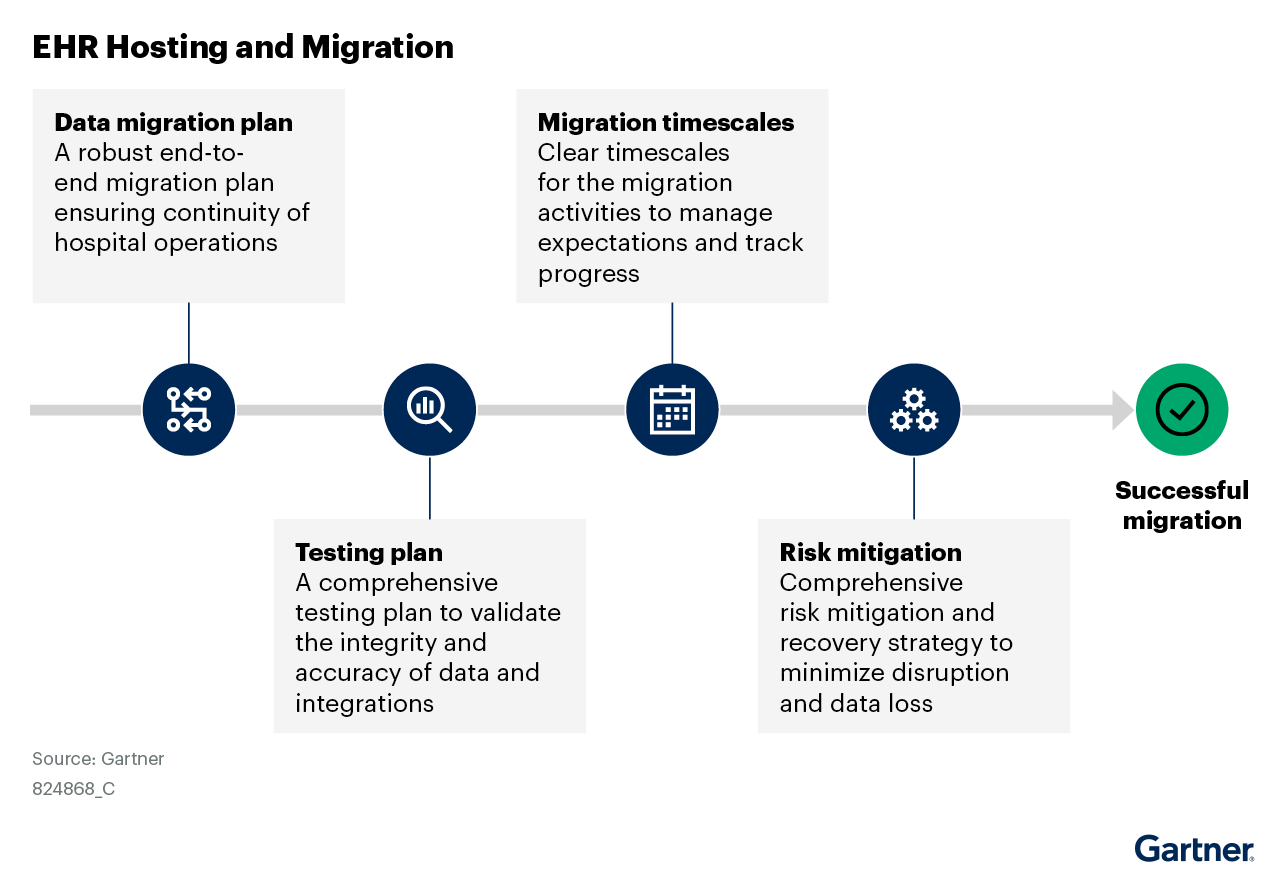
EHR data migration involves the complex process of transferring data from its current location to a cloud-based environment. Hyperscalers often facilitate this transition and recommend using service integrator partners to assist healthcare providers in preparing and executing their data migration. Other vendors, such as EHR and service providers, offer direct support throughout the migration journey, ensuring a seamless transition to the cloud. All vendors and their partners supporting data migration should provide, at a minimum, a robust end-to-end data migration plan, a comprehensive testing plan, timescales for data migration completion, and a risk mitigation and recovery strategy (see Figure 1).
EHR application migration is provided systematically, even for a straightforward rehosting (lift and shift). This should include, at a minimum, a review of application integrations, such as order communications, ancillary systems and patient monitoring devices, to ensure the continuation of these services.
EHR Cloud Hosting
The vendor landscape is made up of a diverse set of providers that include:
- Hyperscale cloud providers: The largest cloud service providers offer a wide range of services, such as infrastructure as a service (IaaS), platform as a service (PaaS), distributed cloud edge computing and sovereignty cloud solutions. Hosting vendors understand the strategic importance of the EHR and offer flexibility on the hosting and payment models.
- Cloud vendors: Smaller than the hyperscale vendors, cloud vendors focus on the healthcare industry vertical to offer software as a service (SaaS), combining technology, staffing and processes into a packaged service.
- EHR software vendors: A growing number of EHR vendors offer hosting services, including PaaS and SaaS.
- Global system integrators (GSIs)/managed service providers (MSPs): These organizations combine technology, staffing and processes into a packaged service.
Market Direction
The EHR cloud hosting market is expanding quickly, shifting toward platform and EHR-as-a-service models. To some extent, these models have been influenced by Oracle’s acquisition of Cerner and its aspiration to migrate customers to Oracle Cloud Infrastructure (OCI), as well as to accelerate the development and deployment of AI capabilities into clinical and administrative workflows. This has been a turning point for the industry and an opportunity for some healthcare providers to consider alternative EHRs. It has given others optimism that these vendors will move toward a modern architecture and accelerate the delivery of new features.
Healthcare provider CIOs, faced with reduced budgets, skills shortages and the demand for data-driven insights, are refocusing their resources away from managing colocated data centers. Instead, they are outsourcing those responsibilities to someone else so that they can focus on areas that their organization sees as more valuable, such as using data for better planning, informing population health and conducting research. As a result, hosting by EHR vendors and cloud vendors offering SaaS capabilities will continue to be a favored model.
Healthcare providers currently favor hosting EHR vendors over other models. Epic states that 79% of its new implementations are hosted by Epic, while Oracle aims to migrate all its EHR customers to OCI.
Vendors will still aim to attract healthcare providers, as the hosting services are profitable and the EHR is a strategically important system. Therefore, if a cloud vendor hosts an EHR for a healthcare provider, it becomes a strategic vendor and has a greater opportunity to sell other products and services, primarily in data and analytics.
Market Analysis
The EHR cloud hosting and migration services market is poised for significant expansion. Fortune Business Insights reports that the global healthcare cloud computing market is expected to expand from $63.55 billion in 2025 to $197 billion by 2032, with a compound annual growth rate of 17.6% during the forecast period (2025 through 2032). North America currently leads the global healthcare cloud computing market, accounting for a 40% share in 2024.1
The Factors Driving Growth in Wider Healthcare and EHR Cloud Hosting
- The exponential growth in healthcare data: The explosive growth of digital healthcare data, including images, digital pathology slides and genomics, has resulted in a need for a different architectural approach. Combined with clinical workloads that demand solutions that can access EHR quickly to deliver fast and high-quality patient outcomes, this increases storage pressures.
- Capitalizing on the growing amount of data: The growth of healthcare data presents various data and analytic opportunities. Cloud hosting best serves the ability to easily access data from EHRs and other systems of records, with an emphasis on rapid data access, compliance and the need for storage systems that are scalable, agile and secure.
- The growing appetite for GenAI: GenAI solutions that can simplify administrative tasks, such as scheduling appointments and billing, and clinical workflows that have eased the pressures on clinicians, like ambient scribe and case note summarization, require the power of cloud computing to provide these capabilities.
- Reimagining the EHR: EHRs have long been criticized for their poor user experience and their contribution to clinician burnout. Following Oracle’s acquisition of Cerner in 2022, they are building the next-generation EHR that is native to OCI and the Oracle technology stack. They have reimagined the EHR to one that no longer relies on drop-down menus and checkboxes, but is voice-controlled and accessible anywhere. InterSystems has already released its own reimagined EHR, and other vendors are in the planning stage.
- Cloud migration value proposition: The benefits of cloud migration, such as scalability, flexibility and cost-effectiveness, continue to drive healthcare providers to transition infrastructure to the cloud. Additionally, there is a natural, organic workflow migration as newer software solutions, including EHRs, are increasingly offered in the cloud.
The Factors Holding the EHR Hosting Market Back
- Data sovereignty: Hosting EHRs in the cloud raises several sovereignty concerns, especially for healthcare providers operating under regulatory frameworks such as the General Data Protection Regulation (GDPR) and the European Health Data Space. Data stored in one country may be subject to the laws of another — for example, the U.S. Clarifying Lawful Overseas Use of Data (CLOUD) Act, which allows U.S. authorities to access data held by American cloud providers, regardless of where it is stored.2
- Security concerns: Keeping patient data private is a top priority for CIOs (see 2025 CIO Agenda for Healthcare Providers: Insights for Strategic Planning), especially as the number of cyberattacks against healthcare providers is increasing. The impact can devastate healthcare providers, resulting in legal redress and reputational damage. These risks can prevent healthcare providers from migrating their EHRs to the cloud.
- Migration complexity and costs: Migrating an EHR is not a cost-free and straightforward process. The initial upfront investment can be substantial and introduce risk to the organization’s operation. These factors can limit the market’s growth.
- Interoperability issues: Concerns about being tied to a single vendor’s ecosystem and difficulties in integrating with other healthcare IT systems limit flexibility and slow adoption.
- Downtime concerns: Organizations are hesitant to rely on external hosting providers because they fear potential service outages or loss of access to critical patient data.
The Unmet Needs of EHR Cloud Hosting and Migration
- Local presence: Vendors not offering cloud services in the customer’s country will find it harder to meet data privacy and sovereignty in the cloud. Some use cases will require high performance and proximity to healthcare organizations to achieve the lowest latency, for example, serving large clinical images.
- Roadmap direction: Healthcare CIOs working with EHR hosting vendors may feel uncomfortable when the local account and support team have limited control over technical direction.
Representative Vendors
The vendors listed in this Market Guide do not imply an exhaustive list. This section is intended to provide more understanding of the market and its offerings.
The vendors listed in this Market Guide do not imply an exhaustive list. This section is intended to provide more understanding of the market and its offerings.
Gartner has included a range of vendors in this Market Guide to ensure coverage from a capabilities perspective. Those included, as listed in Table 1, are:
- Visible to Gartner clients (based on inquiries)
- Variable in size and distribution to reflect the buying population
Vendor Selection
Representative Vendors in the Electronic Health Record and Migration Market
Vendor | Products |
Managed Services, Cloud Hosting | |
IaaS, PaaS | |
Managed Service, Cloud Hosting | |
PaaS, SaaS | |
Managed Service, Cloud Hosting | |
Managed Service, Cloud Hosting | |
PaaS, SaaS | |
PaaS, SaaS | |
IaaS, PaaS, SaaS | |
IaaS, PaaS, SaaS | |
IaaS, PaaS, SaaS | |
Source: Gartner (July 2025)
Market Recommendations
- Conduct a detailed cost-benefit analysis to assess the financial implications of transitioning from on-premises EHR systems to cloud-based solutions by gathering data on current operational costs, including hardware maintenance, software updates and staffing. Compare these costs with projected expenses for cloud services, taking into account subscription fees, potential training requirements and any associated migration costs.
- Choose the right cloud-hosting model based on your specific needs and capabilities by performing a needs assessment to identify the unique characteristics of your EHR usage, such as data volume, user access patterns and security requirements. Evaluate self-hosted options via hyperscalers and compare them with partnerships from established EHR vendors.
- Implement a comprehensive data migration plan that includes detailed timelines, testing protocols and support from service integrators by outlining a step-by-step approach to validate data integrity postmigration, and ensure staff are trained to handle any issues that may arise. Coordinate with service integrators to provide necessary support and ensure that EHR services are maintained during the migration, minimizing disruptions to patient care and business processes.
2 Sovereign Cloud Geopolitical Risks, KuppingerCole.
Note 1: Gartner’s Initial Market Coverage
This Market Guide provides Gartner’s initial market coverage and focuses on the market definition, rationale for the market and market dynamics.