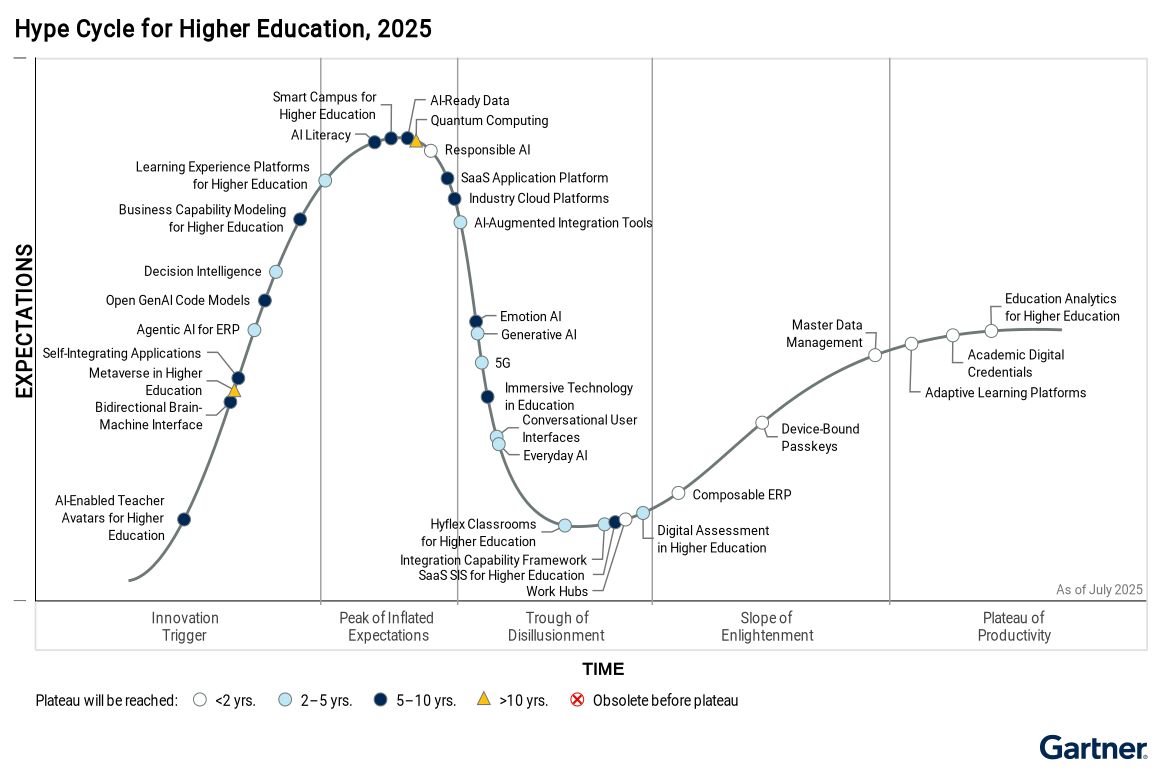
Hype Cycle for Higher Education, 2025
ARCHIVED
17 July 2025 - ID G00829564 - 137 min readBy Marlena Brown
This Hype Cycle highlights innovations that offer potential to modernize IT, enhance the digital workplace and personalize learning. Higher education CIOs can use it to evaluate investments and adoption risks, aligning with strategic goals for accessible and relevant education.
Analysis
What You Need to Know
In the 2025 Gartner CIO and Technology Executive Survey, higher education respondents ranked improving the customer experience (79%), enhancing the digital workplace (75%) and acquiring new customers (67%) as the top business outcomes of their organizations’ digital technology investments.1
CIOs must also plan for broader long-term trends, including value-driven analytics, personalizing student experiences, modernizing IT models, and enhancing student pathways to meet stakeholder expectations for accessible, relevant education.
To strategically pursue these initiatives, CIOs have to balance digital advancement with financial pressures and uncertainty, underscoring the complex equilibrium needed in today’s educational landscape.
This year’s Hype Cycle features innovations transforming support and teaching models, accelerating personalized student experiences, enhancing staff efficiency and converging technologies, with some innovations merging into more comprehensive solutions
The Hype Cycle
Innovations are transforming the learner experience, workplace and IT operating models.
- Personalized Learning Experience: AI-enabled avatar teachers for higher education can transform the learning experience by providing interactive, tailored instruction through online and holographic platforms.
- Enhancing the Digital Workplace: Agentic AI for ERP in higher education uses natural language processing to streamline administrative tasks such as budgeting, faculty hiring and onboarding, and purchasing.
- Modernizing IT Operating Models: Business capability modeling (BCM) for higher education visually maps core functions, aligns tools and support, and integrates capabilities like digital content creation with IT platforms and services.
Innovations showing the most progression are aligned with business trends around increased operational efficiency and enhancing the student experience.
- Accelerating Value-Outcome-Driven Analytics: The acceleration of AI literacy and education analytics for higher education emphasizes foundational elements for data readiness and awareness designed to deliver actionable insights that enhance learner outcomes, optimize resources and modernize IT operations.
- Improving Customer Experience: The progression of adaptive learning platforms and emotion AI focuses on innovations that personalize the academic journey and support well-being, delivering accessible, personalized education.
- Enhancing the Digital Workplace: The momentum of everyday AI and generative AI (GenAI) marks a shift from possibility to practical application. The shift is most prevalent in administrative tasks designed to enhance faculty and staff efficiency.
- Enhancing Student Value and Pathways: The maturing of academic digital credentials highlights the changing student pathways and associated need to capture various learning credentials — from a multitude of providers — to demonstrate learning and increase employability.
Not all innovations have progressed. The stagnation of self-integrating applications, quantum computing and AI-augmented integration tools highlights technical challenges and shifting priorities, with financial pressures steering focus toward innovations that offer more immediate educational benefits.
The Priority Matrix
Gartner anticipates 18 of the 34 innovations on this Hype Cycle to reach mainstream adoption within the next five years, illustrating the significant impact of technology on the evolving landscape of higher education. These innovations provide opportunities to:
- Modernize IT systems and operational models, ensuring institutions can swiftly adapt to technological advancements; meet educational demands efficiently; and deliver appropriate cost optimization.
- Enhance the digital workplace by implementing AI-driven solutions that streamline administrative processes, reduce workload and boost productivity for faculty and staff.
- Personalize the student experience through innovative platforms that offer tailored learning paths, fostering greater engagement and improving educational outcomes.
- Strengthen the pathways to student success by capturing and validating diverse learning experiences, thereby increasing students’ readiness for the workforce and enhancing their employability.
CIOs must gauge how this Hype Cycle’s innovations fit with their institutional strategies and prepare now for deployment.
CIOs focused on enhancing their institutions’ digital capabilities should:
- Prioritize initiatives on the transformational and high-benefit rating levels to achieve the greatest potential for business outcomes.
- Formulate a technology roadmap by considering the institutional context and assessing the innovations’ relevance and maturity, particularly those with longer maturation periods, as they may be surpassed by advanced technologies or integrated into broader architectures.
- Experiment with multiple innovations designed for similar outcomes to minimize the risk associated with investing in any single innovation, thereby increasing the likelihood of achieving desired business results.
Priority Matrix for Higher Education, 2025
| Benefit | Years to Mainstream Adoption | |||
|---|---|---|---|---|
| Less Than 2 Years | 2 to 5 Years | 5 to 10 Years | More Than 10 Years | |
Transformational | ||||
High | ||||
Moderate | ||||
Low | ||||
Source: Gartner (July 2025)
Off the Hype Cycle
The following innovations have been removed from this year’s Hype Cycle because they have been surpassed by advanced AI, mainstream adoption and integration into broader business architectures:
- Blockchain in higher education has been removed from this year’s Hype Cycle because innovations like device-bound passkeys and digital credentials offer enhanced security and efficiency, providing sophisticated solutions for managing and verifying digital transactions and credentials in higher education.
- Business ecosystem modeling has been subsumed by other innovations such as integration capability framework and decision intelligence. These innovations have been integrated as key techniques and practices within the broader business architecture.
- Citizen developers has reached the Plateau of Productivity, indicating that it is no longer a novel concept but a well-established practice within many organizations. This maturity suggests that organizations are beginning to see tangible benefits from empowering non-IT employees to create and extend technology capabilities.
- Design thinking has been removed from this year’s Hype Cycle; it has reached mainstream status and has become an integral part of standard planning and operational activities, as evidenced by increased use of journey mapping and other experience-focused techniques.
- Robotic process automation for higher education has been removed from the Hype Cycle, as it is being incorporated into advanced AI technologies that offer dynamic problem-solving capabilities without relying on predefined scripts, which allows for more flexible and autonomous operations.
On the Rise
AI-Enabled Teacher Avatars for Higher Education
Analysis By: Tony Sheehan
Benefit Rating: High
Market Penetration: Less than 1% of target audience
Maturity: Emerging
Definition:
AI-enabled avatars leverage AI, simulated voice/characters and appropriate knowledge bases to deliver personalized teaching of foundational programs. They are informed by large volumes of institutionally approved content and may be deployed in online, immersive and, as holograms, in physical classroom environments.
Why This Is Important
Higher education institutions are evolving teaching, learning, student engagement and experience, yet must also build critical thinking in an age of content commoditization. Higher education AI pilots have demonstrated the potential of AI teaching assistants guided by educational content. The evolution of such text-based chatbots into multimodal AI-enabled avatar teachers offers the potential to personalize learning at scale and unlock institutions from constraints of passive content delivery.
Business Impact
The rise of AI avatar teachers will enable institutions to rapidly reshape existing content assets into teaching materials in a style beyond static video and text to better engage each individual. They can potentially scale the delivery of core teaching assets and may help develop new revenue streams. They would also enhance universities’ abilities to continuously update curricula based on latest research and rich context case examples.
Drivers
- Rethinking education: The need to reinvent has led institutions to seek out new revenue opportunities and approaches to enhance student experience engagement and success.
- Content commoditization: AI-generated content is accelerating the distribution of existing content and undermining student satisfaction with extended lecture-based delivery.
- Insights from AI pilots: Early-stage text-based GenAI pilots have shown some positive impacts on learner engagement.
- Technology readiness: AI avatars offer the potential for a different 24/7 teaching experience for core content. They are demonstrating improved quality of voice, localization, visuals, content and technology integration in customer service, healthcare and gaming environments.
- Mobilizing faculty insights: Faculty time is a scarce resource, but releasing capacity from lectures on the “known” creates opportunities to both preserve some perspectives from retirees and refresh research and teaching.
- Teaching “thinking”: Multiple universities’ strategies are looking to evolve from faculty time spent on content delivery toward richer stimulation of critical thinking.
- Content production: Time and cost of creating engaging learning content assets can potentially be reduced.
- Technology convergence: Emergence and improvement in the quality of three key technologies combine to offer scope for the rapid creation of AI-avatar-taught sessions:
- AI avatar generation and character development improvements from the gaming industry enhance institutional ability to create lifelike characters, lip synchronization and some autonomous action.
- AI voice generation quality improvements enable the creation of humanlike voices from text and the automation of human/computer interactions.
- The evolution of RAG- and CAG-based models in the creation of GenAI teaching assistants highlight the potential of targeted knowledge delivery and conversations around faculty-validated collections of content.
Obstacles
- Technologies to enable AI-enabled avatars as teachers exist and are maturing separately but are not yet fully integrated.
- The ethics of faculty “digital twins” have yet to be fully evaluated. While some will find this concept liberating, faculty resistance is expected.
- Student engagement is unpredictable and the value they place on these models is ill-defined.
- Success will rely critically on consumer quality design and experience. Past avatar investments have often fallen short of the standards and experience of gaming environments.
- Creation, curation and access to a validated collection of appropriate and continuously evolving content will be a key enabler of success. However:
- Not all faculty will be willing to release any intellectual property rights they have on teaching assets to be taught in this manner.
- New styles of faculty contract may be needed, with some faculty commissioned to become curators of content and teachers of AI avatars rather than of humans.
User Recommendations
- Engage faculty in a discussion on the future of education and the role of the lecture within it. Seek out a faculty partner early to think through the positive and negative implications of this model and understand concerns related to privacy, faculty role evolution and intellectual property.
- Analyze areas where AI text-based tutors have been piloted, and review the implications for content development and curation at a scale that would support future AI avatar needs.
- Prepare to evaluate by identifying a subject area and faculty partner who will commit to a short, targeted pilot as the component technologies reach maturity. Review experiences with customer service examples, not specific to higher education, to review the quality of voice and engagement of users with these models before moving forward.
- Assess student interaction patterns, learning outcomes, ethical issues of using faculty voices and satisfaction levels before evaluating scope to scale to longer lectures.
Sample Vendors
HeyGen; Synthesia
Gartner Recommended Reading
Bidirectional Brain-Machine Interface
Analysis By: Sylvain Fabre
Benefit Rating: High
Market Penetration: Less than 1% of target audience
Maturity: Adolescent
Definition:
Bidirectional brain-machine interfaces (BBMIs) are brain-altering neural interfaces that enable two-way communication between a human brain and a computer or machine. BBMIs not only monitor the user’s electroencephalogram (EEG) and mental states, but also allow some action to be taken to modify the state of the brain based on analytics and insights. Brain-state modification occurs via noninvasive electrostimulation through a head-mounted wearable or an invasive implant.
Why This Is Important
Bidirectional brain-machine interfaces can be a simple noninvasive headband or a more pricey headset or implant. They can perform EEG, apply electrostimulation and use other sensory channels, such as vision or hearing. They can detect illness and prevent accidents. Therefore, this is not only a futuristic, expensive, invasive solution for the few, but can also be deployed as a simple gadget for the benefit of many, provided thorough product testing is performed and adequate security and privacy measures are in place. When connected, these enable the Internet of Brains (IoB).
Business Impact
Over the next three to 10 years, BBMIs will enable business use cases, including authentication, access and payment, post-traumatic stress disorder treatment, jet fighter-pilot enhancement, interactions in the metaverse and control of power suits or exoskeletons. What is unique about BBMIs versus other classes of wearables/ingestibles is their brain-communicating capability. Examples may include boosting alertness in response to a pilot’s EEG markers of fatigue or applying relaxing cortical currents to the brain of a harried nurse.
Drivers
- Continued medical advancements as a foundation. Ongoing development of invasive BBMIs for treating neurological disorders like Parkinson’s disease and epilepsy, alongside restoring lost function, continues to provide the initial set of use cases for BBMIs, especially in invasive form factors.
- While initially focused on restoring lost function like movement and sensation, BBMIs are now rapidly expanding beyond medical foundations and into diverse commercial and industrial applications.
- Noninvasive BBMIs offer the potential for workplace performance enhancement, by monitoring and optimizing cognitive states such as attention and focus in demanding professions like piloting and surgery; noninvasive neurofeedback allows for targeted employee training and performance improvement.
- The development of brain-controlled interfaces is enabling more intuitive operation of complex machinery, robots and software systems, promising increased efficiency, safety and precision across manufacturing, logistics and remote operational environments.
- Immersive entertainment and gaming experiences can be enhanced by noninvasive sensor technology, with BBMIs enhancing and complementing augmented reality control and personalization.
- Data-driven consumer insights via neuromarketing. Utilizing BBMIs to measure emotional responses and cognitive engagement with products, advertising and user interfaces provides valuable data for product development and marketing strategies initially, and for real-time marketing later on.
- Expanding accessibility and assistive technologies. Beyond traditional medical rehabilitation, BBMIs are being adapted to provide assistive tools for individuals with cognitive or motorical impairments, fostering greater workplace inclusion and promoting independent living.
- Advancements in artificial intelligence, machine learning, neural decoding algorithms and biocompatible materials are collectively enabling more useful BBMI application development.
Obstacles
- BBMIs face some of the same problems linked with smart wearable devices, such as high cost for early products, slow user adoption, high drop-off rates for some smart wearables and the complexity of integration between various data systems.
- Resistance to implantables due to risk of surgery and repeat surgery due to the short life span of first-generation devices, which will demand future upgrades.
- Since BBMIs can be a more advanced and extreme form of wearables (when deployed as an implant), providers must offer more affordable products with increased functionality, without added invasiveness to improve acceptability.
- BBMIs create very specific security challenges, because they directly interface with the human brain. This creates new vulnerabilities to individuals and their companies by adding a vector of attack into users’ psycho-physical space.
- Social acceptance, especially for the more conspicuous form factors, may be a long way off.
- BBMIs raise serious ethical concerns, including neurorights and human factor issues such as altering users’ perception of reality, memories or even their personality.
User Recommendations
- Prepare for BBMI devices creeping into enterprises; bring your own device (BYOD) may occur long before specific legislation is in place.
- Ensure customer safety and business security by implementing neurorights with data anonymity and privacy (beyond current legislation such as the General Data Protection Regulation in the EU) for brain-wearable data collection and management.
- Highlight trade-offs in wellness solutions. More data may not equate to improved outcomes for complex systems such as the human brain.
- Set up an independent steering board to monitor products sold to consumers and provided to employees. Preempt potential legal liability by regularly reviewing implanted wearables’ features, data governance policies and acceptability of their read/write from and to users’ brains use cases.
- Involve legal counsel early on to establish policies for unauthorized implantables. While users cannot easily be removed, they may be prohibited from some roles such as operating vehicles or machinery, or require advanced security clearance due to increased hacking risk. However, asking for health-related information will likely not be allowed and will, at very least, be heavily regulated.
Sample Vendors
Blackrock Neurotech; BrainCo; Kernel; Meta; Neuralink; Neuroelectrics; NYX Technologies; Paradromics
Gartner Recommended Reading
Metaverse in Higher Education
Analysis By: Grace Farrell, Tuong Nguyen
Benefit Rating: High
Market Penetration: 1% to 5% of target audience
Maturity: Embryonic
Definition:
The metaverse is a revolutionary stage of internet-delivered capabilities that represents a seismic shift toward more immersive, interactive and digitally converged experiences. Over the next decade, higher education institutions can benefit by leveraging immersive precursor technologies and trends to prepare themselves for a transformational change to learning and retention.
Why This Is Important
The metaverse is the next level of interaction in the virtual and physical worlds that will allow students to replicate or enhance the in-person activities that they typically would perform in a physical classroom setting. This change could happen either by transporting or extending physical activities to a virtual world or by transforming the physical world. Although the goal of the metaverse is to combine many of these activities, there are currently emerging metaverses with limited functionality.
Business Impact
The metaverse can enable institutions to enhance their current academic offerings in unprecedented ways, opening up innovative opportunities, such as:
- Interactive learning (e.g., real-time information during anatomy lab for an autopsy).
- Personalization in the classroom (e.g., custom student avatars).
- Global collaboration (e.g., cross-cultural exchanges and global partnerships).
- Research and development (e.g., develop innovative solutions to real-world problems).
Drivers
- Metaverse, in general, has three drivers:
- Transport: “Transport” is where we see the most use cases in higher education today, predominantly with students using headsets for discovery and experiential learning. It is the ability to “go and immerse oneself” in a virtual world, which may be a 3D simulation and/or in virtual reality.
- Transform: Spatial computing allows the learner to access real-time information, collaboration and experiences in the physical world, bringing digital reality to the physical world.
- Transact: Refers to the economic foundation of the metaverse through the use of cryptocurrency, non-fungible tokens (NFTs) and blockchain. “Transact” is not prevalent in higher education today, but in other industries, such as fashion and virtual real estate.
- The goal of implementing metaverse is that learners will desire to enhance and/or augment their lives in digital and physical realities, driving user adoption rates.
- Metaverse in higher education enables:
- Student collaboration and participation from a diverse group of students, wherever they may be located.
- Student engagement through a feeling of presence (“being there”), as if the students were in-person, turning their focus to the task at hand with less distraction.
- Student connectedness in a more immersive way with classroom environments, labs and communities of interest — regardless of where or if they exist in the physical world.
Obstacles
- Adoption of metaverse technologies remains embryonic, nascent and fragmented. Investing in a specific metaverse application, use case or vendor requires extreme care, as it is too early to determine which investments have long-term viability. Furthermore, this is a time of learning about, exploring and preparing for metaverse with limited implementation. Financial and reputational risks of early investments are not fully known, and caution is necessary.
- Current manifestations of metaverses are siloed, app-based, noninteroperable experiences that do not satisfy the decentralized content and interoperable vision of the metaverse. This current walled-garden approach also strongly limits users’ control of experiences.
User Recommendations
- Set realistic expectations. Education institutions often struggle to identify desired outcomes of a metaverse implementation. Throughout your trials, routinely analyze KPIs, such as student attendance, engagement, test scores and quality of content.
- Identify metaverse-inspired opportunities by evaluating current high-value use cases within your academic institution.
- Work with stakeholders to evaluate the viability of metaverse technologies in terms of learner reach and outcome.
- Develop technology strategies that allow for innovation and routine exploration of emerging vendors in the education market.
- Adopt a cautious and measured approach when investing in a specific metaverse, as it is still too early to determine which investments will be viable in the long term.
Sample Vendors
Decentraland; Meta; Microsoft; NVIDIA; Roblox; VictoryXR
Gartner Recommended Reading
Agentic AI for ERP
Analysis By: Greg Leiter
Benefit Rating: Transformational
Market Penetration: Less than 1% of target audience
Maturity: Emerging
Definition:
Agentic AI is an approach to building AI solutions based on the use of one or multiple software entities that are classified, completely or at least partially, as AI agents. AI agents are autonomous or semiautonomous software entities that use AI techniques to perceive, make decisions, take actions and achieve goals in their digital or physical environments.
Why This Is Important
AI agents have the ability to reliably adapt, plan and act open-endedly over long time horizons to achieve goals. Given increasing investments in AI research, organizations are creating and deploying AI agents to achieve a range of tasks from simple to complex. Nearly all of the vendors in Gartner Magic Quadrants for Cloud ERP (for both service- and product-centric enterprises) have announced agentic AI initiatives.
Business Impact
AI agents have the potential to revolutionize a broad range of activities as they enable organizations to:
- Automate tasks and optimize processes, leading to increased productivity and efficiency
- Provide opportunities to personalize customer experience and/or innovate new products and services and achieve a faster time to market
- Make informed decisions and interact intelligently with their surroundings
Drivers
- Agents represent a paradigm shift in how AI systems interact with users and environments: Unlike GenAI, which creates content based on prompts, agents powered by AI make autonomous decisions and actions. Where GenAI is passive, agentic AI is active and can solve complex problems independently. Agentic AI represents a revolution from robotic process automation (RPA) as AI agents do not require explicit inputs or produce predetermined outputs. Companies have long aimed for RPA, but it is complex to introduce and maintain. Agentic AI makes automation simpler (and allows more complex execution than repetitive prerecorded automation). AI agents can learn, plan and execute in complex environments.
- A confluence of factors drives the agentic AI trend: These factors include the need for greater automation, the desire for more autonomous systems, advancements in AI algorithms, and the increasing availability of data and compute power. Agentic AI addresses the limitation of model-based AI and GenAI, which tend to be passive and request-driven. Agentic AI, in contrast, applies AI inference to enable adaptive systems capable of independent action and decision making.
Obstacles
- Vendors are delivering agent capabilities in their latest cloud ERP solutions only. Many companies are still operating legacy solutions, whereas the latest ERP vendor innovations are available only on the latest cloud ERP solutions. Customers wanting to adopt agentic AI capabilities will need to rely on third-party solutions that could be more difficult to implement and support.
- There will be a high level of uncertainty concerning how vendors monetize this innovation. ERP vendors are still determining whether and how to charge customers for using agentic AI. Customers can expect a variety of consumption-oriented pricing models.
- ROI is difficult to calculate. It remains to be seen whether agentic AI will improve productivity, meet expected business outcomes and provide a realistic ROI, as vendor use-case studies are limited.
- Beware of “agent washing.” Vendors have begun using the term “AI agents” to describe a broad spectrum of capabilities, including renamed AI assistants and chatbots. This is primarily driven by marketing, and is motivated to capture the imagination and attention of users, technical professionals and leaders.
User Recommendations
- Increase the likelihood of meeting enterprise objectives by defining specific agentic AI use cases required by your organization, then developing a clear understanding of the current state of AI in the ERP market that can address them. AI is not a goal in itself. The aim should be to deliver business outcomes that meet organization enterprise objectives.
- Manage the exaggerated hype around AI by focusing efforts on the organization’s AI aspirations, then assess the available vendor capabilities that have proven use cases. This includes AI use cases that provide sufficient value and feasibility, both technically and organizationally, which should be prioritized.
- Balance the value of the expected innovation and its cost by monitoring current ERP contracts and expected future ERP contractual scenarios. Vendors are likely to migrate to usage-based costing, which will require substantially more insight into use cases and how they are monetized by vendors.
Sample Vendors
Epicor; IFS; Infor; Microsoft; Oracle; Priority Software; Sage; SAP; Workday
Gartner Recommended Reading
Open GenAI Code Models
Analysis By: Manjunath Bhat, Arun Batchu, Haritha Khandabattu, Philip Walsh
Benefit Rating: High
Market Penetration: 1% to 5% of target audience
Maturity: Emerging
Definition:
Open GenAI code models are specialized foundation models fine-tuned for software development tasks. The models are free to use, modify and distribute for research and commercial purposes; however, some use cases may be restricted. The model creators release model weights, but the precise datasets used to train the model may be unavailable. This could prevent users from recreating the model from scratch. Hence, not all open models are open source and are often called “open weight models.”
Why This Is Important
Open GenAI code models are important for three reasons:
- They provide developers a self-hosted option for experimenting and choosing the one that best meets their use cases.
- Open access to models enables developers to benefit from community-driven innovation.
- Open code models permit further fine-tuning for specialized purposes — for example, enterprise-specific or domain-specific languages.
Business Impact
Organizations can self-host open GenAI code models and manage private instances. This addresses IP theft and data exfiltration concerns that prevent engineering teams from adopting GenAI. The models’ openness can democratize innovation through greater customizability and avoid vendor lock-in. Unlike proprietary models, self-hosted open models mitigate the downsides of multiturn conversations, such as per token costs, API rate limits and potentially network latency.
Drivers
- Technology providers continually release open GenAI code models in an attempt to thwart the competition or commoditize commercial offerings that have significant mind share and market share. This is especially evident in the rapid pace at which DeepSeek AI released open models in early 2025, including DeepSeek-V3 and DeepSeek Coder, which are optimized for math and coding tasks.
- The initial success of commercial GenAI code assistants powered by proprietary GenAI code models encouraged open innovation on the part of big-tech providers, leading to the release of open GenAI code models.
- Freedom of choice and access to multiple, specialized code models create a virtuous cycle between demand and supply and an incentive for rapid innovation.
- Small language models trained on a specific dataset for a specific task perform well on coding benchmarks, such as HumanEval, BabelCode, SQL-Eval and Mostly Basic Python Programming (MBPP). This is likely to result in language-specific (for example, SQL, Python) and task-specific (for example, in-line code completion, text-to-code) open GenAI code models.
- Developers in non-English-speaking countries often do not see the same level of model accuracy and productivity gains for text-to-code functions from popular proprietary models. These countries will use open AI models to bring comparable accuracy to non-English-speaking developers.
Obstacles
- Open GenAI code models share risks similar to enterprise open-source software — they require governance and oversight, lack service-level commitments and need to comply with terms of use. Meta’s terms of use restrict using Llama’s output to train other AI models. Hence, using this output to generate synthetic data to train in-house custom models may violate license conditions.
- Open GenAI code models released by a single vendor may have multiple variants. The CodeGemma family includes 2B, 7B and 7B-Instruct variants; Code Llama includes Code Llama Python, Code Llama Instruct and Code Llama. Lack of expertise as to the variant to use and lack of repeatable, sustainable processes to download, manage, update and operate the models hinders adoption at scale.
- Running models that provide fast responses may require expensive investments in AI inference hardware, such as GPUs, to optimize developer experience.
- Geopolitical tensions between countries may inhibit the use of models despite being open.
User Recommendations
- Include security, risk, legal and compliance teams, as well as the open-source program office, in due diligence. Ensure the open GenAI code adheres to the publisher’s licensing conditions/terms of use.
- Establish a red team to perform adversarial attacks on code models to mitigate vulnerabilities and anomalies caused by their use.
- Create a curated open-source catalog as the single source of truth for a vetted open model. This catalog reduces the risk developers will arbitrarily source models from malicious repositories.
- Prioritize developer experience in going from experimentation to scaled rollouts of open models. It may require engineering teams to manage self-service tooling and development environments.
- Assess open GenAI code models based on model accuracy, response time, resource requirements, integration with developer tooling, programming language support and documentation. Use a test harness with code-specific benchmarks to test models on sample code and assess their outputs.
Sample Vendors
Alibaba Cloud; Databricks; DeepSeek; Defog; Google; IBM; Meta; Mistral AI; Zhipu AI
Gartner Recommended Reading
Decision Intelligence
Analysis By: David Pidsley, Pieter den Hamer, Erick Brethenoux
Benefit Rating: Transformational
Market Penetration: 5% to 20% of target audience
Maturity: Emerging
Definition:
Decision intelligence (DI) is a practical discipline that advances decision making by explicitly understanding and engineering how decisions are made, and how outcomes are evaluated, managed and improved via feedback. By digitizing and modeling decisions as assets, DI bridges the insight-to-action gap to continuously improve decision quality, actions and outcomes. DI is technology-agnostic and applies decision-centric frameworks like observe, orient, decide and act (OODA) and Gartner DI (GDI).
Why This Is Important
Agentic AI and generative AI (GenAI) hype, regulatory pressures on decision automation, and recent global crises have exposed the fragility of business processes and the predigital, implicit and suboptimal ways of decision making that remain incumbent. DI is positioned beyond the trigger, poised to address these challenges by making decisions more explicit, optimal, adaptable and auditable.
Business Impact
- Faster, higher quality decisions that are consistent, compliant and cost-effective while being complex, contextual and continuous, thus driving agility in facing opportunities and threats in domains like banking, healthcare and supply chain.
- Enduring, effective, efficient, explainable and ethical enterprisewide DI execution enhances timely stakeholder outcomes.
- Risk is mitigated through accurate, trustworthy, fair, privacy-protective and scalable decision-centric operationalization of AI to augment and automate decisions.
- Adaptability of decisions as assets strengthens decision governance and outcome predictability.
Drivers
- Dynamic business complexity: Unpredictable disruptions, chaotic environments and accelerating pace of digital competition demands near real-time decision models that can adapt. Decision services can be powered by the composition of multimodal data analysis, data science, optimization, expert knowledge and other AI techniques.
- Decision silos: DI curtails fragmented, localized and implicit decisions that undermine organizational efficacy and efficiency. It also addresses the demand for cross-functional alignment on decisions as assets, the need for harmonization on which action should be taken following a business decision, and outcome optimization that balances global efficiency and local adaptations.
- Deluge of dashboards not driving action: Despite proliferation of “data-driven” tools and interfaces, most of which fail to connect insights to actions, dashboard development delays create decision latency, ambiguous outcomes and inability to perceive a decision’s impact harming organization efficiency.
- Human-AI delegation and distrust: AI adoption requires transparent, auditable decision models to address ethical concerns and ensure accountability. Automating human decisions has promoted disquiet and requires monitoring.
- Regulatory scrutiny: Data protection, AI and socio-environmental mandates compel explicit decision documentation for tighter compliance, risk awareness and mitigation. Explicit decision modeling and decision stewardship drive the analysis, management and control of the operational processes and observations needed to enforce decision governance policies and standards applied to decisions as assets.
- Availability and innovation of enabling technologies: Convergence of rule engines, simulation and optimization in DI platforms practically enables DI prototypes and pilots to become scalable DI implementations.
- GenAI acceleration of DI: Enriched context awareness via LLMs is accelerating composite AI model development for low-code/no-code business decision analysts and pilots of agentic decision automation.
Obstacles
- Business stakeholder apathy, limited urgency and low cultural readiness, ineffective change management, and lack of DI skills and AI literacy hinder adoption.
- Bridging the insight-to-action gap to improve outcomes requires a decision-centric vision beyond the data-driven dogma and the data-to-insight workflow. Technology centricity overlooks psychological and sociological factors in decision making.
- Weak collaboration, inadequate operating, delivery and organizational models (i.e., a DI center of excellence), and disconnected decision-making silos hamper DI effectiveness. Even advanced cross-silo DI practitioners struggle to impartially reconsider key decision flows.
- Unselective or overly enthusiastic adoption of decision automation introduces risks, including unintended consequences, loss of context and bias amplification. This undermines trust in DI and limits effective use of DI platforms.
User Recommendations
- Define and model critical decisions involving resource allocation, uncertainty or competing alternatives. Use these as pilots to build DI momentum and demonstrate value for enterprisewide adoption.
- Inventory repetitive, high-impact decisions and their key inputs. Adopt decision-centric modeling by articulating outcomes, decision logic, alternative courses of actions and required observations to drive continuous learning, improvement and transparency.
- Maximize decision quality, resilience and traceability through cross-functional DI fusion teams, fostering collaboration and alignment across departments. Delegate decision-making authority to those with the most relevant expertise and context.
- Upskill staff in decision modeling, prescriptive analytics and optimization. Investigate the roles of decision engineers, decision scientists and decision stewards. Experiment with agentic, GenAI and other composite AI, and DecisionOps to support organizationwide decision centricity and excellence.
Gartner Recommended Reading
Business Capability Modeling for Higher Education
Analysis By: Robert Yanckello, Paul Riley
Benefit Rating: High
Market Penetration: 1% to 5% of target audience
Maturity: Adolescent
Definition:
Business capability modeling (BCM) is a strategic management technique that enables organizations to provide a visual representation of an institution’s essential functions. This helps improve strategic planning and resource management and design the essential processes to deliver the capabilities necessary to support the execution of business strategy and institutional mission.
Why This Is Important
Business capability models express the institution’s most important activities required to execute the organization’s strategy and deliver value to students or constituents. These models focus on what work must be done, not how it is done. BCM enables business and IT leaders to identify the business capabilities and resources needed (people, business process, technology and information) to achieve business outcomes. This provides a clear line of sight from business strategy and outcomes, through business capabilities to change requirements, roadmaps and project plans.
Business Impact
BCM:
- Provides a compelling, high-level list of capabilities and transformation opportunities that will be immediately understood by academic, operations and IT leaders.
- Identifies core versus differentiating capabilities that facilitate business operations simplification.
- Facilitates conversations with senior executives about the impact of digital technologies on the institution by focusing on business capabilities and ability to create, deliver and capture value.
- Supports line-of-business functionality, as a communication tool, to optimize technology investment and achieve measurable outcomes.
Drivers
- Interest in BCM continues to grow as evidenced by the more than 50% growth of higher education client interactions on the topic between the start of 2023 through the end of 2024.
- BCM provides a common language between IT and the business that is understandable and supportive of the business, highlighting where the IT layer provides value or is redundant.
- These models support active collaboration with academic and operations units by facilitating the scoping and calibration of digitalization initiatives to deliver a variety of business outcomes.
- BCM enables institution and IT leaders to engage in strategic planning and execution, providing a simple way to identify priorities and organizational capabilities needed and a bridge to the underlying technology platform.
Obstacles
- BCMs get confused with business process maps or architectural reference models that embed roles, processes, data and services into each capability and obscure the purpose of the BCM.
- Identifying and mapping all the necessary capabilities can be complex, especially for large institutions with diverse operations.
- Lack of proper stakeholder engagement and buy-in creates models that may not accurately reflect the institution’s needs or align with strategic objectives, thus rendering it ineffective.
- Developing a comprehensive capability model requires time, expertise and tools, which may be difficult to identify in a resource-constrained environment.
User Recommendations
- Lead and engage business and IT stakeholders in capability-based planning, focusing on how it can support them to deliver targeted business outcomes.
- Combine BCMs with other key business architecture deliverables to identify future capabilities, guide strategy, improve customer and employee experiences, and design composable applications and a composable enterprise.
- Build a holistic view of the institution, capability by capability, and conduct a more concrete discussion focused on the student life cycle capabilities required to connect the dots that impact student outcomes and your broader institutional objectives.
- Explore higher education BCM frameworks, such as the Higher Education Reference Models from EDUCAUSE, Process Frameworks from American Productivity & Quality Center and the Higher Education Reference Architecture (HORA) developed for Dutch higher education institutions. Use them to assess digital readiness and drive internal dialogue regarding the impact and opportunities that BCM provides.
Gartner Recommended Reading
At the Peak
Learning Experience Platforms for Higher Education
Analysis By: Marlena Brown, Tony Sheehan
Benefit Rating: Moderate
Market Penetration: 1% to 5% of target audience
Maturity: Adolescent
Definition:
A learning experience platform (LXP) for higher education is a front-end layer that can be used independently or integrated with a learning management system (LMS). LXPs enhance an individual learner’s interactions and engagement via greater personalization, content curation and expanded breadth of content.
Why This Is Important
Students are demanding that educational institutions provide personalized learning pathways and platforms that allow for flexible learning options. LXPs facilitate delivering personalized learning paths, channels and collections that enable learners to easily organize, access and share relevant resources and gain visibility on additional learning assets, including noninstitutional content.
Business Impact
Educational institutions are looking to enhance online and blended learning and are seeking solutions to provide more flexible learner options. LXPs curate content from approved sources, tailor learning paths and allow students to learn independently without requiring additional faculty resources. Personalizing learning using LXPs leads to more independent, engaged and empowered learners who are better prepared for reskilling and upskilling in the workplace.
Drivers
- Content delivered without personalization risks low adoption and engagement. When learners are spread across different geographies and consist of diverse cultures, jobs and preferences, a more targeted approach is necessary. LXPs are emerging from the corporate learning space as a potential solution to address this challenge.
- Remote and hybrid teaching environments and digital workplaces have changed expectations for learners. Therefore, institutions must blend approaches to engage different learner preferences and appeal to nontraditional learners.
- Students are demanding a wider range of resources and upskilling options beyond traditional program offerings.
- Students are willing to learn from a diverse array of content sources, extending beyond the institution’s offerings. This includes leveraging various external resources to enhance existing program content through innovative content partnerships and expanded credential pathways.
Obstacles
- The landscape for LXPs in education is still maturing and evolving, with few corporate LXP vendors active in the education space and no commonly defined feature set.
- Education LMS vendors are adapting to offer benefits similar to LXPs, blurring the boundaries between LXPs and LMSs in education.
- Quantification of LXP ROI is challenging, particularly within education. While enhanced learner engagement can be tracked, institutions have multiple paths and systems to support improved student outcomes.
- The shift from structured pathways to a more open, personalized environment requires significant investment in content provision and change management.
- Adoption of LXPs demands diverse content to support multiple learning pathways, challenging institutions to produce or integrate external content. This integration risks diluting the institution’s unique academic identity, complicating differentiation efforts in a competitive landscape.
User Recommendations
- Keep track of the evolution of existing education LMS platform providers toward LXP functionality.
- Evaluate the strengths, weaknesses and roadmap of the LXP capabilities to determine their advantages relative to existing systems and their fit for institutional strategy, culture and context.
- Assess the compatibility of LXPs with existing learning technologies to ensure integration, appropriate functionality and continuity across platforms.
- Pilot an LXP for a small, targeted population of learners with approved content to clarify benefits and increased enrollment potential prior to a major investment.
- Ensure that thorough business-case evaluation and change management communications are carried out before any LXP initiative.
Sample Vendors
360Learning; Absorb Software; Cornerstone; Degreed; Fuse Universal; Learning Technologies Group; Microsoft; Skillsoft
Gartner Recommended Reading
AI Literacy
Analysis By: Donna Medeiros, Alan D. Duncan, Pieter den Hamer
Benefit Rating: High
Market Penetration: 1% to 5% of target audience
Maturity: Emerging
Definition:
AI literacy is the ability to effectively and responsibly utilize AI in context (business and societal). This includes role-based knowledge about its implications, risks, and resulting values and outcomes. It includes understanding the fundamental principles of AI, technology and applications, analytical and algorithmic methods, data and knowledge sources, and ethical considerations.
Why This Is Important
AI, in particular generative AI (GenAI) is a top business priority for many organizations. Increasingly, business leaders are realizing that to capitalize on AI’s potential to drive innovation, create value and transform the organization, upskilling staff in AI is necessary. Role-specific AI literacy is a foundational competency that organizations of all types must develop to realize the full potential of the new AI era and beyond.
Business Impact
To capitalize on the promise of AI to transform business models and positively shape society, leaders must accelerate AI literacy as a core component of AI adoption and governance. AI leaders need to optimize value, build trust and manage AI risk via workforce upskilling. They must work closely with other C-suite leaders to ensure the impact of AI is realized. Quick-win and minimum viable AI use cases can build momentum. However, lasting change requires time for the acquisition of new skills across the workforce necessary to attain expected business outcomes.
Drivers
- As AI implementations increase, especially GenAI, driven by CEOs and business leaders, there is a focus of attention on AI readiness and the need to upskill the workforce. Employee AI literacy has become increasingly recognized as an important factor in an organization’s overall ability to identify opportunities, triage AI-ready data, and deliver on the promise of AI and innovation.
- Based on high demand, the adoption of AI is growing rapidly. It is now at the core of an organization’s business model and digital platforms. With everyone being an information worker, the ability to use AI — together with adjacent technologies such as data and analytics and knowledge management — is more urgent than ever before.
- Effective AI strategies are reliant on the incorporation of change management initiatives that drive AI adoption and include upskilling staff in AI and data.
- The risks, limitations and ethical concerns of AI, along with growing regulatory pressures such as the EU AI Act, drive the need for governance, policies and more technical mitigation strategies. These factors are driving the urgency for AI literacy to focus on the awareness, behavior and critical thinking skills, essential for the responsible use of AI.
Obstacles
- AI directives from CEOs and executives equate to high-stakes pressure to deliver but are met with unrealistic expectations regarding AI workforce skills.
- There is a lack of clarity of what AI literacy means and how it relates to data literacy.
- AI literacy in the workforce is low at many organizations.
- Organizations don’t recognize AI readiness requires AI literacy as foundational.
- AI literacy frameworks and training offerings are relatively new.
- Not recognizing that AI literacy and data literacy are connected as foundational for AI poses a hurdle.
- Failure to get KPIs and metrics right can result in the inability to measure AI value.
- There is a lack of a designated AI literacy program leader.
- Some initiatives in digital literacy do not link with AI literacy.
- Organizations lack adequate investment to launch and scale an AI literacy program.
- Enterprisewide AI literacy adoption will take years to achieve across all roles in some organizations.
- Some people may choose to exit rather than upskill.
User Recommendations
- Capitalize on GenAI demand from business executives as an opportunity to make AI literacy an integral part of AI readiness and value creation.
- Establish the business case for AI literacy as a critical component of the organization’s workforce talent management strategy.
- Leverage your data literacy initiative, if one exists, to springboard AI literacy.
- Differentiate the AI literacy training curriculum by role. At project level, work in fusion teams for project-enabled AI training.
- Utilize communities of practice and centers of excellence to foster AI literacy by bringing people together.
- Look to service providers for AI literacy training. Consider whether to be fully dependent on a service provider or to take a hybrid approach based on your resources and expertise.
- Utilize data and AI literacy assessments to evaluate current skills and maturity and aid in planning.
- Establish a plan to foster culture change as AI skills will be new to numerous roles and may be daunting for some.
Sample Vendors
Accenture (Udacity); DataCamp; Data Society Group; IBM; InnovateUS; Pluralsight; Skillsoft
Gartner Recommended Reading
Smart Campus for Higher Education
Analysis By: Grace Farrell
Benefit Rating: High
Market Penetration: 1% to 5% of target audience
Maturity: Emerging
Definition:
A smart campus is a physical or digital environment in which humans and technology-enabled systems interact, using gathered data and coordinated technologies. Multiple elements, including people, processes, services and things, come together to create a more immersive and automated experience for the students, staff, faculty and other stakeholders of an institution.
Why This Is Important
A smart campus is beneficial for modernizing higher education as it integrates advanced technologies like IoT and AI to enhance learning and operational efficiency. It offers personalized student experiences, optimizes resource management and supports sustainability initiatives. By enabling data-driven decision making, smart campuses can attract talent and funding, providing a competitive edge in an evolving educational landscape.
Business Impact
A smart campus will boost efficiencies for utilities, traffic, parking, safety, space usage and campus navigation. As the digital campus matures, learning and student retention will improve as an immersive and content-rich environment emerges. Mature smart campuses in higher education will track student movement and building utilization. In K-12, they will free up critical funding and personnel through automation of frequently asked questions via chatbots and virtual assistants.
Drivers
- With the rapid advancement of technology and the growing need for digital transformation, higher education institutions are under pressure to adopt smart campus solutions. This demand is driven by the desire to enhance the learning experience, improve operational efficiency and remain competitive in the educational sector. As a result, there is significant interest and investment in technologies such as IoT, AI and data analytics to create more connected and intelligent campus environments. This push toward digital transformation is propelling smart campuses to the Peak of Inflated Expectations.
- Like many other organizations, education institutions are being pushed to report on their sustainability efforts. Smart-city-related measurement and data visualization can be important ways of accomplishing these sustainability goals.
- Where applicable globally, funds designated to support a shift toward renewable energy, building modernization, or greening and decarbonization will provide schools with more funding to support smart-campus efforts.
- There is a growing public concern that many institutions must bolster safety and security efforts. The use of automated license plate readers, facial recognition, AI-based gunshot detection and location intelligence has helped to ensure that stakeholders feel safer on campus.
- The ability to measure and automatically adjust heating, cooling and lighting presents potentially significant cost-saving opportunities.
- As the student experience demands more personalization, education organizations are looking to differentiate by incorporating smart-campus technologies in stadiums, laundry services, classrooms, food services and mobile devices.
Obstacles
- Designing a smart campus takes significant time and resources. Institutions will need to begin by upgrading their wireless and wired infrastructure, and improving bandwidth and software-defined networks.
- Many smart-campus initiatives begin with a hyperfocus on one particular aspect rather than a holistic strategy for the ecosystem. Smart-campus goals can range from traffic and parking to virtual health services. Cross-collaboration among different departments is essential for interoperability, yet many institutions fail at this step and get stuck at the individual project level.
- Education leaders will need to think beyond technologies implemented and look toward the utilization of data and its impact on student experience.
- Stakeholders may resist smart-campus initiatives due to unforeseen risk and privacy concerns. Being able to prove a clear line of value from the initial steps of a smart-campus investment will be critical.
User Recommendations
- Identify the business purpose and specific objectives for developing a smart campus. Involve organizational stakeholders in this process.
- Prepare the institution for a future smart campus by planning for highly scalable network availability, especially in high-volume areas, such as outdoor spaces, classrooms and residence halls.
- Create a strong data infrastructure by investing in robust data integration, data mining and analytics capabilities. The underlying fundamentals of a smart campus are solid integration, privacy and security.
- Engage with facilities departments in the earliest possible stages of building design. New buildings being planned on campus will need the appropriate infrastructure to support smart-campus applications.
- Maintain satisfaction with student- and faculty-facing smart-campus applications through continuous feedback and development.
Sample Vendors
CommScope; Ecosave; Honeywell; Johnson Controls; Microsoft; NTT DATA Group; Quantela; SEAtS, Siemens; Willow
Gartner Recommended Reading
AI-Ready Data
Analysis By: Roxane Edjlali, Mark Beyer, Svetlana Sicular, Ehtisham Zaidi
Benefit Rating: Transformational
Market Penetration: 1% to 5% of target audience
Maturity: Adolescent
Definition:
AI-ready data is determined through the data’s ability to prove its fitness for use for specific AI use cases. Proof of readiness comes from the assessment of its representativeness evaluated by its alignment to the use case, support for continuous data qualification, and ensuring data and AI governance. As a result, AI-ready data can only be determined contextually to the AI use case and the AI technique used, which forces new approaches to data management.
Why This Is Important
With the rise of pretrained off-the-shelf models and hype from generative AI (GenAI), data management leaders are at the forefront of creating data strategies for AI. Chief data and analytics officers and data management leaders must quickly respond to rising AI-ready data demands by delivering AI-ready data to support AI use cases. Organizations not investing in AI-ready data practices can increasingly fail to deliver to business objectives and face data and AI governance issues that can lead to erroneous results and financial risk.
Business Impact
Organizations that invest in AI at scale need to evolve their data management practices and capabilities not only to preserve the evergreen classical ideas of data management but also to extend them to AI. It will be critical to provision AI-ready data iteratively to cater to existing and upcoming business demands, ensure trust, avoid risk and compliance issues, preserve intellectual property, and reduce bias and hallucinations.
Drivers
- Data is becoming the main source of differentiation and value from these pretrained models. Models, especially for GenAI, increasingly come from vendors rather than delivered in-house.
- According to the 2024 Gartner Evolution of Data Management Survey, 57% of organizations estimate their data is not AI-ready, and among the remaining 43% that do, the readiness assessment demonstrates gaps.
- According to the 2024 Gartner AI Mandates for the Enterprise Survey, participants report that data availability or quality is the No. 1 barrier to successful AI implementation.
- Rapid progress of AI poses new challenges in organizing and managing AI data. A cycle of augmented data management techniques better suited for meeting AI data requirements is expected. Data ecosystems on the foundation of data fabric architecture indicate the beginning of this new cycle.
- Augmented data management capabilities and tools greatly benefit from AI. AI techniques offer new data-centric approaches, such as automated feature engineering or assisted data engineering and code generation using retrieval-augmented generation.
- GenAI is removing the distinction between structured and unstructured data, thereby requiring data management to adapt to new uses.
Obstacles
- The AI community remains mostly unaware of data management capabilities, practices and tools that can greatly benefit AI development and deployment. The lack of information can lead to challenges when scaling prototypes in production. Traditional data management also ignores AI-specific considerations such as data bias, labeling and drift; this is changing but slowly.
- Responsible AI requires new governance approaches for both the data and AI model. These AI-specific data practices are not yet part of traditional data governance in most enterprises.
- Assuming AI models have addressed all potential data management issues once deployed is a fallacy. Deployment considerations such as ongoing drift monitoring require ongoing data management activities and practices.
- AI developers are focused on the use case context as opposed to independent validation and reuse, affecting effective production use and reusability across use cases.
User Recommendations
- Formalize AI-ready data as a dedicated practice as part of your overall data management strategy. Implement active metadata management, data quality, observability, integration and fabric as foundational components of this strategy.
- Train data engineers in support of AI and train AI specialists in data management.
- Support AI model development in a data-centric way due to the dependency of AI models on representative data. Diversify data, models and people to ensure AI value and avoid involuntary bias.
- Utilize data management expertise, AI engineering, DataOps and MLOps approaches to support the AI life cycle. Include data management requirements when deploying AI models.
- Develop data monitoring and data governance metrics to ensure that your AI models produce the correct output continuously.
- Define and measure minimum data standards for AI readiness of data early for each use case and continuously prove data fitness when taking AI to scale. These include checking lineage, quality and governance assessment, versioning and automated testing.
- Investigate data management tools rich in augmented data management capabilities that can integrate well with AI tools that have created disruptive data-centric AI capabilities, like multimodal data fabric.
Gartner Recommended Reading
Quantum Computing
Analysis By: Chirag Dekate, Matthew Brisse
Benefit Rating: Transformational
Market Penetration: Less than 1% of target audience
Maturity: Embryonic
Definition:
Quantum computing is a type of nonclassical computing that operates on the quantum state of subatomic particles. These particles represent information as elements denoted as quantum bits (qubits). Qubits can be linked with other qubits, a property known as entanglement. Quantum algorithms manipulate linked qubits in their entangled state, a process that addresses problems with vast combinatorial complexity.
Why This Is Important
Quantum computing will not displace conventional computers. However, it will disrupt areas such as some classes of the bounded-error, quantum, polynomial time (BQP) problem, quantum realistic simulations (used in material science, chemical simulations and drug discovery) and cryptography (security). This is where it delivers results beyond what is feasible using classical techniques. Quantum computing could also advance the speed and/or quality of machine learning (ML) and optimization solutions.
Business Impact
With minimal investment (e.g., QCaaS) required to investigate a broad range of quantum use cases, the potential rewards greatly outweigh the risks. However any quantum investment is a long-term investment strategy rather than an immediate return. Multiple use cases, such as materials simulation and factorization, run optimally on quantum computing system architectures. Also, the growing maturity of quantum ecosystems enables organizations to choose from a variety of quantum computing as a service (QCaaS) offerings. Enterprises need to plan for key areas of impact, including simulation, AI and security.
Drivers
- Quantum computing innovations are being accelerated due to massive investments by governments and major corporations.
- QCaaS can help enterprises and quantum service providers lower the barrier to explore quantum applications.
- Enterprise and academic research teams have produced promising results for diverse use cases, including optimization and materials simulation, using current-generation noisy intermediate-scale quantum (NISQ) systems.
- Demonstrations of foundational quantum technology using electrons, ions, cold/neutral/helium atoms and photons are resulting in potential pathways to scalable quantum computing.
- The scale of superconducting gate-based quantum systems continues to increase, with some quantum computing vendors developing systems that scale to hundreds of qubits.
- Error correction algorithms and new methods such as error mitigation and error suppression are in development. These promise to make NISQ systems more usable.
- Managed service providers, including boutique quantum services companies, are partnering with enterprises to identify use cases and develop quantum algorithms.
Obstacles
- Without meaningful results or progress, governments and enterprises could start deprioritizing quantum investments.
- Current, limited-scale qubit technology is too noisy and delivers returns of limited value.
- Major challenges around scaling error correction need to be addressed before maturation of quantum technologies
- Standardization is lacking across programming, middleware and ecosystems.
- The market is highly fragmented, with over 600 startups operating in high-risk macro conditions. This exposes enterprises to innovation risk.
- Although small numbers of qubits can represent large amounts of data, quantum computers cannot convert large amounts of data to a quantum state, due to quantum RAM’s immaturity.
- Unlike computing-on-silicon technology, there is no single physical computing stratum for quantum computing, and it is not possible to mix platforms at the quantum level. This results in a highly diverse range of potential platforms and in enterprises choosing platforms that might prove incompatible with future quantum computers.
- If current roadmaps and proposed quantum scaling innovations do not pan out, then quantum technologies might take more than 10 years to mature.
User Recommendations
- Be frugal when it comes to investing in quantum computing. Focus on the problem you want to solve and ways to mature the quantum computing ecosystem. Quantum innovation is a long-term endeavor, so it is imperative to temper expectations.
- Create a pipeline for quantum computing talent by funding academic research projects that closely align with your use cases. When quantum computing becomes relevant to your organization, even a few quantum-capable employees will make a material difference.
- Plan for quantum-inspired classical optimization projects for skills development in areas such as warehouse routing, traffic routing, portfolio balancing and workforce planning.
- Plan for innovations in chemistry and materials science. Quantum computing has the potential to enable quantum-realistic simulations that could prove important in diverse fields, such as manufacturing, aerospace and defense.
Sample Vendors
Amazon Web Services; Atom Computing; Google; IBM; IonQ; Pasqal; QBitSoft; Quandela; Quobly; SandboxAQ
Gartner Recommended Reading
Responsible AI
Analysis By: Svetlana Sicular, Philip Walsh
Benefit Rating: Transformational
Market Penetration: 5% to 20% of target audience
Maturity: Early mainstream
Definition:
Responsible artificial intelligence (RAI) is an umbrella term for aspects of making appropriate business and ethical choices when adopting AI. These include business and societal value, risk, trust, transparency, fairness, bias mitigation, explainability, sustainability, accountability, safety, privacy and regulatory compliance. RAI encompasses organizational responsibilities and practices that ensure positive, accountable and ethical AI development and operation.
Why This Is Important
Wide adoption of AI resulted in separation of RAI mostly into individual focus areas, AI governance, and trust, risk and security management (TRiSM). Furthermore, jurisdictions and industry regulations concretize practices that were less defined under the RAI umbrella. While the term responsible AI is still in use, enterprises will continue emphasizing specific areas and focus on their nuanced AI goals, such as risk, privacy, compliance, ethics, AI applications evaluation, and ensuring AI-ready data.
Business Impact
Responsible attitudes toward AI are required from every role in the organization. RAI assumes accountability for AI development and use at the individual, organizational and societal levels. If AI governance and TRiSM are practiced by designated groups, RAI extends its reach to all stakeholders involved in the AI process. Concrete RAI practices, such as preserving privacy and debiasing AI, protect organizations by ensuring AI technologies are beneficial, safe, ethical and trustworthy.
Drivers
RAI helps AI participants develop, implement, utilize and address the various drivers they face. With widening AI adoption, the RAI drivers are becoming more important and are better understood by vendors, buyers, society and legislators:
- The adoption of generative AI (GenAI) raises new concerns, such as hallucinations, leaked sensitive data, copyright issues and reputational risks, that bring new actors in RAI (for example, in security, legal and procurement).
- Leading vendors are offering indemnification of their GenAI offerings, making customers more confident as part of their RAI approaches: although a good step, these are still incomplete.
- The organizational driver of RAI assumes the need to strike a balance between the business value and associated risks within regulatory, business and ethical boundaries. This includes considerations such as reskilling employees to adapt to AI technologies and safeguarding intellectual property.
- The societal driver includes resolving AI safety for societal well-being versus limiting human freedoms. Existing and pending legal guidelines and regulations, such as the EU’s Artificial Intelligence Act, make RAI a necessity.
- The customer/citizen driver is based on fairness and ethics and requires reconciling privacy with convenience. Customers/citizens may be willing to share their data in exchange for certain benefits.
- AI affects all ways of life and touches all societal strata; hence, the RAI challenges are multifaceted and cannot be easily generalized, therefore, organizations address concrete items under the RAI umbrella. New problems will continue to arise with rapidly evolving technologies and their uses.
Obstacles
- RAI may look good on paper, but poorly defined accountability for RAI renders it ineffective in reality.
- Organizations lack awareness of AI’s unintended consequences. Many turn to RAI practices only after they experience AI’s negative effects, whereas prevention is simpler.
- Most AI regulations are still in draft. AI products’ adoption of regulations for privacy and intellectual property makes it challenging for organizations to ensure compliance and avoid all possible liability risks.
- Rapidly evolving AI technologies, including tools for explainability, reasoning, bias and hallucinations detection, privacy protection and some regulatory compliance, lull organizations into a false sense of responsibility, while mere technology is not enough. A disciplined AI risk, ethics and governance approach is necessary, in addition to technology.
- Creating RAI principles and operationalizing them without regularly measuring the progress makes it hard to sustain RAI practices.
User Recommendations
- Identify and prioritize RAI focus areas for your AI strategy. Publicize consistent approaches across all RAI focus areas. Typical areas of RAI in the enterprise are fairness, bias mitigation, ethics, risk management, security, privacy, reliability, sustainability and regulatory compliance.
- Designate a champion for each use case who will be accountable for the responsible development and use of AI.
- Define the AI life cycle framework. Address RAI in all phases of this cycle. Address hard trade-off questions.
- Provide training for applicable RAI focus areas to personnel. Include AI literacy and critical thinking as part of the training.
- Operationalize RAI principles. Ensure diversity of participants and enable them to easily voice AI concerns.
- Participate in industry or societal AI groups. Learn best practices and contribute your own because everybody will benefit from this exchange. Ensure policies account for the needs of any internal or external stakeholders.
Gartner Recommended Reading
SaaS Application Platform
Analysis By: Akash Jain
Benefit Rating: Moderate
Market Penetration: 5% to 20% of target audience
Maturity: Adolescent
Definition:
A SaaS application platform is the development platform underpinning and incorporating vendors’ SaaS capabilities, made available for application development. It provides a catalog of application development and business capabilities to a typically low-code development environment supporting the creation of custom applications.
Why This Is Important
SaaS application platform offerings continue to expand their presence across the technology landscape of enterprises. In addition to the core SaaS business services, vendors like Salesforce, Microsoft, Oracle, SAP, ServiceNow and Zoho also provide comprehensive application development and generative AI (GenAI) capabilities to their customers. Customers often view these vendors as strategic service providers, but they are rapidly evolving into strategic technology platforms too.
Business Impact
SaaS vendors consume increasing proportions of IT budgets. Business audiences are attracted to SaaS’s commoditized services with predictable pricing, but also need differentiating custom applications and extensions. SaaS application platforms enable customers to exploit SaaS vendors’ development tooling and composable services to meet their own application goals.
Drivers
- Although SaaS usage continues to expand, the need to differentiate these services to custom audiences and practices remains consistent. SaaS application platform usage continues to grow to support the need for customization of more instances of SaaS across a growing list of SaaS vendors.
- SaaS application platforms have become a key mechanism for enabling GenAI adoption within enterprises by providing strong capabilities coupled with enhanced governance and security.
- Many vendors in this space have added robust capabilities to build custom AI agents for automating a variety of tasks, ranging from application development to providing employee services within enterprises
- Consumption of API services to support application composition continues to grow. SaaS APIs enable applications to deliver more and extended use cases through access to shared SaaS data and services.
- SaaS application platforms provide easy access to various technologies for customer IT and business technologist developers. The low-code application platform (LCAP), business process automation (BPA) and integration platform as a service (iPaaS) capabilities embedded in most core SaaS application platform offerings represent high-growth digital platform development technologies.
- Hype around SaaS offerings is rising as SaaS application platform adoption evolves from departmental to strategic and enterprise use cases and SaaS vendors increase their marketing to CIOs and IT leaders.
Obstacles
- Lock-in to strategic SaaS partners increases when usage extends to custom extensions and other applications. At the same time, the cost of SaaS application platforms is typically tied to the number of named seats, which inhibits use of these platforms for strategic enterprise wide use cases.
- The technology components of SaaS vendors that support application development can be incomplete or immature compared to specialist competition. In particular, the support for complex architectures, application testing, DevOps, B2C support and extensibility might be limited.
- In addition to the existing governance challenges associated with SaaS application platforms, GenAI presents new operational, compliance and security risks.
- As these vendors increasingly work toward infusing GenAI and AI agents within their offerings, managing the costs associated with their usage can be challenging for many enterprises.
User Recommendations
- Explore the implications of using SaaS application platforms versus stand-alone low-code platforms with a best-of-breed approach for applications and platforms. Overlapping platforms can lead to increased costs, diluted skill sets and redundant capabilities, but will reduce exposure and risk to any specific vendor.
- Beware of AI agent-washing by vendors and carefully assess the need for AI agents for your use cases.
- Evaluate the cost, security and deployment flexibility of GenAI capabilities provided by vendors before expanding usage.
- Implement a robust governance framework focusing on identifying the right use cases, developer personas and software development life cycle processes. The framework will help manage the sprawl, costs and security risks associated with distributed application development on SaaS application platforms.
Sample Vendors
Creatio; Microsoft; Oracle; Salesforce; SAP; ServiceNow; Zoho
Gartner Recommended Reading
Industry Cloud Platforms
Analysis By: Gregor Petri
Benefit Rating: Transformational
Market Penetration: 5% to 20% of target audience
Maturity: Adolescent
Definition:
Industry cloud platforms (ICPs) address industry-relevant business outcomes by combining underlying SaaS, PaaS and IaaS services into a whole product offering with composable and AI-based capabilities. They typically include an industry data fabric, a marketplace with packaged business capabilities, business orchestration and automation tools, and other innovations. ICPs are adaptable business clouds to address increasing volatility, uncertainty, complexity and ambiguity (VUCA) challenges.
Why This Is Important
Enterprises that are facing VUCA challenges need adaptive business innovation that requires whole-product business solutions from providers who truly understand the targeted industry. These solutions address well-understood challenges in specific industries, minimizing extensive configuration and integration by the enterprises themselves. ICPs are crucial for enterprises to implement holistic cloud strategies that encompass established cloud service categories like SaaS, PaaS and IaaS.
Business Impact
Cloud, software and service providers are all introducing ICPs that combine SaaS, PaaS and IaaS offerings with industry-specific features and AI-based packaged business capabilities. This combination offers more appealing solutions for mainstream industry customers. ICPs enable innovative and AI-enabled approaches to cope with business changes faster by using composable packaged business capabilities (PBCs), PBC marketplaces and data fabrics, and by engaging fusion teams.
Drivers
- As business and technology become more complex, enterprises are seeking outcome-based engagements with their cloud providers. However, these outcomes need to be adaptable to changing circumstances and increasing uncertainty.
- ICPs offer value to enterprises by bringing together traditionally separate solutions in a modular and composable way. This simplifies the process of sourcing, implementing, maintaining and integrating these solutions.
- Analytical capabilities, such as traditional or generative AI (GenAI), can unlock additional value by extracting insights from existing and new application data. Industry-specific add-on functionality in enterprise applications, both in the front and back office, can also contribute to value creation. Industry cloud marketplaces offer collections of such modular building blocks that can be recomposed to meet specific needs.
- Industry clouds represent the first step in a new generation of adaptable business cloud platforms that not only tackle industry-specific challenges but also broader issues like sustainability, sovereignty and other business concerns.
- Over the past two years, ICP providers are investing heavily in foundational AI and GenAI capabilities and applying them to add functionality to their offerings through agentic AI, including AI agents (see Top Strategic Technology Trends for 2025).
Obstacles
- Increasing geopolitical issues may cause the global cloud market to fragment, preventing providers from offering the same set of industry capabilities simultaneously, with acceptable cost, across multiple geographies.
- The experience of working with an ICP can be overwhelming due to the abundance of products, services and vendors. This may discourage customers who want less choice and a simpler buying experience. Modern marketplaces can play a crucial role in addressing this obstacle by enabling governance, certification, delivery, promotion, pricing, protection and other aspects of ICPs at cloud scale.
- Enterprises often implement ICPs as a full replacement of the current portfolio, rather than attaching new capabilities easily. To ensure faster time to value and accelerated innovation, implementing an ICP should bring new and improved capabilities rather than replace the current enterprise portfolio.
- Industry clouds need to evolve into ecosystem-driven business platforms to reach their full potential. Enterprises able to navigate such ecosystems can benefit by participating in shared business processes such as procurement, distribution, payment processing, and potentially even R&D and innovation.
- Given the mission-critical nature of industry-specific processes, ICP customers will initially be hesitant to provide too much agency and autonomy to agentic AI capabilities and demand ways to maintain human supervision.
User Recommendations
- Consider ICPs as an exoskeleton that augments existing application portfolios with valuable new capabilities rather than as a wholesale replacement of already existing functionality with more up-to-date technology.
- Develop composability skills by involving business technologists and fusion teams. This will help create a comprehensive understanding and garner support for the journey toward implementing ICPs throughout the enterprise.
- Establish guidelines for determining when to deploy ICP capabilities as a productive platform for optimizing and modernizing existing processes. Identify when it is appropriate to actively recompose these capabilities for more transformative and innovative initiatives.
Sample Vendors
Amazon Web Services; Google; Infor; Microsoft; Oracle; Salesforce; SAP
Gartner Recommended Reading
Sliding into the Trough
AI-Augmented Integration Tools
Analysis By: Keith Guttridge
Benefit Rating: High
Market Penetration: 5% to 20% of target audience
Maturity: Adolescent
Definition:
Digital integrator technologies apply AI techniques to assist integration design and delivery and to optimize production performance and availability. They augment integration platforms with a range of AI features focused on improving the build process. These features include connector creation, next best action and intelligent data mapping, and operational management of the runtime environment with intelligent platform operations and augmented incident resolution.
Why This Is Important
Digital integrator technologies are designed to simplify building and operating integrations at scale. Vendors in the iPaaS market have a track record of constantly evolving their offerings to take advantage of emerging innovations including AI. GenAI is driving this next wave of innovation, and has caused a major disruption across the integration vendor landscape. This enables organizations to implement integrations faster with less training and operate them more reliably than ever before.
Business Impact
- Multimodal user experiences help to democratise integration delivery by reducing the skills barrier to building integration, enabling adoption among business technologists.
- Digital integrator technologies provide automated guidance for integrating applications and data, simplifying integration development and improving productivity.
- AI-assisted insight of the runtime environment can improve availability, identify process improvement and provide benchmarking against other organizations.
Drivers
- The growth in GenAI has raised expectations of improved capabilities, such as communication in natural language to simplify the builder experience, data mapping between schemas and dynamic generation of connectors, processes and tasks.
- Delivery of integration is becoming pervasive across the organization rather than work for a specialist team. Digital integrator technologies empower a broad range of personas like integration specialists and business technologists. This advances the ideas of democratizing integration and enabling composable business.
- Conversational user experiences for integration make it easier to create integration processes on demand or query the operational state of the integration platform.
- Increasing adoption of integration platform as a service (iPaaS) has resulted in vendors gaining greater insight into how their tens of thousands of clients use their technologies via metadata. This, in turn, enables them to assist their clients by providing valuable AI-augmented integration services.
Obstacles
- Governance challenges arise when there is limited availability of data lineage/metadata management capabilities. It is difficult to ensure the traceability of integration flows or avoid substantial damages created by flawed next best steps guided by inaccurate data.
- The proprietary nature of the applications and data sources being integrated adds complexity. This could result in digital integrator technologies only working with standards-based applications and data sources.
- A lack of maturity of AI within some integration platforms can lead to dubious results. This will exacerbate underlying process issues with regards to quality assurance of integration delivery.
- Generative integration capabilities in development platforms, business applications and data platforms results in increased adoption of embedded integration features, and reduces the demand for independent integration platforms.
User Recommendations
- Evaluate the AI-augmented features of your integration products against your most common and simplest integration scenarios to assess their accuracy and productivity benefits before making them available to business technologists.
- Manage expectations by making it clear that digital integrator technologies will only help with the most common integration scenarios for the leading applications and data sources. Complex integrations and data structures will see little benefit and still require integration specialists with the current generation of digital integrator technologies.
- Ensure integrations are fully managed by planning for security, monitoring, auditing, reporting and life cycle management. Digital integrator technologies simplify the delivery process resulting in integrations being delivered with less technical training.
Sample Vendors
Boomi; IBM; Informatica; Jitterbit; Microsoft; Oracle; SAP; SnapLogic; Tray.ai; Workato
Gartner Recommended Reading
Emotion AI
Analysis By: Annette Zimmermann, Roberta Cozza
Benefit Rating: High
Market Penetration: 1% to 5% of target audience
Maturity: Emerging
Definition:
Emotion AI technologies, also called affective computing, use AI and software techniques to analyze the emotional state of a user via computer vision, audio/voice input, sensors and/or software logic. Emotion AI can facilitate responses by performing specific, personalized actions to fit the mood of the customer.
Why This Is Important
Emotion AI is considered high impact as it turns human behavioral attributes into data that will have a large impact on human-machine interfaces. Machines will become more “humanized” as they can detect sentiments in many different contexts. Furthermore, the emergence of multimodal AI models trained with text, audio and images can be used to provide emotional insights.
Business Impact
Contact centers use voice analysis and natural language processing-based algorithms to detect emotions in voice conversations, personal chat conversations and chatbots. Emotion AI based on computer vision has already been used for more than a decade in market research with neuromarketing platforms that test users’ reactions toward products. In addition, we see the technology expanding to other verticals and use cases, including healthcare (diagnostics), sales enablement and employee wellness.
Drivers
- One of the drivers for detecting emotions/states is the need for a system to act more sympathetically. For instance, emotion AI creates anthropomorphic qualities for personal assistant robots (PARs) and AI avatars, making them appear more “human.” This “emotional capability” is an important element in enhancing the communication and interaction between users and a PAR.
- Emotion AI vendors are starting to combine their technology with GenAI; for example, by creating automated reporting functionalities after the emotion analysis.
- The emergence of multimodal GenAI models allows training of single generative models on multiple types of data (e.g., images, video, audio frequency and numerical data). As a result, emotion AI solutions can leverage larger multimodal datasets of different sources of emotion indicators to best understand emotion for personalization of services. Examples are GenAI avatars exploiting multimodal data to adaptively learn from facial expressions and voice tone/pitch and empathize with the user’s emotional state, or use cases in marketing and customer service to generate emotionally compelling campaigns, content and interactions.
- Strongest adoption is currently happening in the context of contact centers, where voice-based emotion analysis supports multiple use cases. These include real-time analysis on voice conversations, emotion detection in chat conversations and emotional chatbots.
- Market research and neuromarketing tools are continuously leveraging emotion detection in various user scenarios, including focus groups and product testing.
- Emotional responses are a critical element in the creation of AI avatars in customer service or other consumer-facing scenarios.
- As the advanced application of the metaverse unfolds, AI avatars will play an important role as business models evolve and the entire ecosystem of this new digital world emerges.
Obstacles
- Privacy concerns are the main obstacle to rapid adoption in the enterprise. Privacy is especially a concern in real-life environments (versus lab/research environments) for both consumer-facing situations, like monitoring emotions in a retail environment via cameras, and employee-facing situations. Research environments, like product testing, have the advantage that the emotion AI is used for this specific purpose, and the users (product testers) are fully aware that their emotions are being captured to improve usability or other features.
- The EU AI Act prohibits computer vision-based emotion detection systems in certain environments, such as education. The ban has brought a few projects to a stop in this region.
- Emotion AI may be suspected of bias and lacking nuance. When using facial expression analysis, models are likely to be retrained in different geographies and ethnicities to get the system to detect the different nuances present due to different cultural backgrounds.
- Certain emotions can be better detected with one technology mode than with another. For instance, irony can be detected using voice-based analysis but is close to impossible to detect with facial expression analysis.
User Recommendations
- Review vendors’ capabilities and reference cases carefully. As the market is currently very immature, most vendors are focused on two or three use cases in two or three industries.
- Monitor the development around multimodal GenAI models, as multimodality can increase output accuracy.
- Reduce bias in your emotion recognition solutions by leveraging synthetic data for more complete training datasets.
- Enhance your customer analytics and behavioral profiling by applying emotion AI technologies, bringing your customer experience strategy to the next level.
- Be use-case-driven. The use case will determine the emotion AI technology to be used and vendor selection.
- Appoint responsibility for data privacy in your organization — a chief data privacy officer or equivalent.
- Work with your vendor on change management in order to avoid user backlash due to collection of sensitive data.
Sample Vendors
Cogito; DAVI The Humanizers; Emotion Logic; kama.ai; MorphCast; Soul Machines; Stern Tech; Uniphore; Verint Systems
Gartner Recommended Reading
Generative AI
Analysis By: Svetlana Sicular
Benefit Rating: Transformational
Market Penetration: More than 50% of target audience
Maturity: Adolescent
Definition:
Generative AI (GenAI) technologies can generate new derived versions of content, strategies, designs and methods by learning from large repositories of original source content. Generative AI has profound business impacts, including on content discovery, creation, authenticity and regulations; automation of human work; and customer and employee experiences.
Why This Is Important
GenAI is becoming real in enterprises. AI leaders from the 2024 Gartner AI Mandates for the Enterprise Survey reported an average spend of $1.9 million in fiscal year 2024 on GenAI initiatives, which reflects a belief in further GenAI potential. Governments are committing large funds to GenAI; vendors continue fast innovation, advancing model performance, multimodality, reasoning and agentic capabilities. Research of training data, explainability, fine-tuning, distillation and other aspects of GenAI exploitation is fast-paced and is reflected in commercial and open-source solutions.
Business Impact
GenAI has a strong momentum for expansion and deeper integration into business workflows across various business functions and industries. Fully integrated tools, accompanied by AI governance practices, robust education and IT support, enable enterprises to tackle critical business processes. Multimodal GenAI opens new opportunities in life sciences, transportation and education. The current focus for GenAI application is on productivity, automation and evolving job roles.
Drivers
- GenAI is proving its worth in life sciences, manufacturing, finance, law and entertainment. It is becoming more specialized and optimized for domains such as coding assistance, scientific discovery, research, diagnostics, legal analysis and financial modeling. Additionally, 78% of enterprises surveyed by Gartner have integrated or are planning to integrate the use of GenAI into some areas (see Technology Spending Drivers, Business Outcomes and Challenges for CIOs Across Industries for more information).
- Businesses aim to automate tasks, generate content and enhance customer experience by integrating GenAI into their processes. Prompt engineering is the main approach for custom GenAI use cases.
- Governments, spurred by the GenAI promise, are increasing investments in national AI strategies.
- Agentic AI is a top driver of a GenAI value proposition this year due to automation benefits and combining GenAI with other techniques.
- Fierce GenAI model competition continues. GenAI providers are introducing model quality and performance improvements, as well as more sophisticated reasoning and handling of image and video inputs. Galloping leaderboards list hundreds of large language models (LLMs), including a variety of smaller models that demonstrate precision and cost-effectiveness in specific domains and tasks, such as time series. Distillation, truncation and other methods to derive smaller models from large ones result in reduced latency and lower costs. Open-source LLMs democratize access to GenAI and stimulate ecosystem innovation.
- Technology vendors and service providers compete on GenAI applications and model offerings, and their enterprise readiness, pricing, infrastructure, safety and indemnification. Vendors and open-source communities offer better tooling for training, fine-tuning, evaluation and life cycle.
- Infrastructure innovations and investments are on the rise. Hyperscalers and some enterprises are building supercomputing systems that combine innovations in computational accelerators, high-speed networks and performance-optimized storage. Meanwhile, innovations like DeepSeek stimulate ideas efficiently with less advanced chips and lower costs.
Obstacles
- Estimating GenAI's value is challenging, with less than 30% of the AI leaders from the 2024 Gartner AI Mandates for the Enterprise Survey reporting that their CEOs praise AI investment returns. Organizations face productivity leakage, where GenAI adoption doesn't directly yield value.
- Technical challenges include security, model evaluation, data availability and quality, and managing compute for inferencing.
- Low maturity organizations have difficulty in identifying suitable use cases and face unrealistic expectations for GenAI initiatives.
- Advanced organizations struggle to find skilled professionals. New users necessitate GenAI literacy.
- Governance challenges include hallucinations, bias, fairness and establishing a governance operating model. Government regulations may impede GenAI initiatives.
- GenAI licensing and pricing are inconsistent among providers. Pricing remains confusing and constantly evolving, often catching customers by surprise.
User Recommendations
- Focus on problems that GenAI can solve effectively. Develop methods to identify impactful GenAI use cases that align with business objectives and offer tangible benefits.
- Design solutions to be loosely coupled with GenAI models to enable flexible model selection and combinations. Investigate GenAI vendor roadmaps to avoid spending your own resources on the capabilities that vendors will deliver in the future.
- Develop an AI-ready data strategy around your GenAI portfolio. Plan to incorporate your proprietary data into GenAI via retrieval-augmented generation or similar methods. Ensure data is relevant, clean, and accessible for GenAI models.
- Invest in AI literacy and talent upskilling for working with GenAI tools and technologies.
- Establish GenAI governance operating model, policies, controls and technical oversight. Consider both your and your vendors’ responsible AI practices.
- Plan for the cost of running GenAI initiatives, including infrastructure, compute resources and ongoing maintenance.
Sample Vendors
Alibaba Cloud; Amazon Web Services; Anthropic; DeepSeek; Google; Hugging Face; IBM; Meta; Microsoft; OpenAI
Gartner Recommended Reading
5G
Analysis By: Sylvain Fabre
Benefit Rating: High
Market Penetration: 20% to 50% of target audience
Maturity: Early mainstream
Definition:
5G is the fifth-generation cellular technology standard by the 3rd Generation Partnership Project (3GPP). IMT-2020 eventually targets maximum downlink and uplink throughputs of 20 Gbps and 10 Gbps, respectively, with latency as low as 4 milliseconds (ms) in a mobile scenario and 1 ms in ultrareliable low-latency communication scenarios, down to centimeter-level location accuracy indoors, and massive Internet of Things scalability. New system architecture includes core slicing and wireless edge.
Why This Is Important
5G supports the Fourth Industrial Revolution and Internet of Things (IoT), enhanced mobile broadband (eMBB), ultrareliable low-latency communications (URLLC) and Massive Internet of Things (MIoT) — vital for enterprise transformation. Each 3GPP 5G standards release delivers incremental functionality:
- R15 — eMBB
- R16 (latest commercially available release) — Industrial IoT (IIoT) such as MIoT, slicing and security
- R17 — Multiple input/multiple output enhancements, sidelink, decision support system, IIoT/URLLC, bands up to 71GHz, and nonterrestrial networks
- RedCap 18 — 5G Advanced reduces complexity and cost of 5G devices (e.g., industrial sensors and wearables) by supporting lower bandwidths, reduced signaling and simplified device capabilities compared to full 5G.
- R19 — 5G Advanced (work is underway)
Business Impact
- 5G enables three main technology deployments; each supports distinct new services for multiple industries and use cases of digital transformation:
- eMBB for HD video
- Massive machine-type communications (mMTC) for large IoT deployments
- URLLC for high-availability and very low-latency use cases, such as remote vehicle operations
- Promising applications for 5G use include fixed wireless access, IoT support and private mobile networks.
Drivers
- As of April 2025, 354 operators have launched commercial 3GPP-compatible 5G services (per the Global Mobile Suppliers Association), covering approximately 44% of public mobile networks. Some form of 5G capability is penetrating all price bands of smartphones in vendors’ portfolios (with over nine versions of the technology depending on the band and the 3GPP release).
- Increased data usage per user and device requires a more efficient infrastructure.
- Industrial users require 5G lower latency from URLLC and expect 5G to outperform rivals in this area.
- Demand continues for mMTC to support scenarios of very dense deployments up to the 5G 3GPP R17 target of 1 million connected sensors per square kilometer. Availability has increased for private spectrum options.
- Fixed wireless access (FWA) continues to gain momentum as a quick way to provide residential broadband for CSPs, and also as a test case for justifying fiber rollout in a given area.
Obstacles
- Lower-cost connectivity alternatives are available for IoT.
- Current performance improves over 4G levels, but is still far from IMT-2020 goals.
- Issues with availability and cost of spectrum, in particular for industrial private networks, occur in some countries.
- Security concerns arise when using 5G in critical industrial scenarios.
- Availability is low and pricing is high for networks and modules for R16 and beyond solutions.
- Upgrading to 5G stand-alone (SA) core is needed for more advanced R16 releases (such as slicing), and to commit to the continuous evolution of 5G releases over R17, R18 and beyond.
- Costs may rise, as radio network upgrades for 5G coverage and availability may require additional sites.
- Use of higher frequencies and massive capacity requires denser deployments with higher frequency reuse, which could raise network costs.
- Uncertainty exists about use cases and business models that may drive 5G for many CSPs, enterprises, and technology and service providers.
- Feedback from some industrial clients indicates that the majority of their use cases could be serviced by a 4G private network, Wi-Fi, and a low-power, wide-area network such as LoRa.
User Recommendations
- Enable R16 and above 5G for enterprise connectivity for mobile, nomadic and fixed wireless access secondary/tertiary use cases for branch location redundancy, as long as 5G is not the primary link for high-volume or mission-critical sites, and there are no other options.
- Provide clear SLAs for network performance by testing installation quality for sufficient and consistent signal strength, signal-to-noise ratio, video experience, throughput and coverage for branch locations.
- Ensure backward compatibility to 4G devices and networks so 5G devices can fall back to 4G infrastructure.
- Focus on architecture readiness — such as software-defined networking, network function virtualization, CSP edge computing and distributed cloud architectures, and end-to-end security — to take advantage of 5G.
- Build an ecosystem of partners to target industry verticals more effectively with 5G before your competition.
Sample Vendors
Ericsson; Huawei; Mavenir; Nokia; Qualcomm; Rakuten Symphony; Samsung; ZTE
Gartner Recommended Reading
Conversational User Interfaces
Analysis By: Gabriele Rigon, Bern Elliot, Adrian Lee
Benefit Rating: Transformational
Market Penetration: 20% to 50% of target audience
Maturity: Early mainstream
Definition:
Conversational user interfaces (CUIs) are human-computer interfaces that enable natural language interactions via multimodal inputs for the purpose of fulfilling a request, such as answering a question or completing a task. The sophistication of CUIs varies from understanding basic queries, such as simple FAQs, to handling complex dialogues. So CUIs range from Q&A bots and conversational search to advanced virtual assistants (VAs) and conversational AI agents.
Why This Is Important
In CUIs, users control interactions through text or voice inputs, which can be combined with images and video, rather than relying on application-specific commands. The CUI back end determines and acts on user intent. Basic CUIs can work as conversational “search bars” or Q&A assistants to offer instant access to enterprise knowledge. Advanced CUIs can provide a multimodal UX for software and devices, as well as a single, intuitive interface to multiple application functions across the organization.
Business Impact
AI-enabled CUIs can standardize and improve the usability of applications across business functions, such as CRM, digital workplaces and ERP, while also facilitating access to enterprise knowledge through agent-assist applications. CUIs in enterprise applications can enhance efficiency, reduce cost to serve and lower barriers to employee adoption. CUIs can also augment customer experience (CX) by automating support through self-service chatbots or customer-facing virtual assistants. However, poorly designed CUIs can be detrimental to both CX and employee experience (EX).
Drivers
- Users’ expectations, accelerated by GenAI and agentic AI: Users increasingly expect to converse with applications and ask questions in natural language. CUIs have started to complement or even replace traditional interfaces in some applications, such as search and insight engines, business intelligence platforms and productivity software, including document and spreadsheet applications. Opportunities for natural language interaction between users (customers and employees) and software have grown since GenAI’s popularity and the emergence of agentic AI, fueling users’ expectations to interact with enterprise applications and technology in a range of scenarios.
- Conversational AI solutions: The underlying technology supporting custom-developed CUIs built on conversational AI platforms (CAIPs) has matured significantly in recent years, with vendors embracing GenAI technology and AI agent trends. More application-level solutions have also emerged to compete with platforms, including stand-alone GenAI-native applications, such as ChatGPT Enterprise or Amazon Q, and GenAI-enabled extensions of platforms for productivity suites, CRM, ERP, ITSM and contact center technology.
- Multimodal interactions: GenAI methods increase the feasibility of multimodal interactions, such as inputting images, videos, audio or other sensory data, or receiving them as output. Beyond text-based interfaces, voice continues to represent a key mode of interaction with CUIs. In some use cases, such as in customer service and support, voice-based interaction significantly enhances communication.
- Accessibility requirements: The global legislative efforts and contractual obligations related to accessibility, along with needs around inclusion, are creating a demand for digital services that can meet these requirements. CUIs, particularly multimodal CUIs, can help fulfill these needs by enhancing accessibility to applications that may have been previously hard to use or inaccessible to hearing or visually impaired users.
Obstacles
- Overproliferation of CUIs can lead to unsuccessful implementations. CUIs are not the best approach when tight control over input or output or intricate data handling is required. In such scenarios, GUIs should be preferred.
- Developing multimodal CUIs is complex and requires more effort than GUIs. Significant attention should be dedicated to GenAI-specific guardrails when using GenAI techniques.
- Inaccuracies and poor conversational design, as well as the uncertainties of emerging agentic AI methods, remain barriers that negatively affect UX.
- Understanding the benefits and limitations of CUI solutions is complex, and market fragmentation and silos may lead buyers to choose suboptimal solutions.
- Accelerated offerings misaligned with enterprise-grade robustness requirements, as well as preliminary information governance gaps, may delay or block deployments.
- Measuring the actual value of CUIs may be problematic, especially in employee-facing scenarios, and this can hinder their adoption in some specific use cases.
User Recommendations
- Capitalize on CUIs’ potential to transform user-application interactions, but keep in mind that they are not ideal in all situations, such as those requiring precise handling of sensitive data or where a simple presentation of information would save users time conversing.
- Prioritize preliminary information governance, as well as accuracy, privacy and security when evaluating design requirements of your custom CUIs. Then incorporate sophistication, integration flexibility, and continuous monitoring and improvement.
- Design a strategy for consolidation upon one or a few CAI solutions or approaches, avoiding technical debt from the proliferation of CUIs deployed by different business units in different regions.
- Invest now in new roles and skills. Conversational AI designers and AI trainers are needed to support some CUI initiatives. Citizen developers will require increasingly sophisticated prompt engineering and model management skills to build GenAI-native CUIs.
- Define metrics to calculate the expected ROI at the time of designing the CUI use case.
Sample Vendors
Amazon Web Services; Avaamo; Cognigy; Genesys; Kore.ai; Microsoft; Omilia; OneReach.ai; OpenAI; SoundHound
Gartner Recommended Reading
Everyday AI
Analysis By: Adam Preset
Benefit Rating: Transformational
Market Penetration: 5% to 20% of target audience
Maturity: Adolescent
Definition:
Everyday AI refers to snippets of AI services that help workers improve productivity, deliver higher-quality work and save time. Workers interact with everyday AI mostly as features of widely used personal and team productivity applications that are typically deployed across an organization horizontally. Employees use these AI services throughout the day, which will become increasingly varied and integrated into our working lives.
Why This Is Important
Everyday AI technology aims to help employees deliver work with speed, comprehensiveness and confidence. Recent advances in generative AI (GenAI) promise to streamline content creation, analysis and collaboration. Machine learning (ML) and natural language processing (NLP) capabilities are becoming more common and embedded in application features to enable automation and efficiency. Everyday AI supports a new way of working, where intelligent software is acting as more of a collaborator than a tool.
Business Impact
Everyday AI aims to amplify the productivity of any worker. As digital work becomes more complex, workers are expected to master more capable yet complex applications. Everyday AI can simplify some of that complexity and reduce work friction. Employees who wield everyday AI can focus on meaningful, high-value, creative output rather than the routine tasks that can be delegated elsewhere. Deploying this technology to meet this need is more scalable and efficient than hiring and training additional talent.
Drivers
Technology vendors seek to improve worker productivity in novel ways beyond simple application and feature enhancements. Everyday AI delivers productivity benefits while also providing vendors with new marketable and monetizable offerings. Gartner expects continuing innovation, especially from collaboration megavendors, making aggressive investments and prominent announcements. Everyday AI existed before GenAI, but increasingly, everyday AI tools are adding GenAI for capabilities such as search improvements, summarization and content creation.
Several enterprise application markets offer everyday AI. Here are examples of categories and functions:
- Business productivity: Correct errors, enhance message clarity and coordinate meetings.
- Content creation: Compose entire documents or build presentations based on minimal prompts.
- Workstream collaboration: Collaborate on notifications, canned responses and task execution.
- Meeting solutions: Provide transcription and translation, and highlight action items and schedule meetings.
- Search: Aggregate, summarize and cite information after natural language prompts.
The term “everyday AI” encompasses two distinct meanings:
- Horizontal or “AI for everyone”: The AI-powered features included in typical applications that all workers access without incurring additional licensing cost.
- Specialized or “just the right AI for you”: The AI-powered applications designed for and used every day by specific business roles at additional cost, contrasting with the one size fits all approach.
Workers generally embrace everyday AI, as it helps save time while reducing drudgery. Organizations will invest further in everyday AI, as it multiplies their workers’ output and effort. Everyday AI will become more sophisticated, moving from services that, for example, can sort and summarize chats, messages and meetings, to services that can create comprehensive output such as detailed analyses, plans, reports and deliverables with minimal input. In many ways, everyday AI is the future of workforce productivity.
Obstacles
- Employees may be unaware of everyday AI features. They could distrust everyday AI, could be concerned about privacy and may resist using it due to poor early experiences with it.
- Some routine work processes may not be suitable for everyday AI. Enterprises may need to create foundational governance policies and practice guidance to enable the use of everyday AI.
- Everyday AI tools backed by GenAI demand more cloud computing resources, so sustainability and environmental impact may limit comfort with the technology.
- The benefits of successful use may be hard to capture or attribute to everyday AI capabilities.
- Everyday AI may require an explicit request for service rather than being integrated into how people work, where contextual disclosure can be applied.
- Vendors may overrepresent the capabilities of everyday AI, particularly with GenAI features. They may create and charge for product models where varying levels of everyday AI features are available at different tiers, which can make broad adoption confusing or expensive.
User Recommendations
- Ensure that employees are aware of everyday AI capabilities in the tools they use. Find out why employees may be hesitant to use everyday AI features. Methodically address functionality and privacy objections.
- Maintain a running inventory of everyday AI features, and communicate tips and examples as part of change management and adoption efforts.
- Track new everyday AI usage patterns to inform enablement strategies. Make everyday AI a top software evaluation criterion.
- Retain healthy skepticism when vendors claim to have advanced everyday AI capabilities or move functionality into higher product tiers as the technology continues to mature.
- Be increasingly bold in the approach to everyday AI. Look for applications where the use of everyday AI can have an increasingly larger impact, such as in common activities like creating content, data analysis and improving meetings.
- Assess the outcomes of everyday AI in terms of traditional return on investment (ROI) if possible, but seek value in other ways such as return on employee (ROE) and improvement to individual productivity and skills.
Sample Vendors
Google; Grammarly; Microsoft; Salesforce; Slack; Zoom
Gartner Recommended Reading
Hyflex Classrooms for Higher Education
Analysis By: Paul Riley, Tony Sheehan
Benefit Rating: Moderate
Market Penetration: 20% to 50% of target audience
Maturity: Adolescent
Definition:
Hyflex classrooms are collaborative teaching spaces that allow faculty to teach students on campus and online at the same time. Students and faculty are connected using technologies that allow all to be synchronously seen and heard to create rich student engagement.
Why This Is Important
The use of hyflex classrooms increased during the peak of COVID-19 as constrained campus access intensified interest in connecting online and on-campus participants. Demand for continued institutional flexibility, space optimization and opportunities to improve support for remote students has created a need to review the performance of hyflex classrooms to date and evolve their design to support institutional learning strategy.
Business Impact
Given the sustained interest in online and hybrid models, teaching must evolve to align with student needs and expectations. Hyflex classrooms offer the potential to synchronously engage on-campus and online participants, improve collaboration and mobilize the knowledge of students and external experts. They can support learning where high faculty contact, personalization and global reach are required but effectiveness depends on faculty competences, seamless technology and student engagement.
Drivers
- A multitude of hyflex classroom designs have been explored with some institutions strategically reverting to on-campus teaching, while others look to consolidate or enhance their technology investments and newly acquired faculty competencies.
- By delivering hyflex learning to students on campus and those online at the same time, institutions are (in theory) able to preserve existing educational models rather than initiate complete program redesigns. This allows them to accelerate the initial teaching impact of faculty inexperienced with online learning design, leveraging high-quality video and audio technologies to enhance learning quality.
- Hyflex classrooms offer an opportunity for higher education institutions to reassure students that a high-quality experience would be delivered online by facilitating highly collaborative teaching rather than solitary distance learning. They also offer higher education institutions an opportunity to compete against other institutions, positioning hyflex as a critical part of online teaching.
- True hyflex models (as developed by Dr. Brian Beatty at San Francisco State University) empower students’ choice of learning delivery mode but require careful coordination by the institution.
- Institutions must now review the role of hyflex classrooms. Hyflex modes are better understood and can transition from being peripheral toward a more integrated component of online and blended learning.
Obstacles
- Complexity: Mixing in-person and online interaction is technically and socially challenging. Faculty and students can find excessive use of synchronous activities inflexible and exhausting.
- Engagement: Faculty preference for face-to-face teaching models and poor attendance of students in hybrid mode can undermine the effectiveness of hyflex classrooms.
- High labor intensity: Teaching, facilitation and technology support are frequently needed to preserve student engagement, particularly in breakout rooms.
- Need for coordination: True hyflex teaching models allow students to choose between on-campus and online attendance. Institutions must manage attendance to preserve the teaching experience.
- Transient nature of solution: As teaching models and student preferences evolve, hyflex classroom use must be evaluated to manage risks of overinvestment.
- Cost: Beyond initial investment, the technology entails additional costs associated with ongoing maintenance, operational and potential replacement.
User Recommendations
- Address risks of excessive expectations from hyflex classrooms by aligning investments to institutional strategy, capabilities and budgets.
- Reevaluate the need for hyflex classrooms within the institutional learning and teaching strategy by actively seeking out faculty, student and staff insights on the experiences of hyflex classroom designs to date.
- Assess the benefits and optimal uses of hyflex classroom experiences alongside other models of purely on-campus or blended learning.
- Ensure hyflex classroom designs align with accessibility regulations and an inclusive approach.
- Manage the use of hyflex classrooms within a blended learning strategy by balancing the use of hyflex synchronous activities with other live, asynchronous or content-based learning interventions.
Sample Vendors
Barco; Cisco Systems; Echo360; Engageli; Microsoft; Zoom
Gartner Recommended Reading
Integration Capability Framework
Analysis By: Andrew Humphreys
Benefit Rating: High
Market Penetration: 5% to 20% of target audience
Maturity: Adolescent
Definition:
An integration capability framework outlines an organization’s strategic integration tools. It helps determine the right mix of integration technologies needed to meet a wide range of integration requirements. It establishes a consistent and adaptable approach to integration, managing them as a unified, federated and cohesive entity.
Why This Is Important
Organizations must be able to link systems and services located on diverse endpoints and facilitate a wide array of use cases and integration patterns. They also need to support delivery by various integrator personas and deploy across different runtime environments. An integration capability framework helps software engineering leaders structure their integration portfolio to meet these challenges.
Business Impact
The integration capabilities framework:
- Provides a reference model to match desired integration capabilities with the evolving business needs.
- Reduces unnecessary duplication, diversity and expenditure in the integration portfolio.
- Provides a roadmap to support and govern decentralized, self-service integration delivery.
Drivers
Most organizations possess a variety of integration tools and dispersed platforms that are not governed or managed as a cohesive unit. These tools and platforms encompass on-premises and cloud-based integration platforms, API management platforms, event brokers, metadata management tools, open-source integration frameworks, SaaS-embedded integration capabilities and other components specific to use cases, frequently sourced from different providers.
The integration capability framework offers a method to organize and manage these diverse products and use cases to:
- Streamline and eliminate redundancies within their integration landscape.
- Empower various integration personas to conduct integration tasks independently. Facilitate the integration of numerous endpoints found in cloud environments, on-premises data centers, ecosystem partners and mobile and Internet of Things (IoT) devices using APIs, events and batch processes.
- Support a diverse array of use cases to ensure data consistency, implement multistep processes, and construct composite services. Deploy integration platform capabilities in a hybrid, multicloud setup, which includes a mix of public and private clouds and on-premises data centers, and embed them in applications and edge systems.
- Enhance the organization’s integration maturity by supporting the delivery of SaaS-embedded integrations and code-first integrations executed by software engineers using programming languages, open-source integration frameworks, and serverless functions.
Obstacles
- Many organizations view the implementation of a capability framework as overly complex or costly, opting instead to address all integration challenges with a single tool or approach.
- Gartner clients frequently express that introducing new technology is easier than altering established practices with existing technologies. Consequently, existing integration strategies are often bypassed, with new tactical integration needs being addressed on an ad hoc basis. The absence of formal governance and standardization in tackling new integration requirements leads to inconsistent implementation and support, heightening the risk of project failures and escalating costs.
- There is significant overlap among the capabilities offered by various integration tools. Often, there is insufficient guidance on which product to choose when multiple options are available. This results in organizations possessing more integration products than necessary to fulfill all their capability needs.
User Recommendations
- Identify core requirements by documenting the applications and systems that need to be integrated to address each key business initiative.
- Group common requirements by mapping them to the three standard integration patterns — data consistency, multistep process and composite service.
- Map skills and operating models to requirements by determining which user personas will build and manage integrations. Map their skills and desired operating model to use cases and patterns.
- Build a capabilities matrix that shows what technologies the organization will use to address integration requirements by mapping patterns, skills of users and operating models to both existing and new technologies.
- Demonstrate and measure the value of the integration by adopting and reporting on key performance indicators that focus on business outcomes rather than operational metrics.
Gartner Recommended Reading
SaaS SIS for Higher Education
Analysis By: Robert Yanckello, Grace Farrell
Benefit Rating: High
Market Penetration: 5% to 20% of target audience
Maturity: Adolescent
Definition:
Student information system (SIS) software as a service (SaaS) is a core system of record for higher education institutions and serves as the central hub for storing, organizing and processing student academic and administrative activities. SaaS SIS is delivered on a pay-for-use basis or as a subscription license model (with regular updates), where the vendor is responsible for application support and infrastructure provisioning and management.
Why This Is Important
A SIS serves as an institution’s core system of record, making it a critical component of day-to-day college and university operations. It provides functionality for administrators, faculty and students to manage key institutional information assets, such as demographic data, course offerings, schedules, grades and transcripts.
Business Impact
SaaS-based SISs have the potential for high business impact. Their modern design can bolster operational efficiencies and effectiveness, while improved, updated user interfaces can boost student and faculty engagement. However, support for new business models, such as nontraditional students, alternative credentials and borrower-based academic year nonterm financial aid will likely have the greatest impact as learners, institutions and providers continue to navigate the morphing post-secondary education market.
Drivers
- Modernization strategies focus on composing a platform of technologies that emphasize improving student outcomes, student engagement and the total experience.
- SaaS SIS products can provide more agility and innovation to meet changing student expectations and new business models.
- More institutions are progressively deploying SaaS applications for learning management systems (LMSs), CRM, HR, finance and other administrative applications.
- Vendor-based SaaS SIS products for higher education continue to evolve, and a growing selection of competitive offerings with fully featured capabilities exists in the SaaS SIS space.
Obstacles
Despite curious optimism from clients about its future opportunities, SaaS SIS continues to ease its way through the Trough of Disillusionment as it encounters a few obstacles:
- A limited number of SaaS SIS deployments and lengthy product evolution process.
- Lack of vendor-delivered migration paths and institutional commitments to change management.
- An ongoing emphasis on deploying other functional point solutions that provide near-term results with long-term value and strategic agility.
- Lack of a collaborative student life cycle strategy and corresponding modernization plan to support contemporary engagement experiences.
- The slow pace of product development and lack of certified partners to deliver on-premises-to-SaaS transformation.
User Recommendations
- Prepare for the SaaS SIS transition by evaluating and addressing critical success factors such as data conversion, organizational change readiness, application extension capabilities and integration architecture.
- Develop a SaaS SIS change management strategy for modernizing your administrative processes by partnering with key stakeholders and focusing on their business requirements. Document gaps between current-state and future-state expectations to compare both critical and emerging capabilities. When feasible, leverage third-party professional services to support and facilitate these activities.
- Position your institution to create improved digital experiences by updating and maintaining a reliable, secure and scalable infrastructure that supports a composable, hybrid and multicloud environment.
- Use Gartner’s Magic Quadrant for Higher Education Student Information System Software as a Service to evaluate vendors and navigate the market, in addition to exploring other Sample Vendors listed below.
Sample Vendors
Oracle; Populi; TechnologyOne; Tribal Group
Gartner Recommended Reading
Work Hubs
Analysis By: Joe Mariano
Benefit Rating: High
Market Penetration: More than 50% of target audience
Maturity: Mature mainstream
Definition:
Work hubs are assemblies of integrated personal and team productivity applications. They can be augmented with services for development, automation, analytics and, increasingly, generative AI (GenAI).
Why This Is Important
Foundational work hubs such as Microsoft 365 and Google Workspace have a large market share. However, gaps in these hubs often demand additional strategic applications from other best-of-breed vendors for visual collaboration, collaborative work management, workstream collaboration, meeting solutions and content services platforms. While there may be a standard set of products from the foundational vendor for these functions, the mix of vendors and applications in the work hub can change to match the needs of worker personas.
Business Impact
The impact of effective work hub usage starts with general-purpose productivity but ends with opportunities to reduce process cycle time and improve business results arising from the need for more effective contextual collaboration. This coordination via the hub can be especially helpful to citizen developers and business technologists working in fusion teams using work hubs to meet organizational goals.
Drivers
- Foundational work hub services, such as Google Workspace and Microsoft 365, have become the focal point of work hub application portfolios. However, IT leaders, business technologists and fusion teams often realize that they don’t address all domain and situational needs.
- Strategic work hubs are gaining popularity as they are designed to achieve specific business outcomes and offer advanced services compared to traditional work hubs. For example, a collaborative work management (CWM) tool can be implemented into a strategic work hub to support product management. In this scenario, all information, communications and content are stored within this solution, which is accessible only to designated employees.
- GenAI is revolutionizing collaboration and the use of personal productivity tools, as IT leaders explore its potential to accelerate content creation and upskill employees. Simultaneously, AI-powered agents are enhancing work hub technologies by streamlining workflows and improving user experiences. These intelligent agents anticipate user needs, automate routine tasks, and offer personalized recommendations, allowing employees to concentrate on higher-value activities. As these agents become more sophisticated and easier to build, they will enable seamless integration of various work hub applications, fostering a more efficient and connected digital workplace.
Obstacles
- IT leaders often underestimate the overall value of foundational work hub services, mistakenly believing these core offerings (like email and personal productivity tools) will fully address all collaborative needs, when in reality, best-of-breed services are crucial for meeting the specific requirements of diverse teams such as frontline workers, marketing and sales.
- While foundational work hubs may offer similar services to best-of-breed strategic work hubs, in many cases, these services do not seamlessly connect or provide the correct templates for more advanced use cases. For example, while foundational work hubs provide reporting services, they may not have out-of-the-box reporting for project tracking, which the employee would then have to build from scratch.
- Due to the horizontal nature of work hubs, GenAI use cases are not as explicit as those for industry-specific vertical applications, making it hard to identify the ROI of the products.
- IT leaders are concerned about using multiple services and having potentially business-critical data spread out across a series of disparate productivity apps that are outside of their purview.
User Recommendations
- Assume that a single vendor will not meet all your work hub needs and digital employee experience goals.
- Track key performance indicators (KPIs) across productivity, collaboration, cost efficiency and user satisfaction: This includes metrics like time saved on tasks, increased collaboration activity (e.g., shared document edits, meeting usage), reduction in IT support tickets related to productivity tools, cost savings compared to previous solutions (factoring in potential training and migration costs), and positive user feedback gathered through surveys and adoption rates of key features.
- Collaborate with business functions to understand employee needs, especially with business technologists who can help drive new use cases and popularize digital workplace technology. Expand the focus beyond IT use cases.
- Work with functional teams to assess work hub applications to determine fit for purpose. Consolidate applications with similar functionality to optimize costs. Change work hub applications as needed to support innovation. Increase the value of work hubs with everyday AI features, cross-tool integration and citizen development tools.
- Develop proportionate security and governance controls that can cover multiple apps. This will give IT the visibility and oversight required while allowing users to work safely with best-of-breed products.
Sample Vendors
Asana; Google; M-Files; Microsoft; Miro; monday.com; Salesforce; Zoho; Zoom
Gartner Recommended Reading
Digital Assessment in Higher Education
Analysis By: Saher Mahmood
Benefit Rating: High
Market Penetration: 20% to 50% of target audience
Maturity: Early mainstream
Definition:
Digital assessment in education refers to the technology platform that enables the secure digital delivery and, increasingly, the automation of all components of different assessment life cycles. This includes preexam, during the exam and postexam steps for both summative and formative assessments. Digital assessment platforms help improve the efficiency and accuracy of assessment delivery.
Why This Is Important
Digitizing assessments can ease delivery of both term-end, high-stakes tests and instructionally embedded formative assessments. Achieving the latter at scale can offset dependence on the retrospective summative model. Advanced technologies like generative AI (GenAI) are already automating many components of the assessment life cycle. It also holds the potential for dynamic personalization and feedback, which — when combined with immersive technologies — can transform the education experience.
Business Impact
Digital assessments can:
- Generate timely data on performance and learning
- Help instructors and students focus on weak areas by automating higher-frequency assessments, just-in-time and continuous feedback
- Improve retention and graduation rates and inform curriculum improvements
- Be a key component in scaling up and improving maturity of online learning
- Provide an equitable and more inclusive access than pen-and-paper exams in many cases
Drivers
- Technology automating large-scale delivery of assessments can free up faculty’s time on test development and grading, and provide crucial insights on performance to improve assessment and instruction quality.
- Higher education institutions are leveraging digitization of assessments to expand and ease their international admission processes and grow enrollment.
- GenAI has accelerated the availability of assistive tools — many freely available — to automate test generation, grading and feedback. Usage, especially in informal assessments, is largely unaudited and an informal exercise yet, with lack of data to indicate the extent. However, it has increased the opportunities for continuous or light-touch assessments, which are critical in education.
- AI capability enhancements include plug-ins for automation of item generation aligned to customizable rubrics, language translation, closed response and short-answer grading and personalized feedback. As use of AI models increases and refines, we are seeing growing expertise in open-ended essay grading, improved adaptive or dynamic testing and improved analytics on test items and answer patterns for test security.
- Publishing houses develop advanced and integrated digital learning and assessment content, further driving the overall digitization of classroom learning.
- AI can help refine and scale other types of evaluation such as group, peer or self-driven, project-based, oral and other forms of authentic assessments.
- There is a slow but growing adoption of AR/VR technologies for enhancing teaching, learning and assessment. While current usage is higher in STEM programs and professional education such as medicine, aviation and construction, there are increasing options for democratized use across education.
Obstacles
- Online assessments must balance integrity and student privacy concerns. Choosing a proctoring solution for this presents ethical and practical considerations.
- Some automated solutions generate false positives (for cheating) and can require time to investigate.
- Digital does not always mean different. Faculty members often tend to continue with the pen-and-paper templates, merely transposing it on a digital platform. This requires faculty to be educated on diversifying assessment experiences using multiple formats available on these platforms and on digitizing decades’ worth of analog tests.
- Adoption of AR/VR technologies for enhancing assessments is constrained by curriculum alignment, prohibitive costs and calculating ROI.
- Digital solutions don’t eliminate the risk of test theft completely. GenAI has created new concerns with open-source large language models being fed test data.
- In some cases, exam anxiety is compounded by technology anxiety, raising overall student well-being concerns.
User Recommendations
- Develop a strategy and timeline to introduce digital assessments by setting up a team that includes IT, faculty and assessment managers to identify the current challenges, anticipated requirements and the scale of digitalization desired.
- Ensure optimization of existing assessment capabilities within the learning management system by collaborating with the business team to identify potential departmental use. Provide adequate enablement to faculty, where required, on the role and scope of human review as also deploying and leveraging insights gained.
- Update your understanding of the market by a request for information (RFI) from service providers that can not only help meet your current requirements, but also partner in building a future vision of assessment at your institution.
- Review security features, including AI usage and data policy, and the vendor’s support for access management. This will allow you to address the general concerns around privacy and instill stakeholder confidence.
Sample Vendors
Excelsoft; Inspera; Janison; Learning Spiral; Learnosity (Questionmark); Open Assessment Technologies (OAT); TestReach; Turnitin (ExamSoft); UNIwise
Gartner Recommended Reading
Climbing the Slope
Composable ERP
Analysis By: Johan Jartelius
Benefit Rating: Transformational
Market Penetration: 20% to 50% of target audience
Maturity: Early mainstream
Definition:
Composable ERP is an adaptive technology strategy that supports the foundational administrative and operational digital capabilities that enable an enterprise to keep up with the pace of business change and effect business outcomes. It is not a single, off-the-shelf product, but a strategic framework in which application and platform capabilities support enterprise business capabilities via a networked solution consisting of multiple hybrid and multicloud deployment models.
Why This Is Important
The adoption of composable ERP systems is increasing across various industries. ERP strategies are evolving from a collection of loosely connected applications into an integrated network of ERP solutions, platforms and external vendors. This approach aims to enhance flexibility and accelerate the speed at which organizations can derive value. Composable ERP allows heads of enterprise applications to implement a strategy that can adapt more rapidly to changing business needs.
Business Impact
Composable ERP empowers organizations to adapt to evolving business conditions, market demands and competitive pressures more swiftly. When implemented effectively, it offers a flexible and scalable architecture that facilitates faster deployments, which leads to faster value realization. The potential to deliver these benefits is undergoing significant transformation, driven by the continuous introduction of new technologies, innovative mindsets and evolving practices.
Drivers
- Organizations are looking to be more flexible and adaptable to changes in business dynamics and competitive pressure by being able to quickly adopt new capabilities.
- ERP and surrounding capabilities are moving more toward a cloud subscription model, making it increasingly important for organizations to rethink their traditionally customized ERP landscapes by adopting cloud ready extended capabilities through a composable architecture.
- By adopting a composable architecture from multiple vendors, when deployed correctly, enterprises can decrease dependency on a single vendor. This helps, for example, to risk a sudden price increase or other major strategic changes by a single vendor that might have negative effects on the organization.
- By decomposing the traditional monolithic ERP into several applications, the upgrades become quicker for each individual application.
- A composable ERP architecture allows for more tailored applications for individual business processes, which can lead to a better user experience for employees by focusing on business processes rather than the single application capabilities.
- Vendors are increasingly focusing integration points through APIs, which leads to easier integrations for a composable architecture.
- With AI having a strong development focus from vendors, organizations are looking to prepare themselves to enable cross-system AI capabilities and user experiences.
Obstacles
- While composable ERP provides better agility and flexibility, it also introduces complexity, such as for example integrations, data consistency and integrity, version upgrades, competence to deal with multiple vendors and more.
- Customers face challenges such as different software licensing models and potentially costly integrations to third-party applications continue to hinder the development of a more open ecosystem.
- A composable ERP may lead to multiple vendor-specific systems integrators, each with a specific knowledge for a specific solution, which leads to more complex collaboration to reach business value.
- Without a strong, value-centered ERP strategy, organizations risk adopting disparate solutions, leading to overly complex architecture.
- A composable ERP requires significant business maturity in technology understanding, strategic thinking and value orientation, which is seen as a barrier for many organizations.
User Recommendations
- Address the challenges of a composable ERP and make sure the balance of value versus increased complexity is strategically considered.
- Tackle composable ERP complexities by using a robust integration platform, establish centralized data governance, and develop strategies for version management and vendor relations.
- Develop a strong ERP strategy, together with the business, which focuses on business value outcomes that can be delivered through a composable ERP.
- Strategically map business capabilities in a pace-layered approach by exploring composable ERP primarily outside of the system of record.
- Avoid tactical-only thinking, and stay focused on strategic values, in composable ERP to prevent complex landscapes that undermine its intended value.
Gartner Recommended Reading
Device-Bound Passkeys
Analysis By: James Hoover, Yemi Davies, Ant Allan
Benefit Rating: High
Market Penetration: 20% to 50% of target audience
Maturity: Early mainstream
Definition:
Device-bound passkeys and legacy Fast IDentity Online (FIDO) credentials are public-key credentials used within FIDO2 and older user authentication protocols published by the FIDO Alliance. The credentials are bound to a hardware authenticator (“security key”), or to a user’s PC, tablet or phone via a software authenticator. They are typically combined with a local authentication “gesture” such as a PIN or a biometric method.
Why This Is Important
A user authentication method should provide credence in an identity claim, sufficient to bring account takeover risks within an organization’s risk tolerance, ideally without adding unnecessary friction to the user journey. Device-bound passkeys and legacy FIDO credentials provide a basis for phishing-resistant passwordless authentication, as a robust alternative to widely used multifactor authentication (MFA) methods, along with better user experience (UX).
Business Impact
Identity and access management (IAM) and other cybersecurity leaders across all industry verticals and geographies can benefit from adopting device-bound passkeys and legacy FIDO credentials, which can:
- Improve UX by eliminating passwords.
- Elevate trust by providing phishing-resistant MFA in a variety of workforce and customer use cases.
- Simplify the implementation of third-party biometrics (for improved accountability) in some use cases.
Drivers
- The imperative to avoid the vulnerabilities, risks and user frustration associated with passwords, driving interest in passwordless authentication generally.
- An increase in phishing, prompt bombing and other attacks against phone-as-a-token authentication methods, including mobile push, as well as legacy one-time password (OTP) tokens. This has led to the emerging imperative to use “phishing-resistant” MFA.
- Continued use of legacy Universal Authentication Framework (UAF) or FIDO2 platform authenticators with device-bound credentials on phones as a robust way of enabling the use of device-native biometrics for customer authentication, for example, in mobile banking apps.
- Wide availability of hardware tokens with device-bound FIDO credentials — legacy Universal Second Factor (U2F) and FIDO2 security keys — from many vendors. These tokens are roaming authenticators, usable across multiple devices; some embed fingerprint sensors, providing an alternative to PINs.
- Widespread support for FIDO2 and Web Authentication in web browsers and access management (AM) tools, including Microsoft Entra ID, enabling the use of a variety of FIDO2 platform and roaming authenticators.
- Microsoft Windows 10 and 11 support for Windows Hello for Business (WHfB), which embeds FIDO2 elements, and for FIDO2 security keys, enabling login to corporate Active Directory networks as well as the cloud (via Entra ID).
- Microsoft Authenticator’s nascent support for device-bound passkeys enabling login from the phone to a SaaS application via Entra ID, and from another device using the phone as a FIDO2 roaming authenticator via cross-device authentication. Gartner projects that other AM vendors will follow suit.
- Third-party vendors’ support for: Windows login using device-bound passkeys on a person’s phone in place of a FIDO2 security key; login to legacy Windows, macOS, and so on (i.e., where FIDO2 security keys can’t be used natively); and non-Entra ID passkeys.
Obstacles
- Handling U2F or FIDO2 security keys may be difficult for some people. Smartphone apps with device-bound passkeys may provide an easier option.
- WHfB cannot scale beyond 10 people per device. Although Microsoft states that WHfB can provide high assurance, and multifactor unlock can be enabled, some clients remain concerned about threats from employees with physical access to others’ PCs who might discover their PINs. Using FIDO2 security keys addresses both obstacles, but these have high costs and logistical overheads.
- The use of a phone as a FIDO2 roaming authenticator for Windows login is currently limited. While options exist, they are either nascent, or require additional software.
- Legacy applications (including older VPNs) that cannot be federated or otherwise integrated with a FIDO2-enabled identity provider (AM tool) are unsupported.
User Recommendations
- Use smartphone apps or FIDO2 security keys with device-bound passkeys rather than legacy phone-as-a-token authentication methods and OTP hardware tokens, wherever feasible. Take care to segregate device-bound and multidevice passkeys.
- For Windows PC and network login, and downstream access to SaaS applications, use WHfB, FIDO2 security keys or smartphone apps with device-bound passkeys. Note that using such smartphone apps will require third-party tools for the time being.
- Be cautious about continued investment in legacy tokens — such as OTP hardware tokens, mobile push apps and X.509 public-key tokens — but note that these may be needed to support legacy nonweb applications. Tokens and apps supporting FIDO2 as well as OTP or X.509 can span transitional needs.
Sample Vendors
FEITIAN Technologies; HYPR; IDmelon; Microsoft; Okta; OneSpan (Nok Nok); Ping Identity; Yubico
Gartner Recommended Reading
Master Data Management
Analysis By: Sally Parker, Andrew White
Benefit Rating: High
Market Penetration: More than 50% of target audience
Maturity: Early mainstream
Definition:
Master data management (MDM) is a technology-enabled business discipline in which business and IT work together to ensure the uniformity, accuracy, stewardship, governance, semantic consistency and accountability of the enterprise’s official shared master data assets. Master data is the least number of consistent and uniform sets of identifiers and extended attributes that describe the core entities of an enterprise.
Why This Is Important
MDM is a collaborative, cross-organizational governance effort that addresses the consistency, quality and ongoing stewardship of master data. Master data is the subset of data that describes the core entities that an organization requires to function — its party, places and things data. Thus, master data is at the heart of the most important business decisions and processes that require a unified and trusted view across business silos.
Business Impact
MDM is mainstream in organizations with mature governance practices, where the link between a unified and trusted view of their master data (parties, places and things) and measurable business outcomes is understood. MDM is, therefore, essential for successful digital transformation and supportive of business agility more broadly, irrespective of industry. Typical use cases include customer retention and satisfaction, supply chain optimization, improved risk and regulatory compliance, and providing trusted data for AI use cases.
Drivers
- Two-speed MDM maturity: Outside of the financial and health sectors, master data governance maturity is variable. This is further diluted outside of North America and Europe.
- MDM yields high governance ROI: That’s because of the “highly leveraged” and “least changing” characteristic of this special category of important data.
- Uncertain business climate: Trusted master data improves business agility, which supports business resilience in uncertain times.
- AI hype: AI has elevated the governance discussion to the board level and triggered a heightened need for a trusted, curated foundation of master data to ensure accuracy in AI and analytics programs.
- Data and/or analytics products: Hype here has demonstrated that any effective MDM program has already created highly reusable data — master data — which is the quintessential data product.
- Lower barrier to entry: A latent transition to cloud- and subscription-based pricing has lowered the barrier to entry for commercial MDM solutions. A prior hesitance to embark upon MDM initiatives, due to complexity and cost, has eased, attracting a broader audience beyond large enterprises.
- Ease of use and deployment: Cloud-based solutions, more readily consumable user interfaces and ease of configuration (configure vs. code and industry-specific accelerators) make commercial MDM solutions a more attractive proposition today.
- Expansion beyond customer and product MDM: Customer and product MDM are by far the most mature and commonly deployed. However, organizations are expanding beyond customer and product MDM as interest extends to a broader range of stakeholders and business use cases. For example, location, asset, employee and supplier MDM can collectively address environmental, social and governance compliance.
- Business process integrity: Siloed master data is symptomatic of complex application landscapes and impacts the integrity of the decisions it informs.
- Application modernization: Digital transformation is forcing organizations to start or modernize their MDM programs to leverage more recent cloud-based offerings and new augmented MDM capabilities that are an expectation of MDM solutions today.
Obstacles
- Low data and analytics governance maturity: MDM is a discipline — technology alone is insufficient in solving a challenge that traverses people, processes and technology. Governance is a process of continuous improvement — MDM is governance. The prevailing pitfall remains treating MDM as a data management project.
- Stakeholder engagement: Organizations that fail to proactively engage business stakeholders from the outset struggle to meet expectations of value and establish sustainable master data governance practices.
- Perception of complexity: Early MDM programs were expensive and often failed to deliver value. MDM retains a negative perception despite the advent of more approachable MDM solutions and well-tested granular approaches to MDM programs that have reduced deployment times to as little as 12 weeks.
- Inconsistent MDM vendor coverage: Not all MDM solutions suit all industries or use cases. Not all vendors have a market outside North America and Europe. (See Market Guide for Master Data Management Solutions.)
User Recommendations
- Start with “why”: Always approach MDM as a technology-enabled business-led initiative. Consider why you are doing MDM and what business outcomes it will impact. Ensure the causal link between the MDM initiative and the business outcomes it supports is clearly understood and articulated.
- Adopt an iterative approach: Plan the rollout of MDM based on a prioritized list of business outcomes to deliver more granular, but incremental, business value.
- Secure executive sponsorship: Sponsorship facilitates required cross-organizational collaboration.
- Keep master data lean: Avoid bloating master data to retain flexibility. Master data attributes should be lean and focused.
- Leverage services to fast-track time to value: Third parties offering industry expertise and accelerators can greatly impact time to value.
- Recognize the graduated nature of business impact: By governing the most reused data and then the less reused data. Consider distinct programs — such as MDM and application data management — so that effort will be commensurate with business impact.
Gartner Recommended Reading
Entering the Plateau
Adaptive Learning Platforms
Analysis By: Saher Mahmood
Benefit Rating: Moderate
Market Penetration: 5% to 20% of target audience
Maturity: Legacy
Definition:
Adaptive learning platforms dynamically adjust the way instructional content is presented to students based on their responses or preferences. Adaptive learning technology relies on large-scale collection of learning data, algorithms and even AI-derived pedagogical responses to enhance student experience and success.
Why This Is Important
Adaptive learning platforms allow instructors to use existing content and integrated digital assessment to build adaptive courses or supplements to courses. They offer opportunities for institutions to enhance student attention and create dynamic personalization rather than using static learning solutions where content comes preconfigured.
Business Impact
Adaptive learning platforms are typically built on the principle of mastery learning and can scale personalized learning while improving quality. This in turn may improve learning outcomes and graduation rates, which are important accountability measures in education. Gartner has not yet seen the integration of GenAI by vendors, which has the potential to enhance this experience by generating new, tailored multimodal educational content that is, arguably, easier and faster to configure.
Drivers
- Learning experience — Adaptive learning platforms (aided by AI and machine learning) offer considerable potential to personalize learning and improve student engagement.
- Customization — They allow instructors to build their content in the system and bring in external content, override grading scales and rules and adapt the platform to faculty needs.
- Analytics — The promise of enabling instructors to quickly identify learning gaps for individual students, groups or the entire class is attractive. It provides multiple potential and dynamic modifications to the curriculum that target specific needs rather than spend time on unnecessary reteaching.
- Publisher partnerships — These partnerships have allowed high-quality digital content to be disseminated in an interactive adaptive format, improving the learning experience (and potentially, outcomes) beyond static e-books. The engagement analytics allow content developers to take decisions on enhancements. Strong publisher traction in education has also driven the adoption of adaptive platforms.
- Innovation — Given the challenges of enrollment and retention seen worldwide, many institutions are looking to enhance online learning experiences. Complexity limits the adoption of these platforms, but vendors offer powerful authoring tools to create engaging learning experiences.
- Corporate adoption — Adaptive learning seems to have higher traction in the corporate setting at the moment. This may be due to more focused content and use cases, leading to a clearer ROI. However, the rise in demand for skills-based credentials, agile learning and education at scale to prepare students for corporate environments may drive adoption of similar approaches in higher education.
Obstacles
Adaptive learning platforms move slowly due to the following factors:
- The workload and culture change required to implement adaptive learning platforms at scale means the rate at which they have been implemented beyond pilots and individual course offerings remains low.
- The promise of GenAI-based chatbots, powered by closed-source or proprietary large language models, as every learner’s personal tutor will have an impact on adaptive learning technology as we know it now. Existing AI-based approaches need enough data to mine to produce valid insights. The data must be available from a very large set of users using the product, larger than what would be available in most organizations.
- The number of vendors offering adaptive learning platforms remains static, and some functionality is now becoming embedded in other platforms (such as the learning management system [LMS]), contributing to slow movement up the slope.
User Recommendations
Adaptive learning platforms support student learning, but they are difficult to implement. Organizations are advised to follow a four-stage process:
- Educate themselves about the approach, products and potential and optimize adaptive learning features within existing products, like the LMS
- Inquire about vendor roadmaps for emerging technologies impacting learning experience and pilot solutions that meet most needs
- Review lessons learned, including faculty and student feedback
- Move to implementation
Organizations should approach adaptive learning projects less as technology projects and more as large-scale curricular redesign undertakings. They should:
- Seek to identify faculty champions
- Find ways to incentivize faculty to support increasingly personalized student needs
- Ensure they have broad buy-in from faculty and senior leaders for these projects
- Make clear how these approaches supplement and augment, versus replace, the work of faculty (which is what many faculty fear)
Sample Vendors
Area9 Lyceum; Cambridge University Press & Assessment (CogBooks); Fishtree; Pearson (Smart Sparrow); Realizeit
Gartner Recommended Reading
Academic Digital Credentials
Analysis By: Robert Yanckello, Saher Mahmood
Benefit Rating: Transformational
Market Penetration: More than 50% of target audience
Maturity: Mature mainstream
Definition:
Academic digital credentials are the digitalization of traditional diplomas, alternative microcredentials, professional licensure, certifications, badges and informal credentials. They indicate an individual’s knowledge, specialized skills or qualifications via a secure framework to digitally capture and visually present achievements that are verifiable and portable.
Why This Is Important
Credentials are the only tangible evidence of education or skills achievement and can be seen as “education currency.” New forms of credentials are increasing the speed and granularity of credential exchange. Academic digital credentials:
- Enable decoupling of some older, more traditional K-12 and higher education business models regarding transcript sharing and conferring credentials.
- Transform the credential landscape to be more dynamic, transparent and responsive to workforce needs globally.
- Speed up time to market for job seekers and establish a new ecosystem of learning.
Business Impact
Academic digital credentials enable a secure, validated and expedient exchange of skills and education. They impact student outcomes for employment, lifelong learning and career advancement. The learner is empowered to own the credential and share when they choose. The impact of digital credentials on K-12, workforce development and higher education is transforming business models for learning, talent identification and fluidity and enabling new entrants into the academic digital credential ecosystem.
Drivers
- The growing demand to address workforce needs and employability globally is driving the credentials landscape to be more dynamic and responsive and challenging the essence of traditional higher education.
- A growing interest in skills-based hiring is causing employers and many state and local governments to eliminate degree requirements and emphasize skills and work experience as job qualifications.
- As digital business continues to accelerate at an unprecedented pace, delivering all credentials in a digital format is a growing necessity and natural progression.
- Digital credentials enable employers or education institutions to view student information quickly and easily, offering students and learners a swift, agile approach to sharing validated knowledge and skills with potential employers.
- Advancing digital credential descriptions, standards, transparency and exchange formats globally has blossomed through consortiums such as TrustEd Microcredential Coalition, the Trusted Learner Network. They are also driven by the growing partnerships between The Postsecondary Electronic Standards Council (PESC), 1EdTech Consortium (1EdTech) and Credential Engine with the Groningen Declaration Network (the GDN Network). The increased focus in K-12/primary/secondary education on offering more work-based programs fits well with this ability to capture and track specific skills to share with employers. It can also potentially capture other nontraditional course and program completions (including for faculty) as K-12 organizations struggle with shortages of staff for traditional instructional delivery models.
- New U.S. federal policy on workforce development and education programs with new focus on strategies to emphasize alternatives to the four-year college degree that can be mapped to the specific skills needs of prospective employers.
Obstacles
- Currently, there is no widely used digital credentialing infrastructure or common global standard to easily store, share and display credentials that offer a comprehensive picture of learning experiences with employers and training institutions.
- Although digital/alternative credentials are gaining public acceptance, more education and transparency are needed, as progress is hampered by a relative lack of understanding of what digital credentials are and how they are defined.
- Until all institutions establish habits to deliver any credential (formal/informal, traditional/new, badge/diploma) in a digital format, they will struggle to understand the true essence of a digital society and expectations of their students, employers and community.
- Questions linger about the extent to which alternative credentials can displace traditional diplomas, as hiring practices are still behind and favor traditional requirements.
User Recommendations
- Gain familiarity with current digital credentialing technology and standards organizations, such as Credential Engine, 1EdTech community and The Groningen Declaration Network, by participating in these organizations regarding their ongoing development of digital credential ecosystem and global standards.
- Form a community of interest by establishing a team of academic leaders, faculty, corporate partners and administrators to initiate organizational conversations and build a foundation for academic digital credentials objectives.
- Search for an appropriate use case of current digital credentialing technology at your institution or organization by initiating a pilot to help institution leaders consider the policy implications, growing ecosystem and corporate readiness for transitioning to academic digital credentials.
Sample Vendors
Accredible; Accreditrust Technologies; BadgeCert; Edalex; Hyland Software; Instructure; Pearson; Smart Certificate
Gartner Recommended Reading
Education Analytics for Higher Education
Analysis By: Marlena Brown
Benefit Rating: High
Market Penetration: More than 50% of target audience
Maturity: Mature mainstream
Definition:
Higher education analytics refers to the collection and analysis of data designed to provide institutions with data-driven insights that enable informed strategic decisions around impacting student outcomes, institutional performance and operational efficiency. Information analyzed from various sources, such as student records, and learning, financial and enrollment data, provides a comprehensive view of institutional performance.
Why This Is Important
Seventy-four percent of higher education respondents to the 2025 Gartner CIO and Technology Executive Survey indicated their enterprise would increase funding for business intelligence/data analytics in 2025, compared to 2024. On average, this funding was expected to increase by 21%. The same survey noted that improving the student experience, enhancing the digital workplace to gain efficiencies and acquiring new learners are the business outcomes driving digital technology investments (see 2025 CIO Agenda for Higher Education: Insights for Strategic Planning).
Business Impact
Education analytics provide data insights that support:
- Improved student outcomes by predicting risks and identifying successful behaviors.
- Increased efficiency by analyzing process data to optimize resources.
- Expedited compliance through continuous data collection on student outcomes and financials.
- Increased enrollment by identifying areas of opportunity related to recruitment and educational offerings.
- Automated decision making by utilizing data collections as a foundation for AI enablement.
Drivers
- Reducing costs and increasing revenue streams: Higher education institutions face financial pressures that underscore the need to use data to improve efficiency, reduce costs and increase revenue streams.
- Competition for rankings and talent: The desire to compete for better rankings and attract premium talent drives the use of data and analytics (D&A) to improve university performance, enhance student experience and remain competitive in the market.
- Increasing enrollment: Institutions are using D&A to anticipate and respond to enrollment challenges, as well as to improve enrollment strategies and optimize student recruitment.
- Enhancing operational efficiency and student experiences: Higher education institutions can use data to drive innovation, remain relevant and meet student needs in a rapidly evolving landscape.
- Responding to legislative bodies, employers and students: Institutions face increasing pressure from external stakeholders to provide data showing how they improve outcomes and efficiencies, demonstrate effectiveness, respond to workforce needs and meet student expectations.
- Foundation for AI enablement: CIOs are increasingly pressured to harness comprehensive data collection and analysis as a foundation for AI technologies, driving automation, operational efficiencies and personalized student experiences.
Obstacles
- Poor-quality or incomplete data can impede the creation of a compelling D&A storyline and hinder identification of value opportunities.
- Taking action based on D&A insights is crucial but difficult. Institutions must overcome inertia and implement changes, which can be an obstacle to D&A progression.
- The wide range of technology solutions available for educational analytics can be overwhelming and confusing, making it challenging to establish a clear strategy.
- Lack of clarity regarding objectives can lead to overinvestment in big data and tools with little return, impeding D&A refinement and progress.
User Recommendations
- Create a compelling D&A storyline to engage stakeholders, build buy-in and facilitate a shared understanding of data value.
- Identify and prioritize near-term value opportunities through D&A strategy, like identifying at-risk students to increase retention, create value and demonstrate early wins.
- Define roles, responsibilities and processes to enable collaboration and provide D&A services across the organization.
- Ensure data quality, manage risk and protect privacy by establishing a D&A governance plan aligned with organizational goals.
Sample Vendors
Anthology; Civitas Learning; Ellucian; HelioCampus; Jenzabar; Liaison; ST Engineering; Workday
Gartner Recommended Reading
Appendixes
See the previous Hype Cycle: Hype Cycle for Higher Education, 2024
Hype Cycle Phases, Benefit Ratings and Maturity Levels
Hype Cycle Phases
Phase | Definition |
Innovation Trigger | A breakthrough, public demonstration, product launch or other event generates significant media and industry interest. |
Peak of Inflated Expectations | During this phase of overenthusiasm and unrealistic projections, a flurry of well-publicized activity by technology leaders results in some successes but more failures as innovation is pushed to its limits. The only enterprises making money are conference organizers and content publishers. |
Trough of Disillusionment | Because the innovation does not live up to its overinflated expectations, it rapidly becomes unfashionable. Media interest wanes, except for a few cautionary tales. |
Slope of Enlightenment | Focused experimentation and solid hard work by an increasingly diverse range of organizations lead to a true understanding of the innovation’s applicability, risks and benefits. Commercial off-the-shelf methodologies and tools ease the development process. |
Plateau of Productivity | The real-world benefits of the innovation are demonstrated and accepted. Tools and methodologies are increasingly stable as they enter their second and third generations. Growing numbers of organizations feel comfortable with the reduced level of risk; the rapid growth phase of adoption begins. Approximately 20% of the technology’s target audience has adopted or is adopting the technology as it enters this phase. |
Years to Mainstream Adoption | The time required for the innovation to reach the Plateau of Productivity. |
Source: Gartner (July 2025)
Benefit Ratings
Benefit Rating | Definition |
Transformational | Enables new ways of doing business across industries that will result in major shifts in industry dynamics |
High | Enables new ways of performing horizontal or vertical processes that will result in significantly increased revenue or cost savings for an enterprise |
Moderate | Provides incremental improvements to established processes that will result in increased revenue or cost savings for an enterprise |
Low | Slightly improves processes (for example, improved user experience) that will be difficult to translate into increased revenue or cost savings |
Source: Gartner (July 2025)
Maturity Levels
Maturity Levels | Status | Products/Vendors |
Embryonic | In labs | None |
Emerging | Commercialization by vendors Pilots and deployments by industry leaders | First generation High price Much customization |
Adolescent | Maturing technology capabilities and process understanding Uptake beyond early adopters | Second generation Less customization |
Early mainstream | Proven technology Vendors, technology and adoption rapidly evolving | Third generation More out-of-box methodologies |
Mature mainstream | Robust technology Not much evolution in vendors or technology | Several dominant vendors |
Legacy | Not appropriate for new developments Cost of migration constrains replacement | Maintenance revenue focus |
Obsolete | Rarely used | Used/resale market only |
Source: Gartner (July 2025)
1 2025 Gartner CIO and Technology Executive Survey. This survey tracked how senior IT leaders worldwide prioritize strategic business, technical and management objectives. It was conducted online from 1 May through 28 June 2024. The survey includes respondents who lead an IT function, with a total of 3,186 CIOs and technology executives participating, including 126 from higher education. The survey participants are representative of various geographies, revenue bands and industry sectors, including both public and private organizations. Disclaimer: The results of the survey do not represent global findings or the market as a whole, but reflect the sentiments of the respondents and companies surveyed.