Magic Quadrant for Sales Force Automation Platforms
21 July 2025 - ID G00822781 - 53 min read
By Adnan Zijadic, Guy Wood, and 2 more
AI integrations are becoming increasingly widespread, with SFA vendors intensifying their focus on generative AI and expanding into agentic AI use cases. Sales operations leaders can use this research to better evaluate vendor solutions and make more informed purchasing decisions.
Market Definition/Description
Sales force automation (SFA) platforms are AI-enhanced tools that streamline sales tasks, helping teams manage buyer interactions across various channels. By using AI, these platforms optimize sales activities with advanced analytics and actionable insights, improving contact, pipeline and opportunity management. AI features like machine learning and natural language processing enable platforms to predict customer needs, personalize strategies and guide sellers through complex processes. AI-driven tools aid in forecasting and decision making, allowing teams to anticipate market trends and customer behaviors. SFA platforms enhance the user experience for sellers, ensuring scalability and facilitating seamless buyer-seller interactions and shared customer experiences, and providing leaders with visibility.
SFA is a foundational sales platform implemented to automate and augment an organization’s core sales processes while utilizing AI and advanced analytics. It enhances the seller’s ability to engage with customers on all interaction touchpoints and devices. It not only optimizes sales-relevant tasks but also provides actionable next best actions for improved sales contact, pipeline and opportunity management.
Mandatory Features
The mandatory features for this market include:
- Lead, account, contact, opportunity and activity management
- Pipeline and forecast management
- Platform composability, integration, mobile, voice-activated assistants and bots
- Collaboration
- Guided selling
- Visualizations and analytics
- Partner relationship management
- Proposal and quote builder (not formal configure, price and quote [CPQ])
Common Features
The common features for this market include:
- CPQ applications or suites
- Digital sales rooms
- Revenue intelligence
- Sales engagement
- Revenue enablement (digital content management, training and coaching)
Magic Quadrant
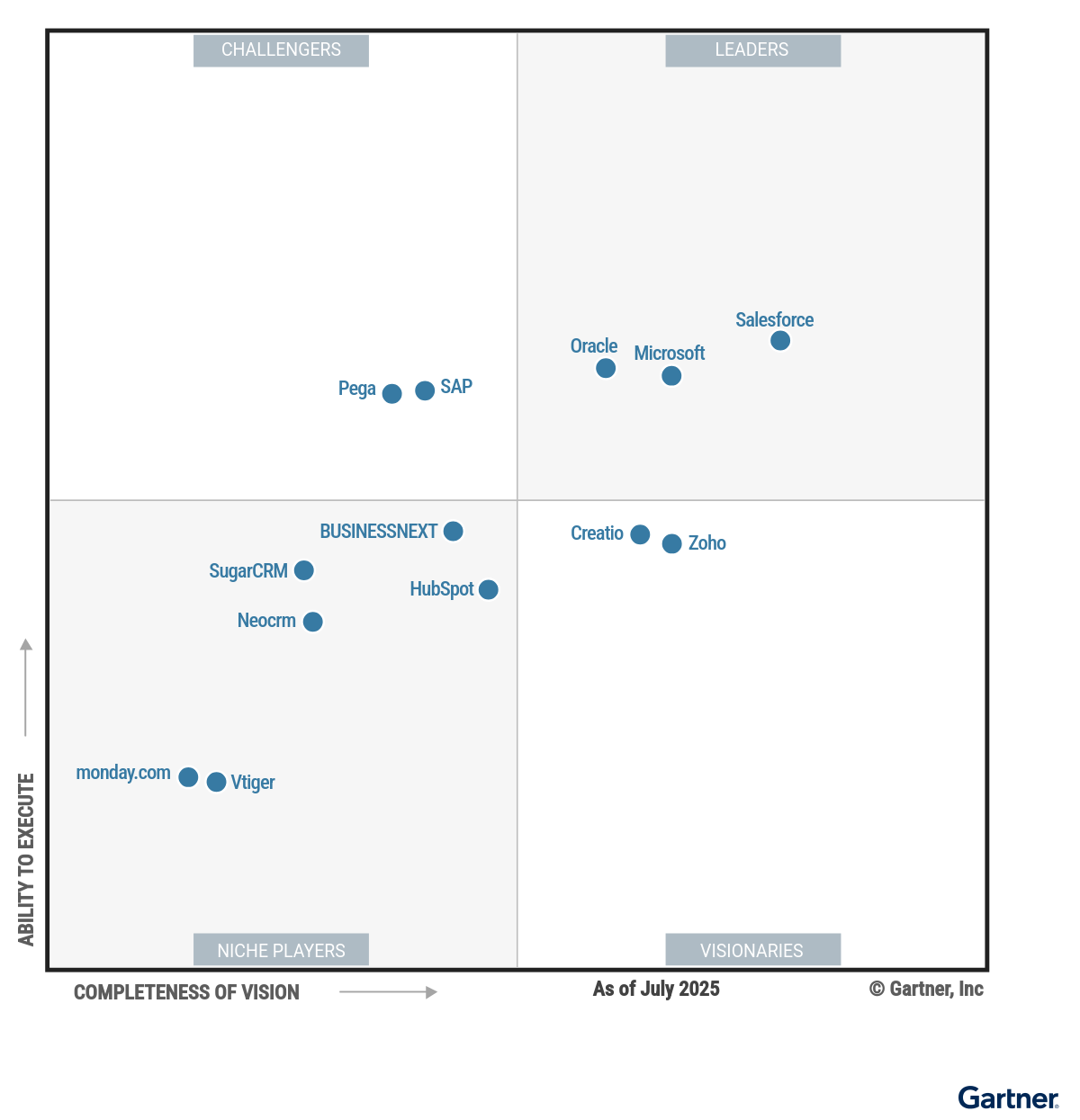
Vendor Strengths and Cautions
BUSINESSNEXT
BUSINESSNEXT is a Niche Player in this Magic Quadrant. BUSINESSNEXT offers a suite of enterprise solutions, including its sales force automation (SFA) product. The vendor has a majority presence in financial services and insurance and operates across multiple regions, with a heavier focus on Asia/Pacific (APAC), followed by EMEA and North America. In the past year, BUSINESSNEXT introduced prebuilt Sales AI Agents for various industries and an agent builder that supports custom topics and actions. It also introduced agentic AI Autoflow Designer enhancements, generative AI (GenAI)-driven call preparation and a “Model Garden” that serves as a repository for prebuilt GenAI models. BUSINESSNEXT’s roadmap includes an AI Digital Journey Designer to streamline development of industry mobile applications as well as principal AI agents that replicate the functions of specific roles and orchestrate and optimize digital strategies. Additionally, the platform includes specialized agents with dedicated solutions for retail banking, corporate banking and insurance.
- Mobile functionality: BUSINESSNEXT’s mobile app supports advanced written and voice data entry, AI-driven notifications and reminders. It summarizes customer opportunities, lists next actions, provides planner and day views, call preparation tools, talk track suggestions and manages contact timing, routing and locations.
- Industry AI/machine learning (ML) models: BUSINESSNEXT provides prebuilt models for finance, hospital mapping and treatment models for healthcare, and solutions for pharmaceutical and fast-moving consumer goods (FMCG) retail industries. Capabilities include large language model (LLM)-based agent creation, bias detection and prompt workflow design via WORKNEXT, its predictive and GenAI platform. Its prompt studio consolidates actions such as account overviews and sales insights.
- Account and contact management: A hierarchy tool provides clear visualization of account and contact relationships, including related transactions and information cards. AI-driven deduplication and segmentation improve data integrity and enable targeted outreach. The social news feed aggregates and summarizes relevant updates.
- Pipeline and forecast management: BUSINESSNEXT’s pipeline monitoring features are less developed than those of most vendors evaluated in this Magic Quadrant. The platform relies on standard charts, tables and dashboards with minimal use of AI/ML, natural language or data storytelling to enhance insights or actionability. B2B opportunity-based forecasting functionality was not evident relative to other vendor demonstrations provided to Gartner.
- Proposal and quote: The AI proposal engine produced generic outputs with limited customization and lacked integrated AI features seen in leading vendor platforms evaluated in this Magic Quadrant. Recommendations for target pricing depend on back-office data and require additional configuration for user access.
- Platform complexity: BUSINESSNEXT’s SFA product relies on multiple modules and tools, including 12 no-code designers to provide deep no-code capabilities. This may sometimes complicate workflow configurations.
Creatio
Creatio is a Visionary in this Magic Quadrant. Its Sales Creatio (v8.2.2) caters primarily to midsize and enterprise organizations while also reaching the small and midsize business (SMB) market via partners. Creatio has global operations, with a customer base spanning over 100 countries (EMEA, North America, Asia/Pacific and South/Central America) and is well-recognized in financial services, manufacturing, professional services and high tech. Creatio is relevant for organizations needing sophisticated custom workflow creation using no-code tooling. Its near-term roadmap highlights a shift toward AI-embedded SFA, with promising and innovative AI-powered features for sales execution and operational efficiency. Key roadmap promises include AI-driven sales agents for automating tasks such as lead qualification and forecasting as well as no-code AI agent customization tools. Additionally, plans to enhance data processing across structured and unstructured sources and to expand conversational intelligence will ensure a more intelligence-infused and intuitive sales workflow.
- Embedded no-cost AI features: Creatio’s SFA embeds predictive, generative and agentic AI into workflows via its platform, supporting multiple LLM providers without extra costs for core AI. AI Skills enable extensible automation, including data analysis, content generation and workflow execution.
- No-code composability: The platform offers granular process control with customizable fields, objects and UI, supported by no-code tools and an AI assistant. Features include configurable email and meeting tracking, duplicate resolution, multichannel integration, advanced forecasting, partner management via Partner Portal, asynchronous deal feeds and full partner relationship life cycle management.
- Viability: Creatio has shown strong operational growth in 2024, with increased customer acquisition, regional investment and expansion of its customer service organization for SFA support.
- Manual configuration in generative AI: Many advanced AI features — such as automated sales data entry, personalized customer communications, account management and LLM-based agent creation — require manual configuration and custom AI skill development within the Creatio.ai assistant side panel. This reliance on manual setup increases complexity and requires ongoing adjustments to maintain optimal performance.
- ISV ecosystem: Compared to Magic Quadrant Leaders, Creatio’s ISV ecosystem is less mature, with 250 authorized independent software vendors (ISVs) and 350 sales-specific applications. While Creatio is expanding its marketplace for partner-built AI agents, many advanced AI-driven features still depend on custom development by ISVs, limiting out-of-the-box extensibility.
- Mobile app AI: The mobile app’s AI capabilities for opportunity management, precall planning and voice-activated assistance are not fully optimized for mobile use. These features often require no-code configuration and manual skill building. Basic activity management and limited voice input constrain the app’s ability to deliver a seamless, real-time sales experience for mobile users without the use of third-party components.
HubSpot
HubSpot is a Niche Player in this Magic Quadrant. Its SFA offering, Sales Hub, includes three paid product tiers: Sales Hub Enterprise, Sales Hub Professional and Sales Hub Starter, and one free tier Sales Hub Free. Sales Hub Professional and Enterprise products are sold primarily through a representative-driven inside sales motion as well as through channel partner representatives who often layer in implementation, training and other types of technical services. HubSpot can be deployed in all regions, with the majority of its customers residing in North America, followed by EMEA, Asia/Pacific and South/Central America. While HubSpot does not segment its product offerings based on specific industries or customer segments, its customer base spans a diverse range of verticals, including high tech and software, professional services and manufacturing. It also serves businesses mainly in the small business to midmarket. HubSpot’s roadmap includes updates to AI-powered deal scoring, guided actions, account scoring and sales forecasting. Its Breeze Copilot feature is evolving with deeper CRM data integration to provide real-time guidance, content generation and task automation integrated throughout the Sales Hub.
- GenAI and AI agent platform: HubSpot’s Breeze platform offers extensive GenAI configuration options specifically for personalizing customer communications through its unified data foundation. This capability is robustly supported by integrating various data types, including structured CRM data and unstructured content such as emails, calls and meeting transcripts via its context layer from HubSpot’s acquisition of Frame AI.
- Activity management: HubSpot includes robust sales activity management, featuring an activity timeline that filters by activity type and integrates with related modules such as marketing emails and events. Native integrations with Microsoft Outlook 365 and Google Mail/Calendar enable seamless activity capture, meeting outcome logging and bidirectional sync. Users control which emails and meetings are tracked and logged.
- Visualization and analytics: The SFA platform offers a wide range of prebuilt reports and persona-specific dashboards for sales reps, managers and executives, covering activities and key performance indicators (KPIs) such as monthly performance, deal management and pipeline visibility. The analytics suite allows users to customize out-of-the-box reports with suggested prompts.
- Opportunity-guided selling: Guided selling relies on static rule-based workflows not AI-driven recommendations. Sales stage, forecast category and probability to win must be manually selected, with no automated suggestions based on opportunity data or activity history.
- Predictive AI/ML capabilities: HubSpot’s AI/ML capabilities are limited compared to the majority of vendors evaluated in this Magic Quadrant. It lacks AI-based account or contact health scoring and does not provide insights from email activities or relationship health.
- Proposals and quote: Proposal and quoting functions are basic, allowing only template-based quotes and line items from a product library. Generative AI is not available for proposals, AI-driven pricing or customer self-service for quote/order creation. HubSpot’s 2024 Cacheflow acquisition for configure, price and quote (CPQ) and subscription billing has not yet enhanced product capabilities.
Microsoft
Microsoft is a Leader in this Magic Quadrant. Its core SFA offering features Dynamics 365 Sales, augmented by Copilot for Sales and underpinned by the broader Microsoft Power Platform. These core components provide native capabilities across a wide range of SFA functions, including account and contact management, sales activity management, opportunity and pipeline management and lead management. Designed for organizations from SMBs to global enterprises, the solution enhances customer engagement and deal management. Microsoft is often considered in the consumer and retail, financial services, manufacturing, professional services and technology industries. Microsoft’s planned roadmap items include autonomous AI agents to handle sales workflows — working across sales cycles from researching leads and opportunities to qualifying leads and closing deals — and expanded GenAI and non-GenAI use cases with enhanced customization across channels from 2025 into 2026.
- Robust collaboration: Microsoft’s SFA platform provides comprehensive collaboration and communication tools, including team and channel creation within Dynamics 365 via its embedded Teams chat panel for real-time discussions. Strong auditing features support internal sales and revenue collaboration directly in the workflow, ensuring transparency and accountability.
- Conversation intelligence: The platform transcribes audio conversations, monitors buyer engagement and sentiment, and provides real-time highlights and action items. Managers can access customer insights, call recordings and engagement metrics through a dashboard, supporting coaching and performance improvement.
- Copilot for UI extensibility: Copilot in Power Apps streamlines UI redesign with conversational assistance and intelligent UI suggestions. Users can efficiently build and customize views, dashboards, forms and automations using AI-driven recommendations and drag-and-drop tools, making it easier to extend Dynamics 365 Sales with custom applications.
- Limited predictive ML: Despite advancements in agentic AI, predictive machine learning remains underdeveloped, with no support for custom attributes and limited model modification in sales use cases. Key SFA functions such as account and contact health scoring provide only preset sliders for thresholds and predictive forecasting has not advanced in the past year.
- Basic next best action: Integration of ML-driven insights with workflow automation is limited. Only a small set of data sources (e.g., SFA, conversation/communication data and LinkedIn) are supported, and custom data integration requires partnerships with providers such as Seismic. This results in basic or absent interplay between workflow automation and ML insights in sales processes.
- Nascent agentic AI for sales playbook: Recent demonstrations to Gartner highlighted agentic AI use cases outside of sales, such as the McKinsey & Company Onboarding Agent, raising concerns about Microsoft’s internal AI agent playbook for sales. While Microsoft provides some self-help resources, organizations should assess Microsoft’s commitment and the comprehensiveness of its Copilot Studio for sales use cases before investing in advanced AI solutions, as reliance on external consulting partners may be necessary for innovation.
monday.com
monday.com is a Niche Player in the Magic Quadrant. Its SFA product, monday CRM, is designed to provide customizable SFA capabilities. monday CRM is most relevant to SMBs (typically with fewer than 250 employees) and the lower midmarket. The platform has established a foothold in professional services and high tech. It supports multiple industries by offering industry-specific templates tailored to manufacturing, high tech, financial services and professional services. It supports deployments worldwide, with a significant presence in North America and EMEA, and a smaller presence in Asia/Pacific and South/Central America. monday.com’s roadmap includes AI Blocks that embed intelligent automation in workflows — enabling features like sentiment analysis, data extraction and guided action recommendations — and a Digital Workforce (AI agents) that will assist with sales tasks and process optimization.
- Highly customizable no-code interface: monday CRM’s intuitive approach and drag-and-drop functionality allow teams to quickly create and adapt workflows without technical expertise, thereby improving familiarity with the solution. Its core user interface resembles a dynamic spreadsheet with columns and row equivalents, also known as boards within monday.com’s features.
- Ease of management: monday.com differentiates itself with competitive license fees, lean implementation and maintenance costs, and a short deployment time, all contributing to a lower total cost of ownership (TCO). The platform’s no-code automation and intuitive UI contribute to rapid deployment and high adoption, driving faster return on investment compared with more complex SFA solutions offered by other vendors evaluated in this Magic Quadrant.
- Collaboration and sharing capabilities: The platform excels in collaboration features, including mutual close plans, document co-editing and granular sharing permissions (down to the cell level). These capabilities support both internal team collaboration and external partner engagement, making it suitable for partner relationship management (PRM) use cases.
- Limited AI and ML depth: Despite the presence of generative AI, monday.com lacks machine learning capabilities across critical areas such as predictive lead scoring, opportunity health scoring and forecasting. All AI-requested demonstrations to Gartner were rule-based and formula-based or relied on simple prompt-driven automation using generative AI, limiting their strategic value.
- Manual data entry: The platform heavily relies on manual data entry and spreadsheet-like boards. This design can become unwieldy and inefficient, especially for larger organizations managing complex sales processes. The need to predefine numerous columns and formulas adds to the setup burden.
- Weak forecasting and analytics capabilities: Forecasting features are minimal to nonexistent. monday.com does not support predictive forecasting, what-if modeling and advanced analytics. Reporting is limited to simple dashboards with limited visualization options, which may not meet the needs of data-driven sales organizations.
Neocrm
Neocrm is a Niche Player in this Magic Quadrant. It serves primarily large enterprises in the Asia/Pacific region, focusing on high-tech manufacturing, biomedical, durable consumer goods and software/internet sectors. Neocrm’s SFA solution is delivered exclusively as SaaS, with a strong emphasis on AI-driven innovation and operational efficiency for complex, multinational sales organizations. The company’s strategic roadmap is centered on expanding its portfolio of AI-powered sales agents and automation tools, with multiple innovations planned for release in 2025. These include advanced sales coaching, enhanced territory management and deeper AI-driven analytics designed to improve sales effectiveness and user productivity.
- AI and ML capabilities: Neocrm supports seller workflows with advanced AI and machine learning, enabling competitive performance against vendors evaluated in this Magic Quadrant. The platform provides AI-driven scoring for account and contact health, lead propensity and opportunity ratings with automated risk alerts. Key features include lead routing based on performance metrics, AI conversation insights for analyzing customer intent and the configurable NeoAI agents and prompt builder, which can generate Budget, Authority, Need and Timing (BANT) analysis by synthesizing knowledge sources, firmographic data and activity data.
- Activity management: Neocrm stands out in activity management through its NeoAI Sales Assistant Agent 2.0, which automates sales data entry from emails and meetings. Native conversation intelligence delivers sentiment analysis, risk detection and coaching recommendations while integrated Outlook 365 and multichannel messaging (e.g., WeChat and WhatsApp) enable configurable synchronization and logging of sales activities. These capabilities, combined with configurable AI models and deep communication integration, enhance data quality and support informed sales execution.
- Customer collaboration: Neocrm facilitates effective customer-seller collaboration via shared workspaces and integrations with popular social platforms, supporting efficient communication and co-creation of documents to accelerate deal progression.
- AI module pricing and complexity: Access to Neocrm’s advanced AI features, such as optimization and prioritization, requires add-on subscriptions across most license editions, with some features incurring extra charges even in higher-tier packages. This modular pricing can increase costs and complexity as operational expenses for machine learning and AI (including DeepSeek) are passed to customers based on setup and agent training requirements.
- Gaps in proactive guided selling automation: Neocrm shows limitations in guided selling workflow automation, with incomplete demonstration of AI-driven action libraries and their integration into seller workflows. This may reduce the platform’s ability to deliver actionable and interpretable sales guidance and recommendations.
- Geographic scope: Neocrm’s market presence is heavily concentrated in Asia/Pacific, which has not changed from previous years, with limited global partner network and customer footprint outside the region. This may present challenges for multinational enterprises seeking consistent SFA platform support across diverse geographies.
Oracle
Oracle is a Leader in this Magic Quadrant. Oracle Sales, its SFA solution, is delivered as SaaS on Oracle Cloud Infrastructure, spanning 43 global data centers. The majority of SFA customers use this SaaS model. Oracle targets large enterprises, particularly in high tech, manufacturing and professional services, and provides industry-specific APIs and AI/ML models to address complex requirements. Recent Oracle Sales releases have centered on generative AI, including writing tools, account insights and an enhanced AI framework. All AI enhancements are embedded and available at no additional licensing cost. The product roadmap for 2025 through 2026 emphasizes advancing composite AI for forecasting, integrating predictive and generative AI for a real-time deal agent, and expanding quoting, contract renewal and compensation guidance capabilities to further automate enterprise sales processes.
- Account and contact management: Oracle Sales demonstrates strong capabilities for managing account and contact duplicates through both automated functions and administrator controls, which helps maintain data quality. For scenarios involving customer data analysis, the platform supports account and contact scoring mechanisms, including machine learning functions and configurable options.
- Visualization and analytics: The Oracle Sales platform offers a comprehensive set of prebuilt SFA reports and dashboards for sellers, managers and leadership. It delivers GenAI capabilities for prompt-based visualizations and dashboards, allowing users to generate analytics through natural language queries. The system supports natural language generation (NLG) to create narratives about single visualizations or entire dashboards, with customizable verbosity levels and analysis modes to tailor content for different stakeholders.
- Mobile: Oracle’s mobile application includes a prioritized task queue, AI-driven account research and support for both voice and text input. The app integrates win probability, risk alerts, competitor analysis and real-time opportunity scoring. Users can also manage sales records and activities via the Oracle Sales Assistant bot in Microsoft Teams.
- Opportunity-guided selling: During demonstrations to Gartner, Oracle Sales guided selling was limited, lacking automated progression based on deal characteristics or activity history. The platform relied on health scores and static workflows without leveraging conversation intelligence to update opportunity details. AI-based win probability informs sales orchestration but seller automation remains basic, with low-probability deals automatically excluded or closed.
- Pipeline and forecast management: While Oracle Sales tracks and reports changes in opportunity values and close dates, forecasting lacks prescriptive guidance and relies on users to interpret trends. AI is used primarily for opportunity health scoring and a light forecast summarization feature was shown to Gartner during demonstrations. The platform provides pipeline value and forecast versus actual metrics; snapshot comparisons must be configured in the analytics layer, standard visualizations such as waterfall or Sankey charts are not available.
- Nascent GenAI and agent configuration: Oracle’s capabilities for building AI agents and configuring GenAI within sales are immature, mostly revolving around prompt template design inputs and outputs.
Pega
Pega is a Challenger in this Magic Quadrant. Pega Sales Automation, its SFA product, is best suited for large enterprises with complex business processes. It has the heaviest presence in financial services, insurance and healthcare verticals, with the ability to support additional industries. The platform provides broad geographical data residency options through Amazon Web Services Data Centers globally or customers can deploy on their local cloud or within their own network on-premises. Recent enhancements focus heavily on generative AI capabilities, such as the Pega GenAI Coach, Knowledge Buddy and meeting preparation tools. Pega’s roadmap includes further advancements with the Pega GenAI Coach assistant and pitch precision for hyperpersonalized sales pitches as an evolution of version 1 of the product.
- Opportunity-guided selling: The platform offers strong integration between rule-based workflows and AI-generated recommendations, providing sellers with a consolidated view of guidance on their landing pages. Pega’s top offers feature presents sellers with ML-generated recommendations of product combinations likely to resonate with the customer along with propensity models for predictive sales. Pega’s conversation AI offers cross-sell and upsell advice to a seller during live calls based on topics discussed.
- Partner relationship management: Pega provides native capabilities for creating and maintaining partner selling models, allowing leads and opportunities to be shared via a partner web portal. Partners gain access to core functionality within the portal similar to direct sales reps, including features like next best actions, top offers and the GenAI Coach.
- Visualization and analytics: Users benefit from a substantial number of prebuilt SFA reports and dashboards available natively for sellers, managers and leadership roles. Pega’s platform includes GenAI capabilities that enable users to create visualizations and dashboards through natural language prompts, simplifying data exploration. It also supports NLG to automatically create narrative summaries of data insights.
- Forecasting: Pega highlights the variance between forecast and AI prediction in each element of the bottom-up forecast, but non-AI forecast values are weighted and may not be flexible enough for some organizations. What-if modeling isn’t provided.
- Collaboration and productivity: Pega’s deal collaboration capabilities are limited to internal interactions. It does not offer a digital sales room that can be shared with customers. When collaborating on documents, sellers can co-view but not co-create or co-edit with other deal team members.
- Lead management: Pega’s platform offers ML-based predictive lead scoring with configurable logic and GenAI explanations. However, lead management is driven by administration-managed rules rather than more advanced AI — though AI-determined lead scores can be included in routing rules.
Salesforce
Salesforce is a Leader in this Magic Quadrant. Its Sales Cloud suite serves organizations of all sizes across industries such as financial services, manufacturing, high tech, professional services, healthcare and consumer goods. With a global footprint, Salesforce has increasingly delivered on Hyperforce, offering advanced public cloud infrastructure with enhanced compliance, security, privacy and flexible data residency. The platform unifies CRM, data and AI for end-to-end sales management. The roadmap for Sales Cloud enhancements includes a dynamically generated UI that streamlines task completion and navigation within Sales Cloud. This feature will offer templated experiences for sellers, such as prospecting, account planning and analyzing pipeline health and forecasts. Additionally, Salesforce’s roadmap calls for expanding sales-specific agents with capabilities for account management and proposal creation.
- Strategic focus on agentic AI: Salesforce is investing in Agentforce, its agentic layer for deploying semiautonomous AI agents across business functions. Agentforce aims to automate workflows, reason and act alongside users with out-of-the-box agents for sales development and coaching, generative AI for personalized communication and a generative AI canvas for natural-language-driven interface usability.
- Robust customization and extensibility: The platform supports extensive customization, including custom fields, apps and objects, now further enabled by GenAI for code generation and component creation via natural language queries.
- Enhanced account and contact research: Salesforce leverages key tools such as Einstein Conversation Insights and Einstein Activity Capture to derive GenAI-driven insights, which are further enhanced by Data Cloud, to update CRM fields and create configurable account plans with SWOT analysis. Customers can access these insights both within the CRM and externally, such as with Sales Cloud Everywhere.
- Dependency on Data Cloud and Agentforce: Salesforce’s advanced AI and unstructured data capabilities may require Data Cloud, MuleSoft and Agentforce contracts, increasing cost of ownership for organizations seeking more advanced solutions. Many of the demonstrations to Gartner for AI evaluations in Sales Cloud featured Data Cloud and Agentforce products for common sales use cases, such as prospecting and opportunity guided selling.
- Limited AI sophistication and cohesion: Salesforce’s AI capabilities are disjointed, lacking cohesion between predictive AI and semantically driven recommendations, outside of its conversation intelligence and deal-risk score features contained in the revenue intelligence product. Limitations of composite AI techniques that optimize AI effectiveness while maintaining semantic integrity in sales workflows are key considerations for sales organizations aiming to maximize AI utility.
- Customer experience: Gartner clients have expressed numerous client complaints over the past year regarding insufficient customer support and success efforts, which many feel diminish the value of the Sales Cloud product. Many clients often cite receiving pitches for new products instead of the best practice guidance they need to optimize their current Sales Cloud deployments.
SAP
SAP is a Challenger in this Magic Quadrant. Its SFA solution, SAP Sales Cloud, operates on a continuous integration/continuous delivery (CI/CD) model, making it a dynamic component of SAP’s broader sales application portfolio. This offering integrates deeply with SAP Customer Experience solutions and the SAP S/4HANA back-office suite. SAP Sales Cloud targets midsize and enterprise organizations (over 500 employees), particularly those in industries with complex product offerings or order-to-fulfillment processes, such as manufacturing, consumer products, high-tech, wholesale and professional services. The company’s vision centers on empowering sales representatives and managers with a composable architecture. Its planned innovations include a business development agent, an email scan agent and an expansion of SAP AI assistant capabilities, namely Joule. Its global operations are distributed across EMEA, North America, Asia/Pacific and South/Central America.
- Collaboration: SAP Sales Cloud Digital Selling Workspace provides sales teams with a centralized, configurable environment for managing all sales activities, KPIs and communications. Administrators can tailor the workspace to specific business needs, including custom tabs, KPI cards, field layouts and mashup integrations with external web content. The workspace supports mobile access, integrated call lists, calendar management, AI-driven insights and quick entity creation, streamlining collaboration and productivity for sales professionals.
- Guided selling: SAP Sales Cloud enables guided selling through a rules action framework with sales paybooks and AI recommendations based on engagement insights and relationship intelligence, allowing organizations to define and automate activities, update fields, and apply conditional logic. Playbooks can be tailored to specific product groups, segments or accounts, with machine learning scores overlaid to optimize recommendations. AI-driven insights track and measure playbook adoption and effectiveness, supporting continuous improvement in sales execution.
- Composable and microservices architecture: The solution is built on a microservices-based, API-first architecture enabling rapid innovation, scalability, reliability and composability. Its UI is composed using different micro front ends, allowing modules to be easily assembled whether from SAP or non-SAP applications.
- Predictive forecasting: SAP supports splitting opportunities only by revenue and lacks configurable model options for broader predictive scenarios. Users cannot view which data attributes influence predictions or their weights, limiting transparency and relying primarily on historical win/loss data without deeper insights into contributing factors.
- Reliance on add-ons and integration: SAP depends on external tools or add-on modules for core SFA functions, such as using Sinch messaging API for multichannel activity management and Microsoft Teams for conversation intelligence.
- AI/ML configuration limitations: While SAP allows machine learning models for leads and opportunities to be extended with custom attributes and reveals which variables drive predictions, business users cannot adjust those models. GenAI and AI sales agents are basic in configuration, lack real-time task execution visibility and reasoning steps, and the account synopsis feature does not yet include references or hyperlinks to information sources.
SugarCRM
SugarCRM is a Niche Player in this Magic Quadrant. Its SFA solution, Sugar Sell, serves customers in the Americas, EMEA and APAC. While retaining broad horizontal coverage, SugarCRM is focused on manufacturing, distribution and wholesale on a go-forward basis through preconfigured account management templates and sector-optimized analytics. Recent updates include time-aware analytics with enhanced forecasting, AI and GenAI summarization and deeper integrations with Microsoft Outlook and Teams. In 2024, the company announced a new CEO and reduced the price of Sugar Sell Essentials, making it a cost-effective entry-level SFA solution for small to midsize businesses that don’t require AI. The 2025-2026 roadmap highlights an embedded AI assistant, proactive account health and recommendations, and expanded AI configurability.
- Lead and account intelligence: SugarCRM helps sellers quickly identify high-potential prospects and at-risk relationships within existing accounts. SugarPredict machine learning ranks and prioritizes leads by analyzing historical sales and intent signals and intelligent account modeling leverages ERP and SFA data to generate health scores, flag churn risks and reveal hidden revenue opportunities.
- Opportunity summarization and alerts: The AI/GenAI-powered opportunity summary is a unique way of comprehensively assessing deal health beyond a simple score to help representatives focus on value-driving activities without relying on manual data aggregation. It summarizes opportunity data and related activities and cases, bringing together a consolidated viewpoint of sentiment insights, deal-risk alerts and next-best-action recommendations.
- Extensible platform with industry-specific accelerators: Preconfigured templates and analytics for manufacturing, distribution and wholesale accelerate vertical deployments while no-code/low-code tools and a broad partner ecosystem enable rapid customization and integration across industries.
- Pipeline and forecast management: In demonstrations to Gartner, SugarCRM showed current pipeline dashboards, week-over-week change visuals and forecast-versus-quota metrics but it did not demonstrate AI-driven predictive forecasts, “what-if” scenario modeling or trend-based projections. Buyers requiring forward-looking, model-based forecasting should validate these capabilities against their needs.
- Shift into manufacturing, distribution and wholesale: SugarCRM’s pivot into a vertical focus on manufacturing, distribution and wholesale, along with leveraging recent acquisitions risks alienating its historically diverse customer base. This approach potentially impacts broader market perception and retention rates for clients outside these newly prioritized industries.
- AI configuration: For SugarCRM’s built-in AI summarization, predictive scoring and sentiment analysis, administrators cannot adjust model parameters, create custom prompt templates or choose data sources, an important capability for sales organizations requiring flexibility in AI tooling.
Vtiger
Vtiger is a Niche Player in this Magic Quadrant. Its SFA product, Vtiger One, primarily serves the small and lower midsize segments. It targets industries such as banking, financial services and insurance, and offers industry-specific editions for areas like construction. Vtiger has a client presence in Asia/Pacific, EMEA and North America. Recent developments include the introduction of an AI-powered Vtiger Agent Builder for administrators to build and deploy agents by automatically suggesting topics and actions based on each agent’s defined purpose. Vtiger’s Prediction AI Designer permits administrators to build and customize ML-based predictive scoring models. Vtiger’s roadmap includes releasing Vtiger NextGen, an SFA platform with a new conversational UI, an AI actions page and views redesigned to surface AI insights.
- Account and contact management: Vtiger One uses a hierarchy system that allows administrators to build and maintain legal entity hierarchies and sales team hierarchies with an interactive visualization tree. This capability is useful for mapping buyer circles and decision influencers more seamlessly.
- Activity management: The platform includes useful AI- and rule-based tools to capture, summarize and rate seller/customer interactions across channels like email, mobile, chat and voice. It offers integrations with channel app providers (like telecommunications) and maintains a repository to automatically track engagements tied to contacts, accounts and deals that are used for engagement scoring, which then feeds opportunity scoring.
- Partner enablement: Vtiger provides a centralized Partner Portal, allowing partners to manage contacts, track deals, handle cases and access essential documents and collateral. The platform supports partner master data management, onboarding, goal tracking and segmentation, which can be done by creating custom lists within the partner modules. Channel managers can generate scheduled reports and distribute them to partners. Vtiger’s Calculus AI offers natural language querying and AI-driven insights, enhancing data interaction and visualization capabilities for channel managers.
- Forecasting: Vtiger’s forecasting capabilities are among the weakest of the solutions evaluated for this report. Forecasting is limited to AI scoring on individual deals, and the platform does not support forecasting splits or offer AI for analyzing and predicting trends in contract values over time. Changes to user-submitted forecasts can only be tracked by examining charts in reporting views.
- Proposal and quoting: Vtiger’s offering for proposal and quotation generation provides limited functionality, focusing primarily on template population. It includes a basic quote-builder tool, but capabilities like AI-guided RFP response automation were limited in demonstrations, and customer self-service quote and order creation are not available.
- Vertical products: Vtiger offers no packaged vertical product tailoring. Vtiger One is positioned as a general-purpose SFA CRM solution that can be tailored to various industry use cases. Clients considering Vtiger One should plan to configure or customize modules, workflows and integrations to adapt the CRM to their specific industry needs. Native vertical-specific AI/ML models are also not offered out of the box. Vtiger’s strategy is to enable industry/domain experts and third-party providers to use their expertise in building vertical adaptations for the platform and creating industry-relevant AI agents and actions.
Zoho
Zoho is a Visionary in this Magic Quadrant. Zoho CRM is the flagship SFA solution, offered as a multitenant SaaS deployment from Zoho-operated data centers in North America, Europe, Asia/Pacific and the Middle East. It is positioned for small business, midmarket and large enterprises customers across high-tech/IT services, financial services, automotive, life sciences/healthcare, retail and professional services, and is tightly integrated with Zoho’s broader application suite. Since 2024, Zoho has accelerated investment in its Zia AI assistant — embedding predictive analytics, GenAI narratives and next best action recommendations throughout core sales workflows — and will roll out on-platform no-code AI agents and advanced data capture capabilities through 2025. Furthermore, Zoho has launched its new set of AI tools under the umbrella of Zia, which is the company’s in-house AI platform. The set includes new Zia Agents, Agent Studio and Agent Marketplace, and will expand GenAI applications through integrations with additional public and hosted open-source large language models via AIBridge by 3Q25.
- Comprehensive partner ecosystem management: Zoho’s PRM portal enables partners to register, qualify, sign contracts, tag deal stages, invoice and track commissions in one system. Brands gain full partner data controls, joint campaign management and deal collaboration tools, supporting scalable indirect channel operations.
- AI-powered account and contact intelligence: Zoho automates data hygiene and hierarchy roll-ups, applies Zia Scores for lead conversion, opportunity health and churn risk with transparent explanations, and maps contact relationships. Generative prompts deliver account SWOT analyses and financial overviews while native enrichment keeps records up to date.
- AI-enhanced visualization and analytics: The SFA platform offers role-based dashboards and reports. Ask Zia converts natural language queries into charts and summaries while Strategy Influencer detects anomalies, identifies top contributors and recommends actions. Predictive target-setting and cross-sell suggestions enable rapid, data-driven decisions.
- Basic AI-guided selling: In demonstrations to Gartner, Zoho’s guided selling features — such as next best action and recommendation builder — relied on basic rule-based logic and preset prompts. The recommendations provided simple context and suggested talking points but did not use advanced AI to generate more complex or tailored guidance based on data signals. This makes Zoho’s guided selling less sophisticated and effective compared to other platforms in this Magic Quadrant that offer more advanced, AI-driven recommendations.
- Added cost for advanced AI/ML: While Zoho offers built-in and included AI tools for common sales scenarios within core SFA packaging, enterprises seeking advanced or highly customized AI/ML models must leverage Zoho’s Catalyst, a separate product. This approach increases both costs and implementation complexity for sales organizations looking at more sophisticated AI use cases that span more custom data pipelines..
- Skills required for administration: Although Zoho supports no-code, low-code and procode development, maximizing the platform’s advanced features — such as multistep automation, predictive modeling and prompt building — often requires moderate to advanced technical expertise. Organizations may need to invest in upskilling their administrator teams to fully leverage Zoho’s capabilities, which could impact adoption and time to value.
Vendors Added and Dropped
We review and adjust our inclusion criteria for Magic Quadrants as markets change. As a result of these adjustments, the mix of vendors in any Magic Quadrant may change over time. A vendor's appearance in a Magic Quadrant one year and not the next does not necessarily indicate that we have changed our opinion of that vendor. It may be a reflection of a change in the market and, therefore, changed evaluation criteria, or of a change of focus by that vendor.
Added
monday.com was added to this Magic Quadrant.
Dropped
Freshworks did not participate in the Magic Quadrant and Critical Capabilities process this year. As Gartner’s evaluation methodology has become more product-centric — placing greater emphasis on vendor demonstrations, including but not limited to API payload demonstrations in key areas, Freshworks was unable to meet the criteria required for a comprehensive assessment. Specifically, we were unable to verify the platform’s capabilities in critical areas such as:
- Account and contact management
- Activity management
Additionally, the evaluation required vendors to demonstrate the configuration of guided selling processes, including the ability to illustrate individual scenarios, interdependencies between tools and how these can be layered within a workflow. Key demonstration items included:
- Workflow automation
- Machine learning
- The integration and layering of these capabilities in real-world scenarios
Without vendor participation and demonstrations, we could not thoroughly evaluate Freshworks’ solutions against these essential requirements sought after by sales organizations.
Clients considering Freshworks need to conduct due diligence to ensure the vendor meets their expected requirements.
Inclusion and Exclusion Criteria
To qualify for inclusion in the 2025 Magic Quadrant for Sales Force Automation Platforms, providers must meet entry criteria and eight of the following nine criteria natively, in Level 1 criteria (i.e., without reliance on third-party add-ons)
Entry criteria: Providers must meet this criterion to be eligible for the Magic Quadrant:
- Provide AI/ML features in at least three critical capabilities
- Account/contact management
- Activity management
- Opportunity management
Level 1 criteria: If the provider meets the entry criteria, it must then meet eight out of nine criteria below:
- Account/contact management, activity management, opportunity management: Serve as a system of record for account and contact management, and sales activity management, and opportunity management. It must also be able to natively support systems of engagement for capturing and facilitating sales and customer interactions, tasks and activities.
- Pipeline management: Serve as a system of record for sales and support sales-customer engagement journeys through channel-agnostic interactions. This includes a web portal (self-service), SMS, chat and email at minimum. It must also support predictive and/or prescriptive analytics for pipeline management (must include all three).
- Forecast management: Automate a recurring bottom-up sales forecast process and serve as a system of record and system of insight for the sales forecast.
- Lead management: Serve as a system of record for lead management capabilities, which includes functions for lead nurturing, lead conversion tracking and lead attribution analysis.
- Guided selling: Provide guided selling capabilities in the form of formal sales playbooks and rule-based recommendations that align with sales playbooks.
- Infrastructure: Provide a platform for extending sales processes with custom user interfaces, custom data objects, custom data fields and custom workflows, including, but not limited to, building engagement support with a diverse set of channel interactions.
- Communication channel support: Provide a platform for extending sales processes into customer interaction channels for buyer-seller engagement support in at least 4 core channels, namely, web portal (self-service), SMS, chat and email.
- Integrations: Provide native-open APIs that allow the solution to integrate with third-party applications such as, but not limited to, ERP systems, BI tools, unified communication tools, etc., or as may be deemed relevant to a selling organization.
- Mobile access: Provide mobile and voice-activated (VA) assistant capabilities, whereby sellers and their managers can manage their primary daily sales from either a natively-provided mobile application, mobile web browser, voice-activated assistant such as a smartwatch, Amazon Alexa, Google Assistant, among others. They must also be supported by a low-code mobile application development SDK (for mobile apps). Native applications should work without the internet or offline.
Level 2 criteria: If the provider meets entry and Level 1 criteria, it must then meet both of the following criteria to qualify:
- Have customers with live SFA implementations in at least two of the three use cases for sales force automation platform critical capabilities: B2B sales, B2C sales and indirect/relationship sales.
- Make at least two major CRM SFA releases with significant functional improvements during the 12 months from 1 February 2024 to 1 February 2025; a new or acquired offering from an established provider in this market is also considered if Gartner established that offering was being sold to customers.
Level 3 criteria: If the provider meets Level 2 criteria, they must then meet at least four of the following five criteria:
- Provide native PRM. To qualify for this criterion, providers must offer a portal user license type, portal management capabilities for partners to manage leads and opportunities assigned to them and partner life cycle management capabilities. All three criteria must be satisfied to qualify for this category of evaluation.
- At least 50 customers with live sales force automation platform implementations as of 1 February 2024, spanning at least four industries, in accordance with industry definitions established by Gartner listed below.*
- Have an average of at least 25 SFA paid users per customer not per org or instance, excluding partner and freemium users as of 1 February 2024..
- At least $15 million in SFA platform sales during calendar-year 2024.
- During the 12 months from 1 February 2024 to 1 February 2025, close either at least 18 new logo contracts on deals exceeding $750,000 in total contract value or at least 50 new logo contracts on deals between $50,000 and $750,000 in total contract value; exclude contracts sold to existing clients.
Industry definitions:
- Automotive (includes automotive manufacturers, distributors or direct-to-consumer sales processes)
- Communications, media and services (includes telecommunications)
- Consumer product goods manufacturing
- Education
- Energy and utilities
- Financial services (includes commercial banking, retail banking, all forms of lending and wealth management)
- Healthcare providers
- High tech and software (includes IT hardware)
- Insurance (includes health insurance)
- Life sciences (includes pharmaceutical and medical device manufacturing or distribution)
- Manufacturing and natural resources (includes all forms of discrete manufacturing and the forms of process manufacturing not already specified in this list)
- Professional and business services
- Retail (includes retailers and specialty retailers, wholesale, restaurants, grocery and hotels)
- Transportation and logistics
Evaluation Criteria
Note to Gartner clients: The Gartner authorship team has chosen to place a heavy emphasis on AI capabilities of SFA vendors, including its SFA-native scope, depth and usability against sales organization needs and requirements. Therefore, all write-ups, placements and scores in this Magic Quadrant and its companion Critical Capabilities reflect this new scoring approach. This is done to prepare for an uptake in the market of such capabilities and to better help clients with strategic roadmap planning.
Ability to Execute
Product or Service: Vendors are evaluated on the quality of their native SFA capabilities, including both the core capabilities and SFA extensions. Vendors are also evaluated on technical considerations, such as ease of use and administrative functions. Gartner assesses information provided by Gartner Peer Insights, other publicly available sources, Critical Capabilities research and observations collected from Gartner inquiries.
Overall Viability: Vendors will be evaluated on additional factors such as customer retention rate and the ability to generate revenue specifically in the SFA market.
Sales Execution/Pricing: Among the many factors in this category, Gartner evaluates the number of new customers acquired, growth in SFA revenue, average SFA deal size, average contract duration and customer retention. Gartner also evaluates client satisfaction with contracting and negotiation processes.
Market Responsiveness and Track Record: Gartner evaluates the quality and depth of a vendor’s releases and the ability to deliver functions requested by clients.
Marketing Execution: Gartner will measure the frequency and quality of a vendor’s marketing techniques, including its use of publicity promotions and thought leadership in social channels or print publications. Gartner will also evaluate a vendor’s presence on the shortlists of Gartner clients and the scope of available third-party solutions.
Customer Experience: Customer experiences are evaluated based on a vendor’s ability to help customers achieve positive business value as well as sustained user adoption, quality implementation and ongoing support.
Operations: Criteria include assessments of product upgrade processes, quality, scope and the breadth of peer user community and customer communities.
Ability to Execute Evaluation Criteria
| Evaluation Criteria | Weighting |
|---|---|
Product or Service | High |
Overall Viability | Medium |
Sales Execution/Pricing | Medium |
Market Responsiveness/Record | High |
Marketing Execution | Low |
Customer Experience | Medium |
Operations | Medium |
Source: Gartner (July 2025)
Completeness of Vision
Market Understanding: Vendors must define how their SFA solutions improve client sales process execution and support sales effectiveness objectives. Vendors must also define their competitive differentiators, value proposition and outcomes achieved by clients. Vendors are also evaluated on their articulated and demonstrated ability to align with client customer experience, digital business and sales execution optimization objectives.
Marketing Strategy: Vendors are evaluated on their segmentation strategies and how their solutions appeal to selling organizations in multiple verticals as well as to prospects with 50 or more sales sellers. If a vendor derives a significant percentage of its revenue from recurring-revenue-based products, it must also have a customer retention strategy.
Sales Strategy: Vendors are evaluated on their ability to sell to business and IT stakeholders as well as to the segments defined in the marketing strategy.
Offering (Product) Strategy: Gartner assesses a vendor’s product and packaging offerings. A vendor should not only demonstrate a product vision that accounts for core SFA functionality (as defined by the market’s core capabilities) but also offer new application functionality across the breadth and depth of product capabilities. This consideration is critical for meeting the needs of a maturing market.
Subcapabilities include a vendor’s vision for:
- Sales enablement functions such as content management, sales training and coaching
- B2B and B2C digital commerce
- Digital sales rooms
- Sales effectiveness functions (e.g., CPQ or order management)
- Integration with third-party sales applications, with a primary focus on native functions
Business Model: Vendors must have clear business plans for how they will be successful in the SFA market. These business plans should include appropriate levels of investment to achieve profitability and healthy revenue growth over a three- to five-year period. Sales channels and partnership strategies are important components of these plans .
Vertical/Industry Strategy: Vendors are evaluated on the scope of native-built applications that automate industry-specific sales processes in verticals such as financial services and life sciences. Vendors will also be evaluated on the scope of third-party partnerships with ISVs that offer industry-specific capabilities.
Innovation: Vendors must show continued investment in improving core SFA features. They must also show growth in new areas such as sales execution, analytics, collaboration or new devices (for example, IoT), and new technology directions such as digital business and bot-building functions to support multiexperience.
Geographic Strategy: Vendors will be evaluated on the percentage of employees allocated to the regions and the depth and scope of partners in those regions.
Completeness of Vision Evaluation Criteria
| Evaluation Criteria | Weighting |
|---|---|
Market Understanding | High |
Marketing Strategy | Low |
Sales Strategy | Medium |
Offering (Product) Strategy | High |
Business Model | NotRated |
Vertical/Industry Strategy | Medium |
Innovation | High |
Geographic Strategy | Medium |
Source: Gartner (July 2025)
Quadrant Descriptions
Leaders
Leaders have the ability to execute their vision through products, services and demonstrably solid business results in the form of revenue and earnings. Leaders have significant, successful worldwide customer deployments in a wide variety of industries and multiple proof points for deployments above 500 users. They demonstrate consistently above-average customer experience levels, product execution scores and sales execution scores.
They demonstrate product leadership by delivering new enhancements and innovations on a consistent schedule. They also provide thought leadership, showing customers and prospects how their SFA solutions improve sales execution and sales processes.
Challengers
Challengers are often larger than most (but not all) Niche Players and demonstrate a higher volume of new business for SFA. They have the size to compete worldwide; however, in some cases they may not be able to execute equally well in all geographies or segments. They often return stronger CX satisfaction scores. They understand the evolving needs of a sales organization yet may not lead customers into new functional areas with a strong functional vision.
Challengers tend to have a good technology vision for architecture and other IT organizational considerations but have not won over the top sales executives and/or application leaders in the IT organization.
Visionaries
Visionaries are ahead of most potential competitors in delivering innovative products and delivery models. They anticipate emerging and changing sales needs and move the market into fresh areas with solutions that improve sales execution.
Visionaries have strong potential to influence the direction of the SFA market but are limited in terms of execution and/or track record.
Niche Players
Niche Players offer products for SFA functionality but may lack some functional components. Some may not show the ability to consistently handle deployments of more than 500 users across multiple geographies. Some may lack strong business execution in the SFA market even if their core features are strong. These vendors may offer complete portfolios for a specific industry but face challenges in one or more areas necessary to support cross-industry requirements, such as complex forecasting or pricing and quotation features. They may have an inconsistent implementation track record or they may lack the ability to support the requirements of large enterprises.
Niche Players often offer the best solutions for the needs of particular sales organizations or sales use cases.
Context
Given that there are more than 75 SFA vendors worldwide, the vendors in this research represent a small part of the overall SFA vendor market. Hundreds more vendors provide basic contact management software, which is a subset of SFA. Dozens of vendors have built vertical-specific SFA solutions.
Because it is not possible to review every SFA provider, this Magic Quadrant evaluates SFA solutions that are broadly applicable to many differently sized sales organizations and verticals.
We place particular emphasis on vendors’ core SFA capabilities as described in the Market Definition/Description section of this Magic Quadrant. However, to build as complete a picture as possible, we also evaluate their noncore SFA capabilities such as sales engagement and sales enablement.
SFA means different things to different types of sales organizations:
- Product-driven transactional sales organizations, such as those with short-cycle B2B sales, value the ability of basic lead and opportunity management functions to reduce sales cycles and improve sales management visibility.
- Product and service organizations selling enterprisewide deals, such as long-cycle B2B sales organizations, value SFA’s account management and forecasting. These organizations often also value lead management, CPQ and sales content management systems. They often tie together proposals, bids, configurations and quotes with authorizations and order capture systems. Organizations operating in this space require granular forecasting and pipeline management features.
- Organizations engaged in relationship selling require SFA tools to manage their customer and prospect data but also require sales enablement tools for content distribution and sales activity capture.
- Organizations that sell via indirect sales channels require PRM features.
Sales Organization Sizing
In this Magic Quadrant, Gartner refers to sales organization customer sizes or vendor target segments. We define these segments as follows:
- Small business: Fewer than 100 sales users
- Midsize enterprise (MSE) or business: 101 to 1,000 sales users
- Large business: 1,001 to 2,500 sales users
- Enterprise: More than 2,500 sales users
Market Overview
The SFA market grew 12.3% to an estimated $15.1 billion in 2024. Gartner continues to facilitate a large number of inquiries surrounding vendors and their capabilities. Most notably, Gartner inquiries have seen a significant shift into AI capabilities, with clients both learning about and inquiring about sales AI use cases and where to anchor their platform investments.
Key Trends in Sales Force Automation Platforms
The SFA market continues to evolve, driven by technological advancements and the increasing demand for smarter, more efficient sales processes and more effective salespeople. Three trends stand out for strategic consideration: the pervasive integration of AI and ML, the emphasis on unified data foundations and platforms for a holistic customer view and a push toward enhancing user experience (UX) and productivity for sales teams.
Trend 1: Pervasive AI Integration, Especially Generative AI and AI Agents
The most significant trend transforming SFA platforms is the comprehensive integration of AI — including predictive analytics, generative AI and specialized AI agents. This shift moves SFA from merely tracking sales activities to actively guiding, automating and ultimately enabling autonomous sales operations. Last year, most vendors demonstrated foundational generative AI features such as summary generation, email drafting and AI assistants powered by large language models. This year, we are witnessing more advanced studio and configuration capabilities alongside a growing focus on agentic AI use cases.
Generative AI for content creation and insights: Platforms are heavily leveraging GenAI to automate content creation and extract actionable insights. This includes generating enhanced email templates with rich text editing, providing AI-powered meeting insights such as summaries, sentiment analysis, action assignments and speaker diarization. Sales representatives can also benefit from AI-driven call preparation and the creation of AI-powered scripts for lead engagement. For broader analytical needs, GenAI is being used for prompt-based visualization and dashboards, allowing users to generate real-time visual insights from natural language queries and translate them into charts and interactive dashboards. Some solutions offer autosuggested visualizations and multisource data integration. Natural language generation is a significant innovation, enabling automatic narratives about single visualizations or entire dashboards, with some platforms offering control over tone and verbosity. One platform even plans to use GenAI to autocreate accounts, contacts, leads and activities from conversational data.
Predictive analytics for smarter sales: Beyond content generation, predictive AI is central to optimizing sales processes. This includes advanced, pretrained lead scoring models that consider firmographics, lead demographics and communication history to efficiently prioritize high-value leads. Predictive analytics are also applied to forecasting, deal scoring and health prediction, and identifying risk factors or buyer goals. Some platforms offer AI optimization for lead routing, matching leads with the most suitable sales representatives based on performance metrics and historical conversion rates.
Rise of AI agents for automation: A critical evolution is the development and deployment of specialized AI agents designed to automate various sales tasks. These range from prebuilt agents for specific industries like pharma, retail, banking and insurance to more general sales development agents and outreach agents. Platforms are investing in multiagent - orchestration platforms to enable seamless coordination between these agents across the sales process, from lead management to deal progression and customer engagement. Examples of planned agents include sales qualification agents for autonomous lead research and prioritization, sales chat agents for quick access to CRM data. Other examples include deal acceleration agents to proactively address stalled deals and even deal close agents for automating simple short cycle transactions. Some platforms are building AI agent studios or prompt builder and agent builder tools to allow administrators to configure and debug custom AI agents for personalized business scenarios. The ultimate vision for some is to transform SFA from traditional tracking systems into autonomous selling engines with minimal human intervention.
Trend 2: Focus on Unified Data and Platforms for Holistic Customer View and Streamlined Processes
Another significant trend is the industry’s commitment to creating unified platforms that break down data silos, provide a comprehensive 360-degree view of the customer and enable seamless end-to-end sales processes.
Eliminating data fragmentation: A core problem SFA solutions aim to solve is the fragmentation problem, where sales teams struggle with too many disconnected systems and screens, each providing only static siloed views of customer data. Providers emphasize building a unified data foundation by combining structured CRM data with unstructured conversational data (from emails, meetings, social feeds) to give sales teams complete visibility into customer interactions and sentiment. This unification supports better AI and personalization.
Integrated suites and ecosystems: Many SFA platforms are designed as integrated suites, aligning sales, marketing, customer service and revenue operations on a single platform. This integration extends to core productivity applications like Microsoft Outlook 365 and Google Mail/Calendar, allowing for real-time synchronization of emails, appointments, contacts and tasks, and even activity capture directly within these external applications. Beyond CRM functionalities, platforms are connecting to broader enterprise systems like ERP, supply chain and human capital management (HCM) to provide a truly holistic customer and revenue view. Some offer zero copy data capabilities for real-time inventory visibility from other systems.
The aim is to deliver a connected cloud platform that brings revenue teams together without costly data integration and supports deployment flexibility across private, public or customer data center clouds.
Comprehensive customer view: The goal is to provide a holistic view of the customer by aggregating data from multiple sources to create comprehensive customer profiles and intelligent tags reflecting preferences and behaviors. This enables highly personalized marketing and sales strategies. This deep data integration allows for account-based selling and the ability to identify opportunities within the customer base by leveraging transactional, behavioral and engagement data. Such a unified approach is intended to simplify technology stacks by integrating email marketing, sales enablement, project management, reporting and data enrichment on a single platform.
Trend 3: Enhanced User Experience and Productivity for Sales Teams
SFA providers are prioritizing user experience and productivity to encourage high adoption rates and maximize the effectiveness of sales professionals, from individual reps to leadership.
Intuitive user interfaces and mobile-first design: The focus is on minimizing clicks, providing context-driven views across devices and offering flexible layouts. Mobile-native applications for both iOS and Android are standard offerings, often with offline capabilities to ensure uninterrupted access to critical data and the ability to update CRM records on the go. Mobile apps are also integrating AI-driven insights and features, such as predictive lead scoring and next best actions, directly into the mobile workflow.
Automation of routine tasks and guided selling: A core productivity driver is the automation of manual and routine tasks. This includes automating CRM updates, meeting scheduling and data retrieval. Many solutions offer guided selling with AI-based prescriptive next best actions to streamline and improve the effectiveness of the sales organization, ensure adherence to best practices and increase win rates. AI-powered guided actions help sellers prioritize and execute high-impact activities by analyzing engagement data, deal patterns and buyer signals. Tools for sales engagement, such as cadences and template building for outbound support, are natively embedded in many platforms.
These trends highlight the market moving toward more intelligent, integrated and user-centric solutions designed to further enhance sales efficiency and drive growth.
Ability to Execute
Product/Service: Core goods and services offered by the vendor for the defined market. This includes current product/service capabilities, quality, feature sets, skills and so on, whether offered natively or through OEM agreements/partnerships as defined in the market definition and detailed in the subcriteria.
Overall Viability: Viability includes an assessment of the overall organization's financial health, the financial and practical success of the business unit, and the likelihood that the individual business unit will continue investing in the product, will continue offering the product and will advance the state of the art within the organization's portfolio of products.
Sales Execution/Pricing: The vendor's capabilities in all presales activities and the structure that supports them. This includes deal management, pricing and negotiation, presales support, and the overall effectiveness of the sales channel.
Market Responsiveness/Record: Ability to respond, change direction, be flexible and achieve competitive success as opportunities develop, competitors act, customer needs evolve and market dynamics change. This criterion also considers the vendor's history of responsiveness.
Marketing Execution: The clarity, quality, creativity and efficacy of programs designed to deliver the organization's message to influence the market, promote the brand and business, increase awareness of the products, and establish a positive identification with the product/brand and organization in the minds of buyers. This "mind share" can be driven by a combination of publicity, promotional initiatives, thought leadership, word of mouth and sales activities.
Customer Experience: Relationships, products and services/programs that enable clients to be successful with the products evaluated. Specifically, this includes the ways customers receive technical support or account support. This can also include ancillary tools, customer support programs (and the quality thereof), availability of user groups, service-level agreements and so on.
Operations: The ability of the organization to meet its goals and commitments. Factors include the quality of the organizational structure, including skills, experiences, programs, systems and other vehicles that enable the organization to operate effectively and efficiently on an ongoing basis.
Completeness of Vision
Market Understanding: Ability of the vendor to understand buyers' wants and needs and to translate those into products and services. Vendors that show the highest degree of vision listen to and understand buyers' wants and needs, and can shape or enhance those with their added vision.
Marketing Strategy: A clear, differentiated set of messages consistently communicated throughout the organization and externalized through the website, advertising, customer programs and positioning statements.
Sales Strategy: The strategy for selling products that uses the appropriate network of direct and indirect sales, marketing, service, and communication affiliates that extend the scope and depth of market reach, skills, expertise, technologies, services and the customer base.
Offering (Product) Strategy: The vendor's approach to product development and delivery that emphasizes differentiation, functionality, methodology and feature sets as they map to current and future requirements.
Business Model: The soundness and logic of the vendor's underlying business proposition.
Vertical/Industry Strategy: The vendor's strategy to direct resources, skills and offerings to meet the specific needs of individual market segments, including vertical markets.
Innovation: Direct, related, complementary and synergistic layouts of resources, expertise or capital for investment, consolidation, defensive or pre-emptive purposes.
Geographic Strategy: The vendor's strategy to direct resources, skills and offerings to meet the specific needs of geographies outside the "home" or native geography, either directly or through partners, channels and subsidiaries as appropriate for that geography and market.