Magic Quadrant for Container Management
6 August 2025 - ID G00822651 - 45 min read
By Dennis Smith, Wataru Katsurashima, and 4 more
Container management solutions are evolving to meet more challenging use cases. Heads of I&O must navigate this market to find vendors that support agility, security, modernization and transformation initiatives.
Strategic Planning Assumption
By 2028, 95% of new AI deployments will use Kubernetes, up from less than 30% today.
Market Definition/Description
Gartner defines container management as offerings that support the deployment and operation of containerized workloads. It uses a combination of technologies (many open source) that enable agile application deployments and infrastructure modernization. Delivery methods include stand-alone software or as a service.
Container management automates the provisioning, operation and life cycle management of containerized workloads at scale. Centralized governance and security policies are used to manage container workloads and associated resources. Container management supports the requirements of modern applications (also refactoring legacy applications), including platform engineering, cloud management and continuous integration/continuous delivery (CI/CD) pipelines. Benefits include improved agility, elasticity and access to innovation.
Mandatory Features
The following mandatory features enable the deployment and operation of containers at scale:
- Orchestration and scheduling
- Container runtime
- Service discovery and registration
- Artifact registry
- Routing and networking
- Service catalog that contains and displays application and infrastructure artifacts
- Management user interface
- API access to the associated resources.
Common Features
The common features for this market include:
- Container infrastructure — Provides enterprise-grade management of containers across on-premises, cloud and edge locations (Container infrastructure also provides tools for integrated fleet management, including life cycles and configurations for large numbers of container orchestration clusters potentially sourced from multiple providers.)
- Managed provisioning and updates — Automates provisioning and update of container management functions and infrastructure
- Platform engineering support — Provides functions needed to deliver a self-service container platform using product management practices
- Application platform capabilities — Provides application development and DevOps capabilities to accelerate the delivery of applications using containers with CI/CD workflows
- Policy management and governance capabilities
- Security functions, including protection of container runtimes and securing container image supply chain
- Infrastructure software, including virtual machine hypervisors and host operating systems
- Storage and data protection services for stateful containerized applications
- Extensibility traits to adapt platforms to support diverse use cases (e.g., HPC, AI/ML, Edge, etc.)
- Serverless container instances or Kubernetes services that abstracts the underlying infrastructure details
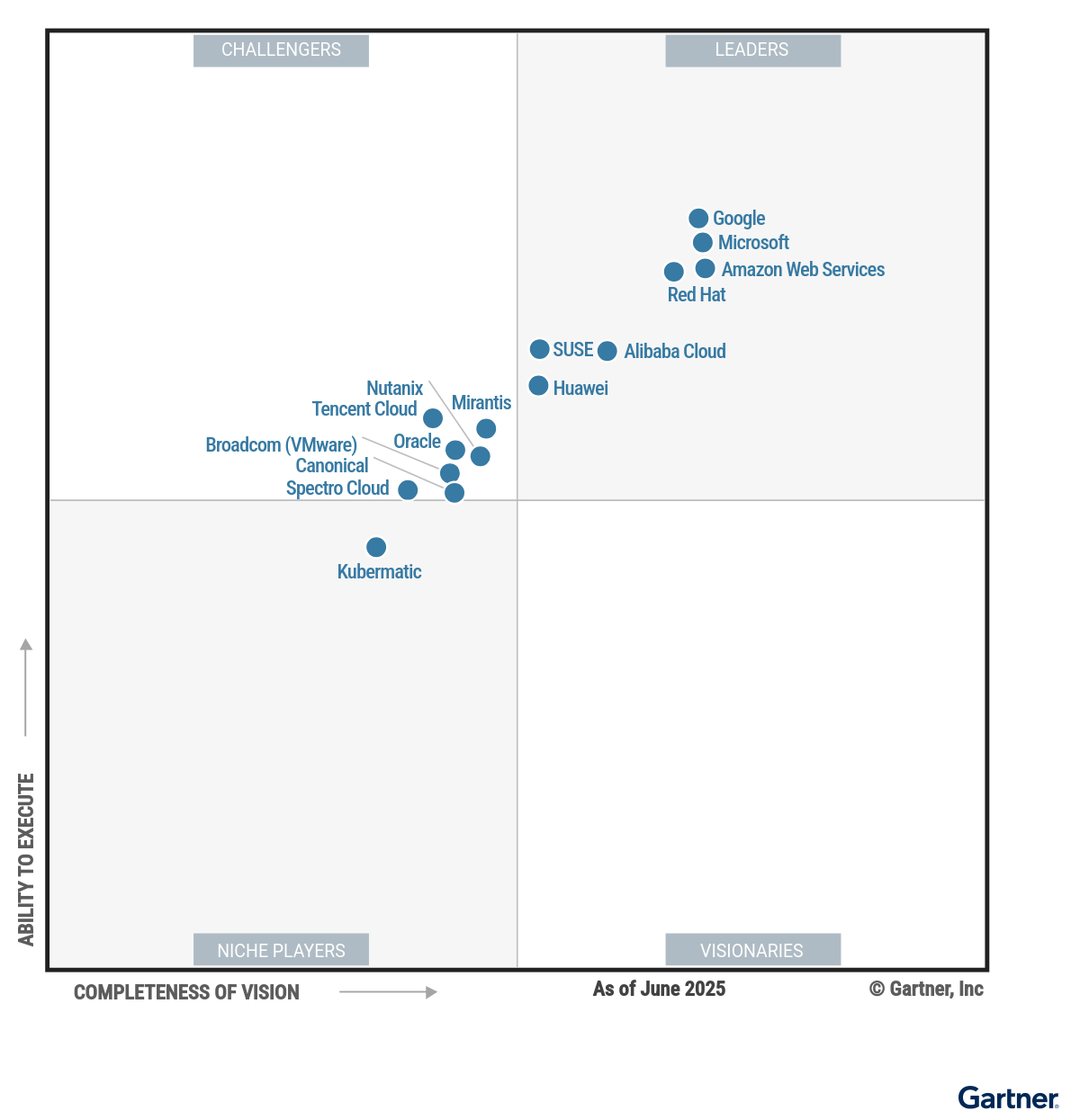
Magic Quadrant
Vendor Strengths and Cautions
Alibaba Cloud
Alibaba Cloud is a Leader in this year’s Magic Quadrant. Its container service portfolio is focused on providing a wide range of container deployment options, from single to hybrid and multicloud. Its services are available worldwide, including Japan, the Middle East, Western Europe and the United States but are mostly focused in China and Southeast Asia. In the global market, its clients tend to be organizations doing significant business in or with China and Chinese multinationals expanding overseas.
Its primary container management service is Alibaba Cloud Container Service for Kubernetes (ACK), which can run not only in the cloud but also on-premises or at the edge. Alibaba Cloud Container Compute Service (ACS) and ACK Auto Mode are serverless container services. ACK One provides fleet management that can manage external Kubernetes clusters external to Alibaba’s public cloud environment.
- Broad functionality: Alibaba Cloud has the broadest functionality coverage among non-U.S.-based vendors in this Magic Quadrant. In some use cases, it surpasses U.S.-based leaders.
- Alibaba Group’s extensive use: Alibaba Cloud’s container services are widely adopted across Alibaba Group’s large e-commerce platform and ecosystem of companies. These companies provide a variety of digital services, which demonstrates the stability, scalability and maturity of Alibaba Cloud’s container services, particularly for AI and cloud-native applications.
- Continued market leadership in China: Alibaba Cloud has maintained the largest cloud infrastructure as a service (IaaS) market share in China (where the vast majority of its revenue originates). Outside China, Alibaba Cloud also has a presence in the public cloud container services market in Southeast Asia.
- Limited momentum outside China and Southeast Asia: Alibaba Cloud has struggled to gain widespread traction beyond China and Southeast Asia, which resulted in its worldwide IaaS market share declining in 2024. Internationally it has yet to become a viable option, except for Chinese multinationals expanding overseas.
- Closure of certain regions: Alibaba Cloud continues to expand its regions globally, including in the Middle East and South America, but notably ceasing data center operations in Australia and India in September 2024. Such region closures cause uncertainty for global use cases.
- Unavailability of latest GPU models: Due to U.S. government graphic processing unit (GPU) export restrictions, the latest GPU models, such as Nvidia GB200, B200, H200 and H100, are not available on Alibaba Cloud, limiting support for AI-related container workloads.
Amazon Web Services
Amazon Web Services (AWS) is a Leader in this Magic Quadrant. Its container service portfolio is focused on providing a wide range of deployment options, from container management leveraging Kubernetes or its own orchestrator, to serverless. Its operations are geographically diversified, and its clients range from large enterprises to startups. AWS customers tend to combine multiple AWS services to create delivery platforms for their applications rather than use containers in isolation.
AWS maintains two primary container services, Amazon Elastic Container Service (Amazon ECS) and Amazon Elastic Kubernetes Service (Amazon EKS). Both can be used with AWS Fargate, and Amazon EKS can also be used with EKS Auto Mode for serverless container deployment. AWS provides a variety of services to complement EKS and ECS, including container registry, service mesh, observability and security. AWS has been expanding services available outside its public cloud, such as Amazon EKS Hybrid Nodes, Amazon EKS Anywhere, and Amazon ECS Anywhere.
- Integration with AWS’s broad and deep range of services: AWS has one of the broadest range of cloud IaaS and platform as a service (PaaS) services available, of which its container services can benefit from performance, consolidation and operational benefits. This integration significantly enhances AWS value propositions as a strategic cloud platform for container management.
- Service and technology partner ecosystems: With its diversified service partner ecosystems worldwide, AWS enables users to more easily find partners for container services than other vendors. AWS also has strong technology partner ecosystems, with over 500 container images and add-ons to choose from in the AWS Marketplace.
- Serverless portfolio: AWS continues to expand serverless container offerings, providing options that cater to both large enterprise organizations and single-application development teams, ensuring flexibility for a wide range of requirements, including those related to AI workloads.
- Solution navigation: The breadth and occasional overlap of AWS’s container management offerings can make it challenging for customers to identify the right service for a given use case — for example, choosing between Amazon EKS and Amazon ECS.
- Limited Kubernetes cluster fleet management: AWS provides third-party solutions, automation tools and best practices for Kubernetes multicluster environments, but it lacks native fleet management tools for managing the life cycle and state of distributed Kubernetes clusters at scale.
- Multicloud support: While AWS supports running containers on other cloud providers through Amazon EKS Distro (EKS-D) open-source project and allows customers to manage containerized applications in multicloud and hybrid environments with Amazon EKS Hybrid Nodes, Amazon EKS Anywhere and Amazon ECS Anywhere, it offers limited prebuilt integrations with other cloud providers.
Broadcom (VMware)
Broadcom is a Challenger in this Magic Quadrant. Broadcom’s operations are geographically diversified, and its customers range from midsize to large enterprises.
There are now two elements to Broadcom’s container strategy. The first element is VMware Cloud Foundation (VCF), which is the core of Broadcom’s private cloud strategy. VCF includes an integrated container runtime (vSphere Kubernetes Service, formerly known as Tanzu Kubernetes Grid service) and multicluster management (Tanzu Mission Control). The second element is Tanzu Platform, which offers a developer-first experience to accelerate containerized application delivery using streamlined workflows, data services and integrated tools.
Broadcom acquired VMware in November 2023.
- Customer base: Broadcom has a large installed base of VMware customers, which reduces the need to develop new operational skills.
- Integrated operations: VCF offers the ability to manage containers with the same control plane used to manage virtual machines.
- Developer community: The roots of Tanzu are connected to the extensive community of Java developers using the Spring Framework. This relationship provides deep insight into developer needs and an opportunity to expand.
- Product integration and roadmap: Gartner clients continue to express confusion over repeated changes to how VMware’s containers technologies are packaged and concern about if and how the different offerings are integrated.
- Acquisition: Broadcom’s acquisition of VMware continues to be a topic of concern for Gartner clients. While Broadcom reports to Gartner that its customer satisfaction has improved since mid-2024, many Gartner clients continue to report dissatisfaction.
- Competitive friction: Broadcom has made changes across the VMware partner ecosystem that continues to force partners to reconsider their relationship. To stay broadly competitive in the cloud-native era, Broadcom must successfully add value that differentiates its container solutions from its cloud partners, software competitors and hosted/managed container services.
Canonical
Canonical is a Challenger in this Magic Quadrant. Its container management offerings are available across a diverse range of compute environments, including on-premises, cloud, and as a managed service. Canonical’s operations are geographically diversified, and its clients tend to be early adopters with a focus on modern, agile development.
Canonical’s most popular offering, Ubuntu Linux, drives much of its product roadmap and engineering effort. Canonical’s roadmap focuses on AI optimization, edge, automation and security. Canonical’s position in the open-source ecosystem provides an opportunity to offset rising geopolitical concerns.
- Frictionless buying: Pricing is cost-competitive, with all relevant information visible on Canonical’s website (including subscriptions, levels of support, training, design and architecture, and remote management costs). This structure provides transparency and simplifies budgeting and expense management.
- Edge computing: Canonical continues to invest in container management for edge use cases (including MicroK8s, which is a minimal Kubernetes distribution). This feature makes Canonical suitable for a wide range of edge-computing use cases.
- Flexible deployment: Canonical’s offerings are flexible and particularly suited to multicloud deployment due to Ubuntu’s support across many cloud infrastructure providers. Likewise, it is supported by most leading hardware providers and, therefore, equally suited for private and/or hybrid deployment.
- Focus: Canonical has a wide variety of users within its installed base, mostly centered around Ubuntu users. Although it has recently increased its focus on enterprise requirements, it still lacks traction compared to other container management offerings.
- Functionality: Canonical’s container management offerings provide base functionality but few differentiating technical features. With continuing market maturity, Canonical risks falling behind unless it invests to remain competitive.
- Business model: Canonical’s focus on open-source principles has led to enterprise concerns about vendor differentiation when competing against larger enterprise-centric vendors.
Google is a Leader in this Magic Quadrant. Its container service portfolio is focused on keeping its user experience simple while adding advanced features. Its operations are geographically diversified, and its clients range from large enterprises to startups. Google’s clients most often use its container services for cloud-native applications and modern software development. Google customers combine multiple Google Cloud services to create delivery platforms for their applications rather than use containers in isolation.
Google’s flagship container management service is Google Kubernetes Engine (GKE). GKE Enterprise provides a broader platform that provisions and manages distributed clusters and services. GKE can run in the public cloud, distributed (with Google’s Distributed Cloud products) and also in AWS and Microsoft Azure. Google provides serverless container offerings, such as Google Cloud Run and GKE Autopilot.
- Differentiated and streamlined portfolio: Google has the highest number of differentiating features of all the vendors’ products in this Magic Quadrant. Google also tends to address requirements with fewer services, rather than adding new ones, which helps keep its portfolio and user experience simple.
- AI workload support: Leveraging its purpose-built AI Hypercomputer architecture, Google delivers several advanced container management features for AI workloads that other vendors haven’t supported yet, such as 65,000 node clusters, GPU support in serverless containers and dynamic resource scheduling.
- Leadership in the cloud-native open-source community: Google, as the creator of and the top contributor to Kubernetes, maintains a highly influential voice in the community and drives the evolution of Kubernetes to meet emerging needs. Its contribution to related projects, such as Istio, Knative, Kueue, Ray and Kubeflow, further reinforce Google’s position among the leaders at the cloud-native platform level.
- Traditional enterprise systems migrations: Google Cloud’s presence remains limited in traditional enterprise systems, such as data center migrations centered on lift and shift or the modernization of legacy applications, compared to cloud-native and modern application development use cases.
- Regional disparities in customer engagement quality: Gartner’s ongoing analysis indicates the quality of customer engagement delivered by Google’s technical field operations and its partners varies across regions, particularly outside the U.S.
- Managed service provider (MSP) ecosystem: GCP has a smaller MSP ecosystem capable of meeting complex enterprise requirements than other U.S.-based Leaders in this Magic Quadrant.
Huawei
Huawei is a Leader in this Magic Quadrant. Its container service portfolio spans from on-premises to hybrid cloud and edge environments as well as public cloud. Huawei’s operations are mostly focused on China and emerging markets, including Southeast Asia, Latin America, the Middle East and Africa. Its clients tend to be organizations that use other Huawei products, such as IT infrastructure and networking, and Chinese multinationals expanding overseas.
Huawei’s primary Kubernetes-managed service is Cloud Container Engine (CCE), which can run not only in the cloud but also on-premises or at the edge. Cloud Container Instance (CCI) and CCE Autopilot are serverless container services. Huawei Cloud Ubiquitous Cloud Native Service (UCS) provides fleet management that can cover Kubernetes clusters outside Huawei’s public cloud environment.
- Feature development speed: With the ability to develop its own technologies related and adjacent to container management (e.g., infrastructure, such as AI chips, to higher layers, such as security), Huawei is narrowing the technological gap with other Leaders in this Magic Quadrant.
- Contribution to open source: Huawei demonstrates its commitment to open source in this market by contributing to 82 Cloud Native Computing Foundation (CNCF) projects, which is the second-highest among the vendors in this Magic Quadrant. Among the open-source projects Huawei participated in and donated to CNCF are KubeEdge, Volcano, Karmada, Kmesh, and Kuasar.
- On-premises and edge: Huawei’s mature portfolio of on-premises IT infrastructure and networking offerings enables it to address on-premises and edge use cases. By leveraging these strengths, Huawei delivers container management that can comprehensively cover on-premises, private and hybrid cloud, and edge requirements.
- International sanctions and geopolitical tension: International sanctions continue to have a critical impact on Huawei’s overall business activities, which is why Huawei does not provide services in some regions, such as the U.S. Heightened geopolitical tensions have also led organizations to impose stricter procurement conditions for Huawei.
- Unique technology ecosystems: Huawei’s hardware components, such as AI accelerators, sometimes deviate from global industry mainstreams or standards. While this uniqueness of its technology ecosystems can lead to differentiated services, it could also significantly limit flexibility and compatibility.
- Unavailability of latest GPU models: Due to U.S. government GPU export restrictions, the latest GPU models, such as Nvidia GB200, B200, H200 and H100, are not available on Huawei Cloud. Although its Ascend NPUs provide alternative options, they could increase the risk of interoperability.
Kubermatic
Kubermatic is a Niche Player in this Magic Quadrant. Kubermatic, which is headquartered in Hamburg Germany, began transitioning its branding from Loodse (an early player in cloud-native and Kubernetes technology) in 2016. The company is still heavily focused on the European market, with much activity in Germany.
Kubermatic focuses on enabling developer efficiency, automation and policy-driven governance at scale on a Kubernetes foundation. Its Kubermatic Developer Platform (KDP) makes use of the Kubernetes API to offer “as-as-service” capabilities, and supports GitOps integrations as well as Infrastructure as Code.
The Kubermatic Virtualization (KubeV) (formally Kubermatic Cloud Stack (KCS)) contributes to the company’s infrastructure modernization capabilities, offering integrations with Kubernetes and KubeVirt to unify containerized and virtualized workloads. KCS makes Kubermatic capable of supporting migration from legacy technology stacks and also provides support for distributed infrastructure.
Kubermatic also provides a flexible pricing model based on a subscription for vCPU/RAM or Core (for baremetal node use cases).
- Complex infrastructure management: Kubermatic specifically targets large and midsize enterprises operating complex, distributed Kubernetes environments across hybrid, multicloud and edge infrastructures. It is increasing its industry focus to deliver low-latency capabilities at the edge.
- Cloud sovereignty support: KubeV allows customers to build their own private cloud for data control and regulatory compliance. This can resonate with enterprises that need to take more control over their IT deployments.
- Open source and CNCF: Kubermatic’s business model operates on an open-core strategy via its Kubermatic Kubernetes Platform (KKP) as an open-source offering and by contributing directly to the CNCF open-source community. Its lack of proprietary technology can appeal to enterprises not wanting vendor technology lock-in.
- Limited native image and storage management: Kubermatic does not provide a native container image build service or a container-native storage (CNS) solution. This does support flexibility in integration use cases but limits support for native integration capabilities.
- Complex setup and troubleshooting: The process for setting up infrastructure using KKP can be complex and requires more extensive knowledge than many enterprises have. Since the offering is more in the unmanaged versus managed platform category, it might not appeal to enterprises with less mature staff.
- Less intuitive user experience: KDP lacks extensive documentation and has a GUI that is difficult to navigate. Users who are new to the platform may find this experience challenging, which can lead to lower-than-expected levels of adoption.
Microsoft
Microsoft is a Leader in this Magic Quadrant. Its container service portfolio is focused on offering a broad and deep integration with its overall services (PaaS and IaaS), including its application development and DevOps platforms. Its operations are geographically diversified, and its clients range from large enterprises to startups.
Microsoft’s primary container service is Azure Kubernetes Service (AKS). Microsoft also provides various serverless container options, such as Azure Container Apps (ACA) and AKS virtual nodes. Azure Kubernetes Fleet Manager enables large-scale cluster management. Microsoft continues to expand container services that can be used outside its public cloud, such as AKS on Azure Local and Azure Arc. Microsoft has significantly invested in AI-driven workload management capabilities across hybrid environments, including investments in agentic DevOps.
- Emphasis on AI workload management: Microsoft supports AI workloads across hybrid environments and supports deployment of data-science models and inference services in GPU-optimized containers. This includes cloud training and edge inferencing, with streamlined model packaging and scaling to achieve cost-effective AI inferencing.
- DevOps/DevSecOps platforms Integration: GitHub’s strong developer community and Microsoft Azure DevOps’ large user base give Microsoft’s container services, which are tightly integrated with these two DevOps platforms, an advantage over other vendors. Growing interest in the use of GenAI in DevOps workflows via GitHub Copilot reinforces this advantage. This includes addressing demand for seamless DevSecOps and multicluster security operations.
- Cost-effective AI inferencing: Microsoft supports simpler and more-cost-effective AI inferencing through GPUs on Azure Container Apps. Azure Container Apps are billed based on consumption plus an hourly environment rate, and include Azure Free Tier, Azure savings plans for compute, and Azure Hybrid Benefit for customers with existing licenses to provide additional flexibility.
- Heterogeneous environments support: Microsoft’s container services lack key support for heterogeneous environments, such as full cluster management on other public clouds or on-premises. This complicates management and migration of container workloads outside Azure or Azure Local.
- Fragmented fleet management experience: Fleet management tasks are spread across multiple tools, such as provisioning clusters in Azure Arc or Azure command-line interface (CLI), and then managing them in Azure Kubernetes Fleet Manager, complicating the IT engineering experience.
- Edge computing support limitations: While Microsoft continues to expand its container management capabilities for the edge, it lags some others in supporting deployment of containers on bare-metal infrastructure without hypervisors, light-weight edge hardware and air-gapped infrastructure.
Mirantis
Mirantis is a Challenger in this Magic Quadrant. Its operations are geographically diversified, with a range of enterprise customers, particularly in telecommunications, financial services and the public sector. Its primary offering is Mirantis Kubernetes Engine.
Mirantis is investing to support training, tuning and inference for AI workloads. It remains actively involved in OpenStack, including Mirantis OpenStack for Kubernetes. It is a primary contributor to open-source projects for managing heterogenous container environments (k0rdent) and a Kubernetes distribution (k0s).
- Enterprise track record: Mirantis has a track record of supporting demanding enterprise IT infrastructure requirements spanning the last two decades. This record helps assure I&O leaders of support and integration with both existing and emerging cloud-native environments.
- Developer focus: Mirantis has integrated developer-centric tools (Lens, amazee.io and Shipa) into its traditional infrastructure offerings. This enables I&O teams to deliver capabilities, including an integrated development environment (IDE), DevOps workflow and associated automation.
- Edge computing: Mirantis has successfully deployed k0s in situations with demanding edge requirements. This serves the needs of telecommunications companies and other edge environments.
- Core functionality: Although Mirantis has improved its technical position, it has limited technical differentiators compared to some others in this evaluation.
- Customer traction: Lower market awareness has meant that Mirantis’ customer base is increasing at a lower rate than many of its competitors. Mirantis has competitive offerings but often fails to make the shortlist of prospective clients.
- Positioning: Mirantis continues to adjust the focus of its products, services and targeted personas. This has caused confusion among prospective customers and raised concerns about consistency among some existing clients.
Nutanix
Nutanix is a Challenger in this Magic Quadrant. The Nutanix Kubernetes Platform (NKP), launched after integrating D2iQ following the 2023 acquisition, enables Nutanix to deliver a platform that provides full stack support for VMs and containers.
Nutanix focuses on simplifying the infrastructure owner experience of operating a container management platform by offering a complete enterprise HCI stack. The stack includes a storage layer for distributed workloads, an enterprise hypervisor, data services for stateful environments, and container management tools that aim to help customers support legacy and cloud-native requirements.
The introduction of a “starter” tier of NKP, which is included with the primary Nutanix product, Nutanix Cloud Infrastructure (NCI), helps existing customers begin using NKP, leading to opportunities for increased adoption of the Kubernetes platform.
- Security capabilities: Nutanix provides support for zero-trust networking with Istio and policy-based controls. Nutanix also includes vulnerability and security best-practice checks via integrations with Trivy and Polaris. These capabilities address the common security challenges often faced by enterprises deploying containers.
- Addressing skills gaps: Nutanix provides an AI navigator tool using LLMs to act as intelligent assistants, helping users troubleshoot and understand cluster health, alerts and best practices through a conversational interface that provides environment-specific recommendations. These capabilities can enable less mature enterprises to adopt container technologies.
- Open source and choice: Adherence to CNCF open-source compliance helps minimize vendor lock-in. It also supports flexibility when choosing Kubernetes versions and hypervisors. This feature can appeal to enterprises seeking to avoid vendor lock-in.
- Lack of support for historical Kubernetes versions: The NKP platform does not provide long-term or extended support for Kubernetes versions. This presents a potential problem for large enterprises and government customers, Nutanix’s primary target market, by presenting challenges to long-term support and predictable upgrade paths for core infrastructure components, which are often critical requirements for production stability and compliance.
- Developer-focus limitations: Nutanix focuses heavily on simplified infrastructure owner experience and provides more focus on market differentiation for infrastructure owners than enterprise developers. Since container requirements are most often driven by developer requirements, this limitation can impact adoption.
- Self-managed only: NKP is only offered as self-managed. Some enterprises might observe complexities when monitoring and troubleshooting cluster instability issues.
Oracle
Oracle is a Challenger in this Magic Quadrant. Its container service portfolio is focused on security, reliability and scalability, which aligns with Oracle Cloud Infrastructure (OCI)’s strengths. Its operations are geographically diversified, and its customers tend to be organizations that use OCI as a strategic IaaS provider.
Oracle’s primary container service is OCI Kubernetes Engine (OKE). It provides a serverless container option on virtual nodes. It enables those services outside its public cloud through OCI Dedicated Region, partner offerings based on Oracle Alloy, Oracle Private Cloud Appliance (PCA), and Oracle OCI AI blueprints. Oracle also provides Oracle Cloud Native Environment (OCNE), which is a Kubernetes distribution that can run on-premises or on other public clouds.
- Diverse private options: Oracle offers more choice than other cloud providers when it comes to container services on private clouds, especially for large organizations in regulated industries that need a wide range of services. Examples include OKE on Dedicated Region, partner offerings based on Oracle Alloy, and OCNE on PCA.
- Resilience and cost-effectiveness: Oracle leverages inherent OCI capabilities and is able to offer its container services in a resilient and cost-efficient manner. This bodes well for critical workloads that require scale.
- Air-gapped infrastructure: Oracle supports the deployment and operation of container technology in an air-gapped configuration. This is key with growing interest in technological sovereign solutions.
- Limited developer experience features: Oracle’s services lack key features in enhancing the developer experience, such as debugging tools, certified container images and application scaffolding. Additional tools and services must be integrated to complement these features.
- Feature velocity for container management: Oracle has been adding container-management features at a good pace, but not fast enough to catch up with the Leaders in this Magic Quadrant.
- Limited cluster fleet management: The retirement of Oracle’s fleet management software, Verrazzano, means there are no native fleet management tools or platform capabilities for managing the life cycle and state of distributed clusters at scale. Oracle provides third-party solutions but lacks these native capabilities in its platform.
Red Hat
Red Hat is a Leader in this Magic Quadrant. Its operations are geographically diversified, and its clients span multiple industries (with strengths in financial services and the public sector). Red Hat OpenShift is broadly focused on container management, with solutions for single and multicloud, on-premises and edge deployments. Red Hat has expanded the OpenShift portfolio to specifically target the management of virtual machines using Kubernetes.
Red Hat partners with cloud providers, including AWS, Microsoft, IBM and Google to provide jointly-operated managed OpenShift services. It also partners with on-premises infrastructure providers, including Hewlett Packard Enterprise (HPE) and Dell. Red Hat also offers integrations with its parent company, IBM, for both cloud and on-premises infrastructure.
- Market understanding: Red Hat continues to develop the product functionality and external partnerships to span the variety of different container management scenarios, including support for AI workloads. This provides confidence to mainstream enterprises looking to adopt a flexible container management offering.
- Product capabilities: Red Hat OpenShift is a strong competitor in the majority of enterprise container management use cases. For enterprises seeking a hybrid offering, its pedigree in software-based deployments now extends to public cloud and edge computing.
- Strategic focus: Red Hat has a decades-long history of supporting modern enterprise IT infrastructure. Adding to this capability, OpenShift continues to be at the core of Red Hat’s and IBM’s strategy and business model.
- Pricing: Gartner clients continue to state in inquiries that they consider Red Hat OpenShift to be relatively expensive (both the container management software subscription and managed cloud offerings). I&O leaders struggle to justify the cost, particularly those not needing advanced functionality.
- Competitive friction: Red Hat partners with many hyperscale cloud providers but also competes in the container management market, which creates competitive tension. Organizations may need to choose between a horizontal approach rooted in a container management software offering (like those covered by Red Hat) or a vertical approach offered by hyperscale cloud providers, where many other enterprise services reside.
- Product dependencies: Although Red Hat OpenShift provides a complete stack, some I&O leaders will be concerned about the degree of lock-in.
Spectro Cloud
Spectro Cloud is a Challenger in this Magic Quadrant. Spectro Cloud, headquartered in the San Francisco area, was founded in 2019.
Spectro Cloud focuses on use cases for Kubernetes management across diverse infrastructure environments, including public cloud, on-premises and edge. Spectro Cloud’s solution acts as a central management plane, offering consistent Kubernetes cluster life cycle management across these diverse environments.
Spectro Cloud also offers tailored solutions like Palette Edge and Palette VerteX to support self-hosted air-gapped environments, and features such as FIPS cryptography to address public-sector and highly regulated industries.
- Emerging technology support: Spectro Cloud addresses AI/ML workloads, including model training and inference, for cloud and edge use cases, including GPU-as-a-service. This can appeal to enterprises looking to leverage container technologies that enable AI/ML workloads.
- Partner ecosystem: Spectro Cloud maintains a diverse partner ecosystem, including cloud partners, technology alliances, resellers and system integrators. This ecosystem includes AWS, Canonical and other key resellers.
- Simplified governance: Spectro Cloud provides support for container governance, including policy management, using tools like Kyverno and OPA, image scanning for vulnerability prevention, detection and remediation of vulnerable images using tools such as Trivy, Clair, kube-bench and kube-hunter. This fits well in regulated industries that need to deploy applications on container workloads.
- Growth-stage financial positioning: Spectro Cloud is venture-capital-backed and operates in a net loss position. The potential support for critical workloads must be weighed against the viability risk.
- Reliance on partners for expansion: Spectro Cloud relies heavily on partners for midsize market expansion, primarily through channel partners. Spectro Cloud’s direct sales focus is mainly on global enterprises and the public sector. Expanding its geographic reach into regions like Asia/Pacific and Latin America is currently planned — through partners initially, not direct sales.
- Strengths heavily skewed toward edge capabilities: Spectro Cloud has demonstrated competitive capabilities at the edge, less so for other deployment scenarios. A lack of size and not having clearly distinguishing capabilities might prevent Spectro from gaining significant adoption.
SUSE
SUSE is a Leader in this Magic Quadrant. Its operations are geographically diversified, with a stronghold in Europe. SUSE has a long history of providing Linux for critical workloads. Its container management clients are distributed worldwide.
SUSE’s vision for cloud-native hyperconverged infrastructure is evident in its SUSE Virtualization offering. It is also a pioneer in managing heterogeneous Kubernetes distributions and deploying Kubernetes at the edge (including K3s). SUSE’s position in the open-source ecosystem provides an increasing opportunity to address rising geopolitical concerns.
- Heterogeneity: SUSE has a history of supporting multiple container management distributions in addition to its own. This allows SUSE customers to reduce lock-in for container workloads and support federated requirements (including autonomous business units).
- Product strategy: An increased focus on AI, developer experience and server virtualization are now key elements of the roadmap. SUSE retains a strong position in edge container deployments.
- Cost-competitiveness: SUSE pricing competes well with the Leaders in this evaluation, especially for general-purpose solutions, and is often a reason for its selection. SUSE is sometimes deployed with higher-priced offerings that are used for specific applications certified for that solution.
- Differentiation: Although SUSE was an early innovator, it often struggles to stand out from the many other vendors that have entered the container management market.
- Infrastructure centrism: While SUSE continues to make investments in developer features, it lacks some of the functionality demanded by enterprise developers (e.g., support for container image-building services, artifact repositories, image registries).
- Managed cloud opportunity: Given enterprise developer demand for cloud-managed deployments, SUSE’s maturing/evolving relationships (relative to other software-oriented vendors in this evaluation) with hyperscale cloud providers risks it being alienated from digital initiatives and the associated growth opportunity.
Tencent Cloud
Tencent Cloud is a Challenger in this Magic Quadrant. Its container service portfolio is focused on providing simple, scalable services that empower digital application developers. Tencent Cloud’s container services are available worldwide, including Western Europe, Japan, Latin America, Middle East and North America, but it is mostly focused in China and Southeast Asia. In the global market, its clients tend to be Chinese multinationals expanding overseas or organizations in industries where Tencent Cloud has strengths, such as entertainment and consumer services.
Tencent Cloud’s primary container services are Tencent Kubernetes Engine (TKE) and TKE Serverless. Tencent Kubernetes Engine Distributed Cloud Center (TDCC) provides fleet management that can cover external Kubernetes clusters. TKE has an edge version, TKE Edge, and an open-source version, TKEStack.
- Entertainment and consumer industries: Tencent Cloud has an extensive amount of case studies and tailored solutions for the entertainment (e.g., gaming, streaming) and consumer services sectors, effectively aligning its offerings with business value and building the trust of potential customers in those industries.
- Proven scalability for large-scale digital services: Tencent Cloud’s container and serverless services with scale-out architectures and advanced networking are used to power many hyperscale digital services. This demonstrated scalability makes Tencent Cloud an attractive choice for customers with demanding, high-scale workload requirements.
- Integration with application platforms for its digital ecosystems: Tencent Cloud’s container and serverless services are seamlessly integrated with application platforms across its digital service ecosystems (e.g., games, social networking and digital e-commerce).
- Limited momentum outside China and Southeast Asia: Tencent Cloud lacks a presence outside China and Southeast Asia. In particular, it has yet to break out of niche markets for entertainment and consumer industries, large-scale digital services, organizations running businesses in China, and Chinese multinationals expanding overseas.
- Partner ecosystems and features for enterprises: Compared with the Leaders in this Magic Quadrant, Tencent Cloud’s partner ecosystems for enterprise businesses in the global market is limited, from consulting to managed-service providers. Its feature sets for containerizing existing applications is not as comprehensive as the Leaders in this Magic Quadrant.
- Unavailability of latest GPU models: Due to U.S. government GPU export restrictions, the latest GPU models, such as Nvidia GB200, B200, H200 and H100, are not available on Tencent Cloud, limiting support for AI-related container workloads.
Inclusion and Exclusion Criteria
For Gartner clients, Magic Quadrant research identifies and then analyzes the most relevant providers and their products in a market.
The inclusion criteria represent the specific attributes analysts believe are necessary for inclusion in this research.
To qualify for inclusion, providers need to meet the following.
Market Participation
- Provide generally available capabilities as of 1 April 2025. General availability means the product or service is available for purchase directly by clients.
- Sell the solution directly to paying customers without requiring them to engage professional services help. The vendor must provide at least first-line support for these capabilities, including any bundled open-source software. This includes, but is not limited to, comprehensive product documentation, installation guidance and reference examples.
- Demonstrate an active product roadmap, go-to-market strategy and selling strategy for their solutions.
- Have phone, email and/or web customer support. Providers must offer contracts, consoles/portals, technical documentation and customer support in English (either as the product’s default language or as an optional localization).
Capabilities
The container management offerings must offer native support for the standard capabilities described in Gartner’s market definition.
The vendor is required to meet the following financial performance criteria (reported in U.S.-dollar constant currency). The default accounting standard is generally accepted accounting principles (GAAP).
- The container management offering must have generated at least $50 million in annual GAAP revenue during the 12 calendar months prior to January 2024. The container management offering must have at least 50 paying production (non-beta-test) customers (excluding sales to managed service providers).
And
- At least five production customers per region in at least three out of seven global regions (North America, Europe, Asia/Pacific [excluding China], Latin America, China, Middle East and Africa).
Or
- The container management offering must have generated a minimum of $15 million in annual revenue and gained 15 net new customers in calendar year 2024 when compared to calendar year 2023.
And
- At least three production customers per region in at least three out of seven global regions (North America, Europe, Asia/Pacific [excluding China], Latin America, China, Middle East and Africa).
In addition, the vendor must be listed among the top 20 organizations in the Customer Interest Indicator (CII) defined by Gartner for this Magic Quadrant research. Data inputs used to calculate customer interest for this research include a balanced set of measures:
- Gartner customer search, inquiry volume or pricing requests
- Frequency of mentions as a competitor to other vendors in this research in reviews for similar use cases on Gartner’s Peer Insights forum as of 13 March 2025
- Evaluations and frequency of mentions, as measured in Gartner Peer Insights
- Significant innovations in the market as noted by major publications, product enhancements or introductions, or industry awards
- Other significant developments in corporate posture, such as merger and acquisition (M&A) activity
- Volume of job listings specifying the container management service and offerings on a range of employment websites in North America, Europe and Asia/Pacific
Honorable Mentions
IBM: IBM offers a range of container management services (e.g., Red Hat OpenShift on IBM Cloud, IBM Cloud Code Engine, IBM Cloud Satellite, IBM Cloud Kubernetes Service, IBM Cloud Container Registry, and Istio on IBM Cloud Kubernetes Service). IBM’s container management strategy is built on Red Hat OpenShift. Red Hat is covered separately and is a Leader in this Magic Quadrant.
Evaluation Criteria
Ability to Execute
We assessed vendors’ Ability to Execute in this market by using the following criteria:
Product or service — This looks at the core container technologies that compete in the container management market, including current product/service capabilities, quality and feature sets. Additional consideration was given to the vendor’s scalability, availability and integration, as well as its security features.
Overall viability — This criterion includes an assessment of the organization’s overall financial health, as well as the financial and practical success of the business unit. Considerations include profitability, geographic distribution of revenue and R&D spending.
Sales execution/pricing — This covers the assessment of a vendor’s success in the market. Vendors’ pricing models and proposals are compared for value and complexity, as well as pricing transparency. Considerations include pricing and discounting, new versus repeat business, and competitive dynamics, including awareness of competitors.
Market responsiveness/record — This criterion looks at a vendor’s ability to respond and change direction, based on the evolution of customer container management needs and changes in market dynamics. Considerations include response to competitors and ability to listen and respond to customer feedback.
Marketing execution — This looks at the clarity, quality, creativity and efficacy of programs designed to deliver the vendor’s message in order to influence the market, promote the brand, increase awareness of products and establish a positive identification in the minds of customers.
Customer experience — This covers the products/services and/or programs that enable customers to achieve anticipated results with the products/services evaluated. This may also include ancillary services, customer support programs and availability of user groups. Considerations include postsales support, programs for high-touch or VIP customers, and specific delivery partners in region.
Operations — This criterion looks at the ability of the vendor to meet goals and commitments. Factors include quality of the organizational structure, skills and relationships, and its ability to meet service-level agreements. Considerations include partnerships, outages that affect customers and SLA adherence.
Ability to Execute Evaluation Criteria
| Evaluation Criteria | Weighting |
|---|---|
Product or Service | High |
Overall Viability | High |
Sales Execution/Pricing | Medium |
Market Responsiveness/Record | High |
Marketing Execution | Medium |
Customer Experience | Medium |
Operations | Medium |
Source: Gartner (August 2025)
Completeness of Vision
We assessed vendors’ Completeness of Vision in this market by using the following criteria:
Market understanding — This criterion considers a vendor’s ability to understand customer needs and translate them into products/services. Consideration was given to understanding the rapidly evolving container management landscape.
Marketing strategy — This criterion looks for clear, differentiated messaging consistently communicated internally and externalized through social media, advertising, customer programs and positioning statements. Consideration was given to new market outreach, innovative marketing initiatives and true differentiation.
Sales strategy — This criterion considers whether the vendor has a sound strategy for selling that uses the appropriate networks. Consideration was given to channel strategy and understanding the buyers and influencers involved in selection of container management products/services.
Offering (product/service) strategy — This criterion evaluates whether a vendor’s approach to container management product/service development and delivery emphasizes market differentiation, functionality, methodology and features that cover current and future requirements. Consideration is given to quality and cadence of vendors’ product/service roadmap and investment priorities into adjacent container technology market segments.
Business model — This criterion looks at the design, logic and execution of the vendor’s business proposition to achieve continued success. Consideration is given to vendors’ business, value proposition, ability to anticipate shifts in licensing/pricing models and relationship with the massive open-source container technology communities.
Vertical/industry strategy — As container management products/services tend not to be industry-specific, evaluating these in detail is not a key element of this research. Where vertical or industry differentiation is relevant, questions are included.
Innovation — This criterion looks at direct, related, complementary and synergistic layouts of resources, and expertise or capital for investment, consolidation, defensive or preemptive purposes. Consideration was given to the level of investment in product/service development in new areas related or adjacent to container management, third-party and partner relationships and integrations, and use of AI/ML and other novel capabilities.
Geographic strategy — This criterion looks at the provider’s strategy to direct resources, skills and offerings to meet the specific needs of geographies outside its “home” or native geography. Additional consideration was given to the number of employees allocated to different regions, tailoring of go-to-market or product/service strategy to address regional differences, and the depth and scope of partners available in countries with existing and new customers.
Completeness of Vision Evaluation Criteria
| Evaluation Criteria | Weighting |
|---|---|
Market Understanding | High |
Marketing Strategy | Medium |
Sales Strategy | Medium |
Offering (Product) Strategy | High |
Business Model | Medium |
Vertical/Industry Strategy | Low |
Innovation | High |
Geographic Strategy | Medium |
Source: Gartner (August 2025)
Quadrant Descriptions
Leaders
Leaders distinguish themselves by offering a service suitable for strategic adoption and having an ambitious roadmap. They can serve a broad range of use cases, although they do not excel in all areas, may not necessarily be the best providers for a specific need, and may not serve some use cases at all. Leaders in this market have appreciable market share and many referenceable customers.
Challengers
Challengers are well-positioned to serve some current market needs. They deliver a good service that is targeted at a particular set of use cases, and they have a track record of successful delivery. However, they are not adapting to market challenges fast enough or do not have a broad scope of ambition.
Visionaries
Visionaries have an ambitious vision of the future and are making significant investments in the development of unique technologies. Their services are still emerging, and they have many capabilities in development that are not yet generally available. Although they may have many customers, they might not yet serve a broad range of use cases well, or may have a limited geographic scope. There are no Visionaries in this year’s Magic Quadrant.
Niche Players
Niche Players may be excellent providers for particular use cases or in regions in which they operate, but they should ultimately be viewed as specialist providers. They often do not serve a broad range of use cases well or have a broadly ambitious roadmap. Some may have solid leadership positions in markets adjacent to this market, but have developed only limited capabilities in this market.
Context
The container management market has grown more than 20% over the past year, with a market value of over $2.5 billion in 2024. The market is forecast to exceed $4.5 billion in constant currency by 2028, with a 17.6% compound annual growth rate (CAGR). Among the major container management services are:
- Container management software — Solutions that enable the deployment and management of containerized workloads at scale. Some solutions are multifaceted (e.g., addressing service mesh, security, observability); others are primarily Kubernetes distributions. They can be software solutions deployed and managed by enterprise staff or a hired third party (on-premises or within a public cloud environment). Container management software can also be offered as a cloud service by a cloud vendor that automates deployment and management of an orchestrator/scheduler (i.e., Kubernetes), but users normally still must manage infrastructure nodes that provide compute resources for containerized workloads.
- Edge-optimized solutions — Scaled-down solutions (mostly Kubernetes) that are intended to be deployed at remote locations with minimal service requirements. Increasingly, these solutions combine orchestration and operating system capabilities.
- Container instance services — The first generation of serverless container services in which the service automatically provisions container hosts so users do not have to configure or manage such nodes. The underlying container orchestration functionality is not visible to the consumer. Most major cloud service providers offer this type of service.
- Serverless Kubernetes — A variant of container instance services that maintains compatibility with Kubernetes applications and APIs. This style automates management of the processing nodes while allowing users to run Kubernetes pods and use Kubernetes APIs, such as regular Kubernetes services.
- Cluster management tools — Solution offerings (often SaaS-based) that enable enterprises to deploy and operate Kubernetes distributions from the same vendor and possibly, Kubernetes distributions from other vendors. Their most important features are multicluster life cycle management and “fleet management” of policy, packages and security.
Market Overview
Vendor technology in the market is more evolutionary than revolutionary, thus the lack of innovators in this Magic Quadrant. The base technology is entering its second decade and the industry (vendors and enterprises) has a good understanding of its capabilities and usage.
The business and technical benefits associated with container deployments are still mostly centered around enabling enterprise business agility and speed. The application of the technology has expanded to more use cases. This includes those related to enabling data and analytics personnel and infrastructure modernization (e.g., replacing existing VMware deployments).
The results for enterprises that have commenced container deployments while seeking cost savings and protection against vendor lock-in is mixed. Both of these goals are attractive, but difficult to achieve with container deployments. In many cases, container deployments increase costs as enterprises add additional staff and technology assets. And although most solutions are Kubernetes-based, vendors add other components that make the entire technology stack proprietary, which often prevents portability, thus enforcing lock-in.
Long-standing technical challenges continue for late adopters, including operational complexity, security concerns and tooling immaturity. Vendors have responded by providing more serverless offerings that relieve the efforts required for these areas. This is causing many enterprises to consider cloud-based container offerings instead of those that are purely software-based.
Container-related expertise is improving but still not common. Successful enterprises often aggregate support within a platform engineering/operations group (e.g., an I&O-based infrastructure platform engineering group) that sits between the application development groups and organizations providing infrastructure (i.e., I&O and/or cloud providers). Such groups prove to be efficient versus having support distributed among multiple application development groups.
Two key reasons for failed projects are enterprises commencing container deployments without an ability to adopt DevOps principles and practices, and enterprises taking a “build it and they will come” approach. Both approaches often lead to disappointment with container deployments. The combination of DevOps and container technology can be a powerful enabler for application development agility and speed, making DevOps skills the critical factor to deployment success. I&O should never deploy container management without deep knowledge of developer requirements.
The most impactful deployment approach is to leverage containers to build new applications, which allows development efforts to be unencumbered by legacy systems. In addition, many enterprises have targeted the refactoring of existing applications. As part of application modernization initiatives, the examination of application portfolios is also increasing attention on the volume of applications that can be optimized or refactored.
Leveraging containers as the underlying foundation for AI/ML workloads is also emerging. The inherent container capabilities around scalability makes container technology an excellent environmental enabler for AI workloads. A significant portion of this workload is being deployed on containers. Container management vendors have been building a cohesive link between DevOps toolchains and AI/ML workflow, along with providing ecosystem integration with independent software and hardware vendors that offer AI infrastructure and data science workbench tools. Finally, since the Broadcom-VMware acquisition, there is also much industry activity around leveraging container based technologies as a replacement for VMware deployments.
Interest in hybrid and multicloud use cases continues to grow. The broader public cloud focus has evolved into a hybrid (in some cases, distributed) and/or multicloud discussion in which most enterprises are open to using multiple cloud environments. Many enterprises believe containers and/or Kubernetes enable multicloud. However, although most vendors offer Kubernetes services, each tends to have proprietary features that make them “sticky,” inhibiting easy portability. Management solutions offer the ability to operationalize management across these different cloud environments through a multienvironment control panel. Additionally, public cloud vendors are offering container management software that can be deployed in a variety of environments. These offerings initially targeted more of a hybrid than multicloud model (that is, extending their technology from the cloud to on-premises).
Gartner sees some bare-metal deployments, but the adoption continues to be relatively low. Bare-metal deployment is often seen as a way to replace or reduce hypervisor usage, and its focus will increase due to disruption in the server virtualization market. A major drawback continues to be a lack of operational tooling to support bare-metal deployments.
Finally, vendors are continually enhancing their marketplaces to enable easy access to third-party container tools and applications that are optimized for containers and Kubernetes, sometimes packaged as operators that help manage their life cycles. Closely monitoring a vendor’s activity in this domain is a good way to gauge the health of its ecosystem.
This research is based on more than 2,000 customer interactions over the past 12 months. In addition, as part of our analysis, we have collected information from Gartner Peer Insights, client inquiries and publicly available sources to supplement the information provided by participating vendors. For Alibaba Cloud, Huawei Cloud, and Tencent Cloud: This Magic Quadrant evaluation is focused on their international businesses, and our technical assessment was performed using their international services.
Ability to Execute
Product/Service: Core goods and services offered by the vendor for the defined market. This includes current product/service capabilities, quality, feature sets, skills and so on, whether offered natively or through OEM agreements/partnerships as defined in the market definition and detailed in the subcriteria.
Overall Viability: Viability includes an assessment of the overall organization's financial health, the financial and practical success of the business unit, and the likelihood that the individual business unit will continue investing in the product, will continue offering the product and will advance the state of the art within the organization's portfolio of products.
Sales Execution/Pricing: The vendor's capabilities in all presales activities and the structure that supports them. This includes deal management, pricing and negotiation, presales support, and the overall effectiveness of the sales channel.
Market Responsiveness/Record: Ability to respond, change direction, be flexible and achieve competitive success as opportunities develop, competitors act, customer needs evolve and market dynamics change. This criterion also considers the vendor's history of responsiveness.
Marketing Execution: The clarity, quality, creativity and efficacy of programs designed to deliver the organization's message to influence the market, promote the brand and business, increase awareness of the products, and establish a positive identification with the product/brand and organization in the minds of buyers. This "mind share" can be driven by a combination of publicity, promotional initiatives, thought leadership, word of mouth and sales activities.
Customer Experience: Relationships, products and services/programs that enable clients to be successful with the products evaluated. Specifically, this includes the ways customers receive technical support or account support. This can also include ancillary tools, customer support programs (and the quality thereof), availability of user groups, service-level agreements and so on.
Operations: The ability of the organization to meet its goals and commitments. Factors include the quality of the organizational structure, including skills, experiences, programs, systems and other vehicles that enable the organization to operate effectively and efficiently on an ongoing basis.
Completeness of Vision
Market Understanding: Ability of the vendor to understand buyers' wants and needs and to translate those into products and services. Vendors that show the highest degree of vision listen to and understand buyers' wants and needs, and can shape or enhance those with their added vision.
Marketing Strategy: A clear, differentiated set of messages consistently communicated throughout the organization and externalized through the website, advertising, customer programs and positioning statements.
Sales Strategy: The strategy for selling products that uses the appropriate network of direct and indirect sales, marketing, service, and communication affiliates that extend the scope and depth of market reach, skills, expertise, technologies, services and the customer base.
Offering (Product) Strategy: The vendor's approach to product development and delivery that emphasizes differentiation, functionality, methodology and feature sets as they map to current and future requirements.
Business Model: The soundness and logic of the vendor's underlying business proposition.
Vertical/Industry Strategy: The vendor's strategy to direct resources, skills and offerings to meet the specific needs of individual market segments, including vertical markets.
Innovation: Direct, related, complementary and synergistic layouts of resources, expertise or capital for investment, consolidation, defensive or pre-emptive purposes.
Geographic Strategy: The vendor's strategy to direct resources, skills and offerings to meet the specific needs of geographies outside the "home" or native geography, either directly or through partners, channels and subsidiaries as appropriate for that geography and market.