Case Study: Trinity Health Drives IT Cost Optimization With Legacy Decommissioning
27 June 2025 - ID G00836537 - 7 min read
By Barry Runyon
Trinity Health, a multistate integrated delivery network, amassed an extensive application portfolio through years of growth and acquisition activity. Healthcare provider CIOs can use this research to learn how Trinity realized millions in cost savings through its legacy decommissioning project.

- Company Name: Trinity Health
- Industry: Healthcare
- Headquarters: Livonia, MI
- Employees: 127,000
- Revenue: $23.9 billion (FY24)
Case Overview
Problem
- As one of the largest not-for-profit integrated delivery networks (IDNs) in the U.S., Trinity Health accrued an extensive and duplicative application portfolio through years of organic growth and mergers and acquisitions (M&A) activity.
- It became increasingly necessary to rationalize and optimize the footprint of its burgeoning application portfolio to reduce operational, licensing and support costs.
- Previous decommissioning projects fell short of their objectives, leaving a significant decommissioning backlog.
- There is a regulatory requirement to comply with state, federal and industry data retention guidelines and mandates.
Action(s)
- Trinity Health established its Singularity project as a strategic initiative to decommission redundant, obsolete and unnecessary systems resulting from organic growth, M&A activity and digital transformation.
- A range of stakeholders evaluated and prioritized candidate applications and systems for decommissioning.
- Trinity Health engaged Clearsense in 2020, an enterprise healthcare data platform and data archiving solutions vendor, to decommission applications and systems that met Trinity Health’s application retirement criteria and project and business objectives.
Results
- Established a secure patient-centric repository of decommissioned clinical, operational and financial data that provided simplified access to decommissioned patient medical record data at the point of care.
- Archived data from over 540 applications and systems through 2024 to achieve annual operating expense cost savings of approximately $68M by focusing on eliminating or reducing recurring costs, including licensing, support, maintenance, infrastructure and staffing. This set the stage for a long-term cost avoidance and containment strategy.
About Trinity Health
Trinity Health is one of the largest not-for-profit, faith-based healthcare systems in the nation, employing 127,000 colleagues and more than 38,300 physicians and clinicians across 26 states. The Trinity Health system includes 93 hospitals, 107 continuing care locations, 142 urgent care locations and many other health and well-being services.1
Decommissioning Drivers
Legacy decommissioning business drivers frequently include outdated system functionality and capabilities, unwarranted increases in licensing, maintenance and support costs, and the potential cost of retrofitting legacy systems to take advantage of integration and interoperability advances. Adopting alternative IT service delivery models, such as commercial and community hosting arrangements and cloud computing, can also trigger decommissioning interest and activity, along with the desire to mitigate raised floor costs (such as obsolete hardware, operating systems and interfaces) associated with legacy applications and systems.
Historically, healthcare providers responded to legacy decommissioning drivers with opportunistic short-term projects meant to reduce or eliminate legacy budgetary overheads. The potential business and clinical value of decommissioned data was largely unappreciated.
Apart from the requirement to upgrade or replace IT systems as part of an overall application life cycle and the need to digitally transform, Trinity Health’s motivation for decommissioning specific applications and systems stemmed from the following considerations:
- As one of the largest not-for-profit IDNs in the U.S., Trinity accrued an extensive and duplicative application portfolio through years of innovation, organic growth and M&A activity. It became increasingly necessary to rationalize and optimize the footprint of its burgeoning application portfolio to reduce operational, licensing and support costs.
- Previous decommissioning projects fell short of their objectives, leaving a significant decommissioning backlog.
- The desire to reduce personnel costs and mitigate cybersecurity risks associated with legacy applications and systems vulnerabilities could not be easily patched or remediated.
- The need to comply with state, federal and industry data retention guidelines and mandates.
Trinity Health required a Health Insurance Portability and Accountability Act (HIPAA)-compliant decommissioning platform to archive and access legacy clinical and business structured and unstructured data.
A Demonstrable Return on Investment
Decommissioning or archiving the data in an obsolete or defunct information application or system is generally the last step in an application rationalization program. Informally referred to as “zombie applications,” the systems are often no longer actively used, maintained or updated but continue to run within an organization’s infrastructure. They consume resources (such as server, storage, compute and network) without providing significant value and can pose security risks due to unpatched vulnerabilities.
Application rationalization involves identifying applications and systems that are candidates for consolidation and replacement and executing a decommissioning strategy responsive to enterprise business drivers and the final disposition of the data they house.
In its most basic incarnation, a legacy decommissioning solution includes migration or extraction, transformation and loading (ETL) technology, an archive or repository that will manage structured and unstructured data, and a way to access, view and report on the decommissioned data. Some legacy decommissioning solutions map source systems to a proprietary information model, while others move the data in native format. This case study involves a legacy decommissioning solution vendor that uses both approaches to accommodate structured and unstructured content.
The return on investment (ROI) of legacy decommissioning is one of the easiest to justify and demonstrate. A well-defined ROI model allows health systems to evaluate performance every quarter, support budgeting decisions, and align IT and finance teams around a shared set of value metrics. Effective legacy decommissioning frees up the IT budget for innovation and transformational initiatives. Migrating legacy data to a patient-centric repository makes the data available for new purposes, such as extending the longitudinal medical record, population health analytics, and validating and training AI models.
Trinity Health’s Singularity Initiative
Legacy decommissioning has been more often a tactical decision than a strategic one. In recent years, however, it has begun to be treated as an essential stage in system life cycle management. Trinity Health made legacy decommissioning a strategic priority by establishing its Singularity initiative, based on the Clearsense legacy decommissioning data fabric and platform. Trinity Health selected a decommissioning solution vendor with a history of successfully decommissioning a wide range of healthcare provider applications and systems. Trinity Health’s Singularity project and supporting legacy decommissioning architecture involved:
- A three-phase decommissioning methodology that included:
- Establishing a cross-functional governance team from clinical, financial, legal, IT, budgeting, vendor and contract management.
- Extracting, transforming and loading the legacy data into the decommissioning data fabric.
- Technical review, leadership reporting, end-user support, integration and regulatory compliance work.
- Establishing an enterprise business case for strategically rationalizing their extensive application portfolio (approximately 7,500 applications and systems).
- Employing legacy decommissioning as an essential component of the application rationalization strategy to eliminate or reduce costs and improve IT service delivery.
- Identifying decommissioning application and system candidates based on multi-stakeholder clinical, business, and financial requirements
- A decommissioning archive that is a HITRUST and SOC 2 Type 2-certified SaaS platform that mitigates cybersecurity vulnerabilities and reduces the overall risk footprint.
- “Archiving the archiver” by replacing multiple incumbent legacy decommissioning solutions and archiving data from previous decommissioning projects.
- Adopting the practice of regularly reporting “cost avoidance” progress to leadership, which highlighted the program’s effectiveness.
Clearsense’s ETL approach to decommissioning resulted in a patient-centric approach to decommissioned clinical, operational and financial data that can be repurposed for initiatives such as population health analytics and AI training. This repository provided simplified and secure access to decommissioned patient medical record data at the point of care, allowing for a longitudinal view of the patient’s medical record and clinical decision-support purposes.
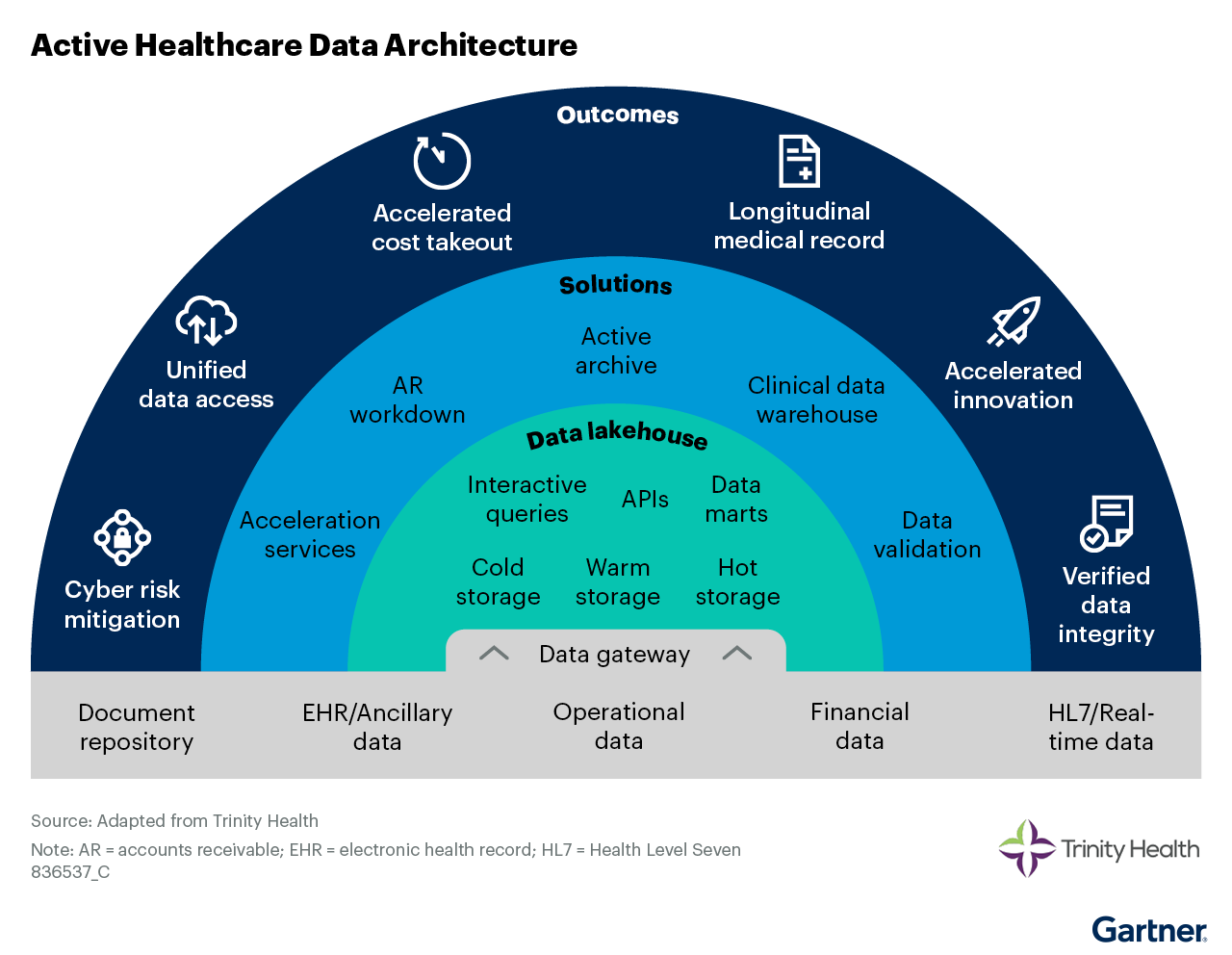
Trinity Health’s Singularity project supporting legacy decommissioning architecture was based on Clearsense’s Active Healthcare Data Architecture (see Figure 1). However, technology alone cannot ensure that decommissioning aspirations, goals and objectives are met and followed through. Without a robust plan to guide the application and workflow integration necessary to leverage and activate decommissioned data, organizations risk maintaining legacy IT systems and equipment long after the data has been successfully decommissioned.
Overcoming Decommissioning Challenges
Legacy decommissioning projects have not been viewed as transformational and do not often attract the same leadership support and budgetary funding. Without a formal application retirement or rationalization program, the CIO lacks adequate visibility into the actual costs of maintaining outmoded and obsolete systems. Disagreements about what applications and systems to decommission and the order in which they should be retired can also impede decommissioning success.
Trinity Health overcame these challenges through strong IT leadership, operationalizing decommissioning as part of the overall system life cycle, and taking a strategic approach closely aligned with its business and financial objectives.
Trinity Health embraced the transformative potential of “active archiving,” which yielded a standardized, repeatable method for calculating ROI or net cost avoidance — essential to securing executive buy-in and sustained funding. Organizations often underreport the actual financial impact of application rationalization and decommissioning by failing to regularly monitor, communicate and socialize positive results.
The Singularity initiative resulted in approximately $68M in annual operating expenses (such as licensing, support, maintenance, infrastructure and staffing) cost savings in 2024. The initiative archived data from a range of over 740 administrative, operational, and clinical applications and systems (such as electronic health record [EHR], ERP, workforce management [WFM], laboratory information system [LIS], patient flow and document management) at a rate of 20 to 45 per month. It worked on accounts receivable in decommissioned legacy financial applications and systems.
Gartner developed this case study to describe the strategic approach to legacy decommissioning taken by a large IDN to an increasingly common operational challenge. It is based on briefings, discussions and critical feedback from Trinity Health and Clearsense.
1 About Us, Trinity Health.