Market Guide for Retail Merchandise Financial Planning
10 February 2025 - ID G00790905 - 18 min read
By Jonathan Kutner
Merchandise financial planning enables merchandisers to optimize sales, profit and inventory, connecting stakeholders with a single trusted source of data. CIOs can use this guide to identify MFP solution vendors to support digital business transformation within a unified retail commerce strategy.
Overview
Key Findings
- Adoption of merchandise financial planning (MFP) solutions does not require wholesale change of working practices. The leap from spreadsheet-based working to utilizing an MFP tool is seen as the quickest “win” among core merchandising functions.
- MFP solutions are a critical part of the orchestrated merchandising suite. They have been proven to increase margins through better forecasting, less over/under buying, a higher full-price sales mix and improved visibility.
- The MFP and assortment processes are inextricably linked, forming intertwined end-to-end planning processes executed sequentially by the merchandiser. This linkage helps merchandisers smoothly transition to adopting customer behavior hierarchies.
- MFP connects merchandising to other vital departments, including finance, logistics, buying, marketing, store operations, warehousing and HR, in support of unified retail commerce.
- MFP implementations will challenge existing legacy product hierarchies that may not represent new business requirements and will have to be redrawn or augmented by attributes.
Recommendations
- Commit with merchandisers to move from spreadsheet-based planning and define the requirements on a joint project to source an AI-driven MFP solution to deliver a fully optimized, multichannel planning strategy.
- Scrutinize the MFP solution market and collaborate with the head of merchandising to select the optimal vendor within two years. Create a centralized repository of merchandising KPIs for users to share, publish and reconcile different plans and versions instantaneously.
- Execute a review of how MFP impacts the assortment process. When considering investments in MFP solutions, ensure a fluid user experience and seamless working capability by operating the two modules on the same platform and, ideally, from the same vendor.
- Break down the silos that impede seamless connections among key collaborative stakeholders. Finance teams, in particular, can benefit from transparent workflow capabilities for critical processes such as managing cash flow.
- Utilize the implementation of MFP as the opportunity to replace linear product hierarchies with a customer-centric hierarchy to allow merchandisers to construct plans driven by customer needs, preferences and behaviors.
Market Definition
Gartner defines the retail merchandise financial planning (MFP) solution market as the planning and analysis of pre- and in-season merchandising strategy that enables merchandisers to optimize sales, profit and inventory, and effectively communicate KPIs to stakeholders across the organization. Modern MFP solutions automate data processing and workflow and leverage AI data analytics and machine learning to create statistical modeling.
MFP is a vital component of retail business planning. It involves merchandisers initiating the strategic planning process for an upcoming season or period and managing its execution during the season. MFP encompasses sales forecasting, inventory receipts, margin and stock-level projections across the product hierarchy, channels, and various product and business attributes. MFP solutions can bridge and facilitate a seamless “talk to finance” working relationship to formulate short- and long-term strategic plans. MFP solution implementations have proven use cases that have delivered direct improvements to KPIs such as reducing inventory levels and increasing profitability.
Mandatory Features
- Forecast sales based on all internal data and external sources that can be leveraged to develop a better understanding of the current market trends.
- Calculate the optimum value of inventory receipts required to achieve the sales plan for preseason and in-season, open-to-buy (OTB).
- Enable forecasts down to all levels of the product hierarchy and attributes and across all channels. Provide reconciliation support to align merchandise financial plans with assortment planning throughout the process.
- Calculate all core merchandising KPIs, including cost of goods sold (COGS), gross margin, mark-down costs and inventory levels.
Common Features
- AI-driven capability to create intelligent and accurate forecasting to derive initial preseason plans.
- Planning facilitated by various personas or roles within the organization.
- Permit planning down to the lowest granular level of the merchandise and organizational hierarchy and alternate hierarchies, including product attributes, either top down or bottom up.
- Capability to plan at the customer behavior hierarchy level.
Market Description
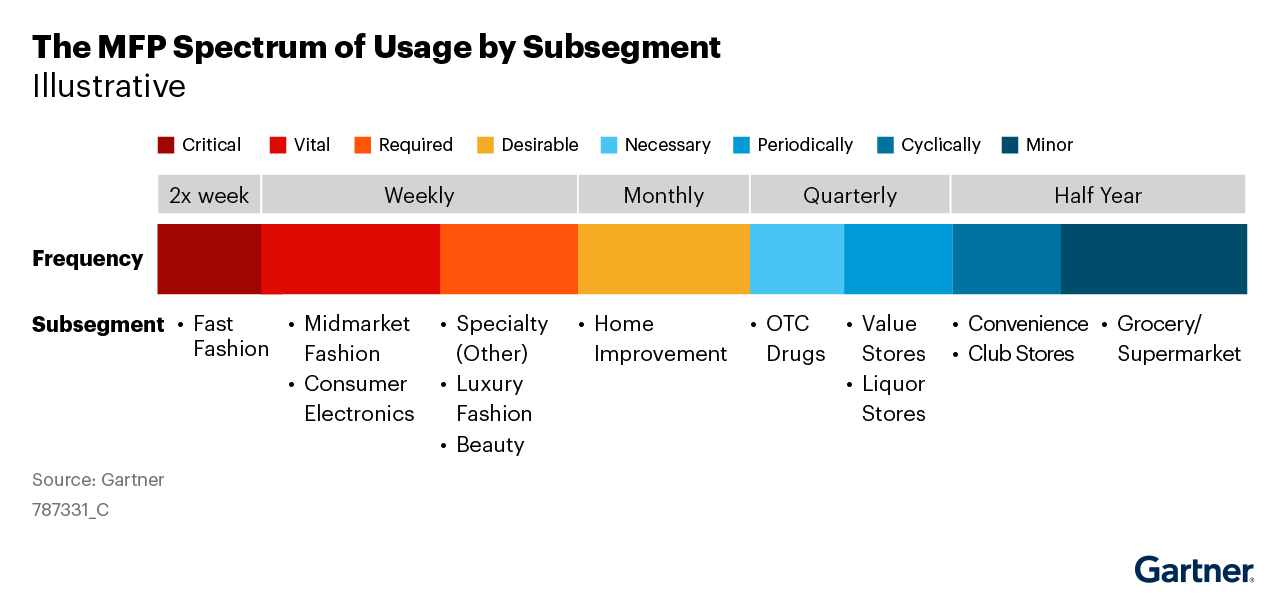
Merchandise financial planning (MFP) is typically associated with retail product categories, such as fashion items, which require high-frequency planning cycles — many times a week, weekly or monthly. This aligns the solution more toward planning short life cycle products, which are seasonal or trend-driven. Consumable products with a long life cycle, such as staple grocery items, which are typically planned at quarterly or half-yearly intervals, are generally not planned using MFP and, therefore, not covered in this guide (see Note 1).
Category managers of long life cycle products are still involved in financial planning as part of their role. They are responsible for budgeting and setting financial targets for sales and margins of their category and can use MFP for this purpose. However, category managers of product categories like grocery, which have much shorter supply chain lead times, do not typically use MFP. This is because they do not need to formulate a receipt plan to build an intake schedule, unlike merchandisers who must do so for preseason planning of short life cycle products, such as fashion items, which have long lead times.
MFP is acknowledged as the primary tool for strategic preseason and in-season planning, which is critical within short life cycle retail merchandising.
Key capabilities include forecast-driven financial planning and management of open to buy (OTB) via top-down and bottom-up automated scenario planning with version control. MFP has enhanced merchandisers’ roles, enabling them to deliver better-targeted customer-centric assortments that drive increased profitability, margin and inventory flow.
When researching MFP solutions, our vendor interactions surfaced numerous use cases demonstrating how implementations have directly improved business KPIs. One example is a large apparel brand that successfully reduced inventory levels by 30% after MFP, which enabled the brand to optimize assortments by gaining a better understanding of store-specific customer demand size.
CIOs must select an MFP that not only meets the merchandisers’ immediate needs, but also aligns with the wider needs of the organization to connect stakeholders, such as finance, HR and store operations.
The application and frequency of usage of MFP depends on the type of products the retailer sells.
Figure 1 illustrates the spectrum of MFP usage by retail industry subsegment.
MFP acts as the first essential and unmissable gateway to orchestrating short life cycle merchandise planning, presenting merchandisers with the capability to digitalize the end-to-end strategic planning process, right through to the assortment stage. Best-in-class solutions offer the entire organization a centralized repository of merchandising KPIs, giving all stakeholders the ability to:
- Communicate, circulate and reconcile different plans and versions instantaneously
- Meet the goal of effectively planning for unified retail commerce execution
In this regard, MFP can contribute toward providing retail consumers with a continuously relevant experience as they browse, transact, acquire and consume, regardless of touchpoints. This means MFP solutions must support a unified retail commerce merchandising strategy to ensure ideal inventory levels across locations, store clusters, channels and other touchpoints.
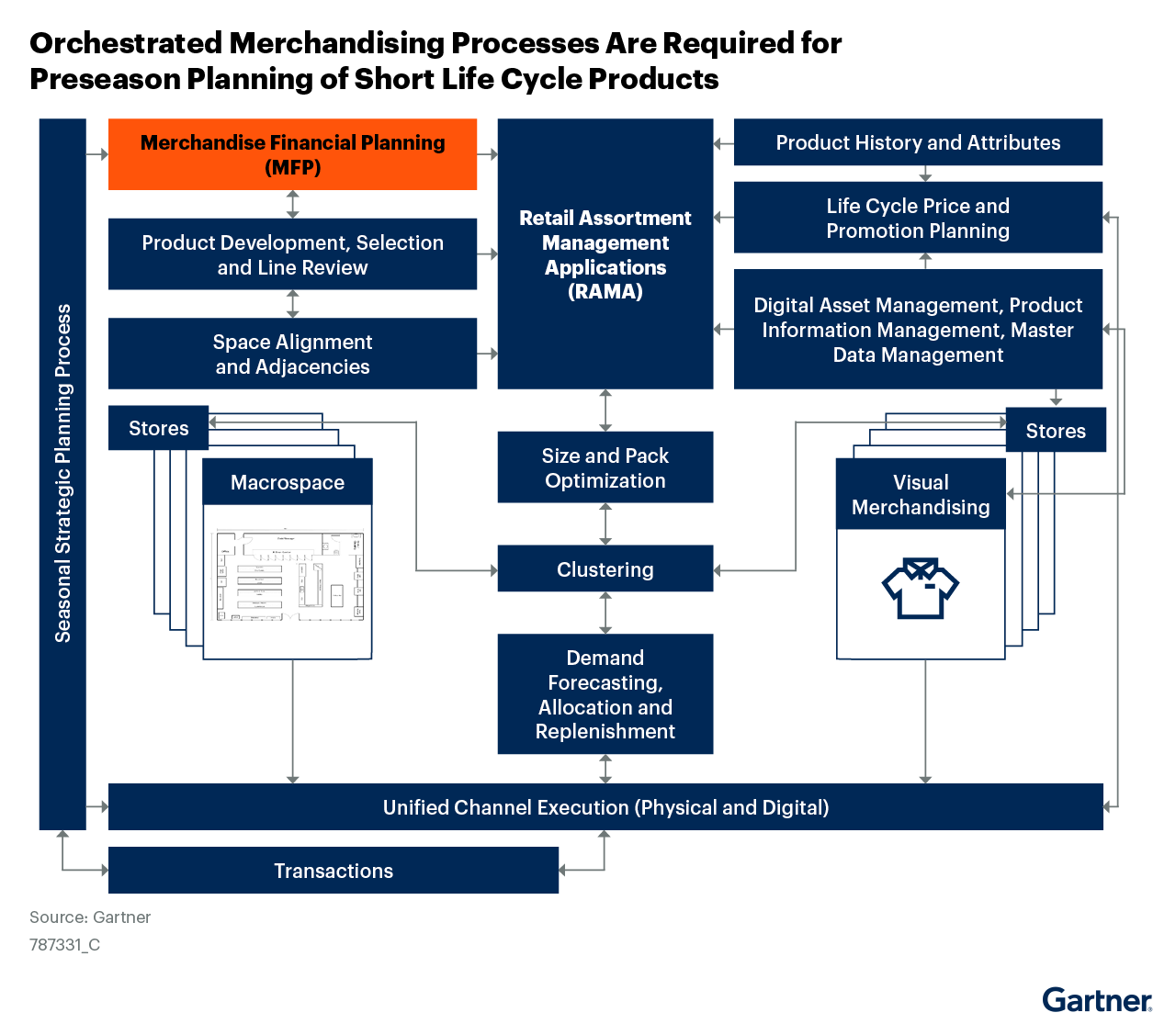
Merchandisers depend on MFP tools to manage both the preseason planning and in-season trading aspects of their roles. Moreover, the assortment process depends on the MFP setting up the initial sales and receipt plans, which are then converted into styles and units to create the assortment plan.
Figure 2 illustrates the new, orchestrated merchandising process where the MFP function is the gateway and essential first, unmissable step.
Market Direction
The demand for MFP has increased over the past 24 months, driven by two emerging benefits.
The primary benefit is that CIOs and merchandising heads have identified MFP as the least complex process to begin their merchandising digital transformation. It requires much less change management than is normally associated with other merchandising functions, such as assortment or pricing optimization.
Adoption of MFP solutions does not require a wholesale change in working practices; the revolution occurs in the automation and preciseness of the tools. The leap from spreadsheet-based working to utilizing an MFP tool is seen as the quickest “win” among core merchandising functions.
For this reason, MFP can be seen as a stepping stone to the journey through the merchandising digitalization maturity curve and a valuable proof of concept for exploring the benefits of AI-driven merchandising.
Secondly, MFP solutions benefit the wider organization, beyond just enhancing the merchandising department. While MFP is a core merchandising process, it interacts with many of the other core processes within a retail organization (see Figure 3).
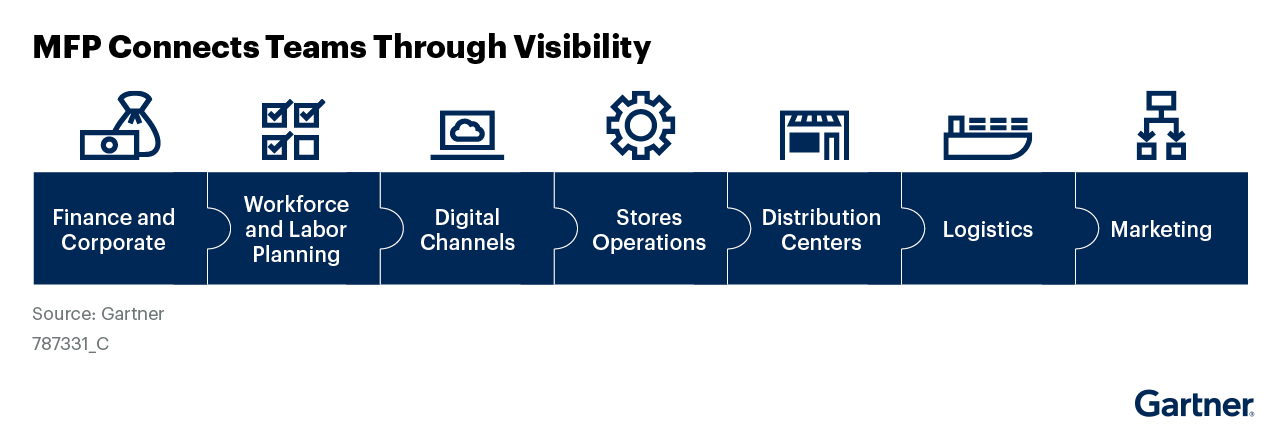
The strongest relationship is with finance teams, clearly linked to financial planning and analysis. MFP solutions can bridge and facilitate a seamless “talk to finance” working relationship, dramatically improving tasks such as calculating cash flow and formulating short- and long-term strategic plans. The silos between merchandising, finance and corporate can be removed, allowing a free flow of information, saving time and avoiding ambiguity.
MFP solutions can also be integrated with other functions to share data openly and transparently to improve workflows, including:
- Workforce and labor planning, enhancing workforce management
- Digital channels, improving visibility of KPIs
- Stores operations, sharing forecasts by country, region or individual locations
- Distribution centers, providing forecasts of peak activity
- Logistics, aiding planning of resources
- Marketing, synchronizing schedules to maximize performance
There is some capability for marketing to feed in social media analytics trends to enhance MFP demand forecasting — for example, if certain categories or products are featured on ByteDance’s TikTok. Weather data can also be incorporated into demand forecasting to drive localized and accurate forecasts.
Market Analysis
While the market for MFP solutions remains buoyant, merchandising teams are increasingly looking for all-embracing functionality to augment their current processes. This has noticeably increased with greater demand for AI capabilities to enhance the scope and performance of MFP solutions.
AI-Powered Planning
AI-powered solutions can drive intelligent forecasting, leveraging an AI/machine learning (ML) forecasting engine as an insightful starting point for seeding plans in the preseason stage. By leveraging AI to create a base forecast for initial plans, the user can then create contrasting scenarios of forecasts and compare plans with multiple different versions. Initial plans derived from AI utilizing data science are more precise than traditional top-line gut-feel assumptions.
Forecasting is enriched as the process moves from user-guided to AI-driven, generating insights that go beyond plus or minus of the prior year.
AI functionality in line with business rules can analyze, adjust and smooth out anomalies in historical performance data, impacted by events that are not anticipated to occur again. This could include the impact of the pandemic, one-off promotions or excessive discounts which are not desirable.
Most MFP is conducted through top-down financial targets set within the strategic business planning process. However, AI-empowered forecasts can predict customer demand at the most granular level and make it available at any level of the merchandise and organizational hierarchy. This can aid with building plans from the bottom up, especially if categories contain “hero products” — that is, individual products or styles that can fundamentally impact the performance of whole categories or even top sales as a whole.
The financial targets set within the MFP used to formulate the strategic plan are also used to drive the OTB process and ultimately create the assortment plan. The OTB process, also described as weekly sales, stock and intake (WSSI) in much of Europe, allows merchandisers to manage their inventory based on sales forecasting, actual sales made and stock information. Once again, AI can augment the WSSI to support precise and accurate forecasting to optimize margins by diminishing the impact of markdowns and discounting.
Customer-Centric Planning Capabilities for URC
Another major force impacting the market for MFP is the need for functionality to reflect the successful execution of unified retail commerce (URC), which can provide consumers with a continuous experience as they browse, transact, acquire and consume, regardless of touchpoints (see Quick Answer: What Is Unified Retail Commerce, and Why Does It Matter?). This means MFP solutions must support a unified retail commerce merchandising strategy that aligns with the organization’s long-term URC strategy and goals.
However, the biggest barrier to the expectation for today’s customers is that they must fit neatly into inflexible and linear archaic merchandising product hierarchies, which will be disastrous and ruinous in the long term. The shortcomings of traditional product hierarchies are now clearly apparent and include:
- Rigidity and lack of flexibility to adapt to market trends, new products, categories and consumer behavior
- Inadequacy of support for granular analytics and detailed product attributes
- Insufficient and poor customer experience for navigation and search
- No clear understanding of complex product relationships across multiple attributes and categories
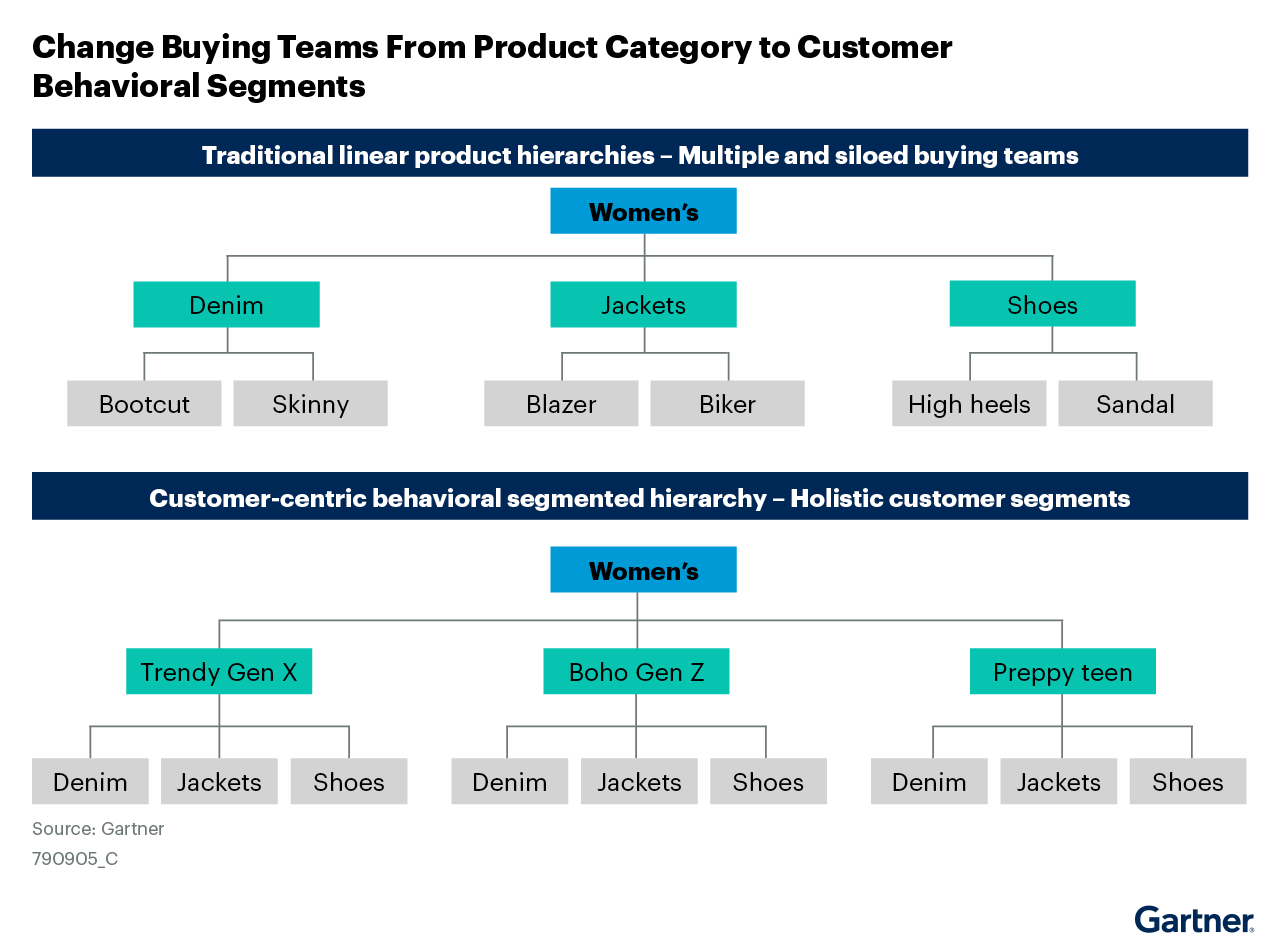
There is a small but noticeable trend in which retailers have started shifting to merchandising processes that move away from traditional product-based planning toward customer behavior-centered hierarchies. MFPs must, therefore, have the capability to support the significant structural reorganization of merchandising and merchandise planning, which must occur so that retailers can recenter key customer behavior segments at the core of their merchandising processes. This will enable retailers to target specific customer cohorts with relevant products and services. MFPs must also be well synchronized with the marketing function. This will lead to accelerated speed to market for innovative products for competitive differentiation resulting in increased loyalty, more repeat spend and an increase in sales conversion.
A customer-centric approach is now unavoidable and, therefore, mandatory to satisfy new, changing consumer behaviors (see Figure 4).
Retailers can then focus on what is truly important to customers in the touchpoints with which they interact (see 3 Key Actions to Help Retailers Adopt Customer-Centric Merchandising).
Using MFP to eliminate guesswork in critical merchandise assortment planning decisions, optimize inventory efficiency and reduce stock-outs to deliver the best possible customer experience will result in the business gaining a competitive advantage and a direct revenue boost.
An MFP is a fundamental tool that can include many complicated matrices involving several factors to calculate the best possible customer-behavior-centered assortments. It can cope with the complexity of the relationships between the factors, which will include a wide range and number of parameters on behavioral segments, locations, touchpoints and products.
Merchandisers will also have to grapple with new customer behavior demands, such as building assortments that are compliant with sustainability requirements. Merchandisers can use MFP’s accurate planning capability to help them reduce waste and overbuying and focus the assortment stage toward a range of products that customers are really seeking.
For MFPs to accommodate URC and customer-centric planning capabilities, they will need to have multidimensional functionality, both top-down and bottom-up, where all data is reconciled and consistent regardless of which level or criteria the user begins or ends within the MFP. This will enable the production of the most effective, accurate, insightful, and coordinated financial and merchandise plans possible across all of a retailer’s product and customer behavior hierarchies and channels. Alongside the diversity of channels, market hierarchy and customer behavioral segments, a must-have requirement is the capability to plan within multiseason and period preferences.
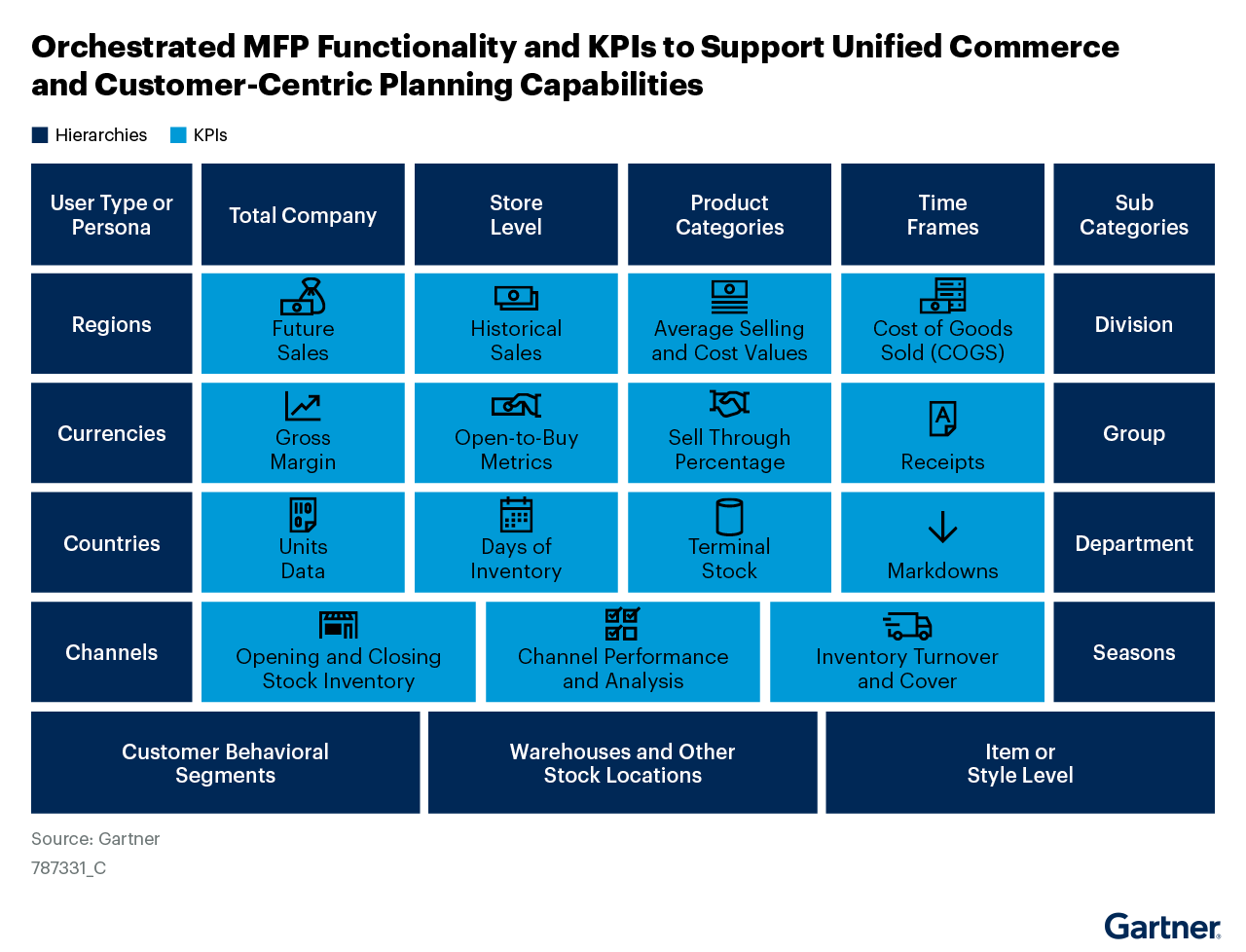
Alongside the merchandising KPIs, planning is required at numerous levels (see Figure 5).
The MFP and Assortment Processes Are Inextricably Linked
When analyzing the MFP market and solutions, the link with assortment optimization for short life cycle products is critical, as it is impossible to disentangle or separate the two processes. MFP and assortment planning together form intertwined, end-to-end planning processes, both executed by the merchandiser sequentially. This is not true for long life cycle products, where merchandisers can plan assortments without defining a strategy in MFP.
The combination of the two processes can also play a critical role in sustainability in short life cycle. It can evaluate which categories and products will achieve the highest performance, reduce costs and minimize supply chain risks.
When considering investments in MFP solutions, CIOs also need to weigh how the MFP will interact with the assortment management process and the associated workflow. Best practice is to operate the two modules on the same platform and, ideally from the same vendor, to ensure a fluid user experience and seamless working capability.
Merchandising processes can no longer operate in organizational or technology silos, as the execution of a unified retail commerce strategy requires complex orchestration across all core processes, such as financial and assortment planning, space management and pricing.
Merchandisers tend to combine the processes of MFP and assortment building during their frequent workload. They regularly start in one process and flip back into the other. Therefore, the ability to toggle between the two functions is imperative, and any changes or adjustments in either will need to be reflected and updated instantaneously.
MFP is a logical first step in the digitalization journey of the merchandising process for short life cycle products. However, it is important to consider how implementing a robust and perceptive MFP will impact the assortment management process and future implementation of retail assortment management applications (RAMAs) (see Market Guide for Retail Assortment Management Applications: Short Life Cycle Products).
Therefore, a roadmap approach to future implementations is highly beneficial to ensure solution procurement decisions made today will complement those made in the future. A best practice when scoping out vendors for MFP is to carry out due diligence on the platform’s assortment capabilities to ensure future implementations will match the required functionality and usability.
Vendors supply MFP and assortment as two separate modules and are implemented individually.
In instances where a retailer has already implemented RAMAs before MFP, this research will help CIOs evaluate whether the accompanying MFP supplied by the vendor has all the core capabilities expected of an advanced data analytics solution. Otherwise, new implementations of both solutions will need to be considered.
Representative Vendors
The vendors listed in this Market Guide do not imply an exhaustive list. This section is intended to provide more understanding of the market and its offerings.
Vendor Selection
The market for MFP has been evolving over the past 15 years, with increasing levels of advanced analytic and AI capabilities becoming the norm. Vendors listed in Table 1 include some with a long history in the planning of sales, profit and inventory, as well as some newer entrants for consideration by retailers seeking to enhance their planning processes.
Table 1 lists the vendors and solutions included in this research. Further data on each vendor’s optimization type and industry subsegment is available upon inquiry with Gartner analysts.
Representative Vendors in MFP
Vendor Name | Solution Name |
Merchandising and Category Planning | |
Merchandise Financial Planning | |
Merchandise Financial Planning | |
Module MFP — Merchandise Financial Planning | |
Centric Planning | |
Merchandising & Assortment SuiteMerchandise Financial Planning | |
Fractal Merchandize Analytics and Planning | |
PlanSmart | |
Merchandise Financial Planning | |
Jesta Group (Jesta I.S.) | Merchandise Planning |
Merchandise Financial Planning | |
Retail Planning and Optimization | |
Merchandise Financial Planning (MFP), Open-to-Buy (OTB) | |
S5 Merchandise Financial Planning | |
SAP S/4HANA Retail for Merchandise Management | |
Merchandise Financial Planning | |
Merchandise Financial Planning | |
Merchandise Financial Planning Software | |
Source: Gartner (February 2025)
Market Recommendations
- Optimize assortments and cash flow management by unleashing AI-powered, fully integrated and connected MFP solutions. Best-in-class MFP solutions allow merchandisers to seize control of preseason and in-season planning processes, adding precision and strategy to their KPIs of demand forecasting, markdowns, receipts, inventory and open-to-buy, across all of a retailer’s channels.
- Seek vendor solutions that allow merchandisers to work in multidimensional levels to ensure a meticulous foundation of the merchandising workflow. Creating MFPs in spreadsheets constrains the entire planning process and inhibits the processes of building precise, curated and customer-centric assortment plans.
- Implement MFP solutions that create a holistic and universal approach to the planning process that empowers all key participants. MFPs with all-encompassing functionality ensure the unification of key roles across the organization, creating the concept of a single source of truth.
- Boost the merchandising role with connected MFP and assortment solutions to streamline processes, saving time, money and effort. Combining the two tools within the same platform allows for a seamless single sign-on working capability, making strategic data easier to collect, manage and access, thereby enhancing performance and work quality.
- Make customer behavioral data the core of your merchandising solutions to enable users to develop insightful customer segments. Embark on the transformation toward customer-centric planning by implementing an MFP solution utilizing customer insights instead of traditional product hierarchies.
Acronym Key and Glossary Terms
| Hero products | Individual products or styles that can have a fundamental impact on the performance of whole categories or even top sales as a whole. |
| Short and long life cycle products | The life cycle of a product is the length of time from a product first being introduced to consumers until it is removed from the market. For short life cycle products, the demand is based on the item being on trend or in fashion. Following maturity, demand will decline. The demand for long life cycle products has a significantly longer maturity stage that can last for years if not decades because they are not so intrinsically linked to prevailing trends or fashions. |
| Retail assortment management applications (RAMAs) | RAMAs support business processes critical to meeting customers’ needs by assuring the best possible assortment of products. They cover the operational functions of advanced assortment/range planning for short and long life cycle product categories, including preperiod and in-period planning and analysis, store clustering, assortment/financial plan reconciliation, inventory and replenishment planning, and open-to-buy calculations. |
Note 1: Gartner’s Initial Market Coverage
This Market Guide provides Gartner’s initial coverage of the market and focuses on the market definition, rationale for the market and market dynamics.