Magic Quadrant for AI Applications in IT Service Management
2 September 2025 - ID G00823161 - 35 min read
By Chris Matchett, Rich Doheny, and 1 more
AI applications in IT service management are tools that use AI to augment and extend ITSM workflows to provide intelligent advice and actions for heads of I&O and their IT support teams. This Magic Quadrant evaluates 10 vendors and their AI-focused products in this market.
Strategic Planning Assumptions
By 2027, 50% of AI projects at IT service desks will be abandoned due to unforeseen costs, risks or an inability to achieve the projected return on investment.
By 2027, generative AI (GenAI) will create more IT support and knowledge-base articles than humans will.
By 2030, 20% of high maturity I&O organizations will operate a zero-touch service desk, up from less than 1% of organizations in 2025.
Market Definition/Description
Gartner defines AI applications in IT service management as tools that augment and enhance IT service management (ITSM) workflows using AI. These analyze ITSM data and metadata (primarily found in ITSM platforms) to provide intelligent advice and actions on ITSM practices and workflows, such as IT service desk and support activities. This software can either be a stand-alone product, features extending an ITSM platform or an add-on to an ITSM platform.
Infrastructure and operations (I&O) leaders are challenged by rising costs of IT support, and declining employee engagement and productivity.
AI features enable I&O teams to optimize IT support and service management processes (such as incident and problem management) through insight and automation. This can lead to tangible reduction in costs, such as labor savings by handling support issues and requests automatically, faster resolutions, and improved accuracy in triage, categorization and expert identification. In addition to addressing overheads, AI solutions can improve the employee-facing user experience and enhance IT’s relationship with the business consumer. Some features, such as intelligent risk advisory, can help I&O leaders reduce disruptions and provide reliable IT services.
These features may be accessed via a conversational AI interface, such as a virtual support agent or operations assistant.
Generative AI (GenAI) features are increasingly sought-after to automate content generation and improve communications. Examples include summarizing information, such as knowledge base articles or case work log updates, and generating major incident notifications.
The AI Use-Case Assessment for IT Service Desk provides further details on the AI and GenAI opportunities that tools such as AI applications for ITSM are able to address.
Mandatory Features
At a minimum, an AI application for ITSM must:
- Use AI technologies like GenAI, natural language technologies and machine learning to analyze ITSM data and metadata.
- Use this analysis to generate recommendations or actions for ITSM practices, including IT incident, request, knowledge, problem and change management.
Common Features
The common features for this market include:
- Virtual support agents as business-consumer-facing conversational interfaces that deliver answers to common questions and perform transactions to provide IT support.
- Operations assistants as ITSM practitioners/practice-lead conversational interfaces that leverage data-driven insights to help them carry out their role.
- AI search to discover IT knowledge and solutions using:
- Public knowledge discovery using public large language models (LLMs).
- Proprietary knowledge discovery using a custom LLM trained on private knowledge.
- Universal knowledge discovery using technologies such as retrieval-augmented generation (RAG).
- Agent advice via:
- Intelligent triage, for guidance on prioritization.
- Intelligent categorization of cases by service, configuration item or solution.
- Intelligent escalation of cases before they hit timed service-level thresholds.
- Intelligent risk advisory of planned changes using similar release history (clustering).
- Intelligent routing to identify suitable and available resolver groups.
- Intelligent swarming to identify experts, including those from outside of IT.
- Sentiment analysis to warn of poor service experiences and/or low digital employee experience (DEX) scores when business consumers contact the IT service desk.
- Pattern recognition powered by case clustering (with incidents, problems, changes, knowledge articles and configuration items) to provide:
- Major incident detection when IT support teams receive incidents from end users that are very high-impact but not already detected by monitoring or AIOps platforms.
- Problem detection when multiple incidents are reported that may share a common cause.
- Root cause analysis for problem management investigations.
- Change optimization to identify changes that could be standardized.
- Content generation using GenAI:
- IT knowledge generation of solutions generated from case work log notes or collaborative support hub conversations.
- Automatic communications to generate and refine case updates or major incident notifications.
- Case summarization:
- Incoming request summarization to help experts understand new incidents and requests.
- Intelligent postcall wrap-up to refine and standardize agent shorthand case work log notes.
- Summarization of major incidents for postincident reviews.
- Generation of ITSM reports, such as postincident and postrelease reviews.
Magic Quadrant
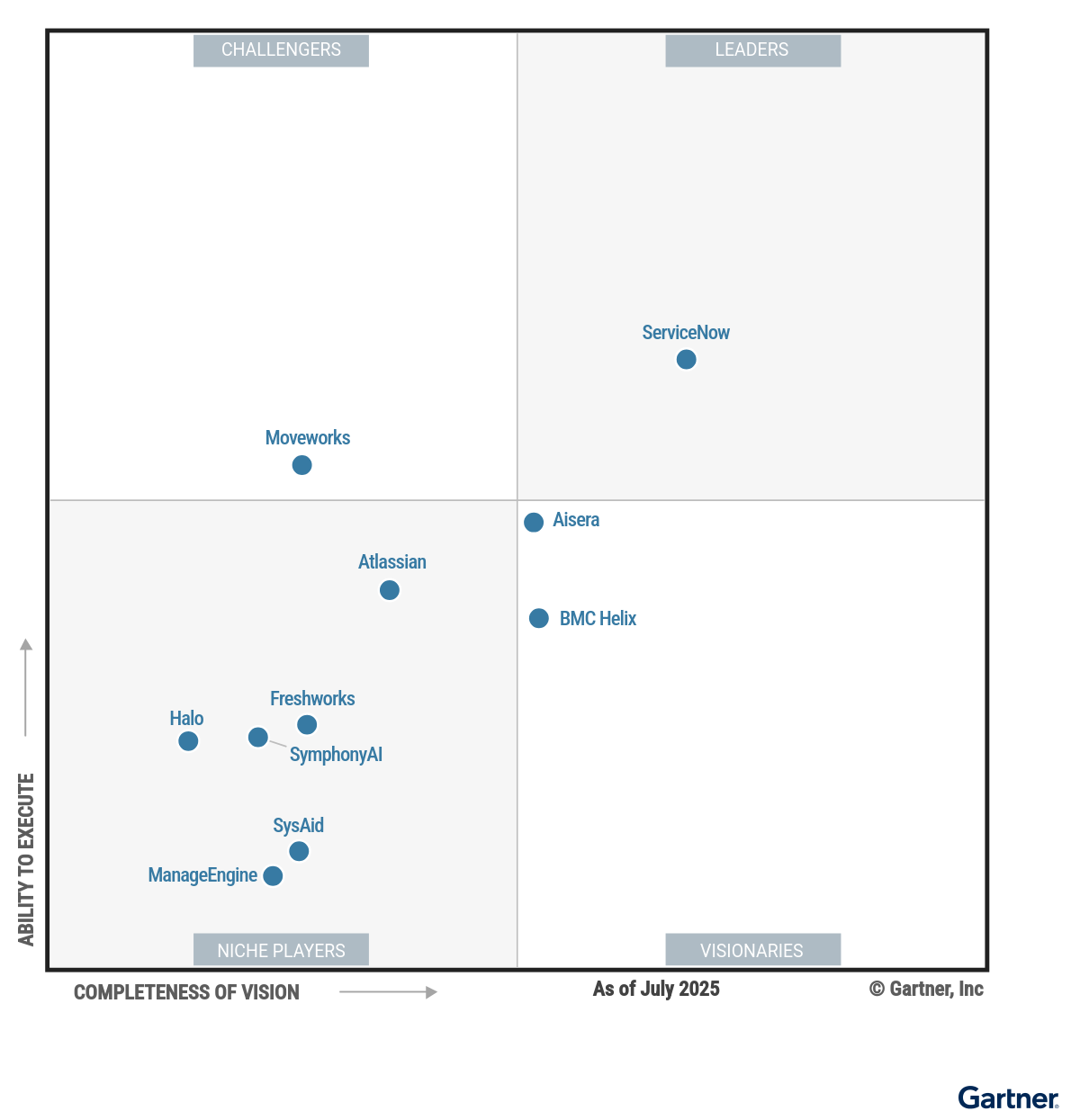
Vendor Strengths and Cautions
Aisera
Aisera is a Visionary in this Magic Quadrant. Aisera’s AI application in ITSM is composed of several products, including AI Service Desk, AI Copilot, AI Agents, Enterprise AI Search, Agent Assist and AIOps. These products are designed to work with third-party ITSM platforms.
Recent product enhancements include Autobrief for document insight extraction and GenIQ for more secure access to foundational AI models. Future product development plans include enhancing AI capabilities with automated incident response (AIR) and introducing real-time predictive analytics.
- Self-service effectiveness: Aisera delivers good results for end-user self-service through robust conversational AI capabilities, enabling customers to leverage its proprietary large language model (LLM) or integrate their own models, with LLM Studio supporting tailored tuning using organizational knowledge and ITSM data.
- Strategic marketing initiatives: Aisera’s collaboration with Stanford University to publish a benchmarking framework highlights the product’s strengths effectively and builds credibility for Aisera in this newer market.
- ITSM market alignment: Aisera shows a solid understanding of ITSM-specific AI needs, ensuring that product enhancements are closely aligned with evolving operational requirements and addressing specific ITSM scenarios rather than generic AI use cases.
- Premium pricing: The combined cost of Aisera’s AI application and add-ons that may be needed for full functionality could exceed the budget of organizations already investing in an ITSM platform.
- Sales channel limitations: Aisera’s sales force is small and it has fewer third-party resellers than many of its competitors. This will challenge its ability to penetrate new markets and facilitate sales support activities.
- Inadequate documentation quality: Product documentation is frequently insufficient or unclear, lacking practical configuration and usage guidance, which can hinder implementation and increase dependence on Aisera’s support teams.
Atlassian
Atlassian is a Niche Player in this Magic Quadrant. Atlassian’s AI application in ITSM is composed of AI features in its own ITSM platform, Jira Service Management, which includes Rovo.
Recent product enhancements include IT knowledge generation and intelligent categorization. Future product development plans include unifying builder experiences with Atlassian Studio and launching a deeply integrated set of AI agents tailored to service teams.
- Bundled features: Atlassian’s inclusion of ITOM features (formerly sold separately as Opsgenie) at no additional cost enhances its agent advisory capabilities, enabling organizations to automate and streamline incident response workflows.
- Financial stability: Atlassian’s overall revenue and sustained ITSM market growth provide assurance of ongoing investment in AI capabilities and long-term vendor viability.
- Cross-team connectivity: Atlassian’s product strategy addresses the need for unified workflows by prioritizing an extensible knowledge graph and advanced enterprise search that enables AI models to access and correlate information across teams.
- Insufficient ITSM alignment: Atlassian needs to further demonstrate value in key ITSM use cases to stand out from more specialized competitors.
- Unproven features: With the launch of Rovo in late 2024, most features in Atlassian’s AI app for ITSM are relatively new and not yet widely adopted.
- Transaction limitations: Limits on the number of intelligent actions to automate AI workflows that can be executed over a defined threshold have disrupted larger customers, particularly those that recently migrated from on-premises data center implementations.
BMC Helix
BMC Helix is a Visionary in this Magic Quadrant. BMC Software announced that BMC Helix will split from BMC in 2025. BMC Helix’s AI application in ITSM is composed of AI features in its ITSM platform, specifically BMC Helix ITSM. BMC Helix Operations Management with AIOps is also required to obtain the functionality in some of the AI applications for ITSM use cases.
Recent product enhancements include HelixGPT Service Collaborator for automated ticket summarization and routing, and HelixGPT Knowledge Curator for automated knowledge article creation. Future product development plans include deploying a major incident coordinator for comprehensive incident detection and launching a CMDB Governor for automated data quality and compliance.
- Incident correlation proficiency: BMC Helix’s product is well-suited to ITSM practice leads through its case-clustering capability, which provides major incident and problem managers with real-time incident correlation.
- ITOM integration: BMC Helix has a large installed base of ITOM customers with a broad offering of related products, giving those customers a platform expansion opportunity with integrated ITOM features.
- Comprehensive roadmap: BMC Helix maintains a well-rounded product strategy that addresses most AI-for-ITSM use cases (end-user self-service, ITSM practitioners and ITSM practice leads).
- Additional costs: Achieving BMC’s full AI functionality requires bringing your own LLM and investment in Helix Operations Management with AIOps, potentially raising costs beyond the affordability of some customers.
- Limited feature adoption: Uptake of AI capabilities remains modest among BMC Helix’s customer base, indicating slower engagement with advanced AI functions compared to broader ITSM adoption.
- Generic market messaging: BMC Helix’s marketing frequently emphasizes broader service operations themes and generic AI messaging, lacking clear demonstration of advanced ITSM-specific AI capabilities.
Freshworks
Freshworks is a Niche Player in this Magic Quadrant. Freshworks’ AI application in ITSM is composed of Freddy AI. This product is designed to work with its own ITSM platform, Freshservice.
Recent product enhancements include improving the accuracy of similar ticket identification and increasing the confidence thresholds for the field-value suggestions. Future product development plans include releasing an operations assistant that offers proactive suggestions and implementing change risk optimization and assessment.
- Streamlined deployment: Customers benefit from comparatively short deployment times and comprehensive documentation for established features, facilitating quicker realization of value.
- Robust sales and partner network: A large direct sales force and growing reseller ecosystem provide customers with flexible purchasing options.
- Global implementation reach: The provider’s strong implementation partner coverage across all regions supports customers seeking localized expertise and support.
- Narrow market perspective: Freshworks’ strategy for AI in ITSM remains closely tied to its ITSM platform product strategy, resulting in missed identification of emerging threats and competitive dynamics shaping the AI applications for ITSM market.
- Limited LLM integration: Support for external LLMs is currently restricted to OpenAI, reducing flexibility for organizations seeking to use their own alternative AI models.
- Delayed feature availability: Freshworks has been slow to address buyer needs for functionality, such as clustering and change management support. Many new features have been locked in extended beta programs, raising concerns about their ability to consistently deliver fully supported, production-ready capabilities in a timely manner.
Halo
Halo is a Niche Player in this Magic Quadrant. Halo’s AI application in ITSM is composed of AI features in its ITSM platform, specifically HaloITSM.
Recent product enhancements include a sensitive information detector for identifying personally identifiable and health-related data, and a feature-request “finder” assistant that leverages a vector database for enhancement tracking. Future product development plans include integrating lightweight, customer-hosted LLMs for private AI processing as well as deploying AI-driven configuration helpers for workflow optimization.
- Bundled AI access: AI features are included within the core ITSM platform cost, allowing organizations to leverage GenAI capabilities without incurring additional licensing fees.
- Low operational overhead: The platform’s simplicity allows customers to achieve results with minimal administrative effort, supporting efficient adoption of available features.
- Global access: Halo is able to extend its global reach beyond core coverage of Europe and North America, leveraging a network of implementation and reseller partners in all major regions.
- Feature gaps: Heavy reliance on public LLMs and limited proprietary AI development restrict Halo’s ability to deliver cutting-edge capabilities for more mature customers.
- Limited innovation capacity: Halo has a small R&D team, which constrains its ability to advance or differentiate AI capabilities in this evolving market.
- Commodity messaging: The inability to showcase distinctive AI features will reduce Halo’s appeal to organizations with advanced or specialized requirements.
ManageEngine
ManageEngine, a division of Zoho Corporation, is a Niche Player in this Magic Quadrant. ManageEngine’s AI application in ITSM is composed of AI features in its ITSM platform, specifically ServiceDesk Plus. ManageEngine Analytics Plus is also required to obtain the functionality in some of the AI applications for ITSM use cases.
Recent product enhancements include postincident review and AnyCall voice agent integration. Future product development plans include supporting Agent2Agent protocol for the Zoho Zia conversational agent and enabling LLM-powered prompt-based app/module generation.
- Global access: ManageEngine’s strong presence in all major regions, including emerging markets, ensures that organizations benefit from local support and regional expertise.
- Cost-effective for SMBs: The solution’s affordability and cross-sell opportunities with Zia make AI features accessible to small and midsize organizations seeking to modernize ITSM.
- Streamlined deployment: The product’s straightforward implementation process enables organizations to quickly adopt and benefit from AI-driven ITSM capabilities.
- Limited conversational AI: The natural language engine lacks context awareness and is restricted to ManageEngine’s internal knowledge base sources, limiting support for complex interactions.
- Undifferentiated marketing strategy: A focus on value over differentiated or advanced features positions ManageEngine as a commodity provider in a market where customers increasingly seek new and distinctive AI capabilities.
- Limited innovation capacity: The R&D team dedicated to AI in ITSM is relatively small, which constrains ManageEngine’s ability to rapidly advance or differentiate AI capabilities in this evolving market.
Moveworks
Moveworks is a Challenger in this Magic Quadrant. Moveworks’ AI application in ITSM is composed of Moveworks AI Assistant, Moveworks Service Management, Moveworks Provision Management, Moveworks Productivity Boost, Agent Studio, Employee Experience Insights and Knowledge Studio. It is designed to work with third-party ITSM platforms.
Recent product enhancements include Enterprise Search and Quick GPT integration within the Moveworks AI Assistant. Future product development plans include expanding AI Assistant with internet search capability for Quick GPT and domain-specific AI assistants.
ServiceNow announced its intention to acquire Moveworks on 10 March 2025. At the date of publication, both Moveworks and ServiceNow met the inclusion criteria for this Magic Quadrant and continued to operate as separate going concerns. Gartner will provide additional insight and research to clients as more detail becomes available.
- Strong market traction: Moveworks’ approach of providing implementation and customer success services leads to it frequently advancing to late-stage procurement with a notable prospect conversion rate.
- Customer awareness: Targeted advertising and compelling website content have established Moveworks as a well-known brand in this market that regularly appears on customer shortlists.
- Strong R&D investment: Moveworks has a well-resourced R&D team, active patenting, and a research-driven culture enabling rapid development and deployment of AI capabilities.
- Diluted ITSM focus: Moveworks’ ongoing investment in non-IT use cases, such as general conversational AI and enterprise search, has resulted in limited advancement of ITSM-specific features and diminished alignment with the evolving needs of ITSM buyers.
- High cost: The pricing of Moveworks’ AI application in ITSM, plus the several add-ons required to provide the full set of available features, is beyond the affordability of some potential customers who are also paying for an ITSM platform.
- Unaddressed product gaps: Moveworks’ emphasis on agentic AI trends has come at the expense of advancing core ITSM-specific capabilities, such as agent advisory, where the solution remains comparatively underdeveloped.
ServiceNow
ServiceNow is a Leader in this Magic Quadrant. ServiceNow’s AI application in ITSM is composed of AI features in its ITSM platform, specifically ServiceNow ITSM Pro Plus. ServiceNow ITOM AIOps Professional is also required to obtain the functionality in some of the AI-application-for-ITSM use cases.
Recent product enhancements include configurable incident summarization and change summarization for streamlined change request reviews. Future product development plans include enabling agent-to-agent integration for collaborative AI workflows and delivering DEX autonomous remediation for proactive endpoint issue resolution.
ServiceNow announced its intention to acquire Moveworks on 10 March 2025. At the date of publication, both Moveworks and ServiceNow met the inclusion criteria for this Magic Quadrant and continued to operate as separate going concerns. Gartner will provide additional insight and research to clients as more detail becomes available.
- ITSM market presence: ServiceNow’s dominant market presence in ITSM platforms gives it an incumbent advantage to position its platform-native AI with a significant number of customers via numerous targeted marketing campaigns.
- Strategic product vision: A 36-month roadmap outlines enhancements across a broad set of AI for ITSM functionalities, supporting long-term customer planning.
- Tangible agentic functionality: ServiceNow stands out as one of the few providers able to demonstrate semiautonomous behavior through its agentic AI. Its AI Agent Studio allows for creation of supervised and autonomous agents with transparent reasoning explanations.
- No free trial: ServiceNow is the only vendor in this evaluation not offering a free trial for new customers, instead providing discounted short-term contracts, which may deter adoption of new and unfamiliar AI features.
- Complex search configuration: Achieving optimal AI search results often requires low-code rule creation, adding complexity for I&O teams without specialized training or assistance.
- ITSM LLM focus: ServiceNow has lagged competitors in tailoring LLMs for ITSM-specific use cases, with most models focused on broader applications, such as low-code development.
SymphonyAI
SymphonyAI is a Niche Player in this Magic Quadrant. SymphonyAI’s AI application for ITSM is composed of SymphonyAI Apex Enterprise IT Copilot and Agentic AI for Work. It is designed to work with its own ITSM platform, SymphonyAI IT Service Management and third-party ITSM platforms.
Recent product enhancements include dynamic quick links on the conversational interface and reporting enhancements for detailed interaction analytics. Future product development plans include expanding agentic AI workflows for autonomous IT task resolution and rolling out automation accelerators for process optimization.
- Predictable cost structure: User-based flat pricing supports budget planning and scalability, making it easier for heads of I&O to forecast and manage costs as adoption grows.
- Transparent support: SymphonyAI delivers comprehensive usage reporting across its AI app for ITSM and maintains a clear end-of-life policy for both the product and its AI models, supporting effective governance of this investment.
- AI platform synergy: SymphonyAI has a broad investment in R&D in a multipurpose GenAI platform. This provides it with opportunities to scale investments and quickly develop enhancements to its AI application for ITSM.
- Diffuse market focus: AI for ITSM represents a small share of SymphonyAI’s overall business, and its current focus on enterprise service management and agentic AI hype has resulted in less emphasis on advancing core ITSM AI features.
- Limited responsiveness: Many AI features were introduced later than competitors, and lower customer engagement with new releases has resulted in fewer enhancement requests, hindering feedback-driven improvement.
- Unoptimized GenAI: SymphonyAI produces AI-generated content that is poorly tailored for internal use by ITSM practitioners, resulting in outputs that are often overly verbose and lack operational value.
SysAid
SysAid is a Niche Player in this Magic Quadrant. SysAid’s AI application in ITSM is composed of SysAid Copilot and AI features in its own ITSM platform, SysAid.
Recent product enhancements include an AI Emailbot for personalized, professional email replies and an AI Chatbot confirmation message that prevents duplicate service records. Future product development plans include launching an Agent Marketplace for publishing and discovering prebuilt agents and enabling multiagent collaboration through an orchestration layer.
- Expedited product development: SysAid’s product strategy allows it to quickly expand the scope of its solution through agents that are grounded by platform-level governance controls.
- Simplified implementation: SysAid’s focus on streamlined deployment and minimal complexity positions it well for midsize and lower-enterprise customers, who often lack dedicated staff and budget.
- Customer enablement: SysAid offers detailed usage reporting, AI training and defined service levels, empowering customers to maximize the value of its product.
- Limited AI adoption: Adoption of AI-specific features is modest, with lower prospect conversion and upgrade rates compared to the broader market.
- Limited innovation capacity: SysAid’s limited R&D capacity and lack of differentiators, such as patents or a compelling AI talent acquisition strategy, will restrict its ability to drive sustained AI innovation.
- LLM overdependence: SysAid’s extensive use of LLMs for functions better suited to techniques such as clustering or ML increases the risk of errors and hallucinations, necessitating greater manual oversight and intervention.
Vendors Added and Dropped
We review and adjust our inclusion criteria for Magic Quadrants as markets change. As a result of these adjustments, the mix of vendors in any Magic Quadrant may change over time. A vendor's appearance in a Magic Quadrant one year and not the next does not necessarily indicate that we have changed our opinion of that vendor. It may be a reflection of a change in the market and, therefore, changed evaluation criteria, or of a change of focus by that vendor.
Added
- Atlassian
- ManageEngine
- SysAid
Dropped
- Espressive: Espressive was dropped because its strategy focuses on selling through managed service providers rather than directly to enterprise customers. This resulted in fewer than 10 new direct sales to enterprise customers for the period from 1 April 2024 to 1 April 2025.
- OpenText: OpenText was dropped because it does not have at least five of the six common market features in active production use by at least five current customers as of 8 May 2025.
- Serviceaide: Serviceaide was dropped because it did not rank among the top 20 in the Customer Interest Indicator (CII) as required by Gartner’s inclusion criteria for this research.
Inclusion and Exclusion Criteria
To qualify for inclusion, providers must meet all of the following criteria:
General Availability: The AI application must have been commercially available since 1 January 2025.
Product Capability: The product must meet Gartner’s market definition for AI applications in ITSM, including the following mandatory features:
- Use AI technologies such as GenAI, natural language technologies and machine learning to analyze ITSM data and metadata.
- Use this analysis to generate recommendations or actions for ITSM practices, including incident, request, knowledge, problem and change management.
The product must include at least five of the six common market features, which are:
- Virtual support agents: Business-consumer-facing conversational interfaces that deliver answers to common questions and perform transactions to provide IT support.
- Operations assistants: ITSM practitioners/practice-lead conversational interfaces leveraging data-driven insights to help them carry out their role.
- AI search: Must use AI to provide at least two of the following three features:
- Public knowledge discovery using public LLMs
- Proprietary knowledge discovery using a custom LLM trained on private knowledge
- Universal knowledge discovery using technologies such as retrieval-augmented generation (RAG)
- Agent advice: Must use AI to provide at least four of the following seven features:
- Intelligent triage for guidance on prioritization
- Intelligent categorization of cases by service, configuration item or solution
- Intelligent escalation of cases before they hit timed service-level thresholds
- Intelligent risk advisory of planned changes using similar release history (clustering)
- Intelligent routing to identify suitable and available resolver groups
- Intelligent swarming to identify experts, including those from outside of IT
- Sentiment analysis to warn of poor service experiences and/or low digital employee experience (DEX) scores
- Pattern recognition powered by case clustering: Must use AI to provide at least two of the following four features:
- Major incident detection for high-impact incidents not detected by monitoring or AIOps platforms
- Problem detection when multiple incidents may share a common cause
- Root cause analysis for problem management investigations
- Change optimization to identify changes that could be standardized.
- Content generation using GenAI: Must use AI to provide at least two of the following four features:
- IT knowledge generation from case work log notes or collaborative support hub conversations
- Automatic communications to generate and refine case updates or major incident notifications
- Case summarization, including incoming request summarization and intelligent postcall wrap-up
- Generation of ITSM reports, such as postincident and postrelease reviews
Each of these common market features must:
- Be generally available to customers as of 1 January 2025, with custom development for specific customers not qualifying
- Not be labeled as beta unless an earlier release provides the qualifying features
- Be fully supported by the vendor, even if third-party technology is used; be in active production use by at least five customers
- Be comprehensively documented including setup, configuration, troubleshooting and release notes.
Proprietary AI Solution:
- Must provide AI models directly rather than only interfacing with third-party public or customer-provided models (not white label).
- Must offer proprietary knowledge discovery methods (e.g., fine-tuning, RAG or deep research).
Proven Enterprise Viability:
- For the period from 1 April 2024 through 1 April 2025, the provider must have at least 10 new active paying enterprise customers using the product in a production environment.
- Customers of the provider’s managed workplace services division (if applicable) or customers that are managed service providers themselves are excluded.
- Each customer must meet either one of the following criteria:
- Spend $100,000 annually explicitly on AI for ITSM features
- Have 100 IT workers actively using ITSM practitioner or ITSM practice lead features (excluding virtual support agent).
Actively Marketed: The product must have been actively marketed since 1 January 2025, including hosting a product promotion page on the company website that is either on the homepage or linked from the homepage. This page must focus primarily on AI features and promote the product. General commentary about AI, such as blog articles that do not promote the product, does not qualify.
Customer Interest: The provider ranks among the top 20 for the Customer Interest Indicator (CII) as defined by Gartner. CII was calculated using a weighted mix of internal and external inputs that reflect Gartner client interest, provider customer engagement and vendor customer sentiment from March 2024 to March 2025.
Honorable Mentions
BigPanda: BigPanda’s AI application in ITSM, AI Incident Assistant, is designed to work with third-party ITSM platforms. While many vendors are focused on end-user support, BigPanda focuses heavily on IT operations and ITSM practitioner needs by providing an operations assistant that closely integrates with its own event intelligence to support tasks such as incident triage and resolution. It did not meet the inclusion criteria because it does not have at least five of the six common market features in active production use by at least five current customers as of 8 May 2025.
InvGate: InvGate’s AI application, InvGate Service Management, consists of AI features within its ITSM platform. InvGate is a recent entrant to this market with a growing customer base in North America and EMEA, but has an established presence in Latin America, a region where most other providers lack significant market share. It did not meet the inclusion criteria because it fell just short of having at least 10 new active paying enterprise customers using the product in a production environment as of 8 May 2025 that met the following qualification. These customers must either spend $100,000 annually explicitly on AI for ITSM features or have 100 IT workers actively using ITSM practitioner or ITSM practice lead features (excluding virtual support agent).
Swish.ai: Swish.ai’s AI application in ITSM is designed to work with third-party ITSM platforms. Swish.ai focuses on applying AI to optimize service management operations, using techniques such as cluster analysis and process mining. It did not meet the inclusion criteria because it does not have at least five of the six common market features in active production use by at least five current customers as of 8 May 2025.
Evaluation Criteria
Ability to Execute
Product or Service: This part of the evaluation primarily examines the provider’s ability to meet the critical capabilities of AI applications in ITSM. Also evaluated is the product’s user experience, ease of use, security/privacy features and integrations with other related products (such as ITSM platforms).
Overall Viability: This part of the evaluation primarily examines the provider’s product revenue and other funding to support the growth and continued investment of AI applications in ITSM. Also evaluated is the number of dedicated staff reserved for product development.
Sales Execution/Pricing: This part of the evaluation primarily examines product bundling and pricing approaches, the ability to extend deals with bundled and/or additional professional services, and the overall effectiveness of the sales channel. Also evaluated is the comparative cost of the product against comparable offerings from competitors and how this is perceived by customers.
Market Responsiveness/Record: This part of the evaluation primarily examines the speed and cadence of product releases and the provider’s ability to get features specific to AI applications in ITSM to market. Also evaluated is the success rate of getting customers to actively use these features.
Marketing Execution: This part of the evaluation primarily examines the impact of product marketing campaigns over a variety of channels and their relevance to customer needs. Also evaluated are the resources that the provider has dedicated to marketing the product.
Customer Experience: This part of the evaluation primarily examines the assistance and guidance provided to customers as well as the flexibility of LLM training and migration. Also evaluated is the general onboarding and offboarding experience and implementation effort. Customer feedback from sources including, but not limited to, Gartner Peer Insights and client/expert interactions is taken into consideration.
Operations: This part of the evaluation primarily examines the ability of the provider to support and maintain the product along with its infrastructure. Also evaluated is the ability of the provider to maintain the performance of the system as it grows.
Ability to Execute Evaluation Criteria
| Evaluation Criteria | Weighting |
|---|---|
Product or Service | High |
Overall Viability | Low |
Sales Execution/Pricing | High |
Market Responsiveness/Record | High |
Marketing Execution | Medium |
Customer Experience | Medium |
Operations | Low |
Source: Gartner (September 2025)
Completeness of Vision
Market Understanding: This part of the evaluation examines the ability of the provider to address present and future customer priorities for the use cases of AI for end-user self-service, AI for ITSM practitioners and AI for ITSM practice leads. Also evaluated is the provider’s understanding of this market and which customers they need to target to be most successful with their product.
Marketing Strategy: This part of the evaluation examines the ability of the provider to reach targeted buyers with differentiated messaging. Also evaluated is the ability to message effectively to the use cases of AI for end-user self-service, AI for ITSM practitioners and AI for ITSM practice leads.
Sales Strategy: This part of the evaluation examines the provider’s ability to gain customers with its sales force and partners, and how it directs prospects to the optimal sales channel for the customer type and location. Also evaluated is how the provider identifies opportunities to drive future growth.
Offering (Product) Strategy: This part of the evaluation examines the ability of the provider’s product roadmap to address both the short- and long-term needs of customers. The length and content of the roadmap is evaluated, including its relevance to product enhancement requests.
Business Model: This part of the evaluation primarily examines the provider’s growth strategy, value proposition and synergies across adjacent products and services.
Vertical/Industry Strategy: This part of the evaluation primarily examines the provider’s ability to enable customers in specific industry segments to meet necessary compliance. The ability to provide vertical-specific messaging that targets those buyers and buying plans or discounts for sectors such as public sector or not-for-profit customers. Also evaluated is the focus on end-user organizations versus other high-tech and managed service provider (MSP) organizations.
Innovation: This part of the evaluation examines the ability of the provider’s R&D division to sufficiently focus on the AI applications for ITSM market and adequately resource its development. Also evaluated is the focus on internal innovation, including patents to protect native IP, versus partnering with other tech providers.
Geographic Strategy: This part of the evaluation primarily examines the provider’s global resources, including offices, partners, data centers and language support. Also evaluated is the provider’s customer presence in each region.
Completeness of Vision Evaluation Criteria
| Evaluation Criteria | Weighting |
|---|---|
Market Understanding | High |
Marketing Strategy | Medium |
Sales Strategy | Medium |
Offering (Product) Strategy | High |
Business Model | Medium |
Vertical/Industry Strategy | Low |
Innovation | High |
Geographic Strategy | Low |
Source: Gartner (September 2025)
Quadrant Descriptions
Leaders
Leaders have executed well with broad market reach, strong customer awareness of their participation in this market and adoption (as evidenced by Gartner client interaction data as well as their growth and market presence). Leaders have a clear vision with roadmaps that exploit relevant opportunities and address challenges of using AI and generative AI in ITSM across multiple use cases. Leaders exhibit the levels of product, marketing and sales capabilities required to drive market acceptance.
Challengers
Challengers have executed well, growing market revenue and driving sufficient customer awareness to participate with competitive providers. In general, however, Challengers are not seen as driving market innovation as strongly as Leaders or Visionaries. This is typically a result of the provider prioritizing in their roadmaps adjacent markets, such as conversational AI solutions or ITSM platforms.
Visionaries
Visionaries deliver an innovative approach to the market that addresses differentiated and/or future opportunities for exploiting AI in ITSM, such as agentic AI, natural language case extraction or IT knowledge generation. However, they have yet to execute as well as Challengers or Leaders. Visionaries have a differentiated message and product strategy that resonates with buyers’ developing needs.
Niche Players
Niche Players in this market have strengths in particular areas of AI in ITSM and often offer solid capabilities for a specific use case, but generally have not invested in satisfying all the requirements to demonstrate Completeness of Vision and the Ability to Execute. Established providers in this quadrant may treat AI applications for ITSM as an add-on or exploratory expansion to their established markets, such as conversational AI platforms or ITSM platforms. The Niche Players in this Magic Quadrant are in the process of ramping up go-to-market efforts and have yet to develop the vision to break out.
Context
The goal of any Magic Quadrant is to provide a level view of comparable vendors (size, capability and corporate structure) to address the demands of a wide variety of buyers. Not every company’s requirements are identical. We encourage clients to review the accompanying Critical Capabilities for Artificial Intelligence Applications in IT Service Management research for use case and functionality requirements, and this Magic Quadrant research to align industry expertise, vision, technology and cost requirements with the right vendor, regardless of the vendor’s quadrant. Buyers should evaluate providers against specific outcome-driven requirements rather than expecting a fully capable end-to-end solution.
Gartner provides context to help buyers understand features in relation to potential business outcomes in AI Use-Case Assessment for IT Service Desk.
Market Overview
The market for AI applications in IT service management continues to evolve rapidly, driven by advances in GenAI, LLMs, and increasing enterprise demand for automation and operational agility. Over the past year, more ITSM platform providers have embedded LLMs and other AI models natively into their offerings, reflecting a broadening baseline of AI capabilities across the market.
Despite this, the pace of innovation has not met earlier expectations. While nearly every vendor is now heavily promoting “agentic AI,” our evaluation finds that very few deliver genuine agentic capabilities such as autonomous planning, adaptive tool use or multistep workflow execution. Most solutions remain assistive, with agentic features often being more prominent in marketing than in practice. This disconnect has contributed to slower-than-expected advancement in overall solution quality, with no offering fully meeting the requirements for any of the core AI applications in ITSM use cases.
Market consolidation has begun, highlighted by ServiceNow’s pending acquisition of Moveworks. This signals both the strategic importance of advanced AI for ITSM and the likelihood of further consolidation as vendors seek to close capability gaps and strengthen their positions. At the same time, the rush to deliver agentic features has in some cases caused vendors to lose focus on the core value outcomes these products are intended to deliver, further impacting quality progression.
Looking ahead, we expect ongoing evolution in this market, with continued consolidation and the potential for new entrants to reshape the competitive landscape. As end-user expectations rise and the technology matures, differentiation will increasingly depend on the ability to deliver verifiable, outcome-oriented AI capabilities that align with real ITSM needs. For more on the evolution of this market, see the Hype Cycle for AI in ITSM, 2025.
AI and GenAI solutions are present in other markets (such as event intelligence solutions, conversational AI platforms, digital employee experience [DEX] tools, and security information and event management [SIEM] solutions), and several of those can be used for the benefit of ITSM as well as many other workflows and situations. The differentiating aspect of AI applications in ITSM is that ITSM data and metadata are the primary sources that these solutions require to operate. AI applications for ITSM use ITSM data and metadata as the primary data source. There are several other solutions from overlapping and adjacent markets that offer AI capabilities that can be used for these use cases, but they have other primary data sources and are not dependent on ITSM workflows.
This is the second edition of the Magic Quadrant for AI Applications in IT Service Management, following its introduction last year. This is a separate market from ITSM platforms. Please see the Market Guide for IT Service Management Platforms for analysis of that market.
Acronym Key and Glossary Terms
| cluster analysis | Cluster analysis, also known as clustering, is the process of categorizing a collection of data objects into distinct groups, referred to as clusters. The primary objective is to ensure that objects within the same cluster are more alike to each other than to those in other clusters. |
| generative AI (GenAI) | Generative AI techniques learn from representations of data and model artifacts to generate new artifacts. |
| large language model (LLM) | Large language models are AI foundational models that have been trained on vast amounts of unlabeled textual data. Applications can use LLMs to accomplish a wide range of tasks, including question answering, content generation, content summarization, retrieval-augmented generation (RAG), code generation, language translation and conversational chat. |
| agentic AI | Agentic AI is an approach to building AI solutions based on the use of one or multiple software entities that are classified, completely or at least partially, as AI agents. AI agents are autonomous or semiautonomous software entities that use AI techniques to perceive, make decisions, take actions and achieve goals in their digital or physical environments. |
Ability to Execute
Product/Service: Core goods and services offered by the vendor for the defined market. This includes current product/service capabilities, quality, feature sets, skills and so on, whether offered natively or through OEM agreements/partnerships as defined in the market definition and detailed in the subcriteria.
Overall Viability: Viability includes an assessment of the overall organization's financial health, the financial and practical success of the business unit, and the likelihood that the individual business unit will continue investing in the product, will continue offering the product and will advance the state of the art within the organization's portfolio of products.
Sales Execution/Pricing: The vendor's capabilities in all presales activities and the structure that supports them. This includes deal management, pricing and negotiation, presales support, and the overall effectiveness of the sales channel.
Market Responsiveness/Record: Ability to respond, change direction, be flexible and achieve competitive success as opportunities develop, competitors act, customer needs evolve and market dynamics change. This criterion also considers the vendor's history of responsiveness.
Marketing Execution: The clarity, quality, creativity and efficacy of programs designed to deliver the organization's message to influence the market, promote the brand and business, increase awareness of the products, and establish a positive identification with the product/brand and organization in the minds of buyers. This "mind share" can be driven by a combination of publicity, promotional initiatives, thought leadership, word of mouth and sales activities.
Customer Experience: Relationships, products and services/programs that enable clients to be successful with the products evaluated. Specifically, this includes the ways customers receive technical support or account support. This can also include ancillary tools, customer support programs (and the quality thereof), availability of user groups, service-level agreements and so on.
Operations: The ability of the organization to meet its goals and commitments. Factors include the quality of the organizational structure, including skills, experiences, programs, systems and other vehicles that enable the organization to operate effectively and efficiently on an ongoing basis.
Completeness of Vision
Market Understanding: Ability of the vendor to understand buyers' wants and needs and to translate those into products and services. Vendors that show the highest degree of vision listen to and understand buyers' wants and needs, and can shape or enhance those with their added vision.
Marketing Strategy: A clear, differentiated set of messages consistently communicated throughout the organization and externalized through the website, advertising, customer programs and positioning statements.
Sales Strategy: The strategy for selling products that uses the appropriate network of direct and indirect sales, marketing, service, and communication affiliates that extend the scope and depth of market reach, skills, expertise, technologies, services and the customer base.
Offering (Product) Strategy: The vendor's approach to product development and delivery that emphasizes differentiation, functionality, methodology and feature sets as they map to current and future requirements.
Business Model: The soundness and logic of the vendor's underlying business proposition.
Vertical/Industry Strategy: The vendor's strategy to direct resources, skills and offerings to meet the specific needs of individual market segments, including vertical markets.
Innovation: Direct, related, complementary and synergistic layouts of resources, expertise or capital for investment, consolidation, defensive or pre-emptive purposes.
Geographic Strategy: The vendor's strategy to direct resources, skills and offerings to meet the specific needs of geographies outside the "home" or native geography, either directly or through partners, channels and subsidiaries as appropriate for that geography and market.