Critical Capabilities for AI Applications in IT Service Management
ARCHIVED
3 September 2025 - ID G00823159 - 37 min readBy Rich Doheny, Chris Matchett, and 2 more
Artificial intelligence applications in IT service management are tools that use AI to augment and extend ITSM workflows to provide intelligent advice and actions for I&O leaders and their IT support teams. Use this research to identify products that will meet your needs.
Overview
Key Findings
- Use-case scores reflected the overall immaturity of AI applications in ITSM and a lack of comprehensive current offerings.
- Several providers use public large language models as a substitute for purpose-built machine learning techniques on local ITSM case data. This increases the risk of hallucinations and inaccurate results when supporting critical business decisions.
- Despite significant market hype, few AI solutions in ITSM currently deliver true agentic capabilities such as goal-oriented behavior, autonomy, reasoning and planning, and memory.
Recommendations
- Maximize the return on AI applications in ITSM investments by evaluating your most important critical capabilities and relevant use cases. Do not make buying decisions purely based on a vendor’s position in the Magic Quadrant.
- Determine whether the provider’s approach to generating AI insights for ITSM meets your needs by choosing simpler LLM-based solutions for use cases with limited or less complex data, and by opting for advanced machine learning techniques for scenarios that involve larger volumes or greater data complexity.
- Cut through agent washing by ensuring providers offer details around the techniques (such as ReAct and reinforcement learning) used in their product’s agentic decision making and running rigorous proof-of-concept testing across scenarios such as autonomous virtual support agent, CMDB discrepancy resolution and deep research for knowledge generation.
Strategic Planning Assumptions
- By 2027, 50% of AI projects for IT service desks will be abandoned due to unforeseen costs, risks or an inability to achieve the projected return on investment.
- By 2027, generative AI (GenAI) will create more IT support and knowledge-base articles than humans will.
- By 2030, 20% of high-maturity I&O organizations will operate a zero-touch service desk, up from less than 1% of organizations in 2025.
What You Need to Know
Heads of infrastructure and operations (I&O) are adopting AI across ITSM practices to improve end-user support and drive efficiency, agility, and productivity for ITSM agents and ITSM practice leads. Each role has unique needs, and AI solutions must deliver the right capabilities for each. There is also growing interest in autonomous ITSM, where AI can handle tasks without human involvement. While emerging, this use case highlights the agentic AI capabilities of these products. This research helps I&O leaders identify AI apps in ITSM that best meet their most critical requirements. It complements the Magic Quadrant, which evaluates vendors more broadly, by focusing on how well each product supports essential ITSM use cases and capabilities.
We evaluate products that have met our specific inclusion criteria (defined below) and support multiple use cases; however, we suggest not to limit your search to these products. While your current or prospective ITSM platform may not be included, it may still have an AI roadmap. Similarly, there are third-party integrated solutions, particularly in the conversational AI market, that may offer a product designed to support one or more ITSM use cases that can meet or exceed your needs.
We strongly recommend that heads of I&O use this research in conjunction with Magic Quadrants, Gartner Peer Insights, client inquiries with Gartner experts and other Gartner research to define their requirements and select the solutions that best match their needs. In addition, while this research highlights functional alignment against specific capabilities, other considerations such as available product integrations and related initial and ongoing costs to support alignment with internal AI security policies should be included in product evaluations.
Analysis
Critical Capabilities Use-Case Graphics
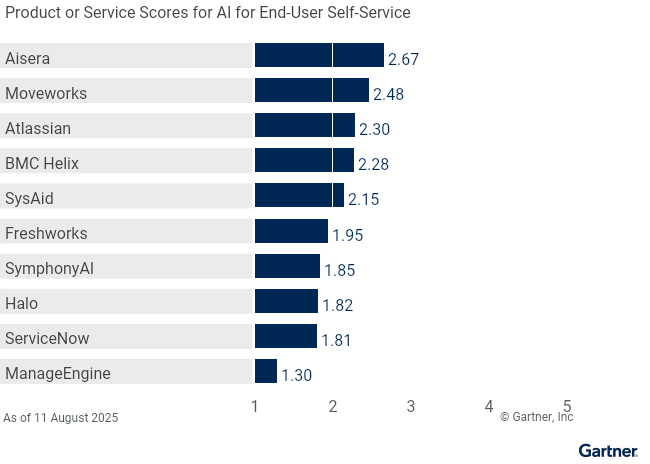
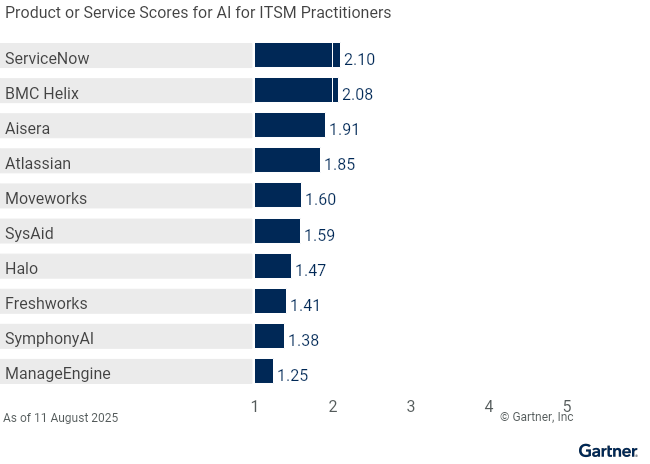
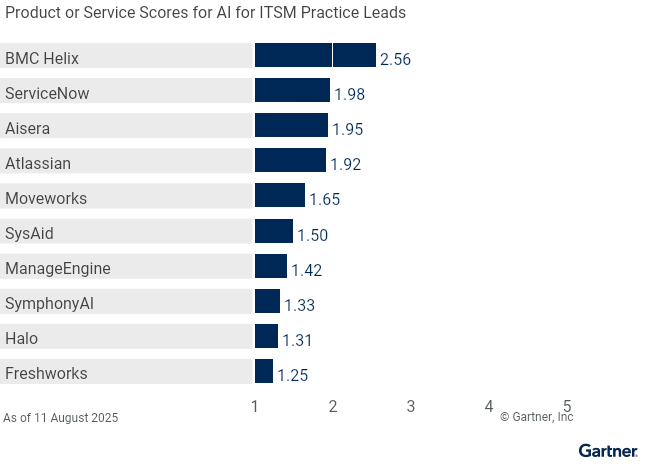
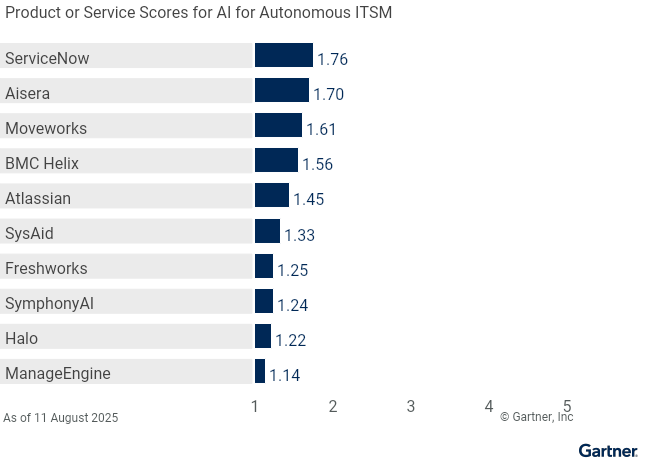
Vendors
Aisera
Aisera’s AI application in ITSM is composed of several products, including AI Service Desk, AI Copilot, AI Agents, Enterprise AI Search, Agent Assist and AIOps. These products are designed to work with third-party ITSM platforms. Recent product enhancements include Autobrief for document insight extraction and GenIQ for more secure access to foundational AI models.
Aisera’s top use case is AI for end-user self-service, and its strongest capabilities are virtual support agent (VSA) and AI search. The VSA offers robust conversational AI, supporting efficient automation of support interactions. It provides large language model (LLM) flexibility through either Aisera’s proprietary LLM or customer-selected models. AI search retrieves public knowledge with source annotations effectively and supports proprietary knowledge discovery across a diverse range of data sources and media types.
Areas where Aisera could see improvement include case clustering and IT content generation. Aisera offers limited out-of-the-box support for optimizing change and problem management workflows with actionable insights through its case clustering. Its IT knowledge generation is not well-aligned with IT agents’ daily activities, as it is optimized for creating knowledge from broader clusters rather than being closely integrated into routine incident management workflows.
Aisera’s product demonstrated functionality that meets Gartner’s definition of agentic AI with the ability to use agents that autonomously make decisions, take actions and achieve goals for IT service management (ITSM). It provides the ability to build custom bots through its agent builder.
Atlassian
Atlassian’s AI application in ITSM is composed of AI features in its own ITSM platform, Jira Service Management, which includes Rovo. These products are designed to work alongside third-party ITSM platforms as well as Atlassian’s own ITSM platform. Recent product enhancements include IT knowledge generation and intelligent categorization.
Atlassian’s top use case is AI for end-user self-service and its strongest capabilities are AI search and virtual support agent. AI search leverages a knowledge graph to enable comprehensive enterprise search across Atlassian and integrated third-party data, mapping people, locations, work, assets and knowledge. The virtual support agent addresses knowledge-based scenarios effectively and enhances user experience by providing suggested follow-up questions in addition to direct responses.
Areas where Atlassian could see improvement include agent advisory and case clustering. Agent advisory capabilities are limited, with no intelligent risk advisory. Furthermore, intelligent triage is restricted to adjusting priority, without considering impact or urgency, which reduces the effectiveness of incident response. It does not provide true clustering functionality, instead relying on custom rules and similar incident searches. This approach does not identify meaningful groups of related records, limiting its value for practice leads who require deeper insights into patterns and trends.
Atlassian’s product did not demonstrate functionality that meets Gartner’s definition of agentic AI with the ability to use agents that autonomously make decisions, take actions and achieve goals for ITSM. It does provide the ability to build custom bots through its agent builder.
BMC Helix
BMC Helix’s AI application in ITSM is composed of AI features in its ITSM platform, specifically BMC Helix ITSM. BMC Helix Operations Management with AIOps is also required to obtain the functionality in some of the AI applications for ITSM use cases. Recent product enhancements include HelixGPT Service Collaborator for automated ticket summarization and routing, and HelixGPT Knowledge Curator for automated knowledge article creation.
BMC Helix’s top use case is AI for ITSM practice leads and its strongest capabilities are case clustering and its virtual support agent. Case clustering is highly configurable, enabling the identification of potential major incidents and problems by analyzing related case data and grouping similar resolutions to support root cause analysis. The platform offers intuitive visualization tools, such as heat maps, that facilitate exploration of clustered data. The virtual support agent benefits from straightforward integration with several public LLMs through HelixGPT Manager, allowing for natural language configuration and streamlined deployment.
Areas where BMC Helix could see improvement include agent advisory and AI search. Agent advisory capabilities are limited, with no intelligent triage for prioritizing support activities and no AI-driven escalation to address potential service-level breaches. BMC Helix’s AI search lacks filtering capabilities when using external knowledge sources, limiting the ability to focus searches by topic or audience outside of the Helix knowledge base. This may reduce the relevance and precision of search results for organizations seeking to leverage a broader set of knowledge assets.
BMC Helix’s product did not demonstrate functionality that meets Gartner’s definition of agentic AI with the ability to use agents that autonomously make decisions, take actions and achieve goals for ITSM. It does provide the ability to build custom bots through its agent builder.
Freshworks
Freshworks’ AI application in ITSM is composed of Freddy AI. This product is designed to work with its own ITSM platform, Freshservice. Recent product enhancements include improving the accuracy of similar ticket identification and increasing the confidence thresholds for the field value suggestions.
Freshworks’ top use case is AI for end-user self-service and its strongest capabilities are its virtual support agent and AI search. When a ticket is created through the virtual agent, relevant fields such as subject, priority and summarized description are automatically populated, streamlining the process for end users. AI search is available out of the box, integrating with the knowledge base, tickets, and service catalog to support retrieval-augmented generation and enhance knowledge discovery without requiring additional configuration.
Areas where Freshworks could see improvement include case clustering and operations assistant. Cluster analysis for major incident and problem detection provides a search of similar records to the current case, rather than identifying subgroups of case records with similar attributes. This makes it unsuitable to practice leads who need broader insights across their cases. The operations assistant is missing most key functionality to support the needs of practitioners and practice leads by extending a conversational interface for activities such as knowledge and run book identification, related case identification, report creation and content generation.
Freshwork’s product does not meet Gartner’s definition of agentic AI for ITSM, and it does not provide an agent builder for developing custom bots.
Halo
Halo’s AI application in ITSM is composed of AI features in its ITSM platform, specifically HaloITSM. Recent product enhancements include a sensitive information detector for identifying personally identifiable and health-related data and a feature request “finder” assistant leveraging a vector database for enhancement tracking.
Halo’s top use case is AI for end-user self-service and its strongest capabilities are its virtual support agent and AI search. The virtual support agent effectively addresses basic use cases such as FAQ responses and ticket creation, and incorporates sentiment analysis to enhance user interactions. To support knowledge retrieval, customers can integrate AzureAI search or use a customer-specific OpenSearch vector database hosted by Halo. Its integration with OpenAI LLMs allows for simplified deployment of generative AI-enabled support features.
Areas where Halo could see improvement include operations assistant and case clustering. HaloITSM’s operations assistant for IT staff is limited to basic actions, limiting its value in more sophisticated needs such as driving automation and proactive support. Case clustering capabilities are limited to identifying similar records to a specific case rather than employing unsupervised learning to detect natural groupings within the data, which restricts the platform’s ability to provide actionable insights for ITSM practice leads. The reliance on LLMs for clustering rather than more specialized machine learning techniques may result in less relevant outputs, reducing the overall value of these features for advanced ITSM analysis.
Halo’s product does not meet Gartner’s definition of agentic AI for ITSM, and it does not provide an agent builder for developing custom bots.
ManageEngine
ManageEngine’s AI application in ITSM is composed of AI features in its ITSM platform, specifically ServiceDesk Plus. ManageEngine Analytics Plus is also required to obtain the functionality in some of the AI application for ITSM use cases. Recent product enhancements include postincident review and AnyCall voice agent integration.
ManageEngine’s top use case is AI for ITSM practice leads, and its strongest capabilities are its case clustering and operations assistant. The case clustering functionality supports problem identification and visualization, with the ability to schedule cluster detection and trigger proactive notifications when defined thresholds are met. Custom clusters can be created within the analytics tool to support additional ITSM requirements. The operations assistant allows users to query and take action on ticket data through conversational interfaces and integrates with reporting tools to streamline report generation using natural language commands.
Areas where ManageEngine could see improvement include IT content generation and agent advisory. Its ability to generate knowledge articles functions primarily as a basic GPT query, without drawing on relevant case or chat data to create articles. Summarization and wrap-up outputs do not effectively leverage ticket metadata, limiting the contextual value of generated content. Agent advisory capabilities are basic, offering limited predictive insights and inconsistent recommendations. This may impact the ability of ITSM teams to benefit from intelligent triage and advanced guidance.
ManageEngine’s product does not meet Gartner’s definition of agentic AI for ITSM, and it does not provide an agent builder for developing custom bots.
Moveworks
Moveworks’ AI application in ITSM is composed of Moveworks AI Assistant, Moveworks Service Management, Moveworks Provision Management, Moveworks Productivity Boost, Agent Studio, Employee Experience Insights, and Knowledge Studio. It is designed to work with third-party ITSM platforms. Recent product enhancements include Enterprise Search and “quickGPT” integration within the Moveworks AI Assistant.
Moveworks’ top use case is AI for end-user self-service, and its strongest capabilities are its virtual support agent and AI search. Moveworks provides a responsive virtual support agent capable of handling complex queries and workflows, supporting comprehensive user interactions. Its AI search supports proprietary knowledge discovery from a broad set of sources, and gives organizations explicit controls — such as the “quickGPT” command — for managing access to public LLMs while maintaining flexibility between internal and public information retrieval.
Areas where Moveworks could see improvement include agent advisory and operations assistant. The platform’s AI-driven change risk assessment is limited, as it may combine unrelated changes and average risk scores inappropriately, reducing the reliability of its recommendations for complex change management decisions. The operations assistant capability is primarily optimized for end-user support and general queries, rather than being tailored to IT-specific operational tasks. As a result, organizations will be challenged to extend this product to ITSM requirements outside the service desk.
Moveworks’ product demonstrated functionality that meets Gartner’s definition of agentic AI with the ability to use agents that autonomously make decisions, take actions and achieve goals for ITSM. It provides the ability to build custom bots through its agent builder.
ServiceNow
ServiceNow’s AI application in ITSM is composed of AI features in its ITSM platform, specifically ServiceNow ITSM Pro Plus. ServiceNow ITOM AIOps Professional is also required to obtain the functionality in some of the AI applications for ITSM use cases. Recent product enhancements include configurable incident summarization and change summarization for streamlined change request reviews.
ServiceNow’s top use case is AI for ITSM practitioners and its strongest capabilities are its agent advisory and operations assistant. Agent advisory features deliver effective support for intelligent triage and enable more responsive change management through AI-driven risk assessments and implementation planning. The operations assistant builds on these insights with a well-integrated conversational interface and a library of out-of-the-box AI agents, accelerating tasks such as incident categorization, post-incident review generation, and change plan development.
Areas where ServiceNow could see improvement include AI search and case clustering. AI search is not fully optimized to interpret the context of common user questions, which can result in less relevant responses and difficulty identifying and interpreting embedded graphics. Additionally, the language model cannot be customized for individual customers. Case clustering does not provide out-of-the-box support for knowledge clustering or change optimization, relying instead on similar incident searches rather than pattern detection. This limits its effectiveness for practice leads seeking deeper insights and proactive standardization opportunities.
ServiceNow’s product demonstrated functionality that meets Gartner’s definition of agentic AI with the ability to use agents that autonomously make decisions, take actions and achieve goals for ITSM. It provides the ability to build custom bots through its agent builder.
SymphonyAI
SymphonyAI’s AI application in ITSM is composed of SymphonyAI Apex Enterprise IT Copilot and Agentic AI for Work. It is designed to work with its own ITSM platform, SymphonyAI IT Service Management, and third-party ITSM platforms. Recent product enhancements include dynamic quick links on the conversational interface and reporting enhancements for detailed interaction analytics.
SymphonyAI’s top use case is AI for end-user self-service and its strongest capabilities are its virtual support agent and AI search. The virtual support agent provides clear, step-by-step guidance to end users, facilitating issue resolution through structured instructions. Its AI search capability supports discovery across a broad range of proprietary data sources and allows for customization through parameters such as synonym definition, term weighting, and business rule application to influence search relevance.
Areas where SymphonyAI could see improvement include case clustering and content generation. The case-clustering functionality provides only basic categorization and visualization, with limited filtering and no advanced support for knowledge article identification or major incident analysis. Content generation features are not fully optimized for ITSM requirements, as summarization and wrap-up outputs lack relevance and actionable context, reducing their overall value for IT support teams.
SymphonyAI’s product did not demonstrate functionality that meets Gartner’s definition of agentic AI with the ability to use agents that autonomously make decisions, take actions and achieve goals for ITSM. It does provide the ability to build custom bots through its agent builder.
SysAid
SysAid’s AI application in ITSM is composed of SysAid CoPilot and AI features in its own ITSM platform, SysAid. They are designed to work alongside its own ITSM platform. Recent product enhancements include an AI Emailbot for personalized, professional email replies and an AI Chatbot confirmation message to prevent duplicate service records.
SysAid’s top use case is AI for end-user self-service, and its most effective capabilities are its virtual support agent and AI search. The virtual support agent provides a user-friendly chatbot interface for ticket creation and FAQ lookups, offering well-formatted responses and demonstrating effective sentiment recognition. The AI search capability enables efficient information retrieval through preconfigured guardrails and system prompts, allowing I&O organizations to realize value with minimal setup.
Areas where SysAidcould see improvement include clustering and content generation. The platform’s reliance on LLMs rather than more specialized machine learning techniques for case clustering does not consistently deliver accurate or relevant groupings. This may limit its usefulness for identifying patterns and insights in ITSM data. Content generation is not fully optimized for ITSM needs, as it relies on manual orchestration and produces outputs that may not be well-suited for effective user communications or documentation.
SysAid’s product did not demonstrate functionality that meets Gartner’s definition of agentic AI with the ability to use agents that autonomously make decisions, take actions and achieve goals for ITSM. It does provide the ability to build custom bots through its agent builder.
Context
Vendors typically enter this space from two adjacent domains: ITSM platform providers building AI capabilities to enhance their own workflow solutions, or conversational AI specialists with expertise in IT end-user support expanding their core offerings to address broader ITSM use cases. Consequently, products in this market largely lack functional maturity across all three primary use cases. Buyers should evaluate providers based on specific, outcome-driven requirements rather than expecting a comprehensive, end-to-end solution. In AI Use-Case Assessment for IT Service Desk, we offer context to help buyers map features to potential business outcomes.
Most vendors demonstrate their highest proficiency in VSA capabilities, which aligns with the most sought-after use case: AI for end-user self-service. This is consistent with buyer demand, as organizations increasingly prioritize automation and improved user experiences in IT support. GenAI is most commonly leveraged to deliver more natural conversational experiences within virtual support agents and to facilitate knowledge retrieval. While these capabilities are generally effective for basic public knowledge queries, discovering proprietary data federated into the knowledge base and more complex tasks such as image recognition often exposes functional limitations.
The proliferation of generative AI has lowered market entry barriers, enabling new providers to quickly launch solutions leveraging public LLMs. These typically offer retrieval-augmented generation (RAG) and integration gateways, with pretrained prompts to drive specific actions. Other vendors offer heavily customized, proprietary models trained on their own data, which may provide future differentiation and address buyer concerns around security and data containment. However, no significant benefits have been observed in output quality to date.
Despite the widespread use of common LLMs, not all products are sufficiently grounded to support diverse content generation requirements. Some products use LLMs as substitutes for real data-driven analysis, which poses risks for buyers — especially when general models are misapplied to business-critical tasks such as change risk analysis or incident triage. Few vendors demonstrate high proficiency with case clustering, exposing a gap in supporting practice leaders with strategic decision making.
Differentiation among tools extends beyond functional capabilities to include system integrations, security, and application-level features, which are outside the scope of this analysis. Due diligence is essential: buyers must ensure required integrations are available or secure written agreements for their development. Furthermore, it is critical to scrutinize each vendor’s approach to privacy and data security to ensure alignment with organizational policies (see Tool: Generative AI Security Policy Template for more details on building a policy).
Market Definition
Gartner defines AI applications in IT service management as tools that augment and enhance IT service management (ITSM) workflows using AI. These analyze ITSM data and metadata (primarily found in ITSM platforms) to provide intelligent advice and actions on ITSM practices and workflows, such as IT service desk and support activities. This software can either be a stand-alone product, features extending an ITSM platform or an add-on to an ITSM platform.
Infrastructure and operations (I&O) leaders are challenged by rising costs of IT support, and declining employee engagement and productivity.
AI features enable I&O teams to optimize IT support and service management processes (such as incident and problem management) through insight and automation. This can lead to tangible reduction in costs, such as labor savings by handling support issues and requests automatically, faster resolutions, and improved accuracy in triage, categorization and expert identification. In addition to addressing overheads, AI solutions can improve the employee-facing user experience and enhance IT’s relationship with the business consumer. Some features, such as intelligent risk advisory, can help I&O leaders reduce disruptions and provide reliable IT services.
These features may be accessed via a conversational AI interface, such as a virtual support agent or operations assistant.
Generative AI (GenAI) features are increasingly sought-after to automate content generation and improve communications. Examples include summarizing information, such as knowledge base articles or case work log updates, and generating major incident notifications.
The AI Use-Case Assessment for IT Service Desk provides further details on the AI and GenAI opportunities that tools such as AI applications for ITSM are able to address.
Mandatory Features
At a minimum, an AI application for ITSM must:
- Use AI technologies like GenAI, natural language technologies and machine learning to analyze ITSM data and metadata.
- Use this analysis to generate recommendations or actions for ITSM practices, including IT incident, request, knowledge, problem and change management.
Common Features
The common features for this market include:
- Virtual support agents as business-consumer-facing conversational interfaces that deliver answers to common questions and perform transactions to provide IT support.
- Operations assistants as ITSM practitioners/practice-lead conversational interfaces that leverage data-driven insights to help them carry out their role.
- AI search to discover IT knowledge and solutions using:
- Public knowledge discovery using public large language models (LLMs).
- Proprietary knowledge discovery using a custom LLM trained on private knowledge.
- Universal knowledge discovery using technologies such as retrieval-augmented generation (RAG).
- Agent advice via:
- Intelligent triage, for guidance on prioritization.
- Intelligent categorization of cases by service, configuration item or solution.
- Intelligent escalation of cases before they hit timed service-level thresholds.
- Intelligent risk advisory of planned changes using similar release history (clustering).
- Intelligent routing to identify suitable and available resolver groups.
- Intelligent swarming to identify experts, including those from outside of IT.
- Sentiment analysis to warn of poor service experiences and/or low digital employee experience (DEX) scores when business consumers contact the IT service desk.
- Pattern recognition powered by case clustering (with incidents, problems, changes, knowledge articles and configuration items) to provide:
- Major incident detection when IT support teams receive incidents from end users that are very high-impact but not already detected by monitoring or AIOps platforms.
- Problem detection when multiple incidents are reported that may share a common cause.
- Root cause analysis for problem management investigations.
- Change optimization to identify changes that could be standardized.
- Content generation using GenAI:
- IT knowledge generation of solutions generated from case work log notes or collaborative support hub conversations.
- Automatic communications to generate and refine case updates or major incident notifications.
- Case summarization:
- Incoming request summarization to help experts understand new incidents and requests.
- Intelligent postcall wrap-up to refine and standardize agent shorthand case work log notes.
- Summarization of major incidents for postincident reviews.
- Generation of ITSM reports, such as postincident and postrelease reviews.
Product/Service Trends
AI applications for IT service management represent a transformative advancement in the automation and optimization of ITSM practices. They are architected to ingest and analyze a broad spectrum of ITSM data — including incident tickets, metadata, and workflow artifacts — while also integrating supplementary data sources such as unstructured natural language conversations, real-time monitoring events, public knowledge repositories, and advanced LLMs to provide ready-to-use advice or actions on ITSM practices.
Early market entrants primarily addressed IT support automation, deploying VSAs to enhance knowledge management and streamline end-user self-service. These initial offerings also augmented agent workflows by applying machine learning to historical ticket data, providing recommendations for incident categorization and resolution. The emergence of LLMs has significantly broadened the functional landscape, enabling advanced capabilities such as dynamic content generation and more sophisticated conversational interfaces, thereby enhancing both traditional and emergent use cases.
However, the rapid influx of LLM-based solutions has introduced challenges. Market hype around agentic AI has, in some instances, led to a dilution of core ITSM functionalities, as vendors prioritize the development of LLM-dependent agents over foundational features. Despite widespread marketing claims, Gartner found that few solutions within this research currently deliver true agentic capabilities — such as autonomous planning, adaptive tool orchestration, or multistep workflow execution. The majority of offerings remain primarily assistive, with agentic features often overstated in vendor messaging. This gap between marketing and actual product capability has contributed to a slower pace of innovation and solution maturity, with no single platform yet fully addressing the comprehensive needs of AI-driven ITSM use cases.
Looking ahead, the market for AI apps for ITSM is poised for rapid evolution, with ongoing advancements expected in areas such as configuration management, collaborative service support, and autonomous workflow automation. The convergence of generative AI and ITSM continues to reshape the landscape, as documented in the latest Gartner Hype Cycle for AI in ITSM, 2025. Organizations evaluating AI for ITSM should prioritize solutions that demonstrate tangible, data-driven outcomes and robust integration with existing ITSM platforms, while remaining vigilant to the distinction between substantive agentic functionality and marketing-driven claims.
Critical Capabilities Definition
Virtual Support Agent
Conversational interfaces that provide IT support to business consumers by resolving common issues, answering questions and performing transactions.
This is an IT-support-specific subset of virtual assistants that use chatbot capabilities but also take actions such as reset passwords, deploy software, escalate support requests, and execute scripts to restore IT services. These are evaluated by the ability to apply natural language capabilities to effectively and accurately address a wide range of end-user support issues, integration into ITSM data and workflows, channel support, consumer-friendly user experiences, and the ability to adapt over time.
Operations Assistant
Conversational interfaces that provide ITSM practitioners and practice leads with data-driven insights and also execute ITSM actions to help them carry out their role.
These solutions simplify access to information by leveraging natural language queries rather than scripts or specialized commands. Organizations commonly leverage operations assistants to query knowledge, reports and cases, or to execute predefined tasks. These are evaluated by the ability to apply natural language capabilities to effectively and accurately address a wide range of ITSM tasks across different practices, integration into ITSM data and workflows, and fit-for-purpose and well-integrated user experiences.
Agent Advisory
Analyzes ITSM data and metadata to generate recommendations that accelerate human agent response in ITSM practices.
There are multiple components evaluated within this capability, including the ability to enable:
- Intelligent triage for guidance on prioritization
- Intelligent categorization of cases by service, configuration item, or solution
- Intelligent escalation of cases before they hit timed service-level thresholds
- Intelligent risk advisory of planned changes using similar release history (clustering)
- Intelligent routing to identify suitable and available resolver groups
- Intelligent swarming to identify experts, including those from outside of IT
- Sentiment analysis to warn of poor service experiences and/or low digital employee experience (DEX) scores when business consumers contact the IT service desk
AI Search
Retrieves and contextually presents relevant IT knowledge assets, thus increasing the effectiveness of problem solving and the caliber of services provided.
There are multiple components evaluated within this capability, including federated enterprise search and the ability to leverage domain-specific LLMs to enable:
- Public knowledge discovery using public large language models
- Proprietary knowledge discovery using a custom LLM trained on private knowledge
- Universal knowledge discovery using technologies such as retrieval-augmented generation (RAG)
IT Content Generation
Generative AI features that learn from ITSM cases and metadata to create new content (such as technical documentation or incident summaries).
There are multiple components evaluated within this capability, including the ability to enable:
- IT knowledge generation of solutions generated from case work log notes or collaborative support hub conversations
- Automatic communications to generate and refine case updates or major incident notifications
- Case summarization:
- Incoming request summarization to help experts understand new incidents and requests
- Intelligent postcall wrap-up to refine and standardize agent shorthand case work log notes
- Summarization of major incidents for postincident reviews
- Generation of ITSM reports, such as postincident and postrelease reviews
- AI code assistants for script and process workflow design
Case Clustering
Uses AI and pattern matching to group related ITSM cases together, exposing new insights.
There are multiple components evaluated within this capability, including the ability to enable:
- Major incident detection that identifies when IT support teams receive incidents from end users that are very high-impact but not already detected by monitoring or AIOps platforms
- Problem detection that automatically identifies recurring incidents from both past and current incidents
- Root cause analysis that identifies commonalities in clustered incident records (e.g., resolution descriptions, associated assets, involved support teams) that can identify potential root causes
- Clustering patterns of changes to identify changes that can be standardized
- Knowledge article topic detection by looking at cases or groups of conversations where no article was linked or flagged as a solution
Agentic ITSM
Goal-driven software entities that have been granted rights by the I&O organization to act on its behalf to autonomously make decisions and take action to carry out ITSM activities.
Agentic AI enables the progression of AI from assistants handling simple tasks with low autonomy to complex AI ecosystems enabling collaboration across applications and organizations. Agentic AI can be applied throughout all ITSM practices (e.g., allowing the CMDB autonomous discrepancy analysis and resolution, providing deep research for knowledge generation, or enabling a virtual agent to drive incident self-healing beyond scripted actions). Evaluated within this capability are both the ability to provide composable autonomous agents as well as the out-of-the-box depth and breadth of these agents across the various ITSM practices.
Use Cases
AI for End-User Self-Service
I&O teams that prioritize the shift-left and deflection of IT service desk contacts using AI to enable business consumer autonomy.
This use case focuses on virtual support agent and IT knowledge discovery capabilities.
I&O leaders responsible for the IT service desk look to AI-driven engagement channels to enhance their multiexperience strategy. This use case is driven by the need for cost optimization through call deflection and enhanced service delivery experience goals. Momentum for AI-driven self-service has been accelerated by the introduction of generative AI solutions that simplify the configuration and enable more natural conversations.
AI for ITSM Practitioners
I&O teams that prioritize accelerating ITSM practice execution with intelligent recommendations, actions and content creation.
This use case focuses on agent advisory and IT content generation capabilities.
I&O leaders want to transform traditional practices and improve human agent accuracy by leveraging AI to provide recommendations that reduce manual steps and accelerate the generation of content. Examples of AI-automated tasks within the workflows include categorizing incidents, executing a risk analysis of a change, identifying relevant subject matter experts, and linking or creating knowledge articles from incidents.
AI for ITSM Practice Leads
I&O teams that prioritize using AI to transform how they access and analyze ITSM data, uncovering patterns and trends that enhance their decision-making ability.
This use case focuses on case clustering and operations assistant capabilities.
ITSM practice leads are being challenged to support increasingly complex environments. This use case emphasizes analyzing case, knowledge, asset and other ITSM metadata for commonalities (clustering) to support key decisions, such as problem identification, prioritization, and root cause analysis, and major incident identification. Operations assistants provide a natural language UI to improve accessibility to these insights.
AI for Autonomous ITSM
I&O teams that prioritize agent-to-agent interactions using an underlying intelligence to handle ITSM tasks independent of human directions.
This use case focuses on agentic AI and IT content generation capabilities.
I&O leaders aspire toward an autonomous future with integration of intelligent AI agents into IT service management processes, enabling automation of service desk operations without human intervention. Through a network of interconnected AI agents, autonomous ITSM can derive deep insights and analyze vast amounts of environmental data, enabling proactive decision making and operational efficiency across ITSM practices.
Vendors Added and Dropped
We review and adjust our inclusion criteria for Critical Capabilities as markets change. As a result of these adjustments, the mix of vendors in any Critical Capability may change over time. A vendor’s appearance in a Critical Capability one year and not the next does not necessarily indicate that we have changed our opinion of that vendor. It may be a reflection of a change in the market and, therefore, changed inclusion criteria, or of a change of focus by that vendor.
Added
- Atlassian
- ManageEngine
- SysAid
Dropped
- Espressive: Espressive was dropped because its strategy focuses on selling through managed service providers rather than directly to enterprise customers, resulting in fewer than 10 new direct sales to enterprise customers for the period from 1 April 2024 to 1 April 2025.
- OpenText: OpenText was dropped because it does not have at least five of the six common market features in active production used by at least five current customers as of 8 May 2025.
- Serviceaide: Serviceaide was dropped because it did not rank among the top 20 in the Customer Interest Indicator (CII) defined by Gartner for the Magic Quadrant for AI Applications in IT Service Management.
Inclusion and Exclusion Criteria
To qualify for inclusion, providers must meet all of the following criteria:
General Availability: The AI application must have been commercially available since 1 January 2025.
Product Capability: The product must meet Gartner’s market definition for AI applications in ITSM, including the following mandatory features:
- Use AI technologies such as GenAI, natural language technologies and machine learning to analyze ITSM data and metadata.
- Use this analysis to generate recommendations or actions for ITSM practices, including incident, request, knowledge, problem and change management.
The product must include at least five of the six common market features, which are:
- Virtual support agents: Business-consumer-facing conversational interfaces that deliver answers to common questions and perform transactions to provide IT support.
- Operations assistants: ITSM practitioners/practice-lead conversational interfaces leveraging data-driven insights to help them carry out their role.
- AI search: Must use AI to provide at least two of the following three features:
- Public knowledge discovery using public LLMs
- Proprietary knowledge discovery using a custom LLM trained on private knowledge
- Universal knowledge discovery using technologies such as retrieval-augmented generation (RAG)
- Agent advice: Must use AI to provide at least four of the following seven features:
- Intelligent triage for guidance on prioritization
- Intelligent categorization of cases by service, configuration item or solution
- Intelligent escalation of cases before they hit timed service-level thresholds
- Intelligent risk advisory of planned changes using similar release history (clustering)
- Intelligent routing to identify suitable and available resolver groups
- Intelligent swarming to identify experts, including those from outside of IT
- Sentiment analysis to warn of poor service experiences and/or low digital employee experience (DEX) scores
- Pattern recognition powered by case clustering: Must use AI to provide at least two of the following four features:
- Major incident detection for high-impact incidents not detected by monitoring or AIOps platforms
- Problem detection when multiple incidents may share a common cause
- Root cause analysis for problem management investigations
- Change optimization to identify changes that could be standardized.
- Content generation using GenAI: Must use AI to provide at least two of the following four features:
- IT knowledge generation from case work log notes or collaborative support hub conversations
- Automatic communications to generate and refine case updates or major incident notifications
- Case summarization, including incoming request summarization and intelligent postcall wrap-up
- Generation of ITSM reports, such as postincident and postrelease reviews
Each of these common market features must:
- Be generally available to customers as of 1 January 2025, with custom development for specific customers not qualifying
- Not be labeled as beta unless an earlier release provides the qualifying features
- Be fully supported by the vendor, even if third-party technology is used; be in active production use by at least five customers
- Be comprehensively documented including setup, configuration, troubleshooting and release notes.
Proprietary AI Solution:
- Must provide AI models directly rather than only interfacing with third-party public or customer-provided models (not white label).
- Must offer proprietary knowledge discovery methods (e.g., fine-tuning, RAG or deep research).
Proven Enterprise Viability:
- For the period from 1 April 2024 through 1 April 2025, the provider must have at least 10 new active paying enterprise customers using the product in a production environment.
- Customers of the provider’s managed workplace services division (if applicable) or customers that are managed service providers themselves are excluded.
- Each customer must meet either one of the following criteria:
- Spend $100,000 annually explicitly on AI for ITSM features
- Have 100 IT workers actively using ITSM practitioner or ITSM practice lead features (excluding virtual support agent).
Actively Marketed: The product must have been actively marketed since 1 January 2025, including hosting a product promotion page on the company website that is either on the homepage or linked from the homepage. This page must focus primarily on AI features and promote the product. General commentary about AI, such as blog articles that do not promote the product, does not qualify.
Customer Interest: The provider ranks among the top 20 for the Customer Interest Indicator (CII) as defined by Gartner. CII was calculated using a weighted mix of internal and external inputs that reflect Gartner client interest, provider customer engagement and vendor customer sentiment from March 2024 to March 2025.
Weighting for Critical Capabilities in Use Cases
| Critical Capabilities | AI for End-User Self-Service | AI for ITSM Practitioners | AI for ITSM Practice Leads | AI for Autonomous ITSM |
|---|---|---|---|---|
Virtual Support Agent | 50% | 0% | 0% | 10% |
Operations Assistant | 0% | 20% | 25% | 10% |
Agent Advisory | 0% | 50% | 25% | 5% |
AI Search | 35% | 5% | 5% | 5% |
IT Content Generation | 10% | 15% | 5% | 5% |
Case Clustering | 0% | 5% | 40% | 5% |
Agentic ITSM | 5% | 5% | 0% | 60% |
As of 11 August 2025 | ||||
Source: Gartner (September 2025)
This methodology requires analysts to identify the critical capabilities for a class of products/services. Each capability is then weighted in terms of its relative importance for specific product/service use cases.
Critical Capabilities Rating
Each of the products/services that meet our inclusion criteria has been evaluated on the critical capabilities on a scale from 1.0 to 5.0.
Product/Service Rating on Critical Capabilities
| Critical Capabilities | Aisera | Atlassian | BMC Helix | Freshworks | Halo | ManageEngine | Moveworks | ServiceNow | SymphonyAI | SysAid |
|---|---|---|---|---|---|---|---|---|---|---|
Virtual Support Agent | 3.1 | 2.3 | 2.7 | 2.2 | 1.9 | 1.3 | 2.9 | 2.0 | 2.2 | 2.5 |
Operations Assistant | 2.0 | 2.2 | 2.3 | 1.3 | 1.2 | 1.4 | 1.8 | 2.3 | 1.4 | 1.5 |
Agent Advisory | 1.9 | 1.7 | 2.0 | 1.4 | 1.6 | 1.2 | 1.4 | 2.2 | 1.4 | 1.7 |
AI Search | 2.5 | 2.6 | 1.9 | 1.8 | 1.9 | 1.4 | 2.2 | 1.5 | 1.6 | 2.0 |
IT Content Generation | 1.8 | 1.9 | 2.1 | 1.7 | 1.5 | 1.1 | 1.9 | 2.0 | 1.4 | 1.5 |
Case Clustering | 1.9 | 1.8 | 3.2 | 1.0 | 1.1 | 1.6 | 1.6 | 1.7 | 1.2 | 1.3 |
Agentic ITSM | 1.3 | 1.0 | 1.0 | 1.0 | 1.0 | 1.0 | 1.3 | 1.6 | 1.0 | 1.0 |
As of 11 August 2025 | ||||||||||
Source: Gartner (September 2025)
Table 3 shows the product/service scores for each use case. The scores, which are generated by multiplying the use-case weightings by the product/service ratings, summarize how well the critical capabilities are met for each use case.
Product Score in Use Cases
| Use Cases | Aisera | Atlassian | BMC Helix | Freshworks | Halo | ManageEngine | Moveworks | ServiceNow | SymphonyAI | SysAid |
|---|---|---|---|---|---|---|---|---|---|---|
AI for End-User Self-Service | 2.67 | 2.30 | 2.28 | 1.95 | 1.82 | 1.30 | 2.48 | 1.81 | 1.85 | 2.15 |
AI for ITSM Practitioners | 1.91 | 1.85 | 2.08 | 1.41 | 1.47 | 1.25 | 1.60 | 2.10 | 1.38 | 1.59 |
AI for ITSM Practice Leads | 1.95 | 1.92 | 2.56 | 1.25 | 1.31 | 1.42 | 1.65 | 1.98 | 1.33 | 1.50 |
AI for Autonomous ITSM | 1.70 | 1.45 | 1.56 | 1.25 | 1.22 | 1.14 | 1.61 | 1.76 | 1.24 | 1.33 |
As of 11 August 2025 | ||||||||||
Source: Gartner (September 2025)
To determine an overall score for each product/service in the use cases, multiply the ratings in Table 2 by the weightings shown in Table 1.
Acronym Key and Glossary Terms
| Agent washing | Without clear criteria, some technology providers have labeled simple automation or chatbot functionalities as agentic AI devaluing the term and confusing customers. |
| Agentic AI | Agentic AI is an approach to building AI solutions based on the use of one or multiple software entities that are classified, completely or at least partially, as AI agents. AI agents are autonomous or semiautonomous software entities that use AI techniques to perceive, make decisions, take actions and achieve goals in their digital or physical environments. |
| Cluster analysis | Cluster analysis, also known as clustering, is the process of categorizing a collection of data objects into distinct groups, referred to as clusters. The primary objective is to ensure that objects within the same cluster are more alike to each other than to those in other clusters. |
| Generative AI (GenAI) | Generative AI techniques learn from representations of data and model artifacts to generate new artifacts. |
| Large language model (LLM) | Large language models are AI foundational models that have been trained on vast amounts of unlabeled textual data. Applications can use LLMs to accomplish a wide range of tasks, including question answering, content generation, content summarization, retrieval-augmented generation (RAG), code generation, language translation, and conversational chat. |
Critical Capabilities Methodology
This methodology requires analysts to identify the critical capabilities for a class of products or services. Each capability is then weighted in terms of its relative importance for specific product or service use cases. Next, products/services are rated in terms of how well they achieve each of the critical capabilities. A score that summarizes how well they meet the critical capabilities for each use case is then calculated for each product/service.
"Critical capabilities" are attributes that differentiate products/services in a class in terms of their quality and performance. Gartner recommends that users consider the set of critical capabilities as some of the most important criteria for acquisition decisions.
In defining the product/service category for evaluation, the analyst first identifies the leading uses for the products/services in this market. What needs are end-users looking to fulfill, when considering products/services in this market? Use cases should match common client deployment scenarios. These distinct client scenarios define the Use Cases.
The analyst then identifies the critical capabilities. These capabilities are generalized groups of features commonly required by this class of products/services. Each capability is assigned a level of importance in fulfilling that particular need; some sets of features are more important than others, depending on the use case being evaluated.
Each vendor’s product or service is evaluated in terms of how well it delivers each capability, on a five-point scale. These ratings are displayed side-by-side for all vendors, allowing easy comparisons between the different sets of features.
Ratings and summary scores range from 1.0 to 5.0:
1 = Poor or Absent: most or all defined requirements for a capability are not achieved
2 = Fair: some requirements are not achieved
3 = Good: meets requirements
4 = Excellent: meets or exceeds some requirements
5 = Outstanding: significantly exceeds requirements
To determine an overall score for each product in the use cases, the product ratings are multiplied by the weightings to come up with the product score in use cases.
The critical capabilities Gartner has selected do not represent all capabilities for any product; therefore, may not represent those most important for a specific use situation or business objective. Clients should use a critical capabilities analysis as one of several sources of input about a product before making a product/service decision.