Magic Quadrant for Intelligent Document Processing Solutions
3 September 2025 - ID G00826287 - 50 min read
By Shubhangi Vashisth, Tushar Srivastava, and 3 more
The intelligent document processing market is expansive, with over 100 vendors, including from adjacent markets, offering full solutions or individual components. Enterprise application leaders should use this research to understand the products offered by the market’s most prominent vendors.
Market Definition/Description
Gartner defines intelligent document processing (IDP) solutions as specialized data integration tools that enable automated extraction of data from multiple formats and various layouts of document content. IDP solutions ingest data for dependent applications and workflows and can be provided as a software product and/or as a service.
Organizations receive and process documents in multiple formats to enable activities such as onboarding new suppliers, receiving applications for loans or insurance claims. This results in large volumes of documents, the content of which is designed for human comprehension rather than machine processing. Extracting data from content is essential for document processing and the automated activities this supports. IDP solutions fulfill this role, augmented by and potentially replacing people.
Documents are received in physical form, typically paper, which must be scanned for digitization, or in digital form, such as emails and PDFs. The content of these documents has varying layouts, ranging from structured formats, such as tabular or outline (e.g., list or hierarchy of headings) or invoices or contracts, to unstructured formats (i.e., free-flowing, such as an email). Layouts that fall between structured and unstructured, or mixing the two, are often referred to as semistructured.
Historically, document content had to be preprocessed by humans to extract data. However, AI can now reliably extract data from content, imperfectly replacing work with automation. IDP solutions build on — and continue to include — long-standing optical character recognition (OCR) capabilities to extract characters from images. Instead of using fixed, rigid templates to map characters to data schemas, their AI also utilizes contextual cues to autonomously map characters from multiple formats and varying layouts of content to data schemas. Consequently, IDP solutions have the potential to process a broad range of document types and variations.
Intelligent document processing solutions must be capable of processing documents in many formats (digital or paper; text or image), combinations (single or multiple pages; separate or combined documents), and qualities (orientation or skew; clarity or obstruction). Moreover, the extracted data must be shared with other applications and, in some cases, stored internally for reuse. Therefore, a pipeline of transformations is required to effectively process documents.
IDPs are applied to the following principal use cases:
- Automated processing: This involves processing transactional documents where data is extracted and passed on to other applications. There are two types of automated processing:
- High volume, low complexity, and low variability
- Low volume, high complexity, and high variability
- Augmented reading/handling: Reading and comprehension of complex documents to facilitate decision making and actions, including summarization, Q&A and directed extraction.
- Extraction and retention of data: Automated extraction and retention of data to support various use cases, including analysis.
Many IDP vendors specialize in specific document types, such as bills of lading in shipping or contracts in insurance. Not all IDP vendors can process every type of document and its content IDP is not yet commoditized. As such, when identifying an IDP vendor, it is important to assess the compatibility with your specific document types and data schemas. This includes evaluating the product or service offerings and the associated services required to achieve optimal processing performance.
Mandatory Features
- Ingestion of documents as digital files in multiple formats and varying layouts.
- Data preprocessing, including document classification.
- Information retrieval and synthesis.
- Extraction of data from content (images, text and content in multiple languages).
- Extracted data review, including automated and human-in-the-loop checking, correction and override.
- Integration of extracted data into third-party applications and digital file formats.
- Administration for configuration, deployment and customization.
- Orchestration and automation, including low-code/no-code, business rule engine, etc.
Common Features
- Analysis and reporting from an internal repository of extracted data.
- Collaboration with other stakeholders in the workflow.
- Composability to support the vendor’s, third parties’ and customer’s software services.
- ModelOps for IDP models.
- Multilingual UI and documentation.
- Governance capabilities for full workflow.
- Dedicated functionalities and tools to handle privacy, enterprise compliance and security in the platform.
Magic Quadrant
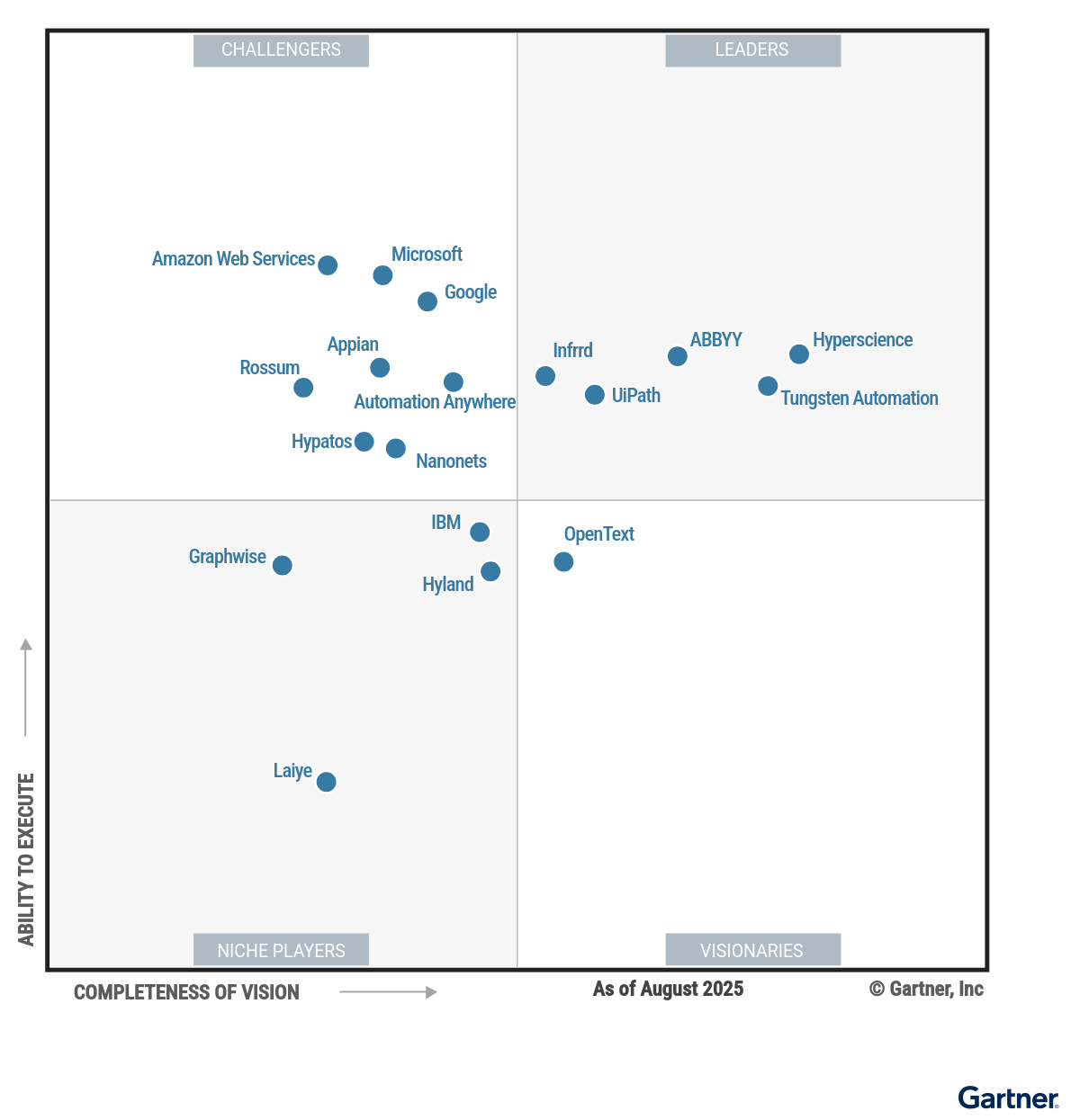
Vendor Strengths and Cautions
ABBYY
ABBYY is a Leader in this Magic Quadrant. Its Vantage platform processes structured, semistructured and unstructured documents in any format, language or layout. The platform handles complex contextual understanding by combining advanced NLP, named entity recognition (NER), document structure analysis and domain-specific logic.
ABBYY’s operations are geographically diversified, with a presence in the U.S. and Europe alongside expansions into APAC (notably India). ABBYY tends to serve enterprises and midmarket organizations across highly regulated industries like financial services, insurance and transportation.
ABBYY offers cloud (SaaS), private cloud, on-premises and containerized deployments.
ABBYY has invested in establishing AI labs in the U.S., Hungary and India to accelerate purpose-built AI for IDP and automation.
- Product or service: ABBYY’s proprietary OCR and ICR technology can recognize over 200 languages (including handwriting) and is frequently repackaged by other vendors/providers. AI models enhance capabilities by dynamically optimizing recognition based on document type and layout and by using transformers and language modeling to maximize accuracy and processing efficiency.
- Sales strategy: ABBYY structures its sales with specialized roles and regional success managers, focusing on key markets and existing customers. It partners with resellers to offer local support. This helps end users in accessing relevant solutions, better support, and options that fit their needs and budgets and drives better customer engagement.
- Geographic strategy: ABBYY focuses its growth efforts on specific regions, such as targeting key markets in APAC like Singapore, Malaysia and Vietnam with dedicated sales teams. In the U.S. and Latin America, it uses specialized teams for different customer segments and industries. Its partner network helps end users in getting solutions and support that are better-suited to their local context and industry.
- Corporate repositioning: ABBYY has undergone reorganization, including restructuring its workforce and senior leadership changes. Existing customers should review roadmap commitments and overall strategic direction to make informed decisions.
- Market responsiveness: ABBYY, compared to some other vendors in the market, is late in offering certain product capabilities like autolabeling using zero-shot learning.
- Market understanding: ABBYY, unlike some of its competitors, hasn’t launched a stand-alone AI agent orchestration framework. Although it offers open and modular architecture, as a leader in the segment, it needs to respond proactively to market trends to stay competitive. Potential buyers must confirm their AI requirements and assess whether ABBYY’s current offerings meet their needs, especially if advanced AI automation and orchestration are critical for their operations.
Amazon Web Services
Amazon Web Services (AWS) is a Challenger in this Magic Quadrant. Amazon Textract is a cloud-native IDP offering with prebuilt models for common document types. It extracts text, handwriting and structured data (forms, tables, key-value pairs) from scanned documents.
AWS’ IDP portfolio also includes Amazon Bedrock, which provides a GenAI reasoning layer for extraction and postprocessing tasks like summarization, generative Q&A and LLM-as-a-judge validation for accuracy.
Its operations are geographically diversified, and its clients comprise organizations of all sizes and sectors.
For AWS Textract, common deployment options involve integrating with S3 for document storage and Lambda for event-driven processing, supporting both synchronous and asynchronous modes.
AWS enables advanced architectural patterns for document processing by integrating Textract with Amazon Bedrock and Step Functions (for orchestration).
- Marketing execution: AWS markets IDP as a suite of interoperable services (Amazon Textract, Amazon Bedrock, Amazon Augmented AI [A2I]), while vertical-specific partners handle niche marketing. This modular building block narrative resonates positively with both new and established customers.
- Product features: Amazon Textract’s adapters with Custom Queries allow clients to fine-tune pretrained models using a small set of sample documents. AWS also provides a managed human-in-the-loop service through Amazon A2I. This helps end users by supporting more tailored document processing and offering an option for human review to help ensure accuracy.
- Sales strategy: Amazon Textract’s industry-specific solutions support quick demos and solution customization, helping to speed up value delivery and improve ease of adoption. The platform also offers a number of partner integrations. This helps end users in getting tailored AI solutions and delivering solutions that align with their industry and operational goals.
- Product customizability: Customers report limited customizability and reduced performance with handwritten content and that creating a custom extractor in Textract is developer-centric. This means end users may need additional technical support to fine-tune extraction workflows and could experience slower or less-accurate processing of handwritten documents.
- Language support: The language support is tiered. Though OCR offers broad language support, higher-level structured data extraction (such as forms and tables) requires thorough testing for language support and the specialized processor library. Users must verify support for their target languages and document types to avoid accuracy issues and may need additional validation or custom solutions.
- Implementation complexity: Developing a full solution on AWS often requires integrating multiple services, demanding cloud architecture expertise and developer effort. This can lead to longer deployment times and higher costs compared to more unified platforms, as technical teams are needed for integration and ongoing maintenance.
AWS declined requests for supplemental information. Gartner’s analysis is therefore based on other credible sources.
Appian
Appian is a Challenger in this Magic Quadrant. Its AI Document Center and AI Skills products focus on automation and are a part of the Appian AI Process Platform, a unified system for process orchestration, automation, and intelligence, built on core low-code app capabilities.
Its operations are geographically diversified, with a global workforce and growth in North America, EMEA and APAC. Its clients are primarily large enterprises in financial services, the public sector and life sciences.
Appian supports cloud deployment model via its Appian Cloud. Licensing options include usage-based, enterprise and SaaS subscriptions.
Appian is investing in expanding its AI capabilities for Appian government cloud and its FedRAMP High support for high-security government customers.
- Product strategy: Appian’s IDP is natively embedded within Appian’s unified, AI-driven process automation platform. This enables streamlined, end-to-end automation within a single environment — from document ingestion all the way through downstream workflows — within a single environment, avoiding the complexity of integrating multiple, disparate tools.
- Sales strategy: Appian offers IDP as part of its Appian Guarantee program, which guarantees new customers can go from idea to production application in eight weeks. This guarantee helps customers reduce the average implementation time required for configuration and deployment of the IDP model into their environment.
- Geographic strategy: Appian maintains a global footprint, with revenue streams and operations across the globe. Appian leverages a robust global partner network of approximately 320 partners, offering local support in various regions, including the United States, Canada, Mexico, Europe, India, Singapore, Japan, Australia and Hong Kong.
- Operations: Appian IDP’s capabilities are currently exclusively available to Appian Cloud customers, with self-managed capabilities expected in 3Q25. Self-managed customers must run Appian on on-premises Kubernetes to maintain deployment patterns between Appian Cloud and their self-managed Appian installments. This means end users opting for on-premises setups face extra operational overhead — setting up and maintaining Kubernetes — and may need additional IT resources to keep their deployments aligned with the Cloud version.
- Product feature: Appian IDP currently lacks native confidence scores for generative-AI-based extractions, but is expected to offer a superior “LLM as a judge” approach in 3Q25 to provide an additional layer of review for straight-through processing. Appian also provides other validation options like business rules and regex.
- Visibility: Appian offers its IDP functionality embedded within its broader process automation platform, rather than as a stand-alone product. This creates a barrier for clients looking for a platform of choice for general-purpose IDP independent of an automation platform.
Automation Anywhere
Automation Anywhere is a Challenger in this Magic Quadrant. Its Document Automation product focuses on automated document workflows, data extraction (from structured, semistructured and unstructured documents), classification, workflow orchestration, redaction, PII masking and document analysis. Its operations are geographically diversified, serving large enterprises and midmarket clients across banking, insurance, logistics and more.
Automation Anywhere’s operations are geographically diversified with a global presence. Its client base is primarily large enterprises and midmarket clients in financial services, healthcare, manufacturing and other industries.
Automation Anywhere supports on-premises, cloud and hybrid deployments.
Automation Anywhere is investing in high-scale cloud extraction services and goal-based AI agents to process large document volumes. Future plans include optimizing document extraction with AI agents and expanding generative AI model support for enhanced IDP capabilities.
- Product/offering strategy: Automation Anywhere’s Process Reasoning Engine (PRE) leverages metadata from several automations and combines it with multimodal LLMs. This can help end users to extract accurate data from complex, unstructured and visual documents.
- Sales execution: Automation Anywhere’s strong client base in the RPA market helps it to execute at scale and allows end users to reuse the existing platform, minimizing the learning curve required to adapt to a new platform.
- Partner ecosystem: Automation Anywhere has a strong partner network, including global system integrators and hyperscale cloud providers. This benefits end users by enhancing the availability and delivery of Automation Anywhere’s solutions, including training and support.
- Product support: On inquiries and on Gartner Peer Insights, users report challenges with customer support. To ensure adequate support, end users should work with Automation Anywhere and its partners to assess the product support and maintenance needs.
- Geographic strategy: Automation Anywhere’s IDP product is limited in customer adoption across APAC and Latin America. Prospective customers in the APAC and Latin America regions should check with Automation Anywhere and its partners on its ability to support them in these regions.
- Marketing execution: Automation Anywhere builds its marketing strategy around its core RPA offering and promotes IDP as a core module integrated into the broader platform for process automation. This can create a barrier for clients looking for a platform of choice for general-purpose IDP.
Google is a Challenger in this Magic Quadrant. Its Document AI platform includes access to foundation-model-powered custom processors for data extraction and automation, and a Layout Parser to prepare documents for retrieval-augmented generation (RAG).
Google serves diverse enterprises in sectors like financial services, healthcare and insurance through usage-based or subscription pricing.
The cloud-native platform runs on Google Cloud and supports multitenant and dedicated environments to meet diverse enterprise data residency and compliance requirements.
Enterprises can build advanced architectural patterns, including loop agents, by combining Google’s core document processing services with the Gemini family of models and Vertex AI agents.
- Vertical solutions: Google Document AI’s custom processors, powered by Gemini, deliver vertical solutions speeding automation for high-value tasks. Vertex AI’s model garden enables users to build custom models for any document workflow. This allows faster deployment of tailored AI solutions and advanced domain-specific reasoning without requiring users to develop models from scratch.
- Product features: Key strengths include a GenAI-native approach to custom models through Document AI Workbench, an advanced RAG with structure-aware parsing, and entity enrichment through Google Knowledge Graph. These features help users quickly set up tailored document workflows, leverage intelligent parsing, and enrich data with contextual insights for better decision making.
- Market responsiveness: Google’s deep integration of the Gemini model family into its core Document AI has evolved it into a comprehensive platform for intelligent document understanding and automation, enhancing pretrained processors’ accuracy and field coverage for common document types, and reducing the time and effort required to build custom document-processing models.
- Channel strategy: Google could improve its channel strategy by focusing on a hybrid go-to-market model to extend its overall customer reach. End users should verify the availability and expertise of local partners, as support and services can vary by region or industry.
- Pricing model: Google’s usage-based pricing may not suit organizations with complex or variable document needs, as stand-alone vendors often offer flexible pricing models based on factors like document or workflow complexity. Some users highlight that pricing for high document volumes and complexity is hard to predict.
- Customer experience: On Gartner Peer Insights, some customers reported that technical expertise is required to customize complex models for processing of uncommon document types. Complex metadata tagging and product documentation can also be improved.
Google declined requests for supplemental information. Gartner’s analysis is therefore based on other credible sources.
Graphwise
Graphwise is a Niche Player in this Magic Quadrant. Its Graphwise Knowledge Management Suite and Graphwise AI Platform products are focused on automated document workflow processing, augmented reading/handling, data extraction, document classification and workflow orchestration.
Its operations are geographically diversified, with a growing presence in North America. Clients are primarily enterprises and midmarket organizations in life sciences, consulting, manufacturing, financial services and infrastructure.
Graphwise supports cloud-native SaaS, on-premises and hybrid deployments.
Graphwise is investing in advancing Graph RAG for AI explainability, unifying its platform experience across IDP, knowledge graph and AI, and expanding graph-based solutions for complex enterprise data challenges.
- Product (offering) strategy: Graphwise’s graph-native IDP foundation means it goes beyond simple field extraction to build a knowledge graph, indexing entities and their relationships as nodes and edges. By preserving context and linking information across disparate documents, Graphwise turns unstructured content into interconnected data that can be queried and explored directly. This approach delivers context-aware search, makes AI-driven inferences transparent and explainable, and applies relationship checks to reduce errors — all of which empower users to gain insights and make decisions without needing specialized data science expertise.
- Sales execution: Graphwise emerged from the merger of Semantic Web Company and Ontotext, merging semantic technology and knowledge graph expertise, with unified customer success teams. This helps guide end users on designing, implementing and scaling graph-based document processing.
- Partner ecosystem: Graphwise operates a partner-led strategy that uniquely benefits Microsoft ecosystem users. This delivers integrated AI solutions for Microsoft 365, Copilot and SharePoint users, resulting in faster deployments and actionable insights within their familiar environment.
- Product features: Graphwise’s reliance on customers to build initial taxonomies and ontologies creates a barrier to entry that demands specialized skills, increasing presales complexity, pushing up initial costs and potentially stalling deployments among organizations unfamiliar with semantic modeling. End users must cautiously evaluate how Taxonomy Builder could help smoothen and expedite the entire process.
- Marketplace: Without a monetized marketplace for prebuilt IDP assets, Graphwise customers lack easy access to connectors and document models, forcing more custom development and manual configuration.
- Marketing execution: Graphwise’s market visibility is currently low, indicating a challenge in marketing execution. This is primarily due to the need to build up the new brand (following the merger of Ontotext and Semantic Web Company in October 2024) and restore the sentiment associated with its predecessor companies, which had better visibility. This limited brand recognition may hinder its ability to reach more prospective enterprise customers effectively.
Hyland
Hyland Software is a Niche Player in this Magic Quadrant. Hyland IDP is part of a broader integrated automation portfolio, Content Innovation Cloud (CIC). It supports automated document workflow processing, augmented reading/handling, document extraction, classification, compliance validation, contract analytics, and LLM-based summarization and Q&A.
Its operations are geographically diversified, with direct and indirect sales in North America, Latin America and EMEA. Hyland serves clients across the banking, healthcare and manufacturing sectors.
Deployment models include stand-alone licensed IDP or integration with CIC.
Hyland is investing in granular security rules based on document type, role or business context, as well as in agent-driven security governance.
- Product (offering) strategy: Hyland’s IDP is integrated into its Content Innovation Cloud, combining content management, RPA, digital asset management and workflow orchestration. This helps end users gain a single environment for document access, metadata sharing and process automation across any repository.
- Sales execution: Hyland offers industry- and vertical-specific IDP offerings for various industries, including healthcare and education. This helps end users to reduce the time to value.
- Data extraction and automation: Hyland’s IDP uses hybrid AI extraction that combines LLM-based extraction with OCR-derived layout recognition to identify fields at runtime. It integrates with workflow automation to execute actions automatically, reducing manual steps and accelerating deployment.
- Customer experience: Hyland should address the ongoing confusion among end users choosing between its IDP solutions, particularly Brainware, which remains better-known in Gartner interactions than its new offering, Hyland IDP. Clearer differentiation and guidance from Hyland solution engineers are needed to help customers select the most suitable product from Hyland’s intelligent document processing catalog.
- Product integration: Integrating Hyland IDP outside the CIC ecosystem presents challenges to the end user. This can add implementation effort and require closer involvement from IT teams.
- Pricing: End users describe problems adapting to Hyland’s pricing. In Gartner end-user interactions, users express challenges with accurately forecasting costs for fluctuating document volumes and aligning subscription models with their budgeting cycles.
Hypatos
Hypatos is a Challenger in this Magic Quadrant. Its Hypatos platform and AI Agent Studio products focus on automated document workflow processing, data extraction, AI-based document classification, workflow orchestration and agentic automation.
Hypatos’ operations are majorly concentrated in Europe, with limited presence in other geographies. It serves large enterprises and global organizations, especially in finance, insurance and shared services.
Hypatos supports SaaS, cloud and on-premises deployments through modular licensing and usage-based pricing.
Hypatos is investing in hyperscaler marketplace expansion, preconfigured agent packs for verticals, and new market entry through the Big Four audit firms and boutique system integrator partners.
- Vision: Hypatos’ autonomous IDP vision unifies document ingestion, AI-driven information extraction, validation, master data management, and transaction execution into a single agent-based platform. This minimizes the need for end users to integrate multiple disparate tools.
- Market understanding: Hypatos adopts a compliance-first architecture, addressing regulatory requirements, such as the EU AI Act, ESG mandates and U.S. data sovereignty requirements. It offers explainable AI, robust audit trails and sovereign deployment, enabling organizations to align with evolving regulations, especially in the EU.
- Sales strategy: Hypatos partners with the four major consulting firms (Deloitte, EY, PwC, and KPMG) and integrates with ERP solutions like xSuite’s SAP Invoice Cockpit. This co-selling and embedded approach gives users automation via familiar consulting and ERP channels, reducing integration effort and providing partner-supported deployment and guidance.
- Product features: Hypatos’ solution lacks built-in discovery or redaction for PII and PHI. End users may need additional tools to protect sensitive data, review document versions, and to address any specific governance requirements around the same.
- Marketing execution: Hypatos’ brand recognition is still developing compared to established IDP vendors and large platform providers. That limited visibility may lead some to default to more familiar, generic solutions. End users should undertake a thorough evaluation — requesting demos, checking customer references and running pilot projects — to ensure that Hypatos meets their automation and support needs.
- Geographic strategy: Hypatos’ customer base is still concentrated in Europe, followed by the U.S., and its presence in regions such as Latin America, China and Oceania depends on recently established partner networks. This means end users outside Europe and the U.S. may encounter fewer local references, less-mature support structures and potential gaps in regional compliance expertise, requiring extra validation and coordination during implementation.
Hyperscience
Hyperscience is a Leader in this Magic Quadrant. Its Hypercell platform focuses on automated document workflow processing, data extraction, AI-based classification, workflow orchestration and agentic automation.
Its operations are geographically diversified, serving large enterprises and government agencies in financial services, insurance, transportation and logistics, and the public sector.
Hyperscience supports cloud, private cloud and on-premises deployments, with prebuilt integration for regulated and complex environments, including FedRAMP-High-authorized deployments.
Hyperscience is investing in expanding hyperscaler integrations, accelerating expert services for faster ROI, and deepening partnerships with BPO and private-equity ecosystems, all while maintaining high R&D investment in machine learning, agentic AI and accuracy-focused automation.
- Product (offering) strategy: Hyperscience allocates a significant portion of its revenue to research and development, driving enhancements in its AI-powered document processing capabilities. This helps end users by offering support for new document types, higher processing precision and faster turnaround.
- Sales execution: Hyperscience runs proofs of concept on prospect documents to quantify Hypercell’s accuracy and automation rates, directly tying performance metrics to customer workflows. This helps end users by providing data-driven expectations for solution performance, potentially reducing deployment risk through measurable benchmarks.
- Customer experience: In Gartner’s customer reference survey, users complemented Hyperscience’s integration, system design, built-in data review steps, and flexible options for custom logic and data enrichment. This benefits end users by streamlining deployment, reducing process complexity, and enabling automation that aligns with their specific workflows and data requirements.
- Geographic strategy: Hyperscience’s IDP customer base is concentrated in North America, representing over 75% of its users. End users in other regions such as APAC and EMEA may encounter fewer local references, less-established support resources, and potentially longer implementation timelines, due to the company’s more recently developed go-to-market and teams outside North America.
- Partner ecosystem: Hyperscience’s partner network is currently smaller than those of many competitors. The company intends to introduce partner-focused packaging and adjust its go-to-market approach to better align with system integrators and other partners. This means end users may have fewer local partner options for implementation and support, potentially relying more on direct vendor services, which could affect deployment speed, regional expertise and access to specialized integrations.
- Marketing execution: Compared to other leaders in this market, Hyperscience still has room to improve its market recognition and awareness. This limited visibility and awareness might impact end users by potentially limiting community support.
IBM
IBM is a Niche Player in this Magic Quadrant. Its watsonx Orchestrate product focuses on automated document workflow processing, augmented reading and handling, data extraction, and end-to-end repetitive task automation with AI agents and IDP tools. The broader product portfolio for IDP includes Datacap (mailroom automation) and Watson Discovery (IDP for unstructured documents).
Its operations are geographically diversified and its clients span large enterprises, midsize enterprises and SMBs across sectors like financial services, healthcare and retail. IBM supports both cloud and on-premises deployment models.
IBM’s watsonx Orchestrate supports deployment across public cloud, private cloud, hybrid cloud configurations, on-premises infrastructure and edge environments.
IBM is investing in watsonx.data integration, AI-driven data intelligence and industry-specific OOTB templates and compliance accelerators, with a roadmap focused on expanding AI, automation and secure, scalable document processing.
- Product/service: The solution handles diverse document formats — including programmatically generated files, low-quality scans and mixed-content documents — and a range of table layouts. It recognizes text in multiple languages. This allows end users to standardize automation across different document types and regions, reducing the need for multiple tools and simplifying deployment in multilingual environments.
- Partner ecosystem: IBM’s IDP product benefits from a strong global partner ecosystem, including global system integrators (GSIs) like HCLTech and Accenture, as well as business partners. This gives end users access to local implementation expertise, support tailored to regional requirements, and faster resolution of issues.
- Operations: The product supports a broad range of deployment options, including public cloud (AWS, IBM Cloud, OCI, Azure and GCP via Red Hat OpenShift), private cloud, hybrid cloud, on-premises and on-edge. This helps end users by giving them the ability to match deployment to their security, compliance and performance needs, and by reducing integration complexity across different IT environments.
- Market responsiveness: IBM lacks service-level agreements for document processing and its AI models don’t automatically learn “on the fly” during document processing and review. The ability to deconstruct composite documents into individual documents isn’t generally available. End users may experience variable processing results and may need to handle model updates and document splitting themselves.
- Marketing execution: In our interactions with clients, those seeking stand-alone IDP solutions often express uncertainty about selecting the most suitable option from IBM’s broader product portfolio. Prospective clients should work with IBM to understand and differentiate the capabilities of each IDP product.
- Product strategy: While IBM offers various analytical functions, detailed and dedicated data quality metrics and reporting are not yet fully implemented features. Customers with critical needs for real-time and comprehensive oversight of data quality should be aware that this is an area where the product is still evolving.
Infrrd
Infrrd is a Leader in this Magic Quadrant. It offers the Titan IDP platform for intelligent document processing, Marvel for reading engineering diagrams and iTrackPro for insurance policy verification and tracking.
Infrrd’s operations are majorly focused in the U.S., but it’s present in Europe, Canada, and other regions. Clients tend to be midsize to large enterprises in mortgage, insurance and manufacturing.
Infrrd supports cloud, dedicated environments and API-first deployments.
Infrrd is investing in expanding industry-specific solutions, deepening partner networks, enhancing process transformation capabilities, and leveraging AI-driven automation as part of its technology roadmap and strategic direction.
- AI focus: Infrrd’s IDP leverages proprietary AI algorithms and holds multiple U.S. patents related to its data extraction and document understanding capabilities, including a system for reading text from images and a system to extract information from documents.
- Product strategy: Infrrd’s IDP is built on a modular, microservices-based architecture and an orchestration layer, allowing customers to assemble and customize various capabilities like classification, extraction, validation and workflow components. Beyond document processing, Infrrd also offers “Deep Worker Agents” designed to automate business processes.
- Sales strategy: Infrrd employs a consultative and iterative sales process that emphasizes direct demonstrations and PoCs using customers’ most complex use cases. This approach, combined with problem-led discovery, allows prospective buyers to experience the platform’s capabilities firsthand and see how it addresses their specific pain points before commitment.
- Industry focus: Importantly, Infrrd currently doesn’t conduct business with government entities, though this is part of the organization’s roadmap. Government clients must look elsewhere until Infrrd can serve this significant market segment, which often has extensive document processing needs.
- Geographic strategy: Over 70% of Infrrd’s IDP customer base is in the U.S. This geographic concentration could pose a risk if market conditions or demand shift significantly in its primary region.
- Product features: Infrrd currently doesn’t include Arabic language support, and its solution UI is available in fewer languages compared to its peers. Additionally, Infrrd doesn’t support certain compliance certifications and standards like CCPA, FDA, FedRAMP, FISMA, HIPAA and ISO 9001, limiting its appeal for organizations that rely on these standards.
Laiye
Laiye is a Niche Player in this Magic Quadrant. Its Intelligent Document Processing (IDP) product offers proprietary AI models for data extraction, layout analysis and semantic understanding. It leverages third-party LLMs, enabling zero-shot extraction and multilingual processing.
Its operations are geographically diversified, with a focus on Asia/Pacific, Latin America, and the Middle East and Africa. Laiye’s clients are primarily large enterprises in the finance, supply chain and legal sectors, with growing midmarket adoption.
Laiye supports both public cloud (volume/annual) and private cloud (buyout/subscription) deployment models.
Laiye is investing in vertical AI model enhancements, region-specific compliance, hybrid cloud and human-AI collaboration.
- Data extraction features: The product supports the recognition and extraction of data from multiple languages, and Laiye’s native RPA synergy allows for automating end-to-end “extract-validate-input” workflows beyond simple data pulling. This helps end users to extract information from multilingual documents and automate document-centric processes.
- Industry focus: Laiye builds competitive advantage by emphasizing its scenario-specific IDP solutions and industry know-how. Laiye’s proprietary AI models train on extensive vertical data, so it offers a significant number of prebuilt assets and industry-specific models. This vertical-first approach enables quicker deployment.
- Business model: Laiye supports both cloud and on-premises environments and offers multiple pricing models based on end-user requirements. This includes consumption-based pricing for LLM-powered modules and traditional subscriptions. Laiye also enables third-party developers to sell or license AI-driven document processing solutions.
- Geographic strategy: Laiye has a limited global footprint compared to other vendors in this Magic Quadrant. It mainly focuses on a single geographic region of China and Southeast Asia, with 94% of its customers coming from that region.
- Product (offering) strategy: Laiye doesn’t support certain compliance certifications and standards, such as CCPA, FDA, FedRAMP, FISMA and HIPAA. This limits its appeal for some organizations. However, it does support the GDPR, ISO 9001, ISO 27001 and SOC 2. Prospects who require these certifications from a compliance perspective must carefully consider the product roadmap around these certifications.
- Vertical-specific solutions: Laiye’s limited prepackaged vertical solutions can prolong deployment for standard use cases. Without industry-tailored features out of the box, organizations may face extended proof-of-concept phases and custom development.
Microsoft
Microsoft is a Challenger in this Magic Quadrant. Its Azure AI Document Intelligence (formerly Form Recognizer) focuses on extracting, understanding and processing information from various document types, using AI and machine learning. Microsoft’s product portfolio for document processing also includes AI Builder within the Power Platform and SharePoint Premium for content processing and management within Microsoft 365.
Its operations are geographically diversified, serving clients across global Azure regions, including the U.S., Europe and APAC.
Deployment models include cloud-based services (Azure AI Document Intelligence) that support lightweight to high-volume, multientity workflows and integration within Microsoft 365.
- Product ecosystem: Microsoft’s IDP solutions are embedded within the broader Microsoft ecosystem, including Azure, Microsoft 365, Power Platform and Dynamics 365. This integration can offer end-to-end automation, content management and data utilization within existing business workflows running on the Microsoft ecosystem.
- Innovation: Microsoft is heavily investing in advanced AI research and development, including deep learning models, generative AI and computer vision. This commitment offers end users improvements in accuracy, contextual understanding and the ability to process complex, unstructured documents, allowing for sophisticated data extraction and content enrichment.
- Product strategy: Microsoft’s IDP offerings are built on a foundation of enterprise-grade security and compliance. They offer global and industry-specific certifications, providing features like advanced encryption, granular access controls and audit trails. This ensures sensitive document data are handled securely, a critical factor for regulated industries.
- End-to-end solution: While Microsoft offers numerous “building blocks” for IDP, effectively bringing them together into a tailored, end-to-end solution often requires significant development effort. Organizations should anticipate needing skilled resources to integrate these components to build end-to-end IDP solutions.
- Customer experience: Achieving highly specialized or nuanced document processing outcomes with Azure AI Document Intelligence can involve a relatively steeper learning curve than solutions offered by stand-alone vendors. Custom model training, complex data extraction logic and integration with other services may require specialized expertise.
- Operations: Microsoft does not support on-premises deployment, which may affect end users who are reliant on other cloud providers, or who require on-premises solutions for compliance, data sovereignty or specific security policies.
Microsoft declined requests for supplemental information or to review the draft contents of this document. Gartner’s analysis is therefore based on other credible sources.
Nanonets
Nanonets is a Challenger in this Magic Quadrant. Its product focuses on automated document workflow processing, augmented reading and handling, data extraction, advanced AI use cases, and multilingual workflows.
Its operations are geographically diversified, serving clients across North America, Europe, the Middle East and APAC. Nanonets’ clients range from midmarket to global enterprises, across industries like manufacturing, retail, healthcare and logistics.
Deployment models include cloud and on-premises, supporting lightweight to high-volume, multientity workflows.
Nanonets is investing in technology innovation, including a custom agent builder and orchestrator, Turing, and rapid rollouts of analytics and no-code modules.
- Market responsiveness: Nanonets follows a cloud-native, continuous delivery model. The organization leverages diverse mechanisms to uncover customer needs and rapidly address feedback. The platform offers few-shot learning AI models and multimodal extraction, and deploys vertical-specific AI agents for end-to-end automation. This helps end users by providing frequent feature updates driven by real-world feedback, delivering tailored automation pipelines, and reducing the time and effort required to adapt the solution to evolving requirements.
- Sales strategy: Nanonets’ sales strategy includes self-serve trials, targeted events for business, finance ops, and automation teams with ROI-led messaging. It leverages generative AI to deliver highly detailed, contextual PoCs using the prospect’s documents, accelerating buying decisions and trust in early phases.
- Data extraction: The platform handles large, complex documents, including structured, unstructured and multipage files; and supports page, subdocument and document-level extractions, as well as complex tables, bar codes, and multilingual text and images. This helps end users to perform advanced contextual extraction from documents.
- Geographic strategy: Nanonets’ customers are predominantly in the U.S. and EMEA. It has a limited footprint in other geographies. Prospects from APAC and Latin America should verify the partner ecosystem and vendor support for deployment and training in their respective geographies.
- Sales execution/pricing: Nanonets’ pricing is not based solely on the number of pages, but rather on the end-to-end workflow usage, which includes various workflow blocks, enrichments, AI agents and integration blocks. Clients looking for a stand-alone IDP solution could find this pricing model complex.
- Product or service: In our interactions with customers, several have reported latency issues with the solution. End users need to be cautious when configuring the workflow for reasoning versus speed, as poor model selection may lead to slower processing speeds, potentially disrupting workflows and affecting overall productivity.
OpenText
OpenText is a Visionary in this Magic Quadrant. Its IDP product, OpenText Capture, processes documents and unstructured files. It offers preconfigured solutions built on top of information capabilities, such as OpenText Vendor Invoice Management for SAP Solutions. Its IDP solutions integrate with Salesforce and can be leveraged by Agentforce agents to automate document-centric workflows. Capture is part of the OpenText Content Cloud platform that offers a platform for information capture, AI, process automation and IDP.
Its operations are globally diversified and it offers specialized solutions for select industries and business functions. Banking, insurance and healthcare are among the top industries that leverage its IDP solutions.
Deployment models include on-premises, public cloud as SaaS, private cloud and managed services.
- Product/service: OpenText’s out-of-the-box integration with major enterprise systems, such as SAP, Salesforce and Microsoft 365, is an advantage compared to others in this Magic Quadrant. Its deep partnership with SAP makes it a default choice for many companies running SAP.
- Product (offering) strategy: OpenText offers a suite of products that help manage the complete information life cycle. It has a document management platform for archiving, records management and compliance that enables seamless integration and process automation across its suite of products for enterprise information management. This helps rationalize the total cost of ownership for end users currently using the OpenText ecosystem.
- Established customer base: OpenText has a global presence and caters to many industries and business functions with its suite of vertical- and horizontal-specific products. Its broad, established customer base prefers using OpenText products for seamless integration within the core ecosystem.
- Market responsiveness: OpenText has been slow to integrate generative AI into its IDP products, and Capture does not integrate with the OpenText Aviator GenAI platform. End users may need to deploy separate tools or manual workflows to access advanced AI features, which can delay automation projects and limit efficiency gains.
- Customer experience: In our interactions with end users, initial setup, licensing and limited support for processing handwritten data come up as challenges. This may lead to longer deployment times, unexpected costs and continued manual processing of handwritten documents.
- Operations: In our interactions with clients, end users mention the sluggishness when dealing with very large document volumes, as well as their struggle to capture nonstandard data and dependence on dedicated technical resources. End users may experience performance bottlenecks, reduced reliability, and increased infrastructure and maintenance costs.
OpenText declined requests for supplemental information. Gartner’s analysis is therefore based on other credible sources.
Rossum
Rossum is a Challenger in this Magic Quadrant. Its IDP product supports complex multidocument transactional workflows with its Transactional LLM (T-LLM) capabilities. It uses a natural language interface to create workflows for automating and optimizing business processes.
Rossum’s operations are geographically diversified, serving large enterprises in industries like manufacturing, retail, and transportation and logistics. Rossum focuses on automating supply chain paperwork from end to end. It offers a spectrum of licensing models, including usage-, workflow- and subscription-based pricing.
Rossum offers standard multitenant environments or optional private cloud setups for specific client requirements.
Rossum is investing in advanced AI agents, a technology roadmap prioritizing dynamic, natural-language-driven automation, and in deepening strategic partnerships to scale reach and innovation.
- Product capabilities: Rossum’s product strengths include advanced AI for automated document workflow processing, augmented reading and data extraction. The platform enables rapid, continuous updates to ensure features meet real-world enterprise needs. Flexible workflows, natural language interfaces and master-data-driven automation enable precise, tailored document life cycle control.
- Sales execution: Rossum offers a simple trial and onboarding process and a structured, multilevel training program. It offers a cloud-native platform with flexible service plans and consulting to enable long-term customer success and scalability.
- Marketing strategy: Rossum focuses on positioning itself as a partner for process transformation. Its marketing strategy emphasizes targeted messaging for enterprise buyers and ecosystem marketing with partners like SAP and PwC. It leverages industry events, optimized content and social media to highlight its proprietary AI, end-to-end automation and rapid ROI. This helps end users by offering clearer guidance on how the solution integrates with existing systems and drawing on partner-validated best practices.
- Geographic strategy: Rossum’s direct presence in key regions like the U.S. is limited, despite a high customer concentration in the region. End users in the U.S. must explore working with local partners for seamless implementation and support services.
- Innovation: Rossum’s future innovation centers on AI agents and dynamic, natural language-driven automation, but its lack of patented differentiation may risk its ability to sustain unique market leadership.
- Customer experience: Customers reported performance challenges at high document volumes and that configuring product integrations requires a high amount of technical knowledge. Documentation and user guides need more frequent updating.
Tungsten Automation
Tungsten Automation (formerly Kofax) is a Leader in this Magic Quadrant. Its TotalAgility product focuses on IDP, AI-powered capture, workflow automation and seamless integration. It also includes advanced capabilities like knowledge discovery, enabling semantic search, question answering and data mining from unstructured content.
Its operations are geographically diversified and serve midsize and global enterprises, especially in finance, insurance and government.
Tungsten supports flexible deployment models, including shared infrastructure with dedicated tenancy, dedicated instance deployment, and self-hosted and partner installations.
To accelerate customer value, Tungsten is investing in expanding its TotalAgility Document Library (with over 3,000 extraction models), as well as in agentic process orchestration and strategic vertical initiatives.
- Sales strategy: Tungsten offers flexible packaging and pricing models, including usage-based and volume discounts, ensuring accessibility to a wide customer base. The vendor integrates sales and execution for seamless customer transitions and high retention.
- Operations: Tungsten’s operational strengths include a global support team and executive sponsors assigned to every strategic customer. The company provides tailored advisory services. Its operational model emphasizes customer success, proactive engagement and rapid issue resolution, supporting clients of varying sizes and industries with reliable and scalable service.
- Product features: Tungsten’s product strengths come from an established IDP offering, (formerly Kofax) Knowledge Discovery, that enables organizations to extract actionable insights from unstructured data, and a marketplace with a number of pretrained document models and preconfigured workflows. This helps teams deploy automation quickly with prebuilt models and workflows, customize processes via low-code, and ensure compliance with built-in controls.
- Customer experience: Customers caution a slow and complex support process. Licensing lacks flexibility for granular, transaction-based charging, and multiple integrated programs create inconsistent user experiences. Additionally, customers mention challenges with reporting and analytics capabilities.
- Market understanding: While the company benefits from a strong legacy and leverages diverse marketing channels, it still faces challenges increasing engagement with new buyer personas and further differentiating its offerings in a competitive landscape.
- Product (offering) strategy: Existing Kofax Capture users migrating to TotalAgility face a complex transition requiring planning to manage legacy configurations and avoid business disruptions. End users should explore using DocAI Studio, offered by Tungsten, to rebuild document processing workflows on TotalAgility.
UiPath
UiPath is a Leader in this Magic Quadrant. Its portfolio of IDP products, including Document Understanding and Communications Mining, are focused on automated document workflow processing, data extraction, AI-based classification and agentic orchestration, and integration with process mining.
Its operations are geographically diversified, serving large enterprises and midmarket clients in industries such as banking, insurance and government, and functions such as legal and contact centers.
UiPath supports cloud (SaaS), on-premises and hybrid deployments, and is FedRAMP certified.
UiPath is investing in agentic automation via its IXP offering, deeper AI/LLM integration including its native SLMs DocPath and CommPath, vertical use cases, and expanding Autopilot and agentic IDP capabilities for more autonomous and intelligent document processing.
- Sales strategy: UiPath has an active community for its automation platform that helps IDP users too. It offers a large knowledge base, support and peer-driven solutions that simplify troubleshooting, improve onboarding and accelerate adoption. It has also increased co-innovation and co-marketing with global and regional partners.
- Partner ecosystem: UiPath’s partner ecosystem comprises more than 6,000 business partners and 715 technology partners. This broad network offers prebuilt components, co-innovation, and extensive training certifications that help with specialized expertise, industry coverage and accelerated value delivery for customers.
- Sales execution: UiPath offers a consultative approach that offers proof-of-concept programs, guided discovery workshops and ROI calculators. This can help buyers understand IDP benefits and improve adoption with recommendations from prebuilt assets. UiPath has consolidated consumption units to apply to any product/module across its platform, giving end users simplified pricing options.
- Licensing complexity: Licensing costs and complexity can be a concern, despite UiPath’s licensing model that allows document extraction with an AI unit. Different licensing terms may apply, depending on contract specifics (current client with automation contracts or otherwise). Those who do not use the UiPath platform should verify their pricing and usage metrics with UiPath.
- Vertical offerings: While UiPath offers out-of-the-box capabilities and an open framework for building custom solutions, prospective buyers with specific vertical requirements may find that tailoring is needed, potentially influencing implementation timelines.
- Product or service: UiPath’s open framework and option to use third-party or open-source components may create perceptions of limited proprietary innovation in intelligent document processing, potentially making it harder for buyers to distinguish its core technology from other readily available solutions.
Inclusion Criteria
To qualify for inclusion, providers need to meet the following criteria:
Product criteria:
- Offers one or more distinct products that meet the market definition for intelligent document processing solutions, and is marketed, sold and licensed as such.
- The IDP platform/product should be generally available as of 1 January 2025. (General availability: Product is fully released, supported and ready for use.)
- A provider must demonstrate active participation in the IDP market and meet the Gartner definition for the IDP market, including the purpose summary, mandatory and common features as specified in the Market Definition section of this document.
In addition to the above platform/product criteria, each participating vendor must meet one of the following financial and market share criteria (reported as constant currency):
- Audited/reported annual revenue of at least $18 million in the last 12 months (until February 2025).
OR
- Audited/reported platform/product revenue growth of over 40% year-over-year between the 12 months before February 2025 and the 12 months preceding that, AND company revenue over $13 million AND over 10 net-new IDP platform/product customers added in the last 12 months until February 2025.
Honorable Mentions
AntWorks: AntWorks’ IDP platform, CMR+, can handle complex unstructured and semistructured documents. CMR+ leverages a blend of AI technologies, including ML, NLP, DL and computer vision, to understand and extract data. Integration with generative AI supports deeper document insights, including summarization, search and more. The platform enables end-to-end document workflow automation. AntWorks’ Insurants AI business offers specific solutions for commercial insurance industry documents and processes. AntWorks did not meet our inclusion criterion for market share.
DocDigitizer: DocDigitizer’s architecture is characterized by its composability through microservices, providing granular access to various IDP pipeline components, including document separation, classification, extraction, validation and fraud detection. It integrates generative AI capabilities, including vector databases and RAG, for complex information extraction, semantic aggregation of results, and consistency checks across multiple documents. DocDigitizer did not meet our inclusion criteria for revenue and market share.
Docugami: Docugami converts document text and tabular elements into a proprietary XML Knowledge Graph, recognizing the original layout, structure and contextual relationships of document information. This foundational method supports advanced functionalities such as conversational interrogations (“chat with your docs”) and one-click autogeneration of data results. It does this by leveraging a multistep pipeline with a UX for data selection and validation, and RAG techniques with both its own and third-party LLMs. Docugami did not meet our inclusion criterion for revenue.
Instabase: Instabase differentiates its offering with an AI Hub that is exclusively GenAI-based, which is intended to reduce the time to value by minimizing requirements for data collection, annotation and model training. This approach aims to facilitate expansion into complex, multimodal GenAI use cases, such as interpreting graphs and plots, and supports conversational interrogations with documents for rapid insights. Instabase did not meet our inclusion criteria due to an absence of evidence for revenue and market share to warrant their inclusion.
Evaluation Criteria
Ability to Execute
Gartner evaluates how well vendors’ products, processes, systems and methods enable them to be competitive, efficient and effective. This includes how well they understand and respond to emerging market trends, the alignment of their sales and marketing execution with the evolving needs of the market and the overall customer experience. The vendor’s overall viability, operations and product or service scores also contribute towards their Ability to Execute.
Ability to Execute Evaluation Criteria
| Evaluation Criteria | Weighting |
|---|---|
Product or Service | High |
Overall Viability | High |
Sales Execution/Pricing | High |
Market Responsiveness/Record | High |
Marketing Execution | Medium |
Customer Experience | High |
Operations | High |
Gartner (September 2025)
Completeness of Vision
Gartner also evaluates how well vendors demonstrate understanding of the IDP market’s current and future direction — including in relation to innovations, customer needs and competition — and the degree to which their vision aligns with Gartner’s. This includes vendors’ ability to anticipate market forces and create new market opportunities.
Completeness of Vision Evaluation Criteria
| Evaluation Criteria | Weighting |
|---|---|
Market Understanding | High |
Marketing Strategy | High |
Sales Strategy | Medium |
Offering (Product) Strategy | High |
Business Model | High |
Vertical/Industry Strategy | Medium |
Innovation | High |
Geographic Strategy | Low |
Source: Gartner (September 2025)
Quadrant Descriptions
Leaders
A Leader must have a market-leading vision and the ability to deliver on that vision. Leaders have an insightful understanding of the IDP market, a reliable track record, the power to influence the market’s direction, and an ability to attract and retain customers. In the IDP market, Leaders demonstrate understanding of enterprise customers’ needs and of opportunities to expand functionality, and add new modules and services to their core IDP offerings.
A Leader may not always be the best choice for every customer. A focused, smaller vendor can sometimes provide superior support and commitment. Other vendors may provide a specialized capability that is essential for some organizations, such as out-of-the-box fields for vertical specific workflows or specific features or functions (required, for example, by call centers).
Challengers
Challengers in this market have the operational capacity to serve a wide variety of enterprise needs in the IDP space through brand recognition and complementary product offerings. A Challenger must demonstrate sustained excellence in execution and a significant following — a combination that few vendors have achieved in this dynamic market. Their current limitations are centered on the appeal of the platform among their target users and limited geographic and/or industry focus.
Visionaries
Visionaries are a market’s innovators. They propel a market forward by responding to emerging customer demands and offering customers new opportunities to excel. Visionaries must also show insightful understanding of market trends and innovative strategies for marketing and sales, as well as for product and business management. Typically, these vendors appeal to leading-edge customers.
Niche Players
Niche Players typically specialize in a limited vertical or functional area, or have a strong product that is limited to fewer parts of the market or only one part. They are known to deliver solutions that meet the needs of their target demographics, but fail to demonstrate a broader appreciation of market trends and enterprise needs. Niche Players often represent the best choice for a specific category of customer or a particular use case.
Context
The market for IDP continues to grow as the demand around document process automation increases.1 There is also an increasing fragmentation, as many vendors offering products in other markets support IDP capabilities without marketing themselves as IDP solutions. Further, generative AI has led organizations to experiment not only with the classification and extraction parts of the process, but also to gain efficiencies in augmented handling of documents, including summarization, translation and natural language question answering.
Enterprise application leaders should use this Magic Quadrant research to develop an overarching cohesive strategy for how documents, and in future, other unstructured content types, need to be processed within the enterprise. As the requirements will vary depending on the use case, it will be critical for the underlying architecture to offer the required flexibility and composability. The success of an enterprise’s IDP approach, whether it’s progressing from out-of-the-box IDP product to a full platform or whether it’s about designing its own agentic architecture, will depend on a number of factors. These include accuracy, ability to handle document variability, document workflow complexity, efficiency and explainability.
Market Overview
The market for IDP continues to grow both in terms of the number of vendors and market size. There are more than 100 vendors explicitly marketing themselves as having an IDP product. Many vendors offering products in other markets support IDP capabilities without marketing themselves as IDP solutions, such as accounts payable invoicing automation, contract life cycle management and insight engine. By 2028, the market size is forecast to be $2,392,000,000, with a 6.7% CAGR from 2023 to 2028. However, this forecast growth has slowed from 13% between 2021 and 2026. The arrival, growing maturity and successful application of generative AI is key to understanding this change. As well as expanding the range of documents from which data can be extracted, generative AI enables agentic capabilities, which vendors have been quick to adopt and promote. This has the potential to shift the scope and purpose of IDP from specialized data integration to handling document workflow automation..
Enterprise requirements for document processing range across a very wide spectrum of use cases. The users of IDP are generally LOB or business users; however, as IDP gains enterprise-level strategic importance, we see CxOs being increasingly invested in the technology to improve operational efficiency, optimize team resources, boost speed and accuracy, enhance service quality, meet regulatory compliance, and further their agenda of autonomous operations.
Vendors in this market generally offer a platform/tool upon which solutions are built. A few offer IDP as an application or a service. Most, if not all, vendors in this market offer professional services (e.g., model development or HITL) or operate in partnership with third-party implementers, resellers and technology providers.
Key trends include:
- Shift from task-based to broader enterprisewide automation
- Increased use of generative AI
Shift From Task-Based to Broader Enterprisewide Automation
Task-focused document processing has led to a tool sprawl across organizations and the challenge continues as enterprises process even other content types to get better insights. We are now seeing a shift from more tactical implementations to an enterprisewide view of automating document-based processes. This helps streamline not only the document processing tasks, but also the enterprise knowledge management strategy.
Increased Use of Generative AI (Including AI Agents)
Many of the use cases require extraction simply via OCR or using traditional AI techniques. However, there are an increasing number of use cases where generative AI shows promising results, in terms of improved accuracy and faster processing, especially when dealing with document variability and in augmented reading/handling of documents. This often leads to a hybrid document process flow, with components leveraging both traditional and generative AI techniques. Many vendors already offer AI agent frameworks and many more have it as part of their roadmap.
The providers in this MQ are evaluated on their ability to handle diverse types and forms of documents. They offer a full range of capabilities, from document preprocessing, classification, extraction and validation through integration with downstream systems, as part of the use cases for data extraction, automated processing, and augmented reading/handling of documents.
Ability to Execute
Product/Service: Core goods and services offered by the vendor for the defined market. This includes current product/service capabilities, quality, feature sets, skills and so on, whether offered natively or through OEM agreements/partnerships as defined in the market definition and detailed in the subcriteria.
Overall Viability: Viability includes an assessment of the overall organization's financial health, the financial and practical success of the business unit, and the likelihood that the individual business unit will continue investing in the product, will continue offering the product and will advance the state of the art within the organization's portfolio of products.
Sales Execution/Pricing: The vendor's capabilities in all presales activities and the structure that supports them. This includes deal management, pricing and negotiation, presales support, and the overall effectiveness of the sales channel.
Market Responsiveness/Record: Ability to respond, change direction, be flexible and achieve competitive success as opportunities develop, competitors act, customer needs evolve and market dynamics change. This criterion also considers the vendor's history of responsiveness.
Marketing Execution: The clarity, quality, creativity and efficacy of programs designed to deliver the organization's message to influence the market, promote the brand and business, increase awareness of the products, and establish a positive identification with the product/brand and organization in the minds of buyers. This "mind share" can be driven by a combination of publicity, promotional initiatives, thought leadership, word of mouth and sales activities.
Customer Experience: Relationships, products and services/programs that enable clients to be successful with the products evaluated. Specifically, this includes the ways customers receive technical support or account support. This can also include ancillary tools, customer support programs (and the quality thereof), availability of user groups, service-level agreements and so on.
Operations: The ability of the organization to meet its goals and commitments. Factors include the quality of the organizational structure, including skills, experiences, programs, systems and other vehicles that enable the organization to operate effectively and efficiently on an ongoing basis.
Completeness of Vision
Market Understanding: Ability of the vendor to understand buyers' wants and needs and to translate those into products and services. Vendors that show the highest degree of vision listen to and understand buyers' wants and needs, and can shape or enhance those with their added vision.
Marketing Strategy: A clear, differentiated set of messages consistently communicated throughout the organization and externalized through the website, advertising, customer programs and positioning statements.
Sales Strategy: The strategy for selling products that uses the appropriate network of direct and indirect sales, marketing, service, and communication affiliates that extend the scope and depth of market reach, skills, expertise, technologies, services and the customer base.
Offering (Product) Strategy: The vendor's approach to product development and delivery that emphasizes differentiation, functionality, methodology and feature sets as they map to current and future requirements.
Business Model: The soundness and logic of the vendor's underlying business proposition.
Vertical/Industry Strategy: The vendor's strategy to direct resources, skills and offerings to meet the specific needs of individual market segments, including vertical markets.
Innovation: Direct, related, complementary and synergistic layouts of resources, expertise or capital for investment, consolidation, defensive or pre-emptive purposes.
Geographic Strategy: The vendor's strategy to direct resources, skills and offerings to meet the specific needs of geographies outside the "home" or native geography, either directly or through partners, channels and subsidiaries as appropriate for that geography and market.