Magic Quadrant for SaaS P&C Insurance Core Platforms, North America
17 September 2025 - ID G00826166 - 42 min read
By Sham Gill, James Ingham
Declining deal volumes, disparities in R&D strategy, AI use cases and pricing make vendor selection complex for these long-term investments. CIOs can use this research to identify platforms that best align with their goals for innovation, resilience and differentiation.
Market Definition/Description
Software as a service (SaaS) property and casualty (P&C) insurance core platforms enable insurers to support the administration of a range of P&C insurance products. They provide full product life cycle support by offering functionality, applications, services and content in a secure, cloud-based environment, offered as a service using subscription pricing. They encompass a single predefined and marketed core solution, either as a suite of preintegrated modules or a single application, supporting policy administration, billing and claims management. They also incorporate additional components to deliver customer, employee or partner experiences; data and analytics; integrations; and access to third-party technology solutions.
SaaS P&C insurance core platforms enable P&C insurance companies to manage and administer the entire life cycle of insurance policies and scope of products. They are mission-critical systems for insurance companies, foundational for digital optimization and enablers for digital transformation.
Depending on the vendor, core and noncore modules can be purchased and implemented separately or as a suite of tightly coupled modules in the cloud. In addition, a core system typically integrates with other information systems, such as general ledgers, CRM, payment gateways, data lakes and third-party data sources, to support the end-to-end operations of the insurer.
Mandatory Features
The mandatory capabilities for this market include proven production deployments for:
- Full, end-to-end policy management and issuance functionalities, including quoting, rating, underwriting, policy generation and statistical reporting.
- Billing management, which supports the entire insurance billing and collections cycle, including functionalities such as electronic bill presentment and payment.
- Claims management, which combines claims administration and business process management to support every phase of the end-to-end claims process for non-life insurers, from first notice of loss through settlement and reporting.
- GUI-enabled configuration for products, business rules and workflows.
- APIs to enable faster integration with internal and external systems.
Common Features
The common capabilities for this market include:
- Data repositories, which use a reference data model to centralize data from core systems that are a part of both the platform and other external systems.
- Reporting and analytics, which provide prebuilt dashboards and reports with industry-specific key performance indicators and support for ad hoc analysis.
- Agent and policyholder portals, apps or tools, which enable sales and self-service functions from any device. Self-service for policyholders can range from simple account information updates to support for new policy applications and claims submissions to full, ongoing life cycle service transactions and tracking. Agent support can include various functions, such as lead management; needs analysis; collaboration with underwriters; account management; policy, billing and claims management; and agent analytics.
- Integration accelerators, which extend the functionality of the core platform by tapping an ecosystem of third parties offering additional functional capabilities and data sources.
- Venues such as app stores or marketplaces that enable customers to search for, and more easily incorporate, technology, data or services from third-party vendors and insurtechs to extend the capabilities of the P&C core platform.
- Supplier portals and apps, which enable collaboration and online transactions with supply chain partners, such as automobile repair shops.
- Self-service cloud consoles, which enable insurance users to access performance metrics, log files and security controls; create or decommission nonproduction environments; and move configurations and data between environments.
- Cloud portability, which enables ease of transition and deployment between different cloud service providers.
This list above is not exhaustive. The number of technologies that will be incorporated into core platforms will continue to expand.
Magic Quadrant
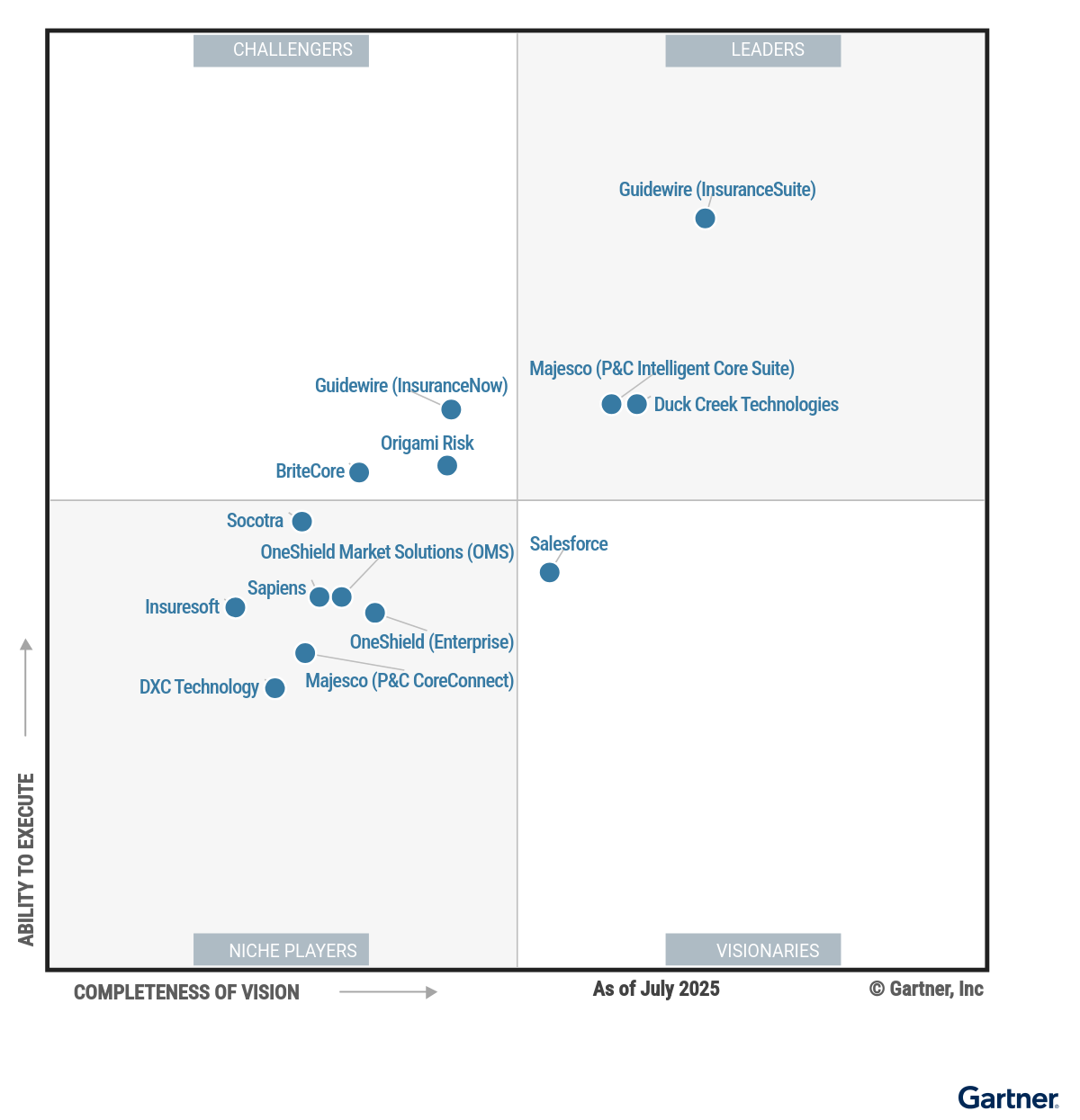
Vendor Strengths and Cautions
BriteCore
BriteCore is a Challenger in this Magic Quadrant. The BriteCore Platform is a single-stack core application with preintegrated components, including portals for customers, agents and partners; APIs; embedded business intelligence (BI) and analytics; and a solution marketplace. The vendor’s SaaS offering is deployed solely on Amazon Web Services (AWS).
BriteCore has software revenue of $26 million. It has 91 employees supporting 107 deployments for its SaaS offering in North America, at the time of this report.
In 2024, the vendor delivered a tool to support dynamic letter generation and default reserve setting for claims along with an updated claims UI.
- Single version with automatic updates: BriteCore is a cloud-only platform that enables investment in a single version of its offering, with biweekly incremental updates automatically applied to customer deployments. This reduces the operational overhead for adopting new features and functions for its customers.
- Strong commercial lines presence: BriteCore’s strongest market execution is for commercial lines carriers and managing general agents (MGAs) with up to $500 million in revenue. This is demonstrated by its recent customer wins and current client base.
- Steady customer growth: BriteCore has seen strong customer growth, increasing the total number of customers from 97 in 2024 to 107 in 2025. This growth demonstrates market confidence in BriteCore’s solutions.
- Limited self-service: BriteCore’s self-service tools for monitoring and managing environments and for promoting changes remain limited. Potential customers will need to validate that the vendor’s SLAs are aligned with their expectations for SaaS solutions.
- Narrow line-of-business support: BriteCore’s key roadmap theme is to deepen support specifically for commercial property, commercial auto and specialty lines. Buyers seeking support for other lines may encounter limitations in prebuilt content and support.
- Restricted AI vision: The vendor’s embedded AI use cases are limited to back-office natural language Q&A, summarization and configuration support. Buyers may need to augment the vendor’s AI solutions with external integrations to support business outcomes for employee productivity and customer experience.
Duck Creek Technologies
Duck Creek Technologies is a Leader in this Magic Quadrant. Its core platform, Duck Creek Suite, is a modular core application with preintegrated platform components. These include digital experience development tools, data hub, predictive analytics, graphical user interface (GUI)-driven product configuration, APIs, software development kits (SDKs) and a marketplace. The vendor’s SaaS offering is deployed exclusively on Microsoft Azure.
Duck Creek Technologies has an estimated revenue of more than $300 million. Its approximately 1,700 employees support 67 policy, 45 billing and 31 claims module deployments for its SaaS offering in North America, at the time of this report.
In 2024, the vendor delivered updated digital engagement applications, a new data management product powered by Snowflake and enhancements to its cloud self-service capabilities.
- Continuous upgrades: Duck Creek offers continuous no-touch updates for policy and claims. This significantly reduces the burden of upgrades associated with traditional insurance core systems.
- Data insights: The vendor’s data platform, Clarity, enables insurers to aggregate data across policy, billing, claims and external data sources to support intelligent decision making, including predictive analytics for loss control risk and exposure. This data foundation will be important for buyers seeking to leverage data for future AI use cases.
- Extensive implementation partners: Duck Creek Technologies continues to maintain extensive system integration partnerships, with more than 2,000 resources certified for implementation through its training program.
- Slowing growth: The vendor’s customers-in-production growth has slowed between 2023 and 1Q25, more notably for billing and claims, indicating an impaired path to implementation.
- Delayed R&D execution: A number of items from the vendor’s roadmap due for delivery in 2024 are yet to make it into production, including no-touch updates for billing. Buyers will need to assess if R&D plans are backed by delivery capacity before finalizing buying decisions.
- Customer-support challenges: Existing customers have reported that the vendor’s customer support can be inconsistent, with frequent changes in resources and multiple initiatives competing for resources. Buyers should seek agreement on resource guarantees for their project delivery and support teams.
DXC Technology
DXC Technology is a Niche Player in this Magic Quadrant. Its core platform for North America comprises three core modules: DXC Assure P&C Policy, DXC Assure Billing and DXC Assure Claims. The vendor’s SaaS offering is deployed on AWS, but clients can select other clouds.
DXC Technology has an insurance market revenue estimate of $1.4 billion. Out of this, Gartner estimates that less than $500 million is generated by its global P&C software business. DXC supports five policy, two billing and 16 claims (excluding BPO) deployments for its SaaS P&C offering in North America, at the time of this report.
In 2024, the vendor delivered an enterprise data hub to enable near-real-time integration across infrastructure, apps and workflows. It also introduced observability tools to support greater self-sufficiency for monitoring health and performance on its SaaS, and an AI-driven intelligent document processing (IdP) and fraud detection solution.
- Extensive global presence: DXC’s core components natively support multiple currencies and languages, enabling service for complex insurers with a wide geographic presence. It also has a robust series of global forums and local advisory groups to engage clients and advance DXC’s global reach.
- Contract simplicity: DXC includes third-party components (such as ServiceNow) in its offering and simplifies contract complexity by embedding the costs and contract agreements into a single agreement with DXC.
- Managed services: DXC offers a broader service proposition than other vendors, including managed services, managed upgrades, meeting compliance and regulatory requirements, and outsourcing. These will provide value to insurance customers with limited internal skills or insurers looking to change their operating models.
- Overweighted focus on existing customers: DXC’s primary focus is to safeguard existing customer investments and enable existing customers to utilize more of its platform capabilities. This is reflected in limited new logo wins for DXC Assure. Prospects will need to weigh up the vendor’s focus on protecting existing customer relationships over implementation support for new customers and advancing the product.
- Module modernization lag: The DXC core platform consists of three separate, integrated modules for policy, billing and claims. Policy and billing are on a different technology stack than claims and with differing UIs. Assure activities and workflow are also a separate module with its own UI. This adds complexity, requiring users to be trained on different user experiences across components.
- Lack of cohesive models: With no contracted upgrade commitment for SaaS, DXC has customers on various versions and on different underlying technologies, limiting the company’s ability to concentrate support, maintenance and R&D on a single version.
Guidewire (InsuranceNow)
Guidewire’s InsuranceNow is a Challenger in this Magic Quadrant. InsuranceNow is a single-stack core application with preintegrated platform components, including predictive analytics, separate portals for customers, APIs and a marketplace. The vendor’s SaaS-only offering is available only on AWS.
Guidewire has a group revenue estimate of $980 million and approximately 3,400 employees. InsuranceNow supports 51 deployments for its SaaS offering in North America, at the time of this report.
In 2024, the vendor increased the number of prepackaged products by adding prepackaged Insurance Services Office (ISO)-based products (commercial general liability, commercial crime, commercial umbrella and inland marine); added a quote comparison function; and introduced integration with One Inc’s ClaimsPay.
- Access to platform investments: InsuranceNow’s roadmap benefits from Guidewire’s shared platform investments, such as the cloud rating engine and partner integrations, enabling faster speed to market for new services and functions.
- Roadmap visibility: InsuranceNow has three releases per year and publishes its roadmap ahead of schedule. This is beneficial to buyers as it will enable them to prioritize and plan for the adoption of new content in advance, leading to faster IT and business value.
- Prebuilt integrations: Guidewire offers 44 apps and integrations for InsuranceNow through its marketplace. This will be important for buyers seeking speed to value through implementation.
- Low growth ratio: The win rate to customer-in-production ratio for InsuranceNow is lower than the market average. This is partly driven by four discontinuations over the last few years. Buyers will need to establish the reasons for discontinuation and engage with existing customers for reference checks before finalizing buying decisions.
- Lack of production-ready AI: Guidewire’s embedded AI solutions for InsuranceNow are still in pilot or R&D and will not be generally available until 2026. Currently, customers must rely on third-party integrations for AI capabilities.
- Configuration complexity: InsuranceNow’s product and rules configuration remains complex, requiring the use of multiple tools. It also offers limited GUI options for modifying page layouts. Advanced configurations or rules must be handled through an integrated development environment, which is suitable only for technical users.
Guidewire (InsuranceSuite)
Guidewire’s second platform, InsuranceSuite, is a Leader in this Magic Quadrant. It is a modular core application with integrated platform components, including predictive analytics, digital experience development tools, data platform, GUI-driven product configuration, a marketplace and an API SDK.
InsuranceSuite SaaS is deployed on AWS only. InsuranceSuite supports more than 87 policy, 86 billing and 96 claims deployments for its SaaS offering in North America, at the time of this report.
In 2024, the vendor delivered an externalized core service to define, manage and optimize automated workflows; added support for multilayer, multitier coinsurance arrangements; and introduced the ability for commercial lines insurers to create custom pricing.
- Positive growth: Between 2024 and 2025, InsuranceSuite has seen a 17% growth in primary insurer customers on its SaaS for its core modules. The growth is driven by a mix of new wins and cloud transitions. This signals robust viability for new buyers.
- Wide access to external resources: InsuranceSuite continues to maintain an expansive network of technology and service partners, with more than 9,700 consultants formally certified for its SaaS offering. This provides buyers with an extensive choice of partners for their implementations and ongoing needs.
- Dedicated R&D investor: Guidewire invests 34% of its product revenue back into R&D. This is substantially higher than other market competitors. The platform is a good fit for customers looking to adopt a viable platform that has multirelease roadmaps backed by committed investment and delivery.
- Price concerns: Guidewire is ending support for on-premises deployments for InsuranceSuite, requiring migration to its cloud platform. Existing customers have expressed concerns about significantly higher long-term cloud costs due to recurring price increases and indexation. This impacts budget planning and may reduce overall ROI.
- Lack of production-ready AI: Guidewire’s embedded AI solutions for InsuranceSuite are still in pilot or R&D and will not be generally available until 2026. Currently, customers must rely on third-party integrations for AI capabilities.
- Implementation backlog: Guidewire has a significant implementation pipeline. Potential customers should assess if the vendor has resources to support their projects before committing to deployment.
Insuresoft
Insuresoft is a Niche Player in this Magic Quadrant. Insuresoft Diamond Platform is a single-stack core application with platform components, including APIs, a data analytics module, separate portals for agents and consumers, and a GUI-driven product configuration engine. The vendor’s SaaS-only offering is deployed solely on Microsoft Azure.
Insuresoft has an estimated revenue of more than $25 million and approximately 107 employees. Insuresoft supports 25 deployments for its SaaS offering in North America, at the time of this report.
In 2024, the vendor added additional integrations for payment processing and partial migration to .NET 9.
- Strong Tier 5 presence: With all clients in production at Tier 5 (see Note 1), Insuresoft continues to be a strong candidate for insurers with gross written premiums of $250 million and below. It offers core system modules with solid fundamental functions, along with good levels of support for most of the major personal and commercial lines of insurance.
- Long-term relationships: Insuresoft has a 95% renewal rate for existing customers, indicating strong loyalty. This will be important for buyers where the relationship with the vendor and its staff is a significant part of the evaluation.
- Prebuilt integrations: Insuresoft has more than 80 partners who support integrations for the exchange of data during different process workflows. These include integrations for supporting fraud and loss history, CRM, financial systems, geocoding, value estimation and call center telephony systems. It also offers access to all core processes and transactions via REST APIs, which help orchestrate and develop transaction solutions external to the core platform. This will help reduce implementation efforts.
- Lagging SaaS model: The vendor offers quarterly releases, but adoption is not enforced and they are not no-touch upgrades. Buyers seeking to keep current will need to factor in additional testing and adoption costs.
- Constrained R&D: The vendor’s roadmap is largely focused on technical and functional updates to existing capabilities, such as portal enhancements and migrating customers to .NET. With lower-than-average employees, at 17%, dedicated to R&D, there will be limited capacity for innovation or rapid response to market changes. Customers should assess whether the vendor can keep pace with evolving technology needs and ensure future requirements will be met.
- Configuration Limitations: The centralized configuration tool requires a separate license. It lacks drag-and-drop screen design or workflow visualization features, making more complex configuration less suitable for nontechnical business users. Customers should anticipate increased reliance on technical resources for ongoing configuration deployment and maintenance.
Majesco (P&C CoreConnect)
Majesco P&C CoreConnect is a Niche Player in this Magic Quadrant. P&C CoreConnect is a single-stack core application consisting of preintegrated platform components, including APIs and GUI-driven product configuration. The vendor’s SaaS offering is deployed solely on Microsoft Azure.
Majesco has a total group revenue estimate of $300 million and approximately 900 employees, of which approximately 200 support the P&C CoreConnect platform. P&C CoreConnect supports 11 deployments for its SaaS offering in North America, at the time of this report.
In 2024, the vendor delivered features to support faster upgrades, an AI help assistant and a responsive design customer portal.
- Specific target market: The vendor’s target market for P&C CoreConnect is MGAs, managed general underwriters (MGUs), united pool associations (UPAs) and smaller-volume carriers for both admitted and nonadmitted business. Buyers seeking lower-cost options for these markets will find CoreConnect a viable option for their shortlist.
- Shared resources: Postacquisition Majesco continues to increase access to shared technologies and human resources, including offshore teams, to increase platform capabilities.
- High SLAs: The vendor’s standard uptime SLA ranges between 99.9% and 99.99%, depending on the instances and availability zones being used. These are some of the highest base SLAs of the vendors profiled in this research.
- Low sales execution: The platform secured only one new win in 2024 and none in 1Q25. Organizations considering CoreConnect should closely evaluate the vendor’s sales coverage, partner ecosystem and customer references to ensure alignment with their growth and support expectations.
- Limited user autonomy: The SaaS platform offers limited self-sufficiency for change management or environment monitoring. Customers will need to depend on the vendor for undertaking most aspects of ongoing change.
- Restricted partner options: The vendor maintains a limited ecosystem of system integration partners and typically prefers to conduct implementations directly. Prospective clients seeking flexibility in implementation approaches, or leveraging established relationships with system integrators may encounter constraints and should evaluate the vendor’s ability to scale resources and provide adequate support outside its direct services.
Majesco (P&C Intelligent Core Suite)
Majesco’s P&C Intelligent Core Suite is a Leader in this Magic Quadrant. P&C Intelligent Core Suite is a modular core application with integrated platform components, including embedded analytics, digital experience design tools, data hub, GUI-driven product configuration, API SDK and a marketplace. P&C Intelligent Core Suite is deployed on Microsoft Azure.
The platform supports 89 policy, 82 billing and 40 claims deployments for its SaaS offering in North America, at the time of this report.
In 2024, the vendor delivered claims support for workers’ compensation, digital payments for claims and multicurrency support through all modules.
- Sustained earnings growth: Majesco has increased its earnings before interest, taxes, depreciation and amortization (EBITDA) by over five times since it was acquired in 2020. Buyers seeking long-term options will find this favorable for supporting ongoing viability.
- Generative AI (GenAI) front runner: Majesco continues to expand the use cases for its embedded Microsoft Copilot along with the ability to demonstrate quantifiable outcomes. This will be of interest to customers seeking deep productivity gains in areas such as policy summarization, transaction automation and agent recommendations.
- Configurable landing pages: The platform offers significant options for personalizing landing pages through a wizard-driven configuration solution. Insurance CIOs seeking to create differentiated experiences for different user personas can use this function to rapidly create screens and flows, which can also include embedded analytics.
- Low employee satisfaction: Reviews in a popular job portal indicate that Majesco has low employee satisfaction ratings. Buyers will need to consider the impact of churn and retention of key employees on any potential implementation.
- Customization deflects SaaS value: Customers are enabled to run their customizations on single-tenant deployments. Although this may be attractive from a flexibility point of view, it allows customers to make significant deviations, reducing the value proposition of SaaS solutions.
- Lack of self-sufficiency: Customers have limited ability to independently deploy changes to the production environment. They will need to depend significantly on the vendor to perform testing and implement changes made in development or test environments.
OneShield (Enterprise)
OneShield Enterprise is a Niche Player in this Magic Quadrant. OneShield Enterprise is a modular core application with preintegrated platform components, including agent and policyholder portals, reporting, relationship management and APIs. The vendor’s SaaS is cloud-agnostic.
OneShield has a total group revenue estimate of less than $50 million and approximately 250 employees. It has 17 policy, seven billing and five claims SaaS deployments of OneShield Enterprise in North America, at the time of this report.
In 2024, OneShield improved Enterprise’s hierarchy and relationship management capabilities and introduced a reinsurance ceding management platform.
- Centralized configuration: OneShield Enterprise offers a centralized design studio that allows both business and IT users to easily configure object models, workflows, products and integrations. This enables faster implementation, easier customization and better alignment between business needs and IT, helping customers streamline operations across all core modules.
- Cloud portability: OneShield Enterprise is cloud-agnostic, giving customers the flexibility to deploy in their preferred cloud environment. This allows organizations to move to a self-managed deployment or switch to an alternative cloud provider as their needs evolve.
- Embedded agent relationship management: OneShield Enterprise features a dedicated relationship management tool for setting up and managing multiple tiers of agents, brokers and agency partners. The system validates agent information and supports dual financial transaction management, enabling embedded validation checks and facilitating white labeling for in-house agents and MGAs.
- Outdated technology dependencies: Enterprise depends heavily on technology such as Linux and various open-source formats that have specific hardware and software dependencies for deployment. The core application is also undergoing technical upgrades for its Oracle dependencies. Existing customers should expect to have to deal with technical upgrades as the vendor rearchitects its core applications.
- Continued low sales execution: With only two new wins for the platform between 2023 and 1Q25, the vendor is well-below the market average in new sales execution. Prospective buyers should be aware that this may impact the vendor’s ability to scale deployments, provide timely support or invest in future product enhancements.
- Restricted AI execution: The vendor’s AI execution is centered around creating foundational capabilities to support AI and low-complexity assistance use cases for developers and users. This may not be suitable for customers seeking advanced AI capabilities with immediate needs for delivering processing efficiency.
OneShield Market Solutions (OMS)
OneShield Market Solutions (OMS) is a Niche Player in this Magic Quadrant. OMS is a single-stack core application with preintegrated platform components, including GUI-driven product configuration, portals for customers and agents, and APIs. The platform is SaaS-only and is deployed exclusively on Microsoft Azure.
OMS has 17 SaaS deployments in North America, at the time of this report.
In 2024, the vendor delivered additional APIs, portal enhancements to support more complex transactions and a real-time note collaboration function.
- Automated upgrades: OneShield OMS offers multitenant deployment and automated push upgrades, so clients no longer need to manage manual system updates. This reduces IT workload, ensures access to the latest features and minimizes system downtime, allowing customers to focus on their core business.
- Strong focus on implementation control: OMS retains full ownership of implementation, using in-house teams instead of external contractors or system integrator (SI) partners. This ensures direct accountability and adaptability to client needs. With coordinated teams in the U.S. and India, OMS enables flexible execution and faster deployment. Clients with simpler needs should benefit from having a single point of contact and consistent standards, reducing risks from third-party handoffs.
- Inclusive pricing model: OMS is competitively priced, with all upfront implementation costs included in the subscription fee. This helps customers avoid large initial expenses, simplifies budgeting and accelerates time to value.
- Restrictive configuration options: OMS does not provide GUI-based tools for configuration, and the vendor undertakes this as part of the subscription. Potential customers will need to evaluate the vendor’s SLAs and customer experience to ensure they are comfortable with the vendor supporting the majority of their implementation and ongoing change needs.
- Limited self-sufficiency: OMS does not enable access to environment management, performance monitoring or security controls. This will not be suitable for customers that want autonomy for their ongoing management and security needs.
- Limited integrations: OMS has limited APIs and supports few revenue-related integrations with third-party solutions. It also does not offer a marketplace for built and maintained integrations. Additional implementation effort will need to be factored in to support integrations.
Origami Risk
Origami Risk is a Challenger in this Magic Quadrant. Its core platform, Origami Risk P&C Insurance Core Solutions, is a single-stack core application with preintegrated platform components, including portals for agents, GUI-driven product configuration and APIs. The vendor’s SaaS-only offering is deployed solely on AWS.
Origami Risk has a revenue estimate of more than $250 million and approximately 940 employees. It supports 25 policy, 23 billing and 23 claims deployments for primary insurers in its SaaS offering in North America, at the time of this report.
In 2024, the vendor introduced functionality that allows configurations to be easily transferred between tenants, removing the need to manually recreate features in each tenant.
- High growth rate: Origami Risk has been demonstrating one of the highest overall win rates for its platform across the past three years. The sustained increase in customer base signals strong vendor viability.
- No upgrade debt: Origami Risk uses a single codebase delivered through multitenant deployment on AWS, ensuring all customers are always on the same software version. This eliminates IT debt for insurers and simplifies maintenance and upgrades.
- Built-out application systems: The platform provides a suite of REST APIs, an API gateway, and prebuilt, configurable integrations. This allows customers to connect systems more easily and accelerates implementation timelines, helping them realize value faster.
- Noninsurer customer base: Only 11% of Origami Risk customers are primary insurers and they predominantly belong to Tier 4 or Tier 5 (see Note 1). Potential customers will need to test the ability to support customizations for more complex deployments in a multitenant architecture.
- Lack of personal lines insurance experience: Origami Risk does not have customers in production for personal lines insurance. Potential customers requiring support for personal lines should verify support for their required products and be prepared to be early adopters.
- Limited implementation partners: The vendor has a limited number of trained resources available within its systems implementation partner network. Prospective customers should carefully assess the vendor’s implementation capacity, partner capabilities and resource availability before initiating large-scale implementations.
Salesforce
Salesforce is a Visionary in this Magic Quadrant. The Salesforce Digital Insurance Platform is a modular core application with additional platform components. These include data solutions, predictive analytics, portals for customers, agents and partners, digital experience development tools, GUI-driven product configuration, APIs, SDKs and a marketplace. The vendor’s SaaS offering is deployed through its own data centers and AWS.
Salesforce has a revenue estimate of $34.9 billion, of which Gartner estimates $150 million is generated from the insurance-specific functions offered as part of Salesforce Industries Financial Services. Gartner estimates that the Salesforce Digital Insurance Platform has less than 200 core deployments for insurers and noninsurers globally.
In 2024, the vendor delivered support for creating AI agents, enabled policy terms of less than 365 days and made improvements to its policyholder portal.
- Access to the Salesforce ecosystem: The Salesforce Digital Insurance Platform is built within the overall Salesforce ecosystem. This means buyers can benefit from cross-platform investments, such as Experience Cloud for creating portals, Marketing Intelligence for analytics and Agentforce for creating embedded AI agents.
- Self-sufficiency: The platform provides a holistic suite of self-service tools for screen design, rule creation, business process definition and data management. This empowers customers to easily configure and adapt the system to their needs without heavy reliance on vendor support, speeding up changes and reducing costs.
- Strong local resources: Salesforce has a strong network of partners in North America to support its platform. Insurers in North America will be able to access the vendor’s internal and system integrator partner human resources capabilities to support implementations and ongoing deliveries of capabilities.
- Less competitive pricing: The vendor has a complex pricing model across components. Published list pricing at 1.5% of gross written premium for the Salesforce Digital Insurance Platforms makes the vendor less competitive for premiums greater than $250 million.
- Too many solution paths: The Salesforce platform offers a wide array of features and capabilities that can achieve similar outcomes for insurers, resulting in multiple possible solution paths. Prospective customers will require guidance from Salesforce or its partners to identify and implement the most effective combination of functions.
- Limited client references: Salesforce has few publicly available insurance client references for its P&C core insurance solutions. This lack of referenceability makes it harder for buyers to assess real-world performance and fit for shortlist inclusion. Prospective buyers will therefore need to conduct detailed reference checks as part of their buying cycle due diligence.
Sapiens
Sapiens is a Niche Player in this Magic Quadrant. Sapiens CoreSuite for P&C is a modular solution with components including portals for agents and consumers, GUI-driven product configuration and APIs. Currently, the vendor’s SaaS offering is transitioning from AWS to Microsoft Azure.
The vendor has group revenue of over $540 million and approximately 730 employees supporting the platform. It has around 16 policy, 11 billing and 14 claims deployments for its SaaS offering in North America, at the time of this report.
In 2024, the vendor increased its product prebuilt journeys to include home, auto, pet and flood cover, and ISO electronic rating content (ERC) support for business owners and commercial package policies.
- Shared platform architecture: Sapiens offers different core solutions in geographies outside of the U.S., but all clients benefit from some shared investments in holistic platform components, such as digital experience tools, AI frameworks and use cases, and API orchestration tools portals.
- Customer-centric roadmap: The vendor involves customers and partners directly in product enhancement prioritization and maintains transparency in the roadmap process. There’s a strong focus on expanding partnerships with system integrators and insuretechs, as well as prebuilt integrations, which enhances the platform’s flexibility and ecosystem value.
- Line coverage growth: The vendor continues to expand its prebuilt ratings, integrations and coverage to additional lines of business, such as business owners and commercial package policies. This will be beneficial for customers seeking to launch or modernize their commercial lines insurance business.
- Stalling growth: The vendor has a low win rate, and the number of customers in production decreased from 2023 to 2024. This may indicate challenges with competitiveness or customer retention. Prospective buyers should closely assess the vendor’s recent performance in the North American market before making a decision.
- Ongoing architecture transition: The platform is currently undergoing an architectural transition, migrating its underlying database from Oracle to Postgres and shifting its cloud infrastructure from AWS to Microsoft Azure. This ongoing transformation may introduce temporary disruptions, compatibility challenges or changes in performance and support processes. Prospective customers should assess the vendor’s migration roadmap, timelines and risk mitigation plans to ensure continuity of service and minimize potential impacts on existing and future deployments during this period of transition.
- AI Execution: The vendor is developing AI capabilities centrally for shared use across its core platforms. Its planned deliveries to support embedded AI summarization and assistance in Core Suite for P&C are not due for release until late 2025 and into 2026, lagging other vendors in this report.
Socotra
Socotra is a Niche Player in this Magic Quadrant. Socotra is a single-stack core application with preintegrated platform components including APIs, SDKs, GUI-driven product configuration and a marketplace. The vendor’s SaaS-only offering is deployed on AWS.
Socotra’s revenue estimate is less than $10 million; it has approximately 70 employees and supports approximately 24 deployments in North America, at the time of this report.
In 2024, the vendor delivered a workbench to enable internal users to manage insurance operations, added the ability to configure fees and post payments across multiple policies, and introduced an API to support policy imports for data migration.
- Cloud-native architecture: Socotra is a cloud-native, API-first platform with no legacy on-premises technical debt. This allows for weekly, zero-downtime releases and backward compatibility, so customers can adopt new features at their pace. This sets Socotra apart from competitors still transitioning from on-premises systems and facing slower, riskier upgrades.
- High R&D investment: The vendor allocates 90% of its development effort to R&D and only 10% to support, due to platform stability and low support incident rates. Customers benefit from this focus on ongoing innovation and regular delivery of new features.
- Employee satisfaction: Employee reviews on online review portals indicate that Socotra offers high employee satisfaction. This helps the vendor provide its clients a more stable, proactive and customer-focused partnership.
- Lacking advanced digital features: Many advanced digital engagement features (e.g., recommendation engines, end-user portals and personalization tools) are not available out of the box and require custom development or third-party solutions.
- Limited claims functions: Socotra’s claims capabilities are limited to intake and basic processing, lacking full end-to-end claims functionality. Customers seeking comprehensive claims management will need to rely on the vendor’s integration with Five Sigma or another third-party solution. Buyers should factor in the added complexity and potential costs of these integrations during planning.
- Commercial lines functional limitations: Socotra currently lacks essential functionality for commercial lines insurers, such as agency billing, support for complex producer hierarchies, and the ability to upload and rate large volume schedules. Buyers seeking support for more complex commercial lines operations should carefully assess Socotra’s roadmap and execution plans to ensure these critical gaps are addressed.
Vendors Added and Dropped
We review and adjust our inclusion criteria for Magic Quadrants as markets change. As a result of these adjustments, the mix of vendors in any Magic Quadrant may change over time. A vendor's appearance in a Magic Quadrant one year and not the next does not necessarily indicate that we have changed our opinion of that vendor. It may be a reflection of a change in the market and, therefore, changed evaluation criteria, or of a change of focus by that vendor.
Added
No vendors were added to this Magic Quadrant.
Dropped
No vendors were dropped from this Magic Quadrant.
Inclusion and Exclusion Criteria
To qualify for inclusion in this Magic Quadrant, vendors need to meet the market definition for SaaS P&C Core Platforms:
- The SaaS platform must be generally available, excluding limited release or beta versions, as of 31 December 2024.
- It must include at least three of the six platform elements in production:
- Separate preintegrated portals or digital experience creation tools for customers, agents or suppliers
- A separate data repository
- Separate preintegrated data analytics
- Integration accelerators, which extend the functionality of the core platform (integration accelerators include access to SDKs and developer portals)
- User-accessible consoles for assessing adherence to SLAs, such as performance and latency, and promoting and demoting data, configuration and customizations among environments
- Marketplace for accessing prebuilt, integrated and maintained solutions and services from partners
- It must have at least five North American P&C insurers in production on the vendor’s SaaS offering, with policy, billing or claims modules as of 31 December 2024:
- A vendor client is defined as a primary insurer that has executed a contractual agreement and has implemented at least one or more core modules (policy, billing and/or claims) for the vendor’s stated SaaS core platform. (A primary insurer owns the insurance product and underwrites its own risk through its own capacity. They are fully licensed and maintain their own balance sheet rated by AM Best.)
- Only one client per registered organization can be included. This means that a separate client can be achieved for the same overarching client deploying the system with separately registered subcompanies in different territories.
- A client that has deployed the system more than once for different channels or product lines does not constitute a new client.
- A project is not still in initiation/blueprint or scoping and, therefore, open for cancellation. (The project has fully commenced and the insurer is using the modules in support of an active book of business for calendar year 2023 through 2024.)
- The client has contracted directly with the vendor — not to include indirect relationships through a white-labeling or third-party administrator (TPA)/business process outsourcing (BPO) arrangement.
- Clients do not include health insurers and life insurers.
- The offer must be live in production in North America as of 31 December 2024. For the purpose of this research, the following countries are included in scope: Canada and the U.S.
- It must have at least one new primary P&C insurer customer SaaS win for the platform, excluding existing customers transitioning to the SaaS platform, in North America for the core system policy, billing or claims (excluding upgrades or expansion within existing customers) during 2023 and 2024.
- It must offer core modules that are currently being marketed by the vendor. Clients on unsupported, not upgradable, or alternative core systems or core modules should not be included in the numbers.
This Magic Quadrant is specific to North America and does not apply to other regions.
Honorable Mentions
Insurity is a large vendor in the P&C core platform market in North America with self-service revenue of more than $300 million. The vendor offers the Insurity Platform supporting a number of underlying P&C insurance core systems. Insurity did not meet the new wins criteria for primary insurers to qualify for this Magic Quadrant.
Evaluation Criteria
Gartner analysts evaluate vendors on the quality and efficacy of the processes, systems, methods and procedures they use to be competitive, efficient and effective, and to improve their revenue, retention and reputation.
Ability to Execute
Ability to Execute Evaluation Criteria
| Evaluation Criteria | Weighting |
|---|---|
Product or Service | High |
Overall Viability | Medium |
Sales Execution/Pricing | High |
Market Responsiveness/Record | Medium |
Marketing Execution | Low |
Customer Experience | Low |
Operations | Medium |
Source: Gartner (September 2025)
Completeness of Vision
Gartner analysts evaluate vendors on their ability to convincingly articulate their current and future market direction, innovation, customer needs and competitive positioning, and how well they map to customer needs. Ultimately, vendors are rated on their understanding of how market forces can be exploited to create opportunities for the vendor.
Completeness of Vision Evaluation Criteria
| Evaluation Criteria | Weighting |
|---|---|
Market Understanding | Medium |
Marketing Strategy | Low |
Sales Strategy | Medium |
Offering (Product) Strategy | High |
Business Model | Medium |
Vertical/Industry Strategy | Low |
Innovation | High |
Geographic Strategy | Low |
Source: Gartner (September 2025)
Quadrant Descriptions
Leaders
Leaders offer strong core functionality to support a broad array of P&C insurance products through prebuilt content and industry integrations. Their SaaS service proposition is backed by SLAs and third-party accreditations. They offer their own platform capabilities for digital employee, agent, policyholder and partner experience, and data and analytics, as well as having built a broader ecosystem around their core offering through partnerships with third parties. They have also started to provide embedded AI use cases with roadmaps that cover AI and AI agent expansion across the value chain.
Challengers
Challengers offer comprehensive core system capabilities that can be deployed rapidly and changes handled predominantly through GUI-based configuration tools. While the breadth of their platform capabilities and line of business (LOB) coverage is narrower than Leaders, they specialize in providing prebuilt content and services to support their chosen market segment and lines of business. All have been highly successful among Tier 4 and 5 North American insurers as well as MGAs.
Visionaries
Visionaries offer strong core system functionality and have demonstrated a flair for innovation in areas such as digital experience or analytics. They tend to have limited production experience in certain segments, but they demonstrate potential with strong architectural foundations in the cloud and low-code/no-code configurations. They also offer platform capabilities for enabling embedded AI, such as the ability to support the creation of AI agents and their governance.
Niche Players
Niche Players have key strengths that make them strong candidates in certain market segments, mainly smaller commercial lines insurers. They have limitations (e.g., LOB coverage, innovation, scalability or reliance on outdated technologies or architectures) that make them less suitable for a broader range of opportunities.
Context
SaaS adoption for P&C insurers seeking core platforms for modernization, consolidation or to meet new needs is almost ubiquitous in North America. The vendors profiled offer SaaS platforms with a comprehensive set of core capabilities for policy, billing and claims management, and an expanded set of capabilities supporting the customer and agent experience via digital channels, data management and analytics. Many capabilities (in particular traditional core system capabilities) are similar, but there are key differences:
- Support for and degree of flexibility offered to customers, production experience with cloud-based deployment, including private cloud or public cloud, managed services and SLAs.
- The technical architecture, ability to deploy modules independently, languages used for coding, databases supported, and the design, maturity and accessibility of integration APIs.
- The range of LOBs and product types they have experience supporting.
- Actual production experience with all core modules and related components, such as rating engines or underwriting workstations.
- Full availability and actual production experience with platform capabilities outside the core modules, such as digital experience creation tools, prebuilt portal capabilities, data management and BI/analytics.
- Availability and certification of implementation partners.
- Number, coverage and ease of access to partner solutions and services.
- Geographic reach of the vendor and its partner ecosystem.
- Embedded AI use cases, including GenAI and AI agents, and an AI strategy for future use-case expansion and governance.
This Magic Quadrant evaluates vendor and platform capabilities as at 31 March 2025. It places emphasis on the vendor’s platform capabilities and their service propositions. Although we recognize that many providers in this Magic Quadrant also sell to organizations in other regions, evaluations reflect the needs of P&C insurers in North America.
Market Overview
SaaS core platforms continue to make up the majority of the new deals for P&C core platform vendors in North America, where the trend continues to be strongest globally. However, there are significant differences in vendor architectures, service offerings, cloud maturity and pricing models. AI dominates conversations for insurance technology leaders. The future of how work gets done and the role of embedded AI in core insurance systems (including machine learning, GenAI and AI agent) brings a sharp focus on vendor roadmaps, support for regulations, delivery capabilities and even their future business model.
Vendors that have traditionally deployed on-premises continue transitioning their software and their customer base to their cloud offerings. For some of these vendors, 30% to 40% of their new wins consist of existing clients transitioning to the cloud, which masks the actual market impact.
Vendors that have started out in the cloud continue to expand their platform capabilities and line of business coverage in efforts to attract larger tier primary carriers. However, functional gaps remain, especially for claims, resulting in much of their customer activity being limited to Tier 4/5 carriers or MGAs. MGAs and MGUs represented 34% of all new wins reported by the vendors in 2024. This trend follows the rapid growth of the MGA market in the U.S.1
Some key market observations include:
- Overall, Gartner has observed that for a like-for-like base of vendors net new wins for 2024 stayed consistent with 2023, bearing in mind that 2023 showed a 25% decrease in net new wins compared to the prior year.
- However, the leading vendor continues to heavily influence the market for net wins of primary insurers.
- When removing the leading vendor, the remaining vendors see a 14% decrease in wins for primary insurers.
- Seven vendor platforms secured two or fewer wins in total.
Buyers should consider the following aspects while choosing vendors:
- Pricing: Although pricing for core capabilities is universally calculated as a percentage of premium, pricing for the same premium can vary as much as 50% between the most and least expensive vendors. However, pricing should factor as just one element of the TCO over a 10-year period and not be a primary driver for selection. Vendor SLAs, tiering for pricing, contract terms and included capabilities and services will all determine what constitutes value.
- AI capabilities: The acceleration of AI and GenAI has seen P&C insurance policy administration and some vendors prioritize R&D developments on embedding AI into their applications. Buyers will need to be mindful that this represents a new capability that will be largely unproven, especially for GenAI-based solutions. However, the promise of the ability to automate tasks and augment key decision points in underwriting and claims will be appealing. Gartner has seen that pricing is nascent at best for embedded AI solutions. Some vendors include certain use cases as part of the subscription. Others are selling the AI solutions as add-ons or providing a certain number of tokens, with token usage linked to the value of the use case. Regardless of model, buyers can expect to pay additional fees as the number of embedded AI, GenAI and AI agents increases. Buyers should factor this into their total cost of ownership.
- Future viability: Buyers face a complex market for the selection of these business-critical core platforms to meet current needs. However, they should also ensure that the vendor and the platform offer the necessary financial viability and resource agility to meet the future needs of the enterprise. This includes intelligent core applications and automations that improve productivity of workers and overall efficiency of operations.
- Vendor compatibility: Gartner advises P&C insurance CIOs against simply selecting vendors that appear in the Leaders quadrant. All selections should be buyer-specific. Depending on the context, vendors from the Challengers, Niche Players or Visionaries quadrants may be better matches for an insurance company’s business goals, IT budget, risk appetite, geographic needs, LOB or functional requirements and future ambitions.
1 MGA Business Surges to $100 Billion as Fronting Carriers Spur Growth, Risk&Insurance.
Note 1: Description of Tiers
Tier 1: More than $5 billion in direct written premiums (DWP)
Tier 2: $1billion to $5 billion in DWP
Tier 3: $500 million to $1 billion in DWP
Tier 4: $250 million to $500 million in DWP
Tier 5: Less than $250 million in DWP
Ability to Execute
Product/Service: Core goods and services offered by the vendor for the defined market. This includes current product/service capabilities, quality, feature sets, skills and so on, whether offered natively or through OEM agreements/partnerships as defined in the market definition and detailed in the subcriteria.
Overall Viability: Viability includes an assessment of the overall organization's financial health, the financial and practical success of the business unit, and the likelihood that the individual business unit will continue investing in the product, will continue offering the product and will advance the state of the art within the organization's portfolio of products.
Sales Execution/Pricing: The vendor's capabilities in all presales activities and the structure that supports them. This includes deal management, pricing and negotiation, presales support, and the overall effectiveness of the sales channel.
Market Responsiveness/Record: Ability to respond, change direction, be flexible and achieve competitive success as opportunities develop, competitors act, customer needs evolve and market dynamics change. This criterion also considers the vendor's history of responsiveness.
Marketing Execution: The clarity, quality, creativity and efficacy of programs designed to deliver the organization's message to influence the market, promote the brand and business, increase awareness of the products, and establish a positive identification with the product/brand and organization in the minds of buyers. This "mind share" can be driven by a combination of publicity, promotional initiatives, thought leadership, word of mouth and sales activities.
Customer Experience: Relationships, products and services/programs that enable clients to be successful with the products evaluated. Specifically, this includes the ways customers receive technical support or account support. This can also include ancillary tools, customer support programs (and the quality thereof), availability of user groups, service-level agreements and so on.
Operations: The ability of the organization to meet its goals and commitments. Factors include the quality of the organizational structure, including skills, experiences, programs, systems and other vehicles that enable the organization to operate effectively and efficiently on an ongoing basis.
Completeness of Vision
Market Understanding: Ability of the vendor to understand buyers' wants and needs and to translate those into products and services. Vendors that show the highest degree of vision listen to and understand buyers' wants and needs, and can shape or enhance those with their added vision.
Marketing Strategy: A clear, differentiated set of messages consistently communicated throughout the organization and externalized through the website, advertising, customer programs and positioning statements.
Sales Strategy: The strategy for selling products that uses the appropriate network of direct and indirect sales, marketing, service, and communication affiliates that extend the scope and depth of market reach, skills, expertise, technologies, services and the customer base.
Offering (Product) Strategy: The vendor's approach to product development and delivery that emphasizes differentiation, functionality, methodology and feature sets as they map to current and future requirements.
Business Model: The soundness and logic of the vendor's underlying business proposition.
Vertical/Industry Strategy: The vendor's strategy to direct resources, skills and offerings to meet the specific needs of individual market segments, including vertical markets.
Innovation: Direct, related, complementary and synergistic layouts of resources, expertise or capital for investment, consolidation, defensive or pre-emptive purposes.
Geographic Strategy: The vendor's strategy to direct resources, skills and offerings to meet the specific needs of geographies outside the "home" or native geography, either directly or through partners, channels and subsidiaries as appropriate for that geography and market.