Magic Quadrant for B2B Marketing Automation Platforms
23 September 2025 - ID G00825059 - 44 min read
By Jeff Cohen, Upasna Chandna, and 3 more
B2B marketing automation platforms enable marketing teams to manage demand generation programs and orchestrate customer engagement. CMOs can leverage this research to assess market maturity and AI innovations and to identify optimal vendors for strategic growth.
Market Definition/Description
Gartner defines B2B marketing automation platforms (B2B MAPs) as software applications that support demand generation processes at scale. B2B MAPs help marketers capture and qualify leads and accounts, orchestrate marketing-driven engagement across the full customer journey, and use analytics to optimize and measure performance.
B2B MAPs enable marketers to automate a wide range of activities intended to drive new customer acquisition, retention and growth. To support the pursuit of new commercial opportunities (from current or prospective customers), marketers use B2B MAPs to generate, prioritize, and manage leads and account buying groups across the revenue life cycle. This includes the distribution of marketing-generated and qualified leads to sales teams for further pursuit.
Also, B2B MAPs are used to orchestrate and measure multichannel customer engagement campaigns and programs. B2B MAPs enable marketers to design and activate some communication channels natively — most notably, email and web landing pages — and orchestrate customer engagement through other channels via integrations with other tools/platforms.
Lastly, marketers use B2B MAPs as a tool for collecting, analyzing and reporting performance analytics. Performance analytics enable both tactical measurement, such as marketing channel engagement metrics, and strategic measurement, such as the attribution of marketing activities to commercial outcomes.
B2B MAPs are optimized for B2B marketing use cases. They may also be applicable to B2C organizations selling high-consideration products with lead management needs or B2B2C models.
Mandatory Features
The mandatory features for this market include the ability to:
- Input and synchronize customer contact and account data into a unified customer profile.
- Create multistep journeys for contacts (e.g., drip campaigns, customer onboarding motions) using a graphical lead workflow UI suitable for nontechnical users.
- Deploy and manage coordinated customer engagement programs across multiple channels, including native email and landing page execution.
- Score leads to evaluate quality based on profile fit and behavioral criteria using business rules and/or predictive analytics capabilities.
- Measure the performance of marketing touchpoints and communicate results using data visualization/dashboarding capabilities.
Common Features
The common features for this market include:
- Ability to create segmented and dynamic lists of contacts or accounts using business rules and/or predictive analytics.
- Functionality to enable one-to-one personalized customer communications based on a combination of persona, account and/or behavioral attributes.
- Functionality for account-level scoring to support account prioritization processes using business rules and/or predictive analytics.
- Ability to use lead workflow functionality for enabling organizations to manage and measure the lead-to-revenue life cycle, from lead generation/collection to conversion.
- Ability to use multitouch attribution capabilities for allocating conversion credit, such as lead creation or closed-won revenue, to certain touchpoints or interactions across the buying journey.
- Ability to set user and group roles and permissions for distinct business units, brands or regional marketing teams.
- Functionality for AI-determined orchestration (e.g., next best offer, next best channel).
- Ability to create content components (e.g., email copy) using generative AI.
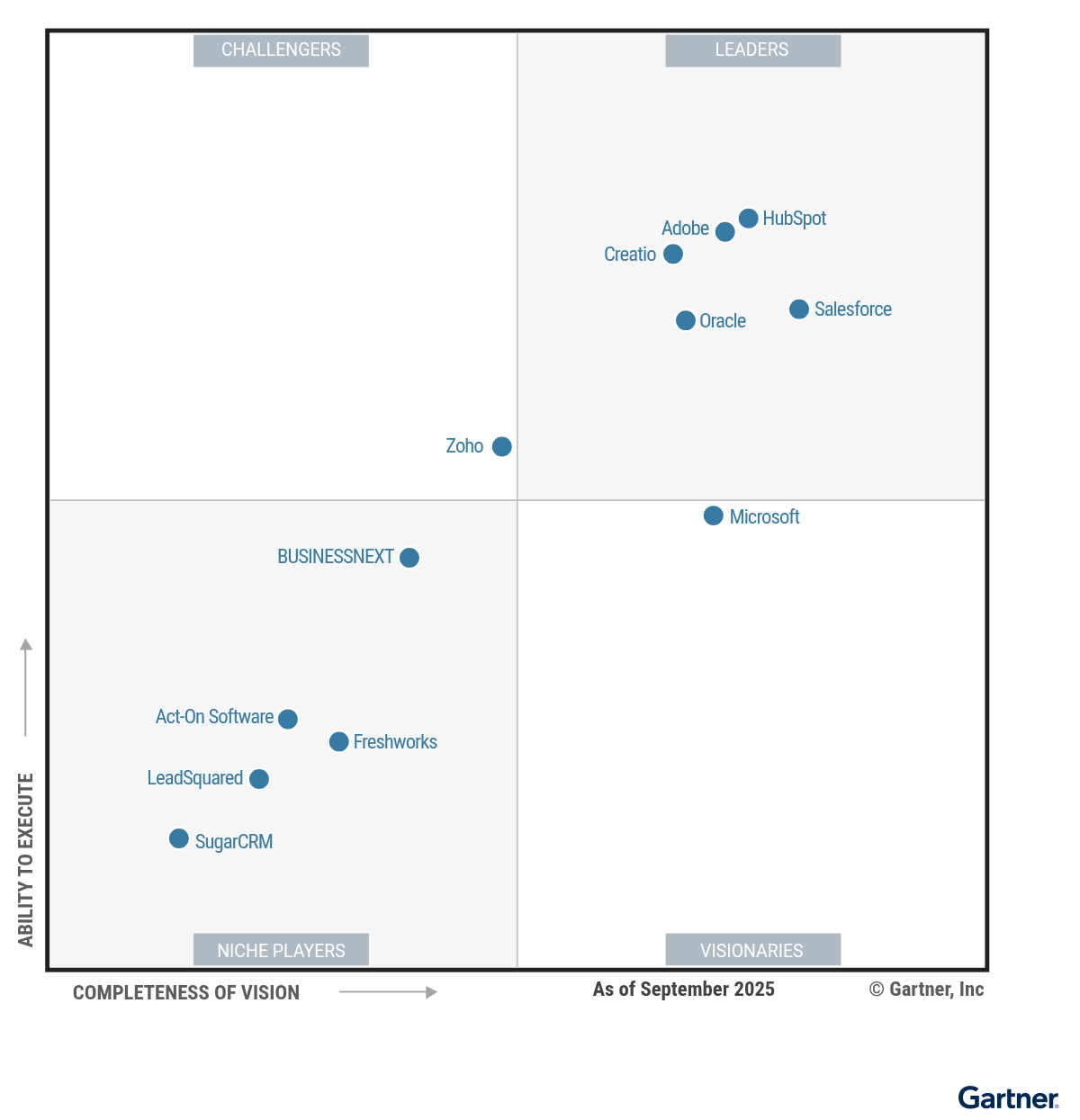
Magic Quadrant
Vendor Strengths and Cautions
Act-On Software
Act-On Software (Act-On) is a Niche Player in this Magic Quadrant. Its simplified, stand-alone MAP is an alternative to integrated suites and multiproduct solutions from larger vendors. Its operations are primarily in North America and the U.K., with mostly small and midsize clients in professional services, manufacturing and financial services. Its recent improvements include the launch of a simplified email composer with revised templates and continued support for triggered commercial and transactional emails. Its roadmap focuses on AI-driven analytics enhancements, featuring a natural language prompt interface for metric retrieval and AI agents to uncover specific results (e.g., email or landing page performance).
Act-On declined requests for supplemental information. Gartner’s analysis is therefore based on other credible sources.
- Stand-alone platform: As the only stand-alone MAP evaluated, Act-On views the challenges of the market in a different way than other vendors. It sees the need for a simple, easy-to-use platform rather than upselling additional products or getting buy-in to a technology ecosystem.
- Workflow simplification: Act-On meets the needs of its small and midsize business (SMB) and midmarket audience by updating and enhancing its capabilities to improve its MAP’s usability. Its Audience Center brings together contact profiles, segmentation and AI to help customers streamline their processes and benefit from AI’s automated insights, which is especially useful for smaller teams with more limited access to technical expertise.
- Rule-based and predictive lead scoring: Act-On shows marketers the predictive lead score of likelihood to convert, based on both integrated CRM data and marketing activities. Displaying these two methods side-by-side, along with using both in segmentation and automated journeys, allows marketers to optimize their lead management definitions.
- Enterprise pricing: While Act-On stands out among vendors for charging based on active contacts, rather than all contacts in the database, its online pricing calculator only provides pricing for the Professional edition. The Enterprise edition, which includes additional features such as CRM integration and advanced reporting, does not have pricing guidance online. Add-on capabilities and implementation prices are also not listed on the Act-On website.
- Limited account scoring: As B2B marketers increasingly prioritize account engagement, Act-On’s capabilities in this area are limited. While it offers predictive lead scoring for contacts, these AI-powered individual scores are not included in either of the two different account scores available. One averages only behavior-based lead scores for an account, while the other combines both profile and behavior scores for all members of an account.
- Low awareness among Gartner clients: Act-On does not have a strong presence in the Gartner client base. Its appearance in both client inquiry and search volume on Gartner.com is among the lowest of evaluated vendors. It also has a lower presence as a competitor in Gartner Peer Insights than many other vendors in this research.
Adobe
Adobe is a Leader in this Magic Quadrant. Its solutions — Adobe Marketo Engage, Adobe Journey Optimizer B2B Edition (AJO B2B) and Adobe Real-Time CDP B2B Edition — use AI to automate and personalize content and engagement across the full buyer journey. Its operations are geographically diversified, serving midsize and large enterprise clients in industries such as high-tech, professional services and financial services. Recent enhancements include a GenAI-first email designer for generating content and native integrations to Adobe Experience Manager Assets and Adobe GenStudio with Adobe Express and Adobe Firefly embedded. It is currently developing out-of-the-box agents to automate common activities, such as audience and buying group discovery, account qualification and journey creation through natural language prompts.
- Expanded product offering: Adobe addresses B2B marketers’ challenges with a multiproduct solution for enterprises. While less mature organizations can meet their needs with Marketo Engage alone, most enterprises will find value in Adobe’s full solution. It enables the management of buying groups and accounts (Journey Optimizer B2B Edition), integration of diverse data sources (Real-Time CDP), workflow management and GenAI content creation (Marketo/Journey Optimizer B2B Edition).
- Buying group templates and metrics: Journey Optimizer B2B Edition allows marketers to create buying group templates with titles, buying roles and importance for a given solution. It shows both an AI summary of the buying group completeness and an account score with product intent that support effective engagement.
- Extensive partner network and community: Marketers benefit from Adobe’s extensive global partner network. Adobe’s user community, Adobe Experience League, and the more product-focused Marketing Nation deliver accessible resources that enhance user expertise to help support broader adoption of the product.
- Lack of pricing transparency: Adobe is the only Leader in this market that does not list its MAP pricing on its website. This is complicated by its multiproduct approach, where customers can determine pricing neither for Marketo Engage and other add-on features on its website nor for its associated applications, AJO B2B Edition and Real-Time CDP. This limits prospective customers from assessing cost implications during early evaluation of this solution.
- North American regional concentration: Adobe’s overall business is much larger in North America than in other global regions. Enterprises with global footprints or those based outside of North America should review local needs and options.
- AI journeys not yet released: Prospects seeking AI assistance to create journeys must wait if they are considering Adobe’s MAP, although several other leaders in this category have released this capability. Its out-of-the-box Journey Agent is set for release in October 2025 for Journey Optimizer B2B Edition and the first half of 2026 for Marketo Engage.
BUSINESSNEXT
BUSINESSNEXT is a Niche Player in this Magic Quadrant. Its CRMNEXT MAP allows users to build personalized campaigns supported by configurable scoring models and AI predictive models. Its operations are mostly in Asia/Pacific, and it primarily serves enterprise financial services and insurance providers. Its recent improvements include both a journey orchestration canvas designer with configurable drag-and-drop elements and revised account profile management with buying group capability. It introduced AI agents for content optimization, performance monitoring and other tasks. It plans to expand its AI agent offerings to handle lead management, campaign creation and other requirements through WORKNEXT and AGENTNEXT integrations.
- AI agent investment: BUSINESSNEXT’s AI agents support campaign orchestration, content optimization, lead nurturing and other tasks, with budget optimization, revenue attribution and additional agents planned in the next year. It offers a list of AI agents to automate select marketing functions and a wider field of agents when purchasing WORKNEXT or AGENTNEXT integrations.
- User experience improvements: BUSINESSNEXT has released a drag-and-drop campaign builder and an improved account-level interface that provides next-best-action recommendations via WORKNEXT integration. These improvements provide a more intuitive interface and reduce the skills needed to build new customer journeys, making it easier for marketers to track and deliver outreach to buying groups or existing accounts.
- Configurable scoring models: Users can create account and lead scoring models by combining AI-driven outputs with business rules via a drag-and-drop interface, and can easily monitor these models’ performance. Marketers can use this to build scoring models that are customized to a specific sales or product strategy unsupported by out-of-the-box scoring tools.
- Client base in select industries: More than half of BUSINESSNEXT’s customers are in financial services and insurance industries. Prospective customers outside of these industries should require proof points and reference clients to validate CRMNEXT’s ability to serve their use cases.
- AI agent platform pricing: While customers can choose from a selection of AI agents depending on their subscription tier, building custom AI agents requires an AGENTNEXT subscription with a one-time platform fee and token costs. Prospective customers could struggle to estimate how consumption costs for these AI integrations impact budgeting and total cost of ownership.
- GenAI implementations: CRMNEXT has limited GenAI features in comparison to other vendors evaluated. For example, GenAI content production for email requires a WORKNEXT integration and provides variations of email copy, including simplification, translation and tone adjustment. Prospective customers should verify that its GenAI tools can support their desired content creation use cases.
Creatio
Creatio is a Leader in this Magic Quadrant. Its Marketing Creatio marketing automation platform delivers a no-code, modular solution that helps marketers automate customer journey mapping and lead-to-revenue cycle management. Its operations are mostly focused in Europe and North America, primarily serving midmarket and large enterprises in financial services, business services and manufacturing. Its recent enhancements, including natural language capabilities in Creatio AI and broad UI/UX updates, make the MAP solution more intuitive and productive. The roadmap emphasizes role-based agents, conversational AI, analytics and integrations for AI-driven audience management and campaign orchestration.
- No AI consumption pricing: Creatio’s AI is available to all customers at no additional cost and with no consumption-based pricing. This serves as a standout benefit, offering clients predictable costs and protection from unexpected monthly or quarterly expenses when compared with other Leaders in this research.
- Natural-language-driven AI interface: Creatio’s refashioned platform makes natural-language-driven AI the default interface, allowing marketers to manage campaigns and workflows without technical expertise. Marketers use simple prompts to build dashboards, launch campaigns, filter data or generate content. This allows quick onboarding without training, while experienced marketers can work faster with AI assistance.
- Integrated intelligence: Creatio’s natively integrated marketing agents in both CRM and productivity tools offer marketers no-code, AI-powered automation for campaign activities, content generation and analytics. Its unified, agent-driven platform combines advanced targeting, campaign coordination and AI-powered audience insights to support more effective collaboration and greater campaign impact.
- Global reach: Creatio lacks the regional scale of other leading vendors in this research. Given its relatively modest presence in Asia/Pacific, prospective clients should assess if it can sufficiently support their regional requirements.
- AI feature utilization: Adoption rates for certain AI features (e.g., natural language user prompts) remain below 25%, suggesting that Creatio’s rapid technological advancements may be outpacing customer readiness. CMOs should consider the potential for internal resistance and slower adoption curves, particularly with autonomous agentic AI functionalities that operate without human intervention.
- Industry-specific functionality: Creatio’s platform is tailored to financial services, business services, manufacturing and insurance, with industry-specific templates and enhancements for these sectors. Organizations outside these industries — such as high tech, pharmaceuticals and retail — will need to rely on third-party solutions or no-code development because integrations, templates and ongoing enhancements are not designed for their needs.
Freshworks
Freshworks is a Niche Player in this Magic Quadrant. Its B2B marketing automation platform, Freshmarketer, focuses on multichannel engagement through AI-powered marketing automation. Its geographically diverse operations mostly serve small and midsize businesses in the high-tech and manufacturing sectors. Recent Freshmarketer enhancements include the ability to create and publish social media posts with AI, which can suggest post topics and generate a prompt. Its roadmap emphasizes generative AI and machine learning capabilities to enhance personalization and campaign optimization, along with deeper integrations across Freshworks’ broader suite of customer engagement tools.
Freshworks declined requests for supplemental information or to review the draft contents of this document. Gartner’s analysis is therefore based on other credible sources.
- Platform simplicity: Freshmarketer features an intuitive user interface and streamlined setup, significantly reducing onboarding time for SMBs. Users can efficiently launch and manage straightforward campaigns and workflows with minimal training or technical expertise, enabling faster time to value.
- Strong partner network: Freshworks leverages an extensive global partner ecosystem, comprising over 1,900 partners, including more than 900 resellers to enhance implementation, integration and ongoing support. Customers benefit from a robust network of consulting, sales and implementation partners across diverse geographies, ensuring access to localized expertise.
- AI innovation: Freshworks maintains a focus on enhancing AI, with advanced features such as campaign creation, audience customization and predictive segmentation. The platform allows users to leverage AI-driven insights to maximize engagement, conversions and marketing ROI with minimal manual effort.
- Basic offering: Freshmarketer’s feature set largely parallels those of other marketing automation platforms, with limited distinctive capabilities to differentiate it in the market. New product releases and enhancements are centered on maintaining parity with other vendors.
- Limited marketing education content: Freshworks’ primary offerings center on IT management and customer service tools, with Freshmarketer receiving limited product focus. Its website lacks comprehensive documentation, educational materials and webinars for Freshmarketer, which prospective buyers should assess to determine if it hinders those seeking in-depth product education and enablement as they evaluate its capabilities.
- Third-party integrations: Freshmarketer’s integrations with other CRM systems are limited and do not support bidirectional data exchange. This restricts real-time synchronization, making it challenging for organizations to unify customer data and orchestrate marketing activities across complex, multisystem technology environments.
HubSpot
HubSpot is a Leader in this Magic Quadrant. Its Marketing Hub marketing automation platform allows users to manage leads, accounts and marketing campaigns with an integrated CRM. Its operations are geographically distributed, and it primarily serves small to medium high-tech, business service and real estate customers. Its recent enhancements include the release of AI lead scoring models and a social AI agent that automatically generates and schedules social media posts based on past performance data. Its roadmap focuses on expanding its AI offerings, providing a number of AI agents across content creation, chat and marketing channel management.
- Depth of AI tools: HubSpot has released numerous AI tools in its Marketing Hub solution. These include social sentiment analysis, an AI prompt interface for segmentation workflows, automated form submission quality monitoring, and two out-of-the-box AI agents for content and social, which require additional credits for advanced features. These tools allow marketers to more easily complete simple marketing tasks and focus on higher-return activities.
- Clear pricing estimates: HubSpot offers an interactive pricing tool that allows prospective customers to choose among different tiers and configure product bundles with contact and AI credit allotments. This offers a reliable price estimate with a clear understanding of what features prospects will receive compared with other vendors evaluated in this research that lack this estimator tool.
- Enriched contact and account data capabilities: Contacts and accounts on Marketing Hub are automatically enriched and managed through HubSpot’s integrated CRM. This allows users to spend less time manually updating existing leads or accounts, while also supporting easier integrations with HubSpot’s other solutions.
- Enterprise experience: HubSpot primarily serves the small and midsize business market, with large enterprises still making up a small portion of its total customer base. Prospective large enterprise customers should vet its capabilities to ensure alignment with their desired use cases and technical requirements.
- Contact pricing: Marketing Hub’s professional plan includes 2,000 contacts, and its enterprise plan includes 10,000. Prospective customers with an immature marketing organization or lower MAP utilization, but large contact lists, will end up paying more for a lower-cost solution.
- Automated contact enrichment: Although HubSpot maintains integrations with third-party CRMs (e.g., Salesforce and Microsoft), many of its AI features and automation capabilities, such as automatic contact enrichment, are only available in its Smart CRM. Enterprise customers with an existing CRM must manage both their current system and Smart CRM when adopting Marketing Hub.
LeadSquared
LeadSquared is a Niche Player in this Magic Quadrant. Its LeadSquared Marketing Automation product focuses on capturing and effectively prioritizing leads with the help of built-in attribution models and integrations. Its operations are mostly focused in Asia/Pacific, with a growing presence in North America and EMEA. Its clients tend to be midsize to large enterprises in education, financial services, healthcare and business services. Its recent innovations focused on integrating GenAI features into the email editor. Its roadmap focuses on propensity-based message personalization and enhancements to custom reporting and dashboarding capabilities.
- Complementary offerings: FloStack, a supplementary LeadSquared product, allows marketing teams to integrate a robust scheduling and contact center solution as a next step in a lead journey. LeadSquared’s MAP hands off leads to the connected sales execution platform, routing them to the sales team for effective follow-up on leads and measuring opportunity performance, including marketing source ROI metrics.
- Customer experience: LeadSquared provides a strong onboarding program with training for administrative, marketing and sales staff included in the license. Its loyalty program rewards long-term clients with discounts on upgrades, access to premium features and priority support, a feature that is unique among vendors in this research.
- Lead scoring: LeadSquared provides prebuilt lead-scoring models to help marketers get started scoring and qualifying leads before handing them off to sales. In addition to the easy customization of these provided models, the platform uses AI to build predictive models that analyze historical data to identify true signals of conversion.
- Basic set of features: LeadSquared Marketing Automation focuses on providing a cost-effective set of all required core features listed in Gartner’s definition for marketing automation platforms. Some customers with more complex marketing operations may seek other advanced features for additional channels, buying group management and AI-assisted journey creation.
- Lack of customer communities: Although LeadSquared collects customer feedback from surveys and account managers, it has not sponsored customer communities as an additional source of customer feedback. Customer communities often help users share best practices and clarify common needs that can inform the future roadmap.
- Account and buying group engagement: Although LeadSquared Marketing Automation provides advanced lead scoring, including predictive AI-based scoring, the platform focuses less on configurability of account-level prioritization. Marketers who want to engage buying group members of an account will likely need to take a more manual approach.
Microsoft
Microsoft is a Visionary in this Magic Quadrant. Its Dynamics 365 Customer Insights unifies customer data, orchestrates real-time journeys and uses Microsoft Copilot’s AI capabilities to create engaging, personalized experiences. Its global clients span small businesses to large enterprises in retail, healthcare, financial services and manufacturing. Recent enhancements include personalizing messages, making journey decisions based on web interactions and streamlining event registrations with form prefills. Its roadmap focuses on advanced Copilot features, enhanced agents and robust orchestration tools, including creating customer journeys using natural language prompts and incorporating conversational voice messages into those journeys.
Microsoft declined requests for supplemental information. Gartner’s analysis is therefore based on other credible sources.
- Advanced AI journey orchestration: Dynamics 365 Customer Insights enables users to turn insights into relevant action with AI-driven recommendations for content, channels and analytics. The platform also uses GenAI to streamline segment creation by interpreting intent, validating outcomes and enabling precise audience targeting.
- Transparent pricing: Microsoft offers transparent pricing, with a base plan that supports up to four environments and 100,000 profiles in each. It is discounted for those using qualifying Dynamics 365 applications. Organizations can scale their capacity with known and published pricing for profiles and engaged profiles.
- Email editor features: Microsoft’s content ideas in the email editor generate tailored email content from natural language prompts, quickly producing multilingual messages. Users can refine tone, add relevant images and apply branded designs by simply entering a website URL.
- Data-centric positioning: Microsoft’s product positioning, which targets nonmarketers such as data analysts, may cause confusion for organizations seeking a dedicated marketing automation solution. The website and overview materials present Dynamics 365 Customer Insights primarily as a data analysis tool, with core marketing features appearing secondary.
- Customization-induced complexity: Some Gartner clients note that the Microsoft platform introduces technical complexity, often demanding specialized expertise to unlock its full potential. Customizations may disrupt standard features, and limited guidance on tailored capabilities can impede effective adoption and best-practice execution.
- Steep learning curve: The Microsoft platform’s steep learning curve and substantial training and expertise requirements can pose a barrier to effective adoption, particularly for new users. Some Gartner clients and Peer Insights reviewers note that the user interface is crowded with options and prone to missteps.
Oracle
Oracle is a Leader in this Magic Quadrant. Its Eloqua MAP helps orchestrate multichannel marketing campaigns across buying journeys. Its operations are geographically diverse, serving midsize to large enterprises in business services, financial services, media and high tech. Recent enhancements include AI-powered content generation via prompts for emails, landing pages, SMS and dynamic content. Its roadmap includes AI-enhanced support for complex lead and account data relationships, including combining Oracle AI Agent Studio and Eloqua’s integration with Oracle’s Unity Customer Data Platform, so marketers can use AI for content creation, account/buying group identification and activation, and journey orchestration.
- Enterprise-grade offering: Eloqua is a marketing automation platform built to handle enterprise-scale marketing with complex multichannel campaign flows, managing large accounts with complex multiproduct buying groups and operations across business units. It uniquely supports integrations with multiple CRMs (from Oracle Sales and other vendors) from a single Eloqua deployment, managing complex lead routing, account ownership and security.
- AI at no added cost: Most of Eloqua’s AI features will be included at no charge for all customers, ensuring their access to evolving capabilities, such as agentic journey orchestration.
- Lead scoring models: Eloqua provides an intuitive way to use built-in lead scoring models, create new scoring models and leverage AI to assist in model adaptation. Lead scoring can be applied to different product categories separately for each target account.
- Vertical industry features: Eloqua offers prebuilt campaigns and custom data models for a handful of industries, including financial services, healthcare, manufacturing, life sciences and education. Prospective buyers with other vertical industry requirements should conduct a proof of concept (POC) to verify that this MAP meets their requirements.
- Platform strategy: Oracle’s platform strategy positions Eloqua as a component within a broader ecosystem, often requiring Oracle Unity CDP as a necessary add-on to access advanced features, such as unified customer profiles. This modular approach can increase overall costs for organizations seeking only Eloqua’s core capabilities. However, existing Oracle customers may realize greater value through deeper integration and expanded functionality across the Oracle suite.
- Lacking AI journey creation: Although Eloqua includes a fully featured and flexible journey creation interface, it lacks AI analytics and agents to assist in journey development and subsequent lead assignment to sales as of May 2025.
Salesforce
Salesforce is a Leader in this Magic Quadrant. Its Marketing Cloud Account Engagement (MCAE) MAP focuses on revenue growth through end-to-end B2B marketing campaigns. Its operations are geographically diversified, serving small to large enterprises in industries such as high tech, manufacturing, financial services, healthcare and business services. Recent enhancements include expanding AI-powered capabilities by improving Agentforce productivity and conversational capabilities, deeper integration with Salesforce Data Cloud for unified customer profiles, and buying group orchestration and scoring capabilities. The roadmap emphasizes Agentforce for distributed marketing, advanced analytics and attribution via Data Cloud, and enhanced automation and personalization across channels.
- Agentic AI innovation: Salesforce’s Agentforce provides marketers with AI agents that rapidly build campaigns, personalize journeys and optimize paid media orchestrations using real-time data and intent signals. Upcoming agents intend to further elevate performance and drive cross-functional efficiency across buyer touchpoints.
- Buying group orchestration: As more teams focus on targeting buying groups, Salesforce’s embedded buyer relationship maps give teams visibility into buying group members within accounts. AI-driven buying group scoring and mapping enable teams to identify decision makers, champions and potential blockers to help mitigate risks and tailor engagement for more effective navigation of complex deals.
- Scalable digital transformation platform: Salesforce has built a platform that continues to focus on easy sharing of data between both applications and functions, especially marketing, sales and service. The expectations of enterprise customers are becoming more complex, and the integration of Data Cloud provides the data for AI-based activities, workflows and reporting.
- Consumption-based pricing: Salesforce consumption-based pricing makes budgeting challenging due to unexpected usage fees. Organizations face unexpected expenses if marketing activity, contact volumes or API/token usage exceed initial projections.
- Complex product offering: With the addition of Marketing Cloud Next Growth and Advanced Editions, Salesforce is expanding its solution to accommodate advanced features such as Data Cloud and Agentforce. But this added functionality, combined with consumption-based pricing, makes it difficult for customers to understand which features can be incorporated into their tech stacks without risking unexpected costs.
- Limited access to advanced AI features: Predictive, AI-driven lead scoring and advanced revenue attribution capabilities are not available to entry-level customers. These features are only available in Advanced and Premium Editions. Buyers interested in the latest AI features need to clearly determine what is included in their chosen tiered editions.
SugarCRM
SugarCRM is a Niche Player in this Magic Quadrant. Its MAP, Sugar Market, focuses on automating lead management for its CRM customers. Its operations are mostly concentrated in North America and Western Europe, and its clients tend to be midmarket organizations in the high tech, financial services and manufacturing/distribution industries. Its recent improvements include a redesigned user interface that provides a more focused workspace and a consistent appearance across the entire SugarCRM platform. It has also updated its form builder to be more intuitive with autosave and automatic page synchronization. Its roadmap focuses on AI capabilities that include a platformwide AI-based chat, a chat-enabled knowledge base and a virtual assistant.
SugarCRM declined requests for supplemental information. Gartner’s analysis is therefore based on other credible sources.
- Refined industry focus: SugarCRM’s go-to-market has tightened to focus on delivering a solution to manufacturing companies, wholesalers and distributors. The offering includes specialized modules that leverage industry-specific data and products influenced by hired experts from those industries.
- Marketing education offerings: SugarCRM’s approach to marketing content includes many how-to guides for customers on topics such as lead scoring, lead nurturing and landing-page best practices. It also offers introductory content on marketing automation, which can be especially helpful for customers expanding their SugarCRM adoption to include Sugar Market.
- Flexible lead management: SugarCRM automates lead management from predictive lead scores using a variety of sources, such as firmographic information, demographic data, social activity, purchase details and intent. It also sends engaged leads to the CRM via native integration. The sales team can reject leads and send them back to marketing for additional nurturing.
- Lagging product enhancement: SugarCRM’s recent MAP enhancements, such as email and form builder updates, have improved the drag-and-drop interface, rather than incorporating AI or customer intelligence into these tools. It has not updated any previously released AI-related features or announced new ones.
- Minimal enterprise adoption: While SugarCRM has some enterprise customers, its customer base is largely midmarket and SMB enterprises. Enterprise clients should conduct a POC and carefully evaluate SugarCRM’s fit for their specific use cases and broader requirements.
- Limited out-of-the-box reports: Sugar Market provides a limited number of reports to get midsize marketing organizations started. The categories with the largest number of standard reports are contacts, email campaigns and web analytics. These can be filtered, but not edited. As customers advance into more mature strategies, they will need to create custom reports from scratch in a builder requiring them to add each field one by one.
Zoho
Zoho is a Challenger in this Magic Quadrant. Its Zoho CRM Plus includes its MAP and focuses on providing comprehensive sales, marketing and customer service tools on a single platform with an intuitive interface and strong third-party integrations. Its operations are geographically diversified and its clients tend to be SMBs and midmarket, primarily in business services, high tech and consumer products. Recent improvements include a journey builder for WhatsApp marketing, advanced bot filtering for more accurate analytics and AI-powered tools like intelligent content generation and collaborative email template builders. Its roadmap includes agents to complete automated tasks, such as lead qualification and sales coaching.
- Data accuracy improvements: In response to customer requests, Zoho has released enhanced churn predictions that integrate customer usage data from platforms like Google Analytics. By analyzing login frequency and product usage, the AI agent provides more precise and transparent churn forecasts.
- Straightforward deployment: Zoho’s MAP is designed for straightforward setup and deployment. With a range of features from no-code to those requiring full development, businesses can tailor the platform to meet their needs with varying degrees of effort or technical expertise.
- Value proposition for SMBs: Zoho delivers competitively priced solutions tailored to the needs of growing SMBs, with advanced marketing features available as their requirements evolve. Its accessible entry-level pricing lowers the barrier for organizations adopting marketing automation for the first time.
- Journey orchestration: Zoho’s lead journey orchestration remains largely manual. The platform does not provide agentic AI capabilities for designing customer journeys based on historical campaign data, customer data and organizational context. Marketers looking for automated, AI-driven journey orchestration capabilities that are already available or planned for some competitors may find Zoho CRM Plus less advanced.
- Customer support model: While Zoho concentrates its operations outside the largest cities, it has offices in several major Asia and Middle Eastern cities to meet the needs of large customers. While these locations enable competitive pricing, CMOs from larger enterprises who expect vendors to have a local presence should assess whether these locations meet their needs for in-person vendor engagement, strategic partnership and postimplementation support. Zoho’s global network of sales and service partners may need to be engaged to fully support some customers.
- Customization required for vertical industries: Zoho CRM serves a variety of vertical industries, however it does not provide an out-of-the-box vertical solution. The platform can be customized with fields, screens and functions to serve specific industries, such as financial services and life sciences. Enterprises that require these vertical industry features will need to engage with Zoho or third-party partners to customize and implement the platform.
Vendors Added and Dropped
We review and adjust our inclusion criteria for Magic Quadrants as markets change. As a result of these adjustments, the mix of vendors in any Magic Quadrant may change over time. A vendor's appearance in a Magic Quadrant one year and not the next does not necessarily indicate that we have changed our opinion of that vendor. It may be a reflection of a change in the market and, therefore, changed evaluation criteria, or of a change of focus by that vendor.
Added
No vendors were added to this Magic Quadrant.
Dropped
No vendors were dropped from this Magic Quadrant.
Inclusion and Exclusion Criteria
The inclusion criteria represent the specific attributes that Gartner analysts believe are necessary for inclusion in this research.
To qualify for inclusion, providers needed to demonstrate they met the following criteria as of 1 May 2025:
- B2B MAP products must be generally available. General availability is defined as something a vendor’s clients have in a production environment, rather than something they are testing or evaluating.
- Proven ability to deliver B2B MAP functionality primarily within a single product offering.
- At least 25 customers (i.e., logos) using its B2B marketing automation solution(s), including at least 10 customers with $50 million+ in fiscal 2024 revenue and/or 100+ employees.
- At least $50 million in calendar year 2024 revenue; or $25 million in calendar year 2024 revenue and a minimum of 12 new customers when compared to calendar year 2023.
- Demonstrated sales and customer support presence in a minimum of two of the following four regions: North America, EMEA, Latin America, Asia/Pacific.
- A client portfolio that includes existing customers in at least three of the seven following industries:
- High tech
- Banking, financial services and insurance
- Education
- Healthcare (including providers, pharma and life sciences)
- Manufacturing
- Services
- Transportation
At a minimum, B2B MAP software must offer functionality with the ability to:
- Capture and synchronize customer contact and account data into a unified customer profile.
- Score leads and accounts to evaluate quality based on profile-fit and behavioral criteria using business rules and/or predictive analytics capabilities.
- Create multistep journeys for contacts and accounts (e.g., drip campaigns, customer onboarding motions) using a graphical workflow UI suitable for nontechnical users.
- Deploy and manage coordinated customer engagement programs using multiple channels across the full customer journey, including native email and landing page execution.
- Measure and optimize the performance of marketing touchpoints and communicate results using data visualization/dashboarding capabilities.
- Integration with CRM/SFA applications (bidirectionally), ABM platforms, and at least one platform from the following list: customer data platforms (CDPs), digital commerce platforms, call/contact center applications, sales engagement applications, revenue intelligence solutions, revenue/sales enablement platforms and web content management (WCM) platforms.
Evaluation Criteria
Ability to Execute
This analysis evaluates vendors on the quality and efficacy of the processes, systems, methods or procedures that enable marketing provider performance to be competitive, efficient and effective and positively impact revenue, retention and reputation within Gartner’s view of the B2B marketing automation platform market.
Ability to Execute Evaluation Criteria
| Evaluation Criteria | Weighting |
|---|---|
Product or Service | High |
Overall Viability | High |
Sales Execution/Pricing | Medium |
Market Responsiveness/Record | High |
Marketing Execution | Medium |
Customer Experience | High |
Operations | Low |
Source: Gartner (September 2025)
Completeness of Vision
Gartner analysts evaluate providers on their ability to convincingly articulate logical statements. This includes current and future market direction, innovation, customer needs, competitive forces and how well they map to Gartner’s view of the B2B marketing automation platform market.
Completeness of Vision Evaluation Criteria
| Evaluation Criteria | Weighting |
|---|---|
Market Understanding | High |
Marketing Strategy | Medium |
Sales Strategy | Medium |
Offering (Product) Strategy | High |
Business Model | Medium |
Vertical/Industry Strategy | Low |
Innovation | High |
Geographic Strategy | Medium |
Source: Gartner (September 2025)
Quadrant Descriptions
Leaders
Leaders possess capabilities that enable them to provide deep support across nearly all B2B MAP product requirements, generally separating themselves from other vendors most significantly across the following capabilities: segmentation, account prioritization and multichannel marketing management. They demonstrate the ability to address the needs of large enterprise clients, in part, due to their strength in managing integrations. Leaders’ product roadmaps balance continued investments in agentic AI with other enhancements that aim to improve customer engagement and demand generation effectiveness and efficiency.
Challengers
Challengers offer functionalities across all of the assessed B2B MAP product capabilities, but they may lack the depth of Leaders in certain places, particularly in terms of their ability to manage lead workflow with AI. While they may show signals of innovation, they have not demonstrated commitment to meeting emerging market needs, including the release of agentic AI, on par with Leaders. This situation may, in part, be a reflection of a desire to maintain ease of use.
Visionaries
Visionaries have a strong vision for delivering some of the more advanced B2B MAP capabilities, but this may happen at the expense of overall ease of use of the platform. They excel in offering emerging functionality, including advanced versions of agentic, generative and predictive AI, which can help shape the direction for how this market enables clients to optimize how they engage their customers. Their ability to execute may be hampered by less clarity in their go-to-market in comparison to Leaders.
Niche Players
Niche Players satisfy the product requirements of B2B MAPs, often through a basic set of functions, and generally to a narrower market segment in comparison to other vendors. Niche Players may excel in supporting clients of certain industries, certain geographic regions and, most commonly, small to midsize businesses. They typically lack the operations, partners, product capabilities or vision to expand their reach. Their limited functional capabilities’ depth, in comparison to Leaders, could have its benefits in that clients may enjoy a more simplified product experience.
Context
B2B MAPs and associated products serve as the primary means for orchestrating prospective and current customer engagement and managing demand generation operations for B2B marketing teams. All of the vendors evaluated in this Magic Quadrant offer the basic capabilities required by most low- to mid-maturity marketing teams.
B2B marketing automation solutions is a mature market, but it is anything but static lately. In the last few years, the market has experienced startling innovation driven by generative, predictive and agentic AI. Many AI features are pervasive across B2B MAP vendors, with more on the roadmap. For example, last year, no vendor was talking about agents that could autonomously complete tasks, while this capability is now offered by the majority of the vendors in this Magic Quadrant.
CMOs can differentiate vendor offerings by assessing which AI-enabled features are available today and which will be delivered in the future based on their product roadmaps. These factors played a role in how Gartner evaluated vendors in this Magic Quadrant.
Beyond finding differentiation in vendor offerings via product capabilities, a key source of vendor differentiation for this market will be how well each vendor’s product(s), packaging and support ecosystem fit your organization’s needs. Key considerations for assessing B2B MAP vendor fit include:
- The vendor’s ability to integrate with other tools in your revenue technology stack (most notably, your SFA/CRM provider), measured in terms of feasibility, level of effort and any associated costs.
- The vendor’s ability to satisfy your predefined use cases. Developing predefined B2B MAP use cases is a non-negotiable task for effective vendor evaluation and selection (see Toolkit: B2B Marketing Technology Use Case Builder).
- The integration of the vendor’s additional marketing, CRM or data technologies, as nearly every vendor evaluated presented a B2B marketing solution featuring multiple products.
- The vendor’s ability to support customized product implementation via self-service modes, customer success programs included in product licensing fees, professional services for an additional cost and/or the vendor’s network of third-party implementation partners. However, marketing teams with limited resources and/or access to in-house technical expertise may prefer vendors that can satisfy basic product requirements out of the box, with minimal effort required.
The evaluation conducted in this Magic Quadrant focuses on how vendors can serve B2B demand generation use cases that are broadly applicable across marketing teams of varying levels of maturity, size, complexity and industry vertical.
Market Overview
In a time of reduced demand and overwhelmed buyers, B2B CMOs must continue to hone campaign approaches to better meet buyers’ needs. Technology requires a solid strategy foundation to address these demands, despite claims from self-styled online experts and influencers who insist that AI can solve all marketing problems.
B2B MAP vendors know these environmental challenges because they are also experiencing them in their business. But they are also adopting ways to mitigate more tactical approaches in their software offerings.
Marketing software buyers rank optimizing programs and campaigns as their top objective for purchase, according to the 2025 Gartner Business Buyer Survey. Thirty-five percent of those surveyed selected this as one of their top three objectives.1 The core of B2B MAP functionality allows marketers to manage customer engagement and orchestrate journeys that define campaigns.
As B2B marketers seek to better understand their buyers, B2B MAPs are playing a larger role in their tech stack. The ability to manage an account-based approach in MAP has always been mixed, but most vendors are expanding their account-based abilities and enabling marketers to identify and manage buying groups. These capabilities can identify titles, buying roles and one’s importance in the buying process. With AI’s help, the platforms can assign contacts to these roles and prioritize accounts based on the completeness of the buying group.
Once marketers can identify buying group members, they have the ability to engage them across a buying journey. Gartner research found buying groups are 20% more likely to reach agreement on the purchase decision and validate that they are making the right decision when campaigns are personalized and most relevant to group concerns versus individual concerns.2
Expansive Solutions
As technology markets mature, the debate about best-of-breed versus integrated suites intensifies. This is a very mature market, and evaluation has moved past that dichotomy. Only one vendor offers a stand-alone MAP. Many offerings are no longer just part of an integrated suite, but are full platform solutions or even broad adoption of an ecosystem. Vendors serving an SMB audience sell their MAP in a full CRM suite, with modules offering marketing, sales and service capabilities.
Large vendors started the recent change very slowly and then rapidly. In the past, B2B MAPs were paired with complementary technology, such as CDPs, for advanced functionality. But now, these solutions require additional technology. For example, one vendor highlights three separate products as its enterprise B2B marketing automation offering. Rather than enhancing and expanding capabilities within these legacy MAPs, vendors are adding new features to these complementary applications.
Some benefits of this approach for technology buyers are the ability to work with a single vendor, a common platform and data model, and easy product integration. A big negative of a larger solution is cost, although bundled discounts are possible versus getting separate products from separate vendors.
As product offering complexity increases, CMOs must develop clear requirements and use cases to ensure they purchase a product mix that meets their needs.
The Force of Agents
Agents represent the biggest B2B MAP innovation in the past year. The ability to interact with an autonomous agent through natural language prompts has changed how marketers use technology to get their jobs done. It is not hyperbole to say that agents with growing capabilities and expanded across platforms are the biggest change in computers since the graphical user interface. Rather than clicking menus and dragging icons, users will type — and soon speak — what they want, and the agent will do it in the background. Creating a segment, building a journey, writing an email and reporting results is just the beginning. Agents will also make suggestions based on data on what they should do. That’s the autonomous part.
Out-of-the-box agents are the easiest way to start using agents in a MAP. This is where many of the vendors started, too. Various vendors have announced or released agents that manage or create program briefs, audiences, segmentation, journeys, campaign and content creation, and social publishing. As with any technology module, it is important to determine if the agent meets your requirements, comes with the product being purchased or must be purchased separately, and requires anything else to function (such as foundational applications or tokens).
Some vendors can build custom agents to automate specific tasks in your MAP operation. Whether it is called Agent Builder, Agent Studio or Agent Orchestrator, these tools help manage out-of-the-box agents and custom agents. Once marketing teams become comfortable with natural language prompts and the released agents, they should explore building custom agents to optimize other aspects of their workflow and operations.
A Price for Every Appetite
CMOs could always budget for their MAPs, whether paid by the number of contacts in the database or seat-based user licenses. There was little variability in their expected invoices, except when they exceeded the number of contacts through successful marketing or other excessive processing or communications limits. Consumption pricing was never part of this market until the recent AI addition. With the addition of agentic AI, determining the ongoing cost of a B2B MAP becomes harder.
Out-of-the-box agents often require credits. Using a data platform requires credits. Enriching contacts requires credits. As of this evaluation, not all consumption pricing is final. In fact, some vendors have recently changed their pricing models to better fit customer usage patterns. Some vendors offer their AI for free in this competitive market unless users seek custom agents, which requires consumption credits. AI pricing is far from settled in this market, or even standardized.
Buyers should get clear and documented pricing for modules that require additional pricing, as well as a usage model of consumption. Partner with internal stakeholders to assess user requirements needed to rightsize your contracts that include consumption pricing. Investigate internal use cases, and use that information to forecast demand for generative credits, enabling you to validate and negotiate for additional generative credits upfront. Negotiate an agreement that usage types cannot change in a negative way for the contract term and that the changes to rate cards will not materially increase costs during the contract term. CMOs should negotiate additional bundled credits with a purchase.
This pricing uncertainty can affect MAP use cases and who in an organization gets access to new features. Finally, consider what level of AI — agentic or otherwise — is included in your selected tiered edition of the platform. Some popular levels of these applications do not include AI capabilities at all, and moving to the next tiered package could cost as much as 50% more.
To avoid surprises, clarify early when engaging vendors in the evaluation or renewal process the product combinations, add-ons and, in some cases, tiers that each proposes to satisfy your documented use cases. Furthermore, identify what future purchases can satisfy your planned future use cases.
1 2025 Gartner Business Buyer Survey. This survey sought to understand how functional business units (customer service, finance, human resources, marketing, sales and supply chain management) within organizations approach large-scale software purchases to support their business function. The survey was conducted online from October through December 2024 among 3,068 respondents from organizations with annual revenue of at least $50 million or equivalent from North America (36%), Western Europe (32%), Asia/Pacific (19%) and Southern Europe (13%). Industries surveyed include education providers, energy, financial services, government, healthcare, health payer, technology, telecom, insurance, manufacturing, natural resources, retail, transportation and utilities. Qualified respondents were at manager level or higher, and had been actively involved in the purchasing process for the most impactful software capabilities for their respective functional business units during 2023 or 2024. Software purchases were either new, replacement or expansion purchases. Disclaimer: The results of this survey do not represent global findings or the market as a whole, but reflect the sentiments of the respondents and companies surveyed.
2 2024 Gartner B2B Buyer Survey. This survey was conducted to explore how B2B buyers learned about potential suppliers, what factors influenced their decision to purchase from a specific supplier and their perceptions of personalization. The survey was administered online from August through September 2024 and includes data from 632 B2B buyers from North America (n = 502) and Europe (n = 130). Respondents who qualified for this survey were required to be employed full time at an organization with a total revenue of at least $250 million (or equivalent) and have participated in a significant B2B purchase decision. A “significant B2B purchase decision” was defined as a decision that required deliberation with at least one other person and the evaluation of more than one potential supplier or vendor. Purchases included in this survey were made in a variety of categories, including manufacturing (n = 144), IT and high tech (n = 140), healthcare (n = 138), financial services (n = 115), non-IT business services (n = 57), and other (n = 35). Disclaimer: The results of this survey do not represent global findings or the market as a whole, but reflect the sentiments of the respondents and companies surveyed.
Ability to Execute
Product/Service: Core goods and services offered by the vendor for the defined market. This includes current product/service capabilities, quality, feature sets, skills and so on, whether offered natively or through OEM agreements/partnerships as defined in the market definition and detailed in the subcriteria.
Overall Viability: Viability includes an assessment of the overall organization's financial health, the financial and practical success of the business unit, and the likelihood that the individual business unit will continue investing in the product, will continue offering the product and will advance the state of the art within the organization's portfolio of products.
Sales Execution/Pricing: The vendor's capabilities in all presales activities and the structure that supports them. This includes deal management, pricing and negotiation, presales support, and the overall effectiveness of the sales channel.
Market Responsiveness/Record: Ability to respond, change direction, be flexible and achieve competitive success as opportunities develop, competitors act, customer needs evolve and market dynamics change. This criterion also considers the vendor's history of responsiveness.
Marketing Execution: The clarity, quality, creativity and efficacy of programs designed to deliver the organization's message to influence the market, promote the brand and business, increase awareness of the products, and establish a positive identification with the product/brand and organization in the minds of buyers. This "mind share" can be driven by a combination of publicity, promotional initiatives, thought leadership, word of mouth and sales activities.
Customer Experience: Relationships, products and services/programs that enable clients to be successful with the products evaluated. Specifically, this includes the ways customers receive technical support or account support. This can also include ancillary tools, customer support programs (and the quality thereof), availability of user groups, service-level agreements and so on.
Operations: The ability of the organization to meet its goals and commitments. Factors include the quality of the organizational structure, including skills, experiences, programs, systems and other vehicles that enable the organization to operate effectively and efficiently on an ongoing basis.
Completeness of Vision
Market Understanding: Ability of the vendor to understand buyers' wants and needs and to translate those into products and services. Vendors that show the highest degree of vision listen to and understand buyers' wants and needs, and can shape or enhance those with their added vision.
Marketing Strategy: A clear, differentiated set of messages consistently communicated throughout the organization and externalized through the website, advertising, customer programs and positioning statements.
Sales Strategy: The strategy for selling products that uses the appropriate network of direct and indirect sales, marketing, service, and communication affiliates that extend the scope and depth of market reach, skills, expertise, technologies, services and the customer base.
Offering (Product) Strategy: The vendor's approach to product development and delivery that emphasizes differentiation, functionality, methodology and feature sets as they map to current and future requirements.
Business Model: The soundness and logic of the vendor's underlying business proposition.
Vertical/Industry Strategy: The vendor's strategy to direct resources, skills and offerings to meet the specific needs of individual market segments, including vertical markets.
Innovation: Direct, related, complementary and synergistic layouts of resources, expertise or capital for investment, consolidation, defensive or pre-emptive purposes.
Geographic Strategy: The vendor's strategy to direct resources, skills and offerings to meet the specific needs of geographies outside the "home" or native geography, either directly or through partners, channels and subsidiaries as appropriate for that geography and market.