Magic Quadrant for Adaptive Project Management and Reporting
ARCHIVED
17 September 2025 - ID G00822746 - 33 min readBy Sean Bankston, Jennifer Jackson, and 1 more
Adaptive project management and reporting tools automate continuous delivery to support an organization in making data-driven decisions. This research evaluates 10 vendors offering these technologies that help manage an accelerated pace of change and continuous delivery.
Market Definition/Description
Gartner defines the adaptive project management and reporting (APMR) market as technologies that can support multiple delivery models to optimize project management practices and complex resource management needs across an organization. These tools promote continuous collaboration and unification of diverse and distributed teams. To support accelerating rates of change and continuous value delivery, these tools adapt to changing customer needs and governance approaches across multiple organizational designs and operating models. They provide multiple execution approaches that are grounded in value-based decision making and the time-to-value perceptions of their customers.
Organizations need tools to support the integration of traditional development practices alongside agile, adaptive and hybrid ways of working while driving high levels of productivity from contributors and team members. The dynamic and complex multiple organizational operating model design of all organizations makes the correct governance approach imperative, yet difficult to achieve. To drive organizationwide outcomes, APMR tools need to support adaptive decision making without incurring additional bureaucracy.
Mandatory Features
- Supporting multimethodology working within the same tool
- Demand management, resource management and prioritization capabilities
- Tracking and reporting on value, and producing reports to support tactical decision making
Common Features
- Optimizing overall project and resource management
- Promoting continuous customer responsiveness and satisfaction
- Adapting to changing customer needs
- Basing execution approaches on the time-to-value perceptions of their customers
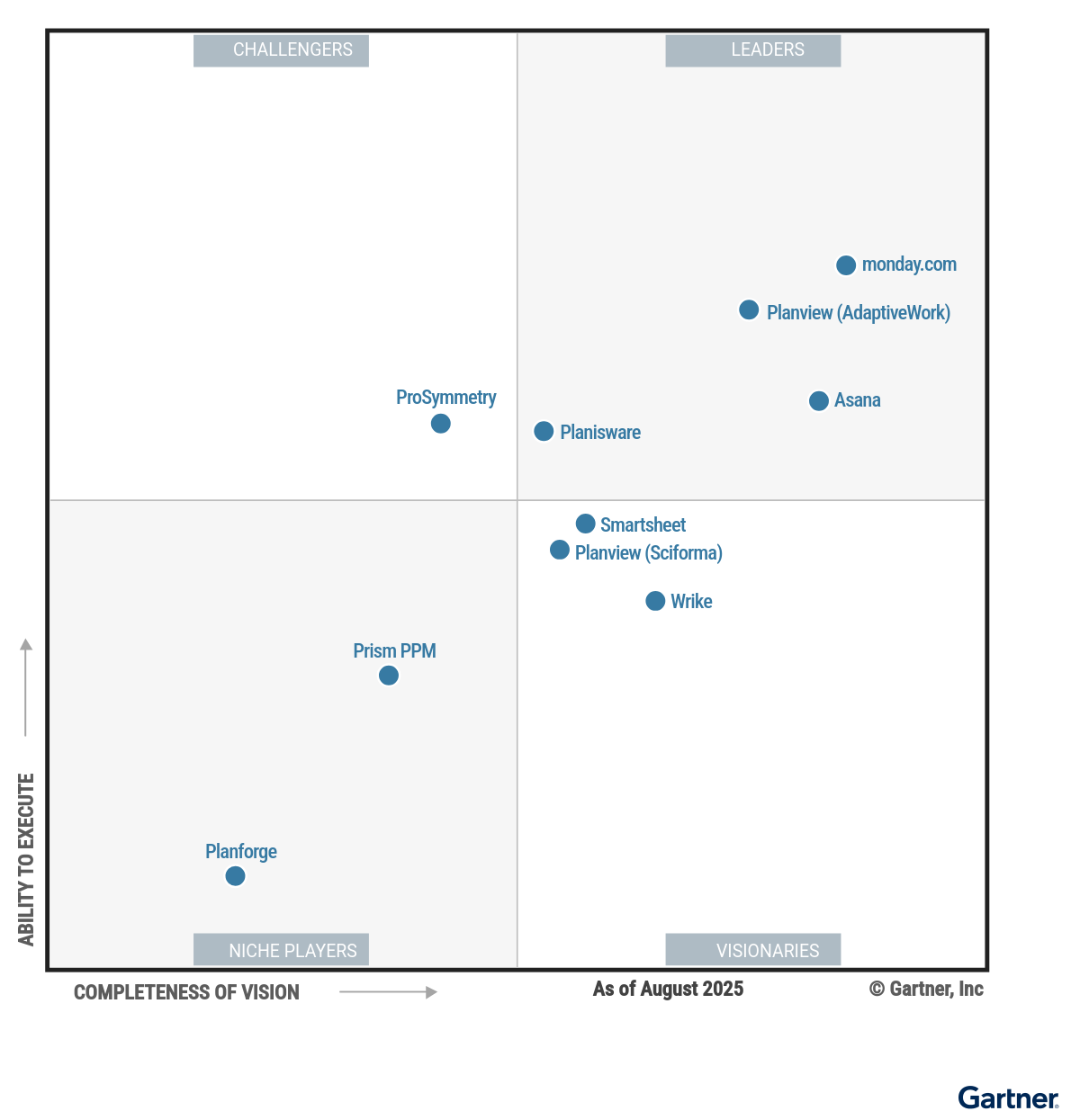
Magic Quadrant
Vendor Strengths and Cautions
Asana
Asana is a Leader in this Magic Quadrant. Its product, also called Asana, focuses on project work management and enables effective team collaboration for various delivery methodologies. Asana’s operations and customer base are geographically diverse. Asana’s product roadmap is driven by market insights, client feedback and continued investment in AI to improve insights and automation. Asana’s product roadmap employs a continuous release process, supported by monthly release notes and training videos.
- Product innovation: Asana’s AI Studio platform enables automated workflows and intelligent analysis for key functions such as prioritization and goal management.
- Market presence: Asana continues to have a large global presence, with customers, offices and partners worldwide. This presence, along with the platform’s availability in many languages, makes it an attractive solution internationally.
- Social media presence: Asana has a significant following across major social media platforms, offering customers real-time product information and new channels for engagement.
- Business model: Despite a strong customer base, Asana’s revenue growth is moderate and GAAP profitability is a challenge.
- Pricing structure: Features expected by most enterprise users will require purchasing Asana’s higher-priced Enterprise and Enterprise+ plans, and some agentic AI capabilities are priced as add-ons.
- Marketing strategy: Asana’s broad approach to industry, customer base and influencing tactics may not appeal to buyers looking for more specificity.
monday.com
monday.com is a Leader in this Magic Quadrant. Its product, also called monday.com, provides project and work management capabilities that support the needs of distributed teams using a mix of methodologies. monday.com’s operations are geographically diversified, and its customer base includes a variety of industries. monday.com’s product roadmap includes AI-powered resource management, SAFe planning within its WorkCanvas suite, and an out-of-the-box interactive executive hub.
- Geographic strategy: monday.com headquarters are located in Israel and the U.S., and it maintains ample staff, offices, direct and partner sales, support and training presence in the Americas, EMEA and Asia/Pacific.
- Marketing execution: monday.com leverages a significant social media presence and multichannel feedback loops. These are used to drive engagement and extend its marketing reach with customers and prospects to continually refine the product strategy.
- Product strategy: monday.com effectively uses cascading objectives and key results (OKRs) to ensure strategic alignment with investment pillars focused on delivering AI capabilities that include preconfigured AI blocks, intelligent agents and AI-powered resource management.
- Sales execution/pricing: monday.com total cost of ownership is perceived as cost-prohibitive by prospective customers who require implementation services or low-code configuration support as a managed service.
- Business model: monday.com is a cloud-based SaaS solution hosted in three global data centers. It does not offer an on-premises option, a potential barrier for some large public-sector organizations.
- Product or service: monday.com positions itself as a low-code application platform, where adaptive project management and reporting (APMR) capabilities are addressed as a subset of functionality within its broader work management operating system.
Planforge
Planforge (formerly ONEPOINT Projects) is a Niche Player in this Magic Quadrant. Its product, Planforge, is a project management tool that supports the execution of enterprise strategy. Planforge operations are based in EMEA, and its clients tend to be midsize organizations. The Planforge product roadmap includes investments in an updated user interface, configurable forms and templates and an AI-assisted project and program planning process.
- Customer experience: Planforge customers value its ease of use and intuitive visual design, both of which enable deployment with minimal required stakeholder training.
- Marketing strategy: Planforge uses a multifaceted approach to market its product by highlighting its ease of use, integrations with enterprise applications, scalability and project life cycle support in a multimethodology environment.
- Operations: Planforge has a stable, satisfied client base and positions itself as a forward-looking company focused on continuous improvement that aligns with customer expectations.
- Geographic strategy: Planforge is headquartered in Austria and has a small, EMEA-based staff. It uses a few sales partners, along with a single partner offering support in South America.
- Marketing execution: Planforge has a limited social media presence, counter to its marketing strategy, and does not run customer user groups outside of the annual Planforge Unite event.
- Viability: Planforge’s revenue is stable; however, it currently operates at a loss, and its geographic strategy further limits its global growth ambitions.
Planisware
Planisware is a Leader in this Magic Quadrant. Its product, Planisware Orchestra, focuses on streamlining project decision making, enhancing collaboration, and delivering best practices in support of traditional and Agile methodologies. Planisware operations are geographically diversified, and its clients tend to be midsize and large organizations. The Planisware product roadmap includes improvements to user interface business rules, funding simulations with predictive planning, and a unified AI platform featuring assistants across capabilities.
- Operations: Planisware has sustained revenue growth, a high net customer retention rate, and it positions Orchestra as a customer-centered, turnkey project execution solution that uses real-time data insights.
- Business model: Planisware offers flexible subscription models and licenses Orchestra via SaaS, hybrid or limited on-premises options, where implementation aligns with a customer-maturity-based licensing model.
- Geographic strategy: Planisware headquarters are located in France and the U.S., and the company is expanding its global footprint by maintaining staff, sales, support and training presence in all regions.
- Sales execution/pricing: Planisware has limited sales partners in the Americas and Asia/Pacific, and its pricing is quotation-based, which may cause prospects interested in a lightweight solution to perceive it as cost prohibitive.
- Marketing strategy: Planisware lacks a significant social media presence and SEO-optimized content, relying more on tradeshows, blogs and customer advisory boards.
- Sales strategy: While Planisware directly distributes Orchestra in North America, EMEA and Asia/Pacific, it relies on channel sales in other regions, where partners may include bundled services on top of standard SaaS licensing.
Planview (AdaptiveWork)
Planview AdaptiveWork is a Leader in this Magic Quadrant. It is a versatile solution that provides comprehensive capabilities to manage a wide range of projects and workflows for a diverse global client base across numerous industries. Planview operations are geographically diversified, and its clients tend to be midsize and large organizations. The Planview roadmap for AdaptiveWork prioritizes the integration of artificial intelligence and the enablement of real-time collaboration while deploying new features that boost efficiency and improve the user experience.
- Market understanding: Planview effectively uses its global presence to understand that the market is driving toward methodology convergence, where customers are adopting flexible, AI-powered frameworks to continuously assess strategic project value.
- Vertical/industry strategy: Planview AdaptiveWork is designed for use by a broad range of industries because it can be configured to organization-specific processes, and product support is provided by offices in every region.
- Operations: Planview operations are stable due to its market understanding, product roadmaps, steady growth rates and a consistent record of serving a large global customer base.
- Business model: Planview AdaptiveWork is highly configurable and offers a wide range of features, which can present a steep learning curve or require professional services for optimal setup.
- Sales/pricing: Planview AdaptiveWork pricing is positioned for medium to large global enterprises with complex project portfolios; some may also require professional implementation services at an additional cost.
- Product strategy: Planview acquired Sciforma (now Planview Vantage) in 2025, and it is important for customers to understand the respective product strategies and differentiating characteristics when evaluating AdaptiveWork and Vantage as potential best-fit solutions.
Planview (Sciforma)
Planview acquired Sciforma in February 2025, and its rebranded product, Planview Vantage, is a Visionary in this Magic Quadrant. Planview Vantage focuses on APMR capabilities that provide end users with fully configurable project workspaces and personalized work experiences. Planview Vantage is designed for a wide array of organizations across numerous industries, although midmarket companies are the target customer base. The Planview Vantage roadmap centers on improving core APMR capabilities, enhancing the user experience and leveraging AI for productivity and predictability.
- Market understanding: Planview understands that citizen project managers require tools that blur the lines between project management and collaborative work management, with the goal of streamlining APMR capabilities through an intuitive user experience.
- Market responsiveness: Planview responds to market expectations by continuously innovating its core capabilities, embracing AI for enhanced productivity, promoting flexible and collaborative work environments, and ensuring strategic alignment across the enterprise.
- Customer experience: Planview Vantage provides an intuitive, configurable user interface that can be adapted to organizational maturity to help improve productivity, select the right projects, optimize resource utilization, and successfully deliver projects.
- Sales execution/pricing: Planview Vantage offers free trials on a case-by-case basis. Contracts are subject to a minimum spend commitment that may be perceived as cost prohibitive by APMR customers.
- Product: With the Planview acquisition of Sciforma in 2025, a significant strategic shift is underway where Vantage will leverage the broader Planview ecosystem for integration services that more closely align with APMR customer expectations.
- Business model: Planview Vantage offers SaaS concurrent and on-premises named user license models. It is not available via on-premises concurrent or hybrid licensing, which a subset of APMR customers may perceive as a barrier.
Prism PPM
Prism PPM is a Niche Player in this Magic Quadrant. The product’s name change (from Work Otter to Prism PPM) in 2025 reflects a rebranding of Work Otter’s APMR tool following private equity investment by Lock 8 Partners. Headquartered in the U.S., Prism PPM is a relatively small global company that operates entirely remotely. Prism PPM is focused on its go-to-market strategy, with sales and marketing leadership additions and expanding distribution partnerships.
- Innovation: Prism PPM committed 50% of its revenue to innovation in 2024, and repeated this in 2025. Prism PPM innovations are based on customer feedback, technological advances and market trends. Prism PPM is focused on enhancing capabilities with AI, automation and analytics.
- Financial strength: Prism PPM is debt free and has a strong growth rate and profit margin. In 2024, it received an additional capital infusion from private equity to invest in the product roadmap and expand its customer base.
- Customer experience: Prism PPM provides tailored support to its clients with meticulous onboarding and a dedicated account manager. Its high staff-to-customer ratio results in a strong understanding of customer needs. Prism PPM has improved its customer experience with user interface upgrades and the use of AI for creating and customizing detailed project plans.
- Marketing execution: Prism PPM has a weak social media presence across all major platforms. Prism PPM’s visibility is further limited by minimal participation in tradeshows and conferences. Prism PPM relies on its account management teams and solutions partners to meet user training needs.
- Geographic strategy: Prism PPM is available only in English, limiting the geographic reach of the product. The Prism PPM team is fully remote and spread thinly across the globe, with limited regional support and delivery partners. Prism PPM meets all basic international data residency and data sovereignty requirements.
- Functionality and integrations: Prism PPM includes the basic functionality of an APMR solution; however, most APMR enterprise users will expect more-advanced capabilities. Prism PPM includes basic integrations and offers limited support for integration capabilities with other common platforms, which may impact its selection by clients requiring integrations with enterprise systems.
ProSymmetry
ProSymmetry is a Challenger in this Magic Quadrant. Its product, Tempus Resource, focuses on skill-based project planning and is built for enterprise resource forecasting. ProSymmetry’s operations are geographically diversified, and its clients tend to be midsize and large organizations. ProSymmetry’s roadmap for Tempus Resource leverages agentic AI to deliver autonomous support for complex decision-making processes, including autonomously generating what-if scenarios and skills-based resource matching.
- Customer experience: Tempus Resource continues to be rated highly by its customers due to ease of implementation, an intuitive user interface, and postimplementation user support.
- Vertical/Industry strategy: Tempus Resource provides an effective, tailored solution to a broad range of industries because it can be configured to address the highly specific and complex resource management challenges unique to various enterprise environments.
- Business model: Tempus Resource is delivered primarily as a SaaS offering, but it also accommodates customers who require private cloud or on-premises deployments due to security requirements.
- Geographic strategy: ProSymmetry has a small staff across the Americas, EMEA and the Asia/Pacific regions, with customer support for Tempus Resource provided through both direct and partner resources.
- Marketing execution: ProSymmetry has a limited marketing presence and continues to build its social media footprint, primarily investing in YouTube and also relying on employee influencers on LinkedIn.
- Innovation: ProSymmetry focuses Tempus Resource innovation on resource management as the single most critical factor in project delivery and what-if analysis for unlocking portfolio value, thereby limiting innovation in other capabilities equally important to APMR customers.
Smartsheet
Smartsheet is a Visionary in this Magic Quadrant. Its product, also called Smartsheet, is a cloud-based collaborative work management and adaptive project management solution. While the majority of Smartsheet customers are based in the U.S., Smartsheet has a strong global presence with geographically diverse customers and regional office locations. The Smartsheet product roadmap focuses on intelligent work management powered by AI-driven insights.
- Overall viability: Smartsheet continues to have healthy revenue and double-digit year-over-year growth in revenue and new customers.
- Geographic strategy: Smartsheet has well-staffed global offices that include sales and support presence. Smartsheet is targeting its sales strategy on expanding further in the EMEA and APAC regions, offering the product in nine languages, and adding local support and compliance features that address regional requirements.
- Marketing execution: Smartsheet has an active online presence with its customers, including blogs and YouTube videos, as well as frequent participation in tradeshows and conferences. It has a strong social media following on X, LinkedIn and Facebook.
- Pricing strategy: Smartsheet has introduced a tiered licensing structure, including Pro and Business plans. While the pricing appears competitive, add-on subscriptions are required for some capabilities, and advanced support plans are also an additional monthly cost.
- Product onboarding: Smartsheet implementations for most organizations require some level of professional services to scale the solution. Users may find that Smartsheet’s steep learning curve delays full adoption.
- Market responsiveness: Smartsheet has limited configuration options and lacks the integration capabilities common in other APMR solutions. Instead, it uses an adaptable data model that can be customized with additional support services from partners.
Wrike
Wrike is a Visionary in this Magic Quadrant. Its product, also called Wrike, focuses on enabling effective project collaboration between enterprise teams and workflow management. Wrike is geographically diverse, with offices, customers and partners across the globe. In early 2025, Wrike acquired Klaxoon, powering visual collaboration capabilities within the tool. Wrike’s product roadmap is focused on leveraging AI to enhance strategic planning and work intelligence, scalability, and continued enhancement of its data management (Datahub) capabilities.
- Market understanding: Wrike continues to leverage its user communities and social media platforms to understand the APMR market. This has resulted in the evolution of its dashboarding capabilities and enhanced resource and skills management features.
- Geographic strategy: Wrike has office locations in North America, Latin America, EMEA and Asia/Pacific. It complements these with a robust support and delivery partner network, providing full global support capabilities. Wrike is available in 11 languages, appealing to a geographically diverse customer base.
- Innovation: Through its Work Intelligence platform, Wrike has enabled human-to-AI collaboration with agents and AI assistants. Wrike’s Datahub provides organizations with a single source of truth across various enterprise functions and platforms.
- Operations: Wrike is still recovering from the restructuring costs it incurred in 2023. EBITDA has improved, and the acquisition of Klaxoon in early 2025 is projected to be an additive to both revenue and cash flow. Wrike is cash-flow positive; however, it is operating with a negative profit margin.
- Pricing: Wrike offers a tiered pricing structure with a range of price points that include different user license types and free unlimited viewers. Most organizations seeking to maximize the tool’s functionality will require the Business license plan, with Enterprise and Pinnacle plans priced upon request.
- Business model: Wrike does not offer an on-premises licensing option, which some large public-sector organizations in EMEA may require. Access to a more robust integration set and advanced capabilities in Datahub and Klaxoon are available only at an additional cost.
Vendors Added and Dropped
We review and adjust our inclusion criteria for Magic Quadrants as markets change. As a result of these adjustments, the mix of vendors in any Magic Quadrant may change over time. A vendor's appearance in a Magic Quadrant one year and not the next does not necessarily indicate that we have changed our opinion of that vendor. It may be a reflection of a change in the market and, therefore, changed evaluation criteria, or of a change of focus by that vendor.
Added
No vendors were added to this Magic Quadrant.
Dropped
- KeyedIn: In March 2023, KeyedIn was acquired by Sciforma and integrated into the Sciforma Vantage product.
- Proggio: Proggio focuses more on collaborative work management and does not satisfy the inclusion criteria pertaining to minimum annual APMR software revenue.
- ProjectManager.com: ProjectManager.com does not offer comprehensive demand management capabilities.
Inclusion and Exclusion Criteria
Inclusion Criteria
- A vendor must demonstrate active participation in the APMR market as a pure-play project portfolio management (PPM) software company — with a clear and primary software business model, as opposed to a consulting business model.
- The software products must not require the purchase of a separate, non-PPM technology platform from the vendor to obtain adaptive project management and reporting (APMR) functionality. The vendor also must not require customers to invest in a set of extensions or modules as part of a “single-source” value proposition from a vendor competing primarily in markets other than PPM.
- The vendor must actively market, sell and support one or more stand-alone APMR software products or online application services.
- The vendor must focus mainly on collaborative PPM, enterprisewide PPM, IT PPM and product-based PPM use cases.
- The vendor must demonstrate a solid track record of successful APMR technology deployments and companion APMR consulting services for most of its PPM customers.
- The product must offer comprehensive, integrated project management, hybrid work, resource management, and reporting features and capabilities.
- The vendor and its product (or products) must demonstrate longevity in the APMR market, providing general availability and active marketing to end users for at least the past five consecutive years, and without any significant company, product or service disruptions.
- The vendor must be able to demonstrate significant APMR market presence, including market penetration, sales and support for multiple regions of the world.
- The vendor must be able to demonstrate a viable, proven and evolving SaaS strategy.
- The vendor must demonstrate a solid product development and innovation cadence shorter than 12-month intervals.
- The vendor must have secured at least 10 new APMR customers (not repeat business or renewals) during the past 12 months.
- The vendor must have at least $5 million in annual APMR software revenue, or reliable financial backing.
Exclusion Criteria
- “Certified partners” of primary APMR technology vendors, systems implementers or consulting firms that use an APMR vendor’s technologies to deliver “products” or “solutions” for APMR are not included.
- ERP, IT service management (ITSM), sales force automation (SFA) and other similar platform vendors that offer APMR extensions or modules from their base platforms are not included.
- Vendors with a primary focus on and significant presence in niche or specialized PPM markets are not included.
- Products focused on the following use cases are not included:
- Agile development and work management
- Outsourced IT services or system integration project and work management
- Client-facing professional services project and work management
- Collaborative work management
Evaluation Criteria
Ability to Execute
Product or service: Evaluation of the application services of the providers in this defined market was conducted — including current product/service capabilities, quality, feature sets and skills — as defined in the Market Definition/Description section and detailed in the subcriteria. This included vendors that offer services natively or via OEM agreements/partnerships. This also included an assessment of multiple, independent APMR products supporting differing APMR audiences and use cases. Ease of use, balanced with functional depth and cost-effective pricing, was examined, as well as how well and how completely the vendors and products support APMR depth and breadth.
Capabilities specifically needed for project managers, project contributors and PPM leaders were evaluated. Scalability of any applicable products and breadth of deployment options for varied APMR use cases were also assessed. Advancements in applying AI and robotic process automation (RPA) to APMR technology were measured in terms of availability in the product and its adoption by customers in the field.
Overall viability (business unit, financial, strategy, organization): This was an assessment of the organization’s overall financial health, the financial and practical success of the business unit, and the likelihood that the individual business unit will continue investing in its products. Also assessed was a measure of the probability that the provider will continue offering the product and will advance the state of the art within its portfolio of products. Organic and other signs of growth were also noted.
Sales execution/pricing: We examined each provider’s capabilities in all presales activities and the structure that supports them. This included responsiveness in sales engagement, deal management, pricing and negotiation, presales support, and the overall effectiveness of the sales channel. Renewal rates, compared to reported losses due to nonrenewals, were evaluated.
Market responsiveness/record: This criterion focuses on ability and proven track record in responding quickly and changing development and/or company direction to meet the needs of the market. This could be via evolving the marketplace through acquisition or other means. How well and how quickly providers executed a multi-APMR product strategy to support an expansive APMR marketplace was measured. Providers should be flexible and achieve competitive success as opportunities develop, competitors act, customer needs evolve, and/or market dynamics change. This criterion also considered the provider’s history of responsiveness to customer requests. The provider’s track record in the field was also examined.
Marketing execution: We analyzed the clarity, quality, creativity, and efficacy of programs designed to:
- Deliver the organization’s message to influence the market.
- Promote the brand and business.
- Increase awareness of the products.
- Establish a positive identification with the product/brand and organization in the minds of buyers.
This mind share could have been driven by a combination of publicity, promotional initiatives, thought leadership, word of mouth, and sales activities. Digital marketing campaign activity was also measured.
Customer experience: Relationships, products and services/programs enabling clients to be successful with the products evaluated were researched. This includes the ways customers receive technical or account support. We evaluated services/programs, including APMR process consulting services, offered at little or no extra cost, that enabled clients to be successful with the products. Levels of responsiveness in technical support or account support were examined. Ancillary tools, customer support programs (and the quality thereof), availability of user groups and SLAs were noted. Customers’ impressions of doing business with the provider were examined.
Operations: The organization’s ability to meet its goals and commitments was measured. Factors included the quality of the organizational structure, such as skills, experiences, programs, systems, the underlying infrastructure, and other vehicles that enable the organization to operate effectively and efficiently on an ongoing basis. Security and data privacy were also measured.
Ability to Execute Evaluation Criteria
| Evaluation Criteria | Weighting |
|---|---|
Product or Service | High |
Overall Viability | High |
Sales Execution/Pricing | Medium |
Market Responsiveness/Record | High |
Marketing Execution | Low |
Customer Experience | High |
Operations | High |
Source: Gartner (September 2025)
Completeness of Vision
Market understanding: This is an assessment of the ability of the provider to understand buyers’ wants and needs, and to translate those into strong APMR offerings. Providers that showed the highest degree of vision listen to and understand buyers’ wants and needs, and can shape or enhance those with their added vision. We examined each provider’s marked recognition of, and periodic departure from, core product development to exploratory product development or other activities (e.g., mergers and acquisitions [M&A]) to address the needs of an expansive APMR marketplace, and beyond it.
Marketing strategy: We recorded and evaluated whether the vendor had a clear, differentiated set of messages consistently communicated throughout the organization and externalized through the website, advertising, customer programs and positioning statements.
Sales strategy: We measured the vendor’s strategy for selling products using an appropriate network of direct and indirect sales, marketing, service, and communications affiliates that extend the scope and depth of market reach, skills, expertise, technologies, services and the customer base.
Offering (product) strategy: This criterion examined the provider’s approaches to product development and delivery, emphasizing differentiation, functionality, methodology and feature sets as they map to current and future requirements. Value as it relates to deployment, ease of use, ease of accessibility and ease of adoption was measured. A cost-competitive pricing model or models, as evidenced in the field, was also measured. Native features and functions, versus reliance on OEM agreements, were assessed. We also considered functionality supporting bottom-up and top-down APMR implementations, as well as depth and breadth of support for use cases defined in other Gartner PPM research. Scalability, depth and breadth of the product were analyzed. Process consulting options, including remote process consulting, were also noted. Integration with customers’ core systems, as well as to non-IT third-party data sources and software systems, was examined. The ability to support a global installed base was measured. We analyzed acquired products and tracked them postacquisition to determine if the provider is simply “maintaining” a product line with small enhancements versus truly innovating it by adding new, meaningful capabilities (or integrating multiple acquired products) using aggressive development efforts. We also considered customer response to the vendor’s product strategy and tangible customer benefits derived from product strategy. We examined how the vendor applied AI and RPA to APMR technology.
Business model: This criterion measured the soundness and logic of the provider’s underlying business proposition. We examined how well the business model provides value to customers, as well as how far it reaches to support multiple APMR use cases.
Vertical/industry strategy: This criterion examined the provider’s strategy for directing resources, skills and offerings to meet the specific needs of individual market segments, including vertical markets.
Innovation: We assessed the direct, related, complementary and synergistic layouts of resources, expertise, or capital for investment, consolidation, and defensive or preemptive purposes. Also evaluated was the vendor’s ability to offer seasonal product releases and exhibit rapid development and Agile-driven releases. Functionality demonstrating a strong product vision that pushes the market — not just the provider — in new directions was analyzed. This functionality gauges the ability of the vendor to “lead the herd” of the market, rather than follow it.
Geographic strategy: We assessed the provider’s strategy for directing resources, skills and offerings to meet the specific needs of geographies outside its “home” or native geography. The strategy could be executed directly or through partners, channels and subsidiaries, as appropriate for the geography and market.
Completeness of Vision Evaluation Criteria
| Evaluation Criteria | Weighting |
|---|---|
Market Understanding | High |
Marketing Strategy | High |
Sales Strategy | Medium |
Offering (Product) Strategy | High |
Business Model | Low |
Vertical/Industry Strategy | Low |
Innovation | High |
Geographic Strategy | Medium |
Source: Gartner (September 2025)
Quadrant Descriptions
Leaders
Leaders have a demonstrable understanding of the wide range of customer needs in the APMR market and are largely responsive to the more advanced levels of APMR methodology maturity within their customer base. Leaders actively engage in the market as thought leaders and help to drive customer success with strong foundational project and work management capabilities, coupled with well-defined implementation plans. These vendors have a Completeness of Vision exhibited by their product, marketing and sales capabilities, which are required to drive market acceptance on a global scale.
Challengers
Challengers have solid success markers, such as growing market revenue, dedication to continuous innovation for meeting shifting customer needs and maintenance of a strong presence in the APMR market. Challengers also demonstrate reach into a diverse set of industries, have strong foundations in project management best practices, and have consistently positive customer reviews about their performance, effective support models and operational strength.
Visionaries
Visionaries have identified a wide range of customer needs, growing momentum behind key market trends, and have adjusted their future product roadmap and business plans accordingly. All the vendors evaluated offer much of the same basic commodity functions and a very similar value proposition. However, Visionaries are able to demonstrate decisive plans to invest in product innovation that meets the needs of the dynamic work environment now and in the future. The entrants into this quadrant offer advancements such as data collection and insight analysis driven by AI, next-level dynamically linked dashboards informed by ML models, and promises of significant productivity gains achieved with natural language processing (NLP) interfaces.
Niche Players
Niche Players have strengths in different capabilities of their products, often resonating more with customers from specific industries, from which they initially targeted their potential customer base. Movement toward the Challengers quadrant will be driven by advances in Niche Players’ Ability to Execute in areas such as customer experience, market responsiveness and sales effectiveness.
Context
The Magic Quadrant for APMR tools assesses the viability of vendors offering products in this marketplace. A variety of evaluation criteria was used to produce a relative placement of each vendor against those criteria. This analysis is complemented by the Critical Capabilities for Adaptive Project Management and Reporting, which analyzes 10 key capabilities across four use cases. The use-case filter helps buyers prioritize the capabilities that have the greatest beneficial impact from APMR products offered by these vendors. Gartner strongly recommends that organizations use this research in conjunction with the Critical Capabilities companion research, Gartner Peer Insights and other Gartner research to define their requirements and select solutions that match their needs.
To select the best tool to support adaptive project management methodology:
- Ensure APMR tool functionality is fit for purpose by assessing the capabilities and features that complement the organization’s maturation, support the mix of delivery frameworks, and align with your projected use cases.
- Facilitate user adoption by qualifying the tool’s ease of use, productivity and collaboration capabilities, as well as the extent of the vendor’s implementation and support services.
- Determine the tool’s architecture alignment by evaluating the solution’s ability to support your organization’s user interface and transparency needs; examine its deployment and security requirements as well.
Market Overview
There are, inevitably, mixed levels of execution maturity within organizations. Each maturity level comes with its own challenges and has separate needs from the organization’s tools of choice. We outline these below; however, despite maturity differences, each organization is on a continuous journey of maturation to navigate the anticipated industry transformation over the next few years.
Enablement: Scaling and Productivity Challenges
Project managers are challenged with navigating team dynamics and productivity in an increasingly complex environment. Organizations that enable APMR capabilities across their enterprise are focused on delivering greater productivity, seizing opportunities to do more, or continuing to deliver with reduced capacity. Prioritization and strategic alignment are key to delivering strategic business outcomes.
These organizations look for their APMR tools to support teams that are building shared digital capabilities to further their change management competencies. Enablement emphasizes the key areas of shared responsibility or engagement: demand management; prioritization; resource allocation; project and work effort management; and out-of-the-box reporting for multiple stakeholder types.
Optimization: Visibility of Value and Impact of Disruption
The visibility of value, both actualized and anticipated, is paramount to driving the strategic decision making necessary to navigate the external disruptions that impact an organization’s ability to deliver on business targets and strategic plans.
Building on foundational APMR capabilities, vendors provide features to address adaptive governance styles that aid agility, modernize capacity/resource management across operating models, and increase autonomous decision making. They recognize the impact of portfolio interdependencies on their ability to optimize financial management and value-based decision making. Vendors must leverage the data and analytics, AI, RPA, NLP and ML capabilities of other advanced toolsets used by their customers. Using workflow automation and no-code/low-code configurations, customer organizations at the higher end of this maturity scale tend to experiment with tailored analytics and enhanced communications.
Transformation: Risk Management and the Adaptive Frameworks to Support It
Organizations that want to transform by maximizing their investment in digital capabilities and products recognize the importance of a strong risk culture. Their APMR tools need to foster genuine ownership and responsibility for risk management, balancing frontline employees’ decision making with executive-level accountability for cultural or risk deficiencies.
These organizations need APMR technology to support elements of transforming the business, the operating model, or both. Coordinated transformation is impossible without an enterprisewide perspective or the ability to connect and foster consensus among the people, processes and culture, supporting the organization through internal and external disruption.
These APMR tools must account for the fact that transformation efforts are supported by multiple technical solutions that provide a wealth of digital capabilities. They build strong integrations to the organization’s foundational technical platforms and established toolsets to provide a connective mesh of data that drives decision making at all levels. This ensures maximum value is achieved with each interaction between change and routine work. To enable the required flexibility within acceptable risk levels, these complex organizations require data transparency, automation and zero-trust security.
Conclusion
In an ever-evolving organization with mixed levels of maturity and multiple operating models such as today’s modern enterprise, APMR users must address cross-organization, cross-geography challenges in a flexible and agile way. If they don’t, they will be left vulnerable to their competition, or fail to meet political pressures in the public sector. The ability to connect governance across organizations, business functions and geographies to achieve strategic outcomes is imperative. Providers in this Magic Quadrant are actively engaged in building capabilities to support the enterprisewide coordination of strategy delivery via project management best practices, Agile methodologies, and varied governance practices.
Vendors must also address the reality of a multimethodology environment where teams are tasked with caring for projects and products alongside the backdrop of operational activities. When evaluating and positioning the vendors included in this research, Gartner has placed emphasis on products with core capabilities that enable traditional project management to coexist with Agile methodologies while integrating with existing systems of record that include portfolio tools and enterprise financial systems.
While the APMR market is crowded, vendors seek differentiation and are making enhancements to their products, including:
- Innovative product roadmaps to keep pace with growing customer demand for a convergence of features to meet the needs of adaptive project work management
- Interdependency management between service portfolios and strategic initiatives
- Efficient implementation approaches to enable fast onboarding of core capabilities for immediate organizational benefit
- Responsive customer support capabilities that provide training, configuration, integration and adoption services
- Reduced product complexity through seamless module integrations that deliver a comprehensive set of capabilities
- Leveraging GenAI capabilities to increase productivity
Acronym Key and Glossary Terms
| Term | Definition |
| APMR | Adaptive project management and reporting |
| SAFe | Scaled Agile Framework |
Ability to Execute
Product/Service: Core goods and services offered by the vendor for the defined market. This includes current product/service capabilities, quality, feature sets, skills and so on, whether offered natively or through OEM agreements/partnerships as defined in the market definition and detailed in the subcriteria.
Overall Viability: Viability includes an assessment of the overall organization's financial health, the financial and practical success of the business unit, and the likelihood that the individual business unit will continue investing in the product, will continue offering the product and will advance the state of the art within the organization's portfolio of products.
Sales Execution/Pricing: The vendor's capabilities in all presales activities and the structure that supports them. This includes deal management, pricing and negotiation, presales support, and the overall effectiveness of the sales channel.
Market Responsiveness/Record: Ability to respond, change direction, be flexible and achieve competitive success as opportunities develop, competitors act, customer needs evolve and market dynamics change. This criterion also considers the vendor's history of responsiveness.
Marketing Execution: The clarity, quality, creativity and efficacy of programs designed to deliver the organization's message to influence the market, promote the brand and business, increase awareness of the products, and establish a positive identification with the product/brand and organization in the minds of buyers. This "mind share" can be driven by a combination of publicity, promotional initiatives, thought leadership, word of mouth and sales activities.
Customer Experience: Relationships, products and services/programs that enable clients to be successful with the products evaluated. Specifically, this includes the ways customers receive technical support or account support. This can also include ancillary tools, customer support programs (and the quality thereof), availability of user groups, service-level agreements and so on.
Operations: The ability of the organization to meet its goals and commitments. Factors include the quality of the organizational structure, including skills, experiences, programs, systems and other vehicles that enable the organization to operate effectively and efficiently on an ongoing basis.
Completeness of Vision
Market Understanding: Ability of the vendor to understand buyers' wants and needs and to translate those into products and services. Vendors that show the highest degree of vision listen to and understand buyers' wants and needs, and can shape or enhance those with their added vision.
Marketing Strategy: A clear, differentiated set of messages consistently communicated throughout the organization and externalized through the website, advertising, customer programs and positioning statements.
Sales Strategy: The strategy for selling products that uses the appropriate network of direct and indirect sales, marketing, service, and communication affiliates that extend the scope and depth of market reach, skills, expertise, technologies, services and the customer base.
Offering (Product) Strategy: The vendor's approach to product development and delivery that emphasizes differentiation, functionality, methodology and feature sets as they map to current and future requirements.
Business Model: The soundness and logic of the vendor's underlying business proposition.
Vertical/Industry Strategy: The vendor's strategy to direct resources, skills and offerings to meet the specific needs of individual market segments, including vertical markets.
Innovation: Direct, related, complementary and synergistic layouts of resources, expertise or capital for investment, consolidation, defensive or pre-emptive purposes.
Geographic Strategy: The vendor's strategy to direct resources, skills and offerings to meet the specific needs of geographies outside the "home" or native geography, either directly or through partners, channels and subsidiaries as appropriate for that geography and market.