Market Guide for Enterprise AI Search
15 September 2025 - ID G00836414 - 29 min read
By Tim Nelms, Stephen Emmott, and 2 more
Generative AI is transforming enterprise search from information retrieval to information synthesis. Yet, employees struggle with fragmented and unmanaged enterprise information. This Market Guide helps enterprise applications leaders understand the evolving market for enterprise AI search.
Overview
Key Findings
- Thirty-four percent of employees have difficulty finding information, and 49% use AI tools like Microsoft 365 Copilot and Google Gemini primarily to find data. However, according to the 2024 Gartner Digital Worker Survey, 36% of these users still struggle to access relevant information, highlighting the need for better solutions.
- Current retrieval-augmented-generation (RAG)-based AI assistants and agents often underperform when scaled across diverse enterprise information, primarily due to issues with data source quality, and retrieval relevancy mechanisms.
Recommendations
- Shift the strategic purpose of enterprise search by repositioning it as a foundational platform that powers AI assistants and agents (and therefore human employees) and delivers tailored, in-application and federated search experiences.
- Institute robust governance by establishing clear policies for managing enterprise information and systematically applying comprehensive metadata enrichment and staging to ensure information is accurate, pertinent and trusted (APT). This will improve retrieval accuracy and synthesis quality while minimizing (but not removing) redundant, obsolete or trivial (ROT) content.
Strategic Planning Assumptions
By 2028, 60% of organizations will have more than six enterprise AI search platforms (including AI assistant platforms) deployed across the business.
By 2028, enterprise AI search and assistants will be embedded into 60% of enterprise applications, up from 20% today.
Market Definition
Gartner defines enterprise AI search as platforms that enable retrieval and synthesis of information across enterprise repositories. They are a key technology for developing AI assistants and AI agents that scale to enterprise needs using retrieval-augmented generation (RAG). They integrate with a wide range of advanced natural language processing (NLP), machine learning (ML) and large language model (LLM) technologies that are essential to knowledge management processes. They are designed to be customized and tuned for specific domains but often come with prepackaged integrations and experiences for some enterprise applications.
Enterprise AI search tools are pivotal tools for humans and machines that need to find information and synthesize it to derive insight, so they can subsequently make decisions and take actions. These platforms connect to a wide variety of data sources, normalize and classify information, index it, and match and rank the most relevant results. Their user experiences are commonly customized and are increasingly used as a platform for building AI assistants for a wide variety of operational use cases. Those building RAG-based systems should consider how to configure enterprise search platforms to deliver AI assistants and, in the future, AI agents.
Enterprise AI search uses include the following:
- Digital workplace AI search experiences for employees are grounded in a range of digital-workplace-centered document management tools.
- Intranet AI search experiences for employees are grounded in corporate communications and knowledge bases residing in company intranets.
- Web AI search experiences for prospects and customers are grounded in public website content for a single organization.
- Deep research AI search experiences for researchers are grounded in a wide variety of internal and external knowledge bases and are used to synthesize insight across multiple information sources.
- IT service hub AI search experiences for employees are grounded in IT knowledge bases, documentation and troubleshooting guides.
- Customer service AI search experiences for customer service agents are grounded in customer service knowledge bases, external documentation and internal sources.
Enterprise AI search may compete with adjacent markets where the search function is embedded in another platform. This includes website search and product discovery tools, digital workplace AI assistants, enterprise application-embedded AI assistants, intranet packaged solutions and document management platforms.
Mandatory Features
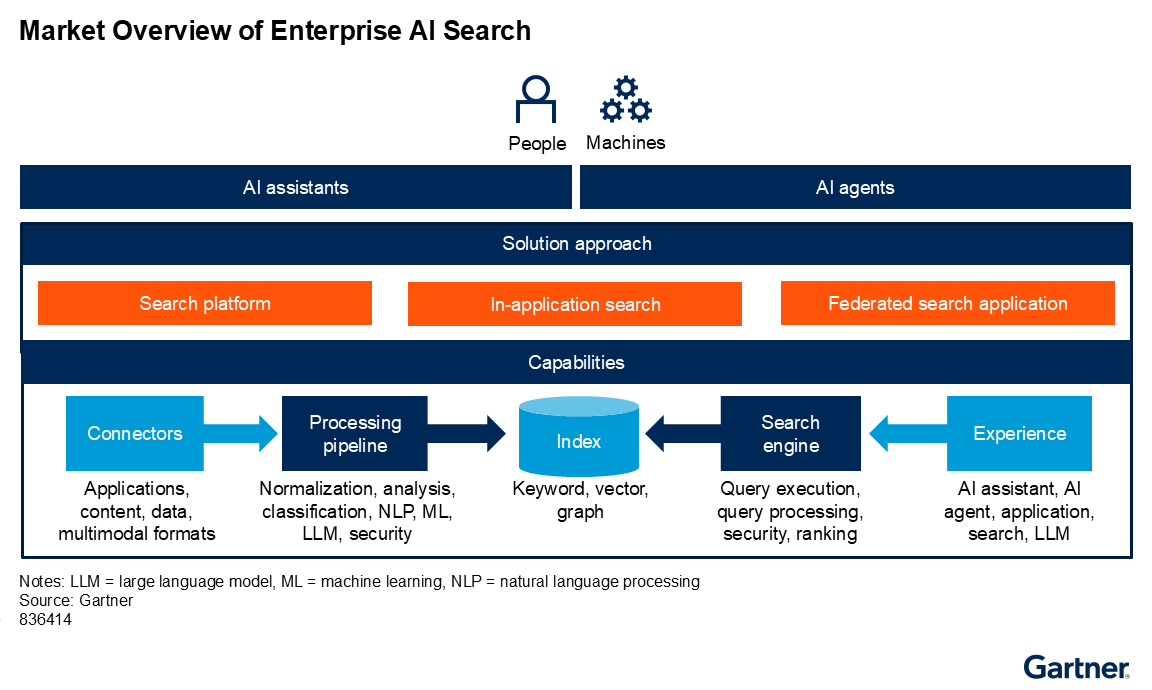
- Connectors integrate enterprise search tools with a wide variety of structured and unstructured data sources. Capabilities include connectors to file systems, intranets, document management systems, email, databases and line-of-business applications. Vendors offer a wide variety of prebuilt connectors, often numbering in the hundreds. Connectors can use either a push or pull model to acquire content, often including metadata like identity or permissions data.
- Processing pipelines vary depending on the format and type of information being processed but commonly include normalization, analysis, classification and security processing.
- Normalization capabilities include conversion into plain text, linguistic normalization like stemming, lemmatization and synonym expansion, language translation, transcription of audio and video, and extraction of text from images.
- Analysis capabilities help in understanding structure, identifying entities, resolving security bindings and analyzing sentiment.
- Classification capabilities include data extraction using ML or LLMs, sensitivity labeling, privacy labeling, facet tagging and ontology mapping.
- Security processing ensures that the original permissions of information (access control lists) are retrieved and resolved, ready for indexing.
- Search indexes store the processed and enriched content and create specialized data structures, like an inverted index and/or vector index, optimized for fast retrieval during searches.
- Search engines are the core component that handles user queries. The search engine pipeline includes query processing, query execution, ranking and security trimming results.
- Query processing uses NLP and other advanced techniques to understand the user’s intent, handle variations in phrasing and correct errors.
- Query execution interacts with the index and passes potential results to the relevance and ranking component. Full-text search and vector search results can be combined using the reciprocal rank fusion algorithm to improve relevance.
- Relevance ranking takes the results identified by the search engine and orders them to present the most useful information first. Hybrid search combines keyword and vector search to improve accuracy. Ranking can be further improved using metadata, user behavior analytics, business rules and explicit boosting or burying configurations.
- Security, including results trimming, is not a mandatory feature — see “security and access control” under common features.
- User experiences are often integrated into existing enterprise applications or can be customized. Capabilities include application integration, personalization, customization, search bars, facets and filters, conversational interfaces, autocomplete, suggestions, search results snippets, voting and answers.
- Conversational experiences allow users to ask questions using natural language, to receive natural language responses and to ask follow-up questions. They use RAG, an AI framework that combines information retrieval (search) with LLMs to generate grounded responses. In the RAG process, the search component first retrieves relevant documents or passages from the index based on the user’s query. This retrieved context is then passed to an LLM, which uses it to generate a response. Conversation experiences are also termed AI assistants.
- Personalization is the ability to vary results based on parameters captured from users and their touchpoints. Parameters including usage history, touchpoint use, point in journey, geography, device and role enable users to be categorized, so as to adjust their experience.
- Application integration helps embed search experiences into enterprise applications and reduce friction for end users. Some vendors provide out-of-the-box integrations with systems like Salesforce and Microsoft 365, and others provide API-level developer services and UI frameworks, which can be customized to integrate with end-user tools.
Common Features
- Security and access control: This ensures users only access content they are authorized to view. Search must respect and enforce document-level security. This enforcement can happen either during the indexing process (early binding), where permissions are stored with the indexed data, or at query time (late binding). Security capabilities include integration with identity providers (like single sign-on), data encryption and compliance with industry standards.
- Artificial intelligence: AI, ML and NLP are deeply embedded in enterprise search tools. NLP is used in query processing to understand user language and intent and in content processing for tasks like entity extraction, sentiment analysis and text classification. ML powers aspects of relevance and ranking, such as semantic search, vector search, learning to rank and personalization. AI/ML also enables features like AI assistants, generative answering and automated workflow tasks presented through the UI.
- Knowledge graphs: These provide a structured representation of organizational information, explicitly mapping entities and their relationships. They can capture domain knowledge, taxonomies and ontologies and are often built from ingested and processed content. By creating this interconnected network, knowledge graphs enhance the system’s ability to understand context, reveal insights and improve information retrieval by enabling semantic understanding and showing relationships between topics and experts. They can also augment AI systems, including serving as a source for RAG.
- Deployment: Many factors affect deployment of enterprise search, such as sovereignty, scaling, off-premises hosting, data source locations and application integration. Common deployment options are SaaS, platforms deployed with vendor-managed services and platforms deployed as client-managed services. Some components such as LLMs may be integrated and hosted separately.
- Languages: Enterprise search tools have wide-ranging support for text in different languages and support different processing pipelines depending on the language. Rules for lemmatization/stemming vary widely, with some tools supporting more languages or having deeper support for certain languages.
- Administration: Administration helps power users and administrators configure the system, including connectors, logging, processing pipeline and user experiences. It helps assess performance through analytics of top queries, click-through rates, content gaps (zero-results queries) and performance monitoring (queries per second, latency). This includes search engine administration, including tweaks to relevance ranking, synonym/antonym lists and metadata enrichment.
Market Description
Enterprise AI search is transforming how organizations find and retrieve information from growing volumes of data. Unlike traditional keyword-based search, AI search platforms synthesize information from diverse sources, delivering direct answers and deeper insights rather than long lists of results. This shift is essential in today’s digital workplaces, where employees often struggle to locate relevant data amid fragmented information.
Through advanced natural language processing (NLP), machine learning (ML) and large language models (LLM) these tools enable both humans and machines to synthesize information for actionable insights and decisions, increasingly through conversational interfaces and automated workflows (see Rethink Enterprise Search to Power AI Assistants and Agents). They are foundational for developing scalable, contextual AI assistants and agents, using RAG capabilities to index, retrieve and synthesize information such that user experiences and decision making across the organization is optimized (see Figure 1).
Effective information governance also underpins effective enterprise search, as unmanaged or ROT information can significantly hinder enterprise AI search performance. The quality and accessibility of the data itself are fundamental to the success of any search system. Even the most advanced AI can’t provide valuable results from poor data. Grounding new search solutions with APT content is crucial to technology value realization and scale across the enterprise (see The Information Governance Maturity Model).
Market Direction
Enterprise AI search is shifting from being merely a means to retrieve information to becoming tools that retrieve, analyze, synthesize and summarize information. They are increasingly delivered through a wide range of tailored and packaged applications as AI assistants and agents. The capabilities that are most critical to buyers include RAG, deep reasoning and agentic AI, federated AI assistants and agents, self-service SaaS and cloud-native deployment, in-application search experiences and hybrid search.
Retrieval-Augmented Generation
Retrieval-augmented generation (RAG) has become a foundational capability in enterprise AI search, enabling advanced AI assistants and agents to deliver accurate, contextually relevant outputs by grounding them in current, enterprise-specific data. Since the generative AI (GenAI) surge in late 2022, nearly all enterprise AI search vendors have adopted RAG patterns, recognizing its critical role in overcoming the inherent limitations of large language models (LLMs) for business applications.
However, the widespread adoption of RAG is complicated by diverse and opaque commercial terms from vendors. Pricing models vary based on user count, indexed volume, storage, infrastructure and token consumption. These factors, coupled with unpredictable inference costs and a lack of transparency in billing, make it challenging for enterprise buyers to assess total cost of ownership and ROI, leading to procurement hesitancy.
If organizations fail to fully understand and manage these cost factors, they risk budget overruns, underutilization of AI capabilities and reduced stakeholder confidence in AI investments. This potentially undermines the value of their AI initiatives and, by extension, AI’s enhanced ability to find and retrieve important information as part of their business processes, which ultimately reduces efficiency and effectiveness.
Deep Reasoning and Agentic AI
The enterprise AI search market is rapidly advancing toward applications that not only provide information but also make decisions and take actions. AI search platforms are now indispensable for enabling AI assistants and agents to synthesize information for both human and machine consumption, driving automation of complex business tasks.
The effectiveness of AI assistants and agents hinges on grounding LLMs in accurate, pertinent and trusted (APT) content. Achieving this requires enterprise AI search platforms to expose trusted sources to advanced natural language processing (NLP), machine learning (ML) and GenAI technologies capable of performing semantic search at scale.
As autonomous business becomes a strategic imperative, delivering consistent, high-quality insights is critical. The ability of enterprise AI search to provide context-rich, verified insights will directly impact the performance and trustworthiness of AI-driven automation and AI agents.
Federated AI Search
The enterprise AI search landscape is experiencing accelerated growth as organizations deploy more AI assistants and agents. Federated search has suffered from low penetration or only partial implementation, so the expansion of AI agents is intensifying a persistent challenge. Information is increasingly scattered across fragmented systems, disparate search applications, and siloed agents, making it difficult for users to efficiently retrieve and leverage relevant data.
Without federated search, employees navigating multiple interfaces and data sources often encounter conflicting or incomplete answers, resulting in frustration and inefficiency. Multiple user experiences that produce potentially different answers to the same question create confusion, which drives demand for solutions that can unify access and deliver coherent, actionable information.
As organizations pursue autonomous business models, the need for federated search architectures — capable of orchestrating information retrieval across diverse environments enabling RAG to power GenAI synthesis — is becoming critical.
Self-Service SaaS and Cloud-Native
Enterprises are increasingly favoring self-service software as a service (SaaS) models and cloud deployment, driven by the need for agility, elastic scalability, continuous updates, reduced operational burden and predictable cost structures. This trend is compelling vendors to prioritize self-service SaaS and multitenant, vendor-managed services, enabling rapid scaling and competitive differentiation in a cloud-first market.
However, organizations in regulated sectors such as government and defense face stringent data sovereignty and security requirements. These buyers often mandate single-tenant, vendor-managed services for on-premises deployments to retain control over data source locations and comply with local regulations. However SaaS solutions are less customizable than self-managed applications and flexibility depends on how configurable and extensible SaaS products are.
As cloud-first strategies become the industry norm, the market for on-premises solutions is projected to decline. Most enterprises lack the technical resources to acquire and maintain the compute infrastructure necessary for large language model (LLM) inferencing, restricting their ability to fully leverage advanced AI capabilities outside of cloud environments. This shift risks leaving regulated sectors with fewer viable options for innovation and modernization.
In-Application Search Experiences
Employees increasingly require seamless access to relevant information across the full spectrum of enterprise applications — including digital workplace suites, ERP, customer relationship management (CRM), IT service management (ITSM) and human capital management (HCM) platforms. The ability to retrieve actionable insights within the flow of work is now a critical driver of productivity, operational excellence and informed decision making.
This imperative is complicated by the proliferation of enterprise applications and the diverse ways employees interact with them. Users gravitate toward solutions that integrate essential information retrieval directly into their daily workflows, favoring platforms that offer superior operational experiences.
Enterprise application leaders face the challenge of delivering in-application search experiences that are both intuitive and robust, while also meeting complex, nuanced requirements typically addressed by enterprise search platforms. Failure to effectively embed search and AI assistant capabilities without disrupting established workflows can result in decreased productivity, poor user adoption and suboptimal business outcomes.
Semantic and Hybrid Search
Employees have rising expectations for the quality and relevance of search results and answers delivered by enterprise AI search tools. Poor user experiences are frequently caused by the inability of these tools to surface the most pertinent information required to provide insights.
The challenge is exacerbated when search engines operate over broad and diverse corpora, making it difficult to consistently identify the most relevant results. While search results refinement is possible, the sheer breadth and depth of enterprise data sources can overwhelm traditional search methods. To address this, enterprise AI search tools increasingly leverage hybrid search — combining traditional reverse indexing lexical search with advanced vectorization and cosine similarity techniques for semantic search.
This evolution, underpinned by advanced NLP, ML and LLM technologies, enables a deeper understanding of user intent and semantic relationships, resulting in more accurate and contextually relevant results — known as semantic search. However, organizations must be cautious of new market entrants who lack a proven track record in delivering superior relevance through hybrid search approaches, as ineffective solutions can erode user trust and hinder productivity.
Multimodal Search
Enterprise information assets now encompass images, video, audio, telemetry and other non-textual formats, fundamentally transforming the knowledge ecosystem. Users expect to find, analyze and repurpose information regardless of its form. While there is some value in the use of textual metadata describing assets in other modalities, true multimodal search is essential for meeting these expectations. True multimodality, enables queries in one modality — such as text, image or audio — and retrieving relevant results across others, thus supporting advanced knowledge discovery and innovation.
However, implementing multimodal search is complex. It requires multimodal LLMs and the alignment of diverse data types into a shared semantic space that preserves meaning across modalities. Effective retrieval demands domain-sensitive interpretation, which is both computationally intensive and prone to semantic errors. This technical fragility poses significant challenges for enterprise adoption.
As multimodal search matures, enterprises will benefit from unified access to documents, images, transcripts and video, greatly enhancing knowledge management and decision making. However, this evolution also introduces new risks — requiring security and compliance teams to address privacy and monitoring challenges across modalities. Without robust solutions, organizations risk data breaches and regulatory violations.
Market Analysis
Enterprise search, previously known as insight engines, has origins dating back to the late 1990’s. It is now undergoing a significant transformation, driven by buyer needs for AI assistants and the accelerating impact of artificial intelligence. Despite its longevity, the global market for enterprise search technology has remained relatively small, until the arrival of GenAI. During its evolution to enterprise AI search, the market is now experiencing a period of higher growth characterised by increased interest from buyers, rapid technology change and new market entrants.
Competition
Enterprise AI search platforms are no longer just stand-alone tools; they are key technologies for developing scalable AI assistants and AI agents using RAG. This places them in direct competition with embedded AI assistants within major enterprise application suites, which, while leveraging search, are often tightly coupled to their vendors’ ecosystems.
The market is seeing an increased number and variety of enterprise AI search tools, diversifying beyond traditional search platforms to include in-application and federated experiences.
Microsoft launched Microsoft 365 Copilot in 2023, which leveraged Microsoft Search and captured early attention from buyers. Google re-entered the market in 2023 with Vertex AI Search, their first foray into the market since end-of-life for the Google Search Appliance. Amazon services have expanded and matured the Kendra, OpenSearch and Amazon CloudSearch offerings. Glean is also a notable new entrant to the market growing rapidly from its launch in 2022 to deliver $100m in revenue in 2024.
2024 also saw the launch of several in-application AI search experiences including Atlassian Rovo, Salesforce Agentforce and SAP Joule.
Organizations are currently piloting GenAI solutions and trying new tools and capabilities to see which deliver the most value. In-application experiences are often a first step, but may fail to deliver the expected value. According to Gartner’s 2025 Microsoft 365 and Microsoft 365 Copilot survey, only 11% of survey respondents said they were planning or moving to a large-scale deployment (more than 20% of office workers) in 2025; a further 6% had already completed a global rollout.2 Such experiments lead to investigations into more domain specific in-application solutions like Salesforce Agentforce or SAP Joule.
For complex needs and diverse source systems, enterprise AI search platforms offer the best solution, but they also offer prepackaged integrations and experiences for key enterprise applications. This approach supports a broad spectrum of operational use cases.
Search Solution Approaches
Enterprise AI search and assistants capabilities can be realized through different solution approaches, namely a search platform, in-application search and federated search applications (see Figure 2).
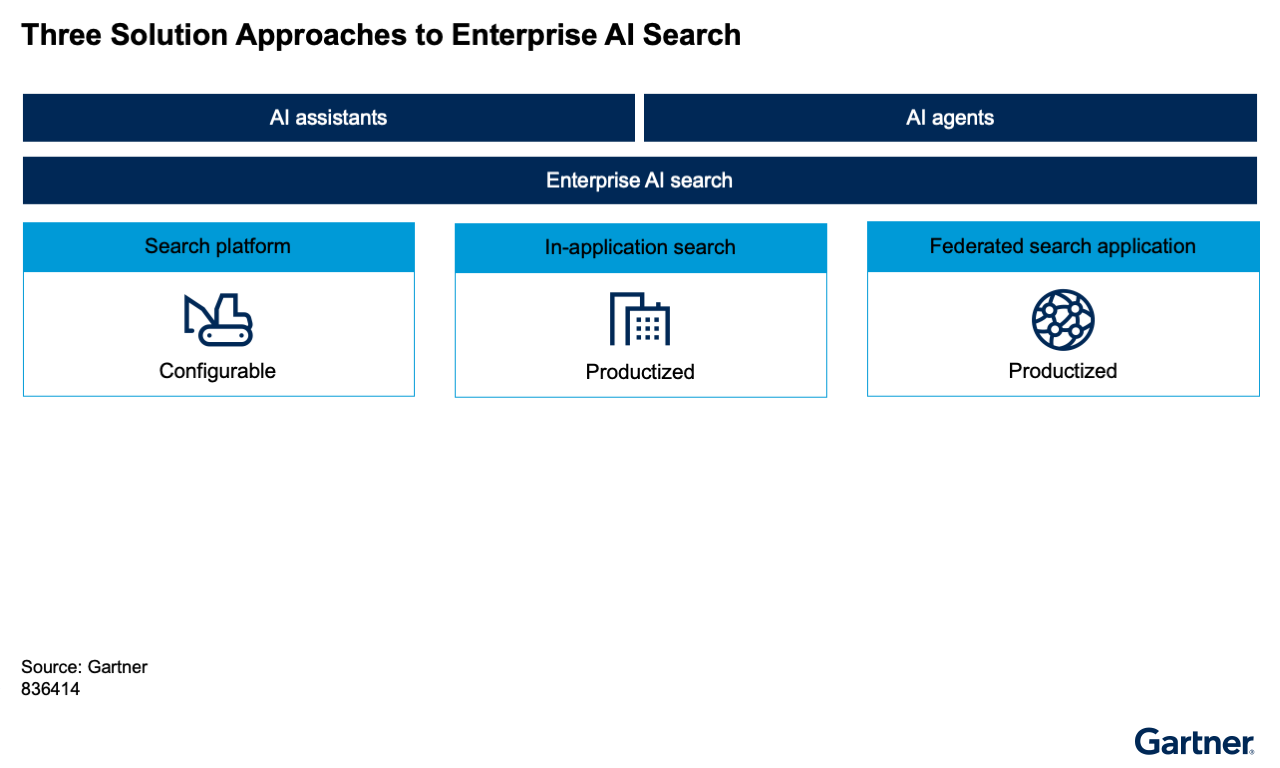
- Search as a platform: Connects multiple content and data sources, enriching a single index and providing a search experience configured to the needs of specific domains and operational business teams. It is the continuation of traditional enterprise search tools also referred to in previous Gartner research as insight engines. Search platforms may require more effort and investment to tailor to specific business needs, but may also deliver greater value. Gartner estimates it to be the largest subsegment of the market.
- In-application search: Brings search experiences into application suites where work is done. It indexes information in the primary application as well as secondary applications connected to the primary application’s graph. In-application search is a high growth sub segment, although the incremental value they drive for vendors in the markets they serve is difficult to quantify.
- Federated search: Connects multiple content and data sources, brokering queries and unifying ranking results from the separate indexes, instead of indexing centrally. Federated search is commonly focused on general-purpose digital workplace use cases and connections to popular collaborative applications and digital workplace suites. Federated search tools are seeing renewed interest from buyers as standards like model context protocol (MCP) make federation easier.
Use Cases
Enterprise AI search supports a diverse range of use cases, which are categorized in Figure 3 by their impact on customer experience, employee experience and operational experience (see Content Services Strategy: Through the Lens of Total Experience).
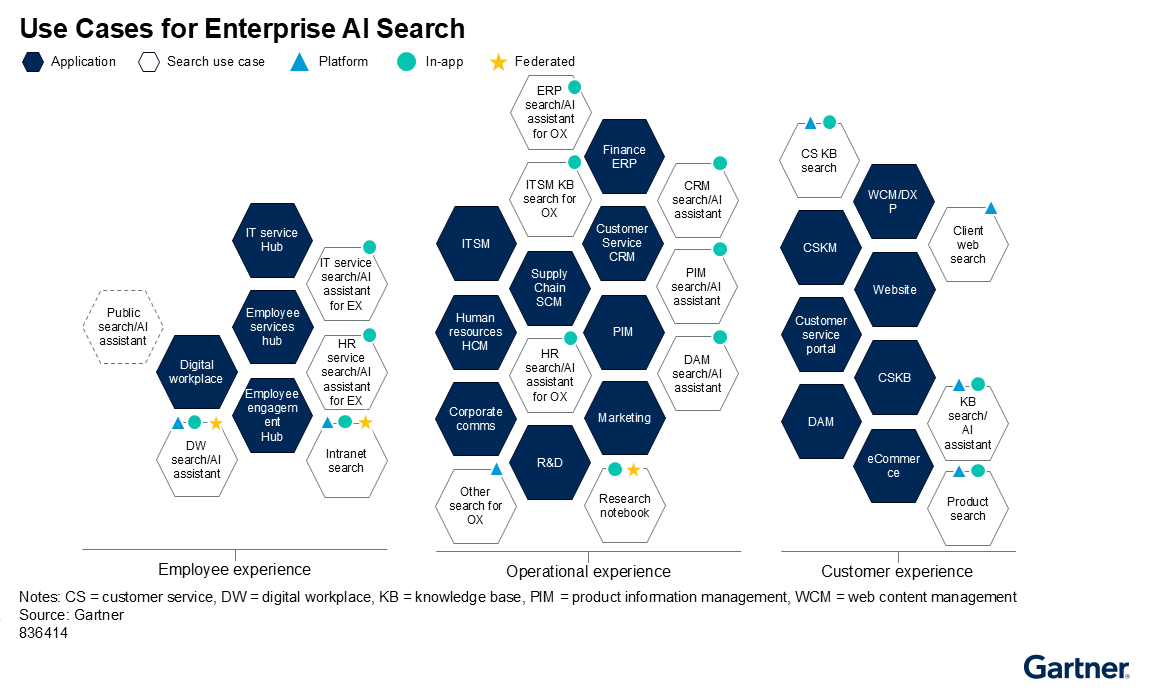
- Customer experience (CX): These use cases enhance how external stakeholders, including prospects and customers, access and engage with information.
- Web AI search: Tailored for prospects and customers, drawing from public website content.
- Digital commerce search and product discovery: Augmenting e-commerce platforms to improve product search and discovery (see the Magic Quadrant for Search and Product Discovery).
- Customer service portals AI search: Providing self-service knowledge bases for customer inquiries.
- Employee experience (EX): These use cases focus on general-purpose knowledge access as part of digital workplace suites and access to employee-facing operational functions like HR and end-user IT.
- Digital workplace AI search: Offering centralized search across digital workplace tools, intranets and corporate communications for employees.
- IT service hub AI search: Grounded in IT knowledge bases, documentation and troubleshooting guides for employee support (i.e., Aisera, ServiceNow [Moveworks]).
- Employee services hub AI search: Delivering broad services for employees, including HR-specific search and AI assistants.
- Intranet AI search: Delivering search experience across a wide range of corporate knowledge and communications (i.e., LumApps, Simpplr and Unily).
- Operational experience (OX): These use cases are geared toward optimizing back-office processes and decision making for business operations.
- Operational AI search: This gathers information from various sources and provides tailored search experiences
- ITSM AI search: Search and AI assistant experiences designed to aid IT teams find answers in ITSM knowledge bases.
- CRM AI search: Augmenting customer relationship management with embedded search and AI capabilities.
- Finance/ERP AI search: AI search experiences integrated within ERP systems to support financial operations.
- R&D deep research and AI search: Enabling researchers to synthesize insights from a wide array of internal and external knowledge bases.
- Analytics and automation: Extracting data from indexed content for advanced analysis and reporting, either within the search platform itself or by syndicating data to other applications to drive automation initiatives. This positions enterprise AI search as a fundamental component of broader hyperautomation strategies.
Representative Vendors
The vendors listed in this Market Guide do not imply an exhaustive list. This section is intended to provide more understanding of the market and its offerings.
Vendor Selection
Vendors were selected for this market based on their fit with the market definition, their interest among Gartner clients and how representative they are of the market categories we define. Vendors appearing in multiple categories do so with different products. Vendors also differentiate their offerings based on alignment with customer experience, operational experience and employee experience.
- Table 1 provides a representative list of enterprise AI search vendors specialized in search platforms.
- Table 2 provides a representative list of enterprise AI search vendors specialized for in-application search.
- Table 3 provides a representative list of enterprise AI search vendors specialized in federated search.
Representative Vendors for Search Platforms.
| Vendor Name | Product | Location |
|---|---|---|
AWS | Kendra | Seattle, Washington, U.S. |
Bloomfire | Bloomfire | Austin, TX |
Sinequa by ChapsVision | Sinequa | Paris, France |
Coveo | Relevance Cloud | Montreal, Quebec, Canada |
Elastic | Elasticsearch | San Francisco, California, U.S. |
Glean | Glean Search, Glean Assistant, Glean Agents | Palo Alto, California, U.S. |
Google | Vertex AI Search | Mountain View, California, U.S. |
IBM | Watson Discovery | Armonk, New York, U.S. |
IntraFind | iFinder | Munich, Germany |
Lucidworks | Fusion | San Francisco, California, U.S. |
Microsoft | Azure AI Search | Redmond, Washington, U.S. |
Mindbreeze | InSpire | Linz, Austria |
OpenText | Aviator Search | Waterloo, Ontario, Canada |
Squirro | Enterprise Search | Zurich, Switzerland |
Source: Gartner (September 2025)
Representative Vendors for In-Application Search
| Vendor Name | Product | Location |
|---|---|---|
Atlassian | Rovo | Sydney, Australia |
Dropbox | Dash | San Francisco, CA, U.S. |
LumApps | Enterprise search | Lyon, France |
Microsoft | Microsoft 365 Search and Microsoft 365 Copilot | Redmond, Washington, U.S. |
Moveworks | Moveworks Enterprise Search | Mountain View, California, U.S. |
Salesforce | Agentforce | San Francisco, California, U.S. |
SAP | Joule | Walldorf, Germany |
Simpplr | Enterprise search | Redwood City, California, U.S. |
Stravito | Stravito Assistant | Stockholm, Sweden |
Unily | Intranet Search | London, United Kingdom |
Source: Gartner (September 2025)
Representative Vendors for Federated Search
| Vendor Name | Product | Location |
|---|---|---|
Abacus.AI | Abacus.AI Enterprise | San Francisco, California, U.S. |
Anthropic | Claude | San Francisco, California, U.S. |
HubSpot | Dashworks | Cambridge, Massachusetts, U.S. |
Mistral AI | Enterprise search | Paris, France |
OpenAI | ChatGPT Enterprise, ChatGPT Business | San Francisco, California, U.S. |
Slack | Enterprise search | San Francisco, California, U.S. |
Unleash Labs | Workplace Search | New York, U.S. |
Source: Gartner (September 2025)
The impact of open source search engine technology on vendor solutions should not be underestimated. Many vendors use technology based on Apache Lucene including Solr (which is being phased out), Elasticsearch, its fork OpenSearch, and Apache OpenNLP. Other open source search engines include Vespa.ai (now powering Perplexity) and Meilisearch. Many vendors use a proprietary closed source technology stack for their search engine.
Market Recommendations
In summary, the enterprise AI search market is rapidly evolving, driven by the critical need to empower AI assistants and agents with accurate and contextualized information. We forecast sustained innovation in AI capabilities, increased adoption of cloud-native deployment models and a strategic focus on unifying fragmented data landscapes to meet the sophisticated demands of enterprise users across all experience domains. To plan for adoption of enterprise AI search, end-user organizations must address governance, adoption and vendor selection challenges with these recommendations:
- Governance recommendations:
- Strengthen AI reliability by establishing robust content governance frameworks that emphasize data quality, provenance and explainability. Begin by setting clear policies for content quality and implement output monitoring to ensure reliability and compliance, starting with a review of your current content governance practices.
- Enhance compliance and innovation by partnering with vendors that align with your specific needs — whether you require accelerated delivery or private and sovereign cloud solutions tailored for regulated sectors. Shortlist vendors whose offerings align with both your compliance needs and your goals for scalable, efficient AI adoption.
- Implement data cleansing programs to address ROT and increase the proportion of accurate, pertinent and trusted (APT) content. Consider metrics that evaluate search data quality, possibly as part of a broader data and knowledge management (KM) program.
- Adoption recommendations:
- Accelerate adoption by investing in federated AI search architectures that synthesize data seamlessly across common content sources. Start by assessing solutions for interoperability and insight delivery. Begin with a comprehensive audit of your existing content platforms and workflows to identify integration opportunities and prioritize areas for federated AI deployment.
- Elevate organizational productivity by adopting a search strategy that combines embedded in-app search with enterprisewide search platforms. Start by selecting solutions that offer strong interoperability, context-aware AI assistants and customizable user experiences. Then, implement continuous user feedback loops and analyze usage data to inform ongoing optimization.
- Vendor selection recommendations:
- Optimize RAG-enabled AI investments by implementing a rigorous cost management framework that demands transparent vendor pricing, conducts scenario-based cost modeling, and establishes ongoing monitoring of usage and spend. Start by evaluating your current vendor contracts for pricing clarity, then develop cost models for key use cases and set up regular review processes to track expenditures and ensure financial accountability.
- Accelerate information discovery by prioritizing AI search solutions with robust hybrid search capabilities and proven performance in large-scale diverse environments. Engage vendors that can demonstrate measurable improvements in relevance and scalability.
- Develop a multimodal search strategy and partner with vendors offering scalable vector search solutions capable of handling all required multimodal data types to support enterprise AI search needs.
Acronym Key and Glossary Terms
| Acronym | Expansion |
| AI | artificial intelligence |
| APT | accurate, pertinent, trusted |
| LLM | large language model |
| ML | machine learning |
| NLP | natural language processing |
| RAG | retrieval-augmented generation |
| ROT | redundant, obsolete, trivial |
This research is based on Gartner insight into buyer needs and behaviours collected during client interactions. It includes the input of vendors collected through publicly available sources and vendor briefings to Gartner analysts.
2025 Gartner Generative and Agentic AI in Enterprise Applications Survey. This study was conducted to understand the key challenges and opportunities when deploying generative AI (GenAI) tools, and where organizations should focus their AI investments. This research also aims to understand what stage organizations are at on their AI agent journey and their thoughts on AI agents. The research was conducted online from May through June 2025 among 360 respondents from organizations with at least 250 full-time employees across all industries (except IT software) in North America (n = 149), Europe (n = 140) and Asia/Pacific (n = 71). Soft quotas were established for country, company size, and respondent’s function type and job level to ensure a good representation across the sample. Organizations were required to have deployed or plan to deploy in less than one year at least one generative AI tool in at least one core enterprise application domain: digital workplace applications, customer relationship management applications, or enterprise resource planning applications. Respondents were team leaders or above, excluding C level, and involved in the rollout of generative AI tools; they were required to have certain responsibilities regarding these generative AI tools. Disclaimer: The results of this survey do not represent global findings or the market as a whole, but reflect the sentiments of the respondents and companies surveyed.
2024 Gartner Impact of GenAI in the Digital Workplace Survey. This survey sought to understand the value of generative AI (GenAI) assistants embedded in popular digital workplace productivity applications in the digital workplace, assessing their ability to enhance employee productivity and efficiency. The survey was conducted online from 16 May through 12 June 2024. A total of 152 IT leaders participated, with 61 who were members of Gartner’s Research Circle, a Gartner-managed panel, and 91 who were contacted through survey links via LinkedIn posts and outreach to clients. Respondents were from EMEA (n = 94), North America (n = 46), Asia/Pacific (n = 10) and Latin America (n = 2). Of the 152 respondents, 132 were primarily responsible for Copilot for Microsoft 365. They were highly involved in the decision-making process or management of Copilot and were required to be currently piloting or finished with the pilot of Copilot in their organizations. The remaining 20 respondents were primarily responsible for GenAI assistants apart from Copilot, such as Gemini for Google Workspace, Salesforce Slack AI and Zoom AI Companion.
Disclaimer: The results of this survey do not represent global findings or the market as a whole, but reflect the sentiments of the respondents and companies surveyed.
Disclaimer: The results of this survey do not represent global findings or the market as a whole, but reflect the sentiments of the respondents and companies surveyed.
2024 Gartner Digital Worker Survey. This survey sought to understand workers’ technological and workplace experience and sentiments. The research was conducted online from April through July 2024 among 5,141 respondents, who were from the U.S. (n = 1,121), Australia (n = 1,086), India (n = 996), the U.K. (n = 973) and China (n = 965). Participants were screened for full-time employment in organizations with 100 or more employees and were required to use digital technology for work purposes. Ages ranged from 18 through 74 years old, with quotas and weighting applied for age, gender, region and income, so that results were representative of countries’ working populations. We defined “digital technology” as including any combination of technological devices (such as laptops, smartphones and tablets), applications, and web services that people use for communication, information or productivity. Disclaimer: The results of this survey do not represent global findings or the market as a whole, but reflect the sentiments of the respondents and companies surveyed.
2025 Gartner Microsoft 365 and Copilot Survey. This survey was conducted online from 10 March through 1 April 2025 to understand how organizations are governing, using and supporting Microsoft 365. It also aimed to determine the adoption and utilization of Microsoft 365 Copilot and its impact on the standing of Microsoft 365 in the organization. A total of 215 IT and CSS leaders influencing or making decisions around Microsoft 365 participated. One hundred seventy-seven completed the survey — 112 from Gartner’s Research Circle (a Gartner-managed panel) and 65 contacted through the dissemination of the survey link via Gartner conferences and outreach to clients. Respondents who disclosed their locations were in North America (n = 96), EMEA (n = 75), Asia/Pacific (n = 9) and Latin America (n = 8); 27 respondents did not indicate their locations. Disclaimer: The results of this poll do not represent global findings or the market as a whole, but reflect the sentiments of the respondents and companies polled.
Notes: Gartner’s Initial Market Coverage
This Market Guide provides Gartner’s initial coverage of the market and focuses on the market definition, rationale for the market and market dynamics.