Market Guide for Sustainable Procurement Applications
20 April 2026 - ID G00844599 - 43 min read
By Miguel Cossio, Marta Muñoz, and 1 more
Sustainable procurement applications are maturing, with vendors expanding capabilities and adopting divergent AI strategies. This research equips chief procurement officers to navigate the latest trends and capabilities offered in this market.
Overview
Key Findings
- The sustainable procurement application market faces significant headwinds from regulatory rollbacks, shifting policy priorities and tightening budgets, leading some organizations to delay or cancel their investment in these tools. Yet sustainability and environmental, social and governance (ESG) remains strategically important, with chief procurement officers (CPOs) ranking this as one of the top five themes they expect to become urgent during the next six to six to 18 months, according to the 2026 Gartner Chief Procurement Officer Role Agenda Poll.
- Vendors in this market are investing heavily in AI to reduce friction for both suppliers and buying organizations. However, approaches vary widely, from AI-native platforms that minimize supplier involvement to human-first platforms where AI augments, but does not replace, direct supplier engagement.
- Many vendors are expanding beyond traditional ESG into adjacent domains such as broader risk management, product compliance and carbon accounting. Some expansions reflect genuinely new capabilities, while others are primarily a repositioning exercise.
- Product-level data collection is becoming mainstream, driven by regulatory requirements such as the EU Deforestation Regulation (EUDR) and Europe’s Carbon Border Adjustment Mechanism (CBAM), and by the need for buying organizations to measure supplier improvements at a more actionable level of granularity.
Recommendations
- Assess vendor commercial viability alongside capabilities. Market headwinds may challenge some vendors’ ability to remain commercially viable, making financial stability and customer trajectory important evaluation criteria.
- Evaluate where a vendor sits on the AI spectrum and whether that philosophy aligns with your intended use of the data. AI-first approaches may suit broad screening; regulatory due diligence and product-level claims require a more rigorous, human-in-the-loop supplier validation.
- Plan for a technology stack, not a single platform. Deeper requirements, such as greenhouse gas (GHG) emissions accounting or on-site audit management, will likely require complementary, purpose-built solutions.
Market Definition
Sustainable procurement applications help buying organizations assess the performance of their suppliers across multiple environmental, social and governance (ESG) topics.
These applications are used to collect supplier data using surveys (e.g., supplier self-assessments) across multiple ESG topics, and enable organizations to measure how well suppliers meet their sustainable procurement requirements.
Mandatory Features
- Supplier data collection: Applications in this market enable organizations to request sustainability information from any supplier in their supply base. Data collection is performed via supplier self-assessment surveys and includes suppliers’ ability to submit supporting documentation required by the buying organization.
- Data analysis: Applications in this market enable organizations to analyze supplier data collected to uncover areas of improvement. Visualization capabilities enable organizations to filter and analyze supplier data by spend category, geography, ESG topic and overall performance, etc. These applications also present an overall “supplier score” that companies can use to guide decision making.
- Domain expertise: Applications in this market provide organizations with domain expertise and relevant ESG content to collect supplier information using recognized standards, such as GRI and SASB. Once organizations select the topics they want to address (e.g., supplier diversity, Scope 3 emissions, modern slavery), these applications provide standard questionnaires that organizations can send to the supply base to collect information on these topics.
- Topic coverage: Applications in this market must support multiple ESG topics in the same platform.
Common Features
- Data validation: The validation of the data provided by suppliers via desktop audits, direct validation with certification bodies or performing on-site audits
- Event monitoring: The continuous screening of adverse supplier events across multiple channels, such as online and printed news, social media, TV, and sanction lists
- Multitier data collection: The ability to collect data, assess and map supplier ESG performance across multiple levels of the supply chain, beyond Tier 1 suppliers (i.e., Tier 2, suppliers of your suppliers)
- Assessment flexibility: The ability to customize the set of questions being asked of the suppliers and define how an overall supplier sustainability score is calculated
- Supplier development: Provides suppliers with feedback, recommendations and online resources to help suppliers improve their overall ESG performance and advance their capabilities
- Data granularity: The ability to collect ESG data from suppliers at the corporate, site or product level
- Supplier ESG risk screening: The ability to estimate suppliers’ sustainability risk profile based on a broad range of public and private data sources, without requesting supplier input
- Scope 3 emissions management: The ability to collect, manage and report supplier greenhouse gas (GHG) emissions data for purchased goods and services
Market Description
According to the 2025 Gartner Supplier Collaboration Survey,1 sustainability is one of the top four metrics used in performance scorecards for strategic suppliers, with 48% of procurement leaders including it — behind cost (66%), quality (64%) and delivery (59%). As sustainability becomes embedded in how organizations evaluate and manage their supply base, sustainable procurement applications provide the infrastructure to act on that priority at scale.
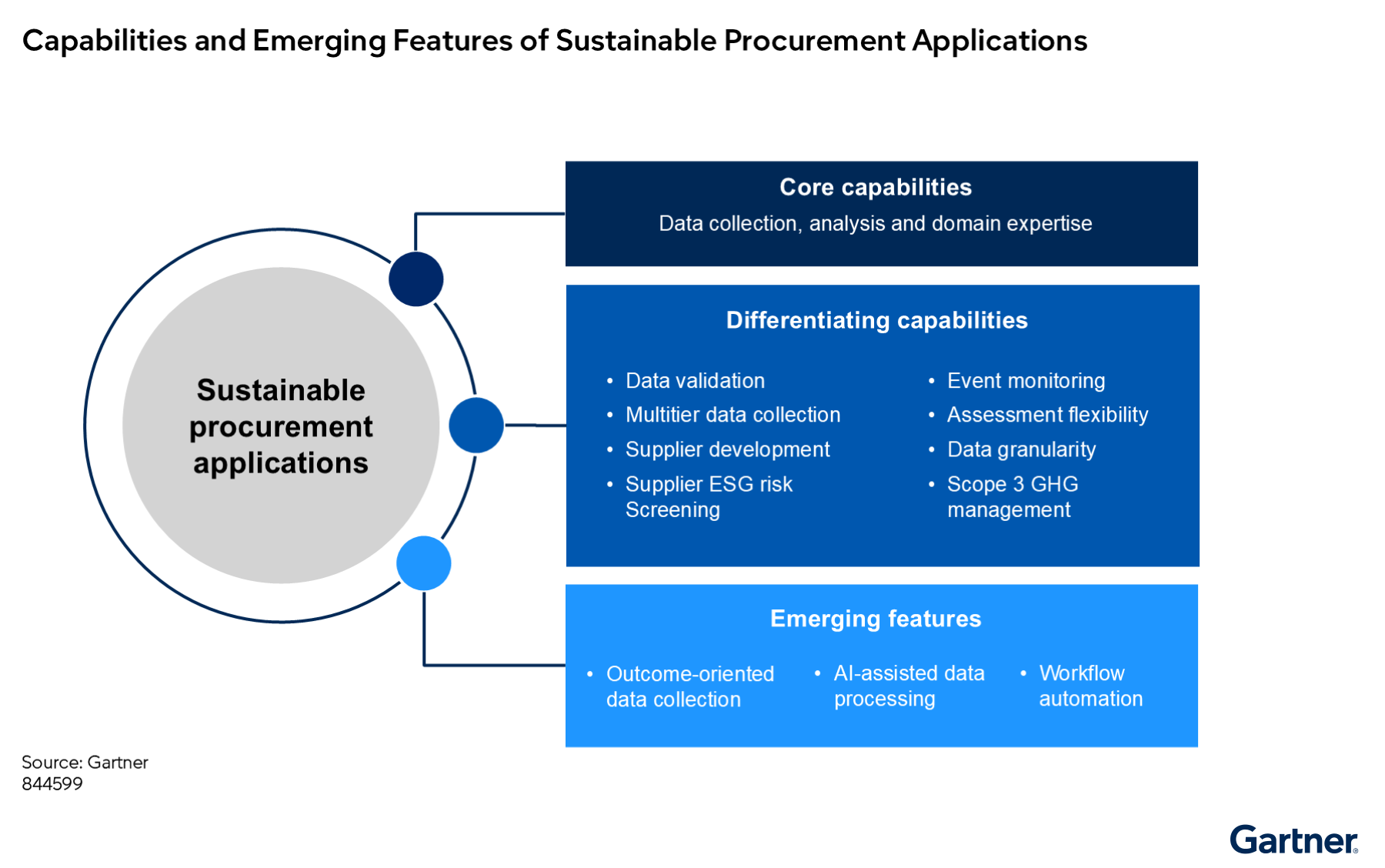
Vendors in this market all provide comparable functionality in core capabilities, such as data collection, data analysis, domain expertise and topic coverage. To set themselves apart, vendors offer a combination of differentiating capabilities to attract buying organizations with varying maturity and strategic ambitions (see Figure 1). Not all vendors offer every differentiating capability, and the depth of each varies significantly across providers. Buying organizations should focus less on how many differentiating capabilities a vendor offers and more on whether the specific capabilities they need are mature and well-supported.
Emerging Features
In addition to core and differentiating capabilities, a number of emerging features are appearing across the market. These are not yet widespread enough to be considered differentiating capabilities, but they signal where the market is heading and may influence vendor selection for organizations with more advanced requirements:
- Outcome-oriented data collection. Rather than deploying a single comprehensive assessment across all suppliers, platforms are enabling buying organizations to define a specific objective, such as regulatory due diligence, decarbonization or product compliance, and collect only the data required for that purpose. Supplier data is progressively enriched over time as new objectives arise, building a cumulative supplier profile that can serve multiple use cases without requiring suppliers to start from scratch for each one.
- AI-assisted data validation and completion. This automates document ingestion, response prefilling and data extraction, reducing the effort required from both suppliers and buying organizations.
- Workflow automation. This enables buying organizations to configure conditional assessment logic, automated supplier outreach and scheduled stakeholder reporting.
Market Direction
The sustainable procurement application market continues to mature, but faces notable headwinds. In the United States, shifting policy priorities have reduced emphasis on corporate sustainability, while in Europe, the Omnibus has reduced the number of organizations required to disclose sustainability data under the Corporate Sustainability Reporting Directive (CSRD). Changes to the EU Corporate Sustainability Due Diligence Directive (CSDDD) have scaled back multitier supply chain requirements, and several EU member states have been slow to transpose directives into national law.
These dynamics, compounded by broader cost pressures from tariffs and tightening budgets, have led some buying organizations to delay or cancel investments in these types of solutions. Yet sustainability in procurement remains strategically important, with CPOs ranking it as one of the top five themes they expect to become urgent during the next six to 18 months.2
Despite the uncertain environment, vendors in this market continue to invest in capabilities that reflect where buyer and supplier needs are heading. Four trends are shaping this market in 2026:
- Reducing supplier burden. Vendors are making significant investments to reduce friction for suppliers responding to data requests. Rather than presenting lengthy questionnaires, platforms are enabling suppliers to upload documents and using AI to extract and prepopulate responses. Some vendors are going further by building dedicated supplier-facing platforms, separate from the buyer interface, where suppliers manage their own data and control what is disclosed to each requesting organization. In a notable evolution, some of these supplier platforms now allow suppliers to respond to data requests from noncustomers of the platform, giving suppliers a single environment to manage sustainability reporting across their full customer base. These investments reflect a recognition that low supplier response rates undermine the value proposition for buying organizations, and that suppliers overwhelmed by fragmented, repetitive data requests across multiple customers and platforms are unlikely to engage meaningfully.
- Product-level data granularity. While some vendors have offered product-level data collection for several years, a clear trend in 2026 is that the majority of vendors are now developing these capabilities. This shift is driven by buying organizations needing to track supplier improvements at the product level, where the impact of their engagement efforts is actually visible, rather than relying on enterprise- or site-level metrics that can obscure progress. Regulatory requirements are accelerating this trend, as frameworks such as the EUDR and CBAM demand product-specific data. Some vendors are also expanding into product compliance use cases that inherently require this level of granularity.
- Vendor scope expansion and repositioning. Facing a contracting addressable market, many vendors are broadening their scope beyond traditional ESG. Some are expanding into adjacent risk domains such as cybersecurity or financial risk, while others are moving into product compliance or enhancing their carbon accounting capabilities. This expansion happens through a mix of native development and white-label partnerships, where third-party capabilities are embedded seamlessly within the platform. However, not all expansion is substantive. Some vendors have simply relabeled from “sustainability” to “risk,” without meaningfully adding new capabilities. Buying organizations should assess whether a vendor’s expanded positioning reflects genuinely new functionality or a marketing response to shifting market sentiment.
- Empowering lean buyer teams. Sustainable procurement programs are typically managed by very small teams, often just two or three people even within large organizations. Vendors are responding by building capabilities that make these teams significantly more productive. Examples include AI-powered data environments that let users query their supplier base conversationally, conditional assessment logic that tailors supplier questionnaires based on prior responses, and configurable workflows that automate supplier outreach, reminders and follow-ups based on risk signals. Platforms are also enabling greater customization, allowing buying organizations to define their own risk weightings and select which data sources feed into risk calculations, rather than relying solely on vendor-defined defaults.
Market Analysis
The sustainable procurement application market consists of both point solutions and suites with complementary capabilities. Different solution modules can often be purchased separately, depending on the scope of the ESG topics covered and the flexibility needed by buying organizations. Some vendors support sustainability management of their customers’ internal operations in addition to modules that support sustainable procurement initiatives.
This Market Guide (first published in 2021) outlines the latest set of capabilities offered in the market and presents a list of representative vendors. No single vendor excels at delivering all capabilities available in the market; therefore, procurement leaders must self-assess their strategic ambitions and prioritize the offerings with the capabilities that are most relevant.
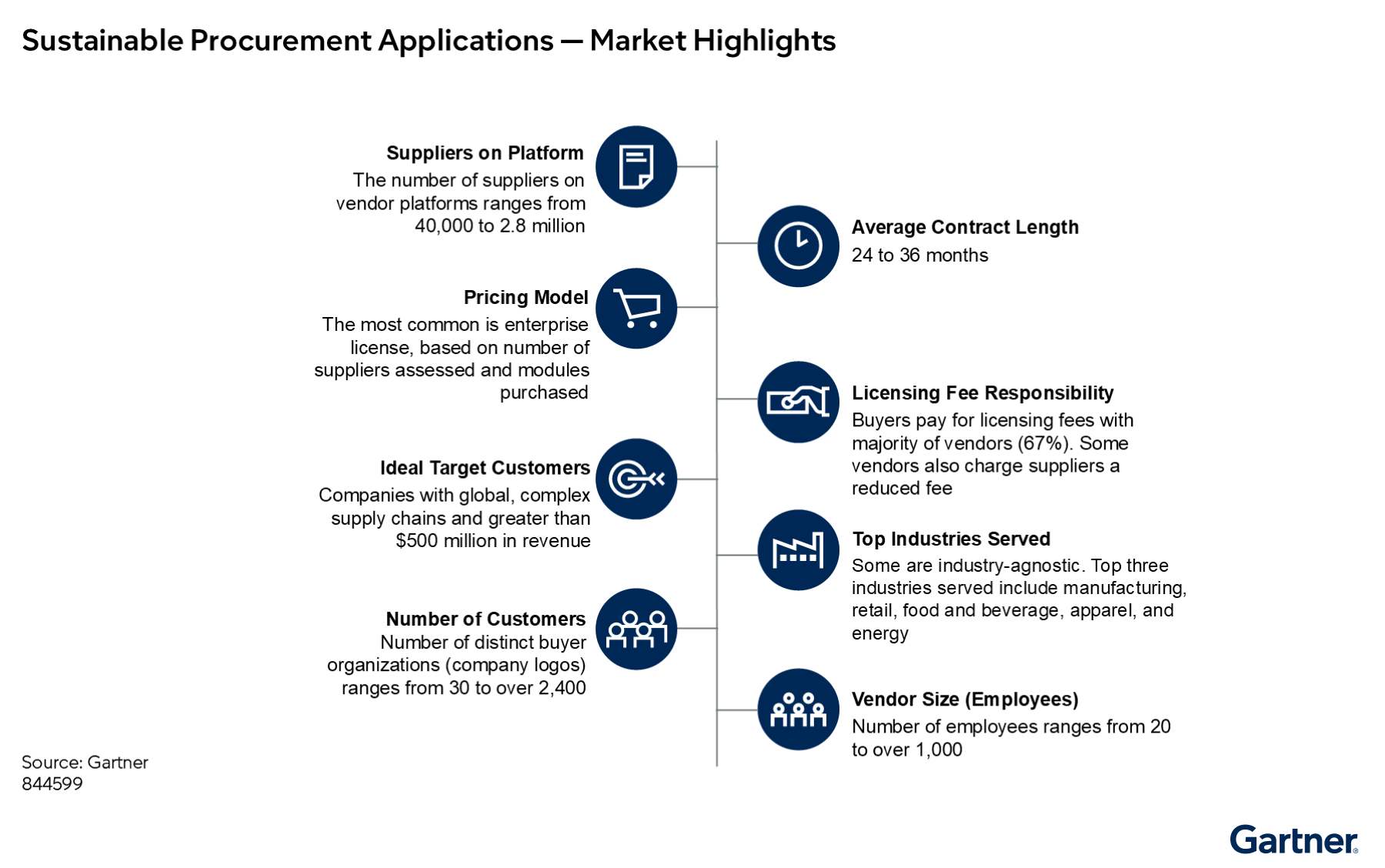
Representative vendors in this market primarily target midsize and larger organizations with complex supply chains across multiple industries. The number of suppliers connected to these platforms ranges widely, from 40,000 to 2.8 million, reflecting significant variation in network scale and market approach. Figure 2 provides market highlights of sustainable procurement applications based on data provided by the representative vendors in this market.
Varying Approaches to Using AI
Vendors in this market are integrating AI across their platforms at different levels of depth and with fundamentally different philosophies about the role AI should play relative to human involvement. These differences have meaningful implications for data quality, confidence and how buying organizations should think about the outputs they receive.
AI-first. Some vendors design their platforms around minimizing the need for direct supplier engagement. AI is used to build supplier profiles from publicly available data, prefill assessments, validate documents and surface insights, often before a supplier is ever contacted. The philosophy is that buying organizations should be able to assess and monitor their supply base with minimal supplier involvement, intervening only where the data warrants deeper engagement. When supplier involvement is required, the interaction is typically designed around an opt-out model where responses are prepopulated and the supplier flags exceptions rather than confirming each data point.
Human-first, AI-augmented. Other vendors view direct supplier engagement as essential to data quality and confidence. AI is used to reduce the effort involved by extracting data from uploaded documents, suggesting responses and translating content, but the supplier remains actively involved in providing and confirming information. The philosophy is that AI should make meaningful interactions more efficient, not replace them. Suppliers are typically expected to opt in and actively confirm the data submitted on their behalf, preserving accountability at each step.
Neither approach is inherently superior. The right fit depends on the buying organization’s intended use of the data and its tolerance for risk. An AI-first platform may be well-suited for organizations conducting broad supply base screening or establishing an initial risk baseline, where the goal is coverage and speed rather than granular precision. Organizations using the data for regulatory due diligence, product-level claims or mission-critical supplier decisions will likely require the confidence that comes with suppliers confirming the information being used about their organization. Buying organizations should understand where a vendor sits on this spectrum and assess whether that philosophy aligns with how they intend to use the data.
Representative Vendors
The vendors listed in this Market Guide do not imply an exhaustive list. This section is intended to provide more understanding of the market and its offerings.
Vendor Selection
The representative vendors included in this Market Guide offer sustainable procurement as their primary value proposition, sell their application as a stand-alone solution and provide the core capabilities along with a meaningful combination of the differentiating capabilities described in this research. Nearly all tools from adjacent markets, including strategic sourcing suites, supply chain risk platforms and carbon management tools, are developing capabilities to collect supplier sustainability data. However, to be included in this Market Guide, sustainable procurement must be the vendor’s primary value proposition, not an add-on module within a broader platform.
This research does not address online survey tools, which can enable data collection but depend on the end user to provide the sustainability domain expertise and assessment content. It also excludes ESG ratings databases, which provide comprehensive information on company sustainability performance but apply to a predetermined list of companies and do not support active supplier data collection. Vendors from adjacent markets that offer sustainability-related capabilities, but do not primarily focus on sustainable procurement, do not offer their solution as a stand-alone module, or do not offer these capabilities natively are also not addressed.
Representative Vendors in Sustainable Procurement Applications
Vendor | Product name | Date of product launch |
Achilles | Supply Chain 360 | 2018 |
amfori | amfori BSCI, amfori BEPI | 2003 |
Assent | Assent Supply Chain Sustainability Platform | 2010 |
EcoVadis | EcoVadis Ratings, IQ Plus, Vitals, Carbon Action Manager, Worker Voice Survey, Worker Voice Connect, Academy | 2007 |
ImpactBuying | ImpactBuying Solutions, Verda, Powerchain | 2010 |
IntegrityNext | IntegrityNext Supply Chain Sustainability Platform | 2017 |
LRQA | EiQ | 2017 |
NQC | NQC | 2007 |
osapiens | osapiens HUB | 2018 |
Prewave | Prewave | 2017 |
Responsibly | Responsibly | 2022 |
Sedex | Sedex, SMETA | 2004 |
Sphera | Supplier Engagement SCRM | 2015 |
Transparency-One | Transparency-One | 2016 |
TrusTrace | TrusTrace Platform | 2016 |
VERSO | VERSO Supply Chain Hub | 2019 |
Worldfavor | Sustainable Sourcing | 2016 |
Worldly | Worldly Platform | 2019 |
Source: Gartner (April 2026)
Vendor Profiles
Achilles
Product name: Supply Chain 360
Achilles is headquartered in Abingdon, U.K. The first production version of its supply chain management platform was released in 2018. Achilles offers three versions of its application, each providing varying degrees of assessment customization and functionality. The platform primarily operates as a community network connecting buying organizations with suppliers across the network. Suppliers can share their verified profile with multiple buying organizations across the network, reducing repeated data submissions. Buyers can also opt for a private network if preferred.
Supplier assessments cover ESG, health and safety, financial risk, compliance, cybersecurity, and geopolitical risk. Buying organizations can adjust the weighting of each dimension to reflect their risk priorities and can add regulatory-specific surveys to complement the standard assessment. Suppliers receive a composite risk score. The platform recently added an AI-powered capability that allows suppliers to submit documents of any format or language, from which the system extracts and prepopulates questionnaire responses. Suppliers review and confirm each suggestion before submission, keeping them in control of what is shared. The platform also supports corrective action planning, enabling buying organizations to define improvement targets for individual suppliers or groups and track progress over time.
Supplier data validation goes beyond self-assessment: Achilles cross-references submitted information against third-party sources and supports on-site audits, including confidential worker interviews to verify site-level performance. Audit data and associated costs can be shared across multiple buying organizations, reducing the audit burden on suppliers. The platform also serves as a supplier discovery tool, where suppliers can complete the standard assessment and request an audit to become visible to potential buyers.
Scope 3 emissions management is supported through a partnership with Green Project Technologies, covering emissions tracking, carbon footprint measurement and compliance-ready reporting.
The top industries served are energy, construction and utilities. Two subscription models are supported: fees can be paid by the buyer alone or shared between buyers and suppliers.
amfori
Product names: amfori BSCI, amfori BEPI
amfori is headquartered in Brussels, Belgium. The first version of its online platform was launched in 2003. amfori is a global business association that supports businesses at every step of their due diligence journey, with a range of ESG products and services. amfori BSCI and amfori BEPI are the organization’s two main products, helping businesses gain insight into the social and environmental performance of their supply chains. Both products are accessible through the amfori Sustainability Platform.
ESG risk screening is offered via amfori ESG Risk Compass, allowing buying organizations to assess supplier and factory risk exposure based on their location, sector and ESG performance. A Social Risk Assessment, launched in early 2026, is a conditional-logic questionnaire that enables buying organizations to identify potential social risks at individual production sites before conducting a formal audit. Corrective action planning is integrated directly into the platform, guiding suppliers through a structured improvement process that includes root cause analysis, proposed corrective actions and documented evidence of completion. Buying organizations can monitor supplier progress and schedule follow-up audits from within the platform. Suppliers can share their data and on-site audit reports across multiple customers, reducing audit and administrative burden.
The amfori Insights module provides a central portal to access and analyze all ESG data available in the platform, benchmark performance against other network members, and share critical data with stakeholders. The amfori Speak for Change solution offers a supply chain grievance mechanism that allows workers, communities and other rightsholders to raise concerns, and facilitates independent investigation and remediation. All members, including suppliers, can access the amfori Academy, an online learning platform providing resources and best practices to help members improve their ESG performance.
The top industries served are fast-moving consumer goods, retail and apparel. Membership fees are paid by the buyers.
Assent
Product name: Assent Supply Chain Sustainability Platform
Assent is headquartered in Ottawa, Canada. The first production version of its application was released in 2010. Assent offers manufacturers, distributors and suppliers integrated solutions for a broad range of sustainability, product and trade compliance topics. Buyers can assess suppliers by choosing from standard assessments covering topics such as climate impact, labor rights and diversity. Suppliers can submit information once and reuse it across multiple customers as part of the Assent Sustainability Network.
Supplier engagement experience is enhanced with AI-powered document processing that automatically extracts structured data from uploaded files in any format or language, reducing the effort required from suppliers to complete assessments. A dedicated team of supply chain experts supports supplier data validation, and a team of regulatory experts advises clients on program best practices. Suppliers receive feedback and support on how to improve their sustainability performance directly on the platform, and buyers can assign corrective actions and track progress.
Both buyers and suppliers have access to Assent University, which offers education, product training and best practices on key sustainability topics. Assent offers ongoing event monitoring using sentiment analysis of social media and other sources. Supplier screening covers a broad range of risk categories and includes a CSRD materiality capability to identify and engage relevant suppliers for additional data.
Scope 3 capabilities include the ability to assess supplier readiness and targets, collect allocated supplier emissions data, request CBAM-specific reporting data, and collect and calculate product carbon footprints. CBAM and EUDR support is offered through third-party partnerships. Assent also offers continuous monitoring of regulatory changes and provides organizations with insights on the supply chain impact of those changes.
The top industries served are electronics, medical devices and industrial equipment. Licensing fees are paid by the buyer.
Additional products offered include product compliance and trade compliance solutions.
EcoVadis
Product names: EcoVadis Ratings, IQ Plus, Vitals, Carbon Action Manager, Worker Voice Survey, Worker Voice Connect, Academy
EcoVadis is headquartered in Paris, France. The first production version of its application was released in 2007. The vendor provides a standard assessment, the EcoVadis Rating, which covers 21 factors across environmental, labor, human rights, ethics and sustainable procurement topics. EcoVadis Vitals is a lighter questionnaire that is free for suppliers to complete and enables organizations to determine whether a full assessment is required. Regulation-specific dashboards provide buyers with the ability to assess compliance against specific regulatory requirements, including the German Supply Chain Act and modern slavery frameworks. Based on their performance, suppliers receive an EcoVadis Rating and Scorecard that can be shared with multiple customers. EcoVadis has a dedicated team of analysts responsible for supplier data validation and rating methodology.
The EcoVadis IQ Plus module enables ESG risk screening across the entire supply base using country, industry and supplier-specific data scanned from public sources. Organizations can collect direct worker feedback using Worker Voice Surveys, create a grievance mechanism using Worker Voice Connect or combine both to streamline worker engagement. Both buyers and suppliers have access to the EcoVadis Academy, which offers education and best practices on key sustainability topics.
Scope 3 capabilities are available through the Carbon Action Manager, which can be purchased as a stand-alone module. It enables buyers to conduct hot spot analysis based on GHG intensity and transition risk, assess supplier carbon management capabilities, and collect Scope 3 emissions data at the corporate and product level. A product carbon footprint calculator, free for suppliers, helps those with limited reporting maturity calculate their own PCFs. EcoVadis assigns one of four Carbon Data Reliability Levels to supplier-reported emissions data to provide buyers with transparency on data quality. The vendor has also established partnerships with carbon accounting platforms, including Watershed, Sweep and Normative, to allow mutual customers to integrate supplier-reported emissions data into their carbon accounting workflows.
The top industries served are manufacturing, services and retail. Licensing fees are paid by both buyers and suppliers, with the exception of EcoVadis Vitals, which is free for suppliers.
ImpactBuying
Product names: ImpactBuying Solutions, Verda, Powerchain
ImpactBuying is headquartered in Alkmaar, the Netherlands. The first production version of its application was released in 2010. Organizations can use standard and customized assessments to check supplier and product compliance with ESG topics, certifications and other industry standards. The vendor provides guidance on material issues that FMCG retailers, producers or traders should prioritize based on their strategy and regulatory landscape. Buyers can create a fully customized supplier risk score based on supplier ingredient, component, activity, country or other buyer-defined attributes. Data verification and validation is performed by an in-house team of analysts, supported by AI-powered document scanning that reads supplier-submitted certifications and reports and automatically answers relevant questionnaire fields.
Multitier data collection enables organizations to map and assess supplier performance at any tier in the supply chain, down to farmer level. The platform also provides traceability capabilities from a supplier, facility and product perspective at the purchase order or batch level. A regulatory module for CSRD provides buyers with the ability to perform supplier due diligence and assess compliance. Supplier corrective actions triggered by desktop audits can be tracked directly on the platform. The vendor offers training resources and best practices for both suppliers and buyer teams through ImpactBuying Academy.
Scope 3 capabilities include the ability to assess supplier readiness and targets, collect allocated supplier emissions data, and gather product carbon footprints through white-label partnerships with providers such as Mondra.
The top industries served are fast-moving consumer goods, retail and premium-brand manufacturing. Licensing fees are paid by the buyer.
Additional products offered include ImpactBuying Academy, compliance-as-a-service engagements, consulting services and consumer involvement solutions.
IntegrityNext
Product name: IntegrityNext Supply Chain Sustainability Platform
IntegrityNext is headquartered in Munich, Germany. The first production version of its application was released in 2017. The vendor provides standard assessments covering a broad range of sustainability topics, including supply chain decarbonization, forced labor, and European Sustainability Reporting Standards. Its platform enables organizations to create a comparable risk view across their supplier base, combining supplier-provided information with automated screening based on country, industry, media and other public risk signals to identify where deeper due diligence or remediation is needed. The company has more than 3 million supplier profiles already on the platform, reducing supplier onboarding time and effort.
Buying organizations can assess their full supplier base without waiting for supplier responses, using automated sustainability and third-party risk screening to identify hidden exposure, prioritize suppliers and focus resources where the potential impact is highest. The platform supports risk-based workflows for due diligence, supplier follow-up, remediation and audit-ready documentation, helping customers move from risk detection to risk mitigation within the same system.
Regulatory-specific assessments, dashboards, and workflows are available for frameworks including CBAM, EUDR, CSDDD, national due diligence laws (e.g., and German LkSG, Swiss Supply Chain Act, Norwegian Transparency Act) and Carbon (CCF and PCF), allowing buyers to assess compliance across multiple regulatory requirements within the same platform.
Its AI strategy includes AI Screening to convert publicly available supplier information into structured, explainable insights, and a broader AI layer designed to connect supplier, product, material and regulatory data to support role specific decisions.
Both buyers and suppliers can access the IntegrityNext Academy, which offers education and best practices on key sustainability topics.
The top industries served are manufacturing, electronics, and energy. Licensing fees are paid by the buyer.
LRQA
Product name: EiQ
LRQA is headquartered in London, U.K. and Hong Kong. The first production version of its application was released in 2017. EiQ is a supply chain risk and sustainability platform that combines inherent risk screening, self-assessment questionnaires and on-site audits into an integrated workflow. The platform draws on a proprietary audit database, public sources and third-party monitoring to assess supplier risk before any direct supplier engagement is initiated.
Inherent risk screening in EiQ assesses suppliers at the entity level, going beyond country and industry indicators to screen for sanctions, adverse media, allegations and ownership structures. The Sentinel module provides ongoing adverse media monitoring using both official and unofficial sources, enabling early identification of emerging supplier risks. Once prioritized, suppliers can be engaged through customizable self-assessment questionnaires tailored to specific commodities, functions and risk profiles.
The platform supports on-site audits and integrates audit findings directly into supplier risk profiles. The platform can ingest audit data from multiple third-party audit programs, such as SMETA and BSCI, and normalize findings into a unified format based on EiQ’s ERSA framework, enabling buyers to compare supplier performance across different audit standards. Corrective actions from audit findings can be assigned, tracked and managed directly on the platform.
A generative AI risk agent, AskEiQ, allows users to query supplier risk data using natural language, surfacing insights across inherent risk scores, audit findings and monitoring alerts without the need to navigate multiple dashboards. The EiQ Learn module provides a learning management system for supplier education and capability building. A carbon data collection module is available for buyers looking to gather supplier emissions data.
The top industries served are apparel, retail, and food and beverage. Licensing fees are paid by the buyer.
NQC
Product name: NQC
NQC is headquartered in Manchester, U.K. The first production version of its supply chain sustainability risk application was released in 2007. The vendor offers a common platform designed around the OECD-risk based framework of identification, risk assessment and mitigation, supporting organizations with transparency and compliance response. The platform consolidates data from suppliers via a suite of proprietary assessments covering a wide range of ESG topics, including carbon footprinting, human rights and forced labor, environmental impact, ethics and corruption, and others. Industry-specific assessments are also offered.
The NQC platform uses third-party risk data to build supplier risk profiles and continuously monitor for emerging risks. Based on those risk profiles, organizations target high-priority suppliers with focused ESG assessments. Suppliers submit responses, upload supporting evidence and receive a rating once verified by an in-house team of compliance analysts. Tailored corrective actions are issued to suppliers and can be tracked directly on the platform.
The platform also supports collection of product carbon footprint and CBAM reporting data. AI capabilities are used for predictive supply chain mapping, enabling organizations to estimate subtier supply chain structures, as well as for adverse media monitoring and translation. Suppliers can submit information once and reuse it across multiple customers. Buying organizations receive alerts when supplier-submitted data is updated, with a full audit history maintained.
Multitier data collection capabilities enable organizations to map and assess supplier performance beyond their Tier 1 suppliers. The vendor offers continuous monitoring of regulatory changes and provides organizations with insights on the supply chain impact of those changes.
The top industries served are manufacturing, government and automotive. The vendor offers flexible plans where licensing fees can be paid by either the supplier or the buying organization, or split between both parties.
osapiens
Product name: osapiens HUB
osapiens is headquartered in Mannheim, Germany. The first production version of its application was released in 2018. The osapiens HUB is a supply chain sustainability and compliance platform that supports organizations in managing ESG risk, regulatory due diligence and emissions reporting across their supplier base.
Questionnaires are delivered selectively based on each supplier’s assessed risk profile, so suppliers identified as low risk receive a proportionate level of engagement while higher-risk suppliers are subject to more detailed assessments. Regulatory-specific assessments and dashboards enable buyers to evaluate suppliers against frameworks such as LkSG and modern slavery requirements, with risk dimensions configurable by regulation.
AI-powered document processing validates supplier-submitted evidence and extracts relevant data, reducing the effort required from suppliers. Buying organizations can monitor suppliers continuously through automated news and sanction monitoring. Supplier corrective actions and improvement plans can be created and tracked directly on the platform. The platform also offers multitier data collection capabilities.
Scope 3 capabilities include collecting emissions data at varying levels of quality, from spend-based estimates through to supplier-specific primary data, and providing buyers with visibility into the quality distribution of emissions data across their supply base. Product carbon footprints can also be collected and AI-assisted suggestions can be used to fill data gaps where supplier-specific information is unavailable.
The top industries served are retail, manufacturing and healthcare. Licensing fees are paid by the buyer.
Prewave
Product name: Prewave
Prewave is headquartered in Vienna, Austria. The first production version of its application was released in 2017. Prewave offers a supply chain risk management platform covering multiple dimensions of risk, including operational risks related to business continuity as well as sustainability and regulatory compliance topics.
Buying organizations can use standard ESG, regulatory-specific, or fully customized assessments and scoring criteria to assess suppliers at the enterprise or site level. Regulatory-specific assessments and dashboards are available for frameworks including LkSG, CSDDD, EUDR and CBAM. For CSRD, Prewave surfaces relevant due diligence outputs to support customers’ reporting obligations. The platform takes an AI-first approach to risk identification, using automated media monitoring and AI-powered alert scoring to surface supplier risk signals continuously across news sources, social media and other channels in multiple languages.
Supplier ESG risk screening draws risk indicators ranging from industry level down to individual commodities, supplemented by supplier-specific data collected from public data sources in multiple languages. Climate risk and biodiversity assessment capabilities, delivered in partnership, enable buyers to identify which suppliers are exposed to these risks across short, medium and long-term horizons. Multitier mapping capabilities leverage both public and private data to extend supply chain visibility beyond Tier 1, with the ability to validate supplier relationships using data confirmed by each tier. The Prewave Action Platform enables buyers to manage supplier corrective actions and trigger requests for on-site audits through a select group of third-party audit partners.
The Carbon 360 module offers carbon measurement for corporate, supply chain and product carbon footprint calculations, while also providing regulatory reporting for CBAM. A modular structure allows buying organizations to purchase the modules most relevant to their regulatory obligations and sustainability strategy.
The top industries served are industrial manufacturing, automotive and energy. Licensing fees are paid by the buyer.
Responsibly
Product name: Responsibly
Responsibly is headquartered in Copenhagen, Denmark. The first production version of its due diligence platform was released in 2022 and provides automated ESG assessments of suppliers. A variety of sustainability objectives can be managed, ranging from regulatory compliance to decarbonization efforts. The platform allows buying organizations to assess the ESG risk level of a supplier before requesting data through the engagement module. An initial risk assessment and ESG media screening are conducted using data aggregated from multiple third-party databases, covering certifications, sanction information, audit results, company claims and news media.
The platform builds a digital profile around each supplier by continuously aggregating data from public and private sources. AI capabilities are used to process and analyze supplier-submitted documents and web-scraped materials, extracting ESG claims and normalizing data into Responsibly’s scoring framework. An AI Answers capability enables users to query collected supplier data directly, surfacing insights without navigating multiple reports.
Scorecards can be customized for specific regulations or the buying organization’s ESG objectives and are dynamically updated whenever new data is available. ESG data submitted by buyers or suppliers is scored automatically. Workflow automation allows buying organizations to define rules that trigger actions based on parameters such as risk exposure, supplier responses or other criteria. Responsibly’s quality assurance team performs data validation, and data quality indicators show the verification status and source type for each data point. The platform supports buyers in managing their own auditors, who can log findings directly on it.
The top industries served are transportation and logistics, pharmaceuticals, and manufacturing. Licensing fees are paid by the buyer.
Sedex
Product names: Sedex, SMETA
Sedex is headquartered in London, U.K. The first version of its platform was released in 2004. It assists buying organizations in identifying, managing and reporting on ESG risks across their supply chains, supporting compliance with national and regional due diligence legislation.
An inherent risk assessment tool enables buyers to screen ESG risks by country, sector and site before directly engaging suppliers. Suppliers then complete a self-assessment questionnaire covering labor standards, health and safety, business ethics, and environmental topics. Uploaded documents are automatically processed to populate supplier profiles. Buyers receive a risk score for each supplier or site, helping them prioritize where further action, including an audit, is needed.
Where risk warrants it, buying organizations can commission a Sedex Members Ethical Trade Audit (SMETA), conducted in-person at the site level. SMETA is a globally recognized social audit methodology. Suppliers share assessment data and audit results across multiple customers, reducing duplication and audit fatigue. Where audits identify issues, approved audit companies assign corrective actions directly on the platform, and buying organizations can monitor remediation progress at site level, completing the due diligence cycle from risk identification through to resolution.
A supplier directory supports discovery and evaluation of new suppliers. Multitier data collection enables assessments beyond Tier 1. Sedex Analytics provides centralized reporting and supplier activity management. All members access an e-learning portal for ESG guidance and best practices. Suppliers can choose a Supplier Plus membership, which includes a badge and certificate, enabling them to demonstrate verified performance to potential buyers.
The top industries served are retail, food and beverage, and manufacturing. Both buyers and suppliers pay subscription fees. Additional services include sustainability coordination and supplier engagement support.
Sphera
Product name: Supplier Engagement SCRM
Sphera is headquartered in Chicago, Illinois, U.S. The first production version of Supplier Engagement was released in 2015. In 2024, SupplyShift was acquired by Sphera, and the application became the Supplier Engagement SCRM product as part of the broader Supply Chain Risk Management (SCRM) solution offering within the Sphera Operational Intelligence platform. The application provides standard assessments for a wide range of ESG topics and regulations, including EUDR, CSDDD, CSRD and CBAM, all of which are fully customizable. Buying organizations can use standard assessments, adapt them to specific needs, or create fully customized assessments at the enterprise, site, product or purchase order level.
The platform employs a risk-based screening capability that combines location and industry inherent risk data to prioritize suppliers and calibrate the depth of engagement required. Suppliers can have previous responses prepopulate future assessment responses on the same regulatory or reporting requirement to reduce duplication of effort. AI-generated risk summaries synthesize signals from multiple data sources into consolidated supplier and portfolio views, supporting faster decision making. The platform takes a continuous monitoring approach, providing ongoing visibility into supplier risk rather than relying on point-in-time assessments. Multitier data collection capabilities enable organizations to map and assess supplier performance beyond Tier 1. Supplier data validation, follow-up, and analysis support services are available through Sphera’s consulting and advisory team.
Greenhouse gas assessments support the evaluation of supplier carbon management capabilities, and Scope 3 data collection is integrated into the platform’s carbon calculator. The Supplier Engagement SCRM application is part of the broader Sphera Operational intelligence platform, which also covers supply chain risk management, enabling integration of sustainability and operational risk data.
The top industries served are industrial manufacturing, automotive and chemicals. Licensing fees are paid by buyers and it is free to suppliers, with flexible options for suppliers in specific product configurations.
Additional products offered include Sphera’s broader supply chain risk management, EHS, product stewardship and sustainability reporting solutions within the Sphera Operational Intelligence platform.
Transparency-One
Product name: Transparency-One
Transparency-One, an ISN company, is headquartered in Dallas, Texas, U.S. Transparency-One is a network-based SaaS platform, backed by the global infrastructure and expertise of the ISN brand. The first production version of the application was released in 2016. Organizations can use standard and customized assessments to monitor supplier and product supply chain compliance with a wide range of regulatory and sustainability topics, certifications, audits, and industry standards. Transparency-One provides buyers with guidance on material sustainability issues based on their industry and products purchased.
Transparency-One places particular emphasis on supplier engagement as a data collection method, working with suppliers directly to gather, verify and improve supply chain data rather than relying solely on third-party sources. Transparency-One’s network approach allows for suppliers to join and report to multiple buyers, helping reduce friction and administrative burden in the supply chain. Regulatory-specific assessments and workflows are available for frameworks including EUDR, UFLPA, CBAM, EPR, FMSA and human rights due diligence requirements across multiple jurisdictions.
Buyers can target sustainability requirements to suppliers based on the product, activity, country or other buyer-defined attributes. Supply chain mapping capabilities enable organizations to assess supplier performance at multiple tiers, and traceability can be tracked at the purchase order or batch level. Risk identification in supply chains is configured through buyer-specific scoring and compared against global environmental and social risk indexes. Further risk and media intelligence is added through SignalAI and OpenSanctions. Transparency-One offers Interoperability of supplier data by linking public data sources into a Supplier Data Hub, along with private data sources established through data sharing agreements (e.g., Creditsafe, Kharon).
Supplier corrective actions triggered by desktop or on-site audits can be managed directly in the platform. An AI-powered chatbot, integrated from the ISNetworld platform, supports supplier navigation and data entry. Support services include training, regulatory education and best-practice sharing.
The top industries served are cosmetics, retail, food and consumer packaged goods. Licensing fees are typically paid by both buyers and suppliers, although buyer-only subscription models are also available.
TrusTrace
Product name: TrusTrace Platform
TrusTrace is headquartered in Stockholm, Sweden. Founded in 2016, the first production version of its application was released in 2018. TrusTrace is a supply chain data platform focused on enabling companies to map, trace and assess their supply chains with a particular emphasis on traceability and regulatory compliance. Supplier data is collected at the enterprise, site or product level, including lot-level tracing for organizations that require granular product traceability.
Buying organizations can configure their supplier data collection program to align with specific regulatory requirements, including CSDDD, CSRD, EUDR (including Digital Product Passport capabilities) and UFLPA, defining the scope and depth of engagement based on their compliance obligations. ESG risk screening is configurable, allowing customers to adjust risk factors and weightings in line with their risk appetite, drawing on country-level risk data supplemented by supplier-specific information such as audit scores and certifications. Multitier data collection capabilities enable organizations to cascade assessment requests upstream beyond Tier 1. AI is used to extract relevant data from supplier-submitted certificates and structured documents, reducing manual effort for suppliers. Corrective actions can be assigned to suppliers and tracked directly on the platform.
Data validation is supported through multiple methods, including connections to certification bodies to verify supplier-submitted credentials. Buyers can trigger on-site audits with third-party audit providers directly from the platform, and audit findings are normalized across different audit programs to enable consistent risk scoring regardless of which audit standard a supplier has completed.
The top industries served are fashion and apparel, with an expansion into food. Licensing fees are paid by the buyer.
VERSO
Product name: VERSO Supply Chain Hub
VERSO is headquartered in Munich, Germany. In 2023, sustainabill was acquired by VERSO and the application became the Supply Chain Hub product within the VERSO product landscape. The application, first released in 2019, assists organizations in evaluating suppliers through a standardized self-assessment covering ESG topics including environmental and climate, social and governance, and product compliance. Suppliers can share assessments submitted to multiple customers within the network. The platform also allows custom buyer questionnaires to complement the standard assessment.
Supplier corrective actions can be created and tracked directly on the platform, with the option to direct actions to subtier suppliers. Risk mapping evaluates supplier risk across a broad range of risk databases and sanction lists, generating automated risk classifications weighted by supplier master data, country and sector. Multitier data collection capabilities enable organizations to map and cascade requests upstream to assess supplier performance beyond Tier 1. Document processing verifies supplier-submitted materials and prepopulates questionnaire fields, reducing manual effort for suppliers. Companies can generate reports for regulatory frameworks including LkSG, GRI and CSRD. An EUDR compliance solution and CBAM data collection capability have been added to the platform. An EU Packaging and Packaging Waste Regulation (PPWR) readiness assessment was also recently launched.
Scope 3 and carbon footprint capabilities allow suppliers to submit emissions data at the facility and product level, which is GHG Protocol-aligned. Product carbon footprints collected through the Supply Chain Hub can be fed into buyers’ broader Scope 3 calculations via the VERSO Climate Hub.
The top industries served are manufacturing, trade and food. Licensing fees are paid by the buyers.
Additional products offered include the VERSO Climate Hub for CCF and PCF calculation and decarbonization management, as well as the VERSO ESG Hub for ESG management and standardized ESG reporting.
Worldfavor
Product name: Sustainable Sourcing
Worldfavor is headquartered in Stockholm, Sweden. The first production version of its application was released in 2016. The vendor has three different solutions to support sustainability programs: Sustainable Sourcing, Sustainable Investments and a free reporting solution. All applications can be purchased separately or as a unified platform.
Buying organizations can choose from over 20 standardized and regulatory-focused ESG assessments or develop customized versions to evaluate their suppliers. The platform then merges these performance scores with inherent risk data to calculate overall risk severity. By supporting risk-based due diligence, configurable workflows and corrective action management, the system guides users from initial identification through to prioritization and improvement. Suppliers can submit information once and reuse it across multiple customers and other stakeholders within the network.
AI-powered, contactless screening assesses suppliers using publicly available information from validated sources before starting direct supplier engagement, providing a rapid initial risk view across the entire supply base. Inherent risk screening can be configured using selected risk indexes to evaluate suppliers and support risk identification, prioritization and materiality assessments. Suppliers can upload documents and the platform uses AI to extract relevant data and prepopulate questionnaire responses, reducing the effort required to complete assessments. Multitier data collection capabilities enable organizations to map and assess supplier performance beyond Tier 1 through a supplier cascading model that allows visualization of the multitier network.
Scope 3 capabilities leverage AI scanning of publicly available data and supplier-reported information to assess and track supplier emissions, including progress against reduction targets, providing buyers with visibility into GHG performance across emissions categories.
The top industries served are manufacturing, food and beverage, and pharmaceuticals. Licensing fees are paid by the buyer.
Additional products offered include Worldfavor Sustainable Investments and Worldfavor Reporting Solution. The Reporting solution enables any organization to proactively share its sustainability data and includes a carbon calculator, progress tracking and data export functionality.
Worldly
Product name: Worldly Platform
Worldly is a globally distributed company. The first production version of its application was released in 2019. The vendor offers different solutions for assessing sustainability performance, supplier compliance and supply chain risk at multiple levels, including facilities, brands and retailers, and materials and products. All Worldly tools are available for purchase as subscriptions or individual modules.
Relevant to sustainable procurement, the platform provides standard facility assessments for multiple ESG issues through the Higg Facility Environmental Module (Higg FEM), the Higg Facility Social & Labor Module (Higg FSLM) and The BHive (digital chemical management, through the acquisition of GoBlu in 2025). These assessments are automatically customized based on supplier sector, facility type and materials manufactured.
Worldly offers different versions of its application, each providing varying degrees of assessment functionality and data benchmarking. The Facility Data Manager enables companies to collect frequently updated primary, quantitative supplier data on impact areas including emissions, waste and water. Supplier data validation is offered through Cascale’s verification program for the Higg FEM and Higg FSLM assessments, while the Facility Data Manager uses a combination of desktop and on-site audits through a partnership with SGS. The Worldly Axion solution, launched in 2025, provides inherent risk scoring and adverse event monitoring across multiple climate and risk dimensions, based on facility-level data combined with regional risk intelligence. An AI-powered assistant provides suppliers with contextual guidance on complex assessment questions, and provides brands and retailers with guidance on decarbonization strategy and planning.
The Worldly Product Impact Calculator enables Scope 3 emissions measurements for brands and retailers by connecting product, purchase order and supplier data. Brands and retailers can total their Scope 3 or supply chain emissions based on category, facility energy data, materials and purchase quantity.
The top industries served are apparel, footwear, textile-based products, and hard home goods like furniture, toys and sporting goods. Licensing fees are paid by both buyers and suppliers.
Additional products offered include Supplier Compliance Management (formerly known as the Fair Factories Clearinghouse), The BHive, the Higg Brand & Retail Module (Higg BRM), Higg Materials Sustainability Index (Higg MSI) and Higg Product Module (Higg PM), Higg Facility Environmental Module (Higg FEM), Higg Facility Social & Labor Module (Higg FSLM), Worldly Facility Data Manager (FDM), Worldly Axion, and Worldly Product Impact Calculator.
Market Recommendations
The core business case for sustainable procurement applications remains strong. Organizations have invested in supply chain due diligence and social compliance for decades, driven by legal requirements around labor standards, working conditions and responsible sourcing that are largely unaffected by recent shifts in voluntary ESG commitments. While the more advanced and voluntary aspects of sustainable procurement, such as Scope 3 target-setting and voluntary disclosure frameworks, have softened in some regions, the foundational need to manage supplier risk, ensure compliance and demonstrate due diligence continues to be critical. The tools in this market have matured considerably, making the question less about whether to invest and more about how to invest wisely.
CPOs and other business leaders looking to adopt or expand their use of a sustainable procurement application should:
- Assess vendor commercial viability, not just capabilities. Current market dynamics may challenge some vendors’ ability to remain commercially viable over the medium term. Look beyond feature checklists and evaluate financial stability, customer base trajectory, and whether a vendor’s expansion into new areas is backed by substantive new functionality or is primarily a repositioning exercise.
- Prioritize platforms that reduce burden on both sides. Favor platforms that invest in reducing friction for your team and suppliers. Platforms offering AI-assisted response prepopulation, configurable workflows and cross-customer reporting capabilities for suppliers will deliver better response rates and higher-quality data from a broader supplier base.
- Evaluate product-level data readiness. Even if your organization does not require product-level data collection today, regulations such as EUDR and CBAM are moving in that direction. Focus on vendors that already support or are actively developing product-level capabilities to avoid a costly platform switch later.
- Pressure-test expanded capability claims. As vendors reposition from sustainability to risk or add adjacent capabilities through white-label partnerships, ask whether these capabilities are natively built or embedded from a third party, and request demonstrations rather than relying on marketing materials.
1 2025 Gartner Supplier Collaboration and Risk Survey. This survey was conducted to understand how organizations leverage supplier collaboration and supplier relationship management to achieve successful procurement goals and, separately, how organizations conduct and manage their supplier risk management activities. Procurement functions’ current supplier collaboration and relationship management (including experience management) mechanisms and risk management processes (including consistency, formality, documentation, cohesion, and cross-functional collaboration) were evaluated. The research was conducted online from 21 July through 15 September 2025. In total, 300 respondents were surveyed in English across North America (n = 154), Western Europe (n = 86) and the Asia/Pacific region (n = 60). Of the respondents, 186 were primarily focused on direct procurement, while 114 were primarily focused on indirect procurement. Of the 300 total respondents, 148 respondents completed the supplier collaboration branch of the survey, and 152 respondents completed the supplier risk management branch of the survey. Qualifying organizations reported enterprisewide annual revenue of at least $250 million for fiscal year 2024. Twenty-two percent of respondents came from organizations with $1 billion to less than $5 billion in revenue, 22% from organizations with $5 billion to less than $10 billion, and 30% from organizations with $10 billion or more. The respondents came from a variety of industries, including retail (n = 61), wholesale trade (n = 48), manufacturing-consumer products (n = 41), manufacturing-industrial discrete (n = 41), manufacturing-industrial process (n = 37), manufacturing-life sciences (n = 37), and manufacturing-high tech (n = 34). Disclaimer: The results of this survey do not represent global findings or the market as a whole, but reflect the sentiments of the respondents and companies surveyed.
2 2026 Gartner Chief Procurement Officer Role Agenda Poll — Wave 1. This poll was conducted to help chief procurement officers understand their functional priorities and challenges for the first half of 2026. The survey was conducted online in January and February 2026 using an external panel of 101 chief procurement officer leaders across various industries from North America, Europe and the Asia/Pacific region and organizations with annual revenue of over $500 million. Disclaimer: The results of this poll do not represent global findings or the market as a whole, but reflect the sentiments of the respondents and companies surveyed.