Magic Quadrant for Cloud ERP for Product-Centric Enterprises
13 October 2025 - ID G00826212 - 44 min read
By Greg Leiter, Tomas Kienast, and 3 more
ERP applications orchestrate and automate core operational and administrative processes and are the system of record for a significant level of business transactions. Application leaders can use this research to evaluate cloud ERP vendors that emphasizes core process standardization with innovation.
Strategic Planning Assumption
By 2027, 60% of customers replacing ERP applications will select software for the platform and business process orchestration capabilities as critical requirements, along with transactional capabilities, in order to deliver more-tailored outcomes.
Market Definition/Description
Gartner defines cloud enterprise resource planning (ERP) for product-centric enterprises as a market for application technology that supports the automation of operational activities for the manufacturing, distribution, delivery and servicing of goods. Cloud ERP for product-centric enterprises is delivered under a SaaS license model (with frequent mandatory updates), where application support, infrastructure provisioning and management are the responsibility of the vendor.
Broadly speaking, ERP solutions enable a variety of enterprisewide business capabilities, primarily those associated with systems of record and systems of differentiation. ERP solutions form the core systems that allow an enterprise to conduct business. For product-centric ERP solutions, process enablement covers a wide range of enterprise processes, including:
- Supply chain planning
- Procurement of product inputs
- Production and quality control
- Warehousing
- Distribution
- Transportation logistics
- Customer order intake and invoicing
- Vendor invoice management
- All elements of financial transaction processing and reporting
Mandatory Features
The mandatory features for this market include:
- Plan supply and demand
- Source and procure production inputs
- Manufacture products (at least one of discrete, process and/or project/asset-intensive manufacturing)
- Manage customer fulfillment and logistics
- Manage core financial management capabilities (general ledger, accounts payable, accounts receivable, fixed assets, cost accounting and project accounting).
Common Features
The common features for this market include processes such as:
- Procurement — Requisition and purchase order management for indirect goods, services and capital equipment.
- Human capital management (HCM) — For cost management, as well as staffing, for operational resources.
- Financial planning and analysis (FP&A) or extended planning and analysis (xP&A).
- Specialized, industry-specific modules or adjacent applications — These include, but are not limited to, modules such as those used for configure to order, make to order and field service management. Also included are broader application solutions, such as those used for manufacturing execution (MES), enterprise asset management (EAM) and product life cycle management (PLM).
- Sustainability, and environmental, social and governance (ESG) — Execution or analytics capabilities that allow organizations a line of sight on their progress against sustainability goals.
Magic Quadrant
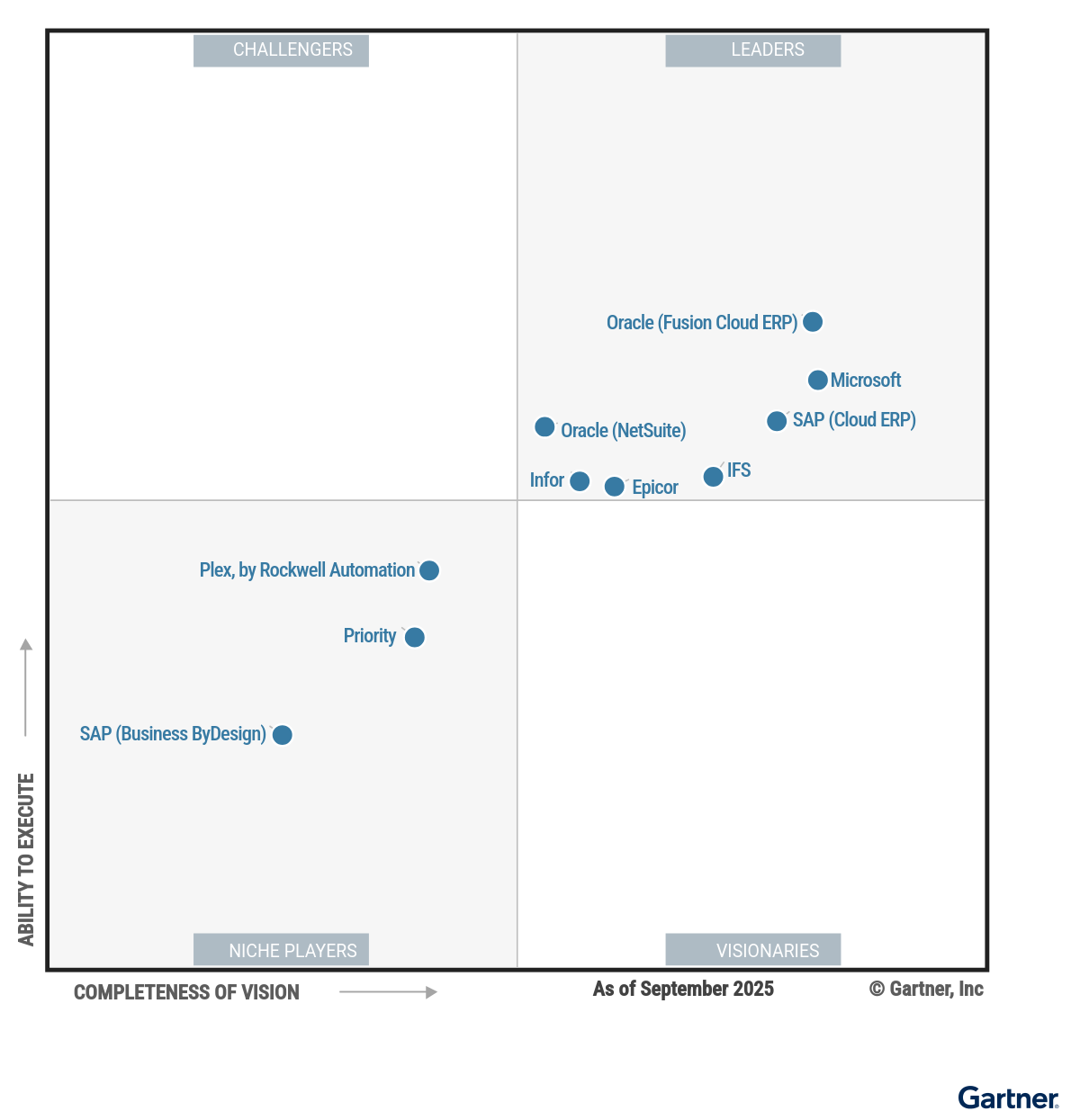
Vendor Strengths and Cautions
Epicor
Epicor is a Leader in this Magic Quadrant, offering Epicor Industry ERP Cloud, with packages like Kinetic for manufacturers and Prophet 21 for distributors. It primarily serves midsize enterprises in North America and EMEA, with a limited number of customers in the rest of the world. Key industry verticals include manufacturing, retail, automotive, distribution and building supply.
Key new innovations include its Prism AI Agent for natural language user interactions, new sustainability and ESG reporting capabilities, and its urgent MRP capability to provide customer flexibility responding to urgent material requirements. The vendor’s roadmap emphasizes continued AI innovation, development of its customer community to help source new ideas for product innovation, as well as vertical industry best practices.
- Robust AI offerings for midsize customers: Epicor has introduced a variety of AI capabilities into its product line and has a robust roadmap for AI development. Its Prism AI Agent provides out-of-the-box natural language AI assistants and its agent strategy is focused on easy-to-configure AI agents, which is generally a critical requirement for midsize organizations.
- Industry focus and tailored solutions: Epicor provides preconfigured, focused industry solutions for its specific vertical industry coverage, which allows it to offer deeper industry expertise and more comprehensive product functionality to midsize organizations.
- Cloud ERP migration automation: Epicor introduced its “Ascend with Epicor” program to accelerate customer migration from legacy Epicor solutions or for net-new customers. Key components include an AI-driven approach for project assessment, scoping and automation to deliver faster go-live times.
- AI agent developer tools: Epicor’s large number of prebuilt AI use cases lack some of the capabilities to allow customers to create and orchestrate their own custom AI agents. Epicor expects to begin releasing such capabilities later in 2025.
- Specialized industry focus may limit broader appeal: Epicor’s highly tailored approach might lead to the vendor being perceived as having more focused cloud platform capabilities. For organizations outside Epicor’s core verticals, or those seeking a highly generalized, cross-industry, ERP solution, this specialization may be less aligned.
- Geographic coverage: Customers with operations outside of North America should evaluate their alignment with Epicor’s multiregional support strategy, country-specific localizations, and regional partner capabilities and availability.
IFS
IFS is a Leader in this Magic Quadrant. It targets midsize to large enterprises with its IFS Cloud solution, mainly in EMEA and North America. The ERP offering focuses on industries like industrial equipment manufacturing, process manufacturing in food and beverage, aerospace, defense, construction engineering, energy, and project-based manufacturing.
Key new innovations include IFS.ai Copilot and some early AI agentic capabilities. The vendor’s roadmap is centered around further agentic AI capabilities as well as embedding AI to a greater extent across the solution through co-innovation with its Nexus Black offering. IFS recently acquired TheLoops and 7bridges to strengthen its AI capabilities, continuing to focus on capabilities relevant to its target industry and heavy asset management customers.
- Strong industry focus: With granular licensing, IFS addresses customer needs from moderate to complex manufacturing, offering a portfolio of integrated capabilities including manufacturing execution systems (MES), enterprise asset management and field service. It provides a core set of features that organizations can enhance with components tailored to their strategic objectives.
- AI-driven automation: The vendor’s IFS.ai brand incorporates existing embedded AI capabilities, including its natural language AI assistant, as well as its agentic AI strategy. It has launched several agentic AI use cases in the areas of supplier management and demand management, and it has a very robust roadmap for AI agents specific to its vertical industry focus.
- Composability strategy: IFS Cloud features integrated IFS Cloud designers for user interface configuration, including Lobby pages, Workflows and Query Builder. Additionally, the IFS Connect integration tool and an extensive API library provide users with flexible options to customize their solutions through extended capabilities.
- Ownership changes: Prospective and current clients should be aware that IFS has experienced notable ownership transitions in the past year, consistent with its private-equity-backed growth strategy. Although the investment group primarily involved the same stakeholders and some newcomers, it may influence the vendor’s strategic direction in the future.
- Modular licensing: While IFS offers flexible modules and functionality, this flexibility can create confusion about what is included in the purchase.
- Partner network development: Gartner client feedback indicates that IFS clients may still struggle to get direct support from the vendor, despite its investment in partners. Although IFS’ partner ecosystems continue to grow, clients should assess their need for direct IFS engagement to ensure adequate support during their initiatives.
Infor
Infor is a Leader in this Magic Quadrant. The vendor’s strategy is centered on its portfolio of industry-specific CloudSuites, which are designed to address high operational complexity in product-centric enterprises targeting lower-midsize to large enterprises globally, with a strong presence in North America and EMEA, a significant presence in the Asia/Pacific region and some presence in Latin America. Infor continues to evolve its offerings, with a focus on enhancing its platform capabilities through expanded GenAI, analytics and automation tools.
A key new innovation is the introduction of the Infor Velocity Suite that bundles innovation components and is designed to accelerate customer value realization. While Infor’s industry depth remains a significant asset, its AI roadmap prioritizes augmenting existing user tasks. Delivering the autonomous process automation being introduced by some competitors is planned for future releases.
- Industry verticalization: Infor’s portfolio of ERP solutions is distinguished by deep, preconfigured functionality for specific microverticals. The Infor Industry Process Catalog (IPC) provides a library of industry-specific process templates that enable clients to accelerate deployment and time to value, while supporting complex, industry-specific requirements out of the box.
- Customer value realization: Infor focuses on helping customers maximize the value of their software investments, exemplified by the Infor Velocity Suite. This bundled solution includes tools like process mining, GenAI and RPA, which allow organizations to improve operational efficiency and decision making, often without separate complex procurement cycles.
- Composable architecture: Infor CloudSuite, built on the Infor OS platform, has a scalable foundation for integration and extensibility, with more than 95% of SaaS customers using native iPaaS (Infor ION), API gateway and data fabric for seamless third-party connectivity. Application leaders should view this architecture as a way to drive platform-level innovation and scalability while preserving core ERP security and reliability.
- AI roadmap focus: Infor’s AI strategy use cases are designed to assist users with specific tasks and enhance solution navigation. Clients seeking fully autonomous operations should evaluate Infor’s roadmap, which emphasizes a “human in the middle” approach with the option for fully autonomous capabilities.
- Portfolio complexity: The Infor CloudSuite portfolio comprises multiple, distinct core ERP solutions. This structure requires prospective customers with operations spanning different manufacturing and distribution models, such as process and discrete manufacturing, to undertake a detailed evaluation to map their specific operational needs to the correct Infor product. This complexity can extend the evaluation cycle.
- Partner ecosystem diversity: Infor’s reliance on a dispersed partner network, including value-added resellers (VARs) and large system integrators (SIs), where many partners specialize in only one ERP solution, can create challenges in securing consistent expertise across products and regions.
Microsoft
Microsoft is a Leader in this Magic Quadrant. It targets upper-midsize to large enterprises with Dynamics 365 for supply chain management and finance. The solution is primarily distributed globally, with a strong presence in North America, EMEA and the Asia/Pacific region. The solution leverages Microsoft Azure services and integrates with Microsoft 365 applications (Teams, Outlook, Excel, etc.) and Power BI.
Key new innovations include domain-specific process mining and Copilot-driven capabilities for supplier communication, demand planning and vendor invoice management. Microsoft’s roadmap calls for substantial agentic AI use cases to pursue autonomous actions.
- AI-driven automation and agentic capabilities: Microsoft Dynamics 365 has embedded AI, role-based Copilots, and autonomous agents that enable automated execution of complex tasks, extending beyond traditional assistance. It also provides the ability to build custom AI agents with Copilot Studio that can further accelerate process automation.
- Integrated cloud stack and unified data model: Dynamics 365 is built on the Azure cloud, providing a comprehensive and integrated technology stack designed for AI. It has capabilities such as unifying data with Microsoft Dataverse and data visualization with Power BI, workflow automation, low-code/no-code application development, and the aforementioned AI tooling for Copilots and agents.
- Global reach: Dynamics 365 has a significant global presence, supporting multicurrency, multilanguage and multilocalization capabilities with embedded localizations for more than 50 countries and over 70 languages.
- Vertical industry capabilities: While Microsoft purports to cover specific vertical industries, it most often defers specific product-centric industry capabilities to a network of ISVs, OEMs and SIs. This may require customers to rely on third parties for portions of the solution life cycle.
- Global and complex customer references: Microsoft has been positioning Dynamics 365 as a capable solution for global and complex enterprises. However, customers may face difficulty finding references for implementing Dynamics 365 on a large scale. Large-scale deployments or high transaction volumes may require careful performance optimization.
- Complex customization: Customers have told Gartner that leveraging the solution’s complex capabilities often requires advanced technical skills and deep platform knowledge. Those requiring substantial tailoring to fill functional gaps or to extend complex applications may need skilled developers or consultants to use these capabilities
Oracle (Fusion Cloud ERP)
Oracle (Fusion Cloud ERP) is a Leader in this Magic Quadrant. Fusion Cloud ERP targets upper-midsize and large enterprises. A broad set of capabilities supports multiple industries, including industrial manufacturing, wholesale distribution, high tech, consumer packaged goods (CPG), energy and life sciences. Oracle Fusion Cloud ERP offers its AI Agent Studio for building custom agents. Oracle’s OCI platform offers iPaaS, API management, AI/ML and analytics services.
Key new innovations include agentic AI capabilities in areas like employee scheduling, asset maintenance and account reconciliation. Its roadmap focuses on additional prebuilt and extensible agentic and GenAI use cases, continued rollout of the Oracle Redwood user experience, and enhanced integrations with Oracle’s industry-focused applications.
- Breadth of capabilities: Oracle supports organizations with moderate to complex operating models, including capabilities for manufacturing, supply chain, finance, procurement, HCM, warehouse management systems, transportation management systems and enterprise performance management. It continues to expand in areas like flow manufacturing, smart operations and recall management.
- Complex corporate capability coverage: Oracle Fusion Cloud ERP’s robust, unified data model enables adoption across organizations with complex corporate operating models that require planning across oceans, multitiered shipping or transfer orders sourced from overseas vendors. These scenarios are supported with deep granularity, which is particularly relevant in today’s volatile trade environment.
- AI and AI Agent Studio: Oracle has delivered GenAI and agentic AI use cases across the Fusion portfolio, with several thousand customers using it in production. Its new AI Agent Studio enables customers to build custom agents or extend prebuilt agent templates, including the ability to test agents’ behaviors prior to production and create multiagent orchestrations for more complex workflows.
- Horizontal and vertical balance: Large, complex manufacturing enterprises must identify vertical gaps between requirements and configuration when using Oracle Fusion Cloud ERP. Customers should assess whether the combination of Fusion and Oracle’s suite of vertical-focused applications can deliver on more complex industry needs.
- Single-vendor presence (manufacturing): Oracle Fusion Cloud ERP is seldom used as a single vendor in complex manufacturing environments. In these cases, users typically see it as part of a tiered strategy to cover corporate requirements. Prospective customers with complex manufacturing requirements will need to seek peer connections to benchmark suitability.
- Continued service and support improvements: Customer feedback reveals that scores for service and support, while improved, still lag behind compared to other vendors in this research. Customers must pay attention to how SLAs are constructed during contracting.
Oracle (NetSuite)
Oracle (NetSuite) is a Leader in this Magic Quadrant. NetSuite primarily targets startups to upper midmarket enterprises. It has a global footprint, but most customers are in North America. NetSuite targets a diverse range of discrete and process manufacturers, focusing on food and beverage, health and beauty, and distributors. It delivers capabilities for HCM, supply chain, order management, production management and financial management. High-volume manufacturing scenarios are covered by ecosystem partners.
Key new innovations include adding vertical depth to its NetSuite SuiteSuccess program, increasing use of the Oracle Redwood design system to help customer adoption, and expansion of NetSuite into more OCI data centers (such as in India and Brazil).
- Supporting rapid growth and scale: While NetSuite primarily targets midmarket enterprises, it can point to over 1,000 customers with over $2 billion in revenue, supporting the rapid scaling of customers that have grown from small companies.
- Strong ecosystem support: Investment in its partner network of private equity, venture capital and trade alliances provides a conduit to acquiring new companies, which has helped NetSuite surpass 43,000 customers.
- Analytics: NetSuite continues to have investments in various 360-degree dashboards that leverage core Oracle capabilities like EPM and analytics warehouse to provide a richer set of capabilities, but tailored to preserve the simplicity that most NetSuite customers demand.
- Manufacturing functionality: Organizations should ensure they understand the scope of NetSuite’s manufacturing offering, as it may not fully align with more complex manufacturing organization needs. It’s an area of continued investment, with new capabilities including flexible manufacturing routing and improved product maintenance in CPQ.
- Agentic AI: NetSuite has been investing in traditional ML and some GenAI capabilities (like Intelligent Recommendations and Prompt Studio), but its delivery of expansive GenAI and agentic functionality lags competitors. Its roadmap includes NetSuite Next, which will expand its AI capabilities and is expected in preview for select customers in early 2026.
- Contracting and cost: In comparison to its market competitors, NetSuite’s pricing structure is often higher, especially for its target of midsize organizations. NetSuite offers pricing that ranges by users, data volume, infrastructure and support levels, providing some flexibility to customers as business needs grow.
Plex, by Rockwell Automation
Plex, a Rockwell Automation business, is a Niche Player in this Magic Quadrant. Its Smart Manufacturing Platform is a multitenant, cloud-native ERP with deeply integrated Plex Manufacturing Execution System (MES) and Plex Quality Management System (QMS) capabilities. It targets midsize product-centric enterprises in discrete and process manufacturing sectors. While its customer base is historically concentrated in North America, the vendor is leveraging its parent’s global footprint to expand its international reach. Plex operates on a versionless architecture, where all customers are on a single code line and receive continuous updates.
Key new innovations have focused on embedding AI directly into factory operations, such as the introduction of the AI assistant, an edge-deployed AI agent for anomaly detection and event-based triggering for its no-code process automation engine. The vendor’s roadmap calls for deeper Rockwell Automation integration to converge IT/OT data and expand AI-powered tools for the connected factory worker.
- Midsize market focus: Plex primarily serves lower-midsize businesses, offering a comprehensive suite of solutions tailored to address the complex requirements of both discrete and process manufacturing environments. Its rapid implementation methodology and benchmarking service further enable customers to identify and act on targeted areas for process improvement, supporting faster time to value.
- MES and QMS integration: Plex has established itself as a provider of robust MES and QMS functionality, with these capabilities natively integrated into its ERP platform. This seamless integration is particularly valued by small and midsize businesses seeking a unified manufacturing solution.
- Unified data model: Plex’s unified IT/OT/ET data model consolidates machine signals, quality checks, material movements and their financial impact in real time. Plex eliminates data silos, improves operational visibility and provides the ability for improved quality management. This approach reduces the need for separate MES or QMS bolt-ons.
- Geographic coverage: Global organizations should closely assess how well the platform addresses local legal and regulatory requirements in their regions. Its focus on North America may present challenges for global enterprises seeking broad international support and compliance.
- AI and automation integration: Some advanced automation capabilities, particularly for nonmanufacturing functions like advanced financial processes, often require integration with third-party partner solutions. Application leaders should evaluate the extent of native functionality versus partner dependencies when considering automation needs.
- Customer support model: Feedback from some Plex clients indicates that support response times can be lengthy, which impacts the overall customer experience. Prospective customers are encouraged to assess the vendor’s support structure and responsiveness to ensure it aligns with their operational requirements and expectations for timely issue resolution.
Priority
Priority is a Niche Player in this Magic Quadrant. Priority Cloud ERP offers general administrative and mixed-model operational ERP capabilities. Priority targets small and midsize organizations, primarily in EMEA and North America, with a lesser presence outside those regions. It primarily focuses on discrete manufacturing and wholesale distribution verticals and provides a single suite approach for those customers seeking to balance operation and administrative capabilities.
Key new innovations have focused on conversational AI for automation of business processes, as well as automatic delivery planning capabilities. This also includes the vendor’s aiERP advisor and assistant conversational features. Its roadmap calls for it to further strengthen its AI capabilities.
- Performance for small and midsize enterprises in EMEA: Priority has successfully captured the attention of cost-sensitive SMB manufacturing clients in EMEA, its home region. Surveyed customers express satisfaction with the value provided by its SaaS suite.
- Implementation lead time: Compared to other vendors in this Magic Quadrant, Priority is noted for its expedited implementation timelines, providing an advantage for SMBs aiming to adopt an ERP system quickly.
- Integration: Priority Cloud ERP provides open API connectivity for seamless integration with external applications and supports rapid mobile, web and portal interface development through low-code/no-code tools. Application leaders should view these capabilities as enablers for faster deployment of digital initiatives and improved adaptability to evolving business requirements.
- Geographical coverage: Priority’s customer base is primarily in EMEA, with a secondary presence in North America. Organizations considering Priority in other regions should closely assess support for local languages and regulatory requirements.
- AI capabilities: Compared to its peers, Priority currently offers fewer AI use cases, With more AI use cases on its roadmap, customers seeking to leverage AI should carefully assess how well Priority’s offerings align with their needs.
- Reliance on partners for last-mile capabilities: Priority increasingly depends on partner-developed solutions for certain industry vertical capabilities. This reliance may complicate the overall solution, particularly for SMB customers seeking an out-of-the-box experience.
SAP (Business ByDesign)
SAP (Business ByDesign) is a Niche Player in this Magic Quadrant. It is aimed mostly at lower-midsize organizations. It is predominantly sold via value-added resellers and has customers in the Americas, EMEA (its largest market) and the Asia/Pacific region.
According to SAP, the solution is considered to be running in “complete” mode, based on core ERP capabilities. The product’s roadmap is focused on maintaining a full set of capabilities for target midsize enterprise customers, as well as enabling application extensions through a cloud platform approach (SAP Business Technology Platform [BTP]).
SAP has announced that it will delist SAP Business ByDesign in April 2026, making it no longer available for new customers. Existing customers will be able to continue using the software and buying additional licenses until further notice.
- Enterprise platform capability: SAP Business ByDesign’s strategic roadmap highlights integration with SAP BTP, the same advanced infrastructure supporting SAP S/4HANA Cloud Public Edition. This allows customers to supplement a simpler, horizontal ERP suite with sophisticated platform features.
- Implementation and support consistency: Customers that have adopted SAP Business ByDesign typically experience a reliable and consistent implementation and support journey. There is little evidence of clients currently seeking alternative solutions, indicating that the platform meets expectations for stability and long-term usability. This consistency helps organizations minimize disruption and maintain focus on core business processes.
- Midmarket adoption growth: SAP Business ByDesign continues to demonstrate focus in the midmarket segment. The solution offers a broad range of capabilities and includes several industry-specific options, making it well-suited for organizations comfortable with the current product direction. This adoption trend suggests that Business ByDesign effectively addresses the needs of its target market and supports industry-specific requirements.
- Product longevity: Given SAP’s plan to discontinue selling Business ByDesign to net new customers after April 2026, prospective customers should consider whether the product’s longevity and ongoing innovation pose a risk to their selection process, particularly if future product enhancements are a priority.
- Resource availability challenges: As SAP places greater emphasis on S/4HANA, references from partners and customers note increasing difficulty in motivating consultants to maintain or develop expertise in Business ByDesign, especially among newer professionals. The long-term effects of reduced resource availability are beginning to concern existing users and should be factored into evaluations when comparing ERP options.
- Embedded AI limitations: Compared to other solutions in the market, SAP Business ByDesign does not distinguish itself with advanced embedded AI capabilities. Most visible AI investments are focused on automating basic functions, which may fall short of expectations for organizations seeking robust, AI-enabled innovation. Customers should review the product roadmap to ensure alignment with their technology goals.
SAP (Cloud ERP)
SAP (Cloud ERP) is a Leader in this Magic Quadrant. It is formerly known as the S/4HANA Cloud Public Edition and primarily targets midmarket and large enterprises. It caters to enterprises needing deep manufacturing capabilities in various industries, including wholesale distribution, consumer products and high tech, across the globe.
Key recent innovations include wider availability of embedded AI capabilities through a framework named Joule, which includes evolving conversational AI interfaces plus AI agent building capabilities. Its roadmap includes an increase in the volume of embedded AI capabilities, including elements like AI-assisted code development and implementation assistants to ease implementation journeys.
- Partner ecosystem: SAP’s large partner network continues to help SAP to increase its presence worldwide, which is an advantage for customers that require support from more sophisticated system integration services that go beyond technical migration services. This provides options to customers with more complex implementation needs.
- AI capabilities and roadmap: SAP has launched a variety of embedded AI capabilities in its product, including its Joule AI assistant. It has one of the more robust roadmaps for agentic AI features enablement in the market.
- Comprehensive capabilities: SAP Cloud ERP continues to provide a comprehensive set of ERP operational capabilities for customer needs, which might be useful for companies that need to go beyond basic core finance management capabilities. The solution delivers PLM, supply chain planning, manufacturing planning, warehouse and transportation management, SAP Sustainability Control Tower, and embedded AI/ML within the cloud instance.
- Adoption: SAP Cloud ERP lags behind in adoption among large enterprise customers. Consistent feedback from that segment of customers says that a lack of depth in industry-specific functionality is the main reason to disregard it as a viable alternative.
- Go-to-market strategy: Multiple changes in messaging and positioning for this product, exemplified by the recent change from GROW with SAP to SAP Business Suite (which includes SAP Cloud ERP), plus an overlapping portfolio that includes solutions like SAP Business ByDesign and SAP Private Cloud ERP, has tended to create confusion on SAP’s application roadmap direction. Customers and prospects cite this as a challenge when evaluating SAP’s solutions.
- Pricing: Client interactions reveal that SAP contract negotiation is still seen as complex, despite recent changes designed to improve and simplify pricing. This includes the predictability of costs associated with the usage of AI and SAP BTP, which are based on consumption. While SAP is providing tools to help customers more accurately predict these costs, customers should carefully model their projected usage and related costs within their overall total cost of ownership.
Vendors Added and Dropped
We review and adjust our inclusion criteria for Magic Quadrants as markets change. As a result of these adjustments, the mix of vendors in any Magic Quadrant may change over time. A vendor's appearance in a Magic Quadrant one year and not the next does not necessarily indicate that we have changed our opinion of that vendor. It may be a reflection of a change in the market and, therefore, changed evaluation criteria, or of a change of focus by that vendor.
Added
No vendors were added to this Magic Quadrant.
Dropped
No vendors were dropped from this Magic Quadrant
Inclusion and Exclusion Criteria
To qualify for inclusion, vendors had to fulfill the following criteria.
Market Presence
- Each vendor had to have at least 200 customer organizations with annual revenue (for commercial organizations), expenditure (for nonprofit organizations) or funding of more than $50 million (for startup organizations). Additionally, each vendor had to use its ERP cloud service in production environments (see Note 1). Each of these organizations had to be live with at least three of the vendor’s operational ERP components (modules) and at least the general ledger, accounts payable and accounts receivable capabilities. Each vendor had to be prepared to provide evidence of sufficient in-production customers. If a vendor chose not to disclose this information, Gartner used its own market research, as well as insights from public sources, to judge that vendor’s viability and eligibility for inclusion.
- The 200 organizations had to be managing at least $50 million annually through the ERP suite. The annual revenue of a parent organization could not be used when only a smaller subsidiary used the cloud service as a lower-tier ERP solution.
- Each vendor had to actively sell and market its cloud service (and have live users of this service in the qualifying revenue ranges) outside its home region. Gartner defined regions as the following: Americas, EMEA and Asia/Pacific. At least 25% of the cloud service revenue had to come from outside the vendor’s home region.
- Each vendor had to have at least $35 million in booked subscription and support revenue for its ERP suite cloud service only. This excluded any revenue from on-premises, hosted, managed cloud service or other deployment models. The time period to meet this criterion was from January 2024 through December 2024 (or whichever 12-month accounting period most closely aligned with this period). Unrealized recurring revenue could not be included. If a vendor chose not to disclose revenue information, Gartner used its own market research, as well as insights from public sources, to judge that vendor’s viability and eligibility for inclusion.
Cloud Service Attributes
Each vendor’s ERP suite had to be deployed as a cloud service (see Note 2) in accordance with the following attribute definitions:
- Responsibility:
- The vendor had to manage all technology infrastructure, either in its own data centers or in third-party data centers.
- The vendor itself had to implement upgrades as part of the cloud service, and not use a third-party or managed service provider for this purpose.
- Licensing and technology:
- The cloud service had to be licensed on a subscription or metered pay-for-use basis.
- Users could not have a contract specific only to them (except for minor adjustments), nor could they be provided with a version different from that offered to other cloud customers.
- The cloud service had to use internet technologies. Use of internet files, formats and identifiers is necessary for the delivery of cloud service interfaces.
- The computing resources used to support the cloud service had to be scalable and elastic in near real time, rather than based on dedicated hardware/infrastructure.
- Customization:
- Modification of the source code should not be possible. Configuration via citizen developer tools and extension via a platform as a service (PaaS) — by partner, vendor or user — was allowed.
- Pace of change:
- A single code line had to be used for all customers of the cloud service to enable rapid deployment of new functionality by the vendor.
- The vendor had to deliver at least two upgrades containing new functionality per annum to all users of the cloud service, and control the pace of the update cycle. All customers had to be operating on the current updated version before the release of the next updated version.
- The vendor had to offer self-provisioning capabilities for the service (at least for development and test instances) without involvement of its own staff.
- The technology used to deliver the service had to be shared by multiple customers, in order to create a pool of resources from which elasticity could be delivered.
All of the above inclusion criteria relate to a cloud service based on a single code line with a unique UI and data model. Vendors offering multiple cloud ERP suites, each with its own code line, had to meet the inclusion criteria above. For example, each cloud ERP suite had to have at least 200 organizations using the suite in a production environment.
This Magic Quadrant reflects Gartner’s definition of “composable ERP.” We define composable ERP as an adaptive technology strategy that enables the foundational administrative and operational digital capabilities required for an enterprise to keep up with the pace of business change. This strategy delivers a core of composable applications and, as a service, software platforms that are highly configurable, interoperable and flexible, in order to adapt to future technology.
Consequently, if a vendor’s cloud ERP suite consists of capabilities drawn from different code lines, that vendor would be included in the Magic Quadrant, provided its solution:
- Has predefined workflow integrations
- Uses vendor-supported integration technologies
- Is positioned as a component of a broader “solution,” rather than as a stand-alone product in the vendor’s portfolio, and the vendor has users of the full solution in production environments.
Honorable Mentions
The following vendors did not qualify for inclusion in this Magic Quadrant, but offer notable, specialized value for certain industries or regions:
- Acumatica: The vendor offers the Acumatica Cloud ERP suite to target midsize organizations globally through a network of partners and ISVs, as well as white-label OEMs in certain locations. Acumatica did not meet all of the inclusion requirements to qualify for inclusion in this Magic Quadrant.
- Dassault Systèmes: The vendor offers DELMIAWorks, a strong manufacturing ERP system for SMBs. DELMIAWorks is part of Dassault Systèmes’ Mainstream Innovation portfolio. However the vendor did not meet all of the requirements for inclusion in this Magic Quadrant.
- Jakob Hatteland Computer: This vendor offers product-centric ERP capabilities through its RamBase Cloud ERP, which is aimed primarily at SMBs in EMEA. Jakob Hatteland Computer did not meet all of the requirements to qualify for inclusion in this Magic Quadrant.
- Kingdee: Although Kingdee has ambitious goals of targeting the global market, primarily with its Kingdee Cloud Constellation product, the vendor did not meet all of the inclusion requirements to qualify for inclusion in this Magic Quadrant.
- Microsoft (Dynamics 365 Business Central): Microsoft offers Dynamics 365 Business Central as an option for lower-midsize enterprises. Microsoft Dynamics 365 Business Central did not meet all of the product-centric capabilities to qualify for inclusion in this Magic Quadrant.
- QAD: This vendor offers manufacturing and operational ERP capabilities globally, with customers concentrated in the Americas and EMEA that are typically midsize or large. During the current analysis period, it focused on its next milestone, QAD ERP O3, and therefore did not meet the current inclusion criteria for this Magic Quadrant.
- Ramco Systems: This vendor offers Ramco ERP on Cloud for U.S., EMEA and Asia/Pacific customers. It did not meet all of the inclusion requirements to qualify for inclusion in this Magic Quadrant.
- Rootstock Software: This vendor offers Rootstock Manufacturing Cloud ERP, built on the Salesforce platform. Its manufacturing ERP suite is aimed at midsize to large enterprises. Rootstock Software did not meet all of the inclusion requirements to qualify for inclusion in this Magic Quadrant.
- Sage Group: This vendor offers product-centric ERP capabilities through its Sage Distribution and Manufacturing Operations and its Sage X3 solutions. These solutions are primarily aimed at SMBs. Sage did not meet all of the inclusion requirements to qualify for inclusion in this Magic Quadrant.
- TOTVS: This vendor is a leading provider of cloud ERP capabilities in the Latin America market. TheTOTVS ERP suite did not meet all of the inclusion requirements to qualify for inclusion in this Magic Quadrant.
Evaluation Criteria
Ability to Execute
Product or Service: This assesses the vendor’s capabilities for the automation of operational activities for manufacturing, distribution, delivery and servicing of goods. This includes the following functions: plan and supply demand; source and procure production inputs; manufacture products; manage customer fulfillment and logistics; and manage core financial processes. (Refer to the Market Definition/Description section for a detailed list.) These areas are assessed for functional breadth and ease of use, and only for the vendor’s current functionality.
Overall Viability: Key aspects of this criterion are the vendor’s ability to ensure the continued vitality of a product, including support for current and future releases, and a clear roadmap for the next three years. The vendor must have consistent revenue growth during the past four quarters to fund current and future employee burn rates and generate profits. The vendor is also rated on its commitment to the specific product being evaluated, and the ability to leverage it to generate revenue and profits in the product-centric cloud ERP market.
Sales Execution/Pricing: The vendor must provide multicountry regional and/or global sales and distribution coverage that aligns with its marketing messages. This includes deal management, partnering, pricing and negotiations, presales support, and the overall effectiveness of the sales channels.
Market Responsiveness/Record: The provider’s ability to continually invest, innovate and take customer feedback into consideration as product-centric ERP needs evolve and market dynamics change is crucial. This criterion also considers the provider’s history of responsiveness to changing market demands.
Marketing Execution: The clarity, creativity and efficacy of blog posts, marketing collateral and branding efforts are essential to delivering the vendor’s message, influencing the product-centric cloud ERP market and increasing awareness of capabilities. It is crucial to clearly understand the target personas and establish a positive identification in the minds of all stakeholders
Customer Experience: We consider feedback from active customers on generally available releases during the past 12 to 18 months. Primary data sources include Gartner client inquiries and other customer-facing interactions taking place at Gartner and industry conferences. Sources of feedback also include analyst-validated customer reviews from Gartner Peer Insights relevant to the audience.
Operations: This criterion assesses the vendor’s ability to meet its goals and customer commitments, including providing customer support according to contractual obligations; robust infrastructure and related services such as backup and disaster recovery; the ability to release new functionality according to published roadmaps and the tools for customers to enable this; and tools for customers to effectively manage their cloud ERP solution on a day-to-day basis. Vendors that administer robust operating cycles, engage in CSR activities and launch new programs while maintaining growth are evaluated highly.
Ability to Execute Evaluation Criteria
| Evaluation Criteria | Weighting |
|---|---|
Product or Service | High |
Overall Viability | Medium |
Sales Execution/Pricing | High |
Market Responsiveness/Record | Medium |
Marketing Execution | Low |
Customer Experience | High |
Operations | Medium |
Source: Gartner (October 2025)
Completeness of Vision
Market Understanding: This refers to the vendor’s ability to understand buyers’ needs and translate them into products and services. We specifically looked for how vendors described the integrated market and opportunity for their product-centric cloud ERP solutions and the business outcomes expected for customers.
Marketing Strategy: Clear, differentiated messaging centered around a tagline should be communicated through diverse channels. We evaluate highly those vendors that aim to deliver buyer-centric messaging that addresses innovation, user experience and vertical industry capabilities, and ultimately deliver value to product-centric enterprises for their customers.
Sales Strategy: Key elements of the strategy include a sales and distribution plan, internal investment prioritization and timing, and partner alliances.
Offering (Product) Strategy: The vendor should demonstrate a vision for application functionality across the breadth and depth of the cloud ERP solution. We place additional focus on the vendor’s vision for the use of emerging technologies; advanced analytics; relevant social, geographic or industry use cases; integration and ease of use; and support for process transformations enabling the supply chain, shop floor and finance processes. The product strategy can be a combination of organic development, acquisition and/or ecosystems.
Business Model: The vendor needs to have a clear business plan for how it will be successful in the product-centric cloud ERP market. This plan should include appropriate levels of investment to achieve healthy growth during the next three to five years.
Vertical/Industry Strategy: The vendor’s strategy to deliver a tailored approach for industries involves directing resources (sales, product development), skills and products to meet the specific needs of individual market segments, including verticals.
Innovation: The vendor must show a marshaling of resources, expertise and/or capital for competitive advantage or investments in new areas. Potential areas include: data and analytics; adaptive UX with new methods of access such as AI assistants; intelligent applications, notably around the use of generative and agentic AI; and platform services, notably around low-code application development, integration and orchestration, and the ability to build custom AI capabilities.
Geographic Strategy: Examples of criteria considered include number and location of sales and support locations, infrastructure (such as data center locations), number of existing languages supported, and local compliance (for example, with GDPR, statutory finance reporting, taxes, etc.).
Completeness of Vision Evaluation Criteria
| Evaluation Criteria | Weighting |
|---|---|
Market Understanding | High |
Marketing Strategy | Medium |
Sales Strategy | Medium |
Offering (Product) Strategy | High |
Business Model | Low |
Vertical/Industry Strategy | Medium |
Innovation | High |
Geographic Strategy | Medium |
Source: Gartner (October 2025)
Quadrant Descriptions
Leaders
Leaders demonstrate a market-defining vision for supporting and advancing ERP product-centric systems and processes in the cloud. They consistently execute this vision through products, services and go-to-market strategies, along with solid customer service and support. Leaders maintain a strong and expanding global presence, serving a wide range of organizations across industries and regions. Their offerings are characterized by deep and broad ERP functionality, scalable and composable architectures, and ongoing innovation, particularly in AI and automation. Leaders’ extensive partner ecosystems further enable successful business transformation and support complex customer requirements.
Leaders are distinguished by their broad ERP functionality, strong innovation roadmaps (particularly in AI and agentic AI capabilities), and scalable, composable platforms. However, organizations should be aware that Leaders’ offerings may introduce complexity in implementation, require careful evaluation of vertical-specific capabilities, and necessitate close attention to contract terms and pricing models, especially for AI and platform services. Service and support quality, as well as portfolio complexity, may vary, and adoption rates for cloud ERP among very large enterprises remain lower compared to midsize organizations.
Challengers
Challengers have greater market presence than Niche Players and Visionaries. They may have developed a substantial presence in one area of the market, but they do not have a broad enough vision to execute consistently across the wider market. They understand the evolving needs of ERP product-centric applications and processes as delivered in the cloud and have a well-defined AI strategy. They may be more focused on specific vertical capabilities or organization sizes than on developing deeper, broader functionality that is acknowledged as market-leading.
Challengers can become Leaders if their vision and focus develop in this market. Over time, ERP providers may move between the Challengers and Leaders quadrants as their product cycles progress and the market’s needs shift.
Visionaries
Visionaries understand how ERP is changing and have a good technology and functionality vision, but are limited in terms of execution or track record (or both). Their solutions are attractive to organizations wanting to move ERP product-centric systems and processes aggressively to the cloud, and they may have some areas of differentiating functional capability. They are typically limited in terms of market and geographical presence outside their home region. Organizations evaluating Visionaries should, therefore, closely evaluate these vendors’ market presence in their industry and region.
Visionaries may become Challengers or Leaders, depending on how they strengthen their go-to-market capabilities and whether they can develop partnerships that complement their strengths.
Niche Players
Niche Players offer cloud ERP capabilities, but are limited in both their Completeness of Vision and Ability to Execute. A Niche Player may focus on project-centric, asset-intensive or process manufacturing, and may not provide broad capabilities across all manufacturing types. As such, a Niche Player may actually have the best solution for your organization if there is a good functional match.
Niche Players may move to other quadrants, depending on how they strengthen their go-to-market capabilities and future innovation roadmaps.
Context
Gartner continues to see the market for cloud ERP for product-centric enterprises as being primarily driven by its adoption among lower-midsize organizations rather than large or global enterprises. While the number of customers adopting cloud ERP continues to grow at low double-digit rates, it is being driven more by those organizations where complexity is not as substantial.
Gartner has seen few very large global enterprises fully adopt a public cloud native ERP, except for adopting a multitier ERP strategy for using cloud ERP in smaller operating units. This is primarily driven by the significant level of change management required with a “greenfield” implementation of a configure-only cloud ERP solution, but also by the difficulty of building a business case that primarily relies on improved productivity and superior data analytics for decision making.
Gartner does believe, however, that the market is at an inflection point given the rise of generative AI and, more recently, agentic AI. Every vendor that we have evaluated in this Magic Quadrant has recognized the high potential of agentic AI, and some have already released basic AI agent capabilities and all vendors have very robust roadmap offerings. In addition, Gartner believes that the platform capabilities (such as low-code application development, integration, data and analytics, process mining, and related capabilities) will become more important. As ERP solutions are mostly characterized by system of record processes, it can be assumed over time that these types of foundational business processes will become highly commoditized. Accordingly, vendor AI and platform offerings will be key differentiators in the market. Given this market context, this Magic Quadrant has placed a higher weighting on criteria such as innovation and product offering.
Market Overview
The ERP software market continues to be one of the largest and fastest-evolving segments in enterprise software. In 2024, the ERP market grew by 11.3% to reach $66 billion in total revenue, driven primarily by accelerated adoption of cloud-based administrative solutions such as human capital management (HCM) and financial management systems (FMS), which aligns with Gartner’s definition of Cloud ERP finance to act as the system of record for financial transactions. As organizations modernize their operations, cloud ERP is becoming the foundation for digital transformation strategies across industries.
Cloud applications now account for $44 billion — or 67% — of total ERP revenue, with HCM solutions leading the way at $27.5 billion and a 16.4% annual growth rate. FMS generated $13.8 billion (17.7% growth), enterprise asset management generated $1.0 billion (16.9% growth) and core manufacturing generated $1.7 billion (19.5% growth) in 2024. Despite this growth, product-centric organizations have been slower to migrate core ERP capabilities to the cloud, largely due to the complexity of their operating models and the slower pace of cloud-native product-centric ERP development.
Many organizations are instead modernizing around the periphery — adopting cloud HCM, FMS and adjacent supply chain management solutions, the latter of which reached $17.5 billion in cloud revenue (54% of total supply chain management market revenue; see Market Share Analysis: ERP Software, Worldwide, 2024).
Key Market Trends
- Cloud adoption and modernization: Administrative ERP components such as HCM and FMS continue to lead cloud adoption, while product-centric organizations are more cautious, often delaying core ERP modernization due to capability gaps and complex business case requirements. Vendor end-of-life deadlines for legacy solutions are forcing many to reconsider their timelines.
- AI and automation: The ERP market is on the cusp of a major transformation as AI — especially generative and agentic AI — begins to reshape ERP applications. While GenAI initially generated interest, vendors are now focusing on agentic AI to automate workflow tasks and deliver a more adaptive ERP experience. However, these technologies are still early in their maturity and approaching the Peak of Inflated Expectations on the Hype Cycle (see Hype Cycle for ERP, 2025).
- Investment in emerging technologies: Gartner forecasts that by 2027, 62% of ERP application spending will be on solutions with embedded AI capabilities, up from just 14% in 2024. This shift is likely to reshape the vendor landscape, as only those with the resources to invest in advanced AI and data quality will be able to keep pace.
- Vendor differentiation and challenges: Vendors are racing to close functionality gaps between legacy on-premises and cloud-native ERP solutions, particularly for product-centric industries. The high cost and complexity of AI integration may disadvantage vendors that are reliant on third-party providers.
Call to Action
Use this Magic Quadrant evaluation to understand how the ERP market is evolving and to identify vendors best positioned to support your organization’s modernization and AI adoption strategies. Leverage the insights to assess which solutions align with your operational needs and long-term vision, and consult the companion Critical Capabilities research to evaluate specific product features that will drive value for your business.
Gartner used several sources of information for the inclusion criteria, market definition and evaluations in this Magic Quadrant. The primary sources were:
- Over 5,750 customer inquiries from January 2024 through July 2025 on the subject of ERP applications, of which more than half were related to ERP strategy and approximately one-third related to vendor evaluation
- Vendor-sourced information and briefings
- Gartner Peer Insights survey data received through June 2025, blended with insights from vendor product demonstrations.
Note 1: Types of Cloud Services
We identified four types of cloud services that met the inclusion criteria for this Magic Quadrant:
- “Born-in-the-cloud” solutions: Architected from the outset only as cloud services, these typically have a multitenant application architecture.
- New-generation solutions: Architected for multiple deployment models (typically, public cloud, private cloud and on-premises), these solutions often support multitenancy at the database or operating system level, although sometimes not at the application level. They also make use of virtualization techniques to enforce a single code line while keeping data secured.
- Existing solutions rearchitected as cloud services: These are similar to new-generation solutions, as they also support multiple deployment models (public cloud, private cloud and on-premises). However, rather than start from scratch, vendors have invested in substantial changes to the underlying architecture of existing applications to support public cloud deployment.
- Existing solutions delivered as public cloud SaaS: The underlying architecture of these solutions has not changed significantly, but the vendor has developed an infrastructure provisioning layer to deliver them in public clouds.
Note 2: About Cloud ERP
Cloud ERP is offered via a cloud service application deployment. A full list of attributes for our definition of a “cloud service” appears in the Inclusion and Exclusion Criteria section.
This market is separate and different from the market for cloud ERP for service-centric enterprises. Service-centric organizations do not physically manufacture and sell products. Instead, they deliver and sell financial, consulting, or a range of other business or consumer services.
Ability to Execute
Product/Service: Core goods and services offered by the vendor for the defined market. This includes current product/service capabilities, quality, feature sets, skills and so on, whether offered natively or through OEM agreements/partnerships as defined in the market definition and detailed in the subcriteria.
Overall Viability: Viability includes an assessment of the overall organization's financial health, the financial and practical success of the business unit, and the likelihood that the individual business unit will continue investing in the product, will continue offering the product and will advance the state of the art within the organization's portfolio of products.
Sales Execution/Pricing: The vendor's capabilities in all presales activities and the structure that supports them. This includes deal management, pricing and negotiation, presales support, and the overall effectiveness of the sales channel.
Market Responsiveness/Record: Ability to respond, change direction, be flexible and achieve competitive success as opportunities develop, competitors act, customer needs evolve and market dynamics change. This criterion also considers the vendor's history of responsiveness.
Marketing Execution: The clarity, quality, creativity and efficacy of programs designed to deliver the organization's message to influence the market, promote the brand and business, increase awareness of the products, and establish a positive identification with the product/brand and organization in the minds of buyers. This "mind share" can be driven by a combination of publicity, promotional initiatives, thought leadership, word of mouth and sales activities.
Customer Experience: Relationships, products and services/programs that enable clients to be successful with the products evaluated. Specifically, this includes the ways customers receive technical support or account support. This can also include ancillary tools, customer support programs (and the quality thereof), availability of user groups, service-level agreements and so on.
Operations: The ability of the organization to meet its goals and commitments. Factors include the quality of the organizational structure, including skills, experiences, programs, systems and other vehicles that enable the organization to operate effectively and efficiently on an ongoing basis.
Completeness of Vision
Market Understanding: Ability of the vendor to understand buyers' wants and needs and to translate those into products and services. Vendors that show the highest degree of vision listen to and understand buyers' wants and needs, and can shape or enhance those with their added vision.
Marketing Strategy: A clear, differentiated set of messages consistently communicated throughout the organization and externalized through the website, advertising, customer programs and positioning statements.
Sales Strategy: The strategy for selling products that uses the appropriate network of direct and indirect sales, marketing, service, and communication affiliates that extend the scope and depth of market reach, skills, expertise, technologies, services and the customer base.
Offering (Product) Strategy: The vendor's approach to product development and delivery that emphasizes differentiation, functionality, methodology and feature sets as they map to current and future requirements.
Business Model: The soundness and logic of the vendor's underlying business proposition.
Vertical/Industry Strategy: The vendor's strategy to direct resources, skills and offerings to meet the specific needs of individual market segments, including vertical markets.
Innovation: Direct, related, complementary and synergistic layouts of resources, expertise or capital for investment, consolidation, defensive or pre-emptive purposes.
Geographic Strategy: The vendor's strategy to direct resources, skills and offerings to meet the specific needs of geographies outside the "home" or native geography, either directly or through partners, channels and subsidiaries as appropriate for that geography and market.