Magic Quadrant for Business Orchestration and Automation Technologies
15 October 2025 - ID G00828060 - 57 min read
By Saikat Ray, Tushar Srivastava, and 4 more
Business orchestration and automation technology platforms unify process orchestration, connectivity and agentic features to enable enterprisewide automation. This Magic Quadrant assesses 20 BOAT vendors to help guide your business process automation decisions.
Strategic Planning Assumption
By 2030, 70% of enterprises will pivot to a consolidated automation platform that orchestrates business processes, AI agents, bots, APIs and human actions, up from 5% today.
Market Definition/Description
Gartner defines business orchestration and automation technologies (BOAT) as a consolidated software platform that delivers enterprise process automation by enabling capabilities including orchestration of business processes, enterprise connectivity, low code development and agentic automation. A BOAT platform includes a cross section of certain capabilities from different markets such as business process automation (BPA), low-code application platforms (LCAP), integration platform as a service (iPaaS), intelligent document processing (IDP), robotic process automation (RPA), collaborative workflow management and document management. However, this list is not necessarily all-encompassing.
A BOAT platform would be suitable for those who are looking for a consolidated platform that can address an interconnected portfolio of capabilities instead of a range of disparate tools. Such a platform should be used to address a wide range of business process automation use cases within the enterprise, such as:
- Case management
- Complex and long-running workflows (e.g., straight-through processing)
- Autonomous or semiautonomous tasks powered by AI agents
- Automation of simple, routine human tasks
- Extraction and processing of semistructured and unstructured data
Customers typically looking to buy or blend instead of custom-building a solution may prefer a BOAT platform. Organizations might also end up with more than one BOAT platform, depending on their needs.
Mandatory Features
- Orchestration of business processes.
- Enterprise connectivity via APIs and UI interactions.
- Extraction of data from unstructured and semistructured documents.
- Capability to design, build and execute automation objects such as bots, workflows, connectors and LLM-based AI agents.
- Low-code development and business-IT collaboration.
- Platform governance and operations.
Common Features
- Orchestration of multiagent systems and multiple LLMs.
- Process discovery, comparisons, simulations and analysis.
- Process design and modeling with interoperable standards (e.g., BPMN 2.0 or DMN).
- Data management and storage.
- Human task emulation via computer use (e.g., Anthropic Claude 3.5 or OpenAI Operator).
Magic Quadrant
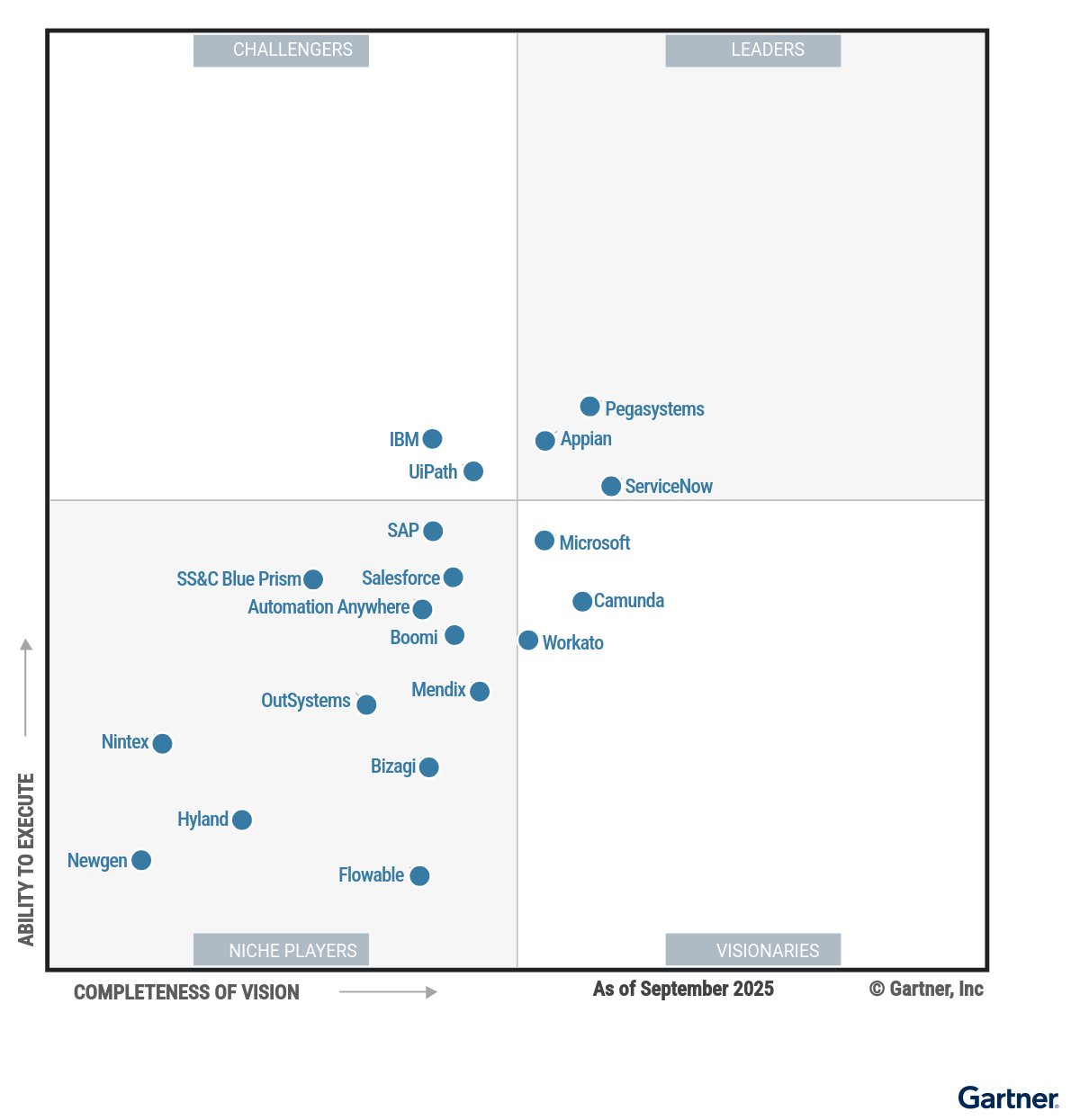
Vendor Strengths and Cautions
Appian
Appian is a Leader in this Magic Quadrant. It is a public company with customers predominantly in large and global enterprises, alongside a significant presence in the government sector. The majority of its customer base is in North America, followed by Europe, Asia/Pacific (APAC) and Latin America. Appian serves clients in an array of verticals, including government; banking, financial services and insurance (BFSI); healthcare; and manufacturing.
The top three roadmap items for its BOAT for the next 12 months are the enhanced AI Agent Studio for multiagent orchestrations, agentic robotic process automation (RPA) and Appian Composer for generating workflow plans.
Its BOAT platform is the Appian Platform, combining business process automation (BPA), RPA, low code, AI and a data fabric. A notable feature is its data fabric, which enables a single, real-time view of business data needed for complex process orchestration.
- Comprehensive BOAT: Appian provides a tightly integrated platform consolidating automation technologies like BPA, RPA, intelligent document processing (IDP), low-code, AI agents and case management. Its process orchestration actively supports interoperability standards such as business process model notation (BPMN) 2.0 and decision model notation (DMN), making it suitable for complex and regulatory processes.
- Platform operations: Appian’s platform offers end-to-end observability via dashboards, real-time logs and metrics (including AI agents). Its Kubernetes-native architecture ensures autoscaling, high availability and disaster recovery (HA/DR), automated alerting, and integrated DevOps for resilience.
- Appian ecosystem: Appian has a global network of more than 300 delivery partners and has trained thousands of customer and partner employees in the past 12 months, illustrating a strong support network. Additionally, Appian supports customer success with extensive training programs through Appian Academy and robust documentation and self-service capabilities.
- Product price and licensing: Some customers report higher-than-expected total cost of ownership (TCO) when scaling beyond departmental or midsized deployments. Appian is expected to introduce usage-based pricing in 2026.
- Orchestration of high-volume microservices: While strong for case and workflow orchestration, Appian’s depth in handling ultra-high-volume microservices orchestration is more limited. Highly distributed, real-time environments may require complementary solutions.
- Emerging AI agent roadmap: According to Gartner client interactions, Appian has been slower than some of its peers in adopting AI orchestration and AI agents. Appian’s core AI Agent Studio is in beta and planned to be released for general availability in 4Q25.
Automation Anywhere
Automation Anywhere is a Niche Player in this Magic Quadrant. It is a private company with customers in large enterprise and midsize organizations. It has customers worldwide, supported by engineering and support centers in North America and India. Automation Anywhere serves clients in an array of verticals prioritizing BFSI, manufacturing and healthcare.
The top three roadmap items for its BOAT for the next 12 months are multiagent orchestration, enhanced computer use-based UI automation and real-time observability for AI agents.
Its BOAT platform is Automation 360. A notable feature includes its process reasoning engine (PRE), combining orchestration, insights and agentic capabilities.
- AI agent focus: Automation Anywhere’s focus on agentic process automation incorporates support for emerging open interoperability standards — including Google’s Agent2Agent (A2A) protocol and Anthropic’s Model Context Protocol (MCP) to enable multiagent ecosystems and cross-platform collaboration.
- Task automation: Automation Anywhere has been an RPA leader and offers a single platform combining RPA, document processing and AI agents to automate enterprisewide tasks, especially integrating legacy applications.
- Connectivity: Automation Anywhere offers a good number of prebuilt connectors to major enterprise applications (e.g., Salesforce, SAP, Oracle, Mainframe) and large language models (LLMs), alongside extensive native support for various messaging and transport protocols (REST, SOAP, GraphQL, gRPC, WebSockets, Kafka).
- Complex orchestration: To offer complex orchestration, Automation Anywhere recently embedded Temporal’s third-party orchestrator, which is still early in maturity. Its BOAT platform currently does not natively support rollback from failed process executions. Clients seeking deep process orchestration are advised to assess its case management and event-driven scenarios compared to established BPM-native platforms.
- Visibility outside RPA: Despite leadership in the RPA market and entry into agentic AI, Automation Anywhere does not come up often in Gartner’s client inquiries about enterprisewide process orchestration relative to other evaluated BOAT vendors.
- Governance: Automation Anywhere’s governance tools are maturing, but may require extra configuration for large BOAT programs. Several governance capabilities, such as measuring automation ROI, SLA tracking, ideation hubs, automation project planning boards and automation operating models, are from an OEM or third party rather than native.
Bizagi
Bizagi is a Niche Player in this Magic Quadrant. It is a private company with enterprise and midsize customers globally. It has key engineering and support centers in North America and Latin America. The company focuses on verticals prioritizing supply chain, BFSI and government.
The top three roadmap items for its BOAT for the next 12 months are enhancing AI agents with reinforcement learning, enabling vector similarity search for AI agents and introducing a natural language operations assistant.
Its BOAT platform, the Bizagi Enterprise Automation Platform, enables orchestration and automation capabilities natively through its BPMN 2.0-compliant IDE. A key feature is its AI Workers, which preprocess human tasks with controlled autonomy and reasoning, supported by Bizagi Enterprise Knowledge (RAG).
- Standards-based business process orchestration: Bizagi emphasizes BPMN-based standardization, with core orchestration and automation capabilities integrated natively into its unified platform. Bizagi complements process models with a fused (and virtualized) data-modeling environment. Together with strong support for the signal intermediate event (BPMN), this provides multiple-process orchestration capabilities.
- Business-IT collaboration and low-code capabilities: Bizagi’s low-code environment bridges business and IT teams, enabling faster solution development while maintaining governance. Its user-friendly process modeling and automation environment make it easier for business users to collaborate with technical teams in orchestrating automation at scale.
- Custom offer and rapid delivery: Bizagi often proposes a customized scenario-based offering that gives customers the flexibility to pick a process to orchestrate and automate. Upon customer’s choice, Bizagi typically builds and demonstrates the transformed process and the finished application within a few days.
- RPA: Bizagi has limited RPA capabilities. Its primary reliance on third-party tools for RPA suggests it may be a better fit for process-first automation initiatives that do not heavily depend on UI integration with legacy systems..
- On-premises and multicloud support: Bizagi offers a fully Microsoft Azure cloud-native platform as a service (PaaS) for new customers; on-premises deployment is no longer available for purchase. This limits options for organizations that require or prefer on-premises or diverse hybrid cloud deployments not tied solely to Azure.
- Pricing: Bizagi utilizes consumption-based pricing tied to total process steps, allowing customers to begin at a low entry point with unlimited users, developers and applications, scaling costs as value increases. While this model offers initial advantages, clients report challenges in forecasting usage and governing consumption as new processes are added.
Boomi
Boomi is a Niche Player in this year’s Magic Quadrant. It serves enterprise, midsize, and small and midsize business segments. Its customer base is distributed worldwide, with primary support in North America, Europe and APAC. Boomi’s vertical reach is broad, including BFSI, manufacturing and retail.
Top roadmap items for its BOAT for the next 12 months include a fully containerized BOAT runtime engine and advanced agent design capabilities.
Its BOAT platform is the Boomi Enterprise Platform — a cloud-native, multitenant solution that integrates connectivity, API management, data orchestration, and AI agent design and governance. A notable feature of Boomi’s platform is its Agentstudio, which acts as a neutral, centralized control tower for building, managing and governing diverse AI agents from multiple vendors across multicloud and multivendor environments.
- Unified AI agent management and connectivity: Boomi’s Agentstudio delivers centralized oversight for building and orchestrating AI agents from multiple vendors, addressing the challenge of “AI agent sprawl.” Boomi is recognized as an early integration platform as a service (iPaaS) innovator in AI agent enablement, with more than 50,000 AI agents in production, underscoring its neutrality and leadership in AI management.
- Unified license and deployment flexibility: Boomi’s strategic vision centers on offering integration, API management, data management and agentic AI capabilities under a unified license. Its support for public, dedicated, managed and self-hosted runtimes provides enterprises with deployment agility.
- Comprehensive Training and community support: Boomi has an extensive community of more than 250,000 members and offers complimentary training and certification programs. The integration of Boomi Answers, an AI-powered in-context learning assistant, further enhances user enablement and support.
- Limited business process orchestration: Boomi’s primary focus is on connecting systems and synchronizing data. Its workflow capabilities via Boomi Flow are best-suited for low to medium complexity use cases. While Boomi can address more complex use cases, it lacks the depth of other BOAT leaders in areas like long-running business process orchestration, case management, escalations and SLA management.
- No native RPA and IDP: Boomi’s platform does not include native RPA or IDP tools. Clients relying on legacy automation via UI interactions and intelligent document processing through Boomi may encounter fragmented interfaces, as these are often sourced from third-party solutions.
- Adoption reality: Gartner client inquiries indicate that Boomi’s platform is primarily adopted for its core connector-led orchestration and low-code workflows. Consequently, it is rarely the chosen solution for high-volume, human-centric case management or complex, multimonth workflows that demand stringent compliance and SLA enforcement.
Camunda
Camunda is a Visionary in this Magic Quadrant. It is a private company with customers in large enterprises. Its customer base is in North America, Europe and APAC. Camunda supports key verticals prioritizing BFSI, healthcare, government and telecommunications.
The top three roadmap items for its BOAT for the next 12 months are further innovation on its orchestration layer for AI agents, enabling data integration with Snowflake and BigQuery, and fostering self-optimizing processes and AI agents through execution history, copilots and memory-driven learning.
Its BOAT platform, Camunda 8, is a unified process orchestration platform for end-to-end business process automation. A notable feature includes its cloud-native Zeebe workflow engine, which brings speed, scalability and resilience.
- Standards-based orchestration: Camunda is built on industry standards like BPMN 2.0 and DMN, offering a common, executable language that enhances collaboration between business users and professional developers. This approach provides clear visual process representation and governance for complex workflows.
- API-driven automation: The platform offers APIs and client libraries across multiple programming languages for seamless integration with external systems and services. Custom APIs can be defined via low-code or OpenAPI specifications, enabling powerful, API-driven process automation across diverse IT landscapes.
- AI agent development and orchestration: Camunda natively supports and orchestrates multiagent systems, embedding AI agents directly within BPMN process models to blend control with dynamic, AI-driven reasoning. The platform enables in-platform AI agent development, deployment and governance without requiring a separate solution.
- IT pro-developer-centric user experience: Camunda is a code-heavy platform. Its product user experience is primarily tailored for professional developers, with its interface perceived as less intuitive for business users. While Camunda’s developer-led adoption is robust, some customers may prefer a broader automation platform.
- Migration dilemma from Camunda 7 to Camunda 8: Some existing customers are hesitant to upgrade due to significant architecture changes and perceived risk in migrating mission-critical processes. Camunda must balance the needs of its open-source community, as available within Camunda 7, with commercial priorities in Camunda 8. Prospective buyers should assess migration support and monitor how roadmap decisions affect feature availability, community engagement and long-term platform sustainability.
- Limited RPA and IDP: Camunda started supporting native RPA and IDP very recently. However, customers have not yet adopted those capabilities. Core AI/ML capabilities like labeled datasets or importing pretrained models are typically provided by third parties. Comprehensive IDP reporting and advanced analytics often necessitate integration with external BI tools.
Flowable
Flowable is a Niche Player in this Magic Quadrant. It is a private company with enterprise customers. Its major presence is in Europe and North America. Flowable serves clients in an array of verticals prioritizing BFSI and government.
The top three roadmap items for its BOAT for the next 12 months are integrating AI natively into its case engine for autonomous agent-driven handling, enhancing multiagent orchestration to support diverse LLMs and external agents, and introducing AI-driven testing.
Its BOAT platform consists of the Flowable Platform and Flowable AI Studio. A notable feature is its AI orchestration capability, which defines flows to call multiple AI agents and utilizes case/process context for prompt evaluation.
- Standards-based orchestration: Flowable supports industry standards like BPMN, CMMN and DMN, supporting strong process modeling, decision management and case management infused with AI-driven capabilities. Features include structured and unstructured data as case context, persistent data links, and conversational workflow design.
- Modular architecture: Flowable’s lightweight, embeddable engine allows integration into existing applications and platforms. Clients can embed orchestration in digital products or microservices, supporting tailored automation strategies and scalable architectures.
- Case management and human-centric workflows: Flowable is known for its strength in case management. Customers typically value Flowable’s ability to support long-running processes, adaptive process flows and AI agent support for knowledge workers involved in case-based processes.
- Market presence: Flowable’s limited market share and geographical coverage may restrict access to certified integrators and large-scale delivery expertise outside of Europe and North America. Clients should verify availability of and access to experienced resources or partners for complex or global deployments and continued support.
- Ease of use: In Gartner’s client inquiries, clients often cite ease of use as a challenge with Flowable, as it typically demands significant technical expertise for deployment, customizations and maintenance. This can slow implementation timelines and limit involvement from non-technical business users, requiring organizations to invest in specialized skills or additional training.
- RPA and IDP: Flowable has lagged behind in native product capabilities compared to its peers. Flowable offers limited RPA and IDP capabilities. Its connectors lack the depth and breadth offered by its competitors. Additionally, Flowable’s analytics and reporting capabilities remain less advanced than those of other vendors.
Hyland
Hyland is a Niche Player in this Magic Quadrant. It is a private company with enterprise customers. It has a strong presence in North America and EMEA, and a focus on Latin America and APAC. Hyland serves clients in an array of verticals prioritizing healthcare, financial services, insurance and government.
Hyland’s top three roadmap items for its BOAT for the next 12 months are agent-to-agent orchestration, vibe coding in Content Innovation Cloud Studio and verticalized enterprise agents.
Its BOAT platform is Content Innovation Cloud, which includes Automate, Agent Builder, IDP and RPA. A notable feature includes its zero-shot classification and extraction engine for documents, which requires no templates or training.
- Content-focused automation platform: Hyland’s Content Innovation Cloud (CIC) offers an automation stack that natively orchestrates APIs, RPA bots, AI agents and microservices alongside BPMN-driven processes, operating directly on structured and unstructured content. This platform provides a robust process repository for storing, versioning and governing all automation artifacts.
- Document-heavy case management: Hyland’s native case management features enable orchestration of document-rich processes, supporting regulated industries such as insurance, healthcare and government. Organizations handling document-heavy cases can streamline operations and improve oversight.
- Native automation capabilities: Unlike other evaluated vendors that rely on open-source RPA, computer use or agentic document processing, Hyland has recognized native capabilities across RPA and IDP. As such, buyers of Hyland’s BOAT capabilities are less likely to need to augment automation capabilities with third-party tools.
- Content-first BOAT focus: Hyland’s vision is highly content-centric, prioritizing “document-grounded orchestration” and a “content-native foundation.” This approach may limit its applicability for organizations primarily seeking a broader platform for diverse use cases not centered on content.
- Enterprisewide orchestration: Hyland’s orchestration is BPMN-compliant and event-driven through its Activiti roots. However, Gartner’s clients rarely mention it as a strategic choice for enterprisewide orchestration. Hyland’s roadmap for advanced agent orchestration is later (2026), indicating a slower pace toward agentic vision. Furthermore, its AI integration and event processing are less mature than competitors.
- Business process automation adoption: Hyland appears rarely in Gartner’s client inquiries on process automation, with sparse uptake of Content Innovation Cloud. Customers primarily use OnBase, Alfresco, Perceptive or Nuxeo, where automation is fragmented and not BOAT-centric.
IBM
IBM is a Challenger in this Magic Quadrant. It is a public company with enterprise customers worldwide, the majority of which are in North America and Europe, followed by APAC and Latin America. IBM serves clients in an array of verticals including BFSI, manufacturing, government and healthcare.
The top three roadmap items for its BOAT for the next 12 months are enhancing AI agent access from workflows, process-intelligence-driven planning, and prebuilt, domain-specific AI agents.
Its BOAT platform consists of IBM Cloud Pak for Business Automation (CP4BA) with IBM watsonx Orchestrate (wxOrchestrate). A notable feature of IBM’s BOAT platform, specifically CP4BA with wxOrchestrate, is its strong process-centric focus on AI agent building and multiagent orchestration.
- Case management and process orchestration: IBM offers a strong set of capabilities that combine advanced workflow automation, case handling, content orchestration, document handling and process orchestration. This helps enterprises to manage complex cases, automate decision making and ensure compliance.
- Native AI: Deep integration with watsonx.ai enables document understanding, natural language processing (NLP) and decision automation directly within orchestration flows. Organizations can accelerate AI-enabled automation without extensive custom development, though alignment with specific business objectives should be evaluated.
- Hybrid and multicloud flexibility: IBM supports hybrid deployments and containerized workloads, with security and compliance controls for both cloud and on-premises environments. Enterprises can orchestrate processes across mixed environments while maintaining data residency and compliance, though careful planning is needed to optimize deployment and governance.
- BOAT packaging: Bringing IBM’s numerous building blocks for BOAT together into a tailored, end-to-end solution requires significant development effort. IBM’s product strategy lacks clarity on how many products a customer needs to buy to use wxOrchestrate with general process orchestration, leading to concerns about confusing licensing requirements.
- Resource-intensive platform and product UX: In Gartner inquiries, clients often cite IBM implementations as resource-intensive and requiring longer ramp-up times compared to lighter-weight platforms, potentially delaying return on investment. Clients also mention platform complexity and UX that does not look modern when compared to other established vendors.
- Ecosystem and tooling dependencies: Advanced RPA and specialized AI workflows may require partner tools or third-party integrations, increasing dependency management and licensing costs. Clients should factor in additional governance and budget considerations when planning complex automation initiatives.
Mendix
Mendix is a Niche Player in this Magic Quadrant. It is an entity within Siemens AG — a public company with mostly enterprise, and some midsize and SMB customers. Mendix has customers worldwide. It serves clients in an array of verticals including BFSI, manufacturing and the public sector.
Mendix’s top three roadmap items for its BOAT for the next 12 months are ad hoc tasks in Workflow (per BPMN) and decision tables (per DMN), multiagent orchestration with a domain-specific language, and enhancements to its data fabric and AI Ops.
Its BOAT platform, the Mendix Platform, is an AI-powered innovation solution integrating low-code development, AI app generation and native agentic automation. Notably, Maia for Software Development delivers AI-assisted support across the full software development life cycle.
- Low-code development with process orchestration: Mendix combines low-code application development with simple-to-moderate process orchestration features, enabling rapid delivery of automation-enabled apps. This allows organizations to shorten development cycles while aligning process logic directly within business applications.
- Product flexibility: Mendix provides a unified development environment for both professional and citizen developers, enabling seamless collaboration on application models. It natively supports the orchestration of AI agents, including tools for building and integrating autonomous agents within workflows.
- Strong platform operation: Mendix offers comprehensive governance features such as visual DevOps workflows, centralized cloud settings governance and application portfolio management. It also boasts extensive native security features, including encryption at rest and in-flight, role-based access control (RBAC) at various levels and numerous security certifications (e.g., ISO 27001, SOC 2 Type II, FedRAMP).
- Limited native automation capabilities: Mendix does not have native RPA and IDP. Broader automation needs, such as RPA, often require third-party platform integration with Mendix. This can increase integration complexity and dependency management. Mendix currently lacks a web-based IDE, support for virtual machines or runtime environments like Node.js, and WebAssembly support for agentic frameworks such as LangGraph and AutoGen.
- Scaling enterprise use cases: Building simple applications is quick, but scaling to complex, high-volume orchestrations requires architectural planning and governance. This can slow time to value for large programs if best practices are not established early.
- Orchestration gaps: Mendix supports simple workflow orchestration, but high-scale, high-volume tasks and complex process orchestration scenarios push beyond its native strengths, often requiring external orchestration.
Microsoft
Microsoft is a Visionary in this Magic Quadrant. It is a public company with customers primarily in large and global enterprises across the globe. Microsoft serves clients in an array of verticals including BFSI, healthcare, manufacturing and government.
Microsoft’s top three roadmap items for its BOAT for the next 12 months are additional first-party computer use agents, expanded multiagent orchestration with A2A communication protocol, and enhanced agent governance and analytics.
Its BOAT platform is the Microsoft Power Platform, which includes Power Automate with Copilot Studio, Dataverse and Azure Logic Apps. Notable features include Azure AI Foundry, which delivers 11,000 AI models and AI-embedded RPA capabilities such as combined screen recording with natural language instructions.
- BOAT with an AI-first approach: Microsoft offers a comprehensive suite of AI capabilities, such as Azure AI infrastructure and low-code agent development, all with embedded trust and compliance. The platform’s security and governance features are evolving to support secure, enterprise-grade AI adoption.
- Governance and scalability: Microsoft provides tools for managing and scaling automation across the enterprise. The Power Platform admin center offers a centralized, streamlined interface for administrators to govern agents, flows, makers and processes. This is a big area of investment from Microsoft but still in progress.
- Global reach and partner ecosystem: Microsoft leverages its global infrastructure and extensive partner network to deliver solutions and support in every region. Its broad reach ensures access to local expertise and resources, enabling tailored implementations. Clients benefit from reliable support and the flexibility to address region-specific needs, accelerating automation rollouts.
- Lack of process orchestration depth: Microsoft’s BOAT platform lacks native support for advanced cross-process communication (e.g., BPMN signal events), limiting robust coordination for complex, enterprisewide workflows further exacerbated by the architectural split between Copilot Studio and Power Automate.
- Fragmented BOAT platform: Microsoft’s automation portfolio spans multiple overlapping products — Copilot Studio, Power Automate, Azure Logic Apps and more. This fragmentation leads to navigational UX challenges and also creates integration, governance and ownership complexity for enterprise buyers.
- Complex pricing structure: Microsoft’s pricing spans consumption-based models including per-user, per-bot, per-workflow, per-page and per-message charges across Copilot agents, Power Platform, Dataverse and Azure. Buyers often face challenges forecasting costs and optimizing licensing for large-scale, multiproduct deployments.
Newgen
Newgen Software Technologies is a Niche Player in this Magic Quadrant. It is a public company serving enterprise customers. Its customer base is in India, the Middle East, APAC and North America. Newgen serves clients in an array of verticals, prioritizing BFSI, government and healthcare.
The top three roadmap items for its BOAT for the next 12 months are adaptive self-learning workflows, expanded multimodal GenAI support and prebuilt cross-industry agent packs.
Its BOAT platform is the NewgenONE Platform that combines enterprise content management, BPM, low code and RPA. A notable feature is NewgenONE Agent Studio, a purpose-built, low-code studio natively integrated into the NewgenONE platform for creating, deploying and orchestrating AI agents.
- Content-first BOAT focus: Newgen combines robust content management with BPM and case management, making it effective for document-heavy, regulated processes. This enables organizations to unify content life cycle management with process orchestration for better compliance and auditability.
- Regulatory fit: The platform has proven adoption in banking, insurance and government, with prebuilt frameworks for sector-specific compliance. This reduces customization effort and accelerates deployment in industries with complex regulatory demands.
- Integrated low-code: Built-in low-code tools allow faster creation of process applications with embedded automation and integrations. This supports quicker iteration cycles and enables business-IT collaboration in delivering process solutions.
- Document-centric workflow focus: NewgenONE lacks productized full event choreography, requiring significant configuration for complex, end-to-end process coordination across disparate systems. Its strong content-first/document-centric case management focus limits its appeal to customers looking for non-document-centric and process-heavy workflow automation.
- Concentrated vertical support: Newgen’s primary prominence and deepest expertise are concentrated in highly regulated, process-heavy industries such as BFSI, government and healthcare. While this specialization is a strength for clients in these sectors, it may indicate a less-developed market penetration strategy or fewer tailored solutions for a broader range of less-regulated or highly diversified industry verticals.
- Developing presence in key global markets: While Newgen is expanding its presence in North America and Europe, its strongest established footprint remains in India, the Middle East and APAC. This suggests that market penetration and brand recognition in some other key global regions may still be in a growth phase, potentially leading to fewer local references or a less-extensive direct support network compared to more globally entrenched competitors.
Nintex
Nintex is a Niche Player in this Magic Quadrant. It is a private company with midsize and enterprise customers. Nintex has a strong presence primarily in North America, Europe and APAC. It serves clients in an array of verticals prioritizing financial services, government and manufacturing.
The top three roadmap items for its BOAT for the next 12 months are expanding foundational AI agent capabilities, platform consolidation, and product enhancements in capabilities like event-driven orchestration, document processing and data management.
Its BOAT platform is Nintex Automation CE, a cloud-based platform that unifies process management, workflow, applications, RPA, document generation and eSign capabilities. Notable features are its comprehensive AI-assisted design and solution generation capabilities, specifically tailored for midmarket usability and full-cycle automation.
- Orchestration and ease of use: Nintex prioritizes simple-to-moderate orchestration capabilities and ease of use. This enables both business users and IT professionals to leverage drag-and-drop interfaces and AI-based design assistants for process, form, workflow and application creation.
- Comprehensive automation stack: The platform offers a full-cycle automation stack encompassing process definition, management, forms, workflow orchestration, task automation, document automation and app development. This integrated approach allows organizations to build and manage end-to-end automation solutions on a single platform.
- Extensive reusability and cross-system connectivity: Nintex supports the creation and reuse of modular components such as workflow snippets, connectors and form plug-ins. It also facilitates easy integration with multiple systems of record through its connectors, API framework and AI builders. This promotes standardization, accelerates development, and ensures seamless interactions across disparate systems.
- Dependency on the Microsoft ecosystem: Despite Nintex’s evolution to a Microsoft-agnostic CE platform, its deepest integrations and historical strengths remain mostly integrated with Azure, SharePoint, and Office 365. Although Nintex maintains integration with several non-Microsoft applications, clients should assess any incremental configuration steps, especially within a non-Microsoft ecosystem.
- Complex orchestration: Gartner’s customers have noted that while Nintex Automation CE performs well for departmental workflows, it faces challenges with handling complex, enterprise-level orchestration. As per Nintex, complex event-driven orchestration is on the near-term roadmap for Nintex Automation CE (within the next six months).
- AI and agentic automation: Nintex’s capabilities in AI-driven orchestration and agentic automation are still developing. The platform currently relies on third-party tools for most agentic functions, with many native capabilities listed as “not available” as of its release up to March 2025. Key native features, including an Agent Studio and AI runtime actions, were planned for release after 31 May 2025 and thus have not been evaluated for this research.
OutSystems
OutSystems is a Niche Player in this Magic Quadrant. It is a private company serving enterprise customers with presence in North America, EMEA and APAC. It serves clients in an array of verticals; its top three are professional services, BFSI and technology.
The top three roadmap items for its BOAT for the next 12 months are multiagentic workflows, Mentor (a guided low-code expertise feature), enhancement enabling AI-driven design of agentic automation, and several enhancements for complex workflows, including parallelism.
Its BOAT platform is the OutSystems Platform, providing cloud-native, cloud-ready and self-managed options. Notable features include low-code development, AI agent building and strong API connectivity.
- Low-code development: OutSystems comes from a low-code heritage and enables rapid application delivery with UX-friendly tooling and reusable components, allowing organizations to quickly build and iterate simple to moderate workflow applications. This accelerates innovation but may require governance measures to ensure consistency and maintainability as teams scale development.
- API creation and connectivity: The platform offers robust API integration and connector support, enabling linkage with enterprise systems and external services. This supports embedding process steps into broader application ecosystems without heavy middleware dependency. OutSystems allows customers to create APIs to be used by other systems.
- Platform operations: Built-in continuous integration/continuous delivery (CI/CD) pipelines, versioning and monitoring tools help streamline application life cycle management, improving operational agility and reducing overhead for maintaining production-grade applications. This can enhance reliability and responsiveness, but organizations should assess how these capabilities align with their existing DevOps and IT operations practices.
- Complex process orchestration: Gartner’s customers indicated that OutSystems’ platform is less suited for orchestrating complex, multisystem, long-running processes, which limits its applicability for end-to-end enterprise process automation. Organizations may need to invest in a dedicated orchestration layer or supplementary platforms for these scenarios, adding architectural and operational overhead.
- BOAT focus: OutSystems does not come up often in Gartner inquiries related to BOAT and business process automation. This can restrict its role in enterprisewide automation, making it important for organizations to carefully scope projects and avoid overextension beyond the platform’s core strengths.
- RPA, IDP and computer use: OutSystems does not have native RPA nor IDP, nor does it support computer use. Broader automation needs such as RPA, event-driven processing or complex orchestration often require third-party platform integration with OutSystems. This may increase integration work, cost and governance complexity, so organizations should plan for additional vendor management and ensure robust oversight of automation workflows.
Pegasystems
Pegasystems (Pega) is a Leader in this Magic Quadrant. It is a public company serving predominantly large enterprises such as large global enterprises, with a strategy to scale into new segments through partners. Pega has a strong presence across North America, Europe and APAC, with increasing focus on Latin America and the Middle East. It serves clients in various verticals, including BFSI, technology and government.
The top three roadmap items for its BOAT in the next 12 months include AI-powered legacy transformation with Pega Blueprint, expanding Predictable AI agents and self-service, and enhancing the Pega Agentic Process Fabric.
Its BOAT platform is the Pega Infinity platform, which combines low-code, BPA, RPA, case management, IDP and agentic AI for enterprise-grade automation. Notable features of Pega’s BOAT platform are its Predictable AI agents and the Agentic Process Fabric to deliver governed, enterprise-grade AI automation with scalable orchestration.
- Unified BOAT platform: The Pega Infinity platform excels at bringing together workflow automation and case management in a single, unified platform, underpinned by its comprehensive business rule management system and predictive analytics.
- Innovation: Key innovations from Pega include Blueprint for autogenerating workflows, Predictable AI agents for transparent and contextual automation, Agentic Process Fabric for unified orchestration, Customer Engagement Blueprint for real-time journey automation and an AI-driven Process Mining assistant.
- Partner strategy and vertical depth: Pega’s 2025 strategy centers on scalable, partner-led growth. Pega delivers deep industry-specific frameworks with its partners, who leverage Pega Blueprint to co-design solutions and embed their IP, which enables faster, repeatable delivery.
- Pega skill requirements: Deploying and customizing Pega for enterprise-scale orchestration demands specialized expertise. Customers sometimes find the initial architecture difficult to set up due to its complexity, particularly the “situational layer cake” approach, suggesting that experienced assistance from Pega or its partners is advisable.
- SaaS dependencies: Many of Pega’s new capabilities aimed at the BOAT market are better-positioned for clients that will have or already have Infinity deployed in SaaS mode. On-premises clients should consider migrating to the cloud or suffer “environment stagnation.”
- Platform complexity and lock-in: Gartner customers often report concerns around high TCO and high degree of vendor lock-in. The comprehensive capabilities of the Pega platform typically come with premium licensing and infrastructure requirements.
Salesforce
Salesforce is a Niche Player in this Magic Quadrant. It serves a broad range of customers from SMBs to large enterprises. It has a strong presence across the globe, with ongoing global expansion through its Hyperforce initiative and partner ecosystem. Salesforce serves clients with more than 15 industry clouds, including BFSI, healthcare, life sciences, retail and manufacturing.
The top three roadmap items for its BOAT for the next 12 months are enhancing multiagent orchestration, natively integrating RPA and IDP into business processes, and strengthening agent governance.
Its BOAT platform, Salesforce Platform, encompasses Flow Orchestration, MuleSoft automation, Agentforce and Data Cloud. In 2025, Salesforce announced its acquisition of Informatica, which was critical to its data cloud strategy. A notable feature for Salesforce’s BOAT is Agentforce, an AI agent platform designed to build and deploy AI agents at scale for various business functions, incorporating a Trust Layer and Atlas Reasoning Engine.
- BOAT with an AI-first approach: Salesforce prioritizes AI agent building and deployment, leveraging its Agentforce platform to create and orchestrate AI agents for diverse business functions at scale. The platform offers extensive connectivity through MuleSoft (more than 430 connectors) and Data Cloud (more than 270 connectors), enabling integration with a wide array of enterprise applications and external systems.
- Task automation: Salesforce has established competencies across UI integration, API connectivity and application building. Compared to other vendors with recently launched automation capabilities built on open-source solutions, Salesforce technologies support a broad range of automation needs.
- Partner ecosystem: Salesforce leverages more than 16,000 partners globally across more than 100 countries for broad market reach and localized expertise. With one of the largest enterprise marketplaces, Salesforce provides prebuilt connectors, apps and partner-led extensions to enhance rapid task automation.
- Fragmented BOAT: Salesforce provides multiple orchestration options, such as Flow Orchestration, MuleSoft and Agentforce. In Gartner inquiries, clients often express their challenges to understand use case alignment at different levels — tasks, processes and agentic, each requiring a fit-for-purpose approach.
- MuleSoft dependency: For cross-system orchestration, customers often rely on MuleSoft, which may involve additional licensing and enablement. This has been cited by clients as a consideration for TCO and rollout planning.
- Limited adoption for enterprisewide orchestration: Flow Orchestration adoption is still in early stages, and customers currently mostly apply it to Salesforce-managed processes. Customers looking for cross-system orchestration involving non-Salesforce applications may need additional purchases, guidance and enablement from Salesforce.
SAP
SAP is a Niche Player in this Magic Quadrant. It is a public company, servicing large and midsize customers across all geographies. SAP reports broad industry coverage across more than 25 industries, prioritizing verticals such as BFSI, government, manufacturing and retail.
The top three roadmap items for its BOAT platform are enablement of custom agentic capabilities supported by a unified MCP layer, introducing next-generation GenAI-enabled development with embedded security and integration of enterprise service management with business process execution.
Enterprise automation with SAP combines Build Process Automation, Signavio, Joule Studio and SAP Integration Suite. Its notable features include embedded GenAI for process automation, as well as comprehensive governance across enterprise workflows.
- BOAT with an AI-heavy approach: SAP’s strategy is AI-heavy, leveraging AI and a suite of applications to orchestrate and automate end-to-end business processes. Its Business AI capabilities aim to provide out-of-the-box agentic automation with some integration to business processes running in SAP Business Suite. This is particularly beneficial for existing SAP customers.
- Process intelligence and governance: SAP offers native process mining for both SAP and non-SAP systems, with process modeling and automation requiring Signavio Process Transformation Suite. This includes Process Insights (analysis for standard SAP processes), Process Intelligence (for custom models) and Process Manager (process modeling component).
- Automation accelerators: SAP provides a catalog of accelerators to deliver automation faster. This includes best-practice process models in a central repository. There are more than 3,900 prepackaged integrations, 4,500 APIs and 1,400 events available to jump-start integrations. Additionally, SAP offers specialized industry-specific automation with more than 7,000 process models and 3,000 metrics.
- BOAT clarity: SAP’s automation stack is perceived as rather complex and difficult to navigate, which may require organizations to invest additional time in solution mapping or to turn to additional SAP products or third-party tools.
- BOAT completeness: SAP currently does not natively support multiagent orchestration. Computer use agents are also not available. Automation and orchestration capabilities are supported by two integrated products, SAP Build Process Automation and SAP Integration Suite. Customers may need to consider any additional efforts required in customization and configuration while using them.
- SAP-centric automation: Although Enterprise automation with SAP supports BOAT as a stand-alone offering and its strategy is system-agnostic, the BOAT offering focuses predominantly on SAP ERP clients. Customers looking to adopt SAP’s BOAT offering are advised to validate its product against non-SAP use cases.
ServiceNow
ServiceNow is a Leader in this Magic Quadrant. It is a public company with customers in large enterprises and the majority globally with strong presences in North America, Europe and Asia, and with Latin America as a future growth region.
The top three roadmap for its BOAT for the next 12 months are a new AI engagement layer for human-AI collaboration, Voice Agents and enhanced enterprise connectivity with multiagent orchestration.
Its BOAT platform is the unified ServiceNow AI Platform that combines low-code, BPA, RPA and AI agents. Its notable features include an AI-first platform, facilitating multiagent orchestration via the low-code AI Agent Studio, as well as AI Agent Fabric to connect diverse agents. ServiceNow’s Workflow Data Fabric is a comprehensive offering for application and data integration, including real-time data.
- BOAT platform and scalability: ServiceNow unifies orchestration, RPA, AI and workflows on a single platform with native data and governance. Its high-performance RaptorDB Pro database handles tens to hundreds of millions of rows. This robust, scalable foundation supports demanding enterprise workloads and complex AI initiatives.
- Multiagent orchestration and openness: ServiceNow prioritizes multiagent orchestration, with its AI Agent Fabric supporting protocols like MCP and A2A to connect AI agents from any platform. This provides clients with a flexible platform for complex, cross-platform automation, ensuring that diverse AI systems and tools can collaborate seamlessly and openly.
- Governance and observability: ServiceNow offers centralized governance via AI Control Tower and Automation Center, enabling monitoring of AI/agentic behavior alongside traditional processes. This includes auditability for user actions and AI model interactions.
- Proprietary modeling standards: While ServiceNow’s design interfaces are inspired by BPMN and DMN, the platform does not formally support these or other industry-standard notations like case management model and notation (CMMN), and Business Process Execution Language (BPEL) . This may present challenges for clients migrating from or integrating with systems that strictly adhere to these formal standards, potentially necessitating additional conversion or adaptation work and increasing integration complexity.
- Potential for custom integration development: Although ServiceNow integrates with various tools, a strong reliance on prebuilt Integration Hub spokes means that clients might encounter scenarios where deeply tailored or niche system integrations require substantial custom development. ServiceNow recently released new AI capabilities to address this, but they are not mature yet.
- Complex licensing and cost predictability: ServiceNow’s multitiered modules and add-ons, combined with consumption-based pricing, make it challenging for customers to forecast total costs and compare packages. This can lead to unpredictable expenses and limited contract flexibility as usage grows.
SS&C Blue Prism
SS&C Blue Prism is a Niche Player in this Magic Quadrant. It is a public company (as part of SS&C) with customers across all sizes. SS&C Blue Prism has its primary market in North America and Europe, while expanding its footprint in EMEA, India, APAC and Latin America. It serves clients in an array of verticals, including BFSI and healthcare.
The top three roadmap items for its BOAT for the next 12 months are orchestration enhancements with Chorus to enable dynamic orchestration, full event-driven support and continued AI Gateway development, which includes enhanced support for A2A, MCP and RAG as a service.
Its BOAT platform is SS&C Blue Prism Enterprise AI, a comprehensive platform focused on unifying automation, AI, orchestration and data. Its notable features include process orchestration, native AI agent building, and robust security and governance through its unified, private AI Gateway.
- Unified platform for automation: SS&C Blue Prism Enterprise AI unifies relevant BOAT technologies that include RPA, BPA, IDP and agentic orchestration. Its modular architecture promotes reusable components, accelerating solution assembly and ensuring consistency across workflows and applications for clients with a strong focus on AI governance.
- AI capabilities: The platform offers native IDP through Chorus Document Automation and Blue Prism Decipher IDP integrated directly into the orchestration layer. It also supports integration with multiple LLMs and “Bring Your Own Model” scenarios. New agentic and AI features are first deployed through SS&C’s “Customer Zero” program, running live in SS&C business operations to validate stability, maturity and governance before release to the broader customer base.
- Accelerators and asset library: SS&C Blue Prism provides access to more than 1,700 prebuilt assets and more than 1,000 frameworks/accelerators via its Digital Exchange (DX), enabling rapid time to value for clients.
- RPA-centric platform: SS&C’s platform has an RPA-centric heritage, and its Chorus orchestration component is cited by some of Gartner’s clients as less robust compared to established BPA counterparts. Additionally, separate logins are typically required for different BOAT components, which may impact a unified user experience.
- Agentic capabilities: While SS&C Blue Prism provides support for multiagent orchestration, it is still undergoing ongoing development to enhance these capabilities. Furthermore, internal agentic framework is not directly exposed for end-user agent building.
- Industry focus: With Chorus, SS&C Blue Prism offers well-regarded orchestration capabilities, but the majority of customers on Chorus are in the BFSI and healthcare sectors. Outside those verticals, SS&C Blue Prism is more well-known for its RPA capabilities.
UiPath
UiPath is a Challenger in this Magic Quadrant. It is a public company with customers across all sizes, including nearly two-thirds of the Fortune 500. UiPath has a global presence, serving clients in diverse verticals such as banking and financial services, manufacturing and professional services.
The top three roadmap items for its BOAT for the next 12 months are orchestration enhancements in Maestro for flexible rule logic, native MacOS UI automation, enterprise-grade Agent Builder enhancement and packaged agentic solutions.
Its BOAT platform is the UiPath Platform. A notable feature is UiPath Maestro, which serves as UiPath’s orchestration layer to orchestrate the bots, API, AI agents (both UiPath and third-party), and people within long-running and complex business processes.
- AI capabilities: UiPath provides native support for multiple LLMs, large action models (LAM), and enterprise RAG, including specialized native SLMs like DocPath and CommPath for IDP. It emphasizes an open, multiagent framework, supporting interoperability protocols like MCP and A2A, which enables multiagent systems across complex, cross-functional workflows.
- Extensive marketplace and community: UiPath has a large developer community with more than 3 million members and offers free online training (UiPath Academy) and certifications. Its Autopilot for Developers offers GenAI-assisted development, enabling users to generate workflows, code and test cases via natural language prompts.
- Task automation: UiPath has long excelled in RPA. It acquired an iPaaS provider (Cloud Elements) in 2021, and has leading document processing capabilities. As such, UiPath is well-suited to automate processes that require legacy systems integration, strong API connectivity and controls, and the ingestion and analysis of semistructured documents.
- Process orchestration: Customers in Gartner inquiries questioned UiPath’s orchestration efficiency for complex, long-running workflows. Despite embedding Temporal’s orchestrator within Maestro in April 2025, potential buyers should recognize that UiPath’s process orchestration capabilities are still new, with very limited customer feedback relative to more established orchestration tools. .
- Diluted BOAT focus: UiPath is investing in agentic orchestration as a core pillar of its product strategy. Gartner’s client conversations often cite UiPath’s prioritization of AI agents, RPA and IDP over enterprise-grade orchestration. This could prompt customers to perceive UiPath as a more specialized agentic or RPA platform rather than a first-choice BOAT platform.
- Pricing: Several Gartner clients have noted that proposals for RPA and AI agent capabilities were unexpectedly expensive. While some BOAT features, such as UiPath Apps, are not consistently viewed as costly, prospective buyers should carefully assess whether UiPath’s pricing aligns with their budget requirements.
Workato
Workato is a Visionary in this Magic Quadrant. It is a private company serving a broad range of organizations globally, including midsize, large and global enterprises, with strong presence in North America, EMEA and APAC.
Workato’s top three roadmap items for its BOAT for the next 12 months are Workato AIRO, enabling declarative-style GenAI driven development; Enterprise Skills Marketplace with reusable verified AI skills; and Workato Xchange as a centralized hub for curated assets, orchestrations and AI agents.
Its BOAT platform, Workato One, is a unified enterprise orchestration platform and cloud-native solution for end-to-end business process automation. A notable feature is its “Enterprise Skills” within the Agent Studio, which empower AI agents (“Genies”) to execute deterministic, repeatable and verifiable actions across enterprise applications.
- Unified cloud-native platform: Workato delivers a single, cloud-native platform with all customers on the latest version, supported by more than 700 minor releases annually. This ensures rapid access to new features, minimizes migration effort and accelerates time to value while reducing operational overhead.
- Innovation: Workato’s innovation is in agentic AI. It embeds user-friendly intelligence at its orchestration layer, leveraging AI Copilots and AIRO for natural language-driven process and agent creation. Workato recently launched Workato Go Agent Action board for human-agent collaboration. Its Agent Studio empowers users to build AI agents (Genies), accelerating enterprise AI adoption.
- Broad connectivity and reusability: With its strong heritage in iPaaS, Workato provides more than 1,200 prebuilt connectors and a Connector SDK for custom APIs, enabling seamless integration across diverse systems. Extensive connectivity and reusable components simplify complex integrations and maximize development efficiency.
- Vertical focus and geographic investment: Workato’s current vertical strategy and geographic strategy are limited compared to some other BOAT vendors. It operates in only a few Amazon Web Services regions, which are placed across North America (Virginia), EMEA (Frankfurt, Tel Aviv) and APAC (Singapore, Tokyo and Sydney).
- Process modeling: Workato’s architecture prioritizes system connectivity over deep process design and modeling. Customers with requirements for advanced modeling or case management may experience functional gaps.
- BOAT visibility: Workato’s market visibility and adoption for its BOAT offering are relatively low. The platform does not come up often as a primary choice in Gartner’s client discussions focused on enterprisewide business process automation.
Vendors Added and Dropped
We review and adjust our inclusion criteria for Magic Quadrants as markets change. As a result of these adjustments, the mix of vendors in any Magic Quadrant may change over time. A vendor's appearance in a Magic Quadrant one year and not the next does not necessarily indicate that we have changed our opinion of that vendor. It may be a reflection of a change in the market and, therefore, changed evaluation criteria, or of a change of focus by that vendor.
Added
This is the first iteration of the Magic Quadrant for Business Orchestration and Automation Technologies; thus, no vendors were added.
Dropped
This is the first iteration of the Magic Quadrant for Business Orchestration and Automation Technologies; thus, no vendors were dropped.
Inclusion and Exclusion Criteria
To qualify for inclusion in this Magic Quadrant, vendors had to:
- Meet the BOAT market definition.
- Have a named platform offering BOAT capabilities that can be directly sold to customers.
- Demonstrate a clear and active go-to-market and sales strategy, primarily for BOAT, as demonstrated by their website, reviews on Gartner’s Peer Insights forum, social media communications, and direct or indirect marketing materials that explicitly mention BOAT or the vendor’s active presence in business process automation.
- Sell BOAT platform directly to paying customers without engaging professional services. Vendors had to provide at least first-line support for their BOAT capabilities. They must not sell their BOAT product solely to, and for the use of, its professional services and consultants.
- Offer a commercially supported enterprise offering — in other words, vendors must not offer their platforms as open-source software only.
- Obtain a minimum consolidated customer interest indicator (CII)* score greater than 30. This was determined by Gartner.
* A CII score is a weighted combination of many factors indicating customer interest in a vendor that includes Gartner inquiries, Gartner search, Google search, third-party website references, social media data, RFP references, Gartner PII data and more.
In addition, vendors had to satisfy one of the following criteria:
- At least $55 million in revenue in the financial year 2024 (FY24) from sales of BOAT software licenses, excluding revenue from professional services, consulting and any systems integrator support.
or - At least year-over-year revenue growth of 30% in FY24 from sales of BOAT licenses.
Vendors had to demonstrate global presence, with at least 3% of total customers (unique logos) each in at least three of the following regions as of 31 March 2025:
- North America
- Latin America
- Europe, the Middle East and Africa
- Asia/Pacific, including Japan and China
Vendors also had to offer the following capabilities natively within their BOAT platform or product as of 31 March 2025:
- Enterprise-level process orchestration that involves process repository, process composition, statefulness, subprocesses, choreography/sequencing and asynchronous task management.
- Orchestration of bots, AI agents, APIs and or microservices.
- Agentic capabilities including building, deploying and operating an LLM-based AI agent, RAG support and ability to support multiple LLMs.
- Process design, modeling and development (supporting standard notations such as BPMN 2.0 or DMN are not mandatory).
- Enterprise-level connectivity including API integration/connectors, and RPA or computer use or general screen scraping. Two of the three should be native capabilities.
- Processing documents and other types of unstructured data (emails, audio) using multimodal AI, IDP and or agentic automation.
- Enterprise IT capabilities, including disaster recovery environments, high-availability support, CI/CD, software development life cycle management and multipersonal collaboration.
We excluded vendors that:
- Did not have a BOAT focus; that is, they either did not actively go to market with their BOAT platform, or did not meet the minimum customer interest indicator score for BOAT, indicating a lack of general visibility and market recognition within the BOAT space.
- Had open-source platforms supporting core capabilities of BOAT via API integrations with other third-party products (or other BOATs).
- Had orchestration-only platforms lacking broader connectivity focus, low-code and agentic AI focus.
- Only sold their BOAT product as licensed software along with development/professional services, where the product was used exclusively by the vendor’s consultants/service providers.
- Did not offer a commercial enterprise BOAT offering (that is, they offered a platform only as open-source software or a free community version).
- Would retire their BOAT platform by the end of 2025.
- Did not have a generally available BOAT platform as of 31 January 2025.
Evaluation Criteria
Ability to Execute
Product or Service: Gartner specifically looked for (1) the breadth and depth of a vendor’s BOAT platform; (2) cohesiveness of the platform and how integrated all capabilities are; and (3) depth of certain capabilities such as orchestration, connectivity and agentic automation.
Overall Viability: Gartner specifically looked for (1) overall sentiment about the vendor from the BOAT perspective (market, customer, investor); (2) net BOAT sales pipeline and depth of sales capability; and (3) operational strength in BOAT (investment in sales, marketing, product, innovation, engineering, support), global presence and number of employees.
Sales Execution/Pricing: Gartner specifically looked for (1) BOAT sales volume, pipeline and overall execution strength; (2) BOAT pricing clarity, flexibility and value for price; and (3) BOAT revenue, market share and growth.
Market Responsiveness and Track Record: Gartner specifically looked for (1) number of BOAT releases per year; (2) evidence of listening to the voice of the customer and a good short-term roadmap; and (3) overall upgrade quality, all from a BOAT perspective.
Marketing Execution: Gartner specifically looked for (1) effort from the vendor to make itself visible in the BOAT market (web, social media, print media, marketing narrative); (2) clarity of go-to-market messaging; and (3) brand awareness, market relevance and customer community strength.
Customer Experience: Gartner specifically looked for (1) customer satisfaction/feedback; (2) support focus and maturity; and (3) overall training, support and upgrade focus.
Operations: Gartner specifically looked for (1) number of employees supporting BOAT; (2) investment in product, marketing, sales, support and innovation labs; and (3) global presence, number of offices and developer community strength.
Ability to Execute Evaluation Criteria
| Evaluation Criteria | Weighting |
|---|---|
Product or Service | High |
Overall Viability | High |
Sales Execution/Pricing | High |
Market Responsiveness/Record | Low |
Marketing Execution | High |
Customer Experience | Medium |
Operations | High |
Source: Gartner (October 2025)
Completeness of Vision
Marketing Strategy: Gartner specifically looked for (1) product vision alignment to BOAT; (2) product clarity and number of native capabilities supported; and (3) market influence on BOAT.
Sales Strategy: Gartner specifically looked for (1) clear future product and market strategy for BOAT; (2) pipeline strength; and (3) effort to ramp up partner ecosystem.
Offering (Product) Strategy: Gartner specifically looked for (1) clarity of BOAT platform — number of products required to support BOAT; (2) number of native capabilities; and (3) cohesiveness of product UX and ability to offer great quality and depth for key capabilities with a clearly defined roadmap.
Business Model: Gartner specifically looked for (1) core market differentiation in narrative and demonstrated behavior; (2) vendor maturity; and (3) clear future product and market strategy on BOAT, including thought leadership.
Vertical Strategy: Gartner specifically looked for (1) number of verticals supported; (2) vertical-specific prebuilt components (bots, agents, templates); and (3) vertical depth (quality of prebuilt assets) and maturity.
Geographic Strategy: Gartner specifically looked for (1) number of regions supported; (2) specific geographic focus vs. global market reach for BOAT; and (3) sales, support, data center and customer base in different geographic locations.
Completeness of Vision Evaluation Criteria
| Evaluation Criteria | Weighting |
|---|---|
Market Understanding | High |
Marketing Strategy | High |
Sales Strategy | High |
Offering (Product) Strategy | High |
Business Model | High |
Vertical/Industry Strategy | Medium |
Innovation | High |
Geographic Strategy | Low |
Source: Gartner (October 2025)
Quadrant Descriptions
Leaders
Leaders have a record of strong execution and an ability to influence the market’s direction. Leaders tend to have a strong vision and market understanding, especially around end-to-end business process orchestration. They typically support enterprise-grade process orchestration, robust connectivity and leading-edge agentic automation capabilities.
Their platforms are cohesive and functionally rich, and there are regular releases to rapidly address the needs of this fast-evolving market. They have a clear product roadmap to solidify the product’s position and to help buyers protect their investments. They have a large network of partners that provide localized support and services to customers across most geographic regions.
Leaders are well-positioned to remain dominant as the BOAT market evolves. However, their status cannot be taken for granted. In the fast-moving BOAT market, vendors that lose focus will move out of the Leaders quadrant.
Challengers
Challengers offer competitive platforms that deliver value in multiple process automation scenarios but may be limited to certain industries or use cases, or focused on a specific domain. Challengers demonstrate the financial strength and commitment to compete in the BOAT market.
Challengers generally execute the types of work for which they offer certain functionality well, but have a lagging or incomplete view of the market’s direction. Sometimes this is due to a lack of innovation in product, marketing and/or sales strategies or a narrow focus on a single application domain. They often have a narrower focus of who the buyers are, what the use cases are or how users’ expectations will evolve. They may have a background in RPA, agentic AI, low-code development or enterprise process orchestration, or they may be just a component in a large vendor ecosystem, and may currently lack visibility or credibility outside of their existing customer base or domain. As a result, their offerings have a more limited appeal than those of Leaders.
Challengers may lack a coordinated strategy for the various products in their platform portfolio, or their platform roadmap may be less complete or more fragmented than that of Leaders. Alternatively, they may lag behind Leaders in terms of marketing, sales channels, geographic presence, industry-specific content and innovation. To mature their offerings, Challengers must improve in their specific areas of caution and match Leaders’ platform capabilities and roadmaps.
Visionaries
Visionaries demonstrate strong innovation with a good understanding of emerging technology and business trends. They understand the specific requirements of the market and align their BOAT capabilities with current demand by innovating their technologies, delivery models and go-to-market strategies. However, they may not have the sales and marketing expertise required to build awareness for their offerings and sell more widely. Typically, they lack strong process orchestration focus and/or native capabilities such as RPA, IDP or API connectivity.
Visionaries may have a background in traditional on-premises orchestration or connectivity tools or perhaps as cloud-native startups. They may see their BOAT offering as a key element of a broader orchestration and agentic strategy. They may branch out into providing features that support enterprise AI initiatives, hyperautomation use cases or application composition use cases by adding features for, respectively, AI agents, event-driven orchestration, or RPA or low-code application development.
To become Leaders, Visionaries must build stronger recognition of their platforms in new customer segments and drastically improve their sales strategy and execution to expand their market share.
Niche Players
Niche Players typically focus on one vertical, geographical or functional area, or only address a segment of the BOAT market, or may not even have all the capabilities as native and or unified within their platform. They may trail in broader market understanding and innovation because of less investment or focus or because they deliberately occupy a niche within the market. Typically, they lack strong process orchestration focus and/or native capabilities such as AI, RPA, IDP or API connectivity.
Niche Players may be startups or small companies, or even megavendors focused on a specific subset of use cases; or they may be vendors that provide a wide range of capabilities, but lack market understanding or focus for their products. They may even have a fragmented product portfolio with no clear vision to unify it. However, some of their individual technology offerings and degree of customer satisfaction within that segment may often be excellent.
Niche Players’ offerings can be suitable for organizations that require local presence and support, want a close relationship with a provider, or seek a platform that addresses specific industry use cases and functional requirements. Niche Players that can fulfill these specific requirements may offset the viability risks associated with smaller vendors.
Niche Players can mature and refine their offerings by improving their marketing strategy and fostering innovation.
Context
Business orchestration and automation technology platforms encompass a common set of capabilities from BPA, RPA, low-code, document management, intelligent document processing, AI agents and iPaaS, as well as other markets.
AI agent capabilities within BOAT typically focus on agent building, multiagent orchestration, agent-to-agent communications, model-context protocols, prompt-driven development, process insights, targeted content creation, unstructured data extraction, and orchestration of multiple LLMs.
A BOAT platform is designed for customers looking for a consolidated platform that can address an interconnected portfolio of capabilities instead of individual tools. A BOAT platform is used to address a wide range of business process automation use cases within the enterprise.
Enterprise application leaders value BOAT providers’ native orchestration, connectivity, AI agents, unified development and operations within a single platform. Customers typically looking to buy or blend instead of custom-build a solution would prefer a BOAT platform. Organizations also might end up with more than a single BOAT platform, depending on their focus on the orchestration depth, AI agent needs and/or connectivity requirements.
Market Overview
Enterprise process automation is entering a new phase as organizations seek to move beyond siloed RPA, low-code application platforms, iPaaS and BPA tools toward more integrated, intelligent solutions. At the same time, the rise of AI agents is reshaping how work gets orchestrated and executed.
Gartner forecasts that the software spending on BOAT is nearly $7 billion in 2025 and poised to grow at 33.9% year over year to surpass $21 billion by 2029.
Today BOAT platforms are rapidly evolving into adaptive, event-driven control layers that unify bots, humans, AI agents, APIs, services and applications. As organizations move toward autonomous business, BOAT provides the governance, connectivity and orchestration backbone required to ensure processes run seamlessly — whether managed by humans or AI.
Customers need BOAT because it delivers:
- A single orchestration pathway across fragmented automation tools
- Event-driven agility for microservices, AI agents and APIs
- Governance, transparency and compliance in autonomous operations
- Future-proof connectivity for an AI-driven enterprise
BOAT offers the following value propositions for the future of enterprise process automation.
A Consolidated Automation Platform
Enterprises are reducing tool sprawl, especially in the business process automation space. A BOAT offers a consolidated platform that handles a wide range of automation use cases with different capabilities, usually provided by individual specialist markets such as RPA, IDP, low-code, BPA, iPaaS and more.
Business Process Orchestration at the Core
BOAT ensures that future automation strategies will still have robust business process orchestration at their core, avoiding silos and fragmentation. As orchestration shifts to autonomous execution, BOAT embeds governance, transparency and compliance at every decision point, safeguarding trust in the future of automation.
Connecting AI Agents, Bots, APIs and Humans Together
Enterprises are deploying a hybrid workforce of humans, bots and AI agents, complicating where traditional, rigid process management leads to fragmentation and operational silos. As the modern connective tissue, BOAT platforms orchestrate this entire ecosystem by linking AI endpoints, enterprise systems and human workflows.
The Orchestrator of AI Agents From Multiple Vendors
Enterprises will soon deploy hundreds or thousands of specialized AI agents, creating a complication where these uncoordinated agents operate in silos and create operational chaos. BOAT platforms are therefore evolving into the essential “execution brain,” providing the central orchestration needed to coordinate, sequence and govern these multiagent systems within a business process. By supporting agent interoperability and embedding agents into workflows, BOAT enables enterprises to build and scale reliable autonomous operations.
Acronym Key and Glossary Terms
| A2A | Agent2Agent |
| BOAT | Business orchestration and automation technologies |
| BFSI | Banking, financial services and insurance |
| BPA | Business process automation |
| BPMN | Business Process Model Notation |
| DMN | Decision Model Notation |
| iPaaS | Integration platform as a service |
| MCP | Model Context Protocol |
| RPA | Robotic process automation |
Ability to Execute
Product/Service: Core goods and services offered by the vendor for the defined market. This includes current product/service capabilities, quality, feature sets, skills and so on, whether offered natively or through OEM agreements/partnerships as defined in the market definition and detailed in the subcriteria.
Overall Viability: Viability includes an assessment of the overall organization's financial health, the financial and practical success of the business unit, and the likelihood that the individual business unit will continue investing in the product, will continue offering the product and will advance the state of the art within the organization's portfolio of products.
Sales Execution/Pricing: The vendor's capabilities in all presales activities and the structure that supports them. This includes deal management, pricing and negotiation, presales support, and the overall effectiveness of the sales channel.
Market Responsiveness/Record: Ability to respond, change direction, be flexible and achieve competitive success as opportunities develop, competitors act, customer needs evolve and market dynamics change. This criterion also considers the vendor's history of responsiveness.
Marketing Execution: The clarity, quality, creativity and efficacy of programs designed to deliver the organization's message to influence the market, promote the brand and business, increase awareness of the products, and establish a positive identification with the product/brand and organization in the minds of buyers. This "mind share" can be driven by a combination of publicity, promotional initiatives, thought leadership, word of mouth and sales activities.
Customer Experience: Relationships, products and services/programs that enable clients to be successful with the products evaluated. Specifically, this includes the ways customers receive technical support or account support. This can also include ancillary tools, customer support programs (and the quality thereof), availability of user groups, service-level agreements and so on.
Operations: The ability of the organization to meet its goals and commitments. Factors include the quality of the organizational structure, including skills, experiences, programs, systems and other vehicles that enable the organization to operate effectively and efficiently on an ongoing basis.
Completeness of Vision
Market Understanding: Ability of the vendor to understand buyers' wants and needs and to translate those into products and services. Vendors that show the highest degree of vision listen to and understand buyers' wants and needs, and can shape or enhance those with their added vision.
Marketing Strategy: A clear, differentiated set of messages consistently communicated throughout the organization and externalized through the website, advertising, customer programs and positioning statements.
Sales Strategy: The strategy for selling products that uses the appropriate network of direct and indirect sales, marketing, service, and communication affiliates that extend the scope and depth of market reach, skills, expertise, technologies, services and the customer base.
Offering (Product) Strategy: The vendor's approach to product development and delivery that emphasizes differentiation, functionality, methodology and feature sets as they map to current and future requirements.
Business Model: The soundness and logic of the vendor's underlying business proposition.
Vertical/Industry Strategy: The vendor's strategy to direct resources, skills and offerings to meet the specific needs of individual market segments, including vertical markets.
Innovation: Direct, related, complementary and synergistic layouts of resources, expertise or capital for investment, consolidation, defensive or pre-emptive purposes.
Geographic Strategy: The vendor's strategy to direct resources, skills and offerings to meet the specific needs of geographies outside the "home" or native geography, either directly or through partners, channels and subsidiaries as appropriate for that geography and market.