Magic Quadrant for Digital Communications Governance and Archiving Solutions
15 October 2025 - ID G00829700 - 45 min read
By Michael Hoeck, Jeffrey Hewitt, and 2 more
Digital communications governance and archiving vendors continue to innovate to keep pace with the complexity of enterprise communications tools and governance demands. Heads of I&O should use this research to identify vendors that can best support their communications governance and compliance risk strategy.
Strategic Planning Assumptions
By 2029, 40% of digital communications governance and archiving customers will monitor conversations of internal and external-facing GenAI, AI assistant and chatbot tools to monitor their agentic AI-based responses, up from less than 5% in 2025.
By 2029, 30% of enterprises will shift to a proactive employee digital communications governance approach to improve corporate policy outcomes and advance business insights, up from less than 10% in 2025.
By 2029, 85% of DCGA customers will consolidate the supervision of text- and audio/video-based content to a single DCGA solution, which is a major increase from less than 20% in 2025.
By 2030, 70% of enterprises using DCGA solutions will adopt AI-driven features and processes, up from 40% in 2025, due to increasing data complexity and governance demands.
Market Definition/Description
Gartner defines digital communications governance and archiving (DCGA) solutions as designed to enforce corporate governance and regulatory compliance, and derive insights from an evolving number of digital communications tools utilized by organizations. For the various communications tools in use across the enterprise, DCGA solutions enable consistent policy management and enforcement, reveal new data insights, and provide reporting capabilities of their use.
Organizations utilize DCGA solutions to proactively manage, monitor, collect and archive communications content. They are critical to an organizations’ efforts to meet a growing number of regulatory compliance mandates and an expanding scope of organizational communications governance and data insights.
Compliance requirements include monitoring, oversight, audits and investigations for regulated industries such as financial services and health sciences. They also extend to investigation requirements of the public sector to respond to public records requests. Corporate governance requirements include employee conduct and handling of sensitive data in the use of digital communication tools.
DCGA solutions are also emerging as a valued source of insights to utilize communications data as part of data and analytics efforts. They can enrich communications data to reveal operational and behavioral insights, such as enterprise intelligence, employee experience, misconduct risks and industry-specific assessments. They also provide advanced reporting and API capabilities, including integration with third-party data and analytics tools.
The DCGA market aligns to three vendor categories. These include vendors that develop archive- and platform-integrated solutions, which capture and analyze communication channels; vendors that focus on monitoring communications, such as supervision and surveillance use cases; and those that solely develop communications connectors to a variety of communications tools used by enterprises. As part of their direct integration and ability to centralize access to communications data, DCGA solutions facilitate multiple use cases such as archiving, search, supervision, surveillance, investigations, user governance and data analytics and insights.
While email remains a primary communications channel in the scope of DCGA solutions, there are multiple types of communications channels to be factored into a governance strategy, including text-, voice- and video-based content. The scope of these communications tools is constantly changing as new messaging applications are frequently introduced to the market and adopted by employees. Recent evidence suggests that enterprise organizations’ customers are dictating the communications tool of choice.
Mandatory Features
Mandatory features of a DCGA solution include:
- Collecting, processing and storing text-based content found in communications sources, such as email, messaging, workstream collaboration, unified communications and meeting solutions, in the vendor’s own archive platform or third-party archive platform
- Administering basic life cycle, export, reporting and access activities of supported communications
- Classifying, categorizing and tagging captured content based on content metadata
- Capabilities to proactively monitor or surveil communications
- Organizing search activity into saved searches, assignment to investigations/cases, and data export management
Common Features
Common features of a DCGA solution include:
- Supporting capture of rich media communications formats such as audio, video and screen-sharing content.
- Supporting mobile text messaging and chat communications sources, including SMS, MMS and industry-specific tools (e.g., financial services and healthcare).
- Providing advanced integrations, processing and management of communications data from messaging applications and RCS, including collection and rendering of advanced characteristics such as edits, deletions, reactions, emojis and rich media content.
- Capturing and monitoring use of AI-based interactions, such as Microsoft Copilot and OpenAI ChatGPT.
- Capturing and monitoring use of customer-hosted chatbot tools to interact and provide responses, advice and direction to customers.
- Consolidating multiple communications sources into single-search, conversation timelines and proactive monitoring views.
- Classifying and categorizing captured content, based on the complete communications content and context, then aligning it to the appropriate data retention schedule.
- Translating multiple language communications content into a selected language; this includes the ability to adapt policies written in one language and apply them to multiple languages.
- Transcribing audio, video, image or other on-screen content to text.
- Performing a complete reconciliation process to monitor, report and audit captured communications, from originating source to archive storage.
- Automating monitoring, alerting and tagging to create efficiencies and improve accuracy using artificial intelligence/machine learning (AI/ML). This would include capabilities such as implementation of techniques to reduce false-positive and false-negative outcomes; integration of data models, including large language models (LLMs) and natural language processing, to perform classification and categorization and expand proactive monitoring beyond lexicon-based rules; and assessing communications for sentiment, tone and other behavioral analytics.
- Presenting and sharing data insights from captured communications data using vendor-developed reporting and API capabilities, as well as integration with third-party data and analytics tools.
- Enriching and anonymizing employee communications analysis to deidentify employee sentiment and insights.
- Implementing GenAI and agents to administer the operations of DCGA solutions and augment key capabilities such as investigation, supervision/surveillance, search/index, and data analytics and insights.
- Allowing real-time interaction with communications tools to provide immediate alerts and feedback to users and optionally remediate user actions.
Magic Quadrant
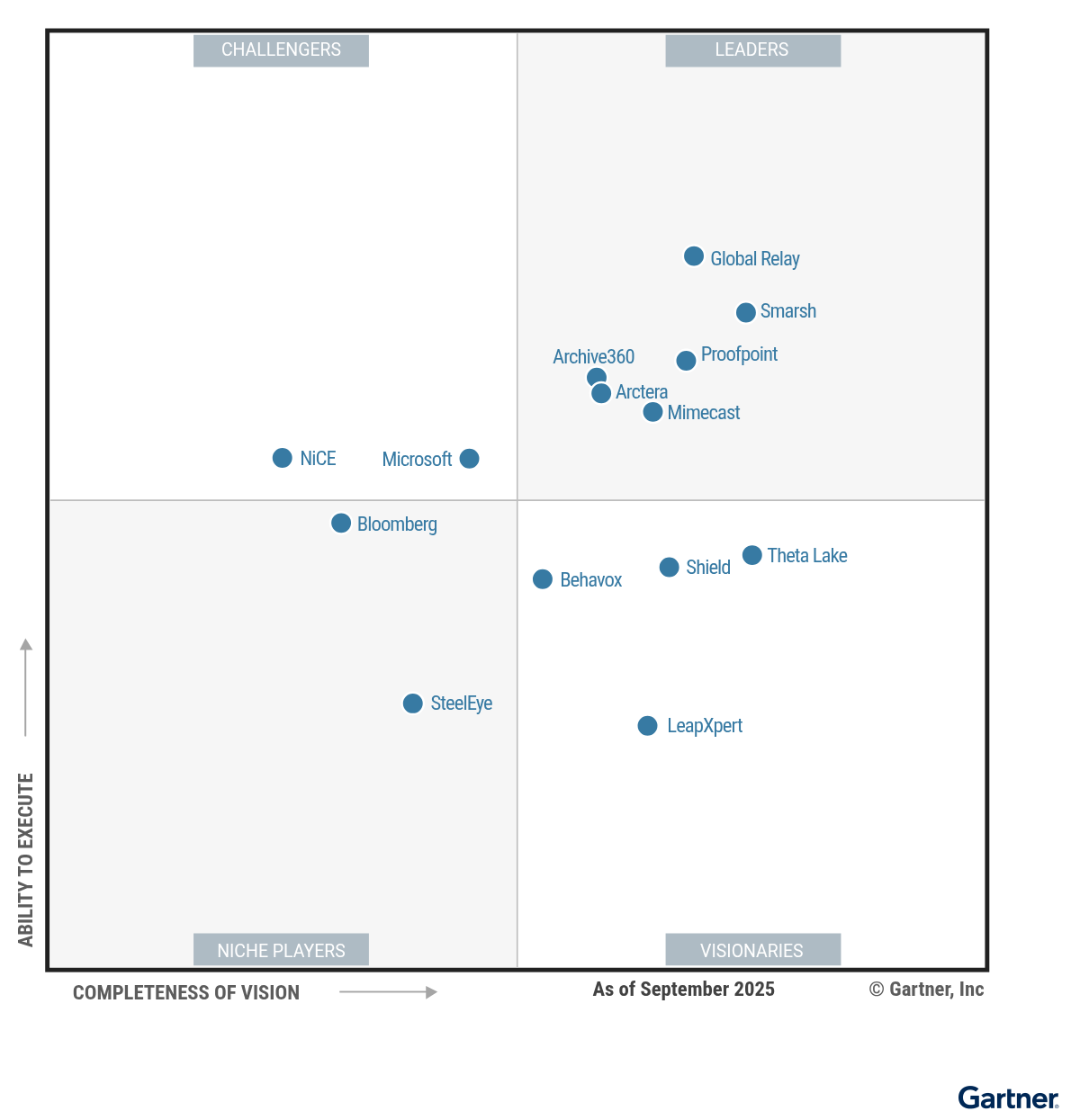
Vendor Strengths and Cautions
Archive360
Archive360 is a Leader in this Magic Quadrant. Its DCGA offering is the Archive360 Unified Data Governance Platform. Archive360’s operations are distributed across the U.S., Europe and the Asia/Pacific region. Its customers are primarily large enterprises in the government, healthcare and financial sectors.
During the past year, Archive360 introduced integration with Microsoft Copilot Studio for analysis, investigation and summarization of archived data and an AI digital assistant chatbot collection to capture prompts and AI-generated responses from digital assistants deployed on public or private websites. It also introduced updates to its data pipeline and onboarding module, and improved publishing of archived data to Snowflake and Microsoft Power BI.
- AI-ready data archive platform: The open architecture of the Archive360 Platform is designed to allow customers to integrate their DCGA datasets with enterprise AI tools.
- Chatbot collection feature: Archive360 offers integration with customer-deployed GenAI, AI assistant and chatbot tools implemented on public and private websites to capture, archive and monitor user prompts and AI-based responses.
- Microsoft Copilot Studio integration: Archive360 integrates Microsoft Copilot Studio with customer data, allowing AI prompts to dynamically query archived content in support of investigation use cases.
- Lagging surveillance enhancements: Archive360 lags behind leading vendors in the advancement of surveillance capabilities. Its platform does not use AI data models for flagging monitored content, nor does it use GenAI to produce compliance summaries.
- Progressing clients to SaaS from PaaS: Archive360 is shifting its primary business model from PaaS to single-tenant SaaS, offering PaaS on an exception basis. This shift may impact the customer’s level of visibility, control and customization of its DCGA infrastructure, application stack and security.
- Limited data visualization: Archive360 offers limited built-in data visualization features in its investigation and surveillance offering compared to other Leaders in the DCGA market.
Arctera
Arctera is a Leader in this Magic Quadrant. Its DCGA offering is Arctera Insight Platform, which consists of Information Governance, eDiscovery and Surveillance. Arctera’s operations are global, and its customers are primarily large and midsize enterprises across a variety of vertical markets.
During the past year, Arctera introduced its Insight AI Assistant for eDiscovery, sentiment score-based classification, natural language querying, data masking, translation support, and new connectors for OpenAI ChatGPT, Microsoft Copilot, Viva Engage, Symphony Messaging and FX Connect. In addition, it enhanced its surveillance offering by adding support for hotword statistics, audio/visual smart transcript and the ability to delete Microsoft 365 content.
In August 2025, Cloud Software Group announced its intent to acquire Arctera. The transaction is expected to close during 4Q25. While Gartner anticipates that Arctera will remain a separate operating business within Cloud Software Group, similar to its other recent acquisitions, no details about Arctera’s future state have been communicated.
- AI integration: Arctera’s use of AI throughout its Insight Platform is pervasive. Its AI integration enables natural language queries, case summaries and end-user insights via InsightBooks, along with vendor-developed AI/ML for intelligent review and high-accuracy transcription in more than 100 languages.
- Flexible deployment models: Arctera offers SaaS, on-premises and hybrid solutions supported by a global data center footprint. Combined with its support for customer-managed encryption keys, Arctera’s platform can address most data sovereignty concerns.
- Comprehensive communications sources: Arctera’s data capture covers more than 120 communications sources natively, alongside data reconciliation reports that are designed to ensure completeness and track audio/video transcription. This provides visibility into data integrity and does not involve additional separate charges for individual source capture.
- Customer experience: Gartner clients have provided negative feedback around Arctera’s licensed capacity thresholds, and new bundles and repackaging of new capabilities, which have resulted in unexpected price increases at renewals.
- Data export limits: For Actera’s SaaS offering, vendor APIs are not exposed directly to customers for data export. Customers must submit bulk data export requests to Arctera, which can lead to data export and access limitations and potential related request charges.
- Recent mergers and acquisitions activity: Actera completed its separation from Veritas Technologies on 10 December 2024. In August 2025, the Cloud Software Group announced it would acquire Arctera. Mergers can provide expanded investment, but some customers may have concerns about Arctera’s continued organizational stability, potential roadmap priority issues, and the consistency of its customer support and experience.
Behavox
Behavox is a Visionary in this Magic Quadrant. Its DCGA offerings include Behavox Quantum, Intelligent Archive, Falcon, Pathfinder and Mosaic Smart Data. Its operations are distributed across the U.S., Europe and the Asia/Pacific region. Its customers are primarily medium to large enterprises in financial services, government, manufacturing and telco/internet.
During the past year, Behavox introduced and deployed its LLM 2.0 for risk detection; Intelligent Archive for compliance-based, long-term storage and investigations; Falcon for real-time surveillance for data exfiltration and insider threats; and region- and industry-specific AI risk policies that incorporate local regulatory language and risk specifications.
- Platform reliability: Behavox’s core DCGA offerings are resilient and single-tenant architected, built on Google Cloud Platform infrastructure. The vendor has not reported any outages or service disruptions in the past 24 months.
- Multilingual AI risk policies: Behavox’s custom-developed AI-based policies are multilingual and trained using both native and non-native languages rather than translation. This results in improved risk detection and reduced false positives based on jurisdictional context.
- Platform extensibility: Behavox provides RESTful APIs and native connectors to data warehouse platforms such as Snowflake and BigQuery. It also can synchronize metadata and classification tags with data governance offerings such as Collibra and Alation.
- Limited archive adoption: Behavox Intelligent Archive has limited deployment scale and customer adoption compared to the vendor’s Quantum offering. To ensure that this relatively new offering meets requirements, customers should plan to thoroughly assess its capabilities and prioritize use of customer references.
- Limited historical reconstruction capabilities: Behavox’s historical reconstruction capabilities require customers to utilize its APIs to develop communications timelines, export reconstruction outputs and combine data with third-party applications.
- Unified communications support limits: Compared to other vendors evaluated in this Magic Quadrant, Behavox’s support for text and audio/visual content integrations with unified communications as a service offerings is limited. It lacks support for RingCentral, GoTo Meeting and Avaya Cloud.
Bloomberg
Bloomberg is a Niche Player in this Magic Quadrant. Its DCGA offering is Bloomberg Vault. The company has a geographic presence in the U.S.; Canada; Europe, the Middle East and North Africa (MENA); and the Asia/Pacific region. Its clients are primarily in the financial sectors serving a wide range, from midtier banks to the broader financial market.
During the past year, Bloomberg introduced new AI surveillance policies and lexicons for antibribery and anticorruption, market abuse, gifts and entertainment, and unapproved communications channels. It also added an ingestion monitoring dashboard, browser-based downloading, and extended capabilities to address data sovereignty and nationalization.
- Financial services alignment: Bloomberg’s longstanding focus on a single vertical provides financial firms with a vendor that has domain-specific product development and support.
- Proprietary data capture: Bloomberg Vault provides native, real-time capture of communications from its proprietary Bloomberg Message and Instant Bloomberg channels. The capture includes metadata such as in-application edits and reactions, enabling more comprehensive supervision of communications within the Bloomberg ecosystem.
- Domain-specific AI models: Bloomberg’s compliance models are trained on proprietary financial services data combined with natural language processing. This training methodology improves the models’ contextual understanding of financial terminology, reducing false positives in the compliance supervision workflow.
- Product control limitations: Bloomberg has made a strategic financial investment in Insightful Technology and integrated its products with Bloomberg Vault to expand its supported communications channels and offer additional geographic storage options. Bloomberg’s minority stake in Insightful Technology does not enhance the company’s control over its DCGA solution, which may hinder its ability to respond to customer feature requests.
- Limited AI-enabled investigation capabilities: Bloomberg Vault lags behind competitors in applying AI to investigation workflows, lacking features such as automated search optimization, NLP, case timeline reconstruction and summarization. As a result, customers need to rely more on manual processes.
- Data access constraints: Bloomberg Vault lacks API-based data integration capabilities, constraining direct access for custom dashboards, reporting and data analytics.
Global Relay
Global Relay is a Leader in this Magic Quadrant. Its DCGA offerings are Global Relay Archive, App, Connectors, Surveillance, eDiscovery, My Archive, Data Migration and Discovery-as-a-Service. It has a geographic presence in the U.S., the U.K. and Canada. Its customers range from small, midsize businesses to large enterprises in the financial, energy, government and telco/internet sectors.
During the past year, the vendor introduced the Global Relay LLM, which analyzes each message against 11 risk categories to identify compliance risks. Global Relay also introduced options that allow users to choose between Wi-Fi/data or their mobile plan for voice calls in the Global Relay App and group text messaging with up to 10 participants.
- AI architecture: Global Relay has an extensible AI framework with prompt-based LLM and deep learning models. Its AI architecture includes agentic AI, incorporating reasoning and chain of thought across three tiers (category, subcategory and indicator) for surveillance, automation and workflows.
- Data integrity: Global Relay has more than 100 connectors and APIs to normalize chats, social, voice, documents, email and trade data into common, structured data. It also offers Constant Integrity Check, which audits all copies of data to verify integrity through their life cycle. Both these features help to ensure that all data is present, indexed, unaltered and not corrupt.
- Robust security: Global Relay’s security program is SOC 2- and ISO 27001-certified, incorporating NIST standards and CIS controls with a 24/7 security operations center. Data at rest is protected using a dual-key encryption model that uses FIPS 140-2 Level 3 hardware security modules (HSMs), ensuring keys are not exportable and messages cannot be decrypted off-site without HSM use.
- High upfront pricing: Global Relay’s DCGA solution includes licensing, implementation, support and hosting, so the upfront pricing is higher than most of its competitors. Clients that require a lower-cost solution may prefer alternatives to Global Relay.
- Elevated extraction fees: In most cases, Global Relay meters and charges per GB for data exports, especially for larger volumes, when providing professional assistance and in contract exit scenarios. Clients must account for these charges when evaluating the total cost of ownership of Global Relay’s DCGA solution.
- Lack of image captioning: Global Relay lacks features to transcribe and index content using image captioning capabilities. These features are commonly offered by the other Leaders evaluated in this research.
LeapXpert
LeapXpert is a Visionary in this Magic Quadrant. Its DCGA offering is The LeapXpert Communications Platform. The vendor operates mainly in the U.S, Europe, MENA and the Asia/Pacific region. Its customers are mainly midsize to large enterprises in the financial services, government, legal, manufacturing and telco industries.
Over the past year, LeapXpert enhanced support for iMessage, WhatsApp, Telegram, Signal and Teams, including bulk provisioning, emoji reaction capture and reply message tracking. It advanced its chat usage analytics, onboarding dashboards and metadata reports. Additionally, LeapXpert launched Maxen, an AI-powered assistant that boosts productivity through delivering insights from messaging, internal communications, email, calendar, notes and other sources of written communication.
- Extensive consumer coverage: LeapXpert supports a wide range of consumer messaging applications, such as WhatsApp, iMessage, SMS, RCS, WeChat, Telegram, Signal and LINE, enabling organizations to meet diverse client communications needs while maintaining compliance.
- Flexible deployment and onboarding: LeapXpert’s platform offers customizable deployment options across major cloud providers (including Microsoft Azure, Amazon Web Services and Google Cloud Platform) and supports both self-onboarding and admin-led provisioning. Thus, it accommodates various enterprise deployment models.
- Communications conduit into Teams: The platform acts as a conduit for SMS and consumer messaging apps, enabling external communications to flow directly and natively into Microsoft Teams for centralized collaboration and oversight.
- Lack of support for investigations: LeapXpert’s product offering strategy does not include native support for investigation capabilities, such as legal case or matter management, and search, refine and hold. Customers seeking these capabilities will need to use a LeapXpert partner that supports integrations to share data.
- Limited data retention: LeapXpert’s platform architecture retains data for up to one year before it is exported to a customer’s choice of long-term archiving partner offering.
- Limited scope of carrier support: LeapXpert’s integration with mobile carriers lacks support for voice calls and recording capture. These capabilities are outside the scope of its platform strategy and require the use of a partner solution.
Microsoft
Microsoft is a Challenger in this Magic Quadrant. Its DCGA offering is Microsoft Purview Communication Compliance. Microsoft operates globally, and its customers are mainly midsize and large enterprises across most sectors.
During the past 12 months, Microsoft added a new interaction template to analyze all Copilot for Microsoft 365 prompts and responses based on specific conditions or deploying trainable classifiers. It also introduced advanced data life cycle management capabilities for Microsoft Purview, such as managing retention labels via Microsoft Graph APIs and initiating Power Automate workflows. It enhanced Microsoft Purview eDiscovery to include search of additional metadata, and Microsoft Purview Communication Compliance now analyzes Teams meeting transcripts.
Microsoft did not respond to requests for supplemental information. Gartner’s analysis is therefore based on other credible sources.
- Broad governance capabilities: Microsoft Purview Communication Compliance is part of a single platform offering a broad set of compliance capabilities for governance and risk-based use cases, such as data loss prevention, insider risk management and information protection.
- Scope of GenAI capture: Microsoft supports multiple GenAI capture integrations, including Microsoft Copilot and other AI apps, which are detected through browser activity and categorized as GenAI in the Defender for Cloud Apps catalog.
- License package benefits: Microsoft Purview Communication Compliance is included in the Microsoft 365 E5 License bundles, which has helped drive customer adoption.
- Policy restrictions and storage capacity: Microsoft Purview Communication Compliance creates extra copies of messages when they match a defined policy. These redundant copies use separate retention schedules with strict settings and may cause customers to exceed storage entitlements over time.
- Unpredictable costs for non-Microsoft data sources: Microsoft Purview’s pay-as-you-go model introduces additional costs for managing data outside the Microsoft 365 ecosystem. Organizations using third-party sources may face charges for storage, processing and governance, likely increasing the total cost of ownership for hybrid environments.
- Challenging user experience: Some Gartner clients report operational friction when using Microsoft Purview Communications Compliance, citing its steep learning curve, constant product changes and limited customization options due to its reliance on PowerShell.
Mimecast
Mimecast is a Leader in this Magic Quadrant. Its DCGA portfolio includes Search & Discover (formerly Cloud Archive), Signal, Spotlight, Sync & Recover and Data Management. Mimecast’s operations are global, with a focus on North America, Europe and MENA. It serves a wide range of enterprise clients in industries such as financial services, healthcare, government and legal.
During the past year, Mimecast advanced the integration of Aware’s four core products into its platform: Search & Discover, Signal, Spotlight and Data Management. Other enhancements include its GenAI chatbot Ask and summaries within search and review interfaces, as well as expanded unified support for collaboration platforms like Teams, Slack and Webex Messaging.
- AI integrated pricing: Mimecast’s AI features, including GenAI and NLP-based capabilities, are included as part of each product license. The use of such features is not subject to separate usage or monitoring fees.
- Risk visibility: Mimecast’s platform architecture provides unified, AI-driven risk visibility from email, collaboration and insider threat sources, using its proactive behavioral anomaly detection in its security and DCGA offerings.
- AI and data processing architecture: Mimecast Signal provides notifications to users and capabilities to delete content from collaboration tools, which can be configured as automated actions. This extends the functionality of the vendor’s event-driven, AI-native architecture and its role in investigations.
- Incomplete portfolio integration: The Mimecast platform is in a transitional state after the vendor’s acquisition of Aware, with key features such as supervision and case review still operating in functional silos. This requires users to manage separate processes for critical compliance workflows that span both emails and collaboration channels, which may impact operational efficiency.
- High end-of-contract exit fees: While common export use cases are included at no additional charge, Mimecast charges a per-GB data extraction fee when customers request full environment bulk exports or customer extraction services. Customers must account for this fee when evaluating the total cost of ownership for the platform.
- Lack of in-application translation: Mimecast’s Search & Discover and Case Review applications do not provide integrated, on-demand translation of foreign language content within their respective review interfaces. This creates operational friction for global organizations with compliance teams that must rely on external processes to review multilingual communications during investigations and monitoring/supervision.
NiCE
NiCE is a Challenger in this Magic Quadrant. Its DCGA offering is Compliancentral, which consists of NTR-X, SURVEIL-X and ARCHIVE-X. NiCE’s operations are global, and its customers are primarily midsize to large enterprises in the financial services sector.
In the past year, NiCE introduced ARCHIVE-X, a stand-alone, API-driven SaaS archive solution enabling secure archiving of data captured on third-party platforms. NiCE also enabled capture support for Microsoft Teams chat attachments, Cisco Webex Calling voice capture for all Webex Calling endpoints and Zoom voicemail, and alarming enhancements and passive recording for Session Initiation Protocol (SIP) endpoints.
- AI-assisted review: NiCE uses LLMs trained on financial compliance data to classify alerts as suspicious, assign a confidence score and provide explanations in English with key influencing terms. These alerts are categorized into themes like insider dealing and front running to help compliance teams prioritize reviews efficiently or to trigger automated escalation or closure via the NiCE workflow engine.
- End-to-end case management: The NiCE case management system enables regulatory compliance and investigations with a tailored workflow process, integrated collaboration capability with real-time notifications, note sharing, reporting and audit control.
- Trade surveillance integration: NiCE correlates trading information with related digital communications data to reconstruct trades and identify potential misconduct, which enables fast, more accurate investigations and helps ensure regulatory compliance.
- Low R&D spending: Compared to leading vendors, NiCE invests a lower percentage of its DCGA revenue into research and development (R&D). NiCE may not be able to match the delivery pace of new features and functions compared to DCGA vendors with higher relative investment in R&D.
- Uncompetitive pricing: The upfront pricing for Compliancentral is relatively higher than most competing offers. Cost-conscious clients may prefer alternatives that offer lower upfront prices.
- Limited industry focus: NiCE’s DCGA vertical industry strategy is primarily focused on financial services.
Proofpoint
Proofpoint is a Leader in this Magic Quadrant. Its DCGA offerings are Proofpoint Archive, Supervision, Discover, Automate, Track, Capture and Patrol. Proofpoint’s operations are mainly in North America and Europe, and its customers are primarily large enterprises across multiple sectors.
During the last 12 months, Proofpoint acquired Nuclei to expand its capture and analytics capabilities. It also introduced its Discover 6.0 and Supervision 6.0 modules, as well as the addition of mobile support in Capture, including SMS, voice, WhatsApp, WeChat, Telegram and iMessage. It also added prompt and response capture for OpenAI ChatGPT and Microsoft Copilot, AI-based language translation, and GenAI-based models for Proofpoint Automate.
- Expanded communications channels portfolio: Proofpoint’s completed acquisition of Nuclei provides customers with immediate access to an expanded list of supported communications channels and capabilities, including classification, search, reconciliation and GenAI-based behavioral analytics, as well as the ability to generate alerts as part of the capture process.
- Security solution integration: Proofpoint’s DCGA solutions integrate with its own and third-party security offerings to enable delivery of user-detected events in communications content and behavior analytics to signal downstream security outcomes.
- Financially backed search SLA: Proofpoint provides customers with a financially backed service-level agreement for adequate search speeds, regardless of the volume of data in the customer’s archive.
- Proofpoint 6.0 progression: The Proofpoint 6.0 rollout is still underway. Track 6.0 updates and migration tools to move existing Archive, Discover and Supervision customer data have yet to be completed.
- Lags behind in AI assistant capabilities: Proofpoint trails other Leaders in this Magic Quadrant in the use of AI assistants to offer features such as guided search creation, natural language query, conversation summaries and escalation recommendations.
- Limited data sovereignty coverage: Proofpoint’s primary operations and data center deployments are located in North America, Europe and the United Arab Emirates. Clients in other regions, such as the Asia/Pacific and South America, will need to qualify Proofpoint’s alignment to their data storage requirements or seek alternative vendors.
Shield
Shield is a Visionary in this Magic Quadrant. Its DCGA offerings include Shield Data Hub, Archive, Discover, Surveillance, Supervision, InfoBarriers, Voice and AmplifAI suite. It operates in Europe, North America and the Asia/Pacific region. Its customers are primarily financial institutions and other regulated industries like energy, commodities and insurance.
During the past year, Shield introduced thematic controls and data completeness reports. It launched its AmplifAI suite, which includes Fortified Surveillance to reduce false positives, Risk Reasoning to accelerate alert triage and the Shiela AI assistant for conversational investigations. It expanded platform connectivity by doubling its native connector library.
- AI architecture and extensibility: The AmplifAI suite uses a multiagent system designed to enhance coverage, reduce false positives and increase risk explainability. Using GenAI, it identifies nuanced risk, reduces noise and accelerates risk triage. It also includes Shiela, a GenAI assistant for natural language queries during investigations. Shield’s model-agnostic architecture allows customers to integrate their own proprietary AI models into the workflow.
- Commercial model and data accessibility: The vendor uses a per-employee pricing model, which contributes to a predictable total cost of ownership. The pricing model includes no-cost data exports, removing a common financial and operational barrier for clients seeking to access or migrate their archived data.
- Positive product experience: Customer feedback on the platform is favorable, particularly regarding its core compliance workflows, system alerts and market abuse detection models.
- Limited focus outside large enterprises: Shield primarily targets large financial institutions through a direct sales model that may limit focus on SMB organizations. This go-to-market focus means SMB customers may find Shield’s offerings less targeted to their requirements.
- Lack of on-screen content analysis: Shield’s platform lacks optical character recognition (OCR) to capture text presented visually, although it plans to deliver this critical capability in a future offering. This may create a gap in which on-screen documents or presentations would not be captured or flagged for review.
- Premium-focused pricing: Clients report that negotiating competitive pricing with Shield can be more challenging than with other vendors that may leverage discount-driven sales tactics. Buyers with cost sensitivities should consider vendors with lower pricing models early in the evaluation process.
Smarsh
Smarsh is a Leader in this Magic Quadrant. Its DCGA offerings are Smarsh Professional Archive, Enterprise Archive, Enterprise Conduct, Enterprise Discovery, Capture Mobile, Cloud Capture, On-Premises Capture, Call Recording and Analytics, and Web Archive. Smarsh’s operations are based mainly in the U.S. Its customers are organizations of all sizes, primarily in the financial services sector.
During the past year, Smarsh completed its acquisition of CallCabinet. It added capture integration with OpenAI ChatGPT and Microsoft Copilot GenAI offerings. It added Miro and Mural whiteboards, and also added Singtel to its carrier network support. Smarsh introduced its Intelligent Agent Filter to reduce compliance reviewer workloads, and AI Assistant for supervision and contextual insights.
- CallCabinet acquisition: Smarsh continues to expand its communications channel coverage with the acquisition of CallCabinet. Available as a stand-alone product and integrated into the Smarsh portfolio, it enhances Smarsh’s voice capture capabilities with integration into multiple call platforms, and AI-based voice analytics features such as transcription, sentiment analysis and speaker identification.
- Tiered storage model: Smarsh has introduced a lower-cost storage tier to its pricing model. This enables customers to reduce total cost of ownership by moving infrequently accessed data to a lower-performance storage tier.
- Positive customer support and services: Smarsh customers provide positive feedback on the knowledgability of its support services teams, quick response times, proactive engagement and availability of dedicated customer success managers.
- Telemessage breach: In Gartner client inquiries, some Smarsh customers and prospects expressed dissatisfaction with the timing and lack of transparency that the vendor provided in explaining the scope of the Telemessage security incident.
- Lack of iMessage capture: Smarsh does not provide native or third-party support for capturing iMessage content. To satisfy this requirement, customers will need to explore alternative vendor solutions.
- Lack of FedRamp qualification strategy: Smarsh lacks a plan to achieve FedRAMP authorization. Federal and some state agency customers requiring FedRAMP-authorized solutions may need to consider alternative vendors or prepare appropriate exception documentation to implement Smarsh offerings.
SteelEye
SteelEye is a Niche Player in this Magic Quadrant. Its DCGA offering is the SteelEye platform. Its operations are in North America, Canada, Europe, MENA and the Asia/Pacific region, and its customers are primarily midsize to large enterprises in the financial services sector.
During the past year, SteelEye has launched Neural, an LLM alert generation capability; updated its Surveillance Lexicon; and added new data access policies, integration with identity and access management (IAM), and Compliance CoPilot enhancements for alert scoring. It expanded its partner integrations to include Verint, LeapXpert and Symphony to capture iMessage, SMS, WhatsApp and WeChat communications channels. SteelEye also introduced a new premium tier to separately license its advanced LLMs, Compliance CoPilot, voice-to-text and translation capabilities from its core AI features.
- Advanced AI-driven alerting and triage: SteelEye’s platform uses LLMs for multitiered alert generation via Neural and to automate first-level reviews via Compliance CoPilot, providing transparent risk scoring, summaries and suggested actions to improve compliance efficiency and accuracy.
- Integrated trade surveillance with extensive data coverage: SteelEye offers an integrated trade surveillance solution that combines voice and electronic communications with trade and market data, enabling oversight across more than 150 data connectors.
- Surveillance Lexicon for contextual intelligence: SteelEye provides lexicons in multiple languages that cover market abuse and nonfinancial risk misconduct. Its use of NLP; configurations such as colocation, fuzzy matching and stemming; and language detection and translation provides context awareness to improve investigative efficiency.
- Limited scalability for large enterprises: SteelEye’s experience to support large-scale deployments is limited. Its largest known implementation covers fewer than 3,750 users, which is relatively modest compared with its competitors.
- Use of customer data in AI training: SteelEye trains its AI-based language models with anonymized customer data to improve surveillance models for use cases with low incidence data. Customers can opt out of inclusion per request to prevent its use in SteelEye’s models.
- Lack of GenAI content collection: SteelEye does not offer content collection of GenAI prompts and responses from platforms such as Microsoft Copilot, OpenAI ChatGPT and Perplexity.
Theta Lake
Theta Lake is a Visionary in this Magic Quadrant. Its DCGA offering is the Theta Lake Risk and Compliance Suite, a single platform that includes Unified Capture, Unified Search and Archiving, and Proactive Compliance. Theta Lake’s operations are primarily in North America, with some market presence in Europe and the Asia/Pacific region. Its customers are organizations of all sizes, primarily in the financial services sector.
During the past year, Theta Lake added enhancements to monday.com, LinkedIn profile capture, Workvivo, Bloomberg, email analysis policies and the ability to capture Zoom transcripts. Theta Lake also introduced Zoom AI Companion call summary, a detection rules dashboard, Microsoft Copilot support and market manipulation detection rules.
- API developer platform: Theta Lake offers public access to its API-based products, so customers, service partners and third-party vendors can access customer data, use existing features, or build new features and functions.
- Efficient multichannel search: Theta Lake unifies search and data, and it adds contextual navigation of conversations across multiple tools and communications channels. It offers full replays, timeline views, and AI summarizations of content and communications while saving searches as workflows, improving the efficiency and speed of searches across channels.
- Single comprehensive offering: The Theta Lake Risk and Compliance Suite is a single offering that includes a large selection of functions and features bundled in three primary modules. This simplifies customers’ evaluation, purchase, deployment and maintenance of the Theta Lake DCGA offering.
- Financial characteristic concerns: Although Theta Lake achieves high revenue growth and has access to working capital for stability, it should be noted that Theta Lake is neither cash-flow positive nor profitable. This might be a concern for risk-averse customers seeking a provider with a more established financial base.
- Limited GenAI communications capture: Theta Lake’s fully integrated support for GenAI prompt and response direct capture from the GenAI provider is limited to Microsoft Copilot and Zoom AI Companion. Clients seeking providers that support other GenAI capture integrations may find Theta Lakes’s current GenAI content coverage to be narrow.
- Limited multilingual support: Theta Lake supports a wide array of languages for capture, archiving, search and custom detections, but it does not provide a multilingual user or administrative interface.
Vendors Added and Dropped
We review and adjust our inclusion criteria for Magic Quadrants as markets change. As a result of these adjustments, the mix of vendors in any Magic Quadrant may change over time. A vendor's appearance in a Magic Quadrant one year and not the next does not necessarily indicate that we have changed our opinion of that vendor. It may be a reflection of a change in the market and, therefore, changed evaluation criteria, or of a change of focus by that vendor.
Added
- Behavox
Dropped
- ZL Tech: This vendor was dropped because the absence of new DCGA updates during the past year resulted in its inability to meet the inclusion criteria.
Inclusion and Exclusion Criteria
To qualify for inclusion, vendors must:
- Develop a qualifying DCGA solution that meets all mandatory features, as defined in the Market Definition.
- Meet at least one of the following revenue criteria. Revenue must be derived solely from its DCGA solution product portfolio. This revenue should not include revenue generated from implementation services or through managed service provider (MSP) sales. It needs to meet at least one of the following revenue criteria:
- Generated more than $40 million in reported annual recurring revenue (ARR) on 31 May 2025 or
- Generated more than $10 million in reported ARR on 31 May 2025, combined with YoY ARR growth greater than 25%
- Actively sell and support its DCGA solutions under its own brand name in at least two of the following four major geographies: North America, Latin America, EMEA and Asia/Pacific.
- Have made its qualifying DCGA solution generally available and fully supported for use by customers since 1 July 2023.
- Be the developer of the DCGA product(s), and not be only an OEM reseller, MSP or value-added reseller (VAR).
- Have released new products or made updates to existing DCGA products that were released during the past 12 months and generally available to all customers, without restrictions, on or before 31 May 2025.
We excluded vendors from this Magic Quadrant if they had products or solutions that are designed and mainly positioned as solutions for archiving a single content type.
Honorable Mentions
Gartner tracks more than 30 vendors in this market. Of those, 14 met the inclusion criteria for this Magic Quadrant. However, the exclusion of a provider does not mean that the vendor and its products lack viability. The following are noteworthy vendors that did not meet all inclusion criteria but could be appropriate for clients:
- Cloudficient: This DCGA vendor is headquartered in Dover, Delaware. Cloudficient’s DCGA portfolio includes migration, archive and investigation offerings. Its primary DCGA offering is Expireon. Cloudficient was excluded from this Magic Quadrant as it didn’t meet the revenue criteria.
- Insightful Technology: This DCGA vendor is headquartered in London. Insightful Technology’s DCGA portfolio includes connector, archive, investigations, and supervision and surveillance offerings. Its primary DCGA offerings are SOTERIA and FUSION. Insightful Technology was excluded from this Magic Quadrant as it didn’t meet the revenue criteria.
- MirrorWeb: This DCGA vendor is headquartered in Austin, Texas. MirrorWeb’s DCGA portfolio includes connector, archive, investigations, and supervision and surveillance offerings. Its primary DCGA offering is Insight. MirrorWeb was excluded from this Magic Quadrant as it didn’t meet the revenue criteria.
- Umony: This DCGA vendor is headquartered in London. Umony’s DCGA portfolio includes connector, archive, investigations, and supervision and surveillance offerings. Its primary DCGA offerings are Capture, Archive and Monitor. Umony was excluded from this Magic Quadrant as it didn’t meet the revenue criteria.
Evaluation Criteria
Ability to Execute
Product or Service. Vendors were assessed based on:
- Information gathered as a part of product evaluation in the companion Critical Capabilities report
- Distinct and differentiating features of DCGA offering
- New capabilities released/products launched during the evaluation period
- Identifying an established customer base for each product in their DCGA portfolio
- Known issues at the time of product release that impact customer experience
Overall Viability. Vendors were assessed based on:
- Overall profitability of the enterprise DCGA software portfolio
- Cash flow status of DCGA software portfolio
- Growth in DCGA revenue between 2024 and 2023
- Overall margin of DCGA business for 12 months ending 30 June 2025
- Continued growth in DCGA sales and product development staff
Sales Execution/Pricing. Vendors were assessed based on:
- Scope of changes in sales strategy during the past 12 months that impacted go-to-market strategy
- Recognition of top competitors and understanding of losses to the competitor
- Diversification of revenue across sales channels
- Level of new versus repeat business
- Changes in current year deal size and how that compares to the prior year
- Effective use of proofs of concept (POCs)
Market Responsiveness/Record. Vendors were assessed based on:
- New, first-to-market products, marketing and sales, or capabilities released during the past 12 months that created competitive differentiation
- New products or capabilities released during the past 24 months that address market demands and gaps in the existing product portfolio
- Effectiveness in meeting product release schedules
- Ability to articulate common sales pushback and how that is addressed
Marketing Execution. Vendors were assessed based on:
- Rollout of new marketing campaigns during the evaluation period that create mind share, expand new markets and build a pipeline
- Quantitative metrics collected by the vendor that assess the effectiveness of marketing programs
- Gartner Customer Interest Indicator (CII) findings
Customer Experience. Vendors were assessed based on:
- Performance-based SLAs for availability and performance
- System availability/outages
- Progress in Net Promoter Score or equivalent score determining the likelihood of existing customers recommending the vendors’ offering
- Progress in customer satisfaction or Customer Effort Score (CES) results during the last 12 months
- Level of transparency regarding SaaS/PaaS platform availability/outages
- Results of customer net retention rate
- Distinct customer support capabilities and experiences over the competition
- Severity 1 and Severity 2 bugs reported from the field in the last 12 months, as determined via Gartner client inquiries, publicly available information and vendor responses
- Costs and options to extract data, including contract exit
Operations. Vendors were not assessed on this criterion.
Ability to Execute Evaluation Criteria
| Evaluation Criteria | Weighting |
|---|---|
Product or Service | High |
Overall Viability | Medium |
Sales Execution/Pricing | Medium |
Market Responsiveness/Record | High |
Marketing Execution | Low |
Customer Experience | High |
Operations | NotRated |
Source: Gartner (October 2025)
Completeness of Vision
Market Understanding. Vendors were assessed based on:
- Alignment of current product portfolio with key market requirements
- Identification of top customer challenges and the capabilities of the portfolio to address them
- Ability to articulate a vision of future market changes
- Ability to explain the scope of DCGA solutions beyond regulatory compliance-centered use cases
- Ability to explain the scope of communications policies and use of DCGA solutions to address GenAI-based interactions
Marketing Strategy. Vendors were assessed based on:
- Marketing vision and how it addresses the competitive landscape
- A 12-month, future-looking plan for marketing
- Understanding of various target customer personas, the ability to communicate value to them and how this has changed in the past 12 months
Sales Strategy. Vendors were assessed based on:
- Sales strategy and how it aligns to future business objectives and company goals
- Concise vendor value proposition that draws prospect interest
- Strategies used to onboard VARs and distribution partners and retain them
Offering (Product) Strategy. Vendors were assessed based on:
- Ability to align key roadmap deliverables to business outcomes
- Ability to establish an 18-month roadmap that aligns with customer priorities
- Ability to identify shortcomings in current offering that will address competitive threats in the market
- Ability to recognize and commit to features that will improve the existing capabilities of the product
- Ability to define and schedule features that will competitively differentiate the vendors’ offering
- Extent of dependence on other OEMS or ISVs for specific software functionality
- A vision for the use of AI/GenAI/agentic AI within DCGA offerings
Business Model. Vendors were assessed based on:
- Forward-looking strategies to sustain business growth and profitability in the next 18 months, despite external factors such as price fluctuations, technology obsolescence, new competition and economic disruption
- Strategies to create new revenue opportunities from the existing customer base
- Strategies to create new revenue opportunities and improve customer satisfaction through changes in pricing transparency or consumption-based offerings
Vertical/Industry Strategy. Vendors were assessed based on their ability to:
- Deliver solutions that address specific vertical industry data protection requirements
- Collaborate with industry-specific technology providers to create products, reference architectures and joint go-to-market plans
- Strategies to expand DCGA solutions beyond the financial services industry
Innovation. Vendors were assessed based on:
- Innovations in product design that provide competitive differentiation and increase customer satisfaction
- Innovations in sales and presales cycles that achieve competitive differentiation and increase customer satisfaction
- Innovations in customer support that help with competitive differentiation and increase customer satisfaction
- R&D investment commitment to the product offering
- Achievement of patents in the market that demonstrates innovation
Geographic Strategy. Vendors were assessed based on:
- The scope of business outside of the vendors’ home region
- Vendors’ strategy to address their weakest geography
- Distribution of data centers across geographies for their cloud-based offerings
- Strategy to support data sovereignty and data residency requirements
Completeness of Vision Evaluation Criteria
| Evaluation Criteria | Weighting |
|---|---|
Market Understanding | High |
Marketing Strategy | Low |
Sales Strategy | Medium |
Offering (Product) Strategy | High |
Business Model | Medium |
Vertical/Industry Strategy | Medium |
Innovation | High |
Geographic Strategy | Low |
Source: Gartner (October 2025)
Quadrant Descriptions
Leaders
Leaders have the highest combined measures of Ability to Execute and Completeness of Vision. They may have the most comprehensive and scalable products. They have a proven track record of financial performance and an established market presence. In terms of vision, they are perceived to be thought leaders, with well-articulated plans for ease of use, product breadth and how to address scalability. For vendors to have long-term success, they must plan to address the expanded market requirements for DCGA. This includes scope of content source coverage, expanding uses of AI/ML; relevant investigations and supervision/surveillance capabilities; focus on expanded digital communications governance use cases; and a user experience (UX) that focuses on simplicity.
Leaders must not only deliver to current market requirements, which continue to change, but also need to anticipate and begin to deliver on future requirements. A cornerstone for Leaders is the ability to articulate how these requirements will be addressed as part of their vision for expanded DCGA capabilities. As a group, Leaders are considered part of most new purchase proposals and have high success rates in winning new business.
Challengers
Challengers participate in the DCGA market and execute well enough to be a serious threat to vendors in the Leaders quadrant. They have capable products and can perform well for many enterprises.
These vendors have the financial and market resources and capabilities to become Leaders; however, they lag behind Leaders in DCGA innovation and consistent investments in leading-edge DCGA capabilities, marketing, sales strategies and business model innovation.
Visionaries
Visionaries are forward thinking; however, their execution has not propelled them into a leadership position.
These vendors are differentiated by product innovation, but they have not achieved the sales and marketing success required to give them the high visibility of Leaders.
Niche Players
Niche Players are narrowly focused on an application, a market or a product mix, or they offer broad capabilities, without the relative success of their competitors in the other quadrants.
Niche Players may focus on specific geographical markets, vertical industry segments or limited use cases. This quadrant may also include vendors that are ramping up their product and platform offerings, or larger vendors that are having difficulty developing and executing on their vision against new market demands.
Context
Heads of I&O should use DCGA solutions to solve challenges associated with the broadening scope of communications tools used by employees and broadening communications governance demands. They must consider the following in selecting and deploying DCGA solutions:
- Mitigate potential corporate and regulatory compliance violations by shifting from a reactive to a proactive posture using DCGA solutions.
- Expand the scope of requirements and common personas and users of DCGA solutions to include those such as human resources, data and analytics, and AI teams.
- Shortlist DCGA solutions that best align the scope of digital communications sources to required business use cases, such as compliance, governance, data retention, investigations, supervision, surveillance, analytics and insights.
- Narrow selection to DCGA vendors that properly align their platform infrastructures to the data sovereignty requirements of the business.
- Challenge DCGA vendors to clearly explain how integration of natively and third-party-developed communications connectors works in their respective solutions. This should include details of data format, completeness of metadata capture, and any bidirectional feedback between source and archive.
- Assess vendors based on their ability to monitor GenAI tools, AI assistants and chatbots, including those integrated with internal- and external-facing applications.
- Scope vendors’ capabilities to support mobile and messaging application communications in selection criteria, as both employee use and regulatory and corporate oversight of these tools accelerates.
- Differentiate vendor solutions by assessing whether data models, AI/ML and NLP are critical components of their offerings in data classification, investigations, supervision, surveillance and analytics use cases.
- Request that vendors provide transparency and explainability of outcomes in their use of AI/ML.
Market Overview
Digital communications governance and archiving (DCGA) solutions enable organizations to establish consistent methods and processes to capture, archive, investigate, monitor and analyze employee, AI-based and customer communications. The scope of communications tools is complex. It encompasses traditional tools such as email and collaboration, and newer sources such as messaging applications, mobile devices, unified communications, GenAI tools, intranet packaged solutions, and AI assistance and chatbots found in a growing number of enterprise applications.
The modernization of DCGA platforms, the complexity and volume of communications, and a more-critical regulatory and corporate governance environment have introduced new strategies and entrants to this market. Vendors are innovating to address complicated forms of communications, such as mobile, workstream collaboration, messaging applications, and voice and meeting solutions.
They are modernizing infrastructure to improve scale and include new AI/ML- and NLP-based data categorization and classification, sentiment analysis, and supervisory capabilities. They are also introducing GenAI features that augment capabilities to improve management of a DCGA solution, accelerate the investigation and supervisory process, and improve the accuracy of outcomes.
The DCGA market is heavily influenced by regulatory requirements specific to communications tool use. Requirements may include establishing usage policies; capturing and retaining communications for a defined period; enabling search of communications content for audit, discovery or reporting purposes; and monitoring communications to assess employee adherence to defined policies. The most clearly defined communications governance regulations come from the financial services industry.
Financial services organizations are regulated by entities such as the SEC, FINRA, CFTC and FCA. This results in the majority of spend in the DCGA market coming from the financial services organizations. Demands for response to public record requests have drawn significant investment in DCGA solutions by public government entities, including federal, state and local municipalities.
Beyond financial services and public government, highly litigious organizations will frequently leverage DCGA tools. This would include markets such as pharmaceuticals, healthcare, retail, construction and manufacturing. DCGA solutions provide a means to shift away from a reactive approach to communications data collection that can encounter process complexities, incomplete data collection and potential errors. Shifting to a proactive data capture process can result in more effective capabilities to facilitate investigation processes.
Broader market adoption may also result from DCGA solutions’ abilities to identify or contribute insights on general company, department or team sentiment; business or workplace conduct issues; and employee productivity and efficiency. In addition, the focus on security and compliance risks could result in the use of DCGA solutions across more organizations. This may include improvements to efforts such as data loss prevention, forensics and insider risk management.
DCGA vendors differentiate their offerings based on a number of important criteria that align to the use cases in this research. These use cases include connectors, archive and retention, regulatory compliance, investigations, internal analytics and insights, and user governance. As enterprises rapidly adopt new communications tools to address work from home requirements, shadow IT and their own customers’ demands, DCGA solutions with distinct capabilities to support these new communications have become more visible in the market.
Ability to Execute
Product/Service: Core goods and services offered by the vendor for the defined market. This includes current product/service capabilities, quality, feature sets, skills and so on, whether offered natively or through OEM agreements/partnerships as defined in the market definition and detailed in the subcriteria.
Overall Viability: Viability includes an assessment of the overall organization's financial health, the financial and practical success of the business unit, and the likelihood that the individual business unit will continue investing in the product, will continue offering the product and will advance the state of the art within the organization's portfolio of products.
Sales Execution/Pricing: The vendor's capabilities in all presales activities and the structure that supports them. This includes deal management, pricing and negotiation, presales support, and the overall effectiveness of the sales channel.
Market Responsiveness/Record: Ability to respond, change direction, be flexible and achieve competitive success as opportunities develop, competitors act, customer needs evolve and market dynamics change. This criterion also considers the vendor's history of responsiveness.
Marketing Execution: The clarity, quality, creativity and efficacy of programs designed to deliver the organization's message to influence the market, promote the brand and business, increase awareness of the products, and establish a positive identification with the product/brand and organization in the minds of buyers. This "mind share" can be driven by a combination of publicity, promotional initiatives, thought leadership, word of mouth and sales activities.
Customer Experience: Relationships, products and services/programs that enable clients to be successful with the products evaluated. Specifically, this includes the ways customers receive technical support or account support. This can also include ancillary tools, customer support programs (and the quality thereof), availability of user groups, service-level agreements and so on.
Operations: The ability of the organization to meet its goals and commitments. Factors include the quality of the organizational structure, including skills, experiences, programs, systems and other vehicles that enable the organization to operate effectively and efficiently on an ongoing basis.
Completeness of Vision
Market Understanding: Ability of the vendor to understand buyers' wants and needs and to translate those into products and services. Vendors that show the highest degree of vision listen to and understand buyers' wants and needs, and can shape or enhance those with their added vision.
Marketing Strategy: A clear, differentiated set of messages consistently communicated throughout the organization and externalized through the website, advertising, customer programs and positioning statements.
Sales Strategy: The strategy for selling products that uses the appropriate network of direct and indirect sales, marketing, service, and communication affiliates that extend the scope and depth of market reach, skills, expertise, technologies, services and the customer base.
Offering (Product) Strategy: The vendor's approach to product development and delivery that emphasizes differentiation, functionality, methodology and feature sets as they map to current and future requirements.
Business Model: The soundness and logic of the vendor's underlying business proposition.
Vertical/Industry Strategy: The vendor's strategy to direct resources, skills and offerings to meet the specific needs of individual market segments, including vertical markets.
Innovation: Direct, related, complementary and synergistic layouts of resources, expertise or capital for investment, consolidation, defensive or pre-emptive purposes.
Geographic Strategy: The vendor's strategy to direct resources, skills and offerings to meet the specific needs of geographies outside the "home" or native geography, either directly or through partners, channels and subsidiaries as appropriate for that geography and market.