Magic Quadrant for the CRM Customer Engagement Center
27 October 2025 - ID G00826574 - 42 min read
By Pri Rathnayake, Drew Kraus, and 2 more
CRM customer engagement centers are unified AI-augmented customer service technology suites offering customer interaction orchestration and service process orchestration. Customer service and support technology leaders can use this Magic Quadrant to find the solution that best fits their needs.
Market Definition/Description
Gartner defines the CRM customer engagement center (CEC) as a cohesive set of software built around core case management tools, dedicated to providing customer service and support by engaging with customers, and intelligently orchestrating the processes, data, systems, and resources of an organization.
CRM CEC is a key software platform used in delivering end-to-end customer service and support experiences. It enables customers to engage and interact with an organization as well as for the organization to orchestrate its internal and external processes and resources to fulfill the customer’s expected outcome.
Organizations focused on delivering their customers’ expected outcomes when they engage with a service request, find that it typically requires the activation of multiple parts of the organization. Delivering such outcomes, with minimum effort on the part of the customer, is enabled by technology tools which must seamlessly work in conjunction until the expected customer outcome is fulfilled. These technology tools fall into two main categories:
- External facing tools that enable the customer interaction
- Internal tools that enable the orchestration of various service processes, customer records, systems, data, and other organizational resources. In addition to customer service agents and supervisors, CX designers, business analysts, data analysts, solution developers, senior business leaders, etc. can also use these internal tools.
CRM CEC solutions are instrumental in providing these two types of tools that work together seamlessly as a holistic, unified solution to deliver customer outcomes through self- and assisted-service.
Mandatory Features
CRM CEC solutions must offer the following mandatory features:
- Case Management — enables case creation, assignment, routing, escalation, case conversations, and other necessary processing of a case record
- Digital Engagement — enables customers and employees to seamlessly connect, reconnect and interact over a variety of digital channels
- Knowledge Management — enables the discovery, capture, creation, curation and maintenance of contextual knowledge to be consumed by customers, employees and automations during various moments in a customer’s service journey
- Workflow and Business Process Management — enables the design, orchestration, monitoring and potential automation of process steps involved in delivering customers’ service and support outcomes
CRM CEC solutions must enable organizations to minimize customer effort when they access service and support, and enable self-service experiences, through the following mandatory features:
- Automation of Engagements — uses AI techniques to enable automated customer engagements and workflow automations
- Real-Time Continuous Intelligence — uses of AI techniques and analytics derived from both historical and real-time data to power smarter interactions and customer service journeys in real-time
- Intelligent Voice Support — enables customers to seamlessly move between voice and digital interaction modes while preserving the interaction context, through the use of a range of techniques and data
To be considered a CRM CEC, a solution must be anchored in a customer system of record enabling the control of customer master data during interactions.
- Platform Ecosystem and Integration — provides a range of techniques to incorporate third-party function development and integration of systems and data, including through applications developed by independent software vendors participating in a marketplace
Optional Features
CRM CEC solutions in the market may include these optional capabilities to support requirements specific to certain geographic regions, industry or verticals, scale and complexity of organizations, and many such other considerations:
- Composability
- Low-Code Development
- Workforce Engagement Management
- Usability
- Collaboration
- Globalization
Magic Quadrant
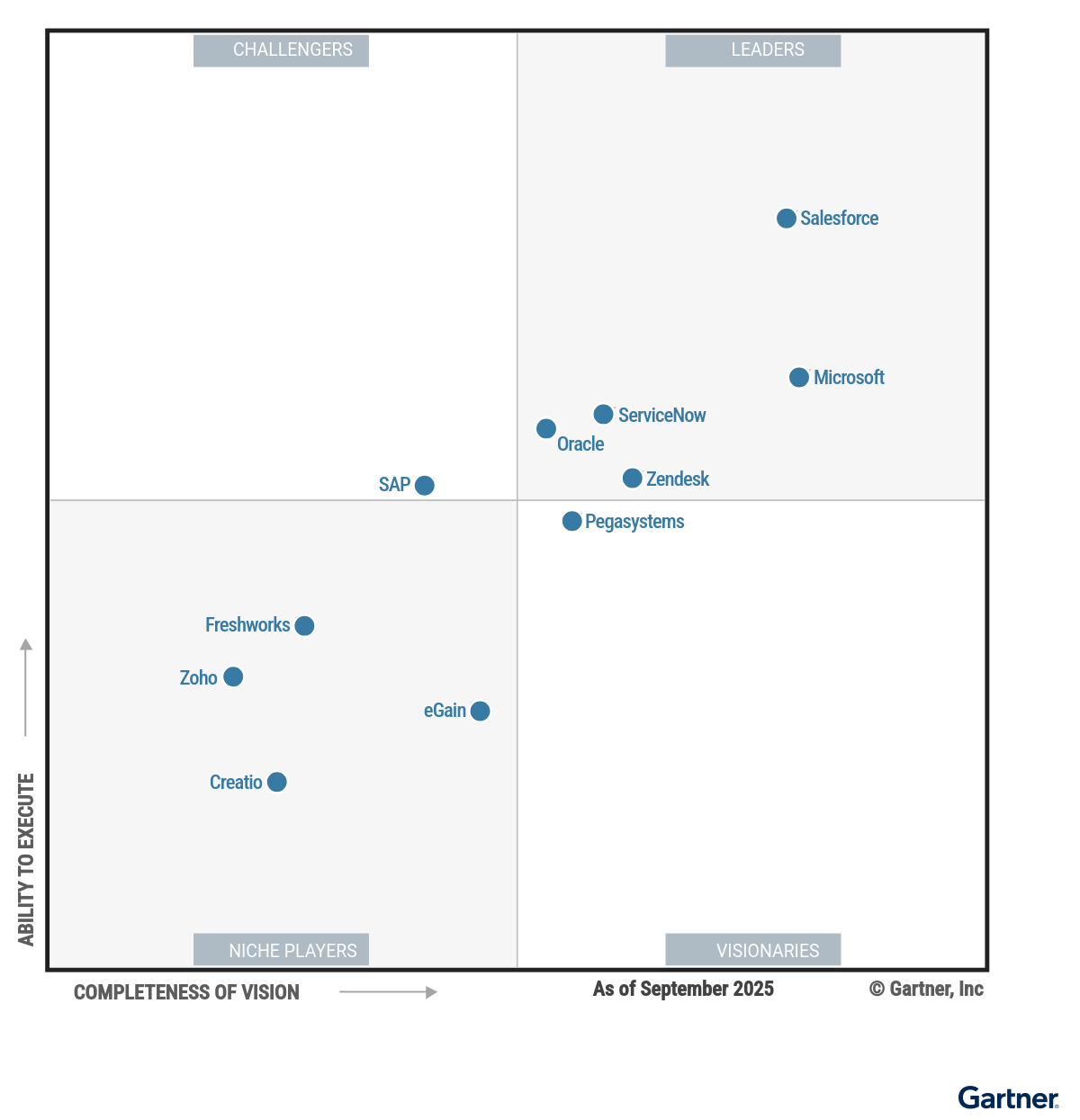
Vendor Strengths and Cautions
Note: Gartner has significantly revised the critical capabilities, use cases and scoring criteria in the 2025 publication, compared to the 2024 Magic Quadrant and Critical Capabilities for CRM Customer Engagement Center. Therefore, please do not evaluate year-over-year differences or make comparisons to the previous version of the Magic Quadrant and Critical Capabilities for this market.
Creatio
Creatio is a Niche Player in this Magic Quadrant. Headquartered in Boston, Massachusetts, U.S., Creatio is a private company offering Service Creatio, its CRM customer engagement center (CEC) platform. Creatio primarily serves financial services, manufacturing, business and professional services, and telecom environments, with its strongest presence in North America, Europe and APAC. Service Creatio leverages its no-code platform and is well-suited for midsize and enterprise organizations while serving small and midsize businesses (SMBs) through partners.
Recent updates include a new AI-centric adaptive UI, unified AI architecture and prebuilt CEC AI agents for case resolution, knowledge drafting and dashboard automation. Updates also include enhancements to its no-code capabilities and expanded contact center as a service (CCaaS) partnerships.
Creatio’s roadmap features CEC AI agents for advanced automation and real-time decisioning across customer journeys, AI-augmented workflows, self-learning agent support and natural-language-driven no-code development.
- No-code composability: Creatio’s modular architecture and robust low-code/no-code tools enable rapid application customization and extension using reusable components and embeddable AI skills. This enables enterprises to scale and adapt the CEC solution, allowing for rapid innovation, seamless integration and business agility while avoiding vendor lock-in and legacy system constraints.
- Operational viability: Service Creatio’s consistent year-over-year growth and agile, AI-embedded platform is well-suited for enterprises interested in deploying rapid customer engagement innovations.
- AI Command Center: Creatio’s AI Command Center centralizes the management of AI skills and agents, supporting real-time risk detection, proactive service optimization and dynamic event-driven actions. This enhances operational resilience and customer experience (CX) while maintaining oversight and governance of AI activities.
- Starter AI use cases: Creatio offers a limited list of starter AI agents and AI skills for customer service. For organizations seeking to build more advanced AI use-cases on their AI journey, this may mean having to build use cases from scratch to be able to use the AI assistant chat panel.
- Global reach: Creatio’s global presence and operations are limited in areas such as the Middle East, Africa and LATAM. Prospective global enterprise customers should evaluate local support needs and consider available mitigation options.
- AI consumption pricing: Creatio’s token-based AI consumption pricing model is defined around requests sent to the model or responses received. Furthermore, it is not transparent about intermediate data processing or external integration use case costs.
eGain
eGain is a Niche Player in this Magic Quadrant. The publicly traded company is based in Sunnyvale, California, U.S. Its primary product is the eGain AI Knowledge Hub, which offers a CEC application coupled with its eGain AI Agent and eGain Analytics Hub. eGain primarily serves financial services, insurance, government, retail and utilities environments, with its strongest presence in North America. eGain is well-suited for large B2C customer service environments, particularly those leveraging its knowledge management platform.
Recent enhancements include AI agent offerings for customer self-service and contact centers, AI-powered knowledge content orchestration, and generative AI (GenAI) integration for tasks such as case summarization and business rule automation.
Its roadmap includes improving the developer experience with expanded language support and software development kits (SDKs), enabling interoperability with third-party AI agents for automated service orchestration and delivering configurable knowledge synthesis capability.
- Platform agility: eGain’s architecture incorporates extensive APIs and prebuilt connectors, resulting in an agile platform. This design simplifies integration with existing enterprise systems, such as CRMs and back-office systems, and accelerates time-to-value for customers.
- Knowledge foundation: eGain’s advanced knowledge automation capabilities are central to its AI Knowledge Hub and CEC architecture. This approach distinguishes it from other vendors that offer knowledge management as a secondary feature or an add-on via third-party integrations.
- Composable architecture: The eGain platform is built on a modular architecture with packaged business capabilities and comprehensive open APIs and events. It includes a “Bring Your Own AI” option, enabling enterprises to integrate their own large language models and various third-party systems, such as CRMs, CCaaS, content management and AI engine applications, that are available in its marketplace.
- Market presence: eGain primarily operates in North America and Western Europe. Prospective customers based or with operations in regions outside these areas should review references and confirm whether the company can deliver, implement and support its solutions to meet local and regional requirements.
- Partner network: Compared to other vendors in this Magic Quadrant, eGain has a limited number of partners and select system integrators (SI) in Europe and North America. This may limit the availability of skilled implementation resources for customers and prospects.
- Delivery consistency: Gartner clients have reported issues with eGain’s ability to meet implementation and support service delivery commitments. Such issues may impact timely fulfillment of agreed-upon services crucial for maintaining strong client trust and satisfaction, and prospective customers may need to invest in vendor management to ensure service expectations will be met.
Freshworks
Freshworks is a Niche Player in this Magic Quadrant. The publicly traded company is based in San Mateo, California, U.S. Its Freshworks for CX is built for case management workflows and interdepartmental collaboration use cases. Other products in its CEC portfolio are Freshdesk Omni for omnichannel support, case management and knowledge management; Freshdesk for ticketing; Freshchat, a conversational product; Freshcaller, a voice service solution for secure calls; and Freddy AI for agentic and assistive AI. Its CEC portfolio is well-suited for SMBs. Freshworks targets all market segments with a strategic goal to increase its presence in the midmarket.
Recent enhancements include a platform spanning marketing, sales and service, alongside its Freddy AI Copilot, which delivers real-time coaching, conversation summarization and response suggestions.
Freshworks’ roadmap shows enhancements to its Freddy AI platform to deliver autonomous multiagent systems, including vertical-specific and prebuilt AI agents, while advancing Freddy AI Copilot for next-best-action execution.
- AI-driven innovation: Freshworks’ Freddy AI Copilot is integrated into its CEC, providing agent assistance features such as real-time coaching, conversation summarization and response suggestions. This functionality is designed to improve agent efficiency and response accuracy, reducing reliance on external integrations and manual effort.
- Unified CX platform: Freshworks offers a unified CX solution, which is built on a single platform that covers marketing, sales and service operations. This architecture provides a simplified, end-to-end CX solution that is suitable for SMBs.
- Deployment agility: Freshworks demonstrates quick deployment and ease of setup, with a minimal learning curve for users and low reliance on external consultants for administration or customization. This facilitates quick value realization for customers, positioning deployment agility as a differentiator.
- Midmarket execution: Freshworks’ emphasis on expanding further into the midmarket, while simultaneously serving its base of SMBs, may challenge its ability to execute across these distinct market segments. This dual focus could impact the depth of engagement achieved in either market.
- Product packaging: Advanced AI features, such as Freddy AI Copilot, are offered as add-ons that customers purchase at an additional cost, which is a point of contention for customers who expect simpler all-inclusive packaging from the vendor. Some Gartner clients have indicated that this makes Freshworks’ CEC difficult to cost-justify in their procurement decisions.
- Enterprise platform scope: While Freshworks articulates a vision for an intelligent engagement platform, its capabilities for deep integration with complex enterprise ecosystems, including ERP and customer data platform products, are still evolving. As a result, large organizations seeking a comprehensive solution for customer engagement and back-office operations may find the platform’s current scope to be limited.
Microsoft
Microsoft is a Leader in this Magic Quadrant. The publicly traded company is based in Redmond, Washington, U.S. Microsoft Dynamics 365 Customer Service makes strong use of AI to drive customer, agent and administrator automation. The company has strong global and vertical market coverage and can support even the largest organizations’ customer service needs. Microsoft’s CRM CEC is well-suited for organizations of any size, particularly those with existing investments in the company’s other enterprise software.
Recent enhancements include the launch of Dynamics 365 Contact Center and support for the Model Context Protocol (MCP), enabling efficient integration of AI agents with MCP-ready enterprise systems.
Its roadmap shows improvements to AI agents and Copilot for Dynamics 365, new Dynamics 365 Customer Service Premium features through the convergence of CEC and CCaaS functionalities, and expanded Microsoft Copilot Studio capabilities to facilitate the creation of AI agents.
- Strategic AI: Microsoft’s AI strategy aims to evolve customer engagement toward autonomous workflows, optimizing service experiences and marking a shift from assisted service to agentic AI-powered self-service models. Customers could benefit from opportunities to test novel AI capabilities as they get deployed to CEC.
- Extensible environment: Microsoft’s platform features a modular architecture built on the Microsoft Power Platform, supporting low-code and no-code development for UI and user experience (UX) design, business logic, workflows and data services. It offers open APIs and SDKs, support for the MCP and numerous marketplace applications for solution extension.
- Platform ecosystem: Dynamics 365 Customer Service benefits from deep integration with a broad Microsoft ecosystem, including Microsoft 365, Azure and Power Platform. This approach streamlines operational processes and provides a consistent UX, shared data and seamless workflows.
- AI value proposition: Although Copilot functionality is included with Dynamics 365 Customer Service Enterprise and Premium licenses, the need for Copilot Credits for some features makes cost and deployment complexity less predictable than competitors offering AI natively without additional charges. Gartner clients have reported concerns such as unexpected costs, implementation issues and mixed results from their deployments.
- Limited industry templates: Microsoft does not offer turnkey industry solutions, unlike some competitors that offer industry clouds and preconfigured templates. Organizations should weigh the benefits of Microsoft’s flexible, component-based approach against potential delays and associated costs, particularly if they need rapid, standardized deployment.
- WEM maturity: Microsoft’s Workforce Engagement Management (WEM) capabilities show gaps in core functionalities, with areas like quality monitoring, coaching tools and integrated employee satisfaction tracking less mature than those offered by some CEC competitors. Organizations prioritizing robust WEM capabilities may find Microsoft’s current offering to be limited.
Oracle
Oracle is a Leader in this Magic Quadrant. The publicly traded company is based in Austin, Texas, U.S. The Oracle Fusion Service suite includes Oracle Service Center, Oracle Digital Customer Service, Oracle Knowledge Management, Oracle Intelligent Advisor, Oracle Field Service, Oracle Digital Assistant and Oracle Customer Data Management. Oracle has a strong global presence and is well-suited for large, global enterprises, including those looking to extend their existing investments in Oracle’s product portfolio.
Recent improvements include Oracle AI Agent Studio with prebuilt task-specific agents and a framework to build custom agents, the addition of languages in which GenAI responses are available, and automated email drafting.
Its roadmap includes improvements to task-specific AI agents for customer self-service, service analytics and continuous real-time data analytics applications.
- Embedded AI: Oracle embeds AI capabilities directly into its Fusion Service platform as standard features, without additional licensing costs. This includes real-time agent assistance, autosummarization of interactions, AI-powered triage and resolution, and the AI Agent Studio, which allows organizations to build and manage AI agents across applications within a governed framework.
- Partner ecosystem: Oracle maintains a global partner network of over 15,000 authorized implementation partners and more than 2 million certified professionals. This broad ecosystem supports complex enterprise-grade deployments across a diverse range of industries.
- Enterprise platform: Oracle provides an end-to-end service solution connecting CEC functions with broader enterprise applications such as ERP, supply chain management and human capital management. This integration offers a single source of truth for shared data across the enterprise, supporting enriched real-time interactions, AI workflows and seamless service automation.
- Limited proof of concept: Oracle’s prepurchase evaluation primarily involves sales engineers configuring demo environments tailored to specific customers rather than allowing extensive independent trials. This limits prospective customers’ ability to conduct hands-on testing or pilot deployments with their own operational data, which is crucial for validating product fit and assessing time-to-value.
- Third-party channels: Oracle relies on third-party products or services for several digital engagement functionalities, including SMS, digital voice, dialed voice (public switched telephone network), social and external communities, social care, video chat and co-browsing. This reliance may introduce additional complexity and costs for customers.
- Validating adoption: Oracle is less likely to showcase customer success stories than many of its CEC competitors. This gap in public validation impacts how Oracle’s innovation vision is perceived and independently confirmed, making it challenging for prospective customers to gauge real-world impact and adoption of its advanced CEC capabilities.
Pegasystems
Pegasystems is a Visionary in this Magic Quadrant. The publicly traded company is based in Waltham, Massachusetts, U.S. Its Pega Customer Service offering delivers robust process automation capabilities and has a notable presence in financial services, government, healthcare, telecom and manufacturing verticals. It is well-suited for large enterprises with hundreds to thousands of users, especially those focused on process automation.
Recent improvements include expanded agentic AI and GenAI capabilities across the platform and advancements in the workflow design tool Pega GenAI Blueprint for accelerated solution delivery.
Pega’s roadmap includes comprehensive conversational service agents and third-party AI agent interoperability. It is also enhancing Pega Blueprint, with a focus on client landscape analysis and rapid solution preview.
- Workflow-centric AI: Pega Customer Service is designed as a unified AI and automation service platform that enables a journey and workflow-centered solution. This approach emphasizes end-to-end orchestration across the entire customer journey, connecting front- and back-office operations, and positioning robust workflow as critical for the reliable and purposeful functioning of AI.
- Enterprise scalability: Pega focuses on serving the largest and most demanding organizations, particularly in regulated industries. Its modular low-code architecture is specifically engineered to accommodate multidimensional business complexity and ongoing change, allowing for the rapid creation and deployment of tailored case workflows.
- Low-code agility: Pega provides a low-code development environment that integrates AI-powered design tools to accelerate application development. This approach, combined with embedded declarative testing and model-driven DevOps, fosters efficient solution delivery in complex service environments.
- Pricing transparency: Pega does not publicly disclose pricing for its CEC product and uses a user- or consumption-based adaptive pricing model, making it challenging for prospective customers to estimate total cost of ownership (TCO) without direct engagement. Gartner clients seeking clear CEC pricing models to simplify procurement decisions have indicated reluctance to shortlist Pega Customer Service.
- Narrow market focus: Pega explicitly targets large and extra large enterprises with a tailored go-to-market approach. Enterprises outside these segments would find that Pega’s solutions are not optimal or prioritized for their scale and operational requirements, impacting solution fit, delivery and support.
- Platform complexity: Although Pega recommends moving to the next-gen Constellation design system, Gartner clients have reported that the lack of a clear transition path has resulted in some difficulties during the migration. Before undertaking this shift, current customers should consider securing specialist skills or consulting services and account for the additional effort required to complete the transition.
Salesforce
Salesforce is a Leader in this Magic Quadrant. The publicly traded company is based in San Francisco, California, U.S. Salesforce Service Cloud is at the core of its CRM CEC, delivering strong process automation and unified interaction orchestration capabilities that incorporate data from other systems of record and engagement. The company has a strong global presence, and its CEC is well-suited for organizations of all sizes, including those lacking previous investments in other Salesforce offerings.
Recent enhancements include Agentforce Service Agents for messaging and email, the launch of Service Rep Assistant with AI-driven resolution plans, and expanded AI-powered capabilities for case summarization and drafted email and chat responses.
Salesforce’s roadmap includes voice-AI agents, Enterprise Knowledge, Agentic Service Portal and improvements to the unified service console and agent assist capabilities.
- Unified AI platform: Salesforce’s CEC is unifying AI, data and automation on a platform designed with deep industry capabilities for personalized service resolution on a multitenant architecture. AI investments in its CEC functionality, including Agentforce Service Agent for self-service and Service Rep Assistant for service reps, demonstrate execution toward this vision.
- Global partner ecosystem: Salesforce’s ecosystem of hyperscalers, independent software vendors, GSI and SI partners provides customers with an array of connected and extensible solutions. This network facilitates functional extension and enrichment, enabling customers to achieve successful implementations for diverse use cases in highly specialized environments.
- Industry-specific strategy: Salesforce’s strategy of delivering end-to-end service across diverse industries is supported by 14 purpose-built industry products. This approach offers out-of-the-box, industry-specific capabilities and agentic actions to expedite time-to-value for customers, reflecting a strong understanding of vertical market needs.
- AI value proposition: While Salesforce champions its AI capabilities, its delivery may involve leveraging add-ons like Salesforce Data Cloud, Mulesoft and Digital Engagement licenses. These may require additional investment or substantial configuration.
- Total cost of ownership: To achieve end-to-end service automation, including back-office integration or specialized functionalities, customers may need to integrate multiple Salesforce or third-party products to its CRM CEC. Prospective customers should evaluate their AI, data and automation expectations and compare the TCO against Salesforce’s prepackaged product editions to mitigate.
- Cost forecasting: Gartner clients report significant complexity in forecasting costs when implementing Salesforce Service Cloud, often necessitating reliance on third-party consultants and Salesforce-certified developers. To mitigate the complexity further compounded by consumption-based components like Agentforce and Data Cloud, customers should utilize pricing calculators provided by Salesforce or consider products that bundle such consumption components into more predictable per-user seat licenses.
SAP
SAP is a Challenger in this Magic Quadrant. The publicly traded company is based in Walldorf, Germany. SAP Service Cloud offers good process automation capabilities, particularly when integrated with the company’s ERP offerings. It has a strong global presence and is well-suited for process-intensive industries, including manufacturing, business and professional services, milling and mining, and wholesale distribution. Its CEC is mainly implemented by organizations already invested in SAP’s ERP platform and it provides industry-focused and tailored applications.
Recent enhancements include AI-powered business information extraction to streamline data capture, Resolution Room integration and expert recommendations for collaborative problem solving.
SAP’s roadmap focuses on AI agents and an agent orchestration layer to enable multimodal workflows, advancing a GenAI-powered case flow designer and deepening vertical AI capabilities, particularly within the utilities industry.
- AI-first vision: SAP’s design strategy for the CRM CEC market is AI-centric, embedding SAP Business AI throughout the service journey. This strategy leverages SAP’s Joule AI copilot, which delivers real-time analytics, contextual summaries and role-specific content generation grounded in business data across the SAP ecosystem.
- Integrated back end: Native integration between SAP Service Cloud and SAP’s ERP ecosystem enables seamless end-to-end service delivery across front-, middle- and back-office functions, and improves TCO and ROI for SAP Business Suite customers.
- Partner effectiveness: SAP’s certified global partner network extends the geographical and industry coverage of SAP Service Cloud by selling and implementing the offering to SAP and non-SAP ERP customers.
- Market expansion focus: SAP’s CEC demand generation strategy is strongly focused on the SAP ERP installed base. While SAP also pursues net new customers, this approach reflects a measured stance toward market share expansion in broader CEC segments, which may impact the prioritization of features and integrations for customers outside the SAP ERP environment.
- Ecosystem integration: Customers requiring highly tailored service functionalities find that custom service development and deployment are handled outside the core SAP Service Cloud environment. While this approach offers extensibility, it can add complexity for customers managing highly diverse IT landscapes and can increase reliance on external development efforts for custom-made solutions.
- Knowledge management integration: Advanced knowledge life cycle management and dynamic authoring are not included natively. Customers may need to acquire and manage an additional solution for these capabilities that support a wide range of AI applications.
ServiceNow
ServiceNow is a Leader in this Magic Quadrant. The publicly traded company is based in Santa Clara, California, U.S. ServiceNow Customer Service Management (CSM) product automates and optimizes front-, middle-, and back-office processes. With a global presence, ServiceNow is well-suited for large and enterprise organizations, especially those using its IT Service Management (ITSM) product or seeking a low-code platform for rapid deployment. Its network of sales and deployment partners provides vertical market customizations that supplement the 12 ServiceNow industry solutions.
Recent enhancements include the release of Agentic Workflows for CSM, GenAI-powered agent assist for email and chat recommendations, workflow data fabric and a Contact Center Integration Framework for unified routing and native call controls.
Its roadmap includes contact center integrations for native voice-AI agents with voice streaming and orchestration and Web Embeddables Core for customer self-service and agents in third-party experiences.
- AI-driven workflow vision: ServiceNow’s CRM CEC market focus is to progressively adopt agentic AI and GenAI, deeply integrating these technologies with its workflow and data platform. This strategy aims to unify and simplify work across departments, enabling automated task completion with cross-functional visibility and delivering faster time-to-value at a lower TCO.
- Unified platform: ServiceNow orchestrates end-to-end service experiences on a unified platform and single codebase. This approach facilitates the management of complex service cases across diverse enterprise functions by leveraging AI, data and workflows within a cohesive system of action, where work is routed, automated and completed at a lower TCO.
- Partner network: ServiceNow’s partner ecosystem contributes a significant portion of customer implementations and net-new contract value. By requiring partners to maintain high customer satisfaction scores, ServiceNow demonstrates a strong commitment to successful deployments and effectively extends its market reach and service delivery capabilities.
- CRM breadth: ServiceNow offers limited native CRM front-office and sales capabilities, with no native marketing functionalities. Organizations prioritizing a robust and natively integrated sales and marketing suite alongside service management should evaluate alternative platforms.
- Analytics breadth and depth: ServiceNow’s real-time dashboards lack a unified view across Sales, Service and Field Service solutions. Advanced analytics often require integration with external data visualization tools, increasing the effort and complexity for customers seeking a holistic view of their customer experience operations.
- Deployment complexity: Implementation can involve substantial configuration and expertise, which may extend deployment time and costs. Some Gartner inquiry clients have described the UI, particularly for agents, as less intuitive and feature-rich, potentially impacting user adoption and operational efficiency.
Zendesk
Zendesk is a Leader in this Magic Quadrant. The private company is based in San Francisco, California, U.S. Zendesk Suite includes CEC services and functions, supporting customer interactions across voice and digital channels in self- and assisted-service deployments. It has a global presence, largely in North America, Europe and LATAM, and is well-suited for B2C customer service departments in business and professional services, technology, retail and manufacturing.
Recent enhancements include AI agents with multistep reasoning, copilot for autoassist and real-time guidance, and integrated quality assurance (QA) capabilities for AI agents and voice bots, with call summaries and deflection.
Its roadmap includes autonomous agentic workflow solutions, a knowledge graph and a unified Customer Service Suite integrating voice services, WEM and CEC capabilities.
- AI-first resolution vision: Zendesk offers an AI-first Resolution Platform that integrates AI-assisted workflows, copilot tools to enhance agent productivity and workforce engagement capabilities. The platform is designed for a cohesive experience from a single agent workspace that streamlines operations.
- Integrated WEM: Zendesk offers native WEM features, including automated QA for voice and bots, enabling consistent quality scoring across interactions. These integrated WFM and QA functionalities are seamlessly embedded within the Zendesk Suite, offering tools for tailored coaching and risk detection to improve agent performance.
- Global operations: Zendesk’s substantial global operations include research and development (R&D), sales, and marketing personnel across North America, Europe and APAC. This broad presence supports its ability to execute on a global scale and meet diverse regional market demands.
- Service scope: Zendesk’s strategic emphasis is around core customer service case management, which may present limitations for enterprises requiring a broader, integrated service management approach that encompasses middle- and back-office operations. This focus may not fully address the demand for extensive cross-departmental orchestration and industry-specific workflows increasingly sought by larger, more complex organizations.
- Pricing and licensing issues: Several Gartner clients have reported dissatisfaction with price increases at renewal and licensing constraints, such as usage limits that prevent downgrading to lower tiers when higher ones are unnecessary. Prospective customers should negotiate pricing and licensing terms during procurement to retain flexibility and cost predictability.
- Vertical specialization: Zendesk’s installed base leans toward retail and technology-driven B2C service environments, with growing expansion into sectors like financial services and manufacturing. Prospective customers in complex B2B organizations or highly regulated industries should evaluate whether leveraging Zendesk’s partner ecosystem would meet their requirements.
Zoho
Zoho is a Niche Player in this Magic Quadrant. The private company is based in Chennai, India. Zoho Desk offers basic customer service process orchestration capabilities for service and support teams. The company has a global presence and sells its CRM CEC solution primarily to financial services, government, and business and professional services. It is well-suited for smaller service and support deployments, particularly in organizations that also use the company’s Zoho CRM offering.
Zoho has recently deployed AI-powered assistants for instant messaging, introduced writing assistance and content analysis tools to aid agent responses, and released a GenAI-based answer bot for self-service and agent support.
Its roadmap includes the introduction of built-in Zia AI agents for customer service personas, the launch of an agent self-service portal and the provision of custom mobile application development for large enterprises.
- Affordable value: Zoho offers a significantly lower TCO compared to many CEC market competitors. This is achieved via an internal development model, reducing acquisition and integration expenses. Transparent pricing plans further attract organizations with constrained budgets seeking core functionality.
- Proprietary infrastructure: Zoho operates its own private data centers in multiple countries, ensuring data privacy, security and integrity, unlike many CEC vendors that rely on public cloud providers. This infrastructure supports a broad suite of integrated applications designed to fit business needs within a single system.
- Partner ecosystem: Zoho’s extensive global sales and implementation partner network, which is crucial to reducing TCO for its customers, is comparable in size to market leaders. Organizations of all sizes will find it easy to access solution delivery and postimplementation support services through the partner network.
- Limited breadth of innovation: Zoho has delivered limited new features and enhancements to current functionality compared to other providers evaluated for this Magic Quadrant. This may impact organizations that prioritize rapid feature evolution and continuous service innovation.
- Case management: Zoho Desk’s case management functionality includes case creation and treatment, round-robin case distribution and case imports from spreadsheets. However, it does not offer competitive advanced case automations such as autocomplete and next-best-action recommendations, which are important for high productivity and superior service experiences.
- Global operations: Zoho’s R&D personnel are exclusively based in the APAC region, and its global customer service and professional services teams are comparatively small. This concentration may present challenges for large enterprises or those outside the APAC region requiring extensive, localized or high-touch product insights and support services.
Vendors Added and Dropped
We review and adjust our inclusion criteria for Magic Quadrants as markets change. As a result of these adjustments, the mix of vendors in any Magic Quadrant may change over time. A vendor's appearance in a Magic Quadrant one year and not the next does not necessarily indicate that we have changed our opinion of that vendor. It may be a reflection of a change in the market and, therefore, changed evaluation criteria, or of a change of focus by that vendor.
Added
No vendors were added to this Magic Quadrant.
Dropped
HubSpot was dropped from this Magic Quadrant because it did not meet the average deal size and geographical presence inclusion criteria.
Inclusion and Exclusion Criteria
To qualify for inclusion, providers needed to have:
Market Presence and Momentum
Factors that affect our evaluation are the presence that a vendor has in the market and the observed momentum of its growth. A vendor with stagnant sales or an ineffectual marketing organization should concern prospective buyers in this rapidly expanding and evolving market. Gartner’s criteria specify that vendors have:
Revenue traction: For the four fiscal quarters that ended closest to 31 December 2024 and no earlier than 30 September 2024, per generally accepted accounting principles (GAAP) or International Financial Reporting Standards (IFRS):
- Confirm a minimum of $51 million in total CRM CEC software license revenue, composed of revenue from concurrent licenses, named-user licenses and application consumption.
- Confirm revenue of at least $14 million in CRM CEC software license revenue for core customer service and support from net new clients.
- Confirm a minimum of 10% year-over-year growth in total CRM CEC software license revenue.
The following must be well-represented and supported:
- Large or midsize businesses (average deal size above 100 customer service representatives or employees in a similar function).
- At least three out of the five major geographical markets of North America, Europe, Asia/Pacific, Middle East/Africa and Latin America, with each contributing a minimum of 10% of total CRM CEC software license revenue.
- At least three industries (examples being utilities, telecommunications, financial services and insurance, high-tech, healthcare, public sector, manufacturing, retail, oil and gas, aerospace and defense, automotive, chemicals, and medical devices).
Functional breadth: Submitted product must provide all of the mandatory features in the Market Definition.
Market awareness: Be recognized by the CRM CEC market, as evidenced by regular appearances on client shortlists, by appearances at tradeshows and by references as a competitor by other vendors.
Market following: Provide thought leadership, which is adopted by customers of the CRM CEC product in live operations, through webinars, market-related white papers, blog articles and user communities.
Short-term viability:
- Funded operations: sufficient cash to fund 12 months of operations at the current burn rate.
- Onboard professional services capacity: sufficient professional services to fulfill customer demands during the next 12 months.
- Additional professional services capacity: a practice and ecosystem with sufficient third-party consulting and integration firms to grow at a double-digit pace for five years.
- Sales pipeline: Demonstrate a pipeline of prospective customers and a sales organization dedicated to drive growth in new CRM CEC business.
Exclusion Criteria
Software applications developed, marketed and implemented primarily for IT service management use cases or for field service management (FSM) use cases are excluded from this research.
Evaluation Criteria
Ability to Execute
Product or Service: The product must offer all contact routing, process orchestration, knowledge management, resource management and analytics capabilities expected in a customer service technology platform. The capabilities should preferably be offered as composable components natively built on a unified platform. The platform should include a low-code/no-code development interface for ease of customization.
Overall Viability: Revenue indications and growth are important factors for this criterion, as is evidence of roadmap item delivery at pace. CEC providers require increased investment in technology, people and infrastructure to withstand competitive risks magnified by significant disruption in the market. The presence of a substantive partner network, supplemented with a community of trained experts, is another important factor.
Sales Execution/Pricing: The CEC market is not close to saturation and shows continued growth opportunities for providers that have demonstrated effective lead generation and deal closing methodology and results. Customers expect flexibility in licensing terms, enabling them to scale services up and down in keeping with business requirements, while enterprises pursuing composable application strategies favor flexible pricing models that include bundled and a la carte pricing.
Market Responsiveness/Record: Visibility in the market as indicated by competitor mentions, shortlist frequency and market share are important factors for this criterion, as is the relevant differentiation of the offering and demonstrated ability to adapt to changing market conditions.
Marketing Execution: The quality, clarity and effectiveness of marketing messaging and materials, especially in targeting enterprise needs, are important factors for this criterion. A comprehensive marketing program is important to attract invitations to bid for opportunities. A strong brand awareness is also key to developing channels with system integrators, which are less likely to go to market with providers unknown to their customers.
Customer Experience: A reputation for consistently delivering reliable support services and a differentiated customer experience are important factors for this criterion. Ease of use through an intuitive user interface of the platform for end users and the breadth and depth of low-code/no-code tooling are other important factors.
Operations: CEC platforms enable orchestration of end-to-end customer service processes, and customers expect the platform to be supported by talented, motivated staff backed by experienced leaders with a strong track record. As customers select strategic suppliers for global or multiregional needs, CEC operations need to be localized, with sufficient staff presence in-region to ensure specific local requirements can be met.
Ability to Execute Evaluation Criteria
| Evaluation Criteria | Weighting |
|---|---|
Product or Service | High |
Overall Viability | Medium |
Sales Execution/Pricing | High |
Market Responsiveness/Record | High |
Marketing Execution | Medium |
Customer Experience | High |
Operations | Medium |
Source: Gartner (October 2025)
Completeness of Vision
Market Understanding: Market understanding includes meeting the current CEC market needs as well as strategies to align to future needs of the market while withstanding disruption. Anticipation of market convergence and new competitive risks, and the ability to defend and increase one’s relevance, are other important factors.
Marketing Strategy: Communicating a differentiated strategy in a market where technologies are largely similar is crucial to win mind share. A CEC vendor’s marketing strategy should help prospects to understand the capabilities of its offering, with positioning and messaging clearly reflecting strengths of the platform, and the vendor’s ability to support a broad customer base across industries, regions and market segments.
Sales Strategy: Striking the best balance between direct and indirect approaches to the market is important when the cost of sales can be high. As customers select a strategic provider for CEC, providers must fulfill customers’ desire to deal directly and centrally for contract terms but be managed locally for regional needs.
Offering (Product) Strategy: Vendors should be able to demonstrate an approach to product development and delivery that highlights industry requirements and the speed at which differentiated or innovative capabilities are added to their CEC platforms. Customer communities hold high importance as sources of information to influence product development as vendors evolve their offerings.
Business Model: Vendors should be able to demonstrate the quality and viability of their growth strategy for the CEC business, the scope of use cases the platform covers by embracing synergies and opportunities with adjacent categories. They should also demonstrate how well they are aligning the product roadmap with the business model and growth strategy. A vendor’s ability to adapt and embrace new opportunities and challenges that arise in the market is another factor in this criterion.
Vertical/Industry Strategy: A focus on specific industries or other segments creates opportunities to increase mind share in key target markets, in contrast to a horizontal, all-encompassing market vision. A vendor should be able to demonstrate the breadth and scope of industry-specific solutions offered on top of or as part of the CEC offering through its presence in diverse industry or vertical market segments.
Innovation: This requires the vision and the ability to research, benchmark and deliver market-differentiating product and service capabilities through in-house development or collaboration with innovative partners. A vendor’s innovations should reflect alignment to its vision of the future CEC and the customer service technology space.
Geographic Strategy: A CEC vendor’s strategy for presence and growth outside its home market in order to attract a larger audience is key to meeting the needs of global and multiregional organizations. Local presence of resources, and platform capabilities that are specific to local needs and locally applicable regulations, are key.
Completeness of Vision Evaluation Criteria
| Evaluation Criteria | Weighting |
|---|---|
Market Understanding | High |
Marketing Strategy | Medium |
Sales Strategy | High |
Offering (Product) Strategy | High |
Business Model | High |
Vertical/Industry Strategy | High |
Innovation | High |
Geographic Strategy | Medium |
Source: Gartner (October 2025)
Quadrant Descriptions
Leaders
Leaders demonstrate a market-defining ability to execute their vision through products, services, customer experience and solid business results in the form of revenue and earnings. Leaders typically respond to a wide market audience by supporting broad market requirements in multiple regions and industries. They demonstrate product leadership by delivering new enhancements and innovations to a consistent schedule. These vendors’ development teams have a clear vision for emerging areas such as agentic AI, AI-ready data and digital customer engagement transparently blended with voice channels. They also focus on the growing impact of AI and Internet of Things (IoT), and the building of a solid ecosystem that can support increasing consumer desire for effortless interactions with businesses and governments. They engineer flexible products along the lines of Gartner’s vision of the future of applications that include composable applications design principles. Their size and financial strength enable them to remain viable through challenging times. Clients indicate that Leaders’ products have improved their organizations’ delivery of high levels of value and ROI.
Challengers
Challengers demonstrate a high volume of sales in their chosen markets — that is, more than 30% of their new business comes from more than one industry, and more than 50% comes from sales to the broader installed base. Challengers understand their clients’ evolving needs, but might not lead them into new functional areas with strong vision and technological leadership. Challengers often have significant size and financial resources and a strong presence in other application areas, but they have not demonstrated a clear understanding of how to win business in the CEC market beyond their installed base. Therefore, they may not be well-positioned enough to capitalize on emerging trends. Over time, large vendors may fluctuate between the Challengers and Leaders quadrants as their product cycles and market needs shift.
Visionaries
Visionaries are ahead of many competitors in terms of delivering innovative products or delivery models. They point the way ahead. They anticipate emerging and changing needs for customer service and move into the new sectors associated with them. They have strong potential to influence the direction of the CEC market, but are limited in terms of execution or track record. Typically, their products and market presence are not yet complete or established enough to challenge the Leaders, which places them in a higher-risk and higher-reward category. Whether Visionaries become Challengers or Leaders may depend on whether customers accept new technology or the vendors can develop partnerships that complement their strengths.
Niche Players
Niche Players have important products with unique CEC functions, or offerings for certain industries or geographic areas. Certain Niche Players do well in a particular segment of a market, or may have a limited ability to innovate or to outperform other vendors in the wider CEC market. They may offer complete portfolios but exhibit weaknesses in one or more important areas. They may, for example, offer the best CEC option for enterprises that have adopted their broader product portfolio but have limited appeal for organizations outside of their installed base. They may focus on supporting a small number of large enterprises or a large number of small and midsize businesses. Niche Players may not have the means to keep pace with the market’s broader demands; however, they can often offer the best solutions for the current needs of particular customer service organizations, considering the price-to-value ratio of their solutions.
Context
From Customer Service Technology Suite to AI-Powered Autonomous Customer Service
Constantly increasing customer expectations for effortless, highly personalized, near-instantaneous service experiences have made delivering such experiences a critical business priority for organizations. These organizations find it challenging to deliver such experiences with existing technology designed for use by large numbers of customer service employees handling customer interactions and manually initiating various tasks to fulfill those requests. This enterprise challenge is further compounded by increasing labor costs and high employee attrition rates in customer service contact centers.
CRM CEC vendors that have been expanding their solutions beyond core capabilities, such as case management, knowledge management, workflow management and unified voice and digital engagement, are recognizing this emerging market need as a pressing need for automating the customer service function. They are positioning autonomous AI agents as the solution to this need but are challenged with demonstrating how reliable such AI agents would be, so enterprises would be willing to trust their brand reputations on such AI agents.
Impact of AI Agents on the Customer Service Technology Landscape
AI agents are solutions that use various software and data elements, including reasoning and orchestration logic, predictive and generative AI techniques, and APIs. They are capable of going beyond providing personalized, in-context information and can execute tasks to fulfill an outcome on behalf of the brand. Several CRM CEC vendors in this Magic Quadrant show AI agents in their near-term roadmaps for 2025 and 2026. Some are positioning these as natural extensions of their AI assistants, such as virtual customer assistants, and agent assistants; others are de-emphasizing the importance of such assistants, instead seeking customers to leap ahead to adopt AI agents. Whether this first crop of AI agents will be autonomous is questionable when considering the criteria such solutions would need to meet or exceed to be considered reliably autonomous (see When to Use or Not to Use AI Agents).
Market Overview
The $43.4 billion customer service and support software market, of which the CEC market is a part, grew at a rate of 13.5% year-over-year and remains the largest subsegment of the customer experience and CRM market (CEC’s proportion of the customer service and support market was about 44.3% in 2024). Enterprise customers and prospective customers will benefit from continued investments in CEC product portfolios by vendors that are experiencing strong growth (see Forecast Analysis: CRM Customer Service and Support Software, Worldwide).
This market is fragmented but remains highly competitive. The bulk of the customer service and support software market is held by the top 10 vendors, which together command 61.6% of the share. Six of the CEC vendors in this Magic Quadrant are among the top 10 customer service and support software market vendors. The leading CEC vendors by revenue are, in descending order, Salesforce, Oracle, Zendesk, ServiceNow, Microsoft and SAP. The CEC market also includes a host of smaller vendors, particularly those with upcoming technologies supporting AI, chat, analytics and self-service, and a few vendors with a CEC offering layered on top of a broader platform (see Market Share Analysis: CRM Customer Service and Support, Worldwide, 2024).
The CRM CEC market is evolving at an accelerating pace. Rapid technology innovations, new market entrants, and enterprises’ rethinking business and technology investment priorities against a backdrop of persistent uncertainty are among the main drivers of this accelerated pace. Customers of all sizes are interested in adopting emerging AI, GenAI and agentic AI capabilities as part of their customer service applications. Vendors in this market have responded to this demand with a wide array of AI innovations, either embedded into the CRM CEC or as add-ons or premium editions of their solutions. Gartner is seeing an increasing demand for functions spanning the CRM CEC and CCaaS markets. Main among the overlapping capabilities between these markets are omnichannel routing, process automation and AI-enabled virtual agent assistants and virtual customer assistants.
Most CRM CEC vendors offer similar functional breadth. Functionality differentiation largely depends on the depth of capabilities in several key areas, which include blending omnichannel interaction data and contextual system of record data to enrich real-time interactions and enhancing the digital channel experience to support multitouch asynchronous interactions. Additional differentiators include the expansion of enterprise data platform capabilities, incorporation of agentic AI and embedding AI-powered knowledge automation.
Customer service and support technology leaders should review the competing future-ready CEC offerings to choose the product that enables the customer service experience and productivity outcomes of the organization at the most optimal cost.
Ability to Execute
Product/Service: Core goods and services offered by the vendor for the defined market. This includes current product/service capabilities, quality, feature sets, skills and so on, whether offered natively or through OEM agreements/partnerships as defined in the market definition and detailed in the subcriteria.
Overall Viability: Viability includes an assessment of the overall organization's financial health, the financial and practical success of the business unit, and the likelihood that the individual business unit will continue investing in the product, will continue offering the product and will advance the state of the art within the organization's portfolio of products.
Sales Execution/Pricing: The vendor's capabilities in all presales activities and the structure that supports them. This includes deal management, pricing and negotiation, presales support, and the overall effectiveness of the sales channel.
Market Responsiveness/Record: Ability to respond, change direction, be flexible and achieve competitive success as opportunities develop, competitors act, customer needs evolve and market dynamics change. This criterion also considers the vendor's history of responsiveness.
Marketing Execution: The clarity, quality, creativity and efficacy of programs designed to deliver the organization's message to influence the market, promote the brand and business, increase awareness of the products, and establish a positive identification with the product/brand and organization in the minds of buyers. This "mind share" can be driven by a combination of publicity, promotional initiatives, thought leadership, word of mouth and sales activities.
Customer Experience: Relationships, products and services/programs that enable clients to be successful with the products evaluated. Specifically, this includes the ways customers receive technical support or account support. This can also include ancillary tools, customer support programs (and the quality thereof), availability of user groups, service-level agreements and so on.
Operations: The ability of the organization to meet its goals and commitments. Factors include the quality of the organizational structure, including skills, experiences, programs, systems and other vehicles that enable the organization to operate effectively and efficiently on an ongoing basis.
Completeness of Vision
Market Understanding: Ability of the vendor to understand buyers' wants and needs and to translate those into products and services. Vendors that show the highest degree of vision listen to and understand buyers' wants and needs, and can shape or enhance those with their added vision.
Marketing Strategy: A clear, differentiated set of messages consistently communicated throughout the organization and externalized through the website, advertising, customer programs and positioning statements.
Sales Strategy: The strategy for selling products that uses the appropriate network of direct and indirect sales, marketing, service, and communication affiliates that extend the scope and depth of market reach, skills, expertise, technologies, services and the customer base.
Offering (Product) Strategy: The vendor's approach to product development and delivery that emphasizes differentiation, functionality, methodology and feature sets as they map to current and future requirements.
Business Model: The soundness and logic of the vendor's underlying business proposition.
Vertical/Industry Strategy: The vendor's strategy to direct resources, skills and offerings to meet the specific needs of individual market segments, including vertical markets.
Innovation: Direct, related, complementary and synergistic layouts of resources, expertise or capital for investment, consolidation, defensive or pre-emptive purposes.
Geographic Strategy: The vendor's strategy to direct resources, skills and offerings to meet the specific needs of geographies outside the "home" or native geography, either directly or through partners, channels and subsidiaries as appropriate for that geography and market.