Critical Capabilities for Cloud ERP for Product-Centric Enterprises
14 October 2025 - ID G00826213 - 36 min read
By Tomas Kienast, Johan Jartelius, and 4 more
Cloud ERP applications for product-centric organizations are being transformed as AI, automation and composable architectures deliver new levels of agility. Application leaders should use this research to assess vendors by industry use case and identify solutions that drive innovation, scalability and compliance.
Overview
Key Findings
- Core business processes, such as manufacturing, supply chain and distribution, are increasingly standardized across leading cloud ERP solutions. This commoditization reduces differentiation in basic process coverage, shifting competitive focus to other areas.
- The integration of embedded and agentic AI, process mining and advanced analytics is transforming ERP value propositions. These capabilities are now weighted more heavily in solution evaluation, given their potential to drive automation, innovation and productivity.
- Application leaders are prioritizing platforms that support composable architectures, extensibility and orchestration. Modular design, low-code/no-code tools and robust integration capabilities enable greater agility, faster innovation cycles and seamless ecosystem collaboration.
- Global financial compliance, local market practices, on-site expertise, strong integration layers and access to vendor marketplaces remain critical for successful cloud ERP deployments — especially in multinational and multientity environments.
Recommendations
- While core business process support remains essential, application leaders should focus on selecting cloud ERP platforms that excel in advanced technology enablement, such as embedded AI, automation and analytics, to maximize innovation and productivity.
- When considering emerging capabilities, application leaders should ensure obtaining evidence of live customer adoption and review product release notes to validate maturity and availability, rather than relying solely on vendor roadmaps and marketing.
- Application leaders should aim to select ERP solutions with a composable architecture and robust integration tools. Organizations should favor platforms that support low-code/no-code customization and offer strong ecosystem collaboration to enable rapid adaptation and continuous innovation.
- Application leaders should ensure that the solution supports global financial compliance as needed, local regulatory requirements and integration with third-party applications. Organizations should also evaluate vendor marketplaces and on-site expertise for complex, multinational deployments.
Strategic Planning Assumptions
- By 2027, more than 80% of organizations will be changing their ERP strategies to facilitate the easier and faster adoption of new functionality.
- By 2027, 60% of customers replacing ERP applications will select software for its platform and business process orchestration capabilities rather than its transactional planning capabilities.
- By 2027, 62% of ERP application spending will be on solutions with embedded AI capabilities, up from just 14% in 2024.
What You Need to Know
Cloud ERP solutions for product-centric enterprises are undergoing rapid transformation, driven by advances in AI, platform technologies and evolving business requirements. A significant majority of organizations with ERP in place plan to replace or upgrade their applications within the next three years, underscoring sustained interest in modernization and innovation.1
This research evaluates cloud ERP solutions based on a defined set of critical capabilities and representative use-case scenarios tailored for product-centric organizations. Seven key use cases are featured, spanning organizational size, manufacturing models and distribution requirements. The interactive Critical Capabilities tool enables readers to adjust weighting percentages, allowing for a personalized evaluation aligned to their functional and vertical needs.
With the accelerated evolution of AI and other advanced technologies, organizations must assess both currently available features and vendor commitments to ongoing innovation. AI capabilities, such as embedded and agentic AI, are still in a phase of rapid development, and direct vendor-to-vendor comparisons based solely on present functionality may not reflect future potential. Therefore, AI should be evaluated as part of a broader “advanced technology” capability, which also encompasses analytics, process automation, platform extensibility and integration.
Organizations should also consider factors such as global financial compliance, support for local market practices, geographic presence, on-site expertise and robust integration layers. These elements remain critical for successful ERP deployments, especially in multinational and multientity environments. Not all vendors will be suitable for every geography or business model, and some may focus on specific sectors or types of organizations.
To maximize the value of this research:
- Evaluate the maturity and adoption of advanced technologies, including AI, as part of the broader technology enablement offered by each solution.
- Seek transparency from vendors on their product roadmaps, investment in innovation and commitment to ongoing enhancement of critical capabilities.
- Review country-level suitability, localization and support for the primary regions in which the ERP suite will be deployed.
- Recognize that vendor strengths may vary by use case, and that high scores in one area do not guarantee suitability for all scenarios.
This approach ensures a comprehensive, forward-looking assessment of cloud ERP solutions, empowering organizations to make informed decisions based on both current capabilities and future potential.
Analysis
Critical Capabilities Use-Case Graphics
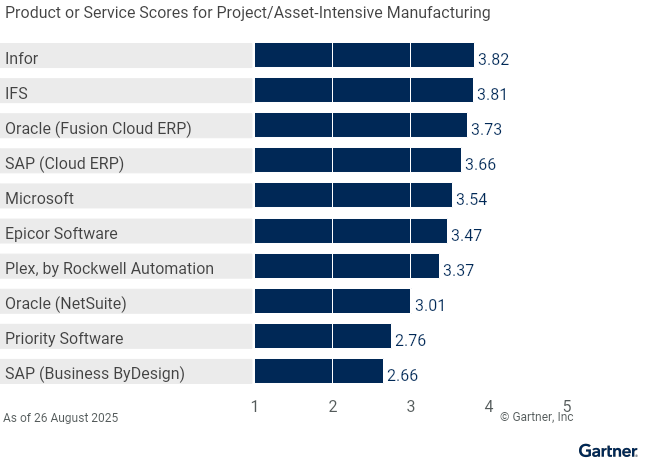
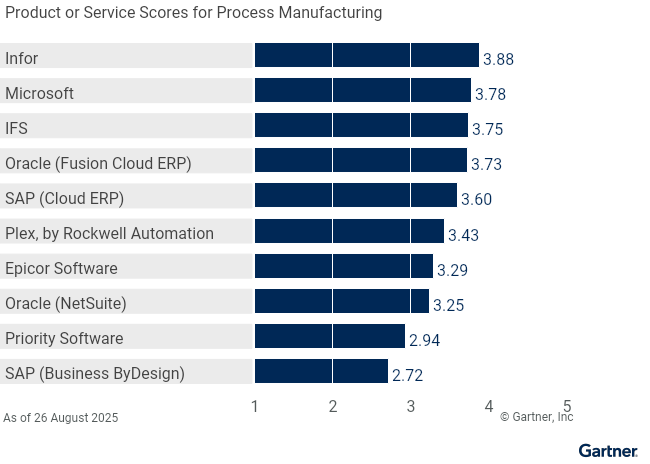
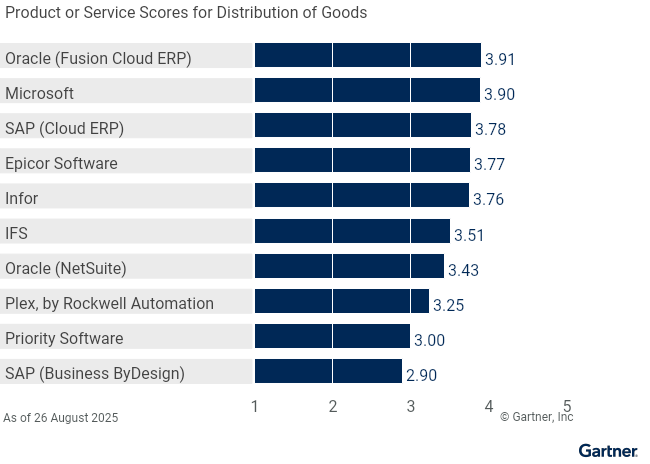
Vendors
Epicor Software
The product evaluated is Epicor Industry ERP Cloud. This solution is best-suited for lower-midsize enterprise discrete manufacturers, retailers and wholesale traders, particularly in industrial machinery, metal fabrication, wholesale distribution and building supply. It offers comprehensive localization support for North America and EMEA, as well as a growing presence in India, Latin America and China.
Epicor Industry ERP Cloud is primarily hosted on Microsoft Azure. It achieves its highest scoring in product-centric capabilities, including distribution, warehouse and logistics, advanced technology, and discrete manufacturing. The offering is further distinguished by its “cognitive ERP” vision (a concept of “data in action” that integrates advanced AI and machine learning to provide intelligent insights), embedding AI agents for natural language interaction and predictive forecasting. It also features Epicor Grow, a strong no-code business intelligence and analytics platform. Conversely, while strong in its core verticals, Gartner does not observe Epicor as the primary ERP in larger global enterprise deployments. Epicor also has a more developed presence in complex process and project/asset-intensive manufacturing use cases.
Ongoing innovation focus for Epicor is centered on expanding its cognitive ERP capabilities and delivering innovation more rapidly. The roadmap includes a strategic transition to a continuous integration/continuous deployment (CI/CD) model to accelerate value delivery. Tangible enhancements will focus on expanding AI-driven automation for processes like supplier communications and accounts payable, and delivering new sustainability features to support CSRD and IFRS compliance by extending carbon tracking to product-level quoting and Scope 1, 2 and 3 emissions.
IFS
The product under evaluation is IFS Cloud. This solution is particularly well-suited for midsize and large enterprises, with some presence among large global enterprises, primarily those operating in Europe and North America. Customers predominantly operate in asset-intensive verticals like industrial equipment, high-tech and process manufacturing sectors, including food and beverage, and chemicals.
IFS Cloud deployments are hosted on Microsoft Azure. The solution’s critical capabilities for composable architecture, single-vendor ERP suite and advanced technology received high ratings. IFS Cloud effectively delivers complex functionalities for project- and asset-intensive manufacturing and process manufacturing. Key features include embedded machine learning for operational anomaly detection in shop floor machinery, enabling proactive issue resolution before production is compromised. However, in comparison to other evaluated products, IFS Cloud receives lower ratings in critical areas such as support and system integrator (SI) ecosystem maturity, and certain complex financial management requirements.
IFS’s ongoing innovation focus is directed toward enhancing AI functionalities, particularly for manufacturing and asset management organizations. The company is committed to a strong AI strategy, featuring an AI platform (IFS.ai) that facilitates the integration of AI not only within IFS Cloud but also across various enterprise applications.
Infor
The product evaluated is Infor CloudSuite. It is a suite of enterprise applications built on the Infor OS platform, designed to address complex industrial process requirements. It enables the composition of tailored ERP solutions for specific industry verticals and is best-suited for midsize and large global enterprises in sectors such as industrial manufacturing, distribution, food and beverage, fashion, automotive, and aerospace and defense. Comprehensive localization is supported across EMEA, Asia/Pacific, North America and most major Latin American markets.
The solution is provisioned on Amazon Web Services (AWS), with a new five-year Strategic Collaboration Agreement in progress to enhance innovation and scalability. Infor CloudSuite achieves high scores for project/asset-intensive, process and discrete manufacturing use cases, attributed to its deep industry-specific functionality and the robust Infor OS platform. Key capabilities include advanced composable services, Data Fabric with a new data warehouse option, extensive robotic process automation (RPA), and embedded AI/ML services leveraging AWS Bedrock. While Infor’s roadmap demonstrates strong investment in user augmentation and operational efficiency, there is a plan to expand toward more autonomous, agentic AI capabilities in future releases.
Infor’s ongoing innovation focus includes the introduction of GenAI Assistant and Knowledge Hub integrated into the user experience (UX), enhanced process mining with generative AI (GenAI) capabilities, and new C-level and role-based workspaces. Development will focus on expanding GenAI use cases and accelerating adoption through the Infor Velocity Suite, which bundles innovations such as GenAI, RPA and process mining to provide a streamlined path to value realization.
Microsoft
The product evaluated is Microsoft Dynamics 365. This solution is best-suited for upper-midsize and large/global enterprises, particularly in the retail, consumer packaged goods (CPG), distribution and manufacturing sectors. It offers comprehensive localization and language support across EMEA, Asia/Pacific, North America and Latin America, with some markets covered by network partners.
Microsoft Dynamics 365 is provisioned on Microsoft Azure. The solution’s primary differentiator is its deep integration with the broader Microsoft Cloud stack, which resulted in its leading critical capability rating for Advanced Technology. This strength is underpinned by the Power Platform for extensibility, the mature Copilot assistant and the introduction of AI agents. The product also scores strongly in the distribution of goods, process manufacturing and discrete manufacturing use cases. Conversely, it received a lower rating for the complex manufacturing capability. It received its lowest score in the project/asset-intensive manufacturing use case, where it is about average relative to other vendors in this research. Microsoft Dynamics 365 is not evaluated for the lower-midsize use case, as it is not a primary target market.
Ongoing innovation focus for Microsoft is focused on further developing its vision for an “agentic ERP” that automates and orchestrates business processes. The roadmap includes the expansion of production-ready AI agents, such as its Supplier Communications Agent for procurement and Account Reconciliation Agent for finance. Further investment will focus on expanding its global footprint with new embedded localizations and e-invoicing capabilities, and on empowering its partner ecosystem to build vertical-specific agents.
Oracle (Fusion Cloud ERP)
The product evaluated is Oracle Fusion Cloud ERP. This solution is best-suited for upper-midsize and large global enterprises looking for an integrated suite of administrative and operational capabilities for complex corporate, supply chain, finance and manufacturing processes. The product offers comprehensive localization for EMEA, Asia/Pacific, North America and Latin America.
Oracle Fusion Cloud ERP is provisioned on Oracle Cloud Infrastructure (OCI), which continues to grow in capability and reach. It is evaluated very highly for the ERP for upper-midsize, large and global enterprises’ use cases due to its ability to support complex corporate requirements involving multilanguage, currency and regulatory compliance. The product receives a high score for its Logistics and Distribution module, including logistics network modeling, multiclient warehousing and global trade. It scored lower for project/asset-intensive, discrete and process manufacturing use cases. Oracle Fusion Cloud ERP is not included in the lower-midsize use case as it is not a target market.
Oracle’s ongoing innovation focus is on leveraging AI (including traditional ML, GenAI and agentic AI) across its product portfolio to enable more complex autonomous workflows through its AI Agent Studio.
Oracle (NetSuite)
The product evaluated is NetSuite. This solution is suitable for lower- to upper-midsize process and discrete manufacturers, retailers and distributors. It offers comprehensive localization for North America, Western Europe and most of Asia/Pacific.
NetSuite transitioned to Oracle Cloud Infrastructure (OCI), leveraging its advanced cloud capabilities, and is expanding to more geographies in the OCI regions covered by Oracle. NetSuite is evaluated highly for its single-vendor ERP suite solutions, financial management and geographic coverage. These well-rounded capabilities, delivered in a single cloud instance, make NetSuite a strong choice for ERP in lower-midsize business use cases. NetSuite’s focus on retail and wholesale trade and its dispersed inventory management capabilities result in a good score for distribution, warehouse and logistics, which are all part of its single suite. NetSuite received its lowest scores in complex manufacturing, process manufacturing and discrete manufacturing. NetSuite is not included in the use case of large, global enterprises.
Oracle’s ongoing innovation focus is expected to be focused on advanced AI across the whole suite, including the delivery of its NetSuite Next in 2026. This mode will provide more comprehensive and intuitive AI use cases leveraging the Redwood Design System.
Plex, by Rockwell Automation
The product evaluated is the Plex Smart Manufacturing Platform from Plex. This solution is designed for midsize organizations that operate multiple sites. It focuses on discrete and process manufacturing verticals, including automotive, industrial equipment, fabricated metals, food and beverage, and specialty chemicals. While its customer base is strongest in North America, Plex is actively leveraging Rockwell Automation’s global footprint to scale its sales, implementation and support services internationally.
The Plex platform utilizes its own global data centers for its core SaaS offering and uses AWS for some machine learning services. The Plex Smart Manufacturing Platform’s highest use-case scores are for discrete and process manufacturing. Recent enhancements for detailed automotive genealogy and food and beverage compliance reinforce its deep native capabilities. However, it has comparatively more limited functionalities for the distribution of goods use case.
Plex’s ongoing innovation focus is on expanding to New Zealand and Australia in the APAC region. Plans for a connected worker solution evolved into the Plex Connected Worker suite, which now includes Interactive Work Instructions (introduced in March 2025) and an embedded operations AI assistant that automates tasks and provides real-time insights. Investment in Internet of Things (IoT) and edge capabilities is demonstrated by a new native integration with Rockwell Automation’s FactoryTalk platform for advanced industrial data operations.
Priority Software
The product evaluated is Priority Cloud ERP. This solution primarily targets small to lower-midsize product-centric businesses seeking a unified SaaS ERP suite that integrates operational and administrative functionalities. The product provides comprehensive localization for North America, Europe and the Middle East.
Priority Cloud ERP is hosted on Amazon Web Services (AWS). Its use-case scores are low compared to other products evaluated in this report. Priority Cloud ERP’s highest critical capabilities scores were for discrete manufacturing, distribution and modular/composable architecture. Priority Software has integrated an easy-to-use low-code Portal Generator and mobile ERP app generator, enhancing the single-vendor ERP suite experience. Additionally, the company has strengthened its Advanced Warehouse Management System, optimizing it for mobile devices and providing intuitive process flow capabilities for warehouse personnel. Gartner has noted that Priority Cloud ERP is not typically utilized by upper-midsize or large global enterprises and did not evaluate it for those corresponding use cases.
Priority’s ongoing innovation focuses on maintaining a strategic commitment to its platform’s “unlimited openness” and flexibility in solution design. The company aims to further enhance UX, AI, analytics, predictive modeling, mobile web and portal generation, and various supply chain capabilities.
SAP (Business ByDesign)
The product evaluated is SAP Business ByDesign. This solution is best-suited for lower-midsize organizations and is particularly effective in addressing the general administrative requirements for industries such as wholesale, high-tech, industrial machinery and consumer products. Localization support is available for most of Western Europe, as well as parts of Asia/Pacific, Latin America and the Middle East.
SAP Business ByDesign is provisioned exclusively on SAP’s own data centers. The solution’s historical strength is its “suite in a box” design, featuring mature, prebuilt end-to-end business scenarios that minimize the need for customization. It includes built-in low-code/no-code tools for key users and nonagentic AI for predictive analytics. Its overall low rating in this evaluation reflects the limited investment in enhancements since SAP declared the product “feature complete,” while competitors in the market have continued to invest in improving their core capabilities. SAP Business ByDesign is not typically utilized by upper-midsize or large global enterprises and was not evaluated for those use cases.
SAP announced that it will stop offering SAP Business ByDesign to new customers starting in April 2026. Existing customers will be able to continue using the software and buying additional licenses until further notice from SAP.
SAP (Cloud ERP)
The product evaluated is SAP Cloud ERP (formerly known as S/4HANA Cloud Public Edition). This solution is best-suited for midmarket and large enterprises. It provides deep functionality for a broad range of product-centric industries, with particular strength in automotive, consumer products and life sciences, and offers comprehensive global support.
SAP Cloud ERP is provisioned with flexible hosting options across SAP’s data centers and all major hyperscalers. Its key differentiator is its ability to support complex, end-to-end operational core ERP processes within a single, comprehensive suite, although it is important to clarify that requirements outside of core ERP, such as HCM, SCM or procurement, require additional line-of-business solutions. This is further compounded by the integration with SAP Business Technology Platform (BTP). The solution is evaluated highly for financial management, a strength driven by its Universal Journal architecture, and demonstrates AI-driven capabilities with its generative AI assistant, Joule. Conversely, while its manufacturing modules are functionally deep, they are often perceived by the market as being more complex to configure than more specialized, best-of-breed solutions.
SAP’s ongoing innovation focus is on embedding agentic AI directly into standard processes and strengthening its “Partner First” delivery model. The roadmap includes the delivery of specific new agents, such as the Production Planning Agent to resolve material shortages, and the Intelligent Sourcing Agent to optimize procurement. SAP will also integrate new capabilities for environmental, social and corporate governance (ESG) reporting and continue its geographic expansion with new local versions.
Context
This Critical Capabilities research evaluates cloud ERP solutions for product-centric enterprises. The analysis is based on seven use cases that represent the primary subsegments of the market, including organizations of varying sizes and those focused on different manufacturing and distribution models. The use cases are designed to reflect the core operational needs and complexity found in this sector.
The scoring and comparative analysis are intended to help organizations identify the solutions best-suited to their specific requirements, as defined by these use cases and the associated critical capabilities.
The critical capabilities and their weighting reflect the evolving priorities of product-centric enterprises, including the increasing relevance of advanced technology enablement and platform extensibility.
Market Definition
Gartner defines cloud enterprise resource planning (ERP) for product-centric enterprises as a market for application technology that supports the automation of operational activities for the manufacturing, distribution, delivery and servicing of goods. Cloud ERP for product-centric enterprises is delivered under a SaaS license model (with frequent mandatory updates), where application support, infrastructure provisioning and management are the responsibility of the vendor.
Broadly speaking, ERP solutions enable a variety of enterprisewide business capabilities, primarily those associated with systems of record and systems of differentiation. ERP solutions form the core systems that allow an enterprise to conduct business. For product-centric ERP solutions, process enablement covers a wide range of enterprise processes, including:
- Supply chain planning
- Procurement of product inputs
- Production and quality control
- Warehousing
- Distribution
- Transportation logistics
- Customer order intake and invoicing
- Vendor invoice management
- All elements of financial transaction processing and reporting
Mandatory Features
The mandatory features for this market include:
- Plan supply and demand
- Source and procure production inputs
- Manufacture products (at least one of discrete, process and/or project/asset-intensive manufacturing)
- Manage customer fulfillment and logistics
- Manage core financial management capabilities (general ledger, accounts payable, accounts receivable, fixed assets, cost accounting and project accounting).
Common Features
The common features for this market include processes such as:
- Procurement — Requisition and purchase order management for indirect goods, services and capital equipment.
- Human capital management (HCM) — For cost management, as well as staffing, for operational resources.
- Financial planning and analysis (FP&A) or extended planning and analysis (xP&A).
- Specialized, industry-specific modules or adjacent applications — These include, but are not limited to, modules such as those used for configure to order, make to order and field service management. Also included are broader application solutions, such as those used for manufacturing execution (MES), enterprise asset management (EAM) and product life cycle management (PLM).
- Sustainability, and environmental, social and governance (ESG) — Execution or analytics capabilities that allow organizations a line of sight on their progress against sustainability goals.
Product/Service Trends
The cloud ERP landscape for product-centric enterprises is being shaped by several key trends, reflecting the evolving priorities and expectations of business and IT leaders.
Standardized process flows for manufacturing, supply chain and distribution are becoming widely available across leading cloud ERP solutions. This is reducing differentiation based on process coverage and shifting the focus toward capabilities that deliver strategic value.
Organizations are increasingly seeking ERP solutions that use embedded and agentic AI, process mining, and advanced analytics to drive automation, productivity and innovation. While these technologies are still maturing, their role in supporting decision making and operational efficiency is becoming a primary consideration in ERP evaluations.
Product-centric enterprises are prioritizing ERP platforms that enable greater flexibility and adaptability. Preference is growing for composable architectures and robust platform offerings that support modular deployment, low-code/no-code customization and seamless integration with broader digital ecosystems. This shift is driven by the need to rapidly respond to changing business requirements, orchestrate complex processes and foster continuous innovation.
These trends are directly influencing the critical capabilities assessed in this research, guiding organizations to evaluate cloud ERP solutions not only for operational excellence, but also for their ability to enable strategic transformation and long-term agility.
Critical Capabilities Definition
Single-Vendor ERP Suite Solution
This capability evaluates midmarket functionality for manufacturing and distribution firms to support all ERP functions in a single cloud instance.
In addition to the functional fit of the solutions to a wide range of midmarket companies, this includes the following:
- Ease of adapting or modifying a solution
- User interface (including ease of use, personalization, collaboration and integration with analytics applications)
- Overall simplicity or complexity of a solution
- The level of industry verticalization that a solution has achieved
Due to resource limitations, many midmarket companies look to their primary ERP vendors when seeking additional products (for product life cycle management, supply chain management and warehouse management, for example). Therefore, this Critical Capabilities report also evaluates the availability of add-on products and the level of their integration with the core ERP system.
Some key functions/components that are used to support this critical capability include:
- Manufacturing resource planning and demand planning
- Financial management
- Order to cash
- Procure to pay
- Vendor licensing policies to support midsize enterprises
- Human capital management (HCM)
- Partner ecosystems to support implementation across multiple industry verticals
Complex Corporate Requirements
This capability includes the suite’s ability (at least in one instance) to manage multiple business units and multiple types of business, perform financial consolidations and provide reporting capabilities across various operating units and lines of business.
This also includes the ability to manage major business processes across multiple business units — such as consolidating supply chains across business units.
Geographic Coverage
This capability includes the number and scope of language translations and country-specific localizations provided by the vendor and/or partners — a partner ecosystem to support implementations across multiple geographic areas.
Discrete Manufacturing
This capability involves producing individual items using bills of material, routings, basic shop floor operations, and unit assembly and testing — typically, discrete manufacturers that produce consumer electronics, computers and accessories, appliances, and other household items.
Some key functions/components that are used to support this critical capability include:
- Basic discrete manufacturing capabilities
- Subcontract manufacturing and light assembly or testing
- Distribution of products manufactured elsewhere
- Higher-volume, lower-complexity manufacturing operations
Complex Manufacturing
This capability supports the development, manufacturing, assembly, selling and delivery of asset-intensive products and their related services. It includes features for activities related to the design, production, sale and support of complex items (e.g., aircraft and power plants).
Companies utilizing complex manufacturing include those active in markets such as utilities, rental and services, and aerospace and defense.
Some key functions/components that are used to support this critical capability include:
- Make-to-order, configure-to-order and engineer-to-order processes
- Complex bills of materials that may change during production cycles
- Discrete, process or mixed-mode manufacturing
- Larger complex products and/or complex processes
- Product life cycle management
- Contract life cycle management
Process Manufacturing
This capability focuses on ingredients and not parts; formulas and not bills of materials; and bulk materials rather than individual units. Process manufacturing is common in the food, beverage, chemical, pharmaceutical, consumer packaged goods and biotechnology industries.
Some key functions/components that are used to support this critical capability include:
- Simple manufacturing and light assembly or testing
- Size, flavor, style and storage requirements, as found in the food and beverage and retail industries
- Traceability of raw materials and products as required in highly regulated industries such as life sciences and food and beverage.
Distribution, Warehouse, Logistics
This capability is based on relevant factors such as distribution, fulfillment, warehouse management and logistics.
Key functions/components that are used to support this critical capability include:
- Distribution of products manufactured elsewhere
- Warehouse tasks of receiving, put-away, cycle counting, task interleaving, wave planning, order allocation, pick, pack, shipping and labor management
- Transportation management and brokerage
- Consolidation of products into kits or packages
Support/SI/Methodology
This capability evaluates the quality, cost, global availability and certification of professional services provided for the products rated.
The reach and capability of highly qualified, vendor-certified system integrators are vital to driving the deployment of ERP solutions for clients. Vendors and their clients benefit from established partner networks, vendor certification programs and the capacity to support implementations aligned with the ERP vendor’s sales strategies and projections.
Some of the key functions/components that are used to support this critical capability include:
- Established system integrator certification processes
- Service organization control reports
- Quality and cost-effective firms with established success in implementation
- Modern project management and implementation methodologies
- Flexible post-go-live support options (native and through third parties)
Advanced Technology
This capability is how AI, machine learning, predictive analytics, hyperautomation and low-code development are embedded into applications or made available in the associated PaaS offering, including multimodal UX, mobile compatibility, contextualized secure data access and analytical reporting.
This year, Gartner has started to see the presence of more ERP-embedded AI capabilities as a result of vendors’ stronger investment in GenAI-based capabilities. Still, given that most of those capabilities are still in pilot mode and not all of the planned features are generally available, the influence of these AI-enabled features in this scoring is limited.
Modular/Composable Architecture
This capability is the ease with which the systems can be deployed and integrated with other applications (cloud and on-premises) or platforms outside the primary ERP application suite to fulfill a composable strategy.
It also includes capabilities to provide integrations and development to extend the data model and/or functionality. Assessing technical capabilities for consuming, providing and exchanging data/metadata — as well as the related commercial licensing/pricing — is also part of this capability evaluation.
Financial Management
This capability provides visibility into an enterprise’s financial position through automation and process support for any activity that has a financial impact.
It covers the core functional areas of:
- General ledger (GL)
- Accounts payable (AP)
- Accounts receivable (AR)
- Fixed assets (FA)
- Cost accounting
- Financial reporting and analytics
- Financial planning and analysis (FP&A) or extended planning and analysis (xP&A) (optional)
- Project accounting
Sustainability
This capability is the ability to track, report on and manage ESG initiatives natively within the suite.
Main features include:
- Ability to define sourcing from suppliers with sustainable business practices/production methods
- Dashboard for observing metrics related to sustainability
- Ability to report on sustainable business practices
- Features that observe pay gap discrepancies
Use Cases
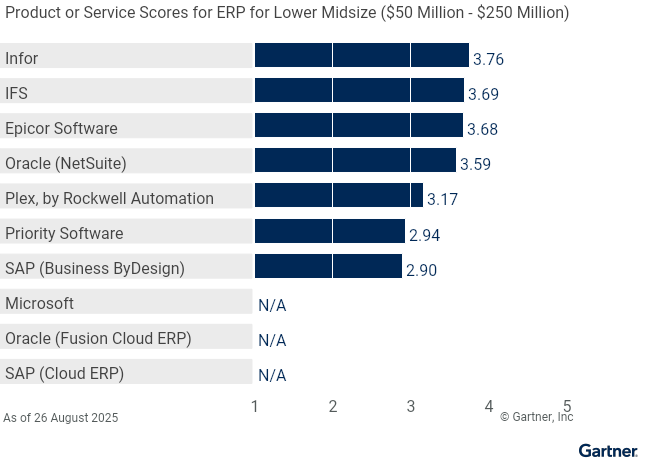
ERP for Lower Midsize ($50 Million - $250 Million)
This use case is for organizations with annual revenue of $50 million to $250 million.
It focuses on organizations that have most of their operations in a single country (although they need to support the processing of multiple currencies and legal entities). Geographic coverage, therefore, has a 0% weighting, because organizations evaluating vendors for this use case will focus on a single country or region.
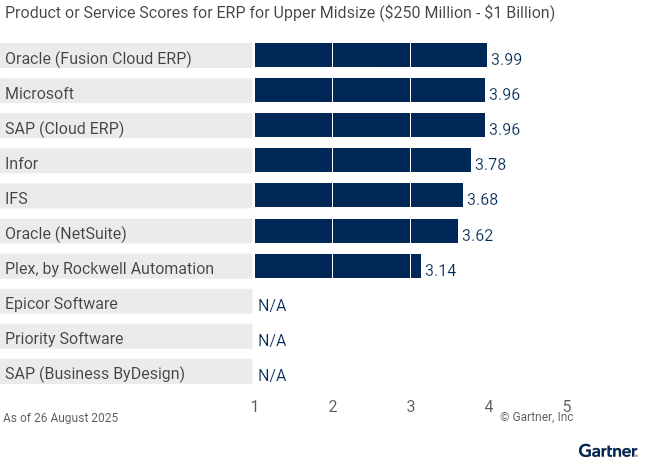
ERP for Upper Midsize ($250 Million - $1 Billion)
This use case is for organizations with annual revenue of $250 million to $1 billion.
Some of these organizations have international operations and more complex accounting, human resources, procurement, order-to-cash and operational reporting needs. As a consequence of these needs, complex corporate requirements and geographic coverage are of increased importance.
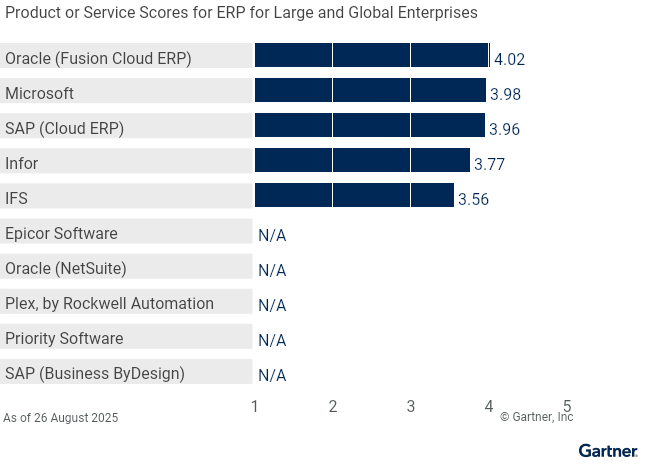
ERP for Large and Global Enterprises
This use case is for organizations with operations in multiple regions that handle complex multientity accounting and that support large transaction and user volumes.
This use case is also relevant to organizations with multiple subsidiaries or autonomous business units with complex consolidations and reporting arrangements.
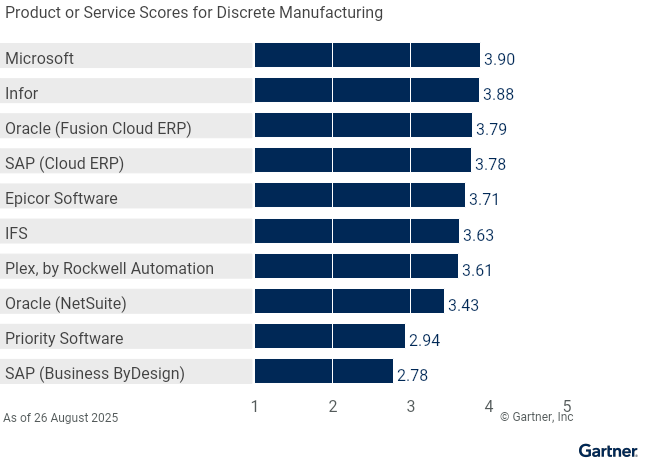
Discrete Manufacturing
This use case includes producers of consumer electronics, computers and accessories, appliances and other household items.
Project/Asset-Intensive Manufacturing
This use case focuses on managing make-to-order and engineer-to-order activities, as well as those related to designing, producing, selling and supporting very complex items.
Process Manufacturing
This use case is common in the food and beverage, chemicals, pharmaceuticals, consumer packaged goods and biotechnology industries.
Distribution of Goods
This use case concerns identifying where products and services should be deployed, determining SKU and location-level replenishment plans and fulfilling orders.
Vendors Added and Dropped
Added
No vendors were added to this report.
Dropped
No vendors were removed from this report.
Inclusion and Exclusion Criteria
Several criteria elements were considered prerequisites for a vendor to be considered in this report.
Product Capabilities
Each vendor had to deliver a suite of cloud-based, product-centric ERP applications that included the following capabilities:
- Operational ERP: Supply chain and manufacturing-related functionality, such as demand management, order management, material requirements planning, inventory management, supply chain/direct procurement, manufacturing control capabilities (shop floor) and distribution/logistics.
- Financial management: GL, AP, AR, FA, project accounting, and FP&A or xP&A.
Optional capabilities could include:
- Purchasing capabilities focused on indirect goods, services and capital equipment.
- HCM capabilities for cost management, as well as staffing for operational resources.
- Specialized, industry-specific modules or applications, including, but not limited to, modules such as those used for configure to order, make to order and field service management. Additionally, there are broader application solutions, such as those used for enterprise asset management and product life cycle management.
Market Presence
- Each vendor had to have at least 150 customer organizations with annual revenue (for commercial organizations), expenditure (for nonprofit organizations) or funding of more than $50 million (for startup organizations). Additionally, each vendor had to use its ERP cloud service in production environments. Each of these organizations had to live with at least three of the vendor’s operational ERP components (modules) and at least the GL, AP and AR capabilities. Each vendor had to be prepared to provide evidence of sufficient in-production customers. If a vendor chose not to disclose this information, Gartner used its own market research, as well as insights from public sources, to judge that vendor’s viability and eligibility for inclusion.
- The 150 organizations had to be managing at least $50 million annually through the ERP suite. The annual revenue of a parent organization could not be used when only a smaller subsidiary used the cloud service as a lower-tier ERP solution.
- Each vendor had to actively sell and market its cloud service (and have live users of this service in the qualifying revenue ranges) outside its home region. Gartner defined regions as the following: Americas, EMEA and Asia/Pacific. At least 25% of the cloud service revenue had to come from outside the vendor’s home region.
- Each vendor had to have at least $30 million in booked subscription and support revenue for its ERP suite cloud service only. This excluded any revenue from on-premises, hosted, managed cloud service, or other deployment models. The time period to meet this criterion was from January 2023 through December 2023 (or whichever 12-month accounting period most closely aligned with this period). Unrealized recurring revenue could not be included. If a vendor chose not to disclose revenue information, Gartner used its own market research, as well as insights from public sources, to judge that vendor’s viability and eligibility for inclusion.
Cloud Service Attributes
Each vendor’s ERP suite had to be deployed as a cloud service in accordance with the following attribute definitions:
- Responsibility:
- The vendor had to manage all technology infrastructure either in its own data centers or in third-party data centers.
- The vendor had to implement upgrades itself as part of the cloud service, not use a third party or managed service provider for this purpose.
- Licensing and technology:
- The cloud service had to be licensed on a subscription or metered pay-for-use basis.
- Users could not have a contract specific only to them (except for minor adjustments), nor could they be provided with a version different from that offered to other cloud customers.
- The cloud service had to use internet technologies. The use of internet files, formats and identifiers is necessary for the delivery of cloud service interfaces.
- The computing resources used to support the cloud service had to be scalable and elastic in near real time, rather than based on dedicated hardware/infrastructure.
- Customization:
- Modification of the source code should not be possible. However, configuration via citizen developer tools and extension via a platform as a service (PaaS) — by partner, vendor or user — was allowed.
- Pace of change:
- To enable the vendor to deploy new functionality rapidly, a single code line had to be used for all cloud service customers.
- The vendor had to deliver at least two upgrades containing new functionality per annum to all users of the cloud service and control the pace of the update cycle. All customers had to be operating on the current updated version before the release of the next updated version.
- The vendor had to offer self-provisioning capabilities for the service (at least for development and test instances) without involving its own staff.
- Multiple customers had to share the technology used to deliver the service to create a pool of resources from which elasticity could be delivered.
The above inclusion criteria relate to a cloud service based on a single code line with a unique UI and data model. Vendors offering multiple cloud ERP suites, each with its own code line, had to meet the inclusion criteria above. For example, each cloud ERP suite had to have at least 150 organizations using it in a production environment.
This Critical Capabilities report reflects Gartner’s definition of “composable ERP.” We define composable ERP as an adaptive technology strategy that enables the foundational administrative and operational digital capabilities required for an enterprise to keep up with the pace of business change. This strategy delivers a core of composable applications and, as a service, software platforms that are highly configurable, interoperable and flexible to adapt to future technology.
Consequently, if a vendor’s cloud ERP suite consists of capabilities drawn from different code lines, that vendor would be included in this Critical Capabilities report, provided its solution:
- Has predefined workflow integrations
- Uses vendor-supported integration technologies
- Is positioned as a component of a broader “solution,” rather than as a stand-alone product in the vendor’s portfolio, and the vendor has users of the full solution in production environments.
Weighting for Critical Capabilities in Use Cases
| Critical Capabilities | ERP for Lower Midsize ($50 Million - $250 Million) | ERP for Upper Midsize ($250 Million - $1 Billion) | ERP for Large and Global Enterprises | Discrete Manufacturing | Project/Asset-Intensive Manufacturing | Process Manufacturing | Distribution of Goods |
|---|---|---|---|---|---|---|---|
Single-Vendor ERP Suite Solution | 41% | 33% | 2% | 2% | 2% | 2% | 2% |
Complex Corporate Requirements | 2% | 5% | 25% | 3% | 3% | 3% | 3% |
Geographic Coverage | 1% | 10% | 20% | 5% | 5% | 5% | 5% |
Discrete Manufacturing | 10% | 10% | 10% | 60% | 0% | 0% | 0% |
Complex Manufacturing | 0% | 0% | 0% | 0% | 60% | 0% | 0% |
Process Manufacturing | 0% | 0% | 0% | 0% | 0% | 60% | 0% |
Distribution, Warehouse, Logistics | 10% | 10% | 10% | 5% | 5% | 5% | 65% |
Support/SI/Methodology | 15% | 10% | 5% | 5% | 5% | 5% | 5% |
Advanced Technology | 10% | 10% | 10% | 10% | 10% | 10% | 10% |
Modular/Composable Architecture | 5% | 5% | 8% | 5% | 5% | 5% | 5% |
Financial Management | 5% | 5% | 5% | 3% | 3% | 3% | 3% |
Sustainability | 1% | 2% | 5% | 2% | 2% | 2% | 2% |
As of 26 August 2025 | |||||||
Source: Gartner (October 2025)
This methodology requires analysts to identify the critical capabilities for a class of products/services. Each capability is then weighted in terms of its relative importance for specific product/service use cases.
Critical Capabilities Rating
Each of the products/services that meet our inclusion criteria has been evaluated on a scale from 1.0 to 5.0 for critical capabilities.
Product/Service Rating on Critical Capabilities
| Critical Capabilities | Epicor Software | IFS | Infor | Microsoft | Oracle (Fusion Cloud ERP) | Oracle (NetSuite) | Plex, by Rockwell Automation | Priority Software | SAP (Business ByDesign) | SAP (Cloud ERP) |
|---|---|---|---|---|---|---|---|---|---|---|
Single-Vendor ERP Suite Solution | 3.8 | 3.9 | 3.9 | 4.0 | 4.0 | 3.7 | 3.1 | 3.0 | 3.0 | 4.0 |
Complex Corporate Requirements | 3.1 | 3.2 | 3.7 | 3.9 | 4.0 | 3.5 | 2.7 | 2.7 | 2.8 | 3.8 |
Geographic Coverage | 3.1 | 3.7 | 3.9 | 4.1 | 4.2 | 4.0 | 2.8 | 2.6 | 3.4 | 4.2 |
Discrete Manufacturing | 3.8 | 3.6 | 4.0 | 3.8 | 3.6 | 3.3 | 4.0 | 3.0 | 2.7 | 3.6 |
Complex Manufacturing | 3.4 | 3.9 | 3.9 | 3.2 | 3.5 | 2.6 | 3.6 | 2.7 | 2.5 | 3.4 |
Process Manufacturing | 3.1 | 3.8 | 4.0 | 3.6 | 3.5 | 3.0 | 3.7 | 3.0 | 2.6 | 3.3 |
Distribution, Warehouse, Logistics | 3.9 | 3.4 | 3.8 | 3.8 | 3.8 | 3.3 | 3.4 | 3.1 | 2.9 | 3.6 |
Support/SI/Methodology | 3.2 | 3.2 | 3.3 | 3.4 | 3.9 | 3.5 | 2.9 | 2.7 | 2.8 | 3.8 |
Advanced Technology | 3.8 | 4.0 | 3.7 | 4.5 | 4.2 | 3.7 | 3.0 | 2.9 | 2.6 | 4.2 |
Modular/Composable Architecture | 4.0 | 3.9 | 3.9 | 4.2 | 4.1 | 3.6 | 3.2 | 3.1 | 3.2 | 4.2 |
Financial Management | 3.4 | 3.5 | 3.4 | 3.8 | 4.3 | 3.9 | 3.1 | 2.9 | 3.1 | 4.3 |
Sustainability | 3.3 | 3.8 | 3.8 | 4.0 | 4.1 | 3.2 | 2.9 | 2.5 | 2.6 | 4.2 |
As of 26 August 2025 | ||||||||||
Source: Gartner (October 2025)
Table 3 shows the product/service scores for each use case. The scores, which are generated by multiplying the use-case weightings by the product/service ratings, summarize how well the critical capabilities are met for each use case.
Product Score in Use Cases
| Use Cases | Epicor Software | IFS | Infor | Microsoft | Oracle (Fusion Cloud ERP) | Oracle (NetSuite) | Plex, by Rockwell Automation | Priority Software | SAP (Business ByDesign) | SAP (Cloud ERP) |
|---|---|---|---|---|---|---|---|---|---|---|
ERP for Lower Midsize ($50 Million - $250 Million) | 3.68 | 3.69 | 3.76 | N/A | N/A | 3.59 | 3.17 | 2.94 | 2.90 | N/A |
ERP for Upper Midsize ($250 Million - $1 Billion) | N/A | 3.68 | 3.78 | 3.96 | 3.99 | 3.62 | 3.14 | N/A | N/A | 3.96 |
ERP for Large and Global Enterprises | N/A | 3.56 | 3.77 | 3.98 | 4.02 | N/A | N/A | N/A | N/A | 3.96 |
Discrete Manufacturing | 3.71 | 3.63 | 3.88 | 3.90 | 3.79 | 3.43 | 3.61 | 2.94 | 2.78 | 3.78 |
Project/Asset-Intensive Manufacturing | 3.47 | 3.81 | 3.82 | 3.54 | 3.73 | 3.01 | 3.37 | 2.76 | 2.66 | 3.66 |
Process Manufacturing | 3.29 | 3.75 | 3.88 | 3.78 | 3.73 | 3.25 | 3.43 | 2.94 | 2.72 | 3.60 |
Distribution of Goods | 3.77 | 3.51 | 3.76 | 3.90 | 3.91 | 3.43 | 3.25 | 3.00 | 2.90 | 3.78 |
As of 26 August 2025 | ||||||||||
Source: Gartner (October 2025)
To determine an overall score for each product/service in the use cases, multiply the ratings in Table 2 by the weightings shown in Table 1.
Gartner used several sources of information for the inclusion criteria, market definition and evaluations in this report. The primary sources included:
- Over 5,750 customer inquiries from January 2024 through July 2025 on the subject of ERP applications, of which more than half were related to ERP strategy and approximately one-third related to vendor evaluation
- Vendor-sourced information and briefings
- Gartner Peer Insights survey data received through June 2025, blended with insights from vendor product demonstrations.
1 2023 Gartner ERP, Procurement, HCM and Finance Apps Survey. This survey was conducted to obtain data that confirms that initiatives for ERP, finance, HCM and procurement apps are still a high priority for organizations, even though recession and constrained resources call for limited investment in complex projects. It further aims to understand the ERP strategy, plans to adopt flexible and agile ERP architecture, ERP vendor strategy, and modernization plans for ERP applications. The research was conducted online from October through December 2023 among 253 respondents from North America (n = 122), Western Europe (n = 97) and Latin America (n = 34). Respondents were screened to be managers and above who are responsible for ERP decision making at organizations of at least $50 million in worldwide revenue across organizations from all industries (except the IT industry). Disclaimer: Results of this survey do not represent global findings or the market as a whole, but reflect the sentiments of the respondents and companies surveyed.
2023 Gartner ERP, Procurement, HCM and Finance Apps Survey. This study was conducted to obtain data that confirms that initiatives for ERP, finance, HCM and procurement apps are still a high priority for organizations, even though recession and constrained resources call for limited investment in complex projects. It further aims to understand the ERP strategy, plans to adopt flexible and agile ERP architecture, ERP vendor strategy, and modernization plans for ERP applications. The research was conducted online from October through December 2023 among 253 respondents from North America (n = 122), Western Europe (n = 97) and Latin America (n = 34). Respondents were screened to be managers and above who are responsible for ERP decision making at organizations of at least $50 million in worldwide revenue across organizations from all industries (except the IT industry). Disclaimer: Results of this study do not represent global findings or the market as a whole, but reflect the sentiments of the respondents and companies surveyed.
Critical Capabilities Methodology
This methodology requires analysts to identify the critical capabilities for a class of products or services. Each capability is then weighted in terms of its relative importance for specific product or service use cases. Next, products/services are rated in terms of how well they achieve each of the critical capabilities. A score that summarizes how well they meet the critical capabilities for each use case is then calculated for each product/service.
"Critical capabilities" are attributes that differentiate products/services in a class in terms of their quality and performance. Gartner recommends that users consider the set of critical capabilities as some of the most important criteria for acquisition decisions.
In defining the product/service category for evaluation, the analyst first identifies the leading uses for the products/services in this market. What needs are end-users looking to fulfill, when considering products/services in this market? Use cases should match common client deployment scenarios. These distinct client scenarios define the Use Cases.
The analyst then identifies the critical capabilities. These capabilities are generalized groups of features commonly required by this class of products/services. Each capability is assigned a level of importance in fulfilling that particular need; some sets of features are more important than others, depending on the use case being evaluated.
Each vendor’s product or service is evaluated in terms of how well it delivers each capability, on a five-point scale. These ratings are displayed side-by-side for all vendors, allowing easy comparisons between the different sets of features.
Ratings and summary scores range from 1.0 to 5.0:
1 = Poor or Absent: most or all defined requirements for a capability are not achieved
2 = Fair: some requirements are not achieved
3 = Good: meets requirements
4 = Excellent: meets or exceeds some requirements
5 = Outstanding: significantly exceeds requirements
To determine an overall score for each product in the use cases, the product ratings are multiplied by the weightings to come up with the product score in use cases.
The critical capabilities Gartner has selected do not represent all capabilities for any product; therefore, may not represent those most important for a specific use situation or business objective. Clients should use a critical capabilities analysis as one of several sources of input about a product before making a product/service decision.