Magic Quadrant for Governance, Risk and Compliance Tools, Assurance Leaders
27 October 2025 - ID G00801545 - 52 min read
By Joel Backaler, Devanshu Mehrotra, and 2 more
With more than one hundred vendors selling GRC tools, it’s hard for buyers to know which one best fits their target use cases. Assurance leaders can use this research to evaluate the GRC market and determine which tools will most effectively support their holistic enterprise risk management process.
Market Definition/Description
Gartner defines governance, risk and compliance (GRC) tools as tools designed to support a holistic enterprise risk management (ERM) process, encompassing risk identification, assessment, mitigation, monitoring and reporting. These tools enable ERM teams to create a unified view of top enterprise risks, facilitating coordination across first- and second-line teams (e.g., corporate compliance) and partnering with internal audit on aligned assurance.
GRC tools empower leaders to automate, manage and report on enterprise-level risks comprehensively. These tools facilitate the risk assessment process, enable workflow automation and streamline information exchange among leaders and first-line risk owners, enhancing the identification, assessment and communication of top enterprise risks. GRC solutions also support decision making through data visualization, reports and dashboards, offering insights for executives and the board, and integrating with other risk management technologies to provide a comprehensive risk view. Increasingly, GRC tools incorporate AI capabilities for advanced automation, including risk score validation, recommended controls and risk quantification.
Mandatory Features
Mandatory features for this market include:
- Artificial intelligence: Embedding AI and machine learning (ML) capabilities to enhance risk management processes, such as recommended controls, anomaly detection and predictive analytics.
- Business-friendly user experience: The ability for the targeted users to easily navigate and use the tool to complete their tasks without the need to consult with product subject matter experts (SMEs) or technical staff. This could be interpreted at a minimum that the majority of users will not revert to tools such as spreadsheets after using the tool.
- Data visualization and reporting: The capability to utilize native dashboards within the GRC tool or seamlessly connect to third-party data and analytics tools, enabling the visualization of GRC data for reporting. This flexibility ensures that information is presented in formats tailored to the diverse consumption needs of various audiences, from high-level executives requiring strategic insights to detailed analyses for risk domain specialists.
- Ease of implementation: The ability to begin using a new instance of the tool to support key GRC activities without the need to heavily customize off-the-shelf templates/prebuilt workflows or make changes to the underlying data model.
- Enterprise-level risk aggregation: The technology capabilities to “roll up” or “drill down” enterprisewide data within the tool to analyze the relationship between enterprise-level risks and their subrisks managed by other second-line or first-line risk owners and vice versa. This functionality helps meet different hierarchies of information needs of organizational stakeholders, such as the board, business executives, operational management and risk owners.
- Frameworks and controls mapping: The technology capabilities to extract, map and link controls from multiple regulations, frameworks and standards with overlapping risk controls, and to reduce redundant work, often referred to as “framework crosswalking.”
- Interoperability: The ability to connect with other relevant enterprise data sources and technology systems (e.g., audit management systems, third-party risk management tools, policy management tools, etc.) to aggregate and analyze risk data, impact and prioritization interdependencies.
- Risk assessment methodologies: The technology capabilities to conduct enterprise risk assessments through various risk assessment options, such as qualitative at ordinal scales (e.g., 1 to 5 scale ratings), semiquantitative methods (e.g., 1 to 5 scales with assigned values) and/or probabilistic/quantitative methods (e.g., Monte Carlo simulations, factor analysis of information risk [FAIR] methodology, regression analysis).
- Risk event management: The technology capabilities to automate the development of risk mitigation plans in response to a change in risk, control efficacy or external events that impact an organization’s enterprise risk management process.
Optional Features
Optional features for this market include:
- System controls and audit trail: The ability to track system usage, approvals and process exceptions and manage how information is secured, shared and promoted.
- System support and maintenance: The ability to maintain the system as new feature updates or software versions are released without breaking tool customizations or requiring users to have specialized in-house technical experts.
- Workflow automation: The ability to automate key activities, such as enterprise risk assessments and associated tasks, notifications, approvals to enhance operational efficiency and governance structure.
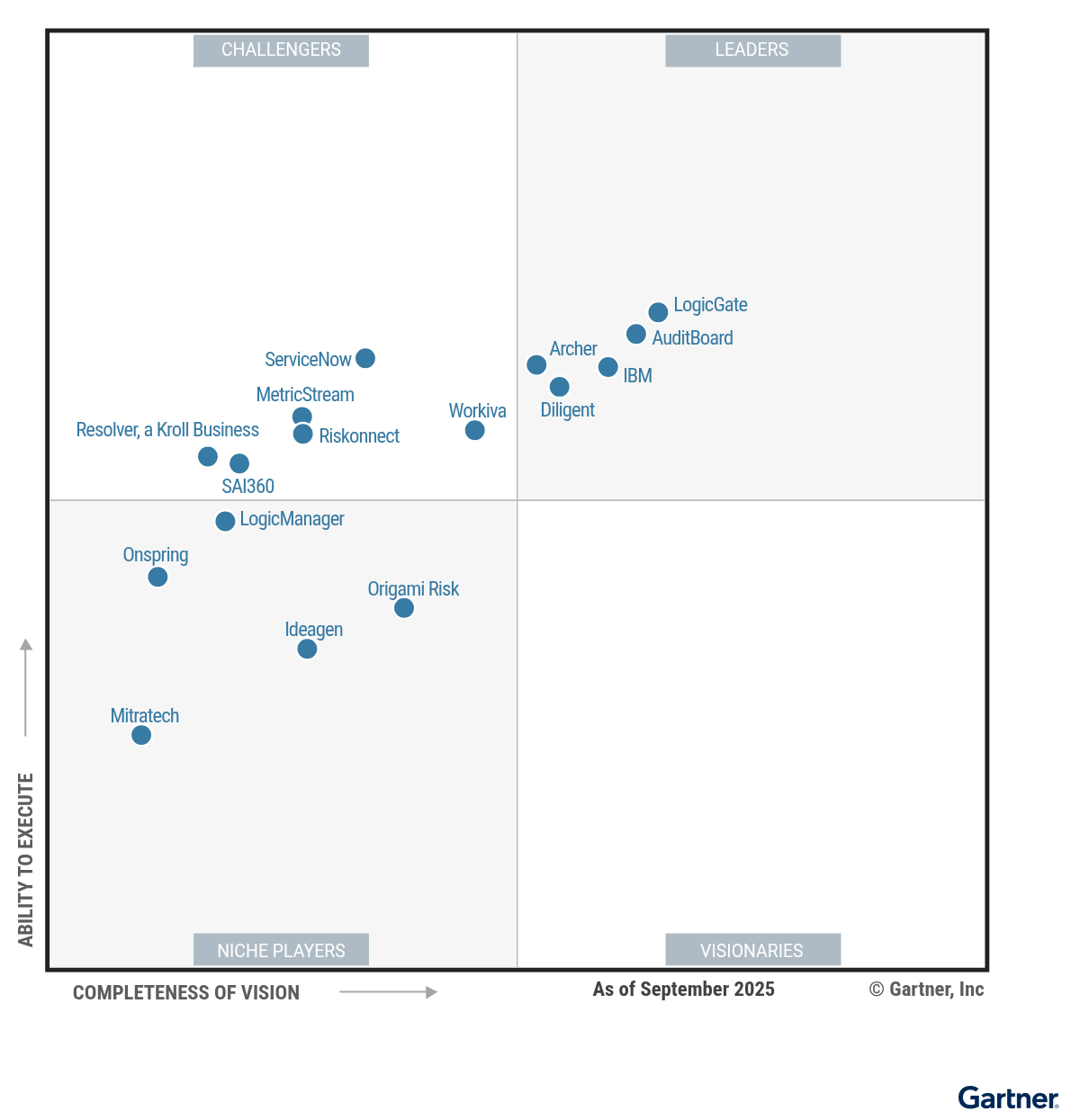
Magic Quadrant
Vendor Strengths and Cautions
Archer
Archer is a Leader in this Magic Quadrant. It is a private company, headquartered in Overland Park, Kansas, U.S., and it was established in 2001. The majority of its GRC customer base is in North America, followed by Europe.
Archer serves customers in an array of verticals; its top three for GRC are financial services, healthcare and insurance. It primarily targets customers in large enterprises.
Its GRC product is Archer. Archer also offers solutions for AI governance and a risk management information system (RMIS). At the time of publication, pricing for Archer solutions is based on enterprise licensing, with costs tiered by total employee count and modules sold individually or in domain bundles. Additional system users are free under the enterprise user licensing model.
- Risk quantification: Archer Insight provides quantitative risk analysis capabilities, enabling organizations to supplement traditional qualitative risk assessments with statistically robust estimates of risk probability, frequency and impact. It leverages techniques such as Monte Carlo simulation and quantitative bowtie modeling to support data-driven decision making.
- Market recognition: Archer has an established brand presence in the U.S. and several other markets, reflecting its longstanding position in the GRC market. This is supported by a proven track record of serving large enterprises and delivering GRC solutions across diverse sectors, contributing to its reputation as a major GRC brand.
- Global support services: Archer provides global customer support, incorporating local market knowledge and regulatory expertise to address region-specific needs. Support teams assist clients with local compliance challenges, language requirements and cultural nuances, ensuring a tailored and responsive service experience.
- Usability and training: Users cite challenges with usability and a steep learning curve, especially for new users or those without prior experience in GRC systems. Configuration changes often require technical support or specialized training, which can slow adoption and reduce overall user satisfaction, with older versions being most affected.
- Customization impact: Extensive customization of Archer can make it difficult and costly to switch to another platform in the future, notably in large-scale deployments. Customer feedback reflects these challenges, particularly when third-party integration partners are involved, which can further extend project durations.
- Pricing and renewal: The acquisition of Compliance.ai and its subsequent rebranding and repositioning as part of Archer Evolv (including Evolv Compliance and Evolv Risk) has introduced additional complexity and changes to Archer’s pricing structure. Clients report that purchasing and renewal processes have become more challenging, with significant cost increases raising concerns about overall value and return on investment.
AuditBoard
AuditBoard is a Leader in this Magic Quadrant. It is a private company, headquartered in Cerritos, California, U.S., and it was established in 2014. The majority of its GRC customer base is in North America, followed by Europe and Asia/Pacific.
AuditBoard serves customers in an array of verticals; its top three for GRC are financial services, manufacturing and professional services. It primarily targets customers in midmarket and large enterprises.
Its GRC product is the AuditBoard Connected Risk Platform. AuditBoard also offers solutions for third-party risk management, IT risk management, SOX compliance and ESG program management. At the time of publication, pricing for Connected Risk Platform is based on the number of modules and number of Core Users (admins). Additional system users are free.
- Practitioner-focused design: AuditBoard’s leadership is fueled by its practitioner-centric roots, resonating strongly with audit, risk and compliance professionals. Its product is grounded in deep assurance expertise, enabling expansion beyond internal audit to effectively address the needs of ERM, compliance and other assurance stakeholders.
- User experience: AuditBoard has invested heavily in user experience and developing a highly intuitive product interface. The modern interface and robust set of product onboarding resources lead to a faster-than-average implementation time, with clients reporting high levels of user satisfaction.
- Community-driven development: AuditBoard’s product development incorporates input from its user community through forums and feedback sessions. Feature updates, including AI rollouts, are more targeted compared to some other vendors in the GRC market that introduce a broader range of AI functionalities. This reflects a measured response to user feedback.
- Pricing: AuditBoard continues to face customer feedback regarding the solution’s overall cost. Prospective customers frequently cite pricing as a primary barrier to adoption. This ongoing concern may limit AuditBoard’s competitiveness in cost-sensitive segments of the market.
- Brand perception: Clients in enterprise risk management and other assurance roles outside of internal audit report challenges gaining cross-functional buy-in for AuditBoard. They cite peers incorrectly characterizing AuditBoard as an audit-focused tool based on its brand name, which can lead to exclusion from their GRC evaluations.
- Leadership transition: AuditBoard was acquired by Hg Capital in June 2024 and appointed a new CEO in July 2025. Such transitions can introduce uncertainty, potentially impacting organizational stability and prompting reassessment of ongoing initiatives and long-term goals as its new leadership and owners establish their vision.
Diligent
Diligent is a Leader in this Magic Quadrant. It is a private company, headquartered in New York City, New York, U.S. It was established in 1994, and it acquired Galvanize — a vendor heavily focused on enterprise risk management and internal audit GRC use cases — in 2021. The majority of its GRC customer base is in North America, followed by Europe.
Diligent serves customers in an array of verticals; its top three for GRC are financial services, government and healthcare. It primarily targets customers in midmarket and large enterprises.
Its GRC product is Diligent One Platform - Diligent Enterprise Risk Management. Diligent also offers solutions for board reporting and ESG. At the time of publication, pricing for Diligent Enterprise Risk Management is based on three tiers with varying product functionality and user access. Additional system users are free.
- Integrated reporting: Diligent One Platform streamlines enterprise risk reporting across organizational hierarchies, supporting ERM teams in delivering tailored risk insights to both operational management and board-level stakeholders. Native integrations with its board reporting tool facilitate communication with the board, strengthening governance and oversight.
- Product innovation: Diligent is executing on a product innovation roadmap that is directly aligned to enhancing the enterprise risk assessment process, especially risk identification. Its partnership with Moody’s adds external risk intelligence, while its Risk Essentials solution uses AI to recommend relevant risks based on SEC 10-K filings.
- Implementation model: Clients report lower implementation costs and faster timelines with Diligent One Platform. Unlike vendors that rely heavily on third-party partners, Diligent leads most implementations with its in-house technical team, engaging partners selectively when specific expertise or local support is needed, such as in international markets or for added capacity.
- User distribution: Diligent’s current customer mix is not evenly distributed across target roles, with approximately 80% of its end users subscribed to Governance & Board and a GRC offering user base of approximately 5,000 customers. Buyers whose primary needs do not include integrated board reporting within the Diligent product ecosystem may wish to carefully assess how Diligent’s GRC capabilities align with their requirements, and consider a range of solutions to ensure optimal fit.
- Brand recognition: Brand confusion appears to be common among prospective and current customers. Clients regularly refer to “HighBond,” “ACL Analytics,” and “Galvanize” when referring to the Diligent One Platform, likely due to multiple acquisitions and product brand name changes in its recent years.
- Pricing model: Diligent One Platform offers unlimited business users across its pricing tiers; however, Gartner clients have reported concerns regarding the transparency of the pricing model, particularly when estimating user numbers and total cost of their desired end state. While Diligent is actively working to provide greater clarity, prospective buyers should be aware of these considerations when evaluating the solution.
IBM
IBM is a Leader in this Magic Quadrant. It is a public company, headquartered in Armonk, New York, U.S. It was established in 1911 and acquired OpenPages in 2010. The majority of its GRC customer base is in North America, followed by Europe, Latin America and Asia/Pacific.
IBM serves customers in an array of verticals; its top three for GRC are financial services, healthcare and telecommunications. Although IBM primarily targets customers in large enterprises, it has started offering options to small and medium businesses.
Its GRC product is IBM OpenPages. IBM also offers solutions such as watsonx.governance and Guardium AI Security. At the time of publication, pricing for IBM OpenPages is based on platform licensing, number of modules and solutions, and number of administrator and business users.
- Corporate viability: IBM’s long-term viability is critical for customers with complex needs and extensive customizations. Its global presence, brand awareness, diversified portfolio, proven record as a trusted enterprise technology partner and well-rounded corporate strategy support client confidence.
- Global support network: IBM’s sales and support teams and large partner network provide localized customer support in all regions. Expanded data center and cloud provider support for more regions and deployment options, along with multilingual functionality, make it a strong fit for global organizations with distributed, global teams.
- Regulated industry expertise: IBM OpenPages excels at serving highly regulated, global organizations operating in industries such as financial services, healthcare and energy. Its ERM capabilities are designed to support complex organizational structures, enabling risk teams to aggregate, analyze and report on risk exposures across business units and geographies.
- Interoperability: Clients report that their integration experience with IBM OpenPages is more seamless when they have a substantial IBM technology footprint. For example, optimization is enhanced when clients adopt an integrated risk management approach by leveraging adjacent IBM solutions such as watsonx.governance, Guardium AI Security and watsonx BI. Assurance leaders requiring integration with a wide range of non-IBM systems should verify OpenPages’ available out-of-the-box integrations and be aware of potential additional costs.
- Solution complexity: While IBM OpenPages could be adopted by small- and medium-sized non-regulated organizations, it may not deliver optimal ROI for these clients. OpenPages provides out-of-the-box integration to offer regulatory content from ecosystem partners. Nonregulated organizations may not fully leverage these features, leading to potential underutilization. Careful evaluation of business needs and regulatory requirements is recommended before adoption.
- AI features and speed to market: IBM OpenPages was the first GRC platform to adopt AI in 2016. However, the market has since evolved, with newer GRC vendors now placing a strong emphasis on embedded AI enhancements. Although IBM is actively integrating generative AI into its platform, the rapid pace at which the industry is adopting AI capabilities in GRC tools may challenge IBM’s ability to maintain a competitive edge in terms of speed-to-market for AI features.
Ideagen
Ideagen is a Niche Player in this Magic Quadrant. It is a private company, headquartered in Ruddington, United Kingdom, and it was established in 1993. The majority of its GRC customer base is in North America, followed by Europe.
Ideagen serves customers in an array of verticals; its top three for GRC are manufacturing, professional services and education. It primarily targets customers in large enterprises.
Its GRC product is Audit and Risk. Ideagen also offers solutions for environmental, health and safety (EHS) and quality management. At the time of publication, pricing for Audit and Risk is based on user factors, such as named user licenses and user type, and solution modules, such as Audit & Risk, Quality or EHS. Additional system users, classified as “Standard Users,” cost extra.
- Industry specialization: Ideagen offers a specialized solution to serve the needs of high-hazard, asset-intensive industries such as manufacturing, healthcare, hospitality and energy. Its deep domain expertise and tailored risk management capabilities enable organizations in these sectors to effectively identify, assess and mitigate enterprise risks.
- Sales strategy: Ideagen’s sales team is organized by priority industries, staffing experts with advanced knowledge of high-hazard, asset-intensive sectors. This competency enables stronger alignment with buyer needs and more effective prospect engagement in target markets.
- Solution breadth: Ideagen offers a diverse selection of general and specialized tools that cover a wide range of assurance, risk management and EHS use cases. This extensive collection of offerings provides assurance leaders with numerous options to address varied requirements, allowing them to potentially source multiple risk management capabilities from a single vendor.
- Acquisition impact: Ideagen completes approximately five acquisitions per year, resulting in a portfolio of 40-50 products. This continual addition of new products can create challenges in maintaining strategic focus and product consistency. Customers may encounter overlapping capabilities and a complex product ecosystem.
- Product interoperability: There are varying degrees of connectivity across Ideagen’s product ecosystem. Its HUB model currently connects eight core products but many legacy products remain disconnected.
- Product innovation: Ideagen prioritizes enhancements for its established EHS offering over its Audit and Risk GRC product. For example, AI-enabled features were added to EHS first, while similar AI functionality for its Audit and Risk solution remained on the roadmap during this Magic Quadrant evaluation.
LogicGate
LogicGate is a Leader in this Magic Quadrant. It is a private company, headquartered in Chicago, Illinois, U.S., and it was established in 2015. The majority of its GRC customer base is in North America, followed by Europe.
LogicGate serves customers in an array of verticals; its top three for GRC are financial services, information technology, and retail and e-commerce. It has historically targeted customers in midmarket verticals but is increasingly focused on enterprise.
Its GRC product is Risk Cloud. LogicGate also offers solutions for AI governance and data privacy. At the time of publication, pricing for Risk Cloud is based on the number of applications and the number of power user licenses. Additional system users are free.
- Product innovation: LogicGate combines a pragmatic approach to product innovation and a deep understanding of its priority user roles to deliver a high-impact product roadmap. It intentionally incorporates AI functionality into the product, focusing on a targeted set of use cases versus attempting to add AI to every aspect of the product.
- Ease of use: Clients highlight Risk Cloud’s ease of use with a modern graphical user interface and no-code configurations, allowing non-technical admins to make system changes. Its graph-powered architecture enables any system object to connect to others, supporting exploration of relationships like risk roll-ups and drill-downs.
- Value realization: LogicGate designed Risk Cloud to demonstrate ROI, helping users educate internal stakeholders on the value GRC adds to their enterprise risk management process. Its native Value Realization Tool tracks outcomes such as resource allocation efficiency, proactive risk reduction and revenue enablement.
- Brand recognition: LogicGate is steadily replacing incumbent GRC vendors at large-scale enterprises. However, enterprise IT departments often default to recommending solutions that are already part of their IT ecosystems, which may present a barrier to new customer acquisition in certain buying scenarios.
- Rising pricing: LogicGate’s pricing is becoming more expensive. Clients report concerns including unexpected fees and difficulty in understanding how pricing scales with additional apps or users. Prospective buyers are advised to request detailed pricing documentation and clarification on all cost components to ensure a clear understanding of total cost.
- Configurability: LogicGate’s GRC platform features extensive configurability and a wide range of applications, but configuration decisions and overall user experience at the administrative level may require substantial training and adjustment. Organizations should anticipate the need for dedicated onboarding and support to ensure effective use and management of the platform.
LogicManager
LogicManager is a Niche Player in this Magic Quadrant. It is a private company, headquartered in Boston, Massachusetts, U.S., and it was established in 2005. The majority of its GRC customer base is in North America.
LogicManager serves customers in an array of verticals; its top three for GRC are financial services, healthcare and manufacturing. It primarily targets customers in SMB and midmarket verticals.
Its GRC product is ERM Platform. LogicManager also offers solutions such as its Risk Ripple Analytics and Document Analyzer powered by LMX. At the time of publication, pricing for their ERM Platform is based on the size and complexity of the organization LogicManager is supporting and the number of programs deployed. Additional system users are free.
- Transparent pricing: LogicManager offers a flat-fee model that includes licensing, advisory services, onboarding, a 90-day satisfaction guarantee and support for unlimited users. This transparent pricing structure can help organizations manage costs and reduce financial uncertainty during implementation.
- Leadership stability: The executive management team at LogicManager is stable, with notable involvement from the long-standing CEO, who is recognized within the enterprise risk management community. This leadership continuity contributes to consistent strategic direction and fosters trust among clients and industry stakeholders.
- Ease of implementation: LogicManager is positioned as a practical option for SMEs and first-time GRC adopters seeking an accessible entry point into enterprise risk management solutions. Straightforward deployment and support make it particularly well-suited for organizations with limited internal resources or those new to formal risk management practices.
- Industry coverage: LogicManager’s customer base is concentrated in a limited range of industries, which may reduce suitability for organizations in sectors not currently represented. Clients in niche or highly specialized markets that are not in scope may find that industry-specific features and best practices are less developed compared to broader-focused competitors.
- Geographic reach: With more than 90% of revenue derived from North America, LogicManager’s geographic reach is limited; global support is minimal and English-only. Organizations with operations across multiple countries may encounter challenges related to language barriers.
- Scalability and functionality: LogicManager’s simplicity limits its scalability and functionality for large, complex environments, positioning it primarily for midmarket organizations. Enterprises with advanced or highly customized risk management needs may find the platform’s feature set and configurability insufficient for their requirements.
MetricStream
MetricStream is a Challenger in this Magic Quadrant. It is a private company, headquartered in San Jose, California, U.S., and it was established in 1999. The majority of its GRC customer base is in North America, followed by Europe.
MetricStream serves customers in an array of verticals; its top three for GRC are financial services, healthcare and energy. It primarily targets customers in large enterprises.
Its GRC product is Connected GRC. MetricStream also offers solutions for cyber risk (Cyber GRC) and operational resilience. At the time of publication, pricing for Connected GRC is based on the number of products and modules, number of users and level of user access, including “admin,” “medium” and “light” users. Additional system users, such as “light” users, cost extra.
- Market longevity: MetricStream draws on over 25 years of experience in building GRC technologies. It uses a multichannel customer feedback aggregation approach, including surveys, advisory boards and direct client engagement. This long-standing industry presence and systematic feedback process inform the company’s vision and its product roadmap.
- Product strategy: MetricStream demonstrates a strong focus on developing AI capabilities within its platform, investing in advanced analytics and machine learning to enhance risk detection. The strategic importance of AI to MetricStream’s future direction is underscored by the company’s decision to appoint its founder and former CEO to personally lead and oversee this area.
- Global coverage: MetricStream is able to support organizations with large, complex global footprints and sovereignty requirements. It offers customer support in all major geographies, with 24/7 service options available for an additional fee, and it has AWS data centers located in North America, Europe, the Middle East and Asia/Pacific.
- Implementation complexity: Implementation of MetricStream can be complex and time consuming (especially if it is not an out-of-the-box product implementation), often requiring significant resources and extended timelines. Organizations should be prepared for a potentially challenging deployment process, particularly for large-scale or highly customized implementations.
- User experience: While MetricStream is in the process of transitioning to a React-based UI, customer feedback indicates that the current user interface and overall user experience lack intuitiveness and modern design. Usability improvements are still in progress and, based on client inquiry, the platform in its current state does not yet meet user expectations for ease of use.
- Leadership transition: The appointment of a new CEO in April 2025 marks a shift in top leadership for MetricStream. Such transitions can introduce a period of adjustment, with possible implications for company priorities, ongoing initiatives and the overall strategic vision, as the new leadership takes shape.
Mitratech
Mitratech is a Niche Player in this Magic Quadrant. It is a private company, headquartered in Austin, Texas, U.S. It was established in 1987, and it acquired Alyne in 2021. The majority of its GRC customer base is in Europe, followed by North America.
Mitratech serves customers in an array of verticals; its top three for GRC are financial services, legal and professional services and healthcare. It primarily targets customers in the midmarket vertical.
Its GRC product is Alyne. Mitratech also offers solutions for legal and human resources teams. At the time of publication, pricing for Alyne is based on the number of modules and number of users. Additional system users may cost extra depending on specific customer contracts.
- Acquisition strategy: Mitratech has a proven ability to grow through the acquisition of niche GRC vendors and adjacent technology providers. Its inorganic growth strategy is coupled with an effective cross-sell, go-to-market approach, expanding its presence across a wide variety of organizations and functional teams.
- Product focus: Alyne stands out as a GRC tool highly suited for organizations seeking “IT risk at the enterprise level” versus holistic corporate assurance-oriented enterprise risk management. With approximately half of its customers serving as CISOs or other IT leaders, this is an audience Mitratech knows well.
- Customer enablement: Mitratech offers tailored onboarding, role-based training and ongoing support through a customer portal, client working groups, webinars and contextualized in-app guidance throughout the Alyne product user experience. This approach reduces time to value and helps increase rates of adoption.
- Integration consistency: Mitratech’s business has grown through a series of acquisitions. Most relevant to this Magic Quadrant was its 2021 acquisition of Alyne. Rather than replatforming products post acquisition, Mitratech focuses on connecting legacy tools and creating a consistent, unified UI experience across products.
- Product positioning: The Alyne product has potential to support non-IT assurance leaders but, currently, the product is most aligned to IT-focused roles like the CIO, CISO and their respective teams. Traditional ERM teams that look at risks holistically across a variety of non-IT risk domains may find the product less tailored to their needs.
- Implementation complexity: Although the product features a modern application architecture, UI alterations and configuration changes may require IT involvement. Organizations without dedicated IT support or those with less mature programs could encounter challenges during implementation or ongoing management.
Onspring
Onspring is a Niche Player in this Magic Quadrant. It is a private company, headquartered in Overland Park, Kansas, U.S., and it was established in 2010. The majority of its GRC customer base is in North America.
Onspring serves customers in an array of verticals; its top three for GRC are financial services, healthcare and insurance. It primarily targets customers in midmarket and large enterprises.
Its GRC product is Onspring GRC. Onspring also offers solutions for CMMC and data privacy management. At the time of publication, pricing for Onspring GRC is user-based (where users have access to all products on the Onspring platform), product-based (including implementation) or a hybrid between the two. Additional system users for product-based pricing are free.
- Business process automation: Onspring’s roots are in configurable, rule-based business process automation, and its related functionality continues to serve as a key differentiator across its entire product suite. As a result, use cases for the Onspring system extend well beyond the scope of GRC, with configurable options to support a wide variety of organizational business processes.
- Industry differentiation: Onspring’s strategy is heavily focused on targeting U.S.-based public sector entities, particularly state, local and education (SLED) and federal agencies. Its partner-led strategy opens doors in a market that is relatively underserved by other traditional GRC vendors in the space.
- Ease of implementation: Onspring provides a relatively straightforward implementation experience for its GRC product. It includes an eight-week implementation project for each purchased product, led by its internal team of implementation specialists. Clients report faster-than-average implementation timelines and high levels of satisfaction.
- Product innovation: Onspring lags behind competitors in its AI-product development. While not generally available during the evaluation period, Onspring has since released AI-enabled features which were not assessed as part of this Magic Quadrant. Users seeking advanced AI-enabled capabilities may find its offering insufficient based on the evaluated version of the product.
- Global reach: While Onspring is an established player in the North American GRC marketplace, it does not have a robust global footprint outside of the U.S. and Canada. Organizations with broad global operations or those based outside North America with sovereignty requirements may require services and support that this vendor does not offer.
- Leadership transition: The appointment of a new CMO in May 2024 and a new chief product officer in April 2025 may necessitate a period of transition. This can impact organizational direction, stability and the execution of strategic plans while the new leadership team develops and communicates its vision.
Origami Risk
Origami Risk is a Niche Player in this Magic Quadrant. It is a private company, headquartered in Chicago, Illinois, U.S., and it was established in 2009. The majority of its GRC customer base is North America, followed by Europe.
Origami Risk serves customers in an array of verticals; its top three for GRC are manufacturing, travel and hospitality, and healthcare. It primarily targets customers in midsize and large enterprises.
Its GRC product is Origami Risk GRC. Origami Risk also offers solutions for RMIS and EHS. At the time of publication, pricing for Origami Risk GRC is based on company size, usage levels and number of products and modules. Additional system users are free through its enterprise unlimited user model.
- Industry specialization: Origami Risk is highly specialized in serving high-hazard industries including manufacturing, healthcare, transportation, education and government. Customers in these industries typically use Origami Risk’s GRC solution with its other product lines that focus on EHS and RMIS needs.
- First-line collaboration: Origami Risk’s GRC solution provides multiple digital channels, such as a user portal and dedicated mobile app, for first-line users to report incidents or raise potential risks. This supports real-time information sharing and strengthens collaboration between first- and second-line teams, resulting in a more responsive and effective risk management process.
- Roadmap focus: Origami Risk’s roadmap is continuing to strengthen its value proposition for high-hazard industry assurance teams. Specifically, it aims to improve the root cause analysis functionality within its GRC product by releasing a series of enhancements to its bowtie risk visualization capabilities.
- Product packaging: While Origami Risk’s GRC product can be purchased as a stand-alone GRC tool, it is best suited for organizations also using Origami Risk’s EHS or RMIS product lines. Its unique product packaging approach may provide less value for those seeking only GRC functionality.
- Product R&D: While Origami Risk’s GRC solution is growing and diversifying to serve new geographies, the vast majority of its client base is currently tied to its original roots with its RMIS product line. As the company evolves, the allocation of resources for GRC product enhancements may reflect the current distribution of its client portfolio.
- User interface: Origami Risk’s GRC user interface appears relatively outdated compared to more modern UI GRC tools included in this Magic Quadrant. While Origami Risk is actively working to modernize its user experience, the current UI may affect user adoption and satisfaction, particularly for organizations prioritizing a modern user experience.
Resolver, a Kroll Business
Resolver, a Kroll Business, is a Challenger in this Magic Quadrant. It is a private company, headquartered in Toronto, Ontario, Canada. It was established in 2000 and acquired by Kroll in 2022. The majority of its GRC customer base is in North America, followed by Europe.
Resolver serves customers in an array of verticals; its top three for GRC are financial services, healthcare and energy. It primarily targets customers in midmarket organizations.
Its GRC product is Risk & Audit. Resolver also offers solutions for brand equity protection and platform moderation. At the time of publication, pricing for Risk & Audit is tiered: midmarket pricing is based on the number of modules and users, while enterprise pricing includes all modules and options for unlimited “light” users. Additional system users beyond thresholds cost extra.
- Financial asset management focus: Resolver serves a wide variety of industries and it also has proven strength in serving financial asset management firms. It identified this as an underserved market segment of GRC tools and developed tailored go-to-market and product configuration approaches to meet their unique needs.
- Bespoke ERM support: Resolver customers can benefit from risk advisory services from its parent company Kroll for extra fees. Kroll’s experts focus on planning and strategy, not technology implementation. This added layer of support helps lower-maturity companies apply best practices for their risk management processes.
- Implementation support: Resolver offers a relatively high degree of support during the product implementation and post-implementation phases. Clients report strong autonomy in maintaining and configuring the system, without reliance on internal technical specialists or external IT consultants.
- Brand value: Before its acquisition, Resolver developed a high degree of brand awareness among its target customers. Acquisitions in this space tend to be led by PE firms or other GRC vendors, but ownership by a risk consultancy is atypical. Over time, there is a possibility that its distinct brand value could become less pronounced despite it continuing to operate as an independent entity under its parent company.
- International support: While clients acknowledge Resolver’s direct engagement model for implementation and service delivery, those operating in international markets may encounter limited access to certified third-party sales and implementation partners. This can affect support and scalability outside Resolver’s core geographic focus.
- Leadership transition: The appointment of a new president in May 2024 is a change that can introduce uncertainty for clients. Transitions at the top may influence the continuity of existing programs and prompt organizations to reevaluate their engagement as the new leader establishes their approach.
Riskonnect
Riskonnect is a Challenger in this Magic Quadrant. It is a private company, headquartered in Atlanta, Georgia, U.S., and it was established in 2007. Riskonnect acquired Camms in 2024, which it rebranded as GRC, Strategy & Performance (GSP). The majority of its GRC customer base is in North America, followed by Europe and Asia/Pacific.
Riskonnect serves customers in an array of verticals; its top three for GRC are financial services, manufacturing and retail. It primarily targets customers in midsize to large enterprises.
Its primary GRC product is Riskonnect GRC. Riskonnect also offers solutions for RMIS and its Active Risk Manager software. At the time of publication, pricing for Riskonnect GRC is based on organization size, number of applications and modules, and number of licensed users. Additional system users cost extra.
- Product evolution: Riskonnect has expanded beyond its roots in insurable risk and RMIS, offering a broad portfolio of productized risk management solutions including GRC. Buyers with additional needs related to Riskonnect’s broader offering, especially business continuity and resilience, may be able to avoid buying additional point solutions required by other GRC tools.
- Customer service: Post-sales implementation support is notably above average. Clients report high satisfaction with Riskonnect’s dedicated onboarding teams, comprehensive training resources and proactive customer service. It also offers customer engagement channels through multiple customer advisory groups and user conferences.
- Salesforce compatibility: Organizations that use Salesforce benefit from a familiar product experience and Riskonnect customizations, as the product is built on Salesforce and many Salesforce CRM clients have technical specialists experienced in system updates and ongoing platform enhancements.
- Brand transition: Riskonnect’s post-acquisition rebranding of Camms to “GRC, Strategy & Performance” introduces potential market confusion, particularly within its dual-product portfolio. The retirement of the established Camms brand may diminish recognition and slow adoption of the midmarket solution, especially in the Asia/Pacific region, where Camms historically enjoyed strong brand equity and a loyal ERM customer base.
- Platform dependency: Riskonnect GRC is built on the Salesforce platform, and some CRM fields are not compatible with end-user needs. Customers do not need to be Salesforce CRM customers to use Riskonnect. However, as a result of its product architecture, the Riskonnect GRC product is reliant on Salesforce’s product and its future strategy.
- AI strategy: Buyers may want to consider how Riskonnect’s ambitious AI roadmap aligns with its current execution resources, as the AI innovation lab is supported by a small team that is continuing to build its expertise. Prospective customers are encouraged to confirm which AI functionalities are currently available in the live product and ensure these align with the published roadmap and anticipated release cycle for new AI features.
SAI360
SAI360 is a Challenger in this Magic Quadrant. It is a private company, headquartered in Chicago, Illinois, U.S., and it was established in 2003. SAI360 acquired BWise, a vendor heavily focused on enterprise risk management GRC use cases, in 2019. The majority of its GRC customer base is in North America, followed by Europe.
SAI360 serves customers in an array of verticals; its top three for GRC are manufacturing, financial services and healthcare. It primarily targets customers in midmarket and large enterprises.
Its GRC product is SAI360 GRC Platform. SAI360 also offers solutions such as disclosure management and ethics and compliance training. At the time of publication, pricing for SAI360 GRC Platform is based on the number of modules. Additional system users are free.
- Risk assessment methodology: SAI360 features AI-guided enhancements to identify and evaluate risk factors. This capability is complemented by integrated data analytics and scenario modeling, which allow business users to analyze historical and real-time data and perform risk assessments.
- Intuitive reporting: Non-technical ERM admin users can easily customize preconfigured reporting templates using SAI360’s embedded Microsoft Power BI functionality. This is attractive for GRC buyers who are accustomed to using Microsoft Power BI for risk reporting outside of a GRC tool, as the in-platform experience mirrors the stand-alone Microsoft Power BI tool user experience.
- Customer support: SAI360 customers report higher-than-average satisfaction with ongoing customer support in both North America and Europe. This is attributed to dedicated account management and responsive technical assistance, which enable organizations to effectively maintain and optimize the platform as their requirements change.
- Brand recognition: Brand confusion is common among its prospective and current customers. Clients regularly refer to “BWise” when referring to the SAI360 GRC Platform brand. This client perception is likely the result of SAI360’s multiple acquisitions and brand name changes in recent history.
- Platform composition: SAI360’s enterprise risk management solution comprises both acquired and internally developed products, resulting in a portfolio with varied codebases and software architectures. While positioned as a unified platform, the ERM offering integrates components from diverse origins, which buyers should consider during evaluation.
- Leadership transition: The appointment of a new chief customer officer and chief product officer in January 2025 introduces typical risks associated with executive leadership transitions, which may include potential changes in strategy or operational focus.
ServiceNow
ServiceNow is a Challenger in this Magic Quadrant. It is a public company, headquartered in Santa Clara, California, U.S., and it was established in 2004. The majority of its GRC customer base is in North America, followed by Europe and Asia/Pacific.
ServiceNow serves customers in an array of verticals; its top three for GRC are financial services, technology and government. It primarily targets customers in large enterprises.
Its GRC product is Integrated Risk Management (IRM). ServiceNow also offers solutions such as business continuity management, third-party risk management, privacy management and environmental, social, and governance (ESG). At the time of publication, pricing for IRM is based on user access level, such as “Operators” and “Lite Operators,” with modules sold as a single bundle. Additional users, classified as “Standard Employee” users, are free.
- IT brand recognition: ServiceNow’s dominant ITSM platform market presence gives it an incumbent advantage to offer its platform-native IRM module to a broad customer base through a land-and-expand strategy. Gartner has seen increased inquiries from CISOs and IT leaders evaluating ServiceNow IRM for other assurance teams.
- Platform ecosystem: IRM benefits from engineering innovation and talent in the broader ServiceNow AI Platform, such as its AI Agent Studio, Now Assist and Now Create. This makes it well-suited for organizations already invested in the ServiceNow ecosystem and experienced in customizing and maintaining other products.
- Global partner network: ServiceNow has an extensive global operations capability, with employees located in all geographies. Its network of over 2,000 partners assists with its entire portfolio, offering comprehensive consulting, implementation and development services. Clients report the importance of these implementation partners in configuring IRM.
- Client experience: Clients report user satisfaction for IRM as inconsistent. Non-IT assurance leaders express feeling IRM was “pushed on them” by their IT departments and that it does not feel purpose-built for their needs. These factors can result in dissatisfaction and lower adoption among enterprise risk management teams.
- Product positioning: ServiceNow IRM is part of the broader ServiceNow ecosystem. While it is available as a stand-alone product, it is rarely shortlisted independently. Buyers seeking a dedicated, stand-alone GRC tool may find its product strategy is more focused on integration within its ecosystem rather than independent deployment.
- Module packaging: Buyers with narrower needs may not benefit from IRM’s packaging approach. While other vendors allow customers to purchase individual modules, IRM is sold as a package that can be segmented by three tiers, with the full package including audit, policy, compliance, risk, operational resilience and regulatory change management.
Workiva
Workiva is a Challenger in this Magic Quadrant. It is a public company, headquartered in Ames, Iowa, U.S., and it was established in 2008. The majority of its GRC customer base is in North America, followed by Europe.
Workiva serves customers in an array of verticals; its top three for GRC are financial services, manufacturing and information technology. It primarily targets customers in midmarket and large enterprises.
Its GRC product is the Workiva Platform. Workiva also offers solutions such as financial reporting and sustainability management and reporting. At the time of publication, pricing for the Workiva Platform is based on four tiers that vary by customer process maturity and are tied to a corresponding set of product capabilities. Pricing is determined by solution and module, and not by number of users; additional system users are free.
- Sales strategy: Workiva employs a differentiated sales approach to reach ERM leaders, leveraging its established customer base for its financial reporting offering. The company expands relationships from finance teams to audit and then to ERM teams, capitalizing on its status as an incumbent vendor within existing enterprise ecosystems.
- User experience: Workiva invests heavily in user experience and the development of a highly intuitive product experience. The modern look and feel of the product, combined with a robust set of product onboarding resources, leads to faster-than-average implementation times and high levels of user satisfaction.
- Simplified reporting: Workiva offers a simplified reporting and dashboarding experience. The system facilitates the creation of interactive dashboards and reports that mirror the look and functionality of Microsoft Word and PowerPoint. This simplicity in design is especially helpful for low-maturity ERM teams transitioning from manual reporting to their first GRC tool.
- Brand awareness: Clients report limited awareness that, in addition to its financial reporting platform, Workiva offers a GRC solution for assurance leaders focused on the ERM process. While its finance buyer relationships support growth, assurance GRC clients may overlook Workiva’s offerings, potentially missing out on relevant capabilities and benefits for their teams.
- Geographic prioritization: Workiva’s immediate focus is on North America, with near-term growth projected in Europe. Its current geographic prioritization may not be sufficient for global customers with sovereignty requirements, especially those with significant operations in Asia, the Middle East and Africa.
- Product focus: Workiva’s customer base is concentrated in finance, and GRC may receive less attention than that provided by other vendors. For example, analysis of product communications shows that enhancements are primarily directed toward financial reporting, SEC filing and audit functionalities, while GRC features tend to receive less-frequent or secondary attention.
Inclusion and Exclusion Criteria
Magic Quadrant Inclusion Criteria
The inclusion criteria are the specific attributes that a provider must have to be included in this Magic Quadrant:
To qualify for inclusion, providers need to:
- Offer a generally available software product that meets Gartner’s definition of a GRC tool
Additionally, vendors must:
- Go to market with a unified platform experience without requiring the mandatory adoption or integration of other vendor-specific enterprise business applications (such as ERP, HCM or CRM) that reside on the same platform layer, for customers to derive significant value from the GRC product itself.
- Generate the majority of revenue from North America and/or Europe.
- Sell and support their own GRC product or service, rather than offering as a reseller or third-party provider.
- Rank among the top 20 organizations in the Customer Interest Indicator (CII) defined by Gartner for this Magic Quadrant. CII was calculated using a weighted mix of internal and external inputs that reflect Gartner client interest, vendor customer engagement and vendor customer sentiment, compiled by Gartner Secondary Research Service in May 2025.
Magic Quadrant Exclusion Criteria
- Vendors primarily selling solely related technologies — such as cybersecurity tools, operational resilience/business continuity management tools, operational technology (OT) tools, and environmental, health and safety (EHS) software — were excluded.
- Vendors whose GRC product offerings are predominantly centered on specialized compliance functions — such as ethics management, incident reporting and regulatory adherence — were also excluded.
Honorable Mentions
The exclusion of a particular vendor does not necessarily mean that it should not be considered or that it does not have viability and capabilities that may be a fit for a customer’s unique requirements. As a result, we recognize a small selection of standout vendors with Honorable Mentions:
Corporater is a GRC technology provider with strong brand recognition in the European market. Its solution, branded as GPRC, emphasizes integration of business performance management with GRC processes and offers flexible configuration options for complex frameworks and business alignment. Corporater did not qualify for inclusion in this Magic Quadrant because it did not meet the ranking threshold, as determined by Gartner’s CII.
Protecht provides a GRC solution, branded as Protecht ERM, with strong brand recognition in the Asia/Pacific region. Customer feedback highlights its intuitive user interface, flexible reporting and strong customer support. Its configurable architecture enables adaptation to various risk frameworks and evolving regulatory requirements. Protecht did not qualify for inclusion in this Magic Quadrant because it did not meet the geographic revenue mix threshold in North America or Europe.
Evaluation Criteria
Ability to Execute
Gartner evaluates a vendor’s Ability to Execute by meticulously analyzing its products, services, viability and the overall customer experience it delivers. The ultimate measure of a vendor’s Ability to Execute lies in its capacity to fulfill its commitments and its track record of success in doing so.
In alignment with this, Gartner’s Magic Quadrant for Governance, Risk and Compliance Tools, Assurance Leaders assigns “high” priority to the criteria of product or service quality, customer experience and operational efficiency. These elements are crucial indicators of a vendor’s capability to deliver on its promises effectively.
The criteria for overall viability and sales execution/pricing are assigned a “medium” weighting. This weighting underscores the necessity for vendors to secure adequate funding, sustain growth and continuously develop, enhance and support their products. Marketing execution is assigned a “low” rating.
Market responsiveness is not evaluated in this first Magic Quadrant iteration. As this is the inaugural release of the Magic Quadrant for Governance, Risk and Compliance Tools, Assurance Leaders, historical performance was not a distinguishing factor. However, this aspect is anticipated to gain importance in future iterations. For this iteration, customer experience serves as a significant indicator.
Ability to Execute Evaluation Criteria
| Evaluation Criteria | Weighting |
|---|---|
Product or Service | High |
Overall Viability | Medium |
Sales Execution/Pricing | Medium |
Market Responsiveness/Record | NotRated |
Marketing Execution | Low |
Customer Experience | High |
Operations | High |
Source: Gartner (October 2025)
Completeness of Vision
Gartner conducts a thorough evaluation of vendors’ ability to comprehend both current and future market and technology trends, customer needs and competitive dynamics, collectively known as their Completeness of Vision.
This assessment ultimately hinges on the vendors’ understanding of how market forces can be leveraged to generate growth opportunities. This qualitative evaluation is informed by Gartner’s extensive interactions with end users and its comprehensive market insights.
As the governance, risk and compliance market continues to evolve, a deep market understanding, robust offering (product) strategy and innovation emerge as the most critical components for vendors to consistently deliver value to customers amid expanding customer demands. Consequently, these three criteria are assigned “high” weightings.
Geographic strategy and vertical/industry strategy are given a “medium” weighting, reflecting their significance as integral parts of a vendor’s overarching vision. Sales strategy is assigned a “low” weighting. Although this factor is important, Gartner considers a demonstrated market understanding coupled with a strong product offering strategy and innovation to be a more accurate indicator of a vendor’s vision.
The marketing strategy and business model were not evaluated. The majority of GRC vendors employ similar business model approaches, making it a nondifferentiating factor in assessing a vendor’s vision. Furthermore, marketing strategy is closely tied to sales strategy, and Gartner considers the sales strategy to be a more substantial indicator of vision than the marketing approach.
Completeness of Vision Evaluation Criteria
| Evaluation Criteria | Weighting |
|---|---|
Market Understanding | High |
Marketing Strategy | NotRated |
Sales Strategy | Low |
Offering (Product) Strategy | High |
Business Model | NotRated |
Vertical/Industry Strategy | Medium |
Innovation | High |
Geographic Strategy | Medium |
Source: Gartner (October 2025)
Quadrant Descriptions
Leaders
Leaders are in the strongest position to influence the market’s growth and direction. They demonstrate a market-defining vision for how GRC technology can help organizations support a holistic enterprise risk management (ERM) process, encompassing risk identification, assessment, mitigation, monitoring and reporting across assurance teams and engaging the first line.
Leaders can execute against that vision through products and services and have demonstrated business results in the form of revenue and earnings. They excel in their combination of market understanding, innovation, product features and functions, and overall viability.
While maintaining a well-established base of long-term customers, Leaders show a consistent ability to win new deals. They have customers in many geographic regions, cover a wide variety of industries and serve customer organizations of a range of sizes. Leaders are often the vendors that other providers measure themselves against.
Challengers
Challengers have established presence, credibility and viability, and have demonstrated the ability to meet customers’ expectations in terms of functionality and customer experience. Challengers may have a good vision for technology, but may not have fully won over business stakeholders and IT executives.
Challengers are well placed to succeed in this market. However, they may not demonstrate thought leadership or innovation to the same degree as Leaders. They may be a good choice for organizations that value execution over vision and leading-edge functionality.
Visionaries
Visionaries are ahead of most competitors in terms of delivering innovative products and/or delivery models and product strategy. They are sometimes smaller vendors or newer entrants that embody trends that are shaping, or will shape, the GRC market. Visionaries have a strong vision and roadmap, which brings innovation and strong functionality to their platforms.
Visionaries may be a good choice for organizations that want an opportunity to skip a generation of technology. They may offer a competitive advantage or a chance to influence their product roadmap. They might be acquired or face a challenge to increase their market share. However, as these vendors mature and prove their Ability to Execute, they may become Leaders.
Niche Players
Niche Players may offer compelling GRC solutions, but they often lack cross-industry adoption, enterprise role focus, some functional components and consistent implementation track records.
Niche Players can often offer the best solutions to meet the needs of particular organizations, considering role priority or the price-to-value ratio of their solutions. These vendors may win deals in specific regions or industries. However, they are typically not winning new business across multiple regions or industries at the same pace as vendors in the other quadrants.
Some Niche Players demonstrate a degree of vision that suggests they might become Visionaries, but they may struggle to make this vision compelling. They may also struggle to develop a track record of continual innovation. Other Niche Players may have the opportunity to become Challengers if they continue to develop products with a view to improving their overall execution.
Context
The GRC tool landscape is crowded and complex for buyers, featuring a diverse mix of established and emerging vendors. We identified over one hundred companies marketing “GRC tools,” making vendor research overwhelming for buyers seeking the best fit for their organization. While some vendors position their solutions as “integrated risk management platforms,” the reality is that no single platform meets all stakeholder needs. In fact, 85% of Gartner clients using GRC tools report having multiple solutions in place.1
Organizations should view GRC not as a monolithic market with a handful of dominant players, but as a composable market where various GRC tools coexist alongside other enterprise systems and data sources.
As a result, this Magic Quadrant focuses on a subset of the broader GRC market: tools designed to support holistic enterprise risk management (ERM) processes, including risk identification, assessment, mitigation, monitoring and reporting. These platforms help ERM teams create unified views of top risks, coordinate across first- and second-line teams, and partner with internal audit for aligned assurance.
Recommendations for technology leaders supporting assurance leaders:
- Assemble a cross-functional team to evaluate vendor options based on required functionality, innovation and integration needs. This increases the likelihood of successful selection and user adoption.
- Consider a three-to-five-year maturity curve when selecting a vendor. Ensure your chosen solution can scale with your growth plans and future needs, such as expanding to new assurance teams or adopting AI-enabled use cases.
- Assess vendor growth and financial viability before selecting or renewing contracts. The market is diverse and acquisitions are frequent; consult Gartner if a GRC solution you are using or considering is being acquired by another vendor.
- Tailor your approach to your organization’s GRC maturity:
- Entry-level GRC adoption: Teams moving from manual processes to their first tool should prioritize ease of use, cost-effectiveness and rapid implementation.
- GRC modernization for less mature/less complex organizations: Less mature organizations seeking alternatives should focus on usability, flexible risk assessment and low-code, business-user-centric innovation.
- Comprehensive GRC transformation for complex enterprises: Complex, highly regulated enterprises need tools that integrate with diverse systems, offer advanced analytics and support extensive customization.
A strategic, tailored approach is essential for navigating this confusing market and selecting the GRC solution that best fits your organization’s current and future needs.
Market Overview
The GRC tool market for assurance leaders remains competitive and dynamic, fueled by significant venture capital and private equity investment that accelerates product development and feature deployment. Demand is strong across midmarket and large enterprises, with organizations seeking more intuitive and configurable solutions to unify assurance teams (see Quick Answer: How Can ERM Rightsize Their GRC Tool Investment?).
Technology maturity varies widely: some organizations are transitioning from manual processes, while others are replacing legacy systems with more advanced requirements. Highly regulated enterprises often require significant customization and integration to support diverse assurance teams.
Key Market Trends
- AI as a differentiator: Vendors are heavily investing in emerging generative AI (GenAI) use cases. Over the past 18 months, GenAI has shifted from a “nice to have” to a key differentiator in vendor selection. AI features typically focus on enhancing usability or generating actionable insights, but vendor approaches differ. Some prioritize features; others take a measured, assurance-first rollout. Buyers should assess not just the quantity, but the relevance and maturity of AI capabilities.
- Advanced risk quantification: Recent enhancements, such as advanced risk quantification, are helping ERM teams move beyond traditional ordinal scales and heatmaps. However, risk quantification is not available across all vendors, and for those that do offer it, the user experience and value delivered is highly variable.
- Modernization and usability: Many vendors are also modernizing legacy user experiences, aiming to make platforms more intuitive and configurable for non-IT business users. However, buyers should be cautious: definitions of “low-code/no-code” vary widely, and while most vendors claim rapid implementation — often under 12 weeks — Gartner inquiry data suggests actual timelines are often longer.
- Regulatory complexity and data sovereignty: The vision for GRC tools will be shaped by advances in agentic AI, enabling greater orchestration and autonomous task completion. Yet, despite vendor claims, technology and user readiness among assurance leaders are not yet sufficient for this future. Advancements are unfolding amid geopolitical volatility and complex global regulation, making data sovereignty, regulatory change management and AI governance critical for multinational organizations.
As an assurance leader, use this Magic Quadrant to evaluate the performance and strategic vision of leading GRC tool vendors. Identify vendors that best align with your organization’s immediate enterprise risk management needs and long-term assurance strategy. Refer to the companion Critical Capabilities for Governance, Risk, and Compliance (GRC) Tools, Assurance Leaders to determine which products offer the specific features and functionalities your organization requires.
This is the inaugural edition of the Magic Quadrant for Governance, Risk and Compliance Tools, Assurance Leaders and replaces the previous Market Guide for GRC Tools for Assurance Leaders.
1 2022 Gartner Adoption and Use of GRC Tools in Risk Management and Assurance Survey. Gartner conducted its 2022 GRC Panel Survey in November 2022 to understand how corporate ERM, audit, legal and compliance programs are using technology tools to achieve risk management and assurance outcomes
The research was conducted online among 326 respondents across NA, EMEA, APAC regions. Qualifying organizations have at least $250 million (USD equivalent) in total annual revenue for fiscal year 2022. All industry segments qualified. Interviews were conducted online, and the survey was developed collaboratively by a team of Gartner analysts- reviewed, tested and administered by Gartner’s Research Data Analytics team.
Disclaimer: Results of this study do not represent “Global” findings or the market as a whole but are a simple average of results for the targeted countries, industries and company size segments covered in this survey.
The research was conducted online among 326 respondents across NA, EMEA, APAC regions. Qualifying organizations have at least $250 million (USD equivalent) in total annual revenue for fiscal year 2022. All industry segments qualified. Interviews were conducted online, and the survey was developed collaboratively by a team of Gartner analysts- reviewed, tested and administered by Gartner’s Research Data Analytics team.
Disclaimer: Results of this study do not represent “Global” findings or the market as a whole but are a simple average of results for the targeted countries, industries and company size segments covered in this survey.
Ability to Execute
Product/Service: Core goods and services offered by the vendor for the defined market. This includes current product/service capabilities, quality, feature sets, skills and so on, whether offered natively or through OEM agreements/partnerships as defined in the market definition and detailed in the subcriteria.
Overall Viability: Viability includes an assessment of the overall organization's financial health, the financial and practical success of the business unit, and the likelihood that the individual business unit will continue investing in the product, will continue offering the product and will advance the state of the art within the organization's portfolio of products.
Sales Execution/Pricing: The vendor's capabilities in all presales activities and the structure that supports them. This includes deal management, pricing and negotiation, presales support, and the overall effectiveness of the sales channel.
Market Responsiveness/Record: Ability to respond, change direction, be flexible and achieve competitive success as opportunities develop, competitors act, customer needs evolve and market dynamics change. This criterion also considers the vendor's history of responsiveness.
Marketing Execution: The clarity, quality, creativity and efficacy of programs designed to deliver the organization's message to influence the market, promote the brand and business, increase awareness of the products, and establish a positive identification with the product/brand and organization in the minds of buyers. This "mind share" can be driven by a combination of publicity, promotional initiatives, thought leadership, word of mouth and sales activities.
Customer Experience: Relationships, products and services/programs that enable clients to be successful with the products evaluated. Specifically, this includes the ways customers receive technical support or account support. This can also include ancillary tools, customer support programs (and the quality thereof), availability of user groups, service-level agreements and so on.
Operations: The ability of the organization to meet its goals and commitments. Factors include the quality of the organizational structure, including skills, experiences, programs, systems and other vehicles that enable the organization to operate effectively and efficiently on an ongoing basis.
Completeness of Vision
Market Understanding: Ability of the vendor to understand buyers' wants and needs and to translate those into products and services. Vendors that show the highest degree of vision listen to and understand buyers' wants and needs, and can shape or enhance those with their added vision.
Marketing Strategy: A clear, differentiated set of messages consistently communicated throughout the organization and externalized through the website, advertising, customer programs and positioning statements.
Sales Strategy: The strategy for selling products that uses the appropriate network of direct and indirect sales, marketing, service, and communication affiliates that extend the scope and depth of market reach, skills, expertise, technologies, services and the customer base.
Offering (Product) Strategy: The vendor's approach to product development and delivery that emphasizes differentiation, functionality, methodology and feature sets as they map to current and future requirements.
Business Model: The soundness and logic of the vendor's underlying business proposition.
Vertical/Industry Strategy: The vendor's strategy to direct resources, skills and offerings to meet the specific needs of individual market segments, including vertical markets.
Innovation: Direct, related, complementary and synergistic layouts of resources, expertise or capital for investment, consolidation, defensive or pre-emptive purposes.
Geographic Strategy: The vendor's strategy to direct resources, skills and offerings to meet the specific needs of geographies outside the "home" or native geography, either directly or through partners, channels and subsidiaries as appropriate for that geography and market.