Magic Quadrant for Collaborative Work Management
28 October 2025 - ID G00827767 - 31 min read
By Nikos Drakos, Joe Mariano, and 2 more
Collaborative work management platforms improve planning, resource management, and teamwork, driving operational efficiency, strategic alignment, and governance in today’s digital workplace. This Magic Quadrant evaluates vendors in this space and highlights key market trends, including AI-powered automation, contextual collaboration, and real-time insights.
Market Definition/Description
Gartner defines the collaborative work management (CWM) market as the market for stand-alone software tools that provide task-driven workspaces to enable end users to plan, coordinate and automate their work. These tools provide an integrated assembly of user-friendly capabilities for work planning, in-context collaboration, content collaboration, workflow and automation, reporting, analysis and dashboarding, intelligent assistance, and use-case acceleration on a platform that handles data management and administrative operations. Tools are defined by their purpose (work planning and execution), target users and breadth of functionality.
CWM tools empower business users to:
- Plan work activities by breaking them into tasks, establishing task dependencies, and specifying timelines, resources or budgets.
- Collaborate with peers in activity team spaces to create and share relevant documentation, update plans based on new information, send or receive notifications, and discuss status or next steps.
- Automate repetitive activities by means of workflows or rules that trigger actions automatically, based on events and execution activity.
- Observe work activity continuously by means of dynamic, customizable, operational and management-level reports, and dashboards.
- Operate at scale by means of template management, batch operations to provide preconfigured team hubs with appropriate permissions, data management controls, and integration with other workplace and business applications.
Mandatory Features
- Work planning functionality for breaking work activities into tasks, establishing dependencies, and specifying timelines, resources and budgets.
- In-context collaboration functionality that provides team spaces where participants can discuss and share documentation relevant to a business activity, update plans based on new information, and send and receive notifications in the context of specific activities.
Optional Features
- Workflow and automation functionality to automate repetitive activities by means of workflows or rules that trigger actions automatically, based on events and execution activity. Actions may include notifications, approval requests, data pulls from external sources and general data manipulation.
- Reporting features, analytics and dashboards that provide comprehensive search and analytical capabilities, including dynamic, customizable, operational and management-level reports — both for team members and different levels of management. These include reports on overall plans, status of execution, dependencies, bottlenecks, timelines and other aspects of work activity.
- Content collaboration features for composing new content by mixing text, rich media and dynamic data, as well as for sharing, editing, viewing and collaborating on existing content; also content version control and audit trails.
- Intelligent assistance for generating and manipulating content based on context and user prompting, offering guidance on how to use advanced product capabilities, and helping generate and optimize plans, workflows and reports.
- Platform and operations support that aggregates system data, including behavioral and other metadata, into a single database that users can query, explore and filter; administrative controls to manage users, data and work plans; and integration with other workplace and business applications.
- Use-case accelerators and prebuilt templates for specific work scenarios, such as work planning and execution; intake, triage and service operations; marketing work management; case management; management of team objectives and key results; product management; and professional services automation.
Magic Quadrant
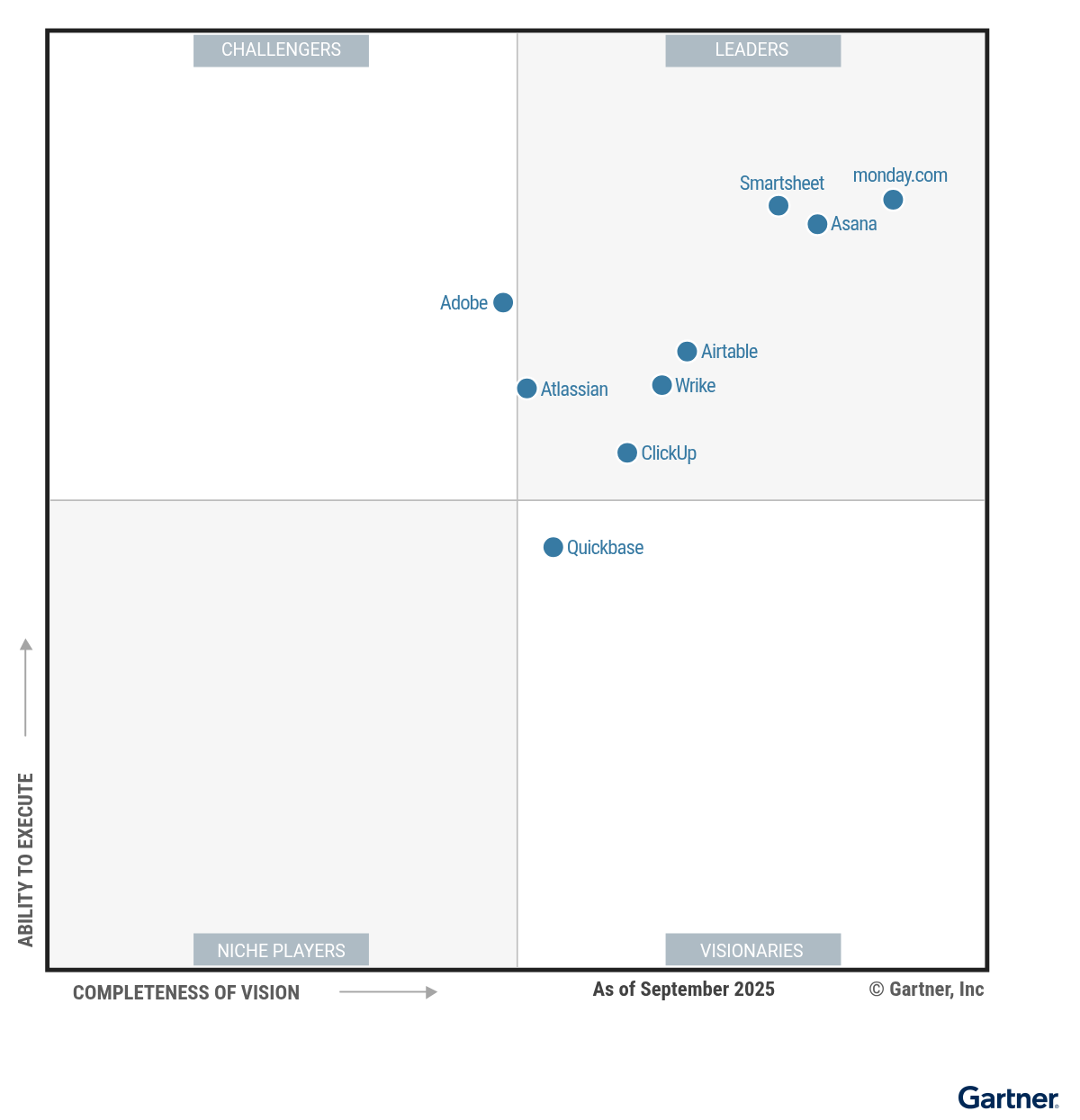
Vendor Strengths and Cautions
Adobe
Adobe is a Challenger in this Magic Quadrant. Its Adobe Workfront CWM product focuses on marketing operations and enterprise work management. Adobe is geographically diversified and leverages an extensive network of offices and a broad partner ecosystem. Workfront stands out for its integration with the Adobe Creative Cloud suite to support content collaboration, proofing, reviews, and approvals. Recent enhancements include integrating GenAI to automate content creation and optimize workflows for “content supply chain management,” AI-powered approvals and process intelligence, and AI-driven form design and smart assignments. Adobe’s roadmap focuses on expanding AI capabilities, including its AI Workflow Optimization Agent.
- Market presence: Leveraging its recognized brand, Adobe has a notable global market presence, particularly within creative and marketing organizations. The company’s established customer base and extensive partner ecosystem provide a foundation for Workfront, which is supported by capable global sales and support teams.
- Ecosystem integration: Workfront benefits from integration with the Adobe Creative Cloud and Adobe Experience Cloud suites, which provide a connected experience for creative teams managing projects and assets directly within familiar design tools. This integration streamlines workflows and improves efficiency across the Adobe technology stack.
- Product capabilities: Adobe Workfront offers broad capabilities for managing complex marketing and creative workflows, providing features for project planning, resource management, and content review. The platform offers comprehensive content collaboration, including granular versioning, audit trails, and integrated review and approval workflows with a built-in proofing tool.
- Product strategy: Adobe’s incorporation of Workfront into its product suite means that it primarily targets content-centric use cases such as marketing operations, which impacts Workfront’s visibility as a CWM solution for those outside the Adobe ecosystem. Adobe Workfront appears on CWM product shortlists in Gartner customer inquiries less frequently than the solutions offered by Leaders in this market.
- Ease of use: Workfront can be complex, especially for novices. Nontechnical users cannot easily consume its scripting and automation capabilities.
- Pricing: Adobe does not provide standard pricing; solutions are priced on a case-by-case basis, which makes pricing less transparent and requires more complex agreements.
Airtable
Airtable is a Leader in this Magic Quadrant. Its Enterprise Scale offering is designed for IT professionals and business users to build functional, no-code applications for business operations. Airtable has a global workforce with geographically diversified operations and is expanding in the Asia/Pacific and EMEA regions. Its platform enables business users to create tailored workflows without relying on IT. Recent enhancements include expanded automation and AI through integration with Salesforce, investment in its Omni AI app-building assistant, HyperDB to support large data volumes, and Airtable Portals for external collaboration. Airtable’s roadmap includes expanding existing AI agent capabilities, exploring new use cases, and refining its core data layer for business operations.
- Scalability: Airtable has addressed enterprise data scale with HyperDB, supporting large organizations that manage extensive data.
- No-code flexibility: The platform’s low-code/no-code capabilities empower business users to create customized apps and sophisticated applications without requiring technical expertise. This design allows organizations to tailor the product to their specific needs.
- AI innovation: Airtable relies on an agentic approach that pairs a conversational agent (for natural language app creation, analysis, and building automations) with embedded in-app agents that automate tasks, generate and analyze content, and conduct research.
- Market reach limitations: Airtable is developing its physical, partner, and data center presence outside of its core markets. Its product language support is currently limited, which may reduce its suitability for customers in certain regions. Airtable’s vertical industry solutions and traditional reseller and distributor programs are still in development, which may limit its market reach.
- Operational complexity: For users new to database concepts, Airtable can present a more significant initial learning curve than simpler tools. Also, its extensive customization options may require additional guidance and training for advanced features.
- Apps governance: While flexible, Airtable’s distributed app-builder model can create complexity in managing custom apps at enterprise scale, and in maintaining consistent governance, security, and compliance across large portfolios.
Asana
Asana is a Leader in this Magic Quadrant. It provides a centralized information hub for work across teams. Asana’s geographically diversified workforce and locations support international customers, focusing on knowledge workers and addressing in-context collaboration, project management, and goal alignment. Recent enhancements have focused on enterprise capabilities, especially security, and the expansion of Asana’s automation engine. The company has also incorporated AI features, including AI-driven work planning and centralized collaboration through Asana Inbox. Its roadmap centers on the Asana Work Graph, which connects an organization’s work — from individual tasks to strategic initiatives — and enhancements to AI Studio, AI Teammates, and add-ons for specific work activities.
- Market presence: Asana has a strong global market presence and brand recognition, which is supported by a large and dedicated user community. This strategic asset contributes to prospective customers’ enhanced market visibility and provides a foundation for continued growth. The company shows high adoption rates for core work management, including work planning and marketing work management use cases.
- AI-enabling Work Graph: Asana leverages its Work Graph architecture, enhanced with AI Teammates, for agentic workflows, delegating work and generally streamlining workflows with automation assistance for repeatable processes.
- Product capabilities: Asana’s platform offers a comprehensive set of CWM features for task management, project planning, and resource management. Its Work Graph data model provides a centralized information hub for team alignment and productivity. Asana also demonstrates strong capabilities in objectives and key results (OKR) management, supporting decomposition and linking strategic goals to daily execution with high visibility.
- Complexity: Due to its extensive feature set, the Asana platform may be perceived as overly complex for users with basic CWM needs, potentially resulting in a longer learning curve and the need for additional training to fully utilize its advanced functionalities.
- Industry focus: Asana is developing its vertical industry sales programs and may lack tailored solutions for specialized use cases, indicating a more general work management approach rather than deeply specialized industry solutions.
- Growth rate: Asana’s static employee count and slowing revenue growth suggest a less mature direct sales approach and/or more reliance on product-led growth than leading competitors.
Atlassian
Atlassian is a Leader in this Magic Quadrant. Its Teamwork Collection suite includes Jira (Cloud), Confluence (Cloud), Loom, and Rovo, enabling every team through a platform for work, knowledge and communication. Atlassian’s operations are geographically diversified, serving a global customer base. Its AI-native platform, built on Teamwork Graph and Rovo, integrates data across Atlassian and third-party apps, providing customizable AI via Studio. Recent enhancements focus on delivering a more unified experience across the product suite with common navigation and information architecture, making it easier for business users to work across apps. Atlassian plans to develop Rovo and AI features for work orchestration and optimization.
- Market presence: Atlassian maintains a strong general global market presence and brand recognition, particularly within software development and IT. This creates significant opportunities to expand Jira’s adoption among business teams.
- Expansive ecosystem and developer support: Atlassian fosters an extensive ecosystem, enabling partners to contribute to core product capabilities and develop extensions and customizations. Its marketplace offers many apps, including “Runs on Atlassian” certifications for third-party products, indicating strong developer and partner programs. This broad and active ecosystem provides various integrations and tailored solutions.
- Pricing: Teamwork Collection pricing is transparent and competitive, making large-scale deployments cost-effective. Rovo capabilities are currently included in all paid plans for Teamwork Collection.
- Product portfolio complexity: Users and buyers may encounter challenges navigating several Atlassian products that overlap or complement each other, such as Trello and Jira.
- Sales and marketing strategy: Atlassian is early in appealing directly to business decision makers outside IT. Its sales and marketing efforts for specific vertical industries remain less developed than those of other vendors evaluated.
- Feature depth: Certain Teamwork Collection functionalities are limited, with specific weaknesses in asset management, resource allocation and integrated time tracking. These gaps may impact its suitability for specific use cases, such as marketing operations and case management.
ClickUp
ClickUp is a Leader in this Magic Quadrant. Its unified platform includes task management, project planning, and document collaboration. ClickUp is U.S.-based, with several regional offices and a global partner network. It stands out for its emphasis on worker and team productivity across various roles — such as project, marketing, and IT managers. Recent enhancements focus on its AI capabilities, automation engine, enterprise features, and innovations — such as turning written content into actionable tasks. Its Map view visualizes tasks tied to geographic locations for managing job sites. ClickUp’s roadmap includes plans to expand its AI agent capabilities and deliver advanced search features for a more intelligent and integrated work experience.
- Customer growth: ClickUp has achieved notable net-new user acquisition and consistent growth in active users and customer deployments, indicating broad market acceptance.
- Usability: Despite its extensive feature set, ClickUp is often praised by customers for its user-friendly, clean interface and views to suit different user needs. The platform offers flexibility and functionality in task management, with readily accessible core features and minimal initial configuration.
- Platform innovation: ClickUp’s “Convergence” narrative aims to unify work, knowledge, and communication. It minimizes context switching and establishes a centralized information hub for users. ClickUp maintains a track record of consistent innovation, regularly releasing new features and functionalities, particularly in GenAI.
- Partner ecosystem and vertical focus: ClickUp is evolving its partner ecosystem and its capacity to target specific industries and business functions. The company does not have a dedicated vertical industry sales program, which may limit its appeal for highly specialized use cases.
- Geographic presence: ClickUp’s physical presence outside the U.S. is limited, particularly in Asia. Multinational organizations seeking localized support should assess whether this limited geographic presence will serve their needs.
- Performance at scale: ClickUp’s largest deployments are generally smaller than those of its direct competitors across key metrics, such as managing less total data and supporting fewer concurrent users.
monday.com
monday.com is a Leader in this Magic Quadrant. Its work platform fosters collaboration around shared plans and work progress. The company is geographically diverse, with its headquarters in Israel and is financially listed in the U.S. It offers expert users, citizen developers, project managers, and operations directors, along with operational efficiency, visibility and cross-team collaboration. Recent enhancements focus on data life cycle management and performance for large deployments, secure workspaces with restricted downloads and sharing, API access for user management and audit logs, no-code reusable building blocks, integrated AI for task generation, and real-time dynamic dashboards. monday.com’s roadmap includes AI advancements, agile delivery insights, and enhanced executive-level dashboards.
- Marketing execution: monday.com has implemented a marketing strategy featuring a popular free tier program that continues to drive brand recognition. This approach has led to consistent year-over-year growth by leveraging an intuitive user experience and effectively targeting influencers across various industries.
- Use-case support: monday.com showcases and sells its product through tailored, productized versions designed for various use cases such as marketing, software development operations, CRM, and service management. These specialized offerings are beginning to compete with dedicated business applications in different markets.
- Platform: monday.com has made substantial platform investments, including enhanced data life cycle management and improved performance for large deployments. The platform also supports secure workspaces and API access for building custom automations and integrations, and managing tasks programmatically.
- Product strategy: monday.com is expanding into several adjacent business application markets through its use-case accelerators, which are essentially distinct products. This broad focus may strain its leadership attention and limit investment in core CWM capabilities.
- Pricing: monday.com’s separate pricing for its use-case accelerators can introduce complexity for organizations seeking multipurpose solutions. This may complicate budgeting and procurement processes for broader deployments.
- Geographic presence: In geographic regions where solution delivery and implementation are predominantly partner-led, buyers should confirm that sufficient localized expertise and certified resources are available to meet their service requirements.
Quickbase
Quickbase is a Visionary in this Magic Quadrant. It automates complex business processes, builds custom workflows, and enables business users to build sophisticated applications without reliance on IT. The company is U.S.-based, with operations and partners primarily in North America. Quickbase enables project managers, frontline workers, and supply chain managers to address needs such as automation, project management, data connectivity across systems, and enhanced collaboration. Recent enhancements expand automation capabilities, improve integrations, and incorporate new AI features. Quickbase’s roadmap focuses on improving AI and machine learning capabilities to provide a more intelligent and integrated experience.
- Platform: Quickbase’s SaaS platform has a scalable in-memory database that includes a sensitive data scanner with pattern matching for enhanced data security. It also exports complete markup text specifications of plans or applications for further processing.
- Use-case accelerators: Quickbase’s collection of general work use cases and customizable, vertical industry-specific Pro Apps includes prebuilt data models and workflows for areas such as construction and property management. Its Frontline Work Management Operations accelerator offers out-of-the-box functionality for shift scheduling, attendance tracking, and task assignments, all integrated with FastField for mobile data capture and field-to-office collaboration.
- Integrations: Quickbase’s extensive integration ecosystem includes Google Workspace, Microsoft 365 and Slack, allowing users to connect Quickbase with existing tools and streamline workflows.
- Market alignment: Quickbase’s strength as a development platform for fusion teams may necessitate a higher level of technical competency from its target users compared with the broader CWM market.
- Market presence: Quickbase has fewer active users and longer sales cycles than the other vendors evaluated in this research. It is also mentioned less among Gartner clients evaluating CWM solutions.
- Geographic strategy: Quickbase’s physical regional presence is limited, and its partner ecosystem focuses on North America. This limited global reach may concern organizations with international operations seeking consistent local support and services in other regions.
Smartsheet
Smartsheet is a Leader in this Magic Quadrant. Its platform blends a familiar spreadsheetlike interface with planning capabilities and is known for its project management, resource management, and reporting features. Smartsheet is geographically diversified and stands out for its enterprise-grade features, such as Control Center and Data Shuttle, and its focus on a scalable solution for complex workflows. Recent enhancements have expanded its AI and machine learning capabilities, improved integrations, and broadened its enterprise features. Smartsheet’s roadmap includes accelerating AI innovation — particularly through AI agents and user-built automations — scenario planning capabilities, a new portfolio offering, and deepening integrations across its suite.
- Enterprise-grade features: Smartsheet offers features that are well-suited for organizations with complex workflows requiring a scalable solution. Large organizations value the platform’s project management, resource management, and reporting features. Its enterprise-grade security and administrative controls further support these strengths.
- Market presence: Smartsheet has a significant global market presence, a large, dedicated user community, and customer expansion within its existing base. This is evidenced by a high Gartner inquiry volume and status as the most frequently compared vendor, indicating strong market recognition and engagement.
- Content collaboration with proofing: Smartsheet offers granular versioning for attached files, audit trails, and a proofing feature for content review with direct annotations and threaded discussions. It supports dynamic structured content types via Document Builder.
- Pricing: Smartsheet’s recent transition to the User Subscription Model has introduced administrative inefficiencies for customers, leading to challenges in reconciling user account details and managing licenses. Removing the free collaborator option has compounded these challenges, leading to dissatisfaction, especially among organizations facing higher costs for the same service.
- Market momentum: Smartsheet’s revenue and employee growth rates are lower than those of leading competitors, which may concern organizations that view rapid expansion and market momentum as indicators of long-term stability.
- Private ownership: The transition to private ownership may impact visibility into Smartsheet’s strategy, roadmap, and results.
Wrike
Wrike is a Leader in this Magic Quadrant. Its platform is designed for governance at scale, from simple task management to complex plans. Wrike is geographically diversified and U.S.-based, with a significant presence in Europe and a center of excellence in India. It enables project managers, client services managers, and product managers to address scalability, workflow automation, and alignment of work progress with business outcomes. Recent enhancements include expanded enterprise capabilities, an automation engine, AI features, a redesigned user experience, AI for document summarization and subtask creation, and Datahub for domain-specific data models. Wrike’s roadmap includes AI and machine learning enhancements, as well as planned agentic AI features such as an AI project management assistant.
- Content capabilities: Wrike enhanced its visual collaboration with the acquisition and integration of Klaxoon. Deeper integration will allow work artifacts to surface on a visual canvas, with AI agents converting unstructured input into structured work, such as generating plans from brainstorming sessions. The company also supports real-time co-authoring through Live Editor and Klaxoon integration.
- Data management: Wrike offers extensive data management tools, including Datahub, which synchronizes data from third-party systems such as CRM and ERP into Wrike workflows. Wrike Integrate offers a no-code engine with prebuilt connectors for complex integrations, while Wrike Sync enables specialized two-way synchronization with developer tools like Jira, GitHub and HubSpot.
- Pricing: Wrike’s pricing is transparent and competitive, with a free tier and paid plans making it accessible to small teams and multipurpose deployments.
- Market momentum: Wrike exhibits mixed market performance, with customer and revenue growth challenges and overall market visibility.
- Regional scale: Wrike’s data center support is located primarily in North America and Europe, limiting its direct presence in other major global regions. Its smaller footprint and less extensive network of channel and service partners contribute to a weaker market position relative to its peers.
- Partner ecosystem: Wrike’s partner ecosystem is less developed, with lower channel partner engagement and a limited service network across regions, indicating a less established channel strategy than competitors. Its marketplace lacks key features — such as self-service publishing, user ratings, and support for user discussions — which impacts extensibility and community-driven innovation.
Vendors Added and Dropped
We review and adjust our inclusion criteria for Magic Quadrants as markets change. As a result of these adjustments, the mix of vendors in any Magic Quadrant may change over time. A vendor's appearance in a Magic Quadrant one year and not the next does not necessarily indicate that we have changed our opinion of that vendor. It may be a reflection of a change in the market and, therefore, changed evaluation criteria, or of a change of focus by that vendor.
Added
No vendors were added to this Magic Quadrant.
Dropped
No vendors were added to this Magic Quadrant.
Inclusion and Exclusion Criteria
To qualify for inclusion, providers needed to meet the following criteria:
- A provider must demonstrate active participation in the collaborative work management market as a pure-play provider of stand-alone CWM software that caters to the technology needs of end users and business teams, and meets the Gartner definition for the CWM market.
- A provider’s CWM software product must not require the purchase of a separate, non-CWM software platform from the provider to obtain all the relevant CWM functionality.
- The software provider must demonstrate a solid track record of successful CWM technology sales, deployments, and delivery of companion consulting services, supporting CWM use cases.
- The software products must offer integrated work planning, in-context collaboration, content collaboration, workflow and automation, reporting, analysis, dashboarding, intelligent assistance, and use-case acceleration on a platform that handles data management and administrative operations.
- The provider and its product must demonstrate stability and longevity in the open market, providing product general availability and active marketing to business users for at least five years.
- The provider must demonstrate substantial CWM market presence, including market penetration, sales, and support for multiple regions, including North America, Europe, and Asia/Pacific. At least 20% of the revenue must be associated with regions outside the primary region in which the provider operates.
- The provider must have at least US$100 million or equivalent in revenue from user subscriptions, or at least 500 full-time employees dedicated to its product in the CWM market in the calendar year 2024.
- The provider must have secured at least 300 new (not repeat business or renewals), active, paying (not free) customers (logos); or at least 30,000 new (not repeat business or renewals) paying (not free) end-user subscriptions for its CWM product in the calendar year 2024.
- The provider must have at least 100 current, active customers with an annual contract value exceeding US$100,000 or 100 current paying customers with more than 1,000 users each for its CWM product.
Evaluation Criteria
Ability to Execute
Gartner evaluates technology providers based on their ability to successfully sell and support their CWM products and services in the global market. Vendors are assessed on how well their market efforts and communication of their vision resonate with the market, as indicated by customer numbers, market recognition, and the likelihood of extended product use.
The key criteria for Ability to Execute are as follows:
- Evaluating product or service capabilities involves assessing core CWM features like task and project management, team collaboration, content sharing, and reporting. It also includes how vendors incorporate emerging technologies like generative AI to enhance functionality and user workflows.
- The overall viability criterion examines the organization’s financial health and the likelihood of continued investment in the product to remain viable and provide high-quality support in the CWM market.
- Sales execution and pricing assess the vendor’s capabilities in all presales activities and the overall effectiveness of its sales channel, covering deal management, pricing, negotiation, and presales support.
- Marketing execution focuses on the clarity, quality, creativity, and efficacy of a vendor’s messaging, its ability to generate awareness, and its effectiveness in promoting its product and value proposition.
- Customer experience assesses the quality of a vendor’s customer support, encompassing responsive and effective technical assistance, training, and professional services.
When weighing these criteria, the product/service and customer experience are considered the primary drivers for vendor selection, as buyers are most interested in product functionality and customer satisfaction during and after implementation.
The criteria for sales execution/pricing, market responsiveness/record, and marketing execution receive low weightings. These assess the vendor’s ability to deliver cost-effective software, responsiveness to market changes, and market recognition through effective marketing strategies.
Ability to Execute Evaluation Criteria
| Evaluation Criteria | Weighting |
|---|---|
Product or Service | High |
Overall Viability | Medium |
Sales Execution/Pricing | Low |
Market Responsiveness/Record | NotRated |
Marketing Execution | Low |
Customer Experience | High |
Operations | NotRated |
Source: Gartner (October 2025)
Completeness of Vision
Gartner evaluates technology providers on their vision for the CWM market, which includes their understanding of the market and their ability to innovate in response to evolving customer needs.
Vendors are assessed on their ability to articulate a believable and tangible roadmap for the next two to three years that aligns with or surpasses Gartner’s vision for the evolution of the CWM market, demonstrating an understanding of major technological and architectural shifts.
The key criteria for Completeness of Vision are as follows:
- Market understanding assesses how well a vendor comprehends the needs and challenges of its target market and responds to evolving trends in collaborative work management.
- Marketing strategy evaluates the clarity and consistency of a vendor’s marketing message, including its ability to articulate a compelling value proposition and differentiate its product.
- Sales strategy assesses the vendor’s approach to selling, including its use of direct and indirect channels, its ability to target specific market segments, and its plan for acquiring new customers.
- Offering (product) strategy evaluates a vendor’s product roadmap, including plans for new features, integrations, and expanding its product portfolio to address new market opportunities.
- Innovation assesses a vendor’s ability to innovate and deliver new features and functionality, considering investment in research and development, use of emerging technologies, and track record of bringing new products to market.
- Lastly, geographic strategy assesses a vendor’s plan for expanding its global presence, including its approach to localization, internationalization, and support for customers in different regions.
Regarding weightings, offering (product) strategy, and innovation receive high and medium weightings, respectively. These criteria are crucial as they assess how vendors demonstrate their vision for supporting digital work management, how they envision planning transforming work, and how they differentiate themselves through innovation. The criteria for market understanding, marketing strategy, sales strategy, and geographic strategy receive low weightings. These indicate vendors’ investment and growth strategies, including their vision for supporting customers across diverse industries and geographies.
Completeness of Vision Evaluation Criteria
| Evaluation Criteria | Weighting |
|---|---|
Market Understanding | Low |
Marketing Strategy | Low |
Sales Strategy | Low |
Offering (Product) Strategy | High |
Business Model | NotRated |
Vertical/Industry Strategy | NotRated |
Innovation | Medium |
Geographic Strategy | Low |
Source: Gartner (October 2025)
Quadrant Descriptions
Leaders
Leaders exhibit comprehension of essential product features. They are dedicated to ensuring customer success and meeting buyers’ expectations in this market. They have a track record of strong performance and influence the market’s trajectory. Leaders continually enhance their offerings, delivering platforms that are functionally robust and demonstrably benefit customers. They possess a well-defined product roadmap to strengthen the product’s market position and safeguard buyers’ investments. Furthermore, they cater to various use cases and address emerging business challenges. Leaders’ extensive network of partners provides localized support and services across most regions globally.
Challengers
Challengers are positioned for success in this market, yet they may face limitations in specific use cases and exhibit weaknesses in their product capabilities. Their vision might be constrained by their focus being diffused among other products in a portfolio of which CWM is only one. Additionally, they might trail Leaders in effective marketing, sales channels, industry-specific focus, and innovation. Challengers possess the size and product strength to compete globally, but their execution may not be equally effective in all regions.
Visionaries
Visionaries are at the forefront of technological innovation, offering advanced capabilities and strong, future-oriented product strategies. These vendors can act as thought leaders, driving market trends and investing in transformative technologies. However, they may face challenges in execution, market presence, and customer support, making them higher-risk but potentially higher-reward choices. Visionaries may lack a consistent track record, broad use-case support, or a track record in large-scale deployments. However, they can influence the market’s direction and provide early access to breakthrough features.
Niche Players
Niche Players typically specialize in one geographical or functional area. They may be newer entrants to the market, small companies just starting to succeed, or they may be focused on a specific subset of use cases. They may not consistently demonstrate the ability to handle large deployments across multiple geographies, or they may lack strong sales. However, their technology offerings and customer satisfaction within their specialized areas are often excellent. Niche Players’ offerings can be suitable for organizations that require local presence and support, want a close relationship with a provider, or seek a platform that addresses specific industry use cases and functional requirements. Niche Players that can fulfill these particular requirements may offset the viability risks associated with smaller vendors.
Context
The CWM market is changing how organizations manage work. It is moving from supporting isolated tasks to providing a view of operations and managing the entire life cycle for different work activities. For digital workplace leaders, the goal is to find solutions that connect strategy to daily work, offer valuable insights, and allow quick responses to business changes.
A significant trend is the widespread use of AI and generative AI (GenAI) in CWM platforms. This goes beyond simple automation to enable complex reasoning and the creation of “autonomous AI teammates.” When choosing CWM platforms, prioritize those that use AI for tasks like instant summaries, automatic task creation, and predicting problems to reduce unnecessary work. Such tasks need strong data integration to bring together information from different sources. Vendors are also adding AI features for automating risk assessment and suggesting ways to avoid project delays.
Another crucial area is the demand for unified platforms that reduce tool switching and act as a central collaboration hub. Look for solutions that combine communication, tasks, and data, offering real-time dashboards for better visibility and actionable insights. AI is even being used to automatically update project summaries for leaders. There is also a strong focus on governance, security, and compliance, with features such as detailed permissions, audit trails, and data storage controls, especially for large organizations.
CWM solutions also need comprehensive dashboards with drill-down options to track progress, resource use, and project finances. Mobile access — allowing work on the go — is also essential for various workers. Clarity and transparency help with practical work and decisions. Templates and ready-made solutions help set up systems faster and standardize practices.
Market Overview
The collaborative work management (CWM) market is changing, driven by evolving organizational needs and the increasing complexity of modern work. Companies are moving past basic project tools to find solutions to manage different types of work, from planning to daily tasks. The CWM market continues to show strong growth.
A central dynamic in this market is the demand for solutions that bring together various work activities and information. This often happens through strong connections with other systems like CRM, ERP, and cloud office tools, allowing smooth data flow and visibility across the company. Vendors focus on creating powerful automation tools that manage different inputs, prioritize tasks, and assign work. They offer dashboards for tracking performance and service levels in real time. There is also a strong push for enterprise-level governance, security, and compliance features, such as detailed permissions, audit logs, and data storage controls, which are necessary for large organizations. Mobile access is a key expectation.
The CWM market focuses heavily on customer success and rapid adoption. Most vendors provide large libraries of templates, ready-made tools, and guided setup options to help companies start using their products quickly and consistently. These “use-case accelerators” act as starter kits, streamlining initial deployment by offering prebuilt data models, workflows, and relevant configurations. By consolidating various operational needs into a single platform, they also reduce the need for specialist applications, particularly when requirements are not highly demanding. Increasingly, these accelerators are becoming more sophisticated with integrated AI capabilities, enabling advanced functionalities that are beginning to position them to compete with specialized business applications in related markets.
Beyond these accelerators, CWM vendors’ growing focus is on providing solutions for specific uses, industries, and business areas, often with dedicated sales teams. Vendors offer different pricing options to reach more users, including lower-cost and free versions for limited use. Marketing efforts combine strategies that encourage users to try the product first (product-led growth) and sales-driven approaches, using specific messages and customer success stories.
The evaluation of providers’ capabilities for this Magic Quadrant and the related Critical Capabilities research came from both primary and secondary research by Gartner.
The primary research used for this Magic Quadrant includes:
- A detailed provider survey, conducted between May and June 2025.
- Recorded demos and presentations by each provider, showcasing specific aspects of its product, including support for different use-case scenarios.
Secondary research used includes the following, all taken from the last 12 months:
- Client inquiries taken by Gartner regarding providers’ CWM products.
- Client satisfaction and verbatim comments on the performance of individual providers, taken from client reviews on Gartner Peer Insights.
- Insight from other Gartner analysts who have spoken with or spoken to providers’ clients about their offerings.
- Briefings delivered by providers to Gartner outside of the Magic Quadrant and Critical Capabilities processes on aspects of providers’ capabilities.
- Press releases and publicly available information, including company websites and financial reports.
- Views and comments provided by other Gartner analysts as part of the peer review process.
Ability to Execute
Product/Service: Core goods and services offered by the vendor for the defined market. This includes current product/service capabilities, quality, feature sets, skills and so on, whether offered natively or through OEM agreements/partnerships as defined in the market definition and detailed in the subcriteria.
Overall Viability: Viability includes an assessment of the overall organization's financial health, the financial and practical success of the business unit, and the likelihood that the individual business unit will continue investing in the product, will continue offering the product and will advance the state of the art within the organization's portfolio of products.
Sales Execution/Pricing: The vendor's capabilities in all presales activities and the structure that supports them. This includes deal management, pricing and negotiation, presales support, and the overall effectiveness of the sales channel.
Market Responsiveness/Record: Ability to respond, change direction, be flexible and achieve competitive success as opportunities develop, competitors act, customer needs evolve and market dynamics change. This criterion also considers the vendor's history of responsiveness.
Marketing Execution: The clarity, quality, creativity and efficacy of programs designed to deliver the organization's message to influence the market, promote the brand and business, increase awareness of the products, and establish a positive identification with the product/brand and organization in the minds of buyers. This "mind share" can be driven by a combination of publicity, promotional initiatives, thought leadership, word of mouth and sales activities.
Customer Experience: Relationships, products and services/programs that enable clients to be successful with the products evaluated. Specifically, this includes the ways customers receive technical support or account support. This can also include ancillary tools, customer support programs (and the quality thereof), availability of user groups, service-level agreements and so on.
Operations: The ability of the organization to meet its goals and commitments. Factors include the quality of the organizational structure, including skills, experiences, programs, systems and other vehicles that enable the organization to operate effectively and efficiently on an ongoing basis.
Completeness of Vision
Market Understanding: Ability of the vendor to understand buyers' wants and needs and to translate those into products and services. Vendors that show the highest degree of vision listen to and understand buyers' wants and needs, and can shape or enhance those with their added vision.
Marketing Strategy: A clear, differentiated set of messages consistently communicated throughout the organization and externalized through the website, advertising, customer programs and positioning statements.
Sales Strategy: The strategy for selling products that uses the appropriate network of direct and indirect sales, marketing, service, and communication affiliates that extend the scope and depth of market reach, skills, expertise, technologies, services and the customer base.
Offering (Product) Strategy: The vendor's approach to product development and delivery that emphasizes differentiation, functionality, methodology and feature sets as they map to current and future requirements.
Business Model: The soundness and logic of the vendor's underlying business proposition.
Vertical/Industry Strategy: The vendor's strategy to direct resources, skills and offerings to meet the specific needs of individual market segments, including vertical markets.
Innovation: Direct, related, complementary and synergistic layouts of resources, expertise or capital for investment, consolidation, defensive or pre-emptive purposes.
Geographic Strategy: The vendor's strategy to direct resources, skills and offerings to meet the specific needs of geographies outside the "home" or native geography, either directly or through partners, channels and subsidiaries as appropriate for that geography and market.