Integrating AEO and SEO: Tactics for Improving Online Search Visibility
ARCHIVED
8 July 2025 - ID G00825146 - 29 min readBy Noam Dorros, Ross Cosner
SEO, and now AEO, are critical components of the digital marketing mix that require consistent attention to stay aligned with consumer, digital and industry evolutions. Digital marketing leaders can use the tactics explored in this research to improve AEO and SEO performance.
Overview
Key Findings
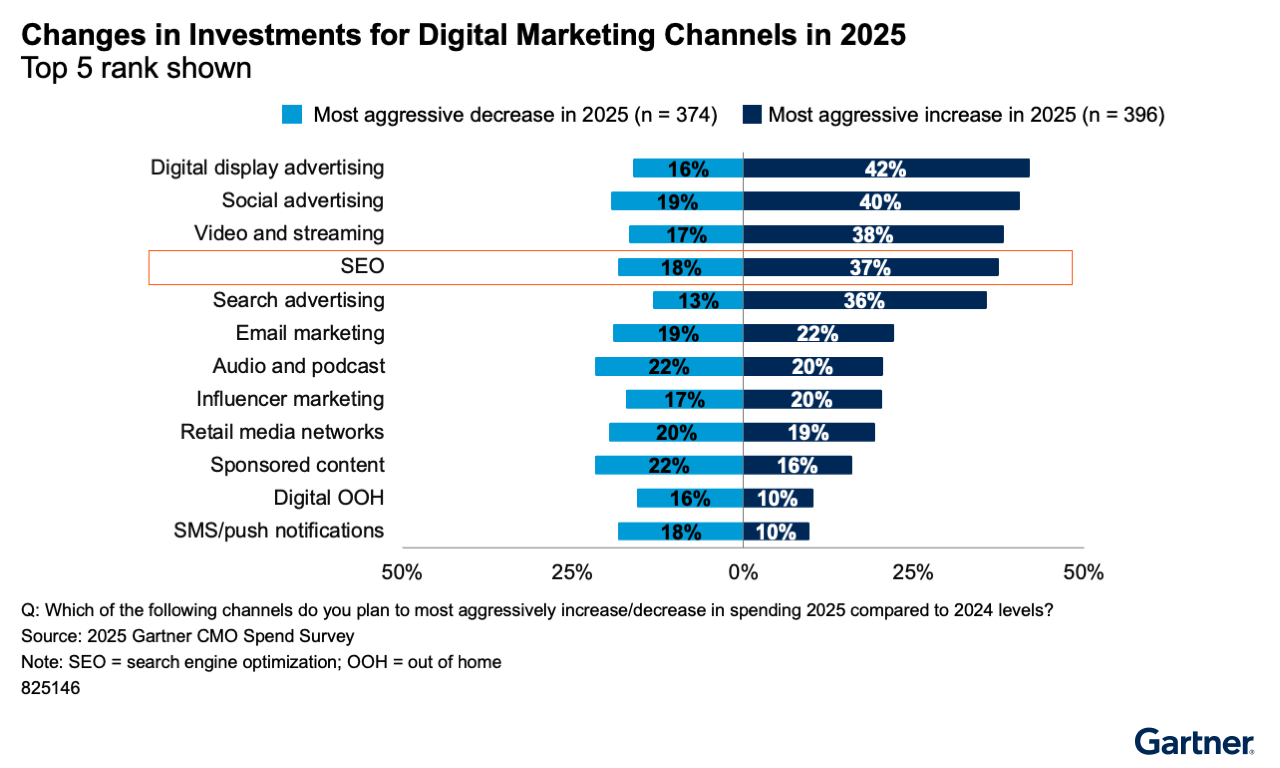
- Search engine optimization (SEO) remains a priority for marketers in 2025, comprising 8.9% of digital channel spend allocation and 37% of CMOs report an aggressive investment increase, according to the 2025 Gartner CMO Spend Survey.
- As of June 2025, 26.6% of scraped keywords — aligned to six sectors — surfaced AI overviews on Google’s search engine results page (SERP) above the organic results.
- By 2026, Gartner predicts more than one-third of web content will be developed exclusively for AI and search engine consumption.
Recommendations
For successful digital marketing strategy and execution:
- Approach answer engine optimization (AEO) and SEO with a consistent cadence of analysis and optimization, while remaining agile to activate against industry and consumer trends for optimal return on investment.
- Maintain an AEO strategy focused on developing content for AI results that aligns with consumer consumption habits: content that is concise (featured snippet, FAQs), straightforward, distinguished and well-structured.
- Implement structured data on websites to enhance visibility and ensure content is accurately understood and featured by answer engines.
Strategic Planning Assumption
By 2026, more than one-third of web content will be developed exclusively for AI and search engine consumption.
Introduction
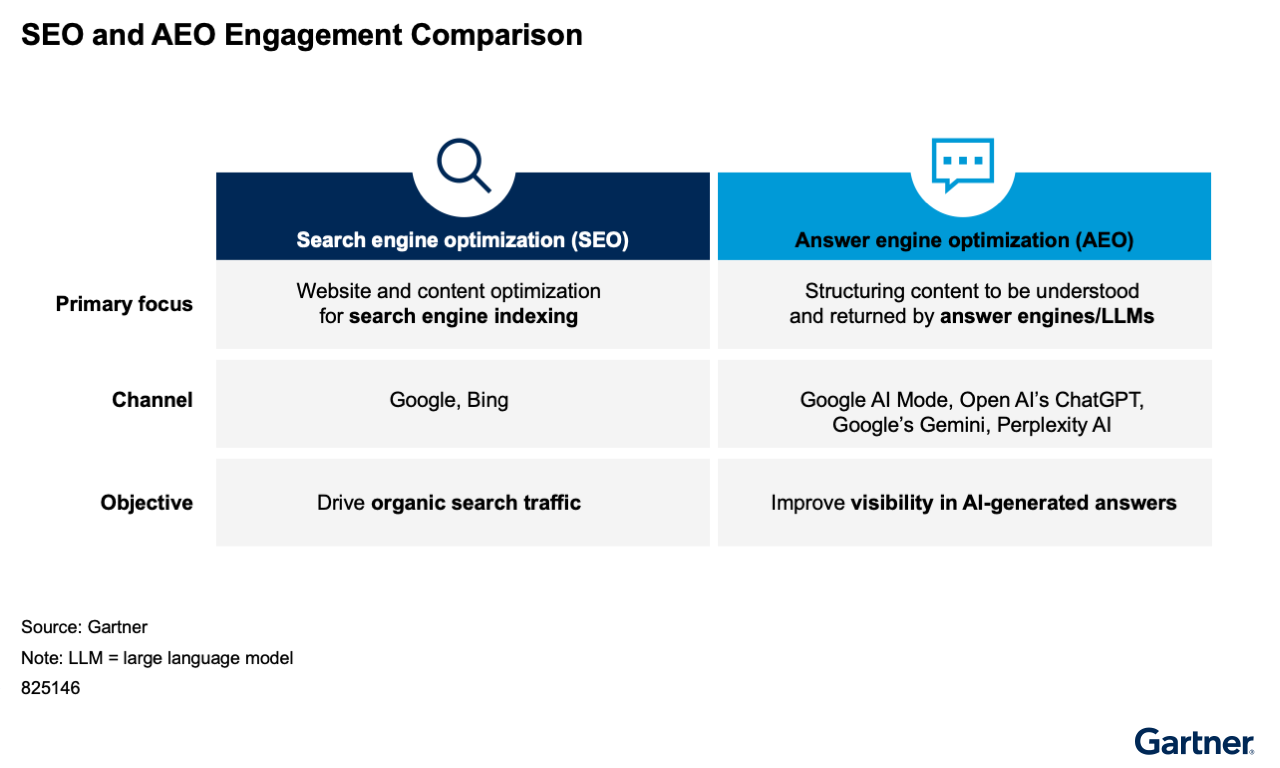
In a rapidly evolving search landscape, both SEO and AEO play crucial roles in ensuring content discoverability and relevancy. SEO helps your website rank higher in traditional search results, driving organic traffic and building long-term visibility. AEO focuses on structuring content for consumption by AI-powered answer engines (e.g., Google AI Mode, Perplexity AI, OpenAI’s ChatGPT) to easily extract and present information. Combining SEO and AEO strategies improves an organization’s visibility while positioning content as a trusted source for AI results. By focusing on both SEO and AEO in an increasingly AI-driven world, brands can ensure their content reaches the right audience at the right time within their journey.
According to the 2025 Gartner CMO Spend and Strategy Survey, SEO accounts for 8.9% of total digital channel allocation. What’s more, 37% of CMOs are expected to aggressively increase investment (see Figure 1). CMOs recognize engine optimization as paramount to future digital success and continue to invest accordingly. But an increased spend commitment does not guarantee results without a clear vision and solid channel strategy.
Digital marketing leaders’ approach to improving visibility and rankings must incorporate answer engine, on-page, off-page and local considerations. Effective search visibility lives at the intersection of four strategies:
- AEO is the process and technology of making content easily understood, extracted and delivered by AI-powered answer engines.
- On-page SEO is primarily concerned with website optimizations that affect what a website may rank for (content, title tags, URLs).
- Off-page SEO focuses on increasing domain authority, which may affect where a brand ranks on results pages (backlinks, guest blogs).
- Local SEO is critical for brick-and-mortar marketing strategies to improve visibility in local search results, such as local business listings, ratings and reviews sites, local content, and query searches that use locations or the phrase “near me.”
But to effectively reach and engage audiences in today’s rapidly evolving landscape, brands must understand the difference between SEO and AEO (see Figure 2). Adapting to these diverse optimization strategies allows brands to maximize visibility, authority and influence to remain competitive and relevant to continuously shifting user behaviors and technologies. Use this research to understand the foundational tactics of AEO and SEO to improve answer and search engine visibility.
Analysis
AEO Tactics
AEO focuses on optimizing content to provide direct, structured answers to user questions, especially for AI-powered search engines and voice assistants. The goal is to become the “best answer” featured in snippets, knowledge panels, or spoken responses, enhancing visibility even without traditional clicks.
Design Content for Answer Engine Extraction
AI engine results (e.g., Google AI mode, Perplexity AI, OpenAI’s ChatGPT) focus on concise summations or explanations that provide quick insights in response to user queries. To increase visibility and ranking in AI results, digital marketing leaders must focus on creating unique, distinguished content that is thought-provoking, offers value and provides human perspectives.
What Should Brands Do?
- Optimize for bite-sized content and high-level take-aways. Content must be diverse and multimodel (blogs, infographics, videos, influencer videos, organic social posts, affiliate content). Use concise definitions, steps or lists at the beginning of sections. Robust FAQ pages with short-form, bulleted answers, content in the form of feature snippets (bulleted lists, short paragraph summations), or “too long didn’t read” boxes atop long-form pieces of content are all extremely valuable and appeal to the AI algorithms.
- Write clear, structured content. Use headings and subheadings to organize information. Bullet points and numbered lists help break down complex ideas. Short paragraphs with few sentences are easier for AI to parse and summarize. Write straightforward, well-structured answers to common questions. Use headings, bullet points and summaries for easy parsing by AI.
- Focus on semantics. Identify related ideas and main concepts, incorporating synonyms and related phrases, to explain how different ideas connect. Provide definitions, explanations, examples and FAQ sections to address common queries.
- Use natural language. Create content that is clear and conversational to improve readability and comprehension. Anticipate how users might phrase questions to AI assistants (think who/what/where/when/why/how queries).
- Keep content up-to-date. Regularly update your content to reflect the latest knowledge, as AI engines prioritize recent and relevant information.
- Improve content discoverability with llms.txt files. Llms.txt files help AI systems access, comprehend and prioritize a website’s most valuable content, potentially leading to better visibility in AI-driven search results. Similar to robots.txt, which guides search engine crawlers, llms.txt allows publishers to specify permissions or restrictions for AI-driven data collection. (Note: This is a proposed standard and has not yet been adopted by most AI search engines.)
Resources
Assess the following tools, vendors and resources to assist with content creation:
- Canva (free and tiered offering)
- Writesonic (tiered)
- Copy.ai (tiered)
- Jasper.ai (tiered)
Assess the following tools to assist with llms.txt creation:
Implement Structured Data
Brands should leverage structured data to maximize their visibility in AI-powered answer engines by making content easy to understand and classify by these systems. AI engines rely on structured data to understand, categorize and present content. Well-implemented structured data increases accuracy in AI summaries, driving more visibility and engagement.
What Should Brands Do?
- Implement schema markup. Use schema vocabulary to tag important content (products, reviews, FAQs, events, organization info, etc.). Choose the most relevant schema types for your business (e.g., “Product,” “Article,” “FAQ,” “LocalBusiness”).
- Ensure data accuracy and completeness. Fill out all recommended and optional schema properties. Keep structured data up to date (e.g., prices, availability, contact info).
- Use JSON-LD format. Google and other AI engines prefer JSON-LD for structured data. It’s easy to implement and update.
- Focus on key content types. Mark up content that AI engines frequently surface, such as product details (name, price, availability, reviews), FAQs, how-to guides, business locations, recipes, events and articles.
- Validate structured data. Use tools like Google’s Rich Results Test or a schema markup validator to ensure your markup is error-free.
- Monitor and update regularly. Structured data requirements and AI capabilities evolve. Monitor performance and update markup as needed.
- Optimize for conversational AI. Use clear, concise language in marked-up content to help AI engines generate accurate, helpful overviews and answers.
Resources
Assess the following tools, vendors and resources to create or validate website structured data and accessibility.
- Schema.org (free)
- Schema Markup Testing Tool (free)
- JSON-LD Playground (free)
- Schema Markup Validator (free)
Follow Google’s EEAT Principles
EEAT principles (experience, expertise, authority, trustworthiness) are a core part of Google’s search quality rating guidelines and are used as a benchmark for evaluating content quality. While still beneficial for SEO, AI engines prioritize content that demonstrates EEAT when generating results and recommendations.1 Following EEAT principles ensures content is favored by AI engines for inclusion, as they are designed to surface the most reliable, accurate and trustworthy information for users.
What Should Brands Do?
- Incorporate experience. Highlight direct involvement or firsthand knowledge in content through case studies, testimonials, user stories and real-world experiences.
- Demonstrate expertise. Showcase credentials, qualifications and subject matter expertise by integrating author bylines, bios and reputable source citations.
- Solidify authoritativeness. Build a strong online brand presence through mentions, backlinks, reviews, or citations and references from other authoritative industry websites.
- Substantiate trustworthiness. Provide accurate, up-to-date information while maintaining transparency about your business, authors, sources, privacy policies and customer service information.
Resources
Assess the following tools, vendors and resources to help align content creation with EEAT Principles:
Boost Brand Presence and Reputation
Increase authority and trust with AI engines by incorporating positive reviews and testimonials on brand websites. AI engines prioritize content that demonstrates trustworthiness and real-world user feedback. Ratings and reviews, marked up with structured data, are strong signals of trust, experience and social proof by adding fresh, unique content that increase topical relevance and provide diverse perspectives that AI engines value. Positive reviews and high ratings can strengthen your brand’s authority and reputation, making AI engines more likely to feature your content.
What Should Brands Do?
- Collect and display reviews. Encourage customers to leave reviews and display them prominently on relevant pages (products, services, homepage).
- Use proper schema markup. Implement “Review” and “AggregateRating” schema to ensure AI engines can parse and understand your ratings and reviews.
- Respond to reviews. Engage both positive and negative reviews to show responsiveness and build trust.
- Keep reviews fresh. Regularly update and add new reviews to signal ongoing trust and activity.
Resources
Assess the following tools, vendors and resources to assist ratings and reviews:
- Trustpilot (free, tiered subscription offerings)
- Feefo (tiered)
- Bazaarvoice (tiered)
- PowerReviews (custom)
- Birdeye (tiered)
- Yotpo (tiered)
Amplify Social Media Presence
Social media activity (e.g., engagement, views, user-generated content) influences AI-generated results.2 AI engines increasingly incorporate social media content into their results to provide timely, relevant and diverse perspectives on trending topics and user queries. AI engines detect emerging trends, public sentiment and authoritative voices through analysis of posts, comments and engagement metrics. The conversational nature of social media content aligns with AI engines’ need to understand natural language queries and user intent to deliver more accurate and contextually relevant answers.
What Should Brands Do?
- Align cross-channel content. Make sure the social media and content teams are aligned in content strategies for proper cross-channel promotion.
- Maintain a consistent content cadence. Employing high-quality, relevant content to build your brand voice and bolster visibility on social platforms can ultimately reflect in, and benefit, AI engine visibility.
- Optimize social profiles. Using platform-specific best practices, update profile details with information that aligns to your brand website to avoid validity questions from algorithms.
- Video is critical. YouTube content is significantly showcased in AI overviews, presenting an opportunity to optimize video content with relevant keywords, robust descriptions and thorough transcripts for increased visibility.
- Partner with influencers. Expertise, experience and insight is amplified through influencer content, making it a trusted source for AI engines. Furthermore, influencers’ endorsement of brands positively impacts brand authority, potentially affecting visibility and rankings.
- Consider forums. Platforms like Reddit and Quora are considered effective sources for AI overviews through user-generated insights and diverse perspectives presented in natural language cadence. These platforms may not apply to all brand strategies, as they are linked with misinformation and erroneous results, but are something to maintain a pulse on through this evolution.
Revisit Your Measurement Strategy
AI search engines are profoundly affecting search performance measurement. Decreased organic traffic resulting from algorithm updates and zero-click search behavior (when a user’s search shows a result that directly answers their query on the search engine results page, so users do not need to click to visit a website) shifts analysis from results page engagement (click-through rate [CTR]) to visibility (AI placement rankings) and customer experience (conversions). Digital marketing leaders must reexamine channel metrics to account for these progressions propelled by AI results and evolving user behaviors.
What Should Brands Do?
- Revisit baselines and targets for conventional performance measures. Temper results for metrics most likely affected by these shifting behaviors. These metrics can include website traffic over time, traffic from organic search, and organic or paid click-through rates. Evaluate performance to identify any specific patterns unique to your website or industry.
- Prioritize conversion over impressions. Pair KPIs to include complementary measures that tell a more holistic story across the marketing funnel. Examples include effectiveness (CTR) + efficiency (CPM), quantity (visits from organic search) + quality (conversions from search), or upper funnel (e.g., AI visibility or AI search ranking) + lower funnel (e.g., AEO attributed leads).
- Be selective with AI search metrics. The AI search landscape is highly volatile, with new players and constantly evolving markets, so it’s important not to dive in headfirst when selecting new metrics (visibility, ranking, citation count) and tools to measure and report on AEO success. Existing metrics can help determine AEO effectiveness, such as incoming traffic from the major AI engine domain names (e.g., chatgpt.com).
- Evaluate platform AI measurement offerings. Be informed about what AI search features and data are available from existing marketing analytics providers if/when evaluating the market for new measurement capabilities for the metrics discussed here.
Resources
Assess the following established tools, vendors and resources to assist with AI engine performance measurement:
- Google Search Console (free)
- Google Analytics (free, tiered offering)
- Conductor (tiered)
- Siteimprove (tiered)
- BrightEdge (tiered)
Consider evaluating new tools, vendors and resources to augment AI search measurement:
- Profound (tiered)
- Bluefish (tiered)
- Otterly.AI (tiered)
On-Page SEO Tactics
On-Page SEO involves optimizing individual webpages to rank higher in, and attract relevant traffic from, search engines. Key elements include high-quality content, title tags, meta descriptions, header tags, keyword usage, internal linking and mobile-friendly design.
Diversify Content Strategies
SERPs are saturated with results from competition, all vying for the same limited real estate. To increase search visibility and ranking, along with clicks resulting in more website traffic, digital marketing leaders must focus on consistently creating high-quality content that is relevant to, and valuable for, their target audiences. As Google’s algorithm comprehension now extends beyond the written word, content forms must be diverse (image, text, video, audio) to offer a wide breadth of educational pieces that appeal to and satiate consumer demand.
What Should Brands Do?
- Take a customer-centric approach. When developing and optimizing content, use a variety of inputs: industry or digital trends, consumer behaviors and search intent (informational, navigational, commercial, transactional). Focus on what the target audience wants to read, see and hear to improve rankings through relevancy to query.
- Learn about your audience. Consumer preferences, demands, and how your audience speaks about products or services offered are all valuable inputs. The more natural the language and the more relevant the content is to the customer’s need states, the higher the success rate for click-throughs.
- Ensure accuracy, relevancy and appeal. Content is the opportunity to speak to your target audience and entice them to click through to the website. Content that helps people educate themselves, solves a problem or uses interactive tools can drive value for your target audience.
- Use a mix of hard and soft content. Content themes should account for hard content (product information, technical details, etc.) and softer content (educational concepts, philanthropy, community, etc.) that appeals to different need states.
- Benchmark performance. Identify content performance metrics and regularly evaluate existing content performance to identify strengths, weaknesses and gaps. Consider metrics like page traffic, bounce rate and dwell time, benchmarking against historical performance to optimize effectively (see Gartner’s How to Measure Content Marketing in 3 Steps).
Resources
Assess the following tools, vendors and resources to assist in content roadmapping and ideation:
- AnswerThePublic (free)
- BuzzSumo (free, tiered subscription offerings)
- Google Trends (free)
- Trends (free)
Cultivate Keyword Strategies
Keywords remain at the heart of any search strategy, and the relevance of those keywords to the user’s search query (i.e., the natural language typed into the search box) drives visibility. The most effective digital marketing leaders can showcase brand relevance to the search query by incorporating natural language within content. Content must align to query intent. Marketers need to determine which keyword categories are most critical for visibility, which keywords are of most interest and which keywords to aspire to for the highest rankings. Keywords are typically grouped into the following categories:
- Branded. Terms associated with the brand that are important to protect. Examples consist of the brand’s name, colloquial brand name references, acronyms, parent company names, legal entities or branded products and services (e.g., Heinz ketchup, Energizer batteries, GEICO insurance).
- Nonbranded. Terms that do not reference any part of a brand and often have higher competition. Examples are typically grouped within industries by product categories (e.g., ketchup, batteries, insurance).
What Should Brands Do?
- Delve into search intent. Categorize keywords related to the consumer journey and search intent (informational versus navigational versus transactional) to better understand query purpose.
- Mirror consumer dialect. Use common, everyday keywords in site content to better resemble customers’ natural language.
- Identify relevant long-tail keywords. While longer-tail terms (more detailed keyword phrases) garner less traffic, the relevance and specificity to audience intent are higher, which increases the chances for conversion.
- Focus on competitive advantages. Highlight unique traits of your brand or products to appeal to the customer and allow for more breadth of longer-tail terms to be incorporated in site content.
- Pinpoint priority high-volume keywords. In addition to long-tail tactics, category leaders must identify those high-volume keywords where they want to win. Choose high-volume keywords strategically, as they are more competitive and require a greater investment to achieve desired visibility.
- Optimize content for natural language search queries. Across search user interfaces, use question starter keywords like “who,” “what,” “when,” “where,” “why” and “how,” because they reflect natural language used in search queries. This approach also aligns with how people use voice search, which continues to grow: 27% of the global online population currently uses voice search on mobile.3
Resources
Assess the following tools, vendors and resources to gain insights about consumer search behaviors within categories of interest, perform keyword research and build keyword lists.
- AnswerThePublic (free)
- Google Keyword Planner (free with Google account)
- QuestionDB (free)
- Semrush (subscription)
Optimize Site Metadata
Creating robust content relevant to consumer query is an investment. However, it can easily become a wasted effort if consumers do not understand the content’s applicability or value. Structured metadata is a standardized format for providing information about a page and classifying the page content (e.g., the ingredients, the cooking time and temperature, and the calories on a recipe page).4
By optimizing metadata, digital marketing leaders ensure that any time site pages are viewed on Google’s SERP or shared via social media, they display all the associated information for a richer result. This strategy helps provide clarity to customers and search engines on the context and content of a webpage, which ultimately assists in determining relevance and appropriateness based on the query. There are generally three categories of metadata: descriptive (e.g., title and description tags), structural (e.g., HTML header tags) and administrative (e.g., last-modified-by time stamp, do not crawl).
What Should Brands Do?
- Avoid duplicate title tags and metadescriptions. Craft unique titles and descriptions, starting with the top-level sections, then drill down further to lower-level pages, ensuring you prioritize the sequence.
- Include target keywords. Incorporate terms toward the beginning of the title to avoid potential natural truncation by Google, especially when viewed on search results pages via mobile devices. Keep titles descriptive but concise while certifying that customer intent is matched. Many web CMS platforms support title-naming conventions that combine the page title, product or service, and brand name.
- Highlight a clear call to action. Include selling points in your description tag to entice users to click, but make sure an accurate summary is authentic in representation. If you wouldn’t click based on the description, don’t use it.
- Use time stamps on videos. For video platforms like YouTube that support chapters, include relevant keywords in each chapter so Google can identify and display those subject matter moments most pertinent to the search query.
- Format for readability and web accessibility. Use HTML tags for headers (H1) and subheaders (H2, H3) to break down longer pieces of content to help consumers navigate easily and to drive engagement. This tactic also supports site users who require screen readers due to vision issues, complying with the Web Content Accessibility Guidelines (WCAG 3.0). Use image alt tags, also known as “alt descriptions,” which provide meaning to images for search engine crawlers.
Resources
Assess the following tools, vendors and resources to create or validate website structured data and accessibility.
- Google Rich Results Test (free)
- Meta Sharing Debugger (free)
- MozBar Browser Extension (free)
- Twitter Card Validator (free with Twitter account)
- Web Toolbox OGP Checker (free)
Fortify Information Architecture
SEO strategy has no backbone without proper information architecture design, which also serves as the blueprint for site and URL structure, menu navigation, and site search. A website without logic in its framework renders the content useless, as a spider unable to crawl the site will not rank it accordingly. Most importantly, poor information architecture design creates a suboptimal experience for customers.
What Should Brands Do?
- Use a clear taxonomy. Taxonomy is how website content is structured and connected. Determine the purpose of the site taxonomy and which type is most appropriate for organizing content for easy discovery: flat, hierarchical, network or facet. You can audit and potentially redesign when planning a website overhaul.
- Use internal links. In addition to enlisting traditional site navigation structures, incorporating internal links throughout site pages (product to content, content to product, etc.) offers clear paths to discovery.
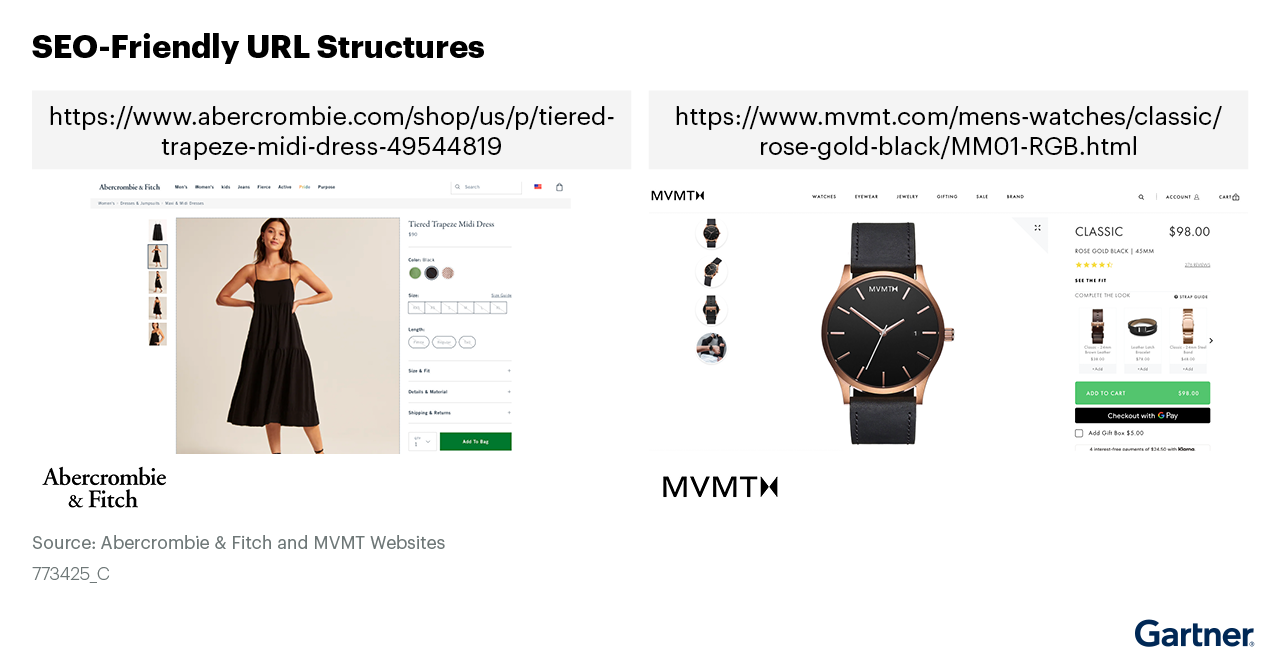
- Make URLs simple and consistent. Applying conventions to URL naming will ensure uniformity, clarity and inclusiveness of target keywords. This approach involves everything from names that reflect the site taxonomy to the use of special characters (see Figure 3).
- Maintain secure sockets layer (SSL) certificates. Updated SSL certificates secure site traffic using HTTPS. Keeping them up to date is important to protect consumer data, achieve higher search rankings and improve consumer trust, especially for transactional websites.
- Monitor for dead ends. Regularly check for dead links or broken content journeys and resolve them.
- Use additional navigation options. Structure content for seamless navigation, incorporating tactics like topic clusters or topic tags to showcase strong internal linking frameworks and contextual support for related pieces of content.
- Maintain a sitemap. Choose a sitemap format, create the sitemap and submit it to Google’s Search Console to crawl and index your site pages more quickly. Sitemap creation can be done manually or through third-party tools (see Google Search Central for more information).
Resources
Assess the following tools, vendors and resources to improve your site experience, examine the analysis offered in varying reports on how site pages perform or create a visual map for your site.
- Google Core Web Vitals (free)
- Screaming Frog (free, subscription offerings)
- XML-Sitemaps (free)
Maximize Page Speed
The amount of time a page takes to load is a clear indicator of quality to the search engine algorithm, as organic rankings are affected by the pace at which websites load. Several issues, ranging from unnecessary code to unoptimized images, can negatively affect page speed. The longer the website load time, the greater the negative effect on the customer’s journey. In addition to negatively affecting SEO, a slow website results in higher bounce rates and ultimately frustrated customers.
What Should Brands Do?
- Aim for optimal page-load speed. Target between zero to four seconds to achieve ideal performance that will positively affect the consumer experience, with an ideal mark of zero to two seconds for highest conversion rates.5 Bear in mind, 53% of consumers abandon a site if load time is longer than three seconds.3
- Use multiple speed performance measures. Many variables can affect the user’s perception of speed. Therefore, it’s important to use multiple measures, such as median speed index (how quickly content is visibly displayed over time), first contentful paint (marks the time it takes to load the first piece of content, text or image) or time to interactive (the time it takes for the page to become fully interactive).
- Optimize images and videos. Balance appropriate video quality, size and compression. Additionally, limit the number of assets per page. While background videos and large images may be attractive, they can increase page-load speed.
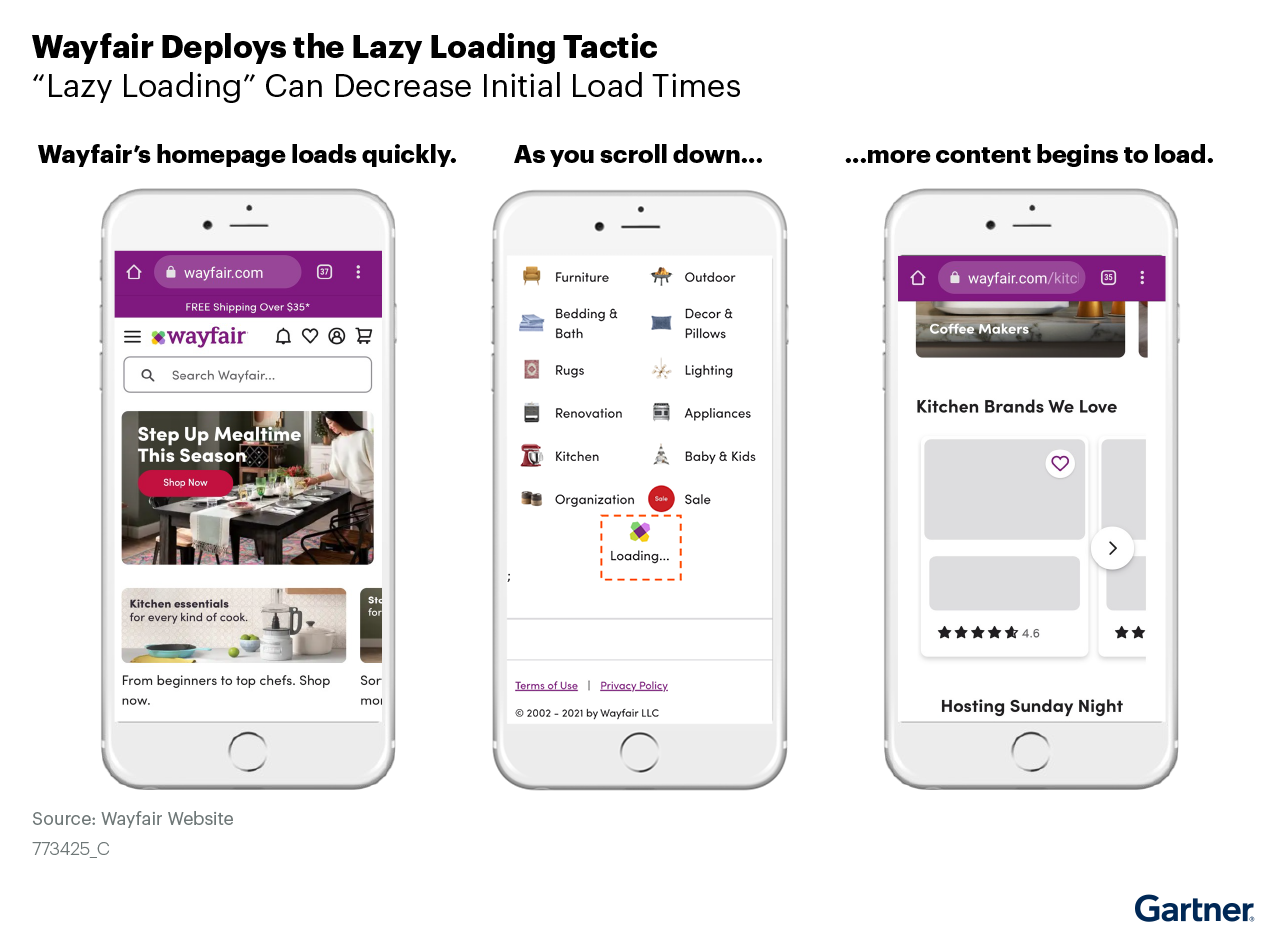
- Use lazy loading. Work with technology partners to use techniques like lazy loading, such that site resources only load (and consume bandwidth) when actually needed (see Figure 4).
- Embed videos. Videos hosted on content delivery networks (CDNs) create a faster, more consistent experience for all customers, regardless of geographic location.
- Develop a site performance plan. Create a formal plan with internal technology partners or external providers to ensure site speed is a priority. The plan should consist of agreed upon performance measures, tools to monitor performance, testing cadence, key stakeholders involved in different layers of the technology stack and mechanisms used to implement improvements.
- Minimize third-party trackers and plug-ins. These tools help with analytics and retargeting, but they often result in a negative effect on site speed.
Resources
Assess the following webpage speed analytics tools, vendors and resources with detailed diagnostics and recommendations:
- Catchpoint (free, tiered subscription offerings)
- Dareboost (free)
- Ghostery Chrome Browser Plug-In for website trackers (free with account, tiered subscription offerings)
- Google PageSpeed Insights (free)
- Google Web.dev (free) or Google Lighthouse Chrome Plug-In (free)
- GTmetrix (free, tiered subscription offerings)
- WebPageTest (free)
Design for Mobile
Because Google primarily uses the mobile version of a website’s content for ranking and indexing, brands must ensure they have a fully mobile-optimized website.
What Should Brands Do?
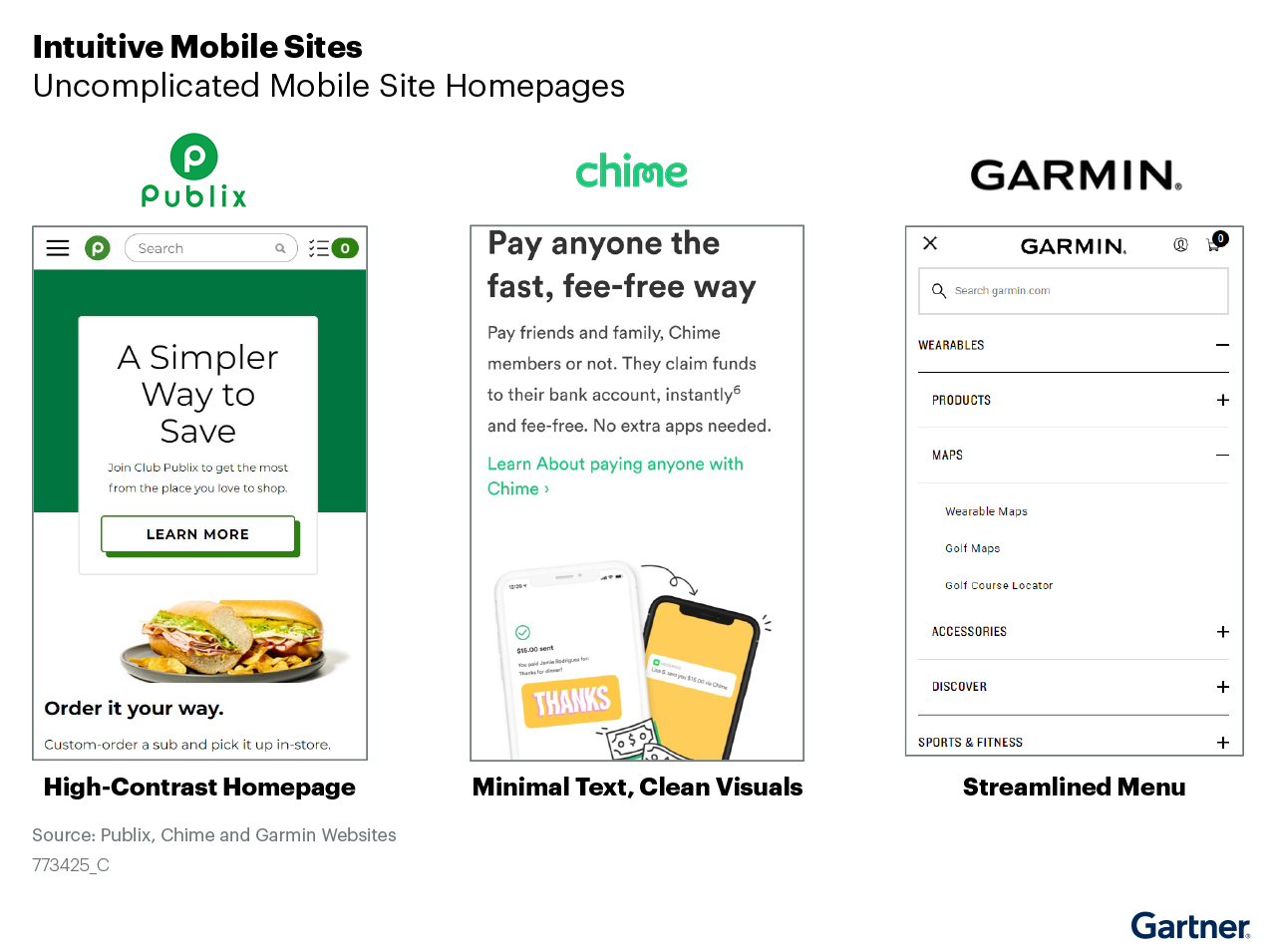
- Focus on simple, user-friendly site design. Consolidate stand-alone mobile and desktop websites with different URLs into a single website using responsive design. This strategy will affect everything from mobile core vitals to search engine indexing (see Figure 5).
- Think mobile-first, but build with responsive design. Maintain well-organized site layout and content that is clear by using subheadings, bullet points, text and numbers for ease of viewership to help improve the mobile experience. Mobile does not require full feature parity with the desktop experience, so decide what features are less critical to mobile journeys and deemphasize or remove them altogether.
- Evaluate site speed across devices. Site speed opportunities are often unique by device, so test across desktop and mobile web browsers.
Resources
Assess the following tools to verify mobile site responsiveness and find suggestions to fix lingering issues:
- Google Mobile-Friendly Test (free)
Off-Page SEO Tactics
Off-Page SEO refers to actions taken outside of your website to affect your rankings, primarily through backlink building, brand mentions, social media engagement, influencer outreach and guest blogging. These tactics build site authority and trustworthiness in the eyes of search engines.
Improve Trust Through Link Building
Link building is a key factor to improve rankings on the SERP because it solidifies a trustworthy standing with the algorithm. The quantity, type of link and quality of backlinks — different domains that refer back to your website — influence your website’s dependability with the search algorithm. The more domains that link back to your website (quantity) and the higher their web authority score (quality), the more trustworthy your site is considered. Linking to other relevant pages on the same topic also positions content as a valuable resource for organic search.
Various approaches to gaining, earning or requesting quality backlinks include:
- Organic — A website links to your site without your help.
- Outreach — Refer a website to a relevant piece of content created, and, if valuable, ask for link reciprocation.
- Blog — Author guest blogs posts or co-promoted content on third-party sites, and, in return, asks for allowance to link back to your site.
- Manual — Add links to a profile (LinkedIn, Instagram) or to comments on social posts or blogs.
As Google continues to emphasize the value of high-quality backlinks to verify a site’s credibility, brands must invest in appropriate link-building strategies to gain favor with the algorithm.
What Should Brands Do?
- Identify resource needs. Reach out and evaluate the authority and relevance of prospective website partners, and determine your resource needs (e.g., employees, tools or both).
- Develop a backlink strategy. Write shareable content or guest posts on relevant websites, engage in link exchanges and lean on influencers. These are just a few strategic approaches to enhancing link building on brand sites.
- Prioritize quality over quantity. Ensure relevancy and authoritativeness with linked websites. Less-trustworthy and spam links will negatively affect your organic visibility.
- Monitor existing backlink performance. Determine if additional links are needed or if any links were removed, and take appropriate action.
- Use internal linking. This tactic establishes an information hierarchy and gives search engines a better understanding of site structure.
Resources
Assess the following tools, vendors and resources to evaluate the authority and relevance of backlinks on your or your competitors’ websites:
- Ahrefs (free, tiered subscription offerings)
- LinkMiner (subscription)
- Moz (free)
- Semrush (subscription)
- Ubersuggest (free, tiered subscription offerings)
Local SEO Tactics
Local SEO aims to improve visibility for location-based searches (e.g., “coffee shop near me”). It includes optimizing Google Business Profiles, managing local citations and reviews, and ensuring consistency of name, address and phone (NAP) data across the web.
Enhance Localized SEO
Forty-six percent of all Google searches are looking for local information, and 72% of consumers who did a local search visited a store within five miles.6,7 Targeting consumers in specified areas (regions, states, cities, neighborhoods) is an integral part of any brick-and-mortar SEO strategy. Optimizing a brand site for local search results through local content, on-page optimization and even link building allows consumers to quickly find local business information, getting them that much closer to conversion. In a highly competitive landscape, brick-and-mortar businesses must ensure that all local pieces of information are accurate and work in concert to gain critical local visibility.
What Should Brands Do?
- Maintain accurate and up-to-date business listings online. Create, verify and manage your physical locations (storefronts) and hours of operation to assist in local visibility, maps and organic rankings.
- Use listing services to manage bulk locations. For marketers with many locations, using Google Business Profile directly may be cumbersome, justifying the need for bulk listing services, like Yext.
- Follow listing guidelines. Ensure that you’re following Google’s guidelines for representing your business appropriately.
- Create local content. Publish site content that covers local topics and seek backlink opportunities with local businesses to build authority.
- Optimize websites for mobile. Consumers often use mobile devices when searching for local results.
- Collect authentic reviews and engage. Build profiles and authority by engaging customers on ratings and reviews platforms that are local to your business.
- Use localized keywords in keyword strategy. Incorporate keywords relevant to your geographic location, such as “financial advisors in New York.” Review your organic visibility and rank on queries that include common natural language phrases, such as “near me.”
Resources
Assess the following tools, vendors and resources to improve your local presence, monitor performance and gain competitive insight:
- Google Business Profile (free)
- Semrush Listing Management (subscription)
- Synup (subscription)
1 The Role Of E-E-A-T In AI Narratives: Building Brand Authority for Search Success, Search Engine Journal.
3 Discovery to Decisions: Marketing in the AI Era, Think With Google.
4 Introduction to Structured Data Markup in Google Search, Google Search Central.
6 12 Local SEO Stats Every Business Owner and Marketer Should Know in 2019 [Infographic], Social Media Today.
7 State of Marketing Report (2022), HubSpot.
Additional Sources
2025 Gartner CMO Spend Survey. This survey explored top-line marketing budgets with the goal of understanding how changing customer journeys, pressures from the C-suite and cost challenges affect marketing’s spending priorities and channel effectiveness. Conducted online from January through March 2025, the research included 402 respondents from North America (n = 202), the United Kingdom (n = 97) and Europe (n = 103; including France, Germany, Belgium, Denmark, Finland, Netherlands, Norway and Sweden). Participants were required to be involved in decisions related to setting or influencing marketing strategies/planning, aligning marketing budgets/resources, or leading cross-functional programs and strategies with marketing. Seventy-seven percent of the respondents represented organizations with annual revenue of $1 billion or more. The respondents came from a diverse range of industries: manufacturing (n = 52), financial services (n = 50), insurance (n = 43), consumer products (n = 43), healthcare (n = 42), travel and hospitality (n = 37), IT and business services (n = 36), retail (n = 36), pharma (n = 32), and media (n = 31). Disclaimer: Results of this survey do not represent global findings or the market as a whole, but reflect the sentiments of the respondents and companies surveyed. Disclaimer: Results of this survey do not represent global findings or the market as a whole, but reflect the sentiments of the respondents and companies surveyed.
Gartner analysis of Google search data (n = 5,996 keywords, June 2025). This research uses data from Google search engine result pages (SERPs) collected from the New York City area by a proprietary Gartner-developed crawler. The keywords selected align to the retail, healthcare, consumer goods, financial services, manufacturing and natural resources, and travel and hospitality sectors, accounting for more than four billion queries a month. These results should be taken directionally because they do not wholly reflect the targeting parameters that are available to search marketers.
Note 1: Tools
The tools and vendors listed in this research do not imply an exhaustive list. This research is intended to provide more understanding of the market and its offerings.