Case Study: Multiple AI Agents System for Maximizing Revenue Renewals
27 October 2025 - ID G00842123 - 8 min read
By Kameron Chao, Sumit Agarwal
Cisco’s customer experience (CX) organization deployed AI agents internally to reduce administrative friction for renewal specialists, providing qualified, contextualized insights and improving effectiveness in its revenue renewals and retention numbers.

Company Name: Cisco
Industry: Global Technology/Networking
Headquarters location: San Jose, CA, United States
Revenue: $56.7B in FY2025
Employees: 90,000+ in 2024
Case Overview
Problem
- Cisco’s CX organization has the renewals team in charge of Cisco’s renewals motion associated with recurring revenue/ARR across the entire company, encompassing products, services and software renewals. Effectively tracking, optimizing, and ensuring timely renewals presents significant operational and strategic challenges, including revenue leakage, customer retention, and process efficiency.
- The goal was to maximize renewals and optimize the renewal approach. Renewal specialists (a population of over 1,000) spent up to 40% of an eight-hour workday on administrative tasks.
- Administrative work primarily involved gathering and rationalizing data from various in-house tools to create optimized renewal strategies.
Actions
- Cisco implemented an agentic AI solution, initially focusing on renewals, to reduce daily friction and administrative tasks.
- An existing predictive machine learning (ML) renewal risk model was enhanced and augmented with explanations and reasoning derived from generative AI (GenAI).
- The solution was decomposed into multiple specialized agents (renewals, sentiment analysis, and adoption), coordinated by a later-implemented supervisor agent, to provide targeted, contextualized data with insights and recommendations to specialists.
Results
- Leveraging the renewals AI agent focused on product ARR, renewal specialists experienced a reduction in administrative workload averaging between 1.6 and 4 hours per week, depending on the specific task.
- The increased efficiency and enhanced visibility of renewal risks and customer sentiment contributed to Cisco’s overall ARR of $31 billion+ in FY25.
Prioritizing High-Impact AI Use Cases for Customer Experience (CX)
To ensure scalable deployment and control rising costs, Cisco’s CX leadership (including the chief customer experience officer) established strict criteria for prioritizing AI use cases.
The renewal optimization project was chosen because it met the critical criteria for maximizing the value of customers’ investments in Cisco technology and solutions. Cisco, a company with over $56 billion in annual revenue (over half of that is recurring, translating to over $31 billion ARR in FY25), has all its renewal motions managed by the CX organization.
Since the customer had already invested money, the AI use case for renewals aimed to prevent potential churn (including scenarios where a renewal opportunity could otherwise go “untouched”) and to increase the propensity of the renewal, thereby maximizing the value a customer would get from the initial investment. This use case was highly descriptive, had a clear problem statement, and had a direct, short-term, high-impact outcome correlated with the company’s financial results.
The core objective was to reduce friction and cognitive load by eliminating some administrative tasks, which could account for 20% to 40% of a specialist’s workday, freeing up time for the more than 1,000 renewal specialists to interact more effectively with customers for improved retention and better experience.
Evolving Agent Architecture for Contextualized Insights
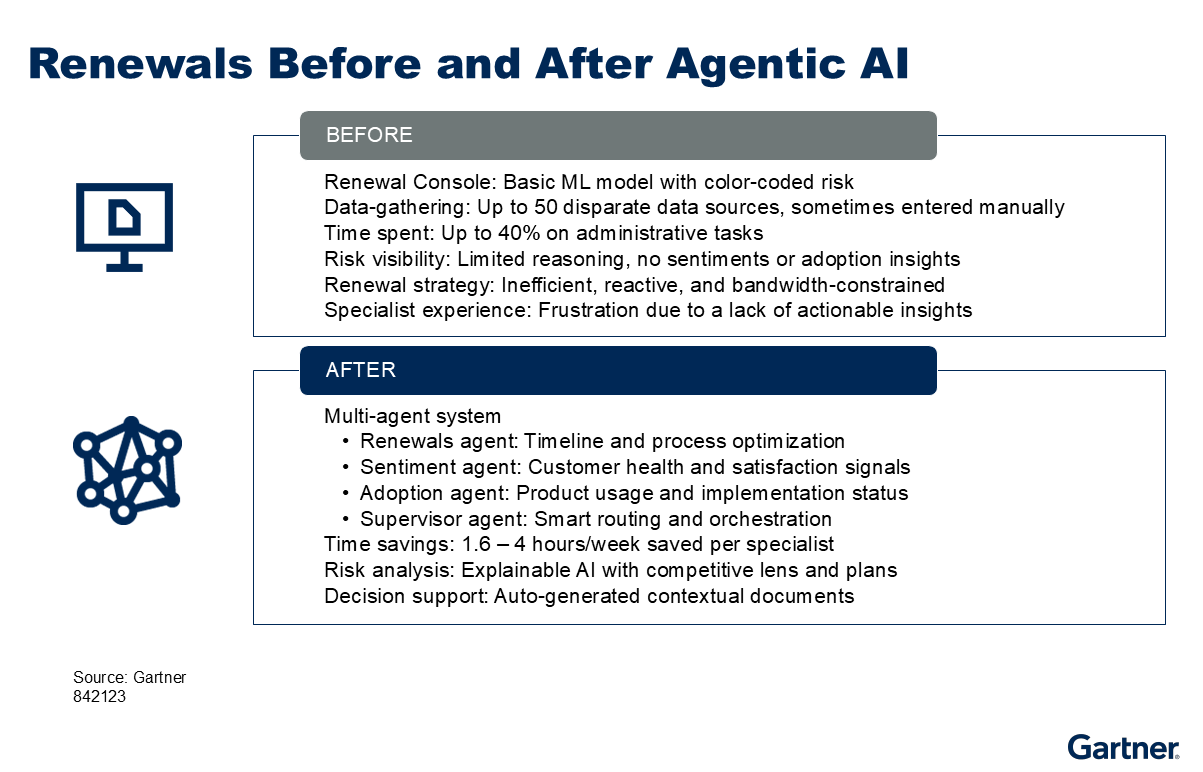
Prior to the new solution, the renewal process relied on an operational tool called the Renewal Console, which tracked renewal risk primarily as a color (green, yellow, or red) based on an existing, pre-developed ML predictive model.
Cisco enhanced this system by augmenting the renewal risk model with GenAI to provide explanation, summarization, and reasoning. The predictive ML model was improved by adding new features, such as the competitive lens, which increased the reliability of the risk prediction.
The system now provides comprehensive insights, including:
- Renewal risk analysis: Explaining the risk level and the signals triggering it.
- Customer health/sentiment: Assessing whether the customer is satisfied or if they have negative sentiment due to factors like misconfigurations or product defects.
- Adoption status: Determining if the customer bought licenses but never implemented or used them, signaling a high risk of non-renewal (like a gym membership).
The architecture was intentionally decomposed into a multi-agent system to handle these interconnected factors:
- Renewals agent: Focused primarily on process, workflows, and timeline related to renewals.
- Customer sentiment analysis agent: Focused on people feedback and related experience signals, acting as an input to the renewals process.
- Adoption agent: More focused on product adoption and functionalities implementation, and associated usage.
- Supervisor agent: Introduced later in development to decompose questions and intelligently route between the various specialized agents.
Crucially, when a high-risk situation is identified by AI, the system automatically generates a mitigation plan (including the renewal risk determinants and derisk details) for the specialist. The system can also generate a personalized value proposition document, typically leveraged by the specialist to augment the renewal engagement with customers. These documents include all relevant context, such as positive or negative customer sentiment, product status (including peer benchmarking-based value and/or relevant issues), competitor comparisons, and external information like the customer’s recent financial earnings (downloaded from the customer’s website). This functionality was essential because renewal specialists are often financially or operationally focused and do not always have the technical depth to discuss specialized product functionality or detailed competitor comparisons (see Figure 1).
Implementation Approach: On-Premises Technology Stack
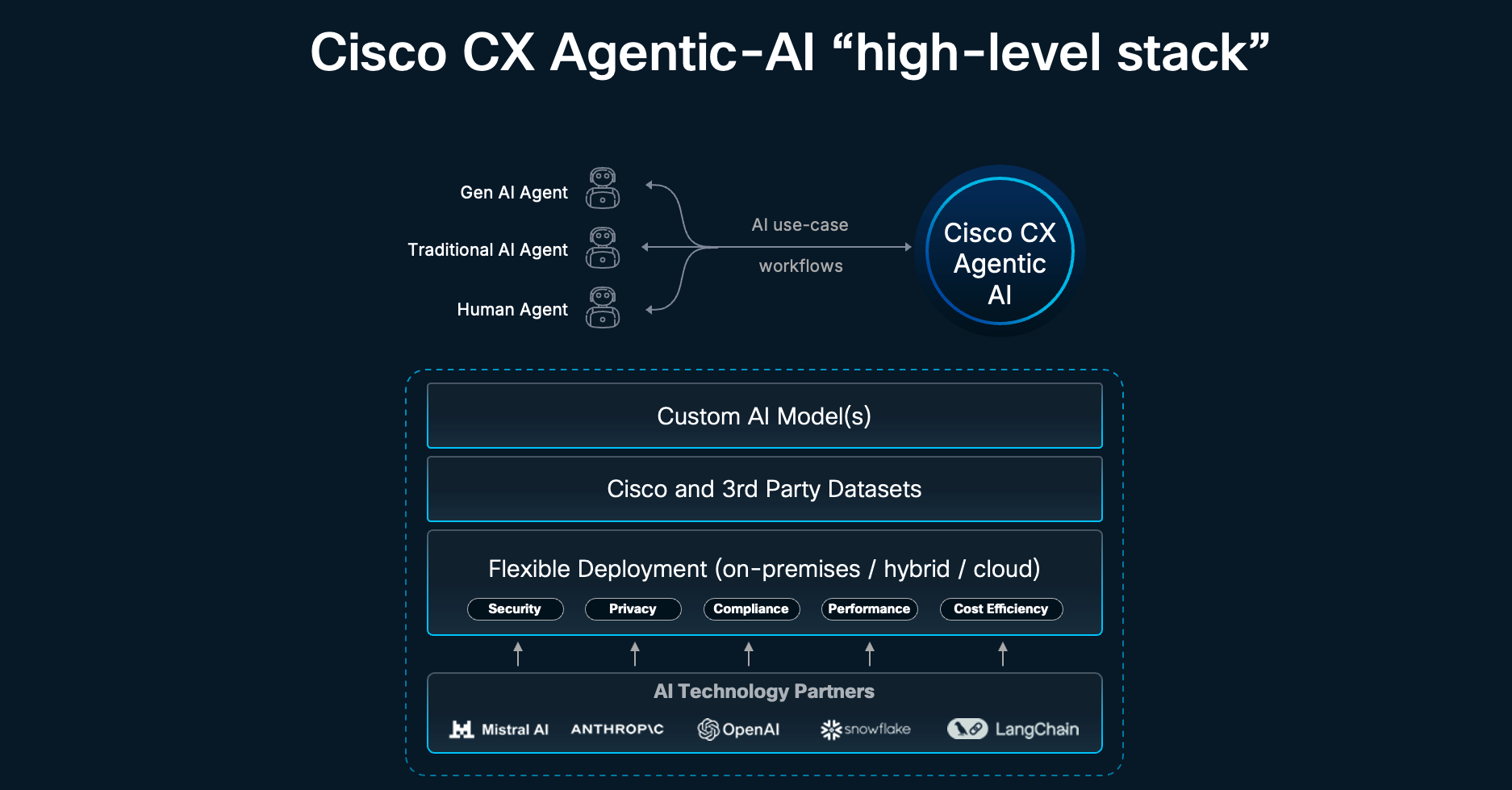
Cisco made an early decision to run the Renewals + Adoption AI system on-premises rather than in the public cloud. This was driven by the high sensitivity of the data, which included customer investment details, installed base information, and confidential sentiment data. As seen in Figure 2, the stack is designed to integrate data from Cisco and third-party sources. It leverages both generative and traditional AI models, alongside human expertise, to automate and support diverse CX workflows. The on-premises environment also necessitated strategic AI technology partnerships, including:
- Snowflake: Cisco’s core CRM data, encompassing contracts and purchasing history, resides in Snowflake. Initial attempts using a large language model (LLM) to directly touch the SQL database failed to achieve the internally required benchmark of 95% accuracy. Cisco’s CX team developed a text-to-SQL solution while leveraging Snowflake’s Cortex semantic model open-source YAML specification to help define how structured data would be approached. Recently, Cisco CX also worked with Snowflake as a co-innovation partner to help with Snowflake’s own upcoming Cortex AI agent solution.
- Mistral: Since major cloud LLMs (e.g., OpenAI, Anthropic, Gemini) were not available for on-premises deployment, Cisco selected Mistral. Cisco CX co-innovated with the Mistral team, helping them enhance their on-premises inference server solution while addressing initial limitations (see Figure 2).
- LangChain: Cisco also partnered with LangChain for orchestration due to its open-source platform, enterprise capabilities, and the Langsmith product for tracing. Tracing was critical to helping understand end-user usage and adoption behavior, and because the renewals AI agent would — depending on the task — need to join up to 55 different datasets to generate accurate results, far exceeding the five to 10 anticipated initially.
Change Management and Development Methodology
Cisco CX recognized that traditional software development practices (DevOps) were not sufficient for AI development. The existing development team lacked the specific domain knowledge of the renewals business. Instead of traditional development, a cohort of renewal specialists (as end users) was integrated into the development cycle from the beginning. This cohort helped define the top questions that business people in renewals would ask, together with the most helpful approach to the answers, which was considered an important learning.
This user input led to the initial implementation of a guided user experience through a menu interface with previously prioritized questions, rather than an open prompt interface (like Google search). This approach helped increase accuracy by constraining the parameters for the questions, which aided the underlying SQL database functions. Based on the user feedback and joint lessons from this initial approach, upcoming releases will provide the optionality of both open prompt and guided interface.
The change management approach focused purely on task augmentation, meaning the AI system helps the human specialist rather than replacing the job, mitigating the belief that the system would “replace” specialists and remove their jobs. However, management triggers were still sometimes needed to encourage adoption and use, as some experienced specialists initially reverted to their “old way of doing things.”
Measuring Impact and Lessons
Cisco measured results across adoption, user feedback, business impact, and lessons learned.
- Adoption and usage: Metrics tracked included logins, recurring use, and what questions were most frequently asked versus what the cohort predicted would be asked.
- Feedback loop: A thumbs-up/thumbs-down feature was implemented, requiring users to categorize and explain their negative feedback (e.g., “not accurate,” “not relevant,” etc.). This immediate feedback loop is critical for calibrating and tuning the models, and it is unique compared to traditional software.
- Indirect metric: The AI system revealed that teams that were more diligent in providing unstructured notes on customer adoption (richer context) received better explanations and reasoning from the AI. This led to a subsequent focus on improving the motivation for people to deal with unstructured data inputs.
- Business impact: The following outcomes were seen among the renewals specialists with high usage of the renewals AI agent and the renewals teams/managers who drove high adoption of AI assistance in their renewals workflows:
- High-level business and strategic impact
- Through proactive strategies, specialists experienced ~50% faster, data-driven decision making and ~40% greater team credibility.
- Customer outcomes improved by ~40%, with teams better able to anticipate needs and deliver tailored solutions.
- Operational and time savings
- Reduced administrative tasks saved specialists 1.6 to 4 hours per week, enabling deeper customer engagement and handling more renewals.
- Manual research and data-gathering were minimized, resulting in a ~30% boost in efficiency.
- The AI agent solution eliminated up to 40% of administrative friction from specialists’ workdays.
- Impact on renewals specialists and managers
- Renewals specialists saw ~30% better access to adoption metrics compared to manual CRM evaluation.
- Renewals managers gained over 90% improvement in obtaining customer sentiment for Enterprise Agreement (EA) engagements.
- Managers also achieved ~50% faster access to consumption data, aiding in expansion and cross-positioning opportunities.
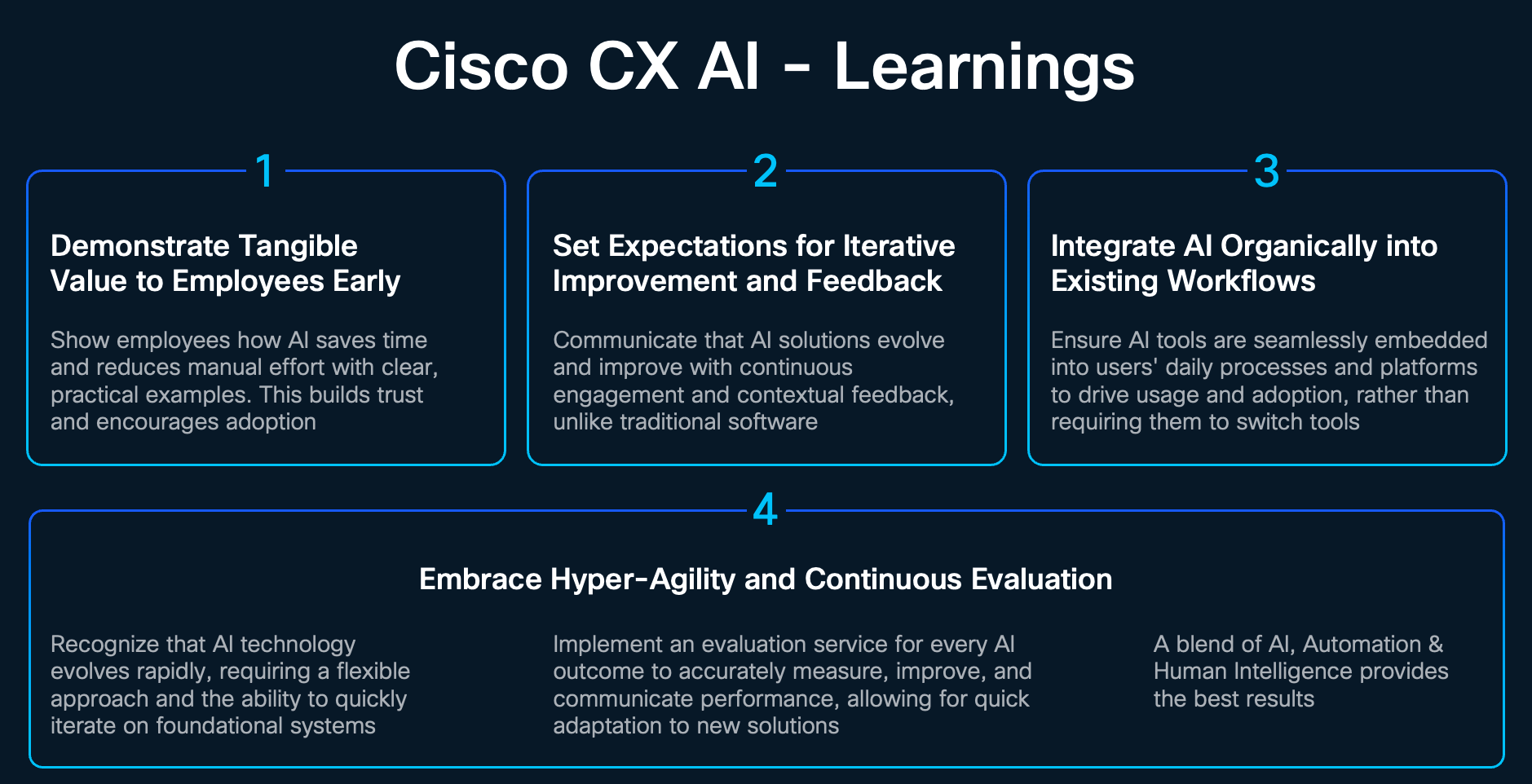
- Lessons: Effective adoption of agentic AI in customer experience requires (see Figure 3) demonstrating tangible value early, integrating AI seamlessly into existing workflows, embracing iterative improvement through continuous feedback, and maintaining flexibility to adapt to rapid technological evolution.
This case study is based on interviews with Carlos Pereira, Cisco Fellow and Chief Architect, responsible for developing the agentic AI solution. The content is derived from conversations on the implementation, technology partners, and process evolution for Cisco Customer Experience (CX).