Critical Capabilities for Digital Experience Services
30 October 2025 - ID G00827851 - 49 min read
By Alan Stanley, Tom Sieber, and 2 more
Sourcing, procurement, and vendor management leaders can use this research with the accompanying Magic Quadrant to review the capabilities of DX services providers based on specific use cases: experience design, experience solution implementation and operations, content and creative services, and marketing services.
Overview
Key Findings
- The digital experience (DX) services market has been converging over the last five years. The market comprises traditional marketing agencies, pure-play system integrators, and a few companies that have developed converged capabilities. Aggregate revenue and growth rate of the providers in this research are estimated at over $80 billion as of December 2024, growing at 6% over the last year.
- The providers’ classification of DX services varies significantly. Some providers have dedicated DX services’ business lines or go-to-market propositions, while others derive the various capabilities from multiple business divisions within their organization that range from consulting to business process services. This distorts the client’s ability to validate their claims on capacity and capability.
- Generative AI (GenAI) continues to change the way marketing, creative, and content technologies and services are delivered. Providers studied in this research have invested significantly in infusing GenAI capabilities into their proprietary tools, and many service providers have demonstrated a range of efficiency improvements in their offerings.
- Composability is now a defining aspect across commerce tech, marketing technology (martech), advertising technology (adtech) and digital experience technologies like customer data platform (CDP), content management system (CMS) and digital experience platform (DXP). Successful technology platform implementations require not only deep expertise in core platforms, but also an ability to bring together the ecosystem of market-leading independent software vendors whose products solve niche problems.
Recommendations
Sourcing, procurement, and vendor management (SPVM) leaders evaluating DX services providers should:
- Inform chief marketing officers (CMOs), chief revenue officers (CROs), CTOs, and CIOs about the evolving DX partners landscape. Bring to their attention the convergence of agency and system integration capabilities, and reiterate the need to balance technology implementation and services priorities at the partner evaluation stage.
- Mandate providers to demonstrate as much competence in marketing operations, content, and creative services as technology platform implementation when evaluating DX services. Additionally, prioritize providers that can bring an outside-in perspective and cross-industry expertise to marketing strategies, content, and creative services.
- Assess service providers on three aspects: their ability to unlock value in GenAI features of core platforms; their investment in and leveraging of GenAI tools to enhance content production; and their efficiency improvements shown through customer references.
- Evaluate service providers’ ability to orchestrate the ecosystem. Do so by assessing their thought leadership, investment, and maturity in using accelerators like prebuilt connectors, marketing and content operations optimization tools, and customer insight and analytics tools, so you can leverage the full potential of composability.
What You Need to Know
This Critical Capabilities research on DX services assesses the relative capabilities of 17 providers in each use case to successfully provide experience transformation advisory services; design, implement and operate technology solutions; and deliver associated marketing, content, and creative services to ensure business value. Sourcing, procurement, and vendor management (SPVM) leaders should use this research in tandem with the companion Magic Quadrant for Digital Experience Services to identify the relevant service providers appropriate for their specific scope/use case, domain, and technical requirements.
All service providers have been scored against 11 critical capabilities that Gartner considers essential for sourcing executives to assess when choosing service providers for the specific use cases, depending on the focus of the engagement and delivery. Although the capabilities are the same across the five use cases, their weightings vary, resulting in assessing the 17 providers for their capability in that particular use case.
The 11 capabilities listed below, along with the reasons for their inclusion, are described in detail in the Critical Capabilities Definition section of this research:
- DX transformation consulting
- Customer insight analytics
- Technical platform implementation expertise
- AI and GenAI capabilities
- Ecosystem orchestration
- Industry expertise
- Functional expertise (marketing, sales and services)
- Marketing operations
- Content creation and management
- Experience evolution
- Business outcome commitment
The capability scores are used to position the service providers for the following five use cases:
- Experience design
- Experience solution implementation (across leading DX platforms; see Note 1)
- Experience solution operations
- Content and creative services
- Marketing services
Size definitions within this research are based on the number of aggregated resources used in that category.
Market Practice Sizing:
- Small: 1,000 or fewer
- Medium: 1,001 to 10,000
- Large: 10,001 to 30,000
- Very large: 30,001 to 60,000
- Extra large: More than 60,000
Organization Sizing:
- Small: 1,000 or fewer
- Medium: 1,001 to 10,000
- Large: 10,001 to 100,000
- Very large: 100,001 to 500,000
- Extra large: more than 500,000
The profiles below highlight the capabilities and performance of each vendor for the five use cases. Leverage these use-case scenarios and capability criteria in conjunction with the Magic Quadrant to speed up the identification and narrow the selection of candidate providers to meet your DX service requirements.
Analysis
Critical Capabilities Use-Case Graphics
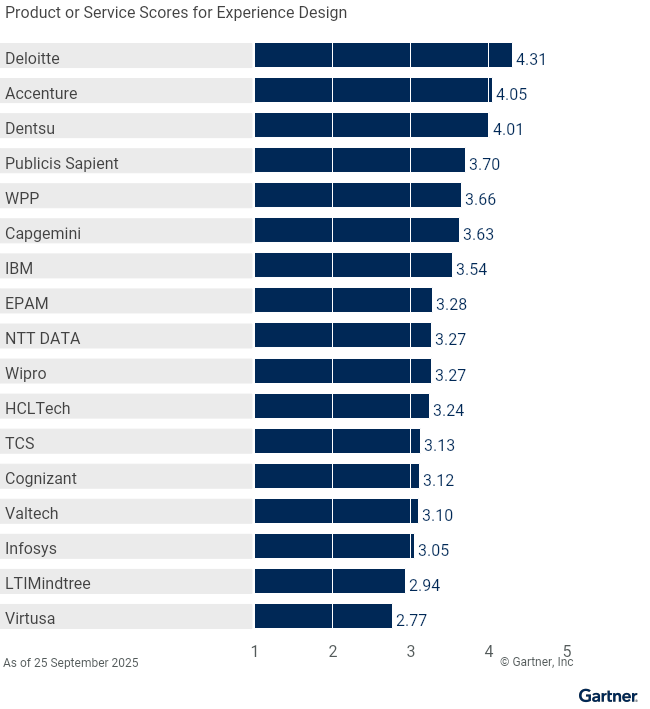
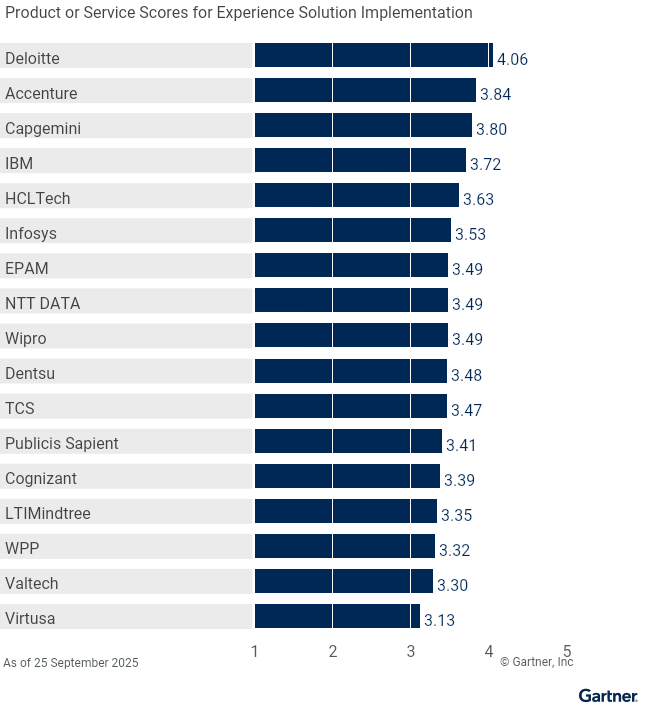
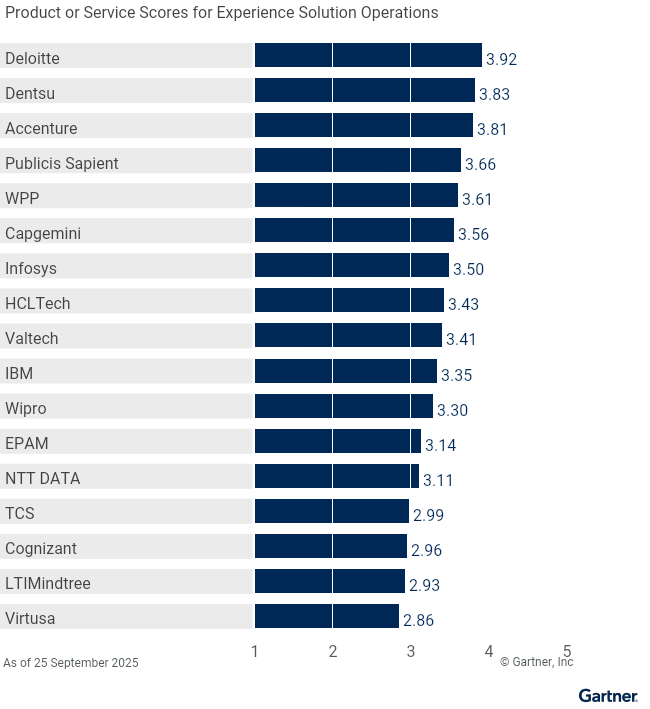
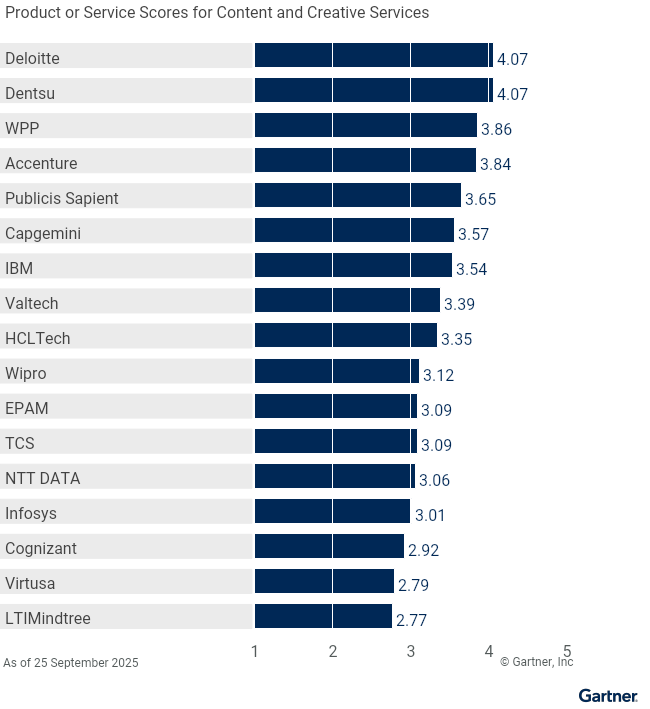
Vendors
Accenture
Accenture serves organizations seeking full-service providers, acting not only as a technology transformation partner but also as a design and creative partner. Through Accenture Song, it delivers experience design, solution implementation, managed operations, content, and marketing services.
Accenture has over 120,000 DX service resources, constituting 15% of its total employees. Its operational model is supported by a global delivery network, with teams strategically located to address client needs across regions, including 27% of its DX FTEs in North America, 14% in Latin America, 39% in EMEA (Western Europe, Eastern Europe, and MEA combined), and 20% in Asia/Pacific.
Accenture has FTEs covering all seven major technical platforms, but only provided the certification numbers for Adobe (1,532) and Salesforce (1,154). Accenture’s approach to experience design leverages its integrated Reinvention Services and massive global scale..
A notable use case for Accenture is experience design. This reflects Accenture’s ability to fuse creativity, technology, and deep human behavior insights to deliver life-centric, innovative digital products and experiences from vision to blueprint, driving client growth.
A distinguishing aspect of Accenture’s capabilities is DX transformation consulting. This reflects its integrated Reinvention Services, combining strategy, consulting, and technology to guide clients through complex transformations, embed AI deeply, and deliver measurable business outcomes.
An opportunity for improvement across Accenture’s critical capabilities is in content creation and management. While strong in general across all the critical capabilities, Accenture is relatively less mature than the digital agencies as a content management provider.
Capgemini
Capgemini serves organizations seeking a global, end-to-end business and technology transformation partner to enhance operational efficiency and deliver personalized customer and citizen experiences. It delivers advisory, design, implementation, and operational services, including content and marketing services, often leveraging its frog creative consultancy.
Capgemini has over 30,750 DX service resources, constituting 9% of its total employees. Its operational model is supported by a global delivery network, with teams strategically located to address client needs across regions: 8% of its DX FTEs are in North America, 4% are in Latin America, 40% are in EMEA (Western Europe, Eastern Europe, and MEA combined), and 48% are in Asia/Pacific.
The numbers of certified resources (FTEs) across Capgemini’s top three platforms are: Salesforce (8,784), Adobe (670), and SAP (381). Capgemini’s approach to operations utilizes an integrated model and its Intelligent Command Center to accelerate time to market, improve digital engagement, and deliver significant operational efficiencies for clients.
A notable use case for Capgemini is experience solution implementation. This reflects Capgemini’s ability to lead global transformations, replacing legacy systems with unified platforms to streamline commercial operations, enhancing customer engagement and process efficiency.
A distinguishing aspect of Capgemini’s capabilities is tech platform implementation expertise. This reflects its 12,000+ professionals dedicated to experience solution implementation, which translates into a significant portion of its digital experience services deals in 2024, including 52% incorporating AI and generative AI capabilities.
An opportunity for improvement across Capgemini’s critical capabilities is in functional expertise. This reflects that, while it has strong technical foundations, its marketing operations services were included in only 7% of its digital experience services deals in 2024, indicating a need to further scale specialized creative and marketing execution.
Cognizant
Cognizant serves organizations seeking to orchestrate intelligent experiences end-to-end and drive digital transformation by leveraging AI and platforms. Through Cognizant Moment, it delivers experience design, solution implementation, managed operations, content, and marketing services.
Cognizant has over 30,000 DX service resources, constituting 10% of its total employees. Its operational model is supported by a global delivery network, with teams strategically located to address client needs across regions, including 35% of its DX FTEs in North America, 20% in EMEA (Western Europe, Eastern Europe, and MEA combined), and 45% in Asia/Pacific.
The numbers of certified resources (FTEs) across Cognizant’s top three platforms are: Salesforce (12,250), Oracle (3,292), and SAP (2,200). Cognizant’s approach to experience design is characterized by its Agency as Software model, AI-accelerated workflows, proprietary tools and extensive design thinking expertise.
A notable use case for Cognizant is experience transformation design. This reflects Cognizant’s service line focusing on experience transformation design and products, supported by over 6,200 design thinking experts and innovation-focused studios.
A distinguishing aspect of Cognizant’s capabilities is AI-driven experience orchestration. This reflects its extensive leveraging of AI and GenAI with proprietary tools such as Campaign+, a GenAI-based accelerator, and its recognition as a top Salesforce Global System Integrator and an Adobe Platinum Solution Partner.
An opportunity for improvement across Cognizant’s capabilities is in business outcome commitment. This reflects that while it is open to alternative commercial models, only 11% of DX services revenue is currently generated from business outcome-based contracts, and the majority of its deals are structured as fixed price (50%).
Deloitte
Deloitte’s global customer-led technology and transformation business offers a full breadth of digital experience services and capabilities across seven customer-centric domains. It delivers services including customer strategy, experience design, solution implementation, AI/data enablement, managed operations, content, and marketing services.
Gartner estimates that Deloitte has approximately 80,000 DX services resources, constituting between 15% and 20% of its total employees. Its operational model is supported by a global delivery network, with teams strategically located to address client needs within local markets and with global digital transformation programs. Most if its DX services resources are in North America, followed by EMEA, APAC and LATAM.
The numbers of certified resources (FTEs) across Deloitte’s top three platforms are: Salesforce (22,380), Adobe (7,750), and SAP (4,390). Deloitte’s approach to experience design uses strategic IP investments such as Converge by Deloitte, a portfolio of AI/data-enabled, industry-centric activations for numerous industries, including life sciences, healthcare, consumer, sports and entertainment, and the public sector.
A notable use case for Deloitte is experience design. This reflects its framework that prioritizes defining strategy, outcomes, key performance indicators (KPIs), and architecture early in the digital transformation journey and its partnership with clients to understand business requirements, such as its work with the world’s largest global sports event organization.
A distinguishing aspect of Deloitte’s capabilities is DX transformation consulting. This reflects its ability to navigate complex business challenges and anticipate evolving sector needs by drawing on deep industry knowledge, combining science and creativity, while offering strong alliances with technology leaders like Salesforce and Google.
An opportunity for ongoing growth across Deloitte’s capabilities is in marketing operations, despite its ranking well in the marketing services category. Deloitte seeks to contintue to enhance its offering by providing even greater differentiation in its marketing services, such as its advanced marketing campaign execution, anchored by tangible business goals that realize key company growth objectives.
Dentsu
Dentsu leverages Merkle as its global consultancy and flagship business for DX services. It operates as a tightly integrated network to amplify growth outcomes for DX solutions and use cases. Through its integrated network, it delivers experience design, solution implementation, managed operations, content, and marketing services.
Dentsu has over 26,000 DX service resources, constituting 39% of its total employees. Its operational model is supported by a global delivery network, with teams strategically located to address client needs across regions: 30% of its DX FTEs are in North America, 4% are in Latin America, 29% are in EMEA (Western Europe, Eastern Europe, and MEA combined), and 37% are in Asia/Pacific.
The numbers of certified resources (FTEs) across Dentus’s top three platforms are: Salesforce (2,738), Adobe (2,139), and Oracle (39). Dentsu’s approach to experience design uses its “TCO-first” methodology to enable insights, reduce operational complexity, increase conversion efficiency, and integrate execution.
A notable use case for Dentsu is experience design. This reflects its dedication of 13% of DX FTEs to design and its notable method of addressing client needs for brand communication, customer engagement, and digital product conceptualization.
A distinguishing aspect of Dentsu’s capabilities is functional expertise. This reflects its extensive experience in the marketing area as a digital agency, its expertise in analytics and data science, with AI and over 3,000 data scientists and analysts, and its Merkury platform, which enables identity resolution, customer file enrichment, and data hygiene.
An opportunity for improvement across Dentsu’s capabilities is in experience evolution. This reflects that while it handles complex modernization efforts, such as global multibrand e-commerce replatforming projects, the comparative emphasis is placed heavily on customer insight and marketing execution rather than deep technical platform implementation and evolution.
EPAM
EPAM serves organizations seeking AI-native, end-to-end digital experience transformation by combining strategy and execution to drive measurable business outcomes. Through its Empathy Lab, an AI-native agency, it delivers experience design, solution implementation, managed operations, content, and marketing services.
EPAM has over 11,000 DX service resources, constituting 18% of its total employees. Its operational model is supported by a global delivery network, with teams strategically located across regions: 7% of its DX FTEs are in North America, 11% are in Latin America, 57% are in EMEA (Western Europe, Eastern Europe, and MEA combined), and 25% are in Asia/Pacific.
The numbers of certified resources (FTEs) across EPAM’s top three platforms are: Salesforce (6,000+), Composable (675+), and Adobe (325+).
A notable use case for EPAM is experience design. This reflects its robust methodology for defining future-state experiences and its research-driven, “outside-in” approach through NXT Trends and centers of excellence, combined with human-centered AI strategy and empathy-led product innovation. This enables it to understand market shifts and customer needs, and offers clients accelerated time to market, improved content quality, and the ability to scale.
A distinguishing aspect of EPAM’s capabilities is robust industry expertise, which spans 28 diverse sectors. This allows it to deliver tailored, scalable digital experiences and complex transformation initiatives for enterprise and midsize clients by integrating specialized capabilities and proprietary accelerators.
An opportunity for improvement across EPAM’ critical capabilities is in business-outcome commitment. This reflects its lower proportion of revenue tied to outcome-based models (5%) and a perceived lack of clarity in articulating how its services consistently deliver and measure direct client business objectives.
HCLTech
HCLTech serves organizations seeking end-to-end digital transformation services and full life cycle support for their DX transformation programs, particularly global enterprises in manufacturing, banking and financial services, and retail and CPG industry verticals. It delivers experience design, solution implementation, managed operations, content, and marketing services.
HCLTech has over 21,000 DX service resources, constituting 10% of its total employees. Its operational model is supported by a global delivery network strategically located across regions: 18% of its DX FTEs are in North America, 5% are in Latin America, 21% are in EMEA (Western Europe, Eastern Europe, and MEA combined), and 56% are in Asia/Pacific.
The numbers of certified resources (FTEs) across HCLTech’s top three platforms are: SAP (1,635), Salesforce (1,551), and Adobe (1,426). HCL’s approach to experience design leverages AI for automated problem analysis, KPI determination, target audience identification, marketing automation and optimization, generative AI for content creation, and scalable transformation.
A notable use case for HCLTech is experience solution implementation. This reflects HCLTech’s ability to accelerate client time-to-market through over 70 platform investments and reusable APIs, which seamlessly integrate with major ecosystems such as Adobe, Microsoft, Salesforce, SAP, and Oracle, and its FENIX 2.0 framework, which guides enterprises through technology roadmaps.
A distinguishing aspect of HCLTech’s capabilities is its tech platform end-to-end services expertise, from consulting to operations. This reflects its extensive platform investments and reusable APIs across major ecosystems, its status as a SAFe Platinum Partner, and its global Digital Consulting organization with over 400 people.
An opportunity for improvement across HCLTech’s capabilities is in digital transformation consulting. This reflects that its “brand and experience transformation advisory capability” is still developing, and its overall proportion of certified FTEs across major DX platforms, at 35%, is notably lower than some competitors.
IBM
IBM serves organizations seeking integrated digital transformation and the delivery of digital experience services with measurable business outcomes. Through IBM Consulting and its experience agency, IBM iX, IBM delivers a full spectrum of digital experience services, from strategy and design to solution implementation and operations.
IBM has an estimated 25,000 DX service resources, constituting 9% of its total employees. Its operational model is supported by a global delivery network, with teams strategically located across regions: 13% of its DX FTEs are in North America, 8% are in Latin America, 16% are in EMEA (Western Europe, Eastern Europe, and MEA combined), and 63% are in Asia/Pacific.
The numbers of certified resources (FTEs) across IBM’s top three platforms are: Salesforce (14,927), SAP (1,818), and Adobe (1,681). IBM’s approach to experience design is characterized by human-centered methodologies like Enterprise Design Thinking and the IBM Garage framework, which leverage AI assets and iOS accelerators for rapid prototyping and co-creation.
A notable use case for IBM is experience solution implementation. This reflects IBM’s dedication of 40% of its DX FTEs to solution implementation, its leveraging of IBM Garage Experience (IGX), a generative AI platform for value-focused transformation, and its IBM Consulting delivery model delivering a claimed 15% productivity gain and 20% operational efficiency improvement on the delivery process.
A distinguishing aspect of IBM’s capabilities is its key partnerships with technology vendors. This reflects its broad network of over 500 strategic partners, including leading platforms such as Adobe, Salesforce, SAP, Oracle, ServiceNow, AWS, and Microsoft, and its embedded watsonx capabilities and Granite models in partner products and platforms.
An opportunity for improvement across IBM’s capabilities is in marketing execution expertise. This reflects the relatively limited breadth of its marketing services, as IBM does not explicitly provide traditional agency functions such as above-the-line advertising, media planning and buying, public relations, or trade marketing.
Infosys
Infosys serves organizations seeking connected, AI-powered, end-to-end digital transformation, integrating strategy, experience design, and technology services. It delivers experience design, solution implementation, managed operations, content, marketing services, and marketing operations with its Infosys Aster marketing suite, WongDoody for creative capabilities, Infosys BPM for marketing operations and its human-centered, design-led transformation methodology.
Infosys has an estimated 60,000 DX service resources, constituting 19% of its total employees. Its operational model is supported by a global delivery network, with teams strategically located across regions: 19% of its DX FTEs are in North America, 70% are in APAC, 14% are in EMEA (Western Europe, Eastern Europe, and MEA combined), and 2% are in LATAM.
The numbers of certified resources (FTEs) across Infosys’ top three platforms are: Salesforce (4,100), Adobe (1,926), and SAP (1,350). Infosys’ approach to marketing is characterized by Infosys Aster, a suite of AI-amplified marketing services, solutions and platforms aimed at CMOs, which embeds AI across the marketing value chain.
A notable use case for Infosys is experience solution implementation. This reflects Infosys’ ability to leverage extensive technology implementation strength, rapidly delivering e-commerce platforms with industry playbooks and agile DevOps methods.
A distinguishing aspect of Infosys’ capabilities is industry experience. This reflects its use of centers of excellence to ensure digital experiences are contextual, drive measurable outcomes and leverage platforms like Finacle for banking.
An opportunity for improvement across Infosys’ critical capabilities is in customer insight analytics. While it leverages AI-based tools for customer behavior insights, clients frequently seek more proactive solution proposals for their business challenges, indicating a desire for more initiative in addressing business problems.
LTIMindtree
LTIMindtree serves organizations seeking an experience-led, AI-first digital transformation partner, particularly midsize clients with a clear vision for digital experience. Through its LTIMindtree Interactive unit, it delivers comprehensive services, including experience design, solution implementation, managed operations, and content and marketing services.
LTIMindtree has almost 30,000 DX service resources, constituting 35% of its total employees. Its operational model is supported by a global delivery network, with teams strategically located across regions: 9% of its DX FTEs are in North America,1% are in Latin America, 17% are in EMEA (Western Europe, Eastern Europe, and MEA combined), and 73% are in Asia/Pacific.
The numbers of certified resources (FTEs) across LTIMindtree’s top three platforms are: Salesforce (2,987), Adobe (196), and Oracle (493). LTIMindtree’s approach to creating digital experience solutions is characterized by an AI-led, experience-first solutions methodology across custom-made and product platforms, leveraging its BlueVerse CraftStudio for AI-led design and creative production.
A notable use case for LTIMindtree is experience solution implementation. This reflects LTIMindtree’s ability to build and deploy digital experience platforms, using a 100% AI-trained workforce (including 15% AI-certified employees) to deliver AI-led, experience-first solutions across various custom-made and product platforms, leveraging its certified consultants in key platforms like Salesforce, Adobe, and Oracle.
A distinguishing aspect of LTIMindtree’s capabilities is technical platform implementation. This reflects its dedication to solution implementation, use of certified professionals to connect on creative strategies with technology, and delivery of complex digital experience solutions.
An opportunity for improvement across LTIMindtree’s critical capabilities is in AI and GenAI related to the digital experiences of personas. Though LTIMindtree is focusing on further strengthening its capabilities in AI and GenAI through investments in platforms such as BlueVerse CraftStudio and product partnerships, its offerings are less mature compared to other providers in leveraging advanced AI for highly personalized and automated digital experiences.
NTT DATA
NTT DATA serves organizations seeking comprehensive, end-to-end digital transformation and modernization services that integrate human-centered design, AI, and ethical practices for scalable and personalized experiences. It delivers experience design, solution implementation, ongoing operations, content creation, and marketing services through its global CX and digital products portfolio, including its design studio network Tangity.
NTT DATA has over 20,000 DX service resources, constituting 10% of its total employees. Its operational model is supported by a global delivery network with teams strategically located across regions: 31% of its DX FTEs are in North America, 20% are in APAC, 44% are in EMEA (Western Europe, Eastern Europe, and MEA combined), and 5% are in LATAM.
The numbers of certified resources (FTEs) across NTT DATA’s top three platforms are: Salesforce (4,804), SAP (1,298), and Adobe (371).
A notable use case for NTT DATA is experience design. This reflects NTT DATA’s human-centered, product-focused, outcome-driven methodology that leverages over 3,000 global design FTEs and more than 15 DX studios to integrate strategy, creativity and technology, anchored in business value creation. It develops data-driven messaging platforms across multiple channels for large public sector entities.
A distinguishing aspect of NTT DATA’s capabilities is technical platform implementation expertise. This reflects that NTT DATA dedicates 47% of its DX workforce (over 7,400 FTEs) to solution implementation, highlighting its technology provider foundation and deployment of integrated solutions with industry-certified experts.
An opportunity for improvement across NTT DATA’s critical capabilities is in content creation and management. While it is advancing its content supply chain vision and integrating AI for content creation, current offerings may not provide the full breadth of advanced content strategy and production capabilities of market leaders.
Publicis Sapient
Publicis Sapient serves organizations seeking integrated digital transformation, specialized creative services, and cutting-edge innovation and design. It primarily targets large multinational organizations, and delivers experience design, solution implementation, managed operations, and content and marketing services.
Publicis Sapient has over 16,000 DX service resources, constituting 95% of its total employees. Its operational model is supported by a global delivery network, with teams estimated across regions as follows: 40% of its DX FTEs are in North America, 15% are in APAC, 40% are in EMEA (Western Europe, Eastern Europe, and MEA combined), and 5% are in LATAM.
Publicis Sapient declined to provide the number of certified resources (FTEs) across its top three platforms. Its approach to experience design is characterized by its integrated SPEED (strategy, product, experience, engineering, and data & AI) capabilities and an experience-led delivery model with AI-native engineering and proprietary tools such as the Slingshot development ecosystem, Figma, and Storybook for high-fidelity prototypes and production code.
A notable use case for Publicis Sapient is marketing operations. This reflects Publicis Sapient’s use of the Publicis Groupe’s “Power of One” model, which integrates digital experience services with leading marketing, media, and creative capabilities and proprietary assets like Publicis ID and GenAI for campaign automation and performance measurement.
An opportunity for improvement across Publicis Sapient’s critical capabilities is in technical platform implementation expertise. This reflects its lower allocation of resources to pure technology platform implementation and ongoing DX service operations compared to other providers, which may indicate a key area for improving technical care balance.
TCS
Tata Consultancy Services (TCS) serves organizations seeking digital transformation and IT modernization. It delivers end-to-end experiences with strategy, systems and stories via Creative Engineering at a global scale, and services including experience design, solution implementation, managed operations, content, and marketing through its TCS Interactive digital agency, design studio, and marketing consultancy.
TCS has 35,000 DX service resources, constituting 6% of its total employees. Its operational model is supported by a global delivery network, with teams strategically located across regions: 28% of its DX FTEs serve clients in North America, 47% are in APAC, 22% are in EMEA (Western Europe, Eastern Europe, and MEA combined), and 3% are in LATAM.
The numbers of certified resources (FTEs) across TCS’s top three platforms are: Salesforce (10,584), Adobe (1,171), and Oracle (1,154). TCS’s approach to experience design is characterized by an experience-first approach that leverages the CX design framework. This framework integrates design, content, technology, data, and human insight, utilizing agile, co-creative methods in innovation hubs like TCS Pace Ports.
A notable use case for TCS is experience solution implementation. This reflects TCS’s extensive technical delivery, supported by 26,000 FTEs for building DX-supporting platforms and its dedicated centers of excellence (COEs) and AI-driven frameworks.
A distinguishing aspect of TCS’s capabilities is tech platform implementation expertise. This reflects the service of its COEs as specialized environments for exploring new features, building prototypes and creating reusable assets for reliable deployments and a strong foundation for digital platforms.
An opportunity for improvement across TCS’s critical capabilities is in business-outcome commitment. TCS’s delivery model, particularly in content services and business consulting, sometimes falls short of meeting expected DX outcomes, which can hinder the effective development of initial customer journeys and consistent stakeholder engagement.
Valtech
Valtech serves organizations seeking integrated digital transformation and innovative, AI-powered experiences. It delivers experience design, solution implementation, managed operations, content, and marketing services through its high personalization and client management protocols.
Valtech has over 5,500 DX services resources, constituting 86% of its total employees. Its operational model is supported by a global delivery network, with teams strategically located across regions: 13% of its DX FTEs are in North America, 18% are in APAC, 52% are in EMEA (Western Europe, Eastern Europe, and MEA combined), and 17% are in LATAM.
The numbers of certified resources (FTEs) across Valtech’s top three platforms are: Adobe (221), Salesforce (200), and Sitecore (159). Valtech’s approach to experience design is characterized by its “Future Frame” process, hyper-personalization and proprietary orchestration of Valtech ONE, along with broad AI and technology experience.
A notable use case for Valtech is experience solution operation. This reflects Valtech’s dedication of a significant proportion of its DX FTEs to solution implementation (58%) and experience solution operations (28%). With expertise spanning major DX platforms, including Salesforce, Sitecore, Adobe, and Optimizely, combined with its ongoing marketing expertise, Valtech provides a balanced support partner.
A distinguishing aspect of Valtech’s capabilities is customer insight analytics. This reflects Valech’s combined technical expertise with a strong focus on marketing engagements, using data not just for insights but also to quantify impact. It is a balanced provider that can bring strong knowledge of personas and marketing skills to deliver well on customer experience.
An opportunity for improvement across Valtech’s capabilities is in DX transformation consulting. This reflects its smaller proportion of staff dedicated to these types of services, as in scale versus capability, which can impact its delivery capacity for these specialized functions.
Virtusa
Virtusa serves large and midsize global enterprises seeking technology-driven digital transformation, AI-native innovation, and expanding agency capabilities. Through its creative tools and digital platforms, it delivers experience design, solution implementation, managed operations, content, and marketing services.
Virtusa has almost 17,500 DX service resources, constituting 73% of its total employees. Its operational model is supported by a global delivery network, with teams strategically located across regions: 20% of its DX FTEs are in North America, 60% are in APAC, 15% are in EMEA (Western Europe, Eastern Europe, and MEA combined), and 5% are in LATAM.
The numbers of certified resources (FTEs) across Virtusa’s key platforms are: Salesforce (321), Adobe (95), and Sitecore (1). Virtusa’s approach to digital experience transformation is characterized by its Helio generative AI engine and strategic “3M” framework (Modernize, Monetize, Maximize), integrating specialized experience design consulting and design thinking and customer experience (CX) strategy.
A notable use case for Virtusa is experience solution implementation. This reflects Virtusa’s client successes, including a strategic transformation for a large European bank, an industry-first Salesforce+Google CCAI solution for a Fortune 5 payer, and its reimagining of Computershare’s Investor Center experience.
A distinguishing aspect of Virtusa’s strongest capabilities is technical platform implementation expertise. This reflects its status as an Adobe Global Platinum Partner and Elite Pega partner, with over 3,500 Pega practitioners and 220 ServiceNow certified FTEs, and its investments in automation platforms such as Accelo, Fusion Migration, and Next Gen LaunchPad.
An opportunity for improvement across Virtusa’s capabilities is in marketing operations and creative services — only 14% of DX services resources are dedicated to marketing and 1% to creative services. Functions such as above-the-line advertising, media planning and buying, and public relations are not explicitly part of its core offerings.
Wipro
Wipro serves organizations seeking consulting-led, AI-powered, and experience-driven digital transformation to address complex challenges. It delivers experience design, solution implementation, managed operations, and content and marketing services, leveraging its creative arm, Designit.
Wipro has over 67,000 DX service resources, constituting 29% of its total employees. Its operational model is supported by a global delivery network, with teams located across regions: 10% of its DX FTEs are in North America, 79% are in APAC, 8% are in EMEA (Western Europe, Eastern Europe, and MEA combined), and 3% are in LATAM.
The top three DX platforms on which Wipro provides services are Salesforce, SAP, and Adobe. Wipro’s approach to digital experience is characterized by its proprietary Mindsets framework, which leverages user research to articulate motivations and behaviors.
A notable use case for Wipro is experience solution implementation. This reflects Wipro’s deep system integration background and significant certified technical staff across multiple digital experience platforms, which enables efficient building and integration of diverse digital experience platforms.
A distinguishing aspect of Wipro’s capabilities is its AI and GenAI capabilities. This reflects its strong leadership in AI and GenAI, backed by significant investments exceeding $1 billion, its proprietary platforms like WeGA Studio 2.0, and its focus on agentic AI, which has driven innovations such as an AI-powered barista and a digital assistant for tourism.
An opportunity for improvement across Wipro’s capabilities is in business-outcome commitment. It could be more consistent in articulating and linking outcome-based models and risk-reward contracts to clear target numbers and specific brand problem solutions across all engagements, especially for diverse client needs.
WPP
WPP, leveraging VML as its business for DX services, serves global enterprises seeking end-to-end integrated solutions spanning creative, media, and commerce services with AI, data and technology at scale to modernize their entire marketing ecosystem.
WPP has over 21,000 DX services resources, constituting 18% of its total employees. Its operational model is supported by a global delivery network, with teams strategically located across regions: 22% of its DX FTEs are in North America, 16% are in Latin America, 30% are in EMEA, and 32% are in Asia/Pacific.
The numbers of certified resources (FTEs) across WPP’s top three platforms are: Adobe (3,200), Salesforce (1,300), and Oracle (800). WPP’s approach is characterized by WPP Open, an AI-powered operating system that acts as a common platform connecting proprietary tools and vast data resources. This delivers accelerated growth through data-driven creativity and increases operational efficiency in marketing for clients.
A notable use case for WPP is content and creative services. This reflects WPP’s fusion of world-class creativity with technology and data strategy to produce content solutions, and its AI-powered Production Studio to deliver personalized content and campaigns at speed and scale.
A distinguishing aspect of WPP’s capabilities is content creation and management expertise. This reflects its ability to manage scaled, personalized content via an integrated content value chain with Adobe and its proprietary AI transcreation platform, Espera, which ensures brand messages resonate across up to 68 languages globally.
An opportunity for improvement across WPP’s capabilities is in technical platform implementation. This reflects its developing scale in technology execution relative to its deep creative agency focus and its low proportion of DX FTEs to solution implementation services, compared to technical providers in this research.
Context
This Critical Capabilities research complements Gartner’s Magic Quadrant for Digital Experience Services and analyzes 11 critical capabilities applied across five use cases:
- Experience design
- Experience solution implementation
- Experience solution operations
- Content and creative services
- Marketing services
This Critical Capabilities research addresses the digital experience services capabilities of vendors that meet Gartner’s criteria for inclusion. The evaluation of providers in this Critical Capabilities research is based on factors determined by Gartner as being relevant to the market for digital experience services. This Critical Capabilities research is a point-in-time analysis, with all the vendor profiles reflecting the status as of August 2025. Quantitative data collected was for a 12-month period ending 31 December 2024.
Additionally, because the inclusion criteria in this research result in the analysis of the largest vendors in the digital experience services market, clients should not disqualify any potential competitors simply because they do not appear in this Critical Capabilities report. Other service vendors not evaluated in this report might present better alternatives for your business requirements. A Gartner analyst can help with a shortlist of the most suitable candidates based on client requirements.
Use this Critical Capabilities report as a tool to help inform your shortlist and evaluation of providers. However, do not discount a provider simply because of its use-case placement.
Market Definition
Gartner defines digital experience (DX) services as those services that design, deliver and optimize digital experiences across customer, employee and citizen journeys using technology solutions. The services involve design, solution implementation, content management services, marketing services and ongoing operations. The digital experience solution is delivered through a combination of technologies and services working together to deliver the desired experience outcomes.
Digital experience services are focused on creating the optimal user experience, to better sell to, market to, inform and manage the target user (customer, partner, citizen or employee). The services include advisory on what the experience should be, implementation services to create the experience, and operational services to evolve and manage the ongoing experience. These services are not just technical services, but also include creative, content and marketing operations, historically served by digital marketing agencies but now offered by a range of providers, including consulting firms, systems integrators (SIs) and agencies.
Buyers of digital experience services will engage with service providers for one or more of the following use cases.
- Experience design: This use case supports the buying organization in defining their brand, product and service experience strategy, marketing strategy, content strategy, customer growth strategy, new product/service launch, technology strategy, and their information and service architectures.
- Experience solution implementation: This use case supports the client organization in implementing, migrating, composing, creating and developing digital experience solutions using a platform or a combination of products.
- Experience solution operation and evolution: This use case includes services that are focused on keeping the already-implemented experience solution current through technical evolution services, ongoing content and creative services, and marketing services.
- Content and creative services: This use case supports the creation and management of digital experiences for the purpose of collaboration, communication, commerce and marketing.
- Marketing services: This use case supports the digital marketing and advertising operations of client products and services.
Mandatory Features
The mandatory features for this market include:
- Digital transformation consulting: The provider’s ability to understand the client’s experience transformation needs and priorities, and to articulate their desired experience and business outcomes. Some of the core capabilities include expertise in: design; brand, product and services strategy; technology roadmap creation; and platform/product selection (if able to be technology-independent).
- Technology platform implementation: The provider’s ability to compose a digital experience solution using best-of-breed platforms and products, and/or build integrations or custom solutions.
- Experience evolution: The provider’s ability to deliver evolution and support services that not only keep the overall digital experience solution (technology and creative and marketing services) current, but also keep pace with changing business demand. In digital experience, the implementation never ends.
- Content creation and management expertise: The provider’s ability to support clients with creation and management of digital content.
- Marketing execution expertise: The provider’s ability to run marketing operations and execute marketing campaigns.
Optional Features
The optional features for this market include:
- Ecosystem orchestration: The service provider’s ability to engage an ecosystem of software/platform vendors and other service providers. This enables the provider to prioritize their clients’ use cases with software and platform vendors, drive co-investments and co-create solutions with other service providers.
- AI & generative AI (GenAI) capabilities: The provider’s ability to embed AI technologies (including GenAI) as part of a digital experience service. For example, digital experience services could involve realizing AI capabilities offered by the platform, building AI-based extensions and customizations, or leveraging GenAI for content generation and campaign automation.
- Business outcome commitment: The service provider’s ability to offer business-outcome-based engagement models. In such models, a percentage of the deal revenue is contingent upon achieving the client’s business objectives.
- Customer insight analytics: The ability of the service provider to adopt a data-driven approach for advisory, design, creative and content, and digital marketing services.
- Industry expertise: The provider’s ability to understand the client’s business issues and operations specific to the client’s industry, and to articulate desired business outcomes. An understanding of the client’s particular industry is important in ensuring that the content and creative services, as well as the marketing services, are contextual and incorporate industry best practices.
- Functional expertise: The ability of the service provider to give advice and guidance related to the marketing, sales and digital commerce functions. It will require deep knowledge of digital experience practices across functional areas in a wide range of industries.
Product/Service Trends
The digital experience (DX) services market is focused on implementing transformational DX solutions across commerce, marketing, and sales functions, and delivering associated content and marketing services.
There continues to be a convergence in the capabilities among the providers. Digital marketing agencies have been acquiring technology implementation services providers to build or augment their creative and content services and marketing services offerings. The technology and service providers have been acquiring creative and digital marketing agencies to develop or expand their capabilities in creative and content marketing services. A full-service provider in this market is one that has scaled capacity and capability across all five use cases described in this research.
The experience design capability is unique and is different from traditional business consulting capabilities or technology advisory services. The capability required to deliver brand and experience transformation includes new skills and tools, like behavioral sciences and ethnographic studies.
Creative and content, and marketing services are essential capabilities for a full-service provider. Creative and content services include creative design, development, and full life cycle management of multimodal content. Marketing services typically range from digital marketing (like SEO and pay per click) to media buying and ad spend optimization and management.
Critical Capabilities Definition
DX Transformation Consulting
This critical capability focuses on the provider’s ability to understand the client’s experience transformation needs and priorities, and to articulate desired experience and business outcomes.
Some of the core capabilities include expertise in:
- Design
- Brand, product, and services strategy
- Technology roadmap creation
- Platform/product selection (if able to be technology-independent)
Measurement criteria for this capability may include:
- Number of consultants/design thinking experts
- Number and location of design studios
- Repository of reusable design assets (frameworks, tools, and human-centered design methodologies)
- Ability to rapidly prototype and generate creative ideas
- Case examples of transformation consulting delivery
Tech Platform Implementation
This critical capability focuses on the service provider’s ability to adopt a data-driven approach to advisory, design, creative and content, and digital marketing services.
Measurement criteria for this capability may include:
- Ability to leverage tools such as user research and profiling, heuristic research and evaluation, and ethnography to drive quantitative insights to design digital experiences
- Ability to use insights from customer data platforms to drive cross-functional (commerce, marketing, sales, customer service and even IT) digital experience programs
- Ability to source and use profile data, online sales data, interaction data, attitudinal data, etc., in the delivery of advisory, design and marketing services
AI & GenAI Capabilities
This critical capability focuses on the provider’s ability to embed AI technologies (including GenAI) as part of a digital experience service.
For example, digital experience services could involve realizing the platform’s AI capabilities, building AI-based extensions/customizations, or leveraging GenAI for content generation and campaign automation, among other things.
Measurement criteria for this capability may include:
- Demonstrated ability to build custom machine learning (ML) models and AI-based solutions to drive better digital experiences for clients
- Number of data scientists and AI engineers
- Client examples of creative and content services delivered using AI/GenAI
- Client examples of marketing services delivered using AI/GenAI
- Ability of the service provider to utilize the AI/GenAI capability offered by leading platform providers, such as Adobe, Oracle, Salesforce and SAP
Ecosystem Orchestration
This critical capability focuses on a service provider’s ability to compose a digital experience solution using best-of-breed platforms/products and/or build integrations or custom solutions.
Measurement criteria for this capability may include:
- Investments in training personnel, building accelerators, and tools
- Track record of successfully designing and implementing organizational change management
- Data management skills (including tools for data migration and management)
- Integration skills (expertise in API design, implementation and management)
- Digital commerce technology expertise: ability to implement digital commerce platforms
- Sales force automation technology expertise: ability to implement sales force automation platforms
- Marketing technology expertise: ability to implement marketing automation platforms (B2B and B2C)
- Cross-platform expertise: the ability of service providers to implement platforms like customer data platforms, customer journey analytics platforms, and digital experience platforms
Industry Expertise
This critical capability focuses on the service provider’s ability to engage an ecosystem of software/platform vendors and other service providers.
It allows clients to prioritize their use cases with software/platform vendors, drive co-investments, and co-create solutions with other service providers.
Measurement criteria for this capability may include:
- Understanding of the ecosystem and a vision of how it is evolving
- Ability to create ecosystems based on the client context
- Partnerships with commerce, marketing, and sales platform providers
- Ability to co-innovate and build solutions with partners
- Capacity to influence the platform/software vendor’s product roadmaps
Functional Expertise
This critical capability focuses on the provider’s ability to understand the client’s business issues and operations specific to the client’s industry and to articulate desired business outcomes.
Understanding the particular industry is important in ensuring that the content and creative services, and marketing services are contextual and incorporate industry best practices.
Measurement criteria for this capability may include:
- An ability to understand business requests effectively and to efficiently and rapidly deliver them using the relevant technology
- Investments in industry-specific functional experts
- Investments in industry and process assets, such as preconfigured processes and industry-specific enhancements
Customer Insight Analytics
This critical capability focuses on the service provider’s ability to give advice and guidance related to the marketing, sales, and digital commerce functions. It will require deep knowledge of digital experience practices across functional areas in a wide range of industries.
Measurement criteria for this capability may include:
- Service provider’s knowledge and expertise to provide guidance for marketing operations, sales function, and online commerce
- Number of functional consultants
- Thought leadership demonstrated through digital-experience-related white papers and publications
- Process maps, functional templates, and functional blueprints
Marketing Execution
This critical capability focuses on the service provider’s ability to run marketing operations.
Measurement criteria for this capability may include:
- Ability to run efficient operations demonstrated through mature operational processes
- The breadth of marketing operations offerings
- Delivered business outcomes evidenced through client examples and case studies
- Leveraging AI/automation tools to drive effective marketing and advertising campaign execution
Content Creation and Management
This critical capability focuses on the service provider’s ability to support clients in creating and managing digital content.
Measurement criteria for this capability may include:
- Ability to deliver creative and content services across the content life cycle (plan, author, publish, and maintain)
- Ability to deliver a variety of services ranging from content strategy, content audits, product information management, and indexing, to content categorization
- Use of GenAI tools in delivering creative and content services
- Multiple language proficiency
- Number and skills of personnel engaged in content creation
Experience Evolution
This critical capability focuses on the service provider’s ability to deliver evolution and support services that keep the overall digital experience solution (technology, creative, and marketing services) current and keep pace with changing business demand.
In digital experience, the implementation never ends.
Measurement criteria for this capability may include:
- Ability to deliver application maintenance and support services for SaaS-based solutions, evidenced by their ability to improve user adoption, deliver extensible support services through fusion teams, and offer innovative commercial models
- Ability to deliver continuous operations optimization
- Thought leadership demonstrated through technology roadmaps, information architectures, and innovative solutions co-created with customers
Business Outcome Commitment
This critical capability focuses on the service provider’s ability to offer business outcome-based engagement models. In such models, a percentage of the deal revenue is contingent upon achieving the client’s business objectives.
Measurement criteria for this capability may include:
- Proportion of deals with business outcomes
- Inherent contractual flexibility, sales execution, and pricing strategies that enable clients to engage in outcome-based models
- Offering a variety of innovative business SLAs
- Case studies of engagements demonstrating business value achievements and accountability
Use Cases
Experience Design
This use case helps businesses define strategies for brand, product/service experience, marketing, content, customer growth, launches, technology and information architecture.
Examples of experience design services include readiness assessments, diagnostics, technology roadmapping, platform/solution selection, user research, persona design, rapid prototyping, UI/UX design, compliance, and regulatory audits.
These services would leverage concepts and approaches like design thinking, ethnography, heuristic research and evaluation, mood map design, sitemap design, and visual experience design.
Experience Solution Implementation
This use case supports organizations in implementing, migrating, composing, and developing digital experience solutions using a platform or a combination of platforms.
Examples of experience solution implementation services include:
- Composing a scalable, fully featured, flexible commerce cloud platform with independent software vendor (ISV) solutions
- Implementing products/platforms for web content management, digital asset management, and media delivery
- Developing custom applications related to a digital experience program
This use case includes technical services, change management services (internal and external), and specific expertise involved in implementing digital experience, digital collaboration, digital commerce, martech, and sales force automation platforms.
Experience Solution Operations
This use case includes services that keep the implemented experience solution current through technical evolution, content and creative, and marketing services.
Examples for technical services include providing break/fix services, release management, extensions and customization. These services may be supplemented by content and creative services required in the maintenance phase of the digital content life cycle and marketing/ad operations services.
Content and Creative Services
This use case supports the creation and management of digital content for collaboration, communication, commerce, and marketing.
Examples of creative and content services include UI/UX design, content audit services, content strategy, and content planning and operations. The digital content life cycle includes designing and authoring multimedia assets (images, videos, text, and audio), asset and rights management, document and records management, indexing and categorization, and content analytics.
These services are not technical implementation services but specialized services with specific toolsets. The skills, personnel, and processes required to run the operations are different from those required for IT services.
Marketing Services
This use case supports digital marketing and advertising (ad) operations of client products and services.
Examples include digital marketing strategy, campaign design and activation, content, email, social and mobile marketing services, marketing analytics, SEO services, paid marketing, and ad operations.
These services were historically delivered by full-service digital marketing agencies. Over the years, IT services providers have acquired digital marketing agencies and are now able to offer marketing operations services.
Vendors Added and Dropped
Added
Valtech and Virtusa were added to this iteration of the Critical Capabilities and Magic Quadrant reports.
Dropped
No vendors were dropped from this iteration of the Critical Capabilities and Magic Quadrant reports.
Inclusion and Exclusion Criteria
The criteria for inclusion of service providers in this Critical Capabilities are based on a combination of quantitative and qualitative measures.
Quantitative Criteria
Digital experience service providers included in this document must satisfy all four of the following criteria:
- A minimum revenue of $750 million (in U.S. dollars) for calendar year 2024 must be from DX services consulting, implementation, and ongoing support, as defined in the Market Definition of this Critical Capabilities.
- This includes DX strategy consulting, solution design, DX implementation, and ongoing services and support for the DX ecosystem and managed services (marketing, design and content, and sales/lead generation).
- This specifically excludes revenue from software, DX software maintenance/support and contact center infrastructure integration.
- At least 15% of the provider’s total revenue must have been realized through DX services during the measurement period or the provider’s fiscal year in review.
- No more than 75% of its DX services revenue can be generated from within a single region.
- Providers must have clients headquartered within at least three of the five major regions: North America, Latin America (LATAM), Europe, the Middle East and Africa (EMEA), and Asia/Pacific (APAC).
- Must have capabilities across at least three of the five DX segments: experience design, experience solution implementation, experience solution operations, creative services, and marketing services.
- One of these segments must be either creative and/or marketing services.
- Must have design and delivery services within at least three of the seven major DX platforms: Acquia, Adobe, Optimizely, Oracle, Salesforce, SAP, and Sitecore.
Qualitative Criteria
- Overall market interest in and visibility of the service vendor, as determined by serious consideration for selection from enterprise clients and Gartner’s analysis of internal and external search patterns.
- Gartner analysts’ interactions with enterprise buyers reveal interest in specific DX services vendors.
- Demonstrated capability to consistently invest in tools, automation, methodology, frameworks, and processes, as well as in resource development, to deliver services in this market.
- Client feedback in Gartner Peer Insights specific to DX services, as well as analyst interactions with end-user buyers.
- Analyst’s opinion of the market and the supplier.
Weighting for Critical Capabilities in Use Cases
| Critical Capabilities | Experience Design | Experience Solution Implementation | Experience Solution Operations | Content and Creative Services | Marketing Services |
|---|---|---|---|---|---|
DX Transformation Consulting | 35% | 0% | 0% | 15% | 10% |
Tech Platform Implementation | 10% | 50% | 5% | 0% | 15% |
AI & GenAI Capabilities | 0% | 5% | 15% | 0% | 0% |
Ecosystem Orchestration | 10% | 10% | 0% | 15% | 10% |
Industry Expertise | 10% | 10% | 10% | 0% | 0% |
Functional Expertise | 15% | 10% | 0% | 5% | 0% |
Customer Insight Analytics | 20% | 5% | 0% | 15% | 15% |
Marketing Execution | 0% | 0% | 15% | 0% | 30% |
Content Creation and Management | 0% | 0% | 15% | 35% | 0% |
Experience Evolution | 0% | 0% | 30% | 15% | 15% |
Business Outcome Commitment | 0% | 10% | 10% | 0% | 5% |
As of 25 September | |||||
Source: Gartner (October 2025)
This methodology requires analysts to identify the critical capabilities for a class of products/services. Each capability is then weighted in terms of its relative importance for specific product/service use cases.
Critical Capabilities Rating
Each of the products/services that meet our inclusion criteria has been evaluated on a scale from 1.0 to 5.0 for critical capabilities.
Product/Service Rating on Critical Capabilities
| Critical Capabilities | Accenture | Capgemini | Cognizant | Deloitte | Dentsu | EPAM | HCLTech | IBM | Infosys | LTIMindtree | NTT DATA | Publicis Sapient | TCS | Valtech | Virtusa | Wipro | WPP |
|---|---|---|---|---|---|---|---|---|---|---|---|---|---|---|---|---|---|
DX Transformation Consulting | 4.3 | 3.6 | 3.1 | 4.4 | 3.9 | 3.5 | 3.1 | 3.1 | 3.2 | 2.9 | 3.2 | 3.7 | 2.7 | 2.5 | 2.6 | 3.3 | 3.9 |
Tech Platform Implementation | 3.9 | 4.0 | 3.7 | 3.9 | 2.8 | 3.9 | 4.0 | 3.9 | 3.9 | 3.9 | 3.7 | 3.2 | 3.8 | 3.4 | 3.5 | 3.7 | 3.1 |
AI & GenAI Capabilities | 4.1 | 3.8 | 3.4 | 3.9 | 3.5 | 3.5 | 3.1 | 3.6 | 3.8 | 2.6 | 3.2 | 3.2 | 3.3 | 3.1 | 2.6 | 3.5 | 3.6 |
Ecosystem Orchestration | 3.8 | 3.8 | 3.2 | 4.1 | 3.8 | 3.4 | 3.4 | 3.9 | 2.5 | 2.8 | 3.6 | 3.4 | 3.4 | 3.2 | 2.8 | 3.4 | 3.5 |
Industry Expertise | 4.2 | 3.9 | 3.4 | 4.5 | 4.4 | 3.2 | 3.3 | 3.1 | 3.9 | 3.2 | 3.5 | 3.7 | 3.5 | 3.4 | 2.6 | 3.6 | 3.2 |
Functional Expertise | 3.7 | 3.3 | 2.4 | 4.1 | 4.4 | 2.8 | 3.2 | 3.7 | 3.3 | 2.6 | 2.8 | 3.7 | 2.8 | 2.9 | 3.2 | 2.9 | 4.1 |
Customer Insight Analytics | 4.0 | 3.5 | 3.3 | 4.5 | 4.5 | 3.0 | 3.0 | 4.0 | 2.0 | 2.8 | 3.3 | 4.0 | 3.5 | 4.0 | 2.5 | 3.0 | 3.5 |
Marketing Execution | 3.5 | 3.1 | 2.7 | 3.4 | 4.5 | 2.9 | 3.3 | 3.1 | 2.9 | 2.7 | 3.0 | 4.4 | 2.7 | 3.5 | 2.7 | 2.9 | 4.0 |
Content Creation and Management | 3.5 | 3.5 | 2.7 | 3.7 | 4.4 | 2.8 | 3.5 | 3.4 | 3.3 | 2.5 | 2.8 | 3.6 | 3.1 | 3.6 | 2.8 | 2.8 | 4.3 |
Experience Evolution | 4.1 | 3.5 | 2.7 | 4.1 | 3.2 | 3.2 | 3.6 | 3.4 | 3.6 | 3.3 | 2.9 | 3.6 | 2.8 | 3.6 | 3.2 | 3.5 | 3.5 |
Business Outcome Commitment | 3.1 | 3.6 | 2.9 | 4.0 | 4.3 | 2.9 | 3.2 | 3.2 | 3.4 | 2.5 | 3.4 | 3.8 | 2.4 | 2.9 | 2.5 | 3.1 | 3.1 |
As of 25 September 2025 | |||||||||||||||||
Source: Gartner (October 2025)
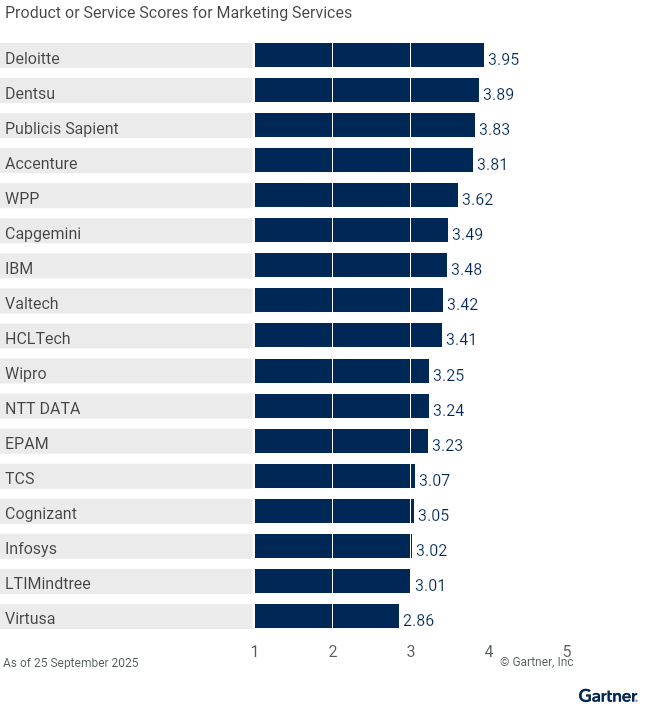
Table 3 shows the product/service scores for each use case. The scores, which are generated by multiplying the use-case weightings by the product/service ratings, summarize how well the critical capabilities are met for each use case.
Product Score in Use Cases
| Use Cases | Accenture | Capgemini | Cognizant | Deloitte | Dentsu | EPAM | HCLTech | IBM | Infosys | LTIMindtree | NTT DATA | Publicis Sapient | TCS | Valtech | Virtusa | Wipro | WPP |
|---|---|---|---|---|---|---|---|---|---|---|---|---|---|---|---|---|---|
Experience Design | 4.05 | 3.63 | 3.12 | 4.31 | 4.01 | 3.28 | 3.24 | 3.54 | 3.05 | 2.94 | 3.27 | 3.70 | 3.13 | 3.10 | 2.77 | 3.27 | 3.66 |
Experience Solution Implementation | 3.84 | 3.80 | 3.39 | 4.06 | 3.48 | 3.49 | 3.63 | 3.72 | 3.53 | 3.35 | 3.49 | 3.41 | 3.47 | 3.30 | 3.13 | 3.49 | 3.32 |
Experience Solution Operations | 3.81 | 3.56 | 2.96 | 3.92 | 3.83 | 3.14 | 3.43 | 3.35 | 3.50 | 2.93 | 3.11 | 3.66 | 2.99 | 3.41 | 2.86 | 3.30 | 3.61 |
Content and Creative Services | 3.84 | 3.57 | 2.92 | 4.07 | 4.07 | 3.09 | 3.35 | 3.54 | 3.01 | 2.77 | 3.06 | 3.65 | 3.09 | 3.39 | 2.79 | 3.12 | 3.86 |
Marketing Services | 3.81 | 3.49 | 3.05 | 3.95 | 3.89 | 3.23 | 3.41 | 3.48 | 3.02 | 3.01 | 3.24 | 3.83 | 3.07 | 3.42 | 2.86 | 3.25 | 3.62 |
As of 25 September 2025 | |||||||||||||||||
Source: Gartner (October 2025)
To determine an overall score for each product/service in the use cases, multiply the ratings in Table 2 by the weightings shown in Table 1.
Note 1: Leading Digital Experience Platforms
For this research, the vendors were evaluated on their capabilities for the DX-related technologies from the following vendors: Acquia, Adobe, Optimizely, Oracle, Salesforce, SAP, and Sitecore are the seven product vendors. While several other product vendors exist in commerce, martech, and sales and services technologies, the vendor assessments are based on these seven.
Critical Capabilities Methodology
This methodology requires analysts to identify the critical capabilities for a class of products or services. Each capability is then weighted in terms of its relative importance for specific product or service use cases. Next, products/services are rated in terms of how well they achieve each of the critical capabilities. A score that summarizes how well they meet the critical capabilities for each use case is then calculated for each product/service.
"Critical capabilities" are attributes that differentiate products/services in a class in terms of their quality and performance. Gartner recommends that users consider the set of critical capabilities as some of the most important criteria for acquisition decisions.
In defining the product/service category for evaluation, the analyst first identifies the leading uses for the products/services in this market. What needs are end-users looking to fulfill, when considering products/services in this market? Use cases should match common client deployment scenarios. These distinct client scenarios define the Use Cases.
The analyst then identifies the critical capabilities. These capabilities are generalized groups of features commonly required by this class of products/services. Each capability is assigned a level of importance in fulfilling that particular need; some sets of features are more important than others, depending on the use case being evaluated.
Each vendor’s product or service is evaluated in terms of how well it delivers each capability, on a five-point scale. These ratings are displayed side-by-side for all vendors, allowing easy comparisons between the different sets of features.
Ratings and summary scores range from 1.0 to 5.0:
1 = Poor or Absent: most or all defined requirements for a capability are not achieved
2 = Fair: some requirements are not achieved
3 = Good: meets requirements
4 = Excellent: meets or exceeds some requirements
5 = Outstanding: significantly exceeds requirements
To determine an overall score for each product in the use cases, the product ratings are multiplied by the weightings to come up with the product score in use cases.
The critical capabilities Gartner has selected do not represent all capabilities for any product; therefore, may not represent those most important for a specific use situation or business objective. Clients should use a critical capabilities analysis as one of several sources of input about a product before making a product/service decision.