Critical Capabilities for Digital Commerce
3 November 2025 - ID G00825737 - 44 min read
By Sandy Shen, Aditya Vasudevan, and 4 more
AI’s role in digital commerce is growing as organizations require more intelligence and automation to scale commerce across business lines, markets and business models. Digital commerce leaders should shortlist vendors based on suitability for business model, composability and AI, among others.
Overview
Key Findings
- The market is at an inflection point for AI capabilities. Many vendors offer AI/GenAI capabilities, primarily for semantic search, buyer assistant, AI assistant for operational tasks, and app development. Next 12 months will see more capabilities, including no-code agent builder, agent guardrails and auditability, and natural language-prompted data insights.
- Headless implementation is supported by all of the vendors in this Critical Capabilities report, though levels of composability vary, with some vendors offering a few individual deployable modules and others offering scores of modules and low-code integration tools.
- B2B commerce offering is highly competitive, with many vendors investing and improving the capabilities, especially for RFQ, sales impersonification, organizational hierarchy and workflow management. B2B-centric search, digital sales rooms (DSRs), visual workflow builders, and guided selling capabilities are differentiating opportunities.
Recommendations
To determine which vendors are the best match for your digital commerce vision:
- Assess if there is a good match between your AI roadmap and AI capabilities supported by the commerce solution. Focus on configuration and management capabilities such as no-code agent builder, agent auditability and guardrail configurations.
- Determine if your organization requires a headless commerce (enabling more flexibility in frontend experience) or composable commerce (supporting complex business with better flexibility and agility) platform.
- Select vendors based on their capabilities to support your B2B or B2C business model. If you have a complex business involving more business models and wider deployments across business lines and geographic markets, select vendors that score high for complex business.
Strategic Planning Assumptions
- By the end of 2026, 80% of digital commerce applications will have embedded GenAI capabilities, up from less than 5% in 2024.
- By 2030, sellers will seamlessly be “in the loop” in both B2C and B2B digital commerce scenarios, when required by customers.
- By 2030, 20% of digital commerce transactions will be executed through GenAI platforms using on-platform check-out or by AI agents.
What You Need to Know
Use Gartner’s evaluations in this Critical Capabilities report to shortlist products from more than one vendor, rather than as a pointer to a single vendor’s offering. The weightings for each use case are not optimized for every type of organization. Use the “customize” function in the interactive version to adjust the weightings.
- B2B commerce and B2C commerce are the primary use cases for business models.
- The AI-enabled commerce use case applies to businesses aiming to operate digital commerce with better intelligence, efficiency and customer experience.
- The composable commerce use case applies to businesses seeking a modular, API-first approach to digital commerce experience beyond headless implementation.
- The complex business use case applies to businesses looking to scale their digital commerce across multiple business lines, geographic markets and business models, including subscriptions, marketplace operations and business-to-business to business/consumer (B2B2X).
In addition to the vendors evaluated in this report, consider others that may provide solutions suited to your industry or specific requirements, such as for cross-border merchant of record commerce and marketplace operations. For additional vendors, see the Honorable Mentions section of the Magic Quadrant for Digital Commerce.
Analysis
Critical Capabilities Use-Case Graphics
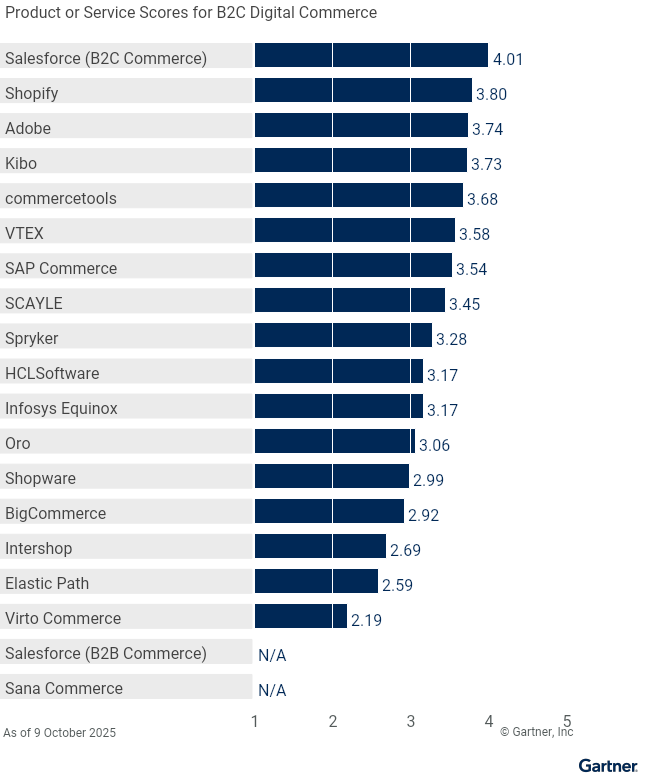
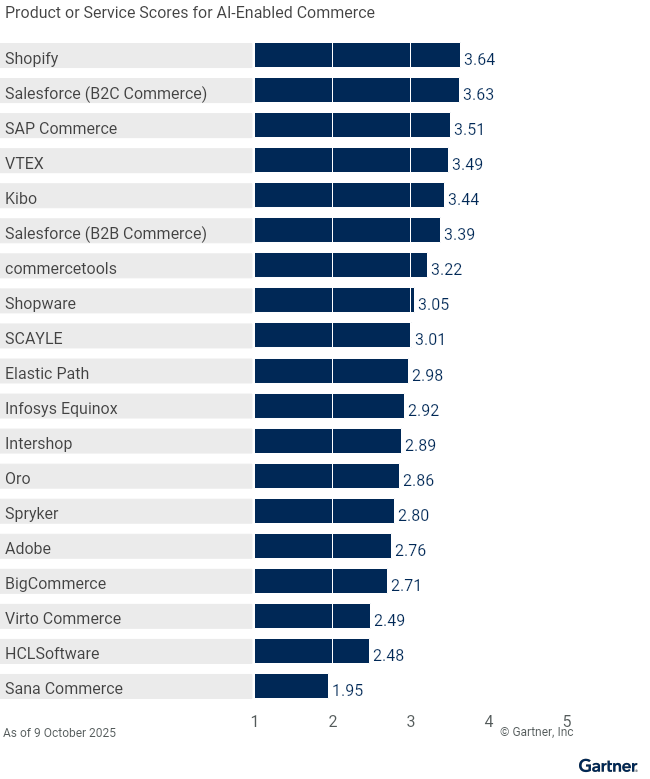
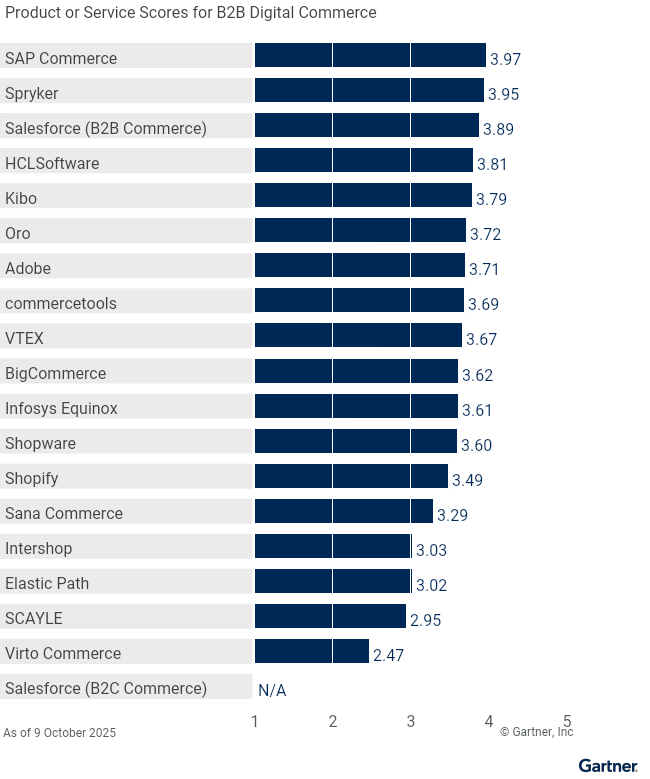
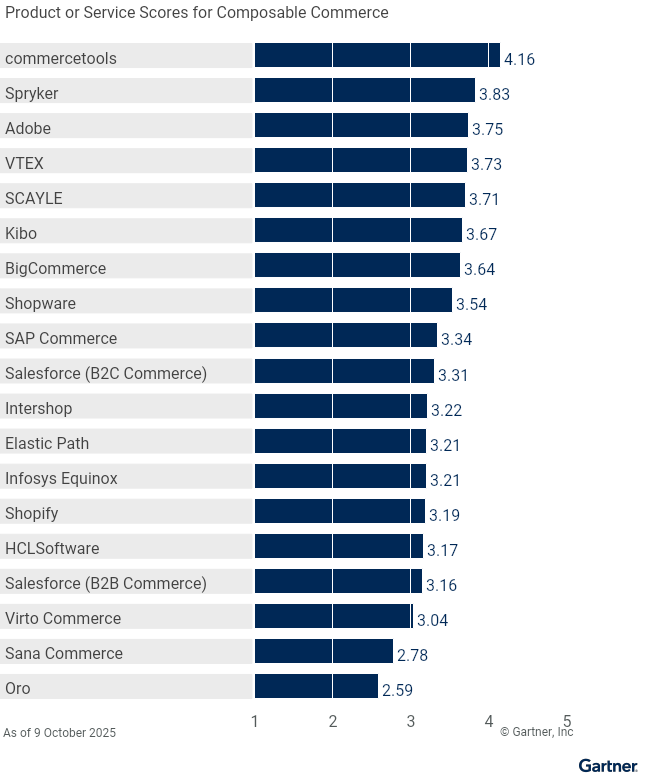
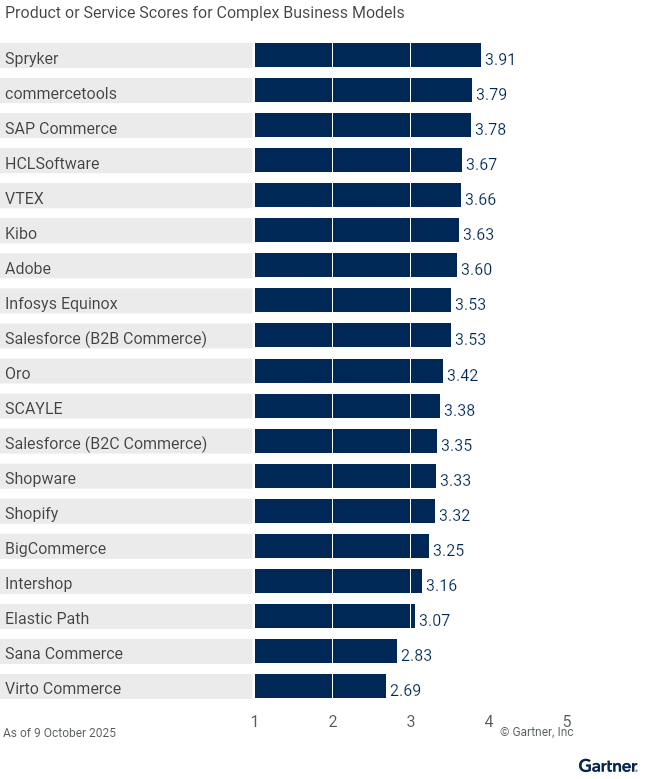
Vendors
Adobe
Adobe’s primary digital commerce platform offering is Adobe Commerce, which typically is deployed as a PaaS and also multitenant SaaS with its newly launched Adobe Commerce Cloud Service. Adobe Commerce can be hosted on AWS or Azure, through Adobe-managed services or on-premises. It is bundled with Adobe Experience Manager and includes strong content management capabilities with different types of visual editors, including an “in-context” visual editor. It is also bundled with Adobe Edge Delivery Services (EDS), its front end as a service (FEaaS) product. Adobe offers Adobe Commerce Optimizer, which enables Adobe’s multitenant SaaS front-end capabilities to run on top of any commerce platform, or it can be layered on top of Adobe Commerce PaaS or on-premises deployments. Adobe Commerce supports headless implementation via native decoupled storefront offerings, third-party storefront integrations and GraphQL.
Adobe Commerce is most suited for implementing B2C and B2B commerce on the same platform, with rich capabilities for catalog management, search, personalization and unified retail commerce. Adobe Commerce investments in AI include intelligent search, product recommendations and content variations. In 2025, Adobe launched Adobe Commerce as a Cloud Service, a multitenant SaaS platform that is generally available globally though data hosting; it was available only in the U.S. at the time of evaluation. Adobe Commerce as a Cloud Service is not evaluated in this report.
Adobe Commerce’s strongest capabilities are in core commerce and platform ecosystem. Its core commerce abilities are supported by robust search, promotion setup, personalization and product recommendations. Its platform ecosystem offers integrations with multiple solution integration partners and third-party ecosystem applications such as PIM, ERP, CRM, and OMS.
Its biggest opportunities for improvement across its capabilities are in AI/GenAI capabilities. The platform offers fewer business user tools for creating agents, lacks prebuilt agents and does not support bringing your own large language model.
BigCommerce
BigCommerce is the digital commerce offering from Commerce. BigCommerce is a multitenant SaaS platform hosted on Google Cloud Platform and comes with a separate B2B Edition. Commerce’s portfolio also includes Feedonomics for data orchestration and optimization management, as well asMakeswift, a visual page builder purchased separately. BigCommerce provides a native low-code storefront (Stencil) and Catalyst, a headless storefront framework that leverages Makeswift and can be deployed on a hosting provider of the customer’s choice. BigCommerce is built on a modular architecture and offers over 100 individually deployed services.
BigCommerce is most suitable for composable commerce, especially midmarket B2B customers requiring speed to market. BigCommerce uses AI for product recommendations and product content translation. In 2024 and 2025, it improved decoupled storefront deployment, and added multiaccount hierarchy and CPQ functionality.
Its strongest capabilities are agility, platform ecosystem and B2B support. For agility, it supports versionless deployments and relatively short implementation timelines. Its platform ecosystem contains an extensive ecosystem of plug-ins and integrations, including for PIM, search and discovery, payment, and tax. For B2B support, it offers a solid set of functionalities for midtier B2B organizations.
Its biggest opportunities for improvement across its capabilities are in business model scalability, unified retail commerce and AI capabilities. For business model scalability, there is limited support for subscriptions and marketplace operations. For unified retail commerce, it requires integrations for returns management and does not offer an in-store application. Its AI strategy is in an early stage, providing description and translation support but lacking agentic support, agent building and natively integrated LLMs.
commercetools
commercetools is deployed as multitenant SaaS on Google Cloud Platform and AWS. It is bundled with a precomposed solution, Foundry, to accelerate deployment for retail and manufacturing clients. commercetools supports API-first implementation via a decoupled frontend, preintegrated through RESTful and GraphQL APIs, and can work with other platforms and endpoints.
commercetools is most suitable for composable commerce, where it offers a modular and API-first architecture that can be used for complex businesses. commercetools’ GenAI capabilities include Developer MCP for developers’ agents to build code more easily, and Essentials MCP for AI agents to access the platform’s capabilities. In 2025, it launched commercetools InStore for unified commerce in physical stores by unifying pricing, promotions, orders and inventory.
Its strongest capabilities are composability, platform ecosystem and agility. All of its APIs can be consumed independently to build custom applications, and it provides tooling to connect users with its ISV partners or to build and deploy small applications on its runtime environments. Its platform has a suite of productized integrations for ecosystem platforms such as PIM, ERP and OMS. The platform is versionless, with approximately 90 deployments a day, and can autoscale for high demand.
Its biggest opportunities for improvement across its capabilities are B2B support, core commerce and AI capabilities. For B2B support, it relies on third parties for punchout functionality. For core commerce, it depends on integrations for more sophisticated personalization and merchandising capabilities (such as those that are AI/ML-enabled). For AI capabilities, it lacks prebuilt agents that customers can deploy, as well as a no-code agent builder.
Elastic Path
Elastic Path offers Composable Commerce as multitenant SaaS hosted on AWS, and Self-Managed Commerce for on-premises or self-hosted deployments. It offers multiple commerce components that can be independently purchased, including Studio, Payments, Subscriptions, Product Experience Manager, Composer, and cart and checkout capabilities. It supports API-first implementation via a no-code digital experience composition offering, and integrated tools for composition and integration.
Its most suitable use case is composable commerce, where its modular platform, decoupled merchandising and page builder applications, combined with a low/no-code integration tool, provide extensive functionality for high-tech and manufacturing clients. Elastic Path’s AI capabilities include semantic search, a B2B shopper assistant and a merchandising agent. In 2024, Elastic Path released a native content management capability within its merchandising tool.
Its strongest capabilities are composability, core commerce and AI capabilities. It offers a modular and a native iPaaS tool with low-code/no-code workflow capability. For core commerce, it supports complex merchandising and product catalog management capabilities. For AI capabilities, it supports several use cases, including a shopper assistant and merchandiser assistant for promotions, which are inclusive of the platform cost.
Its biggest opportunities for improvement across its capabilities are B2B support, unified retail commerce and platform ecosystem. Its B2B support lacks advanced capabilities, such as a visual builder for custom workflows. Its unified retail commerce capability lacks native POS and in-store apps such as clienteling. Its platform ecosystem lacks productized integrations across categories like PIM, OMS, WMS and CDP, with a small number of apps in its app marketplace.
HCLSoftware
HCL Commerce+ is deployed on-premises or as a single-tenant SaaS on Microsoft Azure, AWS and Google Cloud. It includes HCL Commerce AI and marketplace in the base offering, and can be bundled with other HCLSoftware products, such as HCL DX, HCL VoltMX, HCL Unica+ and HCL Aftermarket Cloud. It provides decoupled React-based storefronts for B2C and B2B, supported by its native headless CMS. It has a modular architecture, offering up to 12 individually deployable business capabilities.
HCL Commerce+’s most suitable use case is B2B commerce, especially for large complex businesses, as it has extensive functionality for managing complex catalog, organizational hierarchies and workflows. It provides product recommendations using collaborative filtering. In 2024 and 2025, it improved capabilities in RFQ, search, catalog management, unified commerce and storefront accessibility.
Its strongest capabilities are B2B support, business model scalability and core commerce. It has B2B support for complex catalog, RFQ and contract pricing capabilities. For business model scalability, it offers native support for marketplace operations, B2B2X and multiple product types. For core commerce, it offers rich capabilities for search, product recommendation and order management.
Its biggest opportunities for improvement across its capabilities are AI capabilities, platform ecosystem and unified retail commerce. For AI capabilities, it has few use cases and management and configuration capabilities. For platform ecosystem, it has relatively few third-party integrations, especially for LCAP, PIM, WMS and personalization. For unified retail commerce, it offers native clienteling and click-and-collect apps, but lacks native POS and has relatively few ISV integrations for POS and clienteling.
Infosys Equinox
Infosys Equinox’s offering, Equinox Commerce, is a multitenant or single-tenant solution that can be deployed on AWS, Azure or Google Cloud. It includes add-ons like managed hosting, Equinox Studio, personalization and conversational commerce. The platform is API-first, with more than 25 individually deployable modules. Each module has its own back-end tooling and access control. Equinox Commerce offers two headless options: a React-based reference storefront preintegrated with Strapi CMS and a hosted shopping cart SDK.
Infosys Equinox is most suited for complex commerce, where it has rich functionality for managing complex catalogs, multiple product types and large-scale deployments for both B2B and B2C businesses. Its AI capabilities include product content creation and review sentiment analysis. In 2025, it invested in capabilities for customer service representatives to create a cart or orders on behalf of customers.
Its strongest capabilities are B2B support, business model scalability and core commerce. For B2B support, it enables sales teams to configure, co-browse and transact to support RFQ and bulk orders. For business model scalability, it supports B2B2X, subscription and multiple product types. For core commerce, it has native OMS capabilities, such as to ship products from different warehouse locations.
Its biggest opportunities for improvement across its capabilities are in AI capabilities, unified retail commerce and platform ecosystem. Although it has a variety of GenAI use cases, such as product creation, it lacks prebuilt AI agents. For unified retail commerce, it has just two productized POS integrations, with XStore and Stripe POS. For platform ecosystem, it has few prebuilt integrations with PIM and personalization platforms.
Intershop
Intershop’s latest product is Intershop N (for “next”) and is deployed as single-tenant SaaS on Microsoft Azure. It is modular and includes commerce, search and personalization, customer engagement center, and order management. A Customer Engagement Center, advanced search and product discovery (SPARQUE.AI), and data hub are available at extra cost. Intershop supports headless implementations via APIs and provides a native Angular PWA toolkit and visual builder (though not WYSIWYG) with extensive front-end widgets.
Intershop is most suited for composable commerce, due to its support for multiple headless storefront options and modular architecture. Its AI capabilities include Copilot for Buyers, a no-code/low-code workflow builder, product content generation, fraud detection and sales forecasting. In 2025, Intershop added automated reordering for B2B and B2C customers, as well as APIs for product and catalog management and B2B cost center management.
Its strongest capabilities are agility, composability and business model scalability. Its modular architecture and decoupled storefront framework equip enterprises with good agility. It supports multiple headless deployment options using its PWA toolkit or headless APIs, supported by a headless CMS. Intershop also supports a range of business models and product types for complex selling.
Its biggest opportunities for improvement across its capabilities are in unified retail commerce, AI capabilities and B2B support. For unified retail commerce, it lacks store integrations such as clienteling, endless aisle, and pick and pack. For AI capabilities, it offers limited agent management capabilities and the pricing is consumption-based, which can be difficult to estimate. For B2B support, some common seller features are extra cost via the Customer Engagement Center, and it lacks features such as visual configuration and combining orders for discounts.
Kibo
Kibo’s Composable Commerce Platform is deployed as SaaS and uses AWS and Google Cloud Platform as its cloud infrastructure. It offers individually deployable modules including B2B, B2C, OMS, Subscriptions, Reverse Logistics, CMS, POS, Search, and Dropship and Marketplace. Kibo offers native personalization and product recommendations capabilities via a preintegration with Monetate. Its EDI management enables clients to manage EDI workflows for order, fulfillment and merchandising scenarios directly. Kibo supports DXC and FEaaS for SPA/PWA/Jamstack implementations. Its headless CMS includes themes, templates and accelerators for building server-side storefronts and can manage decoupled storefronts.
Kibo is most suited for B2B commerce, where it has extensive capabilities for B2B search, RFQ and account management. Kibo uses AI for shopper agent, merchandiser agent, semantic embeddings and product recommendations. It also offers a no-code agent builder at no extra cost. In 2025, Kibo added NLP capabilities for personalization, site search and customer support, and launched customized returns, rule-driven reverse logistics, and order fulfillment based on account importance. Its strongest capabilities are unified retail commerce and B2B support. For unified retail commerce, it offers native capabilities for POS, clienteling, order management, stock allocations, and pick and pack. For B2B support, it offers real-time collaboration through co-browsing, on-behalf ordering, and commenting within quotes.
Its biggest opportunities for improvement across these capabilities are in AI capabilities and platform ecosystem. It has relatively few GenAI use cases, allows customers to bring their own LLMs only via connectors and webhooks, and offers basic guardrail controls. For platform ecosystem, it has relatively few integrations for search, personalization and marketplace operations.
Oro
Oro’s OroCommerce is typically deployed as single-tenant SaaS on Oracle Cloud, but is also available on Microsoft Azure, Google Cloud Platform, and AWS, as well as on-premises or self-hosted. OroCommerce is an all-inclusive platform with 17 key modules, including CRM, CMS, DAM, marketplace operations, order management, pricing, promotions and workflows. Oro provides a native, coupled storefront that represents the vast majority of installations, as well as REST/GraphQL API endpoints for deploying a server-side decoupled storefront or a fully decoupled storefront.
Oro is most suited for B2B commerce, with extensive functionality in workflow management via its visual workflow engine, sales impersonation, and two-way communication during RFQ. Oro offers GenAI for generating product description and for a SmartAgent to help buyers with various buying tasks. In 2025, Oro introduced a PWA Field Sales App and an AI SmartOrder capability that reads and converts files into orders. Its new Invoice Portal enables online viewing and payment of invoices.
Oro’s strongest capabilities are in B2B support and core commerce. Its B2B capabilities support co-browsing, flexible workflows, account-based restrictions, and combining quotes for volume discounts. Its core commerce offers strong search, promotions and product recommendations.
Its biggest opportunities for improvement across its capabilities are composability and AI capabilities. It does not offer a headless CMS, has relatively few independent modules as commercial products, and few integrations for front-end tools. It has relatively few AI capabilities and use cases, and its AI roadmap is not as robust.
Salesforce (B2B Commerce)
Salesforce offers separate B2C commerce and B2B commerce solutions. This section covers Salesforce B2B Commerce only. Salesforce B2B Commerce typically is deployed as a multitenant SaaS platform and operates on Salesforce’s first-party data center or via Salesforce Hyperforce. Salesforce offers multiple editions, with the Advanced edition including OMS, Data Cloud and personalization. In the past year, Salesforce added sales capabilities as a native functionality. As a result, a separate Sales Cloud license is not required for RFQ, though it is available for an additional fee. Agentforce, an AI agent platform, was released in 2024 and is licensed separately outside of B2B Commerce. Salesforce B2B Commerce supports a native storefront built on Lightning Web Runtime, which can be combined with client-developed storefront pages. Although it does not offer a decoupled B2B storefront, it supports custom headless implementations.
Salesforce B2B Commerce’s most suitable use case is B2B commerce, with native connections to other B2B-focused offerings, such as Salesforce Sales Cloud and Salesforce Revenue Cloud. Its Agentforce supports AI agent creation, can ingest external data, and allows clients to bring their own LLMs. It acquired Informatica in 2024, but the deal has not closed, and no further details were available at the time of publication.
Its strongest capabilities are core commerce, B2B support and platform ecosystem. Its core commerce offers strong capabilities for B2B search, product recommendations and order management. Its B2B support has robust features for order on-behalf, account-based settings, and catalog segmentation. Its platform ecosystem offers many third-party integrations, such as PIM, OMS, search and personalization.
Its weakest capabilities are composability, business model scalability and AI capabilities. Its composability lacks a native headless CMS platform, and has relatively few individually deployable modules. For business model scalability, it lacks native marketplace operations, and subscription capabilities require a Revenue Cloud license. For AI capabilities, there are few B2B-specific capabilities and the pricing is based on conversations and actions, which can be complex to estimate.
Salesforce (B2C Commerce)
Salesforce B2C Commerce is deployed as a multitenant SaaS solution, typically on Salesforce’s first-party data center infrastructure. Some modules, such as search and product recommendations, operate on AWS. The product can be bundled with order management, data cloud, Einstein, and analytics licenses. In 2024, Salesforce introduced new bundles, including native POS capabilities from its PredictSpring acquisition, and a retail bundle incorporating Service Cloud, Slack, Tableau and MuleSoft. Salesforce B2C Commerce supports a fully integrated front-end architecture via its native Storefront Reference Architecture (SFRA), a headless architecture via its PWA-based composable storefront, and a Node.js-based headless SDK. It also supports hybrid models, allowing page-level deployment of either storefront type.
Salesforce B2C Commerce is most suited for B2C commerce, especially for large brands and retailers. It has strong storefront flexibility and multisite management capabilities. Its AI capabilities include search optimization, product recommendations, agent creation via Agentforce Studio, and support for the client’s own LLMs. Recent acquisitions include PredictSpring for POS and Informatica, though the latter deal has not closed, and details are not available as of this report’s publication date.
Its strongest capabilities are unified retail commerce, core commerce and platform ecosystem. Its unified retail commerce capabilities are supported by native POS, clienteling, live commerce, Click & Collect, and returns management. Core commerce has strong capabilities for catalog management, personalization and order management. For platform ecosystem, it offers many third-party integrations, such as PIM, search, OMS, WMS, personalization and CDP.
Its biggest opportunities for improvement across its capabilities are agility, business model scalability, and composability. For agility, it offers lower frequency of major updates and lacks industry vertical accelerators, compared to its competitors. For business model scalability, it lacks native support for marketplace operations, subscriptions, and combining subscriptions with physical products in a single order. For composability, it lacks a native headless CMS platform and has relatively few individually deployable core commerce modules.
Sana Commerce
Sana Commerce Cloud typically is deployed as a single-tenant SaaS platform hosted on Microsoft Azure. It comes with prebuilt integrations to Microsoft and SAP ERPs, including older versions predating 2010. It also offers Sana Commerce Insights (an analytics engine) and Sana Pay (a payment service) as add-ons. It provides a native decoupled storefront that can be managed using its visual designer, and GraphQL APIs to support decoupled storefronts.
Sana Commerce Cloud’s most suitable use case is B2B commerce, with extensive functionality for companies in manufacturing that prefer a tight integration with their Microsoft or SAP ERPs. Sana Commerce offers GenAI capabilities for product content creation. In 2025, it introduced a guided selling feature that supports images, multiple facets and preference-based filtering.
Its strongest capabilities are B2B support, core commerce and composability. For B2B support, it integrates with ERP systems for seamless data updates. For core commerce, it supports complex catalogs for complex B2B implementations. For composability, it offers integrated tools for module creation, composition and catalog management.
Its biggest opportunities for improvement across its capabilities are in AI capabilities, business model scalability and agility. The platform has few AI use cases or prebuilt agents and lacks ability for customers to create or configure agentic capabilities. For business model scalability, it lacks support for marketplace operations, has limited capabilities for selling digital goods or services, and has few large-scale deployments. For agility, due to its single-tenant architecture, it needs downtime (usually not significant) for data schema changes.
SAP Commerce
SAP Commerce Cloud typically is deployed as a hybrid single-tenant PaaS on Microsoft Azure with multitenant SaaS components. Product catalog management and a workflow and rule engine are bundled into some commerce editions, and OMS and a mobile app builder are available as add-ons. The platform offers several individually deployable modules, including storefront, CMS, PIM, OMS, search, and pricing and promotions. It offers an Angular-based decoupled storefront as part of Storefront Composer, and supports headless CMS such as Contentful, Contentstack and Uniform, as well as FEaaS offerings such as Alokai.
SAP Commerce Cloud is most suited for B2B commerce, especially large global deployments with complex needs for managing organizational hierarchies and workflows. It provides some AI capabilities under the Joule brand, and supports product content generation, Q&A, review summaries and image generation. In 2025, SAP introduced SAP Commerce Cloud B2B Self-Service Portal to provide dedicated portal functionality for B2B buyers.
Its strongest capabilities are B2B support, business model scalability, and agility. Its B2B capabilities include RFQ, advanced search, account-based restrictions, and punchout and EDI integrations. For business model scalability, it supports large complex catalogs, multiple product types and large multisite deployments. For agility, it offers several vertical accelerators and has robust multisite capabilities for complex deployments.
Its biggest opportunities for improvement across its capabilities are platform ecosystem, composability and AI capabilities. For platform ecosystem, it offers relatively few integrations with third-party PIM, ERP, personalization, and CDP solutions. For composability, it offers few individually deployable modules and relies on partners for headless CMS. For AI capabilities, its use cases are centered around search and product data understanding, and the pricing uses a credit unit system with conversion rates for various capabilities, which customers may find complex to understand.
SCAYLE
SCAYLE Commerce Engine is deployed as multitenant SaaS on AWS and offers 20 modules, including shop management, catalog, search, pricing, promotions, check-out, OMS, and marketplace operations. SCAYLE supports headless implementation via REST APIs. It also offers a Vue.js/Nuxt.js storefront accelerator and a native no/low-code Flutter mobile app.
SCAYLE’s most suitable use case is B2C commerce, with rich functionality for unified commerce, such as click-and-collect and clienteling. Its AI capabilities include semantic search with vector embeddings, product content generation, image generation, virtual try-on and recommendations. In 2024 and 2025, SCAYLE added an MCP server, integrated PaaS front-end hosting, a B2B module and improvements to its promotion engine.
Its strongest capabilities are agility, composability and platform ecosystem. For agility, it offers prebuilt storefronts and no-code tools to reduce time to market. For composability, it supports a broad range of individually deployable modules and tools for module creation, integration and catalog management. For platform ecosystem, it offers many connectors to ISV solutions, including PIM, search, OMS and CDP, to extend the platform ecosystem.
Its biggest opportunities for improvement across its capabilities are in B2B support and AI capabilities. Its B2B module is relatively new, lacks a visual workflow builder, and functionalities such as RFQ, quick/bulk order and approval workflows cost extra via its B2B storefront. For AI capabilities, it lacks support for guardrail configurations and for customers bringing their own models; in addition, certain capabilities are under development.
Shopify
Shopify is deployed as multitenant SaaS on Google Cloud Platform, and includes three commerce components — Storefront, Checkout and Shop Pay, which can be bundled or purchased independently. It offers three tiers — Shopify, Shopify Plus and Shopify for Enterprise, each tier providing increased technical distinctions for capabilities such as saved payment methods, support for API calls, concurrent check-out users and SLAs. The pricing is separate for online, retail and B2B usage, with optional payment service fees. It provides a native storefront via Liquid, and supports headless deployment with its Hydrogen, a React-based framework, or a full custom experience via storefront APIs through Hydrogen, or headless hosting with Oxygen.
Shopify is most suited for B2C commerce, with native support for POS, clienteling, click and collect, and many third-party integrations for retail solutions. It offers AI capabilities for content creation, visual editing, customer communication, SEO, marketing, merchandising and business tools. It made multiple acquisitions in 2024 and 2025: Peel Insights (data analytics), Threads (workplace communication), ChannelApe (inventory management), Ritual (mobile ordering) and Vantage Discovery (AI-powered search).
Its strongest capabilities are AI capabilities and platform ecosystem. For AI capabilities, it supports many use cases and offers an all-in-one AI agent (Shopify Sidekick) for various merchant roles. For platform ecosystem, it offers over 10,000 third-party extensions through its app marketplace and has many service partners across major regions.
Its biggest opportunities for improvement across its capabilities are business model scalability and composability. For business model scalability, it has limited capabilities for marketplace operations and lacks support for site inheritance and shared carts across brand stores. For composability, while it supports headless deployments and many extensions, the platform offers very few individually deployable core commerce modules and integration tools beyond API and command line interface.
Shopware
Shopware offers three commercial packages targeted at midmarket and enterprise clients, and an open-source community edition, which is not evaluated. The commercial offerings are available as self-hosted, PaaS, or single-tenant or multitenant SaaS on AWS, Microsoft Azure or Google Cloud. All commercial offerings have the same set of functionalities, with higher versions including more capabilities for inventory and order management, B2B, workflows, and customer experience and marketing. It offers a native storefront, a headless composable frontend and headless CMS that can export content and data to external CMS or DXP in JSON format.
Shopware is most suited for B2B commerce, where it has rich functionality for RFQ, ordering and workflow management. Its AI capabilities include product content generation, review summary and translation, image generation and editing, customer segmentation, and a documentation AI assistant. In 2024 and 2025, Shopware launched a community hub for developers, an AI copilot for admin, and improved capabilities for B2B catalog and digital sales room (DSR).
Its strongest capabilities are in platform ecosystem, B2B support and composability. For platform ecosystem, it offers many third-party integrations for PIM, ERP/CRM, OMS, and CDP. For B2B support, it has a comprehensive rule builder and a differentiating DSR. For composability, it offers about a dozen individual models and has many integrations for frontend tools, such as CMS and DXP.
Its biggest opportunities for improvement across its capabilities are in business model scalability, unified retail commerce and AI capabilities. For business model scalability, it relies on partners for selling services and usage-based subscriptions, and for marketplace operations. For unified retail commerce, it requires integrations for clienteling apps, click and collect, and distributed order management. For AI capabilities, it offers one prebuilt AI agent, and lacks a no-code agent builder and support for customers’ own LLMs.
Spryker
Spryker Cloud Commerce OS is deployed as PaaS, with a multitenant SaaS component for application composition platform (ACP), a no-code integration hub. It is a broad platform that includes capabilities for CMS, PIM and OMS, with add-on components such as marketplace operations, unified commerce and self-service portal. The platform has a modular architecture with more than 40 PBCs; it is typically deployed on AWS, but it also supports Microsoft Azure and Google Cloud Platform. Spryker offers AWS Glue API for front-end integration, and its Composable Storefront has templates for B2C, B2B and marketplace, and supports SPA and PWA.
Spryker Cloud Commerce is most suited for B2B commerce, with rich functionalities for product configurations and visual workflow management. Its AI capabilities include product content generation, visual search, image to cart, AI chatbot and development assistance. In 2024 and 2025, Spryker invested in capabilities in self-service portal, postorder amendment, image-to-cart, and white-label BI from Amazon Quick Sight.
Its strongest capabilities are business model scalability, B2B support and composability. For business model scalability, it supports various product types, marketplace options and large-scale deployments. For B2B support, it offers strong product configuration, a flexible visual workflow engine, and customer self-service portal for easy entry to commerce by traditional organizations. For composability, it has a modular architecture and extensibility via its ACP.
Its biggest opportunities for improvement across its capabilities are in AI capabilities, platform ecosystem and unified retail commerce. For AI capabilities, it lacks a no-code agent builder and capabilities to manage agent-specific guardrails or ingest data from outside the commerce platform. For platform ecosystem, it has a small number of ISV integrations and a few apps in its ACP. It offers an add-on package for unified retail commerce, but lacks a native POS and third-party integrations.
Virto Commerce
Virto Commerce is deployed as a single-tenant PaaS on Virto Cloud; it can run on public clouds including Microsoft Azure, Google Cloud Platform and AWS, and is also deployable on private clouds and on-premises. It includes a marketplace operations module in its core commerce offering. Virto Commerce offers a decoupled CMS and supports asset management on other decoupled storefronts via GraphQL, and a production-ready Vue.js storefront.
Virto Commerce’s most suitable use case is composable commerce, supported by its atomic architecture and rich PaaS tools and capabilities. Its AI capabilities include search intent classification with NLP-based query analysis, file-to-order automation, and AI-assisted UI development. In 2024, Virto Commerce released capabilities for click and collect and product configurations.
Its strongest capabilities are in composability and agility. It has a highly modular architecture and atomic architecture principle. It provides AI-assisted code suggestions and testing capabilities for accelerating development cycles, and offers several individually deployable modules as separate product offerings.
Its biggest opportunities for improvement across its capabilities are platform ecosystem and unified retail commerce. For platform ecosystem, it connects to third-party Integrations using Azure Logic Apps as a middleware, rather than prebuilt connectors. It lacks key unified commerce capabilities, such as POS and clienteling.
VTEX
VTEX Commerce is deployed as a multitenant SaaS offering on AWS. It offers three capability bundles for experience management, marketplace management and distributed order management. It offers VTEX FastStore (react/node.js) as a decoupled storefront and VTEX IO, its low-code development and extension platform. It supports headless implementation via third party DXPs and CMS.
VTEX Commerce is most suitable for complex commerce, especially midtier and enterprises running multiple business models, including B2B, B2C and marketplace. Its AI capabilities include recommendations, semantic search, VTEX Copilot for admin support, Weni by VTEX (a customer service agent), and Data Insights Agent for data insights and visualizations. In 2025, VTEX improved its headless CMS and product recommendation, added semantic search, released FastStore for B2B, and improved B2B capabilities.
Its strongest capabilities are agility, composability and platform ecosystem. Its agility is underpinned by ease of deployment and ease of use for business users. Its composability is supported by the modular architecture, low-code integration framework and many integrations for third-party CMS and DXP solutions. Its platform ecosystem includes many third-party integrations for PIM, ERP, search and personalization, as well as extensions through its app marketplace.
Its biggest opportunities for improvement across its capabilities are AI capabilities, unified retail commerce and B2B support. Its AI offerings lack support for common use cases such as content generation and image editing, and doesn’t support bringing your own model or agent builder capabilities beyond Weni. It offers rich unified retail functions, but via add-on apps for extra costs. For B2B support, its B2B search capabilities lack the ability to save searches or search by unit of measurement, and relies on integrations for visual configuration, CPQ and combining carts for discounts.
Context
This Critical Capabilities report focuses on digital commerce vendors’ products and examines their functionality to support five use cases and nine critical capabilities. The use cases were selected based on Gartner client inquiries, discussions and presentations.
Critical capability weightings were set based on each capability’s influence on a given use case. These weightings can be changed in the interactive version of this document. The critical capabilities represent the functional abilities most required to satisfy the use cases. These capabilities are neither technology-specific nor low-level, feature-/function-specific. Rather, they reflect higher-level capabilities that we frequently hear Gartner clients request during inquiry calls, discussions and presentations.
Use this Critical Capabilities report, in conjunction with Magic Quadrant for Digital Commerce, to understand key market dynamics relating to the included vendors’ vision, execution and overall viability, and how we assess the vendors in the context of those dynamics.
Gartner’s product evaluations were made on the basis of product functionality generally released and available as of 31 July 2025. This year’s product evaluation questionnaire and demo guidelines were updated to make them relevant to the questions asked by our end-user clients during their evaluation process. Also, certain common capabilities were removed or changed weighting criteria. These adjustments have contributed to some score changes across all vendors that were evaluated last year.
Market Definition
Gartner defines digital commerce as the technology that enables customers to purchase goods and services through an interactive and self-service or assisted experience. The platform provides necessary information for customers to make their buying decisions and uses rules and data to present fully priced orders for payment. The commerce product must support interoperability with customer data, product content (e.g., price, availability) and order functionality and data via APIs. Digital commerce is commonly delivered as single or multitenant SaaS, or as single-tenant hosted or managed hosted (PaaS) applications. It could be offered for on-premises implementations in some circumstances.
Digital commerce enables customers to purchase goods and services through an interactive and self-service or assisted experience, providing the necessary information for customers to make buying decisions.
Mandatory Features
The must-have capabilities for this market include out-of-the-box (OOTB) capability or the APIs to support:
- A self-service, interactive commerce experience that includes storefronts, product catalog navigation, search, product pages, promotions, shopping carts, check-out and customer accounts
- Discovering products, adding products to a cart and fully pricing an order inclusive of product-level, customer-level and order-level discounts or promotions
- Business tooling for site merchandising (including search and navigation), product catalog and content management, user access management, promotions management and site operations and configurations
- Interoperability with customer, product content (including price and availability) and order functionality and data via APIs
- Front end as a service/experience composition
- Personalization, testing and optimization
- Product information, pricing and inventory management and/or integration
Common Features
Digital commerce may also have the following capabilities:
- B2B-focused capabilities
- API orchestration and management
- Marketplace operations
- Channel integrations
- Content management
- B2B2X
- Basic contact center
- Basic product information management
- Basic OMS
- Basic configure, price and quote
- Basic CDP
- Basic subscriptions management
- Unified retail commerce (e.g., buy online, pickup in store/click and collect, clienteling, ship from store)
- Live commerce
- Sales associate integration
- Visual configuration
(For further information on the extent of the digital commerce ecosystem, see Evolve Digital Commerce Portfolios by Leveraging the Application Ecosystem.)
Product/Service Trends
Organizations face increasing pressures to grow digital revenues and demonstrate value of technology investments during economic uncertainty. Furthermore, leading GenAI platforms are emerging as a disruptive force in digital commerce. Their answer engines are impacting organic traffic to digital commerce sites, and their on-platform shopping initiatives compete with direct-to-customer commerce offerings by traditional organizations. In response, all digital commerce vendors in this Critical Capabilities have included AI capabilities in their platforms. Features such as buyer assistant, semantic search, AI assistant for operational tasks, and development help organizations improve customer experience on the storefronts and manage back-office operations more efficiently.
2025 is an inflection point for AI capabilities in digital commerce. The next 12 months will see vendors launch more capabilities, including no-code agent builders, agent guardrails and auditability, and natural-language-prompted data insights.
While composability is not being touted as the coolest capability, organizations still value agility and flexibility in the commerce platform. Headless implementation is now mainstream and supported by all vendors in this Critical Capabilities report. The levels of composability vary among vendors, with some offering a few individual deployable modules and others offering scores of modules and low-code integration tools.
B2B commerce has been a fast-growing segment in digital commerce for several years. As more vendors focus on B2B for growth and profitability, this segment has become highly competitive, with vendors competing in functionalities such as RFQ, sales impersonification, organizational hierarchy and workflow management. Capabilities such as B2B-centric search, digital sales rooms (DSRs), visual workflow builders and guided selling are differentiating opportunities.
Critical Capabilities Definition
Agility
The scope and scale of functionality and tools that reduce the time to market and increase the speed of change.
Platform Ecosystem
The scope and scale of the available application ecosystem supporting digital commerce and the breadth of integrations enabled, coupled with the availability of integrations and solution partners.
B2B Support
The ability to sell to other businesses; also supports functionalities such as organizational hierarchy, account-specific views, workflows, RFQ and sales support.
AI Capabilities
The ability to use AI technologies to automate and optimize development and business user tasks, as well as to enhance customer experiences.
Unified Retail Commerce
The ability for customers to select products and complete transactions on any device or channel of their choice. In retail, this includes support for in-store operations, such as BOPIS, curbside, pick and pack, clienteling, endless aisle, and POS integration.
Composability
The degree of product modularity as defined by the architecture, application design, and composability of the individual components, as well as the ability to support headless and modular commerce implementations as the foundation for composable commerce.
Core Commerce
The quality, sophistication and ease of use of core commerce capabilities and the ability to support globalization.
Business Model Scalability
The ability to scale and extend platform capabilities across various business models, such as marketplace, subscription, B2B and B2C, and B2B2X, and support for multiple product types, including digital goods and services.
Use Cases
B2C Digital Commerce
Organizations selling primarily or only to individuals.
B2B Digital Commerce
Organizations selling primarily or only to businesses.
AI-Enabled Commerce
Organizations requiring AI-enabled commerce capabilities to improve productivity and efficiency for their commerce teams and to improve buying experiences for customers.
Composable Commerce
Organizations requiring modular commerce capabilities to compose unique experiences or digital applications to improve agility, flexibility and innovation.
Complex Business Models
Organizations scaling digital commerce across multiple business lines that involve large and complex catalogs, multiple markets, and disparate business processes and models.
Vendors Added and Dropped
Added
- Intershop
Dropped
- Liferay was dropped, as it failed to meet the inclusion criterion of offering digital commerce as a stand-alone offering.
- Optimizely was dropped due to a lack of publicly available information about its offering’s capabilities.
Inclusion Criteria
The inclusion criteria represent the specific attributes that Gartner analysts deemed necessary for vendors to satisfy to appear in this report. To be included, each vendor had to satisfy the following inclusion criteria, defined by Gartner, as of 31 July 2025:
- Vendors must offer a minimum of one digital commerce platform that is actively being sold which meets the product definition and stated functionality.
- The digital commerce platform must be sold as a separate SKU/entity or as an add-on to the core offering (if applicable). In both cases, the vendor should have a clear record of revenue generated and customers actively using the platform.
- The digital commerce platform must support over 70 production customers at the date of submission of this attestation.
- These customers must be using the vendor’s actively sold digital commerce platform to support the commerce journey and capabilities as described in the Market Definition.
- The digital commerce platform must serve customers in more than one unique industry. To qualify for serving customers in an industry, the platform must have a minimum of 5% of production customers in the industry.
- The digital commerce platform must be used by paying customers in more than one geographic region. To qualify for serving customers in a geographic region, the platform must earn a minimum of 10% of digital commerce revenue from other regions (or not more than 90% from one region).
- The digital commerce platform customers must not consist of more than one customer that represents more than 10% of the annual recognized digital commerce software revenue.
- Digital commerce software revenue only includes sales through software licenses (renewals and new), SaaS subscriptions and maintenance/support services. Additional services such as hosting, professional services (including consulting and implementation support), apps sold through marketplaces, and other business operational services are excluded.
Additionally, due to the competitive nature of this segment, vendors had to satisfy one of the following three scenarios for year-over-year (YoY) customer growth, revenue growth and total revenue for their digital commerce platforms.
Scenario 1:
- Net-new digital commerce platform customers during 2024: More than 10
- Annual recognized digital commerce software revenue in 2024: Equal to or greater than $28 million
- Growth in annual recognized digital commerce software revenue from 2023 to 2024: Greater than 10%
Scenario 2:
- Net-new customers in 2024: More than seven
- Revenue in 2024: Equal to or greater than $50 million
- Revenue growth from 2023 to 2024: Greater than 5%
Scenario 3:
- Net-new customers in 2024: More than five
- Revenue in 2024: Equal to or greater than $65 million
The following Gartner definitions inform the preceding inclusion criteria:
- Digital commerce platform product description — A digital commerce platform is the core technology that enables customers to purchase goods and services through an interactive and usually self-service experience. The platform provides the necessary information for customers to make buying decisions, and uses rules and data to present fully priced orders for payment.
- Digital commerce platform product functionality — The platform must have OOTB capability to provide, or APIs to support, a self-service, interactive commerce experience that includes storefront, product catalog navigation, product pages, shopping cart, check-out and customer account. Out of the box, the platform must have the ability to search for a product, add products to a cart, and fully price an order inclusive of product-level, customer-level and order-level discounts or promotions. In some B2B scenarios, this may involve assistance from sales personnel. The platform must support interoperability with customer, product, content and order functionality, and with data via APIs.
- Production customer — A production customer is an organization that has purchased the digital commerce platform, has a corresponding contract with that platform’s vendor in the name of the buying organization, is live and transactional on the platform, and pays for use of the platform (that is, one production customer equals one production contract).
- New digital commerce platform customers — This is the number of new digital commerce platform customers who signed a contract during 2024. It is not a YoY or net growth number, but a new customer count number.
- Annual recognized digital commerce software revenue — This is defined as total revenue exclusively from the sale of licensed software (regardless of deployment model, whether on-premises, SaaS or another model) and corresponding maintenance and support services that can be reported for a specific year according to generally accepted accounting principles (GAAP). For the purposes of this document, annual recognized digital commerce revenue excludes revenue generated by supporting ecosystem applications and services, such as:
- Web content management (WCM)
- Digital experience platform (DXP)
- Distributed order management system (DOM/OMS)
- Product information management (PIM)
- Configure, price and quote (CPQ)
- Search
- Personalization or recommendations
- iPaaS/orchestration/integration tools
- Merchant of record (MoR) services
- Payment services
Also excluded is revenue from a parent organization or another business entity within the same parent organization.
Weighting for Critical Capabilities in Use Cases
| Critical Capabilities | B2C Digital Commerce | B2B Digital Commerce | AI-Enabled Commerce | Composable Commerce | Complex Business Models |
|---|---|---|---|---|---|
Agility | 5% | 5% | 5% | 5% | 5% |
Platform Ecosystem | 5% | 5% | 5% | 10% | 5% |
B2B Support | 0% | 45% | 5% | 5% | 15% |
Unified Retail Commerce | 40% | 0% | 5% | 5% | 0% |
Composability | 5% | 5% | 5% | 60% | 10% |
Core Commerce | 30% | 25% | 15% | 5% | 25% |
Business Model Scalability | 10% | 10% | 0% | 5% | 35% |
AI Capabilities | 5% | 5% | 60% | 5% | 5% |
As of 9 October 2025 | |||||
Source: Gartner (October 2025)
This methodology requires analysts to identify the critical capabilities for a class of products/services. Each capability is then weighted in terms of its relative importance for specific product/service use cases.
Critical Capabilities Rating
Each of the products/services that meet our inclusion criteria has been evaluated on the critical capabilities on a scale from 1.0 to 5.0.
Product/Service Rating on Critical Capabilities
| Critical Capabilities | Adobe | BigCommerce | commercetools | Elastic Path | HCLSoftware | Infosys Equinox | Intershop | Kibo | Oro | Salesforce (B2B Commerce) | Salesforce (B2C Commerce) | Sana Commerce | SAP Commerce | SCAYLE | Shopify | Shopware | Spryker | Virto Commerce | VTEX |
|---|---|---|---|---|---|---|---|---|---|---|---|---|---|---|---|---|---|---|---|
Agility | 3.6 | 4.4 | 4.0 | 3.0 | 3.6 | 3.2 | 3.9 | 3.7 | 2.9 | 3.7 | 3.7 | 2.6 | 3.8 | 4.2 | 3.5 | 3.5 | 4.0 | 3.4 | 4.1 |
Platform Ecosystem | 4.4 | 4.8 | 4.0 | 2.9 | 2.3 | 2.8 | 2.9 | 3.4 | 3.4 | 4.1 | 4.2 | 2.6 | 2.8 | 3.9 | 3.9 | 4.4 | 3.5 | 1.7 | 3.7 |
B2B Support | 3.6 | 4.0 | 3.6 | 3.0 | 4.3 | 4.0 | 2.9 | 4.1 | 4.2 | 4.1 | 2.7 | 4.0 | 4.5 | 2.2 | 3.4 | 3.8 | 4.2 | 2.3 | 3.6 |
Unified Retail Commerce | 3.6 | 2.4 | 3.6 | 1.9 | 2.7 | 3.0 | 2.0 | 4.1 | 2.6 | 3.0 | 4.3 | 2.7 | 3.5 | 3.3 | 4.1 | 2.3 | 2.6 | 1.6 | 3.4 |
Composability | 3.8 | 3.7 | 4.5 | 3.5 | 3.2 | 3.2 | 3.4 | 3.7 | 2.1 | 2.8 | 3.1 | 2.9 | 3.2 | 3.9 | 2.9 | 3.6 | 4.1 | 3.5 | 3.8 |
Core Commerce | 4.4 | 3.2 | 3.6 | 3.0 | 3.8 | 3.3 | 3.1 | 3.5 | 3.7 | 4.3 | 4.3 | 3.1 | 3.5 | 3.4 | 3.9 | 3.5 | 3.9 | 2.4 | 3.7 |
Business Model Scalability | 3.1 | 2.6 | 3.9 | 3.1 | 3.9 | 3.9 | 3.3 | 3.6 | 3.4 | 2.9 | 2.9 | 2.5 | 4.0 | 3.6 | 2.9 | 2.8 | 4.1 | 2.9 | 3.6 |
AI Capabilities | 1.9 | 2.1 | 2.8 | 3.0 | 1.8 | 2.7 | 2.8 | 3.3 | 2.6 | 3.1 | 3.5 | 1.3 | 3.5 | 2.7 | 3.6 | 2.7 | 2.2 | 2.5 | 3.3 |
As of 9 October 2025 | |||||||||||||||||||
Source: Gartner (October 2025)
Table 3 shows the product/service scores for each use case. The scores, which are generated by multiplying the use-case weightings by the product/service ratings, summarize how well the critical capabilities are met for each use case.
Product Score in Use Cases
| Use Cases | Adobe | BigCommerce | commercetools | Elastic Path | HCLSoftware | Infosys Equinox | Intershop | Kibo | Oro | Salesforce (B2B Commerce) | Salesforce (B2C Commerce) | Sana Commerce | SAP Commerce | SCAYLE | Shopify | Shopware | Spryker | Virto Commerce | VTEX |
|---|---|---|---|---|---|---|---|---|---|---|---|---|---|---|---|---|---|---|---|
B2C Digital Commerce | 3.74 | 2.92 | 3.68 | 2.59 | 3.17 | 3.17 | 2.69 | 3.73 | 3.06 | N/A | 4.01 | N/A | 3.54 | 3.45 | 3.80 | 2.99 | 3.28 | 2.19 | 3.58 |
B2B Digital Commerce | 3.71 | 3.62 | 3.69 | 3.02 | 3.81 | 3.61 | 3.03 | 3.79 | 3.72 | 3.89 | N/A | 3.29 | 3.97 | 2.95 | 3.49 | 3.60 | 3.95 | 2.47 | 3.67 |
AI-Enabled Commerce | 2.76 | 2.71 | 3.22 | 2.98 | 2.48 | 2.92 | 2.89 | 3.44 | 2.86 | 3.39 | 3.63 | 1.95 | 3.51 | 3.01 | 3.64 | 3.05 | 2.80 | 2.49 | 3.49 |
Composable Commerce | 3.75 | 3.64 | 4.16 | 3.21 | 3.17 | 3.21 | 3.22 | 3.67 | 2.59 | 3.16 | 3.31 | 2.78 | 3.34 | 3.71 | 3.19 | 3.54 | 3.83 | 3.04 | 3.73 |
Complex Business Models | 3.60 | 3.25 | 3.79 | 3.07 | 3.67 | 3.53 | 3.16 | 3.63 | 3.42 | 3.53 | 3.35 | 2.83 | 3.78 | 3.38 | 3.32 | 3.33 | 3.91 | 2.69 | 3.66 |
As of 9 October 2025 | |||||||||||||||||||
Source: Gartner (October 2025)
To determine an overall score for each product/service in the use cases, multiply the scores in Table 2 by the weightings shown in Table 1.
Critical Capabilities Methodology
This methodology requires analysts to identify the critical capabilities for a class of products or services. Each capability is then weighted in terms of its relative importance for specific product or service use cases. Next, products/services are rated in terms of how well they achieve each of the critical capabilities. A score that summarizes how well they meet the critical capabilities for each use case is then calculated for each product/service.
"Critical capabilities" are attributes that differentiate products/services in a class in terms of their quality and performance. Gartner recommends that users consider the set of critical capabilities as some of the most important criteria for acquisition decisions.
In defining the product/service category for evaluation, the analyst first identifies the leading uses for the products/services in this market. What needs are end-users looking to fulfill, when considering products/services in this market? Use cases should match common client deployment scenarios. These distinct client scenarios define the Use Cases.
The analyst then identifies the critical capabilities. These capabilities are generalized groups of features commonly required by this class of products/services. Each capability is assigned a level of importance in fulfilling that particular need; some sets of features are more important than others, depending on the use case being evaluated.
Each vendor’s product or service is evaluated in terms of how well it delivers each capability, on a five-point scale. These ratings are displayed side-by-side for all vendors, allowing easy comparisons between the different sets of features.
Ratings and summary scores range from 1.0 to 5.0:
1 = Poor or Absent: most or all defined requirements for a capability are not achieved
2 = Fair: some requirements are not achieved
3 = Good: meets requirements
4 = Excellent: meets or exceeds some requirements
5 = Outstanding: significantly exceeds requirements
To determine an overall score for each product in the use cases, the product ratings are multiplied by the weightings to come up with the product score in use cases.
The critical capabilities Gartner has selected do not represent all capabilities for any product; therefore, may not represent those most important for a specific use situation or business objective. Clients should use a critical capabilities analysis as one of several sources of input about a product before making a product/service decision.