Magic Quadrant for Digital Asset Management Platforms
4 November 2025 - ID G00829533 - 61 min read
By Tia Zervas, Rene Cizio, and 3 more
Digital asset management platforms enable organizations to govern digital asset creation, distribution and organization. Digital marketing leaders can use this research to evaluate DAMs that drive enterprise content reuse and automation against those focused on traditional marketing needs and how AI is shaping this divide.
Market Definition/Description
Digital asset management (DAM) is a self-serve content repository. It facilitates the management, ingestion, storage, organization and distribution of all types of content an organization uses. The content includes any digital asset, such as text, graphics, images, videos, audio, design files and product information used by an organization to communicate with internal and external audiences. DAM platforms not only support marketing but can also serve internal and external parts of the organization including sales, HR, legal, finance, call and service centers, third-party suppliers, agencies, and distributors.
The primary purpose of a DAM is to manage governance of digital assets and make them available and useful, enabling brand consistency across the organization. Beyond its role as a self-service solution, DAM products are part of a content operations ecosystem, which includes capabilities that overlap across technologies such as content marketing platforms (CMP), marketing work management (MWM) and product information management (PIM). Individually, technologies support different variations of content taxonomy, content editing, management of and content access controls to third parties (e.g., agencies). Their goals are to drive efficiency, transparency and scale of content deliverables across the organization. The primary purpose of a DAM is to manage governance of digital assets and make them available and useful, enabling brand consistency across the organization.
DAM platforms serve as a repository for all digital content assets. Organizations that have a large number of digital assets use a DAM solution to manage, catalog and transfer files, and to store digital assets. The solution allows organizations to share and edit digital assets across multiple platforms and channels. DAM platforms can support external partners with portals to access an organization’s assets. Overall, it is a self-service content repository and can facilitate collaboration.
The primary owners of a DAM are often marketing teams, but in some instances IT is the owner. DAMs are often managed by admins or DAM librarians.
DAM platforms are used to organize and find assets based on taxonomy and metadata. DAM end users use a DAM to upload assets for storage and management. Admins may also govern who, how, when and where asset contents can be used.
Mandatory Features
Providers must have the following capabilities to be considered a DAM solution by Gartner:
- Ingestion: DAM platforms must support the ability of both single and bulk uploading of various forms of digital assets (e.g., audio, images, graphics, texts, design files). It must allow users to add descriptive information or metadata during the upload.
- Organization and storage: DAM platforms must have a searchable repository that allows users to easily locate and retrieve assets. It should support metadata tagging and taxonomy management, often with AI-based automated content tagging and search functionality to improve metadata accuracy and findability of assets.
- Platform performance and reporting: Providers should be able to deliver digital asset usage and distribution data (e.g., individual asset usage and internal search metrics) to analytics platforms.
- Digital rights management: Admins should have the ability to flag duplicate, unauthorized or unlicensed content based metadata licensing and the ability to inform authorized users. Digital asset controls can support varying limitations of use and access across geographies. They should be able to set licensing dates and/or period terms for licensed content.
- Workflow planning: This supports content approval workflows for content development (e.g., planning, task management, approvals and workflow). DAM platforms support defined creative workflows requiring approved users across any department to review, approve and promote work-in-progress content through self-managed access controls.
- Marketing technology integrations: The DAM platform should have a range of prebuilt connectors, APIs and/or other integration mechanisms (e.g., CIHub, LinkrUI) to seamlessly distribute the DAM assets to marketing technologies.
Common Features
The following common capabilities for the DAM market include:
- Creative development: This supports editing copy and images (e.g., resizing an image or creating multiple resolutions of images without the need to store each format (e.g., high resolution, low resolution, thumbnail)). This includes manipulating content with accompanying audit trails for changes, reviews and approvals.
- Integration with core business technologies: DAM platforms may be able to integrate with components of the broader business technology ecosystem (e.g., CRM, PIM, ERP and product life cycle management). This also includes enterprise identity and access management engines to enable single sign-on and enforce security policies. Providers should have connectors into internal systems such as digital workplace applications (e.g., Microsoft 365, Google Workspace).
- Marketing Channel Performance Analytics: The ability to provide insights and optimization recommendations on digital asset quality and development gleaned from external channel performance data.
- Compliance Review: The ability to use AI algorithms to power brand and regulatory compliance checks, disclaimers, and medical, legal and regulatory (MLR) reviews. It highlights the DAM platform’s ability to ensure that all digital assets meet the necessary compliance requirements and standards.
- Streaming Server: DAM platforms may provide the ability to progressively download large formats of audio or video, and provide the ability for a user to preview the file while the remainder continues to download the remaining asset for review.
Magic Quadrant
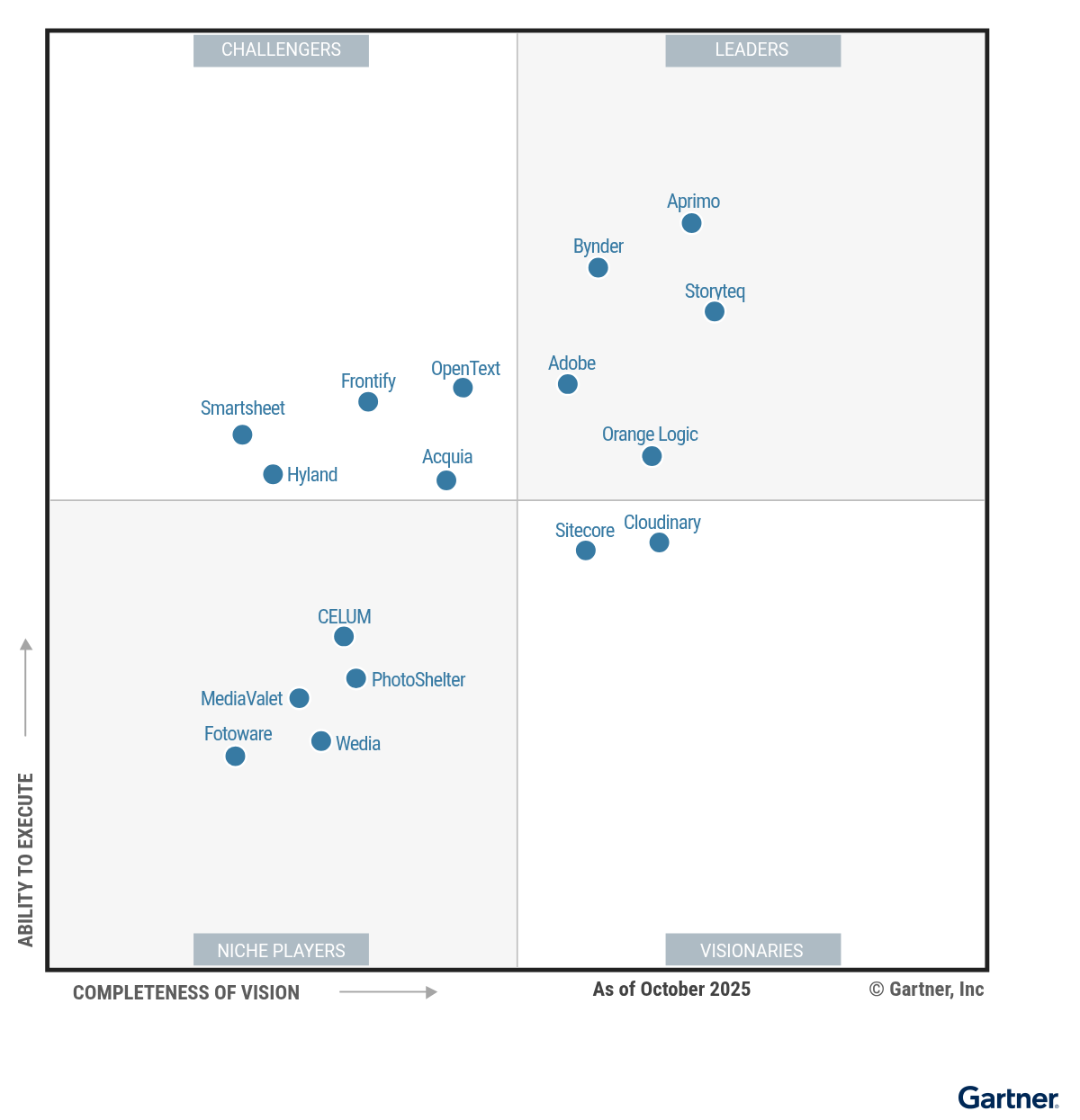
Vendor Strengths and Cautions
Acquia
Acquia is a Challenger in this Magic Quadrant. Acquia DAM supports the full asset life cycle, from ingestion and organization to distribution and archival, enabling enterprisewide content operations across digital, print and packaging. Acquia primarily operates in North America and EMEA, serving large multibrand enterprises and midmarket organizations across industries such as healthcare, financial services, consumer packaged goods (CPG) and manufacturing. Recent enhancements include facial recognition for image tagging, AI-powered video transcription, collaborative collections — which allows users to group assets for sharing and portals and offers the ability to invite others to collaborate on the collection — and an AI assistant for content discovery. The roadmap focuses on AI image generation, semantic search and expanded multilingual UI support.
- Integrations and architecture: Acquia DAM offers over 80 prebuilt connectors, APIs and webhooks for integration with various marketing technologies and enterprisewide solutions, such as master data management (MDM) services (e.g., Amazon Redshift, Google BigQuery and Snowflake), and collaborative solutions (e.g., Google Drive and Microsoft 365). Its architecture supports embedding DAM into existing workflows and scaling content operations across teams and channels.
- Auditability and security certifications: The platform supports configurable user roles, detailed audit trails and rights management. It is HIPAA-ready and ISO 27001 certified, supporting regulated industries and unlimited users for large enterprise scalability.
- Implementation and support: Acquia delivers customer success through dedicated migration services, strategic workshops and managed support. All customers are entitled to 24/7 technical assistance, and its partner enablement program strengthens the support ecosystem by expanding its service network and potentially shortening time to value.
- Generative AI maturity: Acquia’s roadmap for core generative capabilities, such as image generation and AI-based asset transformations, is still developing. Organizations needing integrated AI tools may find current offerings less mature than competitors.
- MLR review capabilities: Support for medical, legal and regulatory (MLR) workflows is less comprehensive than some peers. Features sought by regulated industries, such as electronic signatures and compliance checklists, rely on third-party services, adding complexity to integration.
- Geographic reach: Acquia’s customer base and direct support operations are concentrated in North America and EMEA. Its limited presence in Latin America and Asia/Pacific may constrain expansion and localized support in these high-growth regions.
Adobe
Adobe is a Leader in this Magic Quadrant. Adobe Experience Manager (AEM) Assets uses a suite-based approach to digital asset management, supporting AI metadata enrichment, real-time collaboration and versioning controls for enterprise asset life cycle management. For extended workflow capabilities and deeper connected asset analysis across customer journeys, organizations would need to purchase Adobe Workfront and Adobe Customer Journey Analytics. Its operations are geographically diversified, serving large and midmarket enterprises across many industries. Recent product upgrades include native Figma integration and contextual search that automatically modifies search filters to save for future use and quickly display relevant results. The roadmap features federated search across third-party repositories and a brand score tool for rating asset compliance within company guidelines.
- Democratized content creation: AEM Assets supports creative workflows by letting users submit new asset requests directly in the platform. If an asset is missing, users can use Adobe Firefly to generate new content from their search prompt, streamlining asset creation and fulfillment.
- Enterprise and brand governance: The DAM offers dynamic access controls and governance features, including role-based and region-based content management. It has both role-based and attribute-based controls to further customize permission modes in the DAM. As one of the founding members of the Content Authenticity Initiative (CAI), Content Credentials was at the forefront of establishing content lineage and verifiable metadata to ensure the authenticity of digital assets.
- Partner network: Adobe maintains a global partner ecosystem, providing professional services and implementation support. Global enterprises seeking localized solutions and in-region support to deploy, configure and manage AEM Assets can utilize Adobe’s network of over 4,200 certified partners across the world.
- Limited agentic capabilities: While agentic capabilities are on Adobe’s product roadmap, at the time of this evaluation, Adobe does not have a generally available brand agent that can preview assets during ingestion, surfacing whether an asset meets predefined brand guidelines. As enterprises move toward semiautonomous agentic workflows to scale content governance, this gap may challenge organizations seeking more advanced brand compliance automation.
- Add-on complexity and cost structure: Adobe’s revised pricing model, effective October 2024, introduced Prime and Ultimate tiers with differentiated entitlements for user types and bundled storage in the base package with an option to expand. Access to advanced features, such as real-time dynamic asset renditions and 3D experiences, requires an additional purchase of Dynamic Media. The limited number of included user licenses in each tier may result in higher costs and administrative complexity for large enterprises or organizations with diverse user requirements.
- User adoption: Organizations may struggle to realize the full value of AEM Assets due to users’ potential uncertainty in selecting the appropriate combination of products (e.g., Adobe Content Analytics, Adobe Workfront and/or Adobe Customer Journey Analytics) needed for intended use cases. This lack of clarity can result in underresourced teams and a gap in dedicated DAM expertise, making it challenging for end users to effectively adopt and operationalize the platform.
Aprimo
Aprimo is a Leader in this Magic Quadrant. Aprimo DAM platform supports the full content operations life cycle, including planning, creation, management and distribution on a scalable, multitenant SaaS architecture. Aprimo operates mainly in North America and EMEA, serving large B2B, B2C and B2B2C enterprises in CPG, financial services, healthcare, life sciences and retail. Recent enhancements include semantic search, LLM-powered automated content reviews and generative AI (GenAI) tools for image creation and modification. Aprimo’s roadmap features an agency management module to streamline content submission, review and rework using AI-based scoring.
- AI innovation: Aprimo leads in this market in the scale of AI capabilities integrated within the platform, including GenAI-powered semantic search, predictive metadata and automated content reviews. These capabilities transform traditional DAM into orchestrated asset management, improving operational efficiency across the content ecosystem and enabling streamlined content workflows within and outside of the DAM.
- Functional scope: Aprimo’s autoscaling SaaS architecture empowers global enterprises to manage diverse asset types and complex high-volume workflows, delivering high performance and reliability. As a result, users benefit from a unified platform that integrates content planning, creation, management and performance insights, enabling end-to-end content operations.
- Robust compliance for regulated industries: Aprimo excels in supporting regulated sectors like life sciences, healthcare and financial services. It offers specialized features such as MLR workflows, AI-based compliance checks and immutable audit trails. Aprimo’s hosting model complies with FINRA, HIPAA and ISO 27001 and holds FedRAMP authorization, ensuring strong data governance and security.
- Layered AI pricing model: While Aprimo embeds AI throughout its platform, advanced GenAI capabilities are offered as an optional “AI Elite” add-on with a credit-based consumption model. This layered pricing may introduce cost complexity and unpredictability, especially when compared to vendors that don’t charge for AI features on a consumption basis.
- Aggressive AI-first strategy: Aprimo’s aggressive focus on AI-driven capabilities, even without “AI Elite,” can challenge organizations with lower AI maturity or those that prefer gradual adoption. Buyers should assess their readiness, as the platform’s pace and scope for AI integration into workflows may exceed what some teams can govern.
- Geographic reach and presence: While Aprimo delivers comprehensive global solutions, multinational enterprises seeking a single technology partner with strong in-market customer service should note that Aprimo’s direct office presence and customer support infrastructure are concentrated in North America and EMEA.
Bynder
Bynder is a Leader in this Magic Quadrant. Bynder DAM focuses on AI-powered strategic content management and omnichannel content distribution. Operations span North America, EMEA and Asia/Pacific, with a client base of large and midmarket enterprises in CPG, manufacturing and retail. Bynder recently introduced a suite of AI agents within its DAM for automating complex workflows such as content enrichment, transformation and governance. Planned enhancements include expanded compliance capabilities for regulated industries and support for Coalition for Content Provenance and Authenticity (C2PA) standards that will help detect and flag AI-edited content, as well as expanded compliance agent capabilities that will automate the validation of brand and regulatory industry content requirements.
- Agentic AI: Bynder’s AI-focused DAM platform provides a configurable environment where organizations can create and launch custom AI agents to automate complex workflows within their DAM. For instance, enrichment agents enable automatic metadata tagging and content classification based on user-defined prompts that add reasoning through an LLM. Bynder’s new AI Agents, combined with its API, enable CMOs to easily scale brand-compliant asset creation to nonmarketing stakeholders across the enterprise tech stack.
- Content distribution: The platform has over 145 integrations with martech, content management system (CMS) and product information management (PIM) solutions that enable marketers to distribute content across multiple channels, maximizing audience reach. Dynamic asset transformation ensures assets are automatically adapted for each channel in real time while adhering to brand guidelines.
- Implementation support: Bynder provides customers with prebuilt implementation blueprints, off-the-shelf metadata and taxonomy models, and customizable templates to streamline adoption and reduce setup time. Complex multibrand migrations are supported by best-practice guidance, role-based training, and advice on governance and integration strategies.
- Content performance analytics: Bynder’s content analytics dashboards provide fundamental visibility into asset performance across external channels and traffic sources, but users must configure them through a mixture of APIs and integrations to obtain optimization recommendations or actionable insights (e.g., an asset gained traction on social media and should be used on other channels).
- Vertical strategy roadmap: The platform supports multiple industries, but has a limited vertical-specific roadmap. Bynder prioritizes its extensibility across industries, and the majority of its capabilities are configured for use cases rather than developed for distinct industries. This may be a drawback for buyers seeking advanced visibility into planned industry-specific product innovations.
- Pricing model: Small and midsize businesses (SMBs) and midmarket customers can utilize storage-based pricing models. For large enterprise buyers, Bynder charges by the number of assets rather than total storage volume (terabytes). Large enterprises with smaller average file sizes may find file-size-based pricing more cost-effective, while those with larger or highly variable asset sizes — such as a single large video file — could benefit from Bynder’s asset-based model. Buyers should evaluate their asset library’s typical file size and variability to determine which pricing structure best suits their needs.
CELUM
CELUM is a Niche Player in this Magic Quadrant. Its Content Supply Chain Management Platform for Product Content Management and Brand Management offers tailored audience frontends and content templates to support product content management and brand management. Operations are primarily based in EMEA with some presence in North America, serving large enterprises in retail, manufacturing and CPGs. Recent innovations include enhancements that consolidate and streamline federated user and group management processes. The roadmap includes enhancements for global sharing, such as a unified UX and UI through the Content Supply Chain as well as a central location for managing all active shares.
- Metadata and tag management: CELUM’s metadata capabilities enable the inheritance of product details directly from PIMs and ERPs to its DAM. Its AI autotagging extracts text from content and automatically provides captions and alt text descriptions in multiple languages based on the user’s language settings on asset ingestion.
- Vertical enablement and peer learning: CELUM offers prebuilt metadata and setup templates tailored for four key industries — CPG, high-tech, manufacturing and retail — alongside structured onboarding and training plans that include buddy and ambassador programs to accelerate user adoption. A customer-to-customer coaching program facilitates peer exchange among comparable, noncompeting organizations through an independent user group.
- Collaboration and workflow management: The WORK module includes Kanban project management, in-document markup for any file type, lightweight tasking via @mentions and sandboxed handling of work-in-progress content. Universal review and approval functionality extends these capabilities beyond DAM, supporting approval processes across web and digital experiences to enable more seamless teamwork.
- Manual digital rights management: License and rights management tracking remains largely manual, lagging behind other vendors that offer automated features like expiration alerts and usage restrictions. Asset review capabilities include asset linking and flexible editing; however, automation is limited.
- Packaging: Of the eight products that make up the CELUM platform, two (Content Templates and Integrations) are not included in the platform. Furthermore, many features that other vendors include in their main product, like content templates, classic content delivery network (CDN) transfers and AI content editing abilities, are available only as add-ons for an additional fee. This may result in escalating overall costs for buyers who need advanced capabilities.
- Limited global presence: CELUM’s operations are predominantly concentrated in EMEA with only a limited footprint in North America and minimal representation in other global markets. This concentration may present challenges for organizations requiring robust global support, localized implementation or in-region expertise.
Cloudinary
Cloudinary is a Visionary in this Magic Quadrant. Its Cloudinary Assets product is broadly focused on visual media formats (including images, videos and 3D) and leverages GenAI across the asset life cycle. Operations are primarily based in EMEA and North America, serving enterprise and midmarket organizations in CPG, manufacturing, media and entertainment, and retail. Recent upgrades include Cloudinary AI Vision (visual question answering [VQA]), which leverages a multimodal LLM and specialized algorithms to understand visual context to automate image classification and custom tagging. The platform also offers enhanced workflow engine capabilities with new prebuilt integrations for third-party platforms such as PIMs, CMSs, project management solutions and digital commerce systems. The roadmap includes taxonomy agents to assist with taxonomy creation and refinement, as well as video visual search to identify and locate objects, scenes or moments within video using visual analysis rather than metadata.
- Advanced search and metadata enrichment: The platform supports natural language processing, optical character recognition, search by person, related image search and scene-based search. Automated alt text generation as part of AI-driven metadata enrichment ensures that asset metadata complies with WCAG 2.1 AA accessibility standards when assets are distributed to websites.
- Flexible AI model integration: Cloudinary AI Vision enables customers to integrate their own trained AI models, which allows for domain-specific search and taxonomy enrichment. Cloudinary’s AI Vision provides additional options to create a custom, context-aware tagging and metadata taxonomy without having to train an LLM. This flexibility supports tailored visual content analysis for unique organizational needs.
- Optimized global content delivery: Cloudinary delivers optimized images and videos using automatic quality and size adjustments, content-aware autoformatting and real-time editing. Its multi-CDN architecture ensures fast load times and high-quality displays across global channels, devices and browsers. Dynamic video streaming and accessibility compliance further enhance the customer’s or prospect’s experience.
- Content analytics: Cloudinary’s out-of-the-box dashboards and analytics focus on asset engagement metrics such as views, downloads and search trends within the platform. It does not have prebuilt dashboards for external marketing channels, making it difficult to track asset usage and identify assets for reuse. Instead, users would have to use external business intelligence (BI) tools to manually create this dashboard outside of its platform.
- Vertical-specific expertise: Addressing specialized industry needs often requires implementation partners or third-party tools, especially for advanced digital rights management. This reliance may introduce additional costs, integration complexity and dependencies on partner expertise that can impact alignment with unique or regulated industry requirements.
- Professional services capacity: Many enterprises with complex enterprise DAM deployments typically rely on implementation partners or third-party resources to support their DAM implementation. This dependency can introduce additional costs, extend deployment timelines and increase dependencies on third-party partner expertise that may impact alignment with enterprise-specific requirements.
Fotoware
Fotoware is a Niche provider in this Magic Quadrant. Its Fotoware Veloz and Fotoware Alto products streamline workflows from asset ingestion to distribution and content workflow, with Veloz serving as the classic DAM and Alto as an API-first DAM. Operations are mostly focused in Europe, serving midmarket organizations including manufacturing; galleries, libraries, archives and museums (GLAMs); law enforcement and defense; and media and entertainment. Recent upgrades include the launch of Flow, a cloud-native workflow automation platform, that includes improved in-platform messaging for internal collaboration and enhancements to the consent management solution to support GDPR compliance. Fotoware’s portfolio now features AI-powered autotagging and enhanced support for content authenticity standards. Looking ahead, the company plans to invest in the C2PA, which will enable asset provenance detection, GenAI for asset modification and creation, and basic video editing capabilities.
- Workflow automation and efficiency: The Flow add-on is a cloud-native solution that enables users to automate asset ingestion, metadata tagging and distribution. Workflow states are tracked using standard metadata so assets can exist in multiple states without changing their physical location, supporting efficient and flexible content management.
- Vertical-specific portfolio: Alto and Veloz offer tailored DAM solutions for different client environments with each product configured to handle large collections, structured metadata and time-sensitive workflows for teams managing active content production.
- Customer experience and support: Fotoware has a high customer retention rate, aided by prebuilt frameworks and templates. The professional services and customer success teams provide ongoing support throughout the customer life cycle, encouraging cross-team collaboration and successful platform adoption. They offer multiple sessions and meetings with routine check-ins, comprehensive annual reviews and quarterly business reviews (QBRs) to systematically gather client feedback and maintain lines of communication. This involves many of the client’s stakeholders.
- Native asset dashboards: Fotoware requires exporting asset activity logs and usage data to external BI tools instead of providing in-platform reporting. This reliance increases administrative overhead, creates integration dependencies and limits real-time visibility, making it harder for administrators to efficiently monitor asset performance and user activity within the DAM.
- GenAI innovation: Fotoware has released fewer GenAI features than other vendors, with notable gaps in areas such as brand AI compliance and agent-driven automation. The absence of advanced GenAI capabilities, including automated brand validation and AI agents for workflow management, indicates lower AI-search readiness, despite increased demand among DAM buyers.
- Local operational support: Fotoware’s physical presence is limited to EMEA, and most of its UI languages are those prominent in Europe. Region-specific investment is modest, which may impact organizations seeking broader support outside of EMEA.
Frontify
Frontify is a Challenger in this Magic Quadrant. Its Frontify DAM product is part of a broader platform that combines digital asset management, brand-native workflows, templating and portals to support unified brand governance and consistent content execution across teams and channels. The company operates mainly in North America and EMEA, serving global consumer brands, technology firms and large service-based enterprises, including regulated industries like healthcare and financial services. Recent enhancements include leveraging natural language processing (NLP) to enable its Brand Assistant and intelligent asset search, which includes optical character recognition (OCR) (e.g., search for words within an image), and an OpenAI-powered image generation app. The roadmap features deeper analytics, batch and variant creation, Figma template integration and AI-powered video tagging.
- Unified brand management: The platform integrates DAM, brand guidelines, templating and portals in a single system. This central hub enables consistent brand governance and efficient content delivery across channels. Frontify’s focus in these areas enables teams to move beyond DAM for basic asset storage to DAM as a command center for brand execution.
- AI-driven content operations: AI features such as natural language search, workflow automations and generative tools like image creation are embedded throughout the platform. These capabilities enhance discovery, streamline processes and support scalable, brand-compliant content creation.
- Governance and compliance: Granular permissions, audit trails and support for business associate agreements (BAAs) provide secure and compliant asset management. ISO 27001 certification and a portal-based governance model help enterprises, especially those in regulated sectors, manage and track assets utilization and history.
- Limited GenAI: Frontify’s “AI-first” approach includes prompt-based content creation and image generation but does not yet support the full range of GenAI features, such as audio or presentation creation, or video transcription. The focus remains on amplifying creativity for brand-specific needs rather than replacing content workflows entirely.
- Geographic concentration: Frontify has a strong presence in North America and EMEA but a limited direct presence in Latin America and Asia/Pacific. While it offers global support and works with partners across time zones, most revenue and operations remain concentrated in EMEA and North America, which may limit localized support and expansion.
- AI cost structure: AI features, except for facial recognition, are included at no additional cost; however, an undefined, indeterminate excessive compute may result in additional charges. While future pricing models may evolve, the lack of transparent pricing for high-volume AI usage could lead to unpredictable costs for customers who rely heavily on GenAI.
Hyland
Hyland is a Challenger in this Magic Quadrant. Its Nuxeo for DAM platform focuses on product asset management, connecting product content, data and assets across the organization. The platform emphasizes intelligent content solutions powered by AI and automation with a strategic focus on embedding GenAI to support content management, organization and cloud-native deployments. Operations are primarily based in North America and EMEA, serving enterprise organizations in CPG, financial services and retail. Recent releases include a suite of AI services for content search and analysis, metadata enrichment and agentic workflows. The roadmap over the next three years includes support for 3D/CAD, augmented reality (AR) and virtual reality (VR) content with enhanced viewers and management tools for immersive formats.
Hyland declined requests for supplemental information. Gartner’s analysis is therefore based on other credible sources.
- Creative workflow management: Hyland provides flexible and scalable workflow management, allowing users to design custom, multistep workflows through a visual designer without coding. Advanced features include parallel task execution (e.g., multiple independent tasks occurring at once), conditional transitions (e.g., workflow automation), automated notifications, and integration with other business systems, helping organizations optimize content creation, modification and distribution for greater efficiency.
- Cloud-agnostic optimization: Hyland uses a cloud-native approach that supports deployment and management of its platform on any cloud provider, offering true storage independence. The platform also includes native compatibility with low-frequency access storage solutions such as Amazon S3 Glacier and other cold storage providers, enabling organizations to store rarely accessed assets at a reduced cost and effectively optimize their storage spend.
- Configurable data objects: The platform offers configurable data modeling capabilities, enabling organizations to define and manage any type of asset, container or data object, and then capture the relationships between them without the need for custom coding. This flexibility allows for the abstraction of critical enterprise data from adjacent systems — such as PIM, CRM and MAM — within the DAM environment, supporting complex business workflows and decision making.
- Limited native performance insights: The platform does not natively provide comprehensive performance analytics for distributed content. Asset performance requires integration with external analytics platforms and customer interaction data sources, adding complexity and resource requirements for a holistic view of content ROI and engagement. Buyers have the additional resource burden of needing an external BI tool to supplement.
- Market focus: Hyland has a large professional services organization; however, this team spans the entire Hyland portfolio, limiting the availability of DAM-specific expertise for marketing-centric deployments. Its roadmap for 2025 prioritizes long-term support and core architectural updates, which may divert resources from the development of advanced marketing and creative features advancing in this market.
- Innovation investments: Hyland’s sales strategy and innovation constrain its DAM product’s agility. As a platform-focused vendor, its preference for larger, longer-term and more complex engagements, coupled with limitations on diverse customer feedback, contributes to this limitation. When customers do submit feature requests, Hyland prioritizes suggestions according to its established product roadmap, which may delay new or urgent needs that fall outside predefined development themes. CMOs looking for a competitive advantage from investments in innovative DAMs should potentially seek an alternative.
MediaValet
MediaValet is a Niche Player in this Magic Quadrant. MediaValet DAM delivers a secure, easy-to-use and cloud-native DAM solution with a particular emphasis on user experience as demonstrated by the pending introduction of its new Experience Portals — a customizable CMS that makes a brand portal immersive by dynamically updating content in real time. Operations are primarily based in North America with a presence in EMEA and Asia/Pacific, serving midmarket and enterprise customers in CPG, higher education, financial services and manufacturing. Recent innovations include similar image search, which uses AI for content recognition and MediaValet Proofing, a PageProof-powered feature that streamlines creative workflows through integrated approval and in-DAM asset proofing. The roadmap includes the launch of the MediaValet Intelligent Library Assistant, an AI-driven assistant designed to help users search for assets and execute tasks within the DAM platform.
- Integrated Office365 functionalities: MediaValet has prebuilt integrations to Microsoft Office 365 that MediaValet users can access from within these apps. Additionally, it is the only DAM platform evaluated with an embedded, native Microsoft Office Online integration that allows users of its DAM to preview, present and collaboratively edit Microsoft Word, Excel and PowerPoint files natively within MediaValet.
- Dedicated customer success: MediaValet demonstrates a strong commitment to customer retention through specialized implementation services that emphasize success planning and clear goal setting from the outset. Ongoing account management includes regular progress reviews and proactive health monitoring based on customer utilization data, enabling early identification of issues and tailored support.
- Curated brand portals: The acquisition of Beam in 2Q25 has enhanced MediaValet’s brand portal offering, rebranding as Experience Portals with advanced CMS features, intuitive page building and AI-powered tagging for improved asset discoverability. This integration supports scalable, self-serve content sharing and advanced access controls, enabling organizations to deliver curated, branded experiences and track engagement analytics.
- Limited GenAI content creation: MediaValet does not currently support GenAI-powered content creation, such as prompt-based generation of images, video or text or automated variant generation. These capabilities are not available as add-ons. While the platform uses AI for metadata enrichment and content understanding, it does not provide detailed narrative asset descriptions. Organizations seeking GenAI-driven creation and personalization features may need to consider alternative solutions.
- Vertical strategy: MediaValet’s generalist product development may result in a lack of specialized features tailored to unique industry requirements. The platform does not provide the industry-specific out-of-the-box workflows, compliance tools or integrations needed for organizations in highly regulated or niche sectors such as healthcare, financial services or media. These organizations would require additional vertical-specific customization, third-party solutions or internal development to meet their operational needs.
- Selective integrations and add-ons: MediaValet offers a focused set of prebuilt connections to platforms such as Slack and Salesforce Sales Cloud, but the number of out-of-the-box integrations is more limited than some competitors. Advanced features like templating, cold storage and expanded CDN linking are primarily available as add-ons, which may require additional investment for extended functionality.
OpenText
OpenText is a Challenger in this Magic Quadrant. Its OpenText DAM and OpenText Core DAM products focus on connecting content creation and distribution stages to deliver a uniform omnichannel experience. Operations are primarily in North America and EMEA, serving large enterprises in CPG, media and entertainment and government. Recent upgrades include a public cloud DAM solution and a private trainable AI that lets customers keep intellectual property within their domain while training the AI engine. The roadmap features a no-code iPaaS for martech ecosystem integrations and Aviator Search AI Agent for enhanced search experiences.
- Deployment flexibility: OpenText offers on-premises, public cloud and private cloud deployment options, allowing customers and prospective buyers to tailor their DAM solution to meet their enterprise’s storage and security preferences.
- Partner networks: Dedicated teams maintain strategic integrations with technology and hyperscaler partners. A global network of agency, technology and consulting partners provides region-specific DAM hosting, administration and implementation support.
- Sales strategy: It has industry-specific sales teams and a partner enablement team who collaborate with product and marketing to understand the unique industry-specific needs. Partners have access to OpenText Learning Services for certification, a developer forum and service portal, all of which help partners bring proven expertise to their DAM deployments.
- GenAI content capabilities: While OpenText offers AI-generated images through third-party integrations, many other generative content features such as video, presentations, marketing briefs and email remain on the product roadmap and are not yet generally available. Several competitors already provide these capabilities as part of their core DAM solutions. As OpenText continues to develop its GenAI-enabled content features, organizations with immediate needs for a broader range of capabilities may consider evaluating other solutions that currently offer these functionalities.
- Vertical-specific innovation: OpenText’s product strategy remains primarily generalist and cross-industry, emphasizing customizability over prebuilt, deeply specialized vertical functionalities. While some enhancements are positioned as vertical-specific, they are typically broad feature improvements rather than purpose-built solutions for niche industry challenges, such as automated compliance review workflows for pharmaceuticals.
- Cost of AI: Most of its AI-assisted search capabilities, such as facial recognition and similar image search, are offered for an additional cost, requiring investment beyond the base product subscription and integration with the DAM solution, resulting in higher total cost of ownership and increased budget complexity for adoption of advanced capabilities. This pricing approach contrasts with market trends, where many competitors increasingly bundle advanced search and AI functionalities within standard offerings.
Orange Logic
Orange Logic is a Leader in this Magic Quadrant. Its Orange Logic DAM product delivers scalable, AI-driven enterprise content orchestration with flexible, customizable brand portals, extensive AI agent capabilities and hybrid storage solutions. Operations are primarily based in North America with a presence in EMEA, serving large enterprises in media and entertainment, retail and CPG and financial services. Recent product launches include Agent Studio for deploying prebuilt or custom AI agents, a visual Workflow Design Tool for drag-and-drop automation and AI-driven conversational search. The roadmap includes “DNA mapping” — training AI agents on brand and user behavior data to sharpen insights and tailor experiences through adaptive learning.
- Agentic automation: Orange Logic Agent Studio enables customers to deploy prebuilt or custom AI agents to automate, orchestrate and scale content operations across more than 80 third-party tools. Through these tools, the agents perform functions across the content life cycle, including content creation, enrichment, review and publishing, while ensuring brand safety and robust metadata management.
- AI-driven conversational search: The platform allows users to find assets using natural language queries with contextual awareness across the following vectors: brand awareness, metadata, asset relationships, life cycle status, images, frame-by-frame video analysis and user persona. These features support efficient delivery and intuitive asset discovery.
- User-friendly workflow design: The visual Workflow Design Tool offers drag-and-drop automation with roles, conditional logic, parallel steps and approvals. Teams can build, test and version workflows independently without vendor assistance to orchestrate both human and AI-driven processes across creative, compliance and distribution functions.
- Global market presence: Orange Logic’s market presence is predominantly concentrated in North America, with comparatively limited presence in EMEA. Although it does maintain physical offices in EMEA and Asia/Pacific, customers outside of North America may need to seek more regionally tailored support and services to address local requirements.
- Time-to-value: Despite improvements, Orange Logic’s average implementation onboarding process remains lengthy compared to other vendors evaluated. Marketers should consider that this extended timeline may delay how quickly organizations achieve benefits from the DAM solution, potentially impacting campaign launches, content strategy execution and the ability to respond quickly to market opportunities.
- Premium add-ons: Orange Logic’s pricing model designates a wide range of key functionalities, complemented by optional add-on modules, including media acceleration (3D support), rights/talent management, project and workflow management and site builder (no-code). While modular pricing is common in the DAM market, most large enterprises will need to license their highest module and select to purchase additional modules to meet their DAM requirements.
PhotoShelter
PhotoShelter is a Niche Player in this Magic Quadrant. Its flagship product, PhotoShelter for Brands, is designed for managing high volumes of visual content with a strong focus on sports, higher education and healthcare. The platform offers specialized workflows for real-time content distribution, user-generated content (UGC) management and AI-powered tagging. Operations are primarily concentrated in North America, serving midmarket to enterprise organizations. Recent updates include Shared Albums for social content distribution and the launch of AI Sentiment Analysis. The acquisition of Socialie in 2023 expanded UGC management and social content distribution capabilities. Future investments focus on enhancing AI-powered visual and video search (including logo and player tagging), expanding UGC capabilities, improving accessibility, and growing multilanguage support in EMEA.
- Robust UGC management and social distribution: PhotoShelter enables brands to crowdsource authentic content through branded landing pages, collect usage rights and contributor info, and integrate submissions into the DAM library. The Socialie acquisition and Shared Albums feature further support automated content sharing and social content distribution.
- Vertical expertise and tailored AI: The platform offers AI-powered tagging features for sports and education clients (such as logo, player and facial recognition), leveraging roster and uniform data. In healthcare, HIPAA-compliant workflows and permissions help maintain brand consistency and protect sensitive data.
- Real-time content velocity and performance tracking: PhotoShelter streamlines live event operations by moving content from camera to stakeholders and digital channels in under a minute and offers post suggestions for social sharing. Its Magic Tracking feature automatically detects if shared content on tracked profiles was suggested brand content or not, even if the content wasn’t posted through PhotoShelter, enabling comprehensive engagement analytics.
- Niche market focus: PhotoShelter’s platform is especially tailored for verticals such as sports and education, offering specialized features and workflows. Organizations seeking a general-purpose DAM may find functionality, integration options and scalability less adaptable for other verticals or broader enterprise needs.
- Limited GenAI capabilities: The platform lacks robust GenAI features for content creation, variant generation, marketing briefs and automated recommendations, which will hinder CMOs seeking competitive advantage from GenAI-enabled content creation.
- Additional costs for advanced AI: While core AI features are included, advanced functionalities such as player and logo tagging and sentiment analysis are available only as paid add-ons and are subject to usage limits. High-volume asset processing or extensive AI-driven tagging and sentiment analysis can increase the total cost of ownership.
Sitecore
Sitecore is a Visionary in this Magic Quadrant. Sitecore Content Hub supports enterprise digital asset management, helping organizations centralize, manage and orchestrate content across complex workflows and channels. Operations are based in Asia/Pacific, EMEA and North America, serving enterprise and midmarket organizations in predominantly financial services, manufacturing, professional services and retail. Recent upgrades include template sharing, which streamlines team onboarding and campaign execution by enabling the reuse of standardized templates with preconfigured roles, permissions and workflows. Additionally, Sitecore introduced the ability for customers to use their own preferred AI provider or bring in their own custom-developed AI solution for grounded image tagging and custom workflows. The roadmap features asset usage reporting for media analytics and ROI, as well as AI-generated alt-text for images to improve accessibility and search engine discoverability.
- Enhanced search and findability: Advanced search capabilities proactively display recommended search filters and data-driven suggested search terms, helping users improve search results. Users can refine queries and accelerate content discovery across large repositories.
- Brand compliance recommendations: Integration with external AI models enables asset-level recommendations and compliance checks based on brand guidelines. The system highlights specific issues, strengths and suggested changes to support brand and regulatory adherence.
- Global reach and multilingual support: Content Hub is designed for deployment across diverse geographic markets. Its multilingual framework supports all Unicode-compatible languages with default options for major languages and customizable configurations. GenAI-powered text translation and integration with third-party services enable instant multilingual content delivery.
- Manual taxonomy management: Taxonomy configuration and management is manual and not AI-driven, as increasingly observed in this market. As organizations seek and utilize automated capabilities, this lack of AI automation may limit scalability and delay time to value for organizations seeking automated classification and metadata generation.
- Reliance on third-party integrations for GenAI: Many common GenAI features, such as creating images, videos, audio files and presentations, currently require third-party integrations, providing buyers with flexibility to use external AI tools, and AI assistants are on the roadmap. However, some organizations prefer native, embedded functionality to simplify workflows and reduce martech stack complexity, which Sitecore does not fully support. Buyers should determine whether the flexibility of integrations outweighs the potential for increased cost and operational complexity when considering GenAI content creation.
- Complex and add-on-heavy pricing: The base DAM package includes limited user entitlements and storage. Many advanced capabilities such as expanded user cohorts, development environments, advanced AI tools and Sitecore Stream — a brand-aware guidelines and recommendations content orchestration layer — are available only as add-ons at additional cost. This can escalate costs for organizations that require comprehensive functionality or high utilization.
Smartsheet
Smartsheet is a Challenger in this Magic Quadrant. Its Brandfolder by Smartsheet DAM product focuses on content creation, automation and asset distribution for internal and external use. Operations are primarily in North America with limited presence in EMEA and Asia/Pacific, serving small and midsize businesses (SMBs), midmarket and enterprises across CPG, education, manufacturing and retail. Recent upgrades include improved bulk asset upload limits and launch of 24/7 web and chat customer support. Planned enhancements will expand AI-enabled features such as facial recognition, natural language search and GenAI content editing to improve user experience.
- Customer experience: Shorter average DAM implementation times compared to other vendors evaluated in this research support faster time to value for customers. Smartsheet provides in-house professional consulting, solution architecture services and a comprehensive customer education program for onboarding and training.
- Sales partner enablement: The Aligned Partner Program comprises over 400 global partners, ranging from business consultants to system integrators, who receive free certification directly from Smartsheet, expanding the number of knowledgeable partner customers. Prospective buyers will have access to the partner program for implementation support and ongoing maintenance of the DAM platform.
- Multilingual user interface: The DAM interface is available in 23 languages. Its multilanguage asset details feature allows users to add asset names, description tags and custom fields in multiple languages, dynamically displaying the relevant language for each user.
- GenAI innovation: AI-assisted search capabilities lag behind other DAM vendors. Smartsheet has not released any AI-enabled compliance workflows, such as AI prechecking content to meet brand guidelines. Features like natural language search, facial recognition, related image search and object detection, which are standard elsewhere, remain on Smartsheet’s roadmap.
- Vertical and industry support: Smartsheet does not have any vertical-specific product enhancements planned for its DAM, nor does it offer potential buyers and customers a vertical-specific product roadmap. Prospective buyers increasingly seek vendors with a clear strategy for supporting industry needs and adapting to market changes.
- Regulatory compliance support: The platform does not support the signing of BAAs and lacks FedRAMP authorization. U.S.-based companies that require adherence to these specific regulatory standards should consider alternative platforms that meet their compliance obligations.
Storyteq
Storyteq is a Leader in this Magic Quadrant. Its Storyteq DAM product is focused on AI-first asset operations and contextual analytics, enabling data-centric content orchestration to dynamically manage, optimize and distribute digital assets at scale. Its operations are mostly focused in EMEA with additional presence in North America and Australia, and its clients tend to be enterprise organizations across automotive, CPG, financial services and retail industries. Recent releases include the launch of Halo Intelligence Suite, which introduces contextual intelligence across assets, workflows and user behavior in the platform; machine-learning-based tagging; and compliance AI for asset-level insights and compliance support. The roadmap includes an AI-first Compliance and Rights Engine, leveraging multimodal models to detect rights issues, enforce governance and ensure real-time compliance with continued focus on DAM use cases across its key industry verticals.
- AI security management and innovation: Storyteq’s AI uses legally sourced data and embeds dynamic consent management, automated PII detection and continuous compliance auditing throughout its platform. Its “Agents as a Service” (AaaS) framework empowers organizations to deploy configurable, modular AI agents, such as summarizers, translators and taggers, directly within DAM workflows using no-code/low-code blueprinting for integration with internal processes.
- Professional service and support: Storyteq offers a range of professional services to support customers from onboarding and change management to integration and AI enablement. Technical support is available to all clients, regardless of tier, helping customers best leverage platform capabilities.
- Specialized vertical sales programs: Storyteq leverages dedicated sales teams with deep expertise in pharma and healthcare, automotive, financial services, retail and CPG, and media and entertainment to deliver tailored solutions that address sector-specific challenges. The company offers vertical-specific frameworks that include workflows, content schemas and compliance examples to help accelerate organizations’ time to value.
- Cost of integrations: Many prebuilt integrations with key marketing technology and enterprise systems — including work management, multichannel hubs, personalization engines, social management, ERP, MDM, CRM and PIM — are available for a flat fee per connection. Organizations seeking a fully connected ecosystem should anticipate potential increases in total cost of ownership beyond the base license.
- Limited marketing execution: Storyteq’s marketing investment and outreach are comparatively modest with fewer direct promotional events and a less developed partner marketing channel than many competitors. These factors contribute to a smaller audience reach and may limit brand visibility and market penetration for its DAM offering, particularly in highly competitive segments. A smaller audience reach compared to peers, combined with disruptions of traditional inbound channels such as search, inhibits brand visibility needed to maintain market position, growth and roadmap delivery in highly competitive segments.
- Geographic presence: Storyteq’s direct sales and support operations remain heavily concentrated in EMEA and North America with minimal presence in Asia/Pacific and Latin America. Despite active expansion initiatives and the strategic acquisition of PureRed, the absence of dedicated teams in these regions can limit localized service delivery in terms of customer service and responsiveness for customers seeking support outside core markets.
Wedia
Wedia is a Niche Player in this Magic Quadrant. Its Wedia DAM platform supports enterprise-grade digital asset management with a focus on global content localization, unified product and media workflows and scalable content distribution. Operations are primarily based in EMEA, serving enterprise organizations in financial services, manufacturing, retail and utilities. Recent upgrades include its integrations with Nano-Banana for AI image editing and DeepL (an enhanced AI translation) for metadata, subtitles and web-to-print content. Additionally, its most recent partnerships with Activo and Datasolution continue to enhance Wedia’s commitment to deliver an integrated PIM-DAM ecosystem for unified product and media management. The roadmap features digital templates for content localization across markets and channels without design expertise and the upcoming Media Delivery solution for scalable content distribution while maintaining brand consistency.
- Video search: Users can quickly uncover specific portions of a video by searching for a specific person, object, emotion, place or season, eliminating the need to scrub through or search through a caption. This can help with creating video clips of a desired section and aid in the findability of assets.
- Specialist partner ecosystem: Wedia works with a focused network of DAM specialist partners skilled in metadata modeling, taxonomy design and integration with PIMs, CMSs and creative tools. This supports marketers in achieving effective adoption and sustained use, especially for complex multibrand requirements.
- Tailored implementation and support: Wedia offers configurable implementation services, including custom metadata modeling, workflow setup, UI branding, taxonomy design and integration with existing systems. Structured training and data migration processes support adoption, while ongoing indexing services help digital librarians maintain metadata consistency and asset governance for clients with high content volumes or compliance requirements.
- Manual brand compliance review: Brand compliance checks must be initiated manually as automated review workflows are not available. This can increase operational burden for organizations with strict brand governance requirements.
- Limited global presence: Operations are concentrated in EMEA, which increases dependency on regional market conditions. Limited geographic diversification may not meet the needs of customers seeking broader global support, localized services or an extensive partner network outside of EMEA.
- Midmarket segment: Wedia supports large enterprises; however, it has recently begun to expand to target midmarket. This may dilute its focus on the complex needs of enterprise DAM clients. This transition could result in reduced investment in the advanced features, scalability, and integrations that large organizations require.
Vendors Added and Dropped
We review and adjust our inclusion criteria for Magic Quadrants as markets change. As a result of these adjustments, the mix of vendors in any Magic Quadrant may change over time. A vendor's appearance in a Magic Quadrant one year and not the next does not necessarily indicate that we have changed our opinion of that vendor. It may be a reflection of a change in the market and, therefore, changed evaluation criteria, or of a change of focus by that vendor.
Added
The following vendors were added to this iteration of the Magic Quadrant research:
- Frontify
- PhotoShelter
- Wedia
Dropped
Canto was dropped from this Magic Quadrant because it failed to meet Gartner’s definition of a DAM platform.
Inclusion and Exclusion Criteria
Vendor solutions must align with the earlier market definition and successfully adhere to Gartner’s criteria as defined below.
- A provider must demonstrate active participation in the DAM platform market as a pure-play provider of a stand-alone DAM platform without requiring the purchase of other modules or products from the vendor.
- At a minimum, a DAM platform must meet the market definition for Digital Asset Management Platforms.
- At least 100 paying customers use the vendor’s DAM platform.
- The provider has acquired 15 net-new customers in the calendar year 2024.
- At least 70% of 2024 calendar-year revenue for DAM platform is attributable to software, either SaaS/subscription revenue or perpetual license sales (on-premises).
- The provider is required to meet one of the following (reported as constant USD):
- At least $10 million in software license revenue from the DAM in calendar year 2024 and enough cash on hand to fund a year of operations at the current rate of cash depletion
- At least $5 million in software license revenue from the DAM in calendar year 2024, an addition of 20 paying new customers compared to calendar year 2023, and at least enough cash on hand to fund a year of operations at the current rate of cash depletion.
- Definitions: Software license revenue: Exclusive of revenue from professional services. New customers: A customer who has successfully deployed the digital asset management platform in a production implementation. Clients in production: A client who has successfully deployed the DAM. At a minimum, they have bulk uploaded their organization’s assets.
- The provider must have:
- A physical presence in at least one of the two following regions: North America or EMEA.
- Sales support in at least two regions (North America, Latin America, EMEA, Asia/Pacific).
- Vendor ranks among the top 25 for the Customer Interest Indicator (CII) as defined by Gartner. CII was calculated using a weighted mix of internal and external inputs that reflect Gartner client interest, vendor customer engagement, and vendor customer sentiment from 1 July 2024 through 31 May 2025.
Exclusion Criteria
Vendors will be excluded from this research if the vendor’s DAM platform offering cannot be purchased as a stand-alone product, for example, a DAM module that is provided as part of a product information management (PIM) solution. Gartner defines the PIM market as packaged solutions that enable product, commerce and marketing teams to create and maintain an approved shareable version of rich product content. PIM makes a single, trusted source of product information available for multichannel, commerce and data exchange.
Evaluation Criteria
Ability to Execute
Gartner analysts evaluate providers on the quality and efficacy of the processes, systems, methods or procedures that enable IT provider performance to be competitive, efficient and effective. Performance must also positively impact revenue, retention and reputation within Gartner’s view of the market.
Product/Service
For DAM platforms, we evaluated the providers’ capabilities for mandatory and common features as laid out earlier in the Market Definition.
Overall Viability
For each vendor we considered:
- Its relative size in terms of customers, revenue, and the scale, strength and resilience of its ecosystem
- The impact of past acquisitions and the potential for future acquisitions
- The financial stability and continuity of its offerings in this market
- Its evidence of R&D investment for its DAM platform product
Sales Execution/Pricing
For each vendor we considered:
- Revenue and customer growth
- Presales activities and the structure that supports them
- The clarity and predictability of its pricing models and flexibility
Market Responsiveness and Track Record
For each vendor, we evaluated its ability to:
- Quickly adapt, respond and change direction to achieve competitive success as opportunities develop, including how its product is updated
- Ability to support customer needs as those needs evolve
- Fulfill its roadmap promises
Marketing Execution
For each vendor, we assessed the degree to which it has:
- Captured mind share, demonstrated thought leadership and gained a solid reputation in the market
- Demonstrated its ability to have a strong market visibility in the geographic markets they serve
- Executed marketing and partnership programs to expand its influence
Customer Experience
For each vendor, we considered:
- Its ability to provide technical support and implementation
- Its availability and viability of internal customer service and support capabilities, including customer success programs, support resources, systems and policy
- Support outside the vendor’s home region
- The reach and availability of service implementers, and efforts to expand these, such as training and certification programs
Operations
For each vendor, we considered:
- Its overall operational health, including stability in its workforce and changes in leadership
- Its ability to deliver for customers consistently and efficiently in their local language
- Its partner network and certifications
Ability to Execute Evaluation Criteria
| Evaluation Criteria | Weighting |
|---|---|
Product or Service | High |
Overall Viability | High |
Sales Execution/Pricing | Medium |
Market Responsiveness/Record | High |
Marketing Execution | Low |
Customer Experience | Medium |
Operations | Medium |
Source: Gartner (November 2025)
Completeness of Vision
Gartner analysts evaluate providers on their ability to convincingly articulate logical statements. This includes current and future market direction, innovation, customer needs, and competitive forces and how well they map to Gartner’s view of the market.
Market Understanding
We assessed each vendor’s understanding of:
- Current and emerging trends, client priorities and specific needs in the DAM platform market
- How its planning and vision of the DAM platform market addresses market conditions and customer needs
- Its DAM technology innovations and initiatives
Marketing Strategy
We assessed each vendor’s marketing strategy for:
- Clear articulation of an offering’s value proposition in the context of the customer’s business
- Its product/service bundling that meets customer needs
- Its mind share and customer advisory boards and communities
Sales Strategy
We assessed each vendor’s sales strategy for:
- The right balance of direct and indirect sales and partner strategy
- The strength and reach of its partner network
- Its dedication to sales resources, and an understanding of how it reaches and acquires customers
Offering (Product) Strategy
We assessed each vendor’s offering (product) strategy for:
- A DAM platform product’s unique and differentiating capabilities
- The relevance of a provider’s integration and ecosystem partnerships
- Differentiation of its product roadmap
Business Model
For each vendor, we assessed:
- Breadth and depth of any M&A strategies and/or key partnerships that enhances the viability of its DAM platform product
- Alignment and positioning, packaging and pricing strategies for its DAM platform product
- Ability to maintain long-term customers and sustain customer relationships
Vertical/Industry Strategy
For each vendor, we assessed:
- The industries that the vendor focuses on, the industry-specific solutions (if any) that it offers, and how successful or differentiating these solutions are (or are likely to be)
- Vertical/industry-specific product enhancements for DAM platforms
- Vertical/industry-specific roadmap for DAM platforms
Innovation
For each vendor, we assessed:
- Vision of the market and thought leadership
- Plans to incorporate new technologies such as GenAI and machine vision in its product
- Its track record of anticipating or leading new trends in the market
- Specific innovations made to its DAM platforms capabilities
Geographic Strategy
For each vendor, we assessed its ability to:
- Utilize any region-specific partnerships to support locations and product capabilities that support the unique needs of customers in various regions
- Demonstrate commitment to targeted geographies
- Activate authorized resellers to extend the sale and use of its DAM product outside its “home” or primary geography
Completeness of Vision Evaluation Criteria
| Evaluation Criteria | Weighting |
|---|---|
Market Understanding | High |
Marketing Strategy | Medium |
Sales Strategy | Medium |
Offering (Product) Strategy | High |
Business Model | Medium |
Vertical/Industry Strategy | Medium |
Innovation | High |
Geographic Strategy | Low |
Source: Gartner (November 2025)
Quadrant Descriptions
Leaders
Leaders in this Magic Quadrant are characterized by a central focus on agent-based automation and predictive AI, moving beyond traditional autotagging to enable advanced workflows and content optimization. These vendors demonstrate a deep commitment to governance, compliance and brand safety with sophisticated mechanisms designed to address the needs of regulated industries and ensure content integrity. There is a strong emphasis on dynamic content generation and hyperpersonalization, allowing marketers to efficiently create and adapt large volumes of tailored assets. Additionally, the integration of native performance analytics and AI-driven reporting capabilities is prevalent, supporting the measurement and optimization of content impact within the DAM ecosystem.
Challengers
Challengers perform well across all use cases evaluated in Gartner’s research and are well-positioned to support large-scale enterprise migrations and multibrand management, offering defined methodologies and specialized services to facilitate transitions and consolidation for complex organizations. However, their Completeness of Vision for this market falls short of Leaders due to the lack of more advanced GenAI capabilities (e.g., mass content updates) natively found in the platform. Also, some features are only on their roadmap (e.g., rich media support [3D]) instead of generally available at the time of this evaluation.
Visionaries
Visionaries are defined by their strong performance in their products’ innovation and vision for this market. They provide highly configurable, composable architectures with open APIs, allowing integration into marketing technology stacks and empowering organizations to customize solutions. They demonstrate deep specialization in rich media management, making significant investments in video, 3D, and immersive content capabilities to address complex visual use cases. Additionally, they prioritize optimized, omnichannel content delivery, leveraging advanced distribution technologies to ensure high-performance, scalable, and consistent experiences across diverse channels and devices. But their Ability to Execute may be hindered due to their heavy reliance on third-party partners for implementation and integration needs.
Niche Players
Niche Players support core digital asset management platform capabilities, and they perform well in specific business models, industry verticals or geographies. They embrace a narrow view of the market, which makes their technology a fit for very specific verticals or business models. Niche Players’ offerings can be suitable for organizations that require local presence and support, want a close relationship with a provider, or seek a platform that addresses specific industry use cases and functional requirements.
Context
The DAM platform market continues to rapidly transform itself, increasingly being seen as an active repository evolving to an AI-driven platform that supports content creation, management and distribution across the enterprise. Buyers will find that the modern DAM solutions increasingly offer advanced GenAI capabilities, composable architectures, and deep integrations with broader martech ecosystems, enabling scalable content operations and enhanced discoverability. Governance, compliance, and brand safety are paramount in this market, with platforms providing sophisticated controls to mitigate reputational risks, especially in regulated industries. Enterprise buyers’ shift toward multichannel personalization further underscores the need for solutions that support workflow automation and have robust compliance requirements.
Given these developments, DAM buyers should prioritize platforms that deliver robust AI-powered automation, bidirectional integrations, and comprehensive governance features tailored to their organization’s needs. Evaluating vendor partner ecosystems and professional services is critical, as successful implementation and ongoing value realization often depend on high-touch, partner-driven engagements. Buyers should also ensure their chosen DAM can support enterprisewide use cases, deliver measurable ROI through integrated analytics, and scale to meet the demands of content hyperproliferation.
Market Overview
Historically, DAM platforms were viewed as static storage solutions, but this perception is now obsolete for most players in this space. The market has accelerated year-over-year and has created a clear distinction between the two types of DAM platforms organizations could purchase — classic DAMs focused on centralized repositories for the management of content and next-gen, AI-powered asset repositories focused on optimizing workflows, using AI to improve search and content creation. Vendors are investing heavily in either proprietary AI models — or building on top of open-source LLMs — this includes knowledge graphs, and agentic workflows, enabling automation, enhanced asset discoverability, and dynamic content orchestration.
This shift is not merely technological but strategic. Per the 2025 Gartner Business Buyer Survey, DAMs now rank among the top 10 most-anticipated technology investments for marketing buyers, reflecting both dissatisfaction with legacy systems and a desire for platforms that can support broader business objectives.1 However, this increased customization and flexibility have surfaced challenges in usability, scalability, and ongoing management — particularly where initial implementations lacked strategic planning or dedicated resources. As a result, marketing buyers are looking for DAM platforms that can scale with organizational growth, enable cross-functional collaboration, and support multibrand and multidepartment needs. As a result, buyers should focus on the below forces as they review the market.
GenAI Fuels Content Proliferation
GenAI has democratized content creation, resulting in an exponential increase in asset volume and velocity. This surge in asset volumes poses significant challenges for scalability, discoverability, and compliance. DAM platforms are responding with scalable architectures, automated metadata generation, and advanced search capabilities to support content reuse and ensure delivery aligns with regulatory and brand requirements.
Thirteen of the 17 providers evaluated in this research support GenAI content creation natively in their platform through either proprietary tools or embedding open-source LLMs directly within their platform so the user does not have to leave the DAM platform to use the LLM. GenAI-powered asset manipulation and transformation features are now standard, allowing users to execute sophisticated edits such as background removal and generation, object removal, facial swaps, outpainting, and brand adaptation through intuitive prompt-based interfaces. DAM platforms are also introducing intelligent content briefing tools, where AI agents collaborate with human users to generate and refine campaign briefs, combining context-driven creation with deterministic approval workflows.
In video management, AI-driven scripting, editing, and localization capabilities are increasingly available, automating tasks like voice-over generation, subtitle translation, lip syncing, background replacement, and object recoloring. These advancements streamline the production and adaptation of video content for global audiences.
Dynamic, channel-optimized content variants are another emerging capability, with platforms leveraging AI to automatically reflow layouts, translate copy, and adjust aspect ratios, enabling hyperpersonalized content delivery at scale. To address intellectual property concerns and support enterprise customization needs, DAMs are building composable frameworks that allow organizations to integrate custom or third-party AI models (“BYO AI”), ensuring flexibility and control over content generation and transformation within the DAM ecosystem.
Customers and prospective buyers should prioritize DAMs that offer robust governance controls, transparent AI model management, and integration capabilities to mitigate risks related to compliance, brand safety, and intellectual property. It is essential to evaluate not just the breadth of GenAI features, but also how these capabilities align with content workflows, regulatory requirements and long-term scalability. They should also scrutinize vendor support for custom or third-party AI models, as well as mechanisms for human oversight and approval, to ensure responsible and effective adoption of GenAI within their DAM environment.
Governance, Compliance and Brand Safety
As organizations increase their use of GenAI for content creation, they should pay close attention to how DAM platforms support AI model training and metadata strategies. These elements are critical for ensuring that AI-generated content adheres to brand guidelines and regulatory requirements. Many organizations are piloting various existing AI models and agents or they have chosen to — or are considering — leveraging open-source models to provide more flexibility to use existing enterprise AI models to further train the model on their brand. Regardless of approach, this allows models to learn and adapt to unique brand guidelines and organizational data and workflows. Thus far, only about a third of providers evaluated in this research have begun to implement or plan for model context protocol (MCP), which helps standardize and manage AI agents, AI engines and data sources. MCP servers in DAMs will let organizations enable standardization for content provenance, compliance, and governance across different AI engines.
DAM platforms are also advancing their governance capabilities by embedding AI-powered medical, legal, and regulatory (MLR) compliance checks, digital rights management, and tamper-detectable metadata (“Trust Shields”) to help organizations mitigate legal and brand risks. These features support both content authenticity — detecting and flagging AI-generated assets — and content provenance, which maintains a comprehensive historical record of asset creation and modification. Additionally, platforms are enhancing permissions and rights/talent management, offering more granular options for configuring user groups and embedding rights management directly within assets. The introduction of MLR workflows, which may be handled manually or through direct integration with vertical-specific tools, further strengthens compliance and governance throughout the content life cycle.
Managing the heightened risks associated with GenAI is imperative. Marketing leaders should establish cross-functional governance teams that include IT, legal, brand, and relevant functional stakeholders across the enterprise, such as HR and sales, to define clear policies for AI usage and content validation.
Organizations should require DAM vendors to demonstrate MCP support, comprehensive audit trails, and automated compliance workflows before adoption. Additionally, enterprises must implement ongoing training and change management programs to ensure all users understand the implications of AI-generated content and adhere to established governance frameworks, minimizing exposure to legal, reputational, and regulatory risks.
Organizationwide DAM Adoption Requires Asset Findability
Organizationwide adoption of DAM platforms is becoming increasingly critical as organizations contend with unprecedented growth in content volumes and the need for efficient asset management across multiple departments and business units. The ability to quickly locate, evaluate, and repurpose digital assets is now a key driver of operational efficiency, brand consistency, and speed to market. As a result, DAM platforms are expanding their capabilities beyond traditional marketing use cases, supporting collaboration and asset governance for stakeholders in product, sales, digital commerce, and creative operations.
Emerging search technologies are at the forefront of this evolution, with providers introducing advanced AI-driven features such as semantic search, smart tagging, and chat-based asset assistants. These capabilities enable users to retrieve relevant assets using natural language queries, contextual metadata, and even emotion-based search criteria. Additionally, platforms are leveraging AI for visual and similar image search and to support multimodal asset discovery, making it easier for teams to find and curate the right content for any channel or audience.
Given that asset discoverability and advanced search functionality are already top priorities for organizations adopting DAM platforms, it is essential to move beyond baseline capabilities and critically evaluate the depth and sophistication of these features to appeal to a diverse set of stakeholders. Enterprises should assess platforms for advanced search capabilities, intuitive user interfaces, and robust metadata management to ensure all teams can efficiently locate and leverage digital assets. Prioritizing these features will drive higher adoption rates, reduce operational bottlenecks, and maximize the value of DAM investments across business units.
Acronym Key and Glossary Terms
| Alt Tags | Alternative text or descriptions that help improve accessibility and SEO |
| CDP | Customer data platform |
| CMP | Content marketing platform |
| CMS | Content management system |
| Enterprise | Organizations with more than 1,000 employees |
| FedRamp | The U.S. Federal Risk and Authorization Management Program |
| GenAI | Generative AI |
| HIPAA | U.S. Health Insurance Portability and Accountability Act |
| MAM | Media asset management |
| Midmarket | Organizations with 100 to 999 employees |
| MMH | Multichannel marketing hub |
| PIM | Product information management |
| SMB | Organizations with fewer than 100 employees |
1 2025 Gartner Business Buyer Survey. This survey sought to understand how functional business units (customer service, finance, human resources, marketing, sales and supply chain management) within organizations approach large-scale software purchases to support their business function. The survey was conducted online from October through December 2024 among 3,068 respondents from organizations with annual revenue of at least $50 million or equivalent from North America (36%), Western Europe (32%), Asia/Pacific (19%) and Southern Europe (13%). Industries surveyed include education providers, energy, financial services, government, healthcare, health payer, technology, telecom, insurance, manufacturing, natural resources, retail, transportation and utilities. Qualified respondents were at manager level or higher, and had been actively involved in the purchasing process for the most impactful software capabilities for their respective functional business units during 2023 or 2024. Software purchases were either new, replacement or expansion purchases. Disclaimer: The results of this survey do not represent global findings or the market as a whole, but reflect the sentiments of the respondents and companies surveyed.
Ability to Execute
Product/Service: Core goods and services offered by the vendor for the defined market. This includes current product/service capabilities, quality, feature sets, skills and so on, whether offered natively or through OEM agreements/partnerships as defined in the market definition and detailed in the subcriteria.
Overall Viability: Viability includes an assessment of the overall organization's financial health, the financial and practical success of the business unit, and the likelihood that the individual business unit will continue investing in the product, will continue offering the product and will advance the state of the art within the organization's portfolio of products.
Sales Execution/Pricing: The vendor's capabilities in all presales activities and the structure that supports them. This includes deal management, pricing and negotiation, presales support, and the overall effectiveness of the sales channel.
Market Responsiveness/Record: Ability to respond, change direction, be flexible and achieve competitive success as opportunities develop, competitors act, customer needs evolve and market dynamics change. This criterion also considers the vendor's history of responsiveness.
Marketing Execution: The clarity, quality, creativity and efficacy of programs designed to deliver the organization's message to influence the market, promote the brand and business, increase awareness of the products, and establish a positive identification with the product/brand and organization in the minds of buyers. This "mind share" can be driven by a combination of publicity, promotional initiatives, thought leadership, word of mouth and sales activities.
Customer Experience: Relationships, products and services/programs that enable clients to be successful with the products evaluated. Specifically, this includes the ways customers receive technical support or account support. This can also include ancillary tools, customer support programs (and the quality thereof), availability of user groups, service-level agreements and so on.
Operations: The ability of the organization to meet its goals and commitments. Factors include the quality of the organizational structure, including skills, experiences, programs, systems and other vehicles that enable the organization to operate effectively and efficiently on an ongoing basis.
Completeness of Vision
Market Understanding: Ability of the vendor to understand buyers' wants and needs and to translate those into products and services. Vendors that show the highest degree of vision listen to and understand buyers' wants and needs, and can shape or enhance those with their added vision.
Marketing Strategy: A clear, differentiated set of messages consistently communicated throughout the organization and externalized through the website, advertising, customer programs and positioning statements.
Sales Strategy: The strategy for selling products that uses the appropriate network of direct and indirect sales, marketing, service, and communication affiliates that extend the scope and depth of market reach, skills, expertise, technologies, services and the customer base.
Offering (Product) Strategy: The vendor's approach to product development and delivery that emphasizes differentiation, functionality, methodology and feature sets as they map to current and future requirements.
Business Model: The soundness and logic of the vendor's underlying business proposition.
Vertical/Industry Strategy: The vendor's strategy to direct resources, skills and offerings to meet the specific needs of individual market segments, including vertical markets.
Innovation: Direct, related, complementary and synergistic layouts of resources, expertise or capital for investment, consolidation, defensive or pre-emptive purposes.
Geographic Strategy: The vendor's strategy to direct resources, skills and offerings to meet the specific needs of geographies outside the "home" or native geography, either directly or through partners, channels and subsidiaries as appropriate for that geography and market.