Magic Quadrant for Account-Based Marketing Platforms
6 November 2025 - ID G00824480 - 41 min read
By Jenifer Silverstein, Ray Pun, and 2 more
B2B marketers use account-based marketing to acquire new accounts, grow revenue from existing customers and collaborate with sales. This research helps demand generation leaders evaluate ABM platforms to enable better decision making, improve engagement across accounts and deliver measurable value.
Market Definition/Description
Gartner defines account-based marketing (ABM) platforms as software that enables B2B marketing and sales teams to run ABM programs at scale, including account discovery and selection, planning, engagement and reporting. ABM platforms enable the creation of target account lists by unifying first- and third-party data. In addition, they may engage audiences by activating channels such as display advertising, social advertising, email and sales engagement using a mix of native capabilities and integrations.
ABM platforms help B2B marketers and sellers create a set of target accounts and engage buying team members with relevant outreach and content to help buyers explore and evaluate their solutions. To support this effort, ABM platforms offer capabilities to engage audiences by activating channels such as:
- Display advertising and retargeting
- Social advertising
- Email
- Personalized webpages
- Sales engagement
Common use cases include:
- New account acquisition: This scenario involves coordinating marketing and sales efforts to identify and pursue new accounts by leveraging account data and insights, such as firmographics, technographics, and buying intent or signals. It also entails creating effective, relevant account-based marketing programs designed to engage buying teams across channels to generate demand and revenue.
- Account retention: This scenario focuses on harnessing existing customer data (e.g., purchase history, renewal status, product usage, customer health and intent) to identify accounts that require proactive marketing and sales outreach. Specifically, customer marketing campaigns are designed to increase account engagement by reinforcing value statements with the goal of customer retention.
- Account expansion: This scenario focuses on harnessing existing customer data (e.g., purchase history, renewal status, product usage, customer health and intent) and predictive analytics to identify customer growth opportunities where marketing and sales can develop outreach campaigns across channels to upsell or cross-sell additional products and services.
Mandatory Features
At a minimum, the mandatory features of ABM platforms include:
- Discovery, creation and management of target account lists and audiences by unifying first- and third-party data.
- Integration with CRM or salesforce automation.
- Account-level third-party intent data (proprietary and/or licensed from another vendor) to understand buyer interest and behavior, with at least one native third-party intent data source included with the platform license.
- Native user experience for orchestrating and managing display advertising campaigns.
- Journey orchestration and campaign activation across multiple channels, such as social media or search engines, and engagement channels, such as email or website personalization, to drive engagement and progression in the buyer’s journey.
- Account measurement and analytics to quantify buyer engagement across channels and journey stages.
Common Features
Common capabilities of ABM platforms include:
- Sales alerts and insights based on account-level actions and engagement, triggering timely and relevant sales interactions.
- Integrations with complementary marketing and sales technology, such as B2B marketing automation platforms, marketing analytics platforms and sales engagement tools.
- Predictive analytics, such as ideal customer profile fit or propensity to buy models, and recommendations for next best actions.
- Attribution modeling to understand the influence of one or multiple channels in driving buyer engagement.
- Account data, such as firmographics, technographics and psychographics, and account insights to support the creation of account plans.
Magic Quadrant
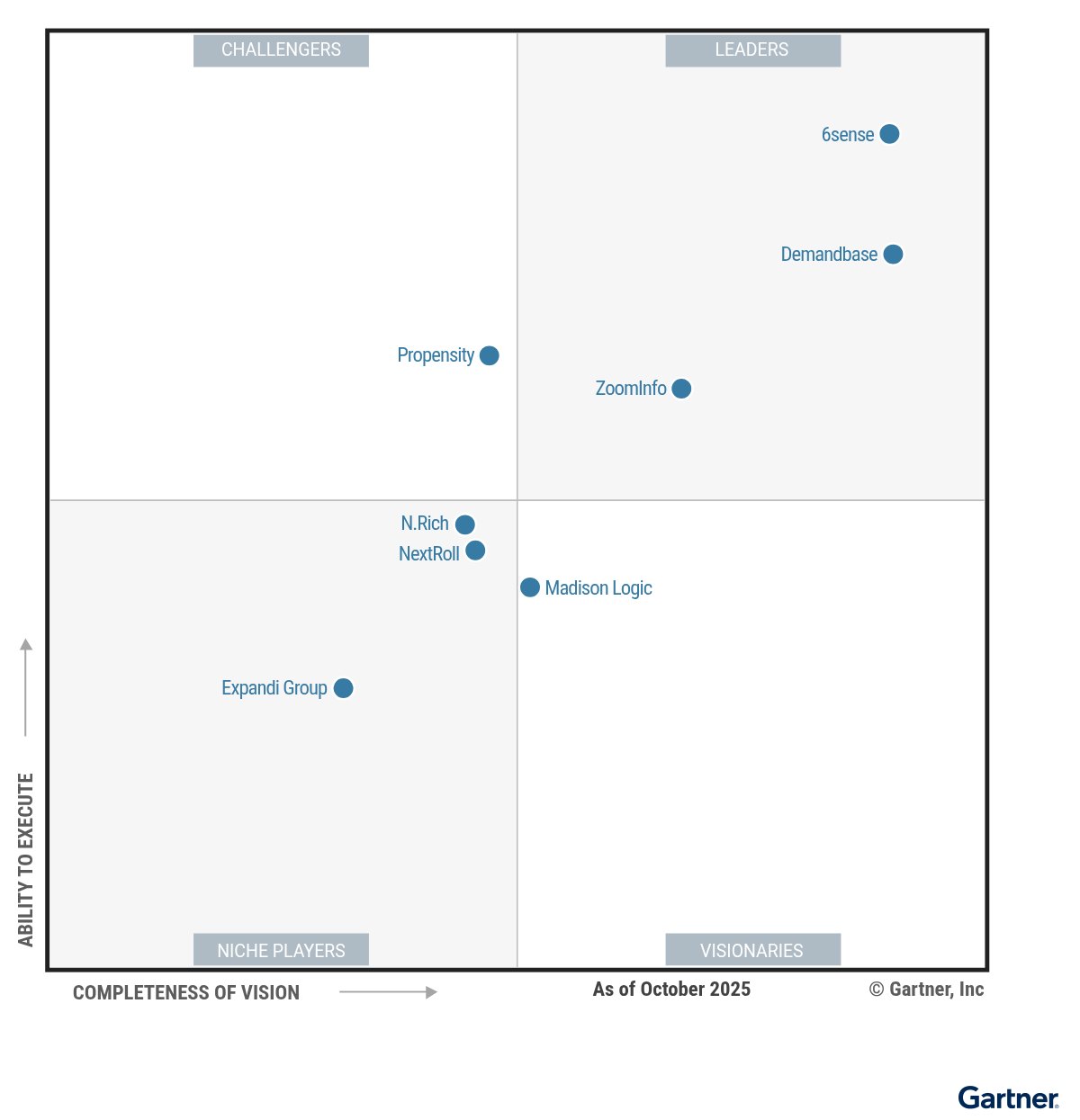
Vendor Strengths and Cautions
6sense
6sense is a Leader in this Magic Quadrant. The 6sense Revenue Intelligence platform helps sales, marketing and supporting operations teams create and optimize account-based marketing (ABM) programs by using AI-driven predictive models, workflows for multichannel orchestration and AI agent-powered email capabilities. Its operations are focused in North America, with additional presence in the EMEA and Asia/Pacific (APAC) regions. Its customers vary in size, with the majority being small to midmarket, primarily in the technology or services verticals.
6sense’s roadmap includes enhanced predictive modeling options, AI-enabled features for sales in a consolidated copilot workflow and AI-based next best actions for marketers.
- Company growth: 6sense has continued to grow over the past year, showing strong performance for both absolute revenue and customer growth. Fueling this growth is 6sense’s strong recognition in the market, as indicated by Gartner’s site search analytics and inquiry volume.
- Sales strategy: 6sense’s direct sales strategy aligns its internal sales team and expertise with the buyer’s company size and industry, allowing customers to receive guidance and solutions tailored to their specific needs. For buyers purchasing via partners, 6sense offers a partner ecosystem, including trained and certified agencies, system integrators, private equity firms helping their portfolio companies to scale and strategic independent software vendors (ISVs).
- Audience management: Earlier this year, 6sense released its Intelligent Workflows feature, offering a drag-and-drop canvas for lead-to-account matching, automated enrichment of its customers’ first-party data, dynamic segment and audience creation and multichannel activation.
- Vertical strategy: 6sense has a higher portion of its customer base within the technology industry than other vendors evaluated in this research. Because the platform’s capabilities are not built toward specific industry needs, marketers seeking industry-specific support for use cases beyond the technology vertical should evaluate 6sense’s capabilities and roadmap to ensure fit.
- Customer experience: Some Gartner Peer Insights reviewers note that platform complexity, integration issues and data accuracy are challenges they faced with 6sense. Buyers should plan for thorough onboarding in partnership with 6sense customer success teams, allocate time for configuration and ensure the availability of internal technical resources to address these concerns.
- Advanced options for measurement and analytics: While 6sense allows ABM teams to customize reports, it does not offer full customization of all account journey stages or advanced features like generative AI (GenAI)-powered report filtering and analysis. Buyers with specific reporting needs should evaluate if the platform meets their requirements.
Demandbase
Demandbase is a Leader in this Magic Quadrant. Its Demandbase One platform provides a comprehensive solution for running sophisticated ABM programs, including advanced advertising options, such as personalized display ads and connected TV. Its data platform unifies customers’ data with Demandbase’s proprietary and licensed data. Its operations are focused mostly in North America, with an additional presence in EMEA and APAC. Its clients range in size from small and midmarket businesses (SMBs) to enterprise companies in technology, business or consumer services, manufacturing and financial services.
Demandbase’s roadmap includes enhanced orchestration to support partner-defined workflows, support for AI standards such as Model Context Protocol and Agent2Agent Protocol and agent-led advertising experiments that automate the creation and deployment of statistically valid control groups.
- Audience management and buying groups: Demandbase provides extensive segmentation options for grouping data objects such as accounts, people, opportunities or activities that share common characteristics. In addition, native support for buying groups enables marketers to identify, target and analyze specific sets of decision makers and influencers who make purchase decisions.
- Vision and product strategy: Demandbase’s vision of providing a B2B go-to-market (GTM) system to accelerate a quality pipeline is matched by its forward-looking product strategy. This strategy centers on differentiated capabilities such as Agentbase, a connected system of AI agents to streamline and automate GTM workflows.
- Customer success: Reviewers on Gartner Peer Insights report positive customer experiences, citing achievement of business outcomes. This can be attributed to Demandbase’s success teams, which are composed of customer success managers, technical onboarding managers, strategy consultants and advertising account directors (if applicable), as well as a supporting team of global support agents and technical account managers.
- Onboarding and implementation time: The average time required for customers to onboard and implement the platform is higher than the average reported by other vendors. Buyers should evaluate if the timelines and resources needed to fully implement and customize the Demandbase platform meet their requirements.
- Pricing: The platform’s average sales price (ASP) is higher than the average across the vendors evaluated. Buyers should evaluate that the value offered by Demandbase matches their expectations for customer experience and business outcomes, such as pipeline lift and ROI.
- Geographic presence: Relative to other vendors in this research, Demandbase has a higher concentration of customers and lower number of sales employees who are based outside of North America. Buyers should evaluate whether Demandbase can support their regional teams located in APAC and LATAM countries.
Expandi Group
Expandi Group is a Niche Player in this Magic Quadrant. At the center of its ABM platform is Expandi Jabmo, with capabilities such as website tracking and personalization, audience management, LinkedIn integration and reporting. Jabmo integrates with Expandi Cyance to provide third-party intent data and AccountInsight to provide display advertising. Its operations are mainly based in EMEA, with an additional presence in North America, and its clients are mainly midsize organizations in the technology, manufacturing, healthcare and financial services industries.
Its roadmap includes the integration of data to cover LATAM, Africa and APAC through its alliance with Kompass, generating corporate reputation scores and applying geolocation data for B2B ad targeting.
- Sales strategy: Jabmo’s specialized field sales team is segmented by industry and company size, and the vendor has strategic partnerships with ABM consultants and B2B agencies. This expertise helps customers with specialized audience or program requirements to assess the platform and align tailored solutions with their specific business requirements.
- Intent data from multiple sources: Third-party intent data is sourced from multiple channels, including bidstream, its B2B Stars network and social media activity, supporting customers in targeting accounts. Intent data accuracy is enhanced by custom propensity models, dual-layer validation and predictive weighting based on historical marketing and sales outcomes.
- Pricing and packaging: Expandi Group offers the Jabmo platform at a lower average price point relative to other vendors in this research, with modular pricing for flexibility. This pricing and packaging structure is well suited to support its midmarket company focus.
- Product differentiation: Jabmo lacks clear differentiation in core ABM capabilities such as campaign management for display advertising, multichannel journey orchestration and account measurement and analytics relative to other vendors evaluated in this research. Buyers should evaluate if these capabilities are sufficient to meet their requirements.
- Marketing automation integration: Jabmo is the only platform evaluated in this research that lacks a direct integration to any B2B marketing automation platform. This may limit marketers’ ability to automatically send audiences to marketing automation tools and activate email channels for orchestrating personalized nurture journeys.
- Market responsiveness: Expandi Group has recently introduced features such as B2B Stars integration and credit rating data enrichment to support account selection. However, recent releases and roadmap items lack market-leading innovation — particularly in areas like AI-driven audience and campaign management — compared to other vendors in this research. Buyers should evaluate if their evolving needs will be addressed by Jabmo’s product plans.
Madison Logic
Madison Logic is a Visionary in this Magic Quadrant. Its ML Platform is focused on supporting marketers running ABM programs that rely heavily on ABM content syndication and paid media advertising, along with its fully managed services and support. Its operations and customer base are geographically diversified, and its customers vary in size, with the majority being enterprises in the technology, professional services, manufacturing and financial services verticals.
The company’s roadmap includes plans to support an intent dashboard with market, audience and profiling intelligence. Additional planned features include an AI-powered landing page builder and predictive buying group signals to infer hidden influencers and emerging decision makers within accounts.
- Paid media capabilities: Madison Logic’s expanded paid media capabilities, which includes audio ads, content syndication, connected TV, video and native display advertising and social ads with LinkedIn, enables marketers to reach target audiences across multiple formats.
- Customer experience: Customers receive onboarding services via a dedicated client experience manager and campaign manager. ABM growth strategists, reporting specialists, programmatic experts and technical support personnel provide ongoing service and support without requiring additional fees.
- Pricing model: Based on a minimum media spend investment, customers receive access to the platform without any incremental costs per seat. This model provides simplified licensing to marketers who seek to engage audiences via paid media channels.
- Indirect sales strategy: Relative to other vendors who have partners for distribution and sales, Madison Logic only offers a direct sales channel. Buyers who prefer to purchase a solution from a local partner may need to evaluate alternate platforms.
- Value assessment: Madison Logic does not provide a self-service value assessment tool to help buyers estimate the potential business outcomes and ROI of their solution. Buyers will need to work directly with the Madison Logic sales team to develop a business case for investment.
- Account measurement and analytics: Relative to other vendors evaluated, Madison Logic lacks configuration options in its platform for account engagement scoring and customer journey analytics. Buyers should determine if additional customization can be provided by the managed services team at Madison Logic.
N.Rich
N.Rich is a Niche Player in this Magic Quadrant. Its ABM product offers a simplified set of ABM capabilities such as display advertising through a demand-side platform, intent data and predictive modeling. Its operations are based in EMEA with an additional presence in North America. Clients tend to be growth-oriented small to midsize organizations across industries, including technology, manufacturing, financial services and healthcare.
N.Rich’s roadmap includes account scoring customization with engagement weightings and identification of U.S.-based website visitors for more precise targeting. It also features AI agents such as a content creation agent, campaign planning agent and an account handoff agent that monitors engagement patterns and notifies sales at the optimal time.
- Product release cadence: N.Rich has a weekly cadence for product releases that include feature rollouts, UI/UX improvements, back-end performance upgrades and integration enhancements, as well as early-stage deployment of capabilities in staging for customer testing. This cadence allows for a rapid response to changing customer needs and feedback.
- Data privacy options: Based in Europe, N.Rich focuses on General Data Protection Regulation compliance requirements. It provides regional data centers in the EU and U.S. with multiple site centers per region, allowing customers to select the most relevant data centers and maintain data sovereignty.
- AI-powered ad creation: N.Rich offers Aurora AI, an AI ad assistant to help create advertising copy for ABM campaigns while adhering to industry-specific regulatory standards. Aurora AI allows marketers to create industry-, persona- or product-specific content at scale while delivering unified messaging for long- or short-form content.
- Marketing strategy: Relative to other vendors in this research, N.Rich’s marketing strategy lacks thought leadership and persona-based programs. This could lead to low market awareness, creating an obstacle for marketers as they seek buy-in from colleagues when purchasing the platform.
- Implementation partners: N.Rich has a limited network of service partners for the implementation of its platform. Marketers should be prepared to work directly with N.Rich’s customer success team if their preferred implementation partners aren’t available.
- Sales alerts and insights: N.Rich users remain limited to sending weekly email alerts to sales representatives surfacing priority accounts and past engagement. Furthermore, the platform does not offer a portal for sales users, and no guidance or specific recommendations are made.
NextRoll
NextRoll is a Niche Player in this Magic Quadrant. Its AdRoll ABM platform (formerly RollWorks) provides target account identification, display advertising and measurement via a self-service user experience (UX). Its operations are focused in North America, and its customers represent a mix of small and midmarket companies in technology and business or consumer services.
Recent innovations include a campaign creation UX for advertising across display, native and video formats. The feature includes AI-powered bidding for display ads, based on the probability that events such as clicks, engagement, auction wins and impressions will occur.
NextRoll declined requests for supplemental information. Gartner’s analysis is therefore based on other credible sources.
- Indirect channel strategy: About 130 agency partners across North America, EMEA, APAC and LATAM support prospects and customers with sales and services, and AdRoll ABM is a HubSpot Certified app. This partner network provides marketers with multiple support and implementation options before and after purchase of the platform.
- Multilingual user experience: Beyond English, the UX offers six languages, and intent keywords can be entered in over 50 languages. Users can specify a preferred language without affecting the language for other teammates under the same accounts, which may help in adoption across globally dispersed teams.
- Account analytics dashboard: The AdRoll ABM Command Center is a dashboard that combines account fit, intent and engagement insights. The dashboard also identifies accounts in a specific journey stage and provides guidance to marketers on recommended preset actions, such as CRM syncing, sales and marketing activity and advertising campaigns.
- Vertical strategy: Relative to other vendors in this research, AdRoll ABM has a limited focus on addressing the needs of specific industries, such as vertical-specific product features. Marketers in verticals such as financial services or healthcare should evaluate whether the precision of intent data and product features are sufficiently tailored to their needs.
- Sales alerts and insights: The platform’s sales alerts offer less configurability and delivery options than other vendors in this research. Furthermore, sales insights focus on identifying contacts for outreach and sales engagement activities but do not indicate a specific recommended next best action.
- Market awareness: AdRoll ABM has lower awareness in the ABM platforms market relative to other vendors evaluated, based on the vendor’s social media following and web traffic analysis. Marketers may need to expend additional effort to secure buy-in from internal stakeholders unfamiliar with the platform.
Propensity
Propensity is a Challenger in this Magic Quadrant. Its ABM platform empowers marketing, sales, revenue operations and customer success teams with contact-level visibility and real-time buyer signals to execute multichannel campaigns targeting in-market accounts. Its operations are mainly focused in North America. Its customers vary in size, with the majority of clients being small to midmarket in technology, business or consumer services, transportation and healthcare.
Propensity’s roadmap includes contact-level website deanonymization, natural language interpretation of reports and dashboards, an AI asset builder and a Google Chrome extension update that allows users to add an account or contact to an ABM campaign by clicking an extension link.
- Easy path to value assessment: Propensity offers a free trial, an initial 90-day customer agreement and a lower average price point relative to other vendors in this research. This combination allows buyers to evaluate and prove fit between their requirements and the platform without a long-term commitment.
- Rapid and consistent release cadence: Propensity delivers product updates as often as daily, while maintaining a weekly release schedule. This rapid release cadence allows customers to benefit from immediate access to the latest innovations.
- AI-powered campaign management: Propensity’s ABM Coach feature uses AI to analyze a customer’s website and generate recommendations for prebuilt audiences, playbooks and messaging. This allows marketers to gain speed in creating and executing campaigns.
- Geographic strategy and operations: Propensity’s sales and support operations and GTM strategy are primarily North-America-focused. While the platform is used by customers in other regions, organizations requiring multiregion support should validate that Propensity can meet their needs.
- Third-party intent signal scoring: Propensity’s intent signal strength is determined by overall recency and frequency of engagement for intent topics, with additional signals for competitor research. However, the platform does not factor engagement volume within specific accounts or the correlation between intent topics and created or won opportunities when gauging signal strength.
- Limited brand awareness: Propensity’s brand recognition remains modest compared to leading vendors in this Magic Quadrant, as reflected in its relatively low social media following. Thought leadership efforts are primarily limited to website blog posts, with minimal event activity and press coverage.
ZoomInfo
ZoomInfo is a Leader in this Magic Quadrant. The ZoomInfo Marketing product is focused mainly on marketing and sales alignment using its proprietary third-party intent data and customers’ first-party data to create and execute integrated programs. Furthermore, it supports AI-powered alerts for sales through its Zoominfo Copilot product and leverages its GTM Studio product to unify signals across data sources. Its operations are widely spread across North America, EMEA and APAC, and it is focused across industries, including technology, business services, financial services and healthcare.
ZoomInfo’s roadmap includes AI agents for custom report generation and ad creation, signal-based dynamic lead and account scoring and persona-based intent.
- Innovation: ZoomInfo demonstrates a robust product roadmap for the upcoming year, with a focus on AI-agent-enabled capabilities and multichannel orchestration. Planned AI agents are intended for both marketing and sales users across integrated campaigns.
- Brand awareness: ZoomInfo possesses high brand awareness across its product portfolio, as evidenced by social media followers, analysis of search trends and its customer base of 35,000 companies across products. This may help marketers who are evaluating the platform and seeking internal buy-in from sales leaders who are already familiar with the ZoomInfo brand.
- Integrations: The ZoomInfo Marketing product offers a broad range of integrations beyond standard options, including third-party ad networks, direct mail and gifting platforms, email and calendar applications and content and conversational marketing applications. This comprehensive set of integrations provides marketers with a unified view of account activity and data.
- Partner support across regions: Relative to other vendors in the market, ZoomInfo has limited reseller and support presence in the EMEA and APAC regions. This will require marketers from these regions looking to evaluate and purchase ZoomInfo Marketing to work directly with the vendor versus their preferred local partner.
- Total cost: Some core features require licensing of ZoomInfo’s Copilot and GTM Studio in addition to ZoomInfo Marketing, putting the total cost above the mean value reported for the average deal size of ABM software across the vendors evaluated. Buyers should carefully assess which products and modules are needed to understand the total cost of their investment.
- Account measurement analytics: ZoomInfo Marketing provides limited customization options for account journey analytics relative to other vendors in the market. Furthermore, report and dashboard layout customization is limited to filtering for time, campaigns and channels.
Vendors Added and Dropped
We review and adjust our inclusion criteria for Magic Quadrants as markets change. As a result of these adjustments, the mix of vendors in any Magic Quadrant may change over time. A vendor's appearance in a Magic Quadrant one year and not the next does not necessarily indicate that we have changed our opinion of that vendor. It may be a reflection of a change in the market and, therefore, changed evaluation criteria, or of a change of focus by that vendor.
Added
Madison Logic and Propensity were added.
Dropped
- Dun & Bradstreet was dropped after not meeting the inclusion criteria aside from functionality.
- Terminus was dropped after not meeting the inclusion criteria for functionality as well as other inclusion criteria beyond functionality.
Inclusion Criteria
To qualify for inclusion, providers need:
- Proven ability to deliver account-based marketing functionality as defined below in the Inclusion Criteria: Functionality section through a production platform that is offered through general availability (GA).
- At least $10 million USD in 2024 calendar year revenue for the vendor’s ABM solution OR a minimum of $5 million USD in 2024 calendar year revenue and 25% year-over-year growth in net new customers versus 2023, which have successfully deployed the vendor’s ABM solution. A successful deployment is defined as being able to show production capability of more than one area from the Inclusion Criteria: Functionality listed below in the context of an ABM use case.
- At least one hundred (100) customers, not including pilot programs or free trials that are using the vendor’s platform for ABM use cases.
- A purpose-built, stand-alone ABM platform that does not have any prerequisite licensing dependencies on a CRM lead management or B2B marketing automation platform. Companies that provide ABM capabilities as add-on modules or features, but do not package these capabilities as a stand-alone offering are not eligible for inclusion in this research.
Inclusion Criteria: Functionality
- Audience management. The capability enables B2B marketers to unify account data by ingesting and activating their own first-party data while bringing in and utilizing third-party data sources via standard data connectors or, if necessary, APIs. This account data can be used to discover, create and manage target account segments and audiences for campaign orchestration and activation. First-party data to be available in audience creation includes a minimum of three (3) of the following types:
- CRM or sales force automation activity
- Website activity (known and anonymous)
- Marketing activity (which may include email, social media, content and events)
- Product usage and adoption scores
- Customer health scores
- Account or segment plan data
In addition, third-party data that can be ingested and used to create audiences includes a minimum of two (2) of the following types:
- Firmographics
- Technographics
- Psychographics
- Intent
- Market intelligence
- Third-party intent data. This capability helps marketers to understand what an individual or company will likely do or buy next based upon behavioral information collected about an individual’s or company’s online activities. ABM platforms offer proprietary or licensed third-party intent data that uses a topic or keyword taxonomy for buyer intent. ABM platforms must include at least one third-party native intent data source with the platform license.
- Campaign management for display advertising. This capability enables marketers to plan, create, execute and measure display advertising campaigns across the open internet and mobile apps for reaching target accounts. Due to current market expectations, ABM platforms must provide a “native” user experience for activating and managing display advertising campaigns. Native functionality enables users to complete campaign workflows, with a self-service user interface in the product, without having to access and use a separate third-party application or managed services.
- Multichannel journey orchestration. This capability enables marketers to orchestrate buying journeys and activate campaigns across multiple channels simultaneously to drive the engagement and progression of complex buying journeys for buying teams in target accounts. ABM platforms must provide support for multiple channels via a mix of native capability and integrations for activating audiences to other systems and applications. Native capability enables users to complete campaign workflows, with a self-service user interface in the product, without having to access and use a separate third-party application or managed services. In contrast, integrations enable marketers to send audiences to another system or application for execution in a specific channel. Beyond display advertising, at a minimum, ABM platforms should support journey orchestration with at least four (4) of the following channels:
- Social advertising
- Search engine advertising
- Content syndication
- Website personalization
- Email
- Website chat
- Direct mail or gifting
- Sales engagement apps or AI SDR agents
- Sales alerts and insights. This capability notifies sales teams about key account activity, providing prescriptive insights to further engagement with buyers. Sales alerts and insights may be delivered via email and integrations with tools for business communication, sales force automation or sales engagement.
- Account measurement and analytics. This functionality enables account-level engagement scoring and analytics across a range of marketing and sales-led channels, including known and anonymous web visitors, using at a minimum bidirectional data from CRM or salesforce automation and B2B marketing automation systems. This tracking and analysis spans all stages of the customer journey and supports ABM activities from account selection through campaign reporting and optimization. Furthermore, there is an increasing market expectation that vendors will offer AI-related technologies such as machine learning frameworks and support for predictive analytics and/or recommendations. Vendors may also offer GenAI-created reports, dashboards or analytic insight.
- Integrations with complementary marketing and sales technology. These include core sales force automation and marketing automation systems as well as sales engagement systems, social advertising networks and conversational marketing tools. Vendors should support out-of-the-box, direct integration (via standard data connectors or APIs) with CRM or sales force automation tools and optionally may support direct integration with B2B marketing automation tools. Additionally, ABM platforms should support out-of-the-box, direct integration (via standard data connectors or APIs) with at least three (3) of the following categories:
- Analytics and business intelligence
- Sales engagement apps or AI SDR agents
- Social advertising
- Third-party ad networks
- Direct mail or gifting
- Email and calendar
- Content marketing
- Conversational marketing
- Customer data platforms or cloud data warehouses
- Digital asset management
Evaluation Criteria
The evaluation criteria and weights describe the specific characteristics and their relative importance that support Gartner’s view of the market. These criteria are used to comparatively evaluate ABM platform providers in this research.
Ability to Execute
Product or Service
This criterion refers to the vendor’s core goods and services that compete in and/or serve the defined market. This includes current product and service capabilities, quality, feature sets, skills and so on. This can be offered natively or through OEM agreements/partnerships as defined in the Market Definition and detailed in the subcriteria.
We specifically look for:
- Execution of the functionalities noted in the Functionality section
- Evidence of a consistent product release/update cadence indicating the overall health of a vendor’s product delivery
- Evidence of a meaningful and robust product roadmap that addresses market needs
Overall Viability
This criterion refers to an assessment of the vendor’s overall financial health, as well as the financial and practical success of its business unit. This criterion examines the likelihood of the vendor to continue to offer and invest in its ABM platform, as well as its position in the vendor’s current product portfolio.
We specifically look for:
- The health of the line of business offering ABM solutions, as evidenced by a consistent ability to generate revenue and growth in the ABM platform market
- Customer retention rates
- Revenue retention rates
Sales Execution/Pricing
This criterion evaluates the vendor’s capabilities in all presales activities and the structure that supports them. It includes deal management, pricing and negotiation, presales support and the overall effectiveness of the vendor’s sales channels.
We specifically look for:
- The number of new customers acquired in the past year
- Cost and pricing competitiveness as it relates to competitors with comparable capabilities, including:
- The published list price of the vendor’s product
- Any optional modules needed to meet the minimum product requirements defined above
- Annual maintenance fees (if any)
- Any required services, training, implementation fees, customization or related services
- Customer satisfaction with contracting and negotiation processes
- The support provided in helping prospects develop a business case and understand and estimate potential business outcomes, return on investment (ROI) or other economic metrics associated with the ABM solution
Market Responsiveness and Track Record
This criterion refers to the vendor’s ability to respond, change direction, be flexible and achieve competitive success as opportunities develop, competitors act, customer needs evolve and market dynamics change. This criterion also considers the vendor’s history of responsiveness to changing market demands.
We specifically look for:
- A vendor’s success in creating and meeting a consistent demand for its product, measured in continuing client wins, adoption and usage among its installed base
- Product development in new areas directly related or adjacent to ABM platforms in response to market demand
- Demonstrated investment of resources in product development
Marketing Execution
This criterion considers the clarity, quality, creativity and efficacy of programs designed to deliver the vendor’s message to influence the market, promote the vendor’s brand, increase awareness of products and establish a positive identification in the minds of customers. This awareness and positioning can be driven by a combination of publicity, promotional activity, thought leadership, social media, referrals and sales activities.
We specifically look for:
- The vendor’s ability to execute tactical and strategic marketing programs and campaigns that engage buyers, customers and influencers
- The vendor’s ability to create and extend its brand as an ABM platform vendor and visionary in the space
- The vendor’s ability to generate interest in and accrue a following for the offering
Customer Experience
This criterion considers the products, services and/or programs that enable the vendor’s customers to achieve anticipated results with the ABM platform evaluated. Specifically, this includes quality interactions by technical support or account support teams. This may also include ancillary tools, customer support programs, availability of user groups, service-level agreements and so forth.
We specifically look for:
- The availability and viability of internal customer service and support capabilities, including support resources, customer success management, online customer communities, systems, policies and extent of global coverage
- Accessibility of external resources, including partnerships with marketing agencies, consulting organizations and technology vendors
- Demonstrated ability to help customers achieve positive business value, as well as drive sustained user adoption of a vendor’s ABM solution (or solutions)
- The average time required and process for customers to onboard and implement the vendor’s ABM solution
Operations
This criterion evaluates the vendor’s ability to meet its stated goals and commitments. Factors include the quality of the vendor’s organizational structure, skills, experiences, programs, systems and other vehicles that enable the vendor to operate effectively and efficiently.
We specifically look for:
- The ability of the organization to meet goals and commitments
- The quality of data privacy and data security policies
- The ability of customers to select where data resides and multiple location options for the storage of customers’ data
Ability to Execute Evaluation Criteria
| Evaluation Criteria | Weighting |
|---|---|
Product or Service | High |
Overall Viability | High |
Sales Execution/Pricing | Medium |
Market Responsiveness/Record | Medium |
Marketing Execution | Medium |
Customer Experience | Medium |
Operations | Low |
Source: Gartner (November 2025)
Completeness of Vision
Market Understanding
This criterion considers the vendor’s ability to understand customer needs and translate them into products and services. We evaluate the vendor’s ability to listen, understand customer demands and shape or enhance market changes with its added vision.
We specifically look for:
- The vendor’s unique value proposition to the market that helps customers drive business outcomes
- A comprehensive vision of external market forces (for example, B2B buying trends and changing regulatory landscape)
- Alignment with customer objectives and use cases for acquisition, retention and expansion
Marketing Strategy
This criterion evaluates the vendor’s ability to provide clear, differentiated messaging that is consistently communicated internally and externalized through social media, advertising, customer programs and positioning statements.
We specifically look for:
- How effectively the vendor communicates and accentuates any unique functionality or value proposition across channels to customer segments by size, region or industry
- How effective the vendor is at reaching the buying center (or centers) for companies purchasing ABM solutions
- How effectively the vendor conveys differentiation and vision via events, thought leadership programs and overall visibility
Sales Strategy
This criterion considers the vendor’s strategy for using appropriate networks — including direct and indirect sales, marketing, service and communication — to sell its ABM platform. We also look at a vendor’s ability to extend the scope and depth of its market reach, expertise, technologies, services and customer base.
We specifically look for:
- The vendor’s direct sales strategy and team structure (for example, account executives, sales development representatives [SDRs] and sales engineers) for engaging customer segments by size, region or industry
- The vendor’s indirect channel strategy and the role of agencies and partners in the vendor’s sales process
- The vendor’s training/enablement programs and joint go-to-market approaches
Offering (Product) Strategy
This criterion refers to the vendor’s approach to product development and delivery. We evaluate how well a vendor is able to emphasize market differentiation, functionality, methodology and features as they map to current and future requirements.
We specifically look for:
- The vendor’s current product relative to the capabilities noted above in the Functionality section
- The vendor’s product vision and roadmap relative to the capabilities noted above in the Functionality section
- A consistent product release/update cadence indicating the overall health of the vendor’s ABM roadmap
Business Model
This criterion examines the design, logic and execution of the vendor’s business proposition to achieve continued success.
We specifically look for:
- The overall design of the vendor’s business model, including its value proposition, customer segments and capabilities such as people, technology and data
- The product license model (such as subscription versus one-time license fee) that is easy for buyers to understand and purchase
- A modular product license model that with a baseline and add-on ABM capabilities align to buyer needs
Vertical/Industry Strategy
This criterion refers to the vendor’s strategy to direct resources (i.e., sales, product and development), skills and products to meet the specific needs and use cases of individual market segments, including verticals.
We specifically look for:
- A strategy that extends beyond technology companies, including software and service providers, evidenced by distribution of customers across industries
- The vendor’s ability to direct resources, skills and investment to meet the specific needs of new market segments, users or vertical industry groups
- The vendor’s existing generally available products built for specific verticals/industries.
Innovation
This criterion evaluates the direct, related, complementary and synergistic layouts of resources, expertise or capital for investment, consolidation or defensive or preemptive purposes.
We specifically look for investment of financial, management or technology resources, expertise or capital in the following areas intended to expand the scope, capabilities or global presence of the vendor and its products for its customers:
- Product development in innovations or features directly related or adjacent to ABM
- Partner ecosystem for solution innovation with technology and implementation partners, including ISVs, system integrators and consultancies
- Mergers and acquisitions
Geographic Strategy
This criterion evaluates the vendor’s strategy to direct resources, skills and offerings to meet the specific needs of geographies outside the “home” or native geography, either directly or through partners, channels and subsidiaries, as appropriate for that geography and market.
We specifically look for:
- The number of employees allocated to different regions where the vendor has a sales/marketing and/or support presence
- Tailoring of the vendor’s go-to-market or product strategy for regional differences
- The depth and scope of partners available in those regions
- The languages available for the platform solution (including user interface and documentation)
- The geographic distribution of customers using the platform
Completeness of Vision Evaluation Criteria
| Evaluation Criteria | Weighting |
|---|---|
Market Understanding | High |
Marketing Strategy | High |
Sales Strategy | Medium |
Offering (Product) Strategy | High |
Business Model | Low |
Vertical/Industry Strategy | Medium |
Innovation | Medium |
Geographic Strategy | Medium |
Source: Gartner (November 2025)
Quadrant Descriptions
Leaders
Leaders demonstrate broad support for all ABM critical capabilities and consistently meet customer needs across the three core ABM use cases (new account acquisition, account retention and account expansion). They have high market visibility, high market penetration, strong market momentum and a clear, long-term strategic vision and roadmap for growing their ABM platform business. Their customers report high levels of satisfaction and success with their implementations. Leaders also have initiated plans for geographic and industry expansion.
Challengers
Challengers offer solid core ABM functionality but may lack the breadth and depth of Leaders, particularly when it comes to audience activation across non-native channels and integrations with the martech and salestech ecosystem. Vendors in this quadrant may distinguish themselves for the level of support and customer success programs they offer to help customers realize value from ABM programs. They focus on established clients’ needs for ABM functions and strategic direction rather than on setting a visionary pace with noncustomer or competitive requirements. In addition, they may lack the marketing efforts, sales channels, geographic presence, industry-specific content or market awareness of the vendors in the Leaders quadrant.
Visionaries
Visionaries may set a strategic direction or demonstrate specific innovative capabilities in one or more functional areas, such as intent data or sales alerts and insights, that the market will eventually adopt. Although Visionaries show promise in enabling ABM, they may have gaps in broader functionality requirements or may be lacking in some aspects of their service and support resources and/or business and partner ecosystems, which impairs their ability to execute. These gaps may limit their market presence and growth potential.
Niche Players
Niche Players provide a foundational set of ABM capabilities, typically to a narrow segment of the market. They may be focused on organizations of a particular size, specific geographies or specific industries. ABM platform vendors in this quadrant may lack the breadth and depth of ABM capabilities offered by Leaders. Similarly, customers of vendors in this quadrant may adopt ABM solutions for only a subset of their total capabilities (such as display advertising). Vendors in this quadrant also may lack execution potential (such as insufficient resources in a key area or an underdeveloped market strategy), resulting in more limited market visibility and market presence relative to vendors in other quadrants.
Context
This research is Gartner’s fifth ABM platform Magic Quadrant. It reflects the growth of this product category and growing momentum for ABM programs by marketing and sales leaders. This Magic Quadrant focuses exclusively on stand-alone ABM solutions and does not include vendors that offer ABM capabilities as part of a B2B marketing automation or CRM lead management platform. Observations about vendors and their capabilities are valid as of the publication of this research, noting that both vendors and the market continue to evolve.
To that end, as a B2B marketer responsible for leading ABM initiatives, you should:
- Study the evaluation criteria by which we determined each vendor’s Ability to Execute and Completeness of Vision.
- Evaluate the vendors’ Strengths and Cautions.
- Assess vendors in any of the four quadrants, with a focus on those that align with your requirements and goals.
- Use this Magic Quadrant research in conjunction with our companion Critical Capabilities for Account-Based Marketing Platforms research, other publications related to ABM best practices and our analyst inquiry service.
Readers should be careful not to ascribe their own definitions of Completeness of Vision or Ability to Execute to this Magic Quadrant, which they often incorrectly map narrowly to product vision and market share, respectively. The Magic Quadrant methodology factors in a wide range of criteria in determining position, as shown by the extensive Evaluation Criteria section.
As you build your business case and requests for proposals, factor in the time, cost and complexity of integrating your ABM platform with other core organizational and martech systems. Similarly, ensure that your organization develops a comprehensive plan to upskill the end users of your ABM solution on key functionality to maximize time to value. Explore vendor-managed services, as well as third-party managed service providers and vendor support packages to help with onboarding, training and ongoing education.
Market Overview
Account-based marketing (ABM) remains a key go-to-market (GTM) model for many B2B companies, enabling organizations to reach net new customers and develop business with existing customers in a personalized yet scalable manner. It originally started with the technology sector, then expanded to other industries, including business services, manufacturing and financial services. Adoption continues, partly due to ABM platforms’ ability to provide contact-to-account or buying team insights that enable better decisions on target audiences, improve engagement across accounts and more easily demonstrate ROI, among other factors.
According to Gartner research, 66% of technology marketers in organizations with $100 million or more in annual revenue have allocated a marketing technology budget for ABM platforms. ABM platforms help B2B marketing and sales teams engage with and report on prospective or existing customer accounts. They automate account selection and prioritization, audience management, activation and orchestration across channels, contact and account-level reporting, sales alerting and engagement analytics. In addition, ABM platforms include native display advertising and retargeting capabilities, as well as proprietary intent data.
Trends Shaping the Market for ABM Platforms
The following trends are shaping the market for ABM platforms and their planned capabilities:
- Expansion of AI-enabled capabilities for greater personalization and program optimization: Many ABM platforms have long leveraged AI-powered features, such as predictive analytics and propensity-to-buy modeling, to help marketers identify and engage potential buyers. Over the past year, innovation has accelerated, with platforms introducing AI agents and expanded GenAI capabilities to support the scaling and personalization of programs for more microtargeted audiences. This evolution began with AI-generated asset creation — including advertising copy, personalized email copy and account summaries for sales — and progressed into optimization of execution within individual channels, such as display advertising and email. As these AI capabilities mature, some ABM platforms offer, or are planning to offer, the optimization of audience engagement across multiple channels, further enhancing ABM program effectiveness and reach.
- Increasing overlap across GTM data providers and technologies: As ABM platforms expand the range of data sources they provide or ingest and broaden the channels available for activation, the boundaries between traditional data providers and technologies are becoming less distinct. At the same time, ABM platforms are enhancing their ability to connect marketing and sales functions, further increasing overlap with the capabilities of adjacent GTM tools and data providers. As this convergence accelerates, marketers will need to carefully assess which capabilities should reside within their ABM platforms versus other technology categories and ensure integration across functional GTM teams to prevent the formation of new operational silos. Specifically, marketers should examine and compare ABM platforms and the audience management, multichannel orchestration and analytics capabilities within B2B marketing automation platforms (MAPs) (see Magic Quadrant for B2B Marketing Automation Platforms); the audience management, orchestration of channels such as email, sales insights and alerts capabilities within sales engagement applications (see Market Guide for Sales Engagement Applications); the audience management, intent data and multichannel orchestration capabilities within customer intelligence applications (see Innovation Insight: Capture More Buying Signals With Customer Intelligence Applications); and audience management and intent data capabilities within GTM data applications (see Market Guide for GTM Data Applications).
- Modest customer adoption outside of North America, EMEA and primary vertical industries: Among all vendors that participated in this research, North America has the highest distribution of customers at an average of 62%, followed by EMEA at 29%. Vendors continue to invest in customer acquisition programs and platform features tailored for specific regions and countries. However, most platforms only offer a user experience and product documentation in English, which may limit adoption in APAC and LATAM. Industry verticals are likewise limited. The top vertical industry for ABM platform adoption is technology providers, with an average customer base of 45% across all vendors, followed by business/consumer services at 11%, manufacturing at 9% and financial services at 8%. To boost vertical adoption, some vendors have tailored GTM programs, intent data and technographic data for specific industries such as financial services and manufacturing.
2025 Gartner Technology Marketing Benchmarks Survey. This survey was conducted online from January through March 2025 among 332 respondents. Respondents came from technology-focused organizations located in the U.S., Canada and the U.K. with more than $10 million in annual revenue. Respondents were required to have knowledge of the marketing budget and spend (for the company or business unit) and the marketing campaign/program tactics. Quotas were established to guarantee a good distribution in terms of countries, product offering (software, technology services and hardware), customer type (B2B and B2B2C) and company size (annual revenue). Disclaimer: The results of this survey do not represent global findings or the market as a whole, but reflect the sentiments of the respondents and companies surveyed.
Ability to Execute
Product/Service: Core goods and services offered by the vendor for the defined market. This includes current product/service capabilities, quality, feature sets, skills and so on, whether offered natively or through OEM agreements/partnerships as defined in the market definition and detailed in the subcriteria.
Overall Viability: Viability includes an assessment of the overall organization's financial health, the financial and practical success of the business unit, and the likelihood that the individual business unit will continue investing in the product, will continue offering the product and will advance the state of the art within the organization's portfolio of products.
Sales Execution/Pricing: The vendor's capabilities in all presales activities and the structure that supports them. This includes deal management, pricing and negotiation, presales support, and the overall effectiveness of the sales channel.
Market Responsiveness/Record: Ability to respond, change direction, be flexible and achieve competitive success as opportunities develop, competitors act, customer needs evolve and market dynamics change. This criterion also considers the vendor's history of responsiveness.
Marketing Execution: The clarity, quality, creativity and efficacy of programs designed to deliver the organization's message to influence the market, promote the brand and business, increase awareness of the products, and establish a positive identification with the product/brand and organization in the minds of buyers. This "mind share" can be driven by a combination of publicity, promotional initiatives, thought leadership, word of mouth and sales activities.
Customer Experience: Relationships, products and services/programs that enable clients to be successful with the products evaluated. Specifically, this includes the ways customers receive technical support or account support. This can also include ancillary tools, customer support programs (and the quality thereof), availability of user groups, service-level agreements and so on.
Operations: The ability of the organization to meet its goals and commitments. Factors include the quality of the organizational structure, including skills, experiences, programs, systems and other vehicles that enable the organization to operate effectively and efficiently on an ongoing basis.
Completeness of Vision
Market Understanding: Ability of the vendor to understand buyers' wants and needs and to translate those into products and services. Vendors that show the highest degree of vision listen to and understand buyers' wants and needs, and can shape or enhance those with their added vision.
Marketing Strategy: A clear, differentiated set of messages consistently communicated throughout the organization and externalized through the website, advertising, customer programs and positioning statements.
Sales Strategy: The strategy for selling products that uses the appropriate network of direct and indirect sales, marketing, service, and communication affiliates that extend the scope and depth of market reach, skills, expertise, technologies, services and the customer base.
Offering (Product) Strategy: The vendor's approach to product development and delivery that emphasizes differentiation, functionality, methodology and feature sets as they map to current and future requirements.
Business Model: The soundness and logic of the vendor's underlying business proposition.
Vertical/Industry Strategy: The vendor's strategy to direct resources, skills and offerings to meet the specific needs of individual market segments, including vertical markets.
Innovation: Direct, related, complementary and synergistic layouts of resources, expertise or capital for investment, consolidation, defensive or pre-emptive purposes.
Geographic Strategy: The vendor's strategy to direct resources, skills and offerings to meet the specific needs of geographies outside the "home" or native geography, either directly or through partners, channels and subsidiaries as appropriate for that geography and market.