How to Balance Patch Management and Operational Resilience
29 July 2025 - ID G00828056 - 15 min read
By Lina Al Dana, Todd Larivee, and 1 more
A risk-based patch management approach enabled by I&O and security collaboration reduces risk and disruption. Heads of I&O can use this research to align patching with vulnerability management and operational priorities.
Overview
Key Findings
- Heads of I&O who prioritize compliance and patch success metrics over genuine vulnerability and risk assessment are creating a false sense of security, focusing more on completing patches than on actually reducing risk exposure.
- Patch management is often practiced as a stand-alone IT process owned by the infrastructure and operations (I&O) team as it introduces stability risks and can destabilize systems if not properly tested, documented and paired with rollback plans. This can result in a lack of collaboration and communication between IT operations and security teams, leading to inefficiencies and misaligned goals and ultimately creating gaps in the organization’s security posture.
- Many heads of I&O overly rely on tools to execute effective patching, but often overlook the importance of establishing a formal patching process that aligns with the organization’s vulnerability and exposure management program.
Recommendations
- Shift focus from solely ensuring patch compliance to minimizing actual security risk needs by integrating risk-based vulnerability assessments and threat intelligence into patch management strategies.
- Integrate patching within the organization’s vulnerability management (VM) program by integrating playbooks across I&O and IT security.
- Establish structured patch management processes that fully leverage tool capabilities by defining clear responsibilities, shared procedures and success measurements.
Strategic Planning Assumption
By 2028, over 80% of I&O leaders will measure patching success by reduction in risk exposure, not patch completion rates, leading to improved alignment between IT and security teams.
Introduction
Heads of I&O are under increasing pressure to maintain strong security postures while maintaining operational resilience and minimizing business disruption. Patch management is often perceived as a straightforward technology process focusing primarily on the deployment of updates and fixes to systems. However, the purpose and success of patching is directly linked to business impact, security risk and organizational trust.
Failing to recognize the broader implications of patching can complicate vulnerability and exposure management, increase risk and heighten resistance to patching as a vulnerability response. Organizations that do not prioritize patch deployment based on their specific business context and threat landscape may find themselves vulnerable despite having invested heavily in patching systems.
In many organizations, patch management procedures vary by domain or platform, with no central governance. As a result, some processes may be significantly more mature than others. For example, most organizations have developed their patch management processes for PCs and Windows servers because these represent the biggest attack field, but many organizations lack a focus on a formalized patching process for Linux, UNIX and multitier applications. This approach erodes trust within the organization and with external stakeholders, ultimately providing only a false sense of security.
In most organizations, I&O teams are responsible for executing the patching process — scheduling, deploying and monitoring patches. However, ownership of execution does not equal ownership of decision making; I&O teams are not the ones who determine patch priorities, deployment timing or how patching aligns with business needs.
To elevate patching from a technical task to a strategic priority, heads of I&O must integrate patch and vulnerability management by developing workflows that engage I&O, end-user services, IT security and business stakeholders to align security, operations and organizational goals. This requires establishing structured patch management processes that maximize tool investments through clear responsibilities, shared procedures and defined success metrics, while shifting the focus from mere patch compliance to minimizing real security risk by incorporating risk-based vulnerability assessments and threat intelligence into patch strategies.
Analysis
Shift Focus From Solely Prioritizing Compliance Metrics to Addressing Actual Security Needs
When organizations focus on compliance metrics — such as the number of patches applied or audit checkboxes ticked — they risk succumbing to a “checkbox mentality.” The emphasis shifts to meet the agreed compliance timelines rather than being secure.
While compliance with regulatory requirements provides a baseline, it does not guarantee protection against real-world threats, often leaving critical vulnerabilities unaddressed. This can create a false sense of security, where organizations believe they are protected simply because they meet compliance standards, potentially overlooking significant gaps in their defenses.
For example, relying on patch count as a security measure is inherently limited because it is purely quantitative and lacks contextual understanding. Not all patches address equally critical vulnerabilities; some may be urgent and essential, while others are less impactful. Additionally, certain systems may be more exposed or vulnerable than others, necessitating a tailored approach to patching. A high number of deployed patches does not necessarily indicate that high-risk vulnerabilities have been effectively mitigated.
By shifting the focus to the quality and impact of patching activities, organizations can better align their security efforts with real-world threats, ultimately enhancing their overall security posture and resilience against cyberthreats with metrics such as those listed in Table 1.
For example, relying on patch count as a security measure is inherently limited because it is purely quantitative and lacks contextual understanding. Not all patches address equally critical vulnerabilities; some may be urgent and essential, while others are less impactful. Additionally, certain systems may be more exposed or vulnerable than others, necessitating a tailored approach to patching. A high number of deployed patches does not necessarily indicate that high-risk vulnerabilities have been effectively mitigated.
By shifting the focus to the quality and impact of patching activities, organizations can better align their security efforts with real-world threats, ultimately enhancing their overall security posture and resilience against cyberthreats with metrics such as those listed in Table 1.
Sample Patching Impact Metrics
Category | Metric | Description | Target |
Timeliness | Average time to patch (standard) | Days from patch release to deployment | ≤ 14 days |
Average time to patch (emergency) | Hours/days to deploy critical patches | ≤ 48 hours | |
Percentage of patches completed within SLA | Percentage of patches applied within the defined time window | ≥ 95% | |
Compliance | Percentage of compliance to baseline | Percentage of endpoints on the latest cumulative update | Organizationally set, based on risk tolerance |
Number of exceptions | Systems that can’t be patched (e.g., legacy dependencies) | Organizationally set, based on risk tolerance | |
Number of mitigations in place | Systems with compensating controls instead of patches | Organizationally set, based on risk tolerance | |
Compliance by population | Breakdown by business unit, geography or application to spot noncompliant systems and clusters | Organizationally set, based on risk tolerance | |
Ageing vulnerabilities | Number of ageing vulnerabilities (30/60/90+ days) | Count of unresolved vulnerabilities by age bracket | Organizationally set, based on risk tolerance |
Top affected populations | Highlights systems or apps with the most ageing issues | Organizationally set, based on risk tolerance | |
Footnote: Where indicated, a collaborative setting of an organizational target requires that the information security, infrastructure and operations and stakeholder groups agree on targets that are then measured and improved upon, undergoing regular review. | |||
Source: Gartner (July 2025)
Integrate Patching Within the Organization’s Vulnerability Management Program
Differences in priorities between I&O and security teams often create friction around patch deployment. Security teams prioritize rapid patching to close vulnerabilities and reduce risk exposure, while I&O teams emphasize system stability, testing, uptime, performance and experience.
The recommended approach integrates security and I&O processes to reduce friction between teams executing vulnerability remediation.
The recommended approach integrates security and I&O processes to reduce friction between teams executing vulnerability remediation.
According to the 2024 Gartner Designing and Building Modern Security Operations Survey, 36% of respondents stated that in their organization, the I&O team plays a proactive role in cybersecurity by being part of a standing committee and regularly consulted on vulnerability remediation.1 This underscores the growing recognition that effective VM requires close, ongoing collaboration between I&O and security teams.
Organizations where I&O is actively involved in cybersecurity decision making are better positioned to align operational stability with security priorities, streamline remediation efforts and ultimately reduce risk more efficiently.
To enhance collaboration and efficiency and successfully integrate security and I&O processes, develop workflows that:
To enhance collaboration and efficiency and successfully integrate security and I&O processes, develop workflows that:
- Drive risk-based prioritization by integrating exposure and vulnerability assessment findings into patch planning
- Establish regular patch schedules that balance security with operational needs
- Form a cross-functional team and establish a process to quickly identify, prioritize and address the highest-risk vulnerabilities first, using shared risk registers for transparency
Create continuous feedback loops, leverage monitoring tools to measure potential performance and employee experience impact and conduct postdeployment reviews to refine strategies, integrating incident response plans for active threats - Facilitate joint training and develop knowledge-sharing platforms to enhance collaboration
- Identify shared metrics for vulnerability remediation and exposure reduction, including tracking reductions in vulnerability debt due to regular patching
- Integrate patching and vulnerability management processes
Patching must not be practiced as a tactical, isolated activity; rather, it is a crucial component of risk mitigation and vulnerability management processes. Deciding what to patch and when requires input from business stakeholders to minimize business disruption while also trying to defend against an increasing volume of cyberattacks.
Shift Focus From Patching to Vulnerability Remediation
Most Gartner clients report significant challenges in keeping up with detected vulnerabilities, often finding themselves in a constant and unsustainable state of catch-up. This struggle frequently results in the inability to meet internal and external compliance targets.
Most organizations undertake patching activities as follows:
Most organizations undertake patching activities as follows:
- Security teams conduct vulnerability scans of the environment to identify risks involving configuration issues and missing patches.
- The security team notifies I&O (and sometimes applications) teams either via an IT incident ticket or change request or a manual notification (for example, spreadsheet).
- Remediation teams review and assess the expected impact, availability of and ability to patch, then tests and schedules patching to minimize business impact.
- Deploy patch and measure operational impact.
- Security rescans to confirm completion or to restart the process.
Unfortunately, this common approach is inefficient and rarely includes sufficient data to prioritize the highest risk vulnerabilities associated with most exposed systems first. Nor does it incorporate additional threat context, such as criticality of assets or known exploits of vulnerabilities or if there are any existing compensating controls in place.
Gartner’s vulnerability management life cycle provides a structured approach for building and maintaining an enterprisewide VM program (see Figure 1). The framework covers the initial definition of objectives, scope, architecture and operational models and organizes the VM process into a continuous cycle of five steps:
- Assess
- Prioritize
- Act
- Reassess
- Improve
This life cycle supports ongoing vulnerability identification and remediation, with foundational prework ensuring that risk management actions are clearly defined and aligned with organizational needs.
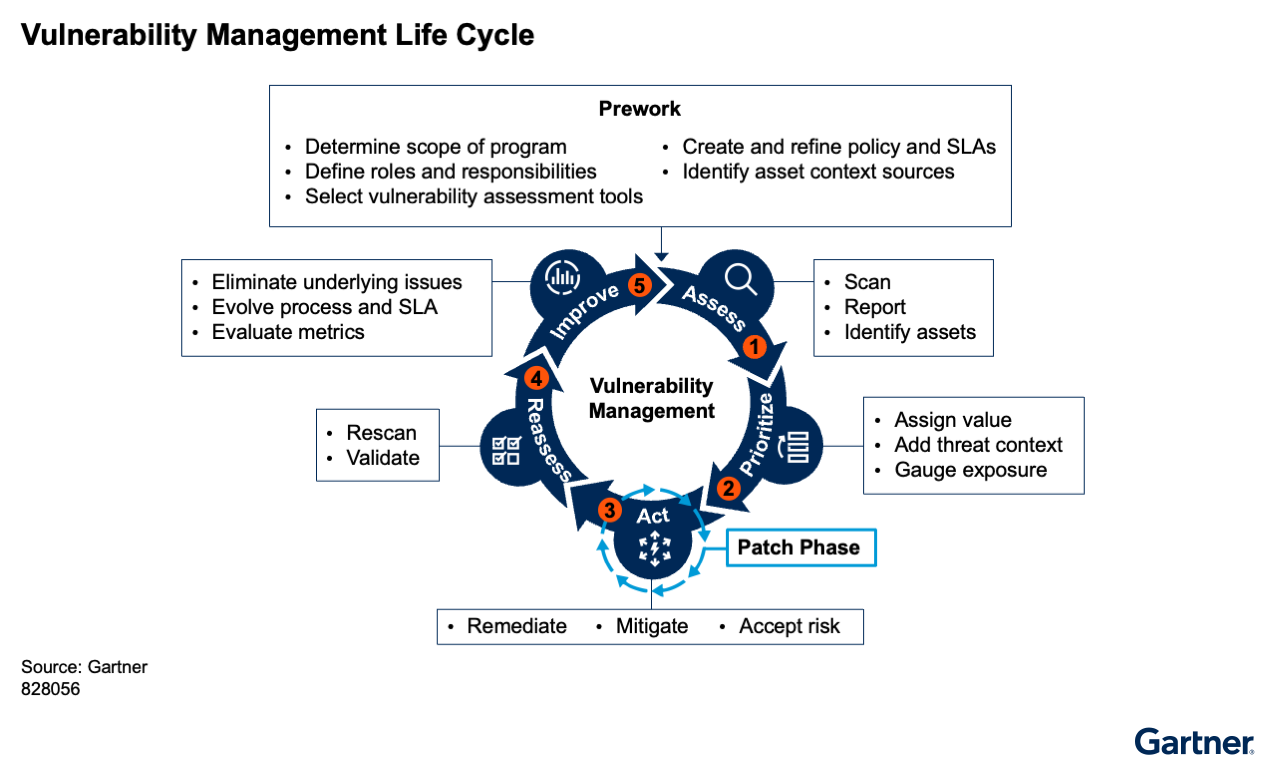
As part of the Act Phase in the VM life cycle, patching is essential for remediating vulnerabilities that have been identified (see How to Implement a Risk-Based Vulnerability Management Methodology).
Integrating patching and vulnerability management processes unites teams to reduce risk, maintain stability, minimize disruptions and enhance security. Prioritizing vulnerabilities based on impact, with input from I&O, information security and stakeholders, ensures high-risk threats on exposed assets are addressed first. This targeted approach optimizes efforts and manages workloads by focusing on the most significant risks.
Establish Structured Patch Management Processes
While patching tools are essential for executing patch deployment, they represent only a fraction of the comprehensive patch management strategy. Gartner’s Digital Workplace Maturity Assessment Tool Results data finds that despite having a patching tool in place, 51% of respondents report a lack of confidence and dissatisfaction in patching success rates.2
I&O teams are often conservative when faced with high-velocity patching requests, especially for business-critical systems. This cautious approach stems from the potential for patches to disrupt business operations, the need to assess the impact of patches and the requirement for appropriate levels of testing.
Being able to patch faster only goes so far in reducing vulnerability exposure. There are valid reasons for delaying or deferring patching, typically as a result of operational concerns, complex architectures, effective mitigation techniques or technical debt that require investment to resolve.
I&O teams are often conservative when faced with high-velocity patching requests, especially for business-critical systems. This cautious approach stems from the potential for patches to disrupt business operations, the need to assess the impact of patches and the requirement for appropriate levels of testing.
Being able to patch faster only goes so far in reducing vulnerability exposure. There are valid reasons for delaying or deferring patching, typically as a result of operational concerns, complex architectures, effective mitigation techniques or technical debt that require investment to resolve.
In many organizations, patch management procedures vary by domain or platform, without central governance. As a result, some teams and processes may be significantly more mature than others. In addition, teams may operate with incomplete processes that address only some aspects of the patch management process. These variations in procedure and process maturity can increase risk, instead of reducing it.
Execute Patch Management in the Act Phase of the Vulnerability Life Cycle
As patching is part of the Act Phase in the Vulnerability Management Life Cycle, the patching cycle should align with the broader goals of remediation while being structured enough to support agility, automation and continuous improvement. To achieve these objectives, you must follow a series of actionable steps that guide the patching process from identification to documentation. These steps, with clear guidance on how to manage the patching cycle efficiently and effectively, are outlined in Figure 2.
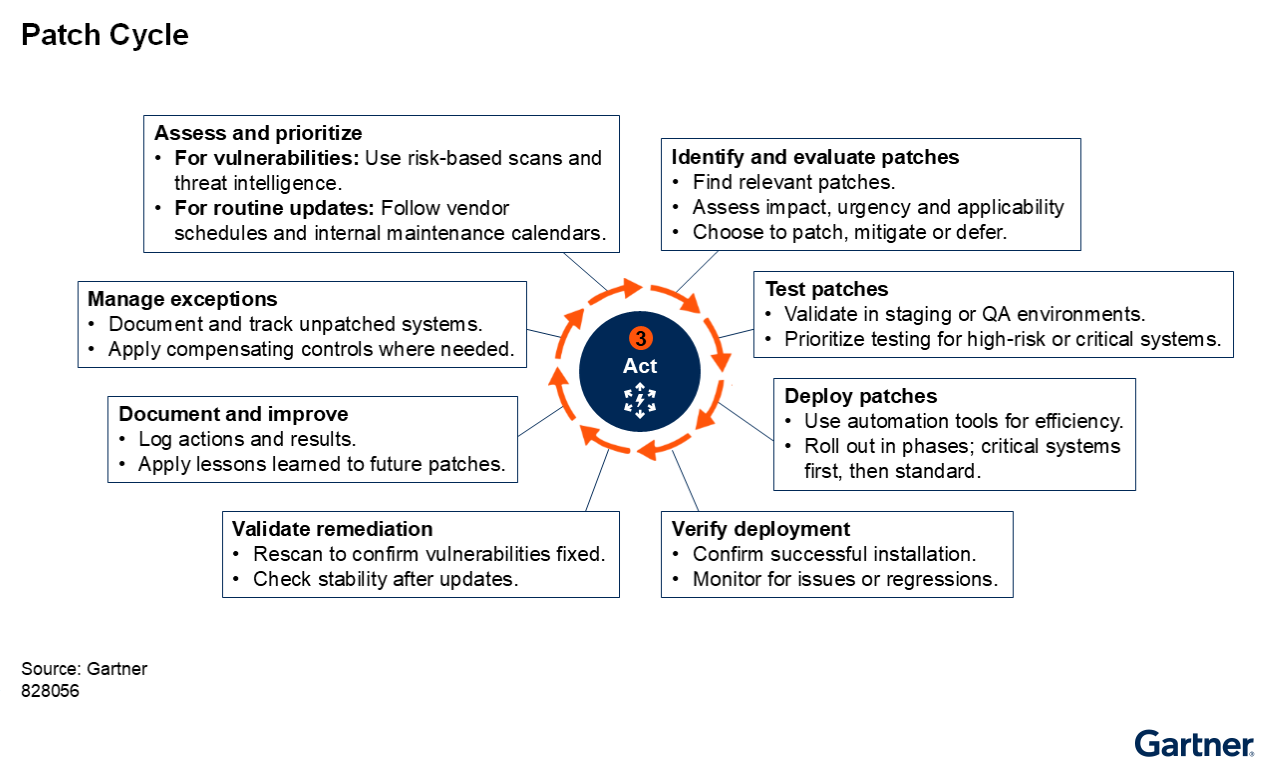
To structure and standardize a patch management process across an entire organization:
- Develop a comprehensive patch policy. A centralized patch management policy, aligned with the vulnerability and exposure management policy, ensures consistent, accountable and effective patch management across systems and applications while fostering I&O and security team collaboration. Distribute it for feedback, especially from business stakeholders, to enhance patching across applications and IT services.
- Define scope. Clearly identify and list all types of systems, applications and environments that are in scope for the patch management process. Document assets that are out of scope.
- Assign roles and responsibilities. Clearly delineate responsibilities among teams. Create a responsible, accountable, consulted and informed (RACI) matrix to clarify responsibilities for each part of the patch management process. A sample patch management RACI matrix is in Figure 3. See Note 1 for more information on the roles and responsibilities.
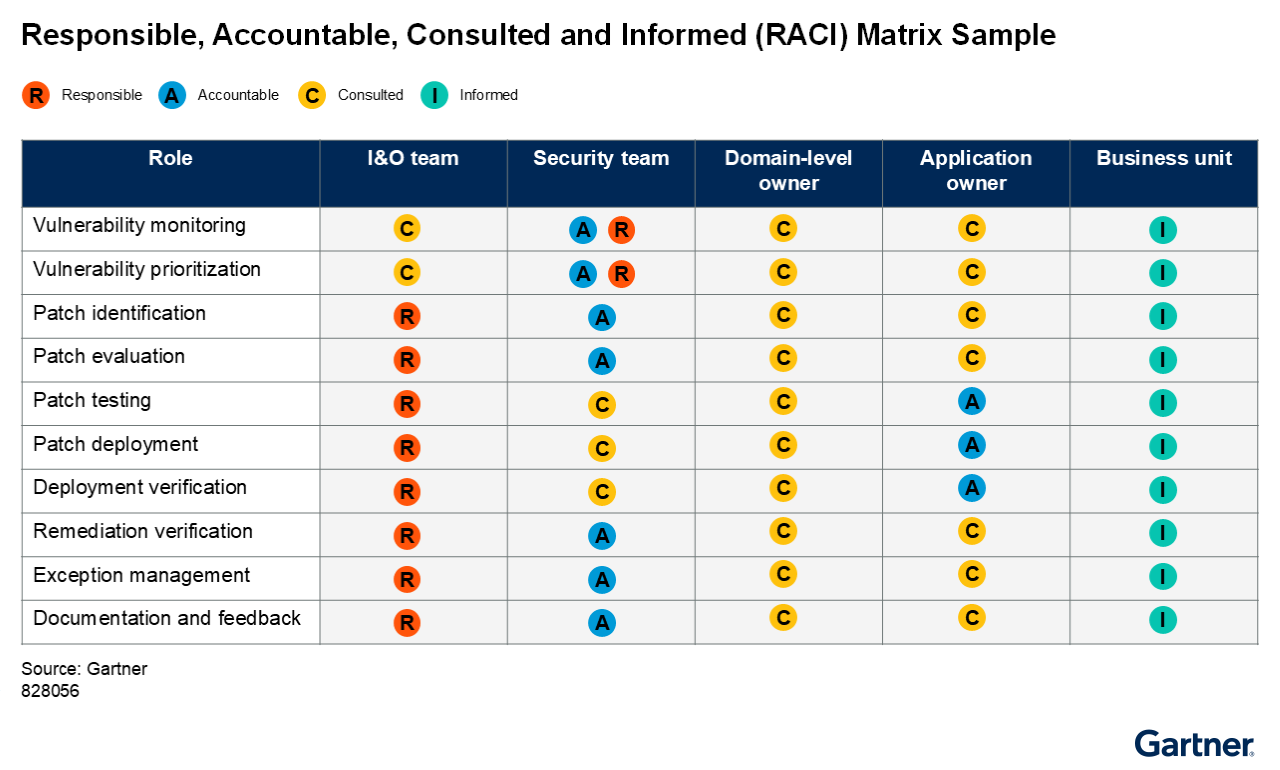
- Collaborate with the security team. Patch management leaders can optimize patch timing by assessing both security and IT operational risks, as illustrated in Figure 4. For instance, patches with high security ratings but low IT service impact can be deployed early, while those with significant impact require more testing and may be scheduled differently. Most patches should adhere to a “standard” change management process with preapproval and documentation, while patches for sensitive systems require a more rigorous approach involving change management leaders. Automation should primarily drive patch management, with an emergency change workflow for critical patches.
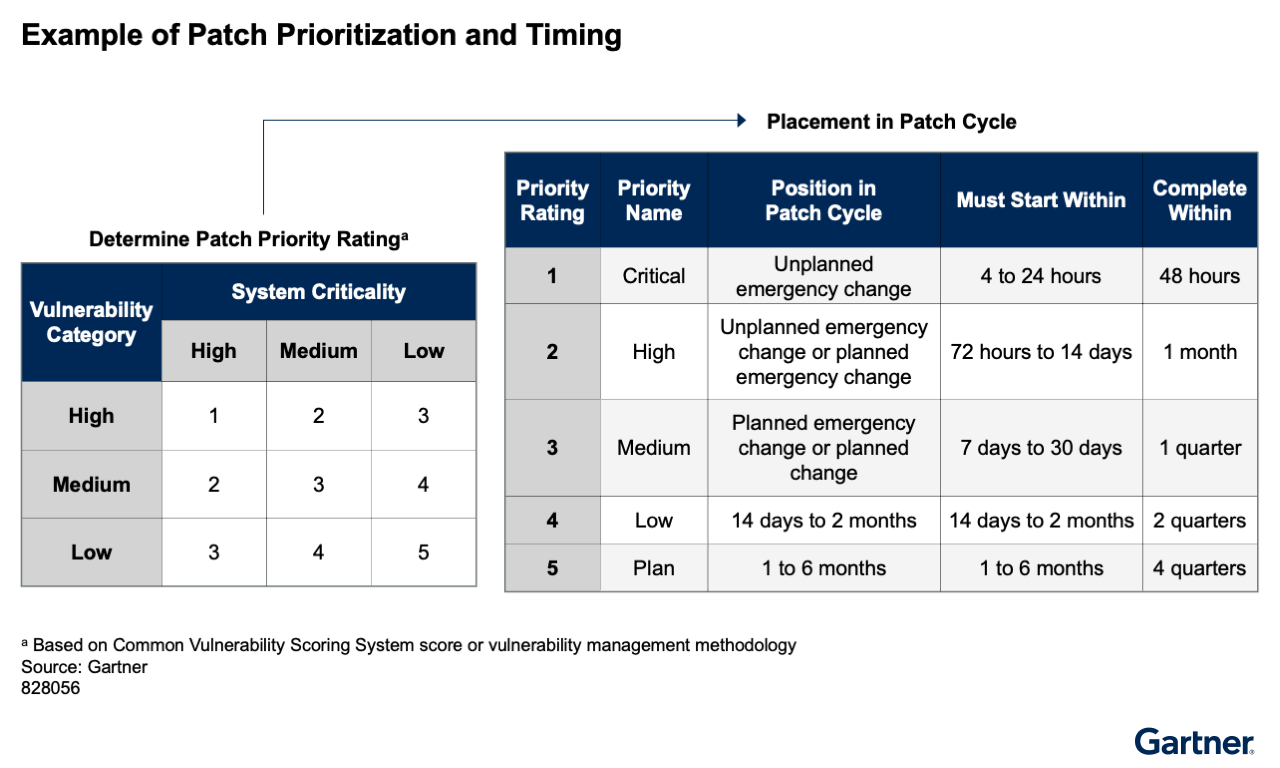
- Identify and document systems. Identify and document systems that can be rapidly patched due to standardization or a successful patching history, prioritizing them for automated patching to enhance efficiency. Additionally, recognize fragile systems that require careful testing and phased rollouts under human supervision to minimize disruptions, using automated tools where appropriate.
- Conduct appropriate testing. Implement risk-aligned testing protocols to ensure patch compatibility and prevent new issues. Test patches in isolated environments, using phased rollouts or ring-based deployments to assess impacts before wider implementation. Abbreviate testing when necessary to meet urgent risk or exposure needs.
- Monitor and report. Establish monitoring systems to track patch deployment progress and effectiveness, reporting any stability issues for root cause analysis and mitigating perceived patching risks. Generate regular reports to ensure compliance and support audits.
- Review and improve. Regularly review the patch management program to adapt to evolving threats and technological advancements. Encourage feedback from all stakeholders to continuously improve processes.
Shared Accountability for Effective Patch Management
The decision of when to apply patches is critical and requires input from multiple stakeholders. Patching is fundamentally a business decision because it directly impacts an organization’s operations, security posture and strategic objectives. Its success depends on cross-functional collaboration and enterprisewide awareness and alignment.
When employees at all levels understand the importance of patching, it can become a normal part of the organization’s culture. Business units are more likely to support patching-related downtime if they understand the risks and benefits. In the event of a critical vulnerability, enterprisewide alignment enables swift, coordinated action.
Patching With Confidence
Reactive patch deployment processes that rely on employee feedback or service desk tickets for broader rollout decisions introduce delays and can negatively impact both security and system performance.
According to the 2024 Gartner Designing and Building Modern Security Operations survey, approximately 40% of security leaders believe that artificial intelligence (AI) will have the most significant impact on security operations over the next 12 to 24 months.1 This perception underscores the growing importance of AI in enhancing security measures, particularly in threat detection and operational efficiency.
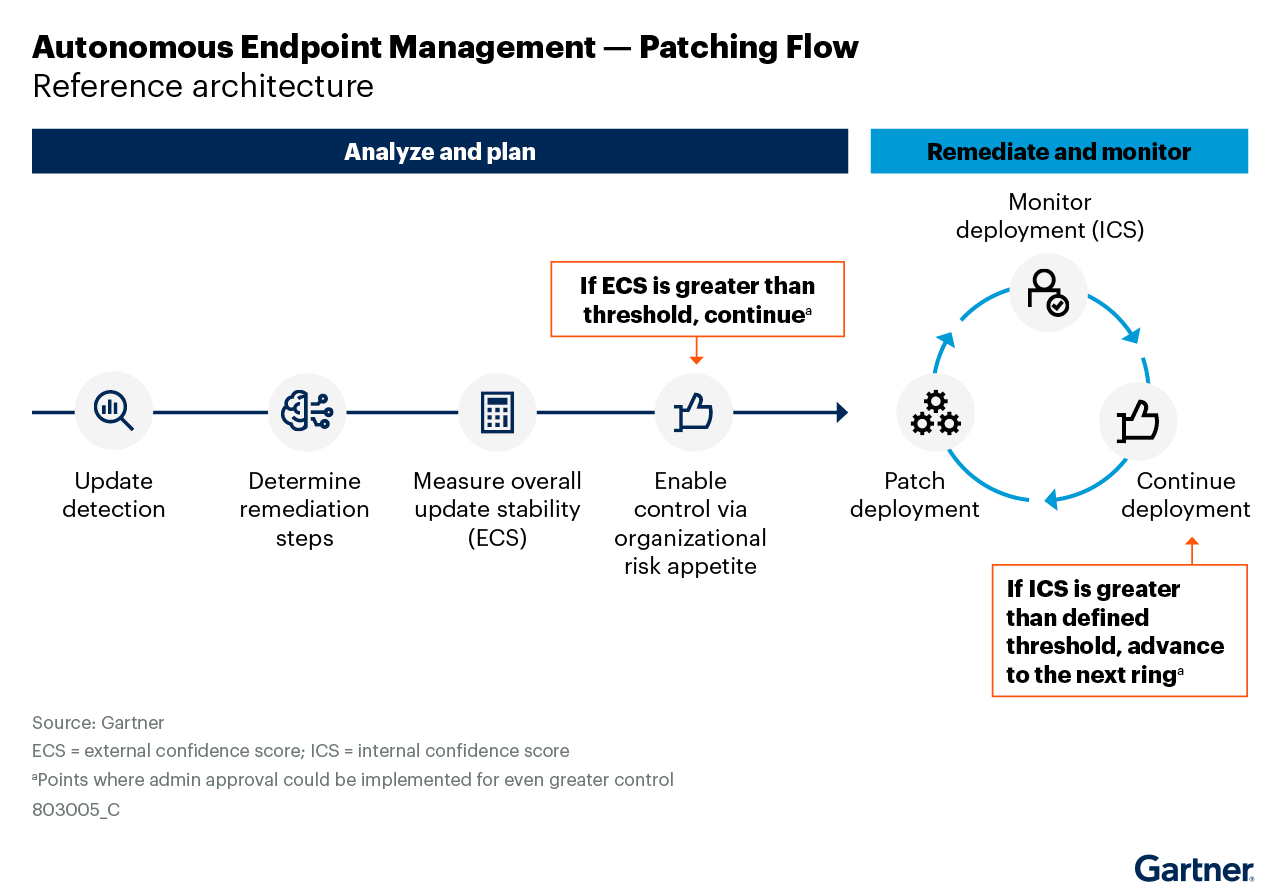
Autonomous endpoint management (AEM) exemplifies AI- and ML-driven automation. Figure 5 illustrates a generally available AEM use case in autonomous patching that leverages real-time monitoring and data-driven insights to expand ring-based patch deployments while minimizing disruption and system stability. (Leaders can use Innovation Insight: Autonomous Endpoint Management to learn about external and internal confidence scores and accelerate endpoint management, remain compliant and improve the digital employee experience.)
According to the 2024 Gartner Designing and Building Modern Security Operations survey, approximately 40% of security leaders believe that artificial intelligence (AI) will have the most significant impact on security operations over the next 12 to 24 months.1 This perception underscores the growing importance of AI in enhancing security measures, particularly in threat detection and operational efficiency.
Autonomous endpoint management (AEM) exemplifies AI- and ML-driven automation. Figure 5 illustrates a generally available AEM use case in autonomous patching that leverages real-time monitoring and data-driven insights to expand ring-based patch deployments while minimizing disruption and system stability. (Leaders can use Innovation Insight: Autonomous Endpoint Management to learn about external and internal confidence scores and accelerate endpoint management, remain compliant and improve the digital employee experience.)
Methodology Statement: P-24024 2024 Gartner Designing and Building Modern Security Operations Survey
1 2024 Gartner Designing and Building Modern Security Operations Survey. This survey was conducted to help us understand how organizations design and build modern security operations and develop optimal cybersecurity structures and operating models to help prioritize and reduce exposure to threats. The survey was conducted online from 28 May through 25 June 2024 among 208 respondents (n = 203 from a vendor panel and n = 5 from a conference list) across North America (n = 85 in the U.S. and Canada), EMEA (n = 83 in France, Germany, Italy and U.K.) and Asia/Pacific (n = 40 in Australia, India and Japan). Qualifying respondents’ organizations had $100 million or more in 2023 enterprisewide annual revenue and 250 or more employees. Qualifying respondents were aware and at least somewhat knowledgeable of security operations in their organization. Qualifying respondents were also required to be involved in decisions related to security operations. Disclaimer: Results of this study do not represent global findings or the market as a whole but reflect the sentiments of the respondents and companies surveyed.
2 Digital Workplace Maturity Assessment Tool Results. Data was collected through the Digital Workplace Maturity Assessment Tool, which helps IT leaders assess their digital workplace maturity and align with their organization’s ambitions for the digital workplace. Survey respondents receive a report identifying areas of greater or lesser maturity to help plan for digital transformation initiatives in the future. As of publishing, the dataset represents over 1,200 unique assessments collected during the last two years from assessors who worked for companies of all sizes with headquarters distributed around the globe.
Note 1: Roles and Responsibilities
Assigning roles and corresponding responsibilities is one step in structuring and standardizing a patch management process across an entire organization, as listed in Table 2.
Roles and Responsibilities for Effective Patch Management
Role | Responsibility |
I&O team | Executes patch deployment, monitors systems and ensures rollback readiness. |
Security team | Assesses risk, prioritizes vulnerabilities and recommends remediation actions. |
Domain-level owners | The patch management process should ideally be owned by individuals or teams with domain-specific expertise. These experts understand the intricacies of the systems and applications in their domain and can make informed decisions about patching priorities and timing. Examples of domain owners: endpoint management teams, server platform owner, database administrators and network engineers. |
Application owners | Validate timing, test patches and assess business impact. |
Business units | Approve downtime, provide operational context and support scheduling decisions. |
Source: Gartner (July 2025)