Magic Quadrant for Revenue Enablement Platforms
10 November 2025 - ID G00824260 - 35 min read
By Doug Bushée, Melissa Hilbert, and 1 more
This Magic Quadrant assesses top revenue enablement vendors as the market pivots to AI-driven, consolidated platforms. Trends include agentic AI, compliance, and ROI-focused outcomes. Use this research to identify vendors that align with your workflow, integration, and business impact priorities.
Strategic Planning Assumption
By 2030, agentic AI will automate 70% of routine sales enablement tasks, such as updating playbooks, curating competitive battlecards, managing content libraries, and scheduling training sessions, while delivering personalized content and training directly within rep workflows.
Market Definition/Description
Gartner defines revenue enablement platforms (REPs) as platforms that unite sales and customer-facing enablement and revenue functions. They encompass revenue-generating roles such as sales, customer success, marketing, partners and presales. They support both sales enablement and marketing leaders in providing a holistic enablement program. REPs are deployed as SaaS with mobile capabilities. The platforms have capabilities for digital content, learning, practice and coaching and engagement analytics as well as AI and conversational intelligence for skill building.
Revenue enablement platforms unify digital content management, learning, practice and coaching. They integrate with sales force automation (SFA) or marketing automation platforms, provide the ability to create and curate content focused to sales use cases and buyer journeys, feature buyer engagement analysis and measure content effectiveness. REPs drive effectiveness through behavior change resulting in improved revenue growth. They provide an organization the ability to control, focus and leverage its messaging delivered by revenue-facing roles to customers while gaining insight on customer and seller engagement with that content. They measure and build role skills and competencies through microlearning and retention quizzing, role-play practice and coaching, and analytics that improve commercial execution.
Mandatory Features
The mandatory features for this market include:
- Digital content or asset management
- Learning, practice and coaching
- Buyer engagement analytics
- Integration and platform
- Analytics and insights (internal and external)
- Guided selling
Common Features
The common features for this market include:
- AI, including generative AI, machine learning, sentiment and/or emotion AI
- Conversation intelligence, including speech-to-text translation
- Digital sales rooms
Magic Quadrant
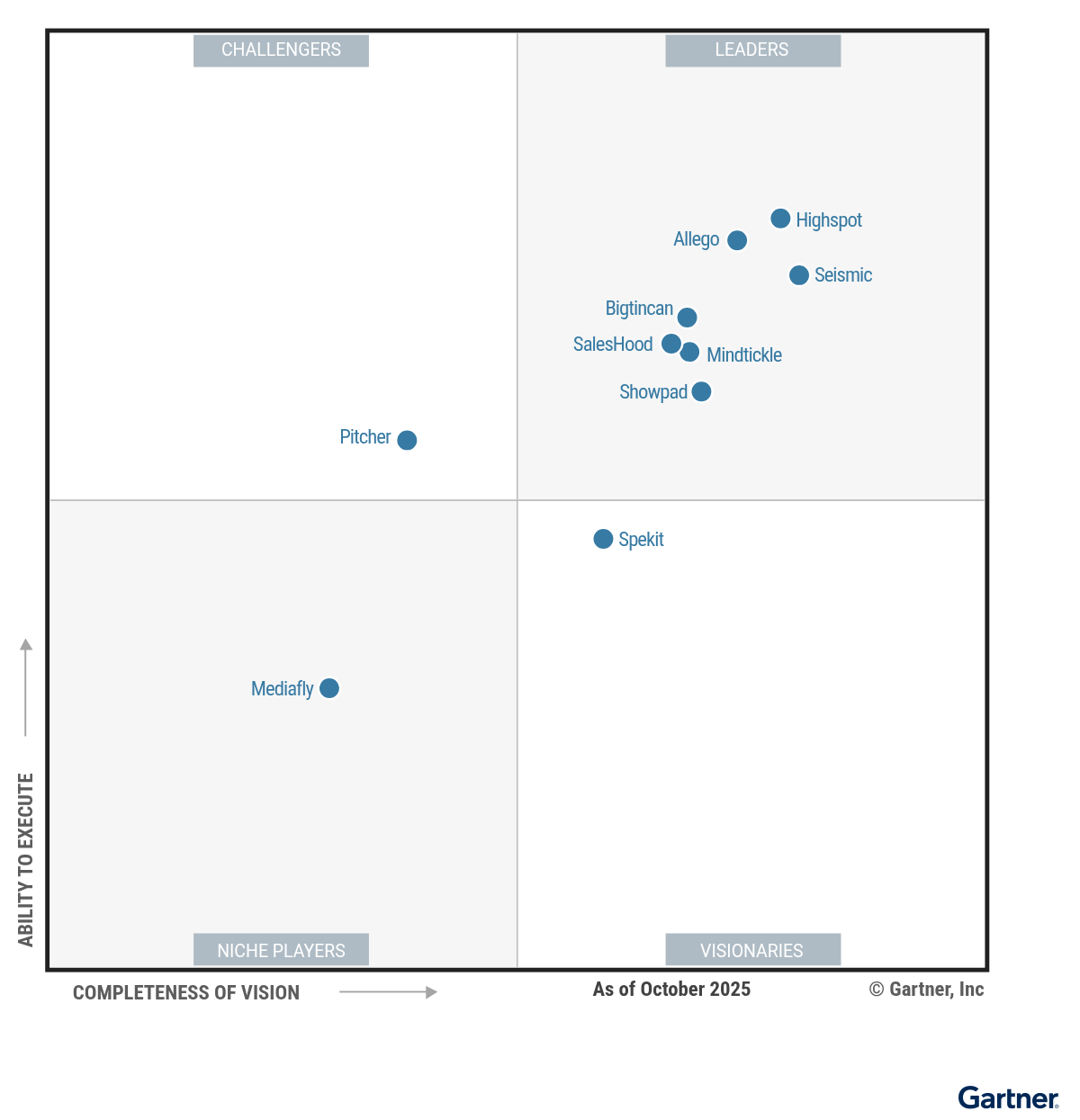
Vendor Strengths and Cautions
Allego
Allego is a Leader in this Magic Quadrant. It unifies learning, content, coaching, and digital selling, embedding AI for unscripted role-play, content authoring, and deal insights — at no additional cost. Allego serves mid-to-large enterprises across IT, financial services, life sciences, and professional services, with strong growth in financial services and a core focus on life sciences. Recent enhancements include AI-driven content creation (e.g., SCORM authoring, automated tagging), intelligent search with natural language Q&A, and market-leading Live Dialog Simulators. Analytics link enablement activity to KPIs, while the roadmap emphasizes cross-deal alerts, AI-led content automation, and extensibility via APIs and enhancements to the LiveApps framework.
- Targeted vertical expertise and momentum: Allego’s commitment to regulated verticals, including financial services and life sciences, aligns with strict compliance-forward workflows, providing essential relevance and specialized tools for B2B sales teams operating within these complex regulated sectors.
- Market responsiveness: Allego excels in responding to critical market signals, competitive intelligence, and feedback, ensuring that B2B sales organizations consistently benefit from rapid product evolution and streamlined go-to-market (GTM) strategies. The use of deep research techniques and customer engagement models ensures offerings and positioning remain relevant to buyer needs and vulnerabilities in competitor strategies.
- Comprehensive mobile and offline functionality: Allego provides comprehensive mobile and offline functionality that supports nearly all core enablement activities. Users can access content, training, coaching, and digital sales rooms (DSRs) while offline, including SCORM lessons and cached content. Managers can also perform coaching activities offline, including filling out a scorecard and providing point-in-time coaching feedback on videos.
- Sales cycle for full suites: Allego lags in the speed of acquiring new customers and has lengthy sales cycles for its comprehensive platform. Prospective buyers adopting the complete platform could experience a delay in overall time to value or expected return on investment (ROI). These delays can be a disadvantage for those seeking swift impact from their technology investments.
- LMS replacement: Allego lacks key legacy learning management system (LMS) capabilities, particularly for coordinating instructor-led training and comprehensive, university-style programs. This forces large enterprises to continue paying for an additional LMS and juggle outdated mental models alongside modern learning methods.
- Geographic footprint: Allego’s primary revenue generation is concentrated in North America, with Europe as a strategic growth region. This limited footprint could impact multinational clients seeking a more globally diverse and established sales and support presence. Organizations operating with extensive global footprints should be aware that comprehensive localized sales support, partner ecosystems, and dedicated user support outside of the North American and European markets may be limited.
Bigtincan
Bigtincan is a Leader in this Magic Quadrant. Its platform, including Genie Assistant Pro, AuthoringAI Pro, and MeetingsAI, helps customer-facing teams improve the buying experience through smart, flexible, AI-driven capabilities. Its operations span North America, Europe, and Asia/Pacific, serving midmarket to large enterprises, mostly in manufacturing, financial services, and high tech. Recent enhancements include GenieAI Pro, offering AI-powered content creation, digital avatars, multilingual capabilities, and advanced role-play and meeting analysis. Its roadmap focuses on plans to transform Genie Assistant into a proactive sales assistant, automating high-value actions and providing real-time, context-aware guidance.
On 30 October 2025, Vector Capital completed an announced plan to merge Showpad and Bigtincan. However, for the purposes of this research, the two vendors are assessed separately due to the evaluation time frame.
- Vertical industry strategy: Bigtincan excels in targeting medical devices, life sciences, pharma, manufacturing/consumer packaged goods (CPG), and financial services by addressing vertical-specific pain points, such as providing audit-ready, role-based training and compliance solutions crucial for regulated sectors, making tailored go-to-market plays less burdensome on enablement teams.
- AI innovation: Bigtincan drives rapid AI innovation by delivering features like podcast generation and voice chat through GenieAI Pro. The platform creates AI-generated digital avatars in over 30 languages. Underpinning this is the SecureGLP architecture and bring-your-own-model (BYOM) framework, allowing flexible large language model (LLM) connection options.
- Customer base diversity: Bigtincan boasts a diverse customer base that spans various organizational sizes, representing midmarket, large enterprise, and small business segments. This adoption indicates the platform’s scalability and relevance across different business needs.
- AI content automation: Bigtincan lacks AI capabilities for automating critical tasks such as bulk tagging, description changes, and the autocreation of visual content and slide decks. Customers may experience inefficiencies in timely content management at scale, with increased manual effort for content curators.
- Market responsiveness: Bigtincan showed lower capacity to swiftly refine platform execution based on changing market expectations. The lack of a self-service software development kit (SDK) for developing custom applications on tablet devices and the inability to access essential coaching and training content offline are examples of where customers may find capabilities are underdeveloped.
- Native call-coaching: Bigtincan lacks a fully integrated recorded and live call coaching feature for real-time conversational analysis. The process of postcall and prompt-driven interactions with the Genie Assistant is less robust than other leaders, and while the platform can trigger actions based on scores, this mechanism is reactive to recorded events and not proactive guidance delivered in real time.
Highspot
Highspot is a Leader in this Magic Quadrant. Its platform, built around its unified analytics and AI engine, Nexus, uses AI holistically with persona-based agents to increase usability and create persona-specific outputs. It converts signals into role-based, real-time actions across content, training, coaching, and execution. Its operations are geographically diversified, serving B2B clients mostly in North America, Europe, and Australia/New Zealand. Recent enhancements include integration with Microsoft Copilot and Salesforce Agentforce. Its roadmap focuses on building a secure, composable AI orchestration layer for multiagent coordination with its agentic layer, content, and buyer intelligence, and AI-powered Digital Room and document creation.
- Agentic AI: Highspot has multiple agents, including a marketing-focused agent that proactively identifies and schedules the archiving of stale or unused content. It allows for automated bulk actions based on specific queries. It also has learning-focused, sales, and deal agents.
- Customer-centric innovation: Highspot demonstrates strong capabilities in innovation using signals and insights from its customer community, market research, and platform insights, including internal feedback from its meeting intelligence. It includes customer feedback in the majority of its product roadmap design.
- Marketing strategy: Highspot’s marketing strategy effectively differentiates its revenue enablement solution by positioning it as a unified, agentic platform for go-to-market performance. Its communications have message clarity, brand consistency, and full-channel cohesion.
- Content creation: Highspot has weaker capabilities than other Leaders for native content creation, focusing more on integration with other content systems. Its autotagging features only suggest lists and tags, and require manual intervention. Videos cannot be edited or clipped, images cannot be created in slides, and administrators cannot create custom notifications.
- Geographic strategy: Highspot’s geographic strategy is limited to its current regions of focus, with no immediate plans for geographic expansion. Prospective customers in potentially fast-growing or new regional markets where Highspot does not have existing operations might not experience tailored strategic initiatives or dedicated localized support beyond the existing model.
- Market differentiation: Highspot has not been able to differentiate its value versus point solution AI tools outside of revenue enablement platforms. Point solutions may appear to offer a quick win at a low cost, offering more advanced features in their chatbots or role-play applications. Customers choosing a point solution would incur additional costs to integrate with Highspot, or else lack a unified data and employee experience, reducing the value of the platform and its insights.
Mediafly
Mediafly is a Niche Player in this Magic Quadrant. It includes Mediafly Engagement (content management system [CMS]), Value (value selling tools), and Appinium (LMS), focusing on content management, value selling, and learning. It uses AI for content search and summarization and as an assistant with GenAI configurability. Mediafly operates primarily in North America but maintains a significant presence in EMEA, supported by its SAP partnership. Typical client size and sector data were not provided. Recent enhancements include advanced digital sales rooms, AI-powered search with natural language and content summarization, AI-driven report and dashboard summaries, and support for customers to bring their AI keys for more flexibility and security. Its roadmap focuses on agentic AI, mutual action plans, and AI content narratives.
- Market understanding: Mediafly demonstrates strong market understanding by leveraging strategic alliances and unique platform differentiation. As a preferred SAP partner and native Salesforce independent software vendor (ISV), it activates ecosystem reach through co-selling and SI partnerships. The recent acquisition of Appinium delivers a Salesforce-native LMS alongside the content management platform and integrated value selling toolkit, positioning Mediafly to meet complex enterprise needs while advancing toward an agentic AI vision.
- Native learning management system: Mediafly’s acquisition of Appinium provides the only LMS natively embedded within Salesforce. It eliminates the need for separate systems or complex connectors and enables training, progress tracking, and certification management within the CRM environment. This helps reduce administrative overhead, accelerates onboarding, and improves seller adoption.
- Operations: Mediafly operates a fully in-house service model for implementation, technical, creative, and value engineering, ensuring consistent delivery and control. Onboarding typically completes within 90 days, with up to 120 days for complex enterprise deployments. Mediafly is increasing investment in product development, customer success, marketing, and sales functions to strengthen enterprise support and drive growth.
- AI content creation: Mediafly shows limited AI-powered content creation capabilities, including generating visual content, initial versions of training content, slide decks, or social media messaging. Customers may need to rely on manual efforts or third-party tools for these tasks.
- Sales strategy ambiguity: Mediafly’s near-term sales strategy does not clearly indicate whether growth will focus on expanding spend within existing accounts or acquiring new customers. This ambiguity in prioritization may create uncertainty for partners and customers seeking alignment with a vendor committed to either deep account expansion or aggressive new logo acquisition.
- Presales effectiveness tracking: Mediafly does not document a dedicated presales capability for tracking “technical wins,” proof of concept (POC) outcomes, or enablement‑specific KPIs. Conversation intelligence and deep deal inspection/forecasting signals are not tailored out of the box to presales technical validation. Teams that need presales‑specific metrics typically implement CRM customizations or pair Mediafly with a presales platform.
Mindtickle
Mindtickle is a Leader in this Magic Quadrant. It combines digital content management, training, AI-powered coaching, and advanced analytics. Its AI supports content generation, personalized communications, recommendations, and virtual assistants. Its operations are geographically diversified, serving medium/large enterprises in North America and Europe in IT, financial services, pharmaceuticals, and medical devices. Recent enhancements include its AI seller, Mindtickle Copilot, for sales productivity, automated data subject request (auto-DSR) creation, interactive AI role plays, and the Readiness Index for actionable insights. Its roadmap focuses on AI content creation, deal insights, an agentic platform, and automated practice to drive skill development and productivity.
- AI-powered training/assessment content: Mindtickle leverages AI to create initial versions of training content and assessments, and to assist bulk tagging and description changes for content. This allows for rapid development of learning materials and efficient content management.
- Enterprise customer base: Mindtickle’s ability to cater to the needs of larger organizations helps it excel in serving medium and large enterprises. This assures clients that it can handle complex, large-scale deployments and serve similar organizational structures.
- Continuous improvement through feedback: Mindtickle employs multiple impactful mechanisms to measure its voice of customer, including rolling Net Promoter Score (NPS) surveys, Support CSAT, built-in product feedback loops, and LLM-powered sentiment analysis of conversations and insights from its customer advisory board. These provide comprehensive data for continuous refinement of support services and product evolution.
- Content governance and creation: Mindtickle lacks direct sales and partner content creation compliance features, such as formal review and approval processes, and AI-assisted content governance, potentially hindering brand consistency, compliance, and scalability across content channels. Its lack of AI capabilities for visual content creation requires external tools or manual processes for visual assets.
- Workflow friction: Mindtickle’s onboarding process may present a risk of delayed time to value. While the company promotes a structured, phased approach designed for rapid value delivery, execution challenges and fragmented administrative workflows, such as requiring separate steps for AI-generated content creation, suggest inefficiencies that could slow adoption and impact overall customer experience.
- Solution awareness: Mindtickle has not fully shifted the market perception of being a training solution to a broader AI-driven enablement platform, due to factors such as its inability to clearly articulate its value proposition in this regard through marketing campaigns and related vehicles. This threatens its ability to stay competitive and risks questions about its ability to drive rapid market adoption and attract new clients.
Pitcher
Pitcher is a Challenger in this Magic Quadrant. Its platform focuses on providing an AI-first approach to revenue enablement, leveraging its Pitcher Intelligent Agent (PIA) for dynamic content, automation, and interactive data capabilities. Its operations are geographically diversified, serving mostly large and extra-large enterprises with a B2B2C focus in North America, Europe, and Asia/Pacific. Recent enhancements include interactive and dynamic data charts and Pitch Deck Wizards, where an administrator can create templates for users. Its roadmap focuses on product development, sales, and customer success, as well as AI agent orchestration, AI content creation, and advanced predictive analytics. It plans to expand in the U.S. and Europe.
- Product/service offering: Pitcher offers true augmented reality (AR) features, demonstrated with 3D images in real-life scenes. It provides an immersive and valuable experience, particularly for consumer packaged goods and retail sellers. It also leverages its Pitcher Intelligent Agent to generate visual content and transform static PowerPoint presentations into dynamic web-based pitch decks. PIA is useful for customers to create content more rapidly and interactively.
- Long-term business viability: Pitcher demonstrates strong market stability as a profitable, privately owned company, as well as strong investment in R&D, primarily serving large and extra-large enterprise customers in the CPG industry. It includes high customer retention rates and growth through expanded departmental deployments.
- Operations: Pitcher clearly indicates its intention to grow through increased investment to support vital areas important to grow the business and support customers, such as product development, sales, customer service, and customer success staff.
- Training or learning capabilities: Pitcher offers limited capabilities for training. It has no capabilities for required features such as training paths, adaptive learning, sales methodology, instructor-led training (ILT), or virtual instructor-led training (VILT). PIA only has limited micro learning capabilities. B2B customers looking for a holistic platform need to factor these limitations into their evaluation.
- Vertical focus: Pitcher focuses on B2B2C industries such as consumer packaged goods, retail, and manufacturing, which has limited its product focus toward content and in-person sales meeting requirements. Prospective customers in B2B-focused industries should assess whether it meets their needs.
- AI adoption: The Pitcher Intelligence Agent lacks some features that other Leaders have, such as governance of content through audit reports, creation of initial training content, and optimization of content. Prospective customers should establish governance procedures before deploying it.
SalesHood
SalesHood is a Leader in this Magic Quadrant. It offers AI-driven content management, training, and coaching. Its operations are geographically diversified, primarily serving midmarket and small enterprises in North America and Europe in IT, healthcare, financial services, and CPG. Recent enhancements include content impact insights for data-driven decisions on content effectiveness and connections to influence revenue, AI search within assets, a Google Chrome Extension App, embedded analytics, and mutual action plan templates. Its roadmap includes advanced integrations into RevOps systems, performance-based training recommendations, a sales confidence scoring engine, and AI-powered performance management with team analysis and coaching.
- AI-powered role play: SalesHood’s AI Role Play offers practice scenarios to provide instant, personalized feedback to users on tone, pace, content, and strategy. This feature securely integrates customer-specific CRM data to guide realistic simulations and includes peer performance leaderboards and pitch commenting, accelerating rep readiness.
- Diverse customer base: SalesHood demonstrates versatility, serving a diverse customer base across various organizational sizes, including midmarket, small, and medium-enterprise segments. This highlights its adaptability to deliver value effectively to a wide range of customer profiles.
- Sales execution/pricing: SalesHood offers several tiered pricing models, including a freemium version with various volume discounts and support plans. It provides transparent pricing on its website. It sells through a good mix of direct, partner, and co-selling channels, providing options for a varied customer base to find a purchase option that works for their budget and preferences.
- User effort: SalesHood’s AI mainly generates content outlines and suggestions rather than fully automated content or predictive insights, requiring manual intervention for tasks such as AI avatar language guidance and offering limited governance tools. Organizations seeking deeply integrated, self-sufficient AI for content creation and adaptive analytics may find that it demands more manual effort and oversight.
- Platform integration: SalesHood has significant gaps in out-of-the-box integrations for essential sales and marketing systems, including Salesforce Communities and Microsoft Dynamics 365 SFA. Clients risk fragmented workflows and increased complexity when integrating with existing tech stacks, potentially hindering unified data exchange and seamless operations.
- Market responsiveness/track record: SalesHood’s market responsiveness and track record indicate areas for improvement in its mechanisms for detecting and responding to changing market conditions. Prospects may find it lacks agility in adapting to new market trends or feedback.
Seismic
Seismic is a Leader in this Magic Quadrant. Its Seismic Enablement Cloud’s AI enhances productivity, content creation, and customer interactions. Its operations are geographically diversified, serving midmarket to large enterprises mostly in North America and Europe in IT, banking/investment services, and financial services. Recent enhancements focus on AI, including its Aura AI assistant for questions, role-playing, drafting emails, and recommending content, as well as lesson building, content tagging, and agentic interactions with Salesforce AgentForce and Microsoft Copilot. Its roadmap includes GenAI-powered workflows and proactive agents for content, coaching, and execution, as well as a financial services platform and AI-powered frameworks for its partner program.
- Market/financial strength: Seismic’s large enterprise customer base provides deep market insights that inform product innovation and accelerate roadmap execution. It reports a focus on sustainable, profitable growth with quarter-over-quarter improvement.
- Ecosystem partnerships/community leadership: Seismic’s strategic partnerships with Microsoft and Salesforce include integrations across Sales Cloud, Agentforce, Slack, and Azure AI Services. It’s a Top Tier Microsoft partner, globally managed within Microsoft’s partner ecosystem, offers a transactable solution in the Azure Marketplace, and embeds IBM’s watsonx into Seismic for Meetings.
- AI-powered workflows: Seismic’s GenAI engine, Aura, is embedded to support content creation, metadata automation, and lesson generation. Aura Chat enables sellers to retrieve and share information, with integrations with Salesforce (including Agentforce), Microsoft, and Slack.
- Operational complexity: Seismic’s enterprise depth, including governance, integrations, and extensibility, can increase administrative overhead in large or global deployments. Organizations without dedicated enablement or IT resources may experience longer time to value compared to lighter-weight solutions.
- Real-time coaching delivery: Seismic emphasizes postmeeting analysis and in-workflow guidance through integrations with Salesforce, Microsoft, and AI-driven recommendations. However, real-time, in-call coaching capabilities (such as live prompts during conversations) were not evidenced during evaluation and are not prominently featured in public materials. Absence of these would limit immediate skill reinforcement during critical interactions.
- Pricing strategy: Seismic employs a premium pricing model and prioritizes revenue growth within existing enterprise accounts. This approach can lead to less predictable long-term costs, particularly for organizations seeking stable pricing or phased enablement. Buyers focused on controlling initial investment or adopting Seismic incrementally should proactively address these considerations during contract negotiations.
Showpad
Showpad is a Leader in this Magic Quadrant. Its eOS platform unifies AI-driven content, training, and buyer engagement. It mostly serves midsize to extra-large enterprises across North America, EMEA, and APAC in healthcare, manufacturing, and high-tech sectors. Recent enhancements include Showpad Assist for multimodal AI assistance in field sales, expanded AI for content creation, tagging, and search (FAQs), upgraded Shared Spaces with templates and dashboards, and integration with Microsoft Copilot for Sales. Its roadmap includes expanding Showpad Assist for full sales motion, AI-powered learning and coaching, a commercial excellence OS with AI agents, agentic library health improvements, and an account hub for unified stakeholder collaboration.
On 30 October 2025, Vector Capital completed an announced plan to merge Showpad and Bigtincan. However, for the purposes of this research, the two vendors are assessed separately due to the evaluation time frame.
- AI for field sellers: Showpad Assist, a voice-first, AI-powered assistant built in Showpad’s workflow for field sellers, enables reps to capture notes via voice, photos, or text. It automatically generates meeting summaries, recommends next steps, drafts follow-up emails, and updates CRM records, all contextualized with the organization’s own content and data.
- Enterprise operations: Showpad delivers secure, scalable global deployments through a mobile-first architecture and advanced data infrastructure. It ensures compliance with regional regulations and maintains content quality via LibraryIQ. Robust developer support includes SDKs, APIs, and App Exchange for custom extensions. Built on Amazon Web Services (AWS), Showpad provides enterprise-grade security, performance, and fast analytics for data-driven decisions.
- Financial and platform stability: Showpad demonstrates strong viability through consistent profitability and disciplined financial management, providing a foundation for sustainable growth. Its strategy centers on internally driven R&D to deliver a cohesive, natively built platform that minimizes complexity and supports long-term stability. This unified approach, combined with a robust cloud architecture and high-performance analytics, reinforces product-led value for enterprise customers.
- Virtual conversational intelligence: Showpad lacks native, full‑featured conversation intelligence for virtual meeting capture/analysis. Its AI investment centers on Showpad Assist, which is embedded in its workflow and optimized for field/in‑person workflows rather than recording and analyzing web/video meetings.
- Sales execution: Showpad’s reported average deal size is at the lower end of the range for vendors in this market, and a high proportion of its contracts are under two years. These factors may indicate limited penetration into large-scale, multiyear enterprise agreements. Clients seeking strategic, enterprisewide enablement programs should validate Showpad’s ability to scale commercially and sustain value over extended contract terms.
- Innovation gaps: Showpad’s strategy shows gaps in advanced, high-fidelity generative AI experiences, particularly around training/role-play and complex content creation. Additionally, conversational intelligence capabilities remain focused on field interactions, leaving virtual meeting analysis underdeveloped. Clients prioritizing these areas should assess roadmap commitments carefully.
Spekit
Spekit is a Visionary in this Magic Quadrant. Its AI-powered platform delivers just-in-time, contextual guidance across the buyer’s journey, while supporting learning, selling, and execution. Its operations are focused mostly in North America, Europe, and Asia/Pacific, serving midmarket to large enterprises in high tech, manufacturing, and financial services. Recent innovations include AI Sidekick for unified conversational assistance and contextual content recommendations, Deal Rooms for dynamic buyer engagement and analytics, and advanced AI analytics dashboards. Its roadmap emphasizes expanding contextual support for sellers, enabling sales actions and revenue workflows, and evolving AI Sidekick capabilities.
- Strategic competitive positioning: Spekit’s open, API-driven architecture supports advanced AI-driven use cases, custom applications, extensibility, and integration with enterprise systems. This enables programmatic access to content, usage analytics, and user interactions, allowing organizations to embed enablement into broader workflows. Its competitive strategy targets rip-and-replace opportunities against legacy systems by addressing common pain points such as low adoption, administrative overhead, and content decay.
- Executive-led marketing: Spekit differentiates through an executive-led marketing strategy that shapes the enablement narrative and prioritizes measurable business outcomes. Its positioning emphasizes performance impact rather than feature lists, while a refined go-to-market approach targets senior decision makers to align with strategic priorities and drive engagement across influential buyer segments.
- AI-powered innovation: Spekit’s AI Sidekick delivers contextual, in-workflow guidance across applications such as Gmail, Gong, and Salesforce. By interpreting the context of any webpage or application UI, AI Sidekick proactively surfaces relevant knowledge, training, and collateral, eliminating manual search and reducing cognitive load for seller productivity and enablement experience.
- Limited comprehensive LMS: Spekit is a just-in-time enablement platform, not a full-featured LMS. It lacks advanced LMS capabilities such as structured course management, complex certification paths, and detailed role-play grading, making it less suitable for organizations prioritizing a comprehensive LMS, including advanced workflows and gamification.
- Limited visibility in sales strategy: Spekit offers limited evidence of a clearly articulated long-term sales strategy or differentiated go-to-market approach compared to leading competitors. The lack of transparency around GTM evolution may create uncertainty for buyers evaluating long-term alignment.
- Limited market responsiveness: Spekit struggles to adapt rapidly to broader market dynamics at scale. Its smaller scale and resource base may constrain its responsiveness to shifting buyer priorities and competitive pressures.
Inclusion and Exclusion Criteria
To qualify for inclusion in the Magic Quadrant for Revenue Enablement Platforms, a vendor must:
- Market and sell a distinct revenue enablement platform (REP) product, available for purchase independently from other core application suites (e.g., CRM). The product must natively provide generally available capabilities across all mandatory feature areas defined by Gartner for this market (digital content management, learning/practice/coaching, guided selling, buyer engagement analytics, internal/external analytics, integration, and platform) and be positioned to support multiple customer-facing roles.
- Show that their revenue enablement platform product has been generally available (GA) for purchase and implementation for at least 12 months prior to 1 June 2025.
- Have generated more than $10 million USD constant currency in platform-only revenue (excluding professional services) specifically from the defined revenue enablement product, in the previous fiscal year (2024) and have at least 40 total revenue enablement platform customers (logos) using the platform as of 1 June 2025.
- Show that at least 20% of the vendor’s current revenue enablement platform customer base has an annual revenue of $250 million USD constant currency or more.
- Have generated at least 10% of its total revenue enablement platform software revenue (as defined above) in the previous fiscal year (2024) from customers headquartered outside the vendor’s primary headquartered region AND must demonstrate active users in at least two major geographic regions (defined as North America, Latin America, EMEA, APAC).
Evaluation Criteria
Ability to Execute
Product/Service: The capabilities, features, and overall quality of the core goods and services that compete in and or serve the defined market, specifically product evolution and innovation, technical ecosystem and integrations, and globalization and accessibility.
Overall Viability: The organization’s overall financial health, as well as the financial and practical success of the relevant business unit. This includes the likelihood that the organization can continue to offer and invest in the product, as well as the product’s position in the organization’s portfolio, specifically financial health and transparency, customer base composition and market reach, and organizational investment in product development.
Sales Execution/Pricing: The organization’s capabilities in all presales activities and the structures that support these activities. This includes deal management, pricing and negotiation, presales support, and the overall effectiveness of the sales channel, specifically customer base and growth metrics, sales and pricing strategies, and revenue distribution and channel performance.
Market Responsiveness and Track Record: The ability to respond, change direction, be flexible, and achieve competitive success as opportunities develop, competitors act, customer needs evolve, and market dynamics change. This includes the provider’s history of responsiveness to changing market demands, specifically market responsiveness capabilities, operational effectiveness, and demonstrated real-world impact.
Marketing Execution: The ability to deliver clear, high-quality, creative, and effective messaging via publicity, promotional activity, thought leadership, social media, referrals, and sales activities. This includes the organization’s ability to influence the market, promote the brand, increase awareness of products, and establish a positive reputation among customers; specifically, market positioning and messaging, marketing execution and impact, and marketing investment and resourcing.
Customer Experience: The degree to which a vendor’s products, services, and programs enable customers to achieve their desired results. This includes the quality of supplier/buyer interactions, technical support or account support. It also includes ancillary tools, customer support programs, availability of user groups, and service-level agreements, specifically customer experience measurement and engagement, customer-centric operations and responsiveness, and customer usage and community involvement.
Operations: The ability of the organization to meet its goals and commitments. This includes the quality of its organizational structure, skills, experiences, programs, and systems that enable the organization to operate effectively and efficiently, specifically organizational resourcing and investment trends, operational and compliance readiness, and certification depth and assurance.
Ability to Execute Evaluation Criteria
| Evaluation Criteria | Weighting |
|---|---|
Product or Service | High |
Overall Viability | High |
Sales Execution/Pricing | High |
Market Responsiveness/Record | Medium |
Marketing Execution | Low |
Customer Experience | Medium |
Operations | Low |
Source: Gartner (November 2025)
Completeness of Vision
Market Understanding: The ability to understand customer needs and translate that understanding into products and services. Vendors with a clear vision of the market listen to and understand customer demands, and they can shape or enhance market changes with their vision. Specifically, this criterion evaluates self-awareness and transparency, market foresight and strategic outlook, and forward-looking differentiation.
Marketing Strategy: The ability to clearly communicate differentiated messaging, both internally and externally, through social media, advertising, customer programs, and positioning statements. This criterion focuses on marketing strategy evolution and rationale, competitive positioning and value communications, and target audience focus and messaging.
Sales Strategy: The ability to create a sound strategy for selling that uses the appropriate networks, including direct and indirect sales, marketing, service, and communication. It encompasses partnerships that extend the scope and depth of a provider’s market reach, expertise, technologies, services, and customer base. Key evaluation points include sales strategy evolution and prioritization, pricing and licensing adjustments, and channel strategy development.
Offering (Product) Strategy: The ability to approach product development and delivery in a way that meets current and future requirements, with an emphasis on market differentiation, functionality, methodology, and features. This criterion assesses planned product enhancements and customer value, product strategy focus, and customer-centric product development.
Business Model: The design, logic, and execution of the organization’s business proposition. Evaluation focuses on adaptability to external market forces, stakeholder value proposition, and alignment of the business model with market evolution.
Vertical/Industry Strategy: The ability to strategically direct resources (e.g., sales, product, development), skills, and products to meet the specific needs of verticals and market segments. This criterion examines vertical/industry strategy adjustments, growth opportunities by vertical, and regulatory and standards readiness.
Innovation: Marshaling of resources, expertise, or capital for competitive advantage, investment, consolidation, or defense against acquisition. The evaluation considers recent and future innovation delivery, vision for market-defining innovation, and commitment to innovation investment.
Geographic Strategy: The ability to direct resources, skills, and offerings to meet the specific needs of regions outside the providers’ home region, either directly or through partners, channels, and subsidiaries. Key areas of assessment include geographic/regional strategy adjustments, growth opportunities by region, and strategic rationale and execution readiness.
Completeness of Vision Evaluation Criteria
| Evaluation Criteria | Weighting |
|---|---|
Market Understanding | Low |
Marketing Strategy | Medium |
Sales Strategy | High |
Offering (Product) Strategy | High |
Business Model | Low |
Vertical/Industry Strategy | Low |
Innovation | High |
Geographic Strategy | Medium |
Source: Gartner (November 2025)
Quadrant Descriptions
Leaders
Leaders deliver a unified, global platform that meets diverse customer needs and supports advanced enablement maturity. They combine core capabilities — content, learning, coaching, and execution — with strong AI-driven insights and embedded, role-aware agents to drive measurable outcomes like faster ramp and higher win rates. Their vision emphasizes agentic AI, transforming platforms into performance systems that activate intelligence across every GTM touchpoint.
Challengers
Challengers demonstrate strong execution and market presence, often excelling in specific segments or industries such as CPG, retail, and manufacturing. They focus on innovation and operational stability, investing heavily in R&D to deliver differentiated capabilities, such as AR features and AI-driven tools that streamline seller workflows. Their vision emphasizes automating tasks and enhancing personalization through advanced AI agents, predictive analytics, and flexible model support.
Visionaries
Visionaries understand a broad range of customer needs and anticipate key market trends, shaping their roadmaps accordingly. They differentiate through bold investment in product innovation aimed at meeting the demands of an evolving, dynamic work environment. While offering core capabilities similar to peers, their forward-looking strategies position them to capture future market opportunities.
Niche Players
Niche Players excel in specific capabilities or industry segments, often building on their original market focus. Their growth depends on strengthening execution in areas like customer experience, market responsiveness, and sales effectiveness. While their solutions may be narrower in scope, they deliver strong value for targeted use cases and specialized needs.
Context
This Magic Quadrant for revenue enablement platforms evaluates providers for midmarket to enterprise organizations, particularly those focused on B2B and B2B2C, content-intensive industries such as financial services, life sciences, manufacturing, and technology, across global operations including North America, Europe, and Asia/Pacific.
The market is shifting from episodic, generic tools to connected, insight-driven solutions. AI has moved from hype to business-critical, with buyers demanding proven ROI from AI investments. Organizations are consolidating disparate systems — such as LMS, CMS, and coaching tools — into unified platforms to reduce complexity and cost. This convergence signals a move toward a “postplatform phase,” where value comes from orchestrating impactful actions within the revenue workflow rather than simply owning multiple tools. Buyers now expect measurable improvements in win rates, deal cycle times, and pipeline health, in addition to adoption metrics. Capabilities such as AI role play, AI-driven coaching, workflow-embedded intelligence, and robust content governance — including AI-powered compliance — are increasingly becoming essential.
Client Actions
To succeed in revenue enablement for your organization, prioritize vendors that offer unified, AI-powered solutions deeply integrated into existing workflows and tied to business outcomes. When evaluating providers, consider their ability to:
- Deliver agentic AI capabilities for hyperpersonalized experiences, real-time coaching, content creation, and workflow automation, embedded securely in the flow of work.
- Enable platform consolidation by unifying content, learning, analytics, and buyer engagement with open APIs and strong integrations to reduce tech stack complexity and cost.
- Demonstrate measurable ROI, moving beyond adoption metrics to show clear improvements in revenue performance.
- Ensure content governance and compliance, especially for regulated industries, through features like moderation, watermarking, version control, and audit trails.
- Support AI-generated, workflow-embedded experiences that deliver just-in-time intelligence to field teams.
To mitigate risk and maximize strategic advantage, select vendors with a clear roadmap for agentic AI, secure and composable AI infrastructure, and vertical-specific go-to-market strategies. This approach will help organizations choose partners capable of not only keeping pace with market evolution but also shaping their revenue enablement success.
Market Overview
The revenue enablement platform market’s transformation is driven by rapid advances in AI, a strong push for platform consolidation, and growing demand for measurable business impact and personalized customer experiences. Gartner estimates the current market spend at $2.3 billion, growing at approximately 11% from 2023 to 2024.1
Key dynamics shaping this market include:
- AI innovation: Generative AI, agentic AI, and AI-as-a-service are central to market evolution. The focus has shifted from early hype to delivering proven ROI. AI now enables hyperpersonalized messaging, real-time coaching, content creation, and workflow automation. Intelligent agents are emerging as primary interfaces for training and support, embedding enablement seamlessly into the flow of work.
- Platform consolidation: Enterprises seek to reduce complexity and cost by unifying LMS, CMS, coaching, and analytics into integrated platforms. Vendors that combine content, learning, analytics, and buyer engagement with robust integrations are setting the pace. This trend is accelerating mergers and acquisitions (M&A) activity.
- Measurable ROI: Buyers demand clear evidence of business outcomes — improved win rates, shorter deal cycles, and healthier pipelines — rather than adoption metrics. Platforms must deliver actionable insights tied to AI-driven processes.
- Omni-device, workflow-embedded experiences: Organizations increasingly expect enablement tools to be mobile-accessible and seamlessly integrated into daily workflows, delivering just-in-time support to sellers in the field.
- Content governance and compliance: Rapid content creation requires strong governance, including watermarking, version control, and audit capabilities. AI-driven governance is emerging to automate policy enforcement and ensure discoverability.
- Evolving buyer behavior: Economic uncertainty and budget scrutiny are making buyers more cautious. There is a growing demand for personalized, context-rich guidance throughout the sales process.
The shift from point AI solutions to agentic AI embedded across unified platforms is a defining trend, alongside increased investment in vertical-specific go-to-market strategies. Major changes from the previous year include accelerated AI adoption and rapid product innovation, with vendors introducing capabilities such as role-play simulations, AI-generated content and training, intelligent coaching, and virtual assistants. Vendors are also pivoting marketing strategies toward brand awareness and high-fit accounts, moving away from volume-based lead acquisition.
As the market matures, vendor differentiation is becoming increasingly nuanced, shifting from feature parity to factors such as execution excellence, scalability, and the ability to demonstrate measurable business outcomes.
This is the first iteration of this Magic Quadrant, which replaces the previous Market Guide for this market.
Ability to Execute
Product/Service: Core goods and services offered by the vendor for the defined market. This includes current product/service capabilities, quality, feature sets, skills and so on, whether offered natively or through OEM agreements/partnerships as defined in the market definition and detailed in the subcriteria.
Overall Viability: Viability includes an assessment of the overall organization's financial health, the financial and practical success of the business unit, and the likelihood that the individual business unit will continue investing in the product, will continue offering the product and will advance the state of the art within the organization's portfolio of products.
Sales Execution/Pricing: The vendor's capabilities in all presales activities and the structure that supports them. This includes deal management, pricing and negotiation, presales support, and the overall effectiveness of the sales channel.
Market Responsiveness/Record: Ability to respond, change direction, be flexible and achieve competitive success as opportunities develop, competitors act, customer needs evolve and market dynamics change. This criterion also considers the vendor's history of responsiveness.
Marketing Execution: The clarity, quality, creativity and efficacy of programs designed to deliver the organization's message to influence the market, promote the brand and business, increase awareness of the products, and establish a positive identification with the product/brand and organization in the minds of buyers. This "mind share" can be driven by a combination of publicity, promotional initiatives, thought leadership, word of mouth and sales activities.
Customer Experience: Relationships, products and services/programs that enable clients to be successful with the products evaluated. Specifically, this includes the ways customers receive technical support or account support. This can also include ancillary tools, customer support programs (and the quality thereof), availability of user groups, service-level agreements and so on.
Operations: The ability of the organization to meet its goals and commitments. Factors include the quality of the organizational structure, including skills, experiences, programs, systems and other vehicles that enable the organization to operate effectively and efficiently on an ongoing basis.
Completeness of Vision
Market Understanding: Ability of the vendor to understand buyers' wants and needs and to translate those into products and services. Vendors that show the highest degree of vision listen to and understand buyers' wants and needs, and can shape or enhance those with their added vision.
Marketing Strategy: A clear, differentiated set of messages consistently communicated throughout the organization and externalized through the website, advertising, customer programs and positioning statements.
Sales Strategy: The strategy for selling products that uses the appropriate network of direct and indirect sales, marketing, service, and communication affiliates that extend the scope and depth of market reach, skills, expertise, technologies, services and the customer base.
Offering (Product) Strategy: The vendor's approach to product development and delivery that emphasizes differentiation, functionality, methodology and feature sets as they map to current and future requirements.
Business Model: The soundness and logic of the vendor's underlying business proposition.
Vertical/Industry Strategy: The vendor's strategy to direct resources, skills and offerings to meet the specific needs of individual market segments, including vertical markets.
Innovation: Direct, related, complementary and synergistic layouts of resources, expertise or capital for investment, consolidation, defensive or pre-emptive purposes.
Geographic Strategy: The vendor's strategy to direct resources, skills and offerings to meet the specific needs of geographies outside the "home" or native geography, either directly or through partners, channels and subsidiaries as appropriate for that geography and market.