Magic Quadrant for Metadata Management Solutions
19 November 2025 - ID G00808349 - 72 min read
By Melody Chien, Thornton Craig, and 2 more
Metadata management solutions are undergoing a significant evolution, shifting from augmented data catalogs to metadata “anywhere” orchestration platforms, acting as technology enablers. D&A leaders must consider the market evolution and vendor landscape as they start data and AI journeys.
Strategic Planning Assumptions
- By 2027, organizations that actively leverage metadata analytics results across their full data management environment will reduce the time to deliver new data assets by up to 70%.
- By 2027, the number of organizations adopting active metadata practices will increase by more than 75% across data, analytics, and AI to accelerate automation, insight discovery, and operational efficiency.
Market Definition/Description
Gartner defines metadata management solutions as applications to enable the collection, analysis and orchestration of metadata related to organizational data assets. These solutions enable workflow and operational support to make data easy to find, use and manage. They do this by collating metadata in any form from within its own application and third-party systems, and providing the ability to search, analyze and make decisions on the collated results. They also provide transparent cross-referencing over all related metadata, and derive insights from data (such as usage patterns and performance) through analysis of metadata to support a wide range of data-driven initiatives.
Metadata management solutions should assist in all of the following regardless of format, structure or location of metadata:
- Improve data understanding and enhance data usage.
- Break down data silos by providing a unified and organized view of data across an organization.
- Capture the context of how data is being used across organizational processes by looking at various types of metadata.
- Establish metadata as the primary form of communications across what were once barriers to collaboration between applications and humans.
The use cases for metadata management solutions are focused on discovering, assembling, accessing and accumulating metadata from origination points such as applications, databases, file systems, data science notebooks, IT systems administration, content, media and more.
Primary use cases include:
- Data usability enablement: Helping an organization to discover, analyze and share data from structured, semistructured and unstructured sources, enabling tools like data catalogs.
- Data governance: Enabling the metadata layer needed to support data governance requirements, ensuring critical data assets are protected and managed appropriately.
- Data engineering: Providing a comprehensive view of data sources, data structures and data workflows — as well as recommendations — through the reference of active metadata for data engineers to optimize data integration, data quality and data pipelines.
- AI readiness: Supporting the assessment of the readiness of data for AI by helping evaluate the representativeness of the data, the ongoing qualification of the data and the contextual governance required for AI implementations.
- Enabling modern data management architectures: Providing comprehensive data lineage and impact analysis to help data management teams build modern data architectures like data fabrics, data mesh and data products.
Mandatory Features
- Metadata discovery: Solutions must be able to scan various data sources such as databases, applications, spreadsheets, XML files, media and content as well as other unstructured asset types to identify, extract and create metadata. Vendors should provide connectors or bridges for a wide range of data sources and systems including modern data stacks as well as legacy data environments. They should also include the ability to access directly or ingest metadata from beyond their native platform or suite of tools in which they are designed for deployment. Periodic updates regarding changes of use, design, distribution and management of data assets can be scheduled via event-based triggers or models that automatically recognize changes.
- Metadata curation and analysis: Solutions must allow users to enrich metadata contents by creating additional metadata such as tags, comments or labels. Users can also link metadata assets to each other with user inputs that describe the cross-reference purpose for linking any two or more metadata assets. They can also analyze metadata collected from various sources to produce insights into data such as data usage patterns and performance across applications, data stores, use cases and user communities.
- Metadata search and sharing: Solutions must enable users to search and explore metadata via a user interface, as well as graph-based visualizations of metadata relationships, usage, tagging and annotations. Additionally, solutions should make their metadata available for direct access or export in as comprehensive and complete a form as possible. Solutions should also aggregate and manage metadata from disparate data catalogs across an organization and provide a “single pane of glass” for discovering and accessing enterprise data assets. Metadata sharing should also be available via data download, API calls, or a data marketplace.
- Ontology and taxonomy management: In a broad sense, metadata provides inputs to derive specific taxonomy from the enterprise data corpus. A solution must have an interface for reviewing the metadata as it develops and then editing the discovered relationships. The interface can take any of several forms. A simple tabular inventory is the minimum, but dictionary, catalog and glossary capabilities are more desirable. The ability to evaluate how the discovered taxonomy can be enriched to build, enhance or challenge ontology concepts within the enterprise is also highly desired.
- Data lineage: Solutions must include the ability to track the first use of data elements within the enterprise throughout all instances of reuse, transmission, transformation, dependencies, and refactoring. This includes duration, frequency, volumes and user-to-use-case associations across its life cycle from source to destination.
- Data profiling: Solutions must provide statistical analysis of datasets to understand their structure, content and quality. This process involves collecting statistics and informative summaries about the data, which can help to identify data quality issues, such as missing values, inconsistencies and anomalies.
- Rules management: Solutions must enforce business rules that are tied to data elements and associated metadata. This capability provides dedicated interfaces for the definition and creation of rules or policies based on requirements from compliance, business operation, workflow or data quality. Solutions should also include the management of rules life cycles including versioning, certification, exception handling and alerts.
- Metadata operational support: Solutions must be able to support workflows and document metadata to complete operational management tasks such as data classification, access rights, data privileges/restrictions, process flow monitoring and other operational support tasks. They must be able to continuously capture operational logs and designs as well as runtime metadata from newly added data processes.
Common Features
- Metadata-specific role and workflow support: Solutions must have the ability to resolve the assignment of inclusion, revision and approval of metadata acquisition, support and maintenance tasks, and support the correct sequence of activities required. Metadata tools can share the taxonomy of actual data use cases as discovered with other data management tools throughout the infrastructure, which may use metadata analytics findings within internal workflows.
- Usage and use-case clustering: Solutions should use cross-referencing to analyze when the same data content is used — regardless of structure and form — by analyzing profiling metadata and processes from other data management platforms. The specific intent here is identifying patterns of how usage accelerates, decrements or even moves from one use case to another (possibly from discovery such as quality operations, to mastering, to data products used within applications).
- GenAI augmentation: Solutions should include discovery, training and consumption of natural language processing (NLP) requests as potential contributors to generated metadata and data management requests for augmented or automated processing tasks. They can leverage available large language model (LLM) functionality to discover, retrieve and, via prompting, generate metadata assets.
- Alerts and recommendations: Based upon all previous metadata analyses, solutions can make recommendations regarding the deployment of physical, semantic or process-based data-delivery designs for implementation. The same can be done regarding data classification issues that can be relayed to third-party access-management tools. Design or optimization recommendations must apply significantly to data products and data hub deployment.
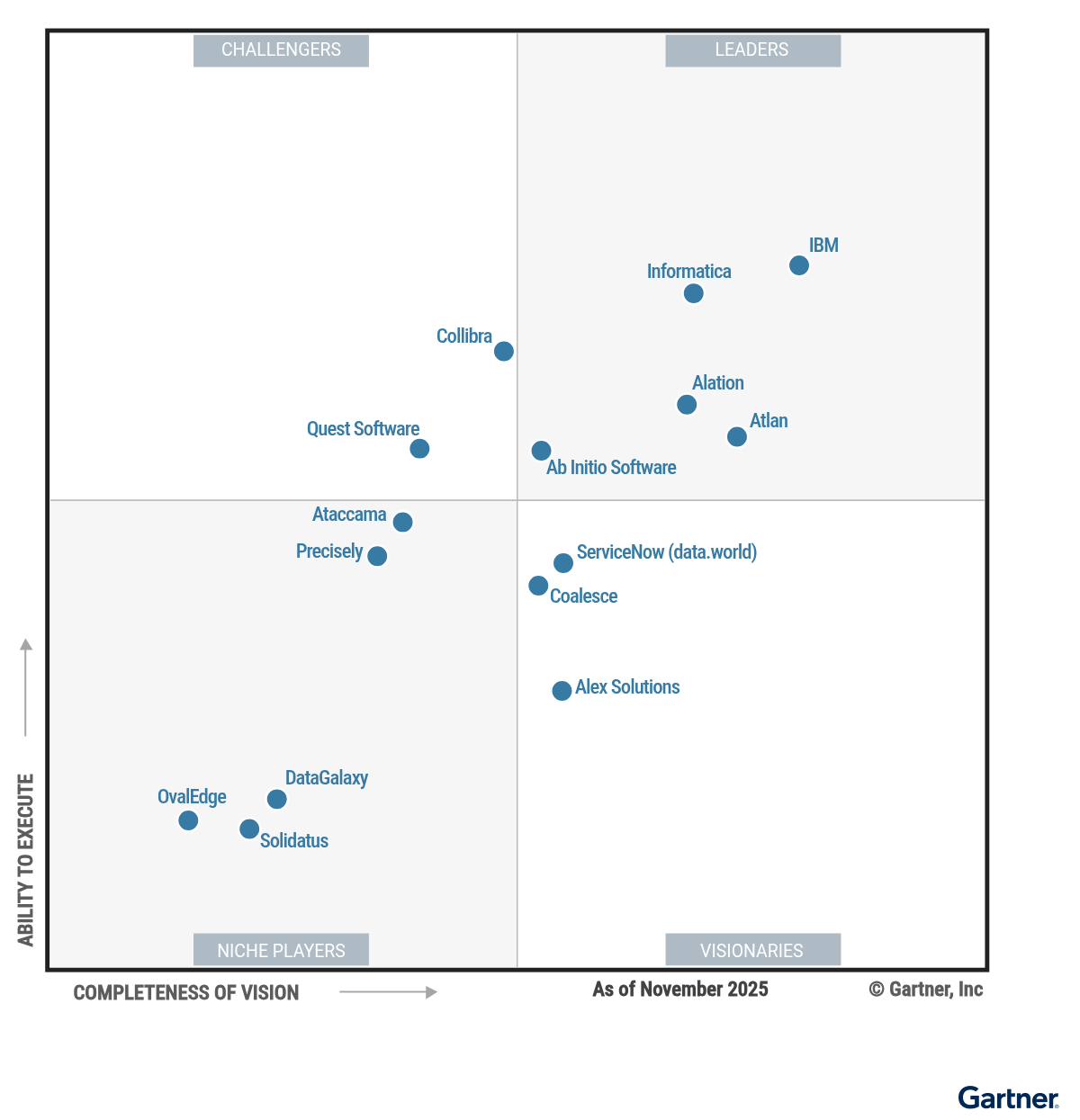
Magic Quadrant
Vendor Strengths and Cautions
Ab Initio Software
Ab Initio Software is a Leader in this Magic Quadrant. It is headquartered in Lexington, Massachusetts, U.S., with global customers mostly in North America, EMEA, and Asia. Its metadata management solution is the Metadata Hub, which is offered as a flexible deployment option across various environments, including cloud, on-premises, virtual machines, containers, and cloud marketplaces. Ab Initio’s operations are geographically diverse, with clients across sectors including financial services, telecom, and healthcare.
- Comprehensive, enterprise-scale capabilities: Ab Initio excels at handling complex, end-to-end data platform deployments by integrating metadata from multiple cloud and on-premises sources, including various file formats, databases, reporting tools, and other third-party catalogs.
- Advanced semantics: Ab Initio’s Metadata Hub leverages agentic AI that utilizes ML/SLMs/LLMs for semantic discovery with reinforcement learning, increasing the accuracy and reliability of user interactions with metadata. Users can interact using business terms and corporate ontologies, asking questions that mix both metadata and data (e.g., “Where did this come from?” and “Give me five records for that data.”).
- Strong use of active metadata: Ab Initio’s approach emphasizes using metadata not just for description, but to drive actual data processing and automation, creating and leveraging active metadata. AI agents generate and manage understandable metadata, which then defines workflows for tasks such as data acquisition, masking, integration, and quality.
- Limited marketing and partner ecosystem: Ab Initio has acknowledged that it has struggled to scale up its marketing and partner efforts. It has also focused more on engaging with IT technical personnel. Ab Initio is making a concerted effort to engage directly with business buyers, but this indicates a potential challenge in broader market awareness beyond its large enterprise customers.
- Cost and complexity: Customers report concerns about vendor lock-in, given the complexity and required customization of enterprise solutions. They also report perceived higher costs than competitors, leading to many evaluating alternatives.
- Platform as a service (PaaS): Ab Initio is transitioning from a pure software deployment to a PaaS model to simplify deployment and maintenance, but this PaaS offering is not yet generally available. Currently, containers are provided for deployment within the customer’s tenant, and Ab Initio maintains and upgrades them. Customers seeking a fully managed, hosted PaaS experience for their metadata solution might need to wait for the future release in early 2026.
Alation
Alation is a Leader in this Magic Quadrant. It is headquartered in Redwood City, California, U.S. Its metadata management solutions are Search and Discovery, Data Catalog, Data Governance, Data Quality, Data Lineage and Data Products Marketplace, offered as SaaS options in AWS or deployed in an infrastructure as a service (IaaS) configuration on AWS, Google Cloud and Microsoft Azure. The products can be installed either on-premises or in public/private cloud environments. Alation has approximately 650 customers, with most of them in North America. Its customers are primarily in the financial services, manufacturing and healthcare industries.
In May 2025, Alation announced that it had acquired Numbers Station AI, a pioneer in building AI agents for data workflows.
- Support for active and continuous metadata utilization: Alation’s platform supports active metadata management by enabling real-time and continuous monitoring, automated alerts for metadata changes, and integrated workflows that guide users toward maintaining metadata trust and data quality. This approach is valuable for organizations looking to leverage their metadata for governance automation, AI readiness and generative applications.
- Integrated collaboration tools: Alation incorporates social and collaborative features within its data catalog. Users can engage directly through embedded discussion platforms, annotations, and sharing functionalities that connect business and technical users in the context of metadata assets. This creates a community-driven approach to data governance, where shared insights and feedback loops continuously improve metadata relevance and quality.
- Shorter time to value: Customers recognize Alation’s quick deployment cycles and competitive pricing. The platform provides immediate insights through automated metadata extraction and self-service, as well as intuitive search capabilities, making it attractive for those seeking metadata-driven decision making and operational efficiency benefits.
- User experience concerns: While recent improvements in navigation, customization, and visual design have made Alation’s solution more approachable for a broader audience, including business users, some users have noted that certain advanced features still necessitate technical expertise and training. Ongoing improvements, such as streamlined workflows and improved onboarding resources, will continue to reduce training requirements.
- Scalability in legacy environments: Alation’s advanced capabilities are architected to scale across large data estates. Legacy systems often lack modern integration capabilities. Alation’s open architecture and platform enable customers to address these challenges by leveraging Alation’s services and integration options. Despite Alation’s assurances of robust scalability and positive customer feedback, enterprises are advised to carefully evaluate integration challenges before proceeding with deployment in legacy settings.
- Agentic platform vision versus current capabilities: Alation’s focus on agentic data management and advanced features is promising, but many capabilities are new or evolving. Customers should validate the robustness and readiness of these features for mission-critical use cases.
Alex Solutions
Alex Solutions is a Visionary in this Magic Quadrant. Its headquarters are in Melbourne, Australia. Its metadata management solutions include Unified Data Intelligence Platform, OpenMetaHub (OMH), Data Hub, Intelligent Connectors, Alex AIGuru, Enterprise Reporting & Analytics (ERA) and Data Discoverer. The platform emphasizes automation through self-developed connectors and governed extensibility via the OpenMetaHub. Alex Solutions serves more than 50 customers across North America, Europe and APAC. Its largest presence is in APAC, with a growing share in North America and EMEA. Roughly 45% of its clients are in the banking, financial services and insurance industries.
- Extensive and open connector ecosystem: Alex invests R&D in its native connector framework to deliver breadth and automation across the ecosystem. The platform delivers over 110 prebuilt connectors for cataloging, lineage and profiling. Alex also provides OpenMetaHub, an SDK-like framework that enables customers and partners to build and contribute their own connectors, agents, and data playbooks. This open design extends the platform’s reach to proprietary and niche technologies, making it suited for complex enterprise technology environments.
- Knowledge graph and flexible architecture: Alex is built on a graph-powered, ontology-driven platform with an integrated knowledge graph and native lineage capabilities. The platform’s architecture enables integration with all metadata types, allowing Alex to function as an active metadata repository across distributed systems. Its bidirectional integration capabilities support metadata exchange and synchronization with other applications.
- Enterprise-scale delivery: Alex is characterized by its fast deployment and enterprise-scale coverage. Implementations for the full platform are typically completed within 14 days, with ERA dashboards going live within 10 days. Alex governs over 35 million assets in a single catalog for large enterprises and handles up to 500 million data assets under management across various environments.
- Market growth and sales strategy: Alex remains profitable and debt-free, but smaller than its competitors. Eighty percent of its revenue comes from its own sales force. Reliance on its own sales teams, with limited operating resources, contributes to limited customer growth. The company is extending its reach beyond APAC, with growing partnership with system integrators and regional resellers in North America and EMEA.
- Targeted industry and enterprise focus: Alex focuses much of its sales and marketing on regulated industries where governance maturity drives early adoption, although the tools can also be used in various industries. In addition, it primarily targets midsize or large enterprises, with less focus on smaller organizations, which limits sales growth.
- Initial familiarization required for full capabilities: Some customers, particularly early users, express concerns about complex interfaces at first. This can lead to a longer learning period through familiarization, and guided onboarding typically addresses this over time. Fully leveraging platform capabilities requires training. The recent releases in the Data Discoverer interface and Alex Copilot, with simplified navigation and contextual assistance, help users come onboard.
Ataccama
Ataccama is a Niche Player in this Magic Quadrant. It is headquartered in Toronto, Canada. Its metadata management solution, Ataccama ONE, is available in the cloud and on-premises. It has 274 active customers and a client base, mostly in North America and EMEA. These clients are predominantly from financial services, insurance and manufacturing. While Ataccama is an established player in the data quality and MDM market, it has shifted its focus to a unified, platform-based strategy through Ataccama ONE.
- Unified data catalog: The Ataccama Data Catalog is crucial for automated metadata discovery, continuous scanning of data sources, and built-in data profiling. This helps organizations maintain an up-to-date repository of metadata. The catalog also supports business glossaries to ensure that the meaning of data is uniform across the organization.
- Automated metadata enrichment: The integration of AI in metadata management supports functions such as automated classification, extraction, and annotation of metadata from multiple data sources.
- Innovation: Ataccama has continuously invested in expanding its AI capabilities, such as the introduction of the ONE AI agent, which automates generating and applying data quality rules. Additionally, the company’s ability to offer specific solutions, like the free Snowflake Native App for data engineers, indicates strong market orientation and responsiveness to customer needs.
- Lack of a SaaS deployment option: Ataccama Cloud is now using a single-tenant architecture (PaaS). For enterprises that prioritize a multitenant SaaS model to minimize operational overheads and reduce deployment complexity, the current cloud option might represent a barrier to adoption. Organizations that require rapid, scalable and fully managed SaaS solutions may experience constraints in flexibility until the SaaS deployment option is implemented.
- Focus on structured data: Ataccama currently offers native support primarily for text-based data types. Most of the capabilities related to processing unstructured data — such as parsing multimedia content — are based on Snowflake. For unstructured data, integrations with external services are required, meaning that the native functionality is limited.
- Reliance on consulting and training: Customers have noted that the platform’s complexity drives a dependence on Ataccama’s consulting services. Although comprehensive training materials are available, the feedback suggests that organizations may need to invest significantly in professional services to fully realize the platform’s benefits.
Atlan
Atlan is a Leader in this Magic Quadrant. Its headquarters are in San Francisco, California, U.S. Its metadata management solutions are Data Catalog and Governance Studio, Data Product Marketplace and Domains, Atlan AI, and Data Quality Studio. Atlan has more than 290 customers across North America, Europe, Asia/Pacific and Latin America, with its largest presence in North America. The majority of its customers are in the consumer, manufacturing and financial services sectors.
- Go-to-market strategy: Atlan focuses on delivering business value with data across enterprises. Atlan’s ability to articulate value and identify clients with a vested interest in high data investments is key to its success, as shown by its market traction and adoption. In particular, Atlan has been focusing on helping organizations that have failed in prior metadata management initiatives.
- Product vision: Atlan’s vision of being the metadata control plane to capture, unify, and understand enterprises’ data estates is central to supporting all consumption and AI use cases and providing the necessary context and data for agentic solutions.
- Ease of use: Customer references praise the ease of use of the technology, and particularly the lineage and search capabilities that are core to all metadata management use cases, particularly data usability enablement and data governance.
- Competition due to market consolidation: Pure metadata solutions like Atlan will face competition in a market that has seen the emergence of metadata management capabilities as part of cloud service providers’ data ecosystems or broader data management platforms.
- Product evolutions: Atlan has an aggressive delivery roadmap and iterates rapidly on its product delivery, but while this is needed in a highly changing market, it can also cause confusion with clients. For example, some are reporting that documentation is not up-to-date or that feature delivery timelines lack clarity, which impacts enterprises’ implementation roadmaps.
- Customer support: By default, customers interact with support online via the customer portal, emails, and Slack/Teams. A few clients report that it can be tedious to interact with customer support and track support cases, and that case resolution can be slow.
Coalesce
Coalesce is a Visionary in this Magic Quadrant. It is headquartered in San Francisco, California, U.S., and offers metadata management solutions called Coalesce Catalog and Coalesce Transform. Coalesce has over 300 customers and a presence in the U.S., Europe, Australia, and New Zealand. The majority of its customers are in the banking, securities, software, and Manufacturing industries.
Coalesce acquired CastorDoc in March 2025. This acquisition expands Coalesce’s data transformation platform with metadata management and AI-assisted data governance features.
- Product strategy: Coalesce aims to define data management by unifying data transformation, metadata and governance in a single AI-powered platform. This aligns with the market convergence across adjacent data management markets. This vision will appeal to clients who have been struggling to build a data ecosystem by integrating multiple technologies.
- Sales execution: Coalesce has been focusing on sales execution and is quickly gaining market traction. In addition to its presence across the U.S., France, the U.K., and DACH, it has added offices in New Zealand and Australia. It has also expanded its partner network across service providers and technology partners.
- User experience: Coalesce provides an intuitive user experience augmented with generative AI, addressing various personas from data engineers, data management experts and data stewards to business users, and combines capabilities in a very intuitive manner across data preparation, data cataloging, metadata management, and data governance.
- Completeness of product capabilities: Coalesce’s product offering for metadata management solutions covers all of the major requirements, but has some gaps in data lineage, impact analysis and semantics. For example, lineage is only automatically computed upfront without providing lazy or eager evaluation of lineage. The vendor does not support graph technologies, like exploiting metadata by leveraging a knowledge graph.
- Confusing market positioning: Coalesce’s positioning and capabilities span multiple markets, forcing enterprise clients to compare Coalesce not only for its metadata management capabilities, but also for its overall product portfolio, particularly for its data integration. This can be a challenge for organizations that have a mix of technologies in their data management ecosystem or who wish to standardize on a converged data management platform.
- User groups and communities: Coalesce currently does not have user groups or communities where users can share insights and experiences. All the support requests or product feedback sharing have to go through the vendor’s official channels. This limits the opportunity for the vendor to directly gather feedback on their product and scale customer support capacity.
Collibra
Collibra is a Challenger in this Magic Quadrant. It is headquartered in New York City, New York, U.S., and offers Collibra Platform, Collibra Data Catalog, Collibra Data Lineage, Collibra Data Governance, Collibra Data Quality & Observability, Collibra AI Governance, and Collibra Protect. It has over 700 customers across all geographies, with the majority in North America and 30% in EMEA.
In June 2025, Collibra announced the acquisition of Raito to enhance its unified governance platform by strengthening its data access governance capabilities. In July 2025, Collibra also acquired Deasy Labs to extend its coverage to unstructured data management.
- Market presence: Collibra’s brand is well-established in the market and is frequently mentioned in Gartner inquiries; it also has a strong partner network across technology vendors and service providers, which further drives market traction.
- Product vision: It has accelerated the delivery of its vision for enterprises to confidently use data and AI via the acquisition of Deasy Labs and Raito, which bring unstructured data governance, security, and governance of data products to deliver a semantic graph of organization’s business entities.
- Broad spectrum of capabilities: Collibra is one of the largest vendors in the Magic Quadrant, with a broad range of capabilities, including a large set of connectors, particularly around data governance, data observability, data lineage and semantics.
- Lack of metadata management solution market focus: Collibra’s core use cases are primarily data governance, including policy enforcement. It is further extending into AI governance. While these use cases require strong metadata management capabilities, and these capabilities are foundational to Collibra’s platform, Collibra has not demonstrated a strong marketing strategy in supporting wider use cases via its metadata capabilities.
- Pricing and licensing: Based on Gartner inquiries, Collibra customers express limited satisfaction with the complexity of its pricing options, the increasing subscription costs, lack of pricing flexibility, and poor negotiation ease. However, Collibra’s new pricing strategy should alleviate the complexity and elevated costs that customers have identified.
- User friendliness: In inquiries and client feedback, Collibra clients mention that while Collibra attempts to address various user personas, it is complex, particularly to business users, and may have an initial steep learning curve.
DataGalaxy
DataGalaxy is a Niche Player in this Magic Quadrant. It is headquartered in Lyon, France. Its metadata tools include DataGalaxy Metadata Hub and DataGalaxy Strategy Hub. It has 200 active customers. Its client base is mostly in EMEA, with clients primarily in the public sector, as well as the banking, financial services, and insurance industries.
DataGalaxy announced the acquisition of YOOI in February 2025 to extend its offering with the new product, DataGalaxy Strategy Hub, which connects data use cases and investments with business value.
- Multilingual support: The platform leverages AI for enhanced user experience and automation in metadata management. This includes a chatbot (Blink), content generation, and live multilingual capabilities that can translate all metadata content into multiple native languages (e.g., German, French, Spanish, Portuguese, Dutch) without needing to duplicate content, effectively removing language barriers.
- Strategic portfolio management with Strategy Hub: Through the acquisition of YOOI, DataGalaxy extended its offering with a Strategy Hub that enables customers to manage their data initiatives like a financial portfolio. The hub directly connects execution to measurable business goals and strategies. It provides templates and advisors to drive business alignment and identify potential use cases.
- Persona-based and collaborative experience: The platform is designed to offer a tailored, persona-driven experience for C-suite leaders, business teams, data teams, AI agents, and engineers, fostering collaboration across all stakeholders. Its Data Knowledge Studio (a tool in Metadata Hub) bridges the gap between executives, technology and business, ensuring everyone can contribute to and benefit from metadata knowledge.
- Vision and marketing strategy: DataGalaxy’s marketing strategy has been skewed more toward the data governance use case than other, more comprehensive and emerging metadata use cases, such as supporting AI-ready data and enabling modern architectures. This may potentially impact the vendor’s future roadmap planning.
- Inflexibility of pricing model: DataGalaxy’s pricing model is based on the number of users and the number of connectors. Although the vendor offers unlimited viewers as a benefit, organizations requiring a large number of users or wanting to connect various data sources with complicated and diverse environments are likely to see a high cost for their implementation. This may cause challenges to scaling with this model later on.
- Connectors to on-premises environments: DataGalaxy currently provides 70+ connectors out of the box. However, in the Gartner Peer Insights portal, some customers comment that there are not sufficient connectors for on-premises environments and that using some of them is difficult. Overall, on-premises integration is not easy.
IBM
IBM is a Leader in this Magic Quadrant. It is headquartered in Armonk, New York, U.S. Its metadata management solutions are primarily centered around its watsonx family of products, which includes watsonx.data intelligence. In April, IBM repacked its stand-alone products, such as IBM Knowledge Catalog (IKC), Manta, and Data Product Hub, into watsonx.data intelligence. Its operations are geographically diversified, with clients in various sectors.
IBM acquired DataStax in May 2025, to expand IBM’s capabilities in managing unstructured data. Its integration into watsonx enhances metadata management by providing advanced vector search and retrieval for unstructured data.
- Hybrid cloud support: IBM supports on-premises, multicloud and SaaS deployments for metadata management. This capability extends to deploying its metadata products in environments such as air-gapped on-premises systems and connecting to on-premises data sources. This flexibility has been a significant factor in its growth, particularly in regions like Latin America.
- End-to-end AI-powered metadata management platform: IBM offers an integrated platform that spans the entire data stack, from the persistence layer through to data consumption, including data, model, and application layers. This end-to-end ownership allows IBM to embed AI automation and metadata intelligence throughout the platform, providing an integrated user experience.
- Commitment to open standards and ecosystems: IBM is embracing open standards and open ecosystems in metadata management. Key examples include support for OpenLineage, Open Data Contract Standard (ODCS), and Model Context Protocol (MCP), which facilitates metadata exchange across diverse tooling.
- Evolving product portfolio: IBM legacy metadata products, such as IBM Knowledge Catalog, Manta and Data Product Hub, are still available stand-alone. IBM customers should confirm whether bundled features meet all their needs or if a stand-alone product is needed for specific requirements.
- Legacy IKC and Manta limitations: Customers report that IKC has limited connectivity to certain data sources (such as SAS), metadata description, and custom attribute creation. The legacy version of IBM Manta Data Lineage is complex and more technical-user-oriented, making it difficult for nontechnical users. IBM has addressed this usability gap through the new unified lineage capabilities in watsonx.data intelligence.
- Complex software solutions: Some IBM customers comment that its solutions are complicated, expensive, large-scale and suitable only for large enterprises with skilled IT professionals. IBM has worked to address this concern with new easy-to-consume SaaS-based plans that have low-entry-point pricing, implementation accelerators, preconfigured templates and training programs.
Informatica
Informatica is a Leader in this Magic Quadrant. It is headquartered in Redwood City, California, U.S. Its metadata management solution is Informatica Cloud Data Governance and Catalog, and is offered as part of Informatica’s broad Intelligent Data Management Cloud (IDMC). IDMC is a cloud-native SaaS solution supporting multicloud environments such as AWS, Azure, GCP and Oracle.
Salesforce entered into an agreement to acquire Informatica in May 2025. The acquisition is expected to close early in Salesforce’s fiscal year 2027.
- Market understanding: Informatica demonstrates a comprehensive understanding of how to utilize metadata effectively for current and emerging metadata-driven AI and business use cases. Informatica continues to adapt to changing market requirements, as demonstrated by its CLAIRE AI suite of tools embedded across all IDMC products.
- Broad data management support: Informatica has strong integrations across the broader data management market, leveraging metadata captured from Cloud Data Governance and Catalog to enable more effective data management beyond core metadata use cases. IDMC leverages metadata to drive insights, suggestions and automation for adjacent data management activities.
- Partner ecosystem: Informatica has a strong global ecosystem, with over 500 partners across its product portfolio. These include system integrators, independent software vendors, and technology and service providers.
- Uncertainty from Salesforce acquisition: Informatica states that its product portfolio, including IDMC and Informatica Cloud Data Governance and Catalog, will continue. Its acquisition by Salesforce creates uncertainty regarding Informatica’s long-term strategic direction, product offerings, pricing options, and commercial models postacquisition.
- High cost and pricing model: Informatica’s pricing model, using Informatica Processing Units (IPUs), requires customers to forecast their monthly or annual usage and expected spend. Because IPUs cannot be carried between periods, and many clients are not experienced in estimating usage, some customers report that Informatica’s cost of ownership is relatively higher than its competitors. Informatica also offers flexible pricing options for customers with irregular usage patterns.
- Cloud-only and end of software maintenance (EoSM) announcements: Informatica has shifted its product approach to lead with cloud-only solutions (IDMC). Some existing clients are concerned with challenges in migration to the cloud, and also support for on-premises and hybrid solutions. Prospective customers of on-premises solutions should be prepared for potential EoSM announcements over the next few years (for example, for the legacy product, Enterprise Data Catalog) and the impact of this cloud-only approach while evaluating Informatica’s metadata solutions.
OvalEdge
OvalEdge is a Niche Player in this Magic Quadrant. It is headquartered in Alpharetta, Georgia, U.S. Its product, the OvalEdge platform, consists of modules including data catalog, business glossary, data quality, data lineage, service desk, workflow, privacy, and compliance. OvalEdge is growing, with over 200 clients primarily in the North America and EMEA regions; its clients are primarily in the banking, financial services, and insurance industries.
- AI chatbot: OvalEdge’s agentic AI chatbot, askEdgi, enables users to ask and receive answers to both data-related and metadata-related questions in natural language. It leverages a metadata knowledge graph to facilitate data discovery and analytics, with multiple agents running behind the scenes for tasks like data discovery and permission checks.
- Connectivity: The OvalEdge platform provides over 150 connectors to various data sources, including data lakes, databases, SQL servers, business applications like SAP and Salesforce, and API systems. These connectors are developed internally, often in collaboration with customers, and offer access to user permissions and code parsing, allowing for better data understanding.
- R&D investment and workflow management: OvalEdge prioritizes its R&D investment and has a staff of over 100 people dedicated to R&D (one-third of the total headcount) and a $12 million budget. Its product development focuses on many areas, including workflow management. OvalEdge provides a complete workflow system that can be configured to manage complex processes, particularly for data access requests in large enterprises.
- AI limitations: OvalEdge uses AI for metadata curation, but AI curation may produce hallucinations because it doesn’t know the business context. A human-in-the-loop is required to overcome the limitation. The vendor developed the AI Question Wall to solicit human input for complete and accurate business-contextual metadata.
- Pricing model: OvalEdge’s pricing model is based on connectors and product features. If a required connector is not available, development will incur an extra cost (though at a reduced rate, with OvalEdge retaining the IP). The total cost of ownership can increase significantly with the number of data sources to be connected and the specific features required.
- Marketing execution: OvalEdge participated in relatively few marketing or partner events over the last 12 months. The vendor is rarely mentioned in Gartner client inquiries, and it is less likely than other vendors in this report to be shortlisted in competitive situations seen by Gartner.
Precisely
Precisely is a Niche Player in this Magic Quadrant. It is headquartered in Burlington, Massachusetts, U.S. Its metadata management solution is the Precisely Data Integrity Suite, currently with 150 customers. It is offered as a cloud-native SaaS solution and agents can be deployed on-premises or in hybrid cloud architectures. The solution enables metadata management across multiple cloud service providers, like AWS, GCP, and Azure, including support for lakehouse platforms like Databricks and Snowflake. Operations are geographically diversified, and its customers are mostly large enterprises in various industries, including financial services, insurance, and manufacturing.
- Engagement strategy: Precisely offers a portfolio of datasets and prelinks them with other leading data vendors through its Data Link partner program to enable data enrichment. The vendor also offers guidance on AI readiness, AI governance, and metadata strategies through its Data Strategy Consulting, and Precisely also has strong relationships with major consulting groups and partners for further expertise.
- Foundational metadata layer: Precisely enables a common metadata foundation, which is shared across its entire Data Integrity Suite. This foundation ensures faster time to value and interoperability across all its solutions, including data integration, data quality, and data governance.
- Extensive connectivity and deployment options: Precisely continues to expand connectivity through new source connectors covering enterprise and third-party metadata sources, leading to faster onboarding. The vendor offers flexible deployment options, including SaaS, on-premises, and hybrid cloud, allowing customers to deploy services where their workloads reside, effectively supporting complex environments.
- Maturity of AI offerings: At the time of this evaluation, Precisely has not taken advantage of AI layers as effectively as many of its competitors. The vendor is working to enhance its AI offerings and provide additional help to customers in accelerating their AI initiatives.
- Positioning and market confusion: Customers report confusion over where Precisely can enable metadata management within broader data initiatives (data integration, data quality, etc.), as many are not aware of Precisely’s metadata capabilities. Precisely’s Data Integrity Suite enables capabilities across many data management markets, and potential customers should be aware of the breadth of Precisely’s offerings.
- Product pricing and value: The Precisely Data Integrity Suite is offered as multiple interoperable services with clients reporting complex pricing and licensing discussions. Potential customers should be aware that solutions often are positioned to include additional capabilities beyond metadata management. Precisely recently released a new pricing model — usage-based pricing based on value metrics and modular licensing that enables customers to adopt capabilities at their own pace.
Quest Software
Quest Software is a Challenger in this Magic Quadrant. It is a privately owned company based in Aliso Viejo, California, U.S. Its metadata management solution is Quest erwin, and provides capabilities as a stand-alone offering or as an integrated platform with its flagship data modeling tool, Quest erwin Data Modeler. Most of the customers using Quest erwin are large organizations (more than 10,000 employees) based in North America, EMEA and APAC.
- Strong data governance and modeling capabilities: Quest’s products highlight its heritage of robust data modeling and governance, with features such as semantic layers, virtual data stewards, and automated governance policy enforcement. These capabilities support advanced stewardship, mapping meaning for AI, and ensure high-quality, trusted data assets.
- Innovative data marketplace and data productization: The introduction of a data marketplace allows organizations to curate, score and monetize datasets and AI models as data products. This approach makes data easily discoverable and accessible, fostering a “data-as-a-product” mindset and enabling economic rationalization of governance.
- Focus on automation and operational efficiency: Quest erwin directly integrates automation into the process of building and maintaining data models and AI workflows, reducing the risk of errors and saving time. It also applies data governance rules automatically as work is done, so teams don’t need to interrupt their processes for separate compliance checks.
- Market position: Quest is changing its products and adding AI features. Its focus on building a broad data management platform may cause confusion to buyers who are only interested in metadata management.
- Incorporation of LLM use cases: The rapid evolution in artificial intelligence and GenAI means that incorporating LLM use cases into metadata management is becoming increasingly important. Quest erwin, however, has lagged behind competitors in incorporating LLM use cases. Organizations looking to harness new AI-driven insights from their data should review available and related planned capabilities and delivery timeframes from the vendor.
- Economic considerations: While the Quest erwin platform offers extensive features, potential customers should carefully evaluate the total cost of ownership against the functional benefits offered. Quest’s platform strategy aims to reduce operational overhead and customer complexity, aligning with industry guidance that converged platforms can significantly reduce costs and operational efforts.
ServiceNow (data.world)
ServiceNow is a Visionary in this Magic Quadrant. It is headquartered in Santa Clara, California, U.S. It offers an Enterprise Data Catalog & Governance Platform (through the acquisition of data.world). ServiceNow’s operations and enterprise customers are globally distributed, but Gartner does not have the breakdown for its metadata management solution product. Its customers are in various industries, including government, insurance, and manufacturing sectors.
ServiceNow announced the acquisition of data.world in May 2025 to embed data catalog and governance capabilities into its AI Platform and Workflow Data Fabric. The acquisition was completed in July 2025.
- Product strategy: Through the acquisition of data.world, ServiceNow positions itself to build a converged data ecosystem that powers a data control tower, which powers all data, AI, and agentic AI use cases that converge data and application requirements.
- Flexibility and ease of use: Client feedback through inquiries and Gartner Peer Insights praises the ease of use and flexibility of implementation of the solution. For example, the knowledge graph supporting the solution offers great flexibility in collecting, managing metadata and building ontology.
- Improved sales execution and go-to-market postacquisition: data.world will benefit from both sales and marketing as part of ServiceNow. In particular, its direct and indirect sales channels should reach a wider set of customers, starting with the existing ServiceNow installed base.
- Uncertainty for existing data.world customers: As part of ServiceNow, data.world will be focusing on developing ServiceNow’s catalog and governance. As a result, its ability to continue delivering to the requirements of its existing installed base, which may or may not have any future focus on ServiceNow AI platform or Workflow Data Fabric of ServiceNow, might be challenged.
- ServiceNow is new to data management: ServiceNow is expanding as a data management platform vendor, but this will require expanding its product portfolio significantly through organic development, acquisitions, or partnerships, which will take time and development in an increasingly competitive market.
- Administration capabilities: data.world is missing features for proper versioning, concurrent authoring of metadata. These capabilities are key to scaling to large deployments with large numbers of concurrent users.
Solidatus
Solidatus is a Niche Player in this Magic Quadrant. It is based in the U.K. and the U.S., with operations focused on the North America and EMEA markets. Its metadata management solution is the Solidatus Platform, which is offered as a cloud deployment on major CSPs (AWS, Azure, GCP) as a cloud-native SaaS, or can be deployed on-premises. The vendor’s clients are mostly large organizations in the finance, insurance, government and healthcare sectors.
- Comprehensive data lineage: Solidatus provides very strong, fine-grained data lineage capabilities and has a strong success record in highly regulated environments such as the finance, healthcare, and government sectors. The solution also provides time-travel capabilities to support strict auditing requirements and enable future planning.
- Strong partnerships: Solidatus is partnered with Microsoft as a preferred data lineage partner supporting Microsoft Purview and Fabric. In addition, Solidatus has strong relationships with industry partners (EY, KPMG, etc.), and other major CSPs.
- Aligned product roadmap: Solidatus has a strong understanding of the market overlaps with other data management offerings, targeting broader capabilities enabled by metadata and lineage. The vendor also has a strong strategy for leveraging AI in future product innovations.
- Solution complexity: Solidatus continues to improve its user interface, but customers report that the UI is often difficult to use due to complex visuals and the number of customizations required, leading to challenges for nontechnical users.
- Market visibility: While Solidatus’ capabilities can support multiple verticals, the product is perceived as a niche vendor, only focusing on specialization in data lineage use cases in highly regulated industries, like finance, and doesn’t appear as frequently in competitive evaluations for metadata solutions in other industries.
- Narrow customer use-case focus: Solidatus is well-established in regulatory and compliance-oriented use cases, focusing on data governance, privacy, and risk management. However, the number of customers using Solidatus as a solution for other metadata use cases remains low.
Inclusion and Exclusion Criteria
Inclusion Criteria
To qualify for inclusion in this Magic Quadrant, vendors must meet the following requirements:
- Offer stand-alone software solutions or cloud services that are positioned, marketed, and sold specifically for general-purpose metadata management applications. Vendors that provide several metadata management modules or products for different features must demonstrate that these are integrated and collectively meet the full inclusion criteria for this Magic Quadrant.
- Deliver all of the following critical metadata management functions at a minimum (descriptions are the same as given in the Market Definition):
- Metadata discovery
- Metadata curation and analysis
- Metadata search and sharing
- Ontology and taxonomy management
- Data lineage
- Data profiling
- Rule management
- Metadata operational support
- Enable large-scale deployment via server-based or cloud-based runtime architectures that can support concurrent users and applications. The cloud-based/SaaS version should support all critical functions independently, as mentioned in the above criteria.
- Provide metadata discovery capability across a wide range of common data sources or environments for different types of data (structured and unstructured).
- Maintain an installed base of at least 50 production paying customers (different companies/organizational entities) for their flagship metadata management product (not individual smaller modules or capabilities).
- Provide direct sales and support operations, or a partner providing sales and support operations, in at least two of the following regions: North America, South America, EMEA, and Asia/Pacific.
- The customer base for production deployment must include customers in multiple countries and in more than one region (North America, South America, EMEA, and Asia/Pacific), and be representative of at least three industry sectors.
- Rank among the top 20 organizations in the Customer Interest Indicator (CII) defined by Gartner for this Magic Quadrant. Data inputs used to calculate the metadata management solutions market momentum included a balanced set of measures:
- Gartner customer search and inquiry volume and trend data.
- Frequency of mentions as a competitor to other metadata management vendors in reviews on Gartner’s Peer Insights.
- Social media communities and overall trends, such as X (formerly Twitter) and LinkedIn followers, and the Google Trends search index.
Exclusion Criteria
Vendors that focus on narrow use cases that are too specific for the broader metadata management market were excluded. In general, vendors have been excluded for the following reasons:
- The core capabilities listed above are provided by a third party through an OEM partnership. This exclusion does not apply to metadata ingestion and translation capabilities.
- Vendors provide products for one very specific metadata management use case; for example, tools for data discovery only.
- Vendors market only products from the list below, rather than metadata management solutions.
- Cloud DBMS product
- Cloud data warehouse or data lake tool
- Analytics and BI platform
- Data science and ML platform
- Data integration tool
- ERP system or any business application
- Other applications or platforms
Honorable Mentions
- Amazon: Amazon is headquartered in Seattle, Washington, U.S. Amazon’s metadata management solutions are Amazon SageMaker, AWS Glue, Amazon S3 Metadata, Amazon DataZone (which powers Amazon SageMaker Catalog), AWS Glue Data Catalog, and AWS Lake Formation. These are cloud-native solutions that support hybrid data landscape delivery, but do not support multicloud environments. The AWS ecosystem increasingly incorporates metadata that feeds into decision-making processes. For instance, Amazon Q and integrations with generative AI (via Amazon Bedrock) offer recommendations for metadata descriptions, further enriching the cataloged data and reducing errors with AI models. The vendor does not meet the inclusion criteria for this Magic Quadrant because these tools are designed to operate within the AWS cloud environment only and are not positioned as general-purpose metadata solutions. The tools, however, can still discover metadata for data sitting outside of the AWS environment.
- Google: Google is headquartered in Mountain View, California, U.S. Google’s metadata management tool is Dataplex Universal Catalog, which offers an AI-enhanced solution for metadata management and data governance within the Google Cloud ecosystem. It natively supports all Google Cloud data and AI sources. For non-Google data sources, managed connectivities in Dataplex Universal Catalog enable metadata import into the catalog. Google Dataplex does not currently support hybrid or multicloud environments. For organizations that have data in these environments, Dataplex Universal Catalog integrates with partners/third-party vendors such as Collibra or Atlan. The tool is not positioned and marketed as a general-purpose or stand-alone metadata management product and therefore did not meet the inclusion criteria for this Magic Quadrant report.
- Microsoft: Microsoft is headquartered in Redmond, Washington, U.S. Microsoft’s primary metadata management tool is Microsoft Purview, a unified data security, compliance, and governance service that provides data discovery, classification, lineage, and data quality assessment on data, primarily in Azure-centric environments. The tool can support metadata discovery across non-Microsoft systems (on-premises or in the cloud). OneLake Catalog is another metadata tool that is part of Microsoft Fabric and natively integrates with Purview. Microsoft does not meet the inclusion criteria of being positioned as a stand-alone, general-purpose metadata solution. However, Purview has a strong market presence and is considered a strong competitor among the vendors assessed in this Magic Quadrant report.
- Orion Governance: Orion is headquartered in San Mateo, California, U.S. Orion’s metadata management tool is called the Enterprise Information Intelligence Graph (EIIG) platform. It integrates data catalog, data lineage, data quality, data observability, and data marketplace capabilities into a single, natively integrated product with direct access to data. It’s built on a knowledge graph foundation, which allows it to dynamically connect and contextualize metadata assets. The vendor does not meet the inclusion criteria due to the small customer size (fewer than 50).
- TopQuadrant: TopQuadrant is headquartered in Raleigh, North Carolina, U.S. Its metadata management tool is called TopBraid Enterprise Data Governance (EDG). It is built on a knowledge graph using open standards and features a semantic data catalog that uses AI to harmonize metadata across the enterprise with 300+ prebuilt ontologies. The tool also offers policies-as-code that form an AI-ready data foundation for continuous metadata sharing between data management and AI applications. The vendor does not meet the inclusion criteria due to lower CII scores.
Evaluation Criteria
Ability to Execute
Gartner analysts evaluate technology vendors on the quality and efficacy of the processes, systems, methods, and procedures that enable their performance to be competitive, efficient, and effective, and positively impact their revenue, retention, and reputation within Gartner’s view of the market.
Gartner evaluates vendors’ Ability to Execute in the metadata management solutions market by using the following criteria:
Product or service: Core goods and services that compete in and/or serve the defined market. How well the vendor supports the range of metadata management capabilities required by the market, the manner (architecture) in which these capabilities are delivered, and the overall usability of the solutions.
For example, we evaluate each vendor on the capabilities that it has to address current market requirements including, but not limited to the Mandatory Features in the Market Definition. We also evaluate connectivity options to various data sources, including nonrelational databases, cloud applications and cloud data stores. Finally, we evaluate the degree of openness of the vendor’s technology and product strategy — that is, the ability to exchange metadata with third-party offerings.
Overall viability: The vendor’s financial strength (as assessed by revenue growth, profitability, and cash flow) and the strength and stability of its people and organizational structure. This criterion reflects buyers’ increased openness to considering newer, less-established, and smaller providers with differentiated offerings. We also include the likelihood that the organization can continue to offer and invest in the product, as well as the product’s position in the organization’s portfolio.
For example, we evaluate each vendor on its revenue growth in products/services, and growth in market share and partner ecosystems. We also evaluate growth of its product lines, its annual recurring revenue (ARR), profitability, and growth in new deals, geographies, or use cases. Finally, we consider the vendor’s investment in skills, personnel, and roles for product development, delivery, and support.
Sales execution/pricing: The flexibility, effectiveness, ease of adoption, and market suitability of the vendor’s pricing and licensing model in light of current and future customer demand trends and spending patterns (for example, operating expenditures and flexible pricing). We consider the ability to provide tools and capabilities through different pricing models appropriate for use cases, personas, and environments.
For example, we evaluate each vendor on the ease with which customers can hold the vendor accountable for agreed-on SLAs (in terms of uptime, turnaround times to issues, bug fixes, migrations, and so on). Providers must demonstrate ways through which customers can escalate and attain credits/discounts when SLAs are not met. We also evaluate the vendor’s ability to provide flexible licensing options for future growth or downsizing of usage. Finally, we consider its ability to provide tools and capabilities through different pricing models appropriate for usage, persona and other factors.
Market responsiveness/record: The ability to respond, change direction, be flexible, and achieve competitive success as opportunities develop, competitors act, customer needs evolve, and market dynamics change. This includes the provider’s history of responsiveness to changing market demands.
For example, we evaluate each vendor on its ability to respond to current market demands for solutions that support AI-ready data use cases. We also consider the channels available for customers to provide product feedback, and how customer feedback is used to prioritize functionality or new features. We evaluate the frequency of new releases and the vendor’s bug-fix cycle.
Marketing execution: The clarity, quality, creativity, and efficacy of programs designed to deliver the organization’s message are essential to influencing the market, promoting the brand, increasing awareness of products, and establishing a positive identification in customers’ minds. This “mind share” can be driven by a combination of publicity, promotional activity, thought leadership, social media, referrals, and sales activities.
For example, we evaluate each vendor on the number of postings, blogs, webinars or other content it shares on social media for metadata management practices or technologies. We also consider the overall effectiveness of the vendor’s marketing efforts to impact its mind share, market share, and account penetration. Finally, we evaluate its ability to support and become part of open community channels for sharing best practices, connectors/code/mappings/other assets, or supporting open metadata-sharing standards.
Customer experience: The degree to which a vendor’s products, services, and programs enable customers to achieve their desired results. This includes the quality of supplier/buyer interactions, technical support or account support, ancillary tools, customer support programs, availability of user groups, and service-level agreements.
For example, we evaluate each vendor on the level of satisfaction expressed by customers with the vendor’s product support and professional services support. We also consider customer feedback on a vendor’s ability to meet roadmap deliverables, as well as its technical knowledge sharing, skills enablement, augmentation, and training. We consider the vendor’s resources in onboarding training for different personas, as well as for online documentation and user certifications.
Operations: The ability of the organization to meet its goals and commitments. This includes the quality of its organizational structure, skills, experiences, programs, and systems that enable the organization to operate effectively and efficiently.
For example, we evaluate each vendor on its ongoing knowledge transfer to end-user organizations, as well as its training, skills augmentation of internal staff, and overall enablement of data teams. We also consider the vendor’s investment in support, training, and achievement of compliance or industry-specific certifications such as FedRAMP, HIPAA, GDPR and the like.
Ability to Execute Evaluation Criteria
| Evaluation Criteria | Weighting |
|---|---|
Product or Service | High |
Overall Viability | High |
Sales Execution/Pricing | Medium |
Market Responsiveness/Record | Low |
Marketing Execution | Medium |
Customer Experience | High |
Operations | Low |
As of November 2025 | |
Source: Gartner (November 2025)
Completeness of Vision
The evaluation covers current and future market direction, innovation, customer needs, and competitive forces, as well as how well they correspond to Gartner’s view of the market.
Gartner assesses vendors’ Completeness of Vision in the metadata management solutions market by using the following criteria:
Market understanding: The ability to understand customer needs and translate them into products and services. Vendors that show a clear vision of their market by listening and understanding customer demands can shape or enhance market changes with their added vision.
For example, we evaluate each vendor on its understanding of current market demands, dynamics, and trends, as well as its customer requirements in the metadata management area. We also consider the degree to which vendors are aligned with the significant trend of convergence with other adjacent data management markets and with emerging metadata use cases. Finally, we evaluate the vendor’s thought leadership in the metadata management area, and the ability to provide “advisors” and insights into using active metadata to support decision insights and decision automation.
Marketing strategy: The ability to clearly communicate differentiated messaging, both internally and externally, through social media, advertising, customer programs, and positioning statements.
For example, we evaluate each vendor on how clear and consistent its branding and messaging is on its official website or social media for overall positioning statements. We also consider its ability to showcase a complex portfolio through clear, differentiated messaging, justifying purchases, and clarifying use of each product/SKU. Finally, we consider the vendor’s efforts and investments in the expansion of training, certifications, and availability of talent in the market (through, for example, partner programs and training).
Sales strategy: The ability to create a sound strategy for selling that uses the appropriate networks, including direct and indirect sales, marketing, service, and communication. This also includes partners that extend the scope and depth of the vendor’s market reach, expertise, technologies, services, and customer base.
For example, we evaluate each vendor on its overall sales strategy in the GTM partnership, and direct versus indirect sales resources. We also consider its growth through varying channels (e.g., OEMs, VARs, SIs, hyperscaler marketplaces, consulting companies, joint GTM, or partnerships with vendors in the D&A space). Finally, we evaluate the vendor’s strategy for growing beyond existing markets, use cases, geographies and key capabilities.
Offering (product) strategy: The ability to approach product development and delivery in a way that meets current and future requirements, with an emphasis on market differentiation, functionality, methodology, and features.
For example, we evaluate each vendor on its partnership/ecosystem development strategy, as well as its differentiated product capabilities to support various personas, use cases, and data environments. We also consider the vendor tools that exhibit improvement in automation-oriented capabilities, including GenAI capabilities. Finally, we evaluate the vendor’s roadmaps, existing capabilities, and its degree of openness to support interoperability through open metadata exchange. :
Business model: The design, logic, and execution of the organization’s business proposition to achieve continued success.
For example, we evaluate each vendor on the overall approach it takes to future-proof its business model and marketing strategy, including diversity of delivery models, packaging and pricing options, partnerships, and data ecosystem relationships. We also consider its ability to create differentiation, land-expand, grow, and target specific differentiated use cases, personas, and delivery models. y models, packaging and pricing options, partnerships, and data ecosystem relationships.
Vertical/industry strategy: The ability to strategically direct resources (sales, product, development), skills, and products to meet the specific needs of verticals and market segments.
For example, we evaluate each vendor on the number of industries in which it has active customers, as well as the dedicated resources it has to provide vertical knowledge and expertise in presales, sales, implementation, and support for targeted verticals. We also consider its differentiated product capabilities for specific verticals, such as a prebuilt data model, ontology, or knowledge graph, and an industry-specific taxonomy.
Innovation: Direct, related, complementary, and synergistic layouts of resources, expertise, or capital for investment, consolidation, defensive, or preemptive purposes. Innovation is judged based on truly new capabilities or combinations in the market, rather than matching the capabilities of existing products from other vendors.
For example, we evaluate each vendor on the new feature it has added to its metadata management solutions portfolio over the past 12 months, as well as its ability to expand new use cases. We also consider its future product roadmap and execution/delivery of the previous product roadmap.
Geographic strategy: The ability to direct resources, skills, and offerings to meet the specific needs of regions outside the providers’ home region, either directly or through partners, channels, and subsidiaries.
For example, we evaluate each vendor on the number of regions in which it has existing customers, and locations with dedicated sales, support centers, or partner networks outside the home region. We also consider the number of languages that the vendor's metadata product supports, including UI display and metadata content. We consider the plan for the vendor’s geographic footprint.
Completeness of Vision Evaluation Criteria
| Evaluation Criteria | Weighting |
|---|---|
Market Understanding | High |
Marketing Strategy | High |
Sales Strategy | Medium |
Offering (Product) Strategy | High |
Business Model | Medium |
Vertical/Industry Strategy | Medium |
Innovation | High |
Geographic Strategy | Low |
As of November 2025 | |
Source: Gartner (November 2025)
Quadrant Descriptions
Leaders
Leaders demonstrate strength in depth across the full range of metadata functions, including the core metadata management capabilities that have existed but are evolving over the years. They exhibit a clear understanding of dynamic market trends and a vision for where the market is headed. They explore and execute thought-leading and differentiating ideas, and deliver product innovation based on the market’s demands. Leaders also provide additional insights into data by leveraging advanced technologies such as AI, agentic AI, knowledge graphs, or GenAI or NLP to bring more automation and augmentation to metadata management solutions. They are also using metadata as decision inputs on everything from security and access rights, to even determining which tool or platform an enterprise should continue using.
Leaders align their product strategies with the latest market trends. These trends include increasing demand for “metadata anywhere” orchestration and interoperability. Vendors must also demonstrate their openness to metadata exchange and utilization across tools and platforms to overcome traditional implementation silos. Other trends are new delivery options (such as cloud, hybrid cloud, and IoT edge deployment), and alternative pricing and licensing models (such as meter-based, consumption-based, pay-as-you-go, or persona/use-case-based).
Leaders address all industries, geographies, data domains and use cases. Their products support multidomain and alternative deployment options such as SaaS or microservices. They offer excellent support for business roles and easy-to-use visualization, and they include out-of-the-box connectors to common data environments, and prebuilt industry-specific packages, including prebuilt rules, ontology, and a business glossary to accelerate the implementation.
Leaders are significant in size, have an established market presence, and have a multinational presence (either directly or through a parent company). They also undertake clear, creative, and effective marketing, which influences the market, promotes their brand, and increases their mind share.
Challengers
Challengers are well-positioned in light of key trends, but they may not provide the comprehensive breadth of functionality and support for use cases of the Leaders. They may lack a clear vision for the market, or their vision may be hampered by a lack of coordinated strategy across the various products in their metadata management solution portfolio. Challengers have an established customer base, as well as credibility and viability. Though they offer competitive solutions and have a strong market presence, they may not be as innovative or forward-thinking as the Leaders.
Challengers may not have the same breadth of offering as Leaders and/or, in some areas, may not demonstrate as much thought leadership and innovation. For example, they may focus on traditional metadata artifacts such as data catalog, business glossaries, and data lineage. However, they may not exhibit a full understanding of concepts like active metadata utilization and metadata orchestration, eventually leading to automated improvements in business operations.
Compared with Leaders, Challengers often exhibit less understanding of some areas of the market, such as new emerging use cases, and their product strategies may suffer from a lack of differentiation.
Visionaries
Visionaries are innovators and demonstrate a strong understanding of emerging technology and business trends. They focus on a specific market need that is far outside of common practices, while also possessing capabilities that are expected to grow in demand. They are aligned with the market in adding features related to automation and augmentation as part of their roadmaps. Visionaries should lead the push toward the utilization of knowledge graphs, semantics, active metadata, and AI/ML for significant automation in data discovery, use, and sharing. Moreover, emerging trends, like the need to leverage metadata to support agentic AI consumption of data and context evaluation, make metadata management solutions a required piece for the coordination and orchestration of AI agents.
Visionaries sometimes lack market mind share or credibility beyond their established customer base, their main use cases, or very specific application domains/verticals. Visionaries may still be ramping up partnerships with SIs, consulting companies, and other partners, and may lack the installed base and global presence of larger vendors. Visionaries may also lack partnerships and/or tight integrations with other incumbent data management vendors, such as in the areas of third-party metadata management, data governance, or data quality solutions. Finally, Visionaries may be established players in adjacent data management markets that do not have the level of execution of the Leaders in this one.
Although Visionaries can deliver good customer experiences, they may lack the scale, market presence, brand recognition, customer base, and resources of Leaders. They have a good vision, but are relatively slow in executing these great vision elements.
Niche Players
Niche Players have gaps in both their Completeness of Vision and Ability to Execute. They often exhibit a narrow focus in supporting traditional use cases (such as data usability enablement) and often specialize in a limited number of industries, geographic areas, or market segments (such as small and midsize businesses). They often have strong offerings for their chosen areas of focus and deliver substantial value for customers in those areas. However, they lag behind their competitors in terms of using emerging technologies to improve metadata sharing and orchestration. Niche Players may not appear frequently in competitive situations for comprehensive and/or enterprise-class metadata management deployments.
Niche Players typically have limited market share and presence, and have limited functionalities, or lack financial strength. They often have to catch up with the latest innovations, such as agentic AI support. Niche Players often exhibit advantages in pricing within their established footprint and in vertical or horizontal solutions, but sometimes cannot complement an organization’s other data management technologies.
Context
Metadata management solutions are undergoing a significant transformation, evolving from their traditional role of merely documenting data content and specifications — often referred to as passive metadata — toward a more dynamic focus on active metadata. This evolution is not just a technological shift, but a strategic one, as organizations recognize the value of leveraging metadata not only for documentation, but also for real-time analysis, trend identification, and continuous data profiling. The ultimate goal is to reach a level where metadata-driven augmentation and automation become integral and permanent features of the data management landscape.
The driving force behind this shift is a new generation of “buyers” and “implementers.” In this context, these are the individuals or teams within an organization — such as data stewards, data architects, and data engineers — who are responsible for selecting, purchasing, and implementing data management solutions and systems. Their mission is to ensure that these solutions are not only deployed effectively, but also deliver tangible value by improving how data is managed, governed, and utilized across the enterprise.
One of the primary business objectives fueling the adoption of advanced metadata management solutions is the desire to gain a deeper understanding of how data management processes are designed, executed, and optimized within the organization. By combining and analyzing metadata from a variety of sources — regardless of the original data management tool — organizations can achieve a more holistic view of their data landscape. This comprehensive approach enables better data governance, higher data quality and more efficient data management practices overall.
Beyond these foundational use cases, organizations are increasingly seeking to move past the stage of simply collecting and storing metadata. Advanced use cases now demand systemwide and enterprisewide analysis of data flows, tracing how data moves through different systems and how it is leveraged across various organizational boundaries and delivery channels. This level of analysis is invaluable for identifying bottlenecks, inefficiencies and opportunities for optimization. It allows organizations to streamline their data management processes, reduce costs and improve the overall agility of their data-driven initiatives.
At the heart of this transformation is the aspiration to enable AI capabilities within the data management ecosystem. By applying machine learning (ML) to patterns in metadata, performing graph analysis to understand data relationships, and integrating business process intelligence, organizations can deploy self-healing and self-orchestrating systems. These systems can automatically generate alerts and recommendations tailored to specific use cases and users, thereby enhancing decision-making and operational efficiency. This is what it means to make data truly AI-ready: not just accessible and well-documented, but actively managed, analyzed, and optimized in real time.
Currently, metadata management capabilities are distributed across a wide array of markets and solutions. However, the demand for seamless metadata sharing and utilization across different platforms is rapidly increasing. The traditional stand-alone metadata management platform has evolved from a mere augmented data catalog to a metadata orchestration platform — one that can operate “anywhere” and integrate with a variety of data-enabling technologies. Metadata analytics, augmented and automated design, and deployment are now foundational elements of modern data management platforms.
When assessing metadata management solutions, it is crucial to recognize that organizations are often at different stages of metadata maturity. This inconsistency can be observed not only between different organizations, but also within different business units, delivery channels, and even individual teams. Some may have advanced metadata practices, while others are just beginning their journey. It is also important to accept that most enterprises do not manage all available metadata. Much of it is never captured, and what is captured is often discarded after initial use. Logs are deleted, schema versions are lost and key architectural decisions may never be documented.
Despite these challenges, metadata does not need to be complete to be valuable. Organizations should focus on areas where metadata is abundant or where there is a high demand for observability and governance. Governance dictates what metadata is necessary, while observability demonstrates how data management responds to governance requirements. Identifying strategic starting points is key to deriving immediate value from metadata initiatives.
To better understand the journey toward mature metadata management, refer to Production AI Requires Metadata Management Maturity, which outlines the five levels of metadata maturity.
In summary, the evolution of metadata management from passive documentation to active, AI-driven orchestration represents a fundamental shift in how organizations leverage data. By embracing these new capabilities, enterprises can unlock unprecedented levels of efficiency, agility, and insight, positioning themselves for success in an increasingly data-driven world.
Market Overview
The metadata management solutions market is experiencing a significant transformation, fueled by the rapid growth of AI and agentic AI, the shift toward active metadata, the increasing complexity of data ecosystems, and the variety of emerging use cases. Once a passive, back-office function, metadata is now recognized as a critical strategic asset for data governance, AI readiness and operational efficiency.
The metadata management solutions that help collect, manage, analyze and share the metadata also become strategic enablers of innovation. While resistance to sharing proprietary metadata and integration complexities remains a challenge, technological innovations such as AI/ML integration, graph analytics, and a push for open standards are shaping a future where metadata acts as an “anywhere” orchestration platform, enabling data trust and empowering composable businesses.
The market is seeing consolidation, with broader solutions emerging that combine metadata management with data quality, governance and analytics functionalities. Servicing metadata to machines will take over servicing metadata for human discoverability and consumption. Organizations that prioritize active, comprehensive, and interoperable metadata management will be best positioned to unlock the full potential of their data assets and achieve significant competitive advantages.
Evolution of Metadata Management
The field of metadata management is undergoing a profound transformation. Traditionally treated as a static documentation exercise involving data catalogs and repositories, metadata management is rapidly shifting to an active, AI-augmented ecosystem — one that is essential for enterprise AI readiness, efficient data governance, and real-time decision making. The market shows a multifaceted evolution of metadata management and how new paradigms — such as active metadata, metadata orchestration platforms, and generative AI integration — are transforming organizations’ ability to turn data into actionable intelligence.
Rise of AI-Driven Active Metadata
Active metadata management (see Quick Answer: What Is Active Metadata?) represents a fundamental shift from static documentation to continuous, automated processing and analysis of metadata. In contrast to traditional systems, active metadata integrates intelligence into the metadata life cycle, making the metadata itself a living asset that continuously informs and augments data operations. The modern metadata management solutions weave together technical details with business context, usage patterns, and operational insights. Key characteristics of active metadata management include:
- Real-time data monitoring: Metadata management solutions collect and analyze metadata in real time. This enables prompt detection of data changes, quality issues, and anomalies — a capability critical for ensuring up-to-date decision making.
- Automation and augmentation: By leveraging AI and ML, metadata management solutions can automatically generate metadata, flag issues, recommend the next best actions, and even trigger automated workflow adjustments. It can also use AI to parse data workflows and automatically suggest data transformation or data quality rules.
In essence, active metadata management transforms metadata into an engine of continuous insight — providing context, driving automation, and forming the basis for advanced analytics and AI model assurance.
Metadata Orchestration and “Metadata Anywhere”
A pivotal innovation in metadata management is the emergence of metadata orchestration. Rather than relying on stand-alone catalogs or isolated repositories, metadata orchestration implements an “anywhere” approach. This approach enables metadata to flow effortlessly across an organization’s entire data ecosystem. The key components of metadata orchestration include:
- Metadata lakehouse or repository: The modern metadata repository is not simply a storage location, but a dynamic “lakehouse” that integrates diverse metadata types — technical, business, operational and social metadata — supporting a holistic view of enterprise data. Tools leveraging open APIs and knowledge graphs are essential for building these comprehensive repositories.
- Bidirectional and embedded metadata delivery: One evolution of metadata management is how metadata intelligence is delivered dynamically to users within their existing workflows. Instead of having to switch to a separate catalog system, users receive context-aware metadata insights integrated directly into the applications they use (e.g., within BI dashboards or code editors). This seamless integration improves productivity and ensures that data insights are always at hand.
- Data management automation: Most data management platforms now include automation engines that use metadata analytics to manage data pipelines proactively. These systems can detect failures, manage schema drift and even predict maintenance needs, leading to significant operational efficiency gains.
By unifying dispersed metadata and automating its analysis, orchestration platforms offer organizations unprecedented visibility into data lineage and quality—crucial elements for building trustworthy AI systems and compliant data governance frameworks.
Enhancing Metadata With Generative AI
One of the most significant drivers in the evolution of metadata management is the integration of GenAI and machine learning frameworks. As AI applications become pervasive across enterprise functions, metadata management must evolve concurrently to ensure that the data powering these models is accurate, complete, and contextualized. The application of generative AI can perform tasks that were once solely the domain of human experts. The key functions of GenAI-enabled metadata include:
- Conversational interfaces: With the advent of natural language interfaces, metadata management is becoming more accessible. Data professionals can now query metadata repositories with simple language questions, reducing the learning curve and democratizing data access.
- Automated tagging: GenAI can automatically tag data assets with relevant metadata based on content analysis. Organizations can enhance the effective usage of metadata by dynamically filtering and curating relevant information.
- Automated metadata enrichment: Generative AI models are now commonly being applied to automatically enrich metadata. This includes converting technical column names into business-friendly terms, generating descriptive annotations, and even automating quality checks. The integration of AI not only expedites metadata curation, but also enhances metadata’s value to downstream processes.
Market Trends and Future Directions
Increased Adoption of Active and Orchestrated Metadata Management
- Increasing demand for AI-ready data: AI and generative AI are the most important forces driving metadata requirements. AI algorithms require clear data semantics and lineage to produce reliable outcomes. Poor or absent metadata can lead to flawed analytics and an AI model. Metadata is key to AI-ready data management, providing statistics that describe the validity of the data to AI processes. In cases of more rigid governance models, AI-driven tools can predict and preempt data anomalies, ensuring a higher level of governance and operational agility.
- Industrywide adoption: As AI and real-time analytics become ubiquitous, sectors such as manufacturing, finance, healthcare, and retail are expected to invest more heavily in metadata management.
- According to the 2024 Gartner Evolution of Data Management Survey, 51% of respondents report their organizations have already implemented metadata management solutions, and 45% said it’s a priority to implement them in two to three years. The Gartner survey indicates that organizations are now prioritizing the transition from passive to active metadata systems for their AI initiatives.
- According to Market Share Analysis: Data Management Software (Excluding DBMS), Worldwide, 2024, the metadata management market grew by 12.9% in 2024, and came to a $2.3 billion market.
Emerging Use Case — Agentic AI Support
- The evolution of AI has created a new generation of autonomous systems known as agentic AI, which can independently plan, execute and adapt in real time. A key enabler of these advanced capabilities is metadata management. Metadata tools play a critical role in supporting agentic AI by organizing, contextualizing and governing the vast volumes of data these systems rely on.
- By providing context, ensuring quality, enforcing governance, and enabling collaboration, metadata management is the indispensable foundation that allows agentic AI to work reliably. Without robust metadata, AI agents will not function properly.
- Vendors’ ability to support agentic AI is still maturing, due to the requirement of comprehensive metadata capabilities, including semantic enrichment, automated lineage creation, policy enforcement, and metadata orchestration, among others. In these Magic Quadrant and Critical Capabilities reports, we do not explicitly include the agentic AI support as one use case. However, the vendors’ performance is evaluated in the innovation category under the Completeness of Vision.
Integration With Modern Data Architectures (Data Fabric and Data Mesh)
- As organizations move toward adopting data fabric and mesh architectures, metadata management plays a critical role in unifying disparate systems. These approaches rely on centralized metadata orchestration to manage data flows seamlessly across multiple environments.
- For data fabric, metadata enables augmented data catalogs, active metadata and semantic knowledge graphs. For data mesh, metadata supports data product observability, social metadata for rating data products in a marketplace, and federated governance.
Demand for Openness
- There is a significant push toward open APIs and interoperability standards to overcome isolated, proprietary metadata repositories. Organizations are seeking solutions that can share metadata omnidirectionally — exporting their own and importing “foreign” metadata — to enable orchestration between platforms.
- Openness is becoming a mandatory requirement for buyers. Platforms that cannot share alerts, recommendations and interoperability metadata are considered less effective.
- Industry initiatives are working to create standards that allow metadata sharing and integration across diverse environments. Vendors who promote open standards (such as OpenMetadata and OpenLineage) and provide open metadata exchange across different applications and environments will become a major differentiator in the metadata market.
Market Consolidation and Vendor Strategies
Data Management Tool Convergence
- Metadata management is evolving from being a stand-alone market into a must-have capability for all data management software markets. It is becoming a critical function in technologies like data integration, data quality and data governance platforms. Data management vendors can no longer treat metadata management as a separate concern; they must embed its capabilities into their existing products, ensuring that metadata becomes the foundational “language” of machine-to-machine communication (see Future of Data Management Markets: Converged Data Management Platforms Drive Tool Consolidation).
- Another overarching trend is the absorption of metadata management functionalities into converged data management platforms (DMPs). DMPs are defined as integrated environments that bring different data management capabilities into a single platform, using shared metadata to automate activities. Within the DMP, metadata management is defined as a mandatory feature (see Market Guide for Data Management Platforms).
- Organizations will likely need two types of solutions: one embedded within their DMPs to tie platform components together, and another from a stand-alone vendor to act as a “catalog of catalogs” for all heterogeneous data sources.
Mergers and Acquisitions
- The trend of tool convergence is driving market consolidation, evidenced by an acceleration of acquisitions in 2025. Large platform and enterprise application vendors are acquiring stand-alone metadata management software vendors to rapidly deploy these capabilities to support AI and other emerging use cases. Examples include ServiceNow’s acquisition of data.world, Coalesce’s acquisition of CastorDoc, and Salesforce’s yet-to-be-completed acquisition of Informatica.
- As the market continues to grow, further consolidation is expected, making metadata management a key focus for organizations aiming to leverage their data assets effectively.
Vendor Strategies
- Investment in R&D: Market players are increasingly investing in research and development to maintain competitive differentiation. Leading companies such as IBM, Informatica, and Atlan continue to enhance their metadata management offerings with AI-driven capabilities and cloud-native architectures. These developments not only extend the functionality of metadata tools, but also help to build an ecosystem where metadata is central to data strategy and digital innovation.
- Product differentiation: Vendors are taking different strategic approaches in how they position their metadata solutions. Some opt for an embedded metadata management layer within a converged data management platform, while others continue to offer specialized, stand-alone metadata products.
- Expansion of use cases: Beyond traditional data management, vendors are now targeting emerging applications such as AI model lineage and agent contextualization. This shift indicates that metadata management is increasingly viewed as a comprehensive technology that supports a wide range of operational and analytical functions.
Metadata Management Offerings From CSPs
- All CSPs, like AWS, Microsoft, and Google Cloud, provide their own metadata tools, which can automatically discover, catalog, and track data and resources as data is created, within their own cloud environments. They are typically strong in discovering and managing technical and operational metadata, but weak in business and social metadata (semantic and glossaries), compared with stand-alone vendors. However, scalability and performance are the advantages of these native metadata tools as a vast amount of metadata grows. Native integration with built-in AI services in the platform is another benefit.
- CSP vendors typically do not market their offerings as stand-alone and general-purpose metadata management tools (this is the case for Microsoft Purview, AWS SageMaker and Google Dataplex). That means that these tools cannot be purchased without other software requirements, or can only be used for specific environments and use cases. For example, Google Dataplex primarily focuses on the Google Cloud environment.
- CSPs still partner with stand-alone metadata vendors for full metadata support. For example, GCP partners with Collibra and Atlan, and Microsoft partners with Informatica and Solidatus. D&A leaders may consider these cloud-native metadata tools if their data sources are primarily in environments with less-diverse data infrastructures. If connecting to a heterogeneous environment is required to support various use cases, stand-alone metadata management solutions will serve better.
Gartner 2024 Evolution of Data Management Survey. This survey was conducted to establish the characteristics of a successful data management function, understand the future operating model, architecture and investment areas of data management teams. It also sought to identify what makes data management leaders successful in delivering data to business domains, meeting their SLAs and being able to defend their position by showcasing value. The research was conducted online from August through September 2024 among 248 respondents from across the world. Respondents were required to have involvement, knowledge and responsibility of implementing the data management side of the D&A strategy at their organizations. Disclaimer: The results of this survey do not represent global findings or the market as a whole, but reflect the sentiments of the respondents and companies surveyed.
Ability to Execute
Product/Service: Core goods and services offered by the vendor for the defined market. This includes current product/service capabilities, quality, feature sets, skills and so on, whether offered natively or through OEM agreements/partnerships as defined in the market definition and detailed in the subcriteria.
Overall Viability: Viability includes an assessment of the overall organization's financial health, the financial and practical success of the business unit, and the likelihood that the individual business unit will continue investing in the product, will continue offering the product and will advance the state of the art within the organization's portfolio of products.
Sales Execution/Pricing: The vendor's capabilities in all presales activities and the structure that supports them. This includes deal management, pricing and negotiation, presales support, and the overall effectiveness of the sales channel.
Market Responsiveness/Record: Ability to respond, change direction, be flexible and achieve competitive success as opportunities develop, competitors act, customer needs evolve and market dynamics change. This criterion also considers the vendor's history of responsiveness.
Marketing Execution: The clarity, quality, creativity and efficacy of programs designed to deliver the organization's message to influence the market, promote the brand and business, increase awareness of the products, and establish a positive identification with the product/brand and organization in the minds of buyers. This "mind share" can be driven by a combination of publicity, promotional initiatives, thought leadership, word of mouth and sales activities.
Customer Experience: Relationships, products and services/programs that enable clients to be successful with the products evaluated. Specifically, this includes the ways customers receive technical support or account support. This can also include ancillary tools, customer support programs (and the quality thereof), availability of user groups, service-level agreements and so on.
Operations: The ability of the organization to meet its goals and commitments. Factors include the quality of the organizational structure, including skills, experiences, programs, systems and other vehicles that enable the organization to operate effectively and efficiently on an ongoing basis.
Completeness of Vision
Market Understanding: Ability of the vendor to understand buyers' wants and needs and to translate those into products and services. Vendors that show the highest degree of vision listen to and understand buyers' wants and needs, and can shape or enhance those with their added vision.
Marketing Strategy: A clear, differentiated set of messages consistently communicated throughout the organization and externalized through the website, advertising, customer programs and positioning statements.
Sales Strategy: The strategy for selling products that uses the appropriate network of direct and indirect sales, marketing, service, and communication affiliates that extend the scope and depth of market reach, skills, expertise, technologies, services and the customer base.
Offering (Product) Strategy: The vendor's approach to product development and delivery that emphasizes differentiation, functionality, methodology and feature sets as they map to current and future requirements.
Business Model: The soundness and logic of the vendor's underlying business proposition.
Vertical/Industry Strategy: The vendor's strategy to direct resources, skills and offerings to meet the specific needs of individual market segments, including vertical markets.
Innovation: Direct, related, complementary and synergistic layouts of resources, expertise or capital for investment, consolidation, defensive or pre-emptive purposes.
Geographic Strategy: The vendor's strategy to direct resources, skills and offerings to meet the specific needs of geographies outside the "home" or native geography, either directly or through partners, channels and subsidiaries as appropriate for that geography and market.