Critical Capabilities for Cloud Database Management Systems for Operational Use Cases
19 November 2025 - ID G00837090 - 47 min read
By Ramke Ramakrishnan, Masud Miraz, and 3 more
Data and analytics leaders are seeking cloud operational databases to address the new demands for modern application development. This report showcases the capabilities of cloud operational databases and reviews use cases such as online transaction processing, lightweight transactions, and application state management.
Overview
Key Findings
- Keeping up with today’s demands: Customers seeking cloud operational databases are looking for solutions that deliver greater scalability, flexibility, resilience, and efficiency to meet evolving business needs. They are increasingly interested in platforms that support open standards and Postgres compatibility, as well as innovations like generative AI, multicloud strategies, and geographically distributed architectures. These critical capabilities are transforming the industry, giving customers more options and enabling them to stay with their chosen database platforms for longer periods.
- Enabling AI-readiness a priority: Organizations are prioritizing AI-readiness, prompting cloud DBMS providers to enhance generative AI capabilities for automated database management, improved productivity, and better handling of unstructured data, which is driving increased support for diverse data types and integrated retrieval-augmented generation (RAG) frameworks in the market.
- Intelligent operations and innovation drive modernization: Cloud operational databases are engineered to handle complex, high-volume transactions while providing seamless integration with advanced analytics and AI-driven solutions to support application modernization. These advancements enable organizations to respond swiftly to market changes, optimize their operations, and deliver real-time innovative services to their customers.
- Data ecosystem and engagement deliver value and flexibility: Leading cloud DBMS vendors are enhancing their platforms with a variety of integrated services to create robust data ecosystems. By delivering tailored solutions for different use cases, they seek to streamline data management and meet changing business requirements. As data gravity increasingly influences ecosystem design, it is essential for vendors to align their architectures with evolving business objectives to maximize value for customers.
Recommendations
- Embrace open standards and Postgres-based platforms where suitable to enhance portability and interoperability, and broaden your database capabilities by adopting innovations like generative AI, multicloud strategies, and distributed architectures to ensure your data ecosystem is future-ready. The majority of operational database vendors featured in this report are adopting open standards while also expanding their core capabilities to promote both innovation and interoperability.
- Prioritize your data infrastructure to achieve AI-readiness to meet the modern demands. Choose cloud DBMS platforms highlighted in this report, focusing on those with capabilities for multimodal data storage and processing, as well as integrated search and analytics powered by large language models (LLMs) and RAG frameworks, to enable the development of AI-driven applications within your organization.
- Use advanced DBMS features to deliver distinctive services that address both operational and transactional demands, as well as evolving market needs. Refer to the critical capabilities scores in this report to guide your evaluation and ensure that the adoption of new features is balanced with effective management of complexity, maintaining efficiency and scalability in your database solutions. By following this approach, your organization can drive innovation while consistently meeting changing business requirements and customer expectations.
- Make informed decisions to evaluate your database solutions by considering feature availability, multicloud and hybrid deployment options, flexible pricing, and support for geographically distributed environments to achieve optimal price performance. Use the Critical Capabilities report and companion research to gain a detailed understanding of the cloud DBMS market and vendor offerings, thus enabling you to make informed decisions that effectively support your organization’s diverse use cases.
What You Need to Know
The Critical Capabilities for Cloud Database Management Systems for Operational Use Cases is a companion report to the Magic Quadrant for Cloud Database Management Systems. This report evaluates the features of specific vendor products that have been nominated for assessment against the cloud database management operational use case criteria. Each vendor selects a single product or service.
The critical capabilities assess these vendors based on the mandatory and commonly available features as defined in Gartner’s cloud database management systems market definition. Each of those critical capabilities are also combined to represent use cases, with distinct criteria and weightings for each use case. The three common use cases used in this report to represent the overall score ranking include:
- Online transaction processing (OLTP) transactions: This use case supports a centralized transaction focus, with a fixed, stable schema, while delivering high speed; high volumes; concurrency controls; data insert/update; atomicity, consistency, isolation and durability (ACID) properties; transaction isolation; and security.
- Lightweight transactions: This use case supports very high volumes of simple transactions with high concurrency, low latency and potentially relaxed consistency. This use case covers the processing of fast-moving events captured from the edge.
- Application state management: This use case supports modern end-user experiences by managing session state at scale, providing rich user profiles and offering variable consistency mechanisms across the database. It supports variable and complex schemas across multiple applications and developer teams.
While operational databases are intended to support a wide variety of use cases, the report shows that more than 80% of vendor products or services satisfy most or all scoring criteria for all three primary and most frequently requested use cases by Gartner clients.
Although the report evaluates only one product per vendor, it also considers the integrated capabilities these products provide, recognizing their role in delivering a comprehensive data management platform and ecosystem as part of the overall cloud DBMS operational capabilities.
Analysis
Critical Capabilities Use-Case Graphics
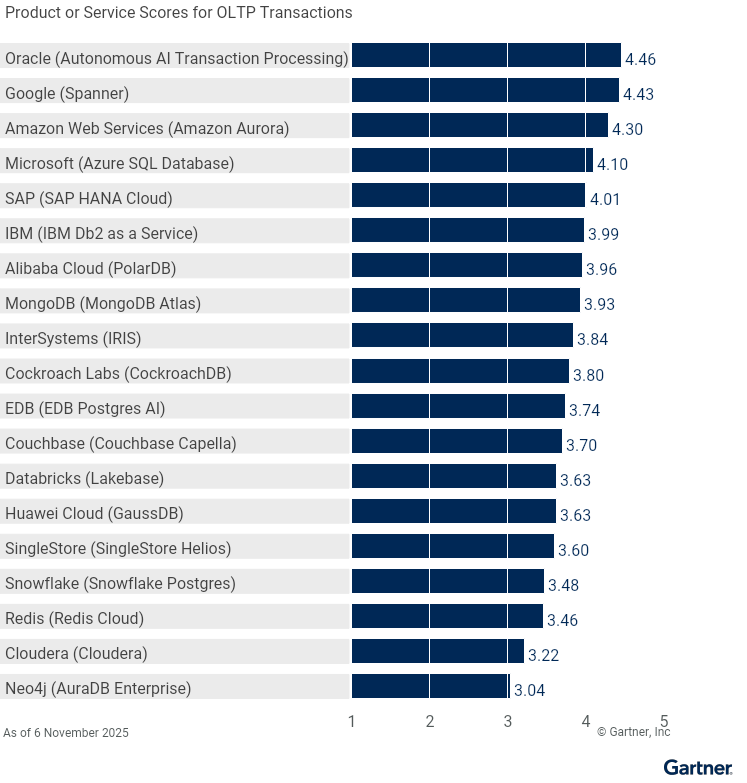
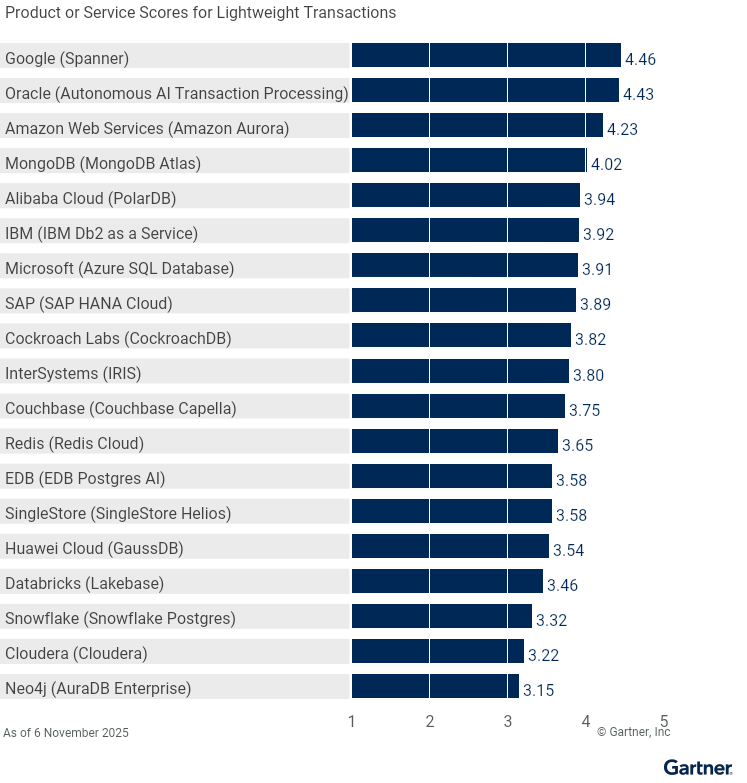
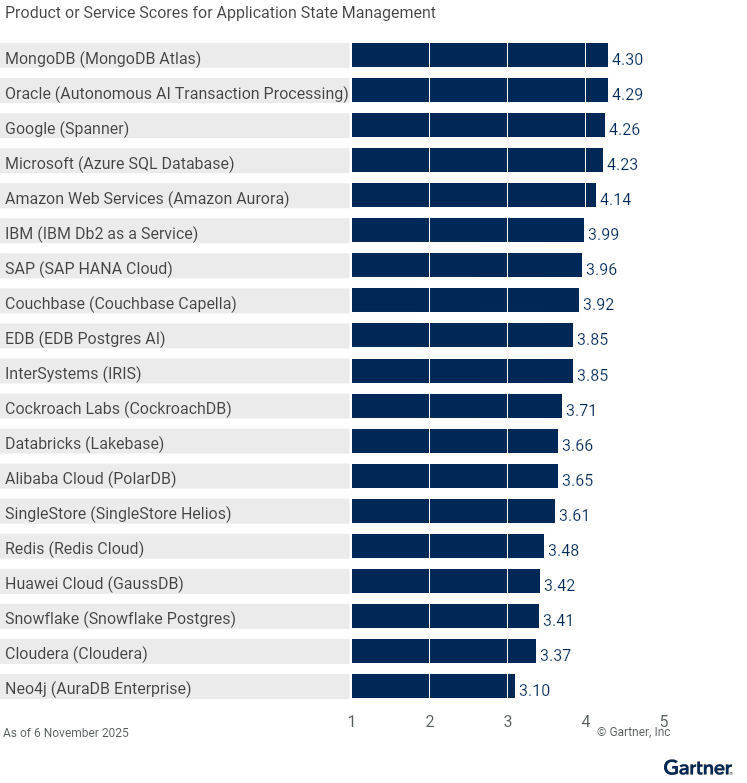
Vendors
Alibaba Cloud (PolarDB)
Alibaba Cloud is a global cloud service provider. Its proprietary DBMS offerings include PolarDB, AnalyticDB, Tair, Lindorm, MaxCompute and Elastic MapReduce (EMR), which cover transactional, analytical, streaming and multimodal data management workloads. PolarDB is evaluated in this research for operational use cases.
PolarDB is well-positioned for both OLTP and lightweight transactions use cases. It was among the top scoring products for performance predictability and elasticity, making it well suited for modernization of data-intensive applications. PolarDB also scored in the top third for management, administration and security, transactional consistency and real-time and event analytics, all of which are key requirements for mission-critical workloads in traditional industries.
Due to its innovations in decoupled resource management (compute, memory and storage) PolarDB has become the top-tier solution for resource efficiency and elasticity. Its full consistency even for cross-region transactions or unpredictable data consumption also contributes to these scores. In addition to a low score in multicloud/intercloud/hybrid — a common trait of some other leading cloud DBMS products from CSPs — financial predictability also receives a low rating, due to the complexity of optimizing/planning the cost, especially when scaling up.
Amazon Web Services (Amazon Aurora)
Amazon Web Services (AWS) offers a variety of database solutions tailored for operational use cases. These include fully managed services such as Amazon Aurora, which features both provisioned and serverless deployment options, is fully compatible with MySQL and PostgreSQL, and now features a serverless distributed SQL database version, Amazon Aurora DSQL, introduced last year.
For lightweight transactional workloads, AWS offers Amazon DynamoDB, a serverless, distributed NoSQL database for workloads at any scale. Additionally, AWS delivers an extensive set of database offerings, including Amazon Relational Database Service (RDS), which supports multiple relational database engines, including PostgreSQL, MySQL, MariaDB, Microsoft SQL Server, Oracle and Db2. This broad support allows customers to migrate transactional workloads to AWS with minimal modifications, ensuring seamless application performance within the AWS cloud environment.
Amazon Aurora continues to be the most preferred managed operational database within the AWS cloud for its strong security, resilience, availability, performance, and scalability. It ranked the top across all three operational use cases and exceeded market average scores in several key areas, such as transactional consistency, elasticity, latency, resource usage, and real-time and event analytics. Aurora’s multicloud/intercloud/hybrid capabilities are limited, as it does not currently offer multicloud deployment options.
Cloudera (Cloudera)
Cloudera comprises multiple integrated services across the data stack. Cloudera is not well-known for operational use cases, as Apache HBase, the foundation for these capabilities, was designed for low-latency access to billion-row, million-column data files for writes to the Hadoop Distributed File System (HDFS). Cloudera Operational Database builds on HBase as well as Apache Phoenix, which provides an SQL interface that enables OLTP and operational analytics over HBase.
Cloudera supports some very large operational database deployments, and it meets the minimum requirements for all three use cases. Cloudera has one of the highest scores for multicloud/intercloud/hybrid. Cloudera Operational Database is deployable across multiple clouds as well as on-premises. However, the developer productivity, performance predictability, and manageability of HBase have not kept pace with the industry. While it remains one of the few database products capable of managing multiple petabytes of data, other databases have evolved. It’s notable that Google, which created Bigtable, on which HBase was originally based, offers one of these products (Spanner), and it offers some of the greatest capabilities in these same areas (developer productivity, performance predictability and management, admin and security.)
While the Cloudera platform overall excels at managing multimodal data, leveraging that functionality inside the Cloudera Operational Database (particularly within a transaction boundary) is not directly supported by the database but left to the programmer for implementation, which led to one of their lower scores. While it is possible to implement very difficult and large use cases in Cloudera, the route for developers can often be complex. For example, while many products in this report have added functionality for calling GenAI within the transaction boundary, and even though Cloudera has significant AI capabilities, leveraging that within Cloudera Operational Database cannot be done through its SQL syntax. While Cloudera Operational Database meets basic requirements for transactional consistency, with only optimistic reads without locks supported, dirty reads are likely and this excludes many potential use cases.
Cockroach Labs (CockroachDB)
Cockroach Labs offers a cloud-distributed transactional DBMS through its CockroachDB. Its database platform as a service (dbPaaS) deployment option is available on the three most popular cloud platforms — Amazon Web Services (AWS), Google Cloud Platform (GCP) and Microsoft Azure — while its self-managed offering can be run on on-premises, hybrid, multicloud and intercloud deployments.
CockroachDB receives good ratings on both OLTP and lightweight transactions. Its enhancement in distributed SQL functions, such as high availability, disaster recovery, security, and full data consistency, has resulted in widespread client adoption across data-intensive applications and mission-critical systems.
Among all critical capabilities, distributed transaction support received the highest score among all the products, because of its continuous innovations in supporting high-volume, high-concurrency, high elasticity, geographically distributed transactions. It also receives high scores in multicloud/intercloud/hybrid capabilities. Cockroach has not typically been used for advanced analytics, AI/machine learning, and GenAI, receiving low scores among all capabilities. However, CockroachDB has introduced improvements such as vector indexing and better performance for analytical queries.
Couchbase (Couchbase Capella)
Couchbase has Couchbase Capella as its cloud-based offering for both operational and analytical use cases. Couchbase Capella has developed from a document database with in-memory capabilities to a broader multimodel access and AI offering in the cloud. Couchbase Capella also has strong capabilities for edge and disconnected use cases, which were not evaluated for this research. Capella is one of the few products that appear this year in both the analytical and operational Critical Capabilities reports.
Of the three use cases evaluated, Couchbase Capella ranked highest for the application state management use case and met requirements for OLTP and lightweight transactions use cases. Capella’s application development capabilities were among the highest rated of its capabilities. Couchbase scored among the highest for performance predictability. This is attributable to the ease of expanding capacity with additional nodes as well as its built-in caching and overall high performance. However, it did not perform as well for financial predictability; customers are not surprised by performance once built but the costs aren’t always predictable until the workload is deployed. AI/machine learning and GenAI score was about average — it has made good progress, but the rate of innovation across the industry is much greater. It is also one of the few products in this report with strong hybrid and intercloud capabilities (as opposed to just multicloud.)
Databricks (Lakebase)
Databricks offers the Databricks Data Intelligence Platform, which was evaluated for this research. It is available on customers’ VPCs as well as on public clouds, such as AWS and GCP. Databricks Data Intelligence Platform is available as a first-party service on Microsoft Azure. Databricks is a significant supporter of the Apache Spark, Delta Lake, Iceberg, and Unity Catalog open-source projects. Lakebase is Databricks’ new, fully managed PostgreSQL operational database, built on Neon’s serverless Postgres technology, which Databricks acquired.
Lakebase met requirements for all three use cases, achieving its highest use case score within Lakebase for Application State Management. This is consistent with Lakebase’s focus on backing AI applications. Lakebase scored above average scores for developer productivity, particularly for a new product; the branching model and rapid provisioning are key strengths in driving developer productivity. While many other aspects of developer productivity come with its PostgreSQL compatibility, Lakebase does not have the richness of performance analysis, debugging, and other developer productivity tools as compared to many of its more mature operational database competitors.
Lakebase’s scores across the breadth of capabilities were uneven. This is expected given the newness of the acquisition and integration into Databricks.
EDB (EDB Postgres AI)
EDB Postgres AI offers a fully managed or self-managed PostgreSQL service, which can be hosted on AWS, Microsoft Azure, GCP, Alibaba Cloud, and others, as well as on-premises and in a distributed environment as EDB Postgres Distributed offering. These solutions are engineered with flexibility in mind, allowing them to be deployed in multicloud or hybrid settings with minimal friction. EDB Postgres unifies data management by integrating analytical and AI capabilities directly with core operational and transactional data, all managed on Postgres — the world’s leading and recently resurgent open source database. EDB provides seamless integration with AI models, delivers robust scalability and enterprise-grade security, and enables AI-powered analytics directly within the Postgres environment.
EDB Postgres AI scored midrange across all three use cases and achieved its highest score for Developer Productivity as it offers broad language and API support, easy-to-use tools, good integration support, and advanced performance optimization capabilities. It provides full atomicity, consistency, isolation, and durability (ACID) and can scale through clustering. It has a top score in transactional consistency. It provides extensive support for predictive models to be run in-database, including various natural language processing (NLP) algorithms. Seamless deployment, management, and high availability across multiple cloud environments give it an above average score in the multicloud/intercloud/hybrid capability. However, due to modest scores in all of the other capabilities, EDB ends up in the bottom half for two out of three use cases.
Google (Spanner)
Google Cloud provides a range of managed operational database services for both relational and nonrelational storage and for enabling transactional applications, including web and mobile development. Google Cloud database services are engineered to meet the modern business needs and to provide seamless integration with other Google Cloud products and services.
One of Google Cloud’s leading databases for operational use cases is Spanner, a globally distributed, horizontally scalable SQL and multimodel database that supports vector, full-text search, relational, key-value, and graph functionality. In addition to Spanner, AlloyDB provides high-performance, enterprise-grade PostgreSQL compatibility, delivering high throughput and low-latency performance, and Cloud SQL, which delivers fully managed relational databases for PostgreSQL, MySQL, and SQL Server, ideal for a range of applications. It also offers specialized NoSQL database solutions, including Bigtable, Memorystore, Firestore, and Firebase Realtime Database, for synchronizing data across mobile and web applications.
Spanner, which was evaluated in this report for the operational critical capabilities, offers versatility, high availability, reliability, and performance with automatic sharding and support for distributed transactions and the use of multiple data models. Spanner scored high across all critical capabilities and ranked in the top three across all three use cases. It continues to outperform in lightweight transactions due to its continuous innovation in handling large-volume transactions. Spanner’s lowest score was in multicloud/intercloud/hybrid because its deployment is limited to Google Cloud.
Spanner is particularly valued for its high availability, automatic sharding, and seamless scaling capabilities, making it ideal for mission-critical applications that require high reliability and performance.
Huawei Cloud (GaussDB)
Huawei Cloud is a cloud service provider with businesses both inside and outside China. Its major DBMS offerings include GaussDB and TaurusDB for relational use cases, Data Warehouse Service (DWS) for analytical use cases and GeminiDB for multimodal use cases. It also offers data management tools that are compatible with its DBMSs, including Data Ingestion Service (DIS) and Data Replication Service (DRS) for data integration, LakeFormation for metadata management and DataArts for data and AI governance. GaussDB is evaluated in this research for operational use cases.
GaussDB’s highest score is OLTP transactions, because of its increasing adoption in mission-critical IT systems in industries like banking, government, healthcare and manufacturing. Its continuous innovations on foundational OLTP capabilities like resilience, availability, security and consistency build up the backbone for clients’ acceptance. However, as a cloud DBMS, clients’ major deployment of GaussDB is not a DBaaS on public cloud at this moment.
Among all its rated capabilities, elasticity, latency and resource usage, and transactional consistency receive the highest scores, reflecting its strength in these foundational capabilities. Despite multicloud/intercloud/hybrid, which is a problem for all CSPs, financial predictability is another low score across all capabilities, due to its shortcomings in managing resource utilization on the cloud.
IBM (IBM Db2 as a Service)
IBM Db2 as a Service (Db2 SaaS), formerly known as IBM Db2 on Cloud, is a fully managed cloud service that provides enterprises with a scalable, secure, and high-performance transactional database solution. Built on the Db2 engine, it offers cloud elasticity, simplified deployment, and integration with other IBM services and hybrid cloud infrastructures.
IBM Db2 SaaS incorporates AI-driven query optimization, enabling enterprises to leverage AI within their database operations by automatically tuning performance. It includes automating model creation by discovering and retraining models, then selecting the most effective columns in a table for calculating cardinality estimates, removing the need for manual selection of statistics and optimization settings.
IBM Db2 SaaS drives transactional consistency for operational workloads through ACID compliance, advanced locking mechanisms, and data integrity features — resulting in a high score in transactional consistency. It also enables the flexible and efficient handling of different data types, which helps developers build applications that require diverse data structures without the need for multiple specialized databases. It also has strong functionalities in advanced analytics and developer productivity capabilities. However, it didn’t get high scores in financial and performance predictability due to suboptimal capabilities in cost management and resource utilization, respectively.
InterSystems (IRIS)
InterSystems offers InterSystems IRIS, a mature multimodel hybrid DBMS built atop a core multidimensional array data model. InterSystems has a global presence, primarily in healthcare, but increasingly in other industries such as financial services and supply chain. InterSystems IRIS is available as a public, fully managed database platform as a service (dbPaaS) cloud service on AWS, GCP and Microsoft Azure. A private cloud managed service based on Kubernetes is also available. InterSystems IRIS was evaluated for this research. InterSystems IRIS met the requirements for all three use cases.
IRIS’s capability scores are very consistent across all the areas scored. InterSystems lags in multicloud/intercloud/hybrid because of a weakness in managed services generally, as well as less support for multicloud/intercloud/hybrid than many other platforms. InterSystems scored well for performance predictability and multimodel capabilities.
Its developer productivity score suffered from a less mature GenAI-assisted developer experience as well as not being supported by a rich ecosystem of tooling; products that use industry standard APIs and syntax are more readily accessible by a broader set of developers and have more tools that already work out of the box. This translates directly into rapid developer ramp-up. However, this is balanced against the high productivity of experienced developers once ramped up on the product. InterSystem customers are able to take on incremental new use cases as well as revise existing applications very rapidly.
Microsoft (Azure SQL Database)
Microsoft is a leading cloud service provider with geographically diversified business operations worldwide. Its customers span almost every region, industry and scale. It provides a broad range of cloud DBMS offerings for operational use cases, including Azure SQL Database, Azure Database for PostgreSQL, Azure Database for MySQL and Azure Cosmos DB. Azure SQL Database is evaluated in this research for operational use cases.
It receives very high scores in both OLTP transactions and application state management. Its strengths in security, availability, disaster recovery and consistency have led to its wide adoption by customers. Its real-time data synchronization with Microsoft Fabric OneLake and in-memory data processing also contribute to its high scores for the application state management use case.
Among all its capabilities, developer productivity receives the highest score due to not only a wide range of programming languages and toolsets for DevOps, but also innovations on AI augmentation, such as natural language assistance. Management, administration and security and data consistency are other high ratings, reflected in its wide adoption to sustain core applications in almost all industries. Multicloud/intercloud/hybrid, which is usually treated as a weakness of CSPs, is highly rated for Azure SQL because of its innovations with Azure Arc for hybrid SQL server data management, and its interconnection collaboration with Oracle.
Distributed transactions and real-time and event analytics received comparatively lower scores among all of its capabilities.
MongoDB (MongoDB Atlas)
MongoDB offers the document-based nonrelational MongoDB Atlas on AWS, GCP and Microsoft Azure; the on-premises MongoDB Enterprise Advanced; and MongoDB Community Edition, which is source-available and free to use. MongoDB Atlas and Enterprise Kubernetes Operators enable customers to deploy and manage MongoDB database resources to a Kubernetes cluster. The vendor also offers MongoDB Atlas Charts, Atlas Data Federation, Atlas Search, Atlas Online Archive, Atlas App Services, and Atlas Device SDKs for remote and edge use. It supports application-driven analytics, GenAI and time series collections, along with full-text search, vector search and stream processing. MongoDB is in wide use in all industry segments and in enterprises of all sizes.
MongoDB focuses on transactional processing and scores well for OLTP transactions and lightweight transactions. It is also well-positioned for application state management, making it suitable for large-scale highly concurrent transactional work. MongoDB is strong in application development support,and is often chosen for its support for agile development where the document model allows for fast implementation and ease of adaptation during development.
MongoDB’s highest score is on developer productivity, and it scored high in its support of distributed processing systems and multicloud intercloud support, providing a wide range of deployments both in the major clouds, on-premises and with hybrid deployments. MongoDB meets the criteria on advanced analytics as it provides capabilities for machine learning, AI and GenAI.
Neo4j (AuraDB Enterprise)
Neo4j is a leading graph database provider that stores data as nodes and relationships, with associated properties, using a labeled property graph model. Neo4j offers both a self-managed, deploy anywhere option as well as a fully managed graph database service with Neo4j AuraDB. Neo4j is ACID-compliant and scalable, making it suitable for demanding applications like fraud detection, real-time recommendations, and complex network management. Its distributed architecture, leveraging Infinigraph, enhances scalability and performance for multimodal graph workloads. Neo4j also incorporates vector capabilities within graphs to support RAG, enriching context, improving accuracy, and reducing hallucinations in GenAI applications.
Neo4j AuraDB excels in advanced analytics, AI, and application development, and stands out for its multicloud, intercloud, and hybrid deployment flexibility across major cloud providers. However, AuraDB only marginally meets most critical requirements, as it is highly specialized for graph-based use cases. It lacks broad compatibility with traditional applications and may not match the performance or scalability of relational or NoSQL databases for general-purpose workloads.
Oracle (Autonomous AI Transaction Processing)
Oracle offers a comprehensive portfolio of operational database services, including Autonomous AI Transaction Processing (previously ATP), Autonomous AI JSON Database, Oracle APEX, Exadata Database Service, MySQL Database Service, NoSQL Database Cloud Service, Database with PostgreSQL, and OCI Cache for Redis. Autonomous AI Transaction Processing is available on OCI, AWS, Microsoft Azure, GCP, and Exadata Cloud@Customer. Oracle operates globally and supports a wide range of industries with solutions for both transactional and operational mission-critical workloads. This research evaluates Oracle Autonomous AI Transaction Processing (ATP) for operational use cases.
Oracle ATP scores well for all transactional use cases and leads in classic OLTP, reflecting its popularity in mission-critical transactional processing. It excels in advanced analytics, automated tuning, and financial predictability, and receives high scores in management, administration, and security for highly secure systems. ATP also offers strong performance features, real-time analytics, and efficient resource usage.
With comprehensive relational capabilities and Oracle-specific enhancements, ATP tops evaluations for transactional consistency, and is widely adopted in financial services. It also scores highly for multicloud support, being available as a service on major clouds, on OCI, on-premises, and in hybrid deployments, with Exadata Service available across these environments.
Redis (Redis Cloud)
Redis offers Redis Cloud, a fully managed cloud DBaaS offering based on the popular open-source database Redis. It is available on AWS, GCP, Azure, on-premises and in hybrid environments. Redis Cloud is a multimodel DBMS that specializes in real-time transactional use cases.
Redis meets the requirements for all three use cases. It performs better in lightweight transactions than in OLTP and application state management. For all use cases, Redis’s scaling, in-memory capabilities and proven production capabilities have established it as a significant component of many application stacks.
Redis’s strength lies in real-time and event analytics, where it received its top score among all the capabilities. While Redis is a very important part of many advanced analytics and AI/machine learning applications, its own capabilities in that area are quite weak. The speed, scalability and reliability of Redis allow for great flexibility in bringing external processing and logic outside the DBMS. For example, almost all data science notebooks can read/write to Redis easily, allowing for advanced analytics; Redis has a very strong LangChain integration allowing for embedding generation. Redis was average on both financial and performance predictability, but these scores should be evaluated alongside consistently positive reports about Redis’s high performance and ease of contracting.
Overall, while Redis is not competitive for the mainstream of operational workloads, it remains an important part of many real-time data processing stacks.
Redis declined requests for supplemental information. Gartner’s analysis is therefore based on other credible sources.
SAP (SAP HANA Cloud)
SAP offers SAP HANA Cloud and SAP Business Data Cloud. The evaluated product, SAP HANA Cloud, supports both operational and analytical workloads, including multimodel, graph, vector, spatial, AI, and GenAI features. SAP HANA Cloud is the underlying core database service for SAP’s main cloud products, such as SAP S/4HANA Public Cloud, SAP Integrated Business Planning, SAP Analytics Cloud, SAP Datasphere, SAP Business Data Cloud and many others. For integrating SAP and non-SAP data, SAP HANA Cloud enables importing, virtualizing, replicating, and delta sharing external data and developing with SQL. SAP serves enterprise customers worldwide across all industries, with support on Alibaba Cloud, AWS, GCP, and Microsoft Azure.
SAP HANA Cloud performs strongly across all operational DBMS use cases, supporting large-scale, mission-critical systems globally. Its native in-memory architecture, AI, and machine learning capabilities with extensive built-in libraries for predictive and business analytics, enhance both analytics and application development. Performance features leverage in-memory processing, although autonomous performance management scored average, especially in predictability. SAP HANA Cloud also excels in administration, security, and transactional consistency as a mission-critical relational database. It supports multimodel processing, including native graph (knowledge graph), spatial, document, text, and OLAP models.
SAP HANA Cloud is highly rated for multicloud, intercloud, and hybrid support, as it is deployable across AWS, GCP, Azure, Alibaba, and SAP’s own cloud, ensuring broad geographic coverage. However, it is primarily used by SAP customers to run and extend SAP applications, rather than as a general-purpose transactional database, though it offers integration features for connecting with other systems.
SingleStore (SingleStore Helios)
SingleStore offers SingleStore Helios as a unified solution for both operational and analytical use cases within the same database. It achieves this by providing a single storage engine that can handle both transactional operations (inserts, upserts, point reads) and complex analytic queries on data. This data is automatically and dynamically distributed across memory and block storage, ensuring that analysis results align with the latest transaction position. SingleStore Helios can be deployed on all major cloud platforms, as well as on private clouds, including AWS, GCP, Azure, and Snowpark Container Services.
SingleStore Helios is built on a modern distributed SQL architecture that supports both relational and multimodel data. It offers low latency, high concurrency, and seamless scalability for demanding applications. The platform ensures high availability through automatic failover and eliminates single points of failure. It provides enterprise-grade security and compliance for data within the platform, while customers remain responsible for securing their own external applications and data usage. Its ability to scale effortlessly to accommodate large volumes of streaming data, along with independently scaling compute and storage, has earned SingleStore Helios one of the top marks for real-time and event analytics among its key capabilities.
SingleStore Helios also received high scores for its multimodel capabilities, as it natively supports relational, JSON, time-series, vector, and geospatial data within a single unified platform. This enables organizations to efficiently manage and query diverse data types without the need for separate databases, streamlining both development and integration. However, due to its narrower range of functionality compared to other vendors, SingleStore Helios ranked in the lower half across all three evaluated use cases.
Snowflake (Snowflake Postgres)
Snowflake AI Data Cloud provides a simplified interconnected architecture across multiple clouds and geographies. Through its data lake, data warehouse, AI/ML and GenAI solutions, Snowflake enables organizations to interoperate their data and AI needs at a global scale, supporting open table formats, unstructured data and access to other data sources. It continues to release new AI/ML capabilities to meet the demands of the market. Snowflake enables the sharing, collaboration and monetization of data assets as well as access to native applications and AI products through its marketplace. Snowflake Postgres was evaluated for this report.
With its recent acquisition of Crunchy Data, Snowflake now offers a fully managed PostgreSQL solution designed for modern enterprises, integrating an enhanced, enterprise-grade Postgres platform. Snowflake Postgres combines the flexibility and developer-centric features of Postgres with strong security, governance, and compliance, making it ideal for organizations with advanced data management needs, such as Fortune 500 companies, SaaS businesses, and government agencies.
As a new entrant to the operational database evaluations, Snowflake Postgres performed above average across most criteria and use cases, achieving its highest scores in transactional consistency to maintain reliability and consistency to support critical applications and moderate scores in other areas.
Context
This Critical Capabilities report focuses on highlighting the essential cloud DBMS capabilities for the operational use of data and its associated use cases. The interactive version of this document allows you to adjust capability weightings by use case to better suit your needs.
Cloud-based DBMS (also known as database platform as a service or dbPaaS) now accounts for the majority of the DBMS market, while on-premises DBMS is shrinking in revenue, market share and deployments. The capabilities and their weightings in this year’s research reflect priorities driven by cloud deployment. Weightings evolve year over year, and new capabilities replace those in prior research.
Use this research in conjunction with other documents provided below to guide your evaluation and initial vendor selection of cloud DBMS offerings for operational use cases. This is part of a family of three documents that should be considered together. The other two are:
- Magic Quadrant for Cloud Database Management Systems. This research evaluates selected vendors of DBMSs that run in the cloud for both analytical and operational use cases. The Magic Quadrant is used to judge the suitability of cloud DBMS vendors for either analytical or operational use or for both.
- Critical Capabilities for Cloud Database Management Systems for Analytical Use Cases. This document evaluates particular cloud DBMS products provided by the Magic Quadrant for their suitability to support three analytics use cases using a range of critical capabilities.
The findings feed into the evaluations of the cloud DBMS vendors in the Magic Quadrant.
The two Critical Capabilities research reports evaluate individual products; each vendor has identified its preferred cloud DBMS product for evaluation. The Magic Quadrant evaluates each vendor holistically, accounting for multiple products or service offerings if the vendor has them. Most of the capabilities are common to the two Critical Capabilities documents but may be interpreted differently for the analytical and operational use cases. The scores for each capability may also carry different weights in each document.
Our analysis synthesizes insights gleaned from the following sources over the past 12 months:
- Product information provided by the vendors.
- Information from interactions with Gartner clients and through various other sources, including Gartner Peer Insights and secondary research.
The capabilities are weighted differently depending on the requirements of the use case. You can customize these weightings with the interactive version of the document to more closely match your own requirements. Any decision process you adopt should include a proof of concept (POC) test with your data on the cloud platform and configuration of your choice, and against your production business requirements and SLAs.
Two essential factors influenced scoring for this research. The Magic Quadrant research considers future directions as part of the evaluation. This Critical Capabilities research does not; the research only considers products that were generally available as of midnight, U.S. Eastern Daylight Time on 1 July 2025. Additionally, the Magic Quadrant considers all products or services offered by a vendor in the cloud DBMS area, while this research considers a single product. Many vendors use different products to deliver different capabilities, but the structure of this research does not allow the evaluation of more than one product. Because of this, make sure you evaluate the full scope of different services offered by a vendor when considering capabilities.
This research is entirely separate from the Critical Capabilities for Cloud Database Management Systems for Analytical Use Cases. A vendor may use the same offering for both pieces of research or may offer different services for each.
How to Use This Research
Data and analytics leaders should use this research to understand how the evaluated cloud DBMS solutions support the 13 critical capabilities relevant to operational use cases. Then, consider how those capabilities, in turn, support the three analytical use cases used for this research. The interactive version of this document allows users to customize the weighting of the scores. Organizations should consider the weighting of these factors that reflect what is important to them. The interactive version enables users to adjust the weightings to align with their own requirements.
While all of the products evaluated address cloud DBMS operational use cases, your individual use cases and needs may call for a more specific mix of capabilities.
The vendor product scores reflect Gartner analysts’ input combined with Gartner client feedback and other factors such as vendor briefings and peer insights. However, it does not provide a complete evaluation of the vendor or tool. It is essential to also consider each vendor’s market presence, track record, financial and organizational strength, availability of skills, product support and outlook, including its vision and adaptability to market changes and disruption. In that regard, this research should be used in conjunction with the Magic Quadrant for Cloud Database Management Systems. Additionally, some capabilities of a particular product may not be relevant to its use for any of the three use cases in this document.
The critical capabilities used during our evaluations were chosen based on their effectiveness in differentiating between vendor offerings. If a capability is commonly available and implemented across all vendors, it is not included as part of the evaluation criteria.
The scoring system used for the critical capabilities ranges from a low of 1 to a high of 5. A score of 3 indicates that the offering meets the requirements for that capability. As expected, most offerings score a 3 or higher on all use cases, as the vendors that qualify for this research represent the best offerings available for these use cases. A score below 3 does not mean that the service cannot be used for the use case. Rather, it means users may have to do additional work on their own to ensure the solution meets the standard requirements for that use case.
The critical capabilities assessed in this report represent a subset of the evaluation criteria that Gartner recommends when selecting vendors and tools. Therefore, the vendor positioning in the graphics and tables does not represent overall vendor positioning in the market and does not necessarily coincide with the positioning of vendors in the corresponding Magic Quadrant.
Market Definition
Gartner defines the market for cloud database management systems (DBMSs) as software products that store and manipulate data and are primarily delivered as platform as a service (PaaS) in the cloud. Cloud DBMSs may optionally be capable of running on-premises or in hybrid, multicloud or intercloud configurations. They can be used for transactional and/or analytical work. They typically persist data using a combination of proprietary and open components in a durable manner, enabling a full range of create, read, update and delete operations. They are used by application end users, designers, developers and operators of large database systems.
Cloud DBMSs provide a means for businesses to store and process data in support of business applications and processes. They support transactional and/or analytical processing by supplying the data to run the business and analyzing it to improve overall business benefits. They address the needs of the following use cases:
- Online transaction processing (OLTP) transactions: Support a centralized transaction focus, with a fixed, stable schema, while delivering high speed; high volumes; concurrency controls; data insert/update; atomicity, consistency, isolation and durability (ACID) properties; transaction isolation; and security.
- Lightweight transactions: Support very high volumes of simple transactions with high concurrency, low latency and potentially relaxed consistency. This use case covers processing of fast-moving events captured from the edge.
- Application state management: Supports modern end-user experiences by managing session state at scale, providing rich user profiles and offering variable consistency mechanisms across the database. It supports variable and complex schemas across multiple applications and developer teams.
- Enterprise data warehouse: Manages data from multiple sources in a highly structured schema to meet analytical demands. It provides predictable performance for both batch and interactive queries.
- Lakehouse: Manages the variety and volume of data of variable structures across a wide range of analytical query workloads, ranging from traditional analytics to data science. Data may be physically distributed.
- Event analytics: Manages data that is written at high frequency and volume. Queries are made in real time to both evaluate data against models and summarize events. The same data is also queried at later times for ad hoc investigation, discovery and model training. In all cases, data is mixed in structure and size. Predictable performance and availability are critical for both ingestion and querying.
A cloud DBMS must support at least one of the use cases listed above.
Mandatory Features
- Deploy as PaaS on provider-managed public or private cloud systems.
- Manage data within cloud storage, not within hosted infrastructure as a service (IaaS), such as a virtual machine or container managed by the customer.
- Persist data; provide full create, read, update and delete (CRUD) operations; and provide durability of data across time.
- Persist data within storage controlled by the cloud DBMS itself, rather than handle data “in flight.”
- Serve as stand-alone data management components that store, read, update and manage data, as opposed to embedded systems within other software, such as business intelligence tools.
- Support transactional or analytical database operations, or both.
- Provide operational management and cost control for monitoring, auditing and performance tracking.
- Support dynamic autoscaling to automatically adjust workloads in response to changing requirements and enable pay-as-you-go models.
Common Features
- Support multiple data models and data types — relational, nonrelational (e.g., document, key-value, wide-column, graph, vector), geospatial, time series and others.
- Deliver as a PaaS that may also be deployable on-premises.
- Participate in a broader data ecosystem.
- Provide AI, machine learning (ML) and GenAI capabilities, either by itself or through interoperability with other services.
- Automatically handle different types and sizes of workloads simultaneously and efficiently, while enforcing, or dynamically extending, policy-based resource limits. The cloud DBMS can also handle varying and conflicting workloads, while optimizing response times and prioritizing the workloads to meet policy-defined service levels.
- Read, write and utilize data stored in open table formats, or utilize the open table APIs most commonly used in enterprises.
- Provide advanced capabilities to support a wide variety of data types for both storage and query, as well as advanced support to aid analysis of such data. This includes support for document types, continuous streams, various multimedia formats, embeddings and other data types.
- Perform support transactions on any of the individual nodes within the distributed database system.
- Access data outside the internal storage of the DBMS and optimize distributed access by a variety of methods, such as push-down, extended metadata, statistics collection and catalog federation.
- Support complex relational operations involving one or many tables that include composite, derived, single and multivalued attributes.
- Optimize performance for queries, transactions and workloads to meet performance and budget goals without manual intervention or management. This optimization may be achieved through performance-enhancing features, as well as pricing and packaging options, that enable management of complex workloads within set budgets.
- Deploy and operate analytical and operational activities across multiple cloud environments and on-premises.
Product/Service Trends
The critical capabilities named here address the major needs identified in this research. Operational DBMS vendors provide key DBMS capabilities for processing transactions, interactions, events and observations. In addition to “traditional” transactional uses, such as ERP and financial systems, these vendors are increasingly involved in adding analytics directly into transactional streams for the convergence of transactional and analytical use cases. We have also seen significant deployments in other use cases, such as global scalability for web applications and Internet of Things (IoT) applications involving event processing/data in motion.
Critical Capabilities Definition
Advanced Analytics
This capability includes the ability to run OLAP-style queries, execute machine learning models and use advanced analytics libraries such as time-series, spatial, semijoin views and anomaly prediction. In-database and real-time/native external analytics product integration are both considered.
Developer Productivity
The ability to support multiple application languages and their APIs, stored procedures and user-defined functions, and the ability to implement constraints, among other features.
Also included is the ability and ease with which DevOps functions, including continuous integration/continuous delivery (CI/CD), blue-green deployments, source code control (SCC) integration and testing can be accomplished.
AI/Machine Learning and GenAI
The integration of AI and ML capabilities directly within database systems to enhance data access, processing and decision making using the database.
GenAI support involves delivering advancements in how GenAI contributes to databases for efficiencies, productivity, etc., and how databases contribute to creating GenAI applications using your own data.
Distributed Transactions Support
The ability to support distributed transactions across multiple nodes, regions and geographies.
This capability includes features where no single node owns a master copy of the data, capabilities that simplify the management of complex distributed topologies and features that help ensure data integrity while leveraging elasticity.
Financial Predictability
The ability to forecast and budget usage and monitor and control costs by throttling, workload user prioritization or other means.
This capability can also include governing the types and numbers of resources used, and recommending and implementing less costly storage strategies. Tools for modeling costs and blended pricing models facilitate this capability.
Management, Admin and Security
The ability to manage instances and resources, monitor operations, track and implement security, high availability and disaster recovery, and perform these and other tasks at an enterprise scale.
Multicloud/Intercloud/Hybrid
The ability to deploy and operate DBMS activities across multiple cloud environments and on-premises.
Multicloud refers to the ability to operate on multiple cloud platforms, intercloud signifies the ability to use data across multiple clouds as a single logical entity, and hybrid denotes the ability to run on-premises and on clouds.
Performance Predictability
This capability encompasses both autonomous and automatic implementation as well as manual tuning features.
Performance features include optimization, statistics collection, the ability to use static and dynamic plans, partitioning and partition elimination, and storage tiering for performance and materialized views, among others.
Real-Time and Event Analytics
This capability involves the rapid processing of low-latency transactions by continuously executing incoming data streams and delivering up-to-date analytics. It enables timely decision making based on current events and datasets.
Multimodel Capabilities
Support all databases’ relational capabilities, including the structure and relationships within the data. This encompasses primary and foreign keys, data types, constraints and indexes, all of which contribute to data integrity, performance and overall database organization.
Elasticity, Latency, Resource Usage
The ability to automatically handle different types and sizes of workloads simultaneously while enforcing or dynamically extending policy-based resource limits; manage varying and conflicting workloads while optimizing response times; and prioritize workloads to meet policy-defined service levels.
This capability also includes the ability to elastically scale resources dynamically.
Transactional Consistency
DBMS-guaranteed properties of ACID to ensure reliable, recoverable database transactions and potentially support distributed transactions over geographic distances.
It also includes forms of relaxed, eventual or tunable consistency for specific use cases.
Use Cases
OLTP Transactions
This refers to a centralized transaction focus with fixed, stable schema and transactions that may be complex and require high performance.
This includes providing high speed, high volume, concurrency controls, data insert/update, ACID properties, transaction isolation, and security for both traditional use cases in finance and insurance as well as retail, gaming and other newer OLTP workloads.
Lightweight Transactions
This refers to supporting simple transactions with high concurrency, low latency, relaxed consistency and very high volume.
Examples include sensor data, device fleet management, billing and others. Many of these workloads are aided by significant elasticity, which allows the processing of fast-moving events captured from the edge.
Application State Management
This refers to the enhancements offered to modern end-user experiences by managing user session states at scale.
This provides detailed user profiles and offers variable consistency mechanisms across the database. Additionally, it supports variable and complex schemas across multiple applications and developer teams.
Vendors Added and Dropped
We review and adjust our inclusion criteria for Critical Capabilities as markets change. As a result of these adjustments, the mix of vendors in any Critical Capability may change over time. A vendor’s appearance in a Critical Capability one year and not the next does not necessarily indicate that we have changed our opinion of that vendor. It may be a reflection of a change in the market and, therefore, changed inclusion criteria, or of a change of focus by that vendor.
Added
The following vendors were added this year because they met this Critical Capabilities’ inclusion criteria, including the customer interest index:
- Databricks
- Snowflake
Inclusion and Exclusion Criteria
This Critical Capabilities research begins with the same inclusion criteria as the companion Magic Quadrant but may impose additional limits based on the use cases supported.
The following inclusion criteria represent the specific attributes deemed necessary by Gartner analysts for a vendor’s inclusion in this Critical Capabilities report.
To qualify for inclusion in this Critical Capabilities report, vendors must meet the following criteria:
- Offer a generally available software product that aligns with Gartner’s definition of a cloud DBMS.
- Support more than one of the following cloud DBMS use cases:
- OLTP transactions
- Lightweight transactions
- Application state management
- Rank among the top 20 organizations in a market momentum index as defined by Gartner for this Critical Capabilities report. Data inputs used to calculate market momentum include the following measures:
- Gartner customer search and inquiry volume and trend data.
- The volume of job listings on various employment websites in the U.S., Europe and China.
- Frequency of mentions as a competitor to other cloud DBMS vendors in reviews on Gartner’s Peer Insights forum during the year ending April 2025.
- Maintain a market presence in at least three of the following regions, where regional market presence is defined as having dedicated sales offices or distribution partnerships in a specific region, and a minimum of 5% of the cloud revenue. The regions are:
- North America (Canada, Mexico and the U.S.)
- Central and South America
- Europe (including Western Europe and Eastern Europe)
- Middle East and Africa (including North Africa)
- Asia/Pacific
- Japan
- Have a cloud DBMS service generally available as of midnight U.S. Eastern Daylight Time on 1 July 2025. This includes any new functionality added to the service(s) by the specified date. We did not consider beta, “early access,” “technology preview,” or other not generally available functionalities or services. Additionally:
- Any acquired product or service must have been acquired and offered by the acquiring vendor as of 1 July 2025. Acquisitions made after this date were considered under their preacquisition identities, if appropriate, and are represented separately until the publication of the following year’s Critical Capabilities report.
Exclusion Criteria
Vendors marketing only the products listed below are explicitly excluded from this Critical Capabilities research.
- Streaming services, whose use cases are dominated by immediate event processing and are rarely, if ever, used for subsequent management and persistence of the data involved.
- Prerelational DBMS products.
- Object-oriented DBMS products.
- Data grid products, including in-memory DBMS.
- BI and analytical solutions that offer a cloud DBMS that is limited specifically to the vendor’s own BI and analytical tools.
- Analytics query accelerators (SQL interfaces to object stores or file systems).
- Data federation, data fabric and data virtualization solutions that do not provide or offer their own data persistence.
These exclusion criteria match those applied in the Magic Quadrant for Cloud Database Management Systems.
Weighting for Critical Capabilities in Use Cases
| Critical Capabilities | OLTP Transactions | Lightweight Transactions | Application State Management |
|---|---|---|---|
Advanced Analytics | 5% | 0% | 0% |
Developer Productivity | 10% | 5% | 40% |
AI/Machine Learning and GenAI | 5% | 10% | 5% |
Distributed Transactions Support | 5% | 15% | 5% |
Financial Predictability | 10% | 15% | 10% |
Management, Admin and Security | 5% | 5% | 5% |
Multicloud/Intercloud/Hybrid | 5% | 5% | 10% |
Performance Predictability | 10% | 5% | 10% |
Real-Time and Event Analytics | 0% | 15% | 0% |
Multimodel Capabilities | 10% | 5% | 5% |
Elasticity, Latency, Resource Usage | 20% | 15% | 5% |
Transactional Consistency | 15% | 5% | 5% |
As of 6 November 2025 | |||
Source: Gartner (November 2025)
This methodology requires analysts to identify the critical capabilities for a class of products/services. Each capability is then weighed in terms of its relative importance for specific product/service use cases.
Each of the products/services that meet our inclusion criteria has been evaluated on the critical capabilities on a scale from 1.0 to 5.0.
Critical Capabilities Rating
Product/Service Rating on Critical Capabilities
| Critical Capabilities | Alibaba Cloud (PolarDB) | Amazon Web Services (Amazon Aurora) | Cloudera (Cloudera) | Cockroach Labs (CockroachDB) | Couchbase (Couchbase Capella) | Databricks (Lakebase) | EDB (EDB Postgres AI) | Google (Spanner) | Huawei Cloud (GaussDB) | IBM (IBM Db2 as a Service) | InterSystems (IRIS) | Microsoft (Azure SQL Database) | MongoDB (MongoDB Atlas) | Neo4j (AuraDB Enterprise) | Oracle (Autonomous AI Transaction Processing) | Redis (Redis Cloud) | SAP (SAP HANA Cloud) | SingleStore (SingleStore Helios) | Snowflake (Snowflake Postgres) |
|---|---|---|---|---|---|---|---|---|---|---|---|---|---|---|---|---|---|---|---|
Advanced Analytics | 4.1 | 4.5 | 3.3 | 2.7 | 3.2 | 3.4 | 3.4 | 4.3 | 3.3 | 4.1 | 3.8 | 3.9 | 3.0 | 2.9 | 4.5 | 2.8 | 4.1 | 3.3 | 3.1 |
Developer Productivity | 3.5 | 4.4 | 3.4 | 3.5 | 4.2 | 3.9 | 4.1 | 4.5 | 3.4 | 4.1 | 4.0 | 4.5 | 4.8 | 3.0 | 4.1 | 3.4 | 4.0 | 3.7 | 3.4 |
AI/Machine Learning and GenAI | 4.0 | 4.4 | 3.7 | 3.0 | 3.5 | 4.2 | 3.9 | 4.6 | 3.4 | 3.8 | 3.8 | 4.1 | 3.7 | 3.4 | 4.2 | 3.3 | 4.0 | 3.5 | 3.6 |
Distributed Transactions Support | 4.1 | 3.8 | 3.0 | 4.8 | 4.6 | 3.0 | 3.1 | 5.0 | 3.8 | 4.0 | 3.9 | 3.4 | 4.7 | 3.0 | 4.8 | 3.3 | 3.4 | 3.0 | 3.0 |
Financial Predictability | 3.1 | 4.2 | 3.3 | 3.5 | 3.2 | 3.3 | 3.7 | 4.5 | 3.0 | 3.6 | 3.5 | 3.9 | 4.1 | 3.0 | 3.6 | 3.4 | 3.4 | 3.1 | 3.1 |
Management, Admin and Security | 4.0 | 4.7 | 3.2 | 3.5 | 3.5 | 3.1 | 3.7 | 4.6 | 3.2 | 4.0 | 3.6 | 4.3 | 4.0 | 3.0 | 4.8 | 3.6 | 4.6 | 3.0 | 3.4 |
Multicloud/Intercloud/Hybrid | 3.0 | 2.6 | 4.1 | 4.3 | 4.1 | 3.7 | 3.9 | 2.2 | 2.9 | 4.0 | 3.5 | 4.1 | 4.4 | 4.0 | 4.7 | 3.9 | 4.0 | 4.0 | 3.7 |
Performance Predictability | 4.0 | 3.9 | 3.2 | 3.7 | 3.9 | 3.0 | 3.4 | 4.0 | 3.7 | 3.8 | 3.9 | 4.1 | 3.7 | 3.0 | 4.3 | 3.7 | 3.9 | 3.6 | 3.0 |
Real-Time and Event Analytics | 4.3 | 4.6 | 3.0 | 3.6 | 3.5 | 3.0 | 3.2 | 4.4 | 3.5 | 4.0 | 3.9 | 3.6 | 3.6 | 3.5 | 4.7 | 4.5 | 4.1 | 4.4 | 3.0 |
Multimodel Capabilities | 3.8 | 4.2 | 3.0 | 3.6 | 3.5 | 3.8 | 3.8 | 4.4 | 3.8 | 4.1 | 4.0 | 4.0 | 3.4 | 2.2 | 4.6 | 3.2 | 4.1 | 4.2 | 3.8 |
Elasticity, Latency, Resource Usage | 4.5 | 4.6 | 3.0 | 3.9 | 3.8 | 3.8 | 3.7 | 4.6 | 4.0 | 3.8 | 3.8 | 4.0 | 4.0 | 3.1 | 4.5 | 4.0 | 4.0 | 3.5 | 3.5 |
Transactional Consistency | 4.4 | 4.8 | 3.1 | 4.5 | 3.4 | 4.0 | 4.0 | 4.9 | 4.1 | 4.5 | 4.0 | 4.4 | 3.6 | 3.2 | 5.0 | 3.0 | 4.4 | 4.0 | 4.0 |
As of 6 November 2025 | |||||||||||||||||||
Source: Gartner (November 2025)
Table 3 shows the product/service scores for each use case. The scores, which are generated by multiplying the use-case weightings by the product/service ratings, summarize how well the critical capabilities are met for each use case.
Product Score in Use Cases
| Use Cases | Alibaba Cloud (PolarDB) | Amazon Web Services (Amazon Aurora) | Cloudera (Cloudera) | Cockroach Labs (CockroachDB) | Couchbase (Couchbase Capella) | Databricks (Lakebase) | EDB (EDB Postgres AI) | Google (Spanner) | Huawei Cloud (GaussDB) | IBM (IBM Db2 as a Service) | InterSystems (IRIS) | Microsoft (Azure SQL Database) | MongoDB (MongoDB Atlas) | Neo4j (AuraDB Enterprise) | Oracle (Autonomous AI Transaction Processing) | Redis (Redis Cloud) | SAP (SAP HANA Cloud) | SingleStore (SingleStore Helios) | Snowflake (Snowflake Postgres) |
|---|---|---|---|---|---|---|---|---|---|---|---|---|---|---|---|---|---|---|---|
OLTP Transactions | 3.96 | 4.30 | 3.22 | 3.80 | 3.70 | 3.63 | 3.74 | 4.43 | 3.63 | 3.99 | 3.84 | 4.10 | 3.93 | 3.04 | 4.46 | 3.46 | 4.01 | 3.60 | 3.48 |
Lightweight Transactions | 3.94 | 4.23 | 3.22 | 3.82 | 3.75 | 3.46 | 3.58 | 4.46 | 3.54 | 3.92 | 3.80 | 3.91 | 4.02 | 3.15 | 4.43 | 3.65 | 3.89 | 3.58 | 3.32 |
Application State Management | 3.65 | 4.14 | 3.37 | 3.71 | 3.92 | 3.66 | 3.85 | 4.26 | 3.42 | 3.99 | 3.85 | 4.23 | 4.30 | 3.10 | 4.29 | 3.48 | 3.96 | 3.61 | 3.41 |
As of 6 November 2025 | |||||||||||||||||||
Source: Gartner (November 2025)
To determine an overall score for each product/service in the use cases, multiply the ratings in Table 2 by the weightings shown in Table 1.
This research is partly based on Gartner client inquiry service data recorded from June 2024 through August 2025.
We considered:
- Earlier information and any news about vendors’ products, customers and finances that emerged during the analysis period.
- The findings in:
Critical Capabilities Methodology
This methodology requires analysts to identify the critical capabilities for a class of products or services. Each capability is then weighted in terms of its relative importance for specific product or service use cases. Next, products/services are rated in terms of how well they achieve each of the critical capabilities. A score that summarizes how well they meet the critical capabilities for each use case is then calculated for each product/service.
"Critical capabilities" are attributes that differentiate products/services in a class in terms of their quality and performance. Gartner recommends that users consider the set of critical capabilities as some of the most important criteria for acquisition decisions.
In defining the product/service category for evaluation, the analyst first identifies the leading uses for the products/services in this market. What needs are end-users looking to fulfill, when considering products/services in this market? Use cases should match common client deployment scenarios. These distinct client scenarios define the Use Cases.
The analyst then identifies the critical capabilities. These capabilities are generalized groups of features commonly required by this class of products/services. Each capability is assigned a level of importance in fulfilling that particular need; some sets of features are more important than others, depending on the use case being evaluated.
Each vendor’s product or service is evaluated in terms of how well it delivers each capability, on a five-point scale. These ratings are displayed side-by-side for all vendors, allowing easy comparisons between the different sets of features.
Ratings and summary scores range from 1.0 to 5.0:
1 = Poor or Absent: most or all defined requirements for a capability are not achieved
2 = Fair: some requirements are not achieved
3 = Good: meets requirements
4 = Excellent: meets or exceeds some requirements
5 = Outstanding: significantly exceeds requirements
To determine an overall score for each product in the use cases, the product ratings are multiplied by the weightings to come up with the product score in use cases.
The critical capabilities Gartner has selected do not represent all capabilities for any product; therefore, may not represent those most important for a specific use situation or business objective. Clients should use a critical capabilities analysis as one of several sources of input about a product before making a product/service decision.