Top Strategic Technology Trends for 2026: AI-Native Development Platforms
18 October 2025 - ID G00829660 - 7 min read
By Mark O'Neill, Gene Alvarez, and 3 more
AI-native development platforms use AI models to create software faster than was previously possible. CIOs are excited about this technology because it improves developer productivity, enables innovation, and holds the potential to replace off-the-shelf SaaS software with custom-built alternatives.
Overview
Opportunities
- AI-native development platforms improve developer productivity, enabling cost savings for CIOs. As well as individual productivity benefits, improved team productivity is also an opportunity because smaller teams can deliver software faster and more productively, aided by AI models.
- Skilled AI engineers and software engineers can use these platforms to accelerate the development of sophisticated software solutions. AI-native development platforms can also help less technical staff build software, including apps, automation and AI agents. However, platform teams must be in place to provide guardrails.
- In the longer term, AI-native development platforms will make developing custom software that maximizes competitive advantage faster, cheaper and less reliant on engineers than ever before. This changes the “build vs. buy” equation. In addition to saving licensing costs, this will enable organizations to tailor their application portfolio to their own custom scenarios. However, the time scale for this change is at least five years from now, and there is no scenario where organizations will replace all of their commercial-off-the-shelf (COTS) software with AI-built alternatives.
Recommendations
- While productivity is the immediate opportunity, the real benefits of AI-native development platforms will be unlocked through creativity and domain expertise. That is because, when developers can build significantly more, creativity in envisioning new requirements, demand-sensing to understand domains, and the overall ability to express these requirements to AI models become key.
- Establish or expand platform teams to provide security guardrails, deployment pipelines, and platform support for AI-native development platforms.
- Review SaaS procurement and renewals to identify opportunities to build alternatives. Recognize that AI-native development platforms are still new, but hold the promise to disrupt the demand for, and economics of, traditional SaaS applications.
Strategic Planning Assumption(s)
By 2030, AI-native development platforms will result in 80% of organizations evolving large software engineering teams into smaller, more nimble teams augmented by AI.
By 2030, enterprise application portfolios will include 40% custom applications built using AI-native development platforms, up from 2% in 2025.
By 2030, enterprise application portfolios will include 40% custom applications built using AI-native development platforms, up from 2% in 2025.
What You Need to Know
AI-native development platforms enable both technical and nontechnical users to create software using generative AI (GenAI). They are enabled by the continued improvement in GenAI models’ ability to generate and interpret software source code, combined with the maturing and advancement of AI code assistants and software engineering agents. These innovations have led to a new generation of AI-native tools that can significantly accelerate software development.
These new platforms will change the “buy vs. build” equation for SaaS purchases by bringing more application requirements into reach by reducing cost, time and resourcing. Building new or replacement software tools will become increasingly accessible to nontechnical roles. However, platform teams and governance will be crucial to manage software security, life cycle support and costs at scale.
Productivity is an immediate benefit. AI-native development platforms improve developer productivity by automating repetitive and time-consuming tasks. They also enable creative work, such as product design and prototyping. Rather than starting with a blank canvas, a product manager or UX designer can use AI-native development platforms to convert text prompts, user interviews, or whiteboard sketches into prototypes.
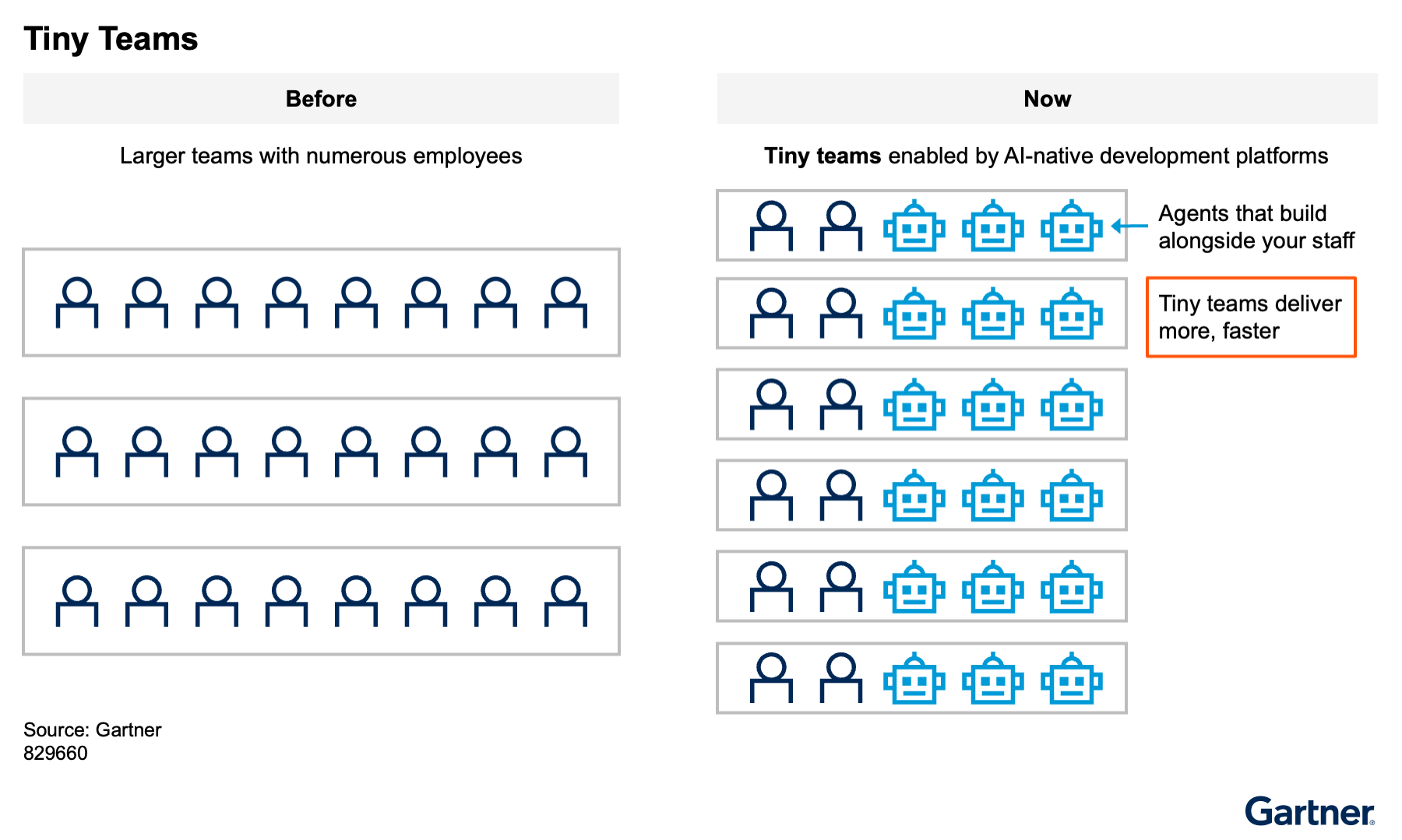
AI-native development platforms also have an impact on organizational structure. Startups with very small numbers of employees are having success building software using AI-native development platforms, particularly vibe-coding tools (see Innovation Insight for Vibe Coding Platforms). A team of two or three people, augmented by AI assistants and software engineering (SWE) agents, can produce software that would have required much larger teams in the past. This “tiny teams” organizational trend is now making the leap from startups to the enterprise, as shown in Figure 1.
This research is part of Gartner’s Top Strategic Technology Trends for 2026.
Profile: AI-Native Development Platforms
Description
AI-native development platforms use generative AI to create software faster and easier than was previously possible. These platforms range from “one-shot” tools that generate software from a single prompt, through “vibe coding” tools that enable software development without deep technical knowledge, to AI agents, which professional developers orchestrate together to create software.
Why Trending
CIOs are enthusiastic about the ability for their teams to generate software faster, using AI-native development platforms. Their CEO and CFO colleagues are focused on the potential cost savings that these platforms bring. In addition to all this, software engineers themselves are naturally excited to use the latest technology, which is leading to viral adoption of AI-native development platforms.
Implications
AI-native development platforms are revolutionizing software engineering as a whole. One important way is through “spec-driven development.” Spec-driven development involves entire applications being generated from written specifications, often in a “one-shot” manner. Spec-driven development emphasizes domain knowledge, leading to a future where domain knowledge is more important than technical knowledge.
Software engineers embedded in the business, acting as “forward-deployed engineers” (FDEs), can use AI-native development platforms to work together with domain experts to develop applications. Over time, platform teams will offer AI-native development platforms to enable nontechnical domain experts to build software themselves. However, to achieve this outcome, security and governance guardrails must be in place. Platform teams, therefore, are a prerequisite to take full advantage of this trend.
Actions
- Create a platform team to enable groups across your organization to use AI-native development platforms effectively. This platform team should manage the platforms themselves, with product life cycle management, including determining which underlying AI models are used.
- Ensure that security guardrails are in place for AI-native development platforms. This includes AI code review tools.
- Adopt an AI-first mindset to leverage AI for software development, where feasible.
About Gartner’s Top Strategic Technology Trends for 2026
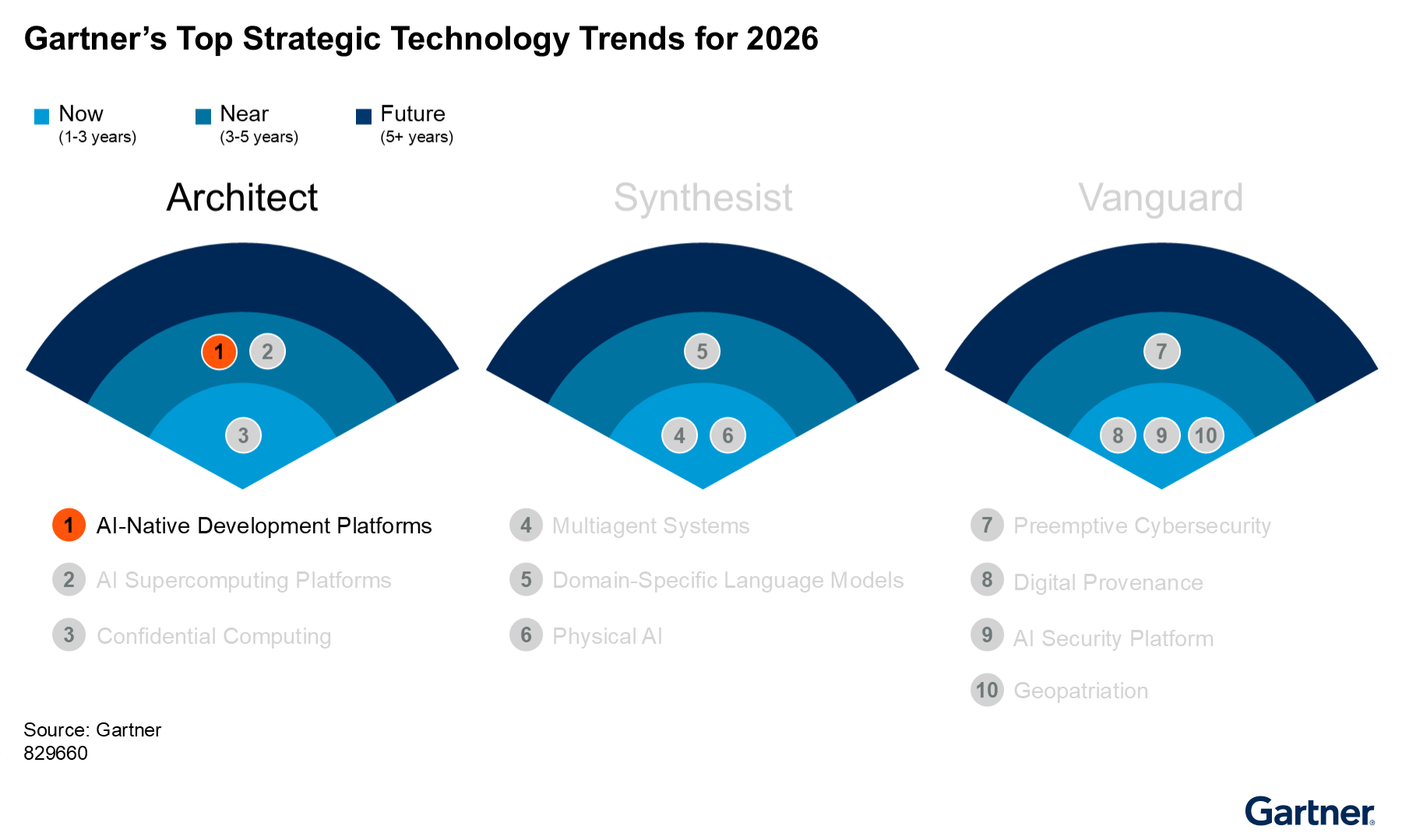
This trend is one of our Top Strategic Technology Trends for 2026. Our Top Strategic Technology Trends for 2026 (see Figure 2) will help you drive responsible innovation, operational excellence, and digital trust. They’re the trends we consider most relevant and impactful, which you should start preparing for.
Our trends fall into three main themes:
- The Architect — Trends in this category focus on building secure, scalable, and adaptive digital foundations that support rapid innovation and organizational resilience. These technology trends are AI-native development platforms, AI supercomputing platforms, and confidential computing.
- The Synthesist — These trends highlight how to orchestrate diverse technologies, such as AI agents, specialized models, and integrated physical and digital systems, to unlock new sources of value and differentiation. These technology trends are multiagent systems, domain-specific language models, and physical AI.
- The Vanguard — Trends in this area address the need to elevate trust, governance, and security, enabling organizations to protect their reputation, ensure compliance, and maintain stakeholder confidence. These technology trends are preemptive cybersecurity, digital provenance, AI security platform, and geopatriation.
Work with other executives to evaluate our trends’ impacts and benefits. This will enable you to determine which single trends — or strategic combination — will have the most significant impact on your organization, and the ecosystem in which it operates. Examine the trends’ potential relative to your organization’s specific situation, factor them into your strategic planning for the next few years, and adjust your business models and operations appropriately.
2025 Gartner AI in Software Engineering Survey. This study was conducted to explore the adoption of AI within software engineering functions, focusing on two key areas: the use of AI tools (e.g., AI code assistants, AI code agents) throughout the software engineering life cycle (SDLC); and the development of AI-powered solutions (or AI engineering) within software engineering functions, along with their contribution to business outcomes. The research was conducted online from 29 April through 25 June 2025 among 299 respondents from North America (n = 150), EMEA (n = 104) and Asia/Pacific (n = 45). Quotas were established for company sizes and for industries to ensure a good representation across the sample. Organizations were required to be either piloting or using AI tools in SDLC for less than four years, and either piloting or having built AI solutions in their software engineering functions. Respondents included both leaders and individual contributors from software engineering functions, each with at least one year of tenure at their current organization. All respondents were involved in decision making or directly engaged in using AI tools or building AI solutions within their software engineering functions. Disclaimer: The results of this survey do not represent global findings or the market as a whole, but reflect the sentiments of the respondents and companies surveyed.