Top Strategic Technology Trends for 2026: Multiagent Systems
18 October 2025 - ID G00829644 - 7 min read
By Tom Coshow, Gene Alvarez, and 9 more
Multiagent systems transform processes by dividing work among task-specialized AI agents, boosting efficiency and innovation. CIOs can leverage MAS to improve performance, reduce risk and gain competitive advantage.
Overview
Opportunities
- Expedite meaningful innovation: Multiagent systems (MAS) help organizations rethink processes, products and experiences, using specialized AI agents to take actions and create new sources of competitive advantage.
- Develop new skills and platforms: MAS adoption requires expertise in agent governance, modular design and interoperability, positioning organizations and vendors that support collaborative integration as future leaders.
- Accelerate automation and collaboration: Under careful management, MAS enable agents to discover, negotiate and work together, supporting workflows beyond organizational boundaries and advancing a larger ecosystem of the Internet of Agents.
- Improve efficiency and resilience: Reusing proven agents increases reliability, faster adoption, scalability and adaptability, reducing errors from monolithic or overly broad AI solutions.
Recommendations
- Begin with the end goal in mind. Redesign processes, products and experiences from the ground up, using MAS to break workflows into steps handled by specialized agents.
- Establish strong governance for MAS, including clear oversight, ethics and compliance.
- Prioritize MAS deployment through testing and observability, starting with small pilots and monitoring resource use to control costs.
- Adopt standards and modular tools that support agent interoperability, observability and control to future-proof MAS investments.
Strategic Planning Assumptions
- By 2027, agent specialization will lead to 70% of MAS having agents with narrow, focused roles, improving accuracy but increasing coordination complexity.
- By 2028, standardized agent communication protocols will enable over 60% of MAS to incorporate agents from multiple vendors, fostering greater innovation and flexibility.
What You Need to Know
This research is part of Gartner’s Top Strategic Technology Trends for 2026.
Myth vs. Reality: Agents Replacing Humans
Much of the talk about digital humans and autonomous digital workforces is hype. Today’s AI agents — even multiagent systems — are not a replacement for people. They augment human work and may mean that an organization needs fewer people overall, but they do not have the agency level of a person.
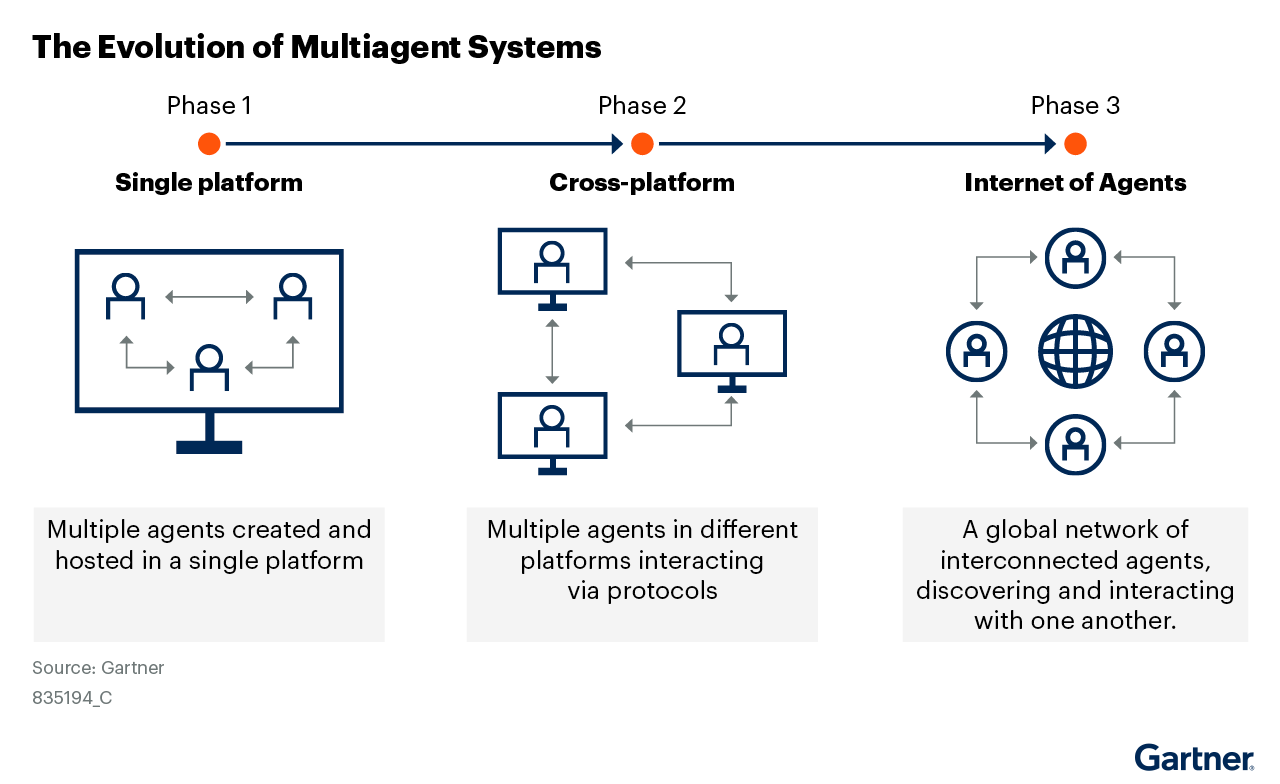
Multiagent systems (MAS) are transforming how organizations build and manage AI-powered workflow automation. Instead of relying on a single, general-purpose AI, MAS divides processes into modular steps handled by specialized agents, like musicians in an orchestra. This boosts efficiency, scalability and reliability, helping organizations overcome the limits of monolithic AI agents on performing complex tasks. With robust interoperability protocols, MAS also makes it easier to reuse proven agents and coordinate work across platforms, paving the way for an Internet of Agents where digital agents can discover each other and collaborate on their own (see Figure 1).
This modular approach brings new challenges, including the need for strong collaborative governance, new skills for managing agent identity and access across libraries, and robust interoperability and security protocols. Costs can be unpredictable, and integration may be difficult as communication protocols mature.
As MAS adoption grows, IT leaders should rethink workflows, invest in observability tools and adopt standards to future-proof their AI strategies.
Profile: Multiagent
Description
Multiagent systems (MAS) are collections of AI agents that interact to achieve individual or shared goals. Agents may be delivered in a single environment or developed and deployed independently across distributed environments.
Unlike single-agent systems, where one agent acts alone, MAS has agents that cooperate, compete or act independently to reach their goals. MAS uses modular architecture, with each agent specialized in a particular activity or domain, allowing complex workflows to be broken into manageable, coordinated tasks.
An MAS can be designed using an orchestrated workflow for more-predictable task execution, semistructured coordination with a planning agent for adaptable goal-oriented processes, or a group of AI agents that collaborate based on their capabilities for flexible and self-organizing problem solving.
Why Trending
MAS is gaining traction as organizations hit the limits of single-agent solutions, especially when large language models (LLMs) struggle with complex, multistep tasks. By dividing workflows into specialized agent tasks, organizations can reduce errors and reuse proven agents across different workflows.
MAS is emerging as a new style of cross-application integration. Many enterprises are building AI agents within their software as a service (SaaS) platforms. This results in many siloed agents across the business. As communication protocols improve and organizations seek to coordinate work across these separate systems, the need for MAS increases. Faulty communication between AI agents can introduce new risks and requires careful monitoring.
Industry momentum is clear: Gartner reports a 1,445% surge in MAS inquiries from 1Q24 to 2Q25, while vendors and investors are accelerating their investments in multiagent frameworks and interoperability standards. The move to collaborative, specialized agents and a future Internet of Agents is reshaping enterprise automation and workflow design.
Implications
Opportunities
- MAS will automate complex workflows and enable new ways for people and AI agents to work together.
- Libraries of specialized, reusable agents enable organizations to assemble more-reliable systems at scale with less risk.
- Modular designs make scaling and adapting to new needs easier.
- Communication between agents in MAS creates new opportunities for observability, making it easier to troubleshoot and update complex workflows.
Use Cases
- MAS optimizes supply chains by coordinating inventory, forecasting demand and rerouting shipments during disruptions, increasing efficiency across partners.
- In healthcare, MAS could connect ambulance dispatch, hospital intake and traffic systems, speeding up emergency response and patient care.
- MAS enhances cybersecurity by monitoring networks, detecting threats and deploying countermeasures in real time to contain breaches quickly.
- MAS can automate enterprise business processes within and across organizations
- Consumers can utilize MAS to automate various tasks, such as shopping or planning travel.
Risks and Challenges
MAS increases security risks, integration complexity and monitoring difficulties. Managing costs and governance is essential as agent numbers grow:
- Larger attack surfaces require strong governance and security controls.
- Costs can spike if agent use is not managed.
- AI agent activity can be difficult to predict, monitor and troubleshoot.
- Testing and validation of MAS is challenging due to the indeterministic nature of agent collaborations.
- Risk scenarios grow exponentially as agents interact. Adding more agents does not simply add risk but multiplies the number of possible interactions, making it significantly harder to anticipate, detect or mitigate failures or attacks.
Accelerators
MAS adoption is fueled by technical advances and market demand:
- Improved agent frameworks, platforms, protocols and standards
- Rising client interest and vendor investment
Inhibitors
Adoption can be slowed by technical and organizational hurdles:
- There are multiple, immature standards for agent communication, identification and certification.
- Reliability remains a critical barrier. Even modest error rates in individual agents compound rapidly across multistep processes, leading to frequent failures. For example, with a 15% error rate per agent, a five-step process will fail more than half the time.
- Most AI agents are not reliable enough to support self-organizing MAS without additional safeguards. Effective deployment often requires explicit validation steps after each agent invocation to mitigate compounded errors.
- Managing unpredictable operational costs is complex.
Actions
- Identify high-value MAS use cases with well-defined process flows, and start with pilots.
- Upskill your teams by learning and experimenting with multiagent frameworks. Begin with orchestrated agent designs to reduce compounding errors before advancing to more autonomous or self-organizing approaches.
- Design modular agents for specialized tasks, not monolithic solutions.
- Build in governance, observability and compliance from the start, including strong API governance and integration controls to manage agent interactions.
- Adopt proven industry standards as they improve that support agent interoperability.
About Gartner’s Top Strategic Technology Trends for 2026
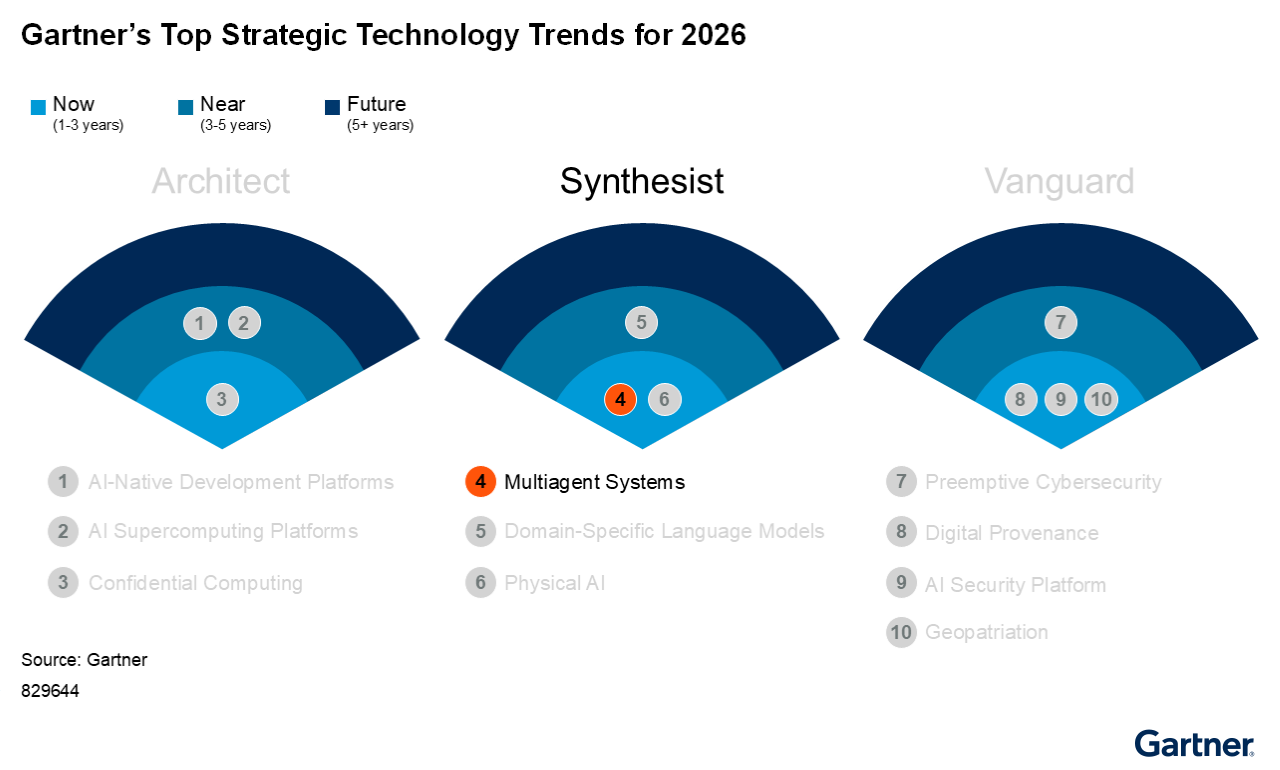
This trend is one of our Top Strategic Technology Trends for 2026. Our Top Strategic Technology Trends for 2026 (see Figure 2) will help you drive responsible innovation, operational excellence, and digital trust. They’re the trends we consider most relevant and impactful, which you should start preparing for.
Our trends fall into three main themes:
- The Architect: Trends in this category focus on building secure, scalable, and adaptive digital foundations that support rapid innovation and organizational resilience. These technology trends are AI-native development platforms, AI supercomputing platforms, and confidential computing.
- The Synthesist: These trends highlight how to orchestrate diverse technologies, such as AI agents, specialized models, and integrated physical and digital systems, to unlock new sources of value and differentiation. These technology trends are multiagent systems, domain-specific language models, and physical AI.
- The Vanguard: Trends in this area address the need to elevate trust, governance, and security, enabling organizations to protect their reputation, ensure compliance, and maintain stakeholder confidence. These technology trends are preemptive cybersecurity, digital provenance, AI security platform, and geopatriation.
Work with other executives to evaluate our trends’ impacts and benefits. This will enable you to determine which single trends — or strategic combination — will have the most significant impact on your organization and the ecosystem in which it operates. Examine the trends’ potential relative to your organization’s specific situation, factor them into your strategic planning for the next few years, and adjust your business models and operations appropriately.
- Data for this research was sourced from the following:
- Client interaction data (such as inquiries and search analytics), research performed by Gartner’s secondary research team using external sources and previously published Gartner research.
Innovation Insight: Multiagent Systems (MAS)