Critical Capabilities for Multichannel Marketing Hubs
23 September 2025 - ID G00824725 - 40 min read
By Tia Zervas, Audrey Brosnan, and 5 more
Multichannel marketing hubs create, orchestrate, execute and measure interactions across devices and channels. Digital marketing leaders can use this research to identify solutions that will help them power effective multichannel campaigns and drive measurable outcomes.
Overview
Key Findings
- AI innovation continues to accelerate with more agentic agents appearing in the market. Common generative AI (GenAI) capabilities include copy assistant and AI-generated images; whereas multichannel marketing hubs (MMHs) are deploying more advanced abilities (e.g., AI-generated customer segments and multistep journeys) into the market.
- Most MMHs still rely on customer data platforms (CDPs) — either their own or through third parties — to enhance profile management, with most providers supporting direct integration with enterprise data warehouses. MMH users have a broad array of choices to generate the customer intelligence needed to power a multichannel marketing campaign.
- Marketers seek MMH vendors that understand their business needs and provide faster time to value. However, the complexity and modularity of MMH vendors still require integration, configuration and operational help to realize the solutions’ full benefits.
- Providers that offer AI-enabled journey orchestration and prescriptive intelligence stand out in the market. These advanced capabilities empower marketers to proactively optimize campaigns, rather than relying on reactive adjustments.
Recommendations
- Determine your need to add to, or replace, existing marketing technology (martech) investments by defining specific multichannel marketing use cases, and determine your organization’s readiness for GenAI uses, such as AI-generated journeys, content or customer segments.
- Create a vendor “shortlist” based on usability, technical needs and business fit to determine the speed of tool deployment, adoption and utilization. Assess offerings based on the vendor’s vertical expertise and plans to support emerging execution capabilities and techniques.
- Weigh the value of holistic, large enterprise MMH solutions and their capabilities against those that specialize in customer engagement or campaign management. Although some providers offer a single, comprehensive MMH product, most providers offer multiproduct solutions. In these instances, many product advancements are delivered through add-on products, which can increase complexity and total cost of ownership for buyers.
- Partner with IT and relevant customer-facing functions to select a vendor. Scrutinize offerings from enterprise software vendors with an existing relationship serving another function. With the same set of use cases, evaluate capabilities and integration requirements to integrate a new vendor’s MMH with your other organizational systems.
What You Need to Know
Marketers continue to prioritize delivering timely, relevant and connected customer engagements across multiple devices and channels. However, as MMH solutions become more complex and costly, some organizations are seeing reduced value and even buyer regret. In response, MMH vendors are placing greater emphasis on predictive and prescriptive intelligence and decisioning capabilities. These capabilities help marketers quickly identify underperforming campaigns, optimize their marketing mix and determine next best actions using real-time data.
This year’s evaluation saw a widespread adoption of GenAI and the introduction of configurable AI agents, fundamentally expanding the capabilities of MMHs. GenAI now supports campaign generation through interactive, text-based queries, enabling marketers to create campaign briefs, explore audiences and ideate journeys more efficiently. GenAI-powered workflows and agents facilitate last-mile personalization, journey and report generation, and allow for configurable model selection and governance. Foundational AI continues to underpin key MMH functions, including segment discovery, campaign and journey path design, propensity modeling, and predictive content and offer recommendations. As buyers seek greater composability and seamless integration with cloud data platforms and enterprise applications, they are also prioritizing tools that improve consumption and spend management, reduce manual intervention through automation, and provide simplified user experiences to maximize value and operational efficiency.
Use this research to identify vendors with capabilities that align to use-case priorities. Critical Capabilities with associated ratings will help you pinpoint areas of differentiation and determine which MMH vendors may be suitable to your requirements. Apply the customize functionality in the interactive version to align the capability percentages to your needs. Treat the scoring in this research as a tool for determining whether the featured products meet the requirements of your organization’s use cases and needs.
Finally, use the companion Magic Quadrant for Multichannel Marketing Hubs to understand key market dynamics and to compare how the featured vendors are ranked in the context of those dynamics.
Analysis
Critical Capabilities Use-Case Graphics
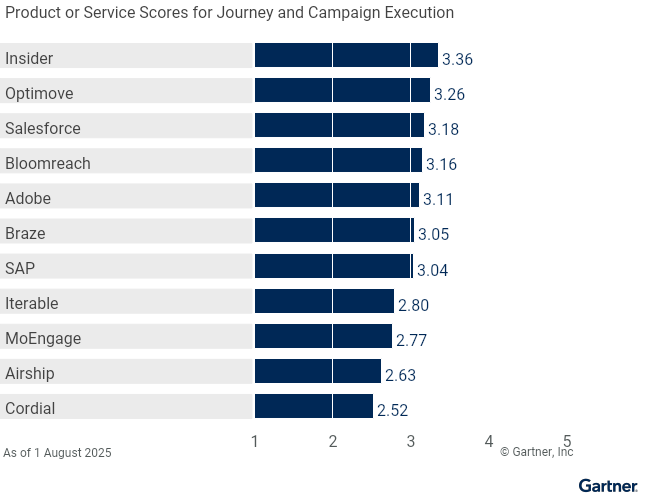
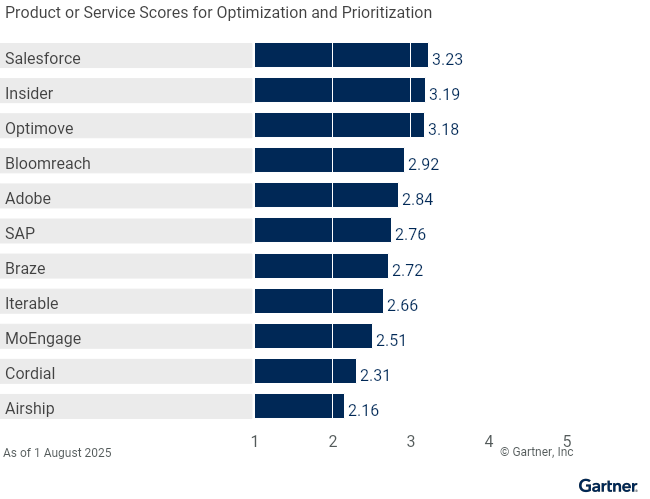
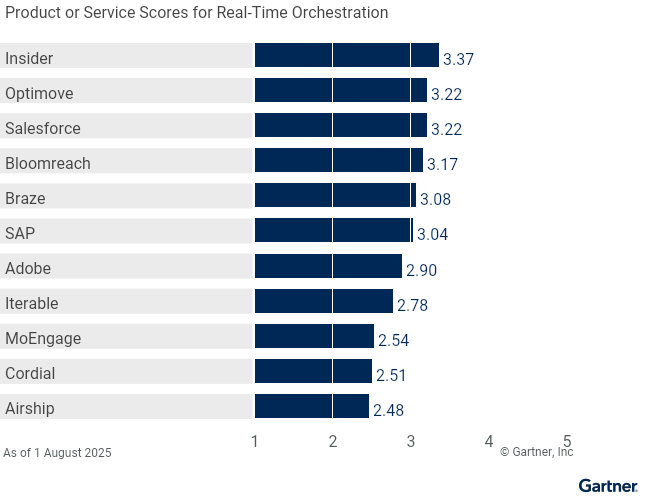
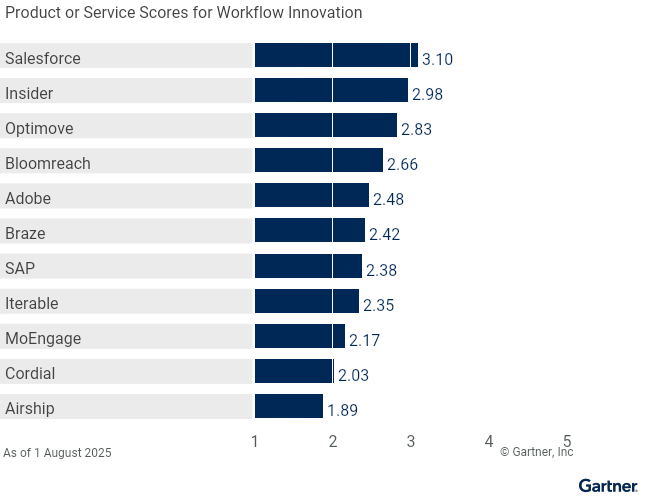
Vendors
Adobe
Adobe’s MMH is Adobe Journey Optimizer and it is supplemented by Adobe Real-Time Customer Data Platform and Adobe Customer Journey Analytics products on the Adobe Experience Platform. Adobe offers Journey Optimizer in Select, Prime and Ultimate tiers, differing in access to features, such as real-time offer decision-making, which requires Journey Optimizer Ultimate. Adobe integrated new GenAI capabilities, such as the AI Assistant for conversational queries, segmentation and message generation, enabling marketers to accelerate production cycle times. Its MMH supports end-to-end experiences across marketing, creative and commerce teams and is reinforced by a strong partner ecosystem and specialized solutions, like Privacy Shield for regulated industries.
Adobe’s strongest use case is journey and campaign execution. It excels at orchestrating adaptive, multistep journeys and campaigns with real-time data and AI-driven personalization.
Adobe’s strongest capabilities are analytics and foundational AI, multichannel execution, and journey and campaign management. For analytics and foundational AI, it delivers GenAI-powered insights, automated reporting and predictive analytics. For multichannel execution, the platform uses rule-based and AI-driven decision-making to scale real-time personalization. For journey and campaign management, its tools allow marketers to design and optimize complex journeys. It streamlines data integration through unified audience segmentation and connects to data warehouses, such as Microsoft’s Azure and Amazon Web Services.
Its lowest scoring capabilities are utilization and consumption management, two-way conversational messaging, and GenAI and configurable agents. For utilization and consumption management, it provides channel usage visibility but lacks advanced forecasting for data credit consumption or media volumes that will help marketers anticipate their future consumption. In two-way messaging, gaps include integration with service and commerce systems, chat, and native voice channel support. For GenAI and configurable agents, further development is needed for autonomous AI agents that can scale the productivity of Adobe Journey Optimizer and related technologies for multichannel marketers.
Airship
Airship’s MMH, the Airship Experience Platform (AXP), is an AI-powered cross-channel solution Airship offers AXP as a base platform with a hybrid subscription and usage-based pricing model, with additional support tiers available for a fee. Airship’s recently released Journeys AI enables customers to rapidly create multichannel journeys with simple prompts. Its AI-powered product recommendations can guide new users through the customer life cycle during onboarding via its Web Scenes product. Its extensive global network of in-house professional services, agencies and system integrators adapt to customers’ unique needs based on region, industry and maturity.
Airship’s strongest use case is journey and campaign execution. It leverages its composable architecture and integrations with cloud data warehouses to enable multistep journeys and campaigns.
Airship’s strongest capabilities are multichannel execution, campaign generation, data integration, and journey and campaign management. For multichannel execution, it supports in-web experiences and emerging channels, such as Apple Live Activities. For campaign generation, its Journeys AI enables customers to rapidly create multichannel journeys using prompts. For data integration, its composable architecture and integrations with cloud data platforms enable segmentation and personalization. For journey and campaign management, it supports cross-channel campaign design and optimization.
Its lowest-scoring capabilities are utilization and consumption management, workflow innovation, collaboration and work management, GenAI and configurable agents, and two-way conversational messaging. For utilization and consumption management, Airship offers basic visibility into usage metrics but lacks advanced forecasting and optimization capabilities. For collaboration and work management, it lacks in-platform features for campaign work management (e.g., tracking campaign tasks, project management or work calendars), although it does support reviews and approvals. For GenAI and configurable agents, Airship’s agentic offerings only operate semiautonomously in response to marketer commands. For two-way conversational messaging, its opportunities involve expanding native channel support for popular messaging apps, like WhatsApp and Apple Messages for Business.
Bloomreach
Bloomreach’s MMH, Bloomreach Engagement, is offered across four layers of the engagement engine that includes CDP capabilities, choice of channels, product updates (e.g., segmentation agent) and add-ons (e.g., transactional emails). It’s known for multichannel campaign capabilities, channel optimization and audience-building capabilities at scale, powered by the GenAI engine, Loomi AI. Its recently released GenAI-based analytics help marketers identify and activate campaign opportunities, and integrate large language models directly into channel canvases, such as the email builder, to generate tone- and brand-specific content across web, email and SMS.
Bloomreach’s strongest use case is for real-time orchestration. It can autonomously connect voice of the customer data, such as Net Promoter Score and survey data, to inform customer journeys and automatically trigger journey flows based on conversations initiated through Rich Communication Services (RCS) messaging.
Bloomreach’s strongest capabilities are in analytics and foundational AI, multichannel execution and two-way conversational messaging. For analytics and foundational AI, it enables marketers to identify top-performing channels, detect anomalies to alert key stakeholders, and predict churn likelihood to optimize frequency caps and send times during campaigns. For multichannel execution, it allows marketers to extend customer journeys to external, walled-garden channels for targeted advertising, supporting robust multichannel strategies. For two-way conversational messaging, its AI shopping assistant, Clarity, enhances organizational support capabilities by empowering marketers to deliver advanced shoppable and customer support experiences based on customer order and digital behavior history.
Bloomreach’s lowest-scoring capabilities are in utilization and consumption management, journey and campaign management, and prescriptive intelligence. For utilization and consumption management, the platform can support channel consumption and has control measures for channel usage; however, marketers seeking features for forecasting operational costs may find the platform’s tools inefficient. For journey and campaign management, prebuilt campaigns are accessible through the Use Case Center, but the out-of-box scoring models for these campaigns may be insufficient for application to large audience groups. For prescriptive intelligence, it has multiple dashboards that identify high- and low-performing campaigns, but it lacks the ability to recommend specific actions for a marketer to take to improve a campaign or journey.
Braze
Braze’s MMH, the Braze Customer Engagement Platform, is offered across four enterprise tiers: Core, Select, Premier and Absolute (as well as Go, a growth-oriented offering for small and midsize businesses). Its real-time streaming data architecture enables profile management, in-the-moment personalization and multichannel execution. Braze recently expanded its data capabilities via the Braze Data Platform, reducing technical complexity for data unification and activation.
Braze’s strongest use case is for real-time orchestration. The intuitive user-interface couples with powerful features to enable marketers to create complex journeys with ease. For instance, marketers can leverage Braze’s predictive analytics suite to see how interactions affect goals and to identify likely drop-offs during journeys. The platform also gives marketing leaders recommendations based on an analysis of touchpoints across channels to support conversion objectives.
Braze’s strongest capabilities are in multichannel execution, analytics and foundational AI, two-way conversational messaging, and campaign generation. For multichannel execution, marketers can execute messages across a range of channels, including email, push, SMS and WhatsApp, plus several ad channels. For analytics and foundational AI, it has prediction modeling that includes event correlation that compares different user groups with an analysis on how a segment’s behaviors or attributes will perform. For two-way conversational messaging, the platform natively supports two-way SMS. Its Canvas builder enables keyword-based triggers and automated responses to automate common conversation topics. For campaign generation, the platform provides modern touchpoints, such as RCS and Content Cards.
Braze’s lowest-scoring capabilities are in utilization and consumption management, GenAI and configurable AI agents, and prescriptive intelligence. For utilization and consumption management, it lacks tools for budget and channel allocation by brand or region and does not help users forecast any future consumption. For prescriptive intelligence, Braze enables time-based capping and can dynamically change a customer’s journey based on behaviors, but it cannot directly alert a marketer to underperforming journeys. For GenAI and configurable AI agents, it lacks configurable agents and its GenAI-enabled features are limited to AI assistants.
Cordial
Cordial’s MMH bundles native customer data management with journey orchestration and multichannel campaign execution on a consumption-based model (e.g., contacts, message volumes and traffic). It leverages Cordial Edge AI for AI-driven message insights and autonomous content creation. It recently released AI product recommendations for personalized content, AI message insights for data-driven message optimization, predictive AI attributes (e.g., send-time optimization and Channel Affinity) to enhance real-time decisioning across channels and prescriptive intelligence for automated journey optimization.
Cordial’s strongest use case is journey and campaign execution, driven by unifying real-time data, messaging and AI for hyperpersonalized, multistep customer interactions. Visual workflow tools, like Podium, and AI-powered features, such as Product Recommendations, Message Insights and Cordial Experiments, accelerate time-to-market and optimize campaign performance.
Cordial’s strongest capabilities are campaign generation, journey and campaign management, and analytics and foundational AI. For campaign generation, Cordial Edge AI’s assistants create subject lines, headers, messages and content variants for email and SMS. Smarty Assist supports code-based asset creation to streamline production. For journey and campaign management, Cordial machine learning experiments in the Podium orchestration platform to accelerate testing, optimization and versioning of campaigns. For analytics and foundational AI, Cordial Edge AI’s predictive attributes and no-code segmentation enhance targeting, personalization and audience development, while journey analytics support next-best-action decisions.
Cordial’s lowest-scoring capabilities include collaboration and work management, GenAI and configurable agents, and utilization and consumption management. For collaboration and work management, it lacks built-in approval workflows for journey or campaign management, requiring teams to use external solutions for structured reviews and approvals. For GenAI and configurable agents, it lacks AI agents capable of independently making and executing marketing decisions. For utilization and consumption management, while Cordial’s straightforward pricing model helps insulate buyers from some of the unpredictable costs commonly seen in the market, their approach to forecasting for triggered-based journey currently relies on internal service teams.
Insider
Insider’s Growth Management Platform MMH offers Essentials, Growth and Enterprise tiers. It’s known for automated, actionable guidance for journey optimization, AI-powered conversational marketing, and native support of mobile and messaging channels to deliver rich product content and interactive experiences in messages, such as images, product descriptions and omnichannel content blocks. Recent innovations include GenAI-powered chatbots and agents from its MindBehind acquisition that automate customer service and marketing interactions and integrate seamlessly into multistep journeys.
Insider’s strongest use case is real-time orchestration, adapting journeys and content in response to immediate customer behaviors. Its optimization and prioritization tools allow marketing teams to compare channel performance, attribute revenue by channel and use AI-powered features, such as Next Best Channel and Send Time Optimization.
Insider’s strongest capabilities are analytics and foundational AI, campaign generation, GenAI and configurable agents, and two-way conversational messaging. For analytics and foundational AI, it includes attribution modeling and customized performance reports for data-driven decision-making. For campaign generation, its updated Sirius AI accelerates marketing velocity by building entire journeys and associated media that marketers can refine. For GenAI and configurable agents, its Sirius AI accelerates journey velocity, integrating customer service and marketing interactions through GenAI-powered chatbots. For two-way conversational messaging, its unified conversational history stores conversation logs across channels and enables events or attributes to trigger dynamic journeys.
Its lowest-scoring capabilities are utilization and consumption management, collaboration and work management, and prescriptive intelligence. For utilization and consumption management, it lacks advanced forecasting tools or predictive resource optimization to help organizations proactively manage product usage and operational efficiency. For collaboration and work management, it has nascent work management features, and it lacks project, task, resource and marketing calendar management features, requiring teams to rely on external solutions. For prescriptive intelligence, Sirius AI optimizes campaigns and automates real-time interventions, but marketers often overlook the team maturity needed to execute this, making the capability overstated and seldom fully realized.
Iterable
Iterable’s MMH solution is Iterable: AI-Powered Communications Platform. It operates on a usage-based pricing model determined by profiles, messages sent, and select data usage types, with premium features available as optional add-ons. It is known for enabling marketers to build adaptive campaigns and customer journeys from multiple datasets. Recent enhancements include Journey Performance Recommendations that provide prescriptive intelligence by alerting marketers to actionable improvements for in-flight campaigns. Its GenAI Journey Assist reduces the effort of building multi-step journeys by instantly generating journey designs and offering templated prompts for common use cases.
Iterable’s strongest use case is journey and campaign execution. Marketers can generate new journeys by typing a prompt or prefilling a form. Brand Affinity insights alert users on campaigns and channels that drive the highest engagement while highlighting the top contributing campaigns driving those insights.
Iterable’s strongest capabilities are analytics and foundational AI, campaign generation, and multichannel execution. For analytics and foundational AI, marketers can leverage predictive modeling to build audiences likely to convert, using no- or low-code schemas. For campaign generation, Iterable’s Nova AI provides campaign performance tracking, actionable recommendations and an AI-powered conversational advisor to assist users in campaign ideation and deployment. For multichannel execution, its prescriptive insights offer visual data modeling and user flows by channel, supporting marketers in optimizing channel selection for multichannel campaigns.
Its lowest-scoring capabilities are collaboration and work management, utilization and consumption management, and data integration and management. For collaboration and work management, limited live campaign editing tools restrict governance for marketers who need to update campaigns in real time. For utilization and consumption management, the lack of cost estimation and predictive modeling features makes it challenging for B2C organizations to forecast costs for highly personalized campaigns. For data integration and management, it lacks data federation with cloud platforms, relying on API connectivity for off-site multichannel campaigns.
MoEngage
MoEngage’s MMH is supplemented by its MoEngage Inform and MoEngage Personalize products. Its primary MMH, MoEngage Core, is offered in either the Growth and Enterprise tiers. It recently released segmentation capabilities to activate audiences directly in MoEngage from a data warehouse. Its Merlin AI enables new copy and creative generation for channels like email and SMS based on brand style and past creative inputs.
MoEngage’s strongest use cases are journey and campaign execution and real-time orchestration. It offers multichannel execution and campaign generation across a wide variety of channels, including LINE and WhatsApp. It also offers a library of journey and campaign templates with some AI-based campaign generation automation.
MoEngage’s strongest capabilities are for campaign generation, journey and campaign management, and data integration and management. For campaign generation, it offers Merlin AI segmentation, which enables users to easily create segments via natural language from which they can create multistep customer journeys. For journey and campaign management, customers can build multistep journeys with MoEngage Flows, which offers a drag-and-drop canvas and interface in addition to journey branching, real-time event triggers and its Sherpa AI for optimization. For data integration and management, the platform provides real-time data intake, unifies customer profiles from multiple sources, and offers multiple prebuilt integrations with two-way data flow, as well as multiple APIs and native SDKs.
Its lowest-scoring capabilities are utilization and consumption management, collaboration and work management, and two-way conversational messaging. For utilization and consumption management, the platform covers channel-level and data processing reporting, and usage reports and alerts, but not predictive reporting, which could make it a challenge for proactively forecasting costs. For collaboration and work management, it offers native campaign planning and calendaring but lacks AI work creation and offers project task management through integrations. For two-way conversational messaging, MoEngage offers chatbots through integrations with named partners but not features like real-time segmentation and storing conversation logs across channels.
Optimove
Optimove’s MMH solution is the Positionless Marketing Platform. Its platform offering includes bundled features, with channels and additional add-ons such as OptiPromo (promotion engine) or Data Share (CDW connection) offered separately. It’s known for an AI-driven approach to campaign and journey management, providing real-time performance insights, and recommended actions to optimize campaigns and journeys. Its recently released content analysis connects content types to campaign performance. Its self-serve data ingestion capability enables marketers to easily integrate external data sources, such as order tracking information, directly into the UI without code or API intervention.
Optimove’s strongest use case is for journey and campaign execution. For large-scale campaign management, marketers can efficiently scale to thousands of campaigns and treatments with its self-optimizing campaign engine. Its AI agents personalize journeys with an always-on experimentation engine and real-time decisioning, leveraging any data source and AI to compare journey strategies, while providing built-in, multitouch attribution and control group capabilities.
Optimove’s strongest capabilities are analytics and foundational AI, multichannel execution, and prescriptive intelligence. For analytics and foundation AI, marketers can import modeling scores and models into the platform for advanced and customized analysis. For multichannel execution, it enables marketers to exclude customers already engaged in campaigns on external channels, such as Facebook, and incorporate CRM data to enhance personalization across touchpoints. For prescriptive intelligence, OptiGenie’s always-on insights and guidance provide clear and actionable recommendations to optimize campaign performance.
Its lowest-scoring capabilities are collaboration and work management, GenAI and configurable agents, and utilization and consumption management. For collaboration and work management, it does not support project or task management natively or through third-party integrations, limiting workflow coordination. For GenAI and configurable agents, it does not support audience segment creation or marketing campaigns and journey generation. For utilization and consumption management, reporting is limited to metrics, such as campaign participation and churn rates, and it lacks the ability to forecast consumption for monthly tracked users, marketing channels, and media spend, potentially leading to inefficient resource allocation.
Salesforce
Salesforce’s MMH, Marketing Cloud Engagement, is supplemented by its Data Cloud, Intelligence (marketing analytics) and Personalization products. It’s offered across Professional, Corporate and Enterprise tiers. It’s known for supporting a variety of marketing execution activities, such as multichannel campaign management, one-to-one personalization and multistep customer journeys. It recently released two-way SMS conversations, allowing use of GenAI to send personalized responses and support self-service transactions (e.g., shopping).
Salesforce’s strongest use case is for real-time orchestration. For triggered campaigns, it can dynamically change a customer’s journey as engagement changes throughout the journey. Journeys can be created by GenAI and immediately imported into the Flow Builder canvas.
Salesforce’s strongest capabilities are for GenAI and configurable AI agents, two-way conversational messaging, and data integration and management. For GenAI and configurable AI agents, it enables building and managing AI agents in Data Cloud to generate campaign briefs and draft channel communications, such as emails, streamlining content creation workflows. For two-way conversational messaging, Flow Builder on Hyperforce empowers marketers to design SMS and AI-enabled conversational WhatsApp messages that support customer sign-ups for marketing communications and loyalty programs, and deploy personal shopping assistants for tailored product recommendations. For data integration and management, Data Stream supports ingestion from third-party sources, including public clouds, and has bidirectional, zero-copy data sharing with platforms like Databricks and Snowflake, enhancing real-time data integration and activation.
Its lowest-scoring capabilities are analytics and foundational AI, utilization and consumption management, and collaboration and work management. For analytics and foundational AI, most advanced capabilities (e.g., bring-your-own model and advanced algorithms) are powered by a secondary product, Data Cloud, that’s not included in Engagement. For utilization and consumption management, Consumption Cards for Data Cloud and Digital Wallets for Engagement give users visibility into their usage, but lack tailored recommendations to manage MMH consumption or forecast future usage impacts. For collaboration and work management, the platform does not support project management or task-setting capabilities in its MMH, limiting in-platform collaboration and workflow management.
SAP
SAP’s MMH, SAP Emarsys, can be expanded with additional products, such as SAP CDP and SAP Business Data Cloud. It’s not offered by tier or edition. It’s known for supporting multistep customer journeys and provides cross-channel marketing and advertising performance. It recently released Joule AI Engagement Agents, a conversational AI marketing assistant that provides quick access to help documentation, suggestions for campaigns and segments, query data, and beginning a task throughout its platform.
SAP’s strongest use case is for journey and campaign execution. It offers a comprehensive library of prebuilt campaigns and journey options that are audience-, behavior- or product-focused, including options to search by marketing use case. It includes out-of-the-box audience segmentation to accelerate marketing activation.
SAP’s strongest capabilities are for two-way conversational messaging, data integration and management, and journey and campaign management. For two-way conversational messaging, SAP leverages Joule AI for interactive customer conversations via SMS or WhatsApp, including deploying shopping assistants that provide personalized product recommendations. For data integration and management, it streams live events and consolidates B2B data within a single platform, further enhanced by SAP CDP for advanced segmentation. For journey and campaign management, it offers GenAI for campaign ideation, orchestrating adaptive multistep journeys and implementing participation checks to prevent redundant messaging.
Its lowest-scoring capabilities are utilization and consumption management, collaboration and work management, and prescriptive intelligence. For utilization and consumption management, the platform allows users to view available AI units and channel consumption; however, it lacks tailored recommendations for forecasting or optimizing resource allocation, making it challenging to effectively control and manage operational costs. For collaboration and work management, teams can share campaigns with other business units, but it does not support marketing campaign planning or integrate with project management tools in the platform to enhance collaboration. For prescriptive intelligence, SAP provides campaign performance dashboards and recommendations through Tactics, but it lacks the ability to provide anomaly or opportunity detection for projects and tasks natively in the platform or through third-party tools (e.g., MWM).
Context
MMHs remain a cornerstone for orchestrating customer journeys and optimizing cross-channel engagement, and buyers now demand platforms that deliver measurable business impact, operational agility and reduced complexity. This shift is largely driven by heightened cost-to-value scrutiny, the need to streamline marketing operations, and the rapid evolution of GenAI.
A key trend is the prioritization of AI-enabled journey orchestration and real-time engagement. Modern MMH buyers expect platforms to leverage prescriptive intelligence and AI-driven decisioning to automatically identify and remediate underperforming journeys, dynamically adjust messaging based on live customer signals, and enhance personalization at scale.
The vendors in this market continue to enhance their AI capabilities. MMHs use GenAI to accelerate campaign ideation, content generation and audience segmentation, while agentic AI assistants are evolving from passive recommendation engines to proactive actors that build and refine journeys and content in real time. There has been an uptick in a vendor’s data composability abilities, as well as a lack of a robust workflow management and campaign tracking insights, in the MMH itself.
The Critical Capabilities featured in this research represent core and advanced functionalities of MMHs that enable effective campaign management and journey orchestration. The use cases represent a range of scenarios that marketing teams prioritize when evaluating MMH providers. Each use case is composed of differently weighted Critical Capabilities to identify which MMH solutions are most capable of achieving the use case’s goal. With growing emphasis on measurable business impact, operational agility and reduced complexity, AI-enabled journey orchestration, real-time engagement and GenAI-driven automation have become central to platform differentiation.
Market Definition
Gartner defines multichannel marketing hubs (MMHs) as software applications, primarily delivered as SaaS, that orchestrate personalized campaigns and event-driven customer journeys across marketing channels. These applications leverage customer data, predictive models and real-time insights to optimize the timing, channel and content of interactions. MMHs apply advanced analytics, AI and prescriptive intelligence to help marketing and technical teams manage the end-to-end life cycle of customer journeys. Although MMHs overlap with customer data platforms (CDPs) and personalization engines, their primary focus is enabling marketing users to manage large-scale consumer interactions, particularly in owned media channels such as email and app push.
Multichannel marketing hubs empower marketers to deliver personalized media and orchestrate customer journeys, thus driving revenue, engagement and loyalty. These SaaS applications unify customer data, predictive insights and real-time decision making to optimize interactions across digital channels. MMHs enable multidisciplinary teams to manage campaigns and event-driven journeys via advanced analytics, artificial intelligence/machine learning (AI/ML) and prescriptive intelligence.
As AI and generative AI (GenAI) technologies evolve, MMHs are helping teams dramatically expand the number, variety and quality of customer journeys, enabling greater personalization at scale. Advanced capabilities, such as campaign ideation, allow marketers to collaborate with AI agents to quickly produce near-complete journeys, including:
- Campaign briefs
- Audience segmentation
- Multistep journey design
- Media channels
- Personalized content coded for individual channels
By automating these traditionally human-bound tasks and pairing them with prescriptive journey optimization, MMHs enable marketers to focus on strategy, creativity, efficient production, and innovative practices or experiences.
Buyers value MMHs for their ability to orchestrate multichannel experiences and accelerate time to market. Organizations increasingly favor MMHs that:
- Ease journey maintenance by optimizing underperforming journeys.
- Speed journey development by identifying audience segments or designing and coding media.
These emerging capabilities enhance agility and performance, helping marketers stay competitive and increasing the tool’s value to the organization.
Mandatory Features
- Multichannel execution and measurement: Enables deployment and measurement of personalized messages across digital channels, such as email, mobile messaging and advertising. This feature includes integrated tools for performance tracking and reporting to optimize engagement.
- Data integration and management: Enables users to integrate customer data or other data objects (audiences, product catalogs, etc.). Specific functions may include APIs and packaged integrations, profile management, data transformation, advanced data (aka zero-copy) access to cloud data warehouses, and support for entities, such as product catalogs, that enable seamless data activation and personalized offers.
- Campaign and journey management: Provides user-friendly tools for campaign and journey design, testing, versioning and reporting. This feature orchestrates workflows to help marketers manage the life cycle of campaigns and journeys, from planning to archiving.
- Analytics and reporting: Offers capabilities such as segmentation, predictive modeling and customer journey analytics. These tools enhance targeting, personalization and overall program optimization. MMHs bundle features for reports and dashboards to help users understand and communicate campaign, channel and journey performance.
- Consent and preference management: Provides native or integrated tools for managing customer preferences, opt-ins, permissions and compliance audits. This feature ensures adherence to global corporate policies or regional regulations while fostering customer trust.
- Application management: Delivers tools for user and permission management, regulatory compliance (e.g., Service Organization Control [SOC] 2), and governance. This feature includes critical functions, such as global frequency capping and messaging policy enforcement, that ensure secure and scalable operations.
Common Features
- Advanced multichannel execution: Expands execution capabilities to paid and earned channels to improve the performance of journeys across first- and third-party touchpoints. Examples include integration with demand-side platforms, paid social media campaigns, retail media integration, and integration with identity resolution or data enrichment offers.
- Campaign ideation and content generation: Features GenAI-powered tools for producing campaign briefs, including audience segmentation, journey design and media recommendations. This feature supports content creation with tools for personalized variants, real-time assets and interactive elements, such as surveys and landing pages.
- Prescriptive and proactive AI decision making and automation: Combines AI-driven anomaly detection and journey prioritization with GenAI-powered automation. This feature automates life cycle tasks, such as journey maintenance and optimization, while providing actionable recommendations or taking actions to improve campaign performance.
- Collaboration and work management: Provides tools for project management, budgeting, resource allocation and calendar optimization. This feature enhances team collaboration and workflow efficiency for more seamless marketing operations. Tools may also provide packaged integrations and features from third-party work management applications.
- Digital commerce and service integration: Offers advanced integrations for commerce and service scenarios, including ERP integrations for real-time inventory and pricing, CRM case management, and two-way communication. This feature supports audience suppression for service exceptions and predictive recommendations for cross-sell or upsell opportunities.
- Two-way conversational messaging: Enables customer engagement through voice-triggered journeys, chatbots and agent-based interfaces. This feature includes seamless transition to human agents, proactive customer engagement and omnichannel messaging support for consistent communication.
- Utilization and efficiency metrics: Provides reporting and tailored suggestions to help organizations increase product usage, performance and operational efficiency. This feature includes dashboards for reporting on product consumption and spend efficiency. Some providers also include features to govern bundled GenAI features and minimize biases. Others include benchmarking tools to evaluate performance against industry peers.
- Hyperlocal- and external-event-triggered functions: Supports real-time adjustments to campaigns based on local and dynamic conditions. This feature includes geotargeted campaigns tailored to weather or events. It also includes tools for scaling responses to major triggers, such as holidays or breaking news.
Product/Service Trends
The market is shifting toward AI-generated marketing journeys, moving beyond simple AI assistants to fully automated journey creation and orchestration. AI assistants identify answers to queries and can generate dashboards. Advancements with AI assistants include creating multistep journeys ready to be deployed directly on the platform. Some vendors have the ability to automatically generate new journeys based on a customer segment’s behavior. Vendors are responding to the demand for more dynamic, two-way customer conversations and real-time journey management, enabling marketers to deliver more personalized and immediate experiences.
Additionally, there is a growing emphasis on collaboration and workflow management across brands and business units, as organizations seek to consolidate marketing tools and streamline operations. This trend is driving the need for solutions that either offer comprehensive, all-in-one platforms or provide seamless integration with existing technologies, supporting both change management and unified campaign execution.
Critical Capabilities Definition
Analytics and Foundational AI
Analytics and foundational AI optimize program performance through targeted interventions and personalization. They include models like send time optimization (STO) and recency-frequency-monetary (RFM) analysis for precise targeting.
Foundational AI, or nongenerative AI, employs supervised and unsupervised learning algorithms to analyze historical data and make predictions using techniques such as clustering (e.g., k-means), decision trees and support vector machines. These methods focus on interpreting existing data to derive actionable insights.
Campaign Generation
These GenAI-enabled capabilities help marketers and marketing leaders interactively identify and develop new ideas for campaigns and journeys through ad hoc, text-based queries to accelerate campaign production.
This includes the ability to create campaign briefs, explore audiences and provide design-related recommendations. The generated output could include personalized creative variants within a campaign or journey, real-time/contextual content, and code-based elements, such as surveys and landing pages.
Collaboration and Work Management
These capabilities enable multidisciplinary teams of marketers and other roles (IT, analytics, data, product managers, etc.) to manage and optimize the activities and work of multichannel marketing.
Organizations can use these collaboration platforms through capabilities like native or integrated project and task management, budgeting, resource management and marketing calendar management.
Data Integration and Management
The ability for an MMH solution to collect customer data or other data objects (audiences, product catalogs, etc.) and integrate with web or mobile data to perform data transformation operations. This includes the ability to support virtual data access (zero-copy integration) in multiple cloud data platforms.
GenAI and Configurable AI Agents
The ability of an MMH to leverage GenAI in marketing workflows to include last-mile personalization, journey generation and report generation.
Characteristics may include configurable LLM features such as, model selection, fine-tuning, and governance elements (e.g., bias detection, brand tone). Emerging capabilities include configurable (semi) autonomous AI agents that make decisions and/or take actions or agent development features.
Journey and Campaign Management
The ability to plan, design, iterate/version both event-based journeys and targeted multichannel campaigns that follows a customer’s channel preference.
These workflows should enable users to create targets and triggers, personalize messages, create next action logic or decisions, conduct experiments, run audit or approval processes as well as customized performance reports.
Multichannel Execution
The ability to implement a single strategy across multiple marketing and/or service channels all within the same campaign.
Prescriptive Intelligence
Offers automated guidance in identifying and maintaining underperforming journeys and journey assets (e.g., triggers, branches, experiments and offers) and in prioritizing and optimizing the overall mix of journeys and campaigns to achieve key objectives (e.g., determining the next best action).
Additionally, real-time functionality is integrated as a feature-level capability, enabling marketers to make timely adjustments and enhancements to their strategies, thereby ensuring optimal performance and alignment with business goals.
Two-Way Conversational Messaging
Enables customer engagement through voice-triggered journeys, chatbots and agent-based interfaces. This feature includes a seamless transition to human agents, proactive customer engagement and omnichannel messaging support for consistent communication.
Utilization and Consumption Mgmt
Provides reporting and tailored suggestions to help organizations manage product usage, performance and operational efficiency. This feature includes dashboards for reporting on product consumption and spend efficiency.
This capability may also include features to forecast likely credit-based consumption impact (profile updates, data actions, etc.) or digital wallets to manage and apportion consumables (data credits, channels, personalization actions, etc.) Other features include benchmarking tools to evaluate performance against industry peers.
Use Cases
Journey and Campaign Execution
Ability to use one or more visual workflows (UXs) to support the design of single interactions campaigns and sequences of multistep interactions across a customer’s journey.
Journey and campaign orchestration helps marketers improve key objectives, such as accelerating time to market for new journeys and boosting the personalization in interactions.
Optimization and Prioritization
Leveraging an MMH prescriptively (through single campaigns or journeys) to (a) identify underperforming assets or (b) achieve an optimal daily marketing mix.
Multichannel marketers can use their MMH to (a) detect underperforming assets or opportunities for improvement, as well as (b) balance the expectations of human stakeholders with the automated decisioning driven by predictive algorithms. MMH providers should include a customizable marketing dashboard to review the results and aid marketer’s decisions to prioritize campaign(s).
Real-Time Orchestration
Provide real-time execution and use two-way conversational approaches (e.g., chatbots, two-way SMS and shopping assistants) that combine marketing, commerce and service experiences.
MMHs can dynamically adapt the journey and content in response to immediate customer behaviors, moving customers from one journey to another based on customer signals.
Workflow Innovation
The use of both foundational and generative AI to help scale multichannel workflows.
MMHs must have the ability, out-of-the-box, to help marketers scale their campaigns and journeys with prebuilt workflows and/or a low-code/no-code option to build or prompt an AI assistant to do so.
Vendors Added and Dropped
Added
The following vendors were added to this iteration of the Critical Capabilities research:
- Airship
- MoEngage
Dropped
The following vendors were dropped from this iteration of the Critical Capabilities research:
- Acoustic was dropped after not meeting the inclusion criteria for business/financial performance.
- Acquia was dropped after not meeting the inclusion criteria for MMH supporting consumables.
- Message Gears was dropped after not meeting the inclusion criteria for business/financial performance.
- Pegasystems was dropped after not meeting the inclusion criteria for business/financial performance and MMH supporting consumables.
- Zeta Global was dropped after not meeting the inclusion criteria for software license revenue contribution and mobile messaging adoption.
Inclusion Criteria
To qualify for inclusion in Gartner’s 2025 Critical Capabilities for Multichannel Marketing Hubs, providers need to meet all of the following thresholds.
Licensing
- The vendor must offer its primary MMH product as a stand-alone or base configuration (lowest edition tier) license that does not require the purchase of other independent product SKUs (excludes consumable product SKUs).
Business/Financial Performance
- MMH software revenue and customers: The vendor is required to meet one of the following (reported as constant currency):
- At least $500 million in 2024 MMH software revenue and 1,500 MMH customers (logos) in 2024
- At least $150 million in 2024 MMH software revenue, and:
- at least 350 MMH customers (logos) in 2024
- the vendor added at least 25 paying net new MMH customers compared to 2023
- At least $50 million in 2024 MMH software revenue, and:
- at least 150 MMH customers (logos) in 2024
- the vendor added at least 40 paying net new MMH customers compared to 2023
- MMH supporting consumables: The vendor is required to meet both of the following:
- At least 50% of a vendor’s MMH customers must also purchase a volume of email messages with the primary MMH product.
- At least 15% of a vendor’s MMH customers must also purchase a volume of SMS, MMS, RCS, mobile push or in-app messages along with the primary MMH product.
- MMH customer contract value: The vendor must meet or exceed an average annual contract value of $90,000 for all MMH customers.
- Total business revenue: At least 70% of 2024 total company revenue attributable to software license sales (MMH or otherwise), either SaaS/subscription revenue or new perpetual license sales.
Market Presence
- Rank among the top 25 organizations in a Customer Interest Indicator (CII) defined by Gartner for this research. Noninclusion due to the CII should not reflect negatively on vendors. Gartner methodology limits the number of vendors that can appear in the research to 20. Data inputs used in the CII include the following measures, among others:
- Gartner customer inquiry, search volume and trend data
- Google search volume and website traffic analysis
- Frequency of mentions as a competitor to other cloud MMH vendors in reviews on Gartner’s Peer Insights forum during the year ending December 2024
- Demonstrated sales and customer support presence in a minimum of two of the following four regions: North America, Latin America, EMEA, Asia/Pacific. “Presence” is defined as regional coverage for a minimum of three of the seven following industries:
- Banking, financial services and insurance
- Healthcare (including providers, pharma and life sciences)
- Manufacturing
- Media
- Retail
- Services
- Transportation
- An ecosystem of partners that can provide technology extensions or services such as system integration services, third-party applications, digital agency services, or consulting and implementation services serving the above geographic areas.
MMH Product Functionality
- The vendor’s primary MMH product — for edition-based licenses, the base configuration — must provide all of the required MMH functionality as native features in the primary MMH product (see the market definition section).
- Vendors must provide packaged integrations with other commercially available martech and enterprise systems in a minimum of five of the following categories:
- Adtech platforms (DSP, DMP, etc.)
- Cloud data platforms
- CRM/salesforce automation
- CRM/customer experience management
- Digital commerce platforms
- Personalization engines
- Marketing analytics, reporting and BI dashboards products
- Content management, digital asset management, product information management or content marketing platforms
- Identity resolution services (deterministic or probabilistic)
- Vendors must offer bundled or consumable channel SKUs for:
- Email
- Carrier-based channels (SMS, MMS or RCS)
- Walled-garden advertising destinations (Google and Meta)
- Vendors must offer five advanced channel SKUs, such as:
- Advanced mobile, including push notifications, in-app messaging, RCS or other app-based experience (e.g., Instagram/TikTok-like stories)
- Web landing pages, website personalization, web push or personalized search
- Direct mail (incorporation and management of direct mail campaigns; native fulfillment not required)
- Paid media, including open programmatic advertising (e.g., DSP/DMP integration), retargeting, paid social (Facebook, Instagram, TikTok, YouTube, etc.) and retail media networks (Amazon Ads, Walmart Connect, Target Roundel)
- Consumer messaging platforms: Apple Messages for Business, Facebook Messenger, WeChat, WhatsApp, etc.
- Other services: Chatbots, webhooks/APIs, digital signage, kiosks or point-of-sale terminals
Weighting for Critical Capabilities in Use Cases
| Critical Capabilities | Journey and Campaign Execution | Optimization and Prioritization | Real-Time Orchestration | Workflow Innovation |
|---|---|---|---|---|
Analytics and Foundational AI | 10% | 25% | 10% | 10% |
Campaign Generation | 10% | 0% | 0% | 0% |
Collaboration and Work Management | 0% | 10% | 0% | 30% |
Data Integration and Management | 15% | 5% | 10% | 0% |
GenAI and Configurable AI Agents | 5% | 10% | 0% | 20% |
Journey and Campaign Management | 25% | 15% | 20% | 0% |
Multichannel Execution | 20% | 0% | 20% | 0% |
Prescriptive Intelligence | 15% | 20% | 10% | 15% |
Two-Way Conversational Messaging | 0% | 0% | 25% | 0% |
Utilization and Consumption Mgmt | 0% | 15% | 5% | 25% |
As of 01 August 2025 | ||||
Source: Gartner (August 2025)
This methodology requires analysts to identify the Critical Capabilities for a class of products/services. Each capability is then weighted in terms of its relative importance for specific product/service use cases.
Each of the products/services that meet our inclusion criteria has been evaluated on the Critical Capabilities on a scale from 1.0 to 5.0.
Critical Capabilities Rating
Product/Service Rating on Critical Capabilities
| Critical Capabilities | Adobe | Airship | Bloomreach | Braze | Cordial | Insider | Iterable | MoEngage | Optimove | Salesforce | SAP |
|---|---|---|---|---|---|---|---|---|---|---|---|
Analytics and Foundational AI | 3.8 | 2.4 | 3.6 | 3.4 | 2.7 | 3.8 | 3.4 | 3.0 | 4.0 | 3.9 | 3.5 |
Campaign Generation | 3.0 | 2.8 | 3.1 | 3.1 | 2.9 | 3.7 | 3.0 | 3.0 | 3.0 | 3.1 | 3.1 |
Collaboration and Work Management | 2.9 | 1.7 | 2.7 | 2.7 | 1.8 | 2.8 | 1.9 | 1.9 | 2.8 | 2.8 | 2.0 |
Data Integration and Management | 3.0 | 2.5 | 3.2 | 3.1 | 2.2 | 3.1 | 2.5 | 2.8 | 3.2 | 3.4 | 3.3 |
GenAI and Configurable AI Agents | 2.1 | 2.2 | 3.1 | 2.1 | 2.0 | 3.6 | 2.8 | 2.4 | 2.4 | 3.7 | 3.0 |
Journey and Campaign Management | 3.2 | 2.5 | 2.9 | 3.0 | 2.8 | 3.2 | 2.7 | 2.9 | 3.0 | 2.9 | 2.9 |
Multichannel Execution | 3.5 | 3.3 | 3.4 | 3.6 | 2.6 | 3.6 | 2.9 | 2.7 | 3.4 | 3.1 | 3.1 |
Prescriptive Intelligence | 2.5 | 2.2 | 2.9 | 2.5 | 2.2 | 3.0 | 2.6 | 2.5 | 3.4 | 3.0 | 2.7 |
Two-Way Conversational Messaging | 2.2 | 2.1 | 3.4 | 3.1 | 2.5 | 3.6 | 2.9 | 2.0 | 3.0 | 3.5 | 3.3 |
Utilization and Consumption Mgmt | 1.8 | 1.5 | 1.7 | 1.9 | 2.0 | 2.5 | 1.9 | 1.7 | 2.4 | 2.7 | 1.7 |
As of 01 August 2025 | |||||||||||
Source: Gartner (August 2025)
Table 3 shows the product/service scores for each use case. The scores, which are generated by multiplying the use-case weightings by the product/service ratings, summarize how well the critical capabilities are met for each use case.
Product Score in Use Cases
| Use Cases | Adobe | Airship | Bloomreach | Braze | Cordial | Insider | Iterable | MoEngage | Optimove | Salesforce | SAP |
|---|---|---|---|---|---|---|---|---|---|---|---|
Journey and Campaign Execution | 3.11 | 2.63 | 3.16 | 3.05 | 2.52 | 3.36 | 2.80 | 2.77 | 3.26 | 3.18 | 3.04 |
Optimization and Prioritization | 2.84 | 2.16 | 2.92 | 2.72 | 2.31 | 3.19 | 2.66 | 2.51 | 3.18 | 3.23 | 2.76 |
Real-Time Orchestration | 2.90 | 2.48 | 3.17 | 3.08 | 2.51 | 3.37 | 2.78 | 2.54 | 3.22 | 3.22 | 3.04 |
Workflow Innovation | 2.48 | 1.89 | 2.66 | 2.42 | 2.03 | 2.98 | 2.35 | 2.17 | 2.83 | 3.10 | 2.38 |
As of 01 August 2025 | |||||||||||
Source: Gartner (August 2025)
To determine an overall score for each product/service in the use cases, multiply the ratings in Table 2 by the weightings shown in Table 1.
Acronym Key and Glossary Terms
| Configurable AI Agents | Virtual agents or bots that can be rapidly customized by business users through low-code or no-code tools, enabling organizations to adapt conversational flows, integrate with business systems and address evolving business requirements without significant IT intervention. |
Critical Capabilities Methodology
This methodology requires analysts to identify the critical capabilities for a class of products or services. Each capability is then weighted in terms of its relative importance for specific product or service use cases. Next, products/services are rated in terms of how well they achieve each of the critical capabilities. A score that summarizes how well they meet the critical capabilities for each use case is then calculated for each product/service.
"Critical capabilities" are attributes that differentiate products/services in a class in terms of their quality and performance. Gartner recommends that users consider the set of critical capabilities as some of the most important criteria for acquisition decisions.
In defining the product/service category for evaluation, the analyst first identifies the leading uses for the products/services in this market. What needs are end-users looking to fulfill, when considering products/services in this market? Use cases should match common client deployment scenarios. These distinct client scenarios define the Use Cases.
The analyst then identifies the critical capabilities. These capabilities are generalized groups of features commonly required by this class of products/services. Each capability is assigned a level of importance in fulfilling that particular need; some sets of features are more important than others, depending on the use case being evaluated.
Each vendor’s product or service is evaluated in terms of how well it delivers each capability, on a five-point scale. These ratings are displayed side-by-side for all vendors, allowing easy comparisons between the different sets of features.
Ratings and summary scores range from 1.0 to 5.0:
1 = Poor or Absent: most or all defined requirements for a capability are not achieved
2 = Fair: some requirements are not achieved
3 = Good: meets requirements
4 = Excellent: meets or exceeds some requirements
5 = Outstanding: significantly exceeds requirements
To determine an overall score for each product in the use cases, the product ratings are multiplied by the weightings to come up with the product score in use cases.
The critical capabilities Gartner has selected do not represent all capabilities for any product; therefore, may not represent those most important for a specific use situation or business objective. Clients should use a critical capabilities analysis as one of several sources of input about a product before making a product/service decision.