Market Guide for AI Gateways
13 October 2025 - ID G00839683 - 18 min read
By Andrew Humphreys, Manjunath Bhat, and 3 more
AI gateways enable more effective governance of AI applications and agents. They reduce the risk of unexpected costs from AI providers and protect private data in API traffic. Software engineering leaders can use AI gateways as a key component of a strong AI management layer.
Overview
Key Findings
- As the quantity and scale of generative AI and other AI projects grow, organizations need greater visibility into their use of AI providers to manage costs and enforce governance.
- The rising volume of AI-related traffic is driving greater need to establish trust and enforce security guardrails for AI services. This traffic demands scalable solutions that can efficiently manage increased workloads, support multiple models, and ensure high availability and reliability.
- AI gateways are becoming a key component in AI architectures, but they are still new and haven’t been widely tested at scale. Expectations for what AI gateways can do are also quickly changing.
- AI gateways were originally designed to manage traffic between applications and large language models (LLMs), they are now increasingly expected to support other use cases like model context protocol (MCP) and A2A gateway patterns. Because of these evolving requirements, it can be difficult for organizations to choose a gateway that meets both current and future needs.
Recommendations
- Simplify management and compliance of the use of AI services by routing all AI traffic from custom-built applications through an AI gateway to provide a centralized control point.
- Reduce security risks by centrally managing credentials for all AI back ends, eliminating the need to update applications when credentials are rotated or revoked.
- Integrate API-driven AI trust, risk and security management (TRiSM) enforcement at this control point. Implement input and output AI guardrails to prevent data leaks, block unsafe prompts and ensure reply accuracy.
- Start with a robust proof of concept (POC) when adopting AI gateways and carefully evaluate products against technical and operational needs before full deployment. As AI requirements evolve rapidly, select vendors with a proven ability to adapt to new standards and regulations by prioritizing those with a clear innovation roadmap to avoid costly retrofits and ensure long-term flexibility.
Strategic Planning Assumption
By 2028, 70% of software engineering teams building multimodel applications will use AI gateways to improve reliability and optimize costs, up from 25% in 2025.
Market Definition
Gartner defines an AI gateway as a technology or platform that acts as an intermediary between applications and various artificial intelligence (AI) services or models. Its purpose is to simplify and manage access to AI capabilities, providing a central point to enable security, governance and observability of AI workloads.
The rapid adoption of AI has led to the emergence of new middleware technologies, such as AI gateways, that support the safe, efficient and controlled integration of AI capabilities. AI gateways address the following concerns in enterprise AI strategies:
- Enforcing security, data protection and risk mitigation on API-driven AI interactions. AI trust, risk and security management (AI TRiSM) ensures AI entity governance, trustworthiness, fairness, reliability, robustness, efficacy and data protection. AI gateways address aspects of AI TRiSM, including governance and reliability. For example, protecting API keys issued by AI providers is vital. If an attacker gets access to an organization’s API keys for an AI provider, they may access private data and run up large usage bills. AI gateways can be used to protect API keys issued by AI providers and take this responsibility away from internal developers.
- Managing access costs. Pricing models for AI services tend to be usage-based, which presents a risk for businesses as the costs associated with use of these services can accrue rapidly. AI gateways help control costs by enforcing policies to track and manage access to AI services and by providing features to reduce costs. As AI services generally use tokens to determine costs, gateways can optimize requests to reduce tokens sent and can cache responses to limit duplicate calls. This helps prevent excessive or unauthorized consumption and support cost-effective AI adoption.
- Monitoring AI service usage. AI gateways enable visibility of AI service usage by providing observability and analytics features.
- Optimizing access to AI services. For organizations using multiple AI providers, gateways can simplify integration by offering a single API entry point. This enables routing for multiple large language models (LLMs), balancing loads and dynamically optimizing cost, performance and response quality. It also supports switching/replacing models without impact to the consumer, resulting in a scalable and agile AI environment.
Mandatory Features
- Access control. User and application authentication. Role-based or policy-based authorization for API usage, audit logging, support for authorization protocols such as OAuth 2.x and OIDC.
- Cost management. Usage-based cost tracking and reporting based on AI tokens. Rate limiting and quota enforcement to prevent excessive or unintended usage.
- Multimodel/multiprovider routing and traffic management. Unified interface for accessing different AI models. Dynamic routing based on defined policies for cost, performance or other criteria. Load balancing and failover of AI workload traffic to optimize performance and reliability.
- Operational monitoring and analytics. Health checks and status monitoring of AI service integrations alerting for failures, anomalies or performance issues. End-to-end tracing, dashboards, and telemetry and analytics on AI service usage and system health, enabling organizations to optimize operations and compliance reporting and identify inefficiencies.
- Security enforcement. Centralized AI service API key management and protection, enabling data privacy controls and scanning. Detection and prevention of unauthorized access and prompt injection attacks.
Common Features
- AI-automated model selection. AI-driven routing to select the best model based on context or historical performance.
- Integration with billing solutions. Enables automated billing for AI service usage.
- Caching. Response caching to avoid duplicate calls and reduce costs (with appropriate controls for sensitive data). Semantic caching for natural language responses. Configurable cache expiration and invalidation policies.
- Data enrichment. Supports for adding context to requests or transforming requests/responses to ensure compliance and improve AI model behavior.
- Request and response guardrails. Implements rules and policies to prevent misuse of AI models, such as blocking unwanted prompts or sensitive content. Automatically detects and redacts sensitive data in requests and responses.
- Request retry and fallback. Improves resilience by defining request retry and model fallbacks in case of errors, ensuring continuous operation.
- Support for AI agent communication protocols. Can also act as a gateway for AI communication protocols — for example, Model Context Protocol (MCP) — to act as a central point of access and control for interacting with multiple MCP servers.
- Support for non-LLM AI services. Integration with image, speech or other AI APIs beyond language models.
Market Description
Gartner surveys and client inquiries highlight the growing urgency and complexity of deploying AI at scale. The 2024 Gartner AI Mandates for the Enterprise Survey identifies security threats (23%), data availability (23%) and integration with existing systems (22%) as the top generative AI (GenAI) implementation challenges that organizations face.1 These findings underscore the need for robust governance frameworks as enterprises seek to operationalize and enable AI use across the organization.
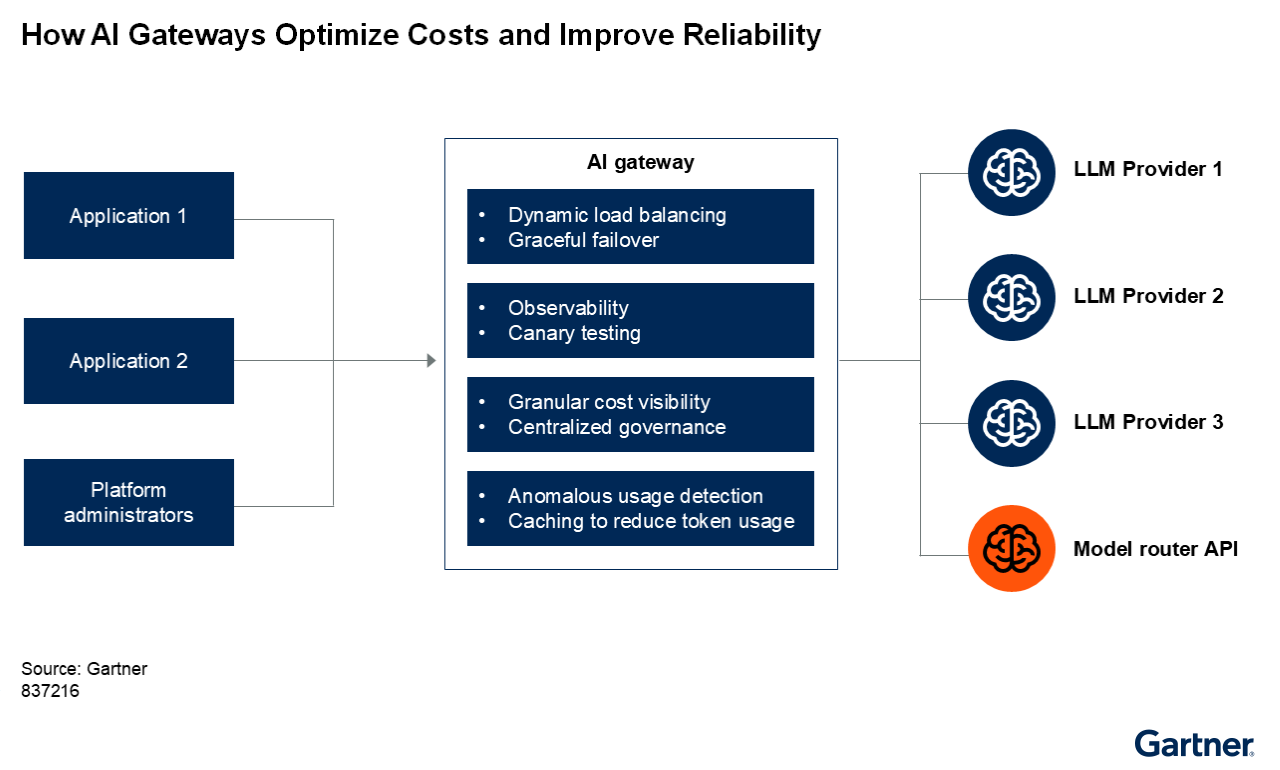
AI gateways are emerging as a key tool for supporting AI governance. The key roles and responsibilities of an AI gateway are shown in Figure 1.
While AI gateways offer considerable promise, several obstacles restrict their widespread adoption:
- Immaturity and rapid evolution: Because AI gateways are nascent, the requirements are new and still maturing and expanding — for example, with the increasing need to manage MCP endpoints. As a result, many vendor offerings are still in the early stages of development. Comparing products shows that the functions offered vary widely in scope and level of maturity.
- Latency and performance: Latency is a critical factor in AI deployments. AI-driven interactions are highly sensitive to delays. AI gateways can introduce latency, so organizations will need to evaluate the latency and performance implications of introducing the gateway into their architecture.
- Caching complexities: Caching in the context of traditional APIs is relatively straightforward; however, caching of semantic responses from AI models poses distinct challenges. The variability in natural language prompts and the nuances in LLM responses make it difficult to standardize caching strategies. As such, organizations may struggle to effectively implement caching measures that improve performance, are consistent with data management strategies and maintain the accuracy of AI outputs.
- Alternative technologies: Model routers, other types of middleware platforms like integration platforms, AI application development platforms and LLM providers themselves offer similar capabilities — for example, around prompt safety and other guardrails — that negate the need for a specialized AI gateway.
As a result of these obstacles, enterprises looking to invest in these solutions must conduct thorough POC evaluations to confidently commit to a vendor. This rigorous evaluation process is essential given the frequent emergence of new requirements in the rapidly evolving AI environment.
Market Direction
The AI gateway market remains in its early stages of development, but as investment in AI continues to surge and because AI gateways play a crucial role in managing interactions with AI models, the market is set to grow rapidly.
The market direction is being shaped by several key trends and technological drivers:
- Rapid evolution of core capabilities: Vendors are quickly adding new features to address latency, changing AI requirements and new security protocols. Also, regulatory frameworks are still catching up with the pace of technological change, adding another layer of complexity. This means organizations should anticipate that there will be frequent upgrades to gateway solutions to keep up with evolving standards and protocols.
- Convergence of API management platforms and AI gateways: Traditional API management platforms are evolving to include AI-specific features, leading to a convergence with API gateways. Many AI gateways are already built on existing API gateway technology, and vendors are increasingly offering unified solutions that support APIs and AI/ML model endpoints. This convergence simplifies architecture, streamlines management and enhances security. Assess the sophistication and support of your existing API management platform for AI services to streamline operational management before looking at a separate platform.
- Consolidation of adjacent and alternative technologies into AI gateway platforms: Solutions like model routers and emerging technologies such as MCP gateways (see Innovation Insight: MCP Gateways), and, in the future A2A, gateways are offering complementary capabilities to AI gateways. In addition, AI application development platforms are also adding gateway capabilities. As the market matures, expect to see consolidation into a single offering that supports multiple AI use cases for gateways.
- Lack of standardization: Industrywide standardization — especially for AI administration and gateway policies — remains limited, and this is unlikely to change in the short to midterm. This limits solution portability, making the correct product choice more difficult.
- Enhancements to address latency concerns: Vendors are increasingly focusing on how to mitigate latency challenges by introducing features like intelligent routing algorithms and load balancing that help minimize delays, and continuous monitoring to measure and tune gateway performance. Doing so helps to address latency bottlenecks and protocol improvements. Adoption of more efficient protocols and streamlined security measures can also help reduce overhead.
- Expanded deployment options: AI gateways can be deployed in the cloud, on-premises, at the edge or in hybrid configurations. Vendors are increasingly supporting hybrid strategies, combining edge and cloud gateways to balance performance, scalability and compliance. The right choice depends on the organization’s specific needs for latency, security, scalability and compliance.
Because the market is still maturing and evolving, organizations must plan for ongoing investment, remain agile in response to rapid technological shifts, and prioritize risk management, security and governance as the AI gateway market evolves.
Market Analysis
Gartner estimates the market size for AI gateways to be approximately $50 million to $100 million in 2025. The estimate is intentionally range-based because this is an emerging market category with blurred borders since the capabilities an AI gateway provides overlap with API gateways, model routers, LLM operations and observability tools.
Market penetration for AI gateways is relatively low. Gartner estimates that less than 25% of the potential target audience has deployed these solutions to date. However, as organizations accelerate their AI initiatives, demand for AI gateways is expected to expand rapidly. AI gateways show significant promise for providing the governance features needed to support AI initiatives. Gartner’s 2025 AI in Software Engineering Survey showed that 34% of top-performing organizations in building AI-powered solutions use AI gateways compared to just 8% of lower performers.2
AI gateways encompass a diverse set of stakeholders including:
- Developers: Engineers and developers benefit from the unified management, security and monitoring of API calls between their applications and LLM provider services.
- Operations and IT administrators: IT departments use AI gateways for governance of access to AI services, to enforce rate limiting and to oversee usage policies. Important features for them are centralized logging, metrics collection and API key protection features that help mitigate security risks.
- Business and innovation leaders: Use gateways to help align consumption models with revenue generation and support outcomes-based pricing models in rapidly evolving AI marketplaces.
- Cybersecurity professionals: View gateways as part of broader AI security ecosystems. AI gateways are fundamental components for real-time threat detection and governance. They ensure that agents access only permitted services and help monitor the overall integrity of AI interactions.
- Data and analytics or AI teams: These teams often own the organization’s LLMs and data. AI gateways provide a single point of access to various AI models and services, making it easier for data analysts and scientists to use, manage and switch between different AI tools without dealing with complex integrations.
Organizations evaluating AI gateways should consider the factors identified in Table 1.
AI Gateway Evaluation Considerations
Criteria | Notes |
Integration With Existing IT Architecture | Assess whether the AI gateway seamlessly integrates with current API management and legacy systems. A best-of-breed solution can offer agility, but it might require additional efforts in integration and customization. |
Vendor Roadmap | Evaluate vendors not only on their current technical capabilities, but also on their future roadmap. Vendors that demonstrate commitment to evolving AI standards and offering continuous enhancements can provide long-term value. Engage with vendors to understand their investment in security research, support for open-source enhancements and plans for integration with other enterprise systems. |
Integration With Wider AI Security Controls | Additional security technology is required to complement AI gateways. This includes specialized AI security controls at runtime, offensive AI security testing and AI security posture management technologies. |
Security and Compliance | Because AI gateways often serve as the access layer for sensitive enterprise data and operations, robust security features, including authentication, authorization, encryption and anomaly detection, are a key requirement. Vendors with a track record in security environments tend to have more proven capabilities. |
Alignment With Regulatory and Compliance Requirements | With the growing convergence of AI and security regulations, ensure that your chosen AI gateway meets the necessary regulatory standards for data protection, identity management and risk governance. This is particularly important for organizations in highly regulated industries such as finance, healthcare or legal services. |
Scalability and Performance | As AI adoption grows, throughput and latency become important considerations. Organizations need to ensure that the chosen AI gateway handles dynamic routing, load balancing and high concurrency without compromising performance. |
Cost Structure and Licensing Models | Pricing models for AI gateways can vary significantly from token-based pricing to subscription models. It is imperative to assess how pricing aligns with consumption patterns and how scalable the financial model is in the context of growing AI service usage. |
Observability | Ensure that observability tools are integrated into the gateway solution. End-to-end tracing and performance monitoring allow IT teams to track interactions, identify bottlenecks and enhance the overall resilience of AI applications. This is essential in dynamic environments where AI agents continuously evolve. |
Source: Gartner (October 2025)
Vendor Landscape
The AI gateways market is diverse. Innovation is driven by established API gateway vendors upgrading their capabilities as well as by startups and specialized vendors experimenting with unique use cases and vertical-specific solutions. The competitive landscape is a blend of open-source initiatives and commercial products, with differentiation primarily based on technical performance, scalability, security features and ease of integration.
The rapid pace of AI development necessitates an ongoing evaluation process. Organizations must develop a rigorous testing framework to judge the performance and consistency of their AI gateway solution. Regular performance evaluations ensure that any new releases or feature updates do not compromise security or functionality.
Vendors in the AI gateway market can be grouped into three different categories:
- API management platforms adding AI extensions: These vendors have traditionally specialized in API management and are extending API gateways for AI-centric use cases. They are mostly adopted for enterprises already standardizing on API management or requiring centralized governance.
- AI platforms providing built-in AI gateways: These vendors are generally best for development teams already on these platforms looking for flexibility in LLM selection as part of the developer experience.
- Purpose-built open-source or open-core AI gateways: These vendors emphasize community- driven platforms and transparent development. They are popular with clients wanting a neutral, provider-agnostic gateway with strong developer ergonomics and open-source flexibility.
Examples of vendors from each of these categories are provided in the Vendor Selection section (see Tables 2, 3 and 4).
Representative Vendors
The vendors listed in this Market Guide do not imply an exhaustive list. This section is intended to provide more understanding of the market and its offerings.
Vendor Selection
API Management Platform Vendors Adding AI Extensions
Vendor | Product |
Amazon Web Services | Amazon API Gateway |
API7 | AP17 AI Gateway |
Cequence Security | Cequence AI Gateway |
F5 | F5 AI Guardrails |
Google | Apigee API Management |
Gravitee | Gravitee API Gateway |
IBM | AI Gateway for IBM API Connect |
Kong | Kong AI Gateway |
Lunar.dev | Lunar.dev AI Gateway |
Microsoft | Azure API Management |
Sensedia | Sensedia AI Gateway |
Solo.io | Gloo AI Gateway |
Tyk | Tyk AI Studio |
Workato | Workato Platform |
Source: Gartner (October 2025)
AI Platform Vendors Providing Built-In AI Gateways
Vendor | Product |
Airia | Airia AI Platform |
Cloudflare | Cloudflare AI Gateway |
Databricks | Mosaic AI Gateway |
nexos.ai | nexos.ai AI Gateway |
SS&C Blue Prism | SS&C AI Gateway |
TrueFoundry | TrueFoundry AI Gateway |
Vercel | AI Gateway |
Source: Gartner (October 2025)
Purpose-Built Open-Source or Open-Core AI Gateway Vendors
Vendor | Product |
Apache Software Foundation | APISIX AI Gateway |
Envoy | Envoy AI Gateway |
Helicone | Helicone AI Gateway |
Lasso | Lasso for Applications |
LiteLLM | LLM Gateway |
NeuralTrust | NeuralTrust AI Gateway |
Portkey | AI Gateway |
Traefik Labs | Traefik AI Gateway |
Source: Gartner (October 2025)
Market Recommendations
- Simplify management and compliance of the use of AI services by routing all AI traffic from custom-built applications through an AI gateway to provide a centralized control point, such as one or more AI gateways.
- Reduce security risks by centrally managing credentials for all AI back ends, eliminating the need to update applications when credentials are rotated or revoked. Integrate API-driven AI TRiSM enforcement at this control point. Implement input and output AI guardrails to prevent data leaks, block unsafe prompts and ensure reply accuracy.
- Start with a robust POC when adopting AI gateways and carefully evaluate products against technical and operational needs before full deployment. As AI requirements evolve rapidly, select vendors with a proven ability to adapt to new standards and regulations by prioritizing those with a clear innovation roadmap to avoid costly retrofits and ensure long-term flexibility.
¹ 2024 Gartner AI Mandates for the Enterprise Survey. This study was conducted to understand how AI and generative AI (GenAI) are being adopted by enterprises, focusing on areas such as AI strategy, data, governance, literacy, engineering, organization, portfolio and value, to assist clients in keeping pace with AI’s rapid evolution. The research was conducted online from October through December 2024 among 432 respondents from the U.S. (n = 181), the U.K. (n = 70), France (n = 50), Germany (n = 50), India (n = 51) and Japan (n = 30). Quotas were established for company sizes and for industries to ensure a good representation across the sample. Organizations were required to have deployed at least one AI use case in production. Respondents were screened for C-level executives (e.g., chief AI officer, chief data officer, chief data scientist, chief digital officer, chief information officer, chief operating officer, chief technology officer or equivalent) or roles above vice presidents. All respondents were required to have high involvement in at least one AI initiative. Disclaimer: The results of this survey do not represent global findings or the market as a whole, but reflect the sentiments of the respondents and companies surveyed.
² 2025 Gartner AI in Software Engineering Survey. This study was conducted to explore the adoption of AI within software engineering functions, focusing on two key areas: the use of AI tools (e.g., AI code assistants, AI code agents) throughout the software engineering life cycle (SDLC); and the development of AI-powered solutions (or AI engineering) within software engineering functions, along with their contribution to business outcomes. The research was conducted online from 29 April through 25 June 2025 among 299 respondents from North America (n = 150), EMEA (n = 104) and Asia/Pacific (n = 45). Quotas were established for company sizes and for industries to ensure a good representation across the sample. Organizations were required to be either piloting or using AI tools in SDLC for less than four years, and either piloting or having built AI solutions in their software engineering functions. Respondents included both leaders and individual contributors from software engineering functions, each with at least one year of tenure at their current organization. All respondents were involved in decision making or directly engaged in using AI tools or building AI solutions within their software engineering functions. Disclaimer: The results of this survey do not represent global findings or the market as a whole, but reflect the sentiments of the respondents and companies surveyed.
Note 1: Gartner’s Initial Market Coverage
This Market Guide provides Gartner’s initial coverage of the market and focuses on the market definition, rationale for the market and market dynamics.