Prepare for the Future of AI Agents in HR
1 December 2025 - ID G00842711 - 10 min read
By Chris Hester, Stephanie Clement
AI agents are one of the most widely discussed trends in HR, with a majority of CHROs planning to use them for greater efficiency and employee productivity. Use this research to guide your strategy, navigate the evolving AI landscape and prepare your organization for the future.
Insights at a Glance
Most CHROs (82%) intend to adopt AI agents over the next year, leveraging vendor solutions or custom-built platforms. To achieve long-term efficiency gains with agentic AI, CHROs must assess the market trajectory for AI agents and proactively guide their teams to prepare the HR organization for ongoing advancements.
Key Trends
- The market is currently focused on single AI agents designed to complete small tasks. Over time, there will be a shift toward multiagent systems (MAS) — networks of AI agents that interact to accomplish more complex individual or shared objectives.
- Gartner predicts that MAS will evolve from single-platform deployments to cross-platform environments, where distributed agents autonomously discover, interact and collaborate in real time to address complex challenges.
Recommendations
- Gain insight into the present and future capabilities of AI agents, weigh their limitations and potential risks, and learn how to use them effectively within your organization.
- Build AI agent literacy and technical expertise within the HR organization to prepare HR for building and managing AI agents.
- Prioritize business process redesign, workflow management, governance and data strategy to position your organization for success in the evolving AI agent landscape.
CHROs can confidently navigate the evolution of AI agents and strategically prepare for the future by leveraging the insights and recommendations in this research.
Strategic Planning Assumption
By 2030, 50% of current HR activities will be AI-automated or performed by AI agents, fundamentally transforming HR’s work, roles and workflows.
Issue Context
Eighty-two percent of HR leaders plan to use some form of agentic AI within their functions by May 2026,1 propelled by the promise of AI agents helping to accomplish HR tasks and/or enhance workflow execution.
Despite this aspiration, most CHROs and their HR teams lack a foundational understanding of AI agents. The rapid evolution of the AI agent market further complicates this lack of knowledge:
- The AI agent market is still maturing, with approaches that range from buying to building.
- An emerging set of technological advancements will improve AI agent capabilities, shaping the future by increasing their autonomy and capabilities.
- The market will move beyond single AI agents to multiagent systems (MAS) — collections of AI agents that interact with each other to achieve individual or shared goals.
CHROs face increased pressure to separate hype from reality, evaluate AI agents and their limitations and risks, and learn how to effectively leverage these AI solutions. A lack of clear understanding and focus on realistic business opportunities and outcomes, combined with the need to keep pace with rapidly evolving AI offerings, will cause HR organizations to make misguided investments. As a result, they may develop AI agent infrastructures that lack future extensibility to meet business goals.
Gartner’s Action Plan for CHROs
Steps:
- Educate your team on AI agents and their role in the future of HR.
- Build AI literacy and technical expertise within the HR organization to achieve success with AI agents.
- Evaluate existing HR tech vendors for their AI agent functionality, and invest in those that align with your HR AI strategy. Where appropriate, focus on modernizing the HR tech stack.
- Upskill select HR staff to customize and manage vendor AI agent technology (in partnership with HR technology or IT).
- Instruct HR staff, in partnership with HR technology or IT, to configure and prototype prebuilt AI agent solutions available in HR technology vendors (i.e., ServiceNow, Workday, Oracle, SAP SuccessFactors, etc.).
- Prioritize business process redesign, workflow management, governance and data strategy to prepare your function for the future of AI agents.
Impact Brief
Interest in AI agents has been surging across HR organizations. Gartner reported a 2,000% year-over-year increase in HR AI agent-related inquiries in 2025, primarily driven by technology progress and increased market hype. Organizations seeking to achieve enterprise efficiencies and improve employee productivity are exploring how AI agents can accelerate these goals. For further context on HR AI agents, see Quick Answer: AI Agent Essentials for CHROs.
Despite the hype, most HR organizations have yet to adopt AI agents due to their cost, complexity and unreliability. Yet, most CHROs plan to explore the landscape and adopt some AI agents over the next year, primarily by leveraging prebuilt vendor capabilities. Despite being more complex and requiring upskilling and heavy IT involvement, other HR organizations are experimenting with building simple AI agents in-house using solutions like Microsoft Copilot Studio. For guidance on navigating the AI agent environment, see 7 Factors to Assess HR AI Agent Capabilities.
To achieve long-term efficiency gains from agentic AI, CHROs must anticipate the future state of AI agents and actively guide their teams to prepare the HR organization to accompany this evolution.
More Detail
AI Agents Shift to Multiagent Systems to Increase Reliability
The multiagent trend largely stems from the limitations of individual AI agents and their inherent unreliability. AI agents need to perform effectively across a broad range of HR workflows, such as recruitment, onboarding, HR operations and payroll. To overcome this challenge, organizations break down workflows into tasks and then use MAS to increase the reliability of execution.
Another challenge is that HR workflows span multiple systems, presenting integration and data complexities that require the orchestration of AI agents. To fulfill these cross-platform duties, AI agents require agent communication protocols to facilitate interoperability and collaboration.
Agent communication protocols are standardized rules and procedures that govern how autonomous agents exchange information, coordinate actions and collaborate to achieve common goals. These protocols ensure that agents can understand each other, interact effectively and avoid misunderstandings or conflicts. However, at present, these protocols are not yet commercially available.
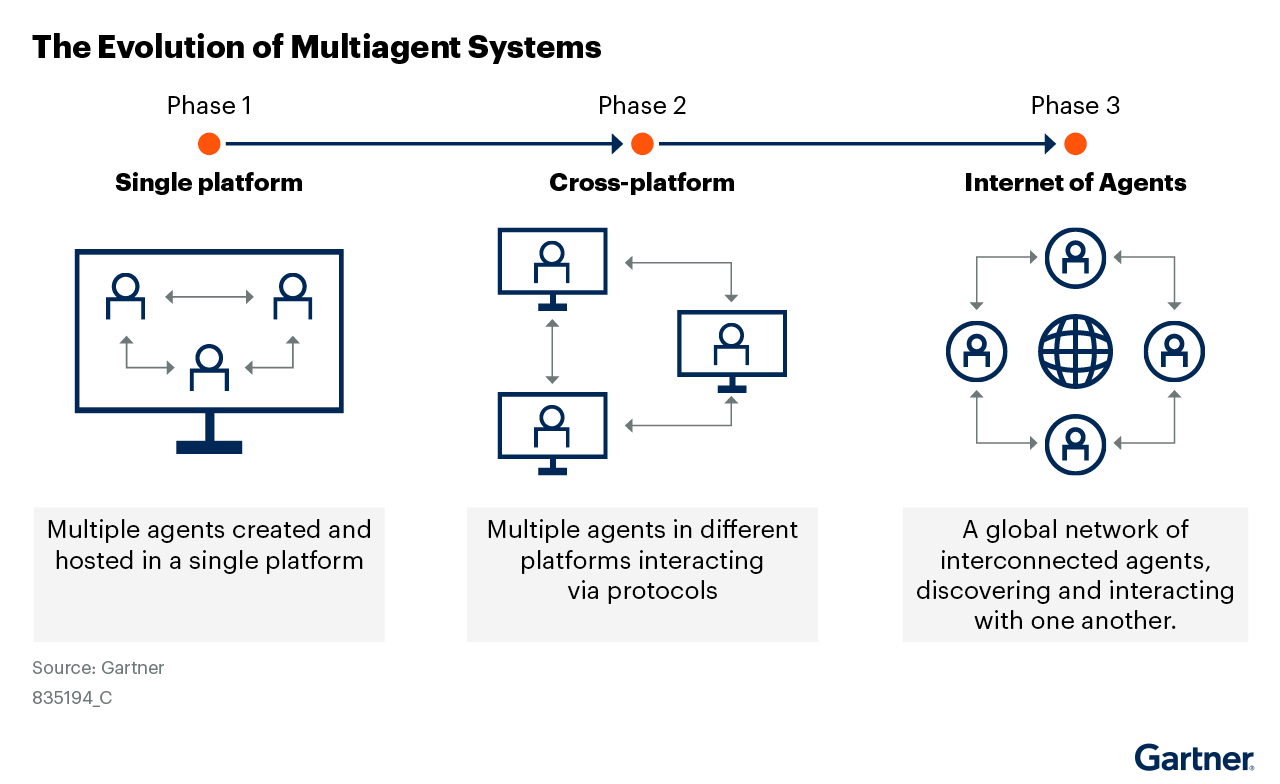
The future of multiagent systems is likely to evolve in three phases, as seen in Figure 1. If an HR organization is currently leveraging AI agents, they are more than likely in Phase 1. As HR organizations mature with AI agents, they will try to push into Phase 2. Moving to Phase 2 largely depends on the solidification of agent communication protocols in the market.
- Phase 1 — Single-platform MAS (current phase): Most HR implementations of AI agents create MAS by leveraging multiple agents within a single HR platform such as an HCM suite. This approach enables streamlined integration of agents working on the same workflows and data, eliminating the need for protocols. AI agents can easily share information about candidates or employees and collaborate on tasks such as scheduling interviews, creating career paths or suggesting learning plans within the same platform. Operating on a single platform simplifies maintenance and updates. Administrators can implement changes across the HR system without disrupting individual agent functions.
The challenge with this approach is that AI agents may not be able to execute workflows that extend beyond a single HR platform. Single-platform MAS require the workflow to remain within one system. Until agent communication protocols mature, HR organizations will remain in Phase 1 or will need to build out interoperability between systems with orchestration bots to realize cross-platform collaboration.
- Phase 2 — Cross-platform MAS: This approach uses agent communication protocols to facilitate interoperability and collaboration among AI agents, enabling workflows that span multiple HR systems. For example, a global retail chain is launching a new employee benefits program. In this scenario, the benefits administration agent in one system collaborates with the human resources agent in another system to efficiently enroll eligible employees, ensuring accurate benefits allocation and adherence to local labor laws across various countries.
Despite the increased interest and adoption of emerging standards, cross-platform MAS still require market maturity and consensus on communication protocols. They are not yet a viable option for the vast majority of HR organizations.
- Phase 3 — Internet of Agents (agentic web): While currently a vision and not yet a reality, this approach envisions a global network of interconnected agents, including HR agents, functioning as a multiagent system. This future state would be similar to the concept of an app store on a mobile device, where users can download apps built for plug-and-play installation and supported by defined communication protocols.
In such an expansive ecosystem, HR AI agents can automatically discover and interact with other enterprise AI agents, forming dynamic collaborations to address complex workforce challenges. This interconnected network would leverage advanced discovery mechanisms, enabling agents to identify compatible agent partners across the enterprise (e.g., finance, travel and expense, IT and central scheduling) and establish communication channels autonomously. Cross-functional AI agents will become increasingly sophisticated, capable of negotiating roles, sharing resources and coordinating efforts across the company.
Prepare for the Future of AI Agents
In the face of HR AI agents’ still-evolving future, CHROs can empower HR leaders to take proactive measures that position their organizations for success as AI agents continue to mature. The six key areas of focus are:
- HR competencies to support AI agents — Build AI literacy and technical expertise within the HR organization to achieve success with AI agents. HR professionals need the necessary skills to experiment with, implement and manage AI agents effectively. Upskilling the HR team is also crucial for building robust AI governance and teaching staff members how to leverage monitoring tools that identify anomalies and deviations from standard HR workflows. Maintaining a human-in-the-loop approach ensures that critical thinking, empathy and oversight remain at the heart of HR practices. This approach not only supports the ethical and equitable use of AI but also keeps employees informed and engaged as AI agents continue to evolve within the organization.
- Workflow mapping and redesign — AI agents will integrate into broader HR workflows, requiring careful redesign to deliver tangible HR value. HR leaders should begin by mapping critical HR workflows and employee journeys — such as recruitment, onboarding, performance management and offboarding — to pinpoint opportunities for various AI use cases, including agentic solutions. This approach ensures that AI agents enhance processes in targeted, meaningful ways.
- Experimentation — Experiment with agentic use cases in HR to build familiarity and proficiency with emerging design patterns in this domain. Pilot AI agents for tasks such as screening résumés, handling service center requests or managing routine employee actions like requesting paid time off or enrolling in learning courses. The skills and insights gained from these HR-focused experiments will prove valuable, regardless of whether the most ambitious future scenarios — such as an Internet of Agents — ultimately materialize.
- Governance — HR organizations should proactively develop, communicate and implement comprehensive governance protocols before deploying AI agents to minimize legal and reputational risks. Organizations must carefully navigate a complex regulatory environment when using AI to inform decisions that affect employees or job applicants. Most jurisdictions require ongoing human oversight, and some even mandate direct human involvement in the decision-making process.
- HR technology, integration and APIs — Assess the current HR tech stack and modernize where appropriate. Remediate gaps with legacy platforms and evaluate the consolidation of disparate platforms. Appraise the interfaces and integration capabilities of your core HR applications, focusing on how effectively HR data and functionality are exposed through APIs. This assessment enables you to establish robust agent interface management, supporting secure, policy-controlled and observable agent integration within your HR technology stack.
- Retrieval-augmented generation (RAG) — RAG represents a critical capability to enhance, as HR AI agents will depend on context and memory to deliver accurate, personalized support. Strengthening RAG ensures that AI agents can access relevant information efficiently and respond to HR queries with greater precision and customization.
1 Benchmark With Gartner: Mitigating Talent Strategy Risk Amid U.S. Policy Shifts & Tackling Skill Gaps. This live polling webinar was designed to facilitate discussions among HR leaders about the positions their peers are taking on pressing issues that affect crucial talent decisions. The main topics covered in this webinar include the labor market climate outlook update for talent-based leading indicators of economic conditions and the implications of U.S. policy and market shifts on talent strategy, agentic AI, skills-based talent management and skills gaps. The webinar was conducted on 21 May 2025 with responses from over 30 HR leaders participating across a range of industries. Disclaimer: The results of this survey do not represent global findings or the market as a whole, but rather reflect the sentiments of the respondents and the companies surveyed.