Market Guide for Last-Mile Delivery Technology Solutions
15 December 2025 - ID G00818552 - 39 min read
By Oscar Sanchez Duran, Nathan Lease
The last-mile delivery applications market continues to evolve and become more dynamic, as software vendors build their roadmaps around delivery orchestration and AI capabilities in response to end-user demands. Supply chain strategy leaders can utilize this research to gauge the market and assess potential solutions.
Overview
Key Findings
- The 2025 Gartner Future of Logistics Survey shows that improving customer experience through offering more service choices (39%) and increasing the digitalization of processes and offerings (35%) are the primary priorities for logistics functions over the next five years.
- While some vendors have expanded their application offerings, most do not yet offer all the capabilities required to fully support all last-mile fulfillment processes and delivery service offerings.
- Adopting generative AI (GenAI) and other forms of artificial intelligence is the top supply chain technology-funded initiative. Agentic AI capabilities are one of the main focuses of last-mile delivery (LMD) vendors in current roadmap plans.
Recommendations
- Match your business requirements with vendors’ capabilities in areas such as fleet types, supported geographies and delivery service offerings.
- Automate delivery transactions and consolidate orders to reduce costs by using LMD technology that allows backroom automation for delivery and supports delivery services, such as “click and collect” or locker delivery.
- Enhance your LMD strategy by leveraging capabilities that provide flexibility and multiple options regarding insourcing and outsourcing delivery and execution, while retaining oversight and governance that focus on consumer engagement, and optimizing transportation costs.
Market Definition
Last-mile delivery (LMD) technology solutions are specialized, customer-centric transportation management solutions that focus on managing the delivery process by which a consumer receives the products they order online. These solutions provide capabilities for routing deliveries to consumer homes, extending the delivery service capabilities offered to support options like ship from store, curbside and returns. LMD supports internal and external fleets, providing access to carrier networks for non-asset-based shippers. They also provide customer-engagement capabilities, providing a digitized experience to a shipper’s customer that allows end consumers to route, book, track and communicate changes to their shipments through a digital channel.
LMD solutions focus on the orchestration of the delivery of products, considering more than just different fleet options, such as owned fleet versus outsourced fleets. They also focus on providing enhanced customer experience capabilities to the recipient of the goods. These solutions can provide a wider array of options for how end consumers choose to receive their products, through various delivery channels such as pickup from store, curbside delivery or locker box delivery. This also applies to return options. Customer experience capabilities are as important, if not more. Some software vendors are deeply specialized in this area and focus solely on the postpurchase experience part of the delivery.
Standard Capabilities
The standard capabilities of these software applications can be depicted in two bigger groups, last-mile delivery and customer experience, and the interaction stages in which they are effective (prepurchase, operation optimization and communication, and postpurchase).
Last-mile delivery capabilities include:
- Internal fleet versus external fleet selection: The ability for some LMD solutions to compare and consider external and internal fleet options during the routing of a delivery. The end user can automate the carrier selection process through the configuration of rules.
- Route optimization for asset-based companies: Capabilities to optimize the routes and asset utilization for those organizations using their own fleets or dedicated fleets.
- Access to external carrier networks through API: Provides shippers with a connection to external carriers to digitize communication and outsource transportation for a particular delivery. Some LMD vendors offer a broad carrier library that includes international shipping companies to hyperlocal courier and transportation providers.
Customer experience capabilities include:
- Customer web portal branding capabilities: Capabilities that enable shippers to have all information and options pertaining to a customer delivery order embedded in their own website. This is typically provided through widgets and weblinks that can be embedded.
- Visibility and live order tracking: Provides visibility to end consumers through real-time visibility or tracking events.
Mandatory Features
Optional Capabilities
The optional capabilities for this market include:
- Workflow management
- Sustainability insights
- Extension of delivery service available (e.g., curbside delivery, in-store pickup, drone delivery)
- Cash-on-delivery settlement via mobile app
- Crowdsource delivery fleet roster management
- Crowdsource delivery driver payouts through mobile app
- End-consumer targeted marketing campaigns
- Special delivery capabilities that consider driver/staff availability and skills
- Delivery slot selection at cart check-out
- Green delivery routing
- In-store time slot booking
- Address verification capabilities
- Locker/PUDO network delivery option
- Driver routing to optimal parking location based on delivery stop
- Reverse logistics capabilities
- End-consumer settlement via cash on delivery (COD) option
- Analytics
- End-consumer delivery reschedule/redirect options after check-out confirmation
- Delivery rating capabilities
- End-consumer personalized updates on shipment status
- Shipment return processing
Market Description
Last-mile delivery technology solutions are specialized applications that address specific needs of organizations in the final leg of their transportation activities, especially in business-to-consumer (B2C) operations. These solutions are increasingly gaining importance within the organization’s IT ecosystem due to the rise of e-commerce and omnichannel shipping, increasing consumer demands, and the need to optimize transportation costs while increasing brand loyalty and customer experience. Pre- and postpurchase processes (see Figure 1) require organizations to adopt technology that enables optimized delivery orchestration. This in turn enables companies to provide a more interactive, transparent, flexible and overall better experience for the end consumer.
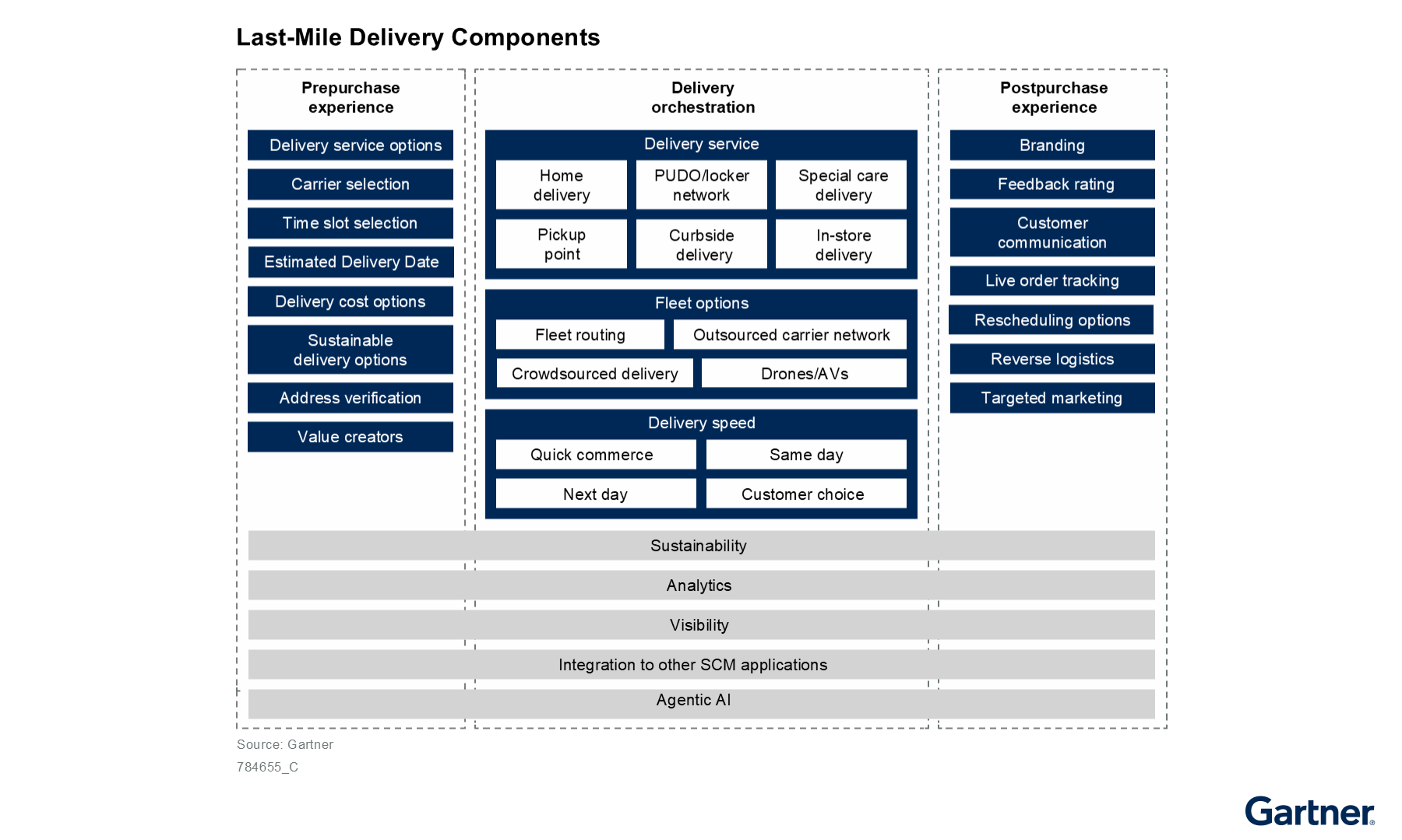
Delivery orchestration is at the core of LMD solutions, offering multiple delivery service options and providing greater flexibility for end consumers to receive their products through various delivery channels.
While delivery orchestration is an important part of LMD solutions, customer experience capabilities are just as important, if not more so. The popularity of software vendors specializing in areas like postpurchase experience continues to increase (see Innovation Insight: Post-Purchase Delivery Experience Solutions). This is due to organizations demanding more capabilities to reduce efforts responding to “where is my order” (WISMO) calls, providing further visibility and value-added services, and seeking to drive more revenue through personalized marketing campaigns. Customer experience-related capabilities can be seen mainly in the prepurchase and postpurchase parts of the order life cycle (e.g., time slot and carrier selection, sustainability options, customer communications, etc). However, those capabilities must be intrinsically connected to the orchestration module of the solutions to be effective, as it is this module that determines the best delivery execution option based on fleet capacity or external carrier service availability.
As technology continues to evolve, so does this market and its solutions. AI-powered capabilities are becoming increasingly prominent, leveraging various AI techniques such as GenAI or agentic AI. Co-pilot capabilities to speed up end-user training and increase user experience, AI agents to address specific use cases such as customer service tracking calls, or intelligent chatbots that provide a quick overview of last-mile operational KPIs are now a reality.
Market Direction
According to the 2025 Gartner Future of Logistics Survey, improving customer experience through offering more service choices (39%) and increasing the digitalization of processes and offerings (35%) are the primary priorities for logistics functions over the next five years (see Figure 2).
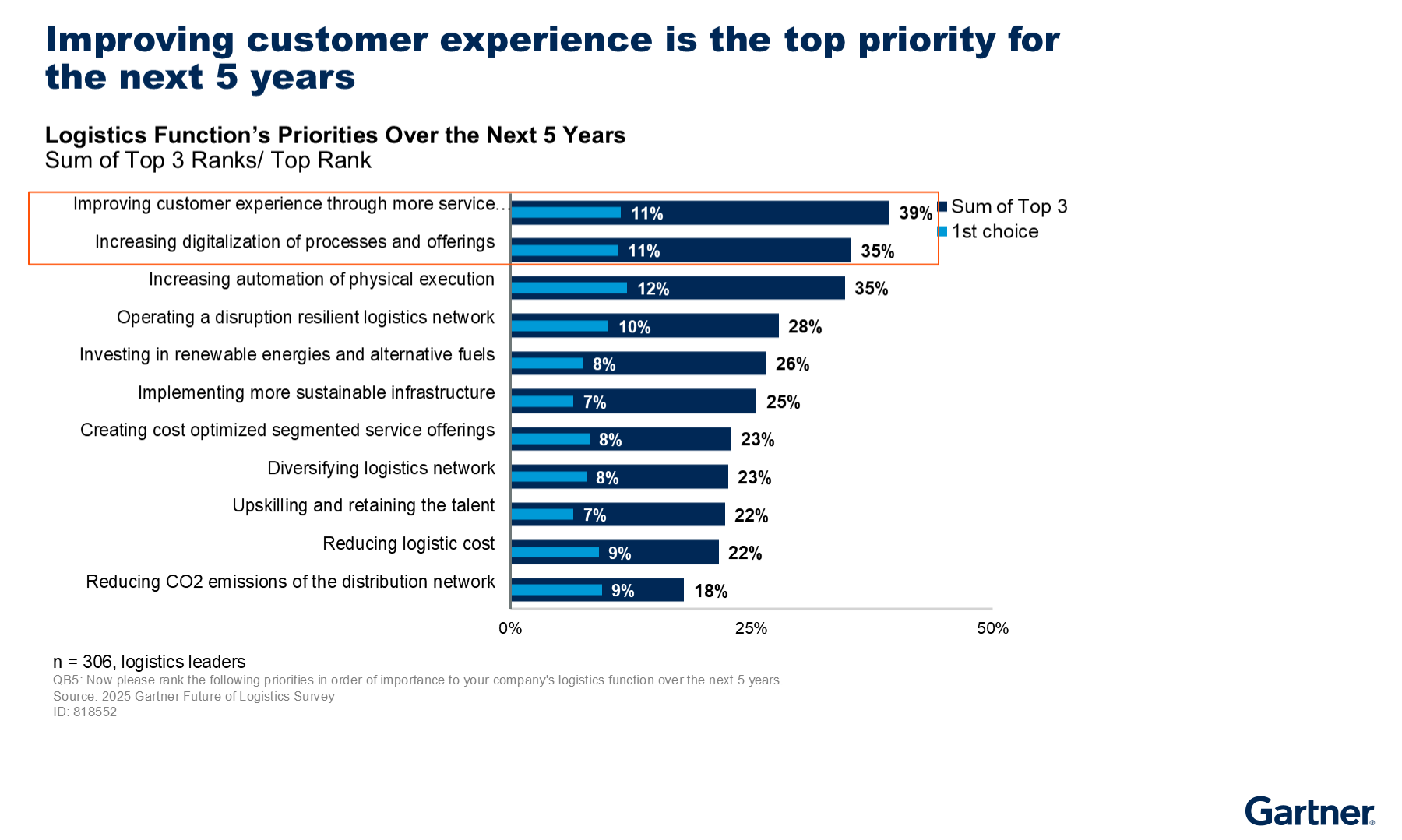
Providing an increasing range of service options through an easy-to-navigate menu for the end customer is one of the top priorities for LMD software providers. While capabilities such as time-slot booking and carrier selection are already common offerings among these types of software solutions, the use of real-time data considering current routes, fleet capacity, delivery costs and even forecast orders is starting to be implemented in LMD solutions. This allows organizations to obtain a more accurate estimated delivery date (EDD), providing more dynamic service choices that enhance the end-customer experience while ensuring the SLA. This is particularly relevant in digital commerce, where new potential strategies can be implemented, provided that the right capabilities are in place and the systems utilize the data they manage effectively (see Accelerate Profitable Fulfillment Outcomes in Digital Commerce).
LMD solutions enable organizations to automate and better manage the orchestration of the delivery process, providing capabilities to leverage their own fleet and extend their carrier networks (including courier and local fleets). This allows the shipper to provide more choices to the end customer and better, faster or more sustainable service, depending on the carriers connected to the application. LMD vendors are increasingly investing more development efforts in extending their carrier network and connectivity options, thereby providing shippers with greater flexibility and service options.
AI is having a significant impact on LMD vendor roadmaps, transforming it from a feature enhancement into a core strategic mandate for future development. Many vendors are exploring and starting to pilot capabilities that aim to provide autonomous operations, enhanced decision support and personalized customer experiences across the entire delivery life cycle. Embedded agentic AI and GenAI capabilities are present in most vendor roadmaps, aiming to transition their AI capabilities to autonomously handle specific roles and use cases such as dispatchers, planners, customer support and others. Additionally, AI is used for internal processes and end-user-facing workflows, with solutions looking to provide superior usability in time-consuming tasks such as end-user training and carrier interface mapping, and provide in-system navigation.
Market Analysis
Last-mile delivery has evolved into a strategic lever for supply chain management, as it plays a critical role in the total logistics costs and influences overall customer satisfaction. A Gartner Consumer Community Survey shows that today, 44% of consumers prefer on-time delivery versus 38% of consumers who prefer an early delivery, with over half of the respondents finding exact delivery data scheduling to be valuable.1 With customer expectations shifting toward accuracy, transparency and sustainability, companies are integrating advanced technologies and new operational models to remain competitive. Additionally, other challenges, such as volatility in transportation capacity, increasing operating costs and changes in global regulation, require organizations to invest in technology and new operational strategies to become more efficient and optimize last-mile operations.
Key Drivers for LMD Technology Adoption
According to the 2025 Gartner Supply Chain Technology User Wants and Needs survey, business priorities have shifted, with organizations now focusing more on improving productivity and efficiency, revenue growth, and reducing operating costs.2 This is a change from the previous year, when business innovation, productivity and efficiency, and customer service and customer experience were the top priorities (see Figure 3).
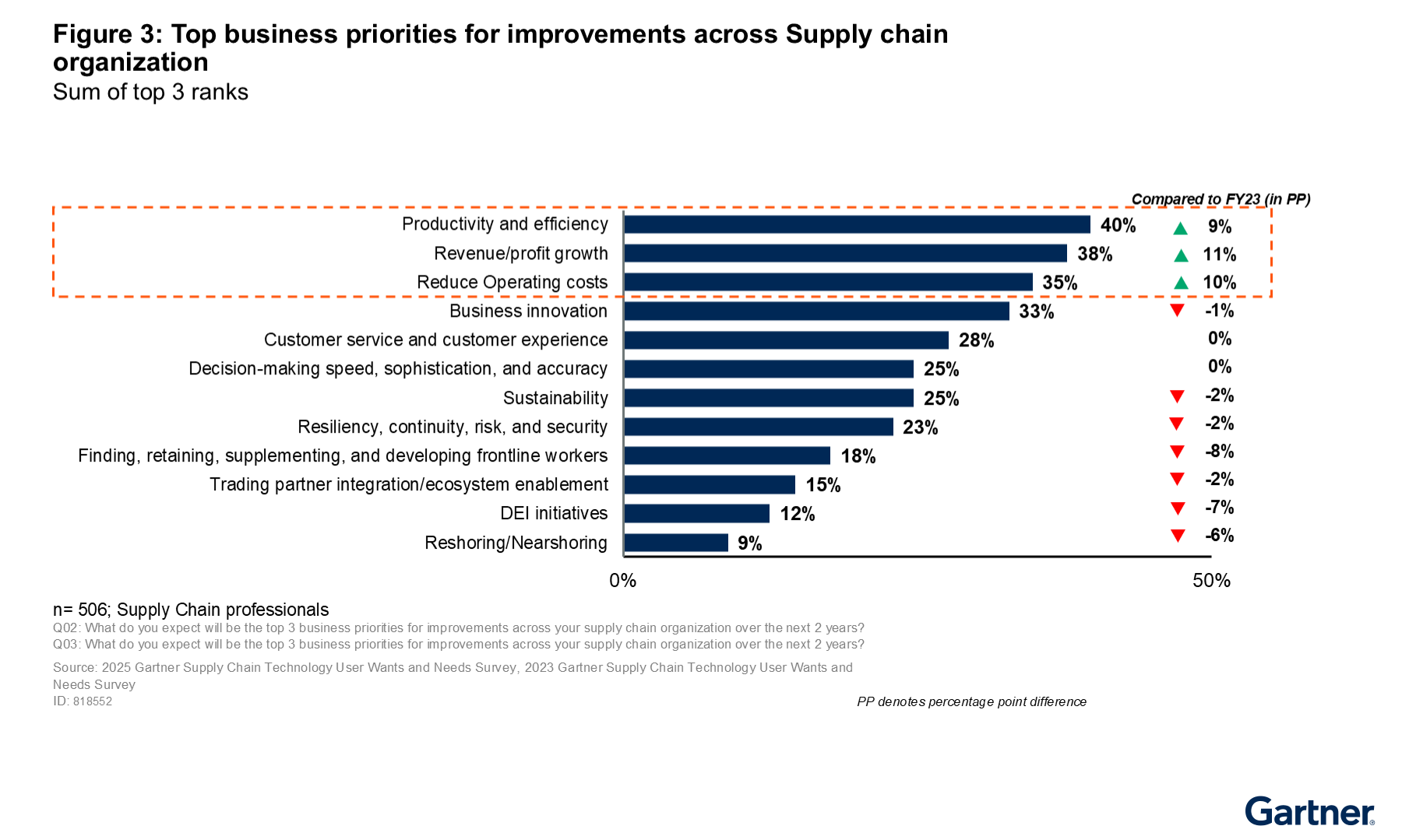
When it comes to the key drivers for adopting LMD technology, various trends align with each of these top business priorities.
- Increasing need for orchestration capabilities to scale last-mile deliveries: Parcel volumes increased by 3.4% year-over-year to 22.4 billion shipments in the U.S. alone, with smaller carriers handling 22.6% more volume than the previous year.3 This suggests that organizations are expanding their collaboration with regional and local carriers for their final-mile deliveries. As organizations aim to provide a higher range of delivery options to consumers, end-to-end orchestration capabilities that unify data and management across internal and external fleets are increasingly sought after in LMD applications.
- Dynamic and personalized delivery windows: Improving customer experience through more service choices was the main logistics function’s priority over the next five years, according to the 2025 Gartner Future of Logistics survey.4 Connecting prepurchase experience processes with the orchestration engine has become a priority for most LMD vendors in recent years as they aim to provide advanced capabilities for slot booking selection at early stages. Dynamic delivery slot selection, considering the real-time capacity of both owned and third-party fleets (which often adjusts capacity based on existing routes and utilization), is becoming a reality, offering greater accuracy in the carrier selection process to meet customer expectations. Additionally, vendors are developing new software capabilities to incorporate elements such as capacity forecasting and demand density analysis with the goal of providing even more accurate carrier choices and estimated delivery times.
- Speed as standard: While reliability is imperative, the market remains highly focused on velocity, with same-day and sub-one-hour quick commerce delivery capabilities becoming more important. According to a recent survey, 86% of customers consider “fast delivery” within two days. Also, 80% of customers expect retailers to offer same-day delivery; among them, 30% expect free same-day delivery, and 76.3% want the option to receive packages within three hours of ordering.5 The 2026 Gartner Logistics and External Manufacturing Outsourcing Trends Survey also indicates that 36% of supply chain organization are planning to shift their type of outsourcing service provider to have a faster last-mile delivery service.6 These demands from end-customers and the pressure to achieve the expected organization goals with regard to last-mile delivery services are spurring the adoption of LMD technology solutions.
- Optimizing the return process: Organizations continue to make their return policies stricter and even charge to provide the service, with retailers charging more often and shortening return windows. Most LMD vendors today incorporate return-enabling capabilities to optimize the return process, offering alternative location options such as return-to-store or providing eligibility for returns based on the client’s track record to further optimize this process.
The “Agentification” of Last-Mile Delivery
Implementation of AI has become a core mandate for supply chain organizations. Adopting GenAI and other forms of AI is the top supply chain technology-funded initiative, surpassing supporting digital supply chain transformations and enhancing the use of advanced analytics. Additionally, Gartner hosted a series of webinars earlier in 2025 and polled the audience to see which functional areas are the most likely to pursue agentic AI. All of the enterprise application subcategories (ERP, CRM, and SCM) are likely to be targets for agentic AI, with CX-related functions being the most attractive (see Figure 4).
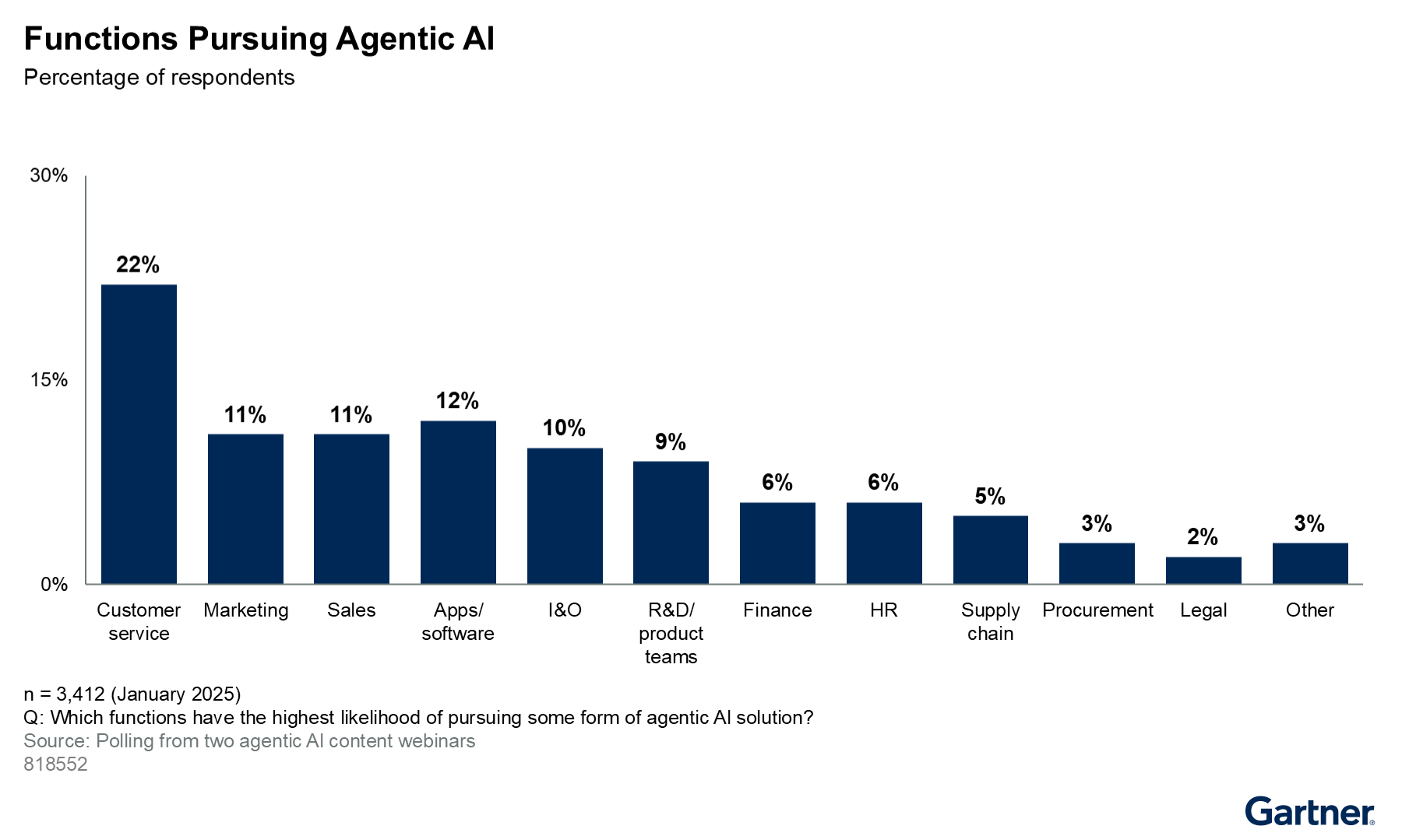
The role of agentic AI in areas such as customer service, where automated agents can help resolve customer issues and enable organizations to scale call volumes without adding headcount, is particularly relevant for last-mile operations, especially in postpurchase delivery processes. While it’s early to assess the impact of agentic AI in last-mile delivery operations, the potential impact could be very high despite the clear market hype on AI in general. The way end customers interact with AI-backed search engines is also changing their purchase paths, leveraging GenAI platforms for product discovery (see Quick Answer: How Agentic Commerce Is Reshaping Path to Purchase). This will prompt customers to delegate purchases to AI agents, which will require interaction with LMD solutions to gather accurate data with regard to delivery and fulfillment service options.
The “agentification” of last-mile operations is a significant trend in the LMD market, with most vendors already offering or planning to launch some form of AI agents by 1Q26. These AI agents can be designed to support various roles involved in last-mile operations, such as:
- Customer service: One of the most commonly offered AI agents by LMD providers, mainly supporting customer queries and WISMO inquiries automatically.
- Dispatcher: Where the AI agent monitors real-time conditions, optimizes dispatching decisions, and recommends or automatically selects carriers based on transportation costs, historic performance and customer SLAs.
- Planner: The AI agent is in charge of optimizing the delivery plans and creating route delivery recommendations based on forecast order demand, historical data, and constraints like traffic patterns, carrier and customer SLAs, and fleet capacity.
- Auditor/cost controller: AI agents automate invoice reconciliation, match carrier invoices to shipment data and detect discrepancies.
- Driver: AI agents support drivers, enhancing the user experience with onboarding and training capabilities, and issue resolution.
Plans to develop AI agents for LMD applications extend beyond specific roles or use cases. LMD vendor roadmaps also include AI agent development to cover other use cases, such as carrier onboarding and integration, support for creating rule configurations based on complex rate cards, and end-user system navigation assistance.
Fragmentation in the LMD Market Remains Unchanged
The LMD software market remains fragmented, with a few large global vendors and numerous small to midsize regional or locally focused vendors. The breadth and depth of coverage vary dramatically across LMD vendors, as many offer only partial functionality compared to the full definition previously provided.
LMD applications are a valuable complement to larger transportation management systems (TMSs; see Magic Quadrant for Transportation Management Systems) and distributed order management (DOM) systems (see Market Guide for Distributed Order Management Systems) as they facilitate the orchestration of delivery in the final stage of the transportation process.
Investments in the LMD market continue to occur, with vendors either acquiring direct and indirect competitors to expand their capabilities and geographical footprints; receiving investments from private investors; or even being acquired by private firms. Here are some notable recent movements in this market:
- Locus was acquired by Ingka Investments, the investment arm of Ingka Group and the largest Ikea retailer, in October 2025.
- OneRail acquired Orderbot in June 2024. Orderbot is an inventory and DOM solution, combining Orderbot’s inventory and order management capabilities with OneRail’s OmniPoint last-mile delivery solution and delivery network.
- OneRail raised $42 million in a Series C funding round led by Aliment Capital in November 2024.
- Shipsy acquired Stockone, a warehouse management system company, in October 2023.
Representative Vendors
The vendors listed in this Market Guide do not imply an exhaustive list. This section is intended to provide more understanding of the market and its offerings.
Vendor Selection
This research provides information on 19 LMD software vendors surveyed that are perceived as relevant in the market based on revenue, number of clients, and end-user interest and feedback (see Table 1). Client interest and market presence also factored into the selection of the vendors featured in this Market Guide. The solutions must be able to provide functionality for LMD in a business-to-consumer scenario. These vendors provided detailed information to Gartner via vendor surveys and vendor briefings, which are the basis for this research and the companion research to this Market Guide - Tool: Vendor Identification for Last-Mile Delivery Technology Solutions
Representative Vendors in Last-Mile Delivery Technology Solution
Vendor | Product Name |
Aptean | Aptean Home Delivery, Aptean Proof of Delivery, Aptean Routing & Scheduling Paragon Edition |
Beans.ai | Beans.ai |
Bringg | ROAD, Delivery Hub |
Delivery Solutions | Delivery Management |
DispatchTrack | DispatchTrack |
FarEye | FarEye last-mile technology platform |
Locus | Order to Delivery Dispatch Management Platform |
LogiNext | LogiNext Mile |
Nash | Nash |
Nomadia | Nomadia Delivery |
nuVizz | nuVizz Last Mile TMS Platform |
OneRail | OmniPoint |
Onfleet | Onfleet |
ORTEC | ORTEC Routing Solutions, ORTEC for Home Delivery, ORTEC Routing Suite |
Shipsy | Shipsy Last Mile Delivery Management Solution |
tiramizoo | tiramizoo Last Mile Platform |
Urbantz | Urbantz |
Wise Systems | Wise Systems Platform |
Woop | Unified Delivery Management System |
Source: Gartner (December 2025)
Vendor Profiles
Aptean
Aptean is a software provider with many production, logistics and supply chain solutions, such as ERP, WMS, e-payment solutions, product life cycle management, and a transportation and shipping management solution. The Aptean Routing & Scheduling Paragon Edition is composed of the following modules: Fastnet, Multi Period Planner, Compartments, Territory Optimizer, Road Speed Data, Street Level Mapping, Truck Attribute Data, Route Execution, Live Management, Waypoint Mapping, Dynamic Tripping and Stacking. This can be supplemented by other modules, such as Home Delivery, which focuses on route planning and management of dedicated last-mile processes, and Proof of Delivery, which dynamically calculates ETAs to update continuously and respond to plan adherence and schedule changes. One new capability is AI routing configuration optimization, providing dynamic self-calibration of the algorithm for each dataset being optimized. Aptean targets organizations with internal and external fleets that need to facilitate customer orders, track them through delivery, and manage post-delivery processes. Aptean has customers in more than 55 countries in Europe and the U.S., and a smaller presence in Asia, Middle East, South America, and Australia/New Zealand. Aptean also has clients in food and beverage, parcels/carriers, third-party logistics (3PL), retail, grocery, pharmaceutical, agriculture, construction materials, and other industries.
Beans.ai
Beans.ai is a software provider for logistics and supply chain technology. Its last-mile delivery solution, Beans Route, features a cloud-based, scalable architecture built upon the company’s proprietary address and map APIs. Beans Route is a modular solution that includes key components like mapping, driver app, dispatching, and planning and optimization. The solution focuses on solving the “last 100 feet” challenge, leveraging a patented multiple-pin approach for navigating complex addresses and potentially cutting down failed deliveries. Recent innovations include indoor wayfinding technology, new transportation procurement to manage carrier rate cards, and providing delivery bidding options. New AI developments include the use of large language models and chatbots to provide insights to end users about operations status, driver performance and other relevant last-mile KPIs. The vendor has customer presence primarily in North America, with smaller customer bases in Europe and Australia/New Zealand. The solution serves a variety of verticals, including logistics service providers (LSPs)/carriers, food service, life science/pharmaceuticals, postal/courier/parcel, and grocery.
Bringg
Bringg is an LMD solution provider. Its modular LMD platform is composed of four different modules, including pre- and postpurchase experience, route planning and optimization, driver management, and delivery fulfillment. These modules are an integral part of its SaaS-based delivery and management platform. The Bringg platform works dynamically across multiple fleet types for multimodal last-mile logistics and connects to its carrier provider network with more than 200 onboarded carriers. The network includes private fleets, crowdsourced fleets, and flex fleets, along with third-party gig workers, allowing shippers to scale capacity as needed. Bringg’s LMD solution supports real-time, capacity-based slot-booking capabilities. These capabilities integrate routes and carrier prices on the client’s website, allowing for buy online, pick up in-store shipments and return shipments, with the option to leverage return networks from other retailers. Bringg helps retailers meet their net-zero pledges by providing customers and ecosystem partners with the capabilities to offer customized service options. In the last year, Bringg added AI Insights, which summarizes analytics and reporting data using GenAI, to provide insights on top of analytics tools within the platform. Bringg has a presence in multiple verticals, with the majority of its customers originating from the manufacturing, retail, grocery and service industries.
Delivery Solutions
Delivery Solutions is a software provider for logistics and supply chain technology solutions. The Omnichannel Enablement & Post Purchase solution is built on a MACH-architected platform that uses an event-driven communication layer and leverages data streaming for analytical insights. The platform is structured around different modules, which pack its four product offerings: Delivery, Pickup, Returns and Post-Purchase. Recent key capabilities include the addition of internal route optimization features for dedicated fleets, reducing reliance on third-party partners for owned vehicle management. New features also comprise a shipping eligibility tool for accurately determining available shipping methods at checkout and value-added capabilities for secure commerce, providing shipping insurance options and delivery rules like signature capture at delivery based on order value or product type. Delivery Solutions currently uses machine learning models for its DeliveryDefense fraud prevention and its Smart Estimated Date of Delivery features, which adjust carrier estimates based on historical performance. The vendor’s customer presence is primarily concentrated in North America, with additional clients located in Australia/New Zealand. Delivery Solutions serves numerous industry verticals, including retail, fashion, apparel and footwear, food service, furniture and office equipment, and others.
DispatchTrack
DispatchTrack is a multitenant SaaS solution for LMD execution and customer experience. Its LMD technology contains routing optimization, full life cycle customer communication, and strategic route and territory planning. Its route optimization system enables users to set various delivery parameters and then optimize delivery schedules for thousands of stops and trucks. DispatchTrack’s route advisory reviews optimal routes to predict costs, carbon emissions, and expected arrival times. DispatchTrack also handles billing, settlement and social reviews, and presents customers with a survey and an option to post to Google reviews directly from their phones. DispatchTrack enables customers to self-schedule and reschedule appointments within the platform. The solution supports home delivery through the company’s own fleet, courier carriers, curbside pickup, in-store pickup, and special care and locker delivery. DispatchTrack released DT Agent, which is an AI-powered delivery assistant that enhances customer interactions, reduces support workload, and increases NPS by minimizing failed deliveries through automation, real-time engagement, and proactive issue resolution. DispatchTrack is mainly active in North America and South America, with a smaller presence in Asia, Europe, the Middle East and Australia. It is mainly active in the 3PL, food and beverage, furniture and appliances, building supplies, retail, grocery and home delivery industries.
FarEye
FarEye is a software provider for logistics and supply chain focused on delivery orchestration, route optimization, multicarrier management, visibility and customer experience. The FarEye Delivery Management System is a multitenant SaaS solution built on a microservices architecture that meets high security standards, as it has multiple cybersecurity certifications. Its capabilities span the order-to-door journey, including planning, dynamic routing, hybrid fleet orchestration (managed, outsourced, crowdsourced), cross-docking, and returns management. Recent product innovations include PLAN for strategic zone design and capacity forecasting, and Yard Management for digitized gate management and real-time visibility. Another key feature is rate-based routing, which uses cost awareness to optimize outsourcing decisions, ensuring efficient allocation across internal and external fleets. FarEye’s roadmap includes a defined AI strategy with the inclusion of AI agents targeting the different roles involved in last-mile delivery operations and a gradual approach to task automation. FarEye caters to many industries, with most of its customers coming from the 3PL, retail, postal, e-commerce and food service industries. The vendor has presence in all regions, with a very proportionate distribution of clients among Asia, North America, Europe and the Middle East regions.
Locus
Locus is a software provider for logistics and supply chain. The Locus LMD solution, Order to Delivery Dispatch Management Platform, is a cloud-native, multitenant SaaS solution built on a microservices architecture. It offers 12 modules across five themes: order fulfillment, dispatch planning, delivery orchestration, track and trace, and insights and analytics. The system supports self-fulfillment, 3PL and crowdsourced fleets, providing dynamic time slotting based on real-time capacity. Key new innovations include Locus Rule Engine, a centralized workflow builder that uses natural language to configure rules, and Smart Filter, which provides role-based views on specific information and actionable insights. Locus has also enhanced its sustainability-related capabilities, integrating carbon emission tracking and EV routing preferences into its optimization logic. The vendor embeds AI throughout its platform, deploying agentic AI (Mycroft) for autonomous decisioning and change management, alongside other GenAI-based capabilities that provide plain-language operational insights on focus areas. Locus has customers in Asia, Middle East, North America and other regions. It has a presence in many verticals, with most of its customers coming from the consumer products, food service and specialty retailer industries. Locus was acquired by the Ingka Group in October 2025.
LogiNext
LogiNext is a global technology company with a focus on the transportation, home delivery, omnichannel fulfillment and B2B distribution markets. LogiNext has helped clients digitize and optimize order scheduling, customer communication, routing, dispatching and real-time tracking to reduce logistics costs and improve operational efficiency. Its last-mile solution is called LogiNext Mile. The platform can onboard and integrate third-party logistics carriers and crowdsourcing partners. It supports all last-mile fleet types, including private or dedicated fleets and external carriers. LogiNext focuses on quick time to value, with most customers realizing ROI within six months. LogiNext Mile clients have been able to go live in one to two weeks. The vendor offers LogiNext Reverse, a reverse delivery management solution that caters to the reverse leg of logistics, especially in e-commerce logistics. LogiNext released a Dispatcher Mobile App enabling last-mile dispatchers to plan routes, allocate orders and monitor live delivery progress through an interactive dashboard. LogiNext is mainly active in Asia, North America and the Middle East, with customers in Europe, South America, Africa and Australia/New Zealand as well. LogiNext is mainly active in the food and beverage, postal courier and parcel, LSPs, consumer packaged goods, and grocery and retail industries.
Nash
Nash is a software provider for logistics orchestration and delivery management. The Nash Platform is an intelligent logistics orchestration solution designed to unify and optimize last-mile delivery operations. Built on cloud-native architecture, its modular design covers the entire delivery life cycle through components like Fleet and Promise for prepurchase, Orchestrate for execution, and Engage and Returns for postpurchase. Recent capabilities include the Pick and Deliver feature, which synchronizes inventory and enables a single courier to handle both picking and delivery, reducing staging time. Furthermore, Nash has expanded its postpurchase capabilities with Returns to support reverse logistics and capture consistent data across the order life cycle. It also introduced the Nash Agentic Commerce Platform to facilitate artificial intelligence-native shopping experiences. The platform leverages proprietary AI models for dynamic dispatch and predictive delivery window pricing, and deploys specialized artificial intelligence agents, such as the AI Customer Support Agent and the AI Dispatch Agent, to automate support and monitor delivery operations. The vendor has a global customer presence operating in over 20 countries among North America, Europe, Asia, Australia and New Zealand, and the Middle East. The customer base is strong in enterprise sectors such as retail (including grocery), food service, LSPs and life science/pharmaceuticals.
Nomadia
Nomadia specializes in the design and implementation of smart mobility solutions for sales representatives, delivery drivers and technicians. Its solution, Nomadia Delivery, is a SaaS platform for LMD. The solution includes capabilities to assess and schedule appointments for delivery slots connecting directly to web carts; manage territories with geographic sectorization; and rebalance workload activities among drivers. The optimization engine is designed for effective management of urban complexities and constraints specific to last-mile logistics. It enables the construction of route plans that combine different types of transportation to support hybrid delivery fleets, including cars, trucks, bicycles, scooters, pedestrians, and others. Nomadia has a mobile application for deliverers, operational agents and order pickers that facilitates interconnectivity to streamline processes. The solution has the capability to consider low-emission zones for route optimization and offers sustainability capabilities for calculating carbon emissions. Nomadia released a Smart Scheduler agent to automate instant appointments, a feature that saves call center time and reduces manual bookings. While Nomadia’s customers are mostly based in Europe, the vendor also has customers in North America, South America and Asia. Nomadia has its main customer presence in the retail, LSP/carrier, life sciences/pharmaceuticals, press, food service, automotive/vehicle transportation, and 3PL industries.
nuVizz
nuVizz is a multitenant SaaS platform for last-mile transportation management for final-mile delivery planning, execution and network visibility. nuVizz connects shippers, brokers and/or 3PLs, freight forwarders, carriers, agents, drivers, and end customers by leveraging the same information and real-time visibility. nuVizz features a portal-based planning component (final-mile route optimization, strategic territory planning, appointment scheduling, dispatch, reporting, dashboards, visibility and exception management). It features a mobile app that enables drivers in the field to capture transportation and delivery execution information. nuVizz supports delivery execution, dispatch, visibility, driver management and customer engagement, along with scorecarding and overage, short and damage (OS&D) management through to point of delivery (POD) and payment. It supports private, dedicated crowdsourcing and external carrier last-mile fleet types. It is focused on quick implementation with low customer effort; typical implementations are three to four weeks. nuVizz has AI agents for specific use cases such as order creation and billing queries, among others. nuVizz is primarily active in North America, with a smaller presence also in Europe and Asia. It has its main customer presence in the LSP/carrier, life sciences/pharmaceuticals, furniture/office equipment, food service, automotive/vehicle transportation, and 3PL industries.
OneRail
OneRail is a software provider for LMD execution with a transportation provider network. Its LMD platform, OmniPoint, focuses on three key components: delivery orchestration system, courier network and logistics management. OmniPoint can dispatch, route and track all types of fleets, including over-the-road, courier, internal or private fleets, and crowdsourced fleets. In addition to flexible fleet type routing and optimization, OneRail also connects to external fleets, with access to over 1,000 carriers. The solution features capabilities such as order consolidation and load planning, dynamic and real-time routing, asset planning and assignment, and two-way communication between dispatch and driver, along with AI-powered POD. In addition to routing and delivery execution capabilities, OmniPoint offers customer experience and engagement features, such as driver and delivery ratings, and real-time ETAs. OneRail also features a hybrid team of AI tools in its Exceptions management process to resolve WISMO calls and general support questions in real time to ensure on-time delivery SLAs. The platform is focused on an API-first strategy, allowing customers to integrate with greater flexibility. OneRail’s platform is currently implemented in North America and the U.K. The vendor serves multiple verticals, with the majority of its customers in the retail, wholesale and consumer products industries.
Onfleet
Onfleet is a multitenant SaaS provider focusing only on LMD operations and customer experience. The solution provides routing, dispatch, delivery analytics, POD and tracking of drivers, as well as automatic notifications and real-time delivery tracking. Onfleet focuses on a user-friendly UI to improve the end-user experience, and intelligence powered by machine learning that provides predictive ETAs and faster optimization. Additionally, its system offers multiple routing configuration options, such as zone-based routing and the possibility to assign regular routes to a specific driver and add the start and endpoint of a route for a specific driver. Onfleet’s customer experience features automatically send customized notifications to customers during the route and collect feedback from customers. The Onfleet Command Center is a new interface for a monitoring dashboard for day-of operations. Onfleet provides access to over 150 couriers in its network, which also utilize its solution, as well as additional carriers through its partner network. Onfleet provides its solutions with a strong presence in North America and a growing presence in Europe and Asia. It is in use in more than 90 countries, with a focus on companies that deliver food and beverage, groceries, e-commerce items, pharmacy items, cannabis, and construction materials.
ORTEC
ORTEC is a mathematical optimization software provider. Its LMD solution, ORTEC Routing Suite, is a combination of the ORTEC Routing Solutions and ORTEC for Home Delivery solutions that are offered in cloud deployments. ORTEC Routing Suite leverages advanced algorithms and optimization technology to consider and balance — based on customer needs — multiple elements in the delivery, such as cost of delivery, environmental impact, customer satisfaction or driver happiness. It provides strategic planning capabilities, such as network analysis, scenario planning, territory planning, visit-day optimization, demand forecasting and capacity planning, to optimize operations both strategically and tactically. It also provides add-on capabilities, such as cost-to-serve analytics, load optimization and asset management, along with predictive maintenance features. ORTEC has AI agents that can handle a range of functions, including dynamic route reoptimization, load balancing, anomaly detection and automated scheduling adjustments. ORTEC targets large to very large enterprises that have their own fleets. It is active in the food service and beverage distribution, grocery retailer, consumer product, logistics service provider and field service provider industries, among others. ORTEC’s customers for last-mile are mainly in Europe, although the vendor has customers in North America and the Australia/New Zealand region.
Shipsy
Shipsy is a software provider for logistics and supply chain technology solutions. The Shipsy Last Mile Delivery Management Solution is a SaaS platform built on a cloud-native architecture with embedded AI. It has core modules for routing and scheduling, driver and roster management, outsourcing carrier selection, analytics, customer communication, and payments management. Key new capabilities include enhancements to its route planning engine, including spatial clustering algorithms to group deliveries into microclusters using driver data, and an AI-based route sequencing to determine the most efficient stop order. It also includes an adaptive gamification layer, adjusting to different challenges and incentives based on real-time performance data, and other enhancements in areas such as slot allocation, fleet allocation, exception management and customer engagement. As part of its roadmap, Shipsy has developed an internal framework for autonomous operations that includes a range of AI agents in core use cases such as dispute resolution, driver assistance, invoice settlement processes and customer experience management. The vendor maintains a global customer footprint, with a strong presence across Asia and the Middle East, and a limited presence in North America, Europe and Africa. Shipsy’s clients operate in numerous industry verticals, including retail, postal/courier/parcel, food service, grocery and third-party logistics.
Tiramizoo
Tiramizoo is a software provider for logistics and supply chain technology. The vendor’s product, Tiramizoo Last Mile Platform, is a cloud-agnostic SaaS solution consisting of five modules: Last Mile Master, Last Mile Professional, Route Optimizer, ATM-Replenisher and Southeast Asia Distribution. The solution leverages a hybrid computation architecture using cloud resources and bare-metal servers for higher performance and scalability. Key product enhancements include a revamped new user interface and a new mobile application that supports several languages. Other enhancements include legal working break compliance in route planning and upgraded vehicle loading optimization options. Recent AI developments include predictive service time estimation using historical courier behavior data to increase planning reliability for business-to-business routing. The vendor is also developing AI agents in specific areas to help customers explore and validate process improvements through simulations. Tiramizoo offers its own courier services in Germany, where it provides transportation services managed through its LMD solution. The vendor targets midsize and large enterprises with complex operations that operate their own fleets or subcontracted fleets. Tiramizoo has a strong customer presence primarily in Europe with some customers in Singapore and Malaysia. Key industry verticals include automotive/vehicle transportation, retail, postal/courier/parcel, and wholesale distribution.
Urbantz
Urbantz is a software provider for last-mile delivery technology solutions. Its last-mile delivery solution operates as a multitenant SaaS platform built on Microsoft Azure cloud. It is composed of thirteen modules, including Time Slot Booking, Ship-from-store application, Route Optimisation, External Carrier Management, Mobile Application and Execution, Delivery Tracking and Control Tower, and other modules. Key new capabilities include “green” timeslots, in-app anonymous calling, and a new WhatsApp functionality for improved communication. The system provides dynamic dispatch for same-day delivery and continuous optimization, which precalculates routes as orders arrive to enable more progressive operations. Urbantz allows for a configurable customer experience based on brand, sender, product type, or type of customer. The vendor utilizes AI in capabilities such as service time prediction, green timeslot engine and estimated time of arrival. Urbantz maintains a strong customer presence primarily in Europe, while having limited customer presence in the Middle East. The vendor targets enterprise accounts, especially logistics service providers and retail customers in the food service, grocery, and furniture/office equipment verticals.
Wise Systems
Wise Systems is a SaaS LMD platform. Its solution, Wise Systems Platform, consists of seven modules: Strategic Planner, Route Planner, Dispatcher, Driver, Customer Portal, Performance Manager and Mobile Manager. Wise Systems’ platform leverages AI to automate route generation and real-time dynamic reoptimization based on live operational data, as well as support dispatch and routing for local delivery and LMD. This enables fleets to improve their operational efficiency and customer service. It provides real-time dynamic routing, planning, dispatch, territory planning, analytics, modeling and communication tools. The platform uses optimization algorithms to support dispatchers, drivers, field service team members, management and delivery recipients. Wise Systems’ applications also include mobile apps for drivers, providing customers with real-time visibility of the location of their cargo as well as delivery notifications. Wise Systems’ platform delivers a last-mile experience and integrates with customers’ existing technology stack to reduce fleet mileage and late deliveries while giving delivery recipients visibility into their parcels’ progress. In addition to North America, Wise Systems supports customers in Asia, South America, Europe, Australia and New Zealand. Wise Systems has customers in many verticals and is mainly active in the beverage, consumer products, food service, final mile/home delivery and retail industries.
Woop
Woop is a software provider for last-mile delivery. Its offering, Woop Delivery Management System, is a modular, cloud-native platform hosted on the Google Cloud Platform, designed to unify and optimize delivery operations. Its five core modules — Check Out Experience, Multi-Carrier Management, Route Management, Delivery Experience and Data Portal — cover the entire delivery life cycle. Recent key features include dynamic timeslot management, allowing customers to choose or change their delivery window through a public booking page, continuous optimization that automatically updates existing routes when a new slot is selected, and dangerous goods management capabilities. Another new capability is advanced scanning within the driver application, providing better performance and augmented reality features, such as scanning multiple packages at once. While Woop leverages AI for route optimization and predictive estimated times of arrival, it has introduced new AI capabilities using GenAI techniques. Woop Delivery Management now supports user queries during the implementation of the solution and assists in the creation of rules in the rate configuration tool. The company operates a global customer presence across 22 countries, with customer locations primarily in Europe, and limited presence in South America and Africa. Key industry verticals where Woop has a strong customer base include wholesale distribution, automotive, retail and logistics service providers.
Market Recommendations
When evaluating LMD vendors, consider the following, in addition to basic IT procurement best practices, to find the best fit:
- Define your business strategy, planning and timeline to ensure that vendors can grow with changing business needs, including those related to functional and geographic coverage.
- Specify the functional areas to be included (for example, delivery orchestration, fleet optimization, higher carrier outsourcing flexibility, customer experience, and whether additional capabilities or complementary technology areas are required), such as:
- Postpurchase delivery capabilities
- Advanced analytics
- DOM
- Warehouse management
- In addition to considering functionality, start with vendors that address your industry and geography. This will increase the possibility of a good functional match, adherence to local requirements and a network of logistics providers that are in your supply chain network.
- Determine company preference for SaaS and cloud versus an on-premises solution, because many vendors have only one or the other. Be sure to involve IT in these discussions throughout the vendor selection process.
- Evaluate the vendor’s ability to provide integration to other applications, such as ERP, DOM, TMS or WMS solutions.
- Inquiry about the vendor’s roadmap and its capacity to deliver new innovations that aligns with your company needs and market trends.
- Assess the capacity of the vendor to offer consulting and implementation services that go beyond the software capabilities of the product.
1 2025 Gartner Consumer Community. Gartner Consumer Community (n = 386 U.S. consumers 18+, from 20 to 27 June 2025). While the Gartner Consumer Community (n ≈ 500) resembles the U.S. general population, the data cited is based on the responses of community members who chose to take each activity. These samples may not be representative of the general population, and the data should only be used for directional insights.
2 2025 Gartner Supply Chain Technology User Wants and Needs Survey. This survey aimed to investigate the roles of digital and technology in supply chains. It also aimed to assist supply chain technology leaders in their efforts to modernize legacy application landscapes and create credible business cases for their digital transformations. Additionally, it examined how supply chain organizations are structuring themselves to support digital initiatives and their evolving perspectives on effectively leveraging emerging technologies within their supply chain organizations. The survey was conducted online from 16 October through 6 December 2024 among 506 respondents from North America (n = 153), Western Europe (n = 162), Asia/Pacific (n = 111) and Latin America (n = 80). Respondents were from organizations with $250 million or more in 2023 enterprisewide annual revenue. Industries surveyed included manufacturing (consumer products, industrial, high-tech, life sciences and healthcare), retail, transportation and logistics, and wholesale trade. Qualifying respondents had job roles tied to supply chain function and were involved in decision making regarding supply chain management processes or operations. Disclaimer: The results of this survey do not represent global findings or the market as a whole, but reflect the sentiments of the respondents and companies surveyed.
3 Parcel Shipping Index Report 2024, Pitney Bowes
4 2025 Gartner Future of Logistics Survey. This survey aimed to understand the current state and readiness of the future of the logistics function and to understand how this function influences business strategy. It was conducted online from early November through mid-December 2024. In total, 307 respondents were surveyed across North America (n = 102), Europe (n = 101), Asia/Pacific (n = 85) and Latin America (n = 19). Qualifying organizations reported enterprisewide annual revenue for fiscal 2024 of at least $250 million, with 78% of the respondents coming from organizations with $1 billion or more in annual revenue. The respondents came from a variety of industries: manufacturing (n = 191), retail (n = 46), healthcare providers (n = 42) and wholesale trade (n = 28). All the respondents were required to be senior decision makers in their organization’s strategy for logistics, with 65% of them holding sole responsibility for the same in their organization. Disclaimer: The results of this survey do not represent global findings or the market as a whole, but reflect the sentiments of the respondents and companies surveyed.
5 Same day delivery statistics (November 10, 2025), CapitalOne Shopping Research
6 2026 Logistics and External Manufacturing Outsourcing Trends Survey. This survey was conducted to understand how organizations leverage partnerships with logistics service providers and external manufacturing service providers, and how they plan to evolve these partnerships in the future. Supply chains’ current drivers for outsourcing (overall, logistics, and manufacturing), types of providers, effectiveness of outsourcing, and plans for future outsourcing were evaluated. The research was conducted online from 8 September through 13 October 2025. In total, 312 respondents were surveyed in English across North America (n = 153), Western Europe (n = 98), and Asia/Pacific (n = 61). Of the respondents, 271 reported having complete knowledge of and visibility into supply chain outsourcing activities, and 41 reported having some knowledge of and visibility into supply chain outsourcing activities. Qualifying organizations reported enterprisewide annual revenue of at least $500 million for fiscal year 2024. Twenty-seven percent of respondents came from organizations with $1 billion to less than $5 billion in revenue, 21% from organizations with $5 billion to less than $10 billion, and 33% from organizations with $10 billion or more. The respondents came from a variety of industries, including retail (n = 97), manufacturing-consumer products (n = 44), manufacturing-industrial discrete (n = 52), manufacturing-industrial process (n = 24), manufacturing-pharmaceutical (n = 36), and manufacturing-high tech (n = 59). Disclaimer: The results of this survey do not represent global findings or the market as a whole, but reflect the sentiments of the respondents and companies surveyed.