Magic Quadrant for Digital Technology and Business Consulting Services
12 January 2026 - ID G00832133 - 64 min read
By Sundar Viswanathan, Tom Sieber, and 5 more
Digital technology and business consulting services increasingly reflect the seamless integration of information, technology and business strategy, with interconnected initiatives spanning disciplines. SPVM leaders can leverage this research to evaluate global service providers in this dynamic landscape.
Market Definition/Description
Digital technology and business consulting services reflect the intermingled nature of information, technology and business. This market is increasingly driven by joined, interdependent actions and initiatives, rather than characterized by layers of the traditional technology stack. Digital technology and business consulting services are project-based consulting services that create the ambition and design for information, technology and business processes for clients.
Digital technology and business consulting services leverage the expertise of skilled business and technology specialists to help clients affect strategic change and achieve sustainable operational improvements. These services are consumed by clients across all industries depending on the use cases described below.
Digital Business Consulting Services
Digital business consulting services are contractually engaged by clients with the objective of generating increased business value by using digital technologies to optimize clients’ operating models and transform their business models. Business consulting services included in Gartner’s services forecast are limited to advisory services that preface, enable or influence IT adoption.
Digital business consulting services are contractually engaged by clients with the objective of generating increased business value by using digital technologies to optimize clients’ operating models and transform their business models. Business consulting services included in Gartner’s services forecast are limited to advisory services that preface, enable or influence IT adoption.
Digital Marketing and Brand Strategy Consulting Services
Digital marketing services involve developing and executing marketing strategies for global brands. Brand strategy services help clients crystallize a differentiated strategic market position and bring that strategy to life to drive the organization’s growth.
Digital marketing services involve developing and executing marketing strategies for global brands. Brand strategy services help clients crystallize a differentiated strategic market position and bring that strategy to life to drive the organization’s growth.
Digital Technology and Cloud Enablement Consulting Services
Consulting services that align ambition and design phases of back office IT environments and systems with a focus on cost, convenience and day-to-day operations — particularly in leveraging cloud-based technologies. These consulting services enable digital business transformation initiatives, acting as the underlying technical architecture and fabric for transformation. Technology Consulting segments include Application Technology Consulting, Infrastructure Technology Consulting, and Technology Strategy and Governance.
Consulting services that align ambition and design phases of back office IT environments and systems with a focus on cost, convenience and day-to-day operations — particularly in leveraging cloud-based technologies. These consulting services enable digital business transformation initiatives, acting as the underlying technical architecture and fabric for transformation. Technology Consulting segments include Application Technology Consulting, Infrastructure Technology Consulting, and Technology Strategy and Governance.
Digital Product Engineering Consulting Services
Consulting services that support organizations seeking to develop products and services relying heavily on digital sources of value creation — which are customizable, interactive, intelligent or connected. These services may include help with the design of products or services or unique customer experiences. Co-creation in close partnership with the client organization — whether virtual or in a physical lab environment — is often a key aspect of these services.
Consulting services that support organizations seeking to develop products and services relying heavily on digital sources of value creation — which are customizable, interactive, intelligent or connected. These services may include help with the design of products or services or unique customer experiences. Co-creation in close partnership with the client organization — whether virtual or in a physical lab environment — is often a key aspect of these services.
Mandatory Features
The mandatory features for this market include:
- Thought leadership and research: Ability of the provider to set vision for the industry/sector/technology area, publish research that expands the horizons of the industry and commercialize intellectual property- (IP) driven advisory services at scale.
- Client portfolio and case studies references: The diversity of client portfolio, scale and tenure of relationship, and the business impact of the services delivered to the clients. This feature also reflects the reputation and brand strength of the provider as a trusted advisor.
- Business transformation ambition expertise: The provider’s ability to deliver advisory services that preface, enable or influence the adoption of IT across HR, supply chain, finance, risk, marketing and customer management. This feature also reflects the ability of the provider to advise clients on their consumer/employee/citizen experience transformation programs.
- Technology transformation design expertise: The ability of providers to advise and guide clients in their digital transformation initiatives leveraging established and emerging technologies.
- Expertise in new product, service or experience development: Ability of the provider to innovate and create new revenue opportunities, design, build and take to market new products, services or experiences for the clients across a range of industries.
- Regulatory and geopolitical advisory expertise: Ability of the provider to advise and guide the client through rapidly shifting geopolitical and industry/sector specific regulatory environments (global and regional) as they consume, build and buy innovative technologies to transform their business and agencies.
- Tools and methodologies: Provider’s investment, thought leadership and inventory of industry/sector specific tools, benchmarks, indexes and frameworks that form the basis of consulting and advisory engagements.
- Capability building and change management: An ability of the provider to elevate the skills of the clients’ leadership teams and employees, create new organizational and business capability for the client, transform the organization’s processes and grow the adoption of technology. This allows the client organizations to realize their full potential.
Common Features
The common features for this market include:
- Talent growth and development: Provider’s ability to attract and retain best-in-class talent across experience levels globally. This critical capability also measures the provider’s ability to structure the talent pool effectively to meet a myriad of client engagements, providing career path/mobility to its personnel and putting in place effective training programs to nurture the talent.
- Strength and depth in chosen geographic markets: Provider’s ability to advise its global clients on their operations through its extensive reach and network, while maintaining deep contextual and regional relevance through on-ground resources and expertise.
- Service delivery model: Ability of the service provider to be agile to support a variety of clients, structure engagements for cost-effectiveness using repeatable frameworks and methodologies, and leverage global centers of excellence for deep domain expertise.
- Innovation and technology adoption: Service providers ability to work with customers across the spectrum from co-creating with customers to driving their innovation agenda. This critical capability measures the service provider’s capability to enable their clients to adopt technology from readiness assessments through to user adoption.
- Strategic partnership and alliances: Strength, diversity and capability of the provider’s partner or alliance network. This includes design, technology and innovation partners. This feature differentiates the partner’s ability to bring to the client the strengths of its ecosystem.
- Business outcome commitment: Ability of the provider to operate in a variety of commercial models directly impact its clients top line, bottom line and total customer experience outcomes, and get compensated based on business outcomes delivered to the clients.
- Public sector expertise: Ability of the provider to understand the nuances of public sector enterprises and agencies. The impact provider has delivered in shaping citizen outcomes and enabling technology adoption in the government.
Magic Quadrant
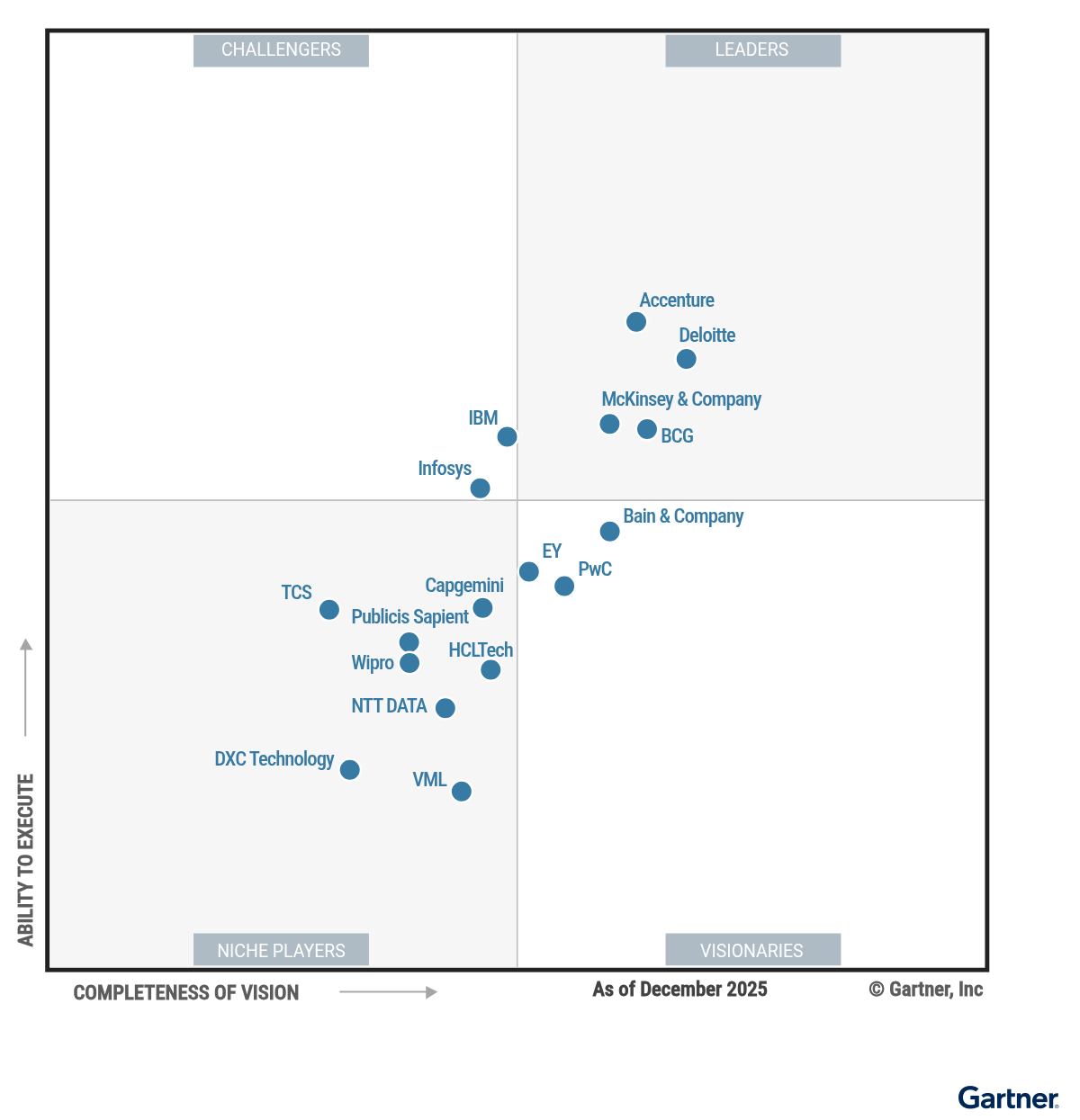
Vendor Strengths and Cautions
Accenture
Accenture is a Leader in this Magic Quadrant. Gartner estimates that Accenture has over 70,000 FTEs delivering DTBCS across all four use cases, geographically diversified with 30% of its DTBCS FTEs in North America, 45% in EMEA and 25% in the Asia/Pacific region. (Note: Percentages may not add up to 100% because of rounding.) Approximately 67% of this talent has less than five years of experience, while 12% has more than 10 years of experience.
Accenture’s key executive sponsors in the C-suite are the CIO/CTO, CEO and CFO, as assessed by their share of contributions to Accenture’s consulting services revenue. Gartner estimates that about 85% of Accenture’s consulting engagements are sole-sourced and substantial in scale, with 40% of them exceeding $5 million, 30% at less than $1 million and 30% in the $1 million to $5 million range.
Retail and consumer products (CPG), banking and capital markets, and public services are the vendor’s top three focus industry verticals in 2026.
- Accountable value creation: Accenture employs outcome-based commercial models, aligning its fees and delivery commitments around measurable client results such as cost efficiency, operational resilience, agility and innovation. Clients must actively seek such arrangements to fully capitalize on the value that Accenture can offer.
- Differentiated offerings for midmarket: Accenture differentiates itself by shifting focus to the midmarket segment, backed by quantified revenue goals and targeted mergers and acquisitions, as evidenced through the acquisition of Navisite, an established provider of cloud and application transformation services in North America.
- Industry-first investment alignment: Accenture’s global matrix is industry-focused, aligning investments and P&L to sectors. Clients benefit from tailored solutions and strong vertical specialization.
- Complexity navigating expanding IP and AI tools: Accenture offers an extensive and expanding portfolio of proprietary IP and AI-powered tools integrated into its services. However, the volume and continuous introduction of new assets could present a challenge for clients to fully comprehend, apply and maximize their value across diverse transformation needs.
- Quality and consistency of delivery and staffing: Despite robust internal tracking and processes, Accenture faces challenges in delivering a uniform, high-quality client experience across all engagements, particularly as it scales operations and integrates various service lines. Clients are advised to specifically validate if the service delivery model, staffing plans and value metrics are fit for purpose.
- Pricing perception risk: Rigid terms, higher costs and expanded project scope may deter cost-sensitive clients. Clients should carefully assess commercial terms and value alignment to ensure the investment fits their objectives and budget.
Bain & Company
Bain & Company is a Visionary in this Magic Quadrant. Gartner estimates that Bain has over 11,000 FTEs delivering DTBCS across all four use cases, geographically diversified with approximately 40% of its DTBCS FTEs in the Americas, and approproximately 54% in EMEA and the Asia/Pacific region. (Note: Percentages may not add up to 100% because of rounding.) About 45% of this talent has less than five years of experience, while 35% has more than 10 years of experience.
Bain’s top executive sponsors in its customer organization are the COO and CRO, as assessed by their share of contributions to Bain’s consulting services revenue. Typically, 80% of the provider’s consulting engagements are sole-sourced and substantial in scale, with 50% of them exceeding $5 million and 30% in the $1 million to $5 million range.
Consumer products (CPG), financial services and private equity are the vendor’s top three focus industry verticals in 2026.
- Proprietary assets: Bain utilizes a robust suite of proprietary platforms and frameworks, such as NPS Prism, Helix, Pyxis by Bain and ARC, which are recognized industry standards for benchmarking and transformation management.
- Commercial proposition: A key commercial proposition of Bain is the strategy to decouple pricing from input costs (e.g., hours and staffing). This enables the flexible involvement of senior partners and global experts whenever needed, while also providing clients with full access to Bain’s platforms and AI tools.
- Proactive peer-to-peer learning communities: Bain offers a refined ecosystem of peer networks designed to strengthen client experience, such as Stratos (a C-suite forum for senior women leaders in financial services) and CEO Forums (convening more than 4,500 executives across over 40 markets), fostering idea exchange and deep engagement. Clients that can justify the premium to access these communities will benefit from this capability.
- Limited scale for technology transformation: Bain maintains a lean internal implementation workforce by design and scales execution through ecosystem partners rather than a large internal delivery bench. Clients must require Bain to commit to outcomes by owning the transformation governance and orchestration of downstream technology implementation.
- Focus on large enterprises: Bain’s engagement with midsize and small enterprises is almost exclusively in the context of private equity work, where the investor requires assistance delivering on a value creation plan. Clients seeking a consulting transformation partner outside of a private equity context may find Bain’s offerings less accessible or customized.
- Lack of depth in industry-specific IP: Bain’s industry-specific IP portfolio, as compared to other providers assessed in this research, includes fewer stand-alone artifacts. Instead, it uses sector-level insights generated through its cross-industry platforms and benchmarking tools. Clients in verticals outside of the vendor’s stated priority verticals should exercise caution, and ensure these assets are tailored to their specific context.
BCG
Boston Consulting Group (BCG) is a Leader in this Magic Quadrant. Gartner estimates that BCG has over 13,000 FTEs delivering DTBCS across all four use cases (including its BCG X and Platinion brands), and is geographically diversified with 34% of its DTBCS FTEs in the Americas, 40% in EMEA and 26% in the Asia/Pacific region. (Note: Percentages may not add up to 100% because of rounding.) Approximately 35% of this talent has less than five years of experience while 35% has more than 10 years of experience.
According to Gartner, BCG’s top three target executive sponsors in its customer organization are the CEO, CIO/CTO and CRO, as assessed by their share of contributions to BCG’s consulting services revenue. Typically, 50% of the provider’s consulting engagements are sole-sourced and substantial in scale, with 80% of them between $1 million and $5 million or more.
Public sector, healthcare and technology, and media and telecommunications are the vendor’s top three focus industry verticals in 2026.
- Advanced AI-powered strategic foresight and geopolitical acumen: BCG’s integrated, AI-driven ecosystem, featuring tools like Strategic Foresight Framework, MarketSensing@BCG platform and CEO Radar, provides real-time insights and scenario planning to help clients anticipate change and achieve resilient transformation. BCG’s Center for Geopolitics combines geopolitical expertise with analytics, guiding clients through global and regulatory shifts with actionable pathways, not just forecasts.
- Integrated delivery and deep vertical expertise: BCG’s organizational framework, known as the “OneBCG” model, is specifically designed to fuse strategic consulting with deep industry knowledge and technical execution to provide end-to-end transformation solutions.
- Embedded enablement and ownership transfer model: BCG differentiates itself with outcome-driven, value-based pricing models, with a significant number of contracts tied to measurable results. The firm’s flexible engagement approach, including co-funding prototypes, joint IP creation and build-operate-transfer models, offers sustainable client value.
- Variability in client experience: Responses to Gartner’s customer reference survey highlighted variability in client experiences. Prospective clients are advised to seek additional client references in their specific industry subvertical.
- Not focused on small and midsize enterprises: BCG primarily serves large, complex organizations and occasionally engages with midsize firms. Small and midsize enterprises may find BCG less suited for standardized, scalable or cost-effective digital consulting solutions.
- Tech implementation scale: While BCG provides strong strategic direction and change management, some clients have noted concerns over technology delivery alignment, fees and the limited depth of shorter engagements. For large-scale, multiyear implementations, BCG often orchestrates rather than directly delivers, so clients should consider their comfort with this model and the potential need for third-party partners.
Capgemini
Capgemini is a Niche Player in this Magic Quadrant. Gartner estimates Capgemini Invent has about 10,000 FTEs delivering DTBCS across all four use cases (including the consulting capability from all its acquisitions), and is geographically diversified with 20% of its DTBCS FTEs in the Americas, 60% in EMEA and 20% in the Asia/Pacific region. (Note: Percentages may not add up to 100% because of rounding.) Approximately 35% of its consulting talent pool has more than 10 years of experience.
According to Gartner’s estimates, Capgemini’s top target executive sponsors in its customer organization are the CIO and CTO. Gartner estimates 20% of the provider’s consulting engagements are sole-sourced and substantial in scale, with 80% of them between $1 million and $5 million.
Based on Gartner’s analysis, life sciences, defense and energy, and utilities are the vendor’s priority industry verticals in 2026.
Capgemini declined requests for supplemental information. Gartner’s analysis is therefore based on other credible sources.
- Strong market sensing and thought leadership: Capgemini demonstrates strong market sensing capabilities through external engagement, proprietary tools and thought leadership. Its consulting team tracks trends, while the Management Lab explores emerging topics.
- Integrated design and consulting capabilities: Capgemini Invent uniquely combines creative design, technology product engineering and strategy consulting to deliver end-to-end transformation that is ideal for large, complex clients, specifically in automotive and manufacturing.
- Industry depth and global scale: With accelerators for growth sectors and approximately 30% to 40% of capability aligned to industry-specific expertise, Capgemini Invent excels in complex verticals like automotive, life sciences and manufacturing. Its global P&L and community-of-practice model, supported by innovative teams such as Connected Products and Services, enables effective delivery across these domains.
- Increased coordination demands for clients in integrated transformations: Capgemini Invent’s success relies on integrating its various brands. Clients should provide extra oversight to prevent fragmented delivery and unclear accountability.
- Tiered service and talent access for midsize clients: Capgemini mainly targets large enterprises and public-sector clients. Midsize organizations and startups may be routed to separate channels (e.g., Sogeti or local teams). Clients should confirm if they will have access to tailored offerings and specialist talent that suit their profile and context.
- Experience variability: Capgemini Invent is stronger in European markets compared to North America or the Asia/Pacific region. Furthermore, service quality and culture vary by practices among Capgemini Invent brands. U.S. buyers should validate local delivery capabilities, while all clients should request specific client references for their particular use case.
Deloitte
Deloitte is a Leader in this Magic Quadrant. Gartner estimates that Deloitte has over 146,000 FTEs delivering DTBCS across all four use cases, geographically diversified in the following rank order: the Americas, EMEA and the Asia/Pacific region. (Note: Percentages may not add up to 100% because of rounding.) Gartner estimates that approximately 65% of this talent has less than five years of experience, while approximately 15% has more than 10 years of experience.
Deloitte’s top three target executive sponsors in its customer organization are the CIO/CTO, CFO and COO, as assessed by their share of contributions to Deloitte’s consulting services revenue. Gartner estimates that approximately 70% of the provider’s consulting engagements are won through competitive tenders, medium to small in scale, with 80% of them at less than $500,000.
Public sector, financial services, and energy resources and industrials are the vendor’s top three focus industry verticals in 2026.
- Integrated delivery and industry focus: Deloitte’s Advise, Implement, Operate (AIO) model integrates strategy, execution and operations in key business functions, supported by sector-specific teams and co-sponsored leadership investments for deep industry expertise.
- Exceptional client penetration depth across industries: Deloitte builds deep industry expertise through dedicated sector teams and a strong portfolio of industry-specific AI-powered IP, serving over 70% of Fortune 500 companies across all verticals. This extensive engagement provides unmatched insight into sector challenges and opportunities.
- Agile acquisition strategy for niche digital and AI capabilities: Recent acquisitions highlight Deloitte’s focus on integrating specialized technology and engineering skills. This disciplined strategy accelerates market readiness and expands service offerings, enabling rapid response to evolving client demands for advanced technology services.
- High volume of small deals: Much of Deloitte’s business comes from large enterprises; however, Gartner estimates that most are small deals (less than $500,000) won through competitive tenders. While the vendor focuses on quantifiable outcomes, clients are advised to seek specific outcomes, mitigate scope creep and ensure the advisory assignments create pathways to scale.
- High ratio of junior staff: Although Gartner estimates about one-third of Deloitte’s revenue is asset-based, value delivery still depends largely on consultant hours. Deloitte operates a leverage model, led by more experienced consultants. Clients should ensure engagement teams have adequate senior leadership and expertise for complex transformations.
- Human oversight and delivery governance: Deloitte is pioneering the use of AI in its delivery of consulting services. While this is expected in the market, it comes with risk. Clients are advised to seek clarity on leverage of AI in the delivery of services and how potential risks are managed through the responsible use of AI, including “human in the loop” reviews.
DXC Technology
DXC Technology is a Niche Player in this Magic Quadrant. DXC reports having over 18,000 FTEs delivering DTBCS across all four use cases, geographically diversified with 9% of its DTBCS FTEs in the Americas, 39% in EMEA and 52% in the Asia/Pacific region. (Note: Percentages may not add up to 100% because of rounding.) Approximately 12% of this talent has less than five years of experience, while 70% has more than 10 years of experience.
DXC’s top target executive sponsors in its customer organization are the CIO and CTO, as assessed by their share of contributions to DXC’s consulting services revenue. Gartner estimates that about 90% of the provider’s consulting engagements are won through competitive tenders, medium to small in scale, with 44% of them less than at $1 million, 24% in the $1 million to $5 million range and 32% exceeding $5 million.
Banking and insurance, manufacturing (discrete), and public sector are the vendor’s top three focus industry verticals in 2026.
- Deep expertise and scalable talent model (inverted pyramid strategy): DXC intentionally maintains a distinctive “inverted talent pyramid” with a highly experienced consulting workforce to ensure a deeper, high-quality impact for clients.
- Strategic focus on technology consulting: A substantial portion of DXC’s resources (FTEs, IP assets, investments) are dedicated to technology consulting. Furthermore, revenue concentration remains high among technical buyers, with CIOs and CTOs accounting for 60% of DTBCS revenue. Clients with specific digital technology transformation needs can benefit from this strong technology advisory focus.
- Engagement flexibility: DXC’s offerings, engagement model and pricing approach are highly flexible and offer clients a variety of engagement options. As demonstrated through its range of client and deal sizes, DXC is among the best in class in this cohort, making it a good choice for clients of all sizes.
- Skewed service portfolio: While DXC has an evolving portfolio of AI offerings, inadequate predictive design services and a lack of process-centric consulting capabilities in the business consulting space impair its ability to execute for clients that have enterprisewide business reinvention or transformation needs. Non-IT business leaders considering DXC will need to ensure that the engagement is anchored in business value realization to avoid a technology-first bias.
- Consulting assets and standards: DXC lacks proprietary frameworks, benchmarks or indexes that have achieved the standard of broad, sustained external adoption by customer communities. This suggests their frameworks are currently internal tools or selectively adopted within niches, rather than widely accepted industry standards.
- Slow pace of growth in capacity and capability: The consulting business has reported revenue decline. Furthermore, DXC does not have an inorganic growth strategy. Slower organic capability building in a rapidly changing market hinders its ability to bring market leading capability to clients.
EY
EY is a Visionary in this Magic Quadrant. EY reports having over 80,000 FTEs delivering primarily DTBCS use cases with limited capacity in brand and marketing strategy consulting use cases. Its team is geographically diversified with 28% of its DTBCS FTEs in the Americas, 21% in EMEA and 41% in the Asia/Pacific region. (Note: Percentages may not add up to 100% because of rounding.) Approximately 82% of this talent has less than five years of experience, while 5% has more than 10 years of experience.
EY’s top three target executive sponsors in its customer organization are the CIO/CTO, CRO and CFO, as assessed by their share of contributions to EY’s consulting services revenue. Typically, 70% of the provider’s consulting engagements are sole-sourced and substantial in scale, with 78% of them exceeding $5 million.
Industrials and energy, consumer products (CPG), and healthcare are the vendor’s top three focus industry verticals in 2026.
- Human-centric approach to change management: EY utilizes its proprietary TransformationEQ framework, co-developed with Said Business School, to specifically focus on the human and emotional side of change programs. This methodology provides clients with a deliberate approach to mitigating the significant risk associated with human or organizational factors in large-scale transformations.
- Deep industry and sector expertise: EY’s approach to structuring its teams across six industry groups and 18 sectors, coupled with dedicated industry boards and platforms like EY Nexus, enables the development and delivery of highly tailored, sector-specific solutions that address unique client challenges and regulatory landscapes.
- Reinvention of service delivery by scaling investment in IP: EY has invested significantly in scaling AI/GenAI capabilities, codifying its traditional consulting assets, developing AI-based workflows and reinventing service delivery. It is recommended that clients actively seek asset-heavy propositions to benefit from the cost and effort efficiencies these assets offer.
- Limited client adoption in outcome-based pricing: EY’s business model relies heavily on sole-sourced, fixed-price or time-and-materials deals with large enterprises. Clients should proactively pursue outcome-based engagements, leveraging EY’s recent investments in AI assets.
- High junior talent concentration: Approximately 82% of the DTBCS workforce has less than five years of experience, largely due to skills intake from global delivery services (GDS). This reliance on junior staff, combined with low retention rates, may limit access to the deep expertise required for multiyear strategic transformations.
- Gradual expansion of IP utilization: EY has invested heavily in IP and plans to use it in all consulting engagements from 2026. However, its asset monetization strategy is still evolving, and most engagements remain people-based. Clients should ask EY to clarify how it leverages IP and shares commercial benefits.
HCLTech
HCLTech is a Niche Player in this Magic Quadrant. HCLTech reports having over 17,000 FTEs delivering DTBCS across all four use cases, geographically diversified with 24% of its DTBCS FTEs in the Americas, 20% in EMEA and 59% in the Asia/Pacific region. (Note: Percentages may not add up to 100% because of rounding.) Approximately 36% of this talent has less than five years of experience, while 22% has more than 10 years of experience.
HCLTech’s top three target executive sponsors in its customer organization are the CIO/CTO, COO and CMO, as assessed by their share of contributions to HCLTech’s consulting services revenue. Typically, 70% of the provider’s consulting engagements are sole-sourced and substantial in scale, with 53% of them exceeding $5 million and 2% in the $500,000 to $1 million range, indicating a strong focus on multiyear, large-scale, technology modernization, transformation consulting engagements.
Fabricating materials industry, e-mobility and government are the vendor’s top three focus industry verticals in 2026.
- Strong consulting operations: Characterized by a distinctive talent acquisition strategy, high talent retention rate, strong financial performance and unique origination, including the pursuit of a POD model and holistic measures for its consulting practice, HCLTech’s ambition for its consulting business is supported by strong operations. Clients can benefit from this clarity and predictability.
- Consistent customer experience: HCLTech’s Experience Management Office (XMO), a holistic customer experience measurement approach, is among the best in class in this cohort. HCLTech’s investment in understanding its customers is paying off, as evidenced through the Gartner customer reference survey in which the vendor received high scores demonstrating a stable customer experience.
- Strong innovation consulting expertise: HCLTech stands out for co-creating with clients and contractually linking innovation to outcomes. Services like BEaaS enable ROI validation through experimentation, while Innovation-as-a-Service ties deliverables such as annual patent filings to measurable results.
- Reactive approach to detect and respond to market dynamics: HCLTech’s product-engineering-focused market sensing lacks proprietary methods, AI-based foresight tools and a dedicated team, limiting its ability to help clients adapt to changing market dynamics.
- Strategic advisory limitations: HCLTech demonstrates strong capabilities in product design and engineering services; however, its strategic consulting depth is limited. The provider lacks robust offerings in areas such as business reinvention, brand strategy and market-entry consulting. Clients seeking support for new product introductions or expansion into new markets may not find HCLTech’s capabilities comprehensive to address their requirements.
- People-based consulting model: Despite its assertions around driving asset-led consulting, HCLTech’s overall consulting revenue is linearly aligned to its headcount. Clients must require HCLTech to break down pricing to the component level and verify if it is paying for people or assets, and negotiate accordingly.
IBM
IBM is a Challenger in this Magic Quadrant. Gartner estimates IBM has over 80,000 FTEs distributed globally across the Americas, Europe, EMEA and the Asia/Pacific region, delivering DTBCS across all four use cases. (Note: Percentages may not add up to 100% because of rounding.) Approximately 38% of this talent has less than five years of experience, while 23% has more than 10 years of experience.
IBM’s top three target executive sponsors in its customer organization are the CIO/CTO, COO and CFO, as assessed by their share of contributions to IBM’s consulting services revenue. Typically, 43% of IBM’s consulting engagements are sole-sourced, medium or small in scale, with 12% of them exceeding $5 million and 66% at less than $1 million.
Banking and financial services, government, and retail/consumer products (CPG) are the vendor’s top three focus industry verticals in 2026.
- Internal transformation blueprint (Client Zero): IBM uses its own internal transformation journey, dubbed “Client Zero,” that spans multiple domains (delivery, HR, customer support, procurement, etc.) as a client-facing blueprint. The vendor publicly shares details of its IBM Consulting Advantage platform and the transformation outcomes it has delivered through its financial results, which offer strong proof points for clients as they evaluate IBM.
- Proven co-creation methodology: IBM Garage uses a collaborative, hands-on approach to quickly develop MVPs and drive innovation. By co-creating solutions, clients experience IBM’s speed and expertise early, building trust before major commitments. This method helps organizations rapidly test ideas, reduce risk and achieve successful digital transformation.
- Consultative assets and standards: IBM has a heritage of developing industry standards. The IBM Institute for Business Value (IBV), its contribution to creating industry standards such as Open Standards Benchmarking (OSB) and the Component Business Model (CBM) are a testament to this strength.
- Prioritization on focus clients: IBM’s sales strategy is heavily anchored around its key clients, which concentrates its best talent and resources on top accounts. Clients are advised to put contractual measures in place to ensure adequate and appropriate resourcing and focus.
- Growth challenge in key markets: IBM’s consulting revenue growth was relatively flat in 2025, as compared to the previous year, especially in its key market, the U.S. IBM has channelized investments in terms of leadership and resources to bring back the momentum. Clients in the U.S. are advised to consider this an opportunity to negotiate better outcomes.
- High proportion of asset-based revenue: IBM earns substantial revenue from asset-based offerings like proprietary IP and platforms. With codification of consulting into AI agents and solutions, clients will be institutionalizing IBM’s approach to delivering specific business outcomes. Clients are advised to define clear risk postures and assess if IBM’s approach to achieving outcomes suits their business objectives in the long run.
Infosys
Infosys is a Challenger in this Magic Quadrant. Infosys reports having over 10,000 FTEs delivering DTBCS across all four use cases, geographically diversified with 28% of its DTBCS FTEs in the Americas, 26% in EMEA and 45% in the Asia/Pacific region. (Note: Percentages may not add up to 100% because of rounding.) Approximately 29% of this talent has less than five years of experience, while 48% has more than 10 years of experience.
Infosys’s top three target executive sponsors in its customer organization are the CIO/CTO, CFO and CMO, as assessed by their share of contributions to Infosys’ consulting services revenue. Typically, 35% of the provider’s consulting engagements are sole-sourced and medium or substantial in scale, with 24% of them exceeding $5 million and 56% in the $500,000 to $1 million range.
Retail and consumer products (CPG), energy and utilities, and healthcare and life sciences are the vendor’s top three focus industry verticals for 2026.
- Robust value realization framework: The Infosys Value Management platform, powered by its proprietary Organization Performance Quotient framework, systematically links analysis to clients’ key business levers. A significant share of DTBCS revenue comes from outcome-based models, reflecting Infosys’s commitment to aligning fees with measurable client value.
- Strong strategy-to-execution model and outcome alignment: Infosys employs a proprietary “strategy-to-execution” model, with an “AI-first philosophy” leveraging platforms like Infosys Topaz and the Infosys Value Realization Method (VRM), to ensure that digital transformation roadmaps lead to measurable results.
- Integrated global consulting structure: Infosys Consulting operates as a single, globally integrated management consulting firm within a large global system integrator (Infosys), which is a unique structure among its cohort. This enables clients with converged needs to get the best of the capabilities of a consulting firm and a global system integrator.
- Technology-centric consulting bias: Infosys’ consulting revenue is primarily attributed to technical buyers, with CIOs and CTOs accounting for more than half of its DTBCS revenue. Non-IT business leaders will need to proactively ensure the engagement is anchored sufficiently in their departmental and commercial KPIs to avoid a technology-first bias.
- Limited relevance in corporate strategy engagements: Infosys does work with clients on business strategy engagements; however, the vendor has limited capabilities around business model reinvention and new market entry strategy.
- Reliance on external partnerships for regulatory compliance advisory: While Infosys has a formal vertical compliance program covering multiple major verticals across all geographies, it actively uses alliances with audit firms (e.g., EY for Europe) to address specific, local compliance needs, such as local labor-law-compliant payroll. Clients need to be aware of such dependence.
McKinsey & Company
McKinsey & Company is a Leader in this Magic Quadrant. McKinsey reports having over 13,000 FTEs delivering DTBCS across all four use cases and leveraging QuantumBlack, which is McKinsey’s consulting arm for AI-specific use cases. Gartner estimates McKinsey has a geographically diversified team: 45% of its DTBCS FTEs are in the Americas, 35% are in EMEA and 20% are in the Asia/Pacific region. (Note: Percentages may not add up to 100% because of rounding.) Approximately 70% of this talent has less than five years of experience, while 9% has more than 10 years of experience.
McKinsey’s top target executive sponsors in its customer organization are the CEO and COO, as assessed by their share of contributions to McKinsey’s consulting services revenue. Notably, client CEOs continue to sponsor McKinsey and account for 30% of the company’s revenue. Typically, McKinsey’s consulting engagements are sole-sourced and substantial in scale, with 80% exceeding $5 million.
Gartner estimates that McKinsey’s priority verticals for 2026 are financial services, healthcare and life sciences, and energy and utilities.
- Proactive market sensing and thought leadership: McKinsey employs a sophisticated approach to market sensing through proprietary tools like McKinsey Global Institute (MGI) and sector-specific research teams. The Digital & Technology Insights (DTi) hub leverages advanced AI to anticipate long-term shifts, geopolitical risks and industry trends.
- Deep sector knowledge: McKinsey’s vertical expertise drives industry-level impact and client value. Its IP strategy digitizes domain knowledge with AI to deliver strategic solutions.
- Mature change management and value realization: The organization utilizes advanced proprietary tools to monitor and manage complex transformations. McKinsey demonstrates maturity in measuring change success by linking skills improvement, technology adoption and process efficiency directly to quantified business outcomes, leading to well-quantified productivity gains and transformation success rates.
- Premium pricing: McKinsey’s premium pricing is driven by the expertise and track record of senior partners. To ensure value realization, clients should seek top-tier partners that are directly and continuously involved in their engagements.
- Monetization prioritized around high-impact challenges: The firm’s model is optimally aligned when solving monumental, multimillion dollar business crises. Clients with smaller, incremental or less “existential” problems may not receive the full benefit of McKinsey’s distinctive, go-to-market model.
- McKinsey IP ownership requirement: McKinsey’s consulting often includes proprietary assets, making IP a negotiated element. Clients should clarify IP ownership early, rather than assuming full rights to co-created tools or default terms.
NTT DATA
NTT DATA is a Niche Player in this Magic Quadrant. Gartner estimates NTT DATA has about 28,000 FTEs delivering DTBCS across all four use cases, geographically diversified with 16% of its DTBCS FTEs in North America, 57% in EMEA and 27% in the Asia/Pacific region. (Note: Percentages may not add up to 100% because of rounding.) Approximately 47% of this talent has less than five years of experience, while 24% has more than 10 years of experience.
NTT DATA’s top target executive sponsors in its customer organization are the COO, CIO and CTO, as assessed by their share of contributions to NTT DATA’s consulting services revenue. Typically, 38% of the provider’s consulting engagements are sole-sourced, medium to small in scale and typically embedded as part of a larger tech transformation, with 17% of them exceeding $5 million and 47% at less than $1 million.
Manufacturing, financial services, and communications, media and services are the vendor’s top three focus industry verticals in 2026.
- Thought leadership in setting industry standards: NTT DATA contributes to the development of global standards across diverse industries, including optical networking (IOWN), sustainability (SCI and related frameworks), financial interoperability, and digital twin ecosystems. Through co-creation with clients and partners, NTT DATA applies these standards in practical solutions that support industry-level transformation.
- Asset-based consulting business model: NTT DATA’s core strategy is built on asset-based business (ABB), using its proprietary platforms like Syntphony. This approach is designed to accelerate time to market, increase scale and generate cost efficiencies by offering composable solutions for quick transformation.
- Vendor lock-In avoidance via open standards: Unlike many proprietary-platform-based consulting services offerings, NTT DATA’s Syntphony solution is a flexible, customizable framework built on open standards with the goal of enabling true interoperability and removing vendor lock-in for clients.
- Fragmented client base and project landscape: NTT DATA serves a diversified client base that includes global enterprises, midmarket organizations and public-sector institutions, and consulting is often delivered within larger multiphase transformation programs. Clients should closely monitor resourcing and project management.
- Reliance on traditional pricing models: Although NTT DATA is expanding to outcome-based pricing, particularly in multiyear cloud, AI and modernization programs, it continues to use traditional pricing models (T&M and fixed price) for a significant share of engagements. Based on their risk posture, clients must actively seek outcome-based propositions as applicable.
- Capability differential between Japan and global markets: NTT DATA’s delivery scale, capability and expertise vary across regions, with Japan and Europe representing the most established bases. Clients in global markets must require NTT DATA to align delivery consistency through shared assets, CoEs and common consulting frameworks, and ensure knowledge sharing in multiregion programs.
Publicis Sapient
Publicis Sapient is a Niche Player in this Magic Quadrant. Gartner estimates Publicis Sapient having over 20,000 FTEs delivering DTBCS across all four use cases, with the majority of its DTBCS FTEs in North America and EMEA. (Note: Percentages may not add up to 100% because of rounding.) Approximately 20% of this talent has less than five years of experience, while 30% has more than 10 years of experience.
Its overall technology consulting is growing and its business consulting capabilities are fledgling. Publicis Sapient’s top target executive sponsors in its customer organization are the CIO/CTO and CMO, as assessed by their share of contributions to Publicis Sapient’s consulting services revenue. Typically, 30% of the provider’s consulting engagements are sole-sourced and substantial in scale, with 60% of them exceeding $5 million, 15% at less than $1 million and 25% between $1 million and $5 million.
Banking and financial services, retail, and communications and media are the vendor’s top three focus industry verticals in 2026.
- Creative, data, media and product engineering integration: Publicis Sapient’s “Power of One” model connects clients to the broader Publicis Groupe ecosystem, including top data sources like Epsilon and Lotame. This integration enables unified marketing, commerce and technology strategies, delivering highly targeted and personalized experiences.
- Rapid AI-enabled experience delivery: Publicis Sapient’s integrated SPEED framework (Strategy, Product, Experience, Engineering, Data & AI) accelerates transformation by connecting strategy to delivery and eliminating silos. Leveraging proprietary platforms and agile, AI-driven methods, SPEED delivers measurable business impact in weeks or months.
- Technology modernization advisory expertise: Publicis Sapient draws on its heritage to deliver advanced technology solutions and large-scale transformation particularly for complex, regulated sectors like financial services and energy.
- Lower strategic focus on core digital business consulting: Publicis Sapient is best known for martech and customer engagement, with less recognition for nonmarketing business consulting. Recent acquisitions leading up to June 2025 focused on marketing, commerce and media, not business model reinvention.
- Limited proprietary IP portfolio compared to scale players: As compared to its peers in this cohort, Publicis Sapient has a limited portfolio of IP assets. This also reflects in its low volume of asset based revenue as a percentage of its overall revenue.
- Reliance on proprietary telemetry for trust and pricing verification: The firm promotes a competitive differentiator through its Slingshot platform, which provides telemetry on speed, quality and cost where clients can see where efficiency is created, which is priced into the model. However, clients must assess if this dependency is viable for them.
PwC
PwC is a Visionary in this Magic Quadrant. PwC reports having over 45,000 FTEs delivering DTBCS across all four use cases, geographically diversified with 53% of its DTBCS FTEs in the Americas, 32% in EMEA and 15% in the Asia/Pacific regionPAC. (Note: Percentages may not add up to 100% because of rounding.) Approximately 41% of this talent has less than five years of experience while 20% has more than 10 years of experience.
PwC’s top three target executive sponsors in its customer organization are the CFO, CIO and COO, as assessed by their share of contributions to PwC’s consulting services revenue. Typically, 80% of provider’s consulting engagements are sole-sourced and substantial in scale, with 41% of them exceeding $5 million, 26% at less than $1 million and 33% in the $1 million to $5 million range.
Healthcare and life sciences, retail and consumer products, and energy and utilities are the vendor’s top three focus industry verticals in 2026.
- Deep expertise In regulated industries: PwC excels at navigating complex regulations with its “compliance by design” approach, integrating regulatory strategy, technology adoption and ESG disclosures.
- Highly responsive to market shifts: PwC has realigned its offerings to meet evolving client needs around future readiness, AI, regulatory shifts and demand for value-based pricing. Initiatives like AI Delivery Excellence and the Value-In Motion campaign evidence this shift. Clients can benefit from these investments as they navigate complex business environments.
- Systemic approach to innovation: As evidenced through significant investments, purposeful partnerships (global and regional), an institutionalized client co-creation methodology, and a growing network of innovation labs and centers, PwC’s innovation capabilities are among the best in class in this cohort.
- Evolving marketing and digital product engineering consulting capability: While PwC has recently been growing the capability inorganically, its capabilities and offerings in marketing, brand transformation and digital product engineering are still evolving. These capabilities are embedded within its technology consulting practice. Clients must seek customer references to validate claims.
- Reliance on people-based services: The majority of PwC’s DTBCS revenue is based on people-based services. While PwC invests in IP to improve internal efficiencies, it does not articulate a clear asset monetization strategy. Clients must seek clarity at a component level when negotiating deals to understand the value drivers.
- Heavy concentration in finance and operations transformation: A high percentage of PwC’s engagements originate from the CFO and COO buyer profiles. Clients engaging PwC for IT strategy mandates driven by nonfinancial leadership will need to ensure that value realization goals are aligned to their departmental/functional KPIs.
TCS
Tata Consultancy Services (TCS) is a Niche Player in this Magic Quadrant. TCS reports having over 50,000 FTEs delivering DTBCS across all four use cases. TCS’s consulting revenue is reliant on people-based services. Gartner estimates the TCS talent pool to be geographically diversified, with 45% of its DTBCS FTEs in the Americas, 35% in EMEA and 20% in the Asia/Pacific region, and heavily skewed to technology consulting. (Note: Percentages may not add up to 100% because of rounding.) Approximately 35% of this talent has less than five years of experience, while 35% has more than 10 years of experience.
TCS undertakes consulting engagements with an intent to deliver downstream implementation services. The vendor’s top target executive sponsors in its customer organization are the CIO/CTO and COO, as assessed by their share of contributions to TCS’s consulting services revenue. Typically, 25% of the provider’s consulting engagements are sole-sourced and medium to small in scale, with 15% of them exceeding $5 million, 40% at less than $1 million and 45% in the $1 million to $5 million range.
Banking and financial services, consumer products (CPG), and communications and media are the vendor’s top three focus industry verticals in 2026.
- Strategic client focus and execution: TCS has a relationship-based growth model, with about 80% of wins being sole-sourced and nearly 95% of growth coming from existing clients over the past two decades. This deep integration with clients supports long-term engagements and significant outcome delivery.
- Advanced innovation and co-creation ecosystem for technology consulting: TCS leverages proprietary ecosystems like COIN and Pace Ports structured co-innovation centers, bringing together clients, startups and academia to accelerate digital transformation through rapid prototyping.
- Institutionalized contextual knowledge: Given that TCS does not monetize its consulting assets explicitly, the premium pricing for consulting is attributed to its senior workforce. TCS Gurukul and Contextual Masters Program (with approximately 75,000 resources) ensure consistent upskilling and leveraging of experienced resources. Clients must explicitly seek personnel from these initiatives to be deployed on projects.
- Organizational ambiguity in consulting definition: TCS integrates consulting across services for on-demand delivery, but this limits niche consulting growth and stand-alone advisory capabilities beyond tech modernization.
- Fledgling business and brand strategy consulting expertise: TCS has limited business, strategy, marketing and brand strategy consulting expertise. Clients seeking advisory support for new market launches or business model reinvention may find TCS’s capabilities to be still developing.
- Reliance on organic capabilities: TCS’s emphasis on organic growth and internal resources limits its access to outside perspectives and specialized expertise, which are essential in today’s dynamic environment. Clients should seek clarity on how TCS will incorporate external insights and best-in-class capabilities from the broader ecosystem.
VML
VML is a Niche Player in this Magic Quadrant. VML reports having over 4,500 FTEs delivering DTBCS across all four use cases, geographically concentrated with 45% of its DTBCS FTEs in the Americas and 47% in EMEA. (Note: Percentages may not add up to 100% because of rounding.) Approximately 15% of this talent has less than five years of experience, while 60% has more than 10 years of experience.
VML has fledgling business consulting and digital product engineering consulting capabilities. Its top executive sponsor in its customer organization is the CMO, as 30% of its deals originate from its customers’ marketing function. Typically, 80% of the provider’s consulting engagements are won through competitive tender and are substantial in scale, with 50% of them exceeding $5 million and 15% in the $500,000 to $1 million range.
Automotive, healthcare and pharmaceuticals, and retail and consumer products (CPG) are the vendor’s top three focus industry verticals in 2026.
- Integrated transformation focus: The firm successfully executes its “Connected Brands” strategy, integrating brand experience, customer experience and commerce capabilities to deliver quantifiable market impact. VML uses proprietary systems like WPP Open to enhance its operations and consulting delivery.
- Customer experience management: VML has one of the largest and widest array of clients across industries among companies assessed in this cohort. Its structured peer-to-peer learning opportunities for clients like Nudgestock (the world’s largest festival of behavioral economists) and its delivery of a consistent client experience differentiates it from among its peers.
- Strong operations: Backed by WPP, VML can accelerate inorganic growth and capability expansion. Recent acquisitions have enhanced its global capacity, while specialized practices like behavioral science and proprietary tools such as Cognitive Profiler enable differentiated experience transformation services.
- Limited standardization of outcome-based pricing: Clients seeking predominantly outcome-based commercial arrangements should discuss their specific requirements early in the engagement process. VML’s three-tier value measurement framework provides a solid foundation for structuring such arrangements, although clients should be prepared to negotiate the appropriate balance between traditional T&M models and outcome-based structures that align with their transformation objectives and risk tolerance.
- Domain focus limitation: VML’s primary business continues to be related to martech, sales tech, commerce tech and CX. While it is expanding to adjacencies and leveraging AI to open doors, the plan for scaling its consulting business beyond these core domains (e.g., into broad finance or HR transformation) is still fledgling.
- IP asset volume: VML has a lower number of proprietary IP compared to other vendors in this cohort. Furthermore, its heavy reliance on revenue from people-based services as compared to asset-based services indicates a lack of codified domain expertise, which typically accelerates industry-specific transformation projects.
Wipro
Wipro is a Niche Player in this Magic Quadrant. According to Gartner estimates, Wipro has over 23,000 FTEs delivering DTBCS across all four use cases and a geographically diversified talent pool, with 24% of its DTBCS FTEs in the Americas, 8% in EMEA and 68% in the Asia/Pacific region. (Note: Percentages may not add up to 100% because of rounding.) Wipro has unified Capco (financial services advisory), Designit (service/experience design), Rizing (business transformation) and its internal domain consulting practices. Approximately 26% of this talent has less than five years of experience, while 51% has more than 10 years of experience.
Gartner estimates that Wipro’s top target executive sponsors in its customer organization are the CIO/CTO and CFO, as assessed by Wipro’s capabilities and offerings. Typically, 20% of the provider’s consulting engagements are sole-sourced and medium to small in scale, with 29% of them exceeding $5 million, 40% at less than $1 million and 31% in the $1 million to $5 million range.
Banking and insurance, energy and resources, and healthcare and life sciences are the vendor’s top three focus industry verticals in 2026.
- Elite talent development: Wipro stands out for its consulting talent strategy, with a high proportion of experienced professionals and significant investment in training and upskilling at the partner level. Large enterprises in sectors like financial services and energy choose Wipro for enterprisewide transformation consulting.
- Execution-focused advisory proposition: Consulting-led sales is a CEO and board mandate, and Wipro prioritizes engagements with strong potential for downstream technology projects. Clients seeking transformation or modernization advisory services can benefit from this approach, securing competitive pricing for advisory services in lieu of commitment to implementation.
- Engagement flexibility: Wipro offers greater engagement flexibility, with consultants embedded in client teams and diverse pricing models. Both large and smaller clients benefit from this adaptability.
- Lack of proprietary market sensing capability: Despite recent AI-based enhancements to its market sensing capability, Wipro’s approach to market understanding heavily relies on customer feedback loops, co-creation and traditional intelligence tools, limiting differentiated foresight and the ability to redesign or reframe client business.
- Offshore heavy talent model: While Wipro maintains a viable onshore presence in key markets like North America and Western Europe, it deliberately pursues an “India hub”-based operating model for consulting services. Clients should evaluate whether Wipro’s staffing and operating models meet their needs.
- Pivot to adaptive pricing is maturing: The shift to outcome-based and risk-aligned commercial models is scaling slowly as the firm is focused on reversing the revenue decline. Clients should verify pricing claims and value realizations.
Vendors Added and Dropped
We review and adjust our inclusion criteria for Magic Quadrants as markets change. As a result of these adjustments, the mix of vendors in any Magic Quadrant may change over time. A vendor's appearance in a Magic Quadrant one year and not the next does not necessarily indicate that we have changed our opinion of that vendor. It may be a reflection of a change in the market and, therefore, changed evaluation criteria, or of a change of focus by that vendor.
Added
As this is a new Magic Quadrant, no vendors were added.
Dropped
As this is a new Magic Quadrant, no vendors were dropped.
Inclusion and Exclusion Criteria
To qualify for inclusion in this Magic Quadrant, providers:
- Need $1 billion in combined revenue for digital business consulting and digital technology and cloud enablement consulting services.
- Must be able to deliver three out four use cases as described in the Market Definition section:
- Must deliver the digital business consulting service use case
- Must deliver the digital technology and cloud enablement consulting service use case
- Must deliver either the digital product engineering consulting or digital marketing and brand strategy consulting use case. If delivering both use cases, the combined revenue must be at least $150 million or, if delivering only one of these two use cases, revenue for the use case must be at least $100 million.
- This is a worldwide MQ — global presence and ability to serve clients across all geographical regions (North and South America, Europe, Middle East, Africa, Asia and Oceania) is mandatory.
Honorable Mentions
Alten: Based in Boulogne-Billancourt, France, Alten is a global technology consulting and engineering leader operating across Europe, North America and Asia. Its consulting services center on outsourced R&D strategy, innovation management and digital transformation for engineering-intensive industries. Key verticals include aerospace, automotive, rail, energy and life sciences. Alten’s proposition emphasizes strategic advisory for product life cycle optimization, sustainability and regulatory compliance. Proprietary IP includes methodologies for information systems security and risk mapping in complex engineering programs. In 2024 and 2025, Alten strengthened its consulting footprint through acquisitions in energy and utilities, positioning itself as a trusted advisor for industrial digitalization and green engineering.
Booz Allen Hamilton: Headquartered in McLean, Virginia, Booz Allen Hamilton operates primarily in the U.S., with a strong presence in defense, intelligence, and civil government markets. Its consulting proposition focuses on strategy and technology advisory for mission-critical programs, emphasizing AI adoption, cybersecurity and digital modernization. Key verticals include national security, defense and federal civil agencies. Booz Allen Hamilton’s consulting IP includes frameworks for AI-driven transformation and cyber risk management, supported by proprietary analytics platforms. In FY25, the firm advanced its position as a premier digital integrator, leveraging deep government relationships and advisory-led innovation to guide clients through modernization and emerging tech adoption.
Cognizant: Headquartered in Teaneck, New Jersey, Cognizant operates globally across North America, Europe and Asia, serving industries such as financial services, healthcare, life sciences, retail, communications, media, technology and manufacturing. Its consulting proposition emphasizes AI-driven business transformation, enterprise modernization and operational strategy. In 2024 and 2025, Cognizant focused on hyperproductivity through AI, embedded engineering and agentic automation, supported by proprietary platforms like Cognizant Neuro AI and Cognizant Flowsource. Consulting IP includes frameworks for responsible AI adoption and enterprise agentification, enabling clients to scale generative AI initiatives. Cognizant differentiates through domain expertise and advisory-led innovation, helping enterprises navigate complex digital and sustainability challenges.
EPAM: Headquartered in Newtown, Pennsylvania, EPAM operates globally across North America, EMEA and the Asia/Pacific region, serving industries such as financial services, healthcare, retail and technology. Its consulting proposition emphasizes digital business advisory, customer experience strategy and enterprise transformation. EPAM’s consulting focus in 2024 and 2025 included AI-native operating models, cloud strategy and data-driven innovation. Proprietary IP includes frameworks for GenAI adoption and digital platform engineering, reinforced by acquisitions like First Derivative for financial consulting. EPAM differentiates through a deep engineering heritage combined with strategic advisory, helping clients reimagine business models and accelerate transformation in an AI-driven economy.
KPMG: Headquartered in London, U.K. (KPMG International), with major U.S. operations, KPMG delivers consulting through its advisory practice, operating worldwide across sectors such as financial services, healthcare, energy and consumer markets. Its consulting proposition focuses on sector-specific business transformation, risk and compliance, and digital strategy. This is underpinned by the KPMG Velocity platform and ecosystem designed for integrated transformation. Key focus areas in 2024 and 2025 included KPMG Velocity’s AI-enabled products and services for enterprise change, ESG advisory and finance transformation. Proprietary IP encompasses KPMG’s consulting insights, methods, expertise and capabilities, along with its Connected, Powered, Trusted, and Elevate solutions with AI technology. KPMG helps guide clients through complex regulatory and digital challenges, enabling them to build and operate intelligent, agile and resilient enterprises that can sustain their next level of growth and value creation.
Leidos: Headquartered in Reston, Virginia, Leidos operates primarily in the U.S. federal market, serving the defense, intelligence, civil and health sectors. Its consulting proposition focuses on mission-critical advisory, combining strategy with advanced technology insights for national security, cyber resilience and digital modernization. Key verticals include defense systems, healthcare and energy infrastructure, aligned with its NorthStar 2030 strategy. Consulting engagements emphasize AI-enabled cyber operations, risk management and modernization of federal programs. Notable intellectual property includes proprietary frameworks for zero-trust cybersecurity and mission analytics. Leidos differentiates through deep domain expertise and advisory-led transformation for government clients seeking efficiency and resilience.
Evaluation Criteria
Product or Service: The capabilities, features and overall quality of the core goods and services that compete in and/or serve the defined market. Criteria include:
- Talent strategy
- Service catalog
- Diversity of skills
Overall Viability: The organization’s overall financial health, as well as the financial and practical success of the relevant business unit. This includes the likelihood that the organization can continue to offer and invest in the product, as well as the product’s position in the organization’s portfolio. Criteria include:
- Financials (growth and margins)
- Client growth and retention
- Diversity in business/capability offerings
Sales Execution/Pricing: The organization’s capabilities in all presales activities and the structures that support these activities. This includes deal management, pricing and negotiation, presales support, and the overall effectiveness of the sales channel. Criteria include:
- Sales effectiveness
- Diversity in deal/client portfolio
Market Responsiveness/Record: The ability to respond, change direction, be flexible and achieve competitive success as opportunities develop, competitors act, customer needs evolve, and market dynamics change. This includes the provider’s history of responsiveness to changing market demands. Criteria include:
- Mechanisms to track and respond to market changes
- Leverage of AI
- Track record of market responsiveness
Marketing Execution: The ability to deliver clear, high-quality, creative and effective messaging via publicity, promotional activity, thought leadership, social media, referrals and sales activities. This includes the organization’s ability to influence the market, promote the brand, increase awareness of products and establish a positive reputation among customers. Criteria include:
- Mind share among business buyers
- Demonstration of market driven thought leadership
Customer Experience: The degree to which a vendor’s products, services and programs enable customers to achieve their desired results. This includes the quality of supplier/buyer interactions, technical support or account support, as well as ancillary tools, customer support programs, availability of user groups and service-level agreements. Criteria include:
- Customer reference surveys
- Ability to create and curate customer community
- Successful client experiences
Operations: The ability of the organization to meet its goals and commitments. This includes the quality of its organizational structure, skills, experiences, programs and systems that enable the organization to operate effectively and efficiently. Criteria include:
- Talent acquisition and retention strategy
- Agility of the organization structure
- Training and upskilling/reskilling
- Leverage of AI to enhance efficiency and quality of service delivery
Ability to Execute
Ability to Execute Evaluation Criteria
| Evaluation Criteria | Weighting |
|---|---|
Product or Service | High |
Overall Viability | Medium |
Sales Execution/Pricing | Medium |
Market Responsiveness/Record | High |
Marketing Execution | Low |
Customer Experience | Medium |
Operations | High |
Source: Gartner (January 2026)
Completeness of Vision
Market Understanding: The ability to understand customer needs and translate that understanding into products and services. Vendors with a clear vision of the market listen to and understand customer demands, and they can shape or enhance market changes with their vision. Criteria include:
- Ability to spot market trends
- Maturity of approaches (tools/methodologies) to track market disruptions, geopolitical and/or regulatory shifts
- Ability to understand buyer behavior
Marketing Strategy: The ability to clearly communicate differentiated messaging, both internally and externally, through social media, advertising, customer programs and positioning statements. Criteria include:
- Differentiated marketing strategies
Sales Strategy: The ability to create a sound strategy for selling that uses the appropriate networks including direct and indirect sales, marketing, service and communication. This includes partnerships that extend the scope and depth of a provider’s market reach, expertise, technologies, services and their customer base. Criteria include:
- Differentiated sales strategies
- Approach to deal qualification and pursuit of opportunities
Offering (Product) Strategy: The ability to approach product development and delivery in a way that meets current and future requirements, with an emphasis on market differentiation, functionality, methodology and features. Criteria include:
- Offering strategy, differentiated capabilities
- Spread and leverage of centers of excellence
- Investment in offerings and leverage of AI
- Ability to set industry standards
Business Model: The design, logic and execution of the organization’s business proposition. Criteria include:
- Ability to compete in marketplace
- Ability to work with clients of varying sizes and complexities
- Leverage of assets/IP
- Use of outcome based pricing and innovative commercial models
Vertical/Industry Strategy: The ability to strategically direct resources (sales, product, development), skills and products to meet the specific needs of verticals and market segments. Criteria include:
- Investment in industry-specific IP
- Distribution and variety of clients across industries and geographies
- Vertical strategy
- Thought leadership/expertise in industry vertical
Innovation: Marshaling of resources, expertise or capital for competitive advantage, investment, consolidation or defense against acquisition. Criteria include:
- Investment in AI
- Strength of partnership and ecosystem
- Innovation process, frameworks and methodologies
- Case examples demonstrating innovation
Geographic Strategy: The ability to direct resources, skills and offerings to meet the specific needs of regions outside the providers’ home region, either directly or through partners, channels and subsidiaries. Criteria include:
- Local/regional alliances and partnerships
- Geographic strategy
- Regional talent strategy
Completeness of Vision Evaluation Criteria
| Evaluation Criteria | Weighting |
|---|---|
Market Understanding | High |
Marketing Strategy | Low |
Sales Strategy | Low |
Offering (Product) Strategy | High |
Business Model | Low |
Vertical/Industry Strategy | High |
Innovation | Medium |
Geographic Strategy | Medium |
Source: Gartner (January 2026)
Quadrant Descriptions
Leaders
Digital technology and business consulting services (DTBCS) Leaders are characterized by their ability to fundamentally reinvent or reorient the business of client organizations across all four use cases as assessed in this Magic Quadrant. The leaders shape the market narrative. They have highly differentiated proprietary capabilities to sense market shifts. Their frameworks and tools are considered industry standard and are used widely by clients across industries. They have codified their deep knowledge of industry-specific processes and subprocesses into AI-powered toolkits and solutions. Demonstrated through transformative client experiences and case studies, Leaders stand out by their ability to underwrite business outcomes and structure commensurate commercial arrangements. Leaders have global reach and differentiate through nuanced regional capabilities, go-to-market strategies and partnerships. They proactively adapt their offering strategy. Not only do Leaders demonstrate a deep understanding of how AI affects the overall consulting business, but they also leverage AI across all facets of service delivery with a high level of maturity. Their investment and purposeful approach to curating their talent pool enables them to command a premium for their people-based services.
Challengers
Challengers in DTBCS have a balanced portfolio across all four use cases as assessed in this Magic Quadrant. Challengers typically have strong operational foundations, reflected in their depth and breadth of service offerings, market responsiveness, talent management, and service delivery models. Although there are pockets of highly specialized capabilities, providers in this quadrant are characterized by the breadth, rather than depth, of their offerings. They service clients across a range of industry verticals and have a balanced portfolio across the four use cases. Be it offering nuanced services or realigning their go-to-market propositions, Challengers are highly responsive to market trends. They have capitalized on AI by adopting it across their portfolio and consulting service delivery. Challengers are still developing their proprietary market sensing capabilities, especially at an industry or domain level. The tools and frameworks offered by Challengers, while effectively used widely in client engagements, are yet to be recognized as industry standard benchmarks. Challengers are often considered to be fast followers with regard to their offering strategy. They tend to industrialize execution and hence adopt a global geographic strategy with limited differentiation at a regional level.
Visionaries
Visionaries in this Magic Quadrant articulate a sophisticated and forward-looking understanding of the DTBCS market. Many of the benchmarks, indexes and tools developed by the Visionaries are widely recognized as industry benchmarks. They have strong offerings and go-to-market strategies that are well-supported by a geographic strategy. The providers in this quadrant differentiate themselves through highly purposeful regional and/or vertical/industry strategies that give them a significant competitive edge. Visionaries expand the horizons of the provider market by leading with innovative business models, pioneering new service offerings or capabilities, driving path breaking innovation and IP, and curating peer-learning forums and opportunities for clients. Visionaries specialize in specific domains, leading to uneven maturity in their offerings across use cases. The providers assessed as part of this quadrant were still evolving their offerings, resourcing and capabilities in at least two of the four use cases. Operational agility constrained by organizational models, traditional talent structures and an inability to shift market perceptions about their strong heritage positions deters the ability of Visionaries to fully capitalize on market opportunities.
Niche Players
Niche Players focus their efforts and investment on specific segments of the DTBCS market. Within their chosen niche, which is typically one or, at best, two use cases as assessed in this Magic Quadrant, they have a strong ability to execute. These providers often receive positive client feedback, demonstrating leadership within a confined scope. Niche Players use publicly available market sensing frameworks and consulting methodologies, but differentiate through their deep understanding of client’s operational constraints in a given domain (technology consulting or marketing/brand strategy consulting, or new product development) and their strong operating foundations. Their offering strategy is rooted in pragmatism and “art of the possible,” rather than driving fundamental business shifts. Niche Players are considered a credible alternative to Leaders in their chosen niche. Furthermore, they operate with inverted talent pyramids, which enables them to command a premium for their people-based services. The providers in this quadrant demonstrate market responsiveness by adopting aggressive inorganic growth strategies to augment their capabilities. Leveraging their global reach and technology services heritage, most providers in this quadrant leverage AI as an opportunity leveler rather than a differentiator.
Context
Business-outcome-based commercial arrangements are now possible in digital consulting services. While the outcome-based models were commonplace in the pure business strategy consulting world, digital technology consulting services were immune to this model as there was a certain degree of separation between the consulting engagement and business outcomes. With AI, this degree of separation is decreasing rapidly.
The business and technology consulting landscape is converging. Traditional strategy firms, Big 4 professional services, global system integrators (GSIs) and digital/marketing specialists increasingly offer end-to-end consulting services that span strategy, technology and engineering. Buyers will see more “one‑stop” narratives, but differentiation will depend on which CxO outcomes a provider can credibly own and which IP it can activate on day one.
Consulting is getting codified. The tacit knowledge of highly valued consultants, the nuanced business workflows, industry benchmarks/indexes and market sensing capabilities are now getting codified through AI agents and solutions. Consulting service providers use these capabilities to not only improve their competitive differentiation, but also to institutionalize their ways of working into the client’s technology DNA.
Navigating this transformed consulting services landscape requires a structured approach.
First, structure hybrid commercials if baselines, data access and measurement are sound. Anchor engagements on quantifiable outcomes (e.g., reduce cost-to-serve by 12%, compress NPI cycle time by 30%, increase first-contact resolution by 20 points). Tie provider scope and fees to these target states.
Second, match provider cohorts to buyer profiles within your organization and program phases. Big 4 and strategy consulting firms, with their governance depth and platformized delivery capability, are still the preferred choice for operating model redesign (CEO/CFO agenda), whereas for digital core modernization (CIO/CDO agenda), GSIs with hyperscaler depth, reference architectures and security integration are a force to reckon with. As for the CMO/CX agenda, experienced agencies with AI marketing platforms are still the favorites. However, do not let the labels dictate your selection. Invest in assessing the providers to achieve your integrated transformation goals.
Third, evaluate IP for its depth through live demos, understand the dependencies and risks (data rights, licensing, derivative rights and portability) it creates, assess if the ways of working that are institutionalized through the AI agents is sustainable and scalable in your context. Also, importantly, validate how AI-based consulting assets are measured for value. Require an asset activation plan that details how a provider’s IP (platforms and accelerators) will cut time to value and support at-risk pricing.
Finally, request credible change methodologies and KPIs for workforce enablement, acknowledging that people and processes account for most of the value realization. When assessing team composition, look for bilingual squads.
Market Overview
The consulting services market is undergoing a profound transformation, marked by a shift from traditional advisory models to AI-enabled, outcome-driven engagements. The global consulting market is projected to reach $544 billion by 2029, reflecting a 6.0% CAGR in constant currency (see Forecast Analysis: Consulting Services, Worldwide). This growth is not evenly distributed; segments such as AI and GenAI consulting are forecast to grow at a 15.7% CAGR, while security-embedded consulting is expected to permeate 43% of IT engagements by 2029, up from 30% in 2024.
The providers assessed in this Magic Quadrant delivered more than $175 billion dollars worth of digital technology and business consulting services from July 2024 to June 2025 (for a detailed market share analysis, see Market Share Analysis: Consulting Services, Worldwide, 2024).
Enterprises are reshaping the procurement landscape through evolving priorities and personas. Boards of organizations are setting expectations with their executive teams on speed to impact, particularly from AI and other transformation initiatives that involve technology. This is shaping the composition of economic buyers in a client organization. The influence of CIO on CxO decisions is growing as every business strategy involves an AI strategy. The CFO is emerging as a key stakeholder, especially as the consulting engagements become value-based or outcome-based engagements. CMOs and chief digital officers continue to own the digital brand and experience transformation for organizations, but now include CIOs in their initiatives as the transformation becomes tech-centric. Meanwhile, decentralized buying is prevalent among technology transformation initiatives, reflecting the permanent shift to business-led IT procurement models. This fragmentation requires providers to navigate complex stakeholder landscapes and tailor propositions to functional outcomes.
Pure outcome-based pricing, still, is a holy grail. While the leveraging of AI in consulting has breathed life into the value-based pricing and gain-sharing constructs, their adoption is still growing. Fixed-price and T&M contracting models still are the most common commercial models. The Gartner customer reference survey conducted for this Magic Quadrant further evidences this, as only 10% of the deals delivered by the vendors in this cohort are structured in revenue-at-risk/gain-sharing models. Furthermore, many providers caution that outcome-based pricing remains selective, dependent on client maturity, trust and transparency, data readiness, and governance clarity.
AI is the most transformative force reshaping consulting services as the market moves from experimentation to scaled execution. Consulting is increasingly software-augmented, with agentic systems automating and orchestrating complex workflows. AI platforms from service providers are transforming consulting delivery into persistent, AI-instrumented pipelines. Delivery models are evolving toward bundled advice-build-run engagements. AI is also reshaping pricing strategies. As effort compresses, providers seek to tie fees to outcomes, speed to value and IP activation.
The evolution of service provider offerings is tightly linked to IP strategies and ecosystem alliances. Providers are industrializing consulting IP into AI-enabled platforms that encode patterns, data, benchmarks and workflows. Deloitte’s RegExplorer, Bain’s ARC, and Infosys’ Topaz exemplify this trend. These platforms derisk outcomes, shorten time to production and support value-based pricing. Furthermore, we see an increased focus from providers on monetizing platforms and frameworks through licensing and productized services. This decouples pricing from effort and aligns fees with business impact.
Ecosystem partnerships are becoming identity-defining. Dedicated business groups or go-to-markets with Microsoft, AWS and Google Cloud signal a strategic pivot from vendor neutrality to platform-aligned consulting identities.
Strategy firms and some Big 4 providers maintain high sole-sourced rates, reflecting trust-based expansion. Accenture is an outlier in the global system integrator (GSI) segment, with a significantly higher ratio for sole-sourced deals, indicating embedded partner status. In contrast, GSIs win the majority of work through competitive tenders. Deal sizes are bar-belling upward, with large-scale engagements (over $5 million) dominating revenue. Even smaller discovery sprints often serve as staging grounds for scaled programs. Gartner’s customer reference survey confirms this trend (75% of the consulting engagements delivered by this cohort of providers cost over $1 million per engagement).
The metrics used in consulting services are evolving. Traditional metrics like billable hours and utilization rates are being supplemented with outcome-linked KPIs such as cost-to-serve reduction, revenue lift and cycle-time compression. Providers are embedding measurement cadences, weekly burn-downs, monthly value ledgers and quarterly governance reviews to demonstrate accountability and justify premium pricing. Unique metrics include agent productivity, IP activation rates and AI-assisted delivery efficiency.
Talent strategies are diverging across cohorts. Junior-heavy pyramids among companies with a consulting heritage emphasize scale economics and industrialized training, but AI is shrinking traditional entry roles, necessitating rapid upskilling and role redesign. Midcareer “diamond” models among specialists and niche global system integrators are primarily driven by the need for hands-on practitioners for product and engineering speed. Senior-heavy models from GSIs justify their premium pricing and also align to more complex work and the projects they are picking up in regulated domains. Providers are creating bilingual squads (business plus AI/engineering), redesigning roles (prompt engineers, agent orchestrators) and deploying AI-assisted learning to bridge experience gaps.
In conclusion, the consulting market is being rearchitected around AI-first, outcome-anchored, platform-enabled delivery. Growth will be strongest where providers couple credible IP, deep ecosystems and security-embedded execution with commercial structures that share accountability for results. CxO buyers must select partners based on fit to outcomes and governance readiness, not legacy category labels. By holding service providers to production-grade blueprints, hybrid value-linked commercials and responsible AI guardrails, buyers can turn today’s hype into a durable performance engine for the next five years.
Ability to Execute
Product/Service: Core goods and services offered by the vendor for the defined market. This includes current product/service capabilities, quality, feature sets, skills and so on, whether offered natively or through OEM agreements/partnerships as defined in the market definition and detailed in the subcriteria.
Overall Viability: Viability includes an assessment of the overall organization's financial health, the financial and practical success of the business unit, and the likelihood that the individual business unit will continue investing in the product, will continue offering the product and will advance the state of the art within the organization's portfolio of products.
Sales Execution/Pricing: The vendor's capabilities in all presales activities and the structure that supports them. This includes deal management, pricing and negotiation, presales support, and the overall effectiveness of the sales channel.
Market Responsiveness/Record: Ability to respond, change direction, be flexible and achieve competitive success as opportunities develop, competitors act, customer needs evolve and market dynamics change. This criterion also considers the vendor's history of responsiveness.
Marketing Execution: The clarity, quality, creativity and efficacy of programs designed to deliver the organization's message to influence the market, promote the brand and business, increase awareness of the products, and establish a positive identification with the product/brand and organization in the minds of buyers. This "mind share" can be driven by a combination of publicity, promotional initiatives, thought leadership, word of mouth and sales activities.
Customer Experience: Relationships, products and services/programs that enable clients to be successful with the products evaluated. Specifically, this includes the ways customers receive technical support or account support. This can also include ancillary tools, customer support programs (and the quality thereof), availability of user groups, service-level agreements and so on.
Operations: The ability of the organization to meet its goals and commitments. Factors include the quality of the organizational structure, including skills, experiences, programs, systems and other vehicles that enable the organization to operate effectively and efficiently on an ongoing basis.
Completeness of Vision
Market Understanding: Ability of the vendor to understand buyers' wants and needs and to translate those into products and services. Vendors that show the highest degree of vision listen to and understand buyers' wants and needs, and can shape or enhance those with their added vision.
Marketing Strategy: A clear, differentiated set of messages consistently communicated throughout the organization and externalized through the website, advertising, customer programs and positioning statements.
Sales Strategy: The strategy for selling products that uses the appropriate network of direct and indirect sales, marketing, service, and communication affiliates that extend the scope and depth of market reach, skills, expertise, technologies, services and the customer base.
Offering (Product) Strategy: The vendor's approach to product development and delivery that emphasizes differentiation, functionality, methodology and feature sets as they map to current and future requirements.
Business Model: The soundness and logic of the vendor's underlying business proposition.
Vertical/Industry Strategy: The vendor's strategy to direct resources, skills and offerings to meet the specific needs of individual market segments, including vertical markets.
Innovation: Direct, related, complementary and synergistic layouts of resources, expertise or capital for investment, consolidation, defensive or pre-emptive purposes.
Geographic Strategy: The vendor's strategy to direct resources, skills and offerings to meet the specific needs of geographies outside the "home" or native geography, either directly or through partners, channels and subsidiaries as appropriate for that geography and market.