Magic Quadrant for Source-to-Pay Suites
21 January 2026 - ID G00833291 - 46 min read
By Micky Keck, Kaitlynn Sommers, and 3 more
Procurement is tasked with delivering on cost, quality, and reduced risk and compliance, which requires a multitude of technology. This Magic Quadrant will help procurement technology leaders evaluate a single S2P suite that can help them manage and automate all of those priorities.
Market Definition/Description
Gartner defines the source-to-pay (S2P) suite market as an integrated set of solutions to source, contract, request, procure, receive and pay for goods and services across an enterprise. These solutions typically are sold as cloud-based software as a service.
Source-to-pay suites allow organizations to manage all of their sourcing and procurement activities within a single integrated solution. These solutions are modular in nature, allowing customers to activate/implement the functionality that is relevant for their needs, and are ERP/financial-system-agnostic. The integrated nature of these solutions allows for data to easily flow across the source-to-pay process, providing needed visibility to upstream and downstream information. For example, users can view a purchase order alongside its related contract, the sourcing event that led to the contract, and connected downstream documents like receipts, invoices and payments.
Mandatory Features
The mandatory features for this market include:
- Sourcing: The creation and management of strategic and tactical sourcing activities. These include: request for information, request for quotation and request for proposals; and the associated collection of information, evaluation, negotiation and the awarding of sourcing events.
- Contract life cycle management: This manages contracts from the initiation stage through the award, compliance and renewal stages.
- Supplier Information and performance management: The ability to manage supplier onboarding, data validation and performance.
- Procure-to-pay: The automation of the transactional procurement end-to-end process, which includes purchase requests, purchase orders, catalog management, goods receipts, and invoice processing up to “OK to pay.”
- Supplier collaboration portal: This enables document and information collaboration with suppliers across the source-to-pay process.
Common Features
The common features for this market include:
- Spend analytics: The robust reporting and analysis of spend activities across all systems and data sources.
- Category management: The ability to create and manage category management strategy documentation and track activities required to execute that strategy.
- Operations and savings management: The tracking of strategic and tactical sourcing and procurement activities by user and project.
- Advanced sourcing optimization: A more advanced form of sourcing for very complex events that may have thousands of data points to consider for building an award solution.
- Intake management: This provides a simplified channel for end users to submit queries and requests to procurement, automatically routing them to the appropriate person or technology for tracking and processing
- Supplier risk management: The ability to monitor, manage and mitigate risk.
- Payments: The ability to pay supplier invoices via bank transfers, purchasing cards or other methods.
- Robust API access: S2P suites need to integrate with numerous adjacent systems and data sources, such as ERPs, and APIs, which are a common way to enable real-time integrations.
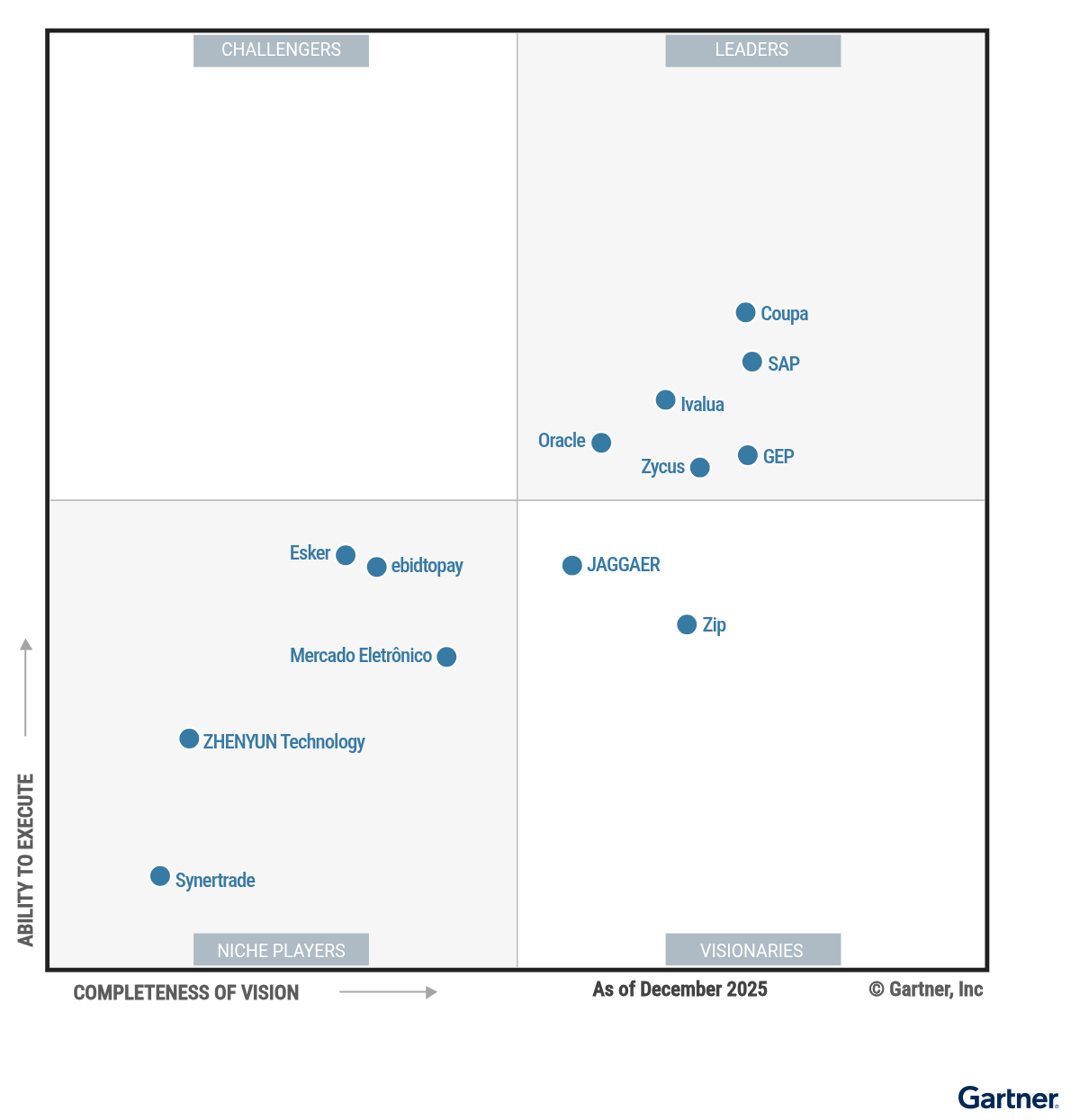
Magic Quadrant
Vendor Strengths and Cautions
Coupa
Coupa is a Leader in this Magic Quadrant. Its Coupa Total Spend Management unifies processes across supply chain modeling, procurement and treasury functions. Coupa’s global operations serve clients ranging from small prerevenue enterprises (like pharmaceutical and technology companies) to large multinational corporations. Coupa’s investment focus areas include building an agentic AI-native engagement platform, deeper integration with its supply chain modeling solution, and enhanced supplier engagement and fulfillment.
- Sales execution: Coupa continues to grow at faster-than-market rates. Gartner has also heard via customer interactions that Coupa is providing greater flexibility to “rightsize” renewal contracts to align with actual customer usage.
- Product strategy: Coupa’s acquisition of Cirtuo will enable Coupa to execute a full category strategy. This will include AI classification integration to standardize and enrich spend data, construction of a scalable taxonomy, and integration with core sourcing and sourcing optimization for seamless execution.
- Deployment models: Coupa offers a variety of options for deploying its S2P solution, ranging from standard multitenant to partner- or customer-managed cloud options. It also offers Federal Risk and Authorization Management Program (FedRAMP) options that are highly attractive for customers in the public sector.
- Vertical strategy: Coupa continues to focus its vertical strategy on one configurable product designed to cater to everyone. Coupa also typically doesn’t engage in customer-specific development, so buyers in industries with nonstandard use cases should evaluate Coupa’s ability to support their specific requirements.
- AI pricing strategy: Coupa is pricing advanced AI through a token model. Given the newness of Coupa’s agentic AI functionality, long-term customers’ usage and costs remain unclear for now. Customers should confirm they understand Coupa’s cost model for AI and how the vendor determines its annual usage estimates.
- User interface: A wave of updated UIs swept across the S2P landscape during the evaluation period, but Coupa’s updated UI was still under development during this time. Prospective customers should ensure that UI is highlighted as a point of difference.
ebidtopay
ebidtopay is a Niche Player in this Magic Quadrant. Its product, also named ebditopay, provides an all-purpose purchasing solution for the public and private sectors, with well-balanced coverage in both direct and indirect spend. It primarily operates in Europe, serving clients ranging from companies with $100 million to $3 billion in revenue. ebidtopay’s investment focus areas include AI-enhanced processing of unstructured documents, natural language AI-enhanced advanced analytics and savings identification, and material resource planning based in its S2P solution.
- Vertical strategy: ebidtopay offers a number of vertical-specific configuration packages to address industry-specific use cases, including pharmaceutical and food and beverage. Potential buyers with industry-specific needs should evaluate these capabilities’ potential benefits.
- Pricing model: ebidtopay’s pricing model allows customers with smaller budgets to access its solutions without losing functionality. It also offers fixed-price implementations with a true enterprise (unlimited usage) licensing model.
- Customer retention: ebidtopay reported retaining 100% of its customers during the evaluation period, which spanned the previous calendar year. This provides a good proxy of its customers’ happiness with support and the overall product value.
- Geographic coverage: ebidtopay continues to focus its operations on Europe, where its primary customer base and support organization are located. Prospective buyers should closely evaluate ebidtopay’s ability to implement and support in their regions, especially those operating in Asia and Latin America.
- Sales resources: ebidtopay’s sales team is one of the smallest reported in this research. Customers wishing to engage with ebidtopay may need to find one of its resellers to get access.
- Marketing strategy: ebidtopay lacks a brand presence outside of Europe, and it does most of its marketing via trade conferences. Prospective buyers should ensure they have a plan for gaining executive buy-in, as brand recognition will likely be limited.
Esker
Esker is a Niche Player in this Magic Quadrant. Its Esker Source-to-Pay platform specializes in removing functional silos by streamlining sourcing processes, improving policy compliance and enhancing supplier management. Its global operations tend to serve finance and procurement leaders in midsize to large international companies with revenue from $1 billion to $10 billion. Esker’s investment focus areas include AI intelligence and automation enhancements across S2P, agentic AI to improve UI/UX, and advanced predictive analytics.
- Operations: Esker offers a wide variety of product hosting options, from servers it owns directly to major hyperscaler partners. Prospective buyers with limitations on who can host their data (and which geographies can host it) should consider Esker as a flexible option.
- Strong foundation In finance: Esker has a long history in the accounts payable invoice automation (APIA) and order-to-cash markets. Prospective buyers seeking a S2P solution with robust support for finance requirements should consider its finance foundation a key advantage.
- Financial Viability: Esker consistently demonstrates both cash flow positivity and profitability, achieving faster overall growth than the S2P software market. This indicates strong financial viability and resilience to volatility.
- Change in ownership: Esker was taken private in January 2025, with private equity firm Bridgeport Partners buying a majority stake. As with any change in ownership, there will be open questions on strategy and execution changes. Potential customers should evaluate if the ownership change made any material changes to product strategy or the organization.
- Innovation: Compared to other vendors in this research, Esker’s roadmap and number of use cases for advanced AI technology are limited. Customers desiring high levels of cutting-edge AI should review Esker’s roadmap to ensure the organization can meet their requirements.
- Vertical strategy: Esker’s product is a general-purpose solution with a very limited vertical-specific strategy. Prospective buyers that require deep, direct material or edge use cases should evaluate whether Esker’s limited vertical capabilities can meet their needs
GEP
GEP is a Leader in this Magic Quadrant. Its GEP SMART solution and GEP QUANTUM platform support procurement and supply chain operations. Its global operations primarily serve procurement and supply chain organizations with revenue of $1 billion or more, as well as midmarket organizations. GEP’s investment focus areas include agentic AI-powered orchestration in procurement and supply chain, featuring an advanced agentic AI studio for building agents, and further enhancements to intelligent category management and multitier supplier and risk management.
- Agentic AI strategy: GEP Qi is an enterprise-grade and platform-based agentic system that includes the AI assistant, intelligent agents and the AI Studio. This solution gives potential customers a clear indication of its product strategy direction and how clients can build and support their own agents.
- Vertical strategy: GEP has a strong history of support for complex, industry-specific requirements. Potential buyers in complex or highly regulated industries should evaluate how GEP’s industry-specific functionality compares to general-purpose solutions.
- Partnership strategy: GEP continues to expand its service provider partnership strategy to reach markets and industries it traditionally hasn’t directly serviced. These partnerships also give potential customers more channels by which to engage with GEP without requiring the vendor to provide services.
- Customers on GEP QUANTUM: Customers have been slower to adopt the GEP QUANTUM platform due to the potential effort and change management required for the upgrade. This research only evaluates GEP SMART’s functionality on the GEP QUANTUM platform, so existing customers may not see the same capabilities. New customers should complete reference checks with customers on GEP QUANTUM.
- Customer support: GEP’s average number of outstanding customer support tickets is higher than other S2P vendors in this research. Customers should evaluate how GEP’s support model aligns with their requirements and tactics to reduce the need to raise support tickets.
- Customer perception: Some buyers may still primarily associate GEP with its service heritage, which can require additional clarification during evaluations.
Ivalua
Ivalua is a Leader in this Magic Quadrant. Its Ivalua Source-to-Pay product provides a unified spend management experience that features a single codebase, data model and UI. Its global operations serve clients from various industries, with most customers exceeding $1 billion in revenue. Ivalua’s investment focus areas include building a hybrid human-agent operating platform that fully embeds agentic AI, enhancements to direct material sourcing and procurement, and AI-powered intake and orchestration.
- Product strategy: Ivalua delivers its solution on a highly configurable platform that allows for both customization and the ability to take standard upgrades. Ivalua also supports EU data privacy regulations and offers multiple deployment models.
- Customer experience: In this research, Ivalua had the shortest average time open for support tickets (well under one day) and the highest overall average contract retention rate. Ivalua also provides customers with three environments by default (development, test and production).
- AI investments: Ivalua has made significant investments in research and development of advanced AI technology. This includes its founder taking on the chief AI officer role. Ivalua also works with multiple LLMs to offer agentic and generative AI capabilities to its customers, as well as a bring-your-own-LLM option.
- Hosting partners: Ivalua has fewer hosting partners than most of the other S2P vendors in this research. Customers that desire specific hyperscalers or locations may find Ivalua’s options limiting.
- Geographic strategy: Ivalua’s market strategy prioritizes organic, customer-led growth, with a strong concentration of customers in Europe and North America alongside a growing global customer base. Prospective buyers should evaluate Ivalua’s global delivery and support model to ensure alignment with their geographic requirements.
- Sales execution: Ivalua’s total customer base remains smaller than many of the other Leaders in this Magic Quadrant. Potential customers may not have as many peer connections to share best practices, so should evaluate Ivalua’s customer community programs, such as their online communities and physical and virtual events, to meet those needs.
JAGGAER
JAGGAER is a Visionary in this Magic Quadrant. Its JAGGAER One product offers an AI-powered S2P solution that supports all spend categories and provides several vertical-specific capabilities. Its global operations tend to serve large organizations across various industries. JAGGAER’s investment focus areas include expanding agentic AI through its JAI personal assistant, enhanced process orchestration that connects JAGGAER with third-party systems, and improved multitier supplier management with predictive analytics.
- Industry-specific extensions: JAGGAER provides multiple add-ons, configurations and capabilities for industries with additional requirements for its S2P tool (such as manufacturing, life sciences and higher education/public sector).
- Product strategy: JAGGAER’s long history in the market provides it with a clear understanding of procurement’s priorities and an ability to translate them into useful functionality. Its product strategy aligns with these priorities, with notable emphasis on developing capabilities that support direct material sourcing and procurement processes.
- Operations: JAGGAER reported the lowest overall downtime in this research. The vendor also offers hosting options in the Middle East, where hosting requirements can be more stringent.
- Change in leadership: JAGGAER has hired a new CEO, and much of its leadership team is new as of 2025. Potential customers should review near-term changes to JAGGAER’s operations and product delivery to evaluate how well these new leaders execute the organization’s strategy.
- Customer experience: While JAGGAER has made strides, the average number of days to resolve support tickets remains above average and its logo retention rates are below average. Potential customers should evaluate how support processes are evolving and if they fit their requirements.
- Product administration: JAGGAER is one of the few vendors that does not provide customers with tools to transport configurations from development to production environments. Buyers looking for more hands-on controls should evaluate how the vendor handles these transports.
Mercado Eletrônico
Mercado Eletrônico is a Niche Player in this Magic Quadrant. Its ME Source-to-Pay product offers a comprehensive B2B procurement management platform. Its operations are primarily located in Latin America (specifically Brazil and Mexico), Portugal and the U.S. Its clients tend to be large enterprises from various industries. Mercado Eletrônico’s investment focus areas include AI-driven predictive analytics for anticipating market trends and pricing, expanded no-code/low-code capabilities with an app marketplace, and enhanced supplier risk and compliance management.
- Operations: Mercado Eletrônico reported one of the lowest downtimes among all the vendors evaluated in this research, and that 100% of its customers run its product’s latest version.
- Supplier adoption: Mercado Eletrônico views suppliers and customers as equally important to the S2P process, a deviation from most S2P vendors. This is extremely beneficial for customers looking to start sourcing and buying quickly with engaged suppliers.
- Pricing model: Mercado Eletrônico’s pricing model is the only one in this research that, optionally, suppliers can fully fund. This could bring the buyer customer’s cost down to zero, or even make procurement a profit center. This offers prospective buyers a unique advantage.
- Limited coverage outside Latin America: Despite Mercado Eletrônico’s efforts to expand its operations outside South and Latin America, its global operations are still limited. Mercado Eletrônico has customer growth and support in North America and Europe, but prospective buyers in those regions should ensure that Mercado Eletrônico can sufficiently support their operations.
- Sales strategy: Mercado Eletrônico has a smaller marketing team compared to other vendors in this research. Prospective buyers may need to spend more time and effort to earn stakeholder buy-in and user acceptance for Mercado Eletrônico compared to other vendors.
- Vertical strategy: Mercado Eletrônico’s strategy centers on providing a general-purpose solution, so verticals with unique use cases may struggle to get industry-specific functionality from the vendor.
Oracle
Oracle is a Leader in this Magic Quadrant. Its Oracle Fusion Cloud Applications platform delivers tools for spend and policy governance across the S2P process to procurement and finance organizations. Its global operations serve clients ranging from companies with $100 million to $10 billion or more in revenue, spanning across industries. Oracle’s investment focus areas include agentic and generative AI to streamline tasks and process orchestration, completion of the Redwood UI across S2P, and increased support for process- and flow-based industries.
- Operations: Oracle has a wide variety of security certifications to meet almost any customer requirement, including FedRAMP. All of Oracle’s customers are on the last two releases, and upgrades are required to keep customers on the latest codebase.
- Vertical strategy: Oracle offers packaged extensions to support unique vertical use cases and allow third-party development usable across the Oracle customer base, beyond the dedicated vertical-specific roadmap that Oracle maintains. Oracle also controls the hardware, database and cloud infrastructure layers that enable deeper support for niche, non-software-related requirements than what other S2P solutions offer.
- Agentic AI strategy: Oracle released its agentic AI development studio for its Oracle Fusion Cloud Applications platform, where customers can design and manage both Oracle-provided agents or agents they create themselves. Oracle does not charge for industry-standard LLMs when accessed using agents created with Oracle’s prebuilt templates, so customers have cost certainty.
- Non-Oracle Fusion ERPs: Oracle Fusion Cloud Applications are designed to work within full-stack Oracle deployments that include cloud infrastructure and databases. Prospective buyers using non-Oracle technology infrastructure should carefully assess the potential challenges with deploying Oracle’s S2P solution.
- Product awareness: Oracle does little to promote sourcing and procurement technologies outside the scope of a larger Oracle Fusion suite proposition. Even users of Oracle’s older, on-premises procurement solutions are often unaware of Oracle’s cloud S2P solution. This can create challenges in change management and user acceptance for prospective buyers migrating from an Oracle on-premises S2P solution.
- Customer experience: Gartner customer interactions report that support levels and speed of addressing issues could be improved. Potential customers should confirm that Oracle’s support operations will meet their requirements.
SAP
SAP is a Leader in this Magic Quadrant. Its SAP Ariba solutions provide a full suite of enterprise-level functionality spanning the full S2P functional scope. Its global operations tend to serve large enterprises across all sectors and types of spend. SAP Ariba’s investment focus areas include platform updates that enable agentic AI and an updated UI, agents based on SAP’s Joule assistant and generative AI for process automation, and supplier 360 profiles to enhance the supplier value proposition and collaboration.
- Product strategy: SAP will deliver a platform upgrade in 2026 that will effectively complete its technical architecture’s modernization and open the door to more agentic and generative AI use cases. SAP is also working on an updated UI/UX consistent across all SAP Business Suite products that should simplify the user experience.
- Scale: SAP continues to prove its ability to deploy and support an S2P solution that meets global requirements and high transaction volumes. SAP has the largest supplier network in the S2P market, making it attractive for customers looking to automate their supplier interactions.
- Operations: SAP offers customers a number of cloud deployment options across the major hyperscalers and major geographic locations. It also holds virtually all the major certifications that customers require, including FedRAMP accreditations.
- AI cost model complexity: SAP’s AI model offers free basic use cases, but charges a per-user/per-month license cost to access advanced use cases (in addition to the standard product licensing). At time of writing, it is unclear how much the AI license fees will impact total pricing. Potential customers should evaluate how this model could impact their total licensing costs.
- Go-to-market: SAP has renewed its focus on cross-selling the Ariba S2P suite with its other ERP and supply chain products. Customers with a robust SAP ecosystem should not be concerned. While SAP is ERP-agnostic, customers with mixed enterprise application technology stacks should confirm that they’re comfortable with SAP’s long-term plans to support non-SAP applications.
- Number of AI use cases: SAP’s reported number of generative AI use cases was in the middle of the vendors evaluated. While number of use cases is only one measurement, potential customers should evaluate how planned AI innovations align with their requirements.
Synertrade
Synertrade is a Niche Player in this Magic Quadrant. Its Synertrade 5 suite targets larger enterprises seeking full S2P technology that supports direct material procurement. It primarily operates in Europe, serving clients that range from $500 million to $50 billion in revenue. Synertrade’s investment focus areas include updates to the UI/UX to simplify user adoption, prescriptive spend analytics, and generative AI enhancements for decision support.
- European customer support: Synertrade offers around-the-clock support in multiple languages for direct support and a chatbot that can support any language. This support is located in the European region for better alignment to clients’ business hours.
- Sales strategy: Synertrade comprehensively supports customer efforts to effectively communicate its value proposition and secure internal stakeholder buy-in. This can include stakeholder mapping and business cast development.
- Pricing strategy: Synertrade provides all customers with fully itemized pricing, which is rapidly disappearing in the S2P market. The detailed price breakdown allows customers to fully understand costs for each piece of functionality they’re procuring.
- Sales execution: Synertrade had the lowest new customer acquisition among the vendors evaluated in this research. Its largest deal size is also among the lowest reported for this research.
- Customer experience: Synertrade’s average number of open support tickets was higher than most other vendors evaluated in this research; these tickets also remained open for longer than most other vendors. Potential customers should evaluate if Synertrade’s support model fits their requirements.
- Low focus on innovation: Synertrade’s roadmap prioritizes UX and UI, as well as extending existing functionalities, rather than adding advanced functionalities and support for agentic or generative AI. Customers should evaluate Synertrade’s long-term roadmap and assess its ability to align with their evolving needs.
ZHENYUN Technology
ZHENYUN Technology is a Niche Player in this Magic Quadrant. Its ZHENYUN Digital Technology Procurement Platform primarily deals with direct material use cases, but it also excels in managing indirect goods and services. It primarily operates in China, and it tends to serve large manufacturing enterprises. ZHENYUN’s investment focus areas include AI assistants to simplify workflows, automated system configurations based on best practices, and supply chain forecasting and planning.
- Direct material capabilities: Many of ZHENYUN’s customers lack the traditional ERP systems that handle transactions, so ZHENYUN offers a strong set of capabilities related to direct material procurement. Prospective buyers without access to ERP solutions should consider the vendor’s direct material capabilities an advantage.
- Licensing cost: ZHENYUN leverages its low corporate overhead in China to drive a more aggressive pricing strategy compared to most other vendors in this research. ZHENYUN was the only vendor with decreasing licensing costs over the past year.
- Deployment model: ZHENYUN supports all deployment models, ranging from on-premises to all cloud types, as well as single-tenant and multitenant options. Prospective buyers that must match the technical deployment with specific requirements should consider its flexibility an advantage.
- AI roadmap: ZHENYUN’s product roadmap contains relatively few agentic and generative AI use cases compared to the other vendors evaluated in this research. Customers that are looking to automate and add intelligence via AI should review ZHENYUN’s roadmap to determine if it will fit expectations.
- Sales strategy: ZHENYUN is still in the very early stages of selling its product outside of Southeast Asia, with go-to-market partnerships in Europe and North America. Customers outside of this area may find it difficult to engage with ZHENYUN sales or partners.
- Geographic support coverage: ZHENYUN’s support is all located in China and only offers native support for five languages. Prospective buyers outside of China should evaluate if ZHENYUN’s current support model will meet their requirements.
Zip
Zip is a Visionary in this Magic Quadrant. Its Zip Procurement Orchestration platform provides a natural language-first environment for orchestrating and executing the end-to-end intake-to-pay process. Its U.S.- and EMEA- based operations serve clients ranging from midsize companies to large enterprises, mainly in North America and Europe. Zip’s investment focus areas include agentic AI-powered workflow orchestration, enhancement of sourcing, contract life cycle management, risk modules to deepen the use cases it supports, and vertical and geographic functional enhancements.
- Orchestration: Zip’s flexible workflow and integration platform offers customers advanced capabilities for building integrations right into workflows. This allows for process automation that is difficult to replicate in other S2P solutions. Potential buyers with a desire to build workflows that include many third-party and cross-functional solutions may find them easier to integrate with Zip.
- Innovation: Zip’s robust product roadmap heavily focuses on agentic AI use cases, rather than building out traditional functional workflows. Customers with forward-looking AI strategies will likely find that Zip can invest more in agentic and generative AI use cases, as there is little to no existing tech debt to rework to enable AI.
- Administration: Zip Procurement Orchestration is designed to be administered by business users, rather than by IT staff. This can enable quicker process improvements or changes as business needs evolve. This doesn’t completely eliminate IT support, but it likely will be greatly reduced.
- S2C functional depth: Zip is actively expanding its functional depth for upstream modules. For example, it is currently missing functionality like auctions. Its contract redlining and negotiations are also limited. Potential buyers looking for deep support for specialized S2C use cases should evaluate if Zip’s functional gaps would present any issues.
- Presence outside of North America: Zip is still expanding its sales and operations footprint outside of North America. This limitation would have the largest impact on potential customers in Asia and South America. Buyers in those regions should confirm that Zip can meet their requirements before engaging.
- Smaller full S2P customer base: Some of Zip’s S2P product is newer to the market, and therefore there are fewer customers using it in a full S2P scenario. Buyers may find it harder to find reference Zip customers that are using every S2P module for end-to-end scenarios.
Zycus
Zycus is a Leader in this Magic Quadrant. Its Zycus Source to Pay platform, powered by Merlin Agentic AI, provides a value-driven S2P suite. Its global operations serve clients ranging from midsize companies to large enterprises. Zycus’ investment focus areas include intake technology for end users and suppliers to simplify processes, agentic AI for broad processes like tail spend management through autonomous negotiation, and context-aware AI for security and control, even when processes access third-party applications.
- Product: Zycus has a well-rounded product that provides above-average functionality across the S2P suite, as well as agentic AI investments in newer functional areas such as intake and orchestration and autonomous negotiation. Zycus is also willing to co-develop with customers, and has an active prerelease program that allows customers to provide early feedback.
- Marketing: Zycus continues to aggressively invest in marketing to increase and maintain its brand awareness. Gartner clients particularly cite the Merlin AI brand as a reason for their engagement with Zycus. The vendor also uses a combination of marketing channels and region-specific strategies to drive customer engagement.
- Customer experience: Compared to other vendors evaluated in this research, Zycus ranked among the best in terms of the number of support tickets generated by customers. Zycus has support centers in all regions of the world except South America, and it provides a Smart Admin function that automatically transports configurations from test environments to procurement environments.
- Operations: Zycus offers fewer data center locations and hyperscaler partners than most of the other vendors evaluated in this research. Customers that require specific hyperscalers or locations should confirm that Zycus can meet these requirements.
- AI cost: Zycus sells much of its AI innovations as add-ons to existing modules. This model, while flexible for customers that do not want AI, incurs additional costs for those that do. Customers evaluating Zycus’ AI roadmap should confirm what the base pricing includes and what will incur an additional cost.
- Sales execution: Zycus added fewer new customers than any other Leader in this Magic Quadrant. Gartner customer interactions corroborate this with fairly consistent testimony that, while Zycus’ product does well in evaluation, the sales process and team raise concerns about signing a deal.
Vendors Added and Dropped
We review and adjust our inclusion criteria for Magic Quadrants as markets change. As a result of these adjustments, the mix of vendors in any Magic Quadrant may change over time. A vendor's appearance in a Magic Quadrant one year and not the next does not necessarily indicate that we have changed our opinion of that vendor. It may be a reflection of a change in the market and, therefore, changed evaluation criteria, or of a change of focus by that vendor.
Added
- Zip
Dropped
- No vendors were dropped from this Magic Quadrant.
Inclusion and Exclusion Criteria
To qualify for inclusion in this Magic Quadrant, each vendor must:
- Own the source code, market and offer to sell all the required S2P modules as a single, stand-alone, integrated solution, including:
- Sourcing: Creation and management of strategic and tactical sourcing activities. These include request for information, request for quotation and request for proposals, and the associated collection of information, evaluation, negotiation and the awarding of sourcing events.
- Contract life cycle management: Management of contracts from the initiation stage through the award, compliance and renewal stages.
- Supplier information and performance management: The ability to manage supplier onboarding, data validation and performance.
- Procure-to-pay: Automation of the transactional procurement end-to-end process, which includes purchase requests, purchase orders, catalog management, goods receipts and invoice processing up to OK-to-pay.
- Supplier collaboration portal: Enabling document and information collaboration with suppliers across the S2P process.
- Spend analytics: Robust reporting and analysis of spend activities across all systems and data sources.
- Provide at least one of the following standard capability modules:
- Category management: The ability to create and manage category management strategy documentation and track activities required to execute that strategy.
- Advanced sourcing optimization: A more advanced form of e-sourcing for very complex events that may have thousands of data points to consider for building an award solution.
- Supplier risk management: The ability to monitor, manage and mitigate risk.
- Additionally, S2P modules:
- Must natively integrate together, with no additional integration work required for the customer.
- Must be ERP/financial-system-agnostic, with the ability to integrate into the customer’s chosen ERP/financial system
- Must have at least 40 customers (logos) with $500 million in revenue or operating budget (or more) live in production that run the defined required modules and at least one of the standard modules.
- Must have added 12 or more new customers (logos) with $500 million in revenue or operating budget (or more) signed in calendar year 2024 that bought the defined required modules and at least one of the standard modules.
- In the last 12 months, must have sold at least the defined S2P required modules and at least one of the standard modules to four or more customers, with expected primary usage in different geographic regions from the vendor’s home region. Geographic regions are defined as: North America, Latin America, Europe, Middle East and Africa, and the Asia/Pacific region and Japan.
Honorable Mentions
Raindrop — Raindrop has shown significant market sales growth during its six-year life span and has expanded its solution to offer a full S2P suite. Raindrop is built on a modern platform with a significant amount of AI and generative AI functionality built in. While it did not meet the inclusion threshold for number of existing customers running a full S2P suite, Raindrop continues to serve sourcing and procurement teams looking for greater agility, transparency and control, particularly, those seeking to modernize legacy systems or accelerate digital transformation without the complex cost of traditional enterprise suites.
Evaluation Criteria
Ability to Execute
Gartner evaluates an S2P suite vendor’s Ability to Execute by assessing its products, services, sales, marketing execution and overall operations. We evaluate how these criteria enable the vendor to be competitive and effective in the market. We also evaluate the vendor’s ability to retain and satisfy customers, create a positive perception, and respond to market changes.
The ability to provide a product and a customer experience that delights clients is what drives value and motivates buyers to choose one solution over another and, as a result, the product carries the highest weighting in this research.
Overall viability, along with sales execution/pricing, is important because customers buying S2P suites are making a major, potentially long-term commitment with high switching costs. Vendors experiencing declining sales or financial instability often find themselves in a detrimental cycle. As customers become hesitant to purchase from these struggling vendors, the vendors’ ability to invest in product development diminishes, rendering them even less appealing to potential new customers.
Operations are important, as they impact the vendor’s ability to deliver on its stated roadmap and effectively run the business. Issues in either of these areas directly impact a customer’s ability to drive additional value from its S2P investments.
Customer experience relates to the quality of customer support and other customer-facing areas such as user groups, conferences and cross-customer engagement opportunities. A strong customer experience directly impacts a customer’s ability to implement and support the vendor’s S2P solution over the long term. Breakdowns in this area often lead to an erosion of the overall value proposition and the ROI the customer obtains.
Marketing execution is weighted low because driving potential customer awareness is important for a viable sales pipeline and is therefore a component of the vendor’s long-term health.
Market responsiveness/record was not rated because we have found that it is highly correlated with operations and sales execution/pricing elements. Given the size of an S2P suite, only minor changes can be made to the codebase on short timelines. However, the ability to adjust factors like pricing, terms and operational execution is a strong indicator of a vendor’s capacity to swiftly respond to changing customer demands.
Ability to Execute Evaluation Criteria
| Evaluation Criteria | Weighting |
|---|---|
Product or Service | High |
Overall Viability | Medium |
Sales Execution/Pricing | Medium |
Market Responsiveness/Record | NotRated |
Marketing Execution | Low |
Customer Experience | Medium |
Operations | Medium |
Source: Gartner (January 2026)
Completeness of Vision
Gartner evaluates an S2P vendor’s Completeness of Vision by assessing multiple criteria that show its ability to understand current market trends, influence the future state of the market, and respond to customer needs and competitive forces.
In a rapidly evolving market, product strategy and innovation are key differentiators between vendors and their ability to anticipate and respond to future customer requirements. Market understanding and geographic strategy both demonstrate a vendor’s ability to comprehend customer demands and deliver value to organizations of varying sizes worldwide. These criteria are split, as many vendors have effective visions for the future market, but lack a strategy to deliver to customers, no matter their location, due to a large part of the market that may be inaccessible to them.
A vendor’s Completeness of Vision is also judged on sales and vertical/industry strategies, although at a lower weighting. There are differences in sales strategies that may work for certain market segments, such as the midmarket, that will not work for large enterprises. Industry-specific functionality is often delivered via different strategies that are more attractive to customers in industries with complex needs, such as oil and gas or defense.
Marketing strategy and business model were not evaluated in this research. The S2P market is characterized by long sales cycles, and marketing methods to potential customers are fairly standardized across the space, so differentiation is not highly valued by customers. Business models in this market are also highly standardized around software licensing, and there is no clear better or worse business model that would materially impact buying decisions.
Completeness of Vision Evaluation Criteria
| Evaluation Criteria | Weighting |
|---|---|
Market Understanding | Medium |
Marketing Strategy | NotRated |
Sales Strategy | Low |
Offering (Product) Strategy | High |
Business Model | NotRated |
Vertical/Industry Strategy | Low |
Innovation | High |
Geographic Strategy | Medium |
Source: Gartner (January 2026)
Quadrant Descriptions
Leaders
Leaders are in the strongest position to influence the market’s growth and direction. They demonstrate a market-defining vision of how S2P technology can help procurement leaders achieve business objectives for managing compliance and controlling external spend. Leaders have the Ability to Execute against that vision, through products that can address global requirements and are well adopted by their customers. Leaders also have demonstrated business results in the form of revenue growth and financial stability. They excel in their combination of market understanding, innovation, product features and functions, and overall viability.
While maintaining a well-established base of long-term customers, Leaders consistently demonstrate a strong ability to win new deals and deliver successful implementations. Their customers are deployed across the most diverse geographic regions, and they cover a wide variety of industry verticals and organization sizes. Strong generative and agentic AI strategies are essential to customers; as such, Leaders all demonstrate that requirement.
Leaders are often the vendors against which other providers measure themselves. They also are the most likely vendors in this Magic Quadrant to still be in the S2P suite business five years from now. Leaders are suitable vendors for most organizations to evaluate when seeking an S2P suite. However, they should not be the only vendors evaluated.
Challengers
Challengers have established presence, credibility and viability, and have demonstrated the ability to meet customers’ expectations in terms of functionality and customer experience. Challengers tend to have a good technology vision in terms of architecture and other IT considerations, but often lack a strategy or vision that is completely aligned with what customers expect from an S2P solution vendor.
Challengers are well-placed to succeed in this market. However, they may not demonstrate thought leadership or innovation to the same degree as Leaders. They may be a good choice for organizations that value execution and a broader, integrated product suite that can be delivered at scale, rather than focusing on the potential of what might be delivered in the future.
Visionaries
Visionaries are ahead of most potential competitors in their vision of what a future S2P solution will look like. These vendors embody trends that are shaping or will shape the S2P market. There may be some lack of awareness of these vendors in the market, and some concerns about their Ability to Execute effectively at scale. Visionaries have a strong vision and roadmap, which brings innovation and strong functionality to their platforms. Strong generative and agentic AI strategies are common with Visionaries.
Visionaries may be a good choice for organizations that want innovation without a big brand or a premium price. These vendors may also provide customers with the opportunity to more quickly evolve their S2P technical maturity and have a greater say in the product roadmap. They often lack the proof points of referenceable customers that are using the full S2P suite at scale, but can still show proof of large customers. However, as these vendors mature and prove their Ability to Execute, they may become Leaders.
Niche Players
Niche Players offer compelling S2P suite portfolios, but their solutions may also:
- Be limited in terms of cross-industry adoption
- Lack some functional components
- Lack the ability to handle deployments consistently across multiple geographies
- Lack strong business execution in the market
- Have an inconsistent implementation track record
- Lack the ability to support large enterprise requirements or complex global deployments
Niche Players can often offer the best solutions to meet the needs of particular procurement organizations, considering the price-to-value ratio of their solutions. These vendors may win deals in specific regions or industries, but they are not consistently winning new business across multiple regions or industries at the same pace as vendors in the other quadrants.
Some Niche Players demonstrate a degree of vision that suggests they might become Visionaries; however, they may struggle to make this vision compelling. They may also struggle to develop a track record of continual innovation. Other Niche Players may have the opportunity to become Challengers if they continue to develop their products with a view to improving their overall execution.
Context
S2P suites help organizations automate the entire end-to-end sourcing and procurement process within a single integrated solution. However, vendors in the S2P market may not have market-leading capabilities across the full suite. Most vendors started with smaller solutions in different categories, such as procurement, sourcing, spend analytics or APIA, and expanded their products either organically or through acquisition to address the entire functional space.
The S2P market is relatively mature as a result; however, the breadth of functionality and use cases varies among vendors, and customers may need to make compromises or obtain supplemental solutions to address their specific needs. Newer entrants from adjacent market spaces, such as intake and orchestration vendors, are adding to customer buying options, although typically with lighter overall functionality.
Procurement technology leaders should:
- Use expected outcomes to determine primary use cases. Ensure vendors’ solutions support specific use cases driven by your organizational goals. Examples include providing end-to-end process visibility, reducing the source-to-contract cycle time and consolidating supplier collaboration into a single solution. Automation via advanced AI has become a highly sought-after topic among buyers.
- Ensure the user experience matches users’ expectations. UX expectations are constantly changing, and the capabilities across the market are evolving from the digitization of processes to automation driven by both AI and machine learning. Both of these elements drive an organization’s ability to gain adoption by internal end users. Therefore, their alignment with user expectations and the cost will impact the business case.
- Understand the monetization model for AI. Vendors have different approaches for generative and agentic AI, including offering it at no cost, creating new product SKUs, increasing the price of standard offerings or combining all these approaches. Given the market’s excitement about AI’s expected impact on productivity, customers should ensure they understand both the current and future costs associated with gaining access to this technology.
- Review supplier-facing capabilities, such as network size, features, onboarding practices and UX. Supplier adoption is often a key factor in maximizing the effectiveness of an S2P suite. Large supplier networks and supplier-friendly functionality are generally beneficial in reducing the effort required to gain supplier adoption.
- Understand global requirements. E-invoicing and tax regulations vary by country and are subject to frequent changes. Assess the vendor’s capabilities in processing fully compliant invoices where necessary.
- Explore integration and extension capabilities. Extending and enriching the S2P process can bring more long-term value to your investment. Open APIs for simplified integration are common, but may not cover the entire data model or functionality. Third-party app stores may be available for one-click buying and activation of custom-made capability extensions. Additionally, many solutions offer deeply configurable platforms that enable customer-specific capabilities without negatively impacting the ability to deploy standard upgrades. Orchestration capabilities that allow for two-way integrations to external solutions from directly inside a workflow are becoming more sought after, but less common with traditional S2P solutions.
- Examine industry-specific requirements and experience. S2P suites widely vary in their ability to support sourcing, contracting, supplier management and purchasing practices unique to specific industries (e.g., manufacturing, healthcare, hospitality, public sector and education).
- Compare vendor-led and partner-led implementation models by level of experience, best practices, time frames and costs. Implementation support may vary by region, depending on the availability of local resources. Vendor-led implementation models are typically strong in software configuration and often have a better handoff to long-term support. Partner-led models are typically stronger with business process changes and overall organizational change management.
- Compare on-premises and cloud delivery models. Most vendors included in this research have a preferred multitenant public cloud delivery model. However, some will offer on-premises, private cloud or single-tenant deployment options. If your organization requires specific deployment models, raise that early in the evaluation process.
- Examine differentiating features and vendor roadmaps. Prioritize generative and agentic AI, UI/UX improvements, analytics, and automation in your evaluation. Ensure that the selected vendor is focused on growth and development that tracks with market expectations and trends to future-proof your investment.
- Ensure understanding and alignment with the post-go-live service model. There are various service delivery models (e.g., local and remote support, multiple languages supported, and premium levels of support). Ensure that any specific needs can be met, and be aware of any additional associated costs.
Market Overview
Source-to-pay suites have broad appeal for organizations across all industries and geographies, and interest in them remains high among sourcing and procurement buyers seeking cost savings, process automation and risk reduction in their daily procurement activities. The market offers a wide variety of options, such as ERP-vendor-integrated S2P, stand-alone, cloud-based, and on-premises solutions.
However, while available options are quite comprehensive, customers’ biggest challenge is that no solution is perfect across every dimension. This enables the market to evolve in response to new customer demands and address any incomplete functionality. Gartner estimates that the S2P technology market will experience a five-year compound annual growth rate (CAGR) of 16.3%, resulting in an annual spend of approximately $18.685 billion on S2P software in 2029 (see Forecast: Enterprise Application Software, Worldwide, 2023-2029, 4Q25).
Key differentiators in the market remain similar to those of the previous year, but the list has expanded as customers seek greater flexibility in S2P solutions. They include:
- Agentic and generative AI for automating tasks, simplifying system configuration, updating the user experience to natural language interactions and improving analytics. Many solutions allow customers to bring their own LLMs for custom use cases.
- Intake and process orchestration, which is now top-of-mind for buyers as they seek to both simplify user interaction with S2P solutions and enhance two-way integration with external systems as part of overall workflow management.
- Configurable platforms that allow customers to customize their environment to a much greater degree without any changes to core code.
- Ease of use for internal users and external suppliers, which is critical for successful user and supplier adoption, and essential for success with S2P tools. Modern UIs with mobile support, as well as natural language interfaces, are key to success.
- Depth of support for multiple spend types across sourcing, supplier management, and procurement activities (see Note 1).
- Unified supplier networks that provide a single location for all supplier-facing collaboration.
- Tight integration across the S2P process so that actions and data are linked and visible to upstream and downstream activities.
- Actionable analytics and intelligence that guide users to opportunities to improve their process automation, or to where they can obtain additional savings, quality and policy compliance.
- Global support, supplier onboarding and configurable industry capabilities. Global regulations continue to change, from invoice regulations to “know your supplier” laws, and top S2P solutions need to be able to address these government regulations.
The differentiation between solutions is often not obvious, and hinges on how each solution addresses specific requirements. Procurement technology leaders must complete in-depth evaluations to closely match requirements with solutions, especially considering that S2P implementations and support are significant long-term investments.
Market Trends
Agentic and Generative AI
Intelligent automation is in high demand, even if buyers aren’t specifically calling out agentic AI in their selection criteria. Common desired capabilities include:
- Supplier recommendations for setting up a sourcing event or raising a purchase request
- Chatbot for buying and executing various tasks
- Intelligent digitization of contracts with the extraction of metadata and clauses
- Intelligent risk analysis of contracts
- Assisted authoring or editing of contract language
- Automated creation of category strategies based on inputted data, past orders and market intelligence data feeds
- Automated supplier risk identification from public news sites and social media
- Assisted creation, execution and analysis of sourcing events
- Intelligent invoice digitization, matching and coding
- Analytics created via natural language
- Automated supplier response agents
Category Management
Buyers are increasingly seeking S2P solutions that deliver value beyond process automation. They seek intelligent systems that will help them create strategic plans to drive greater savings and mitigate supply disruption risks. Additionally, buyers want to track the actions taken against their strategic plans and track them to completion for performance reporting. Category management is an area where there is a wide variance in capability across S2P solutions.
Risk Management
Organizations often deploy an S2P suite as a system of record that is ideal for enforcing company policies and mitigating supplier risks. It empowers procurement to influence spend before it occurs by seamlessly guiding end users to suppliers and products that align with internal policies and goals. The desire to quickly reduce or shut off new purchases from high-risk suppliers is also growing, leading to more scrutiny on how well supplier information and risk management are integrated into S2P solutions. Country-level legislation regarding “know your supplier” and carbon footprint reporting is also forcing organizations to implement controls earlier in the S2P process.
Deep Integrations and Orchestration
Customers continue to demand fully internally integrated solutions that enable users to access accurate data and information related to the actions they are taking from anywhere in the solution. Deep integrations reduce errors and magnify the value of the single integrated S2P suite. Examples of deep integrations include:
- Integration of supplier risk ratings into sourcing events
- Contract pricing that can be converted to a shoppable catalog in one click
- Purchase requisitions that can be converted into sourcing events, with the results automatically populated back to the purchase requisition
- Contracts available for matching against invoices
- Negotiated terms in a sourcing event that are automatically included in the final contract
- Updating supplier data based on supplier responses to sourcing events and contract negotiations
Information used to create the inclusion criteria, market definition and vendor evaluations in this Magic Quadrant came from many sources:
- Interactions of Gartner analysts with hundreds of end-user clients regarding their procurement and sourcing initiatives in 2024 and 2025.
- Interactions with procurement and sourcing vendors in 2024 and 2025.
- Verified customer feedback posted on Gartner Peer Insights in 2024 and 2025.
- A series of briefings, video demonstrations and questionnaire responses by the vendors included in this Magic Quadrant.
- Financial data from the S&P Capital IQ platform for the public companies and financial data from the vendors for the private companies. This information was determined using Gartner’s financial model (see Understanding the Methodology Behind Gartner’s Financial Statement Scorecard for Public Companies).
Note 1: Gartner Spend Type and Source-to-Pay Definitions
The spend types are:
- Indirect goods: Purchases of tangible items consumed by the organization that are not directly related to the manufacturing or sales of products. These goods are typically needed to operate.
- Direct goods: Purchases of tangible items directly related to the manufacturing of a company’s products. Examples include raw materials, component parts and hardware.
- Services: Transactions of intangible deliverables purchased by the organization, typically defined by a statement of work.
- S2P: A suite of applications that address spend analysis, sourcing, contract life cycle management, supplier management, supplier risk management, category management and procure-to-pay.
Ability to Execute
Product/Service: Core goods and services offered by the vendor for the defined market. This includes current product/service capabilities, quality, feature sets, skills and so on, whether offered natively or through OEM agreements/partnerships as defined in the market definition and detailed in the subcriteria.
Overall Viability: Viability includes an assessment of the overall organization's financial health, the financial and practical success of the business unit, and the likelihood that the individual business unit will continue investing in the product, will continue offering the product and will advance the state of the art within the organization's portfolio of products.
Sales Execution/Pricing: The vendor's capabilities in all presales activities and the structure that supports them. This includes deal management, pricing and negotiation, presales support, and the overall effectiveness of the sales channel.
Market Responsiveness/Record: Ability to respond, change direction, be flexible and achieve competitive success as opportunities develop, competitors act, customer needs evolve and market dynamics change. This criterion also considers the vendor's history of responsiveness.
Marketing Execution: The clarity, quality, creativity and efficacy of programs designed to deliver the organization's message to influence the market, promote the brand and business, increase awareness of the products, and establish a positive identification with the product/brand and organization in the minds of buyers. This "mind share" can be driven by a combination of publicity, promotional initiatives, thought leadership, word of mouth and sales activities.
Customer Experience: Relationships, products and services/programs that enable clients to be successful with the products evaluated. Specifically, this includes the ways customers receive technical support or account support. This can also include ancillary tools, customer support programs (and the quality thereof), availability of user groups, service-level agreements and so on.
Operations: The ability of the organization to meet its goals and commitments. Factors include the quality of the organizational structure, including skills, experiences, programs, systems and other vehicles that enable the organization to operate effectively and efficiently on an ongoing basis.
Completeness of Vision
Market Understanding: Ability of the vendor to understand buyers' wants and needs and to translate those into products and services. Vendors that show the highest degree of vision listen to and understand buyers' wants and needs, and can shape or enhance those with their added vision.
Marketing Strategy: A clear, differentiated set of messages consistently communicated throughout the organization and externalized through the website, advertising, customer programs and positioning statements.
Sales Strategy: The strategy for selling products that uses the appropriate network of direct and indirect sales, marketing, service, and communication affiliates that extend the scope and depth of market reach, skills, expertise, technologies, services and the customer base.
Offering (Product) Strategy: The vendor's approach to product development and delivery that emphasizes differentiation, functionality, methodology and feature sets as they map to current and future requirements.
Business Model: The soundness and logic of the vendor's underlying business proposition.
Vertical/Industry Strategy: The vendor's strategy to direct resources, skills and offerings to meet the specific needs of individual market segments, including vertical markets.
Innovation: Direct, related, complementary and synergistic layouts of resources, expertise or capital for investment, consolidation, defensive or pre-emptive purposes.
Geographic Strategy: The vendor's strategy to direct resources, skills and offerings to meet the specific needs of geographies outside the "home" or native geography, either directly or through partners, channels and subsidiaries as appropriate for that geography and market.