Market Guide for Software Asset Management Tools
15 January 2026 - ID G00843077 - 62 min read
By Yolanda Harris, Angelica Wekwete, and 1 more
SAM tools decipher the complex and ever-changing software license landscape and aim to meet an increasing, diverse set of SAM tool requirements, for organizations. Sourcing, procurement and vendor management leaders can use this research for tool selection that drives better SAM decisions.
Overview
Key Findings
- Complex software portfolios, spanning legacy and modern metrics across hybrid infrastructures, make it difficult for organizations to understand software usage and identify opportunities to reduce cost and compliance risk. The introduction of new AI-related metrics adds further complexity to tracking and managing these software portfolios.
- Organizations, especially those early in their SAM maturity, will struggle to realize value from software asset management (SAM) tools if they invest without first developing a clear three-to-five-year SAM strategic roadmap and vision. This maturity journey is further complicated by the challenge of effectively implementing new AI capabilities in SAM tools and realizing value from those enhancements.
- The need for strategic cost optimizations has made cost governance a priority for sourcing, procurement and vendor management (SPVM) leaders. However, siloed functions and SAM tools that fail to provide quality, complete, consistent, or accurate data hinder effective cost governance and detract from aggregating data needed to produce the enhanced analytics and insights AI promises, putting SAM teams and their tools at risk of being sidelined.
Recommendations
SPVM leaders must:
- Engage cross-functional stakeholders to understand software needs, deployment, and the impact of new AI-driven metrics across the organization. Use these insights and high-quality data as a foundation to assess SAM tools’ discovery, inventory, usage, and metering capabilities. Recognize that managing complex portfolios and AI-related metrics may require a combination of tools to achieve complete visibility.
- Build a clear three- to five-year SAM strategic roadmap and vision that prepares for future software and infrastructure needs, including the anticipated integration and value realization from AI capabilities. When seeking investment, go beyond financial ROI by quantifying process improvements, such as demand management, risk visibility and capturing end-of-life software data, as these insights drive better decision making and deliver meaningful, actionable data.
- Prioritize data quality, integration, and governance by breaking down silos and collaborating with FinOps teams (or their equivalent) to aggregate and standardize data across disciplines. This combined approach enables enhanced analytics and AI-driven insights, supports effective cost governance and compliance, eliminates waste and delivers a complete, trustworthy view of software usage and spend for more strategic, data-driven decision making.
Strategic Planning Assumptions
By 2028, organizations maximizing SAM tool AI capabilities will increase SAM team productivity significantly, resulting in doubled cost savings and greater efficiencies compared to 2025.
Through 2028, most organizations that merge SAM and FinOps into a central governance function will report substantially less financial waste from software and cloud investments compared to 2025.
Market Definition
Software asset management (SAM) tools aim to decipher the complex and ever-changing world of software licensing. Organizations now have a diverse set of SAM tool requirements to meet. Core capability of SAM tools include discovery, normalization, reconciliation, optimization and reporting.
SAM tools are third-party solutions that provide some level of automation to support tasks required to produce and maintain compliance with independent software vendor (ISV) license use rights. SAM tools provide organizations with a means to manage software throughout its life cycle and centralize the view of software within the organization. SAM tools provide data on software utilization, identify overdeployed and underconsumed licenses, reharvest and reallocate licenses, track renewals and financials for purchased software, and proactively identify software misconfiguration. SAM tools offer integration with third-party tools, and can provide out-of-the-box reporting capabilities and produce management dashboards. The reporting and dashboards recommend areas for optimization.
SAM tools help address these common use cases:
- Discovery of software on on-premises, virtual and cloud platforms.
- Software entitlement management through a central repository, to track purchase data and contractual commitments.
- Spend management through demand forecasting, downgrading of entitlements, and reallocating of unused licenses or licenses assigned to leavers.
- Provision of software data insights by identifying licenses allocated to users and devices, software metering, providing usage data to procurement teams, and rightsizing. Ability to share data on software rationalization opportunities.
- Risk identification by detecting shadow usage, as well as end-of-life and end-of-support software.
- Increased collaboration between teams that participate in the software application life cycle, including all stakeholders internal and external to IT.
- Creation of reporting dashboards for operations teams and management.
Mandatory Features
- Conduct discovery: Interrogate networks to find the physical, virtual and cloud platforms upon which software executes. Explore vendor portals, procurement systems and other data sources to obtain software contract and purchase records.
- Identify platform consumption: Capture platform-agnostic configuration data and extract a list of all software and software consumption levels. Identifying the software installed on, accessed on or executing upon a platform (as in the case of instance-based software licenses) is foundational to SAM.
- Capture entitlements: Analyze software contracts, purchases and procurement records to obtain the entitlements for software consumption conferred by a given license agreement.
- Normalize data: Consolidate multiple platform consumption datasets and other data sources to resolve duplicated or conflicting records. Consolidate multiple software entitlement records and other supporting data. This creates a single, accurate, organized and categorized dataset.
- Reconcile: Correlate contract, purchase and entitlement records with normalized platform inventory data. This creates an effective license position (ELP), which is the comparison of recorded license entitlements to actual license consumption. ELP provides a basis for compliance management, risk reduction, audit defense, contract (re)negotiations, license “true-ups” and software spend optimization.
- Govern: Allow organizations to properly allocate licenses, proactively identify remediation actions for inaccurate data and noncompliance, and automate workflows to improve process compliance.
- Optimize software entitlements and consumption: Track changes to software license models, and improve and balance software spending by comparing usage to estimated demand for the quantity, type and expense of licenses needed and in use.
- Share software asset information: Consume and produce information for use across other organizational functions, systems and processes. A central system of record for IT assets enables the enterprise to manage vendors and software assets throughout their life cycles.
Common Features
- Integrations into third-party systems
- API integrations into SaaS vendor portals
- Provision of end-of-life/end-of-support information
- Software renewals management
- Automation of software consumption data collection
- Creation of a software request catalog
- Automated workflows
- Optimization of software value delivery
- Sharing of information with other tools and stakeholders
Market Description
The software market’s rapid evolution, driven by new licensing rules and metrics, simplified purchasing methods, the shift to hybrid infrastructure, and the growing adoption of AI-powered solutions, continues to increase the complexity of software management.
Modern and complex technical use cases for managing the software life cycle have seen the SAM tools market diversify into four distinct categories. The SAM tools categories (discussed below) are:
- Hybrid environments
- SaaS
- SAP
- Engineering and specialty software
Vendors represented in this Market Guide fall into one or multiple categories. While some vendors in this space have been operating for over 20 years, innovation has remained steady. Historically, the primary driver for investment in SAM tools has been the need to ensure compliance with license use rights and mitigate the risk of vendor audits for on-premises software, while for SaaS, the focus has shifted toward cost control, efficiency, and security management. Although audit risk remains a significant motivator, the market is increasingly pressured by additional factors, including the need to manage escalating hyperscaler spend, shadow IT and the complexities introduced by AI and other emerging technologies. As a result, organizations now seek to minimize risk, optimize costs, and improve decision making by leveraging SAM tools to manage software and triangulate data (i.e., discovery, financial, and contractual). These efforts span the entire software life cycle.
SAM tools must perform the following 10 key activities (see Figure 1).
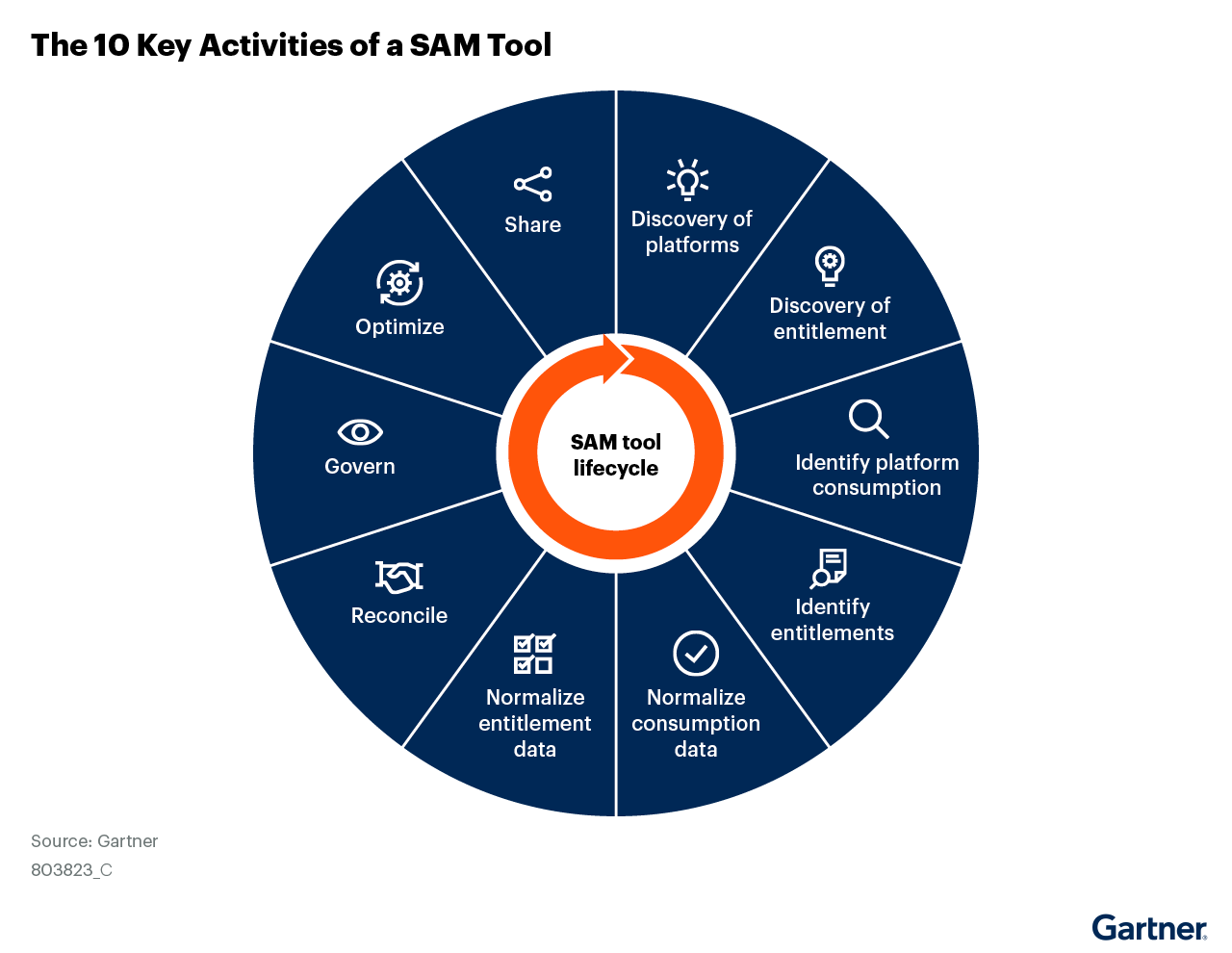
The depth, breadth and automation of SAM activities will vary by vendor. Organizations must assess vendors based on their functional requirements, software portfolio and existing infrastructure during the RFI or RFP stage. In parallel, organizations should also evaluate their current state of data quality and software purchasing life cycle processes. To ensure a comprehensive assessment of SAM tooling and data requirements, organizations should engage the following functions to gather input on integration needs, data flows, and process alignment:
- Enterprise architecture
- IT sourcing and procurement
- IT vendor management
- Security
- Infrastructure and operations
- IT service management (ITSM)
- Finance
By considering these perspectives, organizations can better identify SAM solutions that align with their operational needs and integration requirements. The SAM tool market consists of vendors that can meet the needs of large organizations as well as small to midsize organizations across industries. Customers can source these tools through the vendor, channel partners or software marketplaces. Some of these tools can be delivered on-premises, but vendors are increasingly moving toward SaaS delivery. The tools within each category can be purchased independently to meet a specific business need, such as managing SAP or engineering software, or as part of a wider solution that spans multiple categories. Buyers should note that many SAM tools rely on third-party technology or partnerships, which can affect the tool’s capabilities and long-term value.
As organizations evaluate and implement these solutions, it is important to recognize that the SAM tool landscape is rapidly evolving, with vendors increasing out-of-the-box API integrations to enable more comprehensive and accessible data views across the enterprise. However, despite these enhanced integration capabilities, SAM tools alone are not sufficient to deliver meaningful business outcomes. Organizations must invest in skilled resources who can interpret and apply data insights within their unique business context and establish robust processes to operationalize those insights. When evaluating SAM tools, buyers should prioritize internal capabilities for data analysis, governance and process management. Additionally, some vendors have formed alliances with SAM managed service providers (SAM MSPs) that can host and manage the technology, augment staff and support process development and implementation, helping organizations bridge skills gaps and accelerate value realization from their SAM investments.
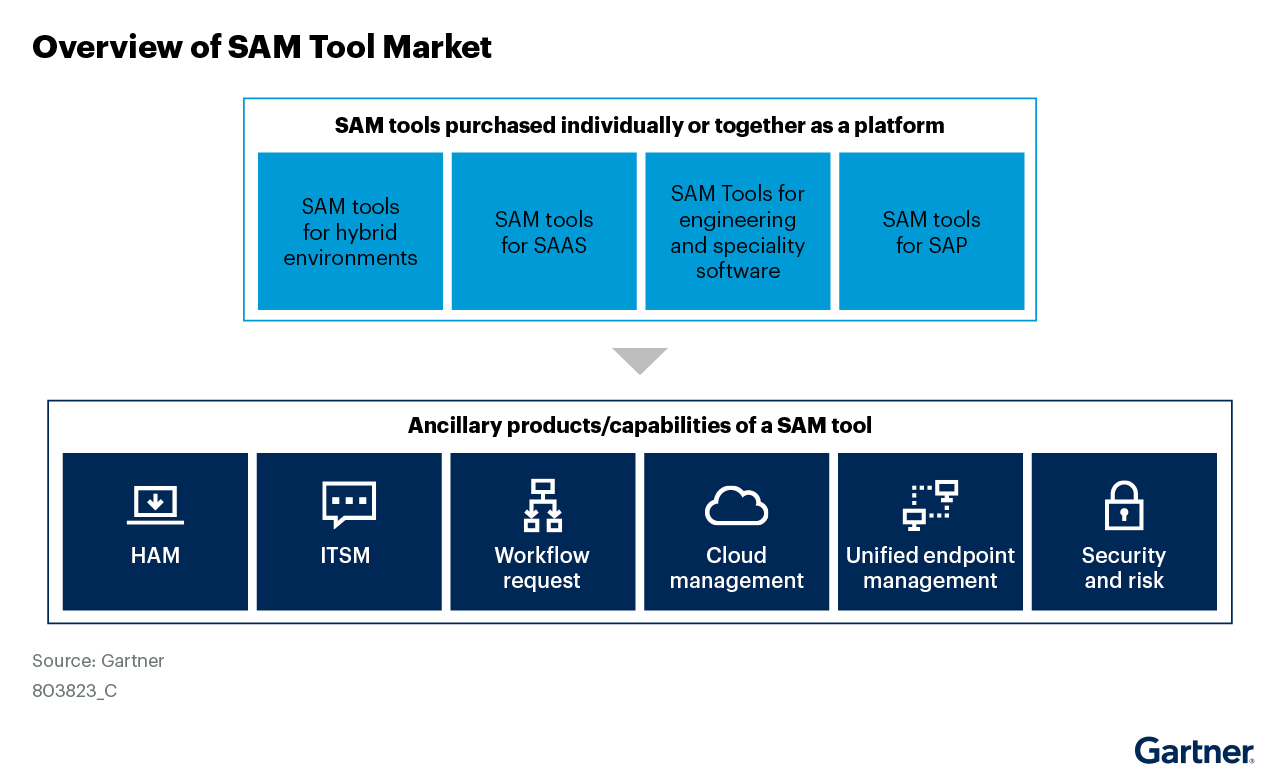
Building on this evolution, the SAM tools market is also expanding beyond its core activities, with some vendors now offering ancillary products and modules in response to emerging market trends and customer needs. These additional offerings are often sold as add-ons or optional modules (see Figure 2).
Market Direction
Software is the foundation of most technology and digital initiatives — a fact that has become even more apparent with the recent impact of AI. The requirement for organizations to manage the complete software life cycle continues to be a burning topic among IT leaders. Client interest in SAM tools will continue to be a priority topic, as indicated by Gartner client interactions on SAM tools increasing by 18% during the last 12 months.1 In most organizations, the software portfolio has increased dramatically and will continue to be driven by:
- Prioritized investments in technology and innovation to drive competitive advantage and navigate current economic volatility, a top three strategy reported by 63% of nonexecutive directors in the 2026 Gartner Board of Directors Survey.2
- The rapid adoption and integration of AI technologies, which is accelerating IT and software spending as organizations invest in AI-powered solutions, platforms and tools to enhance analytics, automation, and innovation.
- The SaaS revolution that has led to a more commercially viable route to market for software vendors (established and startup).
- Software purchasing becoming highly democratized, including through marketplaces.
- Budgets related to digital initiatives being moved into the business.
- The demands from organizations for more capable software applications by users and technology teams.
- Changes in architectures, including the move to cloud and adoption of cloud-native technologies.
Software publishers will continue to innovate and deliver new cutting-edge features, such as GenAI, which will be embedded within their offering, as well as software to be deployed, executed or accessed upon a variety of infrastructures and devices. This inherently will place greater emphasis on the need for deeper, easier and accessible visibility data from SAM tools.
Failure to provide this visibility will leave organizations vulnerable to significant expense and risk and may lead to reduced trust in the SAM tool and its vendor, prompting organizations to reevaluate their SAM tool choices. To mitigate these risks, SPVM leaders should assess their business needs and current or future SAM maturity and select tools that best fit these requirements (see Table 1).
SAM Tool Categories
SAM tool category | Category description |
SAM tools for hybrid environments | SAM tools for hybrid environments help discover, inventory, and manage the use of perpetual and SaaS software for publishers like IBM, Microsoft, and Oracle across on-premises infrastructure, virtual, container, and cloud platforms. |
SAM tools for SaaS | SAM tools for SaaS utilize multiple methods to discover and inventory SaaS applications (such as expense management, single sign-on and browser agents), provide metering and usage data, reconcile the data with entitlements and optimize SaaS spend. These tools provide multiple prebuilt API integrations with SaaS vendor portals, such as Adobe Creative Cloud or Microsoft 365 admin center, to consume utilization data and entitlement data within their solution. These vendors may also overlap with SaaS management platforms. |
SAM tools for SAP | SAM tools for SAP natively support license management for ECC and SAP S/4HANA Cloud codes, engine metrics including digital access and SAP’s credit-based models for BTP and AI units. Some SAM tools for hybrid environments offer these capabilities as a module or as a stand-alone product. |
SAM tools for engineering and specialty software | Engineering and specialty software (e.g., computer-aided design, electronic design automation, geographic information systems) is often managed by vendor-supplied license managers. These SAM tools natively measure usage across multiple license managers and web-based applications to identify usage patterns and denials, identify waste and establish policies to optimize customers’ engineering and specialty software spend. |
Source: Gartner (January 2026)
The competitive landscape for SAM tools is undergoing significant transformation, driven by consolidation and strategic acquisitions. While competition remains in the overall SAM tool market, and is intensifying in the SAM tools for SaaS segment, the acquisition of Snow Software by Flexera has notably reduced competition in the SAM tools for hybrid environments.3 Private equity involvement, such as Thoma Bravo’s majority share in USU and Flexera, reflects ongoing interest in the sector, but its impact on market competition is yet to be fully determined.4
Gartner anticipates that organizations will increasingly leverage a combination of internal resources, third-party system integrators (SIs), and SAM managed service providers (MSPs) to support the implementation, configuration, and ongoing management of SAM tools. Rather than being an either/or decision, most organizations adopt a multi-threaded approach, using SAM tools as a foundation while engaging MSPs and SIs to augment capabilities, address resource gaps, and drive process improvements. This pattern also reflects the reality that various groups within the organization may pursue parallel or overlapping SAM initiatives, highlighting the importance of integration and coordination across silos. The impetus for investing in SAM tools will focus primarily on the SAM practitioner’s ability to utilize a tool’s capabilities to:
- Provide visibility into complex on-premises and SaaS licensing, increasingly run on ephemeral infrastructure.
- Automate processes such as ingesting entitlement and software onboarding and offboarding.
- Provide insight into software usage, risk and cost optimization.
- Highlight risk areas, such as running end-of-life/support software.
- Leverage AI to simplify SAM tasks.
- Integrate into third-party systems.
- Integrate with ITSM processes such as request fulfillment.
Over the next 12 to 18 months, Gartner anticipates the following market changes:
- Continued investment in SAM tools from customers with strong expectations for cost optimization and industry specific regulatory requirements such as DORA.
- Increased investment in SAM tool vendors by private equity firms.
- Declining investment in and sales of SAM tools deployed on-premises.
- Development and enhancement of AI/GenAI capabilities, such as chatbots to optimize support request experiences and the use of AI to automatically extract and ingest entitlement data from EULAs and contract documentation into the SAM tool repository for efficient reconciliation and compliance management.
- Investment into Agentic AI capability to streamline repeatable tasks, such as entitlement onboarding, renewal workflows.
- Increased demand from organizations requiring SAM tools to discover and manage AI/GenAI consumption.
- Greater demand from clients for SAM tools to generate and maintain software bills of materials (SBOMs).
- Increased interoperability between ITSM, procurement and contract management tools and data transformation capability.
- Greater demand from clients investing in SAM tools for data accuracy, data integrity and data health reporting, as well as transparency with metrics for each of these.
- Increased demands from organizations looking to optimize cloud environments by leveraging more FinOps data.
Market Analysis
As portfolios increase in complexity, it is apparent that no single tool can address 100% of the organization’s complex needs. This market remains focused on helping organizations address the challenges of managing complex software licensing, controlling software consumption, and enhancing SAM tools’ ability to integrate with a broader range of enterprise systems (such as cloud platforms, SaaS, ITSM, and procurement solutions). To realize the full value of these solutions, it is paramount that clients investing in SAM tools also secure the necessary skills and resources to support effective implementation and ongoing management.
It is imperative that SPVM leaders investing in a SAM tool clearly match tool functionality against their use cases, and understand and address its limitations, before selling the value of a SAM tool to executive leaders.
The biggest functional issues organizations face today with SAM tools are:
- Software complexity: Managing a large number of applications from various providers requires metering capabilities for software deployed on-premises, in the cloud or on virtual infrastructure. For SaaS environments, if the vendor does not offer built-in integration options, organizations may need to develop custom connectors for each service, which can be complex and often requires developer expertise.
- An evolution of metrics toward consumption-based models: Metrics are continuing to change and become more complex, including a shift from inputs such as users to consumption based on usage, tokens or credits.
- Transparent discovery: Organizations struggle to take inventory and discover cloud environments and containers. Some vendors offer agent and agentless approaches to inventory cloud instances; however, many have yet to add comprehensive container discovery and management.
- Capturing, maintaining and assuring data quality: Gathering all the appropriate data needed for effective SAM is a persistent challenge. Organizations must not only capture the right data from diverse and evolving sources, but also ensure its accuracy, completeness and ongoing maintenance, since poor data quality can undermine all SAM processes and insights
- Compelling insight presentation and value demonstration: Even when SAM tools generate valuable analytics, there remains an unmet need for these tools to present insights in ways that are easily understood and actionable. Many SAM professionals struggle to leverage tool outputs to clearly demonstrate the value and impact of their work to stakeholders and leadership.
Data Quality and Integrity
Given these persistent challenges, especially around data quality, it is important to understand the extent of the issue and its impact on procurement and SAM effectiveness. Over 47% of procurement leaders indicate that their functions are low maturity in data and analytics, citing data quality as one of their key challenges and reasons for low maturity. According to 61% of procurement leaders, their data is disorganized, inaccurate or needs other major quality improvements.5 These data challenges directly impact software asset management effectiveness, making it difficult for organizations to optimize software usage, control costs and manage compliance.
SAM tools can help procurement and sourcing leaders overcome these challenges by enabling more accurate, organized, and complete data collection and management for software assets. As organizations navigate decentralized purchasing environments, driven by software democratization and budget decentralization, data quality and integrity become critical for effective SAM. However, as business stakeholders gain more autonomy over software purchasing and implementation, this decentralization also increases the risk of financial waste, security concerns and unoptimized assets.
Ensuring high-quality, accurate data is a continuous process that must be governed through internal processes and supported by the right tools. While organizations must establish internal data governance protocols to ensure accurate and complete data collection and inputs (e.g., consumption data, financial data, entitlement data), SAM tools that support these efforts enable more accurate and effective data input and management to support decision making.
Operationalizing Data Quality and Integrity Through Governance
Data discovery and inventory capabilities have always driven the effectiveness of SAM tools in helping to ensure data quality and integrity that supports a comprehensive view of consumption and spending.
However, in the era of AI, built-in capabilities for data discovery and inventory are foundational and SAM tool providers are increasingly needing to shift their focus to data filtering, standardization and quality control. These are critical for enabling the consistency and accuracy of data inputs, and ultimately decision making. SAM tool vendors are improving their tools’ capability to yield consistent and accurate outputs for strategic decision making through capabilities including:
- Data standardization and normalization
- Automated anomaly detection and reporting real-time data monitoring
- Automated alerts for anomalies
- Automated data scoring and accuracy evaluations
- Advanced analytics and reporting and actionable reports
- Role-based access controls and audit trails
- AI enabled data standardization and evaluation
SAM tool providers are still developing and refining these capabilities and IT SPVM leaders must closely and carefully review these capabilities to determine how detailed and comprehensive they are in tools. Although AI and automation generally can help to make these capabilities a reality much quicker than in previous years, these capabilities need to have a high degree of accuracy to avoid requiring excessive and costly manual intervention from the SAM discipline.
While SAM tool capabilities to both discover and evaluate data are critical, they should be used to support existing internal governance structures. To make the most of SAM tools and achieve a return on their investment, IT SPVM leaders must ensure their data and entitlement management processes are formalized, as SAM tools will only be able to support data quality and integrity based on the parameters defined by the SAM discipline.
IT SPVM leaders should focus on:
- Stakeholder engagement to help clarify business requirements and surface the data attributes necessary for strategic objectives.
- Establishing a center of excellence (COE) or governance board to streamline decision making, set standards and provide ongoing direction for SAM governance.
- Cross-functional collaboration across procurement, infrastructure and operations (I&O), hardware asset management (HAM), IT service management (ITSM), and configuration management database (CMDB) and others to ensure that both data providers and consumers are engaged in the process.
- Developing a taxonomy to harmonize software and infrastructure terminology to create a consistent way to evaluate entitlement data attributes or using a standardized one (UNSPSC, NAICS, NIGP etc.).
While there are varying baselines for the acceptable state of data that SAM tool vendors will use to underpin the capabilities within their tools (e.g., data availability, accessibility, completeness), organizations are still responsible for aligning data management with their business objectives to identify the data attributes (e.g., entitlement expiration date, license type, business unit/owner) that are most critical for informed decision making about initiatives like strategic cost optimization, risk management, and improving agility and flexibility.
The advanced discovery and evaluation features of SAM tools are essential enablers, but their effectiveness is fundamentally dependent on the strength of the internal governance structures that support them. IT SPVM leaders should prioritize building robust governance and data management processes to fully realize the benefits of modern SAM tools and ensure data-driven, strategic decision making. As organizations strengthen these practices, they must also prepare for the additional complexities and pressures introduced by AI adoption.
Demand for AI outpaces tooling
As we enter the AI era, IT leaders are under significant pressure to deploy and operationalize AI & GenAI within their organizations. Gartner survey data reveals the major source of pressure for the adoption of GenAI tools is coming from executive leaders, who want to be seen as innovative; however, they do not fully understand the governance controls required.6 This pressure is rapidly reaching SPVM leaders, who will increasingly expect SAM tool vendors to help mitigate associated risks. Vendors that can effectively address these challenges will be recognized as industry leaders.
AI Consumption Monitoring Capabilities Remain Nascent in SAM Tools
SAM tools play a crucial role in helping organizations manage software usage, costs and associated risks. In the AI era, organizations are increasingly relying on SAM tools to support governance and cost management for AI-driven applications. This shift will raise the profile of SAM tools within organizations but also increase scrutiny of their ability to deliver actionable insights. Specifically, organizations will look at SAM tools to address:
- GenAI discovery
- GenAI consumption management for commercial off-the-shelf (COTS) software
- GenAI consumption management for internally developed applications
- Monitoring of internally developed GenAI agents
Currently, the market has focused primarily on discovery, with SAM tools able to identify some GenAI assets. However, deep and accurate consumption management remains limited, largely because software and GenAI vendors are introducing new metrics, such as tokens for text input and output, which vary in pricing depending on the back end LLM.
Given the rapid pace of change, innovation and diverse use cases for GenAI across industries, SAM tool vendors will struggle to satisfy all requirements across the AI spectrum. Instead, they will likely be limited to managing a subset of AI applications, such as Microsoft Copilot and Adobe Firefly, which are used by a broader customer base.
— GartnerThis limited focus, paired with aggressive marketing, may exploit customer immaturity. IT leaders must be cautious and demand clear examples of capabilities beyond core vendors and should work with their legal teams to ensure that commitments made during the sales phase are incorporated into the contract.
In light of these limitations, SAM tool vendors have an opportunity to provide transparency about their technology capabilities, limitations, and roadmaps. IT SPVM leaders must demand this transparency from SAM tool providers. IT leaders seeking to invest in SAM tools must also understand the level of R&D investment vendors are committing. In 2025, 42% of the vendors responding to the 2025 Gartner GenAI Impact on Tech Providers Survey indicated they are allocating between 11% and 25% of their budget to GenAI R&D.7 As part of their R&D efforts, SAM tool vendors may consider the faster option of codeveloping offerings with customers. While codevelopment presents opportunities for innovation and tailored solutions, IT leaders should carefully evaluate the legal, intellectual property, and logistical complexities involved before pursuing this approach to monitor and manage AI consumption. These complexities, along with the evolving nature of AI R&D, underscore the challenges SAM tool vendors face in operationalizing AI within their offerings.
Operationalizing AI Within Tools
The SAM discipline is fraught with manual tasks heavily reliant on people. IT leaders will seek out the promise of Agentic AIs ability to unlock efficiency and productivity associated with SAM, placing higher expectations on SAM tool vendors to embed Agentic AI and workflows within their offering. However, to date SAM tool vendors have generally been slow to respond to this.
Rather, most SAM Tool vendors have so far taken a cautious approach in operationalizing AI within their technology. Given the financial investment required and investment in skills, vendors will need to ensure there is demonstrable ROI and significant differentiation from competitors. This also poses significant risk for established vendors in this market, as the rapid innovation in AI may allow new entrants or smaller competitors to overtake them in market share, technological leadership, or customer relevance. Most SAM tool vendors will likely leverage off-the-shelf AI platforms such as OpenAI and Google Gemini to accelerate AI integration within their solutions.
IT SPVM leaders must closely monitor how SAM tool vendors price and package AI capabilities, as AI pricing models are evolving rapidly across the software market. According to the 2025 Gartner GenAI Impact on Tech Providers Survey (covering general software, not just SAM), just 28% of providers plan to embed GenAI into existing offerings without changing pricing, while 24% are experimenting with new pricing models.⁷ This highlights the uncertainty and variability in AI pricing, making it critical for buyers to stay informed and evaluate the long-term cost implications of AI-enabled SAM solutions.
IT leaders must approach AI adoption within SAM tools with pragmatic expectations, recognizing that AI is not a universal solution for all challenges in the SAM market, nor will it eliminate the need for skilled personnel. Most SAM tool vendors are still in the early stages of developing and operationalizing AI capabilities, with many solutions remaining nascent and unproven. Organizations should critically evaluate vendor claims, ensuring they are supported by tangible outcomes and real-world use cases, and that vendors have clearly articulated methods for addressing AI bias, hallucinations and the ongoing need for high data integrity. As organizations demand more from AI and analytics, the ability to integrate and manage data across platforms will become paramount.
Data Demands Accelerate SAM Tool Integration
As enterprises accelerate their investments in artificial intelligence (AI) and advanced analytics, the ability to aggregate and surface actionable data from across the technology estate becomes a critical driver of business value. For SPVM leaders, the SAM discipline remains central to eliminating software and financial waste, managing software sprawl, and optimizing costs. Increasingly, organizations expect SAM to deliver deeper insights and sophisticated analytics that inform technology decision making and maximize ROI from both enterprise AI initiatives and the AI-driven capabilities now embedded within SAM platforms themselves. Achieving these outcomes efficiently requires a synergistic, cross-platform approach, leveraging robust integration, data transformation, cleansing, and aggregation strategies to unify disparate data into a high-quality repository. This unified data foundation is essential for powering machine learning models, predictive analytics, and automated business intelligence, as well as for enabling SAM tools to deliver truly meaningful, actionable outcomes.
For organizations evaluating SAM solutions, it is important to consider how well a platform aligns with current and future data and analytics needs. Clients anticipating a more interconnected or analytics-driven environment may benefit from platforms that are evolving into unifying hubs, capable of aggregating and synthesizing critical software data, such as entitlements, financials, usage metrics, contract details, inventory, and compliance status, and making it accessible for cross-functional analytics and decision support. Buyers should assess whether a SAM tool’s integration capabilities extend beyond the traditional scope of SAM — which has typically been limited to internal discovery, inventory, and compliance — to support interoperability with key platforms such as SaaS and cloud services, ITSM and CMDB systems, procurement and ERP solutions, and security and governance tools, enabling enriched data attributes for advanced SAM analytics. This breadth of integration is fundamental for organizations seeking to unlock greater value from AI and analytics, and positions SAM as a central enabler for technology optimization, innovation, and measurable ROI across the enterprise.
When selecting a SAM tool, organizations should match the platform’s integration and analytics capabilities to their own data maturity and business objectives. This approach ensures that the SAM investment delivers operational benefits today, while also supporting future growth and strategic initiatives as the organization’s needs evolve.
Achieving Integration: Approaches and Enablers
As organizations pursue AI-readiness and unified data strategies, integration capabilities of SAM tools become a decisive factor in tool selection and long-term value realization.
To meet this demand, vendors have adopted an API-first architecture, investing heavily in robust, open APIs that support real-time, bidirectional data exchange with a diverse array of external systems. This approach enables users to create an integrated landscape that is more agile and responsive, allowing organizations to aggregate and harmonize data from disparate sources.
The integration scope for SAM tools now extends far beyond traditional IT asset management, encompassing three primary domains: operational IT, business process and risk management.
Operational IT integrations include ITSM, endpoint management, cloud and virtualization, identity and SaaS platforms (e.g., ServiceNow, Jamf, Intune, Okta, major public clouds). These connections unify asset data, automate discovery, and support AI-driven insights, enabling more accurate tracking and optimization throughout the software life cycle.
Business process integrations focus on ERP, HRIS, procurement, and contract management platforms (e.g., SAP Ariba). These integrations streamline contract ingestion, spend analysis, renewals management, and alignment with organizational policies, driving cost optimization and improved compliance with software entitlements.
Risk management and analytics integrations cover security, GRC, SIEM, vulnerability management, data lakes, and business intelligence tools. By connecting with these platforms, SAM tools surface risk insights, identify compliance gaps in real time, and enable advanced reporting and AI-driven decision support, enhancing audit readiness and proactive remediation.
By leveraging these grouped integrations, organizations can achieve holistic software life cycle management — from discovery and procurement to compliance, optimization, and strategic decision making.
To fully realize the benefits of these integrated capabilities, vendor investment in data normalization and enrichment engines is essential. As discussed in the data quality section, clean and consistent data is foundational, but in the context of integration, these engines ensure that data from on-premises, cloud and SaaS sources can be aggregated and leveraged across platforms. This strong data foundation not only streamlines operational workflows across the software life cycle, but also unlocks advanced capabilities such as predictive analytics, machine learning, and embedded AI features.
Ultimately, buyers should keep in mind that the effectiveness of a SAM tool’s integration strategy is measured not just by the breadth of systems it can connect to, but by the depth and quality of data exchange, workflow automation, and adaptability to new technologies. As these platforms mature, their role as integration hubs will be central to enabling cross-functional visibility, intelligence, and agility in an AI-driven, data-centric world.
Limitations and Challenges in SAM Tool Integration
While SAM tools have made significant strides in integration capabilities, customers must remain aware of persistent limitations and challenges that can impact outcomes. The effectiveness of any integration is ultimately constrained by the data access and control policies of platform vendors, not just the technical capabilities of the SAM tool itself.
APIs are now the primary method for connecting SAM tools with enterprise systems, offering scalable and secure integration. However, platform vendors and internal owners strictly control what information is exposed, which operations are permitted and how data is structured. If certain endpoints or data fields are not provided, SAM tools simply cannot access them, regardless of their technical sophistication.
Access to specific data is often tied to the customer’s licensing tier; organizations without higher-tier or enterprise subscriptions may find that even technically available data is inaccessible, limiting the effectiveness of their SAM initiatives. Additional constraints, such as rate limits, authentication protocols, API versioning, and vendor security requirements, can further restrict integration and introduce unexpected disruptions when APIs are updated or deprecated.
These realities lead to inconsistent integration outcomes across the technology estate. Some platforms offer rich, well-documented APIs that enable deep visibility and control, while others restrict access to only basic license or usage information, or impose policies that further constrain integration effectiveness. Even widely used platforms may change or remove API endpoints with little notice, requiring ongoing maintenance and adaptation by SAM tool vendors and clients alike.
As a result, organizations often encounter blind spots or incomplete datasets in their SAM and analytics initiatives, sometimes due to inherent platform API restrictions, and other times due to limitations within the SAM tool itself. This challenge is particularly acute in environments with a mix of legacy, proprietary, and rapidly evolving SaaS applications, where data models and integration points can vary widely and change frequently.
The Forward-Looking Vision: Will SAM Tools Evolve Toward Platformization?
The SAM tool market is entering a phase of platformization, as organizations face increasingly complex and hybrid IT environments. The convergence of software, hardware, cloud, SaaS, containers, APIs and data is driving a market-wide expectation for unified, integrated management and analytics across technology assets. This shift raises a pivotal question for buyers: Will SAM tools evolve into comprehensive platforms that address the breadth of organizational needs, and should organizations prioritize this transition?
Leading SAM vendors are rapidly expanding their offerings to include SaaS management, cloud cost optimization, container and virtualization discovery, and data asset tracking. This platformization is fueled by both vendor innovation and genuine organizational demand. Client conversations and industry trends indicate that, as organizations increasingly adopt AI and advanced analytics, the need for integrated platforms capable of delivering high-quality, unified data across technology assets is becoming a critical business requirement. There is a growing desire for solutions that fulfill the 80/20 rule and address the majority of organizational tech asset life cycle needs with a unified approach. But even as some specialized gaps remain in this approach, this trend is still developing organically alongside vendor ambition.
Despite advancements, most organizations still rely on a patchwork of SAM, ITAM, CMDB, cloud management, and security tools. Significant gaps persist in areas such as granular data asset oversight and comprehensive data governance. The reality is that a fully unified platform remains aspirational, with integration, interoperability, and the advanced AI capabilities they enable still in progress.
For sourcing, procurement, and vendor management leaders, it is crucial to critically evaluate whether platformization aligns with current needs, organizational maturity and readiness for change. Key questions to consider include:
- How can SAM serve as a foundation for broader platformization and what role should it play relative to other disciplines?
- What organizational changes (i.e., roles, responsibilities, and processes) are required to realize the benefits of platformization and is your organization prepared for them?
- Should you prioritize platformization now, or focus on incremental improvements to SAM and ITAM capabilities?
While demand for integrated platforms is growing in analyst discussions and vendor roadmaps, most organizations are better served by focusing on foundational improvements, such as data quality, process integration and stakeholder alignment, rather than expecting a single platform to solve all asset management challenges. Technology alone is insufficient without organizational commitment and process evolution.
In summary, as SAM tools evolve toward platformization, buyers should approach the market with a balanced perspective. The path to effective technology asset management is as much about organizational change and process maturity as it is about platform capabilities. A measured, need-driven approach will deliver more sustainable value than chasing the latest market trend, even as organic demand for integrated solutions continues to grow.
Representative Vendors
The vendors listed in this Market Guide do not imply an exhaustive list. This section is intended to provide more understanding of the market and its offerings.
Vendor Selection
The SAM tools market has become challenging to navigate, given the constantly evolving definition of software and the variety of tools that support elements of SAM. In this Market Guide, Gartner presents four predominant SAM tool categories where functionality is delivered natively (see Table 2) and solutions can be purchased individually:
- SAM tools for hybrid environments
- SAM tools for SaaS
- SAM tools for SAP
- SAM tools for engineering and specialty software
The vendors represented in this Market Guide provide the core SAM capabilities.
Representative Vendors for Core SAM Capabilities
Vendor name | SAM tools for hybrid environments | SAM tools for SAP | SAM tools for SaaS | SAM tools for engineering and specialty software | Replacement for ILMT | Oracle verification |
Belarc | ✔ | |||||
CloudEagle.ai | ✔ | |||||
Eracent | ✔ | Database and database options, Oracle Fusion Middleware Java SE* | ||||
Flexera | ✔ | ✔ | ✔ | ✔ | Flexera One IT Asset Management (ITAM)*** FlexNet Manager Suite**** | Database and database options, Oracle Fusion Middleware and Java SE* |
Flexera (Snow Software) | ✔ | ✔ | ✔ | CVA (or former IASP)***** | Database and database options, Oracle Fusion Middleware and Java SE* | |
HCLSoftware | ✔ | HCL BigFix Inventory** | Database and database options, and Java SE* | |||
Licenseware | ✔ | |||||
Matrix42 | ✔ | Database and database options, and Java SE* | ||||
Open iT | ✔ | |||||
Oomnitza | ✔ | ✔ | ||||
OpenLM | ✔ | |||||
Pathlock | ✔ | |||||
ServiceNow | ✔ | ✔ | ✔ | CVA (or former IASP)***** | Database, database options, and Oracle Fusion Middleware* (San Diego release backward compatible to the Rome release) Java SE* | |
USU | ✔ | ✔ | ✔ | CVA (or former IASP)***** | Database and database options, Oracle Fusion Middleware and Java SE* | |
VOQUZ Group (VOQUZ Labs) | ✔ | |||||
Xensam | ✔ | ✔ | ||||
Zylo | ✔ | |||||
* Oracle LMS Tooling verifications are subject to change. The usage of a tool from a verified vendor does not replace an Oracle License Audit or remove Oracle’s contractual right to perform one. The verification does not include any other Oracle products or the overall capabilities of the vendor’s solution.⁸ ** IBM subcapacity license reporting requirements mandates Clients to use ILMT or other IBM approved and certified tools. HCL Technology’s HCL BigFix Inventory is the IBM certified HCL Bigfix Software Asset Management product that can be used as an alternate solution for IBM License Metric Tool (ILMT) for subcapacity reporting. *** Flexera provides two product solutions for SAM tools: Flexera One IT Asset Management (ITAM) and Flexera FlexNet Manager. IBM has certified Flexera One ITAM as an alternate solution for IBM License Metric Tool (ILMT) for subcapacity reporting. Only through integration with IBM License Services, Flexera One ITAM is also certified by IBM to report inventory and license usage for software running on Red Hat OpenShift and Kubernetes. The approved replacement is only applicable to customer environments supported by Flexera One ITAM. IBM is also reselling Flexera One ITAM on Passport Advantage under the rebranded name of Flexera One with IBM Observability ITAM for Clients wishing to buy Flexera One ITAM from IBM. Flexera FlexNet Manager is not certified by IBM but can be approved on a client-by-client basis under special terms. Or when clients are included in IBM’s Client Value Acceleration (CVA) program initiative (or the former IBM Authorized SAM provider — IASP — program) they can use Flexera FlexNet Manager for subcapacity reporting if an CVA (or IASP) agreement is executed and the IBM Authorized SAM provider is responsible for managing the tool configuration and has validated the output of the tool. The IBM subcapacity license reporting requirements mandates Clients to use IBM License Metric Tool (ILMT) or other IBM approved and certified tools such as HCL Technologies’ BigFix Inventory or Flexera One ITAM. No other third-party SAM tool has been or is certified by IBM for subcapacity eligibility. On a customer-by-customer basis via the execution of a special Passport Advantage addendum, IBM has approved the use of Flexera FlexNet Manager as a replacement for ILMT/BigFix Inventory. That is, as long as the customer can demonstrate that the setup and configuration meets IBM’s subcapacity requirements. **** The IBM subcapacity license reporting requirements mandate clients to use ILMT or other IBM-approved and certified tools such as HCLSoftware’s BigFix Inventory or Flexera One ITAM. No other third-party SAM tool has been or is certified by IBM for subcapacity eligibility. On a customer-by-customer basis via the execution of a special IBM Passport Advantage Agreements addendum, IBM has approved the use of Flexera FlexNet Manager as a replacement for ILMT/BigFix Inventory. That is, as long as the customer can demonstrate that the setup and configuration meets IBM’s subcapacity requirements. ***** IBM subcapacity license reporting requirements mandates Clients to use ILMT or other IBM approved and certified tools such as HCL Technologies’ BigFix Inventory or Flexera One ITAM. No other third-party SAM tool has been or is certified by IBM for subcapacity eligibility. Customers included in the CVA (or IASP) initiative can, however, utilize these tools for subcapacity reporting if an CVA (or IASP) agreement is executed and the IBM Authorized SAM provider is responsible for managing the tool configuration and has validated the output of the tool. IBM subcapacity license reporting requirements mandates Clients to use ILMT or other IBM approved and certified tools such as HCL Technologies’ BigFix Inventory or Flexera One ITAM. No other third-party SAM tool has been or is certified by IBM for subcapacity eligibility. Customers included in the CVA (or IASP) initiative can, however, utilize these tools for subcapacity reporting if a CVA (or IASP) agreement is executed and the IBM Authorized SAM provider is responsible for managing the tool configuration and has validated the output of the tool. | ||||||
Source: Gartner (January 2026)
Vendor Profiles
Belarc
Belarc was founded in 1997 and is a privately owned company headquartered in Maynard, Massachusetts. Belarc has a global customer base and services customers across industries, with its largest concentration of customers in North America. Belarc’s offering comprises three products, BelManage, BelPower and BelAnalytics; however, BelAnalytics is no longer sold to new customers. Belarc offers an integrated approach to discovery, normalization and licensing information to give users the data they need to optimize their software spend, rather than collecting the data from federated sources. Belarc offers its products on an annual subscription, hosted on-premises, self-hosted and SaaS, with pricing based on number of devices.
BelManage is utilized to discover software usage and inventory IT assets as well as security configuration. BelPower, which has replaced BelAnalytics for new customers, is used for effective license position reporting for all user- and device-based licenses and server licensing for IBM, Microsoft, Oracle and other software publishers. It also provides access to Microsoft Power BI reporting and workflow automation. There is no additional cost for BelPower; however, customers must have adequate Power BI licenses. Belarc can also discover and provide usage of SaaS applications through its agent and offers SaaS support for vendors like Adobe, Box, Autodesk, Microsoft, Slack from Salesforce and Zoom. It also leverages a partnership with OpenLM to deliver capabilities such as discovery and usage patterns to support engineering and specialty applications.
CloudEagle.ai
CloudEagle.ai is a privately owned company headquartered in Palo Alto, California. It provides a SaaS and AI management platform with a global customer base, primarily serving technology and communications organizations.
CloudEagle.ai offers a unified platform for SaaS and AI discovery, license optimization, identity governance, AI governance and renewals. Core modules include Discover & Optimize, which provides visibility into SaaS and AI applications, detects shadow IT, automates license harvesting, and delivers AI-driven optimization recommendations; Renew, which manages contract renewals with price benchmarking and workflow automation; and Govern, which enables zero-touch onboarding/offboarding, role-based access control, and compliance monitoring. Licensing is based on managed users and/or publishers.
The platform integrates with over 500 applications and systems, including ITSM tools (ServiceNow, Jira), procurement platforms (Coupa, SAP Ariba), identity providers (Okta, Microsoft AD), and cloud security solutions (Netskope, Zscaler). Discovery combines API integrations, browser plugins, financial data ingestion, and network-level sources, supported by CloudEagle’s proprietary SaaSMap database of 150,000 vendors. AI capabilities include contract metadata extraction, anomaly detection and EagleEye, an agentic AI assistant that provides natural language insights and automates actions such as license reclamation and provisioning.
CloudEagle.ai partners with HCL BigFix for on-premises software discovery and license management. Its roadmap focuses on enhanced license harvesting, expanded AI-driven automation, deeper contract repository integrations, and anomaly detection. Sustainability is supported through optimization features that reduce overprovisioning and digital waste, lowering energy consumption and carbon footprint.
Eracent
Eracent was founded in 2000 and is a privately held company headquartered in Riegelsville, Pennsylvania. Eracent serves a global client base across multiple industries, with its strongest presence in North America and additional coverage in Latin America, EMEA and APAC. Its core offering is the IT Management Center (ITMC) Suite, which includes ITMC Discovery (covering physical, virtual, cloud, SaaS, containers, and mobile), ITMC Lifecycle (includes HAM and SAM), and the AppStore Plus Portal. ITMC Discovery provides software utilization and application/infrastructure dependency mapping, while ITMC Lifecycle supports contract and entitlement management with automated workflows. Eracent’s IT-Pedia® library delivers normalized, enriched, nondiscoverable data for ITAM, SAM, vulnerabilities and application risk management. SBOM-HQ™, part of its Cybersecurity Management Suite (CSMS), provides software bill of materials (SBOM) analysis for open-source and commercial components.
Eracent offers Continuous License Reconciliation (CLR) modules tailored to vendor license models, including CLR for Oracle Applications (Oracle-verified for Database, Fusion Middleware, and Java SE), CLR for IBM Applications™ (supports PVU, RVU, UVU, and VPC metrics), and CLR Base for common licensing models. CLR for SAP Applications — Advanced™ is powered by Pathlock for direct and indirect usage metrics and optimization for ECC and S/4HANA migrations. Eracent partners with Open iT to support engineering and specialty applications. It provides extensive integration capabilities via APIs, Eracent Data Integrators (EDI), and connectors for ITSM (e.g., ServiceNow, HaloITSM), cloud platforms (AWS, Azure, GCP), identity systems (Okta), and discovery tools (SCCM, Jamf, Lansweeper).
Flexera
Flexera is a privately owned company headquartered in Itasca, Illinois. In February 2024, Flexera acquired Snow Software, expanding its portfolio and SaaS capabilities. Flexera serves a global customer base across industries, with its strongest presence in EMEA and significant coverage in North America and APAC.
Flexera’s portfolio includes Flexera One ITAM (SaaS-based), FlexNet Manager Suite (on-premises), Flexera One SaaS Management, and Snow Optimizer for SAP Software. FlexNet Manager for Engineering Applications is licensed per vendor daemon, while other modules are licensed per device. Flexera One ITAM provides discovery, inventory, normalization, and optimization for hybrid IT environments, including on-premises, SaaS, and cloud. It offers license management for complex vendors such as Adobe, Broadcom, IBM, Microsoft, Oracle, and SAP, along with SaaS management and hardware asset management. Flexera One also integrates FinOps capabilities for cloud spend optimization and sustainability dashboards for hybrid IT.
Flexera offers Snow Optimizer for SAP Software for SAP license management and migration planning, and FlexNet Manager Suite for traditional SAM deployments. SaaS discovery is supported through browser extensions, API integrations, procurement records, and CASB/SSO data. Flexera provides extensive third-party integrations with ITSM (e.g., ServiceNow), endpoint management (SCCM, Intune, Jamf), cloud platforms (AWS, Azure), and procurement systems (Coupa, Ariba). Its Technology Intelligence Platform, powered by Technopedia, delivers enriched data for life cycle, compliance, and risk management.
HCL Software
HCLSoftware is headquartered in Noida, India, and delivers software asset management capabilities through its HCL BigFix platform. HCL BigFix has a global customer base and is widely adopted for endpoint and software governance across industries.
HCL BigFix’s SAM functionality is primarily delivered through HCL BigFix Inventory, which supports software discovery, license management and reclamation for on-premises environments. It includes metering for Windows and macOS applications and integrates with major endpoint management systems. HCL BigFix does not have native SaaS Management capability, to deliver this they have entered into a partnership with CloudEagle.ai OEM technology. It extends HCL BigFix SAM capabilities to SaaS applications, providing insights into usage, spend, and renewals. Additional offerings include HCL BigFix Platform for automation and policy enforcement and HCL Z Asset Optimizer for IBM z/OS mainframe environments. Licensing is based on managed devices, containers, virtual servers or users.
HCL BigFix provides real-time discovery and continuous monitoring through its lightweight agent architecture, complemented by agentless scanning for containers and cloud environments. Its AI-driven software recognition library enriches metadata with license type, category and life cycle details, supporting compliance and optimization. Integrations include ServiceNow, Flexera, Snow, SAP License Workbench, and, through third-party platforms such as CloudEagle.ai, the ability to extend visibility to SaaS and ERP systems.
Recent enhancements focus on AI-driven optimization, automated license harvesting, and conversational analytics through HCL BigFix AEX. The roadmap emphasizes expanded SaaS management, advanced SAP optimization via OEM partnerships, and governance for AI workloads. Sustainability is supported through license reclamation and HCL BigFix Power Management, which reduces endpoint energy consumption.
Licenseware
Licenseware is a privately owned company headquartered in Romania. It serves a growing global customer base with a concentration in North America and EMEA and is expanding into ANZ through distribution partnerships. Licenseware offers a modular approach with stand‑alone tools that can be procured individually or combined. Modules are licensed through several flexible models, including unlimited use, per user/device/database/environment, or pay‑as‑you‑go.
Licenseware’s portfolio includes modules such as Golden Record Generator for merging and reconciling data from multiple sources. Software Inventory Manager provides software recognition, normalization, categorization and enrichment, including life cycle data, product descriptions and licensing models, to support inventory accuracy and compliance analysis. Additional modules include License and Contracts Manager, Self‑Assessment Service for ITAM maturity benchmarking, and a range of vendor‑specific deployment and entitlement managers. These include Microsoft Deployment and Entitlements Managers, Oracle Database, Middleware, Java and Entitlements Managers, Red Hat Deployment Manager and Adobe Deployment Manager. Licenseware also offers NEO, an AI-powered agent that accelerates licensing analysis and provides optimization insights.
Discovery is primarily agentless, leveraging existing inventory tools and structured data uploads (CSV, XLSX, JSON, XML). For organizations without discovery tooling, Licenseware also offers Licenseware Collector, a lightweight optional agent for Windows, Mac, Linux, UNIX and Docker environments. The platform integrates with third‑party tools such as Lansweeper, ServiceNow, SCCM, BigFix, Flexera, Snow and RVTools via APIs and native connectors. Its modules support compliance analysis, entitlement reconciliation and optimization for major vendors including Microsoft, Oracle, Adobe and Red Hat. Licenseware also provides sustainability insights through NEO, which can estimate hardware power consumption and establish CO₂ benchmarks.
Matrix42
Matrix42 is headquartered in Frankfurt, Germany and is a privately held company. It offers Software Asset Management as part of its Enterprise Service Management (ESM) platform, which combines ITSM, unified endpoint management, ITAM and SAM. SAM modules can be purchased independently or as part of the platform.
Matrix42 SAM includes discovery and inventory, asset and contract management and SaaS management to optimize software spend and compliance across on-premises, cloud and SaaS environments. Its License Intelligence Service ensures accurate software recognition and license metric normalization. Advanced SaaS discovery uses multiple data sources to uncover sanctioned and shadow IT and provide usage analytics and spend optimization. Cloud Cost Management extends visibility across AWS, Azure and Google Cloud.
Add-ons include Oracle and IBM compliance modules and SAP compliance powered by Voquz Labs. Secure Discovery and Dependency Mapping provides infrastructure insights, while AI Search and low-code workflow design enable automation and customization. Matrix42 integrates with ITSM, UEM and identity platforms through prebuilt connectors and APIs, supporting Microsoft Intune, SCCM and Entra ID. While ESG functionality is not native, Matrix42 provides asset and usage data that can feed sustainability reporting tools.
Oomnitza
Oomnitza’s SAM capabilities are delivered as part of its ETM platform, which manages software, SaaS, hardware, cloud and data center assets in a unified model. Core modules include Compass, an AI-driven analytics layer that provides actionable insights and optimization recommendations; Guard, which continuously monitors and flags anomalies to strengthen data quality and audit readiness; and Gateway, a flexible integration framework with over 1,500 turnkey connectors for ITSM, procurement, identity, and cloud systems. SAM functionality includes software inventory, entitlement reconciliation, license optimization workflows and automated reclamation. Licensing is subscription-based per enterprise deployment or managed asset.
Oomnitza supports discovery across on-premises, SaaS, cloud and container environments through native connectors and integrations with AWS, Azure, GCP, Kubernetes, and leading endpoint management tools. It offers native metering and usage reporting for Windows, macOS, and Citrix environments, and integrates with SAP systems for T-Code and subscription visibility. While advanced SAP optimization and Oracle/IBM ELP capabilities are limited, Oomnitza provides broad coverage for hybrid environments and aligns SAM with FinOps practices.
Recent enhancements include AI-powered anomaly detection, predictive analytics, and automated workflows via a no-code builder. The roadmap emphasizes AI-driven license intelligence, hybrid visibility, compliance integration and expanded partnerships with ServiceNow, Jamf and global system integrators. Sustainability is supported through optimization workflows that reduce idle infrastructure and energy consumption.
Open iT
Open iT is a privately held company headquartered in Houston, Texas. It serves a global customer base, primarily in manufacturing and energy and utilities, with its largest concentration in NAM and EMEA.
Open iT offers three products: LicenseAnalyzer™, its primary offering supporting over 90 license managers, including 27 cloud license managers; ComputeAnalyzer™ for system resource metering; and StorageAnalyzer™ for storage monitoring. LicenseAnalyzer is available in three levels: Level 1, Runtime Usage, for metering and reporting; Level 2, True Active Usage, for active versus inactive usage and Level 3, Managed Usage, for automated license harvesting and policy-driven optimization.
Add-ons include LicensePlanner™ for entitlement and cost allocation, LicensePredictor™ for forecasting and anomaly detection, and CLIMS™ for centralized license server administration. Open iT also offers point solutions for vendors such as Ansys, Autodesk and MathWorks, and supports SaaS applications like Adobe and Bentley Cloud. Optimizer for SAP is available through an OEM partnership.
Open iT integrates with ITSM platforms such as ServiceNow and Microsoft SCCM and supports discovery across on-premises, cloud, virtual, and SaaS environments. Its roadmap emphasizes AI-driven intelligence, deeper cloud-native metering, and expanded interoperability with ITSM and CMDB platforms.
OpenLM
OpenLM is a privately held company headquartered in Netanya, Israel. It has a global customer base and serves customers across industries, with its largest concentration of customers in North America.
OpenLM’s primary offering is OpenLM software license management (SLM), which provides license monitoring, management and optimization. OpenLM supports more than 95 license managers, including FlexLM, with capabilities varying by manager. Add‑ons to SLM include License Allocation Control for FlexLM and Subscription Optimizer for automated license allocation and harvesting. SLM is available as an on‑premises deployment or a SaaS offering.
Additional products include Virtual License Manager (VLM) for dynamic license allocation and Dongle Monitoring for hardware‑based tracking. OpenLM also offers SaaS Management for subscription oversight and OpenLM Software Asset Management (SAM) for broader software asset visibility. Connectors such as OneDirectorySync, LDAP Connector and License Parser extend integration and reporting capabilities.
OpenLM provides managed services for ongoing toolset operation and professional services for extended maintenance. The company has expanded support for Microsoft 365 and Autodesk Cloud and integrates with ITSM platforms such as ServiceNow and License Dashboard. Its roadmap focuses on enhanced subscription optimization, expanded SaaS coverage, deeper ServiceNow integration and AI‑driven capabilities for contract analysis and automated license provisioning. Sustainability is supported through optimization features that reduce compute waste and energy consumption.
Pathlock
Pathlock is a privately owned company headquartered in Denver, Colorado. The organization has expanded its offering through acquisitions of SAP‑focused firms and operates in the SAP application governance, risk and compliance sector. Pathlock acquired Grey Monarch in 2022 to strengthen its SAP license management capabilities.
Pathlock provides SAP license management through its License Management module, a subscription offering licensed by the number of SAP users. It connects directly to SAP systems and supports SAP R/3, ECC and S/4HANA. The solution enables role‑based and activity‑based license management, user onboarding and provisioning and usage analysis to identify overprovisioned, unused or misclassified users. It reports on T‑Codes exercised and provides optimization recommendations, including indirect access analysis and cost modeling.
Pathlock supports deployment on SAP S/4HANA private cloud and offers reporting for Full Usage Equivalent (FUE) analysis to align with RISE licensing. It automates license allocation and anomaly detection and provides end‑of‑life and version tracking for Pathlock products. Pathlock also offers an integration with ServiceNow through its Risk‑Aware IGA application. The product roadmap includes enhanced RISE license reporting, role optimization and AI‑driven capabilities for intelligent license classification, predictive forecasting, and natural language insights. Sustainability is supported through license right‑sizing and reduction of unused entitlements.
ServiceNow
ServiceNow is a publicly traded company headquartered in Santa Clara, California. It is FedRAMP certified and serves a global customer base across industries. Its IT asset management portfolio is built on the ServiceNow Platform and includes Software Asset Management (SAM), Hardware Asset Management (HAM), Cloud Cost Management (CCM), and Enterprise Asset Management (EAM), all of which may be purchased independently.
SAM is available under two subscription‑based SKUs: SAM Professional and SAM Enterprise. SAM Professional provides license compliance, optimization, SaaS license management, automated entitlement workflows and product use rights. SAM Enterprise includes all SAM Professional capabilities plus Cloud Cost Management across AWS, Azure, and GCP with features such as AI‑based spend analysis, forecasting, rightsizing, and unified SAM—FinOps reporting. ServiceNow supports over 1,500 prebuilt third‑party integrations through the ServiceNow Store, along with
Service Graph Connectors for SCCM, Intune, Workspace ONE and JAMF. SSO integration via Okta and Azure AD enables discovery and visibility into more than 12,000 SaaS applications, while out‑of‑box SaaS License Connections allow customers to build direct integrations to niche SaaS vendors. Software Spend Detection, powered by machine learning, identifies SaaS and software spend patterns and unmanaged SaaS activity.
Discovery capabilities include ITOM Discovery (agentless), the Agent Client Connector for endpoint inventory and usage metering, browser‑based SaaS detection, and integrations with third‑party discovery tools via the Software Asset Connections framework. Engineering application support is enabled through embedded OpenLM and Open iT capabilities, including the ability to report on denials, track license consumption across 125 license managers, and support for FlexLM and non‑FlexLM systems.
Recent enhancements include Now Assist, a suite of AI‑driven agents supporting compliance summarization, software request automation, remediation actions, and anomaly detection. The roadmap emphasizes expansion of AI agents, continued unification of SAM and FinOps, user experience improvements through guided workflows, and additional vertical use cases such as Asset Audit Response for financial services. Sustainability capabilities are provided through ESG dashboards for recycling, emissions, and energy reporting, with planned extensions to SAM workloads.
USU
USU is an IT Management provider headquartered in Möglingen, Germany. In October 2024, private equity firm Thoma Bravo acquired a majority share of USU. USU has a global client base across industries, with its largest concentration of customers in EMEA.
USU’s core offering is USU IT Asset Management, which includes the USU SAM portfolio covering license normalization and license intelligence for major software and cloud publishers such as Oracle, Microsoft, and IBM, supported by a fully integrated product database. USU SAM is complemented by discovery capabilities provided through its long‑standing partnership with Raynet.
USU SAM for SaaS enables management of cloud applications by pulling subscription and usage data directly from SaaS portals such as Microsoft 365, Salesforce and Adobe through APIs. USU SAM for SAP Software supports SAP optimization and license management across ECC, S/4HANA and S/4HANA Cloud environments, including capabilities for indirect access analysis, migration simulation and FUE tracking.
USU SAM products support multiple licensing models, including End User, Named User, Server and optional consumption-based licensing depending on the specific module. All USU ITAM products are available as SaaS and can also be deployed on‑premises through Kubernetes-based containerization.
USU offers a range of software asset management services that complement the tool, supporting customers with complex licensing and operational SAM processes. In addition, USU has been developing AI‑based capabilities across ITAM, ITSM, IT Monitoring, and knowledge management for several years. These include AI-supported normalization, invoice and contract processing, automated recommendations, and chatbot‑based user assistance, as well as anomaly detection and capacity monitoring.
VOQUZ Labs
VOQUZ Labs is headquartered in Berlin, Germany and is a subdivision of VOQUZ Group. The company is now privately held. Main Capital Partners signed a share purchase agreement on March 28, 2025, to acquire a 95.3% stake in VOQUZ Labs AG, with the transaction officially closing at the end of April 2025. VOQUZ Labs has a global customer base, with its largest concentration of clients in EMEA.
VOQUZ Labs is a SAP partner offering products for SAP software management, including samQ License Optimizer for SAP, its core SAP license management solution. The samQ is an SAP add‑on that measures user licenses, engines and digital access, automates license classification, and simulates S/4HANA and RISE with SAP migration scenarios. It includes a Power BI analytics model for visualization and supports integration via web services and file‑based interfaces. Pricing is based on SAP users and systems.
Complementary offerings include visoryQ FinOps Manager, which provides quantitative and financial analysis of SAP consumption, contract and inventory management, and ELP reporting across ECC, S/4HANA, and SAP Cloud products. The visoryQ Business Case Builder helps model financial scenarios for SAP strategy and migration planning. VOQUZ Labs also offers advisory services for SAP audits, contract negotiations and migration to S/4HANA and RISE, as well as setQ Authorization Manager for role and compliance management and remQ Business Controls for fraud prevention.
VOQUZ Labs integrates with SAM tools such as Matrix42, Deskcenter and License Dashboard through open interfaces. Its roadmap focuses on expanding visoryQ capabilities for SAP ELP across on‑premise and cloud, enhancing export and integration features, and deepening partnerships with IBM, Lemongrass, and PwC. While AI and sustainability features are not currently part of the offering, VOQUZ Labs continues to invest in SAP‑specific optimization and compliance capabilities.
Xensam
Xensam is a privately owned company headquartered in Stockholm, Sweden. Xensam has a global customer base and serves customers across industries, with its largest concentration in EMEA. In February 2024, Xensam secured $40 million in funding from a private equity firm.
Xensam provides a cloud-based SAM tool. Its core product, Xupervisor, provides software and hardware inventory, and offers out-of-the-box reporting. It is licensed by the number of devices.
Xupervisor provides inventory data through a proprietary agent that supports device-based discovery across Windows, macOS and Linux environments and offers visibility into over 80,000 web-based applications. This is complemented by the Xource database, which supports normalization of discovered data and provides machine learning and AI-driven normalization enriched with product use rights for software recognition and license compliance insights with the Oracle management function. The Xync connector integrates into SaaS portals and cloud infrastructure, such as Adobe, Microsoft 365 and AWS. The XIP Integration Platform is a low-code product that provides access to open-source connectors. The Xensam product is not deployed on RISE with SAP and provides partial coverage of IBM and Oracle products.
Zylo
Zylo is a privately owned company headquartered in Indianapolis, Indiana. It is a pure-play SaaS management solution with a global customer base, primarily serving technology and communications organizations.
Zylo’s enterprise SaaS management platform is licensed per employee and offered in three packages: Zylo Core, Zylo Premium, and Zylo Enterprise. The platform provides continuous SaaS discovery, license-level usage insights, contract management, and optimization workflows. Key capabilities include Usage Connect for integrating third-party usage data, App Compare for rationalization, Benchmarks for pricing and portfolio insights and App Catalog for controlled software access. Advanced features such as SSO-based deprovisioning, purchase order management and cost-per-user reporting are available in Premium and Enterprise tiers.
Zylo integrates with identity providers (Okta, Entra ID), HR systems (Workday), financial platforms (Coupa, SAP Concur) and SaaS vendors like Microsoft 365, Salesforce, Zoom and ServiceNow. Discovery combines financial data, direct integrations, SSO logs and partnerships such as Netskope for SaaS compliance insights. Recent enhancements include AI-powered contract ingestion, natural language queries and intelligent agents for automated optimization and execution. Zylo’s roadmap emphasizes agentic automation, granular vendor intelligence and procurement integration for strategic cost control. Sustainability features are not currently part of the offering.
Market Recommendations
Selecting the right tools to support your SAM initiative can be challenging. To navigate this market and select the correct tools:
- Define the purpose, goals, key objectives and requirements for your SAM function, establishing a clear three- to five-year vision that aligns with the strategic business priorities.
- Ensure SAM teams play an active role in software vendor selection to provide guidance on licensing rules, and certify that SAM tools are able to discover, inventory and produce consumption data on software vendors stakeholders are selecting.
- Work with cross-functional stakeholders to identify your top three to five independent software vendors that your SAM function will manage. Focus on strategic importance, spend and perceived risk based on the infrastructure on which these independent software vendors (ISVs) are deployed.
- Work with cross-functional teams and stakeholders to review and define the data integrations you require, such as procurement, contract, cloud and business systems, and rigorously assess each SAM tool’s capabilities for native and API-based integration. Prioritize tools that support seamless, scalable integration across your technology landscape.
- Limit SAM tool customization; instead, deploy GA and out-of-the-box capability to avoid issues pertaining to support and maintain compatibility with integrated systems.
- The effectiveness of a SAM tool hinges on its implementation. If using a third-party implementation partner, assess their level of experience, integration expertise and relationship status with the OEM.
- Look beyond a single solution and identify best-in-class tooling that aligns with your use cases, resourcing, license types, infrastructure and ability to integrate seamlessly with complementary tools. Achieving comprehensive integration may require investment in multiple solutions to provide accurate, unified data.
- Ensure your RFP process factors in vendor proof of concept/value, and time box the evaluation to 60 to 90 days, focusing on one to two of your use cases and your most complex vendor integrations.
- Align SAM tools with appropriate staffing levels and SAM managed service providers to augment internal skills gaps, address data integration challenges and maximize SAM tool value realization. Do not rely on SAM tools alone.
- Challenge vendors to prove their marketing claims, such as their ability to provide consumption analysis for AI models, with demonstrable examples based on your own data, integrations and use cases, rather than on generic data.
- Petition for SAM to be under a governance reporting function and seek to ensure SAM and FinOps work together to eliminate waste, leveraging integrated data sources for unified financial and operational oversight.
1 Gartner client Interactions over the past two years — January 2024 through December 2025.
2 2026 Gartner Board of Directors Survey. This survey aimed to explore board dynamics and particles including board personality types, group dynamics and views on critical issues of the day. The survey was conducted online from 14 April through 22 May 2025 among 330 respondents from North America (n = 186), Europe (n = 70), Asia/Pacific (n = 64) and LATAM (n = 10). Respondents were nonexecutive members of a corporate board of directors at organizations across various company sizes and industries, with the exception of governments, nonprofits, charities and nongovernmental organizations (NGOs). Disclaimer: The results of this survey do not represent global findings or the market as a whole but reflect the sentiments of the respondents and companies surveyed.
3 Flexera Completes Acquisition of Snow Software, Broadening Its Portfolio for Technology Value Optimization, Flexera.
5 2024 Gartner Optimizing Procurement Data and Analytics ROI Survey. This survey was conducted to delve into procurement’s struggle to capture value from, and advance their function’s maturity in, data and analytics. The research was conducted online from 29 April through 4 June 2024. In total, 288 respondents were surveyed in English across North America (n = 148), Western Europe (n = 101) and Asia/Pacific (n = 39). Of the respondents, 190 were procurement leaders, while 98 were procurement managers and staff; 158 respondents were from organizations with more than 10,000 employees. Respondents were asked a series of questions regarding their procurement function’s current use of data and analytics as part of their approach to decision making. They were measured on the consistency and scale of their analytics, to determine whether procurement functions that more thoroughly integrate data and analytics into decisions experience greater value and decision quality, superior business outcomes, and higher data and analytics maturity. Additional questions were asked to provide insight into how to better integrate analytics into procurement, including addressing problems with data quality, securing analytics talent and crafting an analytics operating model. Disclaimer: Results of this survey do not represent global findings or the market as a whole but reflect the sentiments of the respondents and companies surveyed
6 2025 Gartner Generative and Agentic AI in Enterprise Applications Survey. This study was conducted to understand the key challenges and opportunities when deploying generative AI (GenAI) tools and where organizations should focus their AI investments. This research also aims to understand what stage organizations are at on their AI agent journey and their thoughts on AI agents. The research was conducted online from May through June 2025 among 360 respondents from organizations with at least 250 full-time employees across all industries (except IT software) in North America (n = 149), Europe (n = 140) and Asia/Pacific (n = 71). Soft quotas were established for country, company size, and respondent’s function type and job level to ensure a good representation across the sample. Organizations were required to have deployed or plan to deploy in less than one year at least one generative AI tool in at least one core enterprise application domain: Digital workplace applications, customer relationship management applications, or enterprise resource planning applications. Respondents were team leaders or above, excluding C level, and involved in the rollout of generative AI tools; they were required to have certain responsibilities regarding these generative AI tools. Disclaimer: The results of this survey do not represent global findings or the market as a whole but reflect the sentiments of the respondents and companies surveyed.
7 2023 Gartner GenAI Impact on Tech Providers Survey. This survey sought to understand the impact of generative AI (GenAI) on revenue and profitability. It also sought to understand how GenAI is being incorporated in products and services and how it helps in sustaining enterprise performance. The survey was conducted online from October through December 2023. It had 459 respondents who came from technology and service providers located in North America (n = 186), Western Europe (n = 152) and Asia/Pacific (n = 121). Among the respondents surveyed, 185 came from organizations with $5 million to less than $250 million in annual revenue, and 274 from organizations with annual revenue of more than $250 million. Respondents were required to align to one of these primary job functions or roles: C-suite executive or equivalent; marketing or product marketing; and product development, engineering or management. The respondents’ organizations were required to have deployed or have a pilot or future plans related to GenAI. In addition, the respondents had some level of influence on decisions related to operations, products or services related to GenAI. Quotas were established to ensure distribution in terms of countries, product offerings (software/SaaS and IT services) and job functions. Disclaimer: The results of this survey do not represent global findings or the market as a whole but reflect the sentiments of the respondents and companies surveyed.
8 Oracle LMS Tooling, Oracle
Note 1: Gartner’s Initial Market Coverage
This Market Guide provides Gartner’s initial coverage of the market and focuses on the market definition, rationale for the market and market dynamics.
Note 2: Sample Licensing Types
Sample Licensing Types
Licensing Types | Description |
Capacity-based licensing | Software licensing is based on the power (CPU, cores, sockets) of the hardware and/or groups of hardware. |
Client access licensing | This requires that any users and/or devices connecting directly or indirectly to a server be licensed. Often a declarative secondary metric. Examples: Windows Server + CALs Licensing, Oracle Named User Plus Licensing. |
Concurrent licensing | Also referred to as “floating licenses,” this is a model in which simultaneous users access the software running on a server within a network within a threshold. Often used for engineering and specialty applications. |
Consumption licensing | Software subscription in which an advance fee is consumed for one or more services, drawn down on the prepaid fee. Examples are digital licensing based on the number of signatures in document signature software and a subscription fee that can be consumed for a variety of services on the vendor’s platform. |
Device licensing | Licensing type (aka node-locked) in which the software is licensed per device. |
Device subscriptions | Software subscription in which the software is licensed per machine and calculated on usage. |
Indirect or digital access | Access to software or systems from humans or nonhumans by way of APIs, devices, bots, IoT sensors and so on. |
User-based licensing | Software is allocated and licensed to a named user. |
User subscriptions | Software subscriptions are allocated to a named user and calculated on usage. |
Subcapacity licensing | Software is licensed for less than the full capacity of the server or servers. This is to reduce licensing costs for virtualization technologies. |
Note: This is not an exhaustive list of all software licensing types. | |
Source: Gartner (January 2026)