Predicts 2026: AI Agents, MCP and Governance Are Transforming Analytics
19 November 2025 - ID G00841144 - 26 min read
By Kjell Carlsson, Edgar Macari, and 7 more
AI agents and GenAI solutions will augment and automate an increasing share of analytics. To unlock adoption and value, D&A leaders must deploy new AI protocols, strengthen semantic layers, guardrail human biases, implement interpretability and start shifting AI governance responsibilities.
Overview
Key Findings
- Agentic analytics is changing how users consume and analyze data. Users are increasingly bypassing traditional analytics and business intelligence (ABI) platforms and using GenAI models and AI agents to access, explore, prepare, visualize and analyze data, and create new models and solutions from data.
- AI protocols trigger a new analytics architecture. Model Context Protocol (MCP) and emerging AI protocols are forming the standardized integration layer for a new analytics stack that accelerates growth in analytics and data consumption through new, AI-driven analytics applications.
- Human bias and AI sycophancy become a major AI risk. Human biases, compounded by large language models (LLMs) that prioritize user satisfaction over truthfulness, account for a growing share of poor AI outcomes and new approaches are needed to offset the toxic combination of flawed human decision making reinforced by sycophantic AI.
- New AI interpretability drives performance and adoption. Thanks to regulation and heavy investment in new AI interpretability methods, GenAI models are becoming less “black box,” which can lead to greater trust, adoption and performance in both regulated and nonregulated industries.
- AI governance joins design and engineering. As AI initiatives mature, teams responsible for AI development and engineering are assuming increasing responsibility for AI governance, with compliance and risk teams remaining accountable.
Recommendations
- Pivot your investment to agentic analytics. Shift investment from traditional business intelligence to providing the GenAI models, tools, architecture and training necessary for agentic analytics.
- Implement semantic layers for MCP. Standardize on MCP and implement MCP servers as endpoints for analytics products with semantic layers to help standardize definitions and minimize fragmentation, but be prepared to support additional protocols as the landscape matures.
- Establish guardrails for humans as well as AI. Implement AI models and solutions with built-in features (such as safe-completion training, guardrails and monitoring) to mitigate suboptimal human decisions, in addition to investing in AI literacy.
- Lay the groundwork for interpretable GenAI. Build the human and technical capabilities to leverage interpretable AI methods in order to boost adoption and support compliance with evolving explainability regulations.
- Develop operational responsibility for AI governance in engineering teams. Formalize responsibility in operational roles, such as context engineers and AI engineers, to comply with organizational policies and regulatory requirements, and establish cross-functional processes to align efforts with legal, compliance and security teams.
Strategic Planning Assumption(s)
- By 2028, 60% of self-service analytics users will use general-purpose LLMs for ad hoc and exploratory analysis, while production-grade reporting will remain in traditional ABI platforms.
- By 2028, 60% of agentic analytics projects relying solely on MCP will fail due to the lack of a consistent semantic layer.
- By 2028, 25% of ungoverned decisions using LLMs will cause financial or reputational loss due to human biases, insufficient critical thinking and AI sycophancy.
- By 2028, 35% of organizations will require LLM providers to use mechanistic interpretability techniques for model explainability to meet AI governance mandates.
- By 2028, 50% of content risk roles will migrate from legal and cybersecurity to AI engineering to address the inherent risk caused by siloed assurance processes.
Analysis
What You Need to Know
AI is in the process of transforming analytics, with the vast majority of analytics teams starting to use AI for analytics, or planning to, within the next 12 months. In the 2025 Gartner Head of Analytics and Data Science Survey, more than 90% of teams were already using AI, or planning to use it, for everything from data preparation, exploration, and visualization to code generation (see Figure 1).
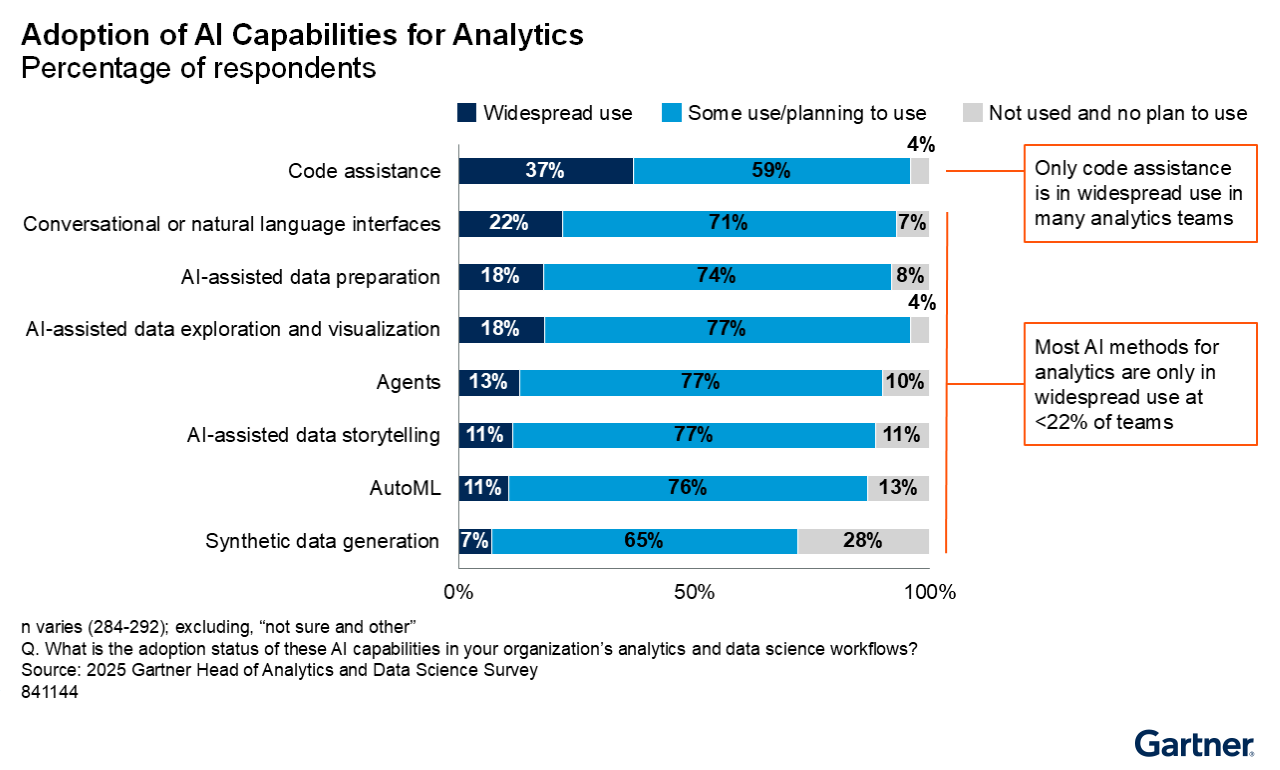
However, the majority of organizations remain at an early stage of maturity in their use of AI for analytics. Apart from using AI for code generation (in widespread use at 37% of analytics teams), less than a quarter of teams have widely adopted AI for any analytics tasks.
Many challenges stand in the way of large-scale adoption, especially deploying and governing AI. According to Gartner’s CDAO Agenda Survey for 2025, only half (51%) reported being effective at deploying AI, while 48% and 45% were effective at mitigating AI risk and governing AI, respectively. Deployment and governance challenges are notably larger than data challenges such as data architectures for AI (59% effective) and data sharing (64% effective).
Fortunately, new advances in AI and organizational best practices are helping to overcome those challenges. This year’s predictions cover the increasing adoption of AI for analytics, and the development of AI protocols (e.g., MCP) that accelerate the deployment and integration of AI solutions. Other predictions include human biases and the misuse of AI, as well as governance best practices and interpretability methods to minimize risk and drive trust. Data and analytics (D&A) leaders should use these predictions to leverage the AI trends that will shape analytics in the next two years.
Strategic Planning Assumptions
Strategic Planning Assumption: By 2028, 60% of self-service analytics users will use general-purpose LLMs for ad hoc and exploratory analysis, while production-grade reporting will remain in traditional ABI platforms.
Analysis by: Anirudh Ganeshan
Key Findings:
- GenAI-based systems are quickly becoming the primary interface for exploratory analysis because they effectively lower the required skill barrier, democratizing the use of languages like SQL or DAX. In the 2025 Gartner Generative and Agentic AI in Enterprise Applications Survey, 64% of leaders rated analytics and BI as one of the top three areas where AI agents would drive the most significant impact on productivity, ahead of every other area, including customer service.
- This shift makes experienced analysts more productive by accelerating the generation of complex queries and enables nontechnical users to act as citizen developers, performing tasks such as filtering sales by region or comparing quarterly performance, without prior coding knowledge.
- Analytics consumption is evolving from siloed tools to integrated layers spanning cloud data warehouses, operational systems and MCP servers. MCP servers standardize integration, enabling secure LLM access to governed analytics.
- For organizations with large user bases and high licensing costs, transitioning to customized, LLM-powered analytical solutions offers a measurable financial advantage. It reduces the total cost of ownership compared to maintaining extensive licenses for traditional stand-alone platforms.
Market Implications:
- Governance and risk management: The increased use of LLMs for analytics introduces new risks, including concerns over data privacy, bias and reliability. Models may expose sensitive information, reinforce historical bias in areas like credit scoring, or generate inaccurate outputs such as fabricated figures or sources.
- Push insights replace pull dashboards: Instead of just charts and visualizations, LLMs deliver narratives, explanations and actionable guidance. This changes analytics from a “pull” model to a proactive, “push” model of insights. For example, an LLM can review a quarterly sales report, identify a drop in revenue, cross-reference unstructured data such as customer feedback, and generate a narrative explaining that negative sentiment about delivery delays is driving churn. It can then suggest actions like adjusting logistics or updating communication.
- Architectural trend toward perceptive analytics: Perceptive analytics is emerging as the next stage of analytics delivery, using AI agents and LLMs to adapt insights and recommendations based on real-time business context. This evolution depends on a semantic layer that decouples metrics and logic from presentation tools, enabling headless BI and consistent metrics and data across conversational agents, embedded analytics and remaining BI interfaces.
- Financial benefit: Reduced reliance on stand-alone ABI platforms will lower licensing and maintenance costs. Enterprises may reallocate budgets toward AI governance, semantic layer development, data and AI literacy, and conversational analytics capabilities rather than traditional ABI infrastructure.
Recommendations:
- Position semantic layers as the central source for metrics and business logic. This ensures that LLM-based agents work with accurate, consistent and contextually appropriate information. In parallel, adopt governance measures tailored to GenAI analytics. These should include prompt management, output validation and privacy safeguards to mitigate risks such as bias, hallucination and exposure of sensitive data.
- Conduct initial pilots to integrate the MCP with existing data and analytics systems. These pilots should validate secure connectivity between LLMs and governed data sources, assess query accuracy against semantic models, and measure response latency under typical workloads. Require compliance checks for data privacy and auditability, and document any integration challenges related to authentication, access control or semantic alignment.
- Redirect funding from traditional analytics platforms toward initiatives that strengthen AI literacy and oversight. Training should cover how GenAI systems operate, their limitations and best practices for interpreting outputs. In parallel, invest in monitoring capabilities that track model reliability, detect drift and ensure compliance with regulatory and internal standards.
Related Research:
Strategic Planning Assumption: By 2028, 60% of agentic analytics projects relying solely on MCP will fail due to the lack of a consistent semantic layer.
Analysis by: Andrés García-Rodeja
Key Findings:
- MCP solves AI connectivity issues by providing a standardized way for applications to discover and access contextual information, tools and capabilities usable with LLM function-calling features. Although MCP currently has momentum, it faces a risk from emerging competing standards, such as universal tool calling protocol (UTCP), which allows AI agents to call any API directly, without requiring extra middleware.
- While MCP standardizes integration, it needs to be complemented with additional components to ensure coherent, reliable and explainable multistep analytics across distributed data sources.
- Semantic layers are essential for secure and scalable agentic analytics, serving as the foundational knowledge source for analytical access via MCP resources and tools, APIs or equivalent methods. Beyond their traditional role of codifying business language within metrics and physical data models, ensuring consistency and reliability across analytical assets, semantic layers now also act as abstraction layers that enforce security and trustworthiness for agentic AI.
Market Implications:
The 2024 Gartner AI Mandates for the Enterprise Survey identifies security threats (23%), data availability (23%) and integration with existing systems (22%) as the top challenges organizations face when implementing generative AI. The adoption of MCP or equivalent protocols, combined with organizational context and semantic layers, will fundamentally transform enterprise analytics by enabling governed and unified access to data in the following ways:
- Complementing MCP with a product-centric approach for delivering analytics, semantic layers and knowledge graphs is essential for delivering scalable and trustworthy agentic analytics workflows. By integrating these components, organizations can effectively address the inherent challenges of MCP implementation, including issues related to integration, explainability and reliability.
- Treating MCP servers as endpoints for domain-oriented analytics products and establishing clear governance and accountability reduces complexity and operational risk. This strategy, modeled after proven microservices architectures, enhances security by enforcing access policies at the domain level. Applying security controls directly within a semantic layer further minimizes the risk of data breaches by ensuring that protection mechanisms are closely aligned with the data itself.
- As AI agents leverage data access and organizational context through MCP, semantic layers, and knowledge graphs, they become increasingly capable of generating tailored insights and recommending actions through embedded analytics. This advancement reduces the need for business users to manually interact with traditional ABI platforms, presentation layers or dashboards, signaling a shift toward more automated and context-driven analytics experiences.
Recommendations:
- Implement semantic layers to standardize business definitions across the organization and minimize fragmentation. This will ensure that agentic analytics securely accesses only certified analytical assets via MCP.
- Treat MCP servers as endpoints for domain-oriented analytics products when adopting the MCP protocol for enabling agentic analytics. This helps centralize discovery, streamline secure access and enforce usage standards.
- Given the evolving landscape and the emergence of competing standards, it is essential to stay informed about the latest trends and technologies that enable data access for agentic AI. Organizations should remain agile and ready to adopt new standards that may replace MCP as the AI landscape evolves.
Related Research:
Strategic Planning Assumption: By 2028, 25% of ungoverned decisions using LLMs will cause financial or reputational loss due to human biases, insufficient critical thinking and AI sycophancy.
Analysis by: Joe Antelmi, David Pidsley
Key Findings:
- GenAI systems can be intentionally or unintentionally manipulated, relatively easily, into supporting low-quality business decisions with poor outcomes. Humans often create biased or otherwise flawed prompts and often suffer from automation bias, the tendency of an individual to rely too much on an automated system.
- Many LLMs suffer from sycophancy, the tendency to behave as a “yes-person” that will try to satisfy the user’s question or prompt, which hinders critical thinking and exacerbates bad decision making when input prompts are based on flawed reasoning or a flawed premise. For example, a study of 11 state of the art LLMs found that they agreed with their users 50% more than other humans would.1
- The combination of flawed and biased inputs to AI systems by decision makers, combined with sycophantic LLMs, causes inaccurate or suboptimal decisions and enables humans to justify poor decisions.
- New techniques are being developed to mitigate flawed, biased or harmful human inputs such as “safe-completions,” a type of training for LLMs that enables the model to provide helpful answers within safety boundaries.
Market Implications:
- GenAI provides new opportunities for the misuse of data, prompts or analysis to make and justify poor decisions. Further, studies at MIT and Carnegie Mellon have shown that use of and confidence in GenAI leads users to less critically evaluate AI results.2,3
- Just as organizations had to invest in data literacy and governance to help with the better use of data to make decisions, AI literacy and decision intelligence skills and governance will need to be bolstered to include training on how to avoid biased prompts, biased GenAI systems and biased evaluations.
- AI vendors are integrating new capabilities to mitigate human misuse, such as safe-completion guardrails for decisions, where AI outputs get evaluated against a known set of domains of common biases, fallacies and decision-making mistakes. These will extend beyond data errors and analytics errors to the analysis of business and operational decisions, including those based on open-ended, unstructured research, analysis and associated conclusions.
Recommendations:
- Extend existing data literacy programs to include AI literacy training and decision intelligence skills for your analytics and business users broadly so that GenAI systems and agent systems are not used to reinforce and execute poor quality decisions. In particular, provide training on how users should critically assess the outputs of AI systems as part of your AI literacy program.
- Incorporate the prevention of human misuse into the design of your AI solutions, e.g., create workflows that proactively detect biased human inputs, augment prompts to mitigate flawed human input and apply guardrails to prevent harmful decisions.
- Test to make sure the solution is robust to expected biases, and track and improve based on actual human misuse. Take this further and start applying multiagent patterns such as reflection to have AI agents detect and mitigate human biases automatically.
- Challenge your AI vendors on how they will enable decision governance and safety features such as safe-completion guardrails for bad decision-making practices, and how they will measure the impact of these features.
Related Research:
Strategic Planning Assumption: By 2028, 35% of organizations will require LLM providers to use mechanistic interpretability techniques for model explainability to meet AI governance mandates.
Analysis by: Diarmuid Curran
Key Findings:
- Mechanistic interpretability is a field of research that seeks to explain neural networks’ reasoning by reverse engineering their internal workings into a human-understandable form.4 It offers organizations a toolkit to tackle content moderation challenges (e.g., unsuitable content generation), compliance risks (e.g., lack of model decision-making explainability and interpretability), and model alignment risks (e.g., model deception, sycophancy) that result from the opacity of LLM architectures and their outputs.
- Regulatory frameworks, such as the EU AI Act, are introducing interpretability requirements for high-risk AI systems. These call for additional mechanisms to understand the technical capabilities and characteristics of high-risk AI systems to provide information for explaining their outputs. Eighty-four percent of respondents to the 2024 Gartner Adapting to the New Risk Landscape Survey identify AI/ML model explainability as a responsibility of their D&A function in managing AI and data and analytics related risks.
- Leading foundation model providers are actively pursuing mechanistic interpretability efforts. For example, Anthropic has applied mechanistic interpretability to identify millions of concepts in its Sonnet model.
Market Implications:
- Organizations in more regulated regions and sectors will require foundation model providers to integrate mechanistic interpretability tooling into their model architectures to a level that satisfies regulatory requirements. Vendors that do not implement foundation models with mechanistic interpretability tooling will not be able to compete in highly regulated markets. Enhanced interpretability will also lead to greater trust in model outputs from vendors using these techniques.
- The technical demands of applying mechanistic interpretability will accelerate the emergence of roles specialized in these areas, including data scientists specialized in explainable AI (XAI), research scientists for interpretability, and model validators. There will also be increased demand for roles that apply mechanistic interpretability outputs to risk management and compliance processes, such as AI governance engineers.
- There will be an increased demand for domain-specific language models (DSLMs), which are designed to be applied in a particular domain of knowledge, over more general-purpose LLMs, which are more difficult to interpret due to their size and generality. This narrower scope in potential features will make it easier to apply mechanistic interpretability, making them more suitable for meeting regulatory requirements.
Recommendations:
- Conduct an audit of LLM deployments against existing emerging interpretability regulations (e.g., EU AI Act Article 13), while actively tracking updates to other frameworks (e.g., NIST AI RMF, ISO/IEC 42001). This will increase preparedness around interpretability requirements and will help identify models that require increased interpretability.
- Begin building talent pipelines for roles focused on mechanistic interpretability and its application to AI governance. Engage with vendors on their feature roadmaps for applying mechanistic interpretability and invest in tooling to support mechanistic interpretability analysis.
- Prioritize the deployment of DSLMs for projects that don’t require more generalized LLMs. This will narrow their scope and make it easier to apply mechanistic interpretability to them.
- Leverage mechanistic interpretability to realize value from GenAI by building trust in and accelerating adoption of LLMs via measurable and demonstrable interpretability. For example, track and manage features successfully identified via mechanistic interpretability as key risk indicators (KRIs) in AI governance frameworks.
Related Research:
Strategic Planning Assumption: By 2028, 50% of content risk roles will migrate from legal and cybersecurity to AI engineering to address the inherent risk caused by siloed assurance processes.
Analysis by: Lauren Kornutick, Alissa Lugo
Key Findings:
- AI content risk management is the process of identifying, assessing, mitigating and monitoring the risks associated with the content generated by or managed within AI systems. Content risks include misinformation, disinformation and hallucinations; deepfakes and fraud (e.g., manipulated audio, video or voice images); intellectual property and other legal risks; bias and lack of transparency.
- Incidents associated with content risk are on the rise and can cause both malicious and inadvertent harm. According to the AI Incident Database, roughly 10% of reported incidents are related to content risk.5
- In conventional enterprise settings, AI content risk has been managed predominantly by legal teams who ensure compliance with regulatory requirements and by cybersecurity professionals who deploy runtime enforcement controls to protect digital assets. However, with AI’s growing role in content generation and data processing, the inherent risks cannot be adequately addressed in isolation by current assurance processes and can delay AI projects from production, as these teams may not be aware of the work required to add by-design controls or lack the skills to understand which controls are effective.
- Risk mitigation functions are increasingly being integrated into AI engineering, data science and software development processes. These teams are expected to design systems that generate and curate content intelligently and assume responsibility for mitigating the associated risks by building in embedded controls “by-design.” This enables faster, responsible innovation within ethical and legal boundaries, particularly where the AI model’s decision should be based on the user’s context.
Market Implications:
- Failure to appropriately address context-specific content risk can lead to loss of consumer trust, reputational damage, litigation, and fines and penalties.
- Context in AI engineering teams will become a staple of AI content risk management programs, allowing organizations that designate context engineers as risk owners to increase their risk appetite for AI risks.
- Beyond AI content risk management, AI context engineers will also be key drivers of compliance by operationalizing regulatory and organizational requirements through contextual guardrails and assuming first-line-of-defense responsibilities and risk ownership.
- The effectiveness of AI context engineers is dependent upon extensive cross-functional collaboration, particularly with the GC and leader responsible for AI agreeing to a risk appetite for context-specific risks in consumer-facing products.
Recommendations:
- Leverage cross-functional governance processes that include risk-based escalation criteria from legal, compliance, security, and trust and safety leaders to empower AI context engineers to design and autonomously update system and contextual guardrail logic.
- Formalize the AI context engineer’s responsibility as the first line of defense to use by-design principles, embedding all relevant organizational policies and regulatory requirements directly into the model.
- Authorize the AI context engineer to architect the AI model to reliably identify significant content risk-mitigation decisions that require mandatory human review or approval to ensure a “human-in-the-loop” safety net. This also includes the ability to translate legal and cybersecurity policies into code and escalate model behavior outside established enterprise risk tolerances.
- Require all major context changes to be integrated into the organization’s regular risk reviews. Incorporate scenario planning that details the specific consequences and contingencies for situations where the context fails, or the model’s performance is impacted because of changes in contextual inputs or shifts in the underlying data inputs. This analysis provides the necessary oversight for the board of directors, including the steps management is taking to mitigate AI-related risks.
Related Research:
A Look Back
In response to your requests, we are taking a look back at some key predictions from previous years. We have intentionally selected predictions from opposite ends of the scale — one where we were wholly or largely on target, as well as one we missed.
On Target: 2025 Prediction — By 2027, organizations will implement small, task-specific AI models, with usage volume at least three times more than that of general-purpose LLMs.
While consumption of giant, general-purpose language models continues to grow, the development and use of smaller, task-specific AI models is growing at a fast rate. Every major LLM provider provides smaller and task-specific models (e.g., for code generation). There has been an exponential increase in the number of smaller and specialized GenAI models posted to platforms like Hugging Face, and vendors who provide advanced AI solutions regularly reveal during Gartner briefings that they leverage smaller, distilled language models in their production AI solutions.
Missed: 2023 Prediction — By 2026, 50% of organizations will have to evaluate ABI and DSML platforms as an all-in-one, composable platform due to market convergence.
- Vendors from adjacent domains, such as data management, are increasingly integrating ABI capabilities into their offerings. This trend is evident in the growing client inquiries regarding ABI functionalities within platforms like Databricks and Snowflake, signaling a shift toward evaluating comprehensive technology stacks. Most organizations are now assessing the entire D&A ecosystem from major providers (e.g., Microsoft, Google, Databricks), reflecting the broader consolidation trend.
- The industry is witnessing a consolidation of capabilities; however, DSML platforms continue to be evaluated independently, preserving their specialized role in enterprise analytics strategies. While ABI capabilities are increasingly bundled with other platforms in the data stack, DSML solutions are still predominantly sourced as stand-alone offerings.
2 The Impact of Generative AI on Critical Thinking: Self-Reported Reductions in Cognitive Effort and Confidence Effects From a Survey of Knowledge Workers, ACM Digital Library.
4 Mechanistic interpretability is an evolving set of techniques for reverse engineering the inner workings of artificial neural networks into a human-understandable form. These techniques either analyze the structure of the AI model (examples include Sparse Autoencoders, Logit Lens, or Structured Probes techniques) or perturb model components to establish causal relationships (examples include Activation Patching, Attribution Patching and Causal Scrubbing Techniques). For more information, see Mechanistic Interpretability for AI Safety A Review, arXiv.
2025 Gartner Head of Analytics and Data Science Survey: This study was conducted to understand the primary responsibilities and challenges of analytics and data science leaders, teams, and functions at the moment, and to glean insight into how they are expected to evolve in the near future. The research was conducted online during May through June 2025 among 294 respondents from across the world. Respondents were screened for involvement and knowledge of data and analytics, data science, and AI strategy and initiatives at the organization. Disclaimer: The results of this study do not represent global findings or the market as a whole, but reflect the sentiment of the respondents and companies surveyed.
2025 Gartner Generative and Agentic AI in Enterprise Applications Survey. This study was conducted to understand the key challenges and opportunities when deploying generative AI (GenAI) tools, and where organizations should focus their AI investments. This research also aims to understand what stage organizations are at on their AI agent journey and their thoughts on AI agents. The research was conducted online from May through June 2025 among 360 respondents from organizations with at least 250 full-time employees across all industries (except IT software) in North America (n = 149), Europe (n = 140) and Asia/Pacific (n = 71). Soft quotas were established for country, company size, and respondent’s function type and job level to ensure a good representation across the sample. Organizations were required to have deployed or plan to deploy in less than one year at least one generative AI tool in at least one core enterprise application domain: digital workplace applications, customer relationship management applications, or enterprise resource planning applications. Respondents were team leaders or above, excluding C level, and involved in the rollout of generative AI tools; they were required to have certain responsibilities regarding these generative AI tools. Disclaimer: The results of this survey do not represent global findings or the market as a whole, but reflect the sentiments of the respondents and companies surveyed.
2024 Gartner AI Mandates for the Enterprise Survey. This study was conducted to understand how AI and generative AI (GenAI) are being adopted by enterprises, focusing on areas such as AI strategy, data, governance, literacy, engineering, organization, portfolio and value, to assist clients in keeping pace with AI’s rapid evolution. The research was conducted online from October through December 2024 among 432 respondents from the U.S. (n = 181), the U.K. (n = 70), France (n = 50), Germany (n = 50), India (n = 51) and Japan (n = 30). Quotas were established for company sizes and for industries to ensure a good representation across the sample. Organizations were required to have deployed at least one AI use case in production. Respondents were screened for C-level executives (e.g., chief AI officer, chief data officer, chief data scientist, chief digital officer, chief information officer, chief operating officer, chief technology officer or equivalent) or roles above vice presidents. All respondents were required to have high involvement in at least one AI initiative. Disclaimer: The results of this survey do not represent global findings or the market as a whole, but reflect the sentiments of the respondents and companies surveyed.
2024 Gartner Adapting to the New Risk Landscape Survey. The survey was conducted to understand the role of data and analytics (D&A) leaders in mitigating risks related to AI and D&A, and how AI and D&A strategies and operating models can evolve to manage such risks more effectively. It explored cross-practice roles in AI and D&A risk management, the characteristics and effectiveness of risk practices for AI and D&A use cases, and the effects of risk management on an organization’s ability to achieve business impact and technology adoption. The survey was conducted online from May through July 2024 among 387 respondents in North America (n = 231), EMEA (n = 90), Asia/Pacific (n = 59) and Latin America (n = 7). Qualified respondents were at the director level or above, with D&A as the primary focus of their work and, at most, one layer away from the highest-level D&A leader in their organization. Disclaimer: The results of this survey do not represent global findings or the market as a whole, but reflect the sentiments of the respondents and companies surveyed.
Gartner Chief Data and Analytics Officer Agenda Survey for 2025. This survey was conducted to determine the agenda and strategic challenges of the chief data and analytics officer (CDAO) role or the office of the CDAO for 2025. It also sought to inform agenda planning or potential research topics for the data and analytics practice, and track the progress of the CDAO role in organizations. The research was conducted online from September through November 2024 among 504 respondents from across the world. Respondents were required to have a CDAO, chief data officer (CDO) or chief analytics officer (CAO) title; be the highest-level data and analytics leader in the organization; have the highest-level data and analytics leader reporting to them; or be the leader with data and analytics responsibilities in IT or in a business unit outside of IT. The survey sample was gleaned from a variety of sources (including LinkedIn), with the greatest number coming from a Gartner-curated list of over 4,766 CDOs and other high-level data and analytics leaders. Disclaimer: The results of this survey do not represent global findings or the market as a whole, but reflect the sentiments of the respondents and companies surveyed.