Top Insights on AI for CMOs
13 November 2025 - ID G00843682 - 17 min read
By Nicole Greene, Noam Dorros
Marketing is on the leading edge of GenAI adoption in many organizations, but long-term success is limited by the focus on short-term results. To meet CEO expectations for growth and profitability, CMOs need to shift from using AI for internal, operational efficiencies to focusing on how AI can deliver unique brand value through enhanced customer experiences that drive growth.
Strategic Planning Assumptions
By 2026, more than one-third of web content will be developed exclusively for AI and search engine consumption.
By 2026, 60% of CMOs will adopt content authenticity technology, enhanced monitoring and brand-endorsed user-generated content (UGC) to protect their brands from deception unleashed by GenAI.
By 2027, mobile app usage will decrease by 25% as audiences shift to using AI assistants.
By 2027, 85% of customer data will be collected from automated interactions or those led by AI agents.
By 2028, brands’ organic search traffic will decrease by 50% or more as consumers embrace generative-AI-powered search.
Analysis
AI is offering an unprecedented opportunity to redefine marketing’s value; it is also shaking the very foundations of the function. For CMOs, the imperative is to strategically deploy AI today to meet business needs and scale employees’ efforts while laying the groundwork for future innovation. This requires balancing immediate execution with a long-range vision, establishing robust governance and ensuring ethical guardrails to safeguard customer trust and enhance brand engagement.
Thirty-eight percent of executive leaders are accelerating investments in AI, as of May 2025.1 However, they tell us upskilling/reskilling teams for AI-related roles and investing in new AI platforms/applications remain the top two challenges to AI adoption for the rest of 2025.1 Despite the scale of opportunity and potential disruption, and the desire to accelerate, there is no easy path to growth.
Data, technology, talent and trust must align to transform marketing into a sustainable, AI-fueled growth engine. To prove the potential value of AI in the near term, prioritize use cases and set relevant performance objectives that support existing KPIs. Also, focus on your people through AI literacy and upskilling efforts.
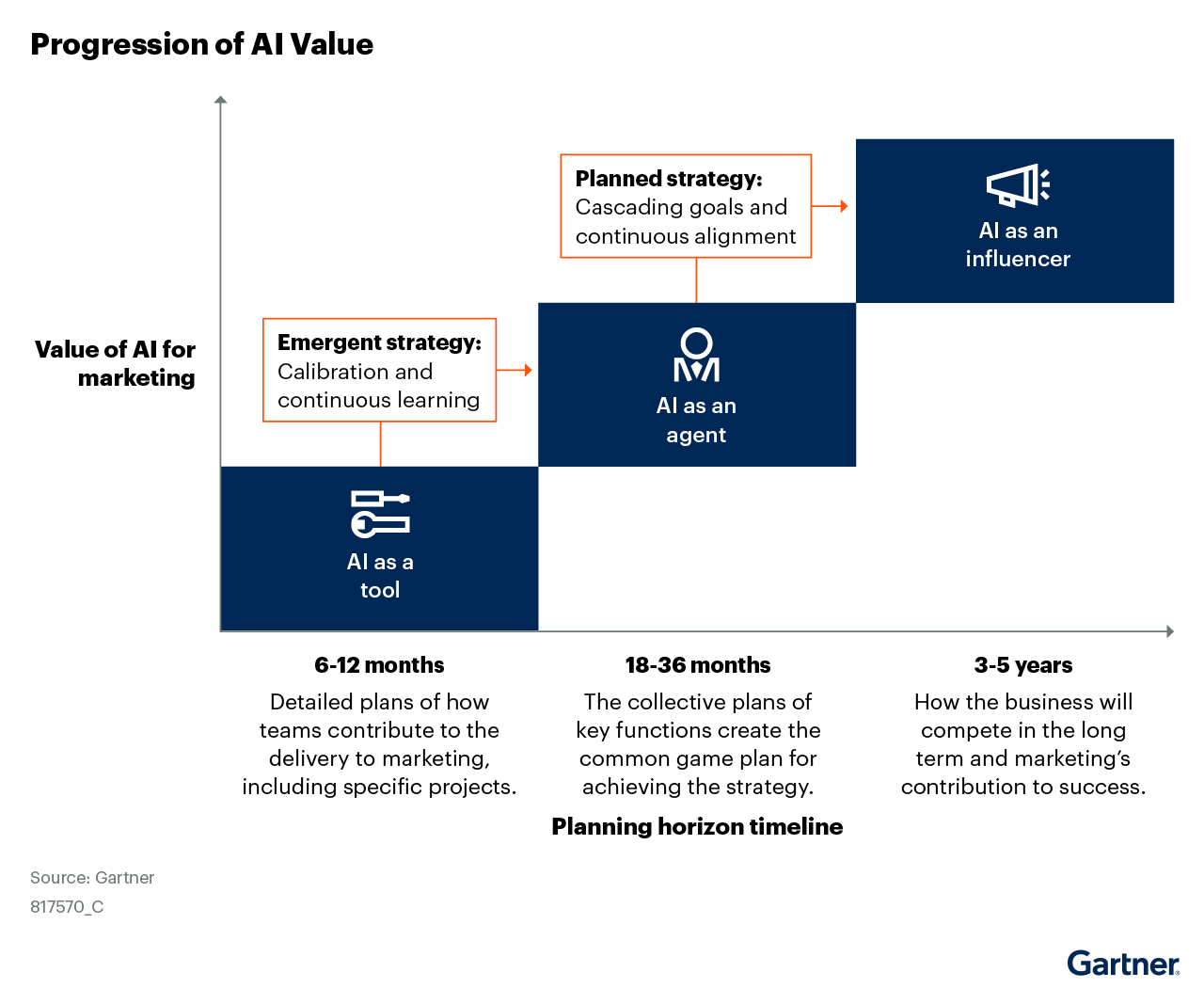
While the democratization of capabilities from GenAI brings opportunities to marketing teams that have been asked to do more with less for years, the newfound productivity must be actively managed to ensure that short-term efforts quickly move from efficiency to effectiveness. These early successes not only prove AI’s value but also facilitate the cultural shift needed for your teams to embrace the technology as AI’s impact on marketing strategy moves from tactical tool to agent or influencer within your organization (see Figure 1).
Despite the perceived threats to marketing viability, the majority (68%) of business leaders believe that the benefits of GenAI outweigh the risks.2 In contrast to this optimism, consumers — who comprise your customer base and your employees — are skeptical about GenAI.3 Now is the time to explore the use cases that will have the most impact on your business that are also feasible based on technology readiness, talent capabilities and customer receptivity.
AI tools and techniques will empower marketing teams to deliver hyperpersonalized, data-driven and agile customer engagements. Such tools encompass intelligent automation, agentic AI and generative AI technologies (see the Hype Cycle for Digital Marketing, 2025). Developing quality brand content to meet customers at pivotal moments will become increasingly important to delivering on marketing objectives and will outpace the capacity of employees who are not using AI.
CMOs must focus on gleaning quality insights to ensure AI isn’t just about the creation of more volume, but also about creating more value.
The AI-fueled transformation is an organizational imperative for competitive advantage. It’s about building an agile business model that keeps pace with both evolving customer and organizational demands. The urgency of this shift is clear in how answer engine optimization (AEO) is impacting SEO. In an era when the future of marketing is constantly questioned, CMOs’ AI strategy isn’t just a plan; it’s the story of how marketing will leverage AI to achieve competitive differentiation and sustainable growth. Use this research as your roadmap, along with the focus and discipline to run your own AI race.
Research Highlights
Some recommended content may not be available as part of your current Gartner subscription.
How Can We Balance Quick AI Wins With Long-Term Strategy?
Gartner’s Position
CMOs need a long-term strategy that recalibrates expectations and leans into data and AI to drive ROI. While operational efficiency is a low-risk, internal approach to AI adoption, it must be interwoven with a strategy that focuses on the unique value a brand can provide through enhanced customer experience.
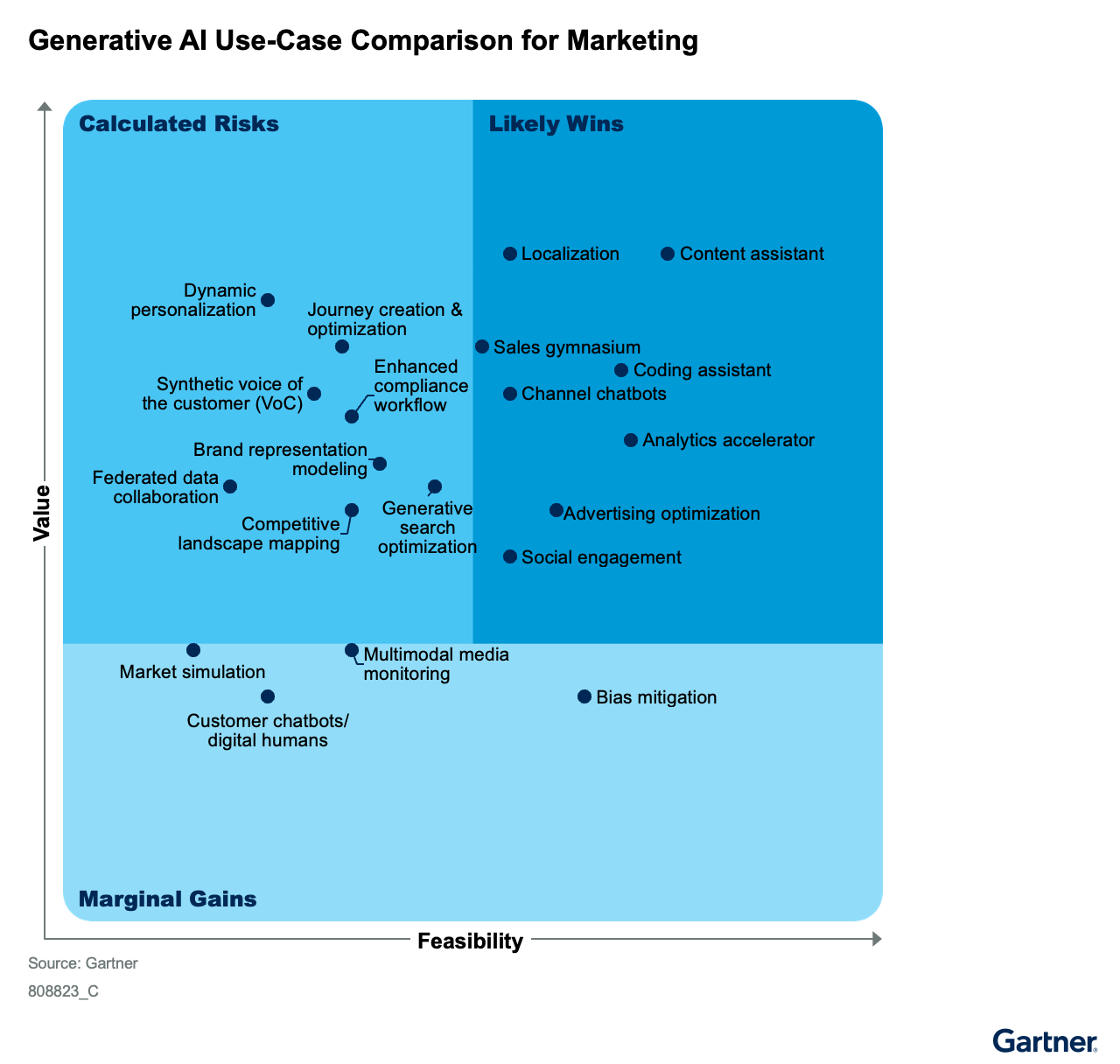
CEOs are hungry for growth and profitability, with 56% naming growth as a top strategic priority.4 This gives marketing a unique position to use AI to help achieve that growth, because it’s proven the impact of AI across personalization, advertising, sales enablement, commerce and more (see Figure 2). CMOs can capitalize on immediate cost and time savings but also create new customer engagement paradigms and drive revenue growth. Balancing strategic planning horizons is essential to avoid letting short-term execution obstacles impede the realization of a transformative, AI-enabled future.

How Do We Change Our Marketing Channel Strategy for AI to Reach Our Customers?
Gartner’s Position
The channel strategies that work today will fail to deliver tomorrow. Channels are collapsing and customer engagement patterns are changing, accelerated by AI in everyday technology. AI-driven disruptions across platforms and processes mean most marketing campaigns in the next three years will fall short of campaign targets — that is, unless marketing does the work today to build strong foundations across data hygiene, operating models and tech stack harmonization.
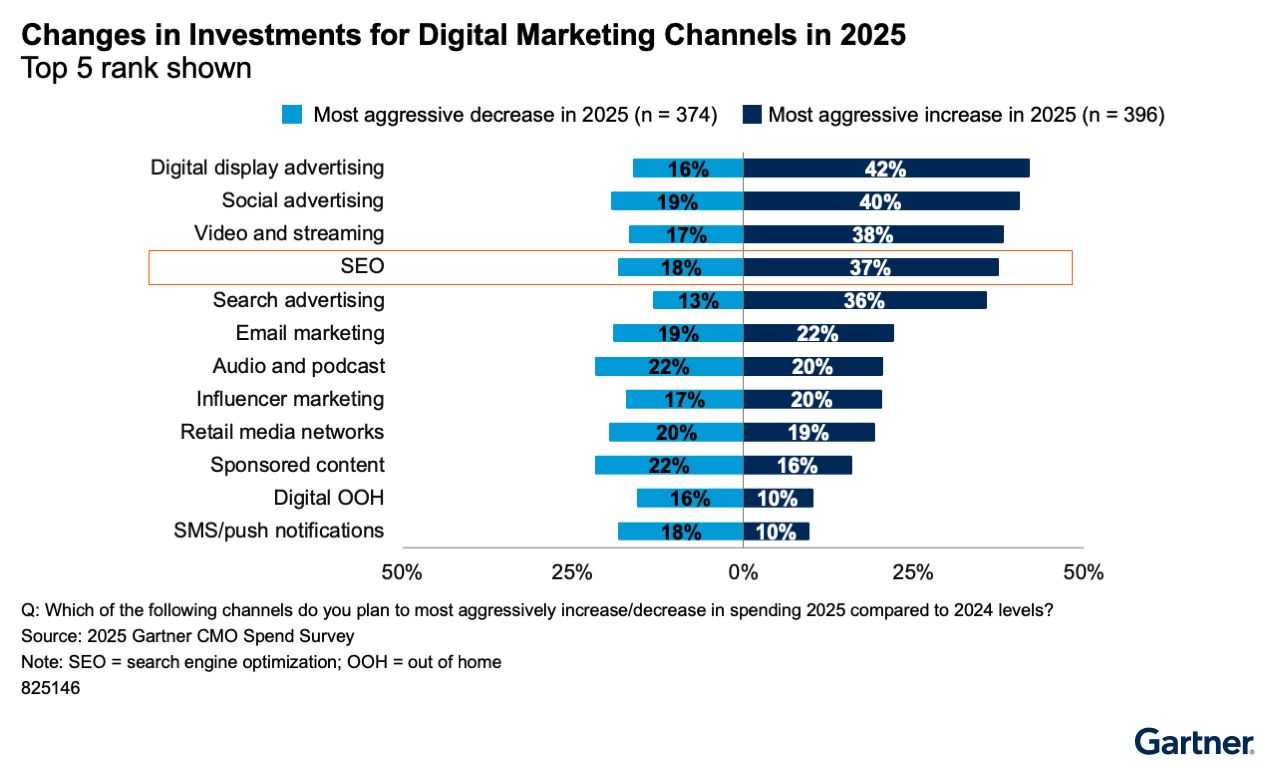
The dramatic shift toward AI-enabled marketing compels CMOs to reexamine channel strategy and budget allocations, with the balance between search and AEO quickly becoming a priority (see Figure 3). Marketers will need to maintain search and develop a unique AEO strategy focused on developing content for AI results that aligns with consumer consumption habits: content that is concise (featured snippet, FAQs), straightforward, distinguished and well-structured.
Other than direct traffic, search currently drives more visitors to the average commercial enterprise website than any other referral source.5 Given this, a loss of search-driven traffic due to algorithmic shifts by major search engines can result in tangible negative commercial impact to any organization. A deeper understanding of search best practices and GenAI-powered search trends can also ensure that content is more likely to rank in traditional search results.

How Do We Use AI to Build Brand Trust and Engage Our Customers?
Gartner’s Position
Threats to brand trust, including the prevalence and potency of disinformation, are growing. CMOs must embed trust at the forefront of AI adoption to enhance organizational trustworthiness, credibility and transparency while mitigating risks from misinformation and harmful associations.
Marketers rely on customers’ trust to build engagement and form relationships. But the use of GenAI may raise skepticism about the authenticity of marketing content. Over 70% of consumers we surveyed believe AI-based content generators could spread false or misleading information, which gives us insight into how customers will react to brands using GenAI.6 Indeed, GenAI may produce inaccurate content if its outputs are not carefully validated. Deepfakes, hallucinations and counterfeits are all real risks. Over three-quarters of consumers (78%) said that it’s either very important or of utmost importance that brands explicitly label content they publish with the aid of AI.6 TrustOps is more than a marketing function. CMOs and their C-suite peers, particularly in communications and legal, must coordinate to manage malinformation and use technology to help combat it.

How Can We Optimize Our Marketing Technology Stack and Operating Models for AI?
Gartner’s Position
Despite increasing experience managing the function, CMOs are struggling to curb wasted martech spend, regardless of company size or industry. CMOs are caught in a cycle of accumulating a growing collection of redundant technologies to meet strategic goals, ad hoc requests and shifting customer priorities. Investment in AI will only intensify this challenge.
Crucially, a CMO’s direct, personal involvement can help ensure AI technology initiatives pay off on the balance sheet and in the boardroom.7 Emerging AI technologies are already reshaping marketing workflows — from content creation to campaign design and customer journey orchestration. CMOs need to defend marketing’s value and strategic technology investments to gain stakeholder support for new and expanded investment in training, martech management, data governance and analytics, and to inform generative AI decision making.

How Should We Prepare for Agentic AI’s Impact on Our Team and Customers?
Gartner’s Position
Marketing needs to evolve and focus on using AI agents to better meet customers where they are, with information that helps them make decisions based on how brands can uniquely help them. To this end, marketing must elevate its risk profile and develop responsible use guidelines and governance to protect the business and customers while harnessing the potential of agentic AI.
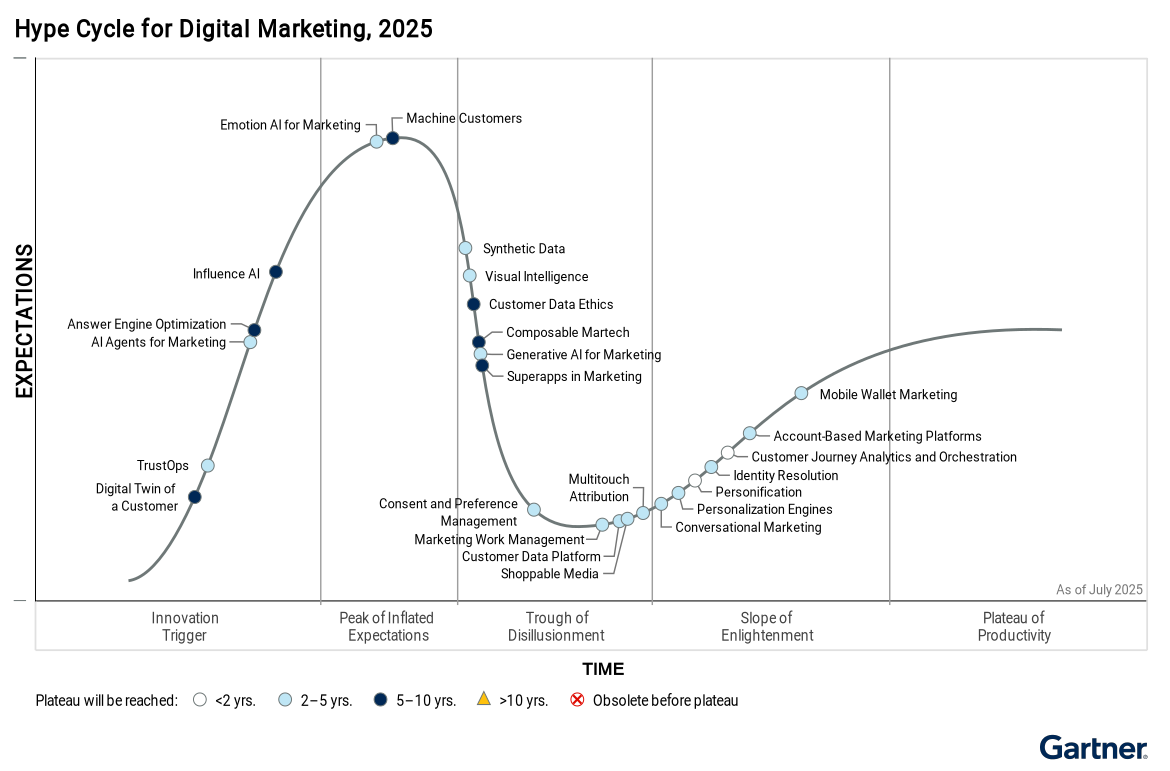
AI agents are revolutionizing marketing by automating tasks, making informed decisions and interacting intelligently with their digital environments, allowing teams to do more with less. As AI technologies improve, tracked by Gartner’s Hype Cycle for Digital Marketing, AI will lead decisions more autonomously, requiring less human oversight and asserting more influence. Marketers will need the discipline to optimize for both human and machine customers (see Figure 4). CEOs tell us they believe on average, 15% to 20% of their company’s revenue will come from machine customers, which is a new type of AI-agent customer, by 2030.4 In fact, it is estimated that by 2025, there will be 15 billion connected products with the potential to behave as customers — to shop for services and supplies for themselves and their owners.8 CMOs will need to rethink the brand-customer relationship. Trust with machines will be based on data-based differences, like value, risk and information. Trust with humans will still involve emotion. Marketers will need the discipline to optimize for both.

1 2025 Gartner Quarterly C-Level Economic Pressures and Forward Planning Survey — Wave 1. This survey aimed to help our C-level clients plan for 2H25 and beyond, with questions about how executive leadership teams currently assess policy change impacts in different business areas (especially risks, supply chain, talent, financial, and technology and vendors) and how they plan to take action for the remainder of the year (2025). The survey was conducted online from 1 May through 14 May 2025 among 253 respondents from North America (n = 146), Europe (n = 94) and Mexico (n = 13). Respondents were C-level executives/heads of functions and their direct reports, including CIO (n = 37), CFO (n = 41), CSCO (n = 40), CHRO (n = 35), COO (n = 35) and CEO (n = 24), among others, at organizations that have operations in or sell to the U.S. across various company sizes ($50 million or more) and industries (banking/investment services, insurance, healthcare providers, manufacturing, information technology, CSP, retail, and energy and utilities). Disclaimer: The results of this survey do not represent global findings or the market as a whole, but reflect the sentiments of the respondents and companies surveyed.
2 Beyond the Hype: Enterprise Impact of ChatGPT and Generative AI Webinar Polls, 21 April 2023; Q: “Do you believe the benefits of generative AI outweigh the risks?,” n = 1,079
3 2025 Gartner Consumer Omnibus Survey. The purpose of this survey was to understand consumer behaviors and sentiment across a wide range of topics and industries that included shopping behaviors, brand communications, loyalty, pharmacy and banking. The research was conducted online from 11 through 31 March 2025 among 2,000 respondents in the United States. Respondents were required to be at least 18 years old. Quotas were set for geographic areas, age, gender, ethnicity and employment status to approximate the U.S. adult population as a whole.
4 Q1 2025 Update Gartner CEO and Senior Business Executive Survey was fielded from 20 March throug 7 April 2025. In total, 105 actively employed CEOs and other senior executive business leaders qualified and participated. All respondents were screened for active employment in organizations greater than $50M in annual revenue. The sample mix by role was CEOs (n = 80); CFOs (n = 10); COOs or other C-level executives (n = 8); and chairs, presidents, board directors (n = 7). The sample mix by location was North America (n = 43), Europe (n = 33), Asia/Pacific (n = 22), Latin America (n = 4) and the Middle East (n = 3). The sample mix by size was $50 million to less than $250 million (n = 7), $250 million to less than $1 billion (n = 31), $1 billion to less than $10 billion (n = 43) and $10 billion or more (n = 24).
Disclaimer: Results of this survey do not represent global findings or the market as a whole, but reflect the sentiments of the respondents and companies surveyed.
5 Gartner analysis of Similarweb data (n = 1,460 brands, 1 June 2025 through 30 June 2025). Similarweb is a third-party data source that captures website traffic and engagement, email referral traffic, and LinkedIn traffic. Similarweb gathers data from a panel of hundreds of millions of monitored desktop and mobile devices, local internet service providers, and public data sources, as well as directly from sites’ first-party analytics.
6 2025 Gartner Consumer Community (n = 336, from 27 October through 3 November, 2025). While the Gartner Consumer Community (n ≈ 500) resembles the U.S. general population, the data cited is based on the responses of community members who chose to take each activity. These samples may not be representative of the general population, and the data should only be used for directional insights.
7 2024 Gartner Marketing Analytics and Technology Survey. This survey was conducted to explore how senior marketing leaders approach proving the value of their function, how they perceive and collaborate with their marketing data and analytics teams, and how they are approaching generative AI and marketing technology utilization. The survey was administered online from April through May 2024 and includes data from 378 senior marketing leaders. These results represent marketers from North America (n = 187) and Europe (n = 191). Respondents were required to have decision-making authority over marketing budgets and strategy at an organization with at least $100 million in annual revenue. Forty percent of respondents came from organizations with at least $3 billion in annual revenue. Respondents came from a wide variety of industries, including manufacturing and natural resources (n = 62); banking and financial services (n = 61); retail (n = 60); healthcare (n = 41); consumer products (n = 39); pharmaceuticals, biotechnology, and life sciences (n = 34); insurance (n=32); technology products (n = 18); travel and hospitality (n = 12); IT and business services (n = 10); and media (n = 9). Disclaimer: The results of this survey do not represent global findings or the market as a whole, but reflect the sentiments of the respondents and companies surveyed.